Lee Martin's Blog, page 15
January 30, 2023
Visual Images and the Writing of Narrative
 Visual images can often suggest narratives. Such is the case with the one that opens this post, a photograph of a pair of hot pink stilettos lying the tall grass. How did they get there? Who was wearing them, or were they wearing them? Where were they going? What happened when they got there? Did something surprising emerge in them because of the pressures of the plot? How can the story work with the visual image while also giving us something we wouldn’t expect? These are some of the questions that come to me while I think of a possible narrative inspired by the visual. What questions come to you? What stories do these shoes suggest?
I once wrote a story titled “Drunk Girl in Stilettos.” It was one of the few times I had the title before I wrote the story. The title was a gift from my wife, Cathy. She doesn’t mind me telling you that we were in Nacogdoches, Texas, at the time. We’d been listening to jazz on the patio of the Fredonia Hotel while enjoying some B & B (brandy and Benedictine). She happened to be wearing high heels that night. When we got up from our table, her heel caught in a crack, and she wobbled. “I guess I’m just a drunk girl in stilettos,” she said. We looked at each other. “Sounds like a story title,” I said. “All right then,” she said. “You write it.” So, I did. I put two men in a Mustang GT coming up the blacktop from the country, headed toward the small town of Sumner, Illinois. I invented a young girl wearing stilettos as she walked along the blacktop. The story that followed was nothing like the one the title would suggest. In fact, when Stephen Corey published that story in The Georgia Review, he said the thing that drew him to it was how the story gave him something he didn’t expect, given the title and the initial setup. Sometimes we have to write against expectations. Sometimes we have to see the opposite of what most people would notice on first glance.
I’ve long used an exercise that asks people to recall pairs of shoes they wore when they were young and then to let one of those pairs take them to a memory of an event that still haunts them. I ask them to do a freewrite that begins with the words, “I was wearing them the day. . . .” The objective is to let the shoes carry them to a moment in which they felt contradictory emotions. The joyful moment is sometimes tinted with grief and vice versa. The evil person is capable of goodness, and, again, vice versa. Opposites co-exist.
So, here’s a variation of the visual image exercise for fiction writers that I suggested in the opening. This one is for those of us who write memoir. Look at an old family photograph—a candid shot rather than a portrait—and notice the objects in the background. Maybe you’ll see a crescent wrench lying on a window sill, or a water dipper hanging from a nail, or a pair of penny loafers tossed into a corner. The idea is to take stock of an object that’s been removed from its owner so you can see it the way a stranger might. Think about what that object would say about you and/or your family. Maybe it even tells you something you’ve never considered about someone in your family or about a certain time period or situation. Maybe it tells you something you’ve never known about yourself. Find the object in the background and use it to show you more layers of the truth than you’ve previously considered.
The poet, Paul Valéry, said, “Seeing is forgetting the name of the thing one sees.” Exactly. Visual images, for both the fiction and the nonfiction writer, can be instructive, but only if we first forget what we’re expected to see.
The post Visual Images and the Writing of Narrative appeared first on Lee Martin.


January 23, 2023
Snow Was General: Broadening the Perspective
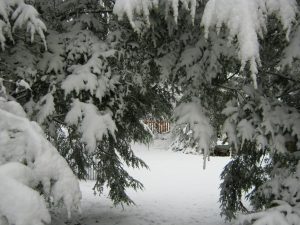 It’s a snowy day here in central Ohio. Big, wet flakes drift down from the sky. The snow piles up on rooftops and driveways and sidewalks. It clings to the branches of evergreen trees. It’s as if a blanket has been thrown over the world. All is eerily quiet.
This type of snow always reminds me of the end of James Joyce’s “The Dead.” Snow was general all over Ireland. This somber, and yet simple, observation signals the move in the last paragraph of the story from Gabriel’s consciousness to a more omniscient perspective. By this point, Gabriel’s wife, Gretta, has told the story of her young love, Michael Furey, and how long ago, despite the illness he was suffering, he stood in the rain and declared his love for her, told her, in fact, that he did not want to live. Then she told him to go home, which he did, and a short time later, he died. That story, and Gretta’s accompanying sadness, has shaken Gabriel to the point that he feels the press of mortality: One by one, they were all becoming shades. He feels his own identity, of which he had been so sure throughout the story, fading into obscurity. This is the point where Joyce lets the point of view move from Gabriel’s consciousness into the larger world:
Yes, the newspapers were right; snow was general all over Ireland. It was falling on every part of the dark central plain, on the treeless hills, falling softly on the Bog of Allen and, farther westward, softly falling into the dark mutinous Shannon waves. It was falling, too, upon every part of the lonely churchyard on the hill where Michael Furey lay buried. It lay thickly drifted on the crooked crosses and headstones, on the spears of the little gate, on the barren thorns. His soul swooned as he heard the snow falling through the universe and faintly falling, like the descent of their last end, upon all the living and the dead.
Sometimes the end of a story can take on added resonance when we place the main character’s interior life within the context of the world around them. Once we know how the character’s personal world has shifted, we can widen the camera’s lens to give a broader perspective that can underscore the thematic concerns of the narrative.
This certainly isn’t a requirement for each story, but it is a technique you can try to see what resonance it might add. So, if you’d like to try it, take the end of one of your stories (or a novel, if you wish) and see what happens if you find a way to turn the focus on the main character’s interior world toward a consideration of a particular place. In the case of “The Dead,” it’s Ireland and all its particulars, starting with the dark central plains and arriving, finally, at the churchyard where Michael Furey is buried. See if this technique can lead you to a deepening of your story’s thematic concerns and maybe even express them in a way that otherwise wouldn’t be possible.
The post Snow Was General: Broadening the Perspective appeared first on Lee Martin.
January 16, 2023
The Adult World Arrives: A Writing Prompt
 The summer I was seventeen I worked on a Christmas tree farm. It was my job to shape the trees that, come December, would end up in people’s homes. “Just like an upside-down ice cream cone,” my boss told me. I used a machete or hand shears to trim the trees into a proper shape.
Like most seventeen-year-old boys, my concerns were self-centered. I thought about the girl I was dating or the one who’d broken my heart. I thought about my car, a 1973 Plymouth Duster, and the money it took to keep it running (hence, the job on the Christmas tree farm). I played in a slow-pitch softball league, spent my time listening to the music of Jim Croce, Cat Stevens, Black Oak Arkansas, and a number of other artists popular at the time. I lay on my bed and used a pair of pliers to zip my jeans because they had to be as tight as possible. I wanted to look good. I wanted to be cool. I wanted to move through the world with a little flash and flare. I was the center of that world until something came along to remind me I didn’t know what I didn’t know.
One morning, I was sitting on our front porch, waiting for my ride to work. We lived at the end of a street in the itty-bitty town of Sumner, Illinois, population a little over one thousand. Catty-cornered across the street from us lived a man and his alcoholic wife. They were often the object of gossip and even ridicule. I’m ashamed to admit now that in my high school days, my friends and I used to sit on my porch, making fun of their antics and their displays of temper. Once, the wife chased the husband with a yard rake. Another time she ran down the sidewalk, naked, and the husband followed her, saying, “You don’t want to be out here like this.” Finally, he took the tires off her car, so she couldn’t drive to the liquor store while he was at work. She tried to drive that car on the rims, sparks flying down the street.
On this particular morning, the husband came out of his house and walked over to where I was sitting. It was early enough for the air to be cool, but I could tell it was going to be a hot day. The sun would burn the dew from the grass, and as it got higher in the sky the locusts would start to chirr and the grasshoppers would stick to my pants legs as I made my way through the dry grass of the fields.
I was often a shy boy. I particularly didn’t like it when adults tried to talk to me. I hadn’t yet mastered the art of conversing with them. I remember how this man put one foot up on a porch step and how he leaned toward me and how his voice shook when he finally spoke.
“My wife died last night,” he said, and suddenly my world of girls and cars and softball and music and tight jeans bumped up against the larger world, a world of loss and regret, and I didn’t know what to say.
I relied on the cliché from television shows and movies. “I’m sorry,” I said in a small voice.
The man was crying now, the sort of silent crying, tears running along his cheeks. He took a red bandana from the hip pocket of his overalls and blew his nose. He wadded it up and stuck it back in his pocket. Then he looked at me with narrowed eyes, his jaw set, and finally he said in a fierce voice, “I loved that woman.”
Now I think of the struggle it must have been for him to have maintained that love through the years of his wife’s drinking. Again, I had no idea how to respond because what did I know of love?
Just then, my ride pulled up, and I said, “I have to go to work.”
“Yes, yes,” the man said. “You go on.”
Which I did, but all through that day and on into the future, those few moments in the early morning stayed with me, and as I moved up and down the rows of Christmas trees, cutting away what didn’t belong, making everything neat and orderly, I couldn’t stop thinking of what it took to love someone even when you had sufficient reason not to, and what it meant to remember there were other people in the world, and sometimes they would come to me with their need and I would have to learn to show them compassion because the time would come when I’d need the same from them. We were all connected. That’s what I learned the morning my neighbor came to tell me, the only person he had to tell, ill-equipped as I was, that his wife was dead, a wife he had always loved.
I tell this story primarily for those of us who write memoir, but I imagine it might have lessons for the fiction writers and the poets as well. Sometimes we have to shake our characters out of their regular come-and-go, and one way to do that is to let someone else’s world rattle theirs. Maybe you recall a time, for instance, when the adult world intruded on your child’s world and showed you how much you still had to learn. Write that moment. Think about what it meant to the person you became. Let it change you.
The post The Adult World Arrives: A Writing Prompt appeared first on Lee Martin.
January 9, 2023
Let’s Get Curious: A Writing Prompt
 Ray Bradbury once said, “That’s the great secret of creativity. You treat ideas like cats: You make them follow you.” Far be it for me to take issue with Mr. Bradbury, but I find myself wondering whether the real secret of creativity is to train ourselves to follow our ideas. Take curiosity, for instance, which the old saying tells us has killed more than one cat, but that’s neither here or there. Curiosity has always been my impetus for following my ideas. I get curious about something, and I have to keep writing to satisfy that curiosity, while making sure not to completely satisfy it too soon.
The spark of an idea must bring with it questions to which we have no answers as we begin to write. In fiction, we follow those questions by dramatizing scenes and thinking about the causal chain they create. Our main character, amid some sort of instability, takes an action. That action creates a consequence that requires further action, and on and on, until the narrative reaches a tipping point beyond which nothing will ever be the same for our main character. I always follow the questions when I write. The key is having a premise that creates those questions.
Here’s an example. Your main character has an article of clothing that they never wear, but they can’t bring themselves to get rid of it. What is it? A dress? A hat? A sweatshirt? A scarf? A pair of gloves? Where do they keep it? Hanging in a closet? Stuffed in a drawer? Under a bed? In the attic in an old trunk? Where did it come from? Did they buy it? Did someone give it to them as a gift? Did they find it somewhere? Did they inherit it? Why don’t they wear it anymore? Does it no longer fit? Is it out of style? Is there an overwhelming memory associated with it? What would it take to make them wear it again? What might happen if they did?
The story might very well open with the day they decide to put that article of clothing on and go out in public. Or maybe they go to someone’s house. Maybe it’s someone associated with the item, or maybe not. At this point, we’re merely following the actions of the main character. We’re also beginning to face this important question. What’s at stake for the main character and how will the wearing of this article of clothing affect those stakes?
At some point, we may want to deal with another question. How will the wearing of the article of clothing create a result that’s opposite to the one the main character expects? This type of irony—one in which the character gets something they never could have imagined—often provides a resonant end to a story.
A sequence of narrative events can come from a small detail that invites us to consider certain questions. All we have to do is follow them to their significant and consequential end.
The post Let’s Get Curious: A Writing Prompt appeared first on Lee Martin.
January 2, 2023
Encouragement for the New Year
 As we turn the page to a new year, I find myself thinking back to March 2, 2011, the date of my first post on this blog. At the time, my new novel, Break the Skin, was three months from its publication date, I was about to teach a graduate seminar in forms of creative nonfiction, and I must have been reading Dani Shapiro’s memoir, Devotion, because I was going to share a quote from it with my students: “It wasn’t so much that I was in search of answers. In fact, I was wary of the whole idea of answers. I wanted to climb all the way inside the questions and see what was there.” So it is today, nearly a dozen years later. My novel, The Glassmaker’s Wife, just came out, I’m about to teach a graduate workshop in creative nonfiction, I just finished reading Dani Shapiro’s gorgeous new novel, Signal Fires, and I’m still writing this blog where I try to climb all the way inside questions of craft to see what might be helpful to you.
To be honest, I never wanted to do this blog. In fact, my web designer had to talk me into it. That’s the truth, but it’s also true that as I started to make these entries, I found myself enjoying the opportunity to think more deeply about craft issues that intrigued me. I also found myself celebrating the community of writers I’ve found with those of you who’ve read my entries and who sometimes take the opportunity to share your own stories, your own thoughts, and your own concerns with me.
I’ve always said writing is a life-long apprenticeship because each project we take on requires something different from us. I’m always questioning and learning. An important part of that process is the connection I feel with other writers. We learn from one another. It also helps to know we’re not alone. Even though the world at large may not understand or even value what we do, we can take heart from the fact that there are plenty of other writers grappling with the same challenges and doubts that we are.
Encouragement from the writing community often comes from what other writers have said. Here, then, are a few of my favorite quotes, offered here with the intention of encouraging us as we move into a new year.
“It is never too late to be what you might have been.” – George Eliot
“Let me live, love, and say it well in good sentences.” – Sylvia Plath
“Amateurs sit and wait for inspiration, the rest of us just get up and go to work.” – Stephen King
“Get it down. Take chances. It may be bad, but it’s the only way you can do anything really good.” – William Faulkner
“You don’t start out writing good stuff. You start out writing crap and thinking it’s good stuff, and then gradually you get better at it. That’s why I say one of the most valuable traits is persistence.” – Octavia E. Butler
“Focus more on your desire than on your doubt, and the dream will take care of itself.”– Mark Twain
“If I waited for perfection, I would never write a word.”– Margaret Atwood
“I hope that in this year to come, you make mistakes. Because if you are making mistakes, then you are making new things, trying new things, learning, living, pushing yourself, changing yourself, changing your world. You’re doing things you’ve never done before, and more importantly, you’re doing something.’ – Neil Gaiman
As we start the new year, we should all remind ourselves that every writer has faced the same challenges, disappointments, and doubts that we do. Work is what saves us. Work quiets the naysayers. Work sweeps us up in what we love, moving words about on the page. Isak Dinesen said, “I write a little every day, without hope and without despair.” Exactly. Staying true to the journey will always takes us exactly where we’re meant to go.
The post Encouragement for the New Year appeared first on Lee Martin.
December 26, 2022
The Grandfather I Never Knew
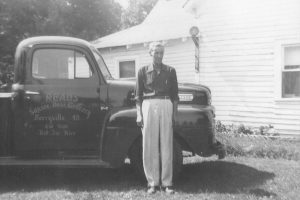 When I was a small boy, I spent Christmas Day with my mother’s side of the family at my grandmother’s house. She lived on the corner where two gravel roads intersected across from the Berryville Store. At one point, she and my grandfather had managed that store, but by the time I came along in October of 1955, they’d moved on to other ventures. My grandfather would die in March of 1957, and the only way I would ever know him would be through the stories my relatives told and the things he left behind, items I would find in the drawer of a library table at my grandmother’s house: pipes and pipe cleaners, cigarette lighters, a deck of Bicycle playing cards. Such was the evidence that he’d once been what we might call “a man of the world.” I’ve heard stories of his dissolute ways, but those are for another time. The closest I ever felt to this man I never knew was when I held his books.
The front bedroom of my grandmother’s house had built-in bookshelves. Keep in mind, this was a modest frame house in what some would have called the boondocks, a rural patch of southeastern Illinois where dirt farms dotted the landscape. My grandmother’s house had no indoor plumbing. She washed her dishes with water heated on the gas stove. An outhouse sat at the rear of her lot. She kept a chamber pot in her bedroom. My point is this wasn’t the sort of house where you’d expect to find a small library, but that’s exactly what my grandfather left behind.
In the winter, my grandmother closed off the front part of her house to save on heating costs. She had what she needed at the back of the house, a good-sized kitchen and a second bedroom. She told me I wasn’t allowed to go into the front part of the house, but each day, when she and I were supposed to be napping, I’d wait until I knew she was asleep, and then I’d open the forbidden door and go to that front bedroom. I’d take a book from the shelf and sit on the cold Linoleum floor. I didn’t yet know how to read, but that didn’t stop me from taking pleasure in the way the book’s binding smelled, or the feel of the slightly raised typeface, or the sound of the pages as I turned them. Years later, my mother would tell me stories about when she was a girl. Each evening after supper, she and her siblings would gather around my grandfather, and he would read Zane Grey westerns to them. I love this image of my grandfather, a man who was broken in many ways but somehow managed to hold faith in the written word and the power of a good story well-told. How I wish I’d had the chance to hear him read from Grey’s Riders of the Purple Sage: “Every day I awake believing—still believing. The day grows, and with it doubts, fears, and that black bat hate that bites hotter and hotter into my heart. Then comes night—”
And indeed the night did come, a Sunday night in March when I was only five months old. My grandparents had come home from church, the white clapboard church just down the road, and somewhere in that house where I would spend many Christmas days, my grandfather’s heart stopped beating, and my grandmother was left to her widowhood.
I often wonder what my grandfather might think if somewhere in the realm of spirits he knows I became a writer. I wish I could tell him he was the start of it all. He left his books for me to find. I held them in my small hands. The words waited for me to decipher them. No matter how broken he may have been—no matter how much his life may have disappointed him—he managed this one thing: He loved books, and in loving them, he left a trail so I could love them, too.
The post The Grandfather I Never Knew appeared first on Lee Martin.
December 19, 2022
The Hidden Object: A Prompt for Fiction Writers
 This week before Christmas, I’m thinking about how, as a child, I couldn’t resist searching for presents my mother had hidden from me. I wish I could say I was a better kid who could resist that temptation, but, alas. . . . Of course, one of two things happened whenever I found a gift meant for me. I either felt deflated when I opened it on Christmas day because the surprise was gone, or I was disappointed because what I found wasn’t what I had asked for at all. The moral of this story? Be careful when you go looking for hidden treasure because you just might find it.
Or maybe you won’t, which leads me to this brief prompt for fiction writers. You can use this to begin a narrative.
Your main character has hidden something in a drawer or a closet or a basement, etc. From time to time, they check to see if it’s still there. But one day, they look and find it gone. Where did it go? What will they do to try to retrieve it? How will their attempt change them forever?
Stories often open with a hint of mystery. Who took whatever it is the main character hid? Why did that character hide this item? Do they suspect a particular person? How do they feel now that the item is missing? Why is it so important to get it back? What’s the first step they take to try to find it? How does that first step complicate the search? What surprise waits at the end of it? These are some of the questions that might guide your plot.
When we write fiction, we might think about the inciting incident, the one that sets the plot in motion. Let the character create the action. Find ways to complicate that action. Come to a climactic moment in which the character has to make a choice. That choice will change them. Think of ways to complicate the final action. Maybe the character makes a choice that surprises them. Maybe the consequences are the opposite of what the character intends. Land in that place that surprises both on the plot and the character level.
Characters are always hiding something. Sometimes they repress something about their true essences. Sometimes they refuse to acknowledge some truth about themselves, others, or dramatic situations. Something is always working its way to the surface because of the pressure the plot provides. If the character can create that plot through their own choices, all the better.
I hope everyone has a very happy holiday season. May whatever someone is hiding from you come to light with delight and joy.
The post The Hidden Object: A Prompt for Fiction Writers appeared first on Lee Martin.
December 12, 2022
The Shadows They Leave Behind: Research and Narrative
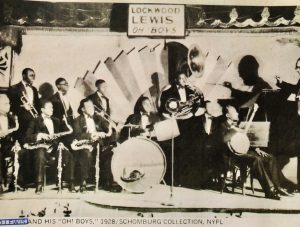 Some of you may recall that my wife Cathy recently discovered the identity of her biological father. This discovery has sent her in search of information about her ancestors. Yesterday, she learned that a son of her great-great grandfather was Lockwood Lewis, a saxophonist who played with the Dixieland Jug Blowers in the 1920s and eventually led the Missourians before they became Cab Calloway’s band in 1930. Lockwood then returned to Louisville, Kentucky, where he led a fourteen-piece dance band which played engagements at many hotels and night clubs in the area. He also toured with the Ringling Brothers, Barnum and Baily Circus band in 1943.
Cathy was even able to find an online photograph of Lockwood and his “Oh! Boys” band from 1928. If Lockwood is the conductor (and wouldn’t that make sense seeing that it was his band), he’s only partially visible just inside the right edge of the photo. What fascinates me is his shadow that’s fully visible. That image stands as a metaphor for what it feels like as we try to create or reconstruct people in our writing. We have just the shadow of a character, and we do what we can to fill it in. Notice how all the members of the band have their eyes trained on the conductor. Even in this obviously posed photo, they’re ready to follow his lead.
Those of us who write memoir know what it’s like to find just enough about our ancestors to make us curious. I dare say this is also the way fiction writers operate. One detail about a character arouses our curiosity and we must find out more. Whether we’re writing memoir or fiction, we’re usually chasing after the particulars of our characters that bring them to life.
If we’re lucky, we find photographs of our ancestors, or we find photographs that inspire our thinking about our fictional characters. The visual can lead to the interior lives. If we’re even luckier, we find letters from our ancestors, or, again, letters that make our fictional characters vivid to us. Of course, if we’re writing memoir, we can rely on all sorts of public records about our ancestors: birth and death records, marriage records, real estate transfers, circuit court records, census records, etc. As one very kind lady at our local family history center told us yesterday, “Everyone leaves behind some sort of paper trail.”
Lockwood Lewis left behind sound recordings, a photograph, and a death announcement in the Louisville Courier-Journal that said he died of a heart attack at 4:30 pm at his home at 552 S. 10th Street. His body was at Cooper Funeral Home, 558 S. 10th Street. The proximity of his home to the funeral home is enough to start me imagining how convenient that must have been, and yet how painful for his widow, Frances, to have that funeral home so close to her as the years went on. As I start to free-associate from that fact, I imagine how often Lockwood must have been gone from home on another tour with this band or that one, and I wonder whether Frances ever accompanied him or whether she was ever on his arm as he entered the fine hotels of Louisville—the Seelbach, perhaps, a well-known haunt of F. Scott Fitzgerald. On some ancient night, did Fitzgerald, deep in his cups, slip Lockwood a bill or two and ask him to play “Ain’t We Got Fun,” and did Scott and Zelda dance the foxtrot, and did Frances watch them and think, Oh, my, how grand?”
My imagination is spinning with possible scenarios, all of them made possible by a photograph and a death announcement and a shadow that invites me to fill it. If you’re writing memoir or fiction, the trails people leave behind can provide the inspiration for narrative.
The post The Shadows They Leave Behind: Research and Narrative appeared first on Lee Martin.
December 5, 2022
What-Iffing in Historical Fiction
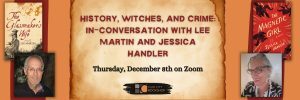 In 1845 near where I grew up in southeastern Illinois, a woman named Betsey Reed stood trial, accused of murdering her husband by poisoning him with arsenic. This is the factual basis for my new novel, The Glassmaker’s Wife, whose publication date is this Tuesday. On Thursday December 8 at 6pm, Eastern time, I’ll be in conversation about the book with Jessica Handler in a virtual Zoom event sponsored by Hub City Books. I hope some of you might join us at this link:
https://www.hubcity.org/events/363/the-glassmakers-wife-with-lee-martin
The chief witnesses against Mrs. Reed were the hired girl, Eveline Deal, who said she saw Mrs. Reed put a pinch of white powder in her husband’s coffee, and the local apothecary who said a scorched paper found in the Reeds’ dooryard was the same sort of paper he used to wrap arsenic for his customers. He said he had no memory of Mrs. Reed purchasing any arsenic, but he had no doubt she did, perhaps wearing some sort of disguise to hide her identity.
When I write novels based on true events, I do a lot of what-iffing. In other words, I start with the facts, and then I say, “What if?” When writing The Glassmaker’s Wife, I asked myself what if there were another explanation for Mr. Reed’s death. Trying to answer that question led me to the relationship between Mrs. Reed and Eveline, a fifteen-year-old girl who adores Mrs. Reed while at the same time feeling dismissed when her employer, in a fit of anger, calls her an ugly girl. In my novel, Mrs. Reed’s fate hinges on her own choices plus the ones Eveline makes.
As I what-iffed, I decided to give Mrs. Reed and Eveline a shared attraction to the letters to the lovelorn published in Godey’s Lady’s Book, a popular women’s magazine at the time. “It must be something to feel as deeply as that,” Eveline says to Mrs. Reed after reading a letter titled, “A Very Bad Case.” Eveline goes on to say, “Do you think these letters are from real people? Do you, Miss Betsey? Do you think people really have lives like that? You know what I mean, lives of longing?” My what-iffing process brought me to the center of my novel—this longing that drives people to do things they never could have imagined.
People who know the facts of the true story of Betsey Reed will, I’m sure, take issue with the way I’ve altered and re-imagined it. I had to do that in order to humanize the people who for so long have been reduced to the archetypes necessary for maintaining the legend that’s been passed down through the generations. The evil wife, the vengeful hired girl. As we know, people are always more complicated than the facts from the news reports suggest. I wanted to write The Glassmaker’s Wife so I could humanize the characters involved. I wanted to create their desires, their fears, their shortcomings so they could be more than the facts allow. That’s why I change and re-imagine and create, so the characters become more fully formed and come alive on the page.
I took particular pleasure from imagining Eveline’s life beyond the story of Betsey Reed:
The rest of her life, Eveline never forgot the summer the Mister died and all that followed. She lived a very long time, long enough to know two wars, to listen to a phonograph, to talk on the telephone, to ride in a motor car, to have the right to vote, to see a moving picture, to see people dance the Charleston, to read a new magazine called Time, to see Harry Houdini escape his water torture cell, to hear of Charles Lindberg ad his solo flight across the Atlantic. She had children and grandchildren, and even a great-grandbaby, but all it took was the smell of coffee, or the taste of salt, or a roaring fire, or the way sunlight fell upon a glass vase, or the sight of a woman with her eyes lined with black to take her back to the girl she’d been, the who’d been unwilling to tell the truth because Miss Betsey had said something to wound her. Ugly girl, she’d said, and ugly girl she was.
Of course, I don’t claim that any of this was true for the real Eveline Deal, which isn’t really my main concern. I started with the facts, and then I let my imagination open Eveline’s character to me. It seemed to me she deserved the grace of a long life, and I gave that to her. Novels based on true stories invite us into the imagined interior lives of real people. The facts are the facts, yes, but we can use them to imagine what else might be true.
The post What-Iffing in Historical Fiction appeared first on Lee Martin.
November 28, 2022
Joining a Community of Writers
 It’s been a glorious Thanksgiving weekend. On Thursday, Cathy and I provided a meal for, and enjoyed the company of, six people associated with our MFA program. Friday, we decorated for Christmas. Yesterday, we finished preparing our patio for winter. Today, we’re meeting friends for dinner. Lovely connections with people all around.
Such connections are often difficult for beginning writers, particularly if they’re natural introverts like me. I had to learn to make myself more outgoing. I guess, even though I was naturally quiet and shy, I so desperately wanted to find readers for my writing I was willing to take a risk. I applied for, and got into, an MFA program where I was still quiet and shy. After my MFA, I was fortunate enough to attend the Indiana University Writers’ Conference and to be a work-study waiter at Bread Loaf. Little by little, my writer’s world began to expand.
To make a long story short, I began to meet people, some of whom were willing to help me along my writer’s journey. Of course, there were, and continue to be, many, many rejections along the way, but I kept putting my work and myself out there. I published a first story. My first book won the Mary McCarthy Prize, and the final judge, Amy Bloom, recommended me to my first agent, who stuck with me and sold my books, and I was fortunate for one of them, The Bright Forever, to be a finalist for the Pulitzer Prize. None of this would have been possible had I given up, as I threatened to do many times when no one was interested in publishing me. I give thanks for those, like Amy Bloom, who took the time to put in a good word for me, and I try my best to do the same for others when I can. Surely, it’s rare that writers have careers without others to help them along.
I’m thinking about this today because my new novel, The Glassmaker’s Wife, has its publication day on December 6, and I’ve set up a small tour that’s a mix of in-person and virtual events. The Glassmaker’s Wife is my fourteenth book, and I realize how fortunate I am. The work has to be good, yes, but a little luck and a boost from someone else never hurts. I could have written for years and years without publishing a thing, but I decided early on to take a chance and apply for that MFA program. I didn’t get in the first time I applied, but I’m nothing if not stubborn. I applied again the next year, and this time the answer was yes. My entire career has been a series of no’s with occasional yeses. Such is the nature of the business. I know one thing for sure, though. No one gets to yes without being willing to risk a number of no’s. No matter how much it might be against our natures, the advantages of being an active member of the writing community far outweigh any discomfort they may bring us. I encourage you to go to readings, attend conferences, make connections, submit your work, and open yourselves to all that can happen when you’re an active participant in this gathering of writers. Maybe I’ll even see some of you at an event for The Glassmaker’s Wife.
The post Joining a Community of Writers appeared first on Lee Martin.