Lee Martin's Blog, page 17
September 5, 2022
The Small Things Contain the Memoir
 Yesterday, I was upstairs in my office when I heard my wife crying. I immediately knew why. Cathy, you see, has begun to put the story of her family onto the page. It’s a complicated story, as some of you know—a story of secrets, a story of a mother and her daughters, a story of an unknown father, a story of racial identity. Cathy’s been telling this story to friends as it’s been unfolding, and now, with some gentle encouragement from others who have told their own stories, she’s beginning to write. That’s what she was doing yesterday in her downstairs office when something from memory overwhelmed her, and she began to weep.
I found her in her office chair, her hands over her eyes, her shoulders heaving with sobs. I did what I could. I held her.
“It was the cards,” she said. The cards and the letters that came to her mother in the last days of her life. It was the memory of how each day, Cathy brought in the mail and sat with her mother and read the “thinking of you messages” people had sent. Then Cathy left that day’s mail on her mother’s hospital bed, and her mother looked through them while Cathy made supper. “I’ve never been able to get rid of those cards and letters,” Cathy told me. “They were the last things my mother and I shared.”
“I’ve been where you are now,” I told Cathy. “I don’t know a memoirist who hasn’t ended up in tears sometime during the writing.”
She was surprised by how quickly the tears had come. She’d been transcribing handwritten pages. “I’d already written about those cards and letters,” she said, “but then something about seeing it in type. . . .”
I’ll leave it to others to speculate on what happens when we put our memories into words, but I’ll venture to say it’s something to do with inserting ourselves more firmly into the experiences we’re dramatizing. To daydream our memories, or to orally narrate them, allows us a bit of safe distance. We watch, or we relate, the narratives of our lives. To dramatize our significant moments in writing, though, invites us to once again be a participant in those times. We relive them, only this time we do so with the knowledge of what’s to come. We stand with one foot in what was then our present and with the other foot firmly planted in our futures. When Cathy wrote about those cards and letters, she once again lived in those last days with her mother, but this time she knew these were indeed the last times, and they were possibly more precious to her because she knew the end. That’s why the small details are so important when we write memoir. They simultaneously contain and express our emotions.
What small details do you associate with significant moments from your lives? A battered tin cigarette case? A pepper shaker? A linen handkerchief? A trading stamp? Start small and let the detail take you into scenes. Let it evoke your emotional response. Let it bring up questions you might have, questions you might find yourself trying to answer, or questions that lead to other questions. Think out loud on the page. Use the reflective voice to speak from the older, wiser, person you are now, the one who investigates, interrogates, and interprets. Everyone’s life is complicated. Everyone’s story is worth telling. If you can recall in vivid detail, you can write a memoir. Let the small things lead you to the bigger things, the ones that are so hard to say.
The post The Small Things Contain the Memoir appeared first on Lee Martin.


August 29, 2022
Revising: What to Keep and What to Let Go
 Cathy and I spent some time clearing our garden of plants that served us well this summer but have stopped producing. The space they were taking up can be of better use for cool weather crops. Yes, we’re making that turn to autumn, and that means some things must go, so other things can be planted. The tired old pole bean vines came up from their roots as did the purple hull peas. I sowed turnips, radishes, and lettuce in the freshly worked soil.
Our writing can often become tired as well. Maybe we have elements in our work that just aren’t producing. The best thing might be to tear those elements out to make room for new things that will better bear fruit.
Here, then, are some questions to ask after you have a draft of something:
Can you identify a passage—maybe it’s a scene, or an image, or even a single line—that expresses the heart of what you’re writing? What stands out for you? What’s hot about that passage? Look for the passage that the piece absolutely can’t do without.
Does every part of the piece contribute to this heart? Keep what’s necessary and do away with what’s not.
What needs to be expanded? Sometimes we have sections that out intuition tells us we need but we haven’t written enough, or looked deeply enough, to understand why. Look for places where you can challenge yourself to write at least three more sentences. The objective is to go more deeply into what’s at hand, so you can see its connections to what’s driving your piece. You might even write a sentence that says, “This passage is necessary because it. . . .” As you fill in the blank, you’ll be able to know what you need to do with that passage to make it more fully contribute.
What have you yet to say? Articulate what seems to be missing from the piece. This should give you cues for material waiting to be written.
What are you afraid to say? Often, we either consciously or unconsciously avoid what frightens us or makes us feel uncomfortable. Have the courage to go where the piece needs to go even if it’s toward a dark place.
I hope these five questions will help you with revision or even get you writing again if you feel stuck with a piece in progress. Sometimes we must do away with passages that aren’t working so we can make room for new passages or deeper dives into something already on the page. The key is to make sure you’re seeing all the contradictory layers of human experience that lie at the heart of all good writing.
The post Revising: What to Keep and What to Let Go appeared first on Lee Martin.
August 22, 2022
Writing What Matters
 Here we are on the cusp of another school year, my 41st in the classroom. I’ve eclipsed the 38 years my mother taught, and each fall I think of her and how she taught and raised a child and helped my father and maintained a home. I can’t recall ever hearing her complain. She stayed up late, marking papers after my father and I had gone to sleep. She had breakfast ready for us the next morning. She cooked supper once she was home from school in the evening. She did our laundry on Saturdays and cleaned our house. I tend to grumble from time to time about how much teaching takes from me, then I think of my mother and how she did all these things—the parenting and the housekeeping enough for a full-time job—and also taught, and I try to remember what a privilege it is to be able to do what I always wanted to do, and to do it for so long. I’ve taught undergraduate students and MFA students and Ph.D. students. I’ve taught in low-residency MFA programs and at various writers’ conferences. I’ve also taught community groups through libraries and writing centers. I’ve been blessed to be privy to so many people’s personal stories as well as those that have come from their imaginations. I’ve taught them what I can. We’ve talked about characterization, structure, point of view, detail, and language. With enough consideration and practice, everyone can learn the techniques common to the craft of storytelling. The question is to what end? What story do you have to tell that comes from your heart?
It’s easy to learn how to construct a narrative. Whether we’re talking about fiction or nonfiction, we already know much more about storytelling that we might think. We’ve all spent our lives telling stories. We know how to tell stories about things that happen that are out of the ordinary. We know how to begin with a once-upon-a-time, how to introduce complications, how to build interest until a climactic moment, and how to offer a resolution. But do we know how to apply these storytelling techniques to stories of emotional complexity? Do we know how to tap into the complicated layers of the human heart?
Maybe this is the one thing I can’t teach—the courage it takes to go to the uncomfortable places—but I’ve spent years and years believing I might just be able to offer people doorways into the stories that only they can tell, the ones that resonate with the splendor of being a particular person at a particular time in the midst of specific circumstances that speak from the heart. For years, I’ve used an exercise that asks people to recall pairs of shoes they wore when they were young. I invite them to begin a freewrite with the words, “I was wearing them the day. . . .” and then to tell a story of something from their pasts that still resonates for them. The shoes are just the trigger to get them to a story that they’ve never been able to forget. I ask them to think about the emotional complexity of the story. “How many conflicting emotions did you feel?” I ask. “These are your touchstone moments,” I say. “The moments that still haunt you, that keep you up at night, that can never be resolved, that beg you to write from the emotional fire they bring.”
After 41 years of teaching, here’s what I know. It’s easy to skate by with a reliance on technique, but that technique will only take us so far. To write the stories that people will always remember, we must write from the heart. We must tap into our experiences to find the luminous moments when we felt, and felt deeply, opposing emotions. Life is short. Let’s spend our time writing about what matters to us. This isn’t to say we fiction writers need to literally dramatize moments from our own experiences, but we do need to utilize the emotional complexity we’ve learned from those experiences. “Of all that is written,” Friedrich Nietzsche said, “I love only what a person hath written with his blood. Write with blood, and thou wilt find that blood is spirit.” Exactly. The blood of the heart.
The post Writing What Matters appeared first on Lee Martin.
August 15, 2022
Road as Metaphor: A New Writing Exercise
 I just got home from the Vermont College of Fine Arts Postgraduate Writers’ Conference, and, like the past fourteen years I’ve taught there, it was a magical week. I really can’t recommend this conference enough. It’s made up of workshops, craft talks, readings, and loads of access to faculty members. One of my pleasures is the craft talks that Sue William Silverman and I do together. This year, we had a conversation that included the audience. Our focus was on literal roads in our latest books—Sue’s was Route 17 in New Jersey; mine was the Sumner-Lancaster blacktop, also called the hard road, in southeastern Illinois—and how those roads served as metaphors in our respective memoirs.
Metaphors are built from particulars that start to represent something that’s important in the writer’s consideration of the material. We use metaphor to help us think on the page and to artistically shape fact and experience. My hard road, for instance, represented the central theme of the book. The literal road stood for escape from a hard life. Sue’s Route 17, with its constant stimulation, represented her desire to avoid death. If she could just keep moving—if she could feel alive—maybe she’d never die. You get the point. One thing represents another. Metaphor helps us investigate our material. It also brings beauty to the arrangement of facts through its subtle associations.
So here’s a prompt that can be used by all writers regardless of genre:
Step 1: Identify significant roads. They could be literal routes upon which cars and trucks travel, or they could be waterways, railways, subways, airways—any path of travel meant to take someone from one point to another.
Step 2: Think about the particulars of those “roads.” Engage the senses. Recall or invent the specific details of the roadways.
Step 3: Associate memories with the roads or invent specific episodes that may be relevant to your essay, your poem, your short story, your novel, your play, your screenplay, etc.
Step 4: After you’ve made the roads vivid, ask yourself what you may be exploring. Maybe you say, “I (or he/she/they) loved the road (defined however you like) because. . . .” Completing that sentence may make you aware of why that road is important and what it represents.
I hope these four steps help you with building metaphors. Now, just open the throttle and keep writing, making yourself more aware, word by word, of what the road is helping you think about, what it represents, and where it wants to take you.
The post Road as Metaphor: A New Writing Exercise appeared first on Lee Martin.
August 7, 2022
Gatsby and the End of Summer
 Tomorrow, I leave bright and early for Vermont which explains why I’m posting this today. For the past thirteen years, I’ve taught at the Vermont College of Fine Arts Postgraduate Writers’ Conference. I often teach a workshop in the novel, and when I do, I ask my participants to read The Great Gatsby. That novel gives us a chance to talk about matters of characterization, structure, point of view, detail, and language. It also gives me a chance to revisit one of my favorite novels. Our narrator, Nick Carraway, spends a summer and early autumn in the company of careless people, and though the book focuses on Gatsby’s attempt to reclaim Daisy Buchanan, the love of his life, it also has a good deal to say about wealth, corruption, the Midwest, and the East. At the end of the book, the East is haunted for Nick, and he makes the decision to go back to the Midwest: “So when the blue smoke of brittle leaves was in the air, and the wind blew the wet laundry stiff on the line I decided to come back home.”
My trip to Vermont always signals the end of summer. The cool mornings and the shortening days remind me that we’re making the turn toward autumn. I think of Gatsby at the end of the book telling his servant not to drain the pool. “You know, old sport,” Gatsby says to Nick, “I’ve never used that pool all summer?” I think of Gatsby floating on his air mattress, and a gust of wind, and the yellowing leaves, and the ripples in the water, and all he doesn’t know about what’s coming: “So we beat on, boats against the current, borne back ceaselessly into the past.”
Autumn has always been a melancholic time for me: “A new world, material without being real, where poor ghosts, breathing dreams like air, drifted fortuitously about.” At the end of summer, when I was a small boy, my mother often took me with her when she went to the grade school where she taught to prepare her classroom. I remember the smells of floor wax, paste, pencil shavings, construction paper. I remember the marking pencils my mother used to correct her students’ lessons, writing not with a glaring red but with a rose blush, for her method was always one of kindness and encouragement rather than punishment. In the end, her gentle nature may have been what kept her from having her contract renewed, but that’s no matter. I hope her spirit knows that I always remember her tender nature, and I wonder how many of her former students might do the same. She modeled a life for me—one filled with books and education—and I followed her path.
My life has been that of a teacher. I’ll spend this week practicing that craft, and then, in two weeks, I’ll start another semester of teaching at Ohio State University. Like this, summer turns into autumn, and our lives cycle through the seasons. I miss those who have gone on before me, particularly my mother. Each autumn, when I step into a classroom, I think of her and everything she gave her students over her thirty-eight years of teaching: “Gatsby believed in the green light [at the end of Daisy’s dock], the orgiastic future that year by year recedes before us. It eluded us then, but that’s no matter—tomorrow we will run faster, stretch out our arms farther. . . .And one fine morning—”
So here’s to that time between seasons where we simultaneously mourn the past and look forward to the future—that bittersweet time of eternal hope.
The post Gatsby and the End of Summer appeared first on Lee Martin.
August 1, 2022
A Message Box: Objects and Memoirs
 Because my father was a farmer, we barely knew what it was to take a vacation. There were crops to tend and livestock to feed, and God forbid our cattle got out of their pasture, as they sometimes did, and we weren’t there to corral them. All through my childhood, I only remember us going on an overnight trip once. We drove up to Springfield, Illinois, to the state fair where my aunt and uncle were camping. We saw a country/western show and slept on the fairgrounds in my uncle’s camper.
The next morning, my father surprised us by suggesting we drive over to Hannibal, Missouri. He knew I was a big Mark Twain fan, and he thought I might enjoy the sights. I remember going through Mark Twain Cave and buying a souvenir in the gift shop. For some reason, I chose a cedar message box to hang on our front door. The box had its own front door that opened beneath a roof peak. “Sorry we missed you,” it said. “Please leave a message.” I have no idea why I chose it, but maybe it had something to do with the pleasant smell of the cedar, or maybe I was fascinated with the replica of a front door that I could open, or maybe I wanted it to be a reminder that at least for these few days we were the sort of family who went on a vacation and left a way for those who came to call while we were gone to leave us a message.
Looking back now, I consider the box an odd purchase for a kid who’d just gone through Mark Twain Cave, but maybe it wasn’t so unusual since I was a boy who watched so many families on television sitcoms, families who routinely went on vacations—to the beach, the mountains, amusement parks, even abroad—and I always sensed my family wasn’t one of those families. Maybe buying that message box and hanging it on the front door of our farmhouse was my way of insisting we were. Maybe it was my way of trying to enter the circle of suburban families who didn’t have the hoof prints of runaway cattle in their yards, or a house with broken plaster and raccoons in the attic, or a pump at the sink, or fuel oil stoves and their fumes, or chamber pots beside their beds so they wouldn’t have to make the trip to the outhouse in the middle of the night. Maybe I wanted to be what television programs told me was normal.
I’m writing about that message box because I don’t really know how to take a vacation. I do it from time to time, and I always enjoy myself, but it’s always hard for me to forget my work and the obligations I have. With Cathy’s help, I’m trying to be better at getting away from things. I meant to make this a short post to say I wasn’t going to do a blog for the next couple of weeks, and here I am writing about that message box and what it meant to me. I’m supposed to hang up my “Gone Fishin’” sign and then disappear until the fifteenth, but like I said, it’s hard for me to stop working.
For those of you who write memoir or personal essays, consider how much mileage you can get from an object that’s lodged itself in your memory. A simple cedar box, for example. Why do you remember it so clearly? What questions does it raise? What other memories does it evoke? What does it have to tell you? Think about your objects. Do a little writing, interrogating, speculating, and thinking on the page, and I’ll see you on the fifteenth. . .if not before.
The post A Message Box: Objects and Memoirs appeared first on Lee Martin.
July 25, 2022
Family Secrets
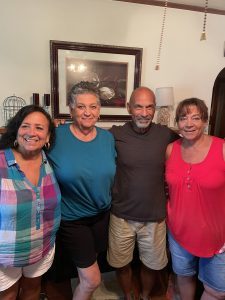 It’s 1961, and my wife Cathy, nearly four years old at the time, is sitting with her great-aunt Tom on a stone bench alongside a brick building on Fulton Avenue in Evansville, Indiana. They’re sitting in the shade watching a rabbit hop about and nibble at grass blades. Her grandfather and grandmother have told her that she can’t go inside the building with them and her mother. Years later, she’ll remember the building, Aunt Tom, the stone bench, and the rabbit. She’ll remember her grandparents coming out of the building without her mother. “We left Mother there,” she’ll tell me. She’ll remember that and a feeling she won’t be able to put words to until much later. Somehow, by a child’s instinct, she knows, as she watches the rabbit, as she sits with Aunt Tom, this is a place where women come to give up their babies.
All her life, Cathy has wondered about the baby she feels certain her mother gave up for adoption via the Vanderburgh County Christian Home just as she’s wondered about her birth father. Once, when Cathy was fifty years old, she told her mother she thought it was high time she knew her father’s identity. Her mother gave her a name that turned out to be a lie, a lie her mother told to protect the secret she thought she’d buried for good. She’d had an affair with a married man, an interracial relationship, no less. I can only imagine how taboo that must have been in our small-town in southeastern Illinois in the 1950s. But the heart wants what it wants. And Cathy, trusting her mother had told her the truth about her birth father, still wanted to know about that place on Fulton Avenue and her nagging belief that her mother had given up a baby. “Am I your only child?” Cathy asked, and her mother assured her she was.
Those of us who write memoir are well aware of the secrets families try to keep. We know the subjects rarely discussed. We know the cryptic references to stories we aren’t meant to tell. We know the feeling of shame even if we don’t fully know why that feeling creeps over us from time to time. We know the family photographs, posed and composed, and the stories they aren’t telling. We know, finally, the power the written word has over the attempt to silence us.
It wasn’t until recently that Cathy came to know that her mother was lying when she gave her the name of a man she claimed to be Cathy’s birth father. Thanks to DNA matches on Ancestry.com and 23andMe, Cathy now knows the truth about her birth father, and she knows her instincts were correct in 1961. She knows her mother gave up three daughters, two of which are Cathy’s full sisters in addition to one half-sister who lives in California. Cathy, the oldest, was the daughter her mother kept.
Cathy also found out her birth father had five children with his wife. But this isn’t a story about sins and compromises and whatever demons those involved had to confront. No, this is a story about three sisters who for so long didn’t know the others existed. First, eleven years ago, a woman in Chicago sent Cathy a message: “I think you may be my sister.” Then last November, a DNA match led Cathy to send the same message to a woman in Evansville. This is a story of three babies and how those who conspired to keep them from knowing one another failed to keep them apart.
Through all the years, Cathy could never forget the child she felt sure her mother gave up for adoption in Evansville. “She was just a baby,” she said, “and we left her behind.”
This past weekend, Cathy’s sister from Chicago came down to southeastern Illinois, where Cathy still maintains her mother’s home, and on a brutally hot Saturday, I waited with them outside a restaurant, for their other sister to arrive. It would be the first time they’d all be together in the same place.
“I just want to hug her,” Cathy said of the newly found sister. “I just want to know she’s real.”
It brings tears to my eyes to type that sentence because I know how long Cathy has waited for this day. And then there she is, the sister she somehow knew her mother left behind at that building on Fulton Avenue, and the three sisters are embracing, and the tears are flowing. I’m videoing the moment, and I have a lump in my throat and tears in my own eyes. I’m thinking about how long they’ve been apart and the incredible odds they’ve beaten to finally be together.
I’m thinking about their mother and father and how they must have had to keep their feelings for each other hidden until the strain became too much and they finally went their separate ways. I’m thinking about how the love they must have felt is now on display in the sight of these three women, now in their sixties, holding onto one another.
“I’ve spent over sixty years waiting for this day,” Cathy says.
Later that afternoon, Cathy’s half brother and his lovely wife join the group, as does Cathy’s daughter and her husband. The newly found sister’s partner is on hand, and I am, too, and it’s a wonder to behold, the way people can come together, as we do at the end of the afternoon, all of us holding hands as the half-brother gives thanks for this new beginning. “Life is short,” he says, “but family is strong.”
Secrets don’t last forever. Those of us who write memoir can tell you that. We resist the lies. We write our way to the truth because we know that truth frees us. In the case of Cathy and her sisters and her half-brother, they all refused to be controlled by the past and the choices of others to find their way to this glorious day where they stand, hand in hand, and they invite us all into their circle, this circle of love.
The post Family Secrets appeared first on Lee Martin.
July 18, 2022
Let’s Be Bold: Tips for Creating Unique Writing
 Cathy and I had our house painted last week. We chose a color called Dress Blues for the front, a color that’s almost navy but not quite. When the first coat went on, we were mortified. It was electric blue, neon blue, Pepsi can blue. It hurt the eyes. Boy, did it ever. The painter told us not to worry; the color wouldn’t look like that when it dried. It would darken and look like the color we chose. About an hour later, the boss man from the painting company dropped by, and we expressed our concern to him. He held the Dress Blues color card up to a place where the paint had begun to dry. “Looks pretty close to me,” he said, and we agreed. Yes, it looked pretty close. Still, at the end of the day, we went to bed wondering exactly what we’d done. We wondered all through the next day, Sunday, when the painters didn’t work. It wasn’t until Monday, when, they painted the white trim that we saw the shade of blue looking more like we thought it would. Something about the contrast between the blue and the white made the blue look darker. It lost that electric sheen. Then it was time to paint the front door. We’d chosen a yellow because Cathy had always wanted a yellow door, and we thought it would look good with the blue. “You’re not Michigan fans, are you?” our painter boss man asked when we gave him our color choices. “We better not be,” Cathy said. “My husband teaches at Ohio State.” Privately, we reconsidered our choice to go with a color scheme close to Michigan’s maize and blue. We even went back to the paint store to gather more color cards—anything but yellow. We found a light blue we could have lived with, but I could tell that Cathy really wanted yellow. “Do it,” I said. “Let’s be bold.”
And that’s what I say to anyone reading this who happens to be a writer. “Let’s be bold.” Sometimes we must take chances to create something spectacular, something out of the ordinary, something unforgettable. Here are some ways to lift your work from the familiar to the unique.
In any scene, consider the most outrageous thing a character might do. Keep in mind that outrageous doesn’t necessarily mean sensational. No axe murderers, please. Something slightly quirky will do.
What’s the one thing a character has always wanted to say to another character? Find the right set of circumstances—the right pressures—to bring that previously unsaid thing to the surface. Dramatize it and then follow its consequences.
Look for the surprises in characters, settings, plots. Don’t settle for the ordinary. Let your characters reveal parts of themselves that even they might not know. Be so intimate with the setting that you know the surprising elements of the landscape or the culture. Be on the watch for believable twists in the plot. A character’s action, for instance, may intend one thing but end up creating a completely different result.
Push moments of tension. Don’t hold your characters back. Let them give expression, either verbally or via action, to what they usually keep hidden from others.
Cathy and I ended up being very pleased with the way our house turned out. The lesson for writers in all this is to not restrain yourself. Go to the dark places, the hilarious places, the odd places. Shake up the worlds of your stories. Paint the house blue, the door yellow. See what you can create by not settling for the expected.
The post Let’s Be Bold: Tips for Creating Unique Writing appeared first on Lee Martin.
July 11, 2022
Forgetting the Facts: Imagination and the True Story
 Many of my novels are based in fact. I start with the real story, and then I invite my imagination to blend with what really happened. I create characters who had nothing to do with the factual story. I alter events, reshaping the narrative with the hope of making a memorable story. The facts give me the basic narrative arc, and I let my imagination alter that arc as I try to write a more interesting story than the reportage of true events can offer. I find it easy to distance myself from the true events so I can allow this imagining when I’m writing about things that happened to people with whom I had no close contact. Writing the stories of my loved ones, though, can prove to be much more challenging.
That’s what I’m learning as I work on a new novel that takes as its narrative spine the story of my wife Cathy’s mother, and by extension Cathy herself and the two full sisters she now knows thanks to the science of DNA. I don’t want to talk about the details of the story since I’m still in the process of writing it. Suffice it to say it’s a story born from family secrets and one so old there’s nary a soul left alive to speak of what really happened. In a way, that’s good for me since what I don’t know can only be created instead of reported.
Which leads me to my first thought for those of us who write stories based in fact. Sometimes the less known the better. The less we know, the more we create, and the more we create, the more interesting the story becomes. Writing about loved ones often forces us into a feeling of obligation. We may feel we need to spin the tale exactly how it happened. After all, even if we’re writing fiction, we’re ultra-aware that we’re putting our family members, no matter how disguised, on the page. We may become less willing to change the facts of their characters because we’re just too close to the people upon whom those characters are based.
We have to become skilled in the art of forgetting. We have to forget some of the facts of the real story, holding on to just enough to guide the narrative while not constraining it. We also have to forget that we’re writing about people who matter to us. Before we begin to write we might be wise to do some preparatory work with our characters. We can make a list of a few details that we associate with the real people—quirks they had, objects they owned, ways of speaking, etc.—and then we might throw in a few anomalous details in the form of things they never would have owned, ways they never would have spoken, idiosyncrasies they never had. Our objective is to make our characters just a little familiar to us and just a little strange so we can let our imagination go to work.
The fiction that we base on fact will be more compelling if we find ways to keep one foot in the real world of the story and one foot in the imagined world. Thinking in terms of opposites as I did in the example of anomalous details should do the trick. Changing the setting or the time period might achieve the same objective. Above all, I suggest creating characters who had no place in the true story. New actors create new events and open up our imaginations. We have to lie a little when we write fiction based in fact. I’m finding in harder to lie about the real story that’s driving this new novel of mine, so I’m hoping some of my advice in this post will pay off for me as well as for you.
The post Forgetting the Facts: Imagination and the True Story appeared first on Lee Martin.
July 4, 2022
Finding a Community of Writers
 Since I’ve begun teaching in the Naslund-Mann Graduate School of Writing at Spalding University, I thought I’d take this opportunity to encourage anyone who may be thinking about enrolling in a low-residency MFA program to consider this one. I’d also like to talk about the things one can gain from the best writing conferences and programs, whether residential or low-res. I’ve always said writing is a lifelong apprenticeship, and it can be a lonely one especially when you’re first starting out and searching for a supportive community of writers. That’s what you can find at a program such as Spalding’s. You can create the literary life you’ve been seeking in an encouraging environment that offers extra faculty attention, lifelong community, flexible scheduling, and affordable tuition. You can learn more at Spalding.edu/MFA. Apply now for a November start. The early placement deadline is August 1, and you can get a one-time $2,000 Faculty Referral Scholarship if a faculty mentor like me recommends you.
If you’re of a certain age, you’ll remember the old thermometers, the ones that you had to keep under your tongue for four minutes, the ones you had to shake down with an expert snap of the wrist, the ones that made you squint in order to make out the level of the mercury that told you your temperature. Believe it or not, I’m now the owner of a thermometer very much like this, only this one contains Galinstan, “a non-toxic, Earth friendly substitute for mercury.” You still have to hold it under your tongue for four minutes.
I’m surprised by how impatient I am for those four minutes to pass, accustomed to the quick turnaround of a digital thermometer. I’ve been lured into the world of instant gratification. Shame on me. If there’s one thing being a writer teaches me, it’s the art of patience. Results come in increments; sometimes, many more than four minutes pass between them. A career happens over a lifetime and not in a few seconds.
When I was just starting out, I decided to attend some writers’ conferences. It turned out to be a smart thing for me to do. Now, as I teach, I try to keep in mind the person I was when I was a student in my own MFA program and then a participant in writers’ conferences. I try to remember that I was nervous and just a little scared to have my work talked about by published writers and the other participants in the workshop. I try to remember that I often felt very far from home, a little bit like the boy on his first day of school. I was lucky, though. My MFA program and the writers’ conferences I attended gave me exactly what I needed:
A supportive group of folks who took my work seriously. In their company, I felt like a writer.A smart group of folks who told the truth, but as delicately as they could.An exposure to the literary life and contact with agents and editors.A network of friends, many of whom I’m still in touch with today.Dedicated workshop leaders who were more interested in teaching than in playing the role of “famous author.”The sense that with hard work and continued practice I could be better.Maybe as I’ve taken the temperature of MFA programs and writers’ conferences (groan), I’ve given you something to think about. If you decide to attend one, stay open to learning, check your egos at the door, get to know people, give the sort of effort and respect to others that you want for yourself, leave with a sense of purpose and a direction to follow with your work. Communities of writers are waiting for you to find them. In August, I’ll be teaching a workshop in the novel at the Vermont College of Fine Arts Postgraduate Writers’ Conference, and in November I’ll be teaching a fiction workshop at Spalding’s fall residency while continuing to teach in the residential MFA program at Ohio State University. No matter where I’m teaching, my one objective is to enter a participant’s work with thanksgiving for its gift, with an understanding of what the work is trying to do, with plenty of praise for what’s working well, and with some suggestions for continued work. I hope I’m successful in returning each participant to his or her writing space with renewed vigor and a genuine excitement about the work that lies ahead.
Like I said, a writing apprenticeship can be a tough process to go through alone. I hope you’ll find your own community of writers to sustain you as you move ahead.
The post Finding a Community of Writers appeared first on Lee Martin.