Lee Martin's Blog, page 16
November 21, 2022
Thanksgiving, Old Photos, and Memoir
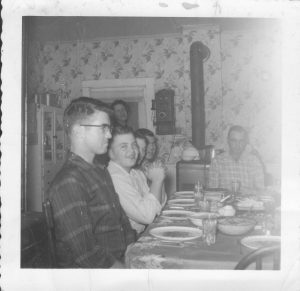 At the start of this Thanksgiving week, I remember the family dinners of my childhood. As long as she was able, my grandmother Read hosted. She lived in a modest frame house cattycornered from the Berryville Store in southeastern Illinois. At one time, she and my grandfather had managed that general store, but he died in March of 1956 when I was five months old, and she was left to her widowhood. She had six children, four of whom still lived close to her. She had grandchildren as well, and at Thanksgiving her house held the conversation and the laughter of many. Because her table couldn’t accommodate the multitude, we ate in shifts. Since my mother was forty-five when I was born, I was much younger than my cousins. When it came time to eat, I always wanted to sit by my cousin, Bill, because he was always kind to me and didn’t try to put foods I didn’t like on my plate like my Uncle Richard did if I sat next to him. Today, Bill is one of my two surviving first cousins. The relentless march of time has thinned my family. Those of us who are still among the living have separated by geography or circumstance, and the family dinners of my childhood are merely memories.
Our photographs, though, endure. Memoirists can use old family photos to immerse themselves in memories. These photos call back an earlier time. Taking note of the clothes people wore, the things they hung on their walls, their furnishings, the way someone held her hands can suggest scenes. One scene can lead to another scene, and before you know it, you’re writing a narrative. Photographs can also make you curious. Why did your father’s eyeglasses never fit properly? Why didn’t he take the time to get them adjusted. What does that one detail say about the story of your family? Looking at old photographs can also make you remember the secrets your family tried to keep. What is your mother hiding with that pained smile? What do you know about her that’s there just beneath the surface of the photo? Old photos can document experience while also sparking our imagination if we take the time to look, to remember, to question, to think, and to imagine.
These days, my wife Cathy and I open our home to students, former students, and friends who need a place to be on Thanksgiving. Cathy cooks too much, but she says it gives her joy, so who am I to complain? She prepares the traditional dishes from her family which are remarkably like what I recall from mine. This shouldn’t surprise me. After all, she and I grew up only five miles from each other. She does homemade noodles, dressing, mashed potatoes, sweet potatoes, green beans, and a Jello salad she calls “pink stuff.” She has a turkey and a vegan option for those like me who don’t eat meat. She makes her own bread and all the desserts. No one will gather around our table and go home hungry.
This is the way we come close to replicating the fellowship of the family dinners we remember. We open our home. We say, “Come break bread with us.” We say, “Gather here, so you won’t have to be alone.”
The post Thanksgiving, Old Photos, and Memoir appeared first on Lee Martin.


November 7, 2022
Say the Secret Things: Memoir and Power
 In October, I taught a two-day workshop at a local public library. Our focus was on writing about moments from our pasts that still haunt us in some way. We wrote about things that hurt us, that shamed us, that left us with guilt and regret. Along the way, we also revisited moments of joy and hilarity. We laughed at our younger selves while at the same time we felt empathy for the children we once were. We wrote with honesty. We didn’t hold back. We wrote to think more deeply about the moments we can’t forget in hopes of increasing our understanding of how they came to be and what they taught us about ourselves and the world around us. We wrote because we had stories to tell, and we wanted to find ways to tell them.
I love teaching memoir workshops for adult learners because, if I do it right, they find a voice for all the things they’ve been unable to say. One woman in my class said, “I haven’t written anything for over fifty years.” I told her, “Welcome home.”
We started small. As some of you know, I have an exercise that I’ve been using for over thirty years, one in which I ask people to remember pairs of shoes they wore when they were children. For this class, I also gave participants an option of recalling favorite toys they had or toys they coveted but never received. One woman recalled a doll she lost on a beach in Florida and how, even now, when she goes back to that place, she keeps an eye out, thinking she just might find it. Everything, I told the participants, is a potential metaphor. Any detail, when held up to our experience, might be a way of exploring and expressing what we can’t bring ourselves to face directly. Another woman, for instance, recalled always wanting a ventriloquist’s dummy but never having it. She said, “It makes me wonder why I wanted one so badly.” Then she went on to say, “Someone was doing something hurtful to me, but I couldn’t tell anyone.” Was it any wonder, then, that she wanted that dummy, a channel for the voice she couldn’t find and the things she couldn’t say?
Another woman wrote about having cerebral palsy and her painstaking attempts to tie the laces of her orthopedic shoes. A ventriloquist’s dummy, a lost baby doll, a pair of orthopedic shoes—such were the conveyances into the memories of hurtful things. If we pay close attention to the details, our sense memory can locate us in the past. Once we’re there, we can use the persona of the writer reflecting on experience to think more deeply about who we were at that time and what it all meant for the people we would become. We might also manage a degree of empathy for, or a least a deeper understanding of, those who hurt us. As Patricia Hampl says, “Memoirists wish to tell their mind. Not their story.” I’d add that the story is the way we invite the memoirist’s sensibility onto the page.
It’s a privilege to live inside the consciousness of a writer as they tell their story. To quote Hampl again: “To write about one’s life is to live it twice, and the second time is both spiritual and historical.” Spiritual because we hold the mystery of a life up to the light. Historical because we place that life in a span of time that transcends the past and carries us into the present and the future.
Try it for yourselves. Choose a small, concrete detail that takes you back in memory to a specific moment from your life that touched you in some way. Maybe it was a hurtful thing you did to someone else, or maybe it was something hurtful that someone did to you. Find those moments you still think about years after the fact because something happened that shook you. Pay attention to the details. Use your position as the adult narrator to interpret your own experience. Say the secret things, the ones that still can keep you up at night, the ones you’ve carried with you for years, the ones you’ve never been able to bring yourselves to share. Claim your experiences. Announce them. Even if no one ever reads what you write, feel the power that bearing witness can bring you.
The post Say the Secret Things: Memoir and Power appeared first on Lee Martin.
October 31, 2022
Just Give It to Me: Clarity in Fiction
 Without intending to, we sometimes withhold important information about the premise of our narratives in our attempts to be mysterious. The problem with such a strategy is it can lead to confusion. Readers can spend too much time trying to figure out the context of the story. As a result, their attention is kept from the nuances of the character relationships. I still maintain these nuances are the heart of good fiction. A writer being coy with the facts of a story may attempt to create a mystery involving the plot, but it’s usually at the expense of the intricacies of character.
Jhumpa Lahiri’s story, “A Temporary Matter” opens like this: “The notice informed them that it was a temporary matter: for five days their electricity would be cut off for one hour, beginning at eight P.M.” With one sentence, Lahiri gives us the facts we need to know about the dramatic present of the story: five days of no power for one hour each evening. This sentence clearly states the premise of the story.
The next question becomes one of what the main characters, a husband and a wife, carry with them into the dramatic present. We quickly learn that six months prior, while the husband was away at an academic conference, a dramatic event occurred: “The baby had been born dead.” Lahiri makes sure we have that piece of information as the story is getting underway.
The dramatic present is now ready to vibrate against the backstory. What will happen when the electricity goes off each night? How will it put pressure on what the couple carry with them because of the loss of their child? Everything is in place. We don’t have to guess at what’s important as the story opens. We know the problem of the dramatic present (the loss of power), and we know the complication that precedes it (the death of the baby). Our attention is focused, then, on how the story will explore the nuances of a marriage in the aftermath of such a profound loss.
It’s really quite simple. Give your readers what they need to know as the story opens. If you withhold important facts, how will we ever be able to trust you when it comes to revealing the mysteries and nuances of the character relationships? Be clear about the premise of the story and about what’s happened in the past. Let the two rub together so the pressure will bring certain undeniable truths to light.
The post Just Give It to Me: Clarity in Fiction appeared first on Lee Martin.
October 24, 2022
Shhh!: The Writer and Silence
 Each Saturday, whenever the weather permits, Cathy and I enjoy a picnic at our local metro park. We have a spot away from the beaten path, and we like relaxing there after the stresses of the work week. We start in the spring, once it’s warm enough, and we keep going until autumn cools enough to make it uncomfortable to be outside. Today is beautiful here in central Ohio. After a week of cold temperatures and howling winds, we have sunshine and warmth. So we went to our spot, perhaps for the last time this season.
I love being in a place where human-made noise is at a minimum. Today, we heard the scrabble of a chipmunk in the underbrush. On occasion, we could hear the mumbled conversations of passing hikers, but for the most part we existed in silence. We both needed that after tough work weeks for both of us.
We writers need that respite as well. We can be an intense lot, driving ourselves to keep to a regular writing schedule, and I’ve always said writing is self-generating—the more regular our writing routine, the better we write—but there’s something to be said for taking a break from time to time, not only to recharge but to let the unconscious parts of our brains work over some problem we’re encountering with what we’re writing. A peaceful getaway can also invite daydreaming which can lead to ideas for future work. When we’re still and have silence around us, we can be more open to what the world is trying to give us—characters, plots, dialogue, imagery, etc.
I remember reading once that Alice Walker believed if she were still, her characters would start to speak. It’s true. We can’t listen unless we’re quiet. Finding times and places, then, in which we can enjoy the lack of noise becomes important to making us more sensitive to where our writing wants to take us.
When Cathy and I finally left our picnic spot and headed back to our car, we found a family—a mother and father and three small children, two boys and a girl—just getting out of their SUV with their own picnic foods in hand. Only there was a problem. The girl didn’t want to get out of the vehicle.
“Anytime, Miss Gracie,” the father said.
He and the boys would go on ahead. The mother would stay to convince Miss Gracie to join them. Of course, to me Gracie’s resistance becomes enough to begin a story, and her father’s line stays in my mind. “Anytime, Miss Gracie.” It could even be a title. My point is we sometimes have to empty ourselves before we can return to the world ready to receive what it might give us. We have to find a place of quiet in order to prepare ourselves for the sparks people’s comings and goings can provide.
The post Shhh!: The Writer and Silence appeared first on Lee Martin.
October 17, 2022
The Nuanced Lives of Strangers
 Yesterday, Cathy wanted to go shopping, so I ended up on a bench outside the fitting rooms at Macy’s. At one point, an elderly gentleman ushered his wife to those fitting rooms. She appeared to be a bit confused about where she was to go, and the gentleman said, “To your left.” She started to turn right, and he took her shoulders and gently directed her. “Your military left,” he said. His wife disappeared down the aisle of cubicles, and the gentleman came to the bench and sat down beside me.
You should know that generally I’m not one for chatting with strangers, but it was a beautiful fall day, and I was happy to be out and about with Cathy, and besides that, I was just plain curious. So, I said to the gentleman, “What’s a military left?”
“I don’t know,” he said, “but my sergeant kept shouting it at me.”
From what I understand, after some research, the military left is the real left, the left that sets the standard. The initial confusion on the part of this gentleman’s wife had brought him to the same sort of exasperation his sergeant had felt when the young soldier the gentleman had been once upon a time started to turn to his right instead of his left. His reaction to his wife’s initial confusion seemed to speak volumes about his character and the role he’d assumed in their marriage. Granted, I was only allowed this brief glimpse, but for a writer the impression of a brief encounter can be enough to help create a character and a narrative.
I’ve always been interested in observing people, and I tend to like them for their imperfections. That’s what I believe I was observing when the gentleman told his wife to go to her military left. There was impatience in his voice, and I can only imagine what challenges he and his wife may have faced in their long life together.
The whole point of this is to say as writers we must be curious and observant. We must be open to the bits of conversations and the small gestures we might witness that arouse our curiosity and seem to provide an entryway into the complications and contradictions of the lives we live. I heard the impatience in my gentleman’s voice, yes, but I also observed how gently he escorted his wife to the fitting rooms and how tenderly he turned her to where she needed to go. Our lives are made up of nuances most people don’t notice. We need to pay attention to the strangers who cross our paths. They have so much to teach us about the intricacies of our human interactions. Try it sometime. Go to a public place and see what you might find that you can use in the stories you tell or the poems or essays you write. Be sensitive to those around you. Love them for everything they invite you to see.
The post The Nuanced Lives of Strangers appeared first on Lee Martin.
October 10, 2022
The Pause before the End: Our Characters’ Interior Lives
 When I walked into my office this morning, I found Stella the Cat lying in a patch of sunlight. She loves the sun, and she likes to roll over on her back to invite a tummy rub. Each time I pet her warm fur, a great feeling of calm comes over me. Everything in my heart and mind slows down, and when I get to my work, I’m able to think more clearly. She reminds me to live in the moment, both in my life and in the lives of my characters.
Autumn is a season of pause. After a summer of activities, it’s time for us to slow down before we make the turn toward the cold and gray of winter. It should be the same for the people who populate our narratives. We should take a cue from Stella the Cat. We should learn not to be in hurry.
I’m thinking about this because sometimes I see writers rushing to get to the end. I see them skimming along the surface the way speed boats do the water. Sometimes we forget our characters have inner lives. Sometimes we forsake them for the purpose of pushing our plots ahead.
I don’t mean to dismiss the rapid pace a plot nearing its end often requires, but I do want us to consider that sometimes major plot moves in a narrative beg for moments of pause. Paul, the titular character of Willa Cather’s “Paul’s Case,” having stolen from his employer, leaves his native Pittsburgh and travels to New York City, escaping the restrictions of his father’s home on Cordelia Street for the life he’s convinced he’s meant to have. He checks into the Waldorf, and for a time, he feels he’s put his father’s house behind him. Then he reads in the newspaper that his father has repaid the money he stole, and his employer has no intention of prosecuting. He also reads that his father has left Pittsburgh for New York where he intends to find his son and bring him home. Paul has one last night to imagine he might stay in the city forever. He drinks to excess and wakes the next morning hungover. There is one final dramatic action to come at the end of the story, but before we get there Cather slows the narrative and uses Paul’s interior thoughts to provide the bridge to the end:
He rose and moved about with a painful effort, succumbing now and again to attacks of nausea. It was the old depression exaggerated; all the world had become Cordelia Street. Yet somehow he was not afraid of anything, was absolutely calm; perhaps because he had looked into the dark corner at last and knew. It was bad enough, what he saw there, but somehow not so bad as his long fear of it had been. He saw everything clearly now. He had a feeling that he had made the best of it, that he had lived the sort of life he was meant to live, and for half an hour he sat staring at the revolver. But he told himself that was not the way, so he went downstairs and took a cab to the ferry.
I won’t spoil the story by revealing its final move. Trust me when I say the passage I quote above is essential to that end. If we don’t pause to take stock of Paul’s inner life, we run the risk of making the ending seem unbelievable.
As an exercise, you might want to think of a surprising action on the part of one of your main characters. Then ask yourself what that character might be thinking about just prior to that action that will make it convincing. Our characters sometimes pause just before their final choice, and as we pause along with them, we get a better sense of their inner lives that make their ends both possible and believable.
The post The Pause before the End: Our Characters’ Interior Lives appeared first on Lee Martin.
October 3, 2022
Writing Historical Fiction
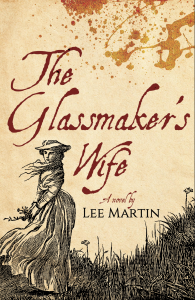 Yesterday, I received advance copies of my forthcoming novel, The Glassmaker’s Wife (Dzanc Books). The official pub date is December 6, but, of course, the book is available for pre-order now from wherever you prefer to purchase your books. There, that’s the end of the self-promotion. I mention the book only because I want to talk about the writing of historical fiction.
Someone recently asked me how I defined historical fiction, and I jokingly said I’d gotten so old everything I write is historical. In all serious, though, isn’t any novel that takes place in a now past time period historical? Couldn’t, say, a book set in the 1990s be speaking from a distinct historical period?
I set my first novel in 1920s Texas. I’ve set other books in the 1950s and the 1970s. Here are three things I’ve learned about writing historical fiction.
The going can be slow. For me, authenticity is the first rule of writing historical fiction. I want every detail to be accurate. I’m not just talking about the history of the time period itself, but also about the small things like what women in the mid-1840s would have used to hold their hair up. The answer isn’t pins, like I first assumed, but rather ribbons or combs. Tracking down these authentic details can slow the writing process quite a bit. Often, I pass them over for the sake of keeping my momentum going, knowing I’ll have to go back later and fill in the accurate details with more research. The Glassmaker’s Wife is the novel that took me the longest to write, and for the most part it was because the time period was so distant, it took quite a bit of research to make sure everything was as accurate as possible.
Research can be seductive. The facts are there to be discovered, but my favorite type of research involves reading the newspapers and magazines from a particular time period. I love knowing what things were for sale in various stores, what movies were playing at the theaters, what sorts of foods were being offered at restaurants, what types of beers were being sold in the taverns, etc. I love this type of research so much it’s easy to let it keep me from writing. After I feel I’ve immersed myself in the day-to-day lives of my characters, it’s time to put my narrative into motion.
The culture matters. As much as the character interactions interest me whenever I’m writing a novel, no matter whether its historical or current, I can’t forget the culture of the time period. I have to know what was going on politically, socially, culturally. What were the larger issues that affected people’s lives. In the mid-1840s, for instance, western expansion was a hot topic, and indeed in The Glassmaker’s Wife, what they called “earth hunger” plays a large role in the plot of the novel, as does a religious group called the Millerites and their belief in an upcoming ascension. As much as I like to pay attention to the inner lives of my characters, when I write a historical novel, I have to understand that those inner lives are shaped by the larger forces of the worlds around them.
James Baldwin once said, “People are trapped in history and history is trapped in them.” For those of us who write any kind of fiction that’s interested in what William Faulkner called “the old verities and truths of the heart,” the history and the people are inseparable. In The Glassmaker’s Wife, a woman is accused, on the basis of flimsy evidence, of poisoning her husband. I can reduce the plot of the novel to this: a pinch of white powder, a scorched paper, a community hungry for a villain, and a young girl’s first taste of revenge. The lives of the characters and the actions they take are determined, in part, by the choices they make, and in part, by the choices their time period and their place make possible. Perhaps the greatest lesson writing historical fiction has given me is this: We live in our worlds, and our worlds live in us.
The post Writing Historical Fiction appeared first on Lee Martin.
September 26, 2022
Memoir by Canned Goods
 Showboat Pork and Beans, Chef Boyardee Ravioli, Campbell’s Tomato Soup, SpaghettiOs, Dinty Moore Beef Stew. When I was a teenager in the seventies, all I needed was one of these, a can opener, a stove, and I had myself a meal. In those days, my mother worked. She worked in the laundry or on the housecleaning crew at the local nursing home. This was after she’d retired from a thirty-eight-year teaching career. Sometimes she had to be at work at five in the morning; other times, she didn’t go in until seven. On occasion, she had to work on Sunday, so she couldn’t go to church until evening services. I usually went with her. It was only a couple of blocks from our house to the church, so we walked. I remember walking home with her in the early summer dusk, her soft voice beside me. What did we talk about? I wish I could remember, but I can only guess. After the singing of hymns, after the sermon and the prayers, my mother’s leisurely gait and the ease of her voice gave me a feeling of peace that was often lacking in my turbulent teenage years. It seemed that my father and I were always at odds. I loved those Sunday evening walks with my mother because it was just the two of us, away from the anger my father and I often brought into our home. Maybe she told me he loved me—she was always telling me that, unwilling to surrender to our chaotic come-and-go, ever insistent that we could be better, that our family could be better, that we could live a kind and happy life.
She would have been sixty when I was fifteen. I was her only child, and in spite of all the ways I found to disappoint her, she loved me.
In Ernest Hemingway’s A Moveable Feast, he talks about overcoming the difficulty of beginning a story. “All you have to do,” he said, “is write one true sentence. Write the truest sentence that you know.”
True sentences come in many forms. Sometimes they feature concrete details. This morning, for whatever reason, I woke up thinking about pork and beans. What brand did we keep on hand when I was a teenager? My wife Cathy jostled my memory. Showboat, of course. As soon as she said it, I visualized the empty cans in our burn barrel or later dumped into a gully on our farm, our own personal landfill. What other brands of canned goods did we have? The associations came quickly—Chef Boyardee, Campbell’s, Dinty Moore—and the next thing I knew I was writing other true sentences. Facts about my mother’s job, facts about our walks to church, facts about my father and the relationship I had with him. Finally, I came to one of the truest sentences I know: “I was her only child, and in spite of all the ways I found to disappoint her, she loved me.” It’s been thirty-four years since my mother died, and nothing has ever shaken my faith in the absolute truth of her love for me. Other things I thought were true have crumbled—some of them because of my own choices and some of them because of the choices of others—but nothing has ever threatened the knowledge that my mother loved me unconditionally.
The point for those of us who write memoir is the smallest concrete detail can allow us to indirectly approach the aspects of our experience that may be too daunting for us to see head-on. A can of Showboat Pork and Beans can take us to the truest sentence we can write. I had no idea when I opened memory’s cupboard that the canned goods inside would take me to my remembrance of those Sunday evening walks with my mother. Sometimes, to begin, we just have to latch onto a concrete detail. If we keep writing true sentences, we’ll be amazed by where we finally arrive.
The post Memoir by Canned Goods appeared first on Lee Martin.
September 19, 2022
A Consideration of Audience
 A question came up the other day regarding the audience for a particular short story. That question may be interesting after a story is written, but when it’s in progress, I’m not sure a consideration of audience is particularly useful and may, in fact, be detrimental to the writing process.
We all have our reasons for writing. Some of us write to entertain. Others write to answer a voice we’ve heard in something we’ve read. Some of us write to try to make sense of something that seems incomprehensible, and some of us write to try to save ourselves. When it comes to all four of these reasons, count me in. I write because I want a shaped narrative to illuminate some aspect of our living that would remain hidden if not for the written word. I write to closely observe the human behaviors that mystify me. I write to practice the art of empathy.
Anton Chekhov listed compassion as one of the elements he considered essential for a good short story. Like Chekhov, I believe a good story increases our understanding of what it is to be someone whose experience we may not share. Joseph Conrad said this:
My task which I am trying to achieve is, by the power of the written word, to make you hear, to make you feel — it is, before all, to make you see. That — and no more, and it is everything. If I succeed, you shall find there according to your deserts: encouragement, consolation, fear, charm — all you demand; and, perhaps, also that glimpse of truth for which you have forgotten to ask.
“. . .that glimpse of truth for which you have forgotten to ask.” Exactly. That’s why literature exists—to show us those truths we didn’t even know we needed. The question of audience, when examined through the lens of this Conrad quote, seems to imply a general audience of humankind. That’s as far as I’m willing to go during the act of creation. I’m writing for any reader who happens to find my work. I’m writing to show that “glimpse of truth.” Any other consideration of audience threatens to shape the narrative in a way that may close off possibilities and spontaneous discoveries.
When it comes to my obligations during the writing process, my only loyalty is to the close observation of the characters and their situations. Good writers live their work from inside their characters. Eudora Welty put it this way:
What I do in writing of any character is to try to enter into the mind, heart, and skin of a human being who is not myself. Whether this happens to be a man or woman, old or young, with skin black or white, the primary challenge lies in making the jump itself. It is the act of a writer’s imagination that I set most high.
That act of imagination can take us to necessary places—places of insight that express our common humanity—but we can’t risk a consideration of audience forestalling our arrival. We set a character into motion. We live inside that character, observing closely. We let the writing show us what we didn’t know when we started. We make that leap of faith all writers must make, that leap that tells us we can see the world from the perspective of any person, no matter how different we may be. In the process, we become our work’s audience. We question, speculate, dramatize, and discover, and if we’re really good at what we do, we end up at a place that takes us by surprise but also seems inevitable. We transport ourselves through imagining the lives of our characters.
The post A Consideration of Audience appeared first on Lee Martin.
September 12, 2022
Memoir and Dramatizing Meaning
 We all have moments from our pasts we can never forget. Memoirists tap into those moments when constructing a narrative. Dramatization allows us to find a causal chain that perhaps didn’t exist in real life. When we write memoir, we strive to document, but we also try to give some shape to experience. If we string together enough significant scenes, we can enhance our readers’ participation in the narrative while also creating an artful arrangement that will enable us to make meaning from what previously may have been puzzling. We aren’t merely reporting or recreating. We’re also interrogating and interpreting our experiences.
When I was about to begin the third grade, my parents moved us from our farm in southeastern Illinois to Oak Forest, a southern suburb of Chicago. I went from a two-room country school to a large urban grade school. We left our farm behind and entered a new way of living. My mother told me years later that it had been my father’s idea that she take a teaching position up north after losing her job downstate. “He thought we needed the money,” she said.
I remember the drive we made to Oak Forest, so my mother could interview for the job. When I wrote about it in my first memoir, From Our House, I began this way: “We drove through the night, and the next morning it was raining so hard, my father had to pull off the highway and wait for the weather to clear.” This is a statement of fact, but it’s also a scene-setting sentence that has narrative momentum: “We drove through the night.” It also quickly presents a complication in the narrative: “. . .and the next morning it was raining so hard. . . .” Complications in narratives usually require actions: “. . .my father had to pull off the highway and wait for the weather to clear.”
So here we are, three people in a car, waiting for the rain to let up. Not much room for narrative action, but plenty of room for characterization. I recall where we were, and I focus on a single image that’s never left me: “We sat in the parking lot of a hardware store, and through the rain sheeting down our windshield, I could see a sign—“Pittsburgh Paints”—the neon balls of red and blue and green fading behind the gray curtain of rain.” Again, these are all facts. The question is what I can make of those facts. In order to move to Oak Forest, we had to leave my grandmother, who’d lived with us on the farm, to the care of my aunts. My grandmother was nearly blind with cataracts, which I’ve dramatized earlier in the memoir. So when I’m writing and I recall that sign for “Pittsburgh Paints” and the way it looked through the rain, I think of my grandmother, and I write this sentence: “I imagined that was how the world looked to my grandmother—gray and watery—and I thought of her waiting for us to come home.” Then I let the scene continue:
“Look at it come down,” my father said. “It’s raining like pouring piss out of a boot.”
“My mother had a road map spread out on her lap. “We’re close,” she said. “About twenty miles.”
My father yawned. “Relax. We’ve got plenty of time.”
I sat in the backseat, lulled by the sound of the rain and the fact that we were dry and warm there in the car. My mother took her compact from her purse and powdered her nose. My father sighed, and then he said, “After this lets up, we’ll find someplace where we can get some breakfast.”
“I don’t want to be late.” My mother snapped her compact shut. “You brought us all the way up here. You can at least make sure we get there on time.”
This exchange of dialogue allows me to discover what my mother would tell me after my father was dead. She didn’t really want to go to Oak Forest. She didn’t want to leave her widowed mother behind. She didn’t want to leave our farming community. The snapping shut of her compact dramatizes what she must have been feeling. Her line of dialogue cements it.
Don’t be afraid to use action and dialogue to make moments come alive for your readers and for you. Dramatizing leads to discovery and to the making of meaning. It puts you back in the moments in a way that invites you to see and to know all that you were incapable of at the time.
The post Memoir and Dramatizing Meaning appeared first on Lee Martin.