Lee Martin's Blog, page 14
April 10, 2023
A Writer’s Faith
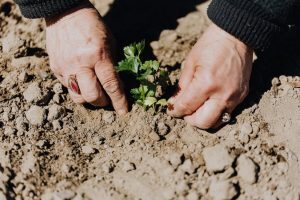 I hated working in the family garden when I was a teenager because, of course, I had teenager things to do, and all of that tilling and hoeing got in the way. Now, decades later, I’m eager to work up the soil in the raised bed Cathy and I rent from our community garden and sow our cool weather crops.
What I remember most from my parents’ garden was how my mother and father worked in it together. I remember how they consulted and assigned tasks and picked and prepared and preserved and ate the vegetables and fruits they grew. I also remember the joy gardening brought them and how invested they were in the process. From time to time, my father would get too close to a plant with his hoe and cut it down. It would be enough to nearly bring him to tears. Those plants meant that much to him, yes, but as I look back on those times now, I see something else at work, something connected to the most significant event in my family’s history, the day my father lost both of his hands in his corn picker because he didn’t take the time to shut down the power take-off when he tried to clear a clog from the shucking box. The spinning rollers caught his right hand, and when he tried to pull it free with his left, the rollers caught it, too. How long must he have blamed himself for the accident? When he cut down a garden plant, did that moment in the cornfield rise up and overwhelm him? I imagine it may have because our family’s story is a story of loss, but more than that it’s a story of loss connected to shame.
Imagine my father, whose prostheses could hold a hoe handle, or the handles of a cultivator, but who had to rely on my mother to plant the small seeds: the lettuce, the radishes, the carrots. I remember how he’d use the point of his cultivator to mark a straight row across our garden plot and how he’d stand by as my mother stooped and dropped the seed in the furrow. There in the early spring it was practically a sacred moment when the seed went into the ground. For my father, I imagine the planting was a moment of faith, perhaps even a moment of redemption. Each perfect radish or beet or bean or tomato was proof that he hadn’t made a mistake.
I’m thinking about this today, not only because I’ll soon be planting, but also because it’s been a good while since I’ve started a new piece of writing. It’s been so long, in fact, that I’m almost afraid to begin because I worry about not being able to bring a new piece to completion. That’s a bad situation for a writer. Fear or uncertainty leads to paralysis. I know eventually I’ll begin again, so now in my fallow period, it’s important to remind myself of the faith writing takes. Consider the lettuce seed, so small, that eventually puts forth glorious leaves. Time, patience, care, faith—that’s all it takes whether writing or gardening. We plant a seed or make a mark on the page or screen, and we trust in the growing season, along with our passion and our skill, to successfully bring something to its end.
“Look at that one,” my father often said when he was telling me which tomato or bean or roasting ear to pick. His voice would be hushed, a tone of reverence and thanksgiving and awe when he added, “It’s ready.” How grateful he was, how pleased, how humbled, how blessed.
The post A Writer’s Faith appeared first on Lee Martin.


April 3, 2023
Practicing the Techniques of Our Craft
 For some reason, I’m thinking today about how I learned to drive. When I was around twelve years old, my father started letting me steer his Oldsmobile on the gravel roads near our farm in Lukin Township. I’d scoot close to him on the bench seat and steer while he operated the gas and, if necessary, the brake. He taught me to feel the tug of the wheel either right or left and to straighten the path with slight, barely perceptible counter turns. Driving, I learned, was nothing like it seemed in television programs where actors give dramatic turns of the wheel as they pretended to drive. Instead, it was a series of small reactions to the feel of the car’s track. “Nice and easy,” my father said. “Just keep it straight.”
In a way, those roads were the perfect place to learn because there was a clearly defined track worn in the gravel with a ridge running down the center. If I let the Olds get too far from a straight track, I’d hear the gravel from that ridge hitting the underside. When my father thought I was ready, he let me solo. Just like that, I was driving. Now, all these years later, I don’t even think about what I’m doing with the steering wheel to keep my car on track. Over time, I internalized the process, and now I steer without giving it much thought.
So it is for writing. We practice the techniques of our craft until we internalize them and employ them by instinct. Write enough passages of description, or enough scenes of dialogue, and we teach ourselves how to do these things. Shift from action to the interior of a character, and we practice the art of the third-person limited point of view. Write until a character surprises us enough times, and we understand the importance of creating characters made up of contradictory layers. I could go on with other examples, but I imagine you get the idea; a piece of writing is a made thing. We practice its techniques to master them.
I remember how impatient I was to reach that magical age of sixteen when I could get my driver’s license. Later, when I began writing in earnest, I had a similar lack of patience for some sort of validation. I wondered whether I’d ever be good enough to publish something. Finally, that day came, but I had to write a lot of words—words that would never see the light of day—before an editor said, “Yes.”
No writing is wasted. It’s all necessary to our development as writers. My father would let me drive from the end of our lane to the first crossroads—then a bit farther, and then a bit farther still. I had a hard time imagining ever driving on a highway or on city streets, but, of course, that’s eventually what happened.
We writers can expand our journeys by first practicing the techniques of our craft. We can imitate passages from our favorite pieces of writing, figuring out how a writer used a specific technique to achieve a certain effect. We can also pick up a good craft book such as Rust Hills’s Writing in General and the Short Story in Particular, along with countless others, to see what successful writers, editors, and teachers have to say about the craft. Some of these books will even include exercises and prompts to lead us to further practice. Above all, we can be patient. We can be satisfied with the early steps, the ones necessary to taking us where we want to go.
The post Practicing the Techniques of Our Craft appeared first on Lee Martin.
March 27, 2023
The Bare Bones of Storytelling
Here’s an old joke about a boy who didn’t speak for the first five years of his life. Then, one night at the dinner table, he says, “These mashed potatoes are lumpy.” His parents are amazed. His father says, “Son, you can speak!” The mother says, “Why did it take you so long to say something?” The boy shrugs. “Up until now,” he says, “everything was all right.”
Often, we write because everything isn’t all right. In narratives, something needs to be unstable. That something can provide the center of the storyline while also being the impetus for the narration. Whether we’re talking about fiction, nonfiction, or narrative poetry, we tell stories to try to figure out the mysteries of human behavior. Why do people do the things they do? What does it mean to be alive?
Stories depend on action. It sounds almost too obvious to mention, but the action I’m talking about should be significant to the point that it alters your main character’s world. Action that comes from a character’s choice leads to a sequence of events that changes that character. The action can be small or large as long as it has a lasting effect on your main character’s world. Going for a walk on your lunch hour might not lead to anything significant, but finding a crudely drawn map of the downtown area, as the main character in a Charles Baxter story does, with one building marked with the words, “The next building I plan to bomb,” very well might. Likewise, a trip to the grocery store might just be routine, but a trip to the store where a character overhears a neighbor talking about that character in disparaging terms might be consequential.
Stories also depend on complications. Plots are memorable because of the twists and turns they take. A character does something, thinking a certain result will occur, only to find something completely opposite takes place. Without complications, we only have a sequence of events that leads us nowhere in a very uninteresting way. Complications are necessary to the act of narration. Without them, why tell the story?
The teller of significant stories relies on the art of scenic depiction. We have to immerse our readers in the worlds of our narratives, and that’s where description, details, and dialogue come into play. What are the sights, sounds, scents, tastes, and tactile sensations of the moments we’re dramatizing? How can we use them to make the world of the narrative real to the readers? What objects are significant, and what do the characters have to say to one another? Your readers shouldn’t feel like they’re in the audience watching a play on stage. They should instead feel like they’re on the stage along with the characters.
Finally, narratives must move toward some sort of resolution. Maybe they move to a moment of change or understanding, but sometimes they move toward a moment that offers the opportunity for the main character to experience a change only to see the character fail to recognize what the readers know quite well. The important thing is to bring the sequence of events to a climactic moment where your main character makes a final choice and the premise of the narrative resolves.
Action. Complications. Scenic depiction. Resolution. Such are the bare bones of narrative. Of course, there’s so much more to the art of storytelling, but this is a fine place to start.
The post The Bare Bones of Storytelling appeared first on Lee Martin.
March 20, 2023
Using the Senses to Tell the Truth
 Our first job as writers is to create a convincing world on the page. Ours is a truth-telling enterprise whether we’re inventing or remembering. Whether we’re writing fiction, creative nonfiction, or poetry, we rely on the concrete details to gain the trust of our readers. How can we ever hope for our work to tell the large truths if we don’t first tell the small ones?
Sensory details count for so much when we’re portraying places and the people who occupy them. What are the sights, sounds, scents, tastes, and tactile sensations of the places you’re creating or recalling in your work? You may find that you tend to favor one sense over the others. If so, challenge yourself to develop those other senses because something magical happens if you can offer a description that uses at least three distinct sensory details. The place and its people become vivid and persuasive. The concrete details carry a message of belief. They say, “You can trust me, dear reader, because here’s this world I’ve made for you, this world you can’t deny.”
The smell of wild onions on a chilly spring evening, the call of a whippoorwill, the wind out of the north. My parents and I walk across our pasture. My father calls for the lost calf we’ve been trying to find. One last hope because it’s twilight now, and we’re headed back to our farmhouse. My mother’s barn coat smells of fuel oil because she wears it when she fills our stoves. My father calls, “Sook, sook,” over and over before cursing under his breath. “Goddamn it,” he says. Sometimes he says that word to me. Then he takes off his belt or reaches for a yardstick and I feel the fire on my legs and backside, and I beg him to stop. I tell him I’ll be good. In the pasture, the only sounds now are our footsteps thudding on the hard ground. We vanish a little more with each step as twilight gives way to darkness. I think of the lost calf, and I feel an ache in my throat. I ball my hands into fists inside the pockets of my corduroy jacket. Although my parents have been dead for years, here they are again. Here they are in the darkness, and I’m with them. I have my mother and my father, and I’m moving through the dark with them. I keep my eyes on the square of light in the window at our farmhouse, the light that tells me we’re almost home.
I wasn’t thinking of that long-ago night when we went searching for the lost calf and had to give up and walk back to our house in the darkness when I began to offer this example of concrete details. The wild onions, the whippoorwill, the north wind took me there. I certainly didn’t mean to write about my father’s anger, but once I heard him say, “Goddamn it,” there it was. Sensory details not only create a convincing world, they also invite us to explore what we might not otherwise be able to face. The details provide an entry into what we’ve come to the page to say. We don’t know that’s where we’re going when we start out—after all, we’re only describing—but if we’re paying attention, those concrete details evoke emotions and suddenly we, too, are immersed in the world of our creation. We and our readers are on a journey together, a journey upon which the details will lead us to the truth.
The post Using the Senses to Tell the Truth appeared first on Lee Martin.
March 13, 2023
Determining the End of a Novel
 We’ve reached that time of year when we. . .well, when we mess with time. Springing forward to Daylight Savings Time, has cost us an hour. What could have happened between two a.m., standard time, and what should have been three a.m., standard time, will never happen. That hour disappeared as soon as we moved forward.
Which leads me to thoughts on one way a novel often unfolds. Incidents proceed along a timeline until they reach an event beyond which only one outcome is possible. A dramatic event eliminates all possibilities but one. This usually happens about two-thirds of the way through the novel, and it provides a fulcrum that tips the book toward its end. Think of the car accident that kills Myrtle Wilson in The Great Gatsby. That accident determines the death of Jay Gatsby at the end of the novel. Because of Myrtle’s death, George Wilson begins his walk toward retribution, ending, finally, at Gatsby’s mansion, where he finds Gatsby floating in the swimming pool. We all know what happens then. George Wilson murders Gatsby before turning the gun on himself. From the point of the car accident, nothing but Gatsby’s death is possible. It’s simply too late for anything else to happen.
I offer this illustration in case it’s useful to your thinking about one way to manage time in a novel. What’s the single event upon which the end of your novel will depend? What dramatic moment will determine how your novel will have to end? Of course, this isn’t the only way to think about structure in a novel, but it’s a good way if you’re working in an early draft and wondering about the directions in which the book might go.
The post Determining the End of a Novel appeared first on Lee Martin.
March 6, 2023
Communion: Telling It All
 When I was in high school, I had a friend who lived down the street. His mother, who cleaned people’s houses, was often away from home. Her husband was quite elderly and nearly blind. When it came to meals, my friend usually had to fend for himself. It became easy for him to rely on junk food—potato chips, candy bars, snack cakes.
Each evening, my parents and I ate supper between five and five-thirty. My friend had a habit of dropping by while we were at our table. My father would ask him if he’d had any supper, and my friend, hovering uneasily in our small kitchen, would say he had. My father knew better. “Beulah,” he’d say to my mother, “get him a plate.”
My friend ate with us several times. My father insisted he fill his plate with whatever my mother had cooked: mackerel patties, hamburgers, meat loaf, fish. My friend didn’t hesitate. He took healthy portions of mashed potatoes, baked beans, coleslaw, green beans, peas, sliced tomatoes, or whatever side dishes my mother had prepared. We sat at our table and ate. My mother asked my friend questions about school; my father gently teased him. It was as if I, an only child, had come upon a brother.
I need to remember the communion of those evenings and how gracefully my father coaxed my friend to eat because when I think of that time, I so often recall the anger that filled our home—my small rebellions, my father’s temper. I need to remember his goodness. I need to remind myself that amid our anger, my father was a goodhearted and generous man.
My mother, as always, was compassionate and lovely. Together, she and my father, invited my friend to join us without ever calling attention to the circumstances that left him needing our kindness. We were often a flawed family, but we always knew how to help someone.
I could stop here. I could end with this account of food given and accepted, but it wouldn’t be the entire story. Good writing depends on honesty. We write to show the world in all its glory and its ugliness, and to do that we have to be willing to face what most people would avoid. To be more exact, writers of memoir cheat themselves, their stories, and their readers if they don’t say it all.
So, here goes. As often happens with childhood friends, my friend and I made choices that distanced us from each other. I left our small town. He stayed. Years and years went by, and I rarely gave him a thought, immersed as I was in the circumstances of my own life. Then the day came when my soon-to-be wife, Cathy, was still living in our home area, and her path crossed that of my friend. He was in poor health. His marriage was ending. He lived in a rundown house trailer. He was disheveled, Cathy said, being as kind as she could while making it clear that his personal hygiene was suffering.
Once, while we were driving down a street in my hometown, I saw him sitting on an old riding lawnmower alongside his trailer. He waved, and I waved, and then I drove on.
I was living by myself in Ohio at the time, and Cathy was working at the local hospital in our home county in Illinois. One day, my friend came into the hospital, and when he saw Cathy, he gave her his phone number and said, “Have Lee call me next time he’s in town.”
So, I did. One night, I called and told him Cathy and I were thinking of going to the local ice cream stand. Would he like to meet us there?
“I don’t have any transportation,” he said.
Now, I’m writing about what I don’t want to say. I’m squirming in my chair. I’m closing my eyes to keep myself from seeing where I know I have to go. I’m feeling the discomfort that tells me this is exactly what I must face. If what we write is to matter at all, we come to these moments of unease when we know we can’t hide.
The thought of my friend, his broken-down body in my car—his dirty body and its odors—gave me pause, and I hemmed and hawed, finding a way, eventually, to say it was getting late and maybe we should wait until next time for that ice cream.
The next time never came. Soon after that call, my friend died.
My refusal to see him still haunts me. I know it would have made my parents, had they still been alive, ashamed. You see this hasn’t been about my father’s goodness at all, but about my own failure. My selfishness. My stingy heart.
All I can do is tell the story of how once upon a time I had a friend who made a habit of coming to my house at suppertime. My father told my mother to get him a plate. I can still see us sitting around that table, passing the dishes of food. I can hear the silverware. I can see my friend eating as much as he wanted. In winter, the dark settled around us. The kitchen windows steamed over with the heat from my mother’s cooking. Outside the wind rose and rattled the storm windows in their frames, but in the living room the gas stove flared, its burners roaring to life.
After supper, my friend and I stood in front of that stove, jostling each other for the best position so we could let the heat warm our backsides. Our bodies touched. We had no desire or need to move. It would be hours before his mother would call, asking if he was there. Sometime after supper, my father would turn on the radio and we’d sit again at the kitchen table, listening to a basketball game, and my mother would pop corn and pare apples, and we’d drink Pepsi Colas, and the night would unfold that way, his mother’s phone call somewhere in the future, and why worry about what hadn’t yet happened? We had popcorn and apples and Pepsi’s. We ate and drank, and my friend had no thought of leaving. Why should he when—I have to believe this—he felt full and warm and cared for and loved?
The post Communion: Telling It All appeared first on Lee Martin.
February 27, 2023
An Object Exercise for Prose Writers
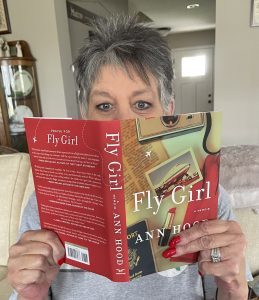 Thanks to a friend, my wife Cathy now has a new hairstyle. It’s short and spiky just like this post is going to be.
This is a writing activity for those who write memoir. Recall a time in your life when you acquired something new. Maybe it was a hairstyle, or a fashion, or maybe you bought a car, a house, a dog. Describe the object and what was going on in your life at the time you purchased or adopted it. Think about why you wanted the object at the time. Then consider what owning that object says about you and this time of your life. Were you in some way in need of remaking yourself? Or were you trying to be the person someone else wanted you to be? Or were you deliberately setting out on a new path? What do you know now, as you look back on that object, that you didn’t know then?
I imagine this exercise might work for fiction writers, too if they substitute one of their characters for the first-person narrator of memoir.
Naturally, the things we own say so much about us. Use this object exercise to look more fully at a period from your life, or the life of one of your characters.
By the way, I think Cathy’s new hairstyle is fab.
The post An Object Exercise for Prose Writers appeared first on Lee Martin.
February 20, 2023
Embrace the Positive: The Benefits of a Writing Community
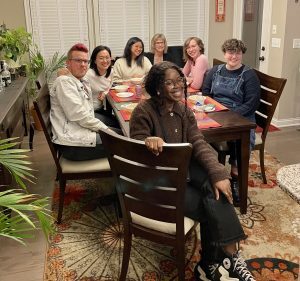 Cathy and I have been hosting MFA students from my fiction and creative nonfiction workshops for Cathy’s excellent vegetable soup and her wonderful homemade bread. It’s a way to extend the community of the workshop and to remind ourselves we are all more than just the work we do. I love hearing my students’ stories about their past and present experiences. We sit around the table and get to know one another as people. Oh, sure, writing comes into the conversation—how could it not?—but for the most part we talk about the places we’ve lived, our families, our hobbies, our guilty pleasures, and in the process we find out that even though we may come from different places, we’re more alike than we are different.
Writers must make friends with solitude. We spend so much time in our rooms, facing the blank page, alone with our characters, our images, our ideas, trying to find the words to bring them to life. That solitude can be seductive. It can lure us into a retreat, closing out the world as much as we can, but we shouldn’t forget our lives take place within a larger community. It’s our interactions with others that bring us to what Faulkner called “the old verities and truths of the heart.” For me, the act of writing has always been a dance between immersion and retreat. I go out into the world to take in its mysteries. I come back to my writing room to explore them.
Last night at dinner, someone told a story about arranging travel for movie stars on location. Certain stars demanded that they not travel with certain other stars. Writers, of course, have their own feuds, grievances, and petty jealousies. I’ve always thought that was energy wasted. The time spent nursing grudges, complaints, and resentments would be better spent working on our craft.
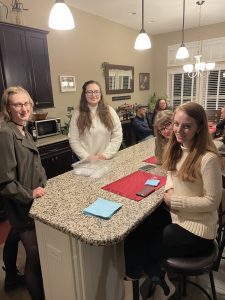 The students who’ve gathered around our table these past few weeks have demonstrated a great unity. They genuinely like one another. They encourage and support. They tactfully tell the truth. They are everything one would want in a best friend, someone who’ll celebrate with you, mourn with you, and tell you the truth when you need to hear it. We writers need these kinds of people in our lives. We need friendships with other writers because they alone know what our craft demands from us. They know the highs and lows. They know the challenges. They know what it takes to overcome them. Wherever we can find such community is a good thing. Finding a supportive group of writers opens our hearts. It expands our empathy. It shows us we’re not alone. This isn’t to say, of course, that petty jealousies don’t exist within such communities—after all, we’re only human—but even our flaws can more easily be tempered when we know our peers truly have our best interests at heart.
I’ll close with this thought. If we can give more in the way of supporting and promoting other writers’ work, we can receive more in return. We can clear our hearts and minds of the negative and embrace the positive. Will that sort of energy make us better writers? Maybe, or maybe not. I really can’t say. All I know is giving to others will make us happier people, and how can we argue with that?
The post Embrace the Positive: The Benefits of a Writing Community appeared first on Lee Martin.
February 13, 2023
Reimagining True Stories
 Last week, I had the pleasure of offering a workshop, via the wonderful Larksong Writers Place in Lincoln, Nebraska, for those who might be interested in reimagining a true story. This has been my approach for six of my novels, including my most recent, The Glassmaker’s Wife. I start with a factual story, and then I let my imagination go to work.
People often approach me with a story they think I simply must tell. I can sense immediately if they’re correct. If there’s something about the true story that allows me to imagine characters with conflicted hearts, I take heed. If the only thing that stands out is the plot, I generally decline the invitation. Characters and their contradictions make compelling fiction, so I’m always looking for how I can see a true story from the interior of a character and what I imagine to be the oppositions they hold. For instance, in The Glassmaker’s Wife, the fifteen-year-old hired girl, Eveline Deal, considers her mistress, Betsey Reed, from a position of conflicting feelings:
Sometimes Miss Betsey would snap at her because she scorched a shift she was ironing or she left the bread to bake too long, and Eveline would let herself hate her just a little, all along wishing Miss Betsey would throw her arms around her neck and press her close and say she was sorry, oh, my precious girl forgive me.
Eveline’s simultaneous adoration and distaste was my entry into this true story of Betsey Reed, who was accused of murdering her husband in 1844 by poisoning him. The story of the murder and the trial that followed is interesting by itself, but I never would have told it without first imagining this story of Eveline.
If you start with a true story, you might write at least three “what-if” questions. These would be questions that would vary from the facts and be located within the characters. In the case of The Glassmaker’s Wife, one of my questions would have read something like this: “What if Eveline Deal was a flighty girl obsessed with romance and sensitive to the slights of others?” Such a question ended up guiding much of the novel’s plot from the character’s interior.
You might also consider the two characters who will stand at the heart of what you’re writing. Which one will feel more deeply? You might even use this as a prompt to get inside that character: “There was a part of her that believed/feared/wanted (or whatever verb you choose). . . .(you fill in the blank), but there was another part of her that. . . .(again, you fill in the blank). Such work can help you identify the central conflict within that character. You can then use that to create plot.
Finally, you might take stock of the documented objects from the true story. In my case, there was a pinch of white powder and a scorched piece of paper. You can then create an object from your imagination. I chose Godey’s Lady’s Book, a popular women’s magazine of the time, and I chose to let Eveline read its letters from the lovelorn to Betsey in the evenings. The imagined object can create plot.
Keep in mind that your objective is not to replicate the facts of a true story but instead to allow your imagination to intersect with the facts to create a different story, perhaps more memorable, because it gives readers what the news reports can’t—the glorious, complicated inner lives of characters.
The post Reimagining True Stories appeared first on Lee Martin.
February 6, 2023
Explosions: An Exercise for Plotting a Narrative
 Cathy and I were having a perfectly pleasant Sunday. We’d had a lovely gathering of students the night before, had slept late, and then gone to brunch. I was in the kitchen, steeping a cup of tea, while Cathy was putting away some clean dishes. Somehow—she doesn’t really know how it happened—a Pyrex measuring cup tumbled from a shelf, hit the granite countertop, and shattered. Really, it exploded. Glass shards went everywhere. Some of them traveled a great distance. Luckily, our orange tabby, Stella, was out of the way of the explosion, and luckily neither Cathy nor I got cut. Of course, I know this was more of an annoyance than anything, but it got me thinking about how we can use “explosions” in our writing.
Sometimes a narrative can open with a shaking of the earth. Maybe it’s something grand, or maybe it’s something small. The key is to let the opening startle the main character and require their action. The aftermath of an explosion can be just as life changing as the explosion itself. This passage from Richard Ford’s story, “Optimists,” may help to illustrate the point: “The most important things of your life can change so suddenly, so unrecoverably, that you can forget even the most important of them and their connections, you are so taken up by the chanciness of all that’s happened and by all that could and will happen next.” You can think you know certain irrefutable truths about your life. You can convince yourself you know who you are, whom you love, and who loves you. You can hold faith in the values you think you’ll have forever. Then the world can show you how precarious all our beliefs really are, as wobbly as a glass measuring cup on a shelf—a cup that’s about to fall. All it takes is a slight vibration to send it tumbling down.
Try it. Open a narrative with simple statements of fact. Maybe you begin with something like this: One evening, Louise came home and told her husband Frank. . . . What might she have to say that will shatter Frank’s world? Probably our first respond would be she’s having an affair, or she’s leaving him, or she’s been diagnosed with a serious illness. All of those are possible, yes, but something on a smaller scale might work as well. Maybe she’s been embezzling money from her employer. Maybe she ran a red light and struck a pedestrian and then fled the scene. Maybe she mistakenly received a compliment from a co-worker—a compliment that should have been delivered to someone else—and Louise accepted the admiration herself. Now she feels guilty about it, so guilty that she can’ go back to work. You get the idea. Anything that will create difficulty for Frank, will require some action on his part, will challenge everything that he thought he knew.
The story that follows, then, concentrates on what Frank decides to do, where it takes him, and what it will mean for his marriage to Louise. Try this exercise to open a narrative with something that threatens to shatter the main character. Watch that character try to avoid the exploding fragments. Create a causal chain of events that follows the explosion to a point beyond which nothing will ever be the same. Remember that the aftermath of something earthshaking can be just as significant as the event itself.
The post Explosions: An Exercise for Plotting a Narrative appeared first on Lee Martin.