
Susan Mary Malone's Blog: Happiness is a Story, page 10
April 27, 2016
This Is Why I Write. Truth Is, It’s In My Bones
Don’t you love convening with like-minded folks?
Why I Write
I had such a fabulous time speaking at the NETWO Writers’ Conference last weekend!
Writers’ conferences jazz me. Talking about all things writing and meeting with new writers and published authors as well is always fun, as is meeting new friends such as Dawn Frederick of Red Sofa Literary.
Part of it is that writing is such a lonely endeavor, as anyone who pens anything from novels to blogs and everything in between knows. We toil away in that solitary hopefully well-lighted room, alone with our words and stories and imaginary worlds. So it’s great to get together with others doing the same and visit with real people now and then.
I was honored to give the opening speech for the conference, titled “Why I Write.”
Because of course I write for the same reason everybody else does: To become Rich and Famous.
We all had a nice chuckle over that! And hopefully you did too, if you’ve spent much time writing and blogging and working at building an audience. Because you know how insane that sentiment actually is.
But there’s truth to it, no? Anytime we work at something creative, we probably went into it with at least some stars in our eyes about where it would take us. Because we’re not creating in a vacuum, right? We’re creating for others to read, see, experience, etc., what it is we’re inventing.
So when you boil it down to the essence, what does Rich and Famous mean for a writer/blogger/artist?
We all sobered up soon enough from the original drunken euphoria of where our craft would take us as far as actual dollars. Fairly quickly. So that’s not what I’m talking about here.
What the Rich part means—to virtually all writers I know, in all forms—is that you can buy more time to work on your craft. To write. Hopefully at some point, to quit your day job in order to write (insert anything creative here) more and more and more.
Because that’s what artists do, no? We live to create. And ah, the nirvana of having undisturbed time to do so.
And what does the Fame part mean?
It means you’ve found your audience—no matter the size.
And don’t all entrepreneurs want this?
One might think that finding that audience would be simple. All writers come into this business with those aforementioned stars in their eyes. “You’ll be the next Hemingway! Everyone will gush over your stunning prose, your compelling characters, the stories that transcend time and space and take readers to the moon!”
Memoirists and short-story writers and bloggers and, well, everyone who writes at least once had that thought! Admit it 
And that’s not a bad thing—we all want someone to actually read what we write. It’s in our bones.
But we’re not everyone’s cup of tea, no? As my mother used to say, “It takes all kinds of people to make the world go ‘round.”
And all kinds of people love all kinds of different things.
For novelists, we face this from inception to end. Ah, the rejections gleaned while trying to get an agent to say yes. Finding the right agent can take years to decades. And then, the rejections from publishers until one of them says yes (the good news is, it only takes one yes!).
And then the book comes out and behold and lo—not everyone likes it. Who knew!
But reviews help us to hone that audience as well. They’re great for that.
When I Just Came here to Dance was published last fall, it received a whole host of great reviews. Oh, how those warm an author’s heart. To know someone got it, truly got it, appreciated the story and characters and writing, well, that can light an eon of dark nights.
Of course, a few not-so-stellar reviews came in as well. One guy couldn’t have hated it more. He wrote a long, scathing review that virtually ended with blaming me for the demise of literature in the Western world.
It was so unfailingly hateful and extreme, it gave us all a laugh. You might as well check it out at the link above. LOL.
Which is a good thing when you can find the humor in someone hating you
But the point of that is, all the reviews helped us (it does take a village) to focus more sharply on the audience for my fiction for next time. Because of course, that’s the first step in finding the folks who do love my work.
And isn’t that the point? Again, not everybody is going to like or appreciate what we offer up. The world just doesn’t work that way.
But there are a lot of people who will eat it up. And no matter what type of service you’re involved in, building up your audience with like-minded folks is one of the main points of the exercise.
So, yep, I write for the same reasons everybody else does—to become Rich and Famous.
Y’all can laugh here!
The Truth of the matter is, however, I do write for the same reason everyone else does. It’s as Maya Angelou said in I Know Why the Caged Bird Sings : Because it has a song.
We, as writers, again no matter what form that takes, have a song to sing. A story to tell. Wisdom or guidance to impart.
That’s why we do what we do, no?
So go write that book or blog. Go send your creative fruits out into the stratosphere. The world needs you.
With all your heart, go sing to the heavens
The post This Is Why I Write. Truth Is, It’s In My Bones appeared first on Susan Mary Malone.


April 20, 2016
Have You Checked In To See If You Are Happy?
That sounds like an odd question, no? I mean, you know if you’re happy or not. Why would you need to check to see if you were?

See if you’re happy
Do you ever have those times when your emotions just seem to slump, and you sort of look up and go, what happened? What’s making me unhappy? And then can’t find anything around you (except life’s usual headaches) that’s causing you to feel blue?
One of the beautiful things about being conscious and aware, is that you find (fairly quickly) that your emotions follow your thoughts. And oddly, life tends to give you back what you put forth.
While this sounds like new-age mumbo jumbo, science has been backing it up for decades. Eminent psychiatrist, David D. Burns, M.D, in his book Feeling Good, outlines these scientifically proven techniques that immediately lift your spirts and help you to develop a positive outline on life.
His research shows that all moods are created by your thoughts. This includes your perceptions, mental attitudes, beliefs, and how you interpret events.
And check this out: These can be changed.
The part of the brain that gives us the ability to think (the prefrontal cortex), is what makes the human brain such a specialized instrument. And when we use our thoughts to refine and guide our emotions, we maximize human potential.
The main premise of cognitive therapy is that all of those thoughts and messages you’re giving yourself all day influence how you feel. So, if your thoughts are negative, you’re going to feel crummy. The converse is also true—if you think positively, optimistically, then you’re going to feel good.
Can you even imagine a better prescription for how to take care of you!
As Dr. Burns says, “Every time you feel depressed about something, try to identify a corresponding negative thought you had just prior to and during the depression. Because these thoughts have actually created your bad mood, by learning to restructure them, you can change your mood.”
One of my biggest demons is this recurring thought: I have no time for me.
Which is ironic, actually, as I’m a writer, an editor, and I work from home. When I remind myself that no one sets my schedule but me, I end up with that blush of embarrassment
Yep, I have a lot to do. And I get a ton done. But if I do it at the expense of me—where I don’t tend to all of my needs, including emotional and spiritual, well, I know I’ll pay the price.
Because nothing halts production quicker than a depressive mood.
You know how that is—you can work a 12-hour day when in a bad mood and get done less than half of what you would had you worked a 6-hour day while in great spirits.
When those times occur for me, I always say, STOP. I know I’m chasing my tail. Being counter-productive. Which is just anathema to me!
And my next step is to take that time for me. To breathe. To stop, get my priorities back in order, and step off on a new road. One that includes some personal time, and some personal freedom.
Of course, spiritual teachers have been expounding upon this topic for millennia. It always tweaks me when scientific studies prove spiritual truths
I’ve been reading (again) the teachings of Abraham Hicks or late, and just ran across this piece of wisdom from Ask and It Is Given
“When you think a thought that rings true with who you really are, you feel harmony coursing through your physical body: Joy, love, and a sense of freedom are examples of that alignment. And when you think thoughts that do not ring true with who you really are, you feel the disharmony of your physical body. Depression, fear, and feelings of bondage are examples of that misalignment. . . . you will use your emotions to feel your way to well-being.”
Sounds a lot like what Dr. Burns said.
Doesn’t that just stop you in your tracks?
So now, anytime I’m feeling the blues, I take a mental inventory first. What thought led to this? How do I change it? To what better thought do I change it?
And the oddest thing happens—as soon as I change the thought, I begin to feel better immediately.
Maybe all those sages over all those millennia were onto something. And now that cognitive therapy is proving the same thing, I’d be an idiot not to listen, no?
How do you change your thoughts?
The post Have You Checked In To See If You Are Happy? appeared first on Susan Mary Malone.
April 6, 2016
Do You Know The Value Of Your Self Worth?
Self-esteem is a wonderful thing. We grow this by being successful in the “outer” world, whatever we deem that success to be, whether making the Dean’s List, getting that new job, fitting back into those size-6 jeans. Or any host of other measuring sticks.

But have you ever noticed that any time we measure worth by something external, that external thing can go away? Next semester you may miss that Dean’s List. You may lose your job. Gain back that weight.
And self-esteem can tank.
But self-worth is quite a different beast. It’s based on how you see yourself from within, and remains as a sturdy ship no matter how roiling the seas.
While mastering outer issues can surely be confidence building, relying on those outer things can ultimately do a number on your actual self-worth. You feel like you’re banging your head against a wall.
And, in actuality, you are.
People who base their own self-worth on what others think and not on their value as human beings might pay a mental and physical price, according to research by Jennifer Crocker, PhD, a psychologist at the University of Michigan’s Institute for Social Research.
Crocker has worked on a series of self-esteem studies, and found in her latest research that college students who based their self-worth on external sources—including appearance, approval from others and even their academic performance—reported more stress, anger, academic problems, relationship conflicts, and had higher levels of drug and alcohol use and symptoms of eating disorders.
Eeek!
But we’ve all been there, no?
In today’s world of celebrity worship, of all sorts, and Promote! Promote! Promote!, it can seem as if the only thing that matters is grasping that brass ring. Everyone else is a loser.
Wow. How did we get to here? But that’s another topic.
The point of course being, if you don’t find it within, you don’t find it anywhere. And being constantly barraged by all the “successful” people on the planet makes it sometimes more difficult to find that constant center within.
And this comes down to who you are, rather than what you are.
Weren’t most of us raised (dinosaurs that we are!) to believe in solid moral concepts? Oh, not the “my god is better than your god” kind, but rather, to foster those character traits that make us decent human beings. You know them:
To be honest. To treat people as you want to be treated. In fact, to see the good in others and celebrate that. To do what you say you’re going to do. To find beauty and meaning in the most awful of places. To leave the world a better place. To always do your best.
To be able to look in the mirror and say, “Good job.”
And yes, it can be pretty tough to hold that center, the insular Tahiti of which Herman Melville spoke. As your little boat gets battered about on the 40 foot seas of this life, and you’re hanging on for dear life while trying to row, yep, it’s easy to ask what the heck you did wrong to get here.
But those seas of life will always ebb and flow. And while yes, sometimes you made a pretty wrong turn back there to get you into this fine mess, you’ve doubtlessly made at least that many correct turns. So once you get out of the crashing ocean, you can figure out the next move again.
Let’s face it, we all have those feelings now and then. The ones that cause you to doubt into your very soul the path you took.
Authors know this oh-so well. It’s a tough world out there, made oh-so-much tougher by the 15 million e-books expected to be released this year. And then a publisher does find you, does publish you, and, well, nobody’s reviews are all stellar I have about a 15-1 ratio of good reviews to bad about I Just Came Here to Dance. And you guessed it—the negative ones stopped me flat.
The ill winds of defeat will always whisper through the gang planks.
The stronger your center though, the deeper that insular Tahiti, the more that defeat can stay in your head (where you can slay it), and out of your heart (where you live).
Because with me, I’m pretty danged certain of my purpose. Which is an incredibly fabulous thing. It sustains me through all those soaring peaks and watery valleys. It drives me from my core. It warms that solitary, well-lighted place where I sit for endless hours and days, weeks and months, writing a story that otherwise existed in my psyche alone.
The doing of the thing sustains me in the end.
Are the good reviews just manna from the gods? Of course. Of course.
But I don’t live from them. Nor suffer too many slings and arrows from the bad ones.
You have this too, no? Your own internal idea of success, no matter what the outer world might say.
Grasp it. Hold onto those ropes when the high seas roil. They will sustain you.
And now go out and do the thing you were put here to do.
As Ralph Waldo Emerson said about success:
“To laugh often and much, to win the respect of intelligent people and the affection of children; to earn the appreciation of honest critics and endure the betrayal of false friends; to appreciate beauty; to find the best in others; to leave the world a bit better whether by a healthy child, a garden patch, or a redeemed social condition; to know even one life has breathed easier because you have lived. This is to have succeeded.”
The post Do You Know The Value Of Your Self Worth? appeared first on Susan Mary Malone.
March 30, 2016
This Is Free And It Will Make You Happy
We’ve all heard forever that money can’t buy happiness, no? And that the things that truly make us happy are free. Oh, a new car of pair of shoes or puppy may make us happy. Especially the puppy For a time.

But have you ever noticed that sort of happiness begins to wane fairly quickly?
A study by Cornell University showed that experiential endeavors–such as a walk in the woods—bring more happiness than material purchases. For one simple reason: People talk more about their experiences than they do their possessions. And, they derive more value from doing so.
In other words, time spent on doing brings more happiness than money spent on buying.
Even if this results from, say, a vacation to Bali, it’s not the purchase itself that brings a smile to your face. It’s the anticipation of going, the planning of what you’ll do, the living it while there, and then coming home and telling your friends all about it that enriches your life.
It’s difficult for a pair of shoes to sustain that sort of joy in your heart for long. Although a new puppy will bring you a smile for a long time—because you’re engaged in interacting with said pup.
But here’s the secret: So many of these sort of experiences truly cost nothing.
The heart of how to be happy in life is in appreciation. And again, while we can and do appreciate the baubles we buy, as the new thing loses its shininess, our joy of it flattens out pretty quickly.
Without true appreciation though, even the day-to-day joys occurring in great abundance around us can go unnoticed.
I love to train my dogs. Not a news flash! And while much of the dog world requires a fair amount of monetary investment, many of my favorite times don’t.
Recently our group hunt-test trained, and oh, the delight of my girls in the field! How much I love seeing them blissfully doing what they were bred to do. The unmitigated joy in their faces will stay with me for a long while, bringing a smile on even a gloomy and cold winter day. And oh how I love Miss Wicked, in the picture above
Once we’ve finished for the day, we pull out our chairs, uncork a nice bottle (loved the Chardonnay from Saturday!), and catch up on each other’s lives. Ah, sitting under a bright shining sun in a mid-winter champagne-colored field, with good friends and laughter and fun. What is better than that?
I’m still chuckling at the stories.
And still filled with appreciation for my friends.
The essence of it is: Appreciation changes your energy vibration in a way that not even gratitude does.
I’m a big gratitude believer, but recently have been chewing on the difference between the two emotions, which is at the heart of why the Cornell folks found what they did.
While we feel grateful for things, from the roof over our heads to the god of our understanding, that’s just the launching place for appreciation.
Spiritual teacher Abraham Hicks explains that gratitude carries the signature of past struggles—struggles we have overcome. But that the emotions of love and appreciation carry a higher energetic vibration. And while appreciation is not exactly the same as unconditional love, it’s quite close.
The difference between gratitude and appreciation is similar to the difference between motivation (which spurs you go somewhere), and inspiration (which is about being called to who you actually are.)
Gratitude is for how far you have come.
Appreciation helps you finish what you started.
Bookends.
And both are free.
As Abraham said:
“Appreciation and self-love are the most important tools that you could ever nurture. Appreciation of others, and the appreciation of yourself is the closest vibrational match to your Source Energy of anything that we’ve ever witnessed anywhere in the Universe.”
The post This Is Free And It Will Make You Happy appeared first on Susan Mary Malone.
March 23, 2016
This is Important: You are Important
We live in such a funny world. Have you noticed how “success” is heralded as pretty much the main goal (sometimes it seems the only goal). One where, especially today, promoting, promoting, promoting is all the rage, and it seems like all anyone does!

Social-media outlets are filled with marketing and promotion. You know the score. And yep, I do this too. Writers (like every other career and business) don’t have a lot of choice these days, as with 15 million e-books out there alone, well, somehow, some way you have to be seen. Otherwise all that lovely work you’ve produced drowns a lonely death in the enormous sea.
The real funny part of this is our hero worship of celebrities, of all makes and models, and how because they have achieved great success, they must be somehow better than everyone else.
We’ve all been there, no? We seek to learn from them how they did it. But more, we emulate their lifestyles, their politics, their spiritual paths.
Now, I’m not saying that some of these people aren’t great folks. I’m sure they are. I’m sure some of them are wise and wonderful in real life.
But honestly, taking political or lifestyle advice from actors or sports stars is kinda goofy.
Just that a vast majority of citizens have made a person famous isn’t a litmus test for that person being a guru.
As an author, I mingle with other authors and writers a lot. And of course, much of the conversation always centers around selling. In fact, many writers’ conferences these days are focusing far more on marketing and selling than on the writing itself.
And it shows. But that’s another topic!
Writers, again, like so many other professions, hone their craft in solitude. Folks on the outside often comment that it must be a lonely way of life—all that time spent alone in your writing space.
But the essence of it is, just as with anything pursued with heart and passion, if you truly love what you do, the world opens wide rather than closes in.
If you truly love your work, then boom! The world you create is beautiful and powerful and filled with such passion that you cannot imagine another way. Any time you’re in the thick of it, your life soars.
That’s when you’re following your bliss. No matter if ultimately you sell a million copies, or ten.
Okay, so maybe the ten would hurt.
But the point is, it’s in the doing of the thing where you meet true success.
Finding this passion, being in your bliss, is the one thing that answers the question of, “Do I matter?” Even when “outer” success is not so apparent.
As our culture more and more seems driven by “what about me?” and “am I important?” with people scampering about to become a celebrity so they’ll be important, what actually makes one valuable gets more and more out of reach.
Because quite simply, you are uniquely you. You have a purpose. A reason to be here. And if that’s not popular in the culture in which you live, so be it. That doesn’t change the fact of what is .
Of course the converse is true as well. You can become the most famous person on the planet, and if you expect fame to fill you up, well, that’s barking at Mars when you thought it was the moon. Our world is rife with such examples. And many of those are tragic indeed.
If you don’t find it within, you won’t find it anywhere.
We all have parts to play in this crazy thing we call life. You have a reason to be here. You matter. What you can give to this world is important.
No matter what the masses say.
And if you live following your bliss, outer accouterments lose their power over you.
As mythologist Joseph Campbell said, “The privilege of a lifetime is being who you are.” A Joseph Campbell Companion: Reflections on the Art of Living
The post This is Important: You are Important appeared first on Susan Mary Malone.
March 16, 2016
7 Surefire Ways To Murder Your Happiness
Man, have I ever excelled at this! I was once the World Champion. Not so much anymore, although I still have my moments.

Have you ever woken up one day and wondered, why am I sad? And not been able to put your finger exactly on the reason, the source of your unhappiness?
I’m not talking clinical depression. Nor the sorrow that comes from losing something or someone you love. But more those days when you just wake up with the Blues.
Life is a funny thing. It responds to the energy you put out, and indeed, that’s what comes back to you, and provides the ultimate meaning of “create your own reality.” The difference in how to be happy vs. how not to be, truly lies not in our stars.
Am I happy now? You bet’cha! But like a lot of folks, I once did my part to live in unhappiness.
And these are the ways:
Regret the Past.
This one will plunge you into shame, increase your levels of stress hormones (primarily cortisol), compromise your immune system, and even cause you to gain weight. Yikes!
Hamilton Beazley, Ph.D., author of No Regrets: A Ten-Step Program for Living in the Present and Leaving the past Behind, says, “When you repeatedly revisit a painful regret, you continue to experience and suffer the negative emotions generated by it.”
That pretty much says it. And while we can surely learn from past mistakes, to wallow in them will leave us in Hell.
Worry About the Future.
Pretty much the converse to number 1.
Sadly, you can’t predict the future (unless your crystal ball is far less hazy than mine!). And you can’t even control it, despite your best efforts.
I have an image I always bring up whenever worry starts to creep into my mind. It’s of walking down a dirt road, and coming toward me are numerous images of bad things that can happen in whatever particular circumstances. And what I know for true is that if 3 of those are headed my way, at least two will fall into the ditch before they get to me, and the third will most likely disappear.
I see them do so.
As Corrie ten Boom said in Clippings from My Notebook, “Worry does not empty tomorrow of its sorrow, it empties today of its strength.”
But by far my favorite saying about future worry is from Charlotte Dunhill, retired minister and dear friend, who will say, “We don’t have nearly enough data to panic yet.”
And you know what? We never do.
Having Expectations. Of Life or Others.
Expectations are tricky demons. I mean, we expect the people in our lives to be decent human beings, no? Isn’t that part and parcel of what makes us human?
Yes. The however is that what we mean by that may be far different from someone else’s definition.
And often we have expectations that when truly dissected, cannot be met.
Life doesn’t owe you anything. Period. And while that sounds a bit harsh, it’s true. Life is exactly what you make of it.
Your mate or lover or friend may be perfect for you, but unable to meet the ideal you hold.
Living without expectations means you accept reality for what it actually is. You accept people for who they actually are. And then you don’t miss the quiet guidance that is always available.
How freeing. How much energy is released by not trying to force people into boxes, not constraining the life flow.
As the Dalai Lama said, “I am open to the guidance of synchronicity, and do not let expectations hinder my path.”
Refuse to Follow Your Internal Guidance.
I know actually of no surer way to slaughter your happiness.
That soft still voice within is always there to whisper the truth into your ear, to say, go this way, not that.
And the thing is, although connected to the collective unconscious, the filter is always uniquely yours. I.e., what may be the exact right path for one person may be the wrong way for you. So you can’t just follow the dots that another person, religion, society says is “The Way.” If it doesn’t fit or work for you, then it didn’t come from that voice of intuition within.
As mythologist Joseph Campbell said, “If the path before you is clear, you’re probably on someone else’s.”
Neglect Your Health
We usually think of this in terms of physical health. And while yes, that’s where we start, it’s not all there is.
Mental, emotional, and spiritual health all play huge parts in how happy we are.
Have you ever began walking down a spiritual path, really bouncing down it, seeing all aspects of your life falling into place, and thinking, wow! This really works!
And like someone taking meds who starts to feel better and quits taking them, you slowly but surely quit your practice. And like that person stopping antibiotics too soon, you tank.
The more esoteric modes of health are every bit as important as that apple a day if you want to stay on track.
As Plato said, “The part can never be well unless the whole is well.”
Be Ungrateful.
So many studies have been done on the positive effects of gratitude in recent years. And we know that being positive, being grateful changes one’s life, and one’s world.
The converse is also true. By depreciating—being ungrateful—the negatives grow in our lives.
In his book, Thanks!: How Practicing Gratitude Can Make You Happier , Dr. Robert A. Emmons describes research he carried out with three experimental groups over 10 weeks (Emmons & McCullough, 2003). Only one of the groups practiced gratitude.
People who were in the group that practiced gratitude were 25% happier. They were more optimistic about the future, they felt better about their lives and they did almost 1.5 hours more exercise a week than the others.
Gratitude is free. It’s right there, for your taking. All you need do is be aware of it. And give it daily practice.
As Maya Angelou once said, “This a wonderful day. I’ve never seen this one before.”
Don’t Follow Your Bliss
Live by someone else’s rules.
Live the life your parents/spouse/society directs you to live.
Forsake your dreams.
Now, that’s the best prescription I know to kill the song in your heart, the dance in your step.
Yep, forging your own path may be difficult indeed. Just ask any writer! LOL. There is no map. No 12-step group. No guide to help you connect the dots. Because they are strictly your dots to connect.
But that’s where the richness of life lies, the magic, the days filled with inspiration and soaring. Do tough times come? You bet’cha. But by taking your own journey, you live a life fulfilled.
“If you do follow your bliss you put yourself on a kind of track that has been there all the while, waiting for you, and the life that you ought to be living is the one you are living. Follow your bliss and don’t be afraid, and doors will open where you didn’t know they were going to be.” ― Joseph Campbell
The post 7 Surefire Ways To Murder Your Happiness appeared first on Susan Mary Malone.
March 8, 2016
This Is Why International Women’s Day Still Matters In 2016
 Wouldn’t it be great if a day such as this was no longer needed?
What if we lived in a world of gender parity, not only in this country, but around the world?
The theme of today’s International Women’s Day is gender equality. Ah, just imagine if that were already the case!
Some of us grew up in a time when women’s issues, women’s rights weren’t really a topic of discussion. Females supported males, and that was pretty much the end of the story.
Until, well, the late ‘60s and ‘70s came and with it, we changed the course of women’s lives in our culture.
But many younger women haven’t experienced sexism in the manner we did (thank goodness!). What’s the problem, they ask?
Let’s take a closer look.
Did you know that working women in 2014 made 79 cents to a man’s dollar? Or that the pay gap has hardly changed in a decade? At this rate, that gap won’t be bridged for 100 years.
Moreover, the pay gap is worse for women of color. It’s worse for mothers (and only grows with age). Some states are worse than others, but women in every state experience this.
Perhaps not surprisingly, this gap spans almost all occupations.
And think about it—we women have it far better in this country than across much of the world. Especially in Muslim countries, a woman’s rights’ focus is on far different things . . .
I’ve often used the wonderful example of Malala Yousafzai in this blog—the young Pakistani girl who when the Taliban began attacking girls’ schools, stood up to them. And the Taliban shot her. But she lived, and now, stronger than ever, continues through her foundation to help educate girls.
But she is by far not alone.
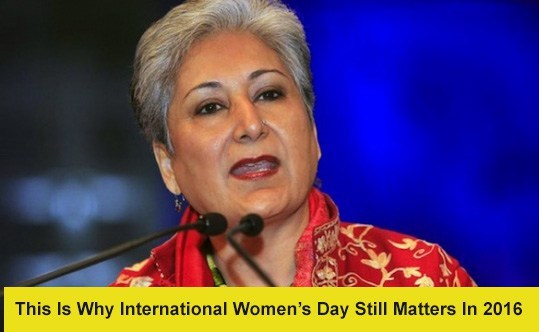
Raheel Raza, the president of the Council for Muslims Facing Tomorrow, also came from Pakistan. As a young girl, she began writing because of course she grew up in a culture where girls were supposed to be seen and not heard.
This grew into a long and successful career as a freelance journalist, and she recently worked with eight other women’s rights activists through the Clarion Project on its latest film, Honor Diaries, which tackles honor-based violence.
We know about those, right? How a Middle-Eastern woman can (and often is) stoned to death for being raped? For adultery? While the males perpetuating the criminal rape or part of the adulterous couple aren’t even questioned . . .
Those are the more extremes, but as Raza says, girls are often horrifically punished for glancing at a boy . . .
And here’s the secret: This doesn’t just occur in the huts of far-removed Middle-Eastern villages. According to Raza’s research, it occurs right here in the USA.
In fact, Newsweek reported that genital mutilation has been perpetrated on girls in this country, and we’ve known about it, for a very long time. The fact of the matter is that the number of women and girls at risk for this, here, in the USA, has more than doubled in the past 10 years.
Didn’t you just gulp?
Raza’s powerful book, Their Jihad, not my Jihad, is a collection of newspaper columns on the themes of political jihad, women’s rights, and the struggle against Islamic fundamentalism—all over the world. Now living in Canada (bet we can figure out why!), she was the first Muslim-Canadian to lead mixed-gender prayer services.
She’s also hilariously funny. Incredibly well spoken. And as courageous a woman as I’ve seen, unafraid to take on, well, just about anybody.
But what’s the point of this for you? What can you do about any of it?
Making a difference is easier than you think.
Participate in International Women’s Day, even if just online. Comment, share, listen to the speeches, all of which will have calls to action.
Support the causes of women such as Malala and Raza. With just a few dollars, or active participation.
Make sure your daughters and nieces and granddaughters all know what it’s like to be female in other countries. AND, that women in this country still only make 79 cents to the man’s dollar. Whenever I talk with a young girl about that, her eyes always spring wide.
Vote. My goodness alive, a woman is about to be the Democratic Nominee for Present of the United States!
And NO! I’m not telling you who to vote for. I’m mentioning it because even though we’ve come a long way, we still have a long, long way to go.
My point is to exercise your privilege to vote—and it is a privilege, from which women worked long and hard in the last century, to put into our hands.
Vote for the candidates of your choice, absolutely. And while you’re at it, see which ones fight for the rights of women . . .
In essence, our rights are all up to us. It constantly amazes me that now we’re the adults in the room! But, we are. It’s time to make a difference. We are it.
So go out and take an action. Go out and do it!
I’d love to know your thoughts, and how things go!
The post This Is Why International Women’s Day Still Matters In 2016 appeared first on Susan Mary Malone.
March 2, 2016
16 Ways to Deal with Regret and how to get Past It
“Regrets, I’ve had a few, But then again, too few to mention . . .” sang Frank Sinatra.

Or then again, maybe more than a few!
In our culture of late we’ve seen a surge in the YOLO idea—You Only Live Once—and contained within that is to have no regrets. Especially with the youth culture, the idea is so pervasive in popular songs.
Then again, we all knew everything when young too, no?
But can you actually live without regret? And is it wise to do so? Or does that mean you’re lying to yourself?
We know where the latter gets you.
In 2012, palliative-care nurse Bronnie Ware published The Top Five Regrets of the Dying: A Life Transformed by the Dearly Departing. And while of course not a scientific study, I’d say she has as good a grasp on this as anybody, with the course of her life’s work, day by day. I’ve had the honor of dealing with the passing of loved ones, and with the Hospice nurses who aided our journeys. They are simply angels of mercy.
The top five Ms. Ware found on those deathbeds:
I wish I’d had the courage to live a life true to myself, not the life others expected of me.
“This was the most common regret of all. When people realize that their life is almost over and look back clearly on it, it is easy to see how many dreams have gone unfulfilled. Most people had not honored even a half of their dreams and had to die knowing that it was due to choices they had made, or not made. Health brings a freedom very few realize, until they no longer have it.”
I wish I hadn’t worked so hard.
“This came from every male patient that I nursed. They missed their children’s youth and their partner’s companionship. Women also spoke of this regret, but as most were from an older generation, many of the female patients had not been breadwinners. All of the men I nursed deeply regretted spending so much of their lives on the treadmill of a work existence.”
I wish I’d had the courage to express my feelings.
“Many people suppressed their feelings in order to keep peace with others. As a result, they settled for a mediocre existence and never became who they were truly capable of becoming. Many developed illnesses relating to the bitterness and resentment they carried as a result.”
I wish I had stayed in touch with my friends.
“Often they would not truly realize the full benefits of old friends until their dying weeks and it was not always possible to track them down. Many had become so caught up in their own lives that they had let golden friendships slip by over the years. There were many deep regrets about not giving friendships the time and effort that they deserved. Everyone misses their friends when they are dying.”
I wish that I had let myself be happier.
”This is a surprisingly common one. Many did not realize until the end that happiness is a choice. They had stayed stuck in old patterns and habits. The so-called ‘comfort’ of familiarity overflowed into their emotions, as well as their physical lives. Fear of change had them pretending to others, and to their selves, that they were content, when deep within, they longed to laugh properly and have silliness in their life again.”
Most interesting about this list is that the regrets all center around what people didn’t do, rather than what they did. Which bears out a study by Morrison and Roese that showed regretting inaction lasted longer than action regrets. And that the feelings of loss were far greater in those regrets of inaction as well.
I don’t know about you, but I’ve had each of these regrets at some point in my life. And, learned from each and every one as I worked through them. I’m still grappling with number 2! But the others I’m very conscious about while building my life. In part because I know the pain of regret when not doing so. Which is something I’d rather avoid
Long ago when studying myths, I came across Nietzsche’s philosophy of “amor fati,” or love of one’s fate. He wrote, “My formula for greatness in a human being is amor fati: that one wants nothing to be different, not forward, not backward, not in all eternity. Not merely bear what is necessary, still less conceal it—all idealism is mendaciousness in the face of what is necessary—but love it.”
Mythologist Joseph Campbell says, “There is an important idea in Nietzsche, of Amor fati, the ‘love of your fate,’ which is in fact your life. As he says, if you say no to a single factor in your life, you have unraveled the whole thing.”
So how do we square the idea of YOLO with human regret, and avoid those big 5 at the end?
Nietzsche’s work focused on waking people up from their daily habits, from the gilded cage of daily life, which make us creatures of comfort. The vehicle for people to wake themselves up, to become conscious, to change their lives, he said was regret.
And he had a 2-sided method for dealing with it, which incorporates both sides, and oddly sounds like the heart of a 12-step group:
If you choose wrong, forget it. Accept it and love it.
From now on, live with constant awareness of your mortality. And choose differently.
Here are 9 of ways for how to deal with life regrets:
Find Your Life’s Purpose.
Nothing, absolutely nothing opens up one’s world like living a life on purpose. That’s where creativity and inspiration live—where you feel literally inspired by the gods.
“Follow your bliss,” Campbell so famously said.
Quite Being a Victim.
Anytime you blame people or circumstances for your unhappiness, you’ve just given them the power to make you unhappy again. Because it’s not about them, in the end. It’s about you and your choices.
“How would your life be different if…You stopped validating your victim mentality? Let today be the day…You shake off your self-defeating drama and embrace your innate ability to recover and achieve.” ― Steve Maraboli, Life, the Truth, and Being Free
Let Go of the Past.
By clinging to those past mistakes, you keep them alive and flourishing in your psyche. Which has the odd effect of causing you to repeat them. Yes, understanding past actions helps you to move past them. And that’s the point—moving past them. Because dwelling on them, obsessing, just keeps you there. And worse, blocks you from the happiness before you.
“Let go. Why do you cling to pain? There is nothing you can do about the wrongs of yesterday. It is not yours to judge. Why hold on to the very thing which keeps you from hope and love?”–Leo Buscaglia
Banish Excuses.
Didn’t reach the goal you were shooting for? Yep, figuring out why is imperative. But it’s so easy to start with excuses. And those are never the issue. They exist to cause you not to take responsibility for the issue.
Filled with reasons why you can’t do something?
As author John Belfort says, “The only thing standing between you and your goal is the bullshit story you keep telling yourself as to why you can’t achieve it.”
Get Out of Your Comfort Zone
Take risks. I know, most of us are risk averse! I know I am. But it’s when I dive into the scary waters of the unknown that the magic arrives. Yep, this isn’t terribly comfortable, but that’s when you know you should do it.
“Move out of your comfort zone. You can only grow if you are willing to feel awkward and uncomfortable when you try something new.” — Brian Tracy
Appreciate.
This sounds like a no-brainer, right? But so often we judge rather than appreciate. And those two things produce radically different energy. By turning the other cheek, so to speak, by seeking the good, the positive, in those around you, connections grow stronger.
By doing so with your own life, the positive flourishes.
“Dwell on the beauty of life. Watch the stars, and see yourself running with them.” ― Marcus Aurelius, Meditations
Let Go of What If
Isn’t that a tough one? It’s so easy to get caught up in: What if my life were different? What if such and such had worked out? What if I’d succeeded at x?”
But, it isn’t and it didn’t.
By dwelling on what didn’t or hasn’t happened, by blaming life today on that, you’ve just flown out of the Present, back into the Past or the Future, and aren’t living your life.
“Finish each day and be done with it. You have done what you could. Some blunders and absurdities no doubt crept in; forget them as soon as you can. Tomorrow is a new day. You shall begin it serenely and with too high a spirit to be encumbered with your old nonsense.” ― Ralph Waldo Emerson
Choose to be Happy.
Because happiness is a choice. No matter your circumstances, you can still wake up every day and choose to be happy. Study after study after study in the last few decades have proven this. So why not take advantage of this?
“Habits of thinking need not be forever. One of the most significant findings in psychology in the last twenty years is that individuals choose the way they think.” —Martin Seligman
Never, Ever, Ever, Ever Give Up on Yourself.
You are who you have. No matter if you live in the worst conditions imaginable, have just been dealt a horrendous defeat, have suffered losses too awful to count, you’re still here.
You’re still in the game.
No one knows which way the fates will turn tomorrow, or even today.
You are worth it. There’s a reason you’re here. Pat yourself on the back, dust yourself off, and keep living.
“It matters not how strait the gate,
How charged with punishments the scroll,
I am the master of my fate:
I am the captain of my soul.”
The post 16 Ways to Deal with Regret and how to get Past It appeared first on Susan Mary Malone.
February 24, 2016
Are You Empowering Girls to be Brave?
We see girls being brave in our world, in huge public ways and smaller ones as well.

Empowering Girls
Who among us isn’t motivated by the incredible courage of Malala Yousafzi? The young Pakistani girl who loved learning, loved school, and became an outspoken opponent of Taliban efforts to restrict education and stop girls from going to school.
So Taliban leaders voted to kill her.
And nearly did.
But she survived. To fight louder, stronger, advocating for the rights of girls to become educated.
Our daughters and nieces and all the young girls we know won’t (we hope) be faced with such choices.
Yet and still, day-to-day life poses huge obstacles to girls trying to be who they are.
Faced with enormous pressures to conform to beauty standards, to don the latest fashions and be the most popular, to fight off peer pressure and that from a body-obsessed media, how can a girl maintain the core sense of herself and be the best person she can be?
It takes help from all the women and men around her. Malala’s love of learning came from her father, who ran a school next to the family’s home, and became an outspoken critic of the Taliban restricting the education of girls.
Ah, powerful stuff indeed, that love of learning.
Girls in childhood tend to be brave. According to Martin Seligman, M.D., girls, at least up to puberty, are more optimistic than boys.
But this changes dramatically in adolescence.
These very formative years, however, will determine which women become leaders (which always requires bravery), and which don’t.
After years of research as a psychologist and consultant for women struggling in the professional world, Dr. Stacey Radin in her book, Brave Girls: Raising Young Women with Passion and Purpose to Become Powerful Leaders, made a groundbreaking realization: It all begins in middle school. At a pivotal time in their lives, girls learn to advocate for others, think critically, and, most importantly, gain confidence in their abilities to create change.
So how can we help our girls be brave? To learn to think for themselves and be who they are, in the face of constant pressure to conform? Many ways exist, but here are a few:
֎ Focus on the Intellect.
When my nieces were quite young, I was living on the farm, writing. Not a very conventional lifestyle, and the family thought me a bit of an odd nut. But my nieces found me to be magic.
And when we visited, I never focused on what they were wearing (their mother always had them dressed so cute, even when out at the farm), or how pretty they were (both were and are just beautiful). Instead, we talked about what they were reading. What they learned in school that week. Which subjects they liked best, which were a struggle.
For a time they could forget about trying to be the cutest, and winning in that manner. And instead, focus on who they actually were becoming.
1. Ask her opinion.
Kids and pre-teens especially are inundated by family and authority figures with what they’re supposed to think and do and be. But what often gets lost in the mix is what the girl herself thinks about the world around her. And while of course all the former is necessary, learning is a two-way street, a back and forth of the ideas and concepts she’s passing through.
So often people say their kids won’t talk to them. Which I often find amusing, as most of the time, girls never shut up around me. Because I don’t tell them what they “should” be thinking or doing, but instead ask them their opinions.
And kids have opinions. Lots of them. All you have to do is find the questions that unlock the keys to their thoughts, and off they go. And then, don’t pass judgement unless asked.
I’ll never forget one of my niece’s friend’s saying to me when they were teenagers, and we were having a deep conversation, “We can talk to you, Aunt Sue, ‘cause you’re not really an adult.” I still chuckle at this. But it just meant I listened more than I preached. And found out far more about their world than the other “adults” around them . . .
2. Become a media critic.
And not about what the latest celeb was wearing, but rather, about why that was the entire focus. Questions as simple as, “I wonder what that actress thinks that they only talk about her butt?”
After a few giggles, the conversation will grow deeper . . .
Or, question the motives of a movie or advertisement. Questions as simple as, “Wonder why she needs to be saved? Her life must be really boring!”
Not accepting the figure-blasting or waif-promoting images opens a new place for girls to consider.
3. Encourage girls to participate.
I grew up in a time when girls weren’t really playing sports. Once we got past the elementary years where softball and tetherball were played by both sexes, boys kept playing and girls, well, girls cheered them on.
Thank God this has changed. Yet, so many of the young girls I know still watch from the sidelines. Which is all fine and good—as long as they participate in some sort of endeavor.
Because that’s where you learn your strengths and weaknesses, and how to master tasks, how to be a good sport, win or lose.
How to jump in and be part.
As Amelia Earhart said, “The most effective way to do it, is to do it.”
4. Encourage them to dive in even when they’re afraid. Because fear is a part of any process, of taking on a new thing and running with it.
And there’s no better time to learn to face fear than now. Whenever that now is.
Fear is a great teacher. Until you participate in something that scares you, that fear can lie dormant until a time comes when you have no choice but to participate. And then it bites a huge hunk out of your backside. When a girl faces smaller ones as she goes, she builds courage to carry her on.
I love what author Caroline Myss says about this:
“Always go with the choice that scares you the most, because that’s the one that is going to require the most from you.”
And what better place to learn that than when making the crazy transition from childhood to womanhood.
Girl empowerment grows our next generation into empowered women. Into women who can change their own lives, and the ones around them. Ultimately, courageous, strong, intelligent women change the world.
And uncovers early on what author Marianne Williamson says about fear, so our girls can go beyond it:
Our deepest fear is not that we are inadequate. Our deepest fear is that we are powerful beyond measure. It is our light, not our darkness, that most frightens us. We ask ourselves, who am I to be brilliant, gorgeous, talented, fabulous?Actually, who are you not to be?
The post Are You Empowering Girls to be Brave? appeared first on Susan Mary Malone.
February 17, 2016
17 Ways to Change Your World
Don’t we all want to change the world? At least in some form or fashion.

Everybody I know wants to change at least something about this world we live in, if not a lot of somethings.
I often joke that if I ran the world it would be a far better place. I am laughing, but part of me believes it.
And most folks I know believe that too.
Lord knows, the world needs fixing!
In the idealism of youth, we actually believe we can do this. As in achieve it. But it doesn’t take too many steps on this path of life before we see that, well, the world is a lot bigger than we are.
And while you truly can fight city hall, most of the change we can effect isn’t outside us.
All change for the better begins within.
So if I want to change my life, how do I begin?
Figure out what you want to change. I know, this seems like a no-brainer, right? But so often when I talk with young women, they tell me they want their lives to be better. Which is great! But the specifics then come quite vaguely.
Make a list. Brainstorm. Write down every single thing that comes into your head.
Prioritize that list. Yep, not very sexy. I mean, you’re wanting to save the whatever! Not sit here making lists. But focusing on the top 5 things you want to improve is crucial to how to change your life.
Take the first one and make a plan. From beginning to end. Whether it’s “getting in shape,” (you can start out in the vagaries, but getting to specifics is where the key lives) or learning Spanish, delineate the action steps to get you there.
Break these down into manageable steps. The surest way to give up on a goal is to make the steps involved too large or broad and not reach them. Reaching the first wrung on your ladder causes you to feel empowered, which then spurs you on to tackle the second one.
See where the holes in your knowledge, skill set, guidance are. And there are always lots of holes. Because you obviously don’t know what you don’t know, or you’d already have mastered the change.
Get help. Whether it’s an online course, finding a mentor, talking to someone who has already achieved what you’re shooting for, help is out there.
Commit to the goal. I know, another no-brainer, right? And wouldn’t you think this one would’ve come earlier in the process?
The difference in commitment and desire, however, is huge. You wouldn’t commit to a marriage with a person you didn’t know, would you? The point being you need to know what you’re up against before going all-in. And there is no shame whatsoever in wanting to achieve something, dissecting what it takes to get there, weighing the pros and cons, and then deciding to pursue a different goal. That’s called maturity.
Once you do commit, once this is truly yours to do, inspiration surges. Make sure you feel that. If not, reexamine step 8. Make sure you’re not a wee bit shy of your truth. Inspiration is a great litmus test for if this thing is truly yours to do. As Patanjali, the compiler of the Yoga Sutras, famously said:
“When you are inspired by some great purpose, some extraordinary project, all your thoughts break their bonds: Your mind transcends limitations, your consciousness expands in every direction, and you find yourself in a new, great and wonderful world. Dormant forces, faculties and talents become alive, and you discover yourself to be a greater person by far than you ever dreamed yourself to be.”
Pat yourself on the back. Yeah, you. You’re on a noble quest! Acknowledge yourself for being on your path. That will cause energy to surge some more. Energy that you can surely use!
Don’t hesitate to change directions. This isn’t about forsaking your goal at all, but rather, being flexible enough to turn a different way. Unforeseen circumstances will surely arrive, and by being able to change the plan when called for, you’ll find a better way to the goal.
Because those dormant forces will be showing you another way. Listen. Watch. Revise. The only shot in life is the next one.
As Zig Ziglar said, “When obstacles arise, you change your direction to reach your goal, you do not change your decision to get there.”
Realize that “failure” is just another way to not succeed. It’s easy to get derailed or demoralized when you fall. But it isn’t the failure itself that stops most people, but the emotional valance we give it. Are you really not good enough? Or do you just need to practice more? Did you fail because you’ll never get there? Or because you didn’t know how to do the thing that felled you?
Because no one masters anything without doing some falling on the butt. So expect and accept that that’s going to happen. Then get up off the mat, see what you need to work on, and proceed again.
Know that a lot of the road will just be filled with slog. We expect highs and lows, but most folks forget that so much of the battle is just waged in the trenches. And those get muddy and boggy and long and slow, without much excitement. It’s easy to question here. “Nothing’s happening!”
Or is it? Mastering difficult steps can often just be a process of doing them—over and over and over.
Plan out rewards along the way. We need them. They inspire us, and we know all the fabulous things that come with inspiration
Stopping to celebrate how far you’ve come pays huge dividends. And besides, you’re worth it.Complain. We hear so often, “Winners don’t complain!” And while as a way of living that’s pretty true, everyone has down times. And if you stuff it, you’re not being honest with yourself. Horrors! Because we know what self-deception brings.
So, get it out. Vent. But set a time limit for this. Take an hour (or a few) and wallow in the misery of it all (doesn’t even the thought of that bring a chuckle? But the harder you wallow, the ludicrousness of giving your power to perceived problems becomes quite apparent!). Then get back on your path to success.
Reevaluate where you are. Often. What usually surprises people here is not how much they’ve failed, but how far they have come. Wow—I learned that! I accomplished this. I’ve come a pretty good ways toward my goal.
Maybe here you need another celebration
Walk your spiritual path in conjunction with the one toward your goal. This one is pervasive, and covers your entire road to success.
Whatever path you walk spiritually upon, be sure to stay with it. This feeds your soul, which is of course the source of strength you’re drawing from. Nothing un-grounds me quicker than being “too busy” to follow my spiritual path. And nothing puts everything back into perspective like the peace that comes with doing so.
As Author Alice Walker says, “Teach yourself peace. Pass it on.”
Which comes to the crux of all of this. If I could change the world, I know I have to change myself first. We are the change that we become.
So change yourself. And then go make the world a better place.
The post 17 Ways to Change Your World appeared first on Susan Mary Malone.
Happiness is a Story

- Susan Mary Malone's profile
- 85 followers

