
Aaron Ross Powell's Blog, page 13
May 7, 2016
The Bittersweet Abundance of Our New Star Wars Era
I was reading news about the casting of the new Han Solo movie and it struck me. As of December last year, we’ve fully entered an era of Star Wars abundance. An original Star Wars movies every year. Star Wars on television. Books and comics advancing the canon.
That’s good. Wonderful. We’re not just staring down the firehose new Star Wars, but what we’re getting is good. Lucas is out of the picture and the franchise is in the hands of people who grew up with it, love it, and–here’s where Lucas stumbled–understand why we all love it.
But I’ve got three kids, of ages where they’re just dipping their toes into what I hope will be a lifelong love affair with the franchise, and something about this abundance–irrationally perhaps–makes me a little sad. Because abundance means their relationship with Star Wars, assuming they get hooked, will be in important ways different from my own. Part of the magic of those movies, especially before the still-birthed prequels, was their scarcity. You got three films. That was it, really. (Because I’m not counting the inconsistent, high-gloss fan fiction of the Expanded Universe.)
It’s similar to how unlimited streaming changes the relationship to music. I grew up saving my allowance or tiny, part-time paychecks for an album, then buying it, and then listening to it over and over and over, because it’s what I had. This created a relationship to the music, a permanence of memory maybe, that won’t happen when you can listen to anything any time at zero marginal cost, and so wander more.
Part of my Star Wars experience is long term and frequent immersion in the original trilogy. Learning it inside and out. Memorizing it, basically. With a new movie every year, one or more TV shows, etc., that won’t happen. Which, even though the abundance is wonderful, also makes me a little sad. Will they have every line of every movie memorized? Of course not. Why would they?
Now is the best time ever to be a Star Wars fan. No doubt. But it’s a different kind of fandom, too. Abundance is awesome. But it’s not without effects. In the case of Star Wars, look with bittersweet anticipation on a future where my kids have so much of it that no single movie is a special and central as those original three were for me.


What the Star Wars Prequels Did Right
They’re terrible movies. Let’s get that out of the way. But watching The Force Awakens again, and then again the divine Original Trilogy, I got this weird and unsettling flash of appreciation for something Lucas had done in those stillbirths of CGI and suffering actors and dialog usually confined to airport novels written by ex-advertising executives. He built a universe and showed it to us.

This is a place people live.
Of course, he’d already done a bit of that with the Originals. We had an Empire and its Rebels. We had spectacular aliens and even more spectacular spaceships. But what we saw of it was only so much as needed to give the characters somewhere to be. Very little came off as existing without them. Luke’s farm sits like as movie set in the middle of nowhere. Alderaan is just a blue sphere until it’s not. Hoth’s a Rebel base and nothing else, and Dagobah is Yoda’s hut and a murky pond.
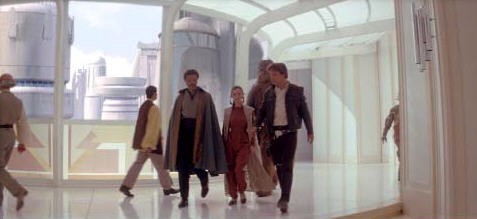
Not that we don’t get tastes. Tatooine in Episode IV has Jawas, a pass through Mos Eisley, and that wonderful cantina. Cloud City in Episode V features hallways with doors behind which people presumably live and earn a living. Jabba’s palace and Endor in Episode VI show denizens up to things unrelated to the struggle for a new Republic.

But those are small. Just tastes. The prequels gave us the whole meal. Planets and citizens. Civilizations from screen corner to screen corner. We knew about this stuff, some of it, going in, because we could imagine it in the Originals’ lacuna and had been told about it in novels and comics and games. Still, the prequels widened, radically, the scope of Star Wars.
That’s what I missed from The Force Awakens. It’s a great movie, a return to form, a revitalization and a demonstration of faith on Disney’s part that they get it, that they’re fans, too. But it’s a return to form, too, in narrowing that scope. Again we’re in a universe of isolated sets, of points of light in otherwise wilderness. Even Maz’s castle seems to exist without neighbors. There are no cities in The Force Awakens, save for a single shot, and only two villages, if we can call Niima Outpost that, and if we count Lor’s tiny settlement, which we only witness dying and never living. The wide angles of the prequels have become tight.
Perhaps this was intentional, meant to remind of us A New Hope, as so much else does, or to keep us focus on fresh faces as a way to establish them in our consciousness the way Luke and Leia and Han are. The fresh worlds will come. But after the expanse of the prequels and then the Clone Wars TV show, The Force Awakens feels a little small.
The prequels feel big.
May 2, 2016
What the Star Wars Prequels Did Right

They’re terrible movies. Let’s get that out of the way. But watching The Force Awakens again, and then again the divine Original Trilogy, I got this weird and unsettling flash of appreciation for something Lucas had done in those stillbirths of CGI and suffering actors and dialog usually confined to airport novels written by ex-advertising executives. He built a universe and showed it to us.
Of course, he’d already done a bit of that with the Originals. We had an Empire and its Rebels. We had spectacular aliens and even more spectacular spaceships. But what we saw of it was only so much as needed to give the characters somewhere to be. Very little came off as existing without them. Luke’s farm sits like as movie set in the middle of nowhere. Alderaan is just a blue sphere until it’s not. Hoth’s a Rebel base and nothing else, and Dagobah is Yoda’s hut and a murky pond.

Not that we don’t get tastes. Tatooine in Episode IV has Jawas, a pass through Mos Eisley, and that wonderful cantina. Cloud City in Episode V features hallways with doors behind which people presumably live and earn a living. Jabba’s palace and Endor in Episode VI show denizens up to things unrelated to the struggle for a new Republic.
But those are small. Just tastes. The prequels gave us the whole meal. Planets and citizens. Civilizations from screen corner to screen corner. We knew about this stuff, some of it, going in, because we could imagine it in the Originals’ lacuna and had been told about it in novels and comics and games. Still, the prequels widened, radically, the scope of Star Wars.
That’s what I missed from The Force Awakens. It’s a great movie, a return to form, a revitalization and a demonstration of faith on Disney’s part that they get it, that they’re fans, too. But it’s a return to form, too, in narrowing that scope. Again we’re in a universe of isolated sets, of points of light in otherwise wilderness. Even Maz’s castle seems to exist without neighbors. There are no cities in The Force Awakens, save for a single shot, and only two villages, if we can call Niima Outpost that, and if we count Lor’s tiny settlement, which we only witness dying and never living. The wide angles of the prequels have become tight.

Perhaps this was intentional, meant to remind of us A New Hope, as so much else does, or to keep us focus on fresh faces as a way to establish them in our consciousness the way Luke and Leia and Han are. The fresh worlds will come. But after the expanse of the prequels and then the Clone Wars TV show, The Force Awakens feels a little small.
The prequels feel big.

What the Star Wars Prequels Did Right was originally published in Aaron Ross Powell‘s Blog on Medium, where people are continuing the conversation by highlighting and responding to this story.
March 4, 2016
Empathy for Trump Voters?
There’s a lot of talk about how elites aren’t fair to Trump voters. That what we see as an attraction to his racism, xenophobia, and, well, stupidity, is in fact a much more reasonable anger at elites who have promised prosperity while working class Americans have seen their prospects decline. Or anger at a culture war that has moved too quickly, its victors too dismissive of its losers. Or anger that it’s not politically correct to say negative things about blacks, or women, or gays, but that it’s perfectly fine–applauded, even–to crack wise about middle America.
I appreciate that line of thought, and, as I’ve written elsewhere, think elites suffer from a genuine lack of empathy for the working class and the struggles it faces in a modernizing economy.
But here’s the problem with it: No matter how deep and real the problems Trump supporters are angry about, their response–embracing Trump–remains contemptible. Set aside the fact that Trump’s proposed policies, such as we can make sense of them, would not actually make things better for working class Americans. Most Americans, across ideologies, lack much understanding of the outcomes of public policy. No, by embracing Trump, I mean embracing the stuff that’s ugly and vicious, no matter one’s perspective on economic cause and effect. I’m talking about his calls to murder the innocent families of terror suspects. I’m talking about his insane plan to deport poor immigrants and prevent entry into the country. I’m talking about his threats to use the office of the president to attack anyone who’s spoken out against him, and to “open up” libel laws because he’s a coward who can’t take criticism.
Cheering Trump as a result of legitimate grievances is like deciding that, because your boss fired you unfairly, you’re going to murder his children. We can say that, yes, you’re right to be mad, and we should empathize with the unjust hardship, but that empathy doesn’t–shouldn’t, can’t, if we believe in basic morality–extend to your reaction to it. America’s elites are often arrogant and ignorant and treat the working class poorly and need to stop. But that in no way excuses the embrace of a man rotten to his core.
March 2, 2016
Immigrants Did Not Take Your Job
Immigrants did not take well-paying American jobs.
Rather, the amount employers can afford to pay someone to do that job (i.e., the amount of return that job produces for the employer) fell—for a variety of reasons, many the result of technological growth. It fell to the point where native-born Americans were demanding more than the employers could justify. The only people willing to work at the lower wages that would still allow the employer stay in the black are immigrants.
So, yes, immigrants have many jobs that used to be done by native-born Americans, but they did not take them. And kicking out the immigrants will not get those jobs back.
February 25, 2016
The Tech World’s Weirdly Myopic View of Government
Whenever the government gets involved in something they understand, techies turn quite libertarian. “We need to stop the FBI from creating dangerous precedent by forcing Apple to unlock an iPhone.” Or, “Regulators will just screw up Uber and Airbnb, because they don’t understand what they’re doing and, anyway, they’re just going to regulate in favor of the dinosaur firms.”
But the moment we talk about something outside the domain knowledge of techies, they settle back into progressive shibboleths. “Government ought to run the health care industry.” Or, “Of course the state should be able to take away everyone’s guns. What could go wrong?”
A good rule of thumb: If you notice that the government works remarkably poorly whenever it gets involved with an issue you know a ton about, you should probably assume it’ll work just as poorly — with just as many errors and bad incentives — when it gets involved in an issue you’re largely ignorant of.
The Tech World’s Weirdly Myopic View of Government
Whenever the government gets involved in something they understand, techies turn quite libertarian. “We need to stop the FBI from creating dangerous precedent by forcing Apple to unlock an iPhone.” Or, “Regulators will just screw up Uber and Airbnb, because they don’t understand what they’re doing and, anyway, they’re just going to regulate in favor of the dinosaur firms.”
But the moment we talk about something outside the domain knowledge of techies, they settle back into progressive shibboleths. “Government ought to run the health care industry.” Or, “Of course the state should be able to take away everyone’s guns. What could go wrong?”
A good rule of thumb: If you notice that the government works remarkably poorly whenever it gets involved with an issue you know a ton about, you should probably assume it’ll work just as poorly — with just as many errors and bad incentives — when it gets involved in an issue you’re largely ignorant of.

The Tech World’s Weirdly Myopic View of Government was originally published in Aaron Ross Powell’s Blog on Medium, where people are continuing the conversation by highlighting and responding to this story.
February 23, 2016
College, Political Correctness, and Intellectual Stasis
I loved college. Taking classes and monopolizing professor office hours is about as ideal a life as I can imagine. But it’s difficult to avoid the conclusion that I got out at the right time. I saw none of this new wave of political correctness when I was a student — and I went to the University of Colorado in Boulder, which you’d think would be on the vanguard of movements like that.
There’s the obvious concern about the wider repercussions of the sort of militant infantilization currently gripping our campuses. I get that, and I am fearful of where this might all lead. More, though, I feel sad for the kids who are robbing themselves and their peers of what’s so profoundly wonderful about attending a university. College isn’t about learning a set of facts or training for a job or earning a credential. If you go into it looking for those things, you’re missing the point. College is about growing as a person, about coming out richer in mind and character than when you started. But for that to happen, you have to let it. Not even seek it out or actively strive for it. Just let it happen. At a good university, it’s in the air.
The trouble is, college kids today seem dead set on fighting personal change, on shutting out anything that might lead to or enable it. It’s like they’ve looked at themselves as they exit high school and said, “This is the best I can be. What matters now is stasis.”
College is by no means the only way to grow and evolve when you’re in your late teens and early twenties. Of course it isn’t. But it’s not like today’s undergrads are availing themselves of the alternatives. They want instead to remain children, and to drive from campuses anyone who strives for more.

College, Political Correctness, and Intellectual Stasis was originally published in Aaron Ross Powell’s Homepage on Medium, where people are continuing the conversation by highlighting and responding to this story.
On Assessing Arguments
Let’s say you believe X is true. You know that many smart, well-educated people believe X — including you! — but also that many smart, well-educated people disbelieve X.
If you come across what strikes you as an obvious, airtight argument for the truth of X, but don’t routinely engage with smart, well-educated people who disbelieve X, then stop a moment and reassess how certain you should be about the obviousness and airtightness of that argument.
Chances are those smart, well-educated people who disagree with you have heard the argument before and have a reasonable — though not necessarily correct! — response. Smart people tend not to hold considered beliefs for conspicuously dumb reasons.

On Assessing Arguments was originally published in Aaron Ross Powell’s Homepage on Medium, where people are continuing the conversation by highlighting and responding to this story.
February 19, 2016
The Meaninglessness of the Clone Wars
I can’t get into Star Wars: The Clone Wars. It’s sat in my Netflix queue for literally years, and I’ve only made it six episodes into season three, and most of that has come half an episode here, half an episode there. I don’t think I’ve ever watched more than two episodes at a time. The show completely fails to engage me.
I’ve been thinking about why that might be, given my enthusiasm for pretty much all things Star Wars. And it comes down to stakes. This is a show about a single, galactic conflict, and none of it matters. Not just because we know how it ends. I love Star Wars Rebels, and I know how that conflict ends. The Clone Wars are different. For one, because we know Palpatine’s basically in charge of both sides, the “war” is like watching one guy play chess against himself. No matter what happens, he wins, and so the individual conflicts within it aren’t part of something bigger.
But, second, even setting that aside, I don’t feel the weight of the non-secret stakes, either. With the Rebellion, you had an obviously evil empire oppressing people, and a band of freedom fighters fighting for, well, freedom. It mattered who won. But why is the Republic fighting the Clone Wars in the first place? Is it because its existence is threatened by an outside foe? No. It’s because a bunch of worlds, disatisfied with its rule, want to … leave. They don’t want to destroy the Republic or enslave its citizens. They don’t even want to enslave their citizens. They just want to do their own thing. And this is bad. So bad that the Republic needs to mobilize all its forces and fight a costly war to stop it. But … why? I know the writers think the war’s important. George Lucas thinks the war’s important. But that doesn’t mean it is important. It just isn’t. And the secret stuff doesn’t make it any more important, because of the whole “chess against himself” thing.
I’ll still probably finish the show. It may just take me another several years.
Aaron Ross Powell's Blog

- Aaron Ross Powell's profile
- 18 followers

