
Aaron Ross Powell's Blog, page 10
September 20, 2017
001: Why You Needn’t Obey the Law
Welcome to the very first episode of my show! I kick things off with a discussion of one of my favorite topics: the remarkable difficult question of whether we’re obligation to obey the law. Plus, I manage to work in a Star Wars reference.
Here’s some of the books and other documents I reference in the discussion:
David Hume, “Of the Original Contract”
Town of Castle Rock v Gozales
Robert Nozick, Anarchy State and Utopia
If you like the show, or want access to previews and behind the scenes stuff, please consider supporting the show at www.aaronrosspowell.com/support


September 18, 2017
How Aristotle Predicted Twitter and the Alt-Right
I’m rereading Aristotle’s Nicomachean Ethics for the umpteenth time for a book club with some of my colleagues, and a passage early on struck me as informative about much that’s going on in American culture today. It comes in Book 1 of the Ethics, and for those classics nerds among you, falls at 1095a.
Learning to be Ethical
It’s important to note that Aristotle sees his project, in the Ethics, as providing not just a moral theory — as philosophical texts on ethics do today — but a broader guide to leading a good life. The Ethics is an instruction manual, meaning it’s meant to be used by an audience. Thus, in the passage, Aristotle is setting out who that audience is.
Hence a young man is not a proper hearer of lectures…; for he is inexperienced in the actions that occur in life, but its discussions start from these and are about these; and, further, since he tends to follow his passions, his study will be in vain and unprofitable, because the end aimed at is not knowledge but action. And it makes no difference whether he is young in years or youthful in character; the defect does not depend on time, but on his living, and pursuing each successive object, as passion directs. For to such persons, as to the incontinent, knowledge brings no profit; but to those who desire and act in accordance with a rational principle knowledge about such matters will be of great benefit.
Think about that passage in the context of contemporary debates about what’s going on on college campuses with free speech, safe spaces, the airing and censoring of disfavored ideas, etc. Or in regards to the negative reactions to NFL players kneeling during the anthem, the backlash to taking down of Confederate statues, or, on the technology front, the shaming and call-out culture we see on Twitter.
Aristotle believes children — which isn’t age limited, as it can mean also childish adults — aren’t ready to study ethics, which for him means something broader than morality, something closer to the principles of how to lead a good life. Children lack the life experience to understand what ethics aims at. And they’re too ruled by their passions, for which the end is action, not knowledge. Children want to live in their passions and operationalize them, but they’re too ruled by them to care much about the how and why of their exercise.
Some American Subcultures Have Failed to Learn Basic Ethics
It struck me that this sheds light on the behaviors mentioned above, all of which seem to have in common the embrace of simple “feelings,” which are trusted and acted upon without critical examination, and with a lashing out at anyone who would ask us to consider more carefully their source or the actions that ought to flow from them.
In a sense, then, these aspects of culture might be the result of a lack of moral growth in a range of American subcultures. Made worse, perhaps, by the incentives that exist in the online world (chasing likes and retweets, or the fun of joining a Twitter mob), which actively discourage the kind of reflection on passions and ends Aristotle thinks is necessary for the study of ethics.
In other words, I’ve come to think that a lot of what’s wrong with American culture — or at least some of its most vocal subcultures — is that we’re stuck in an indefinite adolescence. We’ve become uninterested in rationally examining our beliefs and behaviors so as to learn how to lead good and ethical lives, and instead are interested only in living out our (unexamined) passions.
America, I fear, is becoming a nation of unethical children.
August 31, 2017
Otto Warmbier and American Exceptionalism
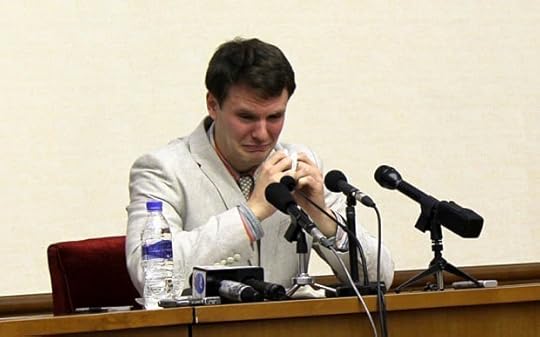
On state violence, injustice, and double standards.
Time for some whataboutism.
Otto Warmbier, an American college student, traveled with friends to North Korea where he was arrested, charged with stealing a propaganda poster in his hotel, convicted, and sentenced to over a decade of hard labor.
He didn’t make it two years. Some time after his sentencing, he fell into a coma, was recently released and flown back to the United States, and died. The exact cause of his condition isn’t known, but he’d suffered extensive brain damage, almost certainly the result of abuse by the North Koreans.
It’s a horrifying story. But why? Why does it provoke us to rage, to a desire for violent revenge against the country that would commit such an atrocity? There’s a bad answer to this and a better one. Both are true, in that both are reasons why actual people find Warmbier’s story actually enraging. But both are troubling, as well. The bad answer is vacuous. The better answer, however, exposes in us, in our inconsistency of its application, a damaging hypocrisy that gets to the core of what’s wrong with so much of our politics.
Here’s the bad answer: We get mad when we hear about Otto Warmbier because it’s a story of them harming one of us. A foreign power had the gall to savage an American, and we can’t let that sort of thing stand. But that’s not an interesting answer because it’s just dumb nationalism and tribalism.
Here’s the better answer: We get mad when we hear about Otto Warmbier because his treatment was monstrously unjust. He was arrested for violating an at best trivial law. (This assumes he stole the poster in the first place.) He was then forced into an unfair trial with no opportunity to defend himself. That trial led to a sentence dramatically out of line with the minimal nature of his “crime.” Finally, while serving that excessive sentence, he was brutalized. And carrying all this out was a government cartoonishly unjust. These facts add up, rightly, to outrage.
But here’s where we get to whataboutism and what’s so troubling about the second reason. Because Americans like Otto Warmbier are, every day, arrest for violating trivial laws, forced into trials where they have no meaningful way to defend themselves, sentenced to punishments far out of line with their crimes, brutalized while serving them, and all by a government with a history of such injustices. Eric Garner had the life choked out of him by agents of the state for the high crime of selling packs of cigarettes. Terrill Thomas died of dehydration in a Milwaukee jail cell when agents of the state turned off his water. The list goes on–and the perpetrators, like those in North Korea, go unpunished.
Yet few call for the overthrow of the regime that brutalized Garner. Few demand bloody revenge against Milwaukee’s tyrant sheriff, David Clarke. Because these things happened in America, by the actions of Americans, and so nationalism and tribalism demand we view them differently from similar horrors perpetrated by foreign powers.
Is America as bad as North Korea? Of course not. Not even close. But does America commit acts as unjust and evil as what North Korea did to Otto Warmbier? Of course. And more often than you’d like to think.
If we care about Otto Warmbier because of nationalism, then none of this matters, because all that matters is who did what, to whom. If, on the other hand, we care about Otto Warmbier because we care about justice and goodness and humanity, then our own justice and goodness and humanity demand that we react just as strongly and with just as much of a desire to see something done and to hold the perpetrators responsible when those perpetrators aren’t North Koreans an ocean away, but fellow citizens much closer to home.
June 21, 2017
Free Speech and the Whims of College Kids
 Hadley is still a child, and so administrators should listen to her, but they should’ve give her an equal say in the institution.
When I was in middle school, my history class staged a walkout. I don’t recall the reasons, but I’m sure at the time we all thought them righteous and just. I’m also sure that if I remembered those reasons today, I’d find them silly. Embarrassing. Childish, in a word, because that’s exactly what we were at the time: children.
That seventh grade walkout came to mind as I watched Michael Moynihan’s recent report on Evergreen State College for VICE News.
https://medium.com/media/01221306b7e8d67acfa40be52d326e44/hrefThe details baffle, but for my purposes here they’re largely irrelevant. The short version goes: a professor objected to a stunt put on by the students, a stunt they thought was righteous and just, and now they want him fired because he’s clearly too filled with hate, and thus too opposed to righteousness and justice, to continue teaching at Evergreen State.
The professor stood up to the students, as he should, but the administration, while not acceding to their demands, has allowed the students to berate the dean and the professor, physically menace both, and generally get treated as equal players at the table when it comes to how Evergreen State, the institution, should address whatever issues set the students off so.
The wave of similar campus tantrums has attracted quite a lot of press and think pieces, offering quite a lot of theories about the cause. Do America’s youth no longer value free speech? Is this a variety of “social justice” morality run amok? How can we right the next generation’s ideological course?
But such thinking goes wrong because it fails to grasp a key ontological point about the perpetrators. Namely, college students are still children.
Of course, college students will tell you different, and many will be insulted by this label. But all children believe, in the moment, that they are not children. When my seventh grade peers and I walked out of history class, we didn’t see ourselves as mere kids, assessing our situation through our underdeveloped lenses, and with our underdeveloped critical reasoning. Instead, we were heroes standing up to injustice. We were roleplaying the plight of the oppressed and playacting a stand against our oppressor. In short, we still had growing up to do.
So do 19 and 20 year olds. That’s why they’re in college. A university takes kids fresh out of high school and provides them an enviroment in which they can learn the skills and develop the traits that will allow them to become adults. But they’re not there yet.
How do I know they’re not there? Because I was in college once, I was 19 and 20 and 21 once. I thought, at the time, that I had it all figured out. But now, as a 38 year old, it’s obvious that I didn’t. I was still a kid. The same’s true for everyone old enough to actually be an adult. Ask them. With age and experience and perspective, they can look back at their college years with clarity.
The blame, then, for the rise of campus protests lies not with the students — they are, after all, still children, still with growing to do — but with the faculty and administrators who refuse to see them as they are, and instead pretend they’re fully adults. The adults on campus are the adults on campus, and the relationship they have with their students should be the same as at any other level of schooling. To act otherwise, to humor these outbursts, is to fail in the very purpose of education: to teach children how to be functioning adults.
These Evergreen State students will grow up and look back on their youthful outbursts the same way all of us look back on our. That is, unless the adults around them, tasked with helping them in their growing up, convince them, through misplaced humoring and an unreasonable fear of being perceived as condescending, that they’re already there.

Free Speech and the Whims of College Kids was originally published in AaronRossPowell.com on Medium, where people are continuing the conversation by highlighting and responding to this story.
April 29, 2017
Social Media and Narratives of Fear
 How social media makes us into horror movie protagonists.
Nobody desires to live in actual fear. But we love the feeling of fear if absent a genuine threat to our safety. That’s why we enjoy horror movies and scary video games and ghost stories. The rush of fear without any real danger. It’s universal.
But as our lives get safer, this short circuits into constructing narratives of panic. Lurking terrorists, the Satanic panic, sex trafficking, the threat of shark attacks. All overblown, but all ways to work ourselves up.
Panicking on social media plays to it even more, because it’s virtual, and so analogizes to fear from movies, books, games. Trouble is, panics in virtual space are, unlike the bad guy in a horror movie, about and directed at other, actual people.
So we use Twitter to make ourselves protagonists in a horror movie, which means making others into the antagonists. This can be fun, like horror movies are fun, but it erodes social bonds, and encourages bad policies.
And that makes the world actually worse, and so more legitimately frightening, all because we got stuck in the fun of a narrative.

Social Media and Narratives of Fear was originally published in Aaron Ross Powell’s Blog on Medium, where people are continuing the conversation by highlighting and responding to this story.
February 9, 2017
Donald Trump on Star Wars
The president has some pretty weird ideas about ranking the Star Wars movies it looks like.
February 8, 2017
Which Star Wars Novels Are Worth Reading?
When Disney took over the Star Wars franchise, they rebooted the novel line. The publication of A New Dawn in September, 2014, not only saw the abandonment of the earlier “Expanded Universe,” and also a much tighter integration between the novels and new movies. This had the effect of making me interested in the novels to a degree I hadn’t before.
That said, these remain shared universe fiction, which has never had a reputation for literary merit. For the most part, that reputation holds true. With one exception, none of the new Star Wars novels would be worth reading if they weren’t Star Wars–if you took the same characters, story, and prose, and put it all in an original universe. But they are Star Wars, and so some are worth reading for those of us who love the movies and want to know the events happening around them, who those background characters are, or what the major characters get up to when they aren’t on screen.
The question is, if you’re going to read Star Wars novels, which ones should you read? If you’re dedicated enough, you read them all, of course. But if your time is limited or your tastes not quite so focused, which ones are worth your time? Here’s my stab at answering.
Highly Recommended
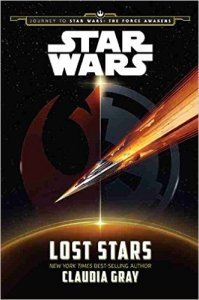
Lost Stars
The first genuinely interesting novel in the new cannon, and the first that’s an unquestionably recommended read. Star Wars: Lost Stars gives us a bit of new information on the post-Return of the Jedi era, mostly regarding the Battle of Jakku, but its good stuff comes in presenting a thoughtful, realistic look at the events of the original trilogy from an Imperial perspective. We get to see the Rebels as terrorists–“If we don’t rebuilt it, the terrorists will have won.”–and the Imperial rank and file as sympathetic true believers.
My only knock against the book is that as a YA novel, it shoehorns in a largely uninteresting teenage dram and romance. But that’s easy enough to overlook when the rest contributes so much to a story I thought I already knew inside and out.
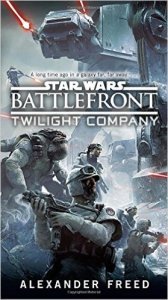
Battlefront: Twilight Company
The thing about Star Wars novels is that if you took away the Star Wars branding and set them in an original universe, we fans probably wouldn’t see much value in reading them. Top-shelf scifi they’re typically not. Battlefront: Twilight Company‘s a rare exception.
Not much new in terms of worldbuilding or secrets revealed, but this story of grunts fighting for the Rebellion is just so damn good, with compelling and adult characterization, meaningful emotion, and excellent, if a little workmanlike, prose. If you read just one of the novels in the new Star Wars cannon, make it this one. Though you run the risk, as happened to me, that Alexander Freed’s book will ruin a bit whatever else you read in the series, because it’s that much better than its peers.

Before the Awakening
Oh man, do I wish I’d read this before seeing The Force Awakens. A collection of three short stories set just before the events of the film, Before the Awakening answers a few of the most confusing things about Episode VII while not spoiling the introductions of Rey, Finn, and Poe. Rey’s story tells us why she’s such a good pilot if she spent her life landlocked on a single planet. Poe’s tells us what the Resistance is and its relationship to the New Republic. Finn’s… Okay, there’s not much in Finn’s. But it’s still good.
The book arrived from Amazon a few days before Episode VII’s premier and I held off reading it, fearing spoilers. That was a mistake. I would’ve enjoyed the movie more if I’d read this first.
Recommended With Reservations

Tarkin
Okay, if a little unfocused. It fills in a good deal of Tarkin’s backstory, but I found it didn’t do much to change my sense of the character or make me appreciate him more. Lucino’s a decent enough writer, but there’s just not enough here to make reading the novel worth the extra time over just reading Tarkin’s entry in Wookieepedia.
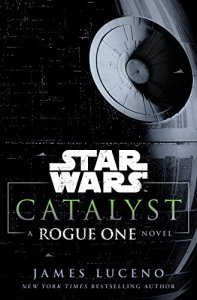
Catalyst: A Rogue One Novel
Catalyst is a difficult novel to slot into this list. On the one hand, it’s pretty dull and largely plotless. On the other, having read it before seeing Rogue One, I’m convinced it make me enjoy that movie more than otherwise. Introducing Galen Erso and Orson Krennic, it strengthens the characters and relationship of both men, and so makes the events of Rogue One better resonate. Recommended for that, but not much else.
Not Recommended
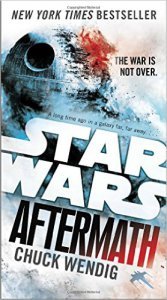
Aftermath
The first novel to give us a peek at events between Episodes VI and VII, Star Wars: Aftermath is mostly about dropping hints. It also suffers from a problem common to many of the new books. Namely, because big reveals must be saved for the movies, reveals in the novels are necessarily small. A such, Aftermath spends most of its time following a rather inconsequential story, though it does give a decent sense of what the galaxy looks like immediately following the Emperor’s death. Is it worth reading? Maybe. Though perhaps it would be better, if your interest is mostly in the state of the universe stuff, to just read the “Interludes” spread throughout the book, instead of the whole thing. Still, like Bloodline, Aftermath probably falls in the category of novels to read only if you’ve got nothing better. Otherwise, the Wookieepedia coverage is just as good.
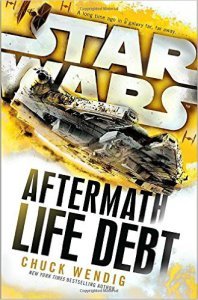
Aftermath: Life Debt
The second in the Aftermath trilogy, Aftermath: Life Debt is more of the same. We get to see the liberation of Kashyyyk, but it’s less interesting than it ought to be. We get to see the remnants of the Empire continue to sputter, intrigue, and seek to regain control. But, again, there’s not enough good here in terms of storytelling, characters or prose to make reading 400 pages worth it–unless you really liked Aftermath.
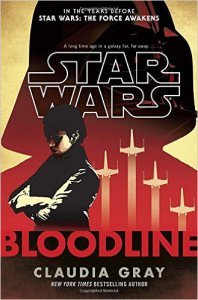
Bloodline
A grown up novel fro the author of the much better YA Star Wars: Lost Stars, Bloodline ploddingly tells a story that should’ve been better, given the importance of its premise. Episode VII begins with the new that Leia is no longer a senator but instead back in a military role leading “The Resistance” against the “First Order,” and this Resistance is somehow distinct from the Republic Navy. So what gives? That’s the story Bloodline sets out to tell. But it’s just not all that interesting when the events are all out on the table. And while the author handles the tragic love affair in Lost Stars with the necessary YA ham-handed starry-eyedness, when she’s writing adults engaged in what’s supposed to be political intrigue, she lacks the chops to make it at all convincing. Simply put, the book is boring and not worth the time. Better to just read about the events and characters online.
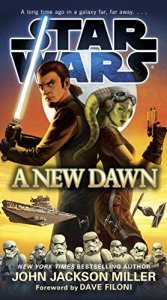
A New Dawn
The novel that started it all doesn’t have a ton to offer, even for fans of Kaden and Hero from Star Wars Rebels, whose introductions it tells.
Here’s where they meet, in a story about an evil corporate overlord in cahoots with the Empire, and his plan to blow up an inhabited moon to speed up mining operations.
The book took me a while to get through because I just didn’t care much about what was happening. We don’t need to know how Kaen and Hera met, especially given how little both of them in A New Dawn remember their Rebels versions. This reads like it was written by someone who’d never seen the show.
December 22, 2016
My new book — and a little Star Wars
So I’ve published a new book. It’s called Arguments for Liberty, and I put it together with my colleague at Cato, Grant Babcock, and it’s published by Libertarianism.org. This is a really good book, featuring chapters by top political philosophers, and it’s something I’ve wanted to read since I first got into politics.
More on that in a moment. But first…
Rogue One is Perfect

I saw the movie earlier this week. Got in a little trouble for taking my seven year old daughter to what turned out to be a significantly darker film than expected. But I loved it. Full stop. There are niggly complaints I could make, of course, but they’re inconsequential. The movie was, for what it set out to do, perfect.
Rogue One looked more like Star Wars than any movie since Return of the Jedi. Yet it also managed to import the “huge universe”-ness of the prequels, something I found missing from The Force Awakens. Rogue One makes Star Wars feel big again.
The plot works. The characters, to the extent they need to, work. The action scenes are shot with real craft, and that space battle at the end is the best outside of Episodes IV and VI. The connections to A New Hope never feel forced or heavy-handed. (Okay, except for maybe once, but it’s forgivable.)
If this is what we can expect from Disney going forward, we can expect very good things.
Arguments for Liberty
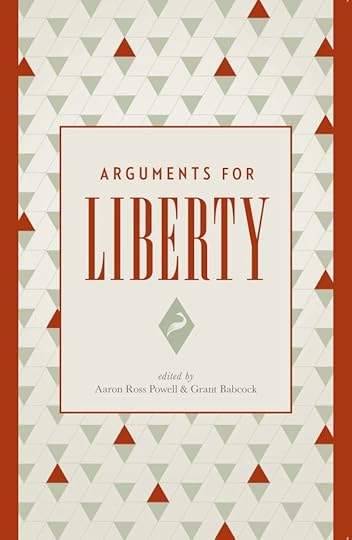
Two schools of thought have long dominated libertarian discussions about ethics: utilitarianism and natural rights. Although those two theories are important, they’re hardly exhaustive of the different ways people think about ethics and political philosophy. In Arguments for Liberty, you’ll find a broader approach to libertarian ethics than you’ll find in any other single book.
Arguments for Liberty is divided into nine chapters, each written by an expert in philosophy. They discuss how their preferred school of thought judges political institutions. Then they say why they think libertarianism best meets that standard. Though they end up in the same place, the paths they take diverge in fascinating ways.
Readers will find in these pages not only an excellent introduction to libertarianism, but also a primer on some of the most important theories in ethics and political philosophy. Assuming little or no training in academic philosophy, the essays gathered here guide readers through a continuous moral conversation spanning centuries and continents, meeting Aristotle in ancient Athens on one page and twentieth-century philosopher John Rawls in the halls of Harvard on the next.
What’s the best political system? What standards should we use to decide, and why? Arguments for Liberty is a guide to thinking about these questions. It’s also a powerful, nine-fold argument for the goodness and importance of human liberty.
Links to get the book — including free downloads — are all gathered conveniently here.
My recent writing

I was on a homicide jury and Michael Slager’s mistrial doesn’t surprise me — aaronrosspowell.com
Michael Slager, a South Carolina police officer, shot Walter Scott several times in the back as Scott, unarmed, fled. We know this because the whole thing’s on video. Now Slager’s temporarily avoided conviction when the jury deadlocked and the judge declared a mistrial. Here’s why I’m not surprised.
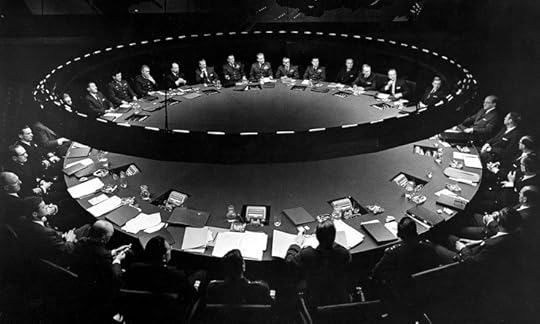
The Secrets of America’s Elite, Revealed — aaronrosspowell.com
In which I try to explain to “the real America” what’s up with us coastal elites, by cracking wise.
December 6, 2016
I was on a homicide jury and Michael Slager’s mistrial doesn’t surprise me
Michael Slager, a South Carolina police officer, shot Walter Scott several times in the back as Scott, unarmed, fled. We know this because the whole thing’s on video. Now Slager’s temporarily avoided conviction when the jury deadlocked and the judge declared a mistrial.
Given what looks, from all the evidence, like a pretty clear-cut case of murder, people on social media expressed bafflement at how anyone couldn’t see Slager’s beyond-a-reasonable-doubt guilt. But if early reports are accurate, this sounds like a case of something I experience first hand. Report indicate that the deadlocking resulted from a single juror refusing to vote for conviction. If true, it fits my experience when I was a juror on a homicide trial–though in the other direction.
This was the summer after my first year of law school. The summons arrived during finals week. During jury selection, I didn’t hide the fact that I was a law student, and the issue only came up once. “Will your legal training get in the way of you applying common sense to interpreting the facts?” an attorney asked. “I certainly hope not,” I said. They passed me through.
The case was a double homicide at a Halloween party. A bunch of kids at a house in Denver, something happened, someone got mad, and a couple of guys started shooting. Two people died and a third was injured. One of the shooters fled shortly after, probably to Mexico. The other, our defendant, got picked up by the police.
The trouble for the prosecution wasn’t in proving that the defendant fired into the partygoers. He admitted as much. The trouble was they didn’t know which gun was his and which was his absconded buddy’s. In other words, it’s possible the defendant fire the shots that hit three people, killing two. It’s also possible he fired all his shots into the air, and the bullets that actually hit came from his friend. The evidence didn’t point either way. Which means reasonable doubt had to win out for the two homicide charges.
My peers on the jury chose me foreman. The first thing I did, once we’d been sent back to reach a verdict, was conduct an anonymous poll. “Not guilty” all around, except one.
The one didn’t disagree on the evidence. She didn’t disagree that it failed to exceed reasonable doubt about the homicides. She acknowledged the prosecution hadn’t made its case. But she voted “guilty” nonetheless because “nice people don’t bring guns to parties.”
That was enough for her to send the defendant to prison. She didn’t care that the jury instruction were clear. That the trial was about whether he killed two people and injured a third. What she cared about was that he carried a gun and young males who carry guns deserve to be in cages.
Fortunately, I was willing to be rather stern with her. I explained in very clear terms what our role was as the jury and just what kind of person she would be if she sent a kid to prison because she didn’t like his lifestyle. I wasn’t going to let her commit an injustice and, with the help of the others in that room, I didn’t. She eventually backed down, but it was close. We found the defendant not guilty of any of the three major charges.
So, if something similar happened with Michael Slager’s trial–if a juror refused to convict a cop, basically no matter what–that doesn’t surprise me. People can be deeply irrational and prejudiced about violence and criminal justice. The jury system has its advantages, but it often means putting serious issues in the hands of people not equipped to deal with them.
Walter Scott deserved better than this.
November 18, 2016
The Secrets of America’s Elite, Revealed
America is divided. The coastal elites who have controlled Washington and much of the nation’s economy were, with the 2016 election, resoundingly defeated by a newly invigorated populism, personified in Donald Trump.
As a member of this demoralized elite–I live and work within the Washington, DC Beltway–I recognize that the rest of America has a low opinion of my social class, and also recognize that, when it comes down to it, America, the real America, just doesn’t get us.
So, in an effort to being healing that divide through increased understanding, I’m taking the risky step of breaking the coastal elite code and revealing our secrets to ordinary Americans.
What follows, made public for the first time, is our core cultural artifact. It contains all of our most cherished beliefs and values and informs the whole of how we view the world. It’s our urtext and our secret handshake rolled into one.
I will likely get in serious trouble for revealing what I’m about to reveal. But I can’t let that stop me. With an outsider administration ascendant, with populism shaking off its shackles, I feel I have no choice but to do whatever I can to help those now taking the reigns of power better understand the people they’ve overthrown.
So, apprehensive as I may be, I plunge ahead in exposing our secrets. Here goes:
Aaron Ross Powell's Blog

- Aaron Ross Powell's profile
- 18 followers

