Rick Conlow's Blog, page 17
February 25, 2019
Employees First, Customers Second
Now here is a revolutionary idea: employees first? Aren’t they the greatest resource of a company? Isn’t it time companies and managers started thinking that way. I just had a comment yesterday from a manager that said, “Employees are nothing more than a cost of doing business.” What an archaic viewpoint.
Multiple research suggests employees engagement is less than in the past. Unfortunately, the “employee experience” isn’t that good in many places. It certainly could be a lot better. Check it out and look up any company on Indeed and Glassdoor. The ratings quickly tell you what employees think or feel. This all affects their efforts, doesn’t it? We all know that. CEOs know that. Yet, little seems to change. I had one leader email me to say that I am drinking the Kool-Aid about the studies and impact of employee disengagement. Actually, while I drink it sometimes, it’s not that. Instead, I listen to my client’s employees, interact with colleagues, read the research, and study online ratings of companies.
Leadership Distrust: Employees First is Forgotten
 With leadership distrust so low in many places, it doesn’t take brain surgeon to know that employee loyalty will be significantly affected by it. Unfortunately, the culture of most organizations focuses on profit or technology or customers, but not on employees. If companies switched this around, they would make more money. I think company executives make this way too hard.
While all of this sounds dire, it’s really great news if you are a manager or an aspiring one. Consequently, when managers treat employees well, and do the things that great managers do, bottom-line results will soar. I have found this can take place in any department or team in an organization regardless of the corporate culture. Now, it is helpful that it changes come from the top. Yet, we all know this doesn’t happen all the time. So, “employees first” can come from the top down or bottom up in an organization.
Trust in leadership at any level facilitates an employee first approach. It creates employee engagement and better performance. Among other actions, you obtain trust by being honest, communicating and coaching well, training effectively, and giving recognition. It’s elevated by paying fairly, gaining employee input and ideas for improving the business, and creating a pleasant working environment. Finally, if you put employee first, they will take care of the customers. Working with my client managers, I have seen many times what a “turned on” team can accomplish!
Do you agree? What are your thoughts?
By the way, do you want to increase employee engagement? If so, check out Superstar Leadership Blog with over 400 complimentary resources.
 Or, do you want a good read for employees first approaches? If so, check out the
Unparalleled Leadership eBook.
Or, do you want a good read for employees first approaches? If so, check out the
Unparalleled Leadership eBook.
The post Employees First, Customers Second appeared first on Rick Conlow.


February 18, 2019
4 Powerful Approaches to Turn Failure into Success
Our life can take unexpected turns for the worst. One day you are a success and the next a failure. Things seem to be going well and then, abruptly they aren’t. You expected the promotion and then didn’t get it. The customer promised a big order and then it didn’t happen. A new boss changes everything, and your job isn’t fun anymore. Your company’s sales dip and you get laid off from a good job. Then your self doubts begin to chant, and inwardly you are asking, “What did I do wrong? Why me?”
Success Becomes Failure
 Early one spring I took my two boys fishing. My youngest son, Brendan, was especially excited. He had received a new fishing rod for Christmas and all winter long he kept asking when we were going to go fishing. Finally, the big day arrived after the ice thawed. As we drove to the Mill Pond, he jumped up and down in the back seat. He kept repeating, “We are going FISHING!” After we parked, Brendan bolted out of the car and slid down the bank to the water. He said, “Dad, can I cast now?” I replied, “Go for it.” He drew back his rod and cast with all of his might–but he forgot to hold tight. The rod flew thirty feet out into the lake with his line. In a split second, his excitement turned to tears.
Have you had a day or month or year like that recently? Are you faced with financial concerns or family worries? Is your mind filled with thoughts related to problems, anxiety and a lack of self-confidence? Tough times can happen to anybody. If you don’t watch out they can become the norm, and you will get stuck in a rut. Negative attitudes about life and the circumstances that go with them can prevail. If they do, it is to your peril. Soon your problems will become impassable mountains. BUT there is hope! What you need are some tools to exterminate the negative attitudes so you can deal with your challenges constructively.
4 Powerful Methods to Deal with Failure
To begin, heed these words by George Bernard Shaw: “People are always blaming their circumstances for what they are. I don’t believe in circumstances. The people who get on in this world are the people who get up and look for the circumstances they want, and, if they can’t find them, make them.” You see, success is not in the situation but the state of being. Sundar Pichal said, “Where your failure as a badge of honor.” Here are four dynamic approaches to help you do that. And, at the same time sustain a positive and optimistic outlook on life even in the dark times.
Do one more
Always make the extra effort, to “do one more” than expected in your job or for others. Famed football coach George Allen coined this phrase for how he built winning team after winning team. He explained that he always worked his teams to go the extra mile in preparing to win so that during the game, under pressure, it happened naturally. By doing this, not only will you feel better, but others will recognize you for your efforts. Don’t stew over your hardship and slough off–ramp it up. It will strengthen your character. Who you are and why you are here is greater than your pain. This will fuel forward momentum, and your own internal motivation to succeed again.
Keep learning
 Begin learning again to renew your mind. Get updated on any new technology and products. Take seminars and read uplifting books. Studies show that people who continue their education end up making more money and enjoy more career success than those who don’t do this. Steven Covey says in his book, 7 Habits of Highly Effective People, that winners keep sharpening the saw. You are no better as a parent, salesperson, manager or employee than what you learned yesterday.
Then, positively review your setback, and honestly seek what you can gain. What worked? Where can you improve? How can you be better next time?) Continuous learning gives you renewed perspective on your capabilities and provides you a competitive edge for your next challenge. Now you can reframe the failure as courage.
Stay Balanced
Yes, work hard! But also enjoy your family, friends or hobbies, especially now. Reconnect with others. What you do off the job affects what you do on the job and vice versa. Relate life balance to the spinning tops that children play with. By pushing on the lever consistently the top spins faster. If you really get the top going it may even play music. However, if you bump the top while it spins it will wobble and crash. Consider a well-rounded focus in life about these areas: family, health, spiritual needs, education, recreation and career. A problem in one of these areas won’t derail you when your support base is balanced and stable. Lean on this balance and remember what’s most important.
Get into action
The great end to life is not knowledge but action. Action rules. Often depression is caused because of inactivity or else the constant re-run of our mistakes. Positive action inspires the soul to reach new heights. Take a risk, write the report, call the customer, meet with your employees, brainstorm new ideas or set new goals. The effort to do this gives you momentum to turn your problems into a possibility. Life is no dress rehearsal–ACT, and do it now!
Dr. Evan O’Neil Kane of Kane Summit Hospital in New York had plenty to be negative about nine decades ago. As a doctor, like other doctors of his day, he lost many patients in appendectomy surgery. Many died due the effects of general anesthesia. He felt local anesthesia would be better. At the time it wasn’t accepted medical practice so he didn’t have volunteers to test his hypothesis.
So he took massive action. On February 15th, 1921, he performed appendectomy surgery with local anesthesia on himself. The results were so positive that he was out of the hospital in few days. He changed medical practice forever.
The Bottom-Line Turning Failure into Success
At times, all of us need to do self-surgery on our minds. Not that the failure we face isn’t difficult. Too often we become our own worst enemy by adding kindling to the fire by beating up ourselves through incessant negative self-talk. To prevent problems from overwhelming us we need constructive actions that can turn our circumstances and perspective around for the better, as described above.
Author James Allen declared, “Every man (or woman) is where he is by the law of being; his thoughts which he had built his character and have brought him there.” That is how we precisely engineer our next level of success and discover the true greatness within us.
 Do you want more success in life and less failure? If so, check out this 98 page eBook road-map to success: GoalPower: How to Increase Your Personal and Professional Success.
Want to really accelerate your career? Check out one or more of my books in the Superstar Book Series for a boost.
The post 4 Powerful Approaches to Turn Failure into Success appeared first on Rick Conlow.
February 14, 2019
Employees Crave Recognition, Give it to Them!
Employee’s crave recognition. Think of how our reliable dog friends become when they are praised for a certain behavior that we like. In addition, a two-handed ear or neck rubbing has them excited to do it all over again, just for that delightful payback!
Employees repeat praised behavior. Managers need to do it more. Consider, employee disengagement is high in most organizations. One reason is that managers don’t recognize or encourage them enough. Instead, the boss only talks to them about problems. Note these dismal trends:
58% of employees say “give more recognition” when asked by leaders what will improve engagement.
65% of employees say they weren’t recognized at all last year.
67% of employees state that they had no recognition in the last seven days.
69% of employees say they would work harder if they are appreciated more.
70% of employees say the most meaningful recognition costs nothing.
88% of employees say they don’t get enough recognition or acknowledgement at work.
Wow! We also know from research that 8 out of 10 managers are unqualified or ill trained. So, there is an obvious problem there, right? Consequently, they aren’t doing a lot of things right. Obviously, they give little recognition to their employees.
How to Do a Great Job of Recognition
 Recently, I attended a quarterly meeting of one of my clients, to give a speech and do leadership training. Part of the meeting included recognition for quarterly results. They had a dozen different categories. Awards included peer recognition, incentives, cash bonuses, plaques, pictures, and lots of applause. In contrast, many of the companies I have consulted with, I had to develop and give the recognition. Some treated as disposable commodities. If you check out Fortune’s Top 100 best companies, you will find examples of excellent and regular ways to appreciate employees.
Look, when you treat people respectfully and genuinely, you do appreciate their efforts. This is really a values and relationship issue. Does the direct supervisor make an effort to praise or reward his or her team for the performance gains? Managers or companies who don’t value caring for people won’t think twice about not giving praise or other recognition. It’s always about ‘what are you doing for me now?’ On, the other hand, managers who do value people appreciate their efforts. They do this especially in a one on one format. This is the most powerful praise because it comes from a value based trusting relationship. For example, people don’t need an award just for showing up for work. Recognition pays off with higher morale and better performance. It is a key to effective performance management. Leaders must do much better, don’t you agree?
Resources for Even More on Recognition
Check out these books for ideas:
1501 Ways to Recognize Employees by Bob Nelson
The Carrot Principle by Gostick and Elton
How Full is Your Bucket by Rath and Clifton
Think of the best manager you ever worked for? Why did you pick that person? My experience says they set high standards, treated people fairly, communicated well, coached effectively, and gave liberal praise. Did you do your best or slough off for them? My hunch says you tried hard and kept trying to be better. What supervisor or manager wouldn’t want that?
Want to accelerate your leadership coaching skills? See this complimentary guide, How to Motivate People: 10 Keys to Employee Engagement.
Do you want a proven plan for recognizing employees? Want even more great performance management strategies? If so, check out Rick’s Superstar Leadership book.
The post Employees Crave Recognition, Give it to Them! appeared first on Rick Conlow.
February 2, 2019
3 Communication Skills with Authentic Power and Positivity!
Excellent communication skills will transform your impact on others. Most managers, and employees are unaware of the concept discussed in this communication skills training video. Consequently, those who communicate well have the power. Also, communicating with positivity can change people’s life’s for the better and motivate them to higher performance. As a result, good leaders, not bad bosses, learn what is discussed in this leadership communication skills training.
 Avoid these Communication Skills
Too often people let these behaviors get in the way of good communication: skills:
1. Prejudice
2. A foul mouth
3. Harassment of others
4. Negativity
5. Criticizing people publicly
6. Sarcasm
7. Off colored jokes
8. Over emotional responses
9. Initiating conflict
10. Lies, or half truths
11. Stupid uneducated remarks
12. Poor listening
3 Steps to Authentic Power and Integrity
How do you breakthrough this? First, value other people. You have to genuinely want to help them succeed. In addition, consider three key communication skills:
1. Words-what you say!
2. Voice tone-how you say it!
3. Body language-what you do about what you say!
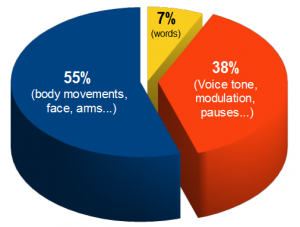 Words account for 7% of your communication skills impact. Although, words are important. Build people up not down, and your words will have positive results. Voice tone is 38% of the impact. This is how you say things. It’s your quality and strength of what we say. For example is your voice loud, soft, angry, caring, sarcastic or ridiculing. Voice tone is to your words is like making letters bold when you type.
What’s left? 55% of the impact of your communication is how you act about what you say. It’s about your behavior and body language. Do you sit up, look people in the eye, turn your back to someone, focus on your phone while talking, or follow-through on a commitment? Let’s say you tell an employee that customer service is important. However, you are rude when you talk to customers. You actions tell the truth not your words. Then, of course, that person trusts you less. If you keep up that behavior the person won’t believe in you.
Pulling It All Together
When all your words, tone and behavior line up with positivity you communicate with power and integrity. When you are authentic like this you create trust, and rapport with people-faster!
 Want to accelerate your leadership and coaching skills? See this complimentary guide: Coaching for Results.
Do you want a proven game-plan for career success? If so, check out Rick’s Superstar Leadership book.
Rick Conlow International is a business consulting and training company. We coach leaders to achieve record-breaking performances in sales growth, customer experience improvement, employee engagement and leadership effectiveness. RCI has online resources to coach and train any and all managers to higher levels of success. Go here for:
Consulting Services
Books & Training Resources
The post 3 Communication Skills with Authentic Power and Positivity! appeared first on Rick Conlow.
January 28, 2019
Why won’t They Recruit and Hire Him?
A friend of mine is looking for a job in retail in the Denver area. He’s been going on line filling out applications. He’s semi-retired and wants something to do to add value and keep busy. He has 30+ years experience running retail store operations, CX departments and training groups for three major retail groups. Recently, he went in to talk to two different store managers. They said, “We would love to hire you. Fill out the online app and we will get back to you.”
Consequently, nothing happened. No follow-up, no acknowledgement of an application ever being completed. And, the stores still have signs that they need people.
Check me if I am wrong, it’s hard to get good people today, right? How recruiters or managers recruit and hire can make or break a business. The squeeze is on to have a full crew. Why aren’t they following up?
What is happening with those that Recruit and Hire?
I can guess at two things.
First, age discrimination. I thought this was illegal when you seek to recruit and him new employees? My friend is obviously over qualified and experienced, but he doesn’t want to run the place anymore. He just wants to help out and have something more to do. He be a great addition to any team.
Furthermore, lousy procedures. It seems like the accountable manager is out of the loop in the selection process, and the corporate recruiters are either too busy, don’t want to hire older workers, and don’t follow-up very well.
Do you think they should Recruit and Hire Him?
Certainly, I do know this. The quality of the hiring effort determines the quality of the applicants and eventual newly hired employees. Consequently, the hiring process either begins a great employee experience or a potentially poor one. In addition, a great hiring process adds to the bottom-line. It also, is expressive of the company’s commitment to an exceptional customer experience. Either way, the companies my friend has contacted are losing out. I wonder how often something like this is happening to others? Finally, I have learned that the best managers are always seeking to recruit or hire top people. And, they consistently have the best people on their team.
 Do you want a proven game-plan for your management career success? If so, check out the
Unparalleled Leadership eBook.
Do you want a proven game-plan for your management career success? If so, check out the
Unparalleled Leadership eBook.
 Want to accelerate your career as a manager? Check RCI online leadership training.
The post Why won’t They Recruit and Hire Him? appeared first on Rick Conlow.
January 11, 2019
11 Mistakes Managers Make in the Performance Appraisal
Most employees dread a performance appraisal. Why? Quite frankly managers are poor at it. So, most end up doing more damage than good.
Nearly all bigger companies have gone to online systems to manage the process. This adds some accountability and quality control. Yet, managers still lack the skills to be effective. In addition, online systems tend to take extra time and are cumbersome. So, there is a lot of policing that has to be done. Furthermore, the once a year review is simply bogus and outdated. This is old technology. It would like using the early 1980’s Advanced Mobile Phone System today versus current Smartphone’s.
 A tremendous amount is at stake in performance reviews. First, an employee’s career progress, and self-confidence are challenged. A poorly done review can sour anyone’s morale quickly. Second, an appraisal sets the tone for an employee’s experience, and performance for the coming year. Third, your success as a leader is influenced. Similarly, consider how high employee disengagement is in so many places. What does that tell us?
11 Performance Appraisal Mistakes
Here are the thirteen mistakes bosses make in a performance appraisal process. And, how to fix them.
Annual or six month review: Instead, meet monthly with employees one on one. Discuss goals, plans, strengths, and progress. Keep it casual, as a performance discussion not an evaluation. In addition, engage employees in informal coaching at regular opportunities. Companies like GAP, GE and Adobe are already getting this done. This adds to a more trusting relationship because it is done in “real time.” Consequently, a company’s yearly or six month formal review will be easier to do. Furthermore, you and the employee will be on the same page.
The recency effect: If you don’t do regular performance discussions this will kick in. Unless, of course, you have a photographic memory.
Limited preparation: This is laziness and unprofessional. Set a date and keep the appointment. Invest serious time in the review. Complete all necessary forms in your company system. Also, have the employee do the evaluation form in advance. Treat employees like the greatest resource of the company. They are, don’t you agree?
Monologue not a dialogue: Include the employee in the process. Have a dialogue about the details. Listen and ask questions. Come to a consensus on the evaluation. This means substantial agreement. As a result, by talking about performance all year, this is a no-brainer. If not, you will probably have issues. Steven Covey said, “Seek first to understand.”
Giving vague feedback: This helps no one. Be specific. Check this out, How to Give Feedback When You Are the Leader.
Lack of flexibility: When talking about performance you have to pay attention to the level of the employee. Experienced or inexperienced? Hard headed or emotional? Plus, be fair, give a higher rating when it is earned. Don’t give an average rating to a poor performer. It isn’t going to inspire them to be better.
Avoiding poor performance: Without talking about poor performance is like building a house by a lake and ignoring the water. Deal with in the monthly discussions.
Dishonesty: Seriously, be honest. Some companies give people good evaluations that don’t deserve them. Later, they lay them off or fire them to satisfy Wall Street. It only degrades your character if you whitewash the truth.
Not discussing self-development needs or career goals: A key area in a performance appraisal and discussion involves establishing plans for career development. Most of the time a one page plan will suffice. A leader’s role involves getting things done well today. In addition, it requires planning to do better tomorrow. Thus, any manager needs the team learning and growing.
Not setting or updating goals and plans: RCI research shows that a lack of clear expectations and goals causes 80% of performance problems. This is a key part of needed planning that you discuss month to month all year long. What are the priority goals for this employee? What are the action steps to exceed the goals? Document this in 1-2 pages.
Focusing only on negative gaps and not giving recognition: While some employees have more “negatives” to discuss, nearly all have some positives, too. By including the employees in performance discussions, more positives will come out. Reinforce those that apply. Besides, emphasize strengths in the action planning. People do perform better with a constructive feedback.
Bonus: Not following through: A performance appraisal requires coaching. Be a champion here. It adds to your credibility with your team. Therefore, don’t forget, your on-going informal performance discussions fit that bill.
 Another concern is discussing salary. This makes the performance review even more emotional. Whether or not a person gets a salary increase or bonus adds to the pressure. Consequently, do this in a separate meeting. Don’t do it during the review.
The Performance Appraisal: Pulling it all Together
Above all, performance management takes work. Leading takes work. Employees have problems that are messy at times. If this whole thing was easy, anyone could do it. Great managers put in the sweat equity that leads to better team performance. Put in the effort if you want the appraisal process to really work.
In summary, businessman Doug Conant had insightful wisdom. He said, “Trust gives you the permission to give people direction, get everyone aligned, and give them the energy to go get the job done. Trust enables you to execute with excellence and produce extraordinary results. As you execute with excellence and deliver on your commitments, trust becomes easier to inspire, creating a flywheel of performance.”
 Want to accelerate your leadership and coaching skills? See this complimentary guide,
How to Motivate People: 10 Keys to Employee Engagement.
Want to accelerate your leadership and coaching skills? See this complimentary guide,
How to Motivate People: 10 Keys to Employee Engagement.
Do you want a proven game-plan for career success? If so, check out Rick’s Superstar Leadership book.
The post 11 Mistakes Managers Make in the Performance Appraisal appeared first on Rick Conlow.
January 5, 2019
A Genuine Leader is Rare and Desperately in Demand
A genuine leader is rare, precious to work with, and desperately in demand.
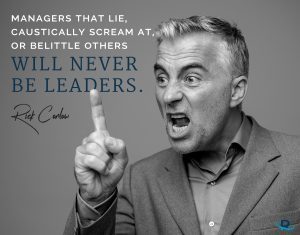 She stormed into the office and interrupted the team meeting. Instantly, she declared that things will change. Similarly, she talked loudly while rapping her bracelets on the table for emphasis. For thirty minutes everyone was frozen in time as the abuse continued.
Then she left abruptly. Her parting words to the manager were, “I will tend to you later.”
This became her standard approach when visiting other teams. The regional vice president had the title but she was not a leader. Her negative behavior resulted in people quitting. Others were left with high levels of fear, and resentment. Could the various teams improve? Yes. Did they care much now? No. Unfortunately, this manager didn’t understand how to partner with employees.
This VP was eventually fired. Her boss took over, and it got worse.
Have you ever been in a similar situation?
An Example of a Genuine Leader
Rita came aboard with no fanfare. Yet, her smile immediately caught everyone’s attention. She became the office coordinator for a busy corporate office of seven companies. Her role was to coordinate calendars, and organize needed resources. Often people in these companies butt heads for office support and materials. It led to ill feelings and intense competition.
Within a few days she took initiative to visit one on one with each manager. She also talked to key employees about their needs and problems.
She ask questions and listened. Her positive energy became contagious. In addition, she quickly implemented a few basic procedural changes. Consequently, the changes help transform chaos into calmness.
Most noteworthy, Rita was friendly and caring with everyone. However, she had a backbone of steel when making decisions. She also got things done that had to be done. When emergencies happened, she created results without leaving causalities.
Within a few months the office was humming a different tune. Numerous times people said, “how did you fix that?” As a result, she earned a promotion to manager within a year. Eventually, she became a company vice president.
A genuine leader is like Rita, regardless of the position. Have you ever been in a similar situation?
Not every manager is a leader, not every leader is a manager.
Want help in dreaming and achieving new goals? Check out GoalPower, an interactive road-map with action exercises to guide you. Achieve your best year this year!
Do you want a proven game-plan for your management career success? And, become a genuine leader? If so, check out the Unparalleled Leadership eBook.
The post A Genuine Leader is Rare and Desperately in Demand appeared first on Rick Conlow.
December 21, 2018
Leadership Trust: 8 Keys to Create Credibility
Leadership trust is about positive influence. However, too many leaders have negative influence on and that’s why 70% of employees don’t like their boss. In addition, nearly 9 out of 10 employees are disengaged at work.
Research Shows Leadership Trust is Low
Research by Edelman’s Trust Barometer demonstrates that distrust worldwide in leaders in all institutions is at all time lows. Furthermore, in the US trust is at record breaking lows. This leadership training video will show you how to gain trust fast. And, keep it.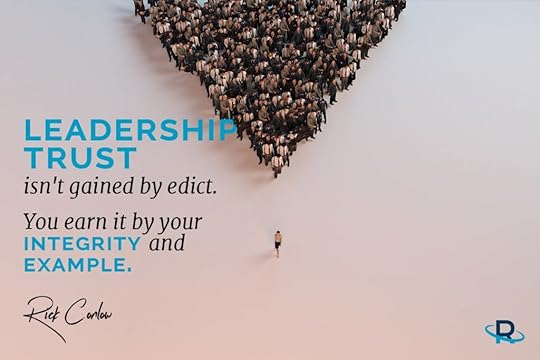
Keys to Building Leadership Trust
Trust is about the relationship a manager has with his or her employees.
Managers who build trust, starting with honesty, are golden to their organizations. Why? Because employees become inspired to their best performance-regularly. Trust involves leading by example. This means you do what you say you will do. You admit mistakes. In addition, you follow-through on promises or requests. Good communication, and listening are are crucial elements. Bottom-line, leadership trust requires treating employees with respect, as partners, as champions.
Without trust employee engagement wanes and all other business results suffer. Do you know what it is like to work with a bad boss? Think about it. A dishonest boss doesn’t bring out the best in employees. Managers with trust forge a bond with employees. As a result, employees want to do a better job. Now, it doesn’t take forever to get trust but you do have to earn it by your daily behavior. Set high standards, expect the best but be helpful to your team so they do well. Don’t be the obstacle. Also, you have to lead with integrity. Integrity involves doing business with ethics and committing to do what’s right not what is expedient. Watch this management video training for the 8 keys for building trust and credibility with your team. Then, give it a “Thumbs up.”
 Also, check out the info below for continued professional development and ideas for establishing leadership trust.
Going through lots of change in your company? See this complimentary guide: Changing Change Management.
Finally, do you want a proven game-plan for career success? If so, check out Rick’s Superstar Leadership book.
The post Leadership Trust: 8 Keys to Create Credibility appeared first on Rick Conlow.
December 4, 2018
10 People Skills that are Guilty of Desertion
“The most important skills I had to learn to be successful were people skills.” Declared flamboyant businessman Richard Branson. Dr. Daniel Goleman calls these skills our Emotional Intelligence. This involves personal and social competence. Unfortunately, it seems people skills are guilty of desertion when you consider the high levels of management failure, employee discontent and poor customer service. This is catastrophic for any company or leader.
Why are People Skills so Important?
With the technological revolution we all are experiencing, there is less emphasis on social skills and team-building. Employees today are bombarded with social media, chat boxes, and apps of all kinds (for employee recognition, communication and engagement). Most Human Resource procedures are connected to online tools. In summary, technology has decreased the quality and quantity of face to face communication for people at work.. Of course this is true for friends and family networks, too. This is particularly noticeable for the millennial and Z generations.
Yet, according to an analysis of nearly one million job openings, the #1 in-demand quality of new hires revolves around people skills. The capability of a job seeker’s people skills has become a powerful differentiator to recruiters. Peoples skill effectiveness is becoming more important for better pay increases and potential promotions. Finally, the most people friendly companies are more profitable. Do you hear that CEOs? And, they have better service, retain the best talent and are the ones most trusted and admired.
The Problem Improving People Skills
Companies spend 10X or more money on technology than on the overall training of their employees. This disparity is even greater when you consider that technical skills training consumers 31% of training budgets. While investment in both areas are up, this stat reinforces where executives put their priority. Consequently, employees who regularly pay for or initiate their own skill development are the chosen ones. Their skills improve while others stagnate. Many become the leaders of tomorrow. Over time they tend to fast track to bigger jobs and higher pay.
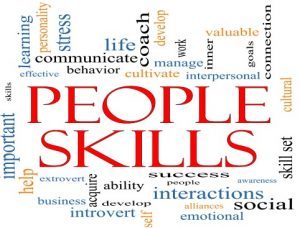 What are the most important People Skills?
Integrity: Leadership distrust abounds. As a result, employee dissatisfaction and loyalty is taking a dive. Yet, honesty in the workplace, bucks that trend by significantly contributing to a happier and more productive work climate.
Communication: Jeff Weiner, CEO of LinkedIn says, “Communications is the No. 1 skills gap across those major cities in the United States.” This should come to no surprise. The #1 issue on employee engagement surveys tends to be the lack of communication from management or across an organization.
Teamwork: About two-thirds of teams fail. Thus, if you know how to work well with people you can make a real difference in a company. Maybe even catapult your career.
Conflict resolution: Conflict isn’t necessarily bad. Managers and employees have be adept at handling it in a fast paced world. Bad news can go viral in a heartbeat. How we handle difficult situations, and people often determines the depth of our career success. The best leaders emphasize divergent views, control their emotions and maintain the self-esteem of others. This build trust.
Change: This involves the speed of constructively adapting and being flexible. This is especially crucial in a condensed globe that daily involves changing priorities, ambiguous standards, diverse workplaces and disruptive marketplaces.
Influence: By definition this is a person’s capacity to effect how others behave, think, feel and act. Positive influence tends to change the world for the better.
Empathy: Listening with sensitivity to others is the highest form of courtesy, and the quickest way to build rapport. Most of us want to do all the talking. This is a top priority among all people skills.
Discipline: People respect others who can get things done while keeping their “cool”. Are you known as one who can be counted on or one that has an excuse? Personal time management, and a focus on action separates the best from the rest.
Optimism: Mayo Clinic research shows that people with an optimistic view in life live longer. Furthermore, others are more attracted to individuals that have a positive, hopeful and uplifting perspective. Without this, other people skills impact are dimmed.
Problem-solving: This is the ability to identify, analyze and fix problems. In this day and age, that’s a managers job, and any employee. A good problem-solver balances a data and creative driven approaches.
Bonus: Negotiations: Are you willing to ask for what you want to get more or better? Are you willing to say it and go for it boldly but constructively? Is your goal a Win/Win scenario? (There are other definitions of negotiations that favor combativeness and Win/Lose. Remember we are talking about people skills here.)
How do you rate on your People Skills?
Emerson said, “Self-awareness is the first step to success”. So, which of the above five areas are a plus for you, and what two or three do you need the most help? Why not make the effort to improve a priori
Businessman and author Bob Conklin said it wisely, “Help other people successful and you will be successful.” Notice how he said it. It isn’t all about you. People skills are about-people. The goal is collaboration, cooperation, care and consensus. This requires the human touch, and an investment of time. Now, this is a radical idea for many leaders, let alone the rest of us.
 Do you want a great read to stimulate your thinking for improvement? Go here: The Extraordinary Employee.
Also, do you want to dramatically change your management career for the better? Go here: RCI Online Leadership Training: 4 Options for Success.
In addition, are you looking for practical management advice to fast track your success? If so, check out the Superstar Leadership book.
The post 10 People Skills that are Guilty of Desertion appeared first on Rick Conlow.
November 29, 2018
The Plague of Employee Dissatisfaction and Disengagement
Employee dissatisfaction and disengagement is at all-time highs. Employee engagement is a plague because nearly all companies struggle in trying to improve it. Few do well at it. As a result, 87% of the worlds employees are disengaged. This costs the US economy 1% of the $20 trillion dollar economy, that’s at least 500 billion dollars. This isn’t counting partially disengaged employees. Watch this employee engagement video training. It will give you seven behaviors that foster great employee involvement and morale.
Managers Cause Employee Dissatisfaction
 Managers today have to get off their high horse to engage their teams. Especially the poor ones, which means companies have to make serious changes. This includes how they measure performance, how they promote, the culture, and the preparation and training of managers. Leadership engagement creates employee dissatisfaction or engagement.
People have to be priority one. If a manager is better at leading, the team will be more engaged. Managers and companies today have to recognize employees as partners not peons to implement their every demand. Employees are the greatest resource of a company, so why not treat them that way? An engaged employee has higher performance, fewer days off, better customer service or sales and greater morale. What company doesn’t want that? Therefore, if you are manager, why not learn to engage your team! So, you have to study and practice to become a better leader. Review these behaviors that minimize employee dissatisfaction while improving morale.
7 Leadership Behaviors that Create Employee Engagement
1. Respect
2. Positive team meetings
3. One on one coaching sessions
4. Problems solving together
5. Self-Development and training
6. Positive outlook and praise
7. Integrity
Summing it all Up
By applying the above behaviors managers communicate with employees in a variety of sincere and genuine ways. The #1 reason for poor engagement is poor leadership communication. If you believe in people and help them succeed, good things happen.
Consequently, think about these approaches, and apply them. Learn to get better at each. You will “fire up” your team and begin achieving excellent results. Give this employee engagement video training a “thumbs up” by making it happen. Think about it, if you know something but never use it, do you really know it? Results rule for successful leaders.
Do you want a proven game-plan for career success? If so, check out Rick’s Superstar Leadership book.
Want to improve employee morale and engagement? Go here: RCI Consulting Services
Looking for a good read for personal development? See this: Books & Training Resources
The post The Plague of Employee Dissatisfaction and Disengagement appeared first on Rick Conlow.