Rick Conlow's Blog, page 21
December 19, 2017
13 Career Warning Signs which Lead to Mistakes, & Misery
If you pay attention you will notice the career warning signs that come your way. If you aren’t you may make unnecessary mistakes that lead to misery.
Are you looking for or feeling like you need a career change? The era of long-tenured employment is gone. Today people change jobs ten to fifteen times in their careers. The lack of company loyalty has spawned the lack of employee loyalty and engagement.
The best way to change a job is on your terms. Career setbacks can be devastating. Being fired, performance issues, becoming burned out, or layoffs can cause deep emotional scars in people. Research suggests it not only impact a person’s self-image but it affects relationships with family and friends.
Have you ever had a friend that got fired from a job? How about a friend that was laid off? Have you encountered a close co-worker that abruptly quit amidst some conflict at work or home? A friendly neighbor that was experiencing a corporate reorganization that changed everything, including his or her career opportunities? Or had a relative passed over for a promotion and then got really angry over it? Maybe a few things like this have happened to you.

13 Career Warning Signs
Consider these career warning signs of impending missteps, mistakes or misery. You might need to take the initiative to change jobs or your career direction. A number of these often go together and will derail your performance, while heightening the chances of someone else noticing what’s happening to you.
1. You feel depressed or frustrated or unfulfilled.
It’s hard to do your job well with these pent up feelings. Chances are your job seems harder and you are making mistakes.
2. You no longer care, much of the time.
You wake up and have to force yourself to go to work–almost every day but pay day or Friday. Also, you become very critical of your company when you talk to others. Almost everyone knows you hate your job.
3. Work isn’t enjoyable.
We work longer hours today. Except for the paycheck, if you aren’t enjoying it, why do it? Boring and routine lead to comfortable mediocrity or worse. Do you find yourself looking forward to breaks or lunch?
4. You aren’t learning anymore.
Ongoing learning stimulates the mind. Without it, a job often becomes the “same old, same old.” When was the last time you attended a training course or learning event?
5. You don’t get along with the people you are working with.
One of the top reasons people leave a job, besides a bad boss, is that they don’t like the people they work with. Has irritability or intolerance set in?
6. The passion is gone.
Are you doing this job because you love it? Or because of the pay? Hopefully both. If not, it creates a long day, week, month…year…malaise. Many people get stuck here but they don’t have to.
7. You know you are better.
If you know that you can do much better but don’t, your performance is slipping and you aren’t sick. It just might be because you just don’t want to anymore. At least not where you are right now.
8. You are comfortable.
Studies indicate that if you aren’t stretching yourself, you start to lose your edge and you get locked in a comfort zone. When this happens, others will notice the change.
9. You lack the energy you used to have.
Physical fatigue can relate to a lack of mental focus and preparedness. If your mind isn’t in the game the body won’t be either.
10. You aren’t going the extra mile.
Jim worked for a delivery service since high school. He changed jobs a few times but felt his career was going nowhere. He didn’t want to leave because of the benefits. He found himself doing just enough to get by in his job, 8-5 pm every day. What is the outlook for Jim’s future here? This is one of the career warning signs you have to act on quickly.
11. You are passed over for a job.
This is crushing. The question is: do we learn or whine? If this applies to you, where are you now? What does that tell you?
12. You aren’t networking.
Connecting with other people increases results, builds teamwork and adds spice to almost any job. If you aren’t into the job much anymore this isn’t going to happen much. It’s a far reaching loss.
13. You blame other people or situations.
People who blame others for problems, mistakes, or why they can’t do the job better are losing their personal accountability and the capability to perform at a higher level. It is an immature way to explain lack of attaining goals. Don’t let this be you.
 A 4 Step Catalyst Plan to Counteract Any or All Career Warning Signs!
You can head off the career warning signs if you do these steps a little every day. You will find yourself more aware, renewed, if not inspired, to do your best to protect your current job or to get a new one.
Get feedback!
Talk to a trusted friend, mentor or advisor that will give you candid input. Or get a coach. Honestly outline your strengths, weaknesses, and challenges. Review, brainstorm, search new ideas, discuss problems and opportunities. Dialogue like this can be rejuvenating.
Renew your learning!
Focus on a personal upgrade. Attend a couple of classes to elevate your knowledge and skills. Participate in a few online discussions to get updated on what’s happening. Enroll in a couple of online training sessions. Learning is the mother of reinvention!
Re-calibrate your goals!
Based on the above, create a one-page succinct game plan to move forward. Include 3-5 goals and key action steps. If you stay in your current job, do this plan as a way to accelerate your results. (See this Goal Planning Guide) Review it with your boss. If you want to leave, identify the kind of company you want to be in and list ten prospects.
Network, network, network!

Whether you think you are leaving your job or not, start talking with others. It can be eye-opening. Update your resume. Use online services to class it up. Brush up on interviewing and job-seeking skills. According to research, the best way to get a new job is to network while you currently working. In addition, networking adds power to your career advancement options.
Liz Ryan CEO of the Human Workplace says, “We all run into roadblocks and hardships. It’s part of life. How we deal with them is everything. I want to hire someone who has faced adversity and who overcame it. They have muscles!”
Want to eliminate the career warning signs that come your way? Elevate your success with this complimentary Success Practices inventory and guidebook.
Want to accelerate your career? Check out one my books in the Superstar Book Series for a boost!

Merry Christmas and Happy New Year!

The post 13 Career Warning Signs which Lead to Mistakes, & Misery appeared first on Rick Conlow.


December 16, 2017
The War of the Sexes: Are Women Leaders Better than Men Leaders?
 Are women better than men in leadership roles? It has been 168 years since the United States got its first woman doctor, Elizabeth Blackwell. Twenty-nine colleges turned down her applications for medical school. She was ridiculed and told it “wasn’t women’s work”. But she didn’t quit. Finally, Hobart College accepted her. almost on a whim. The faculty and Dean really didn’t know how to respond to her. So, thinking she had no chance, they said they would admit her if 100% of the 150 male students voted yes. They voted unanimously to accept her.
After completing her degree, Elizabeth continued her studies in Europe. Just like in America, discrimination rose strongly against her. She was allowed to be enrolled in La Maternité clinic/hospital as a student midwife, but not accredited as a physician. She did gain much additional medical experience. Eventually returning to America, she starting writing and lecturing to make her way. She created the Blackwell Sisters that helped in the Civil War. Blackwell steadfastly dealt with all obstacles and went on to establish hospitals in New York and London. While engaged in medicine she championed many social reforms in the US and Europe.
Inequalities for Women in Today’s Workplace in the US

Women in America still face great inequalities in the workplace, as identified in a recent Chicago Tribune article. For example:
Women are rated lower in their competence by U.S. decision makers (mostly white males).
Pay is one third less than males in the same job, over a lifetime.
Lack of recognition or credit.
Men are promoted more on potential, women on performance.
Few second chances.
Worldwide discrimination and inferior treatment haunt women of all nationalities. Opportunities are much fewer compared to men. Incredibly, in 2017, men in most nationalities still believe that they are superior to women.
Women Leaders vs. Men Leaders
Most of the women leaders that I have engaged through LinkedIn or consulting projects continually exhibit the qualities that Elizabeth Blackwell demonstrated by breaking the glass ceiling in medicine so many years ago. Businesses, this country, and the world desperately need better leaders. In their highly disengaged state, employees are begging for transformational leaders. Research suggests compelling evidence that many women tend to adopt more effective leadership approaches and styles than men. According to personality profiler Dr. Tomas Chamorro-Premuzic, men have a tendency to narcissism and hubris which often leads to serious leadership mistakes and failure. Studies show that men tend to obtain more leadership roles because confidence is confused for competence.
The Next Revolution in Leadership Thought
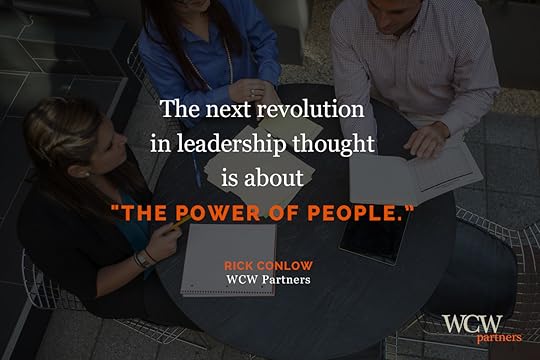
Elizabeth Blackwell confronted discrimination in a time that was even more male-dominated. She forged ahead and said, “My mind is fully made up. I have not the slightest hesitation on the subject; the thorough study of medicine, I am quite resolved to go through with. The horrors and disgusts I have no doubt of vanquishing. I have overcome stronger distastes than any that now remain, and feel fully equal to the contest. As to the opinion of people, I don’t care one straw personally; though I take so many pains, as a matter of policy, to propitiate it, and shall always strive to do so; for I see continually how the highest good is eclipsed by the violent or disagreeable forms which contain it.”
I believe all people have tremendous potential. It doesn’t matter where you are from or if you are male or female. With discrimination in the workplace women, women leaders become better than men simply because they work at it more. They become “students of the game.” I believe that the next great advance in leadership thought will be the power of people. I also believe that women could finally be at the forefront of this movement. What do you think?
For accelerated individual online leadership training go here: RCI Online Leadership Training.
Want to accelerate your career? Check out one my books in the Superstar Book Series for a boost.
The post The War of the Sexes: Are Women Leaders Better than Men Leaders? appeared first on Rick Conlow.
December 13, 2017
15 Change Quotes that Challenge Your Thinking
15 Change Quotes to Challenge Your Thinking
“The world as we have created it is a process of our thinking. It cannot be changed without changing our thinking.” Albert Einstein
“Change is inevitable. Change is constant.” Benjamin Disraeli
“When you’re finished changing, you’re finished.” Benjamin Franklin
“If we don’t change, we don’t grow. If we don’t grow, we aren’t really living.” Gail Sheehy
“I cannot say whether things will get better if we change; what I can say is they must change if they are to get better.” Georg C. Lichtenberg
“Change before you have to.” Jack Welch
“Change is the law of life. And those who look only to the past or present are certain to miss the future.” John F. Kennedy
“Be the change that you wish to see in the world.” Mahatma Gandhi
“If you don’t like something, change it. If you can’t change it, change your attitude.” Maya Angelou
“I alone cannot change the world, but I can cast a stone across the waters to create many ripples.” Mother Teresa
“Change your thoughts and you change your world.” Norman Vincent Peale
“You never change things by fighting the existing reality. To change something, build a new model that makes the existing model obsolete.” R. Buckminster Fuller
“It is not necessary to change. Survival is not mandatory.” W. Edwards Deming
“Your success in life isn’t based on your ability to simply change. It is based on your ability to change faster than your competition, customers, and business.” Mark Sanborn
For a laugh… “Change is inevitable–except from a vending machine.” Robert C. Gallagher
Putting Change to Work
Be clever enough to adapt as the New Year approaches. What must you change to help your team or others enjoy more success? What must you change to realize a better year for yourself?
Also read this post for managing change: Why Change Management Must Change. Check out this complimentary eBook on Changing Change Management.

Want to accelerate your career? Enroll in this one of a kind Excellence in Management training for managers.
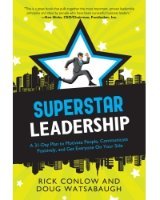 Rick and his business partner Doug published these approaches in their book, Superstar Leadership. They created the Superstar Leadership Model as a way to remember and apply the principles.
The post 15 Change Quotes that Challenge Your Thinking appeared first on Rick Conlow.
December 12, 2017
A Manager’s Anchor in a Change Management Storm
Change management is a frightening concept for most managers. There are various reasons why, but the one I sense the most often is this: managers and leaders alike, tend to think that change is only encouraged or initiated when something is wrong. And obviously, whenever we associate something as the adverse alternative of two options – stability (good)/change (bad) – we are going to prefer the former to the latter. It’s human nature. And with that, it’s no wonder so many professionals pity the process of change – they think it’s a bad thing because it’s associated with negative meanings.
 And I won’t sugarcoat, sometimes change is necessary because things aren’t working and things have gone wrong – but that doesn’t mean change has to be bad. In fact, change should be considered the savior of it all, a hopeful possibility if anything. It’s the one thing that’s in our control when all else has gone awry. This is where you (the manager and/or leader) come into the picture.
I like to think of your role as the anchor to an unstable ship. Regardless of the reason (problems or innovation) change is happening in your team, organization or process, change inevitably alters something. By its very nature, change is variable. And we all know that when things are out of routine and unfamiliar, security comes from stability – and this is the anchor’s role when the ship’s lost its stillness. So, what does all of that mean for you-the manager?
 Three Change Management Keys for Managers
#1. Your attitude has the ability to alter things (negatively or positively). While change is being driven, are you the calm for the storm or the eye of the storm? Be aware of the power of your presence.
#2. Your actions affect the ship (your team) and the storm during any change management process. What you do and how you address the need for change will either define the direction your team needs to go or leave them lost at sea hopeless and astray. Do everyone a favor and don’t drift aimlessly – give your team what they need to sail through the storm successfully.
#3. Your perspective and that of others shapes the experience of change and the change management. While you’re all in process of driving this change (amidst the storm), are you taking the time to draw their attention to the things that matter? Are you paying attention to other and listening to them. In other words, are you stopping to soak in the scenery that makes the journey worthwhile? Or are you rushing to reach the end, ignorant of the lessons and experiences you could have captured along the way?
Now, I’ll ask you: When the change-management storm roars your team’s way, what role do you want to play? Hopefully, after some time and reflection, you choose to be the anchor amidst the storm.
Want to do a better job with all the change in your organization? Check out this complimentary eBook: Changing Change Management.
 Need to elevate your leadership success? Go here and enroll in the Superstar Leadership online training and coaching plan.
For personal coaching or organizational consulting contact:mailto:rick@rickconlow.com or call 1-888-313-0514.
The post A Manager’s Anchor in a Change Management Storm appeared first on Rick Conlow.
November 28, 2017
The Greatest Leadership Principle of All-Time
“The obscure we eventually see. The completely obvious, it seems, takes longer,”says journalist Edward Murrow. Managers often miss the greatest leadership principle of all-time. This is true about what it takes to be a successful leader. There is so much noise out there! Let’s get to where the rubber meets the road.
Famed New York Yankee catcher Yogi Berra added, “You can observe a lot by just watching.” Here are a few quick facts that give you clues to what’s going on in organizations, and the potential impact of The Greatest Leadership Principle of All-Time.

5 Clues about the Greatest Leadership Principle
A time management study by Theodore Barry and Associates showed that 40-50% of employee time is unproductive!
A conference board study outlines how 70% of employees are not motivated toward the company goals.
A Gallup Study shockingly demonstrated that 87% of employees worldwide are disengaged.
A Jackson Organization ROI study found a 3X greater return for higher morale companies over lower morale companies. In addition, 90% of CEOs say they need to improve productivity but few do anything different that will fix it.
A Sirota Study outlines that high morale companies have grown 19.4% in stock price and low moral companies 10%.
A Brief Story about Leadership

Hall of Fame pitcher Warren Spahn of the Milwaukee Braves illustrates the greatest leadership principle. It was the top of the ninth inning and Spahn had a 2-0 lead with two out and two men on. The opponents’ best hitter came up to bat. Spahn’s manager called time out and came out to talk to him and said, “Whatever you do, don’t throw it high and inside!” Unfortunately, Spahn wound up and threw it high and inside. The hitter smashed a three run home-run that eventually led to winning the game. Think about that, why wouldn’t the manager talk about what to do or even tell a joke to lighten the moment or give a compliment for inspirational purposes?
The above corporate stats show that disengaged employees perform significantly less effectively than engaged employees. The managers of disengaged employees are not reinforcing positive behaviors or goals. Instead they are creating a complacent, critical or combative work culture. (Remember: 87% of the world’s employees are disengaged!)

In the best companies, the opposite is true about leadership behavior and the impact on employees. In my career and consulting with clients I have learned that a manager’s influence and behavior is the determining factor. Backed up by research, experience, modeling the best leaders, Olympic champion’s training regimens and some of the most excellent coaching anywhere, here is the greatest leadership principle of all-time…
The Greatest Leadership Principle of All-Time
“What gets reviewed, reinforced and rewarded, gets done!”
To improve your coaching, go here for a complimentary guide: Coaching for Results Assessment and Self-Study.
For accelerated individual online leadership training go here: RCI Online Leadership Training.
Want to accelerate your career? Check out one my books in the Superstar Book Series for a boost!
The post The Greatest Leadership Principle of All-Time appeared first on Rick Conlow.
November 19, 2017
3 Questions to Help You Make a Difference as a Leader
Our world needs leaders that make a difference, not those who just want to make a buck. From my experience, only two kinds of leaders exist: the selfish or servant leader.
How to Make a Difference with 3 Questions
Scan the media in any political or business arena. You can quickly define a leader’s approach using these three questions:
What does the leader talk about most?
Where does the leader spend his or her time?
How does the leader treat other people?
What does the leader talk about most?
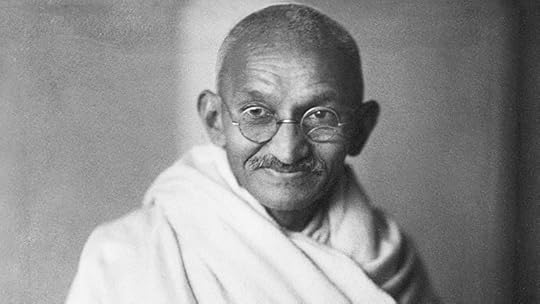
Gandhi’s message was peace. He said, “My life is my message.” His doctrine of ahimsa, or non-violence, was a core principle for him and was exhibited by his genuine love for all life. The relentless pursuit of his ideals changed a nation and world.
Too many leaders say one thing and do another. Politicians often give bold promises during the campaign. Yet they fall short on actually changing anything once elected. If a leader talks mainly about the company, profits and himself or herself, you know the person isn’t a servant leader.
Where does the leader spend his or her time?

Sam Walton, founder of Walmart, felt discounting was the way to do retailing. What mattered most was how he did it. He believed that you should stick to your values: don’t worry about the money but follow your passion, and take care of your people. He spent little time in his office and most of his time in his stores, talking to employees or customers. He called customers ‘neighbors’ or ‘guests’ and employees ‘associates’ or ‘business partners’. He said, ““If you take care of your people, it is your people who will take care of your customers and the business will take care of itself.”
Contrast that with recent surveys about CEOs that shows they are in the bottom quarter of trust in the professional population. According to Gallup only 23% believe that most CEOs can be trusted. Why does this happen? If you don’t spend time in a relationship with others you can’t build the trust.
How does the leader treat other people?
With 87% of the world’s employees disengaged, it’s evident that they don’t feel valued, respected, or that important to their companies. Leaders at Google do it a different way. Sundar Pichai is the CEO. His team believes that great products come from great people and their organization treats them as such. They also formalize that employees need to spend 20% of their time outside of their work functions. Google values passion, transparency and freedom, which leads to creative employee engagement.
Contrast this with research on the political climate in the US. Nearly 70% of people see it getting worse or more hostile than ever. It seems many political leaders don’t work as hard to collaborate for the good of the country as as they do to discredit and bad mouth their opposition. How could anyone believe that leaders who do this will lead authentically or well?

Selfish? That’s not how to make a difference. Your work, your world doesn’t need another selfish leader. Servant? Dr. Martin Luther King Jr a great servant leaders said, “Life’s most urgent question is, ‘What are you doing for others?”
By the way, do you want to elevate your coaching effectiveness and success? If so, check out this complimentary Coaching for Excellence article.
 Do you want a proven game plan for career success? If so, check out Doug and Rick’s Superstar Leadership book!
The post 3 Questions to Help You Make a Difference as a Leader appeared first on Rick Conlow.
November 13, 2017
3 Leadership Lessons for Dealing with Employee Performance Issues
 Leadership lessons are invaluable as long as you take the time to recognize and apply them.
Early in my career I hired an employee, that had a stellar background and work history but almost immediately had performance issues. She was good at the technical duties of the job but not at communicating and working well with others. During meetings she made critical comments of co-workers for the job that they did. Or, she wouldn’t follow-up, and include others in needed communication. She would say, “Why don’t others just do their jobs.” When I had coaching sessions with her, she would complain about co-workers, and then agreed to improve. Inevitably, things would be stirred up through additional sarcastic or caustic remarks. This went on for a while, and I agonized over it.
Is it time to fire the employee?
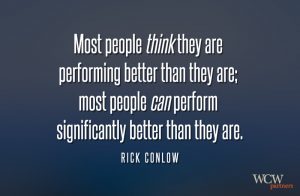 I thought I had to fire her. We eventually had a heart to heart talk, and during our discussion I learned things about her background that shed light on what was happening. Her work history was mostly solo work, where she starred. Plus, she shared some personal things in her past that affected how she communicated. It finally dawned on me that she really didn’t know that much about teamwork, and lacked key emotional intelligence skills to make changes effectively. While this was happening I was attending a seminar related to managing with flexibility in terms of my coaching and leadership style. I had been supervising her the same way for all her priorities including working well with others and teamwork. So, I was at fault, too, for the poor performance. Bottom-line, as I changed how I supervised and coached her, she improved greatly as time went on and became a star employee in all areas.
3 Leadership Lessons Learned
While I hated the experience at the time, I am very grateful today for the situation, and the learning about how to deal with employee issues. My leadership lessons are below and they have served me well over the years.
Thoroughly check what a prospective employee’s work experience actually involves before you hire.
Apply leadership different styles to different employees, and different styles to the same employee depending on their performance on specific objectives.
Don’t give up on people too quickly. Even a poor performing employee can become a top performing employee.
Author John Maxwell said, “Leadership develops daily, not in a day.” Is there a leadership lesson or training that has made a big difference for you?

For 4 dynamic online leadership training programs go here: RCI Online Leadership Training.
Want to accelerate your career? Check out one of my books in the Superstar Book Series for a boost!
The post 3 Leadership Lessons for Dealing with Employee Performance Issues appeared first on Rick Conlow.
November 2, 2017
Leadership Promises Broken, A Lack of Integrity
Leadership promises should be made sparingly because leaders as a whole are highly distrusted today. Promises without follow-up, follow-through or action is lying – dishonest. If you have integrity it means the promises you make, you keep. This builds trust and employee engagement.
 Even little things matter. If you say to any employee, “I will get back to you.” Then, you don’t, your credibility suffers. If fifteen times you do what you say you will do, you have earned the benefit of the doubt if you make a mistake by not keeping a commitment. What I am talking about is a pattern of behavior. Yet, some things aren’t so little and the consequences quickly bring pain, hurt feelings and distrust.
Leadership Promises a Bonus: Bonuses are NOT Paid
My friend is a Sales Director for a company. Sales were up above goal and he exceeded the objectives for adding large new accounts. The company paid bonuses to managers after the year end. He hit the top bonus levels. Bonuses were based on departmental goals. The company wasn’t doing as well, and it came in well below expectations. A new CFO was on the job, and he pulled ALL management bonus payouts because of the company results. Of course my friend and others were greatly disappointed and upset. They lost significant money. In the end, there was nothing they could do. The company claimed they had a clause (in the fine print of the employee handbook) for their protection. Do you agree with this?
Leadership Promises: We will continue to operate as normal, really?
 A large manufacturer bought a smaller one. The new leadership told employees their jobs were safe, and that the current management team would stay on. After a year, things began to change. The large company brought in new people. The top management began to leave one by one. Eventually people were asked to move to a another city (where the corporate headquarters was of the larger company). If the employee didn’t want to move they were offered a severance. Changes soon began to flood the smaller company as it was absorbed by the larger one. Employees were crushed, and many laid off which of course negatively affected their livelihood and families. Sound familiar?
I don’t know about you, this isn’t the first time I have seen things like this happen. It’s a total lack of integrity. Don’t say it if you don’t mean it. Leadership practices like the above demolish trust in corporate America and the individual leaders. Then, companies wonder why employee engagement and loyalty is low. The best leaders lead with integrity, and focus on helping their team succeed. Remember this and you will become an exemplary manager.
 Accelerate your career, see 4 dynamic online leadership training programs go here:
RCI Online Leadership Training.
Accelerate your career, see 4 dynamic online leadership training programs go here:
RCI Online Leadership Training.
Want to be distinguished your job? Check out one of Rick’s books in the Superstar Book Series for a boost!
The post Leadership Promises Broken, A Lack of Integrity appeared first on Rick Conlow.
October 31, 2017
This is a Lack of Leadership; It’s Demotivation
The big man came to town, and he was the SVP of Operations, and his hit man reputation preceded him. He was there to “fire” everyone up, and they were nervous. I was worried it may be demotivation not motivation.
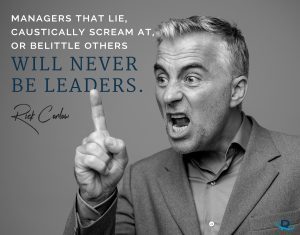 He stormed into the meeting room-where around 50 people had gathered-fifteen minutes late. I had just started working with the region as a consultant (hired by the COO), and he totally ignored me, and the other managers for that matter. His eyes roomed the room, and then he yelled at the top of his lungs, “You are either on the bus or off the bus.” (I hate those words and others like them) Then he started to berate everyone for poor performance, and challenged them to be better or he would can their a**. I counted his bus phrase about twenty-five times. He would walk up to someone, yell the words in their face, say a few choice words sometimes, get up and find someone new to chew on. After about forty-five minutes, he abruptly left to go to another location to give them his dose of demotivation.
Needless to say everyone was deflated, angry and concerned. It became my job to clean up his mess, and it took the next day or so to calm everyone down, and get focused on what to do to move forward. Eventually we pulled a plan together and significantly improved the results. I didn’t see him again but heard the COO of the company had a meeting with him to have…. a conversation. He eventually was fired, although he had a long career at that company.
Leadership is Positive Influence not Demotivation
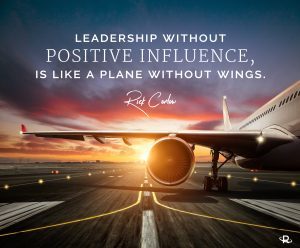 His antics are not leadership. Others that do this, regardless of their title, are not leaders. It’s been said that leadership is influence. Let me add to that phrase, “leadership is positive influence.” Without the positive, leadership is like a plane without wings. Negative influence is demotivation, an affront to employees, customers and quite frankly the company. It ought to outlawed, it’s dinasourish, too! It’s not leadership.
Can you relate to this story?
For 4 dynamic online leadership training programs go here:
RCI Online Leadership Training.
Want to accelerate your career? Check out one of my books in the Superstar Book Series for a boost!
The post This is a Lack of Leadership; It’s Demotivation appeared first on Rick Conlow.
October 17, 2017
Leadership Lesson Learned or Never Taught
This Philosophy of Management image made me think that this simple but powerful statement suggests a leadership lesson any manager must learn and re-learn. Yet it’s absent in so many in positions of authority and influence.
The Leadership Training of Clarence Francis
After graduating from Amherst College in 1910, Clarence Francis went to New York City to apply for a job with Standard Oil. He made a mistake by going to the wrong office and landed a job with Corn Products Refining Company instead. Clarence’s philosophy of management served him well as he worked his way up to Chairman of the Board of Directors of General Foods in 1954. As an expert in the food industry and its distribution, he also served US President FDR and US President Dwight D. Eisenhower in a variety of capacities.
Clarence’s approach to leading appears ahead of its time but I believe he had it right. The major approach to management at the time was Frederick Taylor’s Scientific Management Principles. Through time studies and research, jobs were optimized for the best way to work to improve productivity. While it improved results for a time, it led to employee monotony and a schism between management and workers that still hovers over the workplace today.
The Leadership Lesson: “You have to earn these things.”
We are all in an era of colossal business change, leadership distrust, and the lack of employee engagement. People are fed up with leaders in all areas of life. We need better leaders, yet, there is a vacuum in leadership effectiveness in many areas. Leadership isn’t really about profit, the stock price or a person’s pocketbook; it’s about people. Therefore, it’s about character. Enthusiasm, initiative, loyalty, devotion of hearts, minds, and souls; what do managers need to do today to “…earn these things”? (Leave your comments below.)
For 4 dynamic online leadership training programs go here: RCI Online Leadership Training.
Want to accelerate your career? Check out one of my books in the Superstar Book Series for a boost!
If you liked this post, here are a few other posts you may find helpful.
The post Leadership Lesson Learned or Never Taught appeared first on Rick Conlow.