Rick Conlow's Blog, page 14
February 18, 2020
Nelson Mandela: How to Lead by Example
Nelson Mandela had a huge problem as President of South Africa. How could he help his country heal from apartheid and achieve reconciliation? He did it by leading by example. He stated, “Courageous people do not fear forgiving, for the sake of peace.”
The 1995 Rugby Championships
Mandela encouraged black South Africans to get behind their hated national rugby team, the Springboks. Mandela championed the team during the 1995 Rugby World Cup hosted by South Africa. He developed a supportive coaching relationship with Francois Pienaar, an Afrikaner and team captain. Together they rejected the prejudices of their society. The team rose to the occasion and beat New Zealand to win the championship. While presenting the trophy to Pienaar, Mandela wore a Springbok’s jersey with Pienaar’s #6 on the back. This act along with the other events became a huge step forward for unity. Nelson Mandela led the way and won the hearts of millions of white and black South African rugby fans. As a result, the country began to learn how to collaborate with one another to remake their nation.
The Negative Impact of Not Leading by Example
 I have discovered that managers, who do not lead by example as described above, generally don’t build strong, high performing teams. Consequently, they tend to have higher employee turnover, poorer customer service, sub-par employee engagement and overall lower performance. These are the administrator managers. On the other hand, leaders that lead by example are servant leaders. They get better results.
Nelson Mandela’s Definition of Leading by Example
While your leadership experiences may or may not be on a national scope like Mandela, how you lead will determine your success. Certainly, leading by example means positively influencing others through modeling the way. In other words, showing other the why and how of their work. Without this, managers are doomed to mediocrity or failure. It begins with creating trust through heartfelt humility, creative communication, courageous coaching and indomitable integrity. Finally, hear these words of Nelson Mandela, “If you want the cooperation of humans around you, you must make them feel they are important, and you do that by being genuine and humble.”
Furthermore, Albert Schweitzer said, “Example is not the main thing in influencing others, it is the only thing.” We desperately need better leadership now, in business and all walks of life. A positive and trust filled leadership revolution has begun, will you be a part of it?
In summary, coaching is the secret sauce of leadership success. Why? When done genuinely and with integrity, it helps employee inspire themselves. It brings out the best in people. Any leader that wants to achieve superb results coaches relentlessly and passionately.
 Also, are you committed to your team’s success and ramping-up your career? If so, see this complimentary eBook and guide: Coaching for Results.
Finally, see the video training for further development: How to Lead by Example.
The post Nelson Mandela: How to Lead by Example appeared first on Rick Conlow.


February 13, 2020
Win an Employee’s Heart, Achieve Superb Results
Most employees go to work, and his or her heart isn’t in it. What does that mean? Leaders’ say employees lack engagement. In other words, they lack spirit and excitement for what they do. As a result performance, sales, customer service and quality suffers. Can you relate to this? In other words, the job is a job. In other words, a job is a means to an end to get a paycheck.
A Leader Captures a Person’s Heart
 Too many company cultures are toxic. Consequently, people are in fear or get beat up or don’t get much support. Employees are treated as assets not people, and engaged like numbers on a spreadsheet: dull and boring. Real leaders capture the heart of each team member. How? They engage their team in consistent high performance coaching for results. Certainly, they influence their employees positively not negatively. Employees may have the skill and knowledge, but if they aren’t inspired it won’t be fully applied.
Actions Steps for Coaching for Results
Most importantly, leaders communicate well. Therefore, they communicate consistently with these kinds of activities:
Setting clear business goals and expectations
Establishing what the employee wants: career, personal, financial desires
Asking for input
Listening well
Providing personal development training
Problem-solving together
Encouraging, recognizing, praising
Holding employees accountable for great results based team objectives and personal discussions
Making the time-the team is more important than the goal
2 Kinds of Coaching that Inspire the Heart
 Firstly, effective leaders do informal coaching on a daily basis. This means throughout the day they ignite the heart of any employee by communicating in short bursts. Through a minute here or a minute there they might give someone a compliment. Or, send an encouraging text or answer a question positively. Also, help with a problem. In addition, follow-up on an issue through a phone call. Do you see where this is going? This can happen all day. Therefore, it could involve a chance meeting in the hall that leads to a quick goal review. And, it should include a good morning and talking about the latest weather. Feedback from thousands of managers says that these kinds of encounters happen with employees 30-50 times a day. If each is a minute or so is it too much to ask to invest an hour a day with your team?
Secondly, coaching for results also involves setting scheduled one on one times with each employees. This is formal coaching. If you are separated by distance you can do it by video conferencing, Skype or the phone. These meetings generally take 30 minutes or so. Taking this time consistently also wins an employee’s heart. You invest the time in making them successful. When you do the actions described above collaboratively and constructive, you send a powerfully positive message. These approaches mean-I care about you. I will do everything I can to help you achieve great results here and to whatever career aspirations you have. Consequently, it’s a powerful self-motivator for the employee to step up. Therefore, this kind of coaching has to be done regularly. Usually that means at least monthly.
Pulling It All Together
In summary, coaching is the secret sauce of leadership success. Why? When done genuinely and with integrity, it helps employee inspire themselves. It brings out the best in people. Any leader that wants to achieve superb results coaches relentlessly and passionately.
Finally, are you committed to your team’s success and ramping-up your career? If so, see this complimentary eBook and guide: Coaching for Results.
The post Win an Employee’s Heart, Achieve Superb Results appeared first on Rick Conlow.
January 31, 2020
A Listening Leader is Golden, Others are a Dime a Dozen
Leaders that don’t listen are a dime a dozen, as the saying goes. Almost everyone has had a boss that does all the talking. I am tired of them, aren’t you? Consequently, most of them are bad bosses.
Why don’t they listen? Some don’t care; their internal values aren’t attuned to other people’s situation or needs. Others let their ego get in the way which prevents them from paying attention to other people’s ideas. The truth is that many don’t know how to listen. They haven’t been taught or learned the skills of listening. Finally, we are in a world that values talking, speech-making and presentations. Shock and awe win the day. Our rat race of a world prefers snapchat–the fastest way to share a moment and then forget it.
When I Finally Began to Learn How to use My Listening Skills
 My wife and I were having a disagreement over an issue one day at the kitchen table. Since I train managers in leadership, including how to listen, I emulated good listening behavior with her. I nodded my head, made eye contact, and asked a few clarifying questions. Then I did it–I said this with a big grin, “If I understand you correctly, you are saying...”
She responded quickly by leaning forward on the table, locking her eyes with mine and said, “Rick, don’t give me any of the workshop B.S.!” (She was a little more colorful in her word choice than I just wrote.) I learned I am not the best listener. I bought into the 24/7 business mentality. My listening was robotic, and I lacked honest empathy. I really didn’t care about her point of few at that time and it burst through like a sunrise in a dark room.
Listening is a Lost Art
Using listening skills, and empathy are a lost art because it takes time. Certainly, you have to slow down and this flies in the face of our “fast food” world mentality. Investing the time to create deep, multi-layered relationships are almost a thing of the past. Listening isn’t about you; it’s about the other person. I mean, how often have you listened to a speech or watched a video conference by a CEO explaining their great vision and plan? Now, how often have you seen one in your office or with the team asking for input, listening, clarifying concerns and taking notes?
I believe the following happens way to often in organizations today.
Managers get some random leadership training, and listening may be a part of it.
Yet, managers have 100 different priorities. Everyone is scrambling to get things done.
Their team is down five people.
They attend meeting after meeting.
When objectives aren’t reached or changes not implemented, there isn’t any listening. “Leaders” tell them need to be accountable for results and get their act together. Get on the bus, or they will be off the bus.
Few organizations allow time for listening. They want action.
Also, this is what happens with the yearly or every other year employee engagement surveys. (Even the “real-time ones). Employees fill it out. HR or other managers look at it and then create action plans within a certain time period so the executives can review the input and check it off the list. However, it all happens over a few weeks or months, then poof, it’s all done and forgotten pretty much until next year or so.
Pulling It All Together
 We really put our listening skills to work when we value the person or people above all else. This is a Servant Leadership approach. So we take the time, make eye contact, ask questions, empathize and paraphrase. And we do it sincerely and honestly. When we do, we communicate their value, and trust begins to happen. Now, only doing this one time is the test.
The magic is learning a consistent pattern of behavior while relating to others, regardless of the whirlwind around us. When we do this our credibility is enhanced, and as a leader we gain positive influence, truthful input from others and a higher performing loyal team. With our families we demonstrate a deep love unknown by many. Writer Roy T. Bennett suggests, “Sometimes all a person wants is an empathetic ear; all he or she needs is to talk it out. Just offering a listening ear and an understanding heart for his or her suffering can be a big comfort.”
In addition, do you want to improve your influencing skills? See this eBook: How to Motivate-NO-Inspire People: 10 Keys to Employee Engagement.
Also, for further career development and coaching, check out this complimentary assessment and guide: Success Practices.
The post A Listening Leader is Golden, Others are a Dime a Dozen appeared first on Rick Conlow.
January 10, 2020
The 26 Greatest Motivational Quotes of All-Time
Who doesn’t want the motivation to achieve more success? Therefore, may these quotes support and encourage you on your journey this year. Further, the number 26 signifies gaining wealth, prosperity, happiness and balance. In addition, it emphasizes real positive change in life.
Positive Motivation to Start Fast
“Cheers to a new year and another chance for us to get it right.” Oprah Winfrey
“Imagine your life is perfect in every respect; what would it look like?” Brian Tracy
“You are never too old to set another goal or to dream a new dream.” CS Lewis
“If you have a talent, use it in every which way possible…Spend it lavishly, like a millionaire intent on going broke.” Brenda Francis
“We will open the book. Its pages are blank. We are going to put words on them ourselves. A book called opportunity and its first chapter is New Year’s Day.” Edith Lovejoy Pierce
“You’ll never get bored when you try something new. There’s really no limit to what you can do.” Seuss
“Do what you can with all you have, wherever you are.” Theodore Roosevelt
“Don’t be intimidated by what you don’t know.” Sarah Blakely
“The way get started is to quit talking and begin doing.” Walt Disney
“Today, do what others won’t so tomorrow you can accomplish what others can’t.” — Simone Biles, Gymnast
 Turn Setbacks into Motivational Learning
“If you are working on something that you really care about, you don’t have to be pushed. The vision pulls you.” – Steve Jobs
“Failure Will Never Overtake Me If My Determination To Succeed Is Strong Enough.” Og Mandino
“Motivation gets you started. Habit is what keeps you going.” Jim Ryan
“You should never stay at the same level. Always push yourself to the next.” Marnelli Dimzon
“We may encounter many defeats but we must not be defeated.” Maya Angelou
“Nothing in the universe can stop you from letting go and starting over.” Guy Finley
“Setbacks motivate me.” Lindsey Vonn
“You learn more from failure than from success. Don’t let it stop you. Failure builds character.” Unknown
“Believe me; the reward is not so great without the struggle.” Wilma Rudolph
Keep Your Motivation and Succeed
“Erase the word ‘failure’ from your vocabulary.” Mary Lou Retton,
“Go confidently in the direction of your dreams.” Henry David Thoreau
“It always seems impossible until it’s done.” Nelson Mandela
“The best is yet to come.” Frank Sinatra
“Champions keep playing until they get it right.” Billie Jean King
“Always keep your eyes open. Keep watching. Because whatever you see can inspire you.” Grace Coddington
“Life is 10% what happens to you and 90% how you react to it.” Chuck Swindoll
Finally, today act, learn and begin again tomorrow. Most importantly, genuine motivation is an internal process, and success is a mindset not a destination. May the best of success be yours this year!
 As a result, do you want more motivation? See this complimentary Success Practices guide and assessment.
Furthermore, managers or budding managers see this best seller, How to Motivate-NO-Inspire People: 10 Keys to Employee Engagement.
The post The 26 Greatest Motivational Quotes of All-Time appeared first on Rick Conlow.
December 27, 2019
How to Transform Positive Thinking into Positive Living
Life has the habit of wearing us down. Positive living is hard to do. Will positive thinking really help us in defeat? Rejection? Frustration? Setbacks? Illness? Or, critics? Unfortunately, we all are confronted with these kinds of challenges in life. It’s part of the human condition. Most of us do try positive thinking to get through it all. I have discovered that all of us are engulfed by insidious enemies more challenging than life’s ups and downs. Consequently, we often ignore them or give in. Thus, in spite of our positive thinking, this leaves us slaves to our condition and defenseless to change.
Our Inner Voice and Positive Thinking
 Scientists say the average human being has around 50,000 thoughts a day. Some suggest that 80% or more are negative. For example, have you ever had a great idea and thought, “If only I could sell it in Walmart or Target, I would make a million dollars”? Then you got busy and forgot the idea. Then a few months or a year later you saw your idea on the shelf at one of these stores! Someone else had the idea, too, but they followed-through. Have you ever had a kind or loving word to say to someone but hesitated and then never said it? Now you regret it. Have you ever wanted something and dreamed about it, but it never happened?
We had positive thoughts, but they didn’t necessarily help. Our inner voice often derails our attempts to win in life. We get distracted and forget, or worry about what would happen. Or, doubt kills any good that would come of it. Can you relate to this? Using a baseball metaphor, this is strike one.
 The Media’s Impact on Being Positive
The media also feeds us negative headlines with seventeen bad news stories to one good one because we are attracted to that – which is sensational. Networks subtly tell us we aren’t good enough with over 15 minutes of commercials per hour telling us how we can improve our lives if only we had their products. We work less, watch over 4 hours of TV a day or cell phones, and the trend is up. By the time we are 65, we have witnessed over 2 million of these commercials. Companies aim their messages about being rich and famous at the higher economic levels, and talk about things others can’t afford, but manipulating all of us to buy while preying on our insecurities. In addition, all research shows violence is greater than ever on TV so our fears are fueled. Social media, too, is adding to the tsunami of negative noise with unending gossip and trivia.
These millions of impressions silently dissuade us from believing our positive thoughts or making needed or wanted changes in our lives. Back to baseball, this is strike two.
Other People’s Influence on You
Other people tend to drag us down, too. Why? First, they are influenced by their own thinking and through the inundation of social media. So they reinforce the barrage of doom and gloom. Next, studies show people are ruder and less civil than in years past. Whether you are at the movies, market, coffee shop or mall, politeness and manners are out. Even politicians, our so called “leaders”, are grossly lacking in respect and integrity. This lack of civility infects our family, friends and co-workers who communicate with us daily many times. What do a group of friends or co-workers often do when talking over a drink, meal or during a social gathering? They complain and talk about how bad things are at work, with the government, and the economy. Can you relate? Now, with the baseball metaphor, this is strike three-YOU are out.
As a result, if left unchecked, we are flooded with abusive communication that stops us cold from doggedly pursuing our positive dreams, desires and thoughts. Many of us quit and become conformists.
Positive thinking isn’t the strangest secret. Positive thinking needs two other ingredients: optimism and action.
Self-help Gurus Define the Path to Positive Living Wrong
 Aristotle declared, “We are what we repeatedly do; excellence is not an act but habit.” Positive thinking does not work in and of itself because so many of our thoughts are quietly transformed against us from our own mind and environment. We talk ourselves out of our positive thoughts before we act.
A study at the world-renowned Mayo Clinic determined that optimism is advantageous to our health. The researchers distributed the MMPI assessment to hundreds of patients to determine their pessimism and optimism tendencies. After thirty years, the results proved that, on average, optimistic people live about 13-14 years longer through a healthier life style, suffer less illness, and experience a better quality of life. Pessimism derails our positive thoughts, and causes us to believe in the negative alternatives. Optimism means we believe something is possible or that we can do it, have it or be it. It moves positive thinking from the head to the heart which generates positive action. In addition, it is mental choice that germinates into positive action and living.
Positive thinking is Pollyannaish day-dreaming when it is without positive belief or action. While it is true that thinking and action are intertwined, positive action proves our thoughts are genuine and not superfluous deceptions of our true desires.
For example, if you are over-weight and think about losing weight, but never watch what you eat or exercise, the pounds will remain. When a storm is coming, you can’t think it away with positive thoughts; you have to do something to protect yourself. As a leader, you can talk all day about the importance customer service, but until you demonstrate it, the words are worthless. What we do means much more than what we do either validates or convicts what we think or say.
How Do YOU Achieve a Positive Breakthrough?
Everyone has positive and negative thoughts. Positive thinking without optimism and action is dead. With them it equals positive believing and living. Belief is a choice, not a thought, which translates into action. How do you know if you or someone really believes in a goal? Look at what they do. Optimistic chooses the positive belief that inspires action. It pays the bill so to speak. We become what we believe and do.
Louis Pasteur said, “Chance favors the prepared mind.” Steven Covey showed that successful people have seven habits not seven thoughts. The research and work by Martin Seligman describes how people can flourish as human beings by following systematic practices for a better way of life.
 How do we create more positive believing? Here’s the key: all of us have to work at it daily if we truly covet a better life. If we don’t, we become subservient to the multitude of messages we receive that surreptitiously wreak havoc in our lives.
For example, over nine decades ago, Dr. Evan O’Neill Kane of New York’s Kane Summit Hospital, felt doctors were losing too many patients in appendectomy surgery, many because of the effects of general anesthesia. He felt that local anesthesia would be better for the patient but, not surprisingly, no volunteers came forward to test his hypothesis. Colleagues and the media scoffed at him. Until, that is, February 15, 1921.That’s when he optimistically performed an appendectomy with local anesthesia — on himself! In the process, he changed accepted medical practice.
5 Choices that Create Positive Living
These choices give you POWER over the daily barrage of negativism and pessimism.
Purpose-Clarify and crystallize your beliefs on this one question: How do you want to make a constructive difference in this world? Your answer gives you the inspiration to change how and where you show up in life. Now, what step will you take today to prove it? Clarity of focus brings consistency of intention.
Opportunities–Get involved in learning opportunities: How can you develop your skills and talents to do the above? Lifelong education and training renews your spirit and challenges your creativity. Enroll today.
World View–Change your perspective from self-concern to other concern. How? There are always people in need that could use your assistance. Where can you help someone today? Tomorrow? Samuel Smiles said, “It’s a beautiful compensation in life that when you help others, you help yourself.”
Enjoy–Few face the end of their life hoping to work more hours or earn more money. Most want their loved ones with them. How about you? Where can you make more quality time for family and friends today? How can you relax more? How can enjoy life more?
Results–What are your most important life and career desires? Here is a test to determine what’s most important to you? Look in your checkbook or Visa card statement and your schedule. What can you learn? Where do you spend most of your money and time? These are your priorities in life. What changes are you really prepared to make today if these results aren’t what you want? How can you demonstrate this today?
Summing Up Positive Living and Believing
We all have the POWER but we must “do it now” or again yield to the constant stream of naysayers including ourselves. Rocky Balboa said it well: “You, me, or nobody is gonna hit as hard as life. But it ain’t about how hard you hit. It’s about how hard you can get hit and keep moving forward; how much you can take and keep moving forward.”
 Do you want to benchmark your career with the habits of highly successful people? If so, check out this complimentary inventory and guide: Success Practices.
Finally, commit to taking action to advance your career. Read this action oriented eBook now: GoalPower: How to Increase Personal Performance and Career Success.
The post How to Transform Positive Thinking into Positive Living appeared first on Rick Conlow.
December 14, 2019
10 Phrases that Good Managers Say Regularly
Good managers are different from other bosses. If you have had one lately you probably noticed they have high standards, are upbeat, knowledgeable and straight talkers. You will get the feedback you need to succeed. If you are lucky enough to have one you will want to excel, because you believe in yourself a little more when you are around them.
 A key attribute about good managers is that they talk differently than their colleagues, and that adds to our sense of empowerment.
10 Phrases from Good Managers
Here are ten statements that good managers (real leaders) say regularly that shows they care about their people more than their title.
1. “I am glad you are on our team.”
Yes, some leaders actually say that once in a while instead of something like “What have you done for me lately?” I had one that used to say, “How much money have you made me today?” All employees want to be part of something bigger or grander than the everyday grind, and it’s nice to know work can be that something. Leadership is influence, and it’s either positive or negative. There is no neutral.
2. “My vision is…”
It seems this is a novel concept, to communicate the overall goal of the work team, department, or company. It gives the big picture to everyone’s job and the why. Good managers do this concisely but with passion, not matter what the work is. Plus, they think bigger. It is also important for on-going updates, telling everyone on the team “Here is how we are doing.” With mediocre bosses every day is “same old, same old.”
 3. “My expectations for you are…”
Few managers are good at providing clear goals and expectations. Our research shows that 80% of performance problems are because of a lack of clear expectations and goals. The best managers also say, “Let’s talk about your progress,” and not “Let me give you some feedback.” This means LOOK OUT! The excellent managers adhere to this quote by Pat Riley, President of the Miami Heat: “A coach must keep everyone on the team in touch with present-moment realities- -knowing where they stand, knowing where they’re falling short of their potential, and knowing it openly and fairly.”
4. “You can do it, I believe in you.”
We all need someone to believe in us. Good managers give encouragement, and they challenge you to do the better. I had one that would say, “You can do it, let’s keep hustling.” I had another one that used to sing the song, “Sixteen Candles” down the hallway. Then he’d come over and praise me about some goal and head back down the hall singing. It set a light tone to our brief meeting. Poorer managers always seem to be about bad news.
5. “Thank you!”
People want to be appreciated. A simple thank-you often is enough. ‘Great job on…’,’keep up the good work…’ are also others ways they recognize but they do it regularly and sincerely. It’s hard to get a compliment from other managers. It’s documented that genuine praise works, plus it’s the right thing to do.
6. “How’s it going?
They are willing to talk to you. Mr. Jim Low was a master at this. When I first met him his legend preceded him. For over a decade he led his market in profit, sales and employee retention. I asked why he was so good. He replied by laughingly saying, “I didn’t go to college.” He added that every day he’d come to work and first go talk to as many employees as he could by asking, “How’s it going?” He might relate this to something he knew about the person. The employees mostly talked about their lives. He discussed business only if they brought it up. Then, when he had a problem, he would go to employees and get the straight info, no BS, because he already had a positive relationship with them.
 7. “What do you think?”
Considering the pressures of our jobs and the need for innovation and improvement, why wouldn’t a manager ask this question of his or her team members often? Here are two reasons to do it. First, you don’t want people bringing all of their problems or concerns to you. There isn’t enough time. You have to train them to problem-solve and become solution focused. Second, they will become more proactive while improving their performance. Most employees are astounded when their managers ask this question and reply, “What????” Sadly, less effective managers are fearful of the answers or don’t care. Famed basketball coach from UCLA John Wooden said, “It’s what you learn after you know it all that counts.”
8. “How do you think we can improve?”
This is the next logical question to ask a team. When you do, you begin to get their buy-in and commitment grows. They want to achieve their goals for their reasons too, not just yours. Each employee has untapped potential for great ideas. Why not ask? The best do this and their employee engagement and productivity soars.
9. “I made a mistake.”
Nobody’s perfect. Good bosses admit it when they screw up and even apologize. Obviously, they aren’t making so many mistakes that they are apologizing all of time. I put this in here because it is so out character by leaders to do this at all.
I was at a conference a few weeks ago where a manager talked to his team about a marketing campaign that failed. The manager owned the failure, and said he was sorry to his team because he really pushed for it. Because he had trust with his employees, they got through it. In addition, by learning from this situation and collaborating they created a better plan-that worked. When was the last time you heard a manager say, “I made a mistake”?
 10. “My success comes from the team.”
Sometimes managers say this to their teams, but more often it’s about self-glorifying their success to a boss or colleague. That gets around, and their credibility is destroyed. However, the managers that highlight their teams’ efforts and give credit to them for any victories are golden leaders. A leader’s success is all about the team. In the movie “The Mighty Ducks”, Coach Bombay tells his team,”A team isn’t a bunch of kids out to win. A team is something you belong to, something you feel, something you have to earn.“ With low employee morale and engagement in many companies, this is a valuable lesson that most managers have yet to learn.
Pulling It All Together
Napoleon Hill declared, “Think twice before you speak, because words and influence will plant the seed of either success or failure in the mind of another.” Hopefully these ten phrases give you a lift, and helps you build your team up, not down like so many other managers do. Let’s not forget another quote filled with wisdom, by Emerson: “What you do speaks so loudly that I cannot hear what you say.”
What phrases or statements do you hear good managers say-often?
Do you want to benchmark your career with the habits of highly successful people? If so, check out this complimentary inventory and guidebook: Success Practices.
Finally, check out Rick’s bestselling book, Superstar Leadership.
Thank you for reading this post. I wish you the best of success.

The post 10 Phrases that Good Managers Say Regularly appeared first on Rick Conlow.
December 4, 2019
The Philosophy of Management: “Earn” these Things!
“You have to earn these things.” This is a simple but powerful statement about The Philosophy of Management. It suggests a leadership lesson any manager must learn or re-learn. However, it is absent in so many individuals in positions of authority and influence. Watch this leadership training video as it defines this profound principle.
The Philosophy of Management
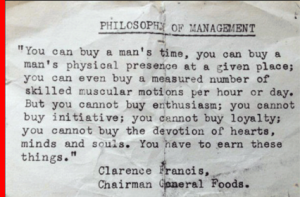 We are all in an era of colossal business change, leadership distrust, and employee disengagement. We need better leaders. Yet, there is a vacuum in leadership effectiveness in many areas. Many have forgotten or ignore what really works. Leadership isn’t really about profit, the stock price or a person’s pocketbook or a strategic plan. It’s about PEOPLE! Therefore, it’s about trust, personal character and integrity. It also is about the respect of others. All of these ignite enthusiasm, initiative, loyalty, devotion of hearts, minds, and souls in employees. A positive relationship with employees is far more powerful than the job title. There are far too many bad bosses out there. It’s worthy to note that the #1 reason employees quit a job is because of a horrible boss.
Do you want to be a good boss? A real leader? Above all, serve your team. Take the philosophy of management video to heart. Learn the three simple but unique ways to earn these things. Great leaders focus on the relationship with their team. They don’t hide behind their title or company organizational chart.
Quick Bio of Clarence Francis
After graduating from Amherst College in 1910, Clarence Francis went to New York City to apply for a job with Standard Oil. He made a mistake by going to the wrong office. So, he landed a job with Corn Products Refining Company instead. Clarence’s philosophy of management served him well as he worked his way up to Chairman of the Board of Directors of General Foods in 1954. He became an expert in the food industry and its distribution. Likewise, he also served US President FDR and US President Dwight D. Eisenhower in a variety of capacities.
The Philosophy of Management appears ahead of its time. Clarence had it right. The major approach to management at the time was Frederick Taylor’s Scientific Management Principles. Additional leadership theories over the years emerged to include: the great man, behavioral, situational and transformational approaches. Over the years, numerous researchers studied and shared new ways to lead. Consequently, Amazon sells over 50,000 different leadership and management books. Some progress has been made. Unfortunately, it is nowhere near in comparison to the advances in technology. Companies and managers seem to be regressing.
 So, many managers or executives fail because of the seduction of greed, ego-fulfillment, power, and influence. This has derailed the careers of many managers. The lack of consistent leadership trust has created a schism between management and employees. It hovers over the workplace like a pack of wolves chasing its prey. Therefore, employee engagement and productivity gains are lower. Learn the three key approaches in the management video training. Then, watch your team excel and your career soar. Furthermore, you will transform from being a manager to a leader.
The Philosophy of Management Challenge
WE APPRECIATE A “THUMBS UP” IF YOU SEE THE VALUE IN THE PHILOSOPHY OF MANAGEMENT. ALSO, PLEASE SHARE IT WITH OTHERS TO HELP STAMP OUT BAD BOSSES.
 Do you need or want to accelerate your skills to lead others? See this complimentary guide: How to Motivate-NO-Inspire People!
Finally, do you want to ramp up your management career success? If so, check out Rick’s Superstar Leadership Performance Plan.
The post The Philosophy of Management: “Earn” these Things! appeared first on Rick Conlow.
November 29, 2019
5 Mindset Tips about the Success of Champions
 Over nine decades ago, Dr. Evan O’Neill Kane of New York’s Kane Summit Hospital changed his mindset. He felt doctors were losing too many patients in appendectomy surgery, many because of the effects of general anesthesia. He felt that local anesthesia would be better for the patients but, not surprisingly, no volunteers came forward to test his hypothesis. Until, that is, February 15, 1921. That’s when he performed an appendectomy with local anesthesia — on himself! In the process, he changed accepted medical practice. To be the best you can be in customer service, sales, leadership, sports, or any other endeavor, you need to change, too. Sometimes that change means operating on yourself!
Begin operating on your own situation by simply counting the how many times the letter f appears.
FEATURE FILMS ARE THE RESULT OF YEARS OF SCIENTIFIC STUDY COMBINED WITH THE FORMAL EXPERIENCE OF YEARS.
In review, how many did you get? 3? 4? 5? 6? 7? There are a total of seven! Most people get four or five. If you missed some, why? Why would anyone miss an f or two or three? It has to do with our mindset or the way we perceive things and act on them. This little exercise points out that what you are missing in terms of personal performance improvement is most likely right in front of you. Sometimes the solutions to your challenges are there, but you just don’t see them. Why? Because of entrenched habits, perceptions and beliefs. When you try to improve, it seems as futile as trying to lose weight with fad diets.
How Do You Achieve a Breakthrough Mindset?
 So, what’s the key? How do you confidently breakthrough? Dr. Charles Garfield of the Peak Performance Institute has discovered exercises that help individuals tap their personal best performances. Garfield experienced these techniques himself as a world- class weight-lifter and researcher. Garfield explains, ” In the process, the researchers discovered that mental training techniques not only combated negative reactions, but also threw open the doors to hidden reserves of energy and endurance.” In another example, Dr. Denis Waitley identified similar peak performance strategies in his work with Olympic athletes and business people. To begin remember these important principles to achieving peak performance:
Self-development is self-management. There is no self-improvement only increasing in the ability to be all that you already are. You can’t change others but you can change yourself. Learn to focus on what’s most important. Get better organized. Know and act on your top priorities. For example, at work take care of the customer. At home, spend time with your children and spouse. If you don’t plan it, you most likely won’t do it.
You have to change proactively not reactively. To manage yourself to increase your effectiveness you must be willing to change some habits to increase productivity. So, start small, and build on it. Remember, you can’t do everything at once.
All good mindset and championship performance begins with clear goals. A foundation to self-management is to respond to all events based on your goals and priorities rather than responding to current difficulties, problems or needs.
Keep learning-diligently. Enroll in 4-6 education and training programs every year. Get a degree. Read a new book in your field every month. Attend webinars every week. Always to be learning. Finally, if you aren’t learning you are decaying and dying. With learning you are growing and becoming.
Never give up! All of us will fail. If we learn that’s how we succeed again. Success isn’t winning every time. It’s being resilient enough to get back up after a fall. Thus, that’s the courage of a champion.
The “Best” of the Best Exercise
Certainly, with these approaches, winning is more than an outcome it’s an attitude. Mind and body and spirit are intricately intertwined; to control what you do, better control what you think. Just like a champion athlete systematically physically and mentally prepares to win the gold, champion salespeople, leaders, and customer service reps do likewise. Make the effort to learn more, know your product, gain new techniques to be customer centered, and prepare mentally too. It will help you handle the setbacks that go with any career, let alone life in general. This is called emotional resiliency and is a key to a successful mindset.
 Furthermore, try this mindset exercise. Think of a time in your career when you did your best work ever. Choose a situation that exemplifies your highest performance. Get a clear mental picture of the event. Replay it in your mind as if it were a movie. For instance, think of the details –people, problems, sounds, feelings, and surroundings. Review in your mind what happened, how you behaved, what you felt and achieved. In addition, capture your thoughts with the questions below:
What was the situation?
What was your motivation to succeed or act?
How did you feel?
What key behaviors or strategies did you use? Write out what worked and what didn’t work.
Identify 3-5 lessons can you learn or relearn about your education, career or success in life.
Summing up a Success Mindset
In summary, practice to replicate the above experience, you will learn how to easily adjust your mindset as needed. You will begin to transform your thinking, efforts and results. To be the best you can be, make a commitment to personal development and excellence. Therefore, if you want to be exceptional, do exceptional things. The difference between winners and losers is that the winners are champions that do what losers won’t do at all or won’t do enough.
 Do you want more success in life and in achieving your goals? If so, check out this 98 page eBook roadmap to success: GoalPower: How to Increase Your Personal and Professional Success.
Finally, do you want to really accelerate your career? Check out one or more of my books in the Superstar Book Series for a boost.
The post 5 Mindset Tips about the Success of Champions appeared first on Rick Conlow.
November 17, 2019
Smile: It Can Change the World for the Better
Have you ever notice how people don’t smile very much?s
At a recent happy event, a wedding, I noticed many of the guests had frowns or deadpan looks on their faces. My wife mentioned the same thing, quoting her mother’s description of “a look like seven rainy days” and “that one hasn’t smiled since first grade”. Over the next week, I watched people in the airport. Most were either looking at their phones or had frowns on their faces. Later that night I saw the same thing at dinner in a restaurant.
 While working the next day with a client that owns supermarkets, I zoned in on customers coming and going. Most seemed like zombies until an employee greeted them with a smile. You know what? Most smiled back! Imagine how this one kind act might change someone’s day or maybe their life for the better! Smiles express empathy and care. Recently, I came across the quote, “If you see someone without a smile, give them one of yours”.
Why not smile more?
It’s an urban myth that it takes more muscles to frown than to smile (11 to 12 ). In addition, research suggests it takes less energy smiling and that they are contagious. Therefore, try it. Smile more and you will feel better. It’s a could be a change for you, but a good one.
It’s been a positive lesson for me to relearn and to do this more. We need this type of human touch in a world of work driven by technology. I think it’s the beginning for a more compassionate world. Finally, Mother Teresa said, “Peace begins with a smile.”
 Do you want a great read to stimulate your thinking for self-development? Go here: The Extraordinary Employee.
Also, do you want to dramatically change your management career for the better? Go here: RCI Online Leadership Training: 4 Options for Success.
In addition, are you looking for practical management advice to fast track your success? If so, check out the Superstar Leadership book.
The post Smile: It Can Change the World for the Better appeared first on Rick Conlow.
November 11, 2019
Believe in Yourself: You Can Do it Today!
To believe in yourself or not, that is the question. Do you want or need a life breakthrough? Are you disappointed in your career progress this last year? Maybe, depressed because things didn’t work out like you planned? Do you have bigger goals but you seem stuck? As a result, watch this motivational training video for a reminder of your potential.
The Importance of Believe
 Someone once said there’s magic in believing. But belief isn’t magical, it’s powerful. The Bible mentions the words “faith” or “believe” 485 times. If God places such tremendous importance in belief, shouldn’t we? Mountains can be moved if you have it. Daily problems become formidable barriers if you lose it. For example, Dr. Jonas Salk believed he could help cure polio. Martin Luther King believed in a dream of racial equality. President John F. Kennedy believed we could put a man on the moon and return him home safely. Helen Keller believed and set an example of fortitude and determination for us all to follow. Bethany Hamilton lost an arm to a shark, but believed and became a surfing champion. Certainly, people with belief have a goal, a faith in something bigger than themselves, as well as a corresponding belief in who they are.
Positive Believe Leads to Success
In each of these examples above, the individuals chose to positively believe by changing their perspective in life so they could achieve their goals. In spite of the inevitable hardships and trials, each applied consistent and persistent action to get it accomplished. Now, if they just thought and thought and thought about it positively and that was it, history would be changed–negatively. The positive thinking video will give you three more outstanding examples that you can relate to.
Two words separate those who find personal fulfillment in their careers and life from those who don’t. Positive belief. You can attend all the seminars, read all of the books, write down your goals, and get a therapist and it will all be in vain unless you positively believe. What does it mean to believe in yourself? If you believe, you mentally accept or trust in yourself, someone, or something without reason or evidence.
Pulling It All Together
Positive believing separates itself from positive thinking because it is a choice. In addition, your choices are actions which leads to more action. The results are evidence. This is the key to the power of positive believing. A college degree, an education, a fancy home, nice clothes, compliments, awards, or past successes aren’t what cause you to have belief in yourself. However, a goal, loved one, God or a cause are what inspires a change in our view of ourselves and the difference we can make. Watch this positive belief video now.
GIVE THIS VIDEO A THUMBS UP! TAKE ADVANTAGE OF THE COMPLEMENTARY “SUCCESS PRACTICES GUIDE AND ASSESSMENT BELOW. MAY THE BEST OF SUCCESS BE YOURS. THANKS FOR WATCHING.
 Do you want to ramp up your success? Engage our complementary Success Practices Assessment & Guidebook now!
Are you a manager or want to be? See our eBook, How to Inspire People: 10 Keys to Employee Engagement.
+Call for consulting, training and coaching services – 612-868-8521
The post Believe in Yourself: You Can Do it Today! appeared first on Rick Conlow.