Kelsey Timmerman's Blog, page 9
September 4, 2017
Someone lives in the middle of nowhere
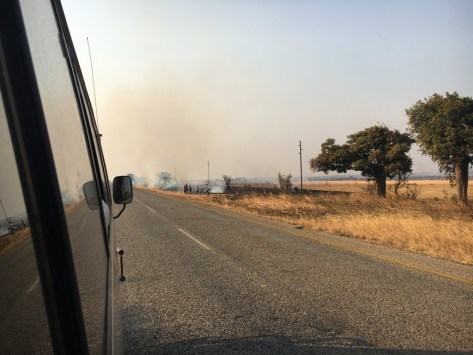
By road from Mbeya, Tanzania, to Mbala, Zambia
Bags of charcoal as high as a 10-year old are stacked on the side of the road. Someone put them there.
A woman with a child strapped to her back, as is the fashion accessory for most women during their child rearing years, is walking over a barren ridge before stopping to wave.
A little boy sits on an empty feedbag pulled on the ground by an older boy. Dust plumes swirl in their wake.
Houses on the side of the road are made from locally-sourced mud and branch and grass. In Kenya, I met a man who lived in such a house. He called it a “temporary house.” Temporary house, but he wanted the property to be his forever home. On a speeding bus the houses are nearly camouflaged.
A father waves for our mini-bus to stop. His children sit on the bags of grain he hopes to take to market. But who has room for 15 bags of grain?
A family flags us down. A young woman is wearing a prom dress with her left breast out and available for the baby boy she holds. They get on the bus. It feels like we have no more space, but somehow we always have room for one more. She covers her nose because the smell of the gas from the gas tanks inside our cab is so strong. After a few hours, I can’t smell them any longer.
A woman in a green shirt takes a nap in the sandy courtyard of her home.
A teenager addresses a circle of smaller kids.
Children and adults light a grass field on fire, the first step in preparing the land for crops.
I observed all of this while I was on a bus from Mbeya, Tanzania, to Mbala, Zambia, a trip of less than 200 miles that took 12 hours. The views were spacious. Vast. Dusty. Shrubbed. I wrote these terms in my notebook. I wanted to write another: “the middle of nowhere.” I fought the urge because there was the charcoal, the waving woman, the boys at play, the father with his grain, the nursing mother, the napper, the circle of kids.
Someone lives in the middle of nowhere. Someone loves in the middle of nowhere. To them it’s home. It’s important to me that I don’t forget this and that I don’t forget them.


August 27, 2017
What being a (privileged) minority abroad has taught me about race
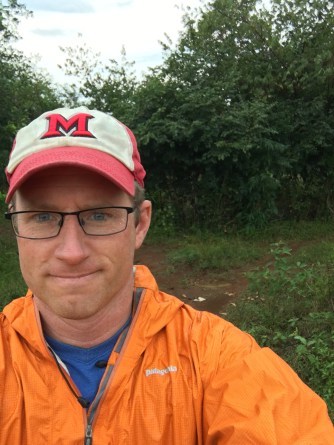
Could I be any more of a mzungu?
“Mzungu! Mzungu! How are you?” The Kenyan kids holler. Or they just stare.
Other kids yell, “Chinese!” Yes, that’s right, they mistake blond-haired, blue-eyed me as a Chinese person. This has also happened to me in Central America several times, which speaks to China’s expanding reach and influence.
This week a new friend told me that I was the first white person he’d ever had a conversation with.
I’ve spent 60 of the last 90 days traveling in Myanmar, Cambodia, India, Kenya, Tanzania, and Zambia and years of my traveling life as a minority. Not only am I majorly a minority in many of the places I travel, I’m a novelty. Sometimes I feel like a freakshow member just there for the staring. Once, in China, a grown-ass man pet my arm hair like I was an animal at the petting zoo.
I grew up in a rural town where 97% of people are white. I went to college at a school that is constantly trying to be more diverse. Fifteen years of such travel as a minority, have given me a small taste of the minority experience so I thought I’d share a few random thoughts.
(Are you awkwardly squirming yet? The white dude is about to talk about being a minority.)
Caveat: I’ve got it pretty easy
I grew up as a white dude in rural Ohio. It’s pretty damn easy being a white dude in rural Ohio. I now live in Indiana. Same story. I’ve benefited from all the privileges and opportunities that come with that, and I didn’t have to overcome any of the challenges that people of a minority race, ethnicity, religion, or sexuality have to face. The same goes for my parents, grandparents, and great-grandparents, and so on.
Although I did grow up Catholic. I had a catechism teacher so old that he could remember when that was looked down upon. That has never been my experience. I never even knew that was a thing until he said something about it. Apparently Mackarel Snapper is a religious slur aimed at Catholics. I just looked it up.
It’s not fun being stared at.
It wears on me. I try to act like I don’t feel the eyes on me, but I feel them. It makes me self conscious about the way I’m dressed or what I’m doing. Of course, I get to go home, shedding my label as a minority, leaving the stares behind.
I don’t like being judged because of my skin color.
People see me and they make assumptions about me not because of the way I act or think, but simply because my skin color is different than theirs. In the places I travel, they assume I’m rich. They might see me as an opportunity or even as a target to exploit. They have immediate expectations because I’m white.
If anything, although awkward and uncomfortable, this is a sort of magnified white privilege.
I’m a privileged minority.
When I travel I’m a minority, but a privileged one.
I walked into the largest nonprofit organization in Myanmar and within 5 minutes I was talking to the CEO. That kid of stuff happens a lot. It makes it easier to do my job as a writer. I’m sure it happens a lot at home, but I don’t realize it because I grew up with those doors open.
Police are less likely to mess with me. No one follows me around a store worried that I might take something. Border Patrol officers often just wave me through. Doors open more quickly.
A decade ago I put this privilege to the test. It’s actually kind of embarrassing. I was in Bangladesh and walked into a movie production studio unannounned thinking I actually had a shot at being the “white guy” extra in a movie. They basically told me to get lost. Thank God! I’m still ashamed that I even thought this could be a possibility.
I’m pretty sure there is no such thing as a well-traveled white nationalist.
I say we “round up” the white nationalists and ship them off to somewhere where they aren’t sure how to ask where the bathroom is and where they are judged on their skin color. I think Mogadishu, Somalia, for instance. Maybe their little pee brains and hearts would find an ounce of empathy for others.
I have no idea what it’s like to live as a minority.
I get a small taste of the judgements and preconceptions directed my way. It has made me empathize more with those who are living their entire lives in communities as minorities, but in no way do I fully know the challenges or the struggles.
And I’ll end with the hardest lesson of all…
My life is worth more.
Over the last month, I’ve made some friends who live in the informal communities around Nairobi. Recently, they’ve seen unspeakable violence because of unrest surrounding the recent contested presidential election. They’ve seen it before and they’ll see it again. One friend estimates that 80% of people in her community have directly been impacted (a loved one or friend was injured or killed). Many of these deaths go unnoticed and unaccounted for. Bodies disappear.
Although my whiteness (and nationality) may make me a target at times (not that I’ve ever experienced though), it also protects me. A white person was killed in Korogocho, and, for the most part, the entire aid and development communities pulled their programs.
Kill a white person and attention is going to come. Something is going to change. Justice is going to be sought.
This isn’t just true when I’m traveling abroad, it’s true when I’m home in Indiana.
Travel has helped teach me that when I’m home, I have the privilege of not thinking about race, of not being reminded that I’m a gringo or a mznungu, but not everyone has that privilege. My experiences as a minority while traveling have slapped me in the face with my own privileges and shown me that they come with a responsibility to listen to and walk beside those who the world–in all of its ignorance, pettiness, and hate–treat less equally.
August 26, 2017
Gunshots in the Nairobi Night: The night Kenya decided (sort of)
I had just picked up my mom from the airport in Nairobi when gunshots rang out and even made their way to the gate of our hotel. I couldn’t sleep so I just tweeted a lot…
[View the story “Gunshots in the Nairobi Night” on Storify]
Burning tires are the voice of the unheard
They felt like their vote didn’t matter.
Their leader said the election was rigged.
Maybe it was. So they grabbed a tire threw it into the middle of the road and lit it. Many had no agenda, but others thought it would bring the attention of their leaders.
But their burning tire, their noxious scream, was one of hundreds if not thousands. Even the media, perhaps afraid of escalating violence, barely covered the protests to Kenya’s 2017 presidential election.
In Kenya, as it is everywhere, democracy is a story in which the people must believe if it’s to work.
A few anecdotes of why folks I’ve met in Kenya doubt the story:
Voters are paid for their vote.
This doesn’t happen everywhere, but people can list the counties where it does happen. It used to be that a voter had proof of their vote. A voter would show a candidate’s representative outside the polls and get paid $5. Now their is not proof and the ballot is secret, but that hasn’t stopped the practice. Some voters can earn a total of $25 on election day “voting” for several candidates.
Politicians become rich.
“That’s where the politicians live,” one of my guides told me as we drove past the poshest neighborhood I’d seen in Kenya. There are no McDonald’s in Kenya, but there are McMansions.
Many radio frequencies are owned by politicians. At least that’s what a community group trying to start a community radio station told me. The group even had funding, but they could never get a frequency. They said that politicians either used the stations to promote their own agendas or snatched them up like land hoping for a big pay day.
In fact, one study found that 50% of Kenya’s wealth is in the hands of political families. In 2011, Forbes listed the current president, Uhuru Kenyatta as the 26th wealthiest person in Africa, owning “at least” 500,000 acres.
“The election was rigged”
Shortly before the election an election official was killed. I’ve heard rumors that the ruling party did it so they could tamper with the election results. I’ve heard rumors that the opposition party did it to make it look like the ruling party was tampering with the election.
The opposing presidential candidate, Raila Odinga, deemed the loser by the election officials and the international community, did his own vote count and, surprise, he won! He’s contesting the results in the court.
Regardless of the truth, people see corruption in all of the above and they protest. Protests have led to the death of countless individuals. One driver told me that he wished more “thugs” would have died in the protests as the police cracked down. There’s even a report of a baby beaten to death by police. A #slumlivesmatter movement has sprouted. No one will ever know how many died or were injured because not all lives are accounted for or matter as much as others.
So tires burn.
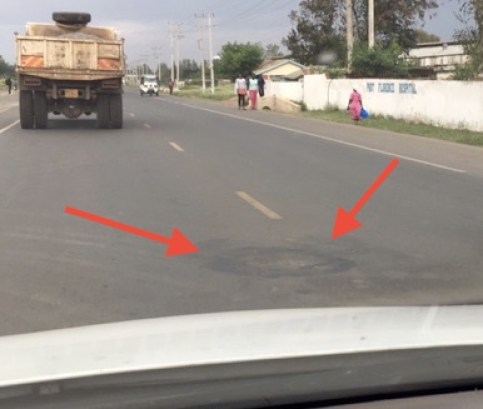
In the past few days I traveled hundreds of miles in and around Kisumu, where the opposition party is the strongest, and I saw hundreds of places on the road where tires burned. They are easy to spot–burnt rings with perfect circles in the middle. The flaming rubber melts away at the asphalt forming the beginning of a pothole.
Holes in the road make the path forward hard to navigate. But to those who lit the tires, it’s proof they existed, that their votes may not have accomplished anything, but their fires did.
August 10, 2017
The Makers of Muncie’s MadJax
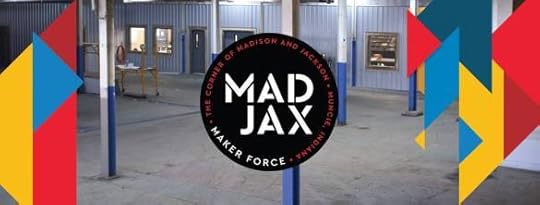
I work in a factory in Muncie, Indiana. Not many people can say that these days.
In fact, many believe that Muncie’s best days–our factory days–are behind us. Our schools are going through budget and transportation issues and a third of our citizens live in poverty. There’s a lack of hope that we can’t be more than our struggles. That we can’t thrive without factories.
I don’t work on a factory line, but I do make things. I create stories.
For the last ten years I’ve traveled around the world to meet the people who produce many of the things in our lives that we take for granted. I’ve worked alongside coffee farmers in Colombia, befriended young women who made blue jeans in Cambodia. I’ve crafted their stories to share with the world. I’ve created The Facing Project, a community storytelling nonprofit, along with my co-founder J.R. Jamison and the hundreds of other folks in Muncie and thousands of others across the nation who’ve participated.
I’m proud to be a maker in a factory of makers.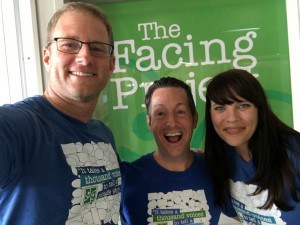
The factory was an industrial laundry first operated by Midwest Towel and then Cintas. It’s my understanding that they washed uniforms and carpets at the facility. With a decline in need of factory uniforms and carpets, maybe they didn’t need 100,000 square feet (or whatever the size of the cavernous building is). So it sat empty like so many other industrial buildings in Muncie–a shell of a building, echoes of labor long forgotten. A city-block-sized reminder of what was and of what we were.
But no longer. The building has new tenants.
Tribune Showprint makes fair and concert posters using steel behemoth printing presses. Kim and Rob Miller walk around with inky hands that are always ready to help a fellow MadJax member. They printed posters for a Facing Project fundraiser, printed our T-shirts, and Kim even brought me over a surprise cupcake made by fellow Muncie maker Amanda Reninger at her business Sea Salt & Cinnamon.
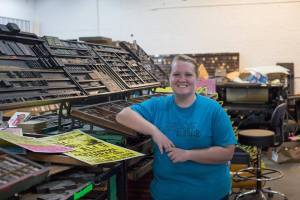 Next door to Showprint, Ball State students work at the Book Arts Collaborative typesetting text and hand-stitching books. English professor Rai Peterson helped advise The Facing Project on a grant.
In the hallway Debra Dragoo’s art is for sale. Some of it hangs in the work stations of those who work in the Co:Lab where my office is with The Facing Project. Next door is Farmhouse Creative owned by Angie Howell. Angie has designed and printed thousands of Facing Project books. Angie was a writer for a Facing Project.
There is also a co-working space where Facing Project board member Stephanie Fisher works for SpinWeb. Shane and Jake are programmers with business sense always willing to bounce ideas around. Marisa works for BY5 promoting child literacy and will get fired up about the needs of our community. Melanie Howe of Addison Avenue Marketing is always ready with a DIY marketing tip. She brings an enthusiasm for the day that makes you want to get shit done and have fun while doing it. I talk Kung Fu and writing with Ken Ring and fair and clean food with Alyssa Harmon. Brad Daugherty of Hoola Technology, and a founding member of the Co:Lab, regularly offers advice on how to keep our computers from exploding. And Jennifer Greene manages our community and makes sure we have a fun, efficient, and clean place to work.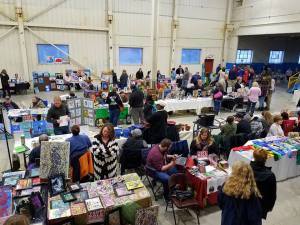
Out my window I can see the giant assembly hall where actors from Muncie Civic Theatre rehearsed Facing Project stories every Saturday in June, and Ken Ring teaches martial arts at night. Upstairs, students with PhyXT Gears make robots to compete and often win national competitions. Soon Guardian Brewery will be open and we’ll all (except the students) be able to grab a pint without walking outside.
We have a foosball table, a ready-to-be assembled pool table. I’m trying to convince Jennifer that we really need a basketball hoop.
We’re like the Google campus of Muncie.
A few months ago, Ben, a twenty-something transplant moved into town. I think he was unofficially crashing at his girlfriend’s dorm at Ball State and didn’t have anywhere to work. He found MadJax. He’s a smart, creative dude who had launched a kickstarter that funded a $40,000 journal for baristas and bartenders. After that he started a content business. The Facing Project was his first client. He does amazing work sifting through our 1,000+ stories to find inspiring and poignant content to share. Someday he’ll be a tech billionaire or president.
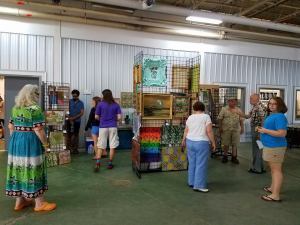 This summer Ball State brought orientation groups through MadJax. At first I thought that was a bit weird since the opposite side of downtown is a distance from campus. But the more I thought about it, the more I got it. Ball State is doing more than introducing students to campus, they are introducing students to Muncie.
MadJax isn’t about what was, but about what will be. At MadJax there’s hope and possibility and belonging to something that is moving forward.
Lately, the local paper has focused on the cost of MadJax as the city council decides if it is worth it. I’m not trying to convince them it is. I think many people in Muncie have no idea what MadJax is, where to park, what happens in there, what the community is like. The intent of this post is to answer those questions.
Some community leaders who love our community wanted the space to be something else from the beginning. That’s fine. I appreciate their passion and dedication.
Some of the most creative forward thinking minds in Muncie that I know, who helped create what MadJax could be, are no longer directly involved with the project. I admit, I’m bummed that they aren’t. I looked forward to having them as active members of our community.
No doubt there have been bumps and hiccups. I’m sure budgets have been exceeded and for sure timelines have been delayed. The idea of MadJax has always been fluid. But the space itself has been shaped by those who have filled it.
Some argue that there are no “makers” in our makerspace. Makers as they define the term use saws, digital printers, and potter wheels. From my understanding there are still plans to create that space and community. When they move in our community of makers will be ready to greet them and talk art, community, business plans, websites, and stories. I’m sure we’ll learn from them and they’ll learn from us until there is no us and them. That’s how community works.
Too often those of us in the Muncie community feel like Muncie is something we have to overcome when we are attracting a new employee, traveler, or conference goer. We addressed this in the introduction to our recent Muncie Facing Project:
“Where you from?” They ask.
“Muncie, Indiana,” you respond.
“Cool,” they say, but their eyes give them away; they really don’t mean it.
Maybe next they’ll say something about the Muncie “timeshare” reference on the show “Parks and Recreation,” or about Garfield or David Letterman if they know about their geographic origins. As if these bits of pop culture are what makes up the place we call home.
Even when we tell people where we are from, sometimes we sort of apologize for Muncie or feel the need to over-justify why we live here—the cost of living, our job, something else.
Factories and schools have closed, our population has declined. Muncie has real issues.
Sure, in post-industrial Muncie, we’re still trying to figure out who we are. But there is one inarguable fact that unites us:
Muncie is our home, and we face the future together.
MadJax can be hard to explain, maybe that’s why there’s confusion about it.
Recently, a piano randomly appeared in our community space. Someone has been playing it at different times throughout the day.
Music echoes in a space that once required ear plugs.
That’s what MadJax is.
NOTE: I’m writing this from Nairobi, Kenya, where I’m researching my third book. The disputed presidential election results have me locked away in my hotel (and you thought American and Muncie politics were bad!). As I write this, Ben, the future billionaire, posted a story for the Facing Project and Jennifer sent me a bill for our monthly rent. I’ll gladly pay it. To me, MadJax is worth it. Tomorrow is beer and pizza Friday at MadJax and I’m more than a little homesick.
August 8, 2017
Election Day in Kenya
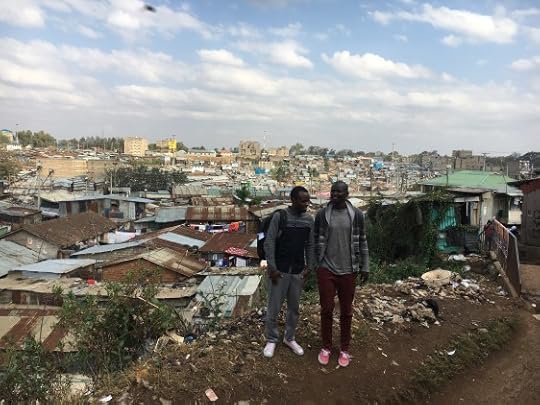
(My friends James and Thomas)
“Hello, whiteman,” the bush said.
I looked around, but couldn’t see anyone. I wondered if this was how Moses felt?
I thought I must’ve been hearing things, so I kept walking toward the fancy café in Nairobi’s Westlands area. It was closed. Everything was closed today.
It’s election day in Kenya.
Christmas or apocalypse?
When I left my hotel the guard—a woman in a black suit with a red tie— had asked me where I was going. I’ve gotten to know her a bit over the few days I’ve been in Nairobi. Yesterday when I was wearing a short-sleeved shirt, she nearly insisted that I go back to my room and get my sweatshirt.
I had told her I was walking to a nearby café. She thought it would be closed. She was right. She told me not to be gone long and that I should definitely be back by 4:30 PM. I got the sense that I would be in trouble with her if I missed my curfew.
“Hellow whiteman,” the bush said again.
I ignored the bush. There was someone in it for sure. And as a rule, anyone who hides in a bush isn’t someone you want to engage in a conversation.
There were far fewer cars and people than normal. Most of the roadside shops had their steel gates closed and locked. It was like Christmas meets the zombie apocalypse. There was an excitement and anticipation, but there was also a bit of hesitation and f fear.
The Barista who didn’t vote
When I asked the barista at the hotel if she voted, she shook her head no and held her finger to her lips, so her coworkers wouldn’t learn that she sat out.
When she asked me what I was doing here, I told her I was a writer.
“Oh shit! Are you serious?” She said
She loves to write, so she gave me a link to her blog and asked for pointers.
I read this:
whatever happened to our blessed country Kenya, more so, whatever happened to her children. Why does she keep deteriorating every single day? She has become so peaceless ,so restless, she is bleeding all over and there is no one to treat her wounds!! And even before she has healed, another wound is inflicted on her! I can’t help but ask all these painful questions.Her children have no peace.They can’t go a single minute without worrying about what nasty thing happens next. My litany of questions so long. Will greed of power cost her all her achievements? Won’t someone come her aid?? Why can’t some of her children accept defeat.
Accepting Defeat
Peace is in the hands of the losing candidate. The challenger has already questioned the results of the election. And an election official was killed. Seeds have been planted.
My friend James waited in line for 5 ½ hours to vote. Another friend sent me a video of a soldier, not an election official, explaining why some of the votes were being thrown out.
A friend who promotes peace in the informal community of Korogocho reported calling several ambulances after some altercations at the polls.
Neighbors divided
In the informal community of Mathare, neighbors of different tribes and parties (parties are largely divided by tribal origin) who normally get along, have stopped talking. Some have left their homes in the city altogether, choosing to go back to their villages. Every five years, an election reminds them that they are different from one another.
Are things so different in the USA? We have our own tribes that divide us and exploit our fears. In some ways we take our democratic obligation less seriously. Eighty-six percent of registered voters in Kenya are expected to vote. In the 2016 election in the USA only 53.5% of registered voters turned out. John Kerry is here to monitor the Kenyan election. Maybe we should have Kenyan officials come to the USA to inspire us to vote and monitor ours.
Overall, things are peaceful for now. Let’s hope they stay that way.
July 13, 2017
A bird crapped on me from 33,000 feet, this is what it says about my life
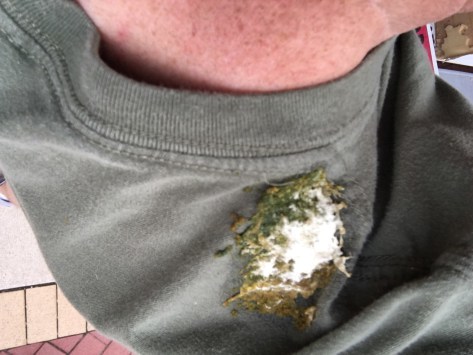
It felt like someone had chucked a marble, hitting me in the shoulder. It stung. But it also stunk because it wasn’t a marble; it was bird shit.
Now I’m no expert in physics, but given the velocity of the bird poop, the bird must’ve been somewhere in the stratosphere, which starts at 33,000′.
I was hobbling down Main Street from my breakfast date at the Downtown Farm Stand with Annie after our morning CrossFit work out. Since I’ve been traveling for my latest book, it has essentially been a month since I did a workout of much significance, hence the hobbling. It doesn’t hurt to sit or lie in one place and not move. But if Rick Grimes saw me walking down the street, he’d probably mistake me for a zombie and put his ax in my head.
At first, I wrongly assumed that I could wipe off the poop with a napkin. There was too much. I’ve read that when bombers drop their payloads, the lightening of their load causes them to rapidly gain altitude. The heavier the load, the greater the ascent. If that’s the case for birds, this particular bird, must be orbiting Earth by now.
So, I was the shirtless guy in downtown Muncie, and, yes, the top button of my shorts was unbuttoned. (I ate well in Burma, Cambodia, and India, and avoided all stomach bugs and I didn’t work out for a month.)
For a brief moment I put on my stinky, sweaty workout shirt, but then I realized I had a bag in my trunk that has been on its way to Goodwill for two years. There was an I “heart” Ferguson shirt in the bag that I bought in Ferguson, Missouri, when I went with my Facing Project co-founder J.R. to talk to folks about leading a project. We bought the shirt for our friend Ashley Ford who was instrumental in raising $450K for the Ferguson Library. Later we learned that the I “heart” Ferguson movement was basically a movement led by white business owners, and had a bit of a political agenda beyond love.
If I hadn’t traveled for the last month, I would’ve been walking faster and I may not have even been on a breakfast date with Annie, and I may have avoided the indignity of some space bird pooping on me. If I hand’t founded a nonprofit storytelling project, I wouldn’t have had a spare purple shirt with an agenda in my trunk.
All this to say…
Our entire lives lead us into each moment and sometimes in that moment a bird shits on you from 33,000′.
Hope your moments today are a bit more pleasant.
July 4, 2017
The hope of America in India
When you grow up in a slum in India, it can be hard to imagine a world beyond the high rises where your family members work as staff for wealthy families.
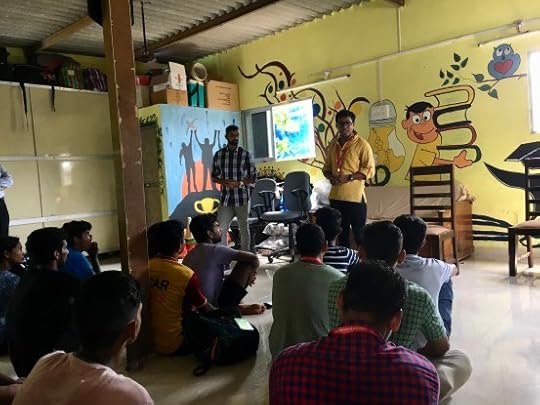
I sat in the back of the sauna-hot room and watched young leaders of the OSCAR Foundation, a program that uses soccer as a vehicle to get kids into school and consider a life and world beyond their community, as they listened to an Indian soccer player who played for a U.S. college.
Suddenly the world must’ve looked a little larger to them, opportunities a bit more possible.
Kean Lewis played at Farleigh Dickinson and got an education in sports management. Now he plays for a team in India and in the off-season works as a sports journalist.
After Kean shared his experience, a representative from the U.S. Consulate shared the steps to get into a school and get scholarships. The impossible suddenly had a road map.
The representative told the students that American universities needed them.
“Tell your story,” he said. “You have something to add.”
He said American universities value diversity and diverse lived experiences.
At the end of the talk, Ashoka, the founder of the OSCAR Foundation (who I’ll be writing much more about in WHERE AM I GIVING?), asked the young leaders, “Who is interested in studying in America?”
Every hand went up.
This is the promise of America.
I’ve been embarrassed plenty on this trip. I’ve had to try to explain what is happening in our country, the ridiculousness of our politics, the immaturity and the insularity. But in that moment, where the young leaders of OSCAR saw the promise of the United States, I was proud to be an American.
—
Happy fourth of July!
I hope you love and will fight for all that is good in our country as much as my fearless friend Michelle Greer …
June 24, 2017
10 Years: Reconnecting with Nari & Ai
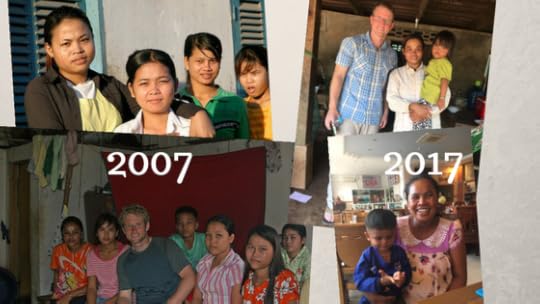
I was 28. I got engaged and bought a home and left the country to meet the people who made my clothes. I had a few small assignments that would pay me hundreds of dollars for three-months of reporting that would cost me thousands.
Nari was 25. She was living with 7 other young women in a room that was maybe 100 square feet. She worked in a garment factory making Levi’s. She paid a $50 bribe to get her job, which paid her $50 per month. She sent half of her money home to support her family in her village. She wasn’t shy.
Ai was 24 and shy. She was one of Nari’s 7 roommates. She missed working in the fields at her family’s home in the country where no one tells you what to do.
All-in-all, the tiny apartment in which Nari and Ai lived vibrated with the energy of a college dorm. For the first time these ladies were living on their own in the city. They cooked together, talked about boys, and complained about work.
I took them bowling. We traveled out to the countryside together to meet their families.
Yesterday, 10 years later, I met up with them.
Now, I’m 38. I’m married and have two kids who adore me (What? It’s true. Shut up!). I have a career writing stories about folks like Nari and Ai. Life is more stressful. There’s healthcare, autism, and a damn dam that needs repaired.
Nari is 35. She has two kids. She moved back to the village and works on a rubber farm. Up at 2 AM and done by 10 AM. Time to watch the kids. Her husband is a teacher. She thinks about her city life and her life in the factory with a smile on her face. When she talks about traveling around the country to find her six-year-old son medical attention for his chronic cold, she doesn’t smile. Her daughter cries a lot. The doctors thought she was still born at first, but then she moved and breathed. Now she likes to ride the motorbike with her grandpa and play with the neighbor boy. Nari and her husband live with her parents when I ask her how life is she tells me, “It’s in the middle.”
Ai is 34 and eight months pregnant with her 2nd child. She holds her three-year-old son on his lap, he’s a child-sized ball of energy. She lives in Phnom Penh and up until recently worked in the hotel cleaning $18 rooms for $100 per month. She wants to move back to the village, but there are no opportunities there.
I’m thankful they remember me. I haven’t forgotten them.
Ten years ago, there were no buildings in Phnom Penh over five stories tall. Now there are more skyscrapers than I can count. I thought I had flown into the wrong city. You can buy Starbucks lattes, Burger King burgers, Krispy Kreme donuts, BMWs, Porsches, and Rolls Royce.
A lot changes in ten years.
June 6, 2017
My next book adventure… Where Am I Giving?!
Sometimes when we see the harsh realities of the world, we can feel guilty, ashamed, and powerless to do anything. That’s how I felt standing in a dump in Cambodia, watching adults and children picking through a trash heap.
I wanted to do something to help, but what could I do? I was just one man, researching my first book, traveling on my second mortgage. I hadn’t done anything wrong, but I hadn’t done anything and that felt wrong.
This feeling of helplessness is what I’m taking on in my new book adventure…
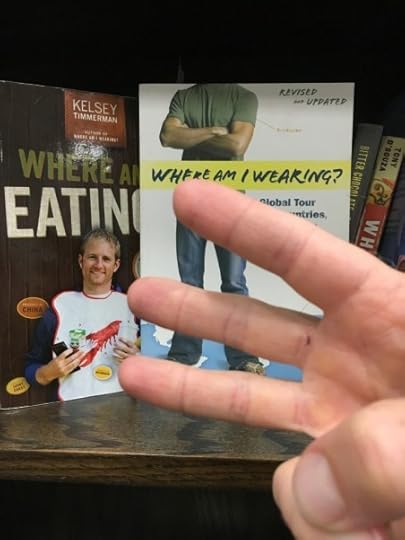
Where Am I Giving? A Global Adventure Exploring How to Use Your Time, Money, and Energy to Make a Better World will explore this distance between the hopelessness of guilt and the amazing opportunity each of us has to make the most difference we can through our careers, time, consumer dollars, and donations.
In my previous books Where Am I Wearing? and Where Am I Eating?, I’ve raised awareness about the realities of the global garment and agriculture industries while exploring topics such as extreme poverty, slavery, and child labor. And while I’ve proposed solutions of how we can address these issues as consumers, we are not going to consume our way to a better world. We need to be producers, producing positive impacts that spread opportunities; we need to be educated global and local citizens, donors, and volunteers.
We were born into relative prosperity and a wealth of opportunity. When faced with global and local poverty statistics and realities, it can be easy to feel guilt.
Where Am I Giving? isn’t about how to absolve ourselves of First World Guilt. It is a book about helping readers recognize their own privilege and the amazing opportunity each of us has to impact the lives of people in our own communities and around the world.
Thanks to my agent JL Stermer at New Leaf Literary for helping shape this project idea and to Richard Narramore, my editor at Wiley, for once again supporting my big ideas and curiosity.
I can’t wait to go on this trip and take all of you along with me. I leave Thursday on a one-way ticket to Myanmar. (I have every intention of returning, it’s just I hate to commit to a set travel itinerary.)
The road calls.