Kelsey Timmerman's Blog, page 7
August 29, 2018
My son the tiger
Raise your expectations to succeed.
“Aim for the moon and, even if you miss, you’ll land among the stars.” – W. Clement Stone
Or, inversely, lower your expectations to feel like you succeeded.
“The secret of happiness is low expectations.” – Barry Schwartz
Expectations can be healthy or unrealistic.
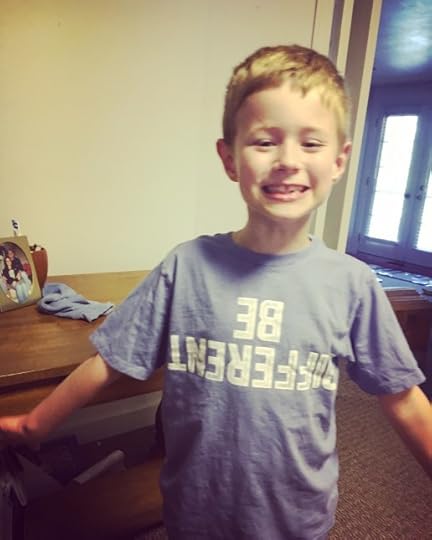
My son Griffin is in Kindergarten. We didn’t expect autism and had never suspected it until our pediatrician raised the concern when Griff was only 18-months old. Then kindergarten seemed like light years away and an impossibility.
Would he talk? Would he learn? Would he listen?
He exceeded our expectations during kindergarten. Academically he performed on a fourth grade-level; that’s as high as the test would go. If you sing a note, he’ll play that note on the piano. If you tell him your birthday, he could tell you what day of the week your birthday is on this year, last year, ten years from now, and maybe even the actual day of the week you were born. He remembers what he ate on March 26th. He’s amazing and did an amazing job in kindergarten.
But he doesn’t really converse. He’s obsessed with toilets…and fire alarms. What could go wrong? A dozen eggs in the toilet could go wrong. An overflowing toilet that dripped through the ceiling in my basement office could go wrong.
Griffin runs off, slips away, vanishes. The technical term is elope. He made it to the road once and the memory of him sitting in the middle of our thankfully seldom-traveled country road still makes me sick to my stomach.
At the end of the year his elementary school has a field day at the high school track. We try to treat Griffin like the other kids are treated. None of the other parents were standing with their kids in the infield. The parents were in the stands. So I asked a high school kid to look after Griffin.
“Griff is pretty easy,” I told him, “but you have to watch him. Stay close. He’s a runner.”
At one point the high school kid was 25 yards from Griff and had his back to him. I went down to the field. Griffin didn’t care that other parents weren’t with their kids. He was excited to see me and ran to give me a hug.
We were at the starting line with the other kindergartners for the 100m dash. They jumped and played and joked. The stands buzzed with parents and grandparents. It was pretty chaotic and the more chaos, the more Griff slips away into his world of flushing invisible toilets.
I knelt beside him. His eyes and mine didn’t meet, they rarely do. Eye contact with Griff is like trying to press two positive sides of a magnet together. His eyes always slip away.
“Griff,” I said. “When you hear the starting gun I want you to run like a tiger.”
A few years ago, I saw a feature on SportsCenter about an autistic teenager who was an amazing runner. His parents credited running with improved social awareness and communication. Apparently this running autism connection is a real thing confirmed by early studies
What if Griff was one of these kids who took to it? What if the race began and Griff ran faster than any of the other kindergartners, leaving me behind and the other parents wondering why this kid–my kid–was so far ahead of theirs?
When you get to know Griff, which takes time, you experience how amazing he is. He has inside jokes with everyone and he never forgets them. He makes you feel special. Like you are in on a secret? But what if he ran…fast…and all the other parents who normally saw a kid flushing toilets saw a sprinter? What if he could show them how amazing I know he is?
Griff looked at me, our eyes actually meeting for a moment, and said, “El Tigre.”
That’s Spanish for Tiger. I think he’s bored of English, so he dabbles in other languages- Russian, Finnish, and sometimes he makes things up just to mess with us. He has his own language which one of his therapists calls Griffinology, which really doesn’t make sense at all. “Griffinology” would be the study of Griffin. It should be Griffish.
Anyhow. The track coach smacked two blocks together and the kids took off. Every single one of them….except for Griffin.
“El Tigre” he repeated and then skipped down the track like he was tiptoeing through tulips. He picked my wife’s cheers out of the crowd and ran over to say “hi” to her. He was 50 meters behind the other kids on a path that would make a drunk waterbug’s look straight. But he didn’t stop running. He didn’t stop smiling.
From the infield, I kept pace and met him at the finish line.
By the way Finish line in Finnish is maaliviiva.
Teachers passed out ribbons to the winners before they could even catch their breath. For most of the kids it was their first race. No doubt each of them thought themselves fast until faced with the cruel reality.
Griffin didn’t care about ribbons. He didn’t care about meeting or exceeding my expectations or his own. Other parents had cheered on Griffin. Everything about him radiated joy. The finish line meant nothing to him. Expectations meant nothing to him. It was the journey that mattered. It’s always the journey with Griff.
It’s like he doesn’t have that camera that faces us all. The “how do I look to other people” camera. He’s just pure.
Like a tiger.


August 6, 2018
I cut Steven Seagal from my book, Putin pasted him into US-Russian relations

Vladimir Putin named Steven Seagal as the Russian Special Envoy to the United States. While writing Where Am I Giving I went on a Steven Seagal tangent I thought was worth sharing. As a kid I watched a few of his movies, but until I went down the Steven Seagal rabbit hole to research the tangent I never realized how deplorable of a person he seems to be.
To set things up… the tangent came in the first chapter of the book when I write about my first post-college trip. I had been taken in by a monk, Sange, who had stayed at Steven Seagal’s house. We were prepping for a celebration in honor of Sange’s teacher Penor Rinpoche.
Here’s what I wrote:
I tried to make myself useful during the preparation for His Holiness’s visit. I helped lug a welder up the hillside, and well that’s about all I did. Mostly I ate and played hackey sack and practiced Kung Fu kicks with the young lamas in training. And whenever Sange was available we’d chat about Tibetan and American culture. Things would come up, for instance Sange had stayed at action movie star Steven Seagal’s house while visiting California. Seagal starred in action films like Out for Justice, Under Siege, Above the Law, and I assume many other movies that followed the preposition-noun titling formula.
Sange wasn’t much of a Seagal fan, although it seemed his teacher was. In 1997, His Holiness Penor Rinpoche announced that Seagal was the reincarnation of Chunddrang Dorje, a 17th century treasure revealer. Considering that Seagal has a long history of sexual and domestic violence accusations and has called Vladimir Putin “one of the greatest living world leaders,” I’m not sure about the validity of the claim. He seems a little further from enlightenment than most of us.
We’ve got Rodman. They’ve got Seagal. If these are our diplomats, what could go wrong.
July 11, 2018
What’s a volunteer worth?
According to the Independent Sector, a membership organization of nonprofits, the value of volunteer time is “the average wage of non-management, non-agricultural workers.” So actually the stat is pretty meaningless and simply an average wage of an American worker.
Not every volunteer or volunteer task is equal.
I worked summers at my parents’ wood truss manufacturing plant swinging a hammer, pushing a broom, and cutting and stacking boards. But I am by no means a carpenter. When I built a bookshelf in shop class in high school, the cuts were rounded and it was a rocking bookshelf, which really isn’t a very desirable quality for a bookshelf. My father, on the other hand, can build anything. If Dad and I both showed up to volunteer at building a home for Habitat for Humanity, Dad’s skills would be put to much better use than mine. The Financial Accounting Standards Board calculated that the current value of a volunteer hour is $23.56. But a volunteer hour from Dad working on a construction site is much more valuable than one from me.
Volunteers should seek out opportunities where their specific skills and training could be put to use. Besides adding more value to your community, you’ll also find the experience more rewarding and it’s more likely you’ll keep at it. Often this is the thing that the world already pays us to do. A student approached me once after a talk at his university, and he said that he wasn’t sure how he could make a difference because he was studying accounting.
“Do you know how many nonprofits need a good accountant?” I told him. “Like, all of them!”
The Best Way to Volunteer
The best way to volunteer is making use of special skills, talents, or knowledge, or doing something an organization would have to pay someone else to do. If you are a body or a number volunteering to do a basic task, look at it as a social function or an opportunity to learn new skills yourself that may allow you to make a bigger impact as a volunteer later.
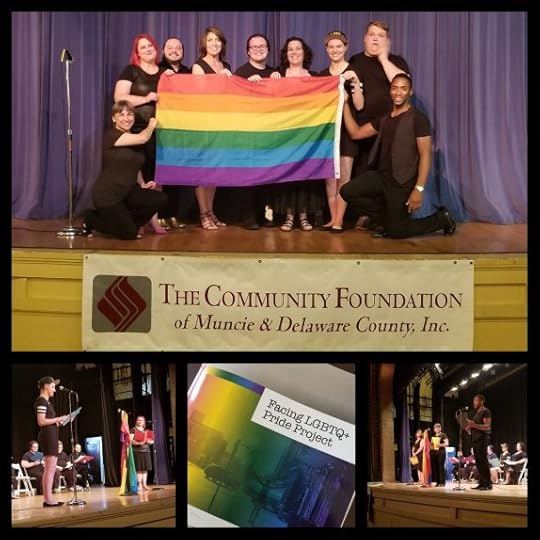
Back to The Facing Project…without volunteer writers, actors, storytellers, and organizers, there would be no Facing Project. So, to us, a volunteer isn’t worth $24, they are worth an unquantifiable amount that is nothing less than the entire existence of our organization.
How much is a volunteer worth? Everything.
June 19, 2018
What are the Human Rights anyhow?

Yesterday Nikki Haley, the US Ambassador to the United Nations, announced that the United States was withdrawing from the United Nations Human Rights Council.
George W. Bush thought about doing the same thing. The Obama administration recognized the group wasn’t the most effective, but decided to work from within it.
But putting the politics aside…do you have any idea what the human rights actually are?
I bet you can’t name all 25 articles. I bet you didn’t even know that there aren’t 25 articles but 30. Ha! Got ya! I certainly couldn’t until I looked them up while researching WHERE AM I GIVING? Here’s an excerpt–probably the most boring of the entire book– where I summarize the human rights.
The 1948 United Nations General Assembly drafted The Universal Declaration of Human Rights, including 30 articles, which I’ll quickly summarize:
We are all born free and equal; these rights apply to everyone; everyone has the right to life, liberty, and security of person; no slavery; no torture; rights apply to everyone everywhere; we’re all equal in the eyes of the law; human rights are protected by law; no unfair imprisonment; the right to a trial; we’re all innocent until proven guilty; right to privacy; freedom to move; the right to seek a safe place to live; everyone has the right to a nationality; right to marry; right to own property; freedom of opinion and expression; right to assemble; equal right to participate in government and elections and receive government services; right to affordable housing, medicine, education, and child care, and enough income to live on; the equal right to work; equal right to leisure and periodic holidays with pay; right to a standard of living adequate for well-being; right to education; copyright protection; a fair and free world in which rights are realized; the responsibility to help others and protect their rights and freedoms; no one can take away your human rights.
One jumps out at me as different, so I’ll quote it directly from the original preamble: “Article 29: Everyone has duties to the community in which alone the free and full development of his personality is possible.”
While the rest seem like declarations of rights, some straight out of the US Bill of Rights, Article 29 is more of a commandment: “You have a duty to help others.”
Another thing that really jumped out at me when I came across the 30 articles was how much the US, the land of the free and home of the brave, falls short. And in some sense, this is why the administration pulled out. Many of the groups members fall short (China, Egypt, Saudi Arabia) and appear rather hypocritical.
Human rights should know no borders. In theory, a family from Honduras escaping violence that crosses into the United States should have all the rights of the rest of us–that’s why they are called Human Rights and not American rights or Honduran rights. But in practice…
The United States pulled out of the Human Rights Council. It was hypocritical for us to stay. We don’t deserve to belong to such a group, nor do many of the other members.
As Colbert tweeted: “No one on the right side of history has ever had to nitpick what the definition of ‘cage’ is.”
(photo courtesy of Flickr Creative Commons by AK Rockefeller)
June 13, 2018
PRIDE & Prejudice
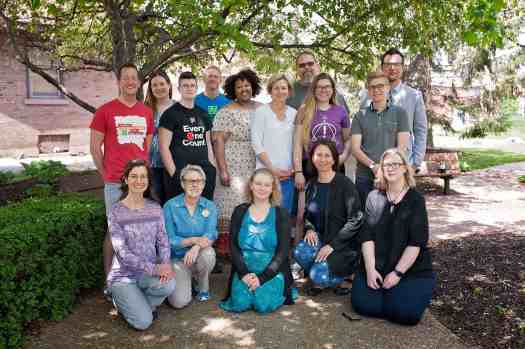
(Facing Pride volunteers, photo by Kira Childers)
“I don’t think they should be executed, just imprisoned.”
And by “they,” the twenty-something grad student in Uganda meant anyone who was gay.
Throughout my travels I’ve seen that the most consistently persecuted group is anyone in the LGBTQ community. “Homosexuality” is illegal in 74 countries and punishable by death in 14.
Each country seems to have a group, at least one, of people looked down upon. There is usually some regional variance. Costa Ricans aren’t fans of Nicaraguans taking their jobs. The government of Myanmar denies the existence of the Rohingya. Most countries don’t like migrants. Sometimes the hate is fueled by economics, religion, and nationality. In some places it’s okay to be a Christian or Muslim or of a certain ethnicity or religion and in other places it’s not. But nearly half the countries in the world hate gay people.
Forty countries have “gay panic” clauses where a defendant can attack or kill someone, plead that they thought the person was gay, and get off for it.
In Zanzibar I met a woman exploring the work of AIDS initiatives in East Africa. She found that organizers were under constant threat of being accused of being gay and then facing jail time. No matter the truth, you could get locked away for someone thinking you might be gay.
It’s not illegal to be gay in the United States, although some people would like that. But it is legal to deny service to someone based on their gender identity and sexuality. In Indiana the GOP just added the definition of marriage–between one man and one woman–back into their party platform despite the Supreme Court’s ruling that marriage equality is the law of the land.
Last week a CrossFit gym in Indiana canceled a PRIDE day event because of the owner’s religious views. The coaches quit, the members left, and the last I heard the gym was closing. You may have the right to discriminate, but others have the right to avoid your business.
And it’s not just institutions discriminating; it’s families too. LGBTQ youth are two times more likely to be assaulted. They make up a significant percentage of the homeless population. A third of LGBTQ youth have attempted suicide in the past year.
June is PRIDE month. Some folks have a problem with that. “Why do they have to flaunt it?” they ask. Because pride is the opposite of shame. In a world and society actively working to make members of the LGBTQ community feel lesser than, PRIDE is an opportunity for members of the community to celebrate and show themselves and the world that they are worthy of love and respect.
This month The Facing Project is launching it’s Facing Pride event and book on June 30th at Cornerstone. (Get your free tickets!) I felt like I had a pretty good idea of what members of the LGBTQ community face on a daily basis. I was wrong. The stories showed me I have a lot of listening and learning left to do.
I listened to and collaborated with my Facing Project cofounder, J.R. Jamison on his story. I had read his memoir (by the way he just signed with an agent), have known him for years, and thought I knew a lot of his story, thoughts and feelings. But we had never talked about the day we met.
It was at a conference and I invited him to be a writer for Facing Poverty, the first Facing Project, and later friended him on Facebook. He was nervous to accept my invitation because he wasn’t sure how accepting I would be of who he was–a gay man. He told me that he picked up a “bro vibe” from me.
I don’t remember how it came up that he was married to a man, but now I know in that moment he was nervous. He was worried that I, like so many people in so many places, would devalue him because of who he loved. I wish this weren’t the case, but it’s this way for so many members of the LGBTQ community.
Think about any time you’ve been brave. Maybe you repelled down a mountain, gave a pubic talk, touched a snake, went on a shark dive. Remember how proud you were. For many members of the LGBTQ community walking out into the world is an everyday act of bravery.
We should all be proud of these brave individuals. And we should all celebrate with them, so they know that although half the world may be against them, we aren’t.
June 10, 2018
Want to make the world a more generous place? Help launch my next book
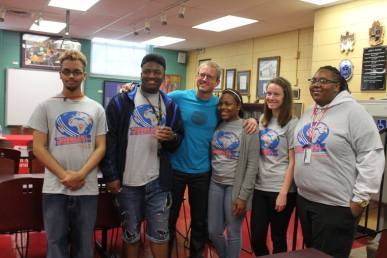
My new book Where Am I Giving? comes out on July 25th, or 15th, or who knows? I’m not JK Rowling. That’s why I need your help!
I believe there is magic in this book that can make each of our lives and the world better. But the world’s a noisy place and marketing budgets are limited. I received some great endorsements from world renowned philosophers, bestselling authors, and Gandhi’s grandson, but none of them meant as much as what my high school English teacher, Dixie Marshall, wrote to me after reading an early version of the book:
“I believe this is the most important book you have written and may ever write. It’s really an impressive book, a valuable book, and one that everyone should read.”
It would be a great gift if we could work together to make sure GIVING makes the impact I know it can.
That’s why I’m starting a private group of readers who’d like to launch GIVING into the world.
None of my books instantly jump to the top of the bestseller list, but thanks to supportive readers, I’ve hit the NYT’s list twice. Join me and let’s do something fun!

What’s in it for you…
Be among the first to set eyes on the book’s first chapters
Access to to the private group where I’ll share behind the scenes stories about the book
a private group ask me anything session where you can hit me up with all of your questions on traveling, do-gooding, writing, or banana suits
A custom-made thank you card from yours truly along with a card of gratitude for you to send to send to someone
a virtual 30-minute visit with your book club (if you have one)
If your application is accepted, you commit to:
Pre-order at least one copy of the book
Post at least two photos of the book #WhereAmIGiving
Read the book and leave an honest review
See the beauty and purpose of your own gifts and pass them on
Let me know if you have any other ideas to spread the word about the book
Fill out the quick and easy application below to join the team.
I’m going to keep this group small, so please fill out the form now while you are here.
Thanks!
Kelsey
Loading…
May 25, 2018
Sociology professors uncovers radiological testing on US citizens

I met Lisa Martino-Taylor when I visited St. Louis Community College for the first time eight years ago. Since then I’ve spoken with her sociology classes a few times.
Lisa acquired government documents that uncovered a US military program during the Cold War that tested radiological, chemical, and biological weapons on Americans living in urban populations.
This isn’t some chem-trails conspiracy. Lisa wrote her dissertation on this, has been featured in reputable media outlets around the world, has inspired lawmakers to demand a full investigation, and recently released a book on it.
From a recent AP story, Cold War radiation testing widespread, author claims:
Martino-Taylor said the offensive radiological weapons program was a top priority for the government. Unknowing people in places throughout the U.S., as well as parts of England and Canada, were subjected to potentially deadly material through open-air spraying, ingestion and injection, Martino-Taylor said.
“They targeted the most vulnerable in society in most cases,” Martino-Taylor said. “They targeted children. They targeted pregnant women in Nashville. People who were ill in hospitals. They targeted wards of the state. And they targeted minority populations.”
Lisa’s book, Behind the Fog, about the testing came out in August.
May 24, 2018
Happy Red Nose Day?

If you’ve shopped at Walgreens recently, no doubt you’ve seen red clown noses for sale. They fight poverty or something, whatever that means.
“60 percent didn’t quite understand what we did,” says Janet Scardino, CEO of Comic Relief USA that partners with Walgreens to sell the noses.
Between the US and the UK, the campaign has raised more than $1.4 billion, which goes to organizations like Save the Children, Feeding America, and the Boys & Girls Club to help children in need.
NPR’s Goats & Soda reported on the campaign: “But how does buying a red foam nose at a drugstore for a buck help the cause? And does this charity with the silly name really do good work? We did some reporting, and here’s what we learned.”
You should read their full report, but here are a few things that jumped out to me:
Why Red Nose day and not Child Poverty Day?
It seems no one really knows, but I do. We don’t like to be reminded that we live in a world (and a country) where so many kids go hungry and die of preventable diseases. Red noses are happy! I’m not against using silly red noses to raise money to help kids, but I am against our trying to hide from the fact that we live in a world where 1.2 billion people live on less than $1.25 per day. Where half the world’s population lives on less than $2.50 per day. Where 21% of American children live in poverty.
Victoria Beckham’s Boots
As part of the campaign, Victoria Beckham visited the slum of “Koro Kocho” in Nairobi. I’ve visited a several slums in Nairobi and I’ve never heard of such a place. There is a Korogocho. I have friends who live there. I’m sure that’s what Comic Relief meant. So if they are wrong, that’s lazy, but I won’t criticize them much because it took me about a week to pronounce Korogocho correctly. I will, however, criticize Victoria’s fashion choice: rubber boots. I can only imagine what my friend Rozy would have thought if she had seen a Spice Girl in shoes reserved for farmers and trash pickers. It was the most sensible shoe choice for sure, but perhaps not the most sensitive (“This place is so dirty I’m going to wear my rubber boots.”).
Despite my inner cynic, I think the red nose campaign is okay. It raises money for some good causes. However, I don’t think I’ll ever be comfortable with cute marketing campaigns that raise money for such serious issues. I don’t blame the marketers. I blame us.
We like to give without much thought. If we opened our wallets with the realities of the world on our minds that just might open our hearts. And the reality doesn’t make us laugh like red noses do, but makes us hurt…as it should…and move us to act in way that is more impactful than dropping a buck on something silly.
(photo by Bryan Ledgard Flickr Creative Commons)
May 7, 2018
Proud to support Dave Ring for Indiana State Senate
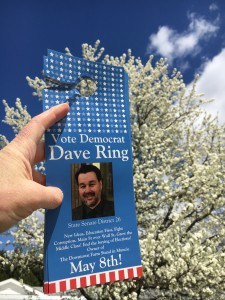
Sitting in the Downtown Farm Stand, the only 100% organic grocer in my area, I watched the presidential returns come in on election night in 2016. I swore between sips of organic beer, as the election started to fall Donald Trump’s way.
How is this our country?
How is it that I can’t understand the voting decisions of nearly half of Americans?
Someone should really do something about this.
Dave Ring, the owner of the Farm Stand, hosted our small election gathering. Gary Younge, a reporter from The Guardian, was also there. Gary was reporting on Muncie, an area that went for Donald Trump and Bernie Sanders in the primary. He told us this is how Brexit felt. One day you wake up in a different country.
Gary has kept tabs on Muncie and even came back a few months ago. Following his most recent visit, I heard Gary on a podcast saying that there was a difference between how the American and British people reacted. A lot of Brits met their new reality with resignation and cynicism, whereas Americans, known for our naive optimism and can-do spirit, met it by marching, organizing, and running for office.
Running for office. That’s what Dave decided to do.
(Learn about Dave’s campaign at votedavering.com)
When he first told me he was running for Indiana State Senate, it was kind of like when a friend hands you a book they’ve secretly written or they found religion or started a new job selling insurance–you’re happy for them, but you are reluctant to part with your time or money to support them. You think, “Maybe this is just a phase.”
I attended Dave’s first campaign meeting, mainly out of obligation, and quickly realized that Dave was taking this very seriously. He committed to not take money from any special interest group or corporation. He was for term limits and committed to limiting himself to two terms if elected. He was against gerrymandering–drawing a voting district to favor a political party. District 26 where I live and where Dave is running, looks like a giant Pac-Man eating Muncie, and was drawn to favor Republican candidates. Dave talked about three ways to redraw districts fairly and which he favored.
He talked about legalized government corruption on the local, state, and federal levels, and what he would do as a State Senator to combat it. He showed me how much local and state-level elections mattered.
I think our politicians should be individuals who teach and inspire us. Someone who we want to follow.
When I heard Dave give his campaign kickoff speech (below), I was inspired because I knew he was someone who I could learn from and follow.
I followed Dave. And for the first time I knocked on a stranger’s door in support of a candidate. I followed Dave to my first ever local protest.
An out-of-county farmer had plans to build a CAFO (Confined Animal Feeding Operation) a few miles from my house and a lot of the neighbors were applying pressure on the commissioners to put a hold on the building permits until some regulations were put in place around such operations. Dave spoke at the meeting against the CAFO and then a local farmer spoke in favor of the CAFO. I knew people who knew the local farmer, and I felt a bit awkward standing on the opposite side of the issue. Dave and the farmer had opposing points of view, and, as soon as the meeting was over, Dave went up to him and introduced himself. I stood in the back of the room by myself and watched them talk.
It looked civil and friendly, and exactly what our state and country needed. Not arguing over an issue that divided us, but connecting around similarities. It looked like two people who wanted the same things–opportunities in rural areas and a healthy environment to farm and raise kids. They just had a different points of view of how to accomplish them. Nothing gets accomplished if people with opposing points of view can’t have a conversation.
Dave is a farmer and an entrepreneur. He started the Downtown Farm Stand more than ten years ago, during a time where he had to educate consumers what organic meant. Dave and Sara never compromised the core values on which they started their store. They could sell vitamin pills, which have a much higher profit margin than groceries, but they believed that all the vitamins we need are in food.
Pills are a quick fix, but the areas we need to address as a society take time and effort and work. They take someone with the patience of a farmer and the vision of an entrepreneur.
In my book, Dave is the right person for the job.
It’s so easy to get caught up in the Breaking News of our breaking federal government that we forget how much local and state elections impact our lives. Watching the news isn’t a political act, voting is.
And it’ll be my honor to cast my vote for Dave Ring tomorrow (May 8th) in the Democratic Primary.
April 11, 2018
What the “elephant whisperer” teaches us about listening

When Lawrence Anthony died, elephants he had rescued and released years ago, showed up to mourn at his graveside.
Here’s what his wife wrote:
“Tonight at Thula Thula, the whole herd arrived at the main house home to Lawrence and I. We had not seen them here for a very long time. Extraordinary proof of animal sensitivity and awareness that only a few humans can perceive. And Lawrence was one of them. Thank you for your wonderful messages. Lawrence’s legacy will be with us forever at Thula Thula.”
They stayed for two days and two nights and then left. Some share this story as proof that animals mourn. But anyone who has had animals knows this already. There is a bigger question.
“How did they know he had died?” Sister Norma Rocklage from Marian University asked the audience of which I was a member at Ball State’s Cohen Peace Conference.
She said scientists can’t explain it.
Lawrence reluctantly welcomed nine elephants onto his 5,000 acre reserve in South Africa in 1999 after he got a call that they were troublesome and would be shot if he didn’t take them in.
Sister Norma told us the elephants weren’t very happy to have their movement restricted, but Lawrence listened to them every day.
“He was gradually able to win the elephants’ trust,” The New York Times reported in Lawrence’s obituary. “He . . . came to communicate with the elephants and to appreciate the way they communicated with one another.”
He wrote about the experience in the, “The Elephant Whisperer: My Life With the Herd in the African Wild,” which was published in 2009.
Sister Norma had a theory that Lawrence listened to them so much they became part of him and he became a part of them. She encouraged us to listen to other so intently they become part of us.
Sister Norma hinted that something beyond science, something metaphysical, happens when we listen to one another.
The more I do this work and the work with The Facing Project, the more people I’ve listened to. I’ve listened to hundreds of people, maybe even more than a thousand. In the past I’ve described carrying the weight of their stories, as if each story were a chain hung around my neck, some weighing more than others. There is weight to their stories, but the analogy made them out to be too much of a burden. They are more than that. They are gifts that have introduced me to new ways of seeing the world, knowledge, and wisdoms.
I’ve been listening to people’s stories for about 16 years now, and, before Sister Norma, I’ve never had someone so accurately put words to what I feel about the people I’ve listened to. Each of them has become a part of me.
When was the last time you intently listened to someone or someone intently listened to you?