Kelsey Timmerman's Blog, page 3
April 9, 2020
Good People: Interview with AP reporter Victoria Milko
Victoria Milko has reported from health clinics in rural Bangladesh, protests in the streets of Myanmar, and refugee camps in Thailand. She joins Kelsey & Jay from her apartment in Jakarta to discuss the global impact of COVID-19, the importance of journalism in today’s society, and her path to becoming a Southeast Asia-based science reporter for The Associated Press.
Show notes
Topics we talked about with Victoria:
– COVID-19 impact in developing countries
– Life in Jakarta during the global pandemic
– Reporting on genocide and mass graves
– Impact of reporting on traumatic events
– Family’s refugee history and impact on her career
– Dream of being a foreign correspondent and how she reached that dream
– Living and reporting in Myanmar
– Rise and fall of Aung San Suu Kyi
– Facebook’s impact fanning flames of genocide in Myanmar
– Importance of journalism during time of “fake” news
– Importance of representation and diverse voices in media
– Challenge women face being a foreign correspondent
– Where she gets her news
– Advice for students interested in becoming a global correspondent
Topics: Jay and I discussed:
– COVID-19 and isolation
– Jojo Rabbit & The Joker
– resource to find a career that makes a difference: 80000hours.org


April 1, 2020
Is COVID-19 Our Alien Invasion
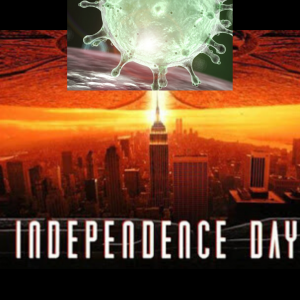
I love alien invasion movies. I love the cuts to scenes from around the world where we come together as a species regardless of race, religion, ideology, and nationality, to confront a common enemy. The poor Eiffel Tower, pyramids, Golden Gate Bridge, Sydney Opera House are the first to go. If you find yourself in an Alien Apocalypse movie, steer clear of major landmarks. But when they are shown exploding, they aren’t Egypt’s pyramids, or France’s Eiffel Tower, they are ours. Faced with human extinction, suddenly all that divides us fades away and what connects us is all that matters.
I’ve always felt like peace on earth was just one good alien invasion away.
Is COVID-19 our common foe, our Independence Day?
It is a new-to-us, alien invader, spreading death and disruption across the planet. However, in many ways we’re not becoming more connected as a planet but less. Borders are closed, as if a microscopic virus cares about a line on a map, or could be turned away by a customs agent.
The virus becomes known as a Chinese virus as if placing blame does anything to fight it.
We watch news from crowded hospitals in Italy. Hear the stories delivered through tears from doctors on the front lines. And we still don’t see it as a human problem. China wasn’t ready for the invasion, neither was Italy. We’ll be fine.
And then the invasion arrives on our shores, and any fantasies of our exceptionalism fade away. Even then, as it nears, we look at it is a city or state problem. A New York problem. A Seattle problem. Shut the borders! Point fingers! Every country, every state, every county, every city for itself.
That might be a little too jaded. There are people volunteering for studies in which they will be infected with COVID-19 in hopes of finding a way to treat it or immunize against it. There are planes full of medical professionals flying into the frontlines. Hell, any nurse or doctor or anyone who works in a hospital showing up for work is a hero.
But, overall, this isn’t the great coming together I imagine in alien movies.
A Global & Local Challenge
I get it. The closer to home our problems, the harder it is to see beyond them. But this virus is a humbling reminder that the local goes global and the global goes local. We are both global and local citizens, and now more than ever we need to take on both roles.
Yes, we should do our best to support local businesses, but let’s not pretend that getting a pizza delivered to your house is some act of altruism, and tipping 30% makes you a hero. That would be the worst damn alien invasion movie ever.
This is going to be a tough time for everyone, but even more so for the most vulnerable in our own communities and especially those living in developing nations. It’s important to support both local organizations and global organizations that help people living in poverty. In Cox’s Bazar in Bangladesh there are 300 hospital beds to serve the 850,000 Rohingya refugees.
My friend Rozy who lives in an informal settlement in Kenya had this to report:
Immediately the government initiated Curfew and everything changed in Kenya… cases of police brutality were witnessed across the country. As per now we are reaching out to the most vulnerable in our communities by providing a package of flour, 1kg sugar,1kg bar soap, and sanitary towels for women. So far we have only managed to reach out to 10 families due to limited resources. If we get such essential things given to at least 50 households, it will be of great importance. We are encouraging them to share the little they receive with at least one neighbor. Because we are foreseeing a total lockdown soon by the government. Most of the people who live in informal settlements are casual laborers who work from hand to mouth so lockdown means no food for their families. I also picked up 4 kids from 3 families for accommodation in my Mom’s house.
If you’d like to help Rozy, email me kelsey@kelseytimmerman.com and I’ll tell you how.
And from my friend Maruti who lives in an informal settlement in Mumbai (the whole country of India is on lockdown, which means most day laborers can’t work):
We are helping give our community rations. Every shop is on lockdown.
To help Maruti and his community, donate to The OSCAR foundation.
The aliens are here and to be a hero we need to act both locally and globally.
How to fight the Aliens
In my book Where Am I Giving I included Giving Rules, which are more guidelines of how to make the biggest impact with your gifts and talents. I’ve spent about a decade thinking about these topics. So in the age of COVID-19 I thought I would offer some additional Giving Rules/Thoughts:
Stay home.
If you’re able, continue to give to organizations and causes you support already. Consider offering them more support because it is a challenging time for all nonprofits.
Give blood. If you’re able, you should be doing this regularly.
Consuming isn’t giving. Eat carryout one less time and donate how much you would’ve spent to one of the most effective poverty fighting organizations in the world.
Volunteer using a unique skill or talent that you have already. 80,000hours.org has a listing of COVID-19 volunteer and job opportunities for a wide range of folks from engineers to coders, researchers to translators, and more.
Find a volunteer opportunity in your community. Retirees are the backbone of volunteer-supported organizations, and they really need to stay at home. Consider volunteering with or donating to Meals on Wheels in your community.
Stay in touch with global events. I recommend BBC and NPR’s site Goats & Soda
Call your parents and grandparents.
Sign up for a CSA and plant a garden .
Fly a spaceship into the COVID-19 mothership and blow it up.
I’ve learned that all the most important ways we can give aren’t measurable. Be there for one another and maybe we can give this movie a happy ending.
March 25, 2020
Good People: Indigenous Wisdom & Intentionality
Live from Patagonia! In this episode Jay and I discuss my experiences visiting with the Arhuaco, an indigenous group in Colombia. This is our first attempt from a show on the road while researching my new book about regenerative agriculture.
This was recorded pre-Covid-19 shutdown. I made it back from South American about one week before the global chaos began. Obviously, the future travels I discuss in the episode are delayed. I should be in Hawaii right now, for instance. But alas, I’m in my basement in Indiana.
March 24, 2020
“Each Land has the Magic” to Help in These Troubling Times
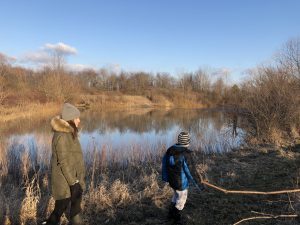
During this time of self-isolating, curve-flattening, and social-distancing, we find ourselves removed from the comforts and relationships of our normal world. We may feel alone, isolated, distant, afraid, and flattened.
COVID-19 is a reminder that we are part of nature whether we understand that or not. A tiny little life-form previously unknown to us has brought our world to a stop. I have friends in Kenya that are bracing for the impact. My friend in Colombia, Maria, is on lockdown and playing Scrabble with her roommates. And here in Indiana and across the United States we are half-heartedly hunkering while the virus closes in around us.
Nature Therapy
But removed from our day-to-day world, and as disjointed as that may make us feel, maybe it’s another world that can give us comfort. The natural world that is scaring the bejesus out of us, and wrecking so much that we thought was unwreckable, may also inflate our flattened souls.
The Japanese call this Forest Bathing (Time article on the topic with some tips):
“This is not exercise, or hiking, or jogging. It is simply being in nature, connecting with it through our senses of sight, hearing, taste, smell and touch. [It] is like a bridge. By opening our senses, it bridges the gap between us and the natural world.”
Dr. Qing Li has conducted research on the health benefits of forest bathing and found that “forest bathing . . . significantly reduced pulse rate and significantly increased the score for vigor and decreased the scores for depression, fatigue, anxiety, and confusion” for participants.
Magic
Last month, when I visited with the Arhuaco, an indigenous group in Colombia, to learn about their way of life and connection with the natural world, I thought that they would show me some of their farming practices and traditions. (After all, I was researching a book on agriculture.) There was some of that, but most of the time we sat in nature and thought. They told me February was the season of asking permission from the plants, land, and mountains.
So we sat and listened, breathed and thought.
They believe that where they live is the heart of the world. And the heart of the heart of the world is their cultural and spiritual capital — Nabusimake. I visited in 2011 and wrote about it in WHERE AM I EATING. I was hoping to revisit, but was told that Nabusimake was closed. Despite the treacherous, nearly impassable roads taken to reach it, tourists were visiting Nabusimake and not being respectful. So the Arhuaco closed it.
Miguel, our Arhuacan guide, consoled me: “Nabusimake would be better, but this will be very good. Each land has the magic.”
I was still disappointed. We went to a different place to meet with a spiritual leader, known as a mamu. We followed the impossibly agile old man down a steep ridge. He disappeared into the thick vegetation. Miguel cut a path for us with a machete and there was the mamu motioning for us to sit, so we sat. He gave us things to think about, so we thought about them. The earth. Our futures our pasts. The more I sat there, the smaller I became. Surrounded by a canopy of reeds, sugarcane, and banana plants, I was reminded of the movie Honey I Shrunk the Kids. Then I noticed highways of ants beneath the layers of leaves on the forest floor. They moved with intent and purpose, no less meaningful than the intent and purpose for which I sat.
I noticed the rhythm of a waterfall somewhere in the distance and the heart in my chest. This world was part of me and I was part of it. The realization made me feel lighter.
Becoming native to our place
“It is possible to love a small acreage in Kansas as much as John Muir loved the entire Sierra Nevada. This is fortunate, for the wilderness of the Sierra will disappear unless little pieces of nonwilderness become intensely loved by lots of people.” – Wes Jackson
A few weeks ago I was surrounded by the mountains and lakes of Patagonia. It was a different world compared to the flatness of Indiana. A world that inspires the creation of new adjectives. I spent several nights sleeping beneath a blanket of stars. It felt like a magic place–a forest bathing immersion.
For about a week, I slept next to South America’s second largest lake. The night was as silent as the distant galaxies. I could hear when someone turned over in a sleeping bag. If only I could bottle this moment, I thought repeatedly, and take it back to Indiana and sip some of the magic when I needed it. I knew it would fade.
My first night back home, when I closed my eyes, I heard a choir of frogs in my shallow pond sing their first spring song. The stars weren’t as bright, there weren’t any mountains, but Patagonia didn’t have singing frogs.
We have plenty of time now to slow down and notice where we live, to put ourselves in nature and to get to work on becoming “native to our place” as Wes Jackson would put it.
I’ve been going for walks outside with a newfound purpose and appreciation for stopping and listening and noticing. I’ve decided to sit more and observe, to not just walk through nature, but put myself in nature.
Don’t be disappointed about where you are. Be where you are.
Nature is scary as hell in this uncertain time, but each place also offers us comfort and magic, if we take time to notice.
March 18, 2020
Why we’re canceling our trip to Kauai: an exponential essay
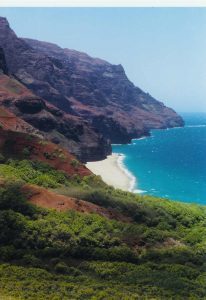 Why we’re canceling our trip to Kauai: an exponential essay
Today
I cancelled
My trip to Hawaii.
I was leaving next week. My wife, too.
She was joining me the first week of a three-week research trip for my next book.
We never really had a honeymoon. Unless you count another book-trip stopping at a garment factory in Perry, New York, and then going to Niagara Falls, Canada, for a day. She doesn’t.
I first visited Kauai nearly 20 years ago. Since I hiked her trails, paddled her waters, ate her wild fruit while swimming in waterfalls, and wondered at her lushly vegetated Emerald City of cliffs, I wanted nothing more than to experience it all with Annie, my patient highschool sweetheart, who didn’t wait for my wanderlust to pass but accepted it as part of me.
Kauai was our dream. Unattainable because of two kids, a great recession, an inconsistent income that made unnecessary purchases seem irresponsible. We bought three knee surgeries for our dog and not a couch for our living room. There’s no room in such deliberations for Pacific islands. I’ve been everywhere. Not really. But close. I’ve stared at glaciers melting into the sea, mountains of coral teeming with rainbows of fish, Himalayan peaks, impossible clear lakes deeper than the sky, and always I’m visited by the same thought: I wish Annie were here. Places and experiences never quite felt full because she was missing, present to the day-to-day of our lives in Indiana, nurturing our most important stories. But then the stars aligned. I cashed in my miles for her.
I was pretty sure that from the cliff of our Airbnb overlooking an ocean reaching toward Alaska’s Aleutian Islands, we could celebrate all those years when this was just a dream, while at the same time imagining the rest of our lives. Middle-aged in the Middle of the Pacific. Remembering and imagining. Sure, I had work to do, but Annie would have the beach, sun, books, and the quiet. We’ve been lucky that my life is my work and Annie my co-author. We live and I write about it. The questions I ask and the people I’ve met and the places I’ve been have changed us. And the living of this book to be published by Patagonia books in 2022, which is about our relationship with nature and the hope of regenerative agriculture was bringing us from the flatfields of unplanted corn in Indiana to Kauai . . . where there is also corn. The place occupying paradise in the ever-open Wikipedia of my mind has fields of corn sprayed with experimental chemicals to be sold and applied to lands in Indiana, polluting the soil and stream that run to the pond where Annie fishes with our daughter in our backyard. Protestors in Hawaii are fighting to keep their rivers, soil, ocean, and kids from exposure to poison. Whether they know it or not, their sacrifice and fight in the middle of the Pacific is a fight for us all. So Annie and I were going to Kauai to experience their paradise and learn how we might protect others.
And now I have 512 words to tell you, despite how long we’ve wanted to go and how important we feel this trip is, why we’re not going. Each of the paragraphs I’ve written represents three days, and each word represents a person in the United States infected with COVID-19. Despite all the measures we’ve taken as a society so far, the number of people infected doubles every three days. If I continued to follow the formula of this piece: Paragraph 17 would be 65,536 words long–about the length of my first book; Paragraph 19 would be 262,144 words long–about the same amount of words in my three, 300-page books combined; and Paragraph 20 would represent two months and 524,288 people infected, 20% of whom would be hospitalized. As the best article I’ve seen about this states, “this is math, not prophecy.” And the only way to flatten the curve and stop the exponential spreading of COVID-19 is to self-isolate. Flying from Indianapolis to Chicago to San Francisco to Kauai and back exposes us to so many more people than living our lives in rural Indiana. I take risks all the time to do work I believe in. I’d be willing to put my individual health at risk to go to Kauai with Annie to realize our dream and to not delay the work of what feels like my most important book to date. We’re relatively young and healthy and the chances of COVID-19 killing us are low. But our choice to cancel the trip isn’t about us. It’s about the whole of society. It’s about my parents and in-laws who are much more at risk from COVID-19. If we contracted the virus we could pass it on to them or to someone you love or to someone someone else loves and depends on, someone who wants to recount the joys of their own lives and imagine and plan a future with someone they love. And they could pass it on to someone else in the United States or beyond. Kenya, where I have friends, just reported their 4th case of COVID-19 yesterday. The U.S. health system is expected to be overrun with patients. Now imagine what will happen in Kenya and in other developing countries around the world. If we went to Kauai we would not be honoring the sacrifices so many people are making by choice or circumstance: people are volunteering in a vaccination study in which they are infected on purpose, people are losing their jobs, people are losing their businesses, healthcare professionals are risking their lives, people are separating themselves from their loved ones, and people are dying. Even if the math and the scientists who’ve dedicated their lives to this are wrong, I don’t want to be sitting on a beach in paradise while others around the world are losing and sacrificing so much. Besides, it’s not everyday that we have such an opportunity to sacrifice something for the greater good of society. Today we do, and we are canceling our trip to Kauai.
January 23, 2020
Good People: A visit to the wall
Drop a quarter into a turnstile and you can cross from the U.S. into Mexico. Easy. The reverse journey is much more difficult, especially for immigrants searching for a better life.
On this episode of Good People, Jay and I chat with my friend Scott Truex, who has spent his career learning and teaching about sustainability and community development. Scott talks about his recent experience visiting the Mexican border and the infamous wall.
Listen below or on iTunes or Stitcher.
December 6, 2019
Good People: Why astronauts are Good People
To be good you have to feel small. On the latest episode of the Good People podcast Kelsey and Jay discuss transcendent moments and what astronauts, meditators, and monks can teach us.
Mentioned in this episode:
The Power of Meaning by Emily Esfahani Smith
We Are the Weather by Jonathan Safran Foer
November 25, 2019
Good People: The ripple effects of giving money
Give a man a fish? Teach a man to fish? But what if he doesn’t want to fish? Joe Huston, The CFO of Give Directly, joins Kelsey and Jay to discuss giving money to the poor and the positive ripple effects it makes in a community.
;
Show notes:
GiveDirectly.org
GiveWell’s report on Give Directly
How do cash transfers impact people who don’t receive them? (post and link to paper)
Review of evidence of direct cash transfers
Research Give Directly shares on site
Hand to Mouth: Living in Bootstrap America book by Linda Tirado
November 12, 2019
It’s HUGE to Feel small
I laid on the bottom of the ocean and stared into space.
The surface of the water was so still and flat that it ceased to exist. The light of the stars traveled unimpeded trillions of miles, through the Earth’s atmosphere and 20 feet of water.
I held my breath, the sound of my heartbeat joining the primordial hum of the Atlantic.
I pushed off the bottom. Underwater like in space one is weightless.
That night off the coast of Key West, I slowly kicked towards constellations, no difference between air and space. I swam into eons and lightyears, not an observer of the universe but part of it.
—
I stood in my backyard in Indiana, waiting for my dog to pee.
The lightning bugs at their peak. Each flash reflected off the surface of the pond.
The stars were free from fossil-fueled light pollution and danced in the darkness of a new moon.
Stars below, above, and around me. As if the heavens descended.
—
In the Rocky Mountains, no tent, just the sky, and more shooting stars in one hour than I had seen in my entire life.
—
Holding my daughter for the first time.
—
Holding my son for the first time.
—
Pouring water onto the back of a beached pilot whale and feeling it’s sonar go through me.
—
Each of these was a moment of transcendence in which I felt small, but part of something much bigger than myself. In her book The Power of Meaning Emily Esfahani Smith includes transcendence in her four pillars of meaning alongside a sense of belonging, purpose, and storytelling.
She writes about the paradox of transcendence:
[Transcendence] simultaneously makes individuals feel insignificant and yet connected to something massive and meaningful. How can this paradox be explained? The experiences of practiced meditators, who describe similar phenomena, may offer a clue. At the peak mystical moment, they sense the boundaries of their selves dissolve and, as a result, feel no more separation between themselves and the world around them. They experience, as a meditator in one study put it, “a sense of timelessness” … the brain can no longer separate the self from the surrounding environment. Individuals feel connected with everyone and everything—they feel a sense of unity.
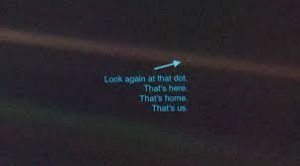
So many of my transcendent moments have involved stars, so it makes sense that Esfahni Smith would write about the experiences of astronauts looking back at the pale blue dot we call home.
Their values, according to one study, shift from self-focused ones like achievement, enjoyment, and self-direction to self-transcendent ones, like unity with nature, belief in God, and world peace. “You develop an instant global consciousness, a people orientation, an intense dissatisfaction with the state of the world,” another astronaut has said, “and a compulsion to do something about it. From out there on the moon, international politics looks so petty. You want to grab a politician by the scruff of the neck and drag him a quarter of a million miles out and say, ‘Look at that, you son of a bitch. ” Scientists have dubbed this dramatic shift in perspective the Overview Effect.
When have you had such moments? It wasn’t taking a selfie–a moment when you certainly aren’t in the moment or looking outside of yourself. But what about Facebook? But what about Instagram? When we think about our audience we leave the moment thinking of how to share this moment instead of experiencing it. I’d argue that no one has ever experienced transcendence while taking a selfie.
I’m not one to worry about the decline of religion in our culture today, but I do worry that it may contribute to a decline in the amount of transcendent moments people experience. We need people who feel small. We need people who discover moments to wonder at the stars and not always feel like a star themselves. A study in 2014 found that students who stared up at a 200-foot tall eucalyptus tree for one minute (one minute!) felt more generous and less self-centered. People feel more satisfied, more connected.
One terminal cancer patient who didn’t believe in an afterlife participated in a study in which psychedelics were used to produce transcendent experiences. Before her trip she felt the dread of not existing, but after she felt much more connected. “There was not one atom of myself that did not merge with the divine.”
So you could try magic mushrooms, find a God, lose yourself in the mystery of art and existence, or my recommendations, and something I should do more, mediate and soak up nature, hug a tree, stare up at the branches, or swim in the stars.
But find something that makes you feel small, yet connected and do that. Our society and the fate of our planet depend on it.
“To the dull mind all nature is leaden. To the illuminated mind the whole world burns and sparkles with light.” – Ralph Waldo Emerson
“When we try to pick out anything by itself, we find it hitched to everything else in the universe.” – John Muir
Carl Sagan unveils the Pale Blue Dot, 1990 from The Planetary Society on Vimeo.
October 31, 2019
Good People: A Night Alone in Castle Dracula
In 2004 I traveled to Eastern Europe specifically to spend the night in Castle Dracula in Romania. This is the story of that terrifying night….