Kelsey Timmerman's Blog, page 10
May 8, 2017
What we learned from the guy who builds $250K Batmobiles
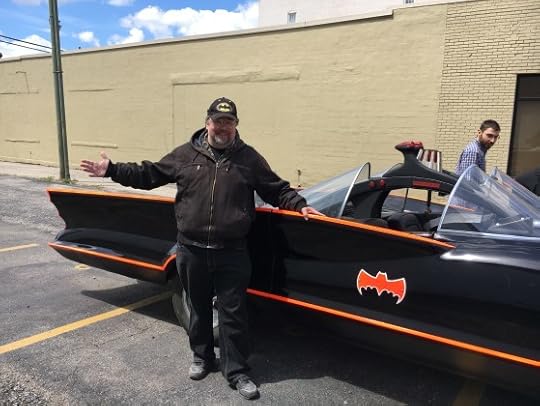
We met the guy who made the Batmobile. His name is Mark and he lives in Indiana.
We were celebrating Free Comic Book Day at our local shop, Aw Yeah Comics, and Mark was there with one of his 1966 Batmobile replica. It had a a “Bat Beam” button, and an “Emergency Bat-Turn Lever.”
Even as a kid, I recognized that the original Batman TV-series starring Adam West was cheesey. I loved it. The corny jokes. The word sounds–Bam! Pa-Zow!! Bat shark spray. Bat-everything. But the Batmobile was just plain cool, so to see it, or at least a pretty darn good replica, of it was awesome.
Mark Racop, the owner of Fiberglass Freaks, stood a watchful yet not hovering distance from the car. As Harper, 8, and I walked toward the store’s entrance, we stopped to talk to him. I asked if he was with the Batmobile.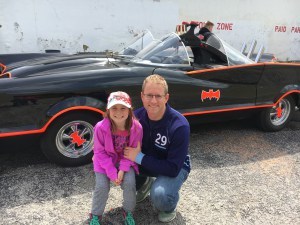
He confirmed that he was and then launched into an unexpected motivational soliloquy that went something like this:
I built my first Batmobile with a few friends in 1977 when I was 17. I never knew it would become this. DC officially licenses us to build replicas. There was a one-in-one-thousand chance that my hobby would become anything. Whenever I get a chance to talk to kids, I always tell them to follow their dreams.
“How much does a Batmobile go for?” I asked, wondering if it was outfitted for car seats.
“$125,000 to $250,000,” Mark said, as matter of factly as superhumanly possible.
To which I thought, “Holy shit, Batman!”
When I first started chatting with Mark, I thought I was talking to a grown man with a quirky hobby. But when I realized I was talking to a grown man who builds cars that cost quarter-of-a-million dollars, I took him more seriously.
I’m not sure why, but the numbers made me see Mark differently. They shouldn’t. Because before Mark had a business building replica Batmobiles, he did it because he loved to do it. No doubt society looked at Mark as a quirky kid with a silly hobby who should probably find something more productive to do with his time.
I can relate. Before I earned a living as a writer and speaker, I was a quirky kid with a silly hobby, and a lot of people told me I should probably find something more productive to do than travel around the world and write stories for ten bucks a pop. My asking Mark what a Batmobile cost was the equivalent of the questions I’m often asked: “What’s your day job? What does your wife do?”
Yet even I judged Mark this way.
Why is it that as a society we’re so quick to dismiss someone’s passion instead of supporting it?
Mark builds Batmobiles. And they are freaking awesome! That’s enough on its own for us to celebrate him.
Mark is proof that we shouldn’t be ashamed of our passions and hobbies. We should embrace them and we should support the passions and hobbies of our family and friends regardless of how quirky.
If you want to buy a Batmobile and have the funds to do so, check out Mark’s site Buy Bat Parts.
More Batphotos below the break…





April 25, 2017
Participating in Chicago’s Fashion Revolution
I’m participating at several events as part of Chicago’s Fashion Revolution week. Fashion Revolution was inspired by the Rana Plaza factory disaster, which I wrote about yesterday.
WEDNESDAY, APRIL 26
Noon CST
I’ll be on NPR affiliate WBEZ’s program WorldView with Jerome McDonnell. Wait, WBEZ? Isn’t that the station that produces This American Life? If I see Ira Glass, he’s totally getting a high-five.
6-9 PM
Explore alternatives! Fashion Show and Panel with Keynote Speaker Kelsey Timmerman at Columbia College. Chicago Fair Trade and Columbia are hosting an ethical fashion show, interactive displays, and a panel. I’ll give a quick keynote before the panel begins. Located at 618 S. Michigan . The fashion show will take place in the 2nd floor lobby, with the screening in the Stage 2 theater, also on the second floor.
THURSDAY, APRIL 27
1:30 PM
EVANSTON PUBLIC LIBRARY EVENT As part of Fashion Revolution Week, Chicago Fair Trade and Evanston Fair Trade have organized an event: a screening of Clothes to Die For, a documentary about the Rana Plaza tragedy, followed by a Q&A with me.
6 – 8:30 PM
Depaul University I’ll be delivering a keynote directly after we watch Clothes to Die For. I just watched this for the first time today and I’m leveled. Scott Nova of the Workers’ Rights Consortium will also be there. I’m excited to meet Scott and learn from him.
April 24, 2017
4 years ago 1,134 Bangladeshis died making our clothes

One moment Reshma Begum was sewing. The next, she was falling from her station on the second floor into the basement of the Rana Plaza garment factory in Savar, Bangladesh.
She lost consciousness. She awoke to cries of help that gradually silenced. Her clothes were shredded, everything was dark, and her hair was stuck in the rubble. She ripped her hair free and scavenged the dark crevices on her hands and knees finding four crackers, a small bottle of water, and the occasional puddle to quench her thirst. She probed her surroundings with a pipe for pockets of air.
This was her life. This was her living for seventeen days.
Was Reshma’s situation an unfortunate end to an individual pursuing real opportunity in the global economy or was she exploited? Is a job in a factory better than working in the fields? Are we, as consumers, justifying the exploitation of factory and farm workers in the name of opportunity?
These aren’t easy questions to answer. In the global economy, the line between exploitation and opportunity can be pretty blurry.
A Path out of Poverty?
In his book, “The End of Poverty,” economist Jeffery Sachs calls such jobs the first rung of the global economic ladder, and he explains they’ve played an important role in Bangladesh’s development. Over the past four decades in Bangladesh per capita income has doubled, life expectancy has increased by 26 years, and the infant mortality rate has been decreased by two-thirds since 1970.
The garment industry does several things that are really important: it goes to some of the poorest places on the planet—Bangladesh has the lowest wage in the world—and it gives people, especially women, an opportunity to earn an income.
Many economists, such as Sachs, say this was the path to prosperity for Americans. We left the fields, headed to the factories, suffered poor working conditions and tragedies, but eventually wages and working standards increased, replacing the labor intense jobs with better paying, safer ones.
But not everyone is so optimistic that this trend continues today.
“A garment industry job can help keep a family from starving from hunger,” says Liana Foxvog, the director of organizing and communications for the International Labor Rights Forum, “but the vast majority of these jobs are not a path out of poverty. The fact that so many workers returned to work at Rana Plaza the day after the cracks appeared in the building is an indicator of the level of poverty these workers live in–that they would rather risk their lives than losing a month’s pay as had been threatened by some managers.”
The jobs may not be a path out of poverty, but garment workers around the world are afraid to lose the jobs all the same.
Workers in China clock out and go back to work for free because they will be replaced if they don’t. Workers in Cambodia pay bribes to get their jobs. They leave their families and the only world they’ve ever known to pursue opportunity.
When Ai, one of the eighty-five garment workers involved in sewing together a single pair of Levi’s jeans in a Cambodian factory, was told that some Americans don’t want to buy the jeans she makes because they think she should earn more than $50 per month, she quickly replied: “If people don’t buy, I’m unhappy because I wouldn’t have a job.
Is it that simple? Should we mindlessly shop and take comfort in knowing that the people who make our stuff in faraway factories have no better options?
Scott Nova of the Workers Rights Consortium estimates that to bring Bangladeshi factories up to acceptable safety standards, garments coming out of the factories would have to retail for 25-cents more.
Would you pay 25-cents more to protect Bangladeshi workers?
Leaving the farm
Ten months before Reshma was buried in the disaster that killed 1,134 fellow garment workers, she left her rural district of Dinajpur where 70% of the population farms, to pursue the opportunities of the city in Dhaka.
Many in Bangladesh and around the world are leaving the fields for the factories, hoping a job in the city sewing Levi’s or assembling iPhones will improve their lives. The United Nations projects that by 2050, 70% of the world’s population will live in cities.
From farm to factory to…?
On the seventeenth day the efforts to dig through the rubble of the Rana Plaza collapse in Bangladesh were no longer labeled as a rescue but as a recovery. Workers were looking for bodies, and they found Reshma, who outlived expectations.
Days later she recounted her experience to the international press, and ended her interview with a simple statement that shared her thoughts on her opportunity as a garment worker in the city.
“I will not work in a garment factory again.”
Americans are paying a smaller price for food and clothing than ever before; others pay much more.
April 10, 2017
Are autistic kids better givers?

Researchers in Germany just published some interesting findings about the prosocial behaviors of kids with autism.
From the abstract of Helping and sharing with preschool children with autism:
We assessed helping and sharing behaviors in 3- to 6-year-old neurotypically (NT) developing children and children diagnosed with ASD. Children with ASD were more inclined to show spontaneous helping in the absence of the helpee than NT children. In the sharing task, NT children shared the resources equally between themselves and the recipients. In contrast, ASD children kept less for themselves and gave more resources away. In addition, the stronger the ASD symptoms were and the less cognitively weaker they were, the more children preferred to give resources to a rich than to a poor other.
I didn’t pay the $40 fee to read the whole study, so I’m basing all of my thoughts from the abstract. As a father of a 5-year-old with autism, I can see this. Or at least how this could be perceived. Griffin, who will be 6 in May, often doesn’t really care if someone takes a toy he’s playing with. Most of the time he’s the most content kids I’ve ever met. Now if he has a favorite toy, he’s a bit more likely to care.
I’ve read that employees who are autistic are more likely to be content with their jobs–the routine of it, what they are paid, their benefits. Often they can be more loyal to a company than those who don’t have autism. I think it’s not in their nature to ask, “How can I get more?” They are much better that the rest of us being content with enough. This is just one of the many lessons we have to learn from individuals with autism.
As for this study, I would be interested to learn how they define “spontaneous helping.” Were these kids on the spectrum acting altruistically or were they simply maintaining order in their world out of habit.
Either way, I’m thankful for neurodiversity. I know there are challenges; believe me. But our Griff, helps us see the world in new and amazing ways all the time.
March 28, 2017
Why I (kinda) stopped eating Chocolate
I stopped eating mass-produced Chocolate (note the capital C for Big Chocolate) about 18 months ago. No Hershey’s. No Mars. No Kit Kat. No…gulp…York Peppermint Patties or Twix.
I’m not healthier or more ethical than you. I don’t think my small act is saving the world. I stopped eating chocolate for me.
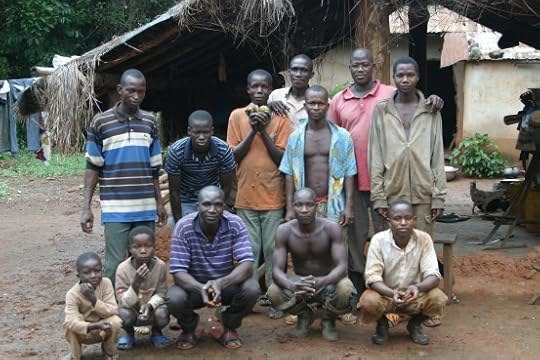
It’s just that most of the time I ate chocolate, I thought about Michale, the farmer I met in Ivory Coast and how whether or not he could send his kids to school depended upon the price of cocoa, which swings wildly. I thought about the Solo, the slave, I met and how his parents didn’t know if he were dead or alive.
—
COCOA FARMERS TASTING HERSHEY’S
—
All of these memories of faces and places filled each bite. They aren’t all bad. It was an honor to meet the people I met and learn about their lives. We had lots of laughs.
But there were times where I didn’t think about them and just mindlessly ate chocolate. I could feel the memories slipping away and I didn’t want to forget about Michael and his family or Solo. So I stopped eating it.
Not eating Chocolate feels right. Meeting them changed me and changing a small behavior, a small indulgence, is my personal way of honoring them and acknowledging that change.
That said, my rules are loose. I rarely consume any Chocolate in a wrapper. I’ll eat chocolate in baked goods. I’ll eat brownies and brownie batter (why do we bother cooking it in the first place?). I’ll eat S’mores. I’m not militant about it. But turning down offers and urges to consume chocolate most of the time has made me more mindful of the act.
I also eat Fair Trade chocolate and have come to appreciate higher quality chocolate. It’s simply more satisfying. I’m noshing on some Fair Trade Green & Blacks as I write this. Walgreens had it on sale for $1 per bar. I bought them out! I don’t keep track of my chocolate budget, but if I did, I would guess that I spend less on chocolate than I did before. Yes, I buy more expensive chocolate, but I buy less of it. There’s also something more enjoyable about eating chocolate that I know is improving the lives of people who produce it. Some of my favorite brands are Alter-Eco, Equal Exchange, and Madecasse.
I’ve found that many of the “ethical” and “environmental” food choices I’ve made—fresh eggs, beef raised on a small farm by my wife’s aunt and uncle—have increased the enjoyment I get out of food.
We are surrounded by Chocolate. You don’t realize it until you give it up. Free Chocolate at the reception desk, leftover Halloween candy, a friend who always has Peppermint Patties (Peggy!) in her office, another (Jama) who has a bottomless candy jar.
“No thanks,” I say each time it is offered. They don’t ask why. I mean who turns down chocolate? Each time I say no, I know why.
I say no because it is my way of not forgetting.
MEETING SOLO
March 22, 2017
What if mentoring doesn’t work?
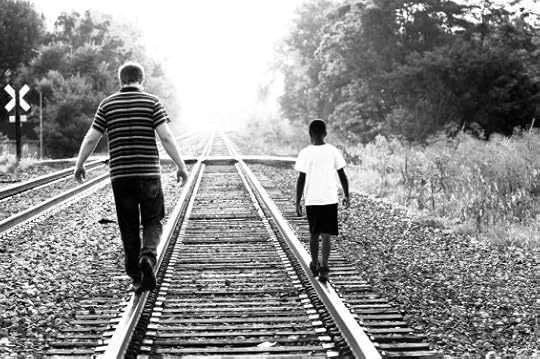
The greatest gift you have to give to another is your time.
I believe that. That feels right. But what if it isn’t? What if you volunteered as a mentor and in the long run it was harmful to your mentee?
For years I volunteered as a big brother with Big Brothers Big Sisters (BBBS). My little was 10, now he’s 19. (I think! He’ll probably read this and correct me. He’s like that.) The BBBS model of recruiting Bigs and selectively matching them with Littles and offering them match support is proven.
(From the Washington Post)
The prototype for all this – and the model from which [Wellesely College economist Philip] Levine suggests building – is Big Brothers Big Sisters of America, which provides mentors to about 200,000 adolescents nationwide. Young people in this program show improvement in academic performance across several measures, including a small but significant increase in pivotal grade-point average. The program’s mentors undergo background checks and extensive training and are supervised.
Big Brothers Big Sisters costs about $1,600 per participant – so a basic question arises: Is it worth it?
Intuitively, most laypeople would say yes. But economists, being economists, tend to answer this in a very particular way: as a matter of private return on investment vs. social return. In the case of private return, does the young person benefit more from mentoring than if Big Brothers Big Sisters had just given him or her the money?
Absolutely, Levine concludes. Doing some fancy math that converts improved grade-point averages into wages over a lifetime, Big Brothers Big Sisters benefits exceed costs by a ratio of almost 5 to 1, he writes.
Confession of a failed mentor?
Often BBBS itself shows that kids who participate in the program are less likely to use drugs, go to prison, and more likely to graduate high school. My Little, who actually feels like my little brother in many ways, was 0 for 3 in these areas. If the Little not getting in trouble with the law, not doing drugs, and graduating high school is how we measure the success of a mentor, I was a major failure.
I didn’t realize that I had some guilt around this until poet Michael Brockley sat down with me to chat and write my story for Mentoring in Muncie: A Facing Project.
Here’s an excerpt from A Brothership Memoir:
None of us chooses our brothers. I volunteered to enter his world of demigods and lightning-scarred wizards. We forged our brothership over a Scrabble board and phone conversations between Burkina Faso and Middletown, U. S. A. I didn’t choose Matt. He didn’t choose me. But we ring true when we’re together.
(Matt isn’t his real name by the way.)
Often I’ve wondered if Matt would’ve been better off without me, and if I had no impact or even a negative impact on his life. Once I really get engaged in trying to do good and make a positive impact, I started to see how difficult it actually was and that trying to do good can sometimes be harmful.
I’m glad to know Matt. He’s a father now. I’ve held his baby boy and enjoyed watching him enjoy being a dad. I’m still a supporter of BBBS, in fact, I helped lead their Facing Project. My friend, Stephanie Fisher, is currently raising funds for our local BBBS program. I’ll donate to her cause (you should consider donating too).
Did my mentoring work for Matt? I don’t know. Not all mentoring programs work.
Kids harmed by mentoring
In 1939 researchers decided to apply the scientific method to see whether mentoring and youth intervention through the Cambridge Somerville Youth Study program lowered the rate of juvenile delinquency. There was a treatment group (those who were paired with a mentor) and there was a control group (those who came from a similar background but weren’t matched with a mentor). They followed the kids over time.
Ten years after beginning the program, there was no significant difference between the groups.
However, thirty years after the program, there was an unexpected statistically significant difference between the groups. The kids who were in the program were more likely to be substance abusers, more likely to have unhealthy relationships with a spouse, and, in general, were not as happy or as successful as the individuals in the control group.
They were harmed by mentoring.
Now if you asked the mentees about whether the program was successful, they would rave about their mentor, ask how they were doing. Same for the mentor. They both looked on the experience positively.
Joan McCord, the researcher who followed up on the study in 1981 and found that the program had a negative impact, was never able to pinpoint why the program was harmful, but she had some theories.
1) The kids in the program were exposed to middle class values and aspirations where you follow your passion, you marry for love, you can be anything you want to be. That’s not a reality for many. She theorized that kids who were in the program raised their expectations and when those expectations were not met, they were unhappy and frustrated, which had a negative long term impact.
2) The kids in the program spent a lot of time together and may have negatively influenced one another.
If you want to learn more about this, I highly recommend listening to Episode 2 of Doing Good Better: a podcast about Effective Altruism. The hosts interview Joan McCord’s son. He was volunteering as a mentor when his mom was conducting this study and she suggested he quit.
Should you quit being a mentor?
No. Please, no. Where would you be without the mentors in your life? You should read the full article in the Washington Post, The Economic Case of Mentoring Disadvantaged Youth. You should ask tough questions of yourself and the mentoring organization you choose.
Time is the most valuable thing we have to give, and therefore we should give it wisely.
March 15, 2017
“Don’t forget to explore!” A lesson in creating from my daughter
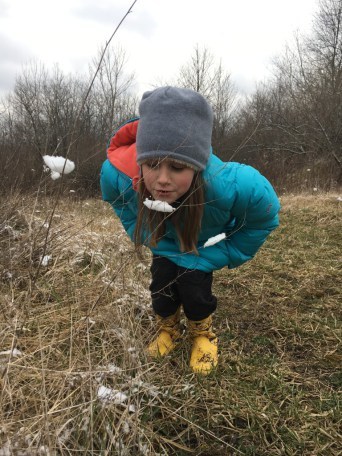
On Monday, Harper and I explored the woods. We found puff balls, a beer bottle, a rabbit, and a squawking heron. We climbed a deer stand and tried to patch a beaver dam.
When we walked from the woods into the clearing next to the pond, we saw what appeared to be snow flowers. It was as if tall weeds that had managed to stay upright through the winter bloomed petals of snow.
Harper wanted to show “everyone,” so we recorded a short episode of Harper & Daddy TV, our hit YouTube show. (I mean, like, one of our video has 100 views.)
While we were filming, we realized that the snow flowers had formed atop nearly invisible spider webs. It was an exciting moment of discovery for both of us.
It had been a while since we had recorded an episode and Harper typically signs off, “Don’t forget to subscribe.” She learned this from other YouTubers who open up toy after toy. Those were the YouTubers Harper wanted to emulate. In the beginning, she always asked for toys while we were shopping, not to play with, just to open for YouTube. If you watch the early episodes of HDTV, you’ll see that they were somewhat toy-centric. I’ve tried to push her toward more experiential episodes where we and the viewers can learn something. It was a struggle at first, but she’s branched out from “toy reveals.”
“And don’t forget to . . . ” I was setting Harper up for her sign off.
“EXPLORE!” Harper said.
I was proud. You can see it on my face in the video.
We live in a world, especially online, that is obsessed with number of friends, followers, connections, visitors, and clicks. All of these things stats should be byproducts of the passion and wonder you put into creating. The passion needs to be there before the clicks.
When the exploration is reward enough, that’s when people start paying attention.
March 14, 2017
Make the Living Room Great Again: A Fable

(photo credit: Ada Bee)
The King of the Living Room surveyed his kingdom. He didn’t like what he saw. He hated his kingdom.
“This living room isn’t what it used to be,” the King of the Living Room said. “So sad.”
“When I was a child, the living room was much bigger. I used to be able to jump off the couch. I peed in the corner and now the whole damn room smells like urine.”
“So here’s what we are going to do. From here on out it’s the Living room first! Not the kitchen, not the bathroom, not the bedroom. Living room first! This living room is a disaster and I’m the only one who is going to fix it.”
And that’s what the King of the Living Room did. The plushest carpet. Paint melted from ancient Peruvian gold. He replaced an entire wall with a TV. Of course, he didn’t do it himself. He was the King!
“I’m hungry! Bring me some food!” Making the living room Great Again had made the King of the Living Room hungry.
“But sir,” the King’s subject said, “the kitchen . . . it’s in shambles. The fridge doesn’t work. The food is spoiled and all of the cooking supplies have been taken.”
“So nasty,” said the King. “Turn down my bed. I’m going to take a nap.”
“But . . . sir,” the subject stammered.
“What now?!”
“The bedroom is gone.”
“How can a bedroom be gone?”
“Well, sir, while we poured all our attention and resources into the living room, we stopped caring for the bedroom. It struggled without our support, fell into civil war, and eventually burned to the ground.”
“How can a bedroom fall into civil war?”
“I don’t know, sir, but it did. That’s nothing compared to the genocide and environmental degradation taking place in the bathroom.”
The King of the Living Room sat on the couch he had bought–or someone else had bought with his money–at Michael Jackson’s estate sale. He couldn’t eat because of the state of the kitchen. He couldn’t sleep because the state of bedroom. He couldn’t even take a leak because of the state of the bathroom.
While he was making the Living Room Great again, the rest of the house had fallen into disrepair. Turns out the problems of the other rooms eventually became his problems. But now it was too late to do anything about it.
He grabbed the remote to turn on his wall-sized TV to look for someone to blame. But the TV wouldn’t turn on.
“Subject, I think the remote needs new batteries,” The King of the Living Room said.
“Sir . . . the batteries were in the kitchen.”
So the King of the Living Room sat on his Michael Jackson couch before the blank, wall-sized TV, staring at a reflection of himself.
Don’t forget to explore!
On Monday, Harper and I explored the woods. We found puff balls, a beer bottle, a rabbit, and a squawking heron. We climbed a deer stand and tried to patch a beaver dam.
When we walked from the woods into the clearing next to the pond, we saw what appeared to be snow flowers. It was as if tall weeds that had managed to stay upright through the winter had bloomed petals of snow.
Harper wanted to show everyone, so we recorded a short episode of Harper & Daddy TV, our hit YouTube show. I mean, like, one of our video has 100 views.
While we were filming, we realized that the snow flowers had formed atop nearly invisible spider webs on the weeds. It was an exciting moment of discovery for both of us.
It had been a while since we had recorded an episode and Harper typically signs off, “Don’t forget to subscribe.” She learned this from other YouTubers who sit in rooms and open up toy after toy. Those were the YouTubers Harper wanted to emulate. In the beginning, she always asked for toys while we were shopping, not to play with, just to open for YouTube. If you watch the early episodes of HDTV, you’ll see that they were somewhat toy-centric. I’ve tried to push her toward more experiential episodes where we and the viewers can learn something. It has been a struggle at times.
“And don’t forget to . . . ” I was setting Harper up for her sign off.
“EXPLORE!” Harper said.
I was a proud papa.
March 11, 2017
Healthcare costs & system could leave kids like my son behind
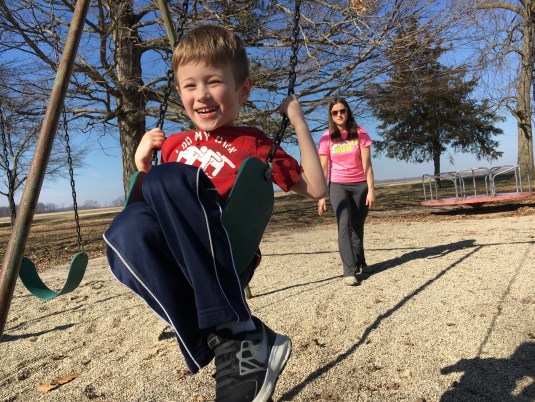
Our son Griffin receives over $100K of therapies each year for autism.
“Are you here to get insurance to cover ABA?” (ABA is autism therapy.)
“Uh, no.” I said. “We’re here because we feel like Griffin should have a developmental pediatrician.”
This is how much insurance is in the discussion these days in the autism community, heck, in America. It was the topic of our first discussion at our first meeting with a new pediatrician.
I’m not criticizing him at all. The last note he had in our file from another doctor at his office was such a request from three years ago. Then Griffin was too young to get a diagnosis that would be acceptable for the insurance company.
This was pre-Affordable Care Act. Our monthly premiums were around $275 and our deductible was in the $8,000 range. This was also during a time that many health insurances excluded autism and/or autism was treated as a preexisting condition.
Today with insurance courtesy of the ACA, we pay a monthly premium of $800 per month, plus Uncle Sam chips in a $300 per month subsidy, which makes the total premium $1,100. Three years ago our deductible was around $9,000, and today our deductible is now $13,000. That’s right, the cost of our monthly premium (the total cost) has gone up $825 and our deductible has gone up $4,000. (Our insurance pre-ACA did cover autism, thankfully.)
There is no doubt that insurance through the Affordable Care Act is becoming unaffordable. When critics talk about the ACA collapsing, I see it happening. We can’t afford not to have insurance for our son Griffin, who receives $100,000 of services per year in therapies, but, honestly, we can barely afford to have health insurance at this point.
Health care is our largest monthly expense.
Not that we would, but if we decided to live fast and furiously and convert our monthly premium into a car payment, we could buy this Alfa Romeo 4c Coupe.

Or, if we decide to squirrel away and invest $1,100/month, we could save $600,000 by the time I am 60 (22 years from now).
All kids should receive the proper medical attention, regardless of their parents’ employment status or income
The doctor and I had a discussion about the uncertainty of our insurance. We kept it very apolitical. He seemed worried that we could be facing a time again where insurance companies exclude autism. That they exclude kids like Griffin getting therapies that can help so much. We’re fortunate I guess because we’re almost done with the biggest therapy expenses as Griff gets ready to enter kindergarten this fall.
Still, it’s a scary time for us right now. I can only imagine how scary it must be for those still facing years of such big health care bills.
Maybe I’m a hippy (I am wearing an alpaca beanie as I write this), but I think all kids with autism or other health issues, should receive the proper therapies and medical attention, regardless of their parents’ employment status or income.
I’m not anti-capitalism, but I do think there are certain areas where it doesn’t work. One of those areas is health care. If you told me I needed a $3 million surgery or I was going to die next week, I’d say, “Let’s do it!” And in turn, if an insurance company, which is legally obligated to maximize profits for its shareholders, is allowed to make a decision on whether or not to insure Griffin’s ABA therapy, they’re going to say, “Hell no!”
No one seems to think that “The World’s Greatest Healthcare Plan of 2017” is all that great. (And that title?! There should be a cabinet position for a writer. Secretary of Sentences?) It doesn’t look like this plan would discriminate against those with preexisting conditions, but who knows what the final product will look like or what it’ll do to premiums and deductibles. So far it’s predicted that it would create 15 million uninsured Americans.
I don’t think this situation would be any better had president Clinton won. The political will and maturity and patience and focus does not exist in our nation to fix our healthcare system, regardless of who is president. So Americans suffer, die, and go bankrupt.
Get a “real” job?
“Ahhhhhh!”
Griff opened up his mouth for the doctor to check inside. There was no need for the doctor to do this, but he did it anyhow to humor Griffin. Then Griffin leaned over and pointed to his butt, apparently ready for a butt check (?).
This kid is hilarious. I would do anything for him…
I would pay $800 per month to improve his chances of living a happy productive life.
I would sell my favorite basketball cards, my car (a Pontiac G6 with 160K miles), and my house to do so.
My impact as a writer/speaker is much greater than almost any “real job” I could have, at least if feels like that. My earning potential is much higher than any “real job” I could land. Yet I would give it all up to have him, my wife and daughter, healthy.
And you know what? I just might have to.
The doctor wants to see us back in a year. Maybe we’ll still have health insurance.