Kelsey Timmerman's Blog, page 12
December 20, 2016
The sweetest Obamacare story you’ll hear this week
Griffin was down in the basement in his “boy cave.” Harper was doing an art project on the kitchen table. Annie was preparing dinner. And I was shopping for Obamacare on healthcare.gov. My appetite a bit less as I scrolled down past ever-rising premiums and deductibles trying to find a plan that worked for us.
We are thankful for Obamacare and the fact we can’t be turned away for my son having a “preexisting condition” of autism. No private insurance company would insure us otherwise.
Basically, we pay the insurance company $10 and they pay $100 of our expenses. Of course, we pay a lot more than $10 each month to have insurance. Our premiums and our deductibles (which we reach by February) have jumped up each year. We can’t afford not to have insurance. Yet the cost of insurance is becoming more unaffordable.
I broke the news to Annie how much our premium was going to go up, and we talked about the proposed plan. During all of this, our daughter Harper, 7, slipped away upstairs.
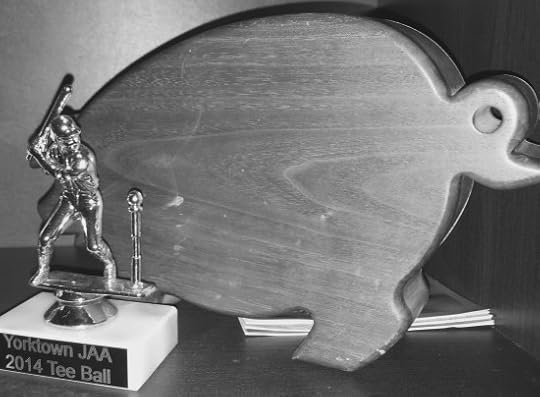
When Harper came back down, she handed me her wooden piggy bank.
“You can have it all, daddy.”
Sometimes I need a reminder why I adult in the first place. That was a good one. I gave Harper a hug, thanked her, and told her that fortunately, at least for now, we could cover the cost.
And to bring back an old meme: Health insurance premium = $800. Deductible = $13,000. Having a daughter that will give you all the money in her piggy bank = priceless.


November 22, 2016
Thanks for the inspiration, Donald Trump. Let’s get to work!
There are a lot of reasons I didn’t want Donald J. Trump to be our next president, but there is one reason (and probably only one) that I’m glad he won.
The night of the election, I went to a watch party hosted at The Downtown Farm Stand. (Can you get more liberal than drinking organic beer and eating organic free-range, potato chips with your GMO-free friends? Probably not.) Like everyone else we expected to watch the election of the first female president. I can’t say I was a vigorous supporter of Hillary Clinton (there’s something rather unappealing about political dynasties), but earlier that day when I cast a vote for her I did get the “feels.” I have a daughter and if her fascination with burping and farting ever goes away, I’d like to think she could have any job, including President of the United States.
At the party, I thought, “If Trump did happen to win by some miracle, I’ll be more inspired than ever to get busy on my personal work and my work with The Facing Project connecting people through stories to strengthen community.”
At 9:30 PM it was obvious that Clinton was in trouble. The myth of the “silent Trump” voter was a reality. I stayed up until 3AM. I watched President-elect Trump’s victory speech. I felt like someone had died.
I had solid reasons to feel this way:
Since I’m a freelance troublemaker, we get our insurance through the ACA healthcare exchange. I have an autistic son who receives more than $100K of therapy each year. If/when President Trump repeals Obamacare, will a private insurance company outside the exchange insure us with Griffin’s “preexisting condition?” Or will we have to end therapy altogether?
Then there is this…

Did I mention I have a son with disabilities.
There’s the rhetoric of hate, fear, and misogyny. But I don’t want to write about all the reasons President Trump scares the shit out of me and makes me disappointed for our country, and how I feel for anyone that’s been labeled an outsider or other by the creepy nationalistic vibe that he represents. I want to write about how his being elected has inspired me more than ever to build empathy through stories.
On Wednesday I mourned. I skipped my morning workout and zombie-like drove Griffin to preschool. As I moved through the day, I’d see people and speculate that they voted for Trump on the smallest detail–what they wore, what they drove, facial hair. I was prejudging everyone and once I determined that they were a Trump voter, I hated them. I hated them because they voted for a man who I despised because of his hate speech. I hated hate so I hated and hated myself for hating.
On Thursday I was giving a talk at Northern Kentucky University. First year students at NKU read Where Am I Eating? as a common read. I had decided to make the talk entirely about the election and not mention our election once.
I told the story of a family who lived in the Mathare Valley slum in Nairobi Kenya. After a disputed election in 2008, violence spilled out across Kenya. The losing party was protesting the results of the election in which a candidate of the Luo tribe lost to a candidate from the Kikuyu tribe. Luo protestors went door-to-door in Mathare Valley and asked questions in their native tongue. If their questions couldn’t be answered, they killed all those inside. Thomas, the middle brother of the family, spoke both languages. He gathered up his neighbors and hid them inside his shanty. He answered the questions. He saved the lives of his neighbors.
“How many houses, dorm rooms, apartments, do you have to go from your home until you don’t know the names of the people who live there?” I asked the students and myself.
I shared a story about standing outside of a mosque in Bangladesh while men in prayer robes poured out. This was 2007, and, as much as I liked to think that the constant barrage of “fear the muslims” in our media and society hadn’t sunk in, it had. My heart beat faster. I was nervous that if they knew I were an American, they wouldn’t like me. I was afraid. But then I spent then next month hanging out with people…people who were muslim. They were amazing.
Here’s one of them.
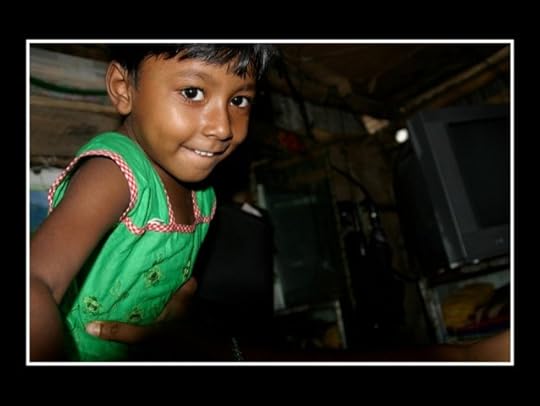
Scary, huh?
“How can we fear people who we’ve never met?” I asked the students and myself.
I shared Amilcar’s story. Amilcar left his job as a garment worker in Honduras and risked his life to come to the United States where he works today supporting his family in a way he couldn’t if he were actually with them. No matter where you are on the immigration debate, you can appreciate the sacrifice Amilcar made for his family and the courage it took to make his journey.
“When we start with stories instead of politics and ideology, we can have a conversation with anyone regardless of what political team they are on or who they voted for,” I told the students and myself.
I talked about knowing our neighbors, listening to them, not fearing people we don’t know, and about the responsibility we all have to use our own privilege and opportunity to help others.
It felt so damn good not to hate. It felt good to take positive action to make a difference instead of complaining about things I couldn’t control.
On Saturday, the Facing Racism in Muncie project shared 38 stories of people in our community who had a racism story to be told. The event sold out in a matter of days. I’m the co-founder of The Facing Project, a nationwide nonprofit storytelling initiative that seeks to build empathy, and I was also a writer and a part of the planning committee for the project. The stories reminded us all how far we’ve come as a society, yet how very far we have to go. To collect the stories, volunteer writers sat with volunteer storytellers to listen and collaborate on each story, and actors brought the stories to life. Well over 100 people were involved in the project.
The participants and the audience reminded me that there are people who are willing to sit and listen to difficult subjects. There are people who are willing to connect with people who are different than them.
After the election, we didn’t wake up in a different country. This is our country. If you were surprised by the results like I was, we obviously weren’t listening to other people enough. We let our politics and our politicians divide us. We need to connect and seek to understand those who have different opinions than us.
Universities, bless their souls, are providing safe places for students to mourn the election results. I’ll give you Wednesday. Wednesday I needed a safe place to just not do Wednesday, so I stayed home as much as possible. But Thursday? We don’t need quiet places to be alone, we need to be meeting people, getting engaged with all parts of our community and not just people who look, think, and act like us.
I will make this important caveat though: I understand why certain people are afraid of a Trump presidency. They are afraid of being deported, having a loved one being deported, being rounded up into an internment camp, of being unmarried to a loved one, of not being able to afford health insurance. Those of us who are less impacted by the possibilities listed above need to be there for the groups of people who feel like they may lose rights or be discriminated against. We need to listen to them and stand with them.
We also need to listen to the people who voted for Trump. I have loved ones who I believe are some of the best damn people on the planet and they voted for Trump. I side with Jon Stewart on this. Here’s what he had to say to Charlie Rose recently:
“I thought Donald Trump disqualified himself at numerous points. But there is now this idea that anyone who voted for him has to be defined by the worst of his rhetoric. Like, there are guys in my neighborhood that I love, that I respect, that I think have incredible qualities who are not afraid of Mexicans, and not afraid of Muslims, and not afraid of blacks. They’re afraid of their insurance premiums. In the liberal community, you hate this idea of creating people as a monolith. Don’t look at Muslims as a monolith. They are the individuals and it would be ignorance. But everybody who voted for Trump is a monolith, is a racist. That hypocrisy is also real in our country.”
We fear what we don’t know. When we don’t know our neighbors, we fear them.
We all need to listen to each other and have empathy for one another. This election has reminded me of that and that the work that I do and the work of The Facing Project is more important than ever. I hope you have similar work to pour yourself into that isn’t just a Facebook post, or a Change.org petition, or protesting. Those things are fine, but if you really want to make an impact, you need to go beyond being against things and work on the things you are for. You need to become part of the community out your actual front door.
If you aren’t sure what to do and want to build empathy story by story, The Facing Project needs volunteer coaches and editors. We also need resources–you can donate here to the Building Empathy Story by Story campaign.
Since the election, I’ve completed the first draft of a book proposal–another global quest–and feel absolutely reinvigorated and as passionate as ever toward my work with The Facing Project.
And for that I’m thankful. It’s not a new world. It’s the same world and this election has been a reminder we still have a lot of work to do.
October 22, 2016
6th grader writes editorial in support of garment workers in Bangladesh
We all need to be a bit more like 6th grader Kayne McConnell of Shelbyville, Illinois. Kayne wrote an editorial to the Shelbyville Daily Union titled, “Upset over Bangladesh working conditions.”
He writes:
Hi, my name is Kayne. I am telling you about the garment workers in Bangladesh. They make some of the most popular clothing in America, but people are dying there.
I am only a 6th grader, but I care about these people. Like in Bangladesh, the Rana Plaza factory collapsed and killed thousands of innocent people!
Also in another factory in Bangladesh, a fire happened and destroyed the building, only two months after!Please consider spreading awareness. These people need better work conditions.
People get killed by their boss for asking for a bandaid! They also get whipped for asking for water! I mean, can you believe these people?!This is serious, people! Help raise awareness, please.
We are born with a compass that points toward fairness and justice, but as we get older our “own problems,” the “complexities of the world,” and apathy can lead us astray.
A factory collapsing and killing 1,134 mothers, fathers, sisters, and brothers isn’t right.
Workers dying in a factory fire they can’t escape because exits are locked isn’t right.
As Kayne gets older, he’ll learn that there are complex factors that lead to such exploitations, and solutions to these problems are unclear, but I really hope he doesn’t lose that sense of justice.
(Shoutout to my cousin Brice for pointing me to this piece. Kayne is the nephew of one of his friends. Brice is always pointing me in the right direction. He’s the one who bought me a shirt that said, “Come with me to my tropical paradise” and I followed it to Honduras, where I first met people who worked in the garment industry. That led me to Bangladesh and beyond.)
August 4, 2016
This photo shatters a common myth about autism
There’s this myth that people with autism aren’t affectionate.
Allow me to shatter that into 1,000 pieces with this pic:
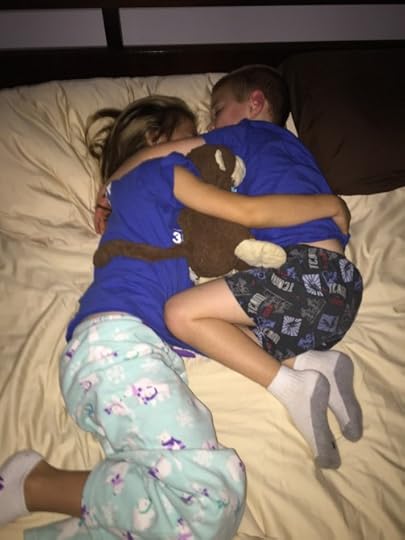
This morning my wife took this photo of our 5-year-old son Griffin, who is on the spectrum, snuggling with his sister, Harper. Griffin gives great hugs and high-fives. He giggles so hard he toots and then giggles even harder because toots are funny. And he has a smile that will make your day.
Not all people with autism can express their affection through actions or words. We’re fortunate that Griffin can. But I’m pretty positive that every single person on planet Earth, including those who are on the spectrum, feel love and affection just like you and me.
Love can be hard to express. For instance, I look at this picture and I am unable to fully express through words–written or spoken–or through actions, the love it makes me feel.
I hope you experience indescribable, inexpressible love as well.
August 3, 2016
What happened to the great American Summer Job?
I got up at 5:42 AM to sweep floors, lug lumber, and do whatever I was told by my boss. By 11:30 AM, a time that many of my friends were rolling out of bed, I was done working my summer job for the day. I started my summer job between my 7th & 8th grade years. There were boards that weighed more than me. Once I hit high school, I started working full days, and continued to do so throughout my college summer breaks too.
I worked for my parents who owned a wood truss manufacturing business. The job left its mark, sometimes literally (I have scars), but more than that it taught me the value of a dollar and of an hour of labor. Once you earn an hourly wage, that new $50 Nintendo game just doesn’t cost $50, it costs 11 hours of work when you are earning $4.50 an hour.
I learned the camaraderie of work. I saw grown men struggling to keep jobs. Some failed. Some thrived. I learned the best I could to respect authority (I’m still not very good at this). I learned to be on time, to always stay busy, to do something even when I didn’t want to be doing it. I learned that pranks and joking around and ongoing conversations were crucial to making the hours slip by faster.
I worked when I was miserable. Some days it would be 90% humidity and 90-degrees plus. When I worked during winter breaks, we would work if it was about 5-degrees. I turned a corner once with a fork-lift and the unit of lumber slid off my icy forks. I couldn’t control the difficulty of the work or the working conditions, but I could control my attitude. Staying positive and happy and interested in the lives and interests of my co-workers, made the work much more enjoyable.
From a social and economic perspective, some of the people I worked with were less valued by society than others working a different job. I learned to try to see the worth and talents and redeeming qualities in all people. I don’t think I would’ve written books about factory workers and farmers around the world if it weren’t for my summer job.
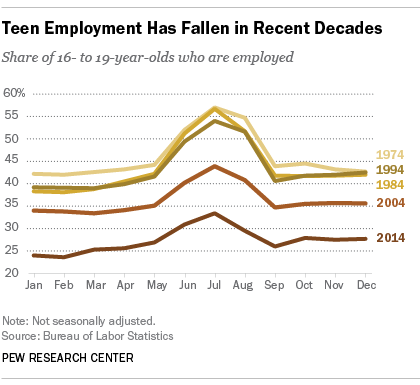
Yet since the 70s, there has been a precipitous decline in the number of summer jobs available for teens. If you would’ve told me at 15 that I was lucky to be working a job during the hottest day of 1994, I would’ve laughed in your face. But I was lucky to have a job. The money and lessons I earned prepared me for my future more than sleeping in and playing video games ever could have.
According to a report, “The fading of the teen summer job,” by the Pew Research Center, in the summer of 2014 fewer than a third of teens had jobs. That’s down from the peak teen employment in 1978 of 58%.
Why the change?
I think there are some among us who chalk it up to “kids these days…” But that isn’t accurate at all. There are a lot more factors at play than the work ethic of today’s teens.
From the Pew report:
Researchers have advanced multiple explanations for why fewer young people are finding jobs: fewer low-skill, entry-level jobs than in decades past; more schools restarting before Labor Day; more students enrolled in high school or college over the summer; more teens doing unpaid community service work as part of their graduation requirements or to burnish their college applications; and more students taking unpaid internships, which the Bureau of Labor Statistics does not consider being employed.
Yesterday, I wrote about short summer breaks for K-12 students, and a few of my Facebook friends pointed out that their kids couldn’t get jobs that would only last 7-8 weeks. Employers didn’t want to train and hire them only to have them leave a few short weeks later. My post argued that complaining about the short summer was a #MiddleClassProblem since so many families struggled to feed and care for their children over summers. In some ways, arguing that your kid can’t get a summer job is another level of #MiddleClassProblem and points to what I feel is the bigger issue. There are fewer, low-skill entry level jobs for teens because they are being taken by adults who are trying to support themselves and their families working jobs that teens once had to pay for their first car or college. Those parents working jobs formerly held by teens are likely the same parents who struggle to make ends meet over long summer breaks.
Our economy has changed and each decline or recession has gutted teen employment. According to a study by CareerBuilder, jobs held by teens plummeted by 33% from 2001 to 2014.
From U.S. News & World Report:
Jennifer Grasz, vice president of corporate communications at CareerBuilder, says teens in the aftermath of the Great Recession are facing more competition for jobs than they did at the dawn of the new millennium.
“There’s this new competitive dynamic that teens have to deal with today that they didn’t have to deal with before,” Grasz says. “Teenagers are now having to compete with college students and even retirees or other workers that are more seasoned for opportunities because people just need to earn a paycheck.”
…
“The impacts of the economic recession – which left many employers reluctant to hire and, when they did, able to fill positions that historically had been filled by teenagers or young adults with more experienced or highly qualified applicants – continue to be felt,” the report [by JP Morgan Chase] said. “At the same time that young people are facing diminished opportunities to gain work experience, they are confronting a labor market that is increasingly demanding a more skilled workforce.”
If you want to really dive into this topic definitely start with the U.S. News & World Report story. It goes deeper into the other factors causing teen unemployment (fewer high school dropouts, more students taking college classes during the summer, etc) and the implications of teens not having jobs.
Regardless of these factors, both positive and negative, without my summer job, I think my future would’ve been much different.
How about yours?
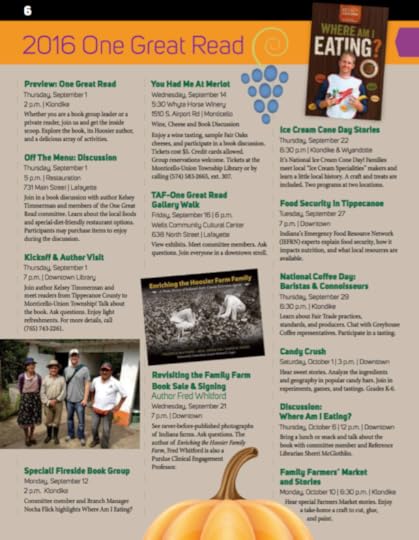
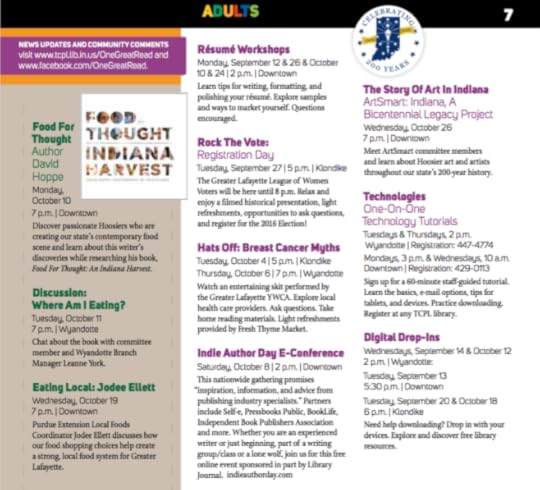
Eating is 2016 Tippecanoe Co. & W. Lafayette Libraries’ One Great Read
Gotta love community read programs. Check out all this great programming around EATING. I’ll be visiting on September 1st. Unfortunately I won’t be there for “You Had me at Merlot.”
August 2, 2016
Complaining about short summers is a #MiddleClassProblem
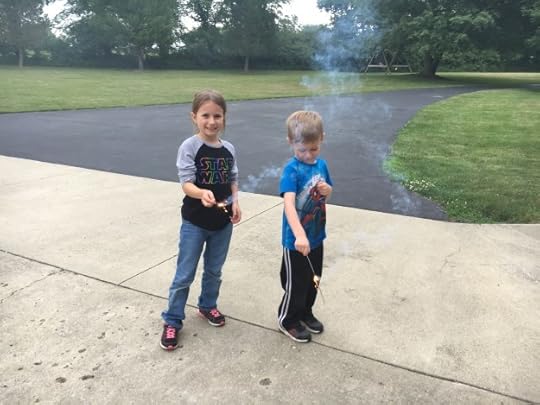
How lucky are these kids?
My daughter starts 2nd grade tomorrow, August 3rd. Where did summer go?
I want to say that summer was too short. I want to complain that our lives will once again be subjected to the school calendar and the threat of too many absences. (We got a letter last year.)
School should start at the end of August like when I was in school. My kids should have the idyllic summer breaks that I had. I want to say each of these things, but every time I start to or hear someone else say them, I think about the this article in my local paper when school let out in the spring:
Where children can eat free this summer
This school year, thousands of students in Delaware County relied on their schools for a free or reduced-price lunch. At Muncie Community Schools alone, 4,017 were eating for free, according to Indiana Department of Education data.
That leaves a big problem when school isn’t in session, especially for students who aren’t in summer camps or day care programs. According to the 2016 Kids Count Data Book, 26.1 percent of the children in Delaware County are living in poverty — a higher percentage than the state and U.S.
I feel like complaining about the short summer is a #MiddleClassProblem, which doesn’t acknowledge my privilege. I have fulfilling work that provides my family with a comfortable lifestyle. I don’t have a boss. I rarely have to be at work on a certain day. Annie, my wife, doesn’t work outside the home. We don’t have to worry about our kids not having enough to eat, nor do we have to cover the increased cost of daycare. Our kids are surrounded by books and rich experiences.
Harper, our daughter, spent a week at science camp, took weekly horse lessons, spent loads of time with friends, and perfected her dive in my parents’ pool. Not a bad summer. My son Griffin, however, was in summer preschool and ABA therapy all summer. Early intervention for autism doesn’t allow a summer break. Affording these schools for Griffin is it’s own sort of privilege, but he did not have the luxury of having a summer break. Neither do many kids who live in poverty.
Last year Slate shared a story written by Elissa Strauss titled “The Lost Summer: The high cost of summer vacation for struggling families.” Here are a few excerpts from the story:
Raina’s child care jumped from $100 to $160 a week after school ended, and she would no longer have access to the two free meals a day given to low-income children in public schools. During the summer the city continues to offer these meals, but they require caretakers to go and pick them up on a daily basis. This wasn’t an option for Olympia or her babysitter…
In a city [NYC] where 1 in 3 children live in poverty (the rate is 1 in 5 nationwide), going to camp is, for many children, just another luxury their parents can’t afford…
According to the American Camp Association, 70 percent of campers in their network come from middle- and upper-income households…
I would love for Griffin to have a summer, and I would love for Harper to have a longer summer. I want to be an advocate for longer summer breaks, but the reality is that there are mothers and fathers–who love their kids, too–who struggle to make ends meet each summer.
For many, the longer the summer, the longer the struggle.
July 18, 2016
That time I filed a harassment complaint against my favorite ice cream shop
Yesterday was National Ice Cream Day–a day, which for religious purposes, we participate in whole-heartedly.
It was getting late in the day, our Sunday naps had given away to a flurry of activity–swinging, bike riding, Ninja-warrioring on the local playground, anything to try to wear out the kids so they would fall asleep before 2AM. (Oh yeah, we also enjoy playing with the kids, but, honestly that was secondary.)
I checked my phone in a panic between underdogs to see what time The Barking Cow, our favorite, local ice cream shop closed. The Barking Cow’s Facebook page said they closed in 50 minutes.
Oh look and there on their Facebook page was a picture of someone we know. The husband of Mrs. Stanley, Griff’s preschool teacher, was holding his little boy who was diving into a double-scoop waffle cone. Here’s the pic…
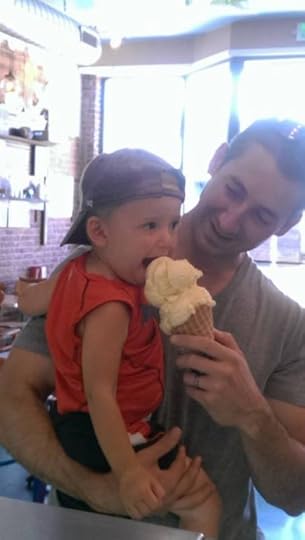
Awesome! Dad. Son. Ice cream. What’s not to love about this pic?
Anyhow, back to the ice cream decision…
I stuffed the phone back in my pocket and, after further thought, we decided it was not best to pump the kids full of sugar before bed. Besides, we had homemade apple turnovers and ice cream in the fridge that we could make after they were in bed.
(Fast forward an hour.)
I was reading Harry Potter & The Prisoner of Azkaban to Harper. The smell of the apple dumplings blasted through the vents into our faces.
“Daddy, what’s that smell,” Harper asked.
“Nothing. Must still be from dinner,” I lied.
“It smells like grilled cheese,” Harper said.
It smelled nothing like grilled cheese and everything like amazing apple dumplings.
“That must be it,” I said, even though we didn’t have grilled cheese for dinner.
So there I was lying to my daughter, for her own good and mine (more for me!), when I get a notification from Facebook that my harassment claim had been reviewed.
Harassment claim?
I clicked on the image of the post I had reported and there was Mr. Stanley innocently allowing his baby boy to eat some ice cream, and there was my report: “Hey The Barking Cow, I find this photo annoying or distasteful. Would you please take it down?”
Somehow I had butt complained, not only once, but twice!
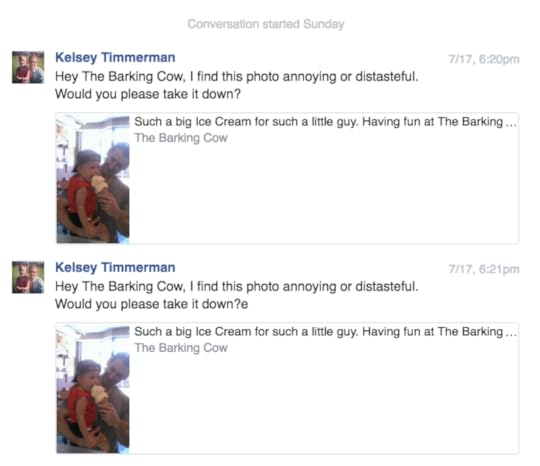
For the record, I highly recommend The Barking Cow. And I always find ice cream tasteful.
June 7, 2016
“Are you prejudiced?”
“Are you prejudiced?” The man on the street asked.
I had just finished the Memorial Day Murph at my local CrossFit gym and was getting a dry shirt out of my car.
“…” I wasn’t sure how to respond.
I suppose I am prejudiced against complete strangers approaching me randomly on the street and asking if I’m prejudiced. Maybe prejudiced isn’t the right word. Cautious is more fitting.
But the man didn’t mean was I prejudiced against strangers on the street. He meant was I prejudiced against people with a different skin color than my own. People like him. Black people.
“No,” I said, “but I’m sorry you feel like you have to ask that.”
Hal introduced himself. We shook hands. And then he told me what he needed. He was new to Muncie and just discovered that the buses don’t run on Memorial day, which was a problem because he was late for work at Wal-Mart.
I wish that I could tell you that without missing a beat I said, “Sure! Hop in!”
But I did miss a beat as I considered if I was going to help Hal or not. In my hesitation, I flipped through my mental list of excuses: My wife isn’t ready to go yet? We’ve got to pick up our kids?
As Hal waited for my response, he lifted his shirt to show his waistband and said, “You can check; I don’t have any weapons.”
The act hit me just like his initial question. This is our world. This is how this man thinks I see him through my blue eyes. Hal felt that if he suffered through the indignity of a pat down that maybe then I would help him. Hal is friendly and inherently unthreatening looking. He looked like someone’s grandpa who would sit down with other grandpas over cups of coffee at the local restaurant discussing the good ol’ days, armed with a joke in one hand and a poignant story filled with life’s wisdom in another. So, Hal, the grandpa, turned a 360 exposing his waistband.
I stared at him in disbelief.
“I’m not sure we’re ready to leave yet,” I said. “Let me check with my wife. Come with me.”
I led Hal over to the gathering of exhausted CrossFitters on the sidewalk.
“Hey everyone,” I said. “This is my buddy Hal. The buses aren’t running today and he needs a ride to Wal-Mart if anyone is heading that way soon.”
Conversations stopped as everyone experienced the hesitation I had experienced. Hal broke the silence with some chitchat about how everyone looked really fit. It’s Hal’s way. I think I was hoping that someone else might step up and take Hal to work, yet I still “helped” him by making the connection. I also thought it was a good idea for other people to see Hal and know when we were going and where we were going.
I found my wife Annie and told her that we needed to give a stranger a ride to Wal-Mart. She didn’t hesitate. Maybe she just trusted my judgement. Maybe she is just a better person than I am. Later she would tell me, “You’re weird like that so I just didn’t think anything of it.”
We walked out of the gym to find Hal still talking with everyone. We said goodbye and gave Hal a ride.
It was only 10 minutes to Wal-Mart, but we covered a lot of ground. We talked about our families, Muncie, and about the Facing Racism Project which I’m participating in as a writer and editor. Hal talked about church and how we must be church people.
He went to work at Wal-Mart on Memorial Day. We picked up the kids from our friends (thanks Terri and Scott!) and spent the day playing, jumping in a bounce house, eating ice cream, and napping.
It was good day, but the two moments I’ll remember most were with Hal.
His question: Are you prejudiced? I keep asking myself that. In those moments was I prejudiced? Did any part of my hesitation and moments of consideration as to whether I would help Hal have anything to do with Hal being black? Honestly, I don’t think so. But in the course of reading 40+ Facing Racism stories, I’ve seen that racism isn’t always overt. Someone doesn’t get a promotion, someone doesn’t get treated quite right, someone doesn’t get helped by a stranger. Was it because of their skin color? Possibly. The person being racist might not even realize their own prejudice shaped by a history of inequality. That doesn’t make it right.
That’s precisely why we need to ask ourselves Hal’s question: “Am I prejudiced?”
I feel that Hal’s skin color had less to do with my hesitation than maybe his situation did. I think it’s more likely that I’m prejudiced against people who don’t have cars, who are desperate for a ride to a minimum wage job on a holiday, people who have so little social resources that they have to ask a complete stranger for help. (Again, I don’t think I’m prejudiced in this instant, but it is still worth asking the question. I think I was cautious of a stranger. I hope that’s the case.)
I’m currently reading Tribes by Sebastian Junger. He talks about how we humans are often at our best during war and natural disaster. The differences that divide us–class, race, religion–fall away during times of crises and we help one another more readily. We are in this together. But in times of peace the walls of difference go right back up.
I’m white and Hal is black. I’m middle class, and it’s likely that Hal is not. The world treats me differently than it treats Hal. That’s a fact demonstrated by Hal, a friendly grandpa, lifting his shirt to show that he was unarmed. In that moment, Hal exposed more than his waist. He exposed all of the racial injustice, inequality, and prejudice that remains in our society.
May 31, 2016
6 reasons the NBA Playoffs are better than March Madness

I know that it’s cool to say that you like NCAA Basketball over the NBA. You are entitled to your opinion, but if this is your opinion, you are wrong. Sorry.
You might be able to convince me that the NCAA regular season is better than the NBA regular season, but when it come to the NBA Playoffs vs. March Madness there is no contest. None.
The NBA Playoffs are better than March Madness.
Here’s why:
The NBA is more authentic. The purity of NCAA basketball has been tainted with embarrassing recruiting violations and stripped championships. We can no longer pretend that passion and love of the game drives NCAA basketball. Money drives it.
Money drives the NBA, too. Why do you think Melo went to the Knicks? A five-year, $124 million guaranteed contract, that’s why. In the NBA we know how much players are paid, we often even know about their endorsement deals. We know who is getting paid how much, let’s play ball.
NBA playoffs value teams more. In the NCAA, a one-in-done player (or several of them) can win a championship. In the NBA, teams are built over years. There is no longer an equivalent of the San Antonio Spurs in the NCAA. A team that succeeds in the NCAA tournament likely has NBA talent who will leave in short order. Even Butler, arguably the most successful Cinderella of March Madness of all time, had Gordon Heyward. He was around for two years and then gone. We didn’t get to watch Gordon grow as a player into his junior and senior years. But in the NBA, we get to see that growth and legacy of teams and players as they gel. Each year the NCAA tournament is becoming more of a yearlong pick-up-game between future NBA players. Tune in next year when completely different rosters will play each other!
A series is better than a single game. I’m not going to take a real hard-line on this one. There is magic in March Madness when all an underdog has to win is one game. But I love watching an NBA series, following the narrative, seeing how the players and coaches adjust and bounce back. Golden State coming back from a 3-1 deficit was amazing.
The talent in the NBA is far superior. I mean this is obvious, right? Just a few years ago though that superior talent in the NBA led to extremely boring games. The days of isolation, one-on-one driven offenses are gone. Watch the Cavs play. Watch the Warriors play. The ball moves. It used to be rare to have a big man who was skilled at passing. Remember when Arvydas Sabonis awed us with his European passing skills? Now many centers and power forwards are expected to pass like him.
So now the NBA has the world’s best players playing an engaging style of basketball. That’s hard to beat.
I’ve never seen anyone hit shots like Steph Curry hits shots. When he starts his shot often he’s not even looking at the basket. His range is unlimited. And he shoots quick enough to get a shot off over any 7-footer. NCAA Steph Curry playing for Davidson was amazing, but nowhere as unimaginably awe-inspiring as NBA Steph Curry.
And LeBron…if Michael Jordan were two inches taller and 40-pounds stronger, he would’ve been like LeBron. That’s a bit of hyperbole. I think Jordan had more of a killer instinct, but I’m not sure he was as efficient as James. (Although LeBron is getting one.) There is no one in the league currently and, not many in history, who can dominate offensively and defensively like King James.
Watching these two square-off in the Finals…what a time to be alive!
In the NBA titans clash. There are two main dynasties right now in the NBA.
The Warriors are the returning champs, and they set the single-season record for most wins. If they win, they’ll solidify their dynasty status.
The other dynasty is LeBron James. This NBA Finals will be his 6th in a row.
These two dynasties will play a best of 7 again. Last year, James almost single-handedly beat the Warriors before running out of energy and role players. Everyone added an asterisk next to their championship last year: *BUT it was basically LeBron on his own since Kyrie Irving and Kevin Love were out injured. This pissed off the Warriors and likely was the main fuel behind their record-breaking season. But only one thing will wipe away the asterisk–beating a healthy Cavs team in the NBA Finals.
Man, that is some good stuff. Far better than two teams having less than a week to prep for one another. The Cavs and the Warriors have been prepping for their 2016 NBA Finals matchup for more than a year.
The storylines and rivalries in the NBA are deeper than the present day version of NCAA basketball.
The NBA Playoffs last longer and are on after my kids are in bed. The playoffs become a part of my summer routine. Feed kids. Put kids to bed. Watch 20 minutes of a show my wife wants to watch, and then after she falls asleep…NBA time!
I am a wee bit pumped for the NBA Finals. I’ll be pulling for the Cavs. I’m oringinally from Ohio and love that LeBron came back to be an active part of his hometown.
I love the game of basketball and the NBA Playoffs just happens to be a higher-level of that game of basketball–it’s more authentic and more entertaining.
Do you agree with me? Or are you wrong?