Kelsey Timmerman's Blog, page 14
April 6, 2016
Jealous of 2008-Kelsey
I’m spending the day at Ohio Northern University visiting classes, talking with faculty and students, eating, some more eating, and giving a presentation tonight.
This is the flyer they made for my event tonight.
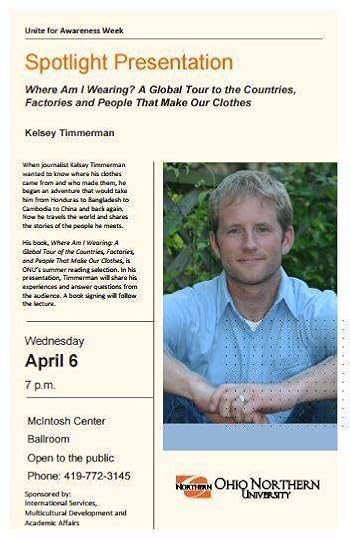
Annie took this picture of me in our backyard in 2008, and it gets used quite often to this day on posters such as this, which makes me a little paranoid: Do I even look like that anymore? Do I look more authorial when I’m not wearing my glasses, which I absolutely have to wear today?
I’ve had professional head shots twice since, and folks can choose from, I don’t know, like 10 different ones, yet they continually choose 2008-Kelsey making 2016 Kelsey a little jealous.
///
I checked in at my hotel this morning and talked a bit about my visit on Facebook Live:
Spending the day at Ohio Northern University.
Posted by Kelsey Timmerman on Wednesday, April 6, 2016


April 4, 2016
The Power of Voluntelling
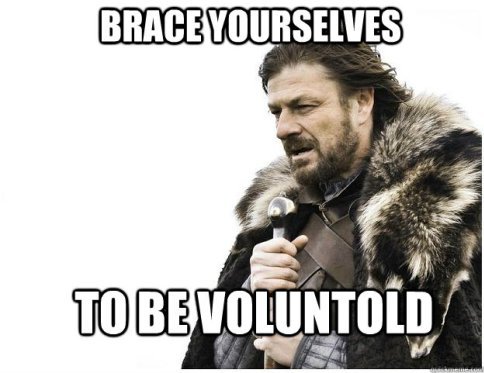
“That’s when Kelsey voluntold me that I was going to be a writer in the Facing Project,” Dr. Adam Kuban told those attending a session at the Indiana Campus Compact conference.
I love the term “voluntold.” But I would, wouldn’t I? I’m a fan of portmanteaus (mashing together two words). That’s where the term touron and glocal come from. I’ve used the hell out of each of those, so much that they don’t need italicized or put in quotes any longer.
A lot of arms have been twisted (that’s what I used to call the hard sell to volunteer I’d put on people) through the years to recruit writers, volunteers, and board members for The Facing Project. In fact, if I hadn’t voluntold my co-founder’s arm to be a writer on the very first project, there probably wouldn’t have been a second.
I know the responsibility of carrying another’s story can transform storytellers, writers, actors, and communities. That’s why I’ve never had much of a problem of voluntelling people to get engaged in a Facing Project.
Here’s how you can get involved
– Donate: We give grants to communities to print books and fund spinoff initiatives.
– Volunteer: See our current volunteer openings.
– #iSeeStories Challenge: Participate in our social storytelling experiment.
– Buy Storyteller Gear: For every shirt sold, $5.00 goes toward supporting community storytelling.
Do it!
You’ve been voluntold!
April 1, 2016
If you read one book on autism, read this one
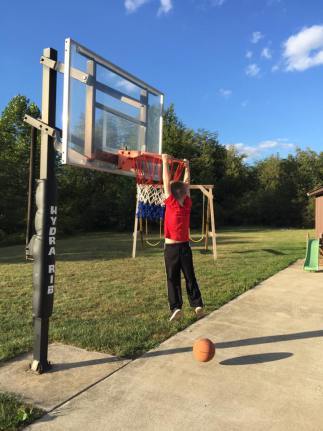
(Autism hasn’t impacted Griffin’s hang time!)
When our son Griffin was diagnosed with autism three years ago, our world got pretty small. We felt alone, as if we were the only family to have a child on the spectrum. We read stuff. Stuff on the Internet! Scary stuff and inspiring stuff, but mostly scary stuff.
Slowly we started to plan a path forward to get Griffin the best help we could. We started to connect with other people who had been where we were. I helped run, and Annie participated in, the Facing Autism Project in Muncie (read Annie’s story, read all the stories and download the book for free).
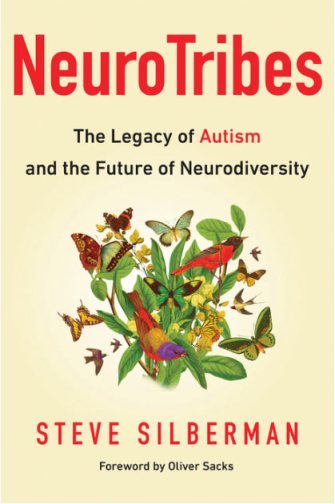
One of the books that helped give me a big view of autism, its history and scope, was Steve Silberman’s Neurotribes. I highly recommend you read it if autism is in your life.
Here are a few of the big takeaways from the book:
Autism as a social justice issue
We should look at autism as a social justice issue. Silberman is gay and credits his own “otherness” for allowing him to take this angle on autism. If possible, autistic individuals should be included in decisions and organizations that impact their lives. (Note: one of the criticisms of the book that rings true is that this take often excludes those who are severely autistic.)
I’m a parent with a child with autism. My thoughts and feelings and opinions on autism matter, but you know whose opinion matters more? My son’s. Fortunately, Griff seems to be fairly high-functioning, so he can steer the ship, as we go along for the ride.
We need to focus more energy and dollars on supporting individuals with autism and their families
Autism is damn expensive. We spend a lot of time, money, sweat, and tears on autism, and I’m convinced we have the sweetest, easiest little boy ever. Still, ABA therapy is really expensive. But thanks to our insurance (Thanks, Obama, really!), we can afford to give him the best therapy possible. Not everyone has access or can afford such therapies.
Yet our society focuses the majority of its dollars and attention on curing autism or finding a way to end autism. (Curing or ending autism can step into controversial waters and I’m not going to do that now.) Silberman’s point is that more focus and dollars should go toward helping those who are living now with autism and their families.
I agree.
Nurture trumped nature and that was a really bad thing
I’m not doing a book report and here nor do I have the book currently handy, so forgive the loose details, but…
Dr. Asperger’s, a doctor in Austria, was the first to “discover” autism (the high-functioning variety). He saw the amazing things these individuals could do (Griffin has been reading since he was two and can spell any word). He saved the lives of the individuals under his care by showing the Nazi’s how useful they could be to society. Others with disabilities were euthanized. Asperger’s believed autism occurred naturally.
An American doctor, Dr. Kanner, claims to have discovered autism a short while later. (He called it autismo just like Asperger’s did and also had one of Asperger’s former research assistants. Hmmm…) Kanner believed autism was caused by nurture–the environment in which kids were raised. This led to the “refrigerator mom theory”–that cold and emotionally disconnected mothers caused autism–and set autism treatment and research back a few decades.
Eradicating Autism
Before we feel morally superior to the Nazis who euthanized those with disabilities, including those with autism, we, in the United States, didn’t treat those with disabilities much better. Silberman recounts horrible stories of how these individuals were treated in group homes and clinics that made jail seem preferable because it involved less torture. I think I even remember something about the Nazis getting the whole “let’s exterminate those with disabilities” thing from a conference in the USA. (May want to fact check me on that one.)
I struggled reading some of these accounts. I’m so thankful that Griff was born today when we understand autism so much more and have resources to help individuals and families.
///
Anyhow, I read Neurotribes months ago, and when I was reading it talked about it ALL of the time. If you want to understand autism better and it’s contribution–YES contribution– to society, you should read it, too.
Or at least listen to Silberman on Fresh Air…
March 31, 2016
Cancer can take, but it also can give
(Video from Facing Cancer in East Central Indiana)
Cancer doesn’t know race, religion, gender, or political ideology. Cancer has touched all of our lives. Maybe not our own bodies, but the bodies of someone we love.
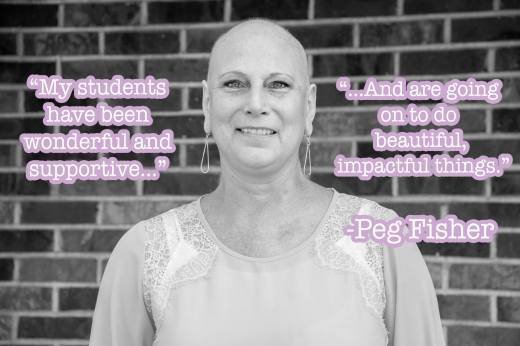
That’s why the most recent Facing Project led by Dr. Adam Kuban’s Ball State class of Ingelhardt Scholars was so important. Students ran the project from start to finish along with their community partner Little Red Door.
From what I’ve seen and read, cancer can divide us, make us feel alone as we deal with our illness or mortality or that of a loved one. But cancer can also connect us. I’ve seen my mother-in-law become a one-woman cancer support group for an entire community after she survived breast cancer.
I know cancer can take so much. I can’t bring myself to read Rory Feek’s blog after the passing of his wife Joey.
I’m scared of what cancer can take, but I’m also inspired by what it can give.
Cancer can give us purpose. Cancer can teach us how to live.
To read stories from the project visit – http://facingcancereci.facingproject.com/
March 25, 2016
All we really own are moments
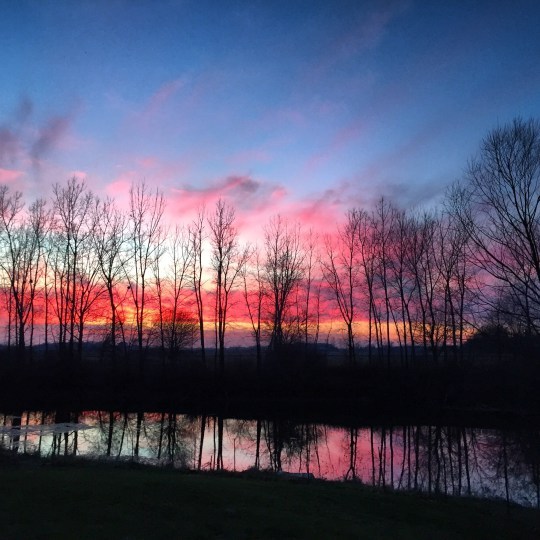
I lay down next to my son and stare up at the stars. They aren’t mine. A hand I’ll never shake placed the glowing sticky stars to bring joy to her daughter in the dark.
“Wish it. Dream it. Do it.” Reads the acrylic letters the same hand affixed to the wall.
The woman who lived in this house before died in her 40s. Her name was Pat. People seemed to have liked her. When I called the company that services our furnace, they remembered her. I delivered the news to a stranger about a stranger’s death. Now about my furnace…
I often wonder how the hole got in the door of the Jack and Jill bathroom. It’s at the right height and size to be a fist. Did the occupant of the “wish it, dream it, do it” room punch a hole in it? Was it an accident?
My wife removed the words of inspiration, painted the pink walls orange.
This place. This house–this thing of things–isn’t ours. No more than the cup owns the water or the ground owns the pond. We simply fill it with life and laughter and new things.
Speaking of ponds, ours is held in place by a beaver dam–sticks and mud. The previous occupants of our property tried to control nature. At some point, they must’ve stood back after a hard day’s labor and thought the work was done. But now netting and PVC pipes have eroded away and washed downstream, no match for the persistence of time.
The dam leaks. I don’t think beavers go south for the winter or hibernate, but the ones who lived here have moved on. Trying to patch it is a humbling experience. An overgrown rodent with no advanced degrees or opposable thumbs or chainsaw, who has never taken a class in hydrogeology, is a billion times more proficient than me at maintaining a dam. But beaver or man, no matter what we do water and time will always win.
We splash around in the water. We eat in the kitchen. We go on walks through the woods.
We are stewards of the land and of our house, no more than temporary inhabitants in a string of 4.5 billion years of temporary inhabitants.
The kids aren’t me, they are of me. I had a geology professor in college who began his first class with the Crosby, Stills, and Nash song Woodstock:
We are stardust, we are golden,
We are billion year old carbon,
And we got to get ourselves back to the garden.
We are not the stars, but we are stardust.
The house will outlast us, someone else will move in and paint the orange on Griffin’s walls another color. But even the house will eventually disappear. The woods will stand unless a new owner tears it down to make room for a few more rows of corn or soybeans like the farmer is doing across the road. The smell of the burning woods wafts through the open windows. Hundreds of years of forest, up in smoke.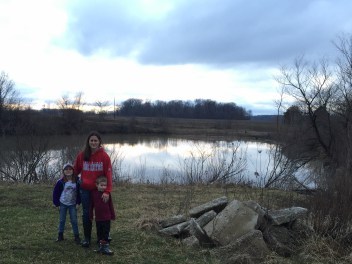
I’ve always been amazed at how quickly humans, me included, take natural beauty for granted. Think of the most amazing place you’ve ever been. The first time you stepped into it, beheld the waterfall or vista or canyon or flowers, the rhythm of your heart changed. You physically reacted to the natural world. And then in maybe 10 minutes or a few hours later, you started to think about what you were going to eat for lunch or the return trip. You got your picture, turned your back on the site and left it behind.
In my 20s, I was especially impatient. But now I enjoy watching the heron, who we’ve named Hershel, who lives on the pond, take flight. I enjoy the passing seasons more, perhaps because I’ve lived long enough to know they are finite. I find joy in watching the erratic path of a humming bird. I’m finding bigger meaning in smaller things.
My grandpa always had a bird house. He knew the visitors. He had a squirrel feeder with a little stool the squirrels would sit on like a human as they ate. Maybe he sat and pondered how our primate ancestors once looked like squirrels 65 million years ago. But I doubt it. I think he just enjoyed watching a squirrel eat. I think I’ll get there someday.
Last fall I camped out with my 6-year-old daughter next to the pond. We lay in the grass and stared up at the stars, billions of light years away, placed by an unseen hand. It was one of those clear nights where you can see the Milky Way, satellites, and shooting stars. We searched for constellations, trying to put names on the nameless. Trying to wrap our minds around the infinite.
Frogs croaked. We could hear the pond trickling through the beaver dam. I was surrounded by my woods, my pond, my property, next to my daughter. Our backs on dewy ground that is ours by the laws of man, and by the laws of man alone.
“Knock, knock,” Harper said.
“Who’s there?” I asked.
“Crack.”
“Crack who?”
“Butt crack!”
Harper giggled so hard her eyes closed. I turned from the stars to her face, laughing at her laughing.
All we actually hold and own are moments. Our laughs faded away.
—-
Trying to fix the dam:
March 17, 2016
Kids & sports & bassoon lessons
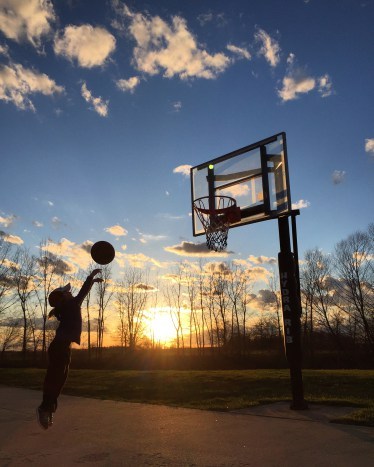 There was a volleyball camp this winter and my wife and I wanted our 7-year-old daughter Harper to do it. It was every Saturday for 6 weeks, or something like that.
“I don’t want to give up my Saturdays,” Harper responded.
It was a shockingly mature and reasonable thing to say. Annie loved playing volleyball and we really wanted her to do it. But we really didn’t have an argument beyond that.
“Ok.”
So we didn’t sign her up.
Right now, I feel like she’s in discovery mode and it’s our job to expose her to as many things as possible. But what if she is the most naturally-gifted bassoon player ever and we haven’t exposed her to a bassoon because I’m really not even sure what a bassoon is?!
Yet she feels no pressure to discover and we feel pressure to expose.
She should be learning Spanish? Did we miss the magical language learning window?
Volleyball is huge in Delaware County, Indiana, and if you don’t start playing while in utero you’ll be left behind!!
Piano!
Gymnastics!
Soccer!
Scouts!
Bassoon?!?!?!!?
As a parent, when do you push kids toward an activity, and when do you allow them to discover their passion on their own?
This is a question we’re wrestling with a bit right now. Even more so, when I lay it out like I just have. We’re also concerned that she’ll love to do too much and we’ll spend half our week running all over between practice and lessons, and the weekend on travel teams.
Now add our son Griffin, 4, into the mix. What will he want to play? What should we expose him to? 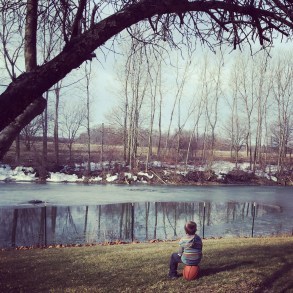
I’m not criticizing any of the above. I believe sports build character, we all should be multilingual, and music expands the mind. I have no doubt that some of the above is in our future, and I should stop stressing the hell out about it because ultimately it will be Harper and Griffin who decide.
I remember loving basketball. I remember getting burned out with basketball in high school. I never really loved piano, but I enjoy fiddling with my guitar a bit now, and we’re thinking of moving my old piano from my parents’ house into our basement. I look forward to playing it again.
I hope our kids get what they want out of practices, lessons, music, and sports. I hope we can allow our kids’ passions and joys to lead the way.
This whole post was inspired by a picture I took of Harper last night (see above). She was silhouetted by the setting sun as she shoots a basketball. Her form doesn’t look half bad. She wasn’t out there pounding the pavement because we forced her to be out there, she was out there because she wanted to be.
Parents, how did you decide what activities to expose your kids to?
Are you an adult who still enjoys an activity from your childhood? How were you first exposed to it?
March 16, 2016
Struggles into strengths
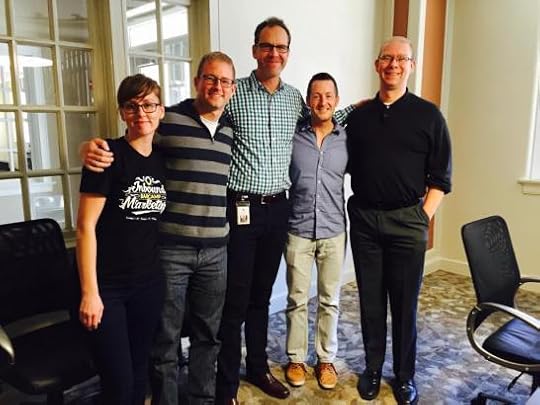
(The Facing Project board)
Find purpose. Find community.
I get a lot of emails from students and recent grads who are struggling to find their way or going through a rough patch. The quarter-life crisis is real! I can relate to the struggle. I only began to discover my purpose when I was 25 and tracked down the guy who made my favorite shirt, Amilcar, in Honduras. (We’re still friends.)
I received such an email last month, and I thought I’d share my response with you. Maybe it will help you, or you could share it with someone who you think it will help.
I first shared this in my newsletter. Go ahead and subscribe already.
Here’s what I wrote to the struggling student:
Thanks for emailing. It means a lot.
I’m sorry that you are going through a time of struggle. Here’s what I know about struggle. Often our greatest struggles become our greatest sources of strength in helping others. So know that whenever you get through what you are going through, you will be uniquely suited to help others going through the same thing. I know that’s not an immediate solution to your present situation.
Any time that I’ve been down my view of the world tends to shrink, and soon I can only see my own problems. The bigger the problem, the closer to home the problem, the harder it is to see beyond the problem. We can shut ourselves off from the world. Loneliness and isolation prevail, making things just that much worse. All of this is our natural reaction, and one that we need to fight against, by serving others and embedding ourselves in a community.
I’ll give you a recent example in my own life.
Our pediatrician expressed concern that our son, Griffin, at the age of 15 months was autistic. Our world was turned upside down. We never knew what to do, where to go, who to talk to. Our pediatrician wasn’t much help beyond bringing up the initial concern. We had to wait 4 months to see a specialist. My wife was especially distressed and depressed by the news.
I had cofounded a community storytelling nonprofit called the Facing Project. We were looking for the next topic for a project. We chose autism. Through that project we told the stories of 20 folks in our community who had been right where we were. Organizing the project introduced us to so many people who are on Team Griffin today. We learned we could get a diagnosis at a local office instead of waiting months and driving 2 hours away, we could get plugged into a parent support group, we could connect with people who knew how to help us best help Griffin. Ultimately the project produced a book [download pdf for free] that has helped many other families across the country, but none probably more than it helped my family.
Here’s my point: Sometimes serving others is the most selfish thing we can do. It connects us to other people and it gives us purpose.
Here’s another thing that we did…we joined a CrossFit gym. I know that sounds like a silly thing. But this was especially important for my wife who had recently stopped working. It was important for her to get plugged into a community. I wrote a post about it for the Huffington Post – http://www.huffingtonpost.com/kelsey-timmerman/crossfit_b_4519961.html
I’m not saying sign up to do CrossFit, but I am saying find a community to plug into. Maybe that’s a nonprofit you volunteer for, maybe that’s an institution of faith, who knows.
To wrap this up: 1) As you’re facing your own problems find a way you can help others; 2) Plug into a community.
Hope that helps.
Thanks for writing and please don’t hesitate to write again,
Kelsey
///
If you have any questions for me, please email kelsey@kelseytimmerman.com
February 11, 2016
Come with me on a tour of the Midwest Writers Workshop’s new location
The Midwest Writers Workshop helped launch my writing career. I went to the conference in the summer of 2007 and by the end of the year the agent I met there had sold my first book (WHERE AM I WEARING?) to a publisher.
You should REGISTER NOW for the conference this summer if you’d like to reach the world with your words. We’re well on our way to another sell-out.
I’ve been a proud member of the nonprofit’s planning committee for the last 6 years or so. We’re growing the number of opportunities we offer writers along with the number of faculty we bring in, including agents, editors, authors, and publishing experts. We outgrew our old location at Ball State’s Alumni Center and this summer will host the conference at Ball State’s Student Center.
To show attendees how awesome this new location is, I joined my fellow committee member Gail Werner on a tour of the Student Center.
Gail and I planned this video for a whole 5 minutes and then started shooting. We never had to shoot more than one take. It’s not that the video is THAT good, so much as it was that informal. Secretly we’re both hoping that Veejay scouts see this video and immediately hire us.
Are there still Veejays?
Anyhow, register for the conference and come hang out in Muncie this summer.
February 5, 2016
What if Trump is Punking us for the best possible reason?

What if everything Donald Trump says and does is actually satire?
If so, here’s what he’s deftly taught us so far:
Candidates shouldn’t have to rely on million dollar donations from corporations because the candidates should all be billionaires.
We are a racist, Islamophobic nation.
Policies and beliefs don’t matter, polls do.
The media will cover whatever gets the most ratings regardless if it’s necessary information, hate-mongering, and harmful to our country.
The Iowa caucus is a horrible event that puts an obscene amount of power into the hands of of one of the whitest states (92.5), and then only those who don’t work nights, aren’t single parents, aren’t serving in the military abroad or disabled and unable to attend the live event. (h/t Mr. Reed)
Lies can expose the truth
But what if Donald Trump is revealing all of the problems in politics and politicians by masquerading as one of them?
There are a few precedents for such satire.
Maybe Ashton Kutcher is talking directly into Trump’s ear, and he’s Punking an entire nation.
But more likely, I think he’s one of the Yes Men. The Yes Men are culture jamming activists who raise awareness about social and political issues by impersonating organizations and individuals who they despise. They work under the belief that lies can expose the truth.
They’ve impersonated Shell employees selling “Last Iceberg” snow cones:
And my personal favorite is when they posed as representatives of the World Trade Organization presenting to individuals in the textile industry. They introduced the “management leisure suit,” which has a hands-free monitor at the end of a giant inflatable penis to allow managers to view their workers on the other side of the world at all times:
So here’s what’s going to happen. Donald Trump will win the Republican nominee and then during his big speech at the Republican National convention, he’ll reveal his true self as a concerned American who actually does want to make America great again by regulating corporate greed, championing love and acceptance of all Americans, reforming the political campaign process, and scolding the media for spreading a message of hate.
Donald Trump is holding up a mirror to the American electorate, and that mirror is Donald Trump.
At least that’s what I hope he is doing. How about you?
And here’s the full length movie of the Yes Men Fix the World (2009):
February 4, 2016
Have the Courage to be Curious
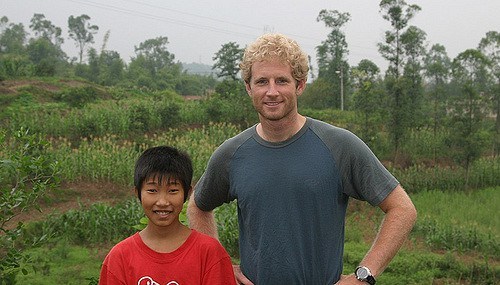
(At 25, I followed my flip flops to China to meet the people who made them.)
I’ll forever be a wide-eyed recent college grad. At least this is so in the pages of my first book Where Am I Wearing? The book follows me from the age of 22 to 31.
This is actually thrown in my face some. Browse the one-star reviews on Goodreads (thankfully there aren’t a ton) and you’ll see for yourself. I wear flip-flops! I’m too folksy! (I probably still am too folksy for some folks. For instance, I use the word folks.) I asked Bibi Russell if she knew Gandhi! What did I think I’d see when I visited garment workers in Bangladesh?!
Some of these criticisms are people who just don’t like me. Some of the “he’s naive” arguments are spot on. I was naive about a good many things in the beginning of the book and far less naive about some of those things at the end of the WEARING journey. That’s the point! The journey changed me.
Let the Journey Change You
This week I’ll turn 37. My daughter is in the first grade, and my four-year-old son is getting bigger by the day. Life has brought me to tears of joy and pain. I’ve felt the weight of adult life. I’m more familiar with death and disease, and more aware of my own mortality.
My time isn’t all my own. Instead of “my time” there is “bath time” and “bedtime” and “dance party time.” I’m not complaining. I’m finding joy in the lives of others. This is all part of my journey, too. A journey that again will change me, if I live it right.
Over time, I’m becoming less naive about some things, but the greatest wisdom I’ve gained is to admit my ignorance and challenge it. The nonprofit, community storytelling project I co-founded, The Facing Project, regularly does this on a whole host of issues from poverty to addiction and sex trafficking.
I combat my own ignorance every day, much in the same way I combatted it in my books: by asking questions.
Never Stop Asking Questions
Curiosity kills ignorance.
Knowledge isn’t just gained, it is pursued, and that pursuit is fueled by curiosity.
As naive as I was when I set off into the world to meet the person who made my shirt, I had the curiosity part right. I asked uncomfortable questions of others and of myself, and I haven’t stopped.
I visit 30 or so colleges each year. I take this as a huge responsibility and go out of my way to meet every student who wants to meet me, to answer their emails and tweets and Facebook posts years after we first met. To be a part of their journey in anyway and to help encourage their curiosity are some of the most rewarding parts of my career. Today, when I sign copies of Wearing, I often inscribe the best advice I have for them…
Never stop asking questions!
In 2012, when I was working on the second edition of Wearing, I could’ve edited out some of my ignorance. There were plenty of face-palm moments in Wearing. But I didn’t. It was important to me that I preserved how I felt and what I said when I was 22-years-old pursuing big questions.
Many of those questions are still unanswerable. It is essential as responsible humans that we continue to ask tough questions, pursue our curiosity, and pursue answers regardless of how unattainable they seem.
Questions like:
What invisible systems are in place that have benefited me, but not others?
How can I be a better husband, father, son, brother, and friend?
What are my responsibilities as a local and global citizen?
If you want to call pursuing unanswerable questions naive, I’m proud to be naive. But not asking them is to live a life of apathy. And that’s not okay. Apathy breeds ignorance.
Have the Courage to be Curious
I’m terrified of apathy.
We recently moved into the house we hope to live in forever. Our kids are happy and healthy. My wife is amazing. My work is rewarding and meaningful. I’m as happy as I could be. You know how everyone says Facebook is an unrealistic, overly positive perspective of a person’s life? Well, on Facebook, I feel like I have to tone it down. My life is happier than it seems on Facebook. I find myself at times literally running from place-to-place on my daily routine because I love each part of my day that much. Annoying, right? My point is that I could be happy living in my little bliss bubble and not asking the tough questions.
But the older I get the more injustices I see. The more opportunities and freedoms we have, the more responsibility we have to fight injustice. I’m not sure I saw that when I first wrote Wearing. But I see it now.
As much as I cringe at the naivete of 22-year-old me, I’m proud of him having the courage to follow his curiosity.
Let’s not judge those who are pursuing knowledge; let’s pity those who think they’ve attained it.