Kelsey Timmerman's Blog, page 18
July 9, 2015
Should firefighters stand in the street and ask for money? (Criticizing the Fill the Boot Campaign)
First, before you start hating me, let me say that I’m amazed by the risk firefighters face and the courage with which they face it. Even Grizzly bears and great whites are afraid of fire. That makes firefighters, who jump into a blazing building, braver than grizzlies and great whites!
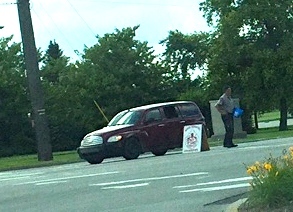
(Photo: I took this photo of a firefighter in the street “filling the boot” in my hometown.)
A woman who has an office in the same building I have an office would not be with us any longer if not for the action and courage of local firefighters. Firefighters miraculously rescued her and her husband from a horrible home fire in the middle of the night. They risked their lives to save hers.
The world is a safer place because of these brave individuals, BUT . . .
Every time I see a firefighter standing in the middle of a busy intersection holding a boot and asking for money, I want to go off on a big rant.
This is that rant, sort of.
Do you Fill the Boot? Should you?
Firefighters are ambassadors of all things safety. There is nothing safe about standing in the middle of the street like trolls wielding clubs of guilt to shakedown motorists of their loose change. I don’t give because I don’t want to support the practice.
I’m not alone.
A petition signed by 900 citizens of Loudon County Virginia asking for a ban of panhandlers, including firefighters, was presented to the local Board of Supervisors. The petition led to a ban. The ban was criticized by the regional director of the Muscular Dystrophy Association.
Maybe I was always too busy ignoring the firefighters on the street or pretending to look for loose change and finding none, but I didn’t realize that “Fill the Boot” campaigns raised funds for MDA. The regional director of the Loudon county area said that the campaign had led to more than $800,000 of donations in the past decade, and that standing in the street asking for change was four times more effective than standing at a storefront.
The Washington Post even covered the ban and pointed out that in Fairfax County the campaign raised $568,000 over Labor Day Weekend in 2012. The article included this paragraph which really makes me feel like a jackass:
Joel Kobersteen of International Association of Fire Fighters Local 2068, who helps organize the Fairfax program every year . . . said he has met families who would not have gotten medical items such as braces and wheelchairs without the MDA’s help, as well as benefit from “the research that Fairfax County ‘Fill the Boot’ helps fund in order to extend their lives and find cures to their particular neuromuscular diseases.” Last year, Fairfax County’s firefighters collected more than $568,000 over Labor Day weekend, the most in the country for the third time in the last six years.
Risky, bad giving practice, but raises a ton of money
Also, as a giver, I’m not a fan of this practice. It’s not a very intentional way to give. It’s just a step above from being asked at the cash register if you’d like to round up your charge to give to “Charlie.” What’s Charlie?! (That actually happened to me yesterday at a movie theater.)
(I have some giving tips here)
A concerned firefighter who was relieved his station didn’t participate in Fill the Boot wrote into Firefighternation.com’s advice columnist Nozzlehead to ask if the practice was safe. It’s worth a read for a balanced view and history of the campaign, which has raised $500 million for MDA. Nozzlehead saves his biggest criticism for firefighters that have to turn to raising funds for themselves. Here’ the gist of it:
To answer your question directly, the risk is there and if firefighters can come up with better ways to collect these important funds, they should. Volunteer firefighters having to raise funds to operate should be commended, but it’s 2015, and with personal time so tight, it’s time for the local community to ante up and pay for your equipment. You don’t see public works crews doing boot drives to buy new snow plows or cops doing boot drives to buy new cars. Next time you see the city manager or related city hall dwellers doing fundraising to buy their desks or build a new office, take a picture and send it to me. The days of expecting volunteer firefighters to volunteer AND raise money to volunteer is over; many volunteer fire departments can barely get enough people to join, train, and respond.
Specific to those on the roadways, find a better way to raise the funds such as shopping centers, malls, and places where you are less likely to be struck. If you can’t, use extreme caution following the same standards you would anytime you are operating on the roadways.
So, do you Fill the Boot when they come to your car window?


July 8, 2015
GMO corn lawsuit encourages farmers to sue seed company
I live in rural Indiana, so it’s not rare to see billboards promoting a seed company, but last week I saw a first: A billboard advertising a class action lawsuit against a seed company . . .

At first I thought this might be farmers suing seed companies for contaminating (pollinating) their non-GMO corn with nearby GMO corn. This happens, but I was surprised there would be enough farmers in that situation to warrant a billboard. After some digging, I found that the lawsuit wasn’t recruiting from this small niche of farmers, but instead every single corn farmer.
That’s right if you planted corn in 2013 or 2014, you could join the lawsuit.
Not Approved in China
Syngenta, the seed company targeted by the lawsuit, sold a genetically-modified corn seed known as Agrisure Viptera MIR162. Sounds yummy! China didn’t think so.
From the site (cornlawsuithelp.com) of the law office heading up the suit:
Syngenta is a global Swiss agribusiness that markets seeds and agrochemicals. In 2010, Syngenta released MIR162, a genetically engineered corn trait, to the US market. Viptera was designed to be resistant to insects such as the corn borer and corn rootworm. Syngenta brought the seed to market without it being approved for sale in China. At the same time it was marketing the seed, Syngenta told investors in April of 2012, “There isn’t outstanding approval for China, which we expect quite frankly to have within a matter of days.” It wouldn’t get approval from China until December of 2014.
In June of 2013 China found traces of Viptera in US corn shipments and subsequently shut down US corn imports. Starting with the first rejection of US corn due to the Syngenta seed, corn prices fell from near $7/bushel to a little under $3.30/bushel in October of 2014. The Syngenta corn lawsuit looks to recover money for farmers who lost value to their crop from falling corn prices caused by the Viptera seed.
From November 2013 to March of 2014, estimates show that China rejected billions of dollars of American corn. Let that sink in. China rejected food from us. China where 800 tons of 40-year-old frozen meat was being sold, found our corn to by unworthy.
This meant less corn left our borders, which led to a surplus in the United States. Corn prices fell dramatically. Hence, all farmers growing corn can join this lawsuit.
China did eventually approve Syngenta corn, but the damage had been done. China’s imports of U.S. corn have also declined as China has increased corn manufacturing in their own country.
Good for China. Grow more of your own corn. You’ve got the land and the farmers to do it. Shipping corn halfway around the world to a place that is capable of growing its own corn is nonsense. Maybe U.S. corn farmers will turn to food that we actually eat!
July 1, 2015
Getting THE GIGGLES at the dermatologist with my wife
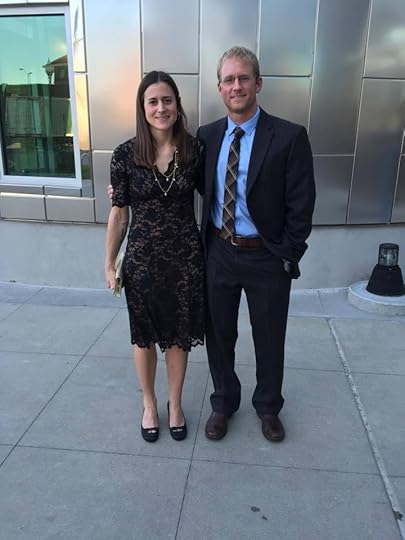
Posing as serious adults who would never get The Giggles
“Looks like you have a pimple right here,” the woman placed her finger right in the middle of my wife Annie’s forehead.
Annie and I have been together for 19 years (since high school), and I know there’s nothing my wife loves more than when I point to one of the zits, she so rarely gets, and say, “You have a zit!” She typically reciprocates by pointing out one of my few flaws.
The woman, a dermatologist, continued to offer her professional opinion of where my perfect wife was less than perfect. She delivered each judgement in the tone of a straight-faced Saturday Night Live character.
Perfect as she is to my loving eyes, I couldn’t look at Annie any longer. I felt them coming on, the unstoppable, involuntary force known as The Giggles. My insides began shaking, but I was able to keep the tremors from reaching the surface.
I directed my mind elsewhere, forcing myself to ponder the thickness of the clinical tile or exactly how Coolsculpting works. It was no use. The Giggles were still there.
“You are a grown man. You are 36-years-old. A father of two. Keep it together, man!” I gave myself an internal pep talk that got me through Annie’s examination.
Then it was my turn.
“You have a pimple on the back of your neck right here,” the dermatologist told me. I took a deep breath. If I laughed, I knew I would have be laughing at my own zit. Somehow that seemed less offensive than laughing at Annie’s. The Giggles crept toward the surface.
“And right here,” she said. “You seem to have a mole on your back, and . . . there are a few black hairs growing out of it.”
That was it. I couldn’t fight any longer. The visible shaking started at my belly and climbed to my shoulders.
That’s the first I noticed it. Annie gave a stifled laugh too. We were both fighting The Giggles.
The Science of Love & Laughing
Neuroscientist Sophie Scott gave a TED Talk titled “Why We Laugh” in which she points out several findings that were relevant to our situation at the dermatologist.
As we get older we become better at deciphering real laughter from fake laughter. We hit our peak at deciphering between the two in our late 30s. (Annie and I are nearing our “late 30s.”)
Real laughter is more contagious, but as we get better at reading laughs, we’re less likely to catch a laugh. So as we age there needs to be more than just a funny situation for a laugh contagion to break out among humans. There needs to be a strong social connection.
Scott pointed out the research of Robert Levenson at UC-Berkeley. Levenson brought married couples into his lab, hooked them up to a polygraph machine to monitor their stress levels, and then asked them a series of stressful questions, such as: “What annoys you about your wife?”
The polygraph found that the couple’s stress immediately spiked, but the couples who managed that feeling of stress with laughter immediately became less stressed. Levenson concluded that couples who laughed reported higher levels of satisfaction in their relationships and that they stayed together longer.
In her TED Talk Scott says that we are thirty times more likely to laugh when we are with someone. I’ve been with Annie since I was a teenager and without even glimpsing at each other we gave each other The Giggles.
If that’s not love, I’m not sure what is.
Annie and I have grown up together, are raising two kids together, and have made a life together, but on the way out we agreed that no longer could we visit the dermatologist together.
Here’s Sophie Scott’s talk:
June 29, 2015
Dear Game of Thrones, I want my life back
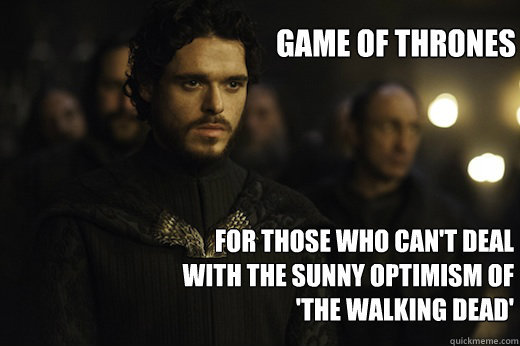
I’m five years late to the Game of Thrones series. (Also, I recently watched this amazing series called Breaking Bad. Heard of it?) Since discovering the GOT books late last year, it has consumed my life.
My first GOT experience was with the audible book. George R.R. Martin’s first book Game of Thrones read by Roy Dotrice comes in at 34 hours long. That may seem long until you consider the 3rd book which is 48 hours long. I’m currently eleven hours into book 4 of the series, A Feast of Crows. Add it all up and I’ve spent 130 hours or 5.5 days listening to Game of Thrones books.
I listened on my five minute commute to work, while I showered, while I mowed the lawn, while flying, and while I drove to speaking engagements all over the country. And sometimes I even laid in bed at night with my earbuds in lost in Westeros.
Over the past three months I started the HBO Series and last week finished the most recent season, season 5. The series so far is 50 episodes, or 50 hours long. That brings my total GOT time since the first of the year to 180 hours.
I’ve committed more than a week of my life to The Game of Thrones, and now I want my life back.
Typically I mix up my reading selection. I write nonfiction, so I have to read a lot of boring nonfictions books, but some good ones. I mix in some contemporary fiction and some science fiction and fantasy. But GOT cut the head off that balance and mounted it on a spike. The series has dominated my reading time like a white walker dominates a wildling in a fight.
I stopped reading anything but Game of Thrones. I stopped listening to podcasts and NPR. And sometimes when I popped my earbuds out I struggled to pull my head out of Westeros.
I would read nothing but science fiction, fantasy, and zombie books, if I felt like it wouldn’t bring a screeching halt to my career. To me these books are like donuts. I love them. I could eat them everyday, but if I do so, I’m jeopardizing exposing myself to the realities of the world I actually live in. Sometimes science fiction and fantasy can say more about our world than a work of nonfiction, but it is important for me to stay in touch with actual events happening in real time.
A few months ago someone asked me about some news event. I’m pretty good at keeping up on things through the New York Times, the Muncie newspaper, and online, but here was my answer: “I don’t know much about that. I’ve been reading Game of Thrones.” And then as he told me whatever bad news it was I had to fight from saying, “Winter is coming!”
So Game of Thrones audible books, I’m quitting you! I’ve decided to only watch the series now as it comes out episode by episode.
Yesterday I watched HBO’s Vice about the Cold War 2.0, listened to my favorite NPR podcast while I mowed, and played with the kids.
Bit by bit I’m getting my life back and I’m living in 2015 in Muncie, Indiana, which is a good thing because if I actually lived in Martin’s Westeros, he would’ve probably killed me off by now.
June 25, 2015
The beauty in the thing you feared
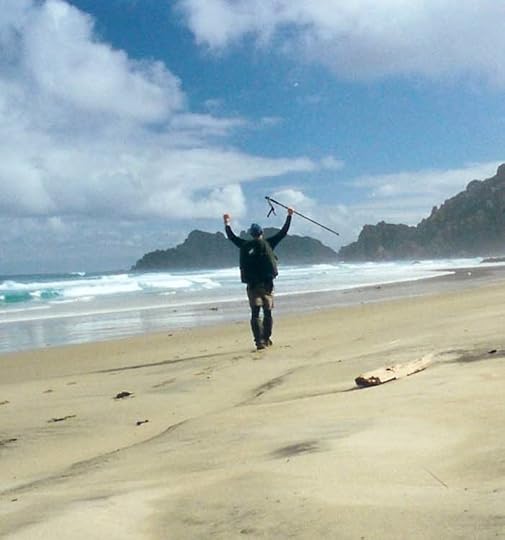
Hiking in the rain in New Zealand in 2002
This rainy morning as I hustled out the front door and into my car, I thought about the freedom of hiking all day in the rain.
You go through life avoiding getting wet. And when you’re hiking and the rain starts, you do the same. You get out your poncho, you jump over the mud puddles, you hide under a tree, but then you slip on a rock and your shoes get wet or you realize that the rain isn’t stopping and you no longer fear getting wet. At some point you can’t get any wetter.
When the rain saturates us there is no place for it to go but to roll off.
You hike. The mud sucks at your boots and the rhythm of the rain ebbs and flows. You smell the clouds. Maybe even whistle. No more seeking shelter or hiding from the rain. There is a beauty in the thing you feared.
I listened to Marc Maron interview President Obama right before I stepped into the rain this morning. The president was talking about fearlessness and how at some point in our lives and careers we stop acting fearless and start being fearless.
[Warning CrossFit reference!!!] One thing I’ve learned from CrossFit is that you have to fail to get stronger. There’s the weight of a barbell and then there’s the mental weight–the actual weight multiplied by your fear of that weight. But when you learn to fail, how to bail on a back squat or a clean, you realize that the worst thing that can happen is that you safely dropped a weight. You no longer fear failure. And because you know failure and embrace it, you are stronger.
When the thing we avoid–rain, failure, pain, loss–becomes our reality, the power of that thing dissipates with each step we take forward.
***
I’ve spent several days hiking in the rain. One of the more memorable rain/mud hikes I’ve been on was on Stewart Island in New Zealand. Years ago I wrote about the experience, which you can read below. Know that I wrote this more than a decade ago, and since then I’ve grown–through failure–to become a better writer (or at least I hope so).
THE NORTHWEST MUD CIRCUIT
New Zealand is a spectacular country to go for a hike, but many of its trails are overly crowded; waiting lists and hordes of hikers have to be dealt with. One trek where the sanctity of solitude is upheld is the Northwest Circuit on Stewart Island, south of the South Island. Few individuals take the time (8-10 days) to walk the Northwest circuit to see and feel the island for what it really is: isolated, rugged, windblown, and…oh yeah, muddy.
While hiking, wet feet seem to lead to a heavy heart and for this reason I was jumping from rock to root to rock avoiding the patches of mud. I am not graceful, and with a thirty-pound pack on my back this was never truer; it was only a matter of time before the inevitable misstep.
On my tiptoes in a sea of mud, my hopes of dry feet sunk, literally, as the branch that I stood upon was slowly swallowed. Facing defeat I found some consolation in recalling the words uttered by a tiny 65-year-old woman, a Northwest circuit veteran at the Department of Conservation office, “It’s not like you are going to fall in the mud and never be seen again. You just have to be mentally and physically prepared for the mud.” I would live. I would live with muddy wet feet for the next week.
MUD – it’s a state of mind.
Hiking through ankle deep mud my spirit dwindled. With each step the mud hissed and sputtered as if alive. M.U.D. = Mushy Underfoot Dirt.
Up to my knee, the mud threatened to retain my shoe for eternity. M.U.D. = Malignant Undeniable Devil.
My leg disappeared. Pulling with my hands and straining at the hip I battled to reclaim my limb. Somehow, managing to wiggle out away from the leg-swallowing mud, I sighed with relief as I stood once again in knee-deep mud. M.U.D. = Malicious Unrelenting Damnation.
Much of the time while waging war with the mud I could hear the surf pounding the shore, just out of sight. During the entire circuit the trail meets the beach nine times, making the hike well worth the struggle. With mud grinding in my teeth, in my eye, and covering my body, the trail would climb up the sand dunes and run down to the beach. The violence of the waves threw water up onto the beach face and it was here that I would cleanse the mud from my legs and boots. Beside the emerald sea, beneath the blue sky and cotton ball clouds, winding in out amongst the driftwood I would see my lone set of footprints stretching for miles, and it would be here, shrouded in the salty mist, that I cleansed my spirit.
That is the thing about the Northwest Circuit; it likes to beat you down and then build you back up.
Regularly the trail treats weary hikers to climbs from sea level to 1,000 feet in less than one muddy mile. Step off the trail and risk never finding it again. Amongst the birch and pine trees, plants seem to brandish their spear-like thorns in protest of passers-by. Even plants as unthreatening as ferns take on the persona of monsters as they lock leaves with their neighbors forming a devilish sort of velcro.
“It is very important that we keep downed trees and brush from blocking the trail to keep the lost hikers to a minimum,” said the rangers who were taking a break from clearing the trail when I came upon them. They told me a story: “One morning we were cleaning up a hut and doing some repair work. We said goodbye to a tramper in the morning that we had spent the night with at the hut. At noon we were scarfing down some lunch when who appeared on the porch but the same hiker. ‘Wow you fellas sure do move fast, I never even saw you go around me.’ With a little pleasure we informed him that we had not moved and had been working at the same location all morning. He was halfway into the day’s hike when nature called. Apparently he stepped off of the trail and once having found it again, unknowingly began to backtrack.”
Breaking up the seventy-mile trail are ten huts spaced out from four to ten miles apart, in most cases making for a good day’s hike between huts. Huts have mattresses, outhouses, wood burning stoves, and running water via cisterns that are filled by Stewart Island’s 275 days of rain a year. The majority of the nights there would only be one or two others in the huts and one night I was alone.
The sun neared the horizon and after a nap in my warm, dry sleeping bag, I walked a short distance to the sand dunes overlooking the beach. I had time to kill before the sunset so I kicked off my shoes and played. The sand was cold and my feet became numb as I pumped my legs trying to run up the steep dunes; I would bound down in an avalanche of sand, triggered by each giant step. The sun lit the crest of the waves soft pink and the sky became blood red. The tufts of grass on the sand dunes waved good-bye to the sun in the soft breeze. Sleep came easily with exhaustion and fulfillment.
After hiking on several other treks in New Zealand, the solitude and the ruggedness of the Northwest Circuit was a very rewarding challenge. Come with the proper equipment, enough food, and the right attitude and you will enjoy it. If for no other reason come because, as one local conservation worker put it, “mud builds character.”
June 24, 2015
“Are you a Christian?”
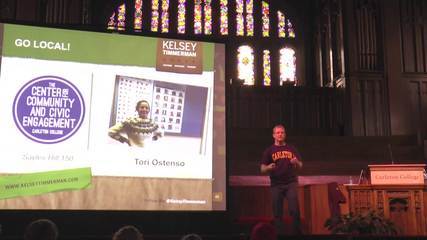
I was at a faith-based university and had talked for 50 minutes on our global and local connection with people around the world who make many of the things that we take for granted. I talked about global poverty and introduced the audience to Arifa in Bangladesh who earned $24 per month. I showed pictures of a dump in Cambodia where barefoot kids pick through trash for 25-cents per day. I shared the story of my friend Amilcar, who risked his life for his family traveling from Honduras to the United States riding on top of trains and outrunning bandits who wanted to hold him for ransom.
And “Are you a Christian?” is the first question the audience asked. It just kind of hung there. This was fairly early on in my years of speaking about these stories and it was the first time I had been asked the question, but it wouldn’t be the last.
I think I said something about being raised Catholic and then proceeded to give a very humanistic answer. But on the inside I was screaming, “Does it matter?!”
Every story I share I do my best to put my heart into. The stories and the kindness of those who entrusted me with their stories still motivates and moves me even if I’ve shared their stories hundreds of times. So I had just put my heart out there and then the question came as if my answer could devalue everything I had just shared.
Maybe I read too much into the question. Maybe it was a “just curious” question and nothing more. But it felt an awful lot like an “are you on my team?” question. I felt like my answer lost some of the students. Like they were all about my work and stories until I stepped around the question.
The professor responsible for inviting me continued to use WEARING in his class and he would get the question about my faith too. Here’s what he wrote me:
I always get asked by students whether I know anything about your faith. I point them to your blog entry where you discuss that. In my mind, I see you as being more like Jesus than many who call themselves Christians. I try to challenge my students to think about what the gospel message really is. It is all about loving God and loving neighbors — loving God by loving neighbors. And the fact that you are out there loving and serving ‘the least of these’, promoting justice among people everywhere, that’s what I hope for from them. From myself, too.
That’s a pretty humbling comment from a man I greatly respect. It’s also one that I’m a little embarrassed to share. ”This guy said I’m like Jesus!” #humblebrag!!” But I feel like it gets to the heart of what I want to get at with a response of “Does it matter?”
We’ve since discussed this question at greater length and settled on that maybe the best response is, “What do you think?”
Am I a Christian?
Recently Annie and the kids and I have been attending Commonway Church where my friend Matt is the pastor. Matt asked me to talk at church about listening. The point being that before loving your neighbor you have to know their name and listen to them. Two weeks ago, I gave my talk. Or should I say it was a sermon?
I didn’t talk about Jesus or the Bible, I just did what I always do and talked about the people I listened to and how they’ve made me want to be a better person. After my talk Matt connected it to the Bible.
I gave a sermon in a church (listen to it ), yet I’m no more or less a Christian than I was when I was first asked the question.
Am I a Christian?
That’s still a question that I find very complicated to answer.
What do you think?
June 17, 2015
I’m that annoying dad who teaches his kids to despise Wal-Mart

(Photo: Outside a WalMart in China.)
Harper was with my brother’s family as they pulled their van into Wal-Mart.
“WalMart,” Harper, 5, said. “We don’t shop there because they don’t treat their workers right.”
Kyle, my brother, thought this was funny when he told me. But I can’t help but think it’s a bit annoying too.
Let me say this. I’m not better than you because I don’t shop at WalMart. I just can’t do it. I have friends who work at WalMart and I’m glad they have jobs, but still, I just can’t do it.
I wrote the following in the Huffington Post (how annoying am I?! I even write about WalMart in the Huffington Post!) right around the time Harper and I had our first conversation about why we don’t shop there:
I have an online friend who works for Walmart. I emailed him before Black Friday asking him what he thought of the Walmart workers threatening to strike in the United States.
Here’s what he told me:
“I don’t like working 12 hours so people can trample each other to buy $4 bath towels for $1.88 or a $60 DVD player for $25. But here’s the thing: I don’t like everything about the job, but I knew the nature of this beast when I applied for the job. And in the present economy, I feel blessed to have a job. There are changes that ought to be made. Others that need to be made, but you won’t find me on a picket line. I need a job too badly to complain.”
His statement sounds an awfully lot like how we justify workers in Bangladesh earning a monthly income of $37 and having to spend almost half of that income just to feed their families rice: they need the opportunity.In the name of lack of opportunity and poverty, we are exploiting American workers and Bangladeshi workers.
How long will we justify injustice?
We are paying a high cost for chasing low prices. As many as 80 percent of Walmart employees at some stores are on food stamps. In total Walmart employees receive $2.66 billion in government subsidies. Since 2006, 700 Bangladeshis have died in garment fires. When we demand everyday low prices, we get everyday low wages and bad working conditions. We are saving money, but are we living better?
There’s another really good reason to not shop at WalMart. WalMart doesn’t have unannounced inspections of the factories they source from. Target on the other hand does.
But there are reasons to shop at WalMart: low prices and one-stop shopping. This is why millenials under the age of 24 prefer shopping at WalMart to any other retailer. From AdAge:
“Millennials now, as a generation, like Walmart the best, more so than Generation X, more so than boomers,” said Matt Kistler, Walmart senior VP-consumer insights and analytics.
“That kind of shocks a lot of people, including inside the company,” admitted Walmart Chief Marketing Officer Stephen Quinn.
It doesn’t exactly jibe with the perception that big-box supercenters are losing ground to niche brands, small stores and e-commerce. Mr. Quinn sees it differently. “As millennials become time-crunched with relationships and kids coming along, it’s opening up a strong need for them to have a one-stop shop,” he said.
Millennials were also the first generation to grow up in a time where Walmart was a dominant retailer. “It could be their Baby Boomer parents dragged them to Walmart so much it feels a bit like home,” said Mr. Quinn.
In fact, this surprised me as well. In EATING I found research that showed millennials were less loyal to brands and more willing to shop differently–no longer insisting on one stop shopping–which was presented as a troubling trend for the big box stores.
Will Harper grow up and shop at WalMart? Who knows? I’m doing my best to brainwash her.
Here’s a dose of reality. There have been times in the past when our budget was really tight and we gave WalMart a go, choosing our family’s budget over the family budgets and well being of other families around the globe.
But I much prefer when NOT shopping at WalMart is a luxury we can afford.
June 11, 2015
Connecting with Germany

I’ve been to Germany. I spent one night sleeping in a subway with a group of homeless folks in Frankfort.
So, really, I’ve barely been to Germany, but my words are there.
A few years ago a German textbook publisher adopted an excerpt of WEARING or of an article I wrote on WEARING. I don’t really remember. Now each year I get emails from German students asking follow up questions to the story. At first I tried to answer them all, but that became a bit like work. Now I offer to Skype with the class.
I just got off Skype with the enthusiastic students above, one who reached out to me on Twitter. They stayed after school to Skype with me. They were hilarious. I had trouble understanding their questions over their giggles. That got me giggling, and then we all were just staring at each other an ocean a part lost in a giggle vortex, but connecting all the same.
I’m thankful my words are out there reaching folks, but nothing is better than actually connecting with them in real or virtual life.
May 12, 2015
Where I’m Giving. How to support the children of Nepal.
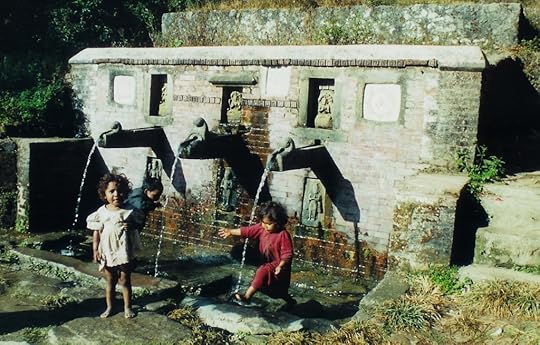
(I took this shot outside of Katmandu in 2001)
A second earthquake has hit Nepal. The first on April 25th killed 8,000, injured many more, and directly affected 1.7 million kids. I’ve been to Nepal and have had a heart for the country ever since. Several friends have reached out to me asking where they should give to support Nepal.
This is my answer . . .
I signed up for a recurring donation to Next Generation Nepal. Please join me in giving to an organization working to help support Nepal and not exploit it.
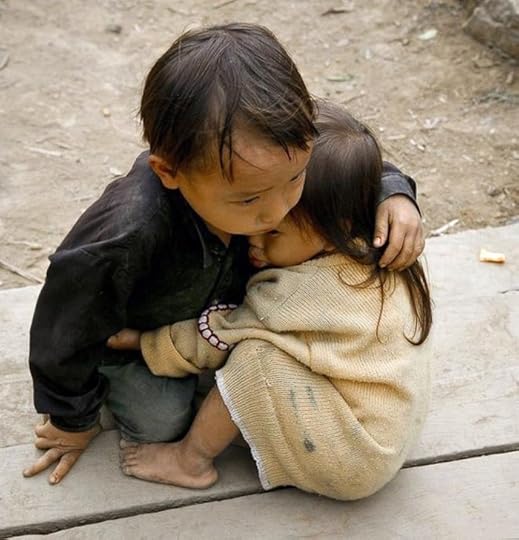
When disasters happen, images like the one to the right are posted and shared and used as “disaster porn” to raise millions that may harm the folks we are trying to help. The image by the way isn’t even of Nepalese children, but a stock photo from Vietnam.
Next Generation Nepal recognizes this. They are a nonprofit co-founded by my friend Conor Grennan. Conor is also the author of Little Princes, a New York Times bestseller that traces the creation of the organization and Conor’s realization of how orphanages were preying upon the charity of donors to promote child trafficking.
NGN rescues children from traffickers and seeks to reunite them with their parents.
Orphanages in developing countries must always be looked at skeptically. A few years back Kelsey Nielson wrote a guest post, Africa Does Not Need More Orphanages, pointing out that 4 of 5 children in orphanages in developing countries have a living parent.
A misplaced donation can contribute to keeping children from their families and condemn them to a lifetime of being used to perpetuate child trafficking.
From The Guardian:
Next Generation Nepal is one organisation on the ground tackling these problems head on. Country Director Martin Punaks said: “We are now deeply concerned that the earthquake will accelerate [child trafficking] beyond our worst nightmares. Aid money is flooding in to the country, children’s homes are offering hundreds more places for children, and not enough is being done in the rural areas to stop the flow of children away from their families into profit-making orphanages.” Children who have been separated, displaced or orphaned are among the most vulnerable in society. If we stand by while they are trafficked into institutions – many of which keep children in woefully inadequate conditions and some of which are dangerous – we will fail them.
“The next few weeks and months will determine the future for thousands of children in Nepal, and in turn, the future of Nepali society.”
Again, I hope you’ll join me in donating to Next Generation Nepal.
May 8, 2015
How Bruce Jenner & a College Student Made Me Less of a Jackass on Transgender Issues
Over at the Facing Project blog, I shared my evolution in thinking about transgender issues. I really believe that many of us are just one powerful story away from growing in understanding and shedding ignorance around particular topics.
I don’t know anyone who is transgendered (that I know of) and I had never really closely paid attention to anyone’s story until I heard Bruce Jenner’s story and until a Ball State student shared his story.
You can read the entire piece, on the Facing Blog. For now here’s an excerpt:
Two years ago I didn’t know the difference between a crossdresser, a drag queen, or someone who is transgendered. In fact, if you would have engaged me in a conversation about the issue, I may have even used the term transvestite, which for the most part is totally out of use.
I could’ve benefited from reading GLAAD’s reference guide for transgender issues.
Even right now, I’m not the most confident that I won’t say something wrong or sound like an ignorant jackass when I talk about transgender issues. In the buzz before Bruce Jenner came forward as transgendered to Diane Sawyer, I remember thinking that maybe his gender identity struggle was just another celebrity losing it as result of the bright spotlight of fame. I’m not sure there is a more ignorant viewpoint of GLBT issues than the ol’ “mental illness” argument.
But then something happened . . . I heard Bruce’s story. How he struggled from an early age. How he’d put on his sister’s dresses when no one was home, took hormones in the 80s, told his sister and two of his wives about his true self years ago. Long before Bruce was an Olympic champion on a Wheaties box or wrapped up in the Kardashian circus, he struggled with who he was.
When I heard Bruce’s story, I stopped judging him. I felt happy for him that he was finally stepping forward and sad for him that it took six decades to do so.
Bruce shared a shocking stat in his interview with Diane Sawyer that more than 40% of transgender individuals have attempted suicide.
One of those suicidal individuals shared his story in Facing Depression. . .
Konner is a Ball State student and I’m amazed by his bravery. Konner is doing something that Bruce, one of the world’s best athletes, couldn’t find the strength to do when he was Konner’s age.
It is such a tough journey.
… if it weren’t for Bruce and Konner sharing their stories, I’m not sure my thinking would’ve evolved enough to see what they’ve done as acts of bravery. They’ve helped me see ignorance of which I was unaware. They’ve helped me grow. And they’ve helped countless transgender individuals by sharing their stories.