Kelsey Timmerman's Blog, page 21
November 18, 2014
The Gold Nugget in My Wallet
(This story originally appeared on the blog of the Indiana Authors Award.)
I carry a gold nugget in my wallet. A slave owner in Burkina Faso gave it to me.
The bus ride that took me from Burkina Faso’s capital, Ouagadougou, ended at a flooded road and a trip in a tiny dugout canoe where the oarsman joked about crocodiles. From the canoe I got in a taxi that didn’t have brakes. The driver stopped the car using the “Fred Flintstone” method – sticking his foot out the door and dragging it along the road.
We arrived to the town of Poura, Burkina Faso, at dusk. There were no rooms to be had. The proprietor of the town’s only hotel had taken all of the keys with him on vacation. Fortunately, one of my taxi co-riders – a teenager named Karim, decked out in a new hip-hop outfit complete with bling – took pity on me.
“Come with me,” he said.
I figured he was relatively rich. Not many in Burkina Faso can afford to dress like he dressed. His bootleg Chicago Bulls baseball cap almost looked real enough to be worthy of the shiny “authentic” sticker still affixed to it.
“In here,” he showed me into his room, a hot, dark room, without electricity, in a building that had seven other such rooms. Even though I couldn’t see anyone, I heard and smelled humans sleeping on the floor.
“Where can I use the bathroom?”I asked.
“Come. I’ll take you to my master’s.”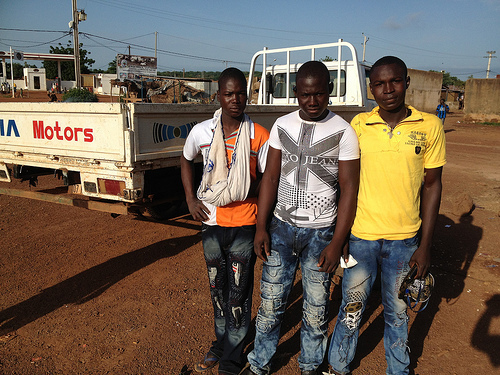
Master? Oh, no, here we go again. In Ivory Coast while researching cocoa I met a slave named Solo, tried to free him and was nearly arrested. I wrote about the experience extensively in my book “Where Am I Eating?”
As it turns out, the teenager, Karim, was a 15-year-old gold miner. He worked in his master’s mine and was returning from Ouagadougou where he made a run to sell his master’s gold.
Karim’s master looked me up and down, and I did my best to not look like a journalist. He offered me the floor of his guesthouse, which I hesitantly accepted but really had no choice. I stayed up with his child laborers that night and talked about their lives.
“My parents work in the cocoa fields of Ivory Coast,” Karim said. “They can’t afford to feed and clothe me so they send me here.”
Karim hadn’t seen his parents in two years. He told me that while he thinks he knows where they live, that it is just an assumption at this point. He has worked here since he was 13.
We jammed to a stereo powered by a car battery. Between songs performed by Akon and Chamillionaire, there were distant conversations and the sound of animals and humans turning in for the evening.
“If you want, tomorrow you can come [to the mine] to see gold.”
“Uh…wow.” I picture myself standing in a mine staring at child laborers slaving away for tiny pieces of gold. Suddenly my gold wedding band felt a little heavier. “I better not.”
I wanted to seem as disinterested in the workers and the gold as possible. I just wanted to leave this village, find Solo’s parents in Ghana and leave West Africa. I had seen more than I was able to handle already.
I slept with an ear and eye open that night, afraid I was going to be abducted at any point. In the morning the master sent me on my way and gave me the gold nugget as a reminder of his hospitality.
We communicated through Karim’s broken English and hand gestures. The language barrier would keep me from hearing his entire story. The fact he was a slave and I was a journalist in a remote region of a remote land scared me. I was too afraid to carry his story, so instead I carry the gold nugget.
The gold nugget, more like a pebble, makes a small leather bump that I rub every time I pull out my wallet to buy something. It’s only worth $6, but it’s a priceless reminder that stories are heavy and too many of them are untold. And for those of us charged with carrying them and telling them, they forever change us.
The stories of factory workers and farmers, mothers and fathers, around the world have changed the way I live my life as a father, husband, giver, volunteer, a global and local citizen. The stories are why I co-founded The Facing Project with my friend J.R. Jamison. The Facing Project is a storytelling project that connects people through stories to strengthen community. It allows other writers to carry the stories of their neighbors. To feel that weight, that responsibility, to change and be changed.
We all have stories to share and to carry. What are yours?


November 17, 2014
Change Starts with a (Fair Trade) T-shirt: Nerding out over at prAna
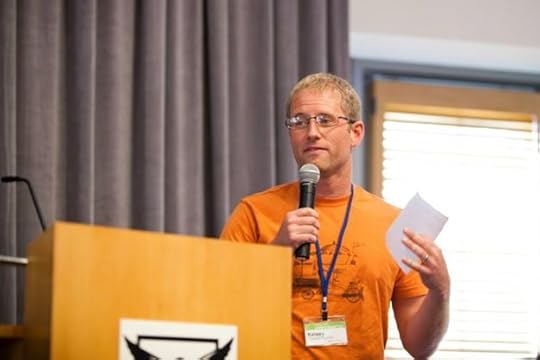
Rocking my prAna Fair Trade T-Shirt at the Midwest Writer workshop. Apparently I’m about to drop an F-bomb.
This afternoon, I’m visiting Fair Trade USA’s headquarters, so I though I’d share the post I wrote for the clothing company prAna:
The post covers how a T-shirt changed my life and how excited I am that Fair Trade certified clothing exists.
Suit-Wearing Kelsey Says Stupid Things: My Evening at the Indiana Authors Award
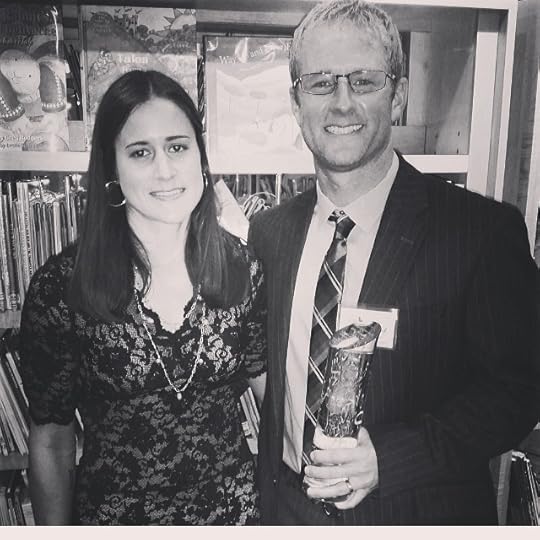
The sun poured through the glass walls of the library and made me even more aware of the fact I was wearing a hot and itchy suit.
“Man this suit is hot,” I said to Jessica Brockmole, one of my fellow Emerging author finalists at the Indiana Authors Award. She socially appropriately acknowledged my statement.
And then I went on.
“I don’t normally wear suits. Actually, borrowed this one.” If only I had stopped there. “My suit doesn’t fit any more. I started doing CrossFit about a year ago and my butt got bigger.”
The more dressed up I get, the more socially awkward I become. It’s a law that is as true as gravity to me.
(In a suit at the wedding of a former high school classmate who I bumped into on the way to the bathroom: “This wedding…THIS wedding is just beautiful.” I didn’t think it was that beautiful. I really didn’t even want to be there, but there I was having the out of body experience watching suit-wearing Kelsey say stupid things.)
Jessica didn’t really say anything. What was there to say? And thankfully, Laura, one of the amazing organizers of the evening called us over to walk through the order of events.
(Note to self: Don’t talk about body parts with people you’ve just met. You’ll probably end up in their next book as a creepy neighbor.)
This was my second year as a finalist for the Eugene and Marilyn Glick Indiana Authors Award. The Library Foundation spoils the authors, putting us up at a fancy hotel in downtown Indianapolis, giving us money to eat, and even paying our mileage. Annie and I dumped our kids on the grandparents and treated the weekend like a mini-vacation.
The best part of the event is without a doubt getting to meet the other authors. Michael Shelden, the national winner, writes big books about legendary figures (Orwell, Twain, Churchill) and enviably seems as comfortable in a suit as I am in my pajamas. Norbert Krapf, the regional winner, is a poet healing his and the Catholic Church’s wounds a poem at a time. Clifford Garstang, a fellow Emerging Finalist, is a recovering lawyer who seems to have giddy yet practical passion for words. And of course, Jessica Brockmole turned her love for place, connection, and travel into her book, Letters from Skye.
It really is a joy being around folks to whom I don’t have to out myself as a writer. That’s always awkward. (I’m on a plane right now and I hope the lady beside me who is reading a book(!) doesn’t ask me what it is that I do.) I also love the opportunity to talk to them about the work, the words. Sure, we chatted career stuff. Even fellow authors are up for telling me what my next WHERE AM I… book should be. But there was less of a focus on time and money than the joy and burden, the honor and the privilege of sharing stories.
And then the grown ups showed up
Once Laura walked us through how the evening would play out, the grown ups in suits showed up. They bid in the auction for events, goods, and services that were a luxury in our writer-income household. They small talked with us. And in many ways Annie and I felt like kids playing dress up. (Also, it must be stated, Annie looked amazing.)
The main event of the day is the awards dinner. The event sort of hangs over the entire day. The winners of the national and regional awards are announced months before the event, but the winner of the Emerging Award is announced at the very end of the evening.
As much as I’d like to say that I was okay enjoying the evening without winning, just like last year, as soon as the phrase, “And the winner of the Emerging Author Award is . . .” my pulse pounded against my tie, and, just like last year, I wanted to win.
Let’s pause the second before the winner was announced. It’s an odd thing. I’m either going to win $5,000 + $2,500 for the Muncie Library, and have to give a speech, or I’m going to sit and watch someone else do the winning and the speaking.
But unlike last year . . .
“. . . Kelsey Timmerman!”
I’ve seen awards shows before. Act surprised. Kiss your wife. Go to the stage and make a few remarks. Those folks are often actors though, so you don’t know if they are surprised or acting. I was more than surprised, I was touched. I’ve bled literally and figuratively to collect and share the stories I’ve written. I’ve sacrificed being with Annie, Harper, and Griffin for weeks at a time. When my name was announced, I almost cried. When I took the stage and took 5 minutes to deliver a 2-minute speech (I had things to say), I almost cried again when I looked at Annie to thank her for being the best part of my story.
Look, I know this isn’t a National Book Award or a pulitzer, but it meant a lot to have my weirdness validated, and to be appreciated, not just in an email, but by people who dress up to come to the Central Library to support writing and storytelling.
Wearing a suit and tie, eating meals with lots of shiny utensils, and then having a lot of people wearing fancy clothes stare at me after they too ate meals with lots of shiny utensils is not my average day or necessarily in my comfort zone. But that was my evening at the Indiana Authors Award and it, just like last year, was awesome.
Nominations for the 2015 awards open in February. If you want to show an Indiana author some love and support, please consider nominating them.
The moment my name was called and I turned to Annie and saw the excitement in her eyes is a moment that I’ll never forget.
And right after that moment I sat for this interview.
November 5, 2014
I’m looking down on Times Square
I was scrolling through Facebook, wasting time, not expecting to see a picture of a picture of me on a Jumbotron in Times Square. Why would I?
But there it was…
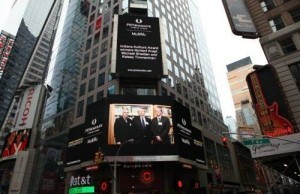
“That’s cool,” I thought. “Probably photoshopped, though.”
The Eugene and Marilyn Glick Indiana Author’s Awards had shared the photo. I haven’t officially mentioned it here on my site, but I won the Emerging Author Award. (I should write about that later. It was an awesome evening and honor.) The photo featured Norbert Krapf, the regional award winner, Michael Shelden, the national award winner, and me . . . in a suit . . . a borrowed suit.
I never wear a suit.
I had to ask if this was real . . .
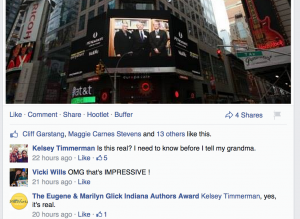
Apparently it was.
I was a bit nervous in sharing the photo because it could be perceived as: “Hey everybody look at me! I’m such a big deal I made it onto a Times Square Jumbotron.”
But being overly humble can make one look like a jackass too. “I’m on a Jumbotron . . . no big deal. It’s not even worth noting just a typical Monday.”
I guess I’m a little over sensitive to social media perceptions right now. I’m reading The Village Effect by Susan Pinker. Pinker writes how social media can make users feel inadequate:
“Online networks [blitz] user with a steady stream of status updates, which by some unwritten rule, accentuate the positive and eliminate the negative in other people’s social lives–making your own life look so much worse in comparison.”
Look, my life isn’t suits and 20-foot tall images of me overlooking Times Square. I don’t even want it to be that, especially the suit part. I wouldn’t change places with anyone. I’ve got the perfect job and family for me, but it’s not all peaches and cream and awards. I have self-doubts, concerns for loved ones, and sometimes I get in ruts. I wasn’t depressed after writing and living WHERE AM I EATING, but I was something and I was exhausted.
Anyhow, how do I feel about this Jumbotron thing?
It’s cool.
It’s cool in the same way that getting sprayed by a skunk was cool. Well, the actual getting sprayed wasn’t cool, but the story is fun. The skunk story has always been my go to interesting tid bit for those awkward “get to know you” mixers at conferences. Now I’m happy to have this:
“I’m Kelsey from Muncie, Indiana. I was once on a Jumbotron in Times Square. Also, I’m not a big deal.”
All that said, winning the Indiana Author’s Award was a big deal to me and to Annie, but it does not make me a big deal. Every once in a while it is nice to have my weirdness validated.
October 31, 2014
Harper Loves Griffin

Our kids get a bath every night whether they need one or not.
Bath times are extra special at our house. I think that’s why we wash our kids every night.
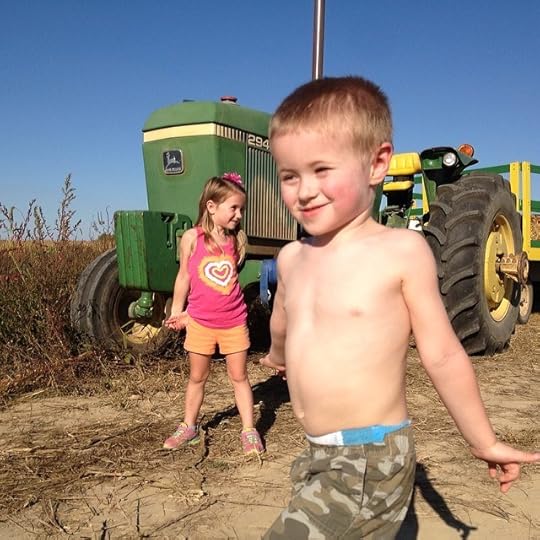
Our five-year-old daughter, Harper, and our three-year-old son, Griffin, don’t play together much during the course of the day. Griffin has autism and is in “Griffin Land” most of the day.
“I don’t know why Griffy won’t play with me, but I still love him,” Harper said one day, summing up her relationship with her brother.
You try not to compare your kids to other kids. You try. But you do. Watching special sibling bonds develop in other kids and not seeing them in your own is tough.
But bath time is time for Harper to make Griffin laugh. The other night in an effort to make the funniest of faces she stretched her cheeks out with her fingers so far that she left read marks at the corners of her mouth. Bath time is a time for Griffin to play hide and seek, to share and take toys from Harper.
Sometimes the kids get in fights, but they are interacting and I’ll take it. (note: Griffin is easy and unlike other siblings their ages Griffin and Harper rarely get in a fight or argue. Autism has its advantages, I guess.)
Griffin is very affectionate to Annie and me, but Harper rarely gets an unprompted hug from Griffin. I worry that Harper won’t love Griffin as she would if he didn’t have autism. She plays. He keeps to himself and spells out multisyllabic words that kids twice his age can’t even read.
Then last night something happened. It was a small something, so don’t get all worked up for an Upworthy “and you won’t believe what happened next headline.”
I got Harper out of the bath first, she put on lotion (because she gets a bath every single night), got dressed, and then brushed her teeth. She did all of this while I finished bathing Griff. When Harper is done she usually goes into her room to read, which she did this night. But here’s what got me. When Griffin and I went to the sink to brush his teeth, there was his toothbrush with a little dab of toothpaste and his cup, the one with a G on it, half full of water.
Harper didn’t stick around and ask for praise or even think she was doing anything special.
It’s a small thing, but it’s the small things that we only do for those we love the most.
Sometimes I’m not sure if Harper loves Griffin or just loves him because she’s expected to love him. Her small act of love was unexpected and it screamed . . .
Harper loves Griffin.
October 30, 2014
Chris Christie told the wrong heckler to “sit down and shut up”
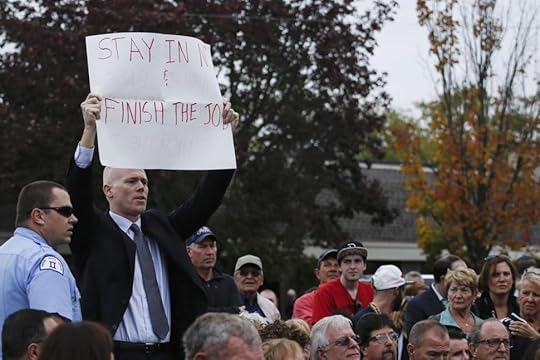
If you’ve read my book WHERE AM I WEARING? you remember Jim Keady. He spent a month in Indonesia living with the workers at a Nike factory. That was in 1997. To this day, Jim still travels back to Indonesia. Recently he was deported from Indonesia for joining a labor rally. He stands with workers and through his work with Team Sweat educates high school and college students about global workers’ rights.
Jim stands for what he believes in. He does not sit down, nor does he shut up.
Yesterday Jim attended a press conference in which Governor Chris Christie was talking about the progress that had been made in Jim’s childhood neighborhood since Hurricane Sandy hit two years ago. Jim held up a sign that read: “Get Sandy Families Back in Their Homes / Finish the Job.”
In the wake of the hurricane, I remember following Jim’s efforts. Someone needed help with the disaster that was their homes and Jim would show up with a crew of volunteers. Eventually the city gave him his own dump truck to drive around and help people recover what they could of their possessions and discard what was unsalvageable. He took off an entire month and did this.
When Christie took to the mic, Jim held up his sign and began to ask him why only 20% of the $1.1 Billion set aside for families impacted by Sandy had been spent. Jim didn’t have a mic, but he had a voice. He kept talking. And eventually Christie shouted him down:
(From Bloomberg)…“somebody like you doesn’t know a damn thing about what you’re talking about except to stand up and show off when the cameras are here. I’ve been here when the cameras aren’t here buddy, and done the work.” Christie went on to tell Keady that “I’m glad you had your day to show off” and now, “turn around, get your 15 minutes of fame, and then maybe take your jacket off, roll up your sleeves and do something for the people of this state.”
There is a time to vote. There is a time to sit and listen. But there is also a time to stand and speak. (My thoughts on Standing Up here). Jim stood.
I honestly don’t know the intricacies of the Sandy recovery efforts, but I do know one thing: Chris Christie told the wrong guy to sit down and shut up.
Here’s Jim speaking out on MSNBC:
Below you can read what I wrote about Jim in WHERE AM I WEARING
In 1997, Jim was a graduate assistant soccer coach at St. John’s University studying theology. For one of his classes, a professor asked him to do a project on theology and sports. He chose to look into Nike’s labor practices in developing countries. At the same time he began his research, St. John’s University, the largest Catholic University in the United States, was about to sign a multimillion-dollar contract committing their coaches and players to wearing nothing but Nike shoes, clothes, and gear. Jim, who refused to wear any Nike products, received an ultimatum: “Wear Nike or you’re out.” Jim’s career as a soccer coach came to an end, and his life as a labor activist began.
Along with labor rights activist Lisa Kretzu, Jim traveled to Indonesia where he lived on the daily budget of the local Nike workers, $1.25 per day, for an entire month. They lost a combined 40 pounds and, as Jim wrote in an article for Doctors of Global Health. He described how “they lived “in a 9′ × 9′ cement box, with…two thin mats to sleep on … in a neighborhood lined with putrid open sewers, riddled with piles of burning garbage, and pollution you could cut through.” The experience left them even more impassioned to raise awareness about the workers, writing, “they are fellow human beings, our brothers and sisters. We will strive to give them a voice, to let the world know that they are suffering and in need of justice.”
October 23, 2014
Win My Fair Trade Underwear & More than $500 of Goodies!
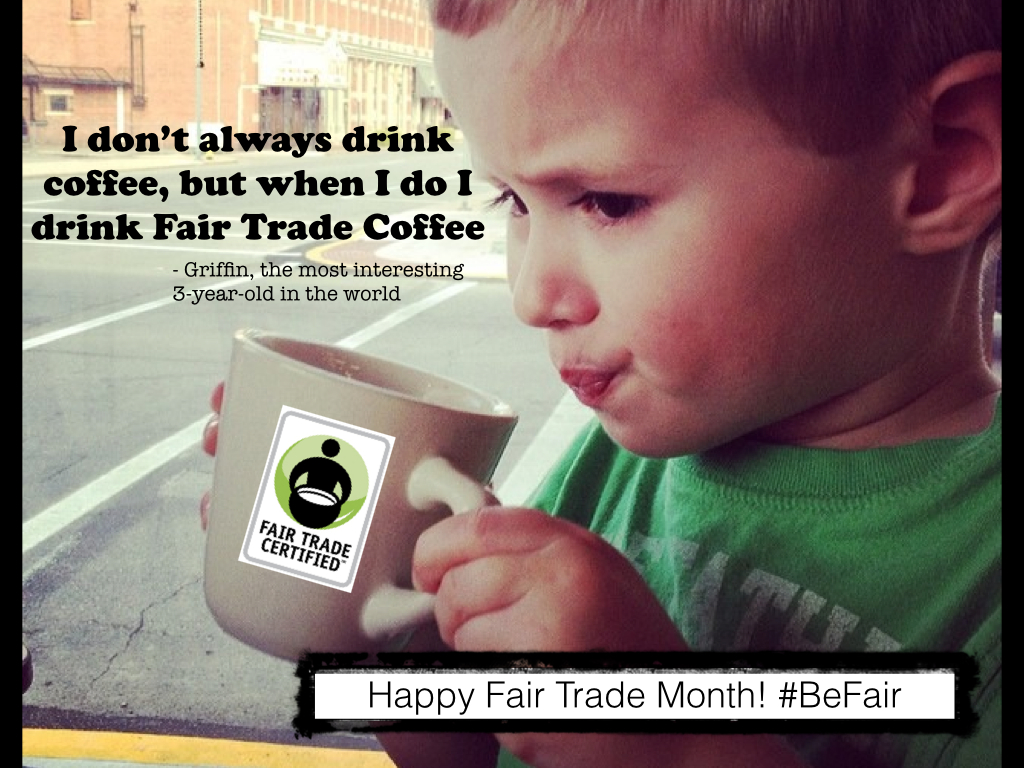
Enter to win more than $500 of Fair Trade goodies!
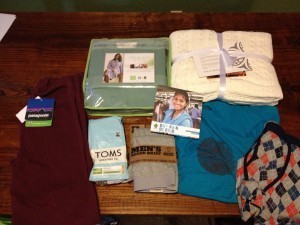
I’m wearing Fair Trade underwear! And you could be too. Just enter the contest below to win more than $500 of goodies including PACT underwear, Patagonia yoga pants, prAna T-shirt, Boll & Branch throw, Under the Canopy bathrobe, and TOMS coffee.
Buying Fair and Being Fair is now more than just about your (and Griffin’s) cup of coffee
The fact that I’m wearing Fair Trade Certified underwear is something I can’t believe. (My super soft organic underwear were made by PACT. I love their slogan: Change starts with your underwear!)
You may have heard of Fair Trade coffee, chocolate and other food products. I write about Fair Trade extensively in WHERE AM I EATING. Fair Trade food is nothing new, but fair trade underwear?
This is a big freaking deal!
Right now, I’m imagining you imaging me sitting in my Fair Trade underwear, and I know what you are seeing in your mind’s eye. You are picturing me in wooly yak underwear woven on some wooden loom handcrafted in Nepal. You are imagining me itch myself. (And if you weren’t imagining this before, you definitely are now. Sorry.)
Stop it!
These aren’t those kind of Fair Trade underwear. These are underwear made in an underwear factory just like the underwear factory that made your underwear. Except it’s not a typical underwear factory. It’s a Fair Trade Certified underwear factory. This means that the factory upholds social and environmental standards outlined by Fair Trade USA. (a PDF of those standards is here.) The brands sourcing from Fair Trade factories pay a 1-10% premium that goes to a worker-controlled fund that can be used for however the workers vote for it to be used.
When I wrote the first edition of WHERE AM I WEARING? in 2007 there was no such thing as fair trade apparel. Yes, there were fair trade handicrafts, and you could buy some items of clothing, but traditional Guatemalan poncho pants don’t necessarily work in Indiana. That is a different kind of fair trade. Handicrafts aren’t upheld to the same standards as Fair Trade coffee or, now, Fair Trade certified apparel.
Then the industry was far from even acknowledging that people in faraway lands actually even made their clothes. In 2007 a consumer or author asking about who made his or her clothes and what their life was like was a radical conversation that even the most forward-thinking apparel companies weren’t ready to have.
Seriously. I had a brand tell me that my views were too extreme. My views? Many people who read WHERE AM I WEARING? aren’t even sure what my views are. And that was intentional. My goal was to take a reader along for the ride and for them to meet the folks I met. My view was that maybe we should think about the people who make the clothes we wear every day, and that we should care about them.
Clothes are changing
Now clothing companies such as PACT, Patagonia, prAna, Oliberte, Under the Canopy, and Boll and Branch are breaking ground in Fair Trade apparel.
It is important that we support these companies as they do so. They are clearing a path, and the apparel industry is watching. In the wake of the Rana Plaza factory collapse, companies are looking for alternatives to the industry as usual. Companies are watching consumers to see if they actually care.
Show them you care by:
Entering to win the contest above
Visiting BeFair.org and participating in Fair Trade month
Browsing the latest in Fair Trade products
Meet Ranjit Singh
Because I’m a vocal supporter of Fair Trade, Fair Trade USA asked me to share a story of one of the workers who has benefitted from working in the Fair Trade certified factory that made my underwear.
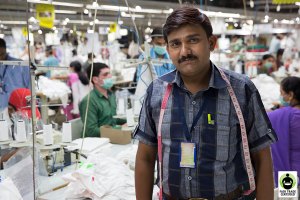
Ranjit Singh, 37, from Pithampur, Madhya Pradesh, India, works as a tailor at Pratibha Syntex, in the same town. A member of the factory’s Fair Trade Committee, he has been in the garment industry for 18 years, and for the past 6 years at Pratibha. “We have a better working environment and overall atmosphere here. Unlike at other factories, the hours are fixed; you get weekly breaks, and no work overload. Once you complete your work, you’re a free man – no tension!” He adds that he’s most thankful that the “factory provides medical insurance my whole family.” “I’m proud of the quality we produce at this factory.”
Supporting workers is the fashionable thing to do
When I met and wrote about garment workers around the world there was no real tangible way to make a difference in the lives of factory workers like Amilcar in Honduras, Arifa in Bangladesh, Nari in Cambodia, and Dewan and Zhu Chun in China. Now there is.
The more we look for the Fair Trade Certified label, as seen below, and the more we support it, the more we’ll see it in stores.
Happy Fair Trade month!
October 17, 2014
Triple Header at Bakersfield College on Tuesday
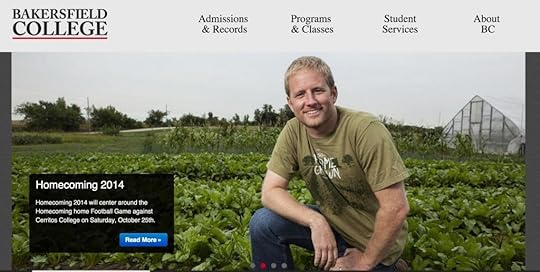
I’m speaking at Bakersfield College in Bakersfield, California, three times on Tuesday. Three times! Apologies in advance to the third audience for not remembering what I’ve said or not said. I honestly don’t know how teachers and professors do back-to-back classes. Actually my mind shouldn’t turn to mush because I’ve got plenty of time between talks.
I’m speaking at 10AM, 2PM, and at 6:30PM. More info on the event here.
The event is part of the Cerro Visiting Author Series:
Made possible by a generous bequest by Delores Cerro, a local citizen who believed in the power of libraries to shape students’ lives, the Cerro Author program brings a prominent writer to the Bakersfield College campus each fall.
Students, faculty, staff, and community members have an opportunity to hear the author speak about the creation of and themes within the writer’s works. Audience members are able to hear firsthand about both the challenges and rewards of the writing process from the vantage point of a professional author.
Once again, I’m grateful for people like Delores Cerro, and for organizations like the college and the library for helping spread my stories.
Other folks who’ve rocked Bakersfield
The Rolling Stones were influenced by the Bakersfield sound and mention the city in the beginning of “Far Away Eyes.”
And the members of Korn are from Bakersfield.
October 16, 2014
Chocolate comes from W. Africa, so does ebola. What this means for Halloween.
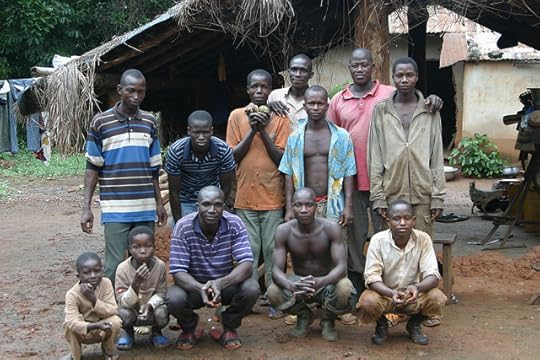
Cocoa farmers I met in Ivory Coast
First off, as ebola madness grips the world . . .
YOU CANNOT GET EBOLA FROM CHOCOLATE!
I was in grade school when the AIDS epidemic blew up in the 80s. My brother convinced me that one got AIDS by sitting on a toilet seat at truck stops after a trucker with AIDS had pooped. Seriously. Granted, at the time I didn’t really know much about sex or intravenous drug use, so I was easily convinced. The thing I don’t know is if my brother made this up or if he actually heard it somewhere. I the ebola fear is any indicator, I’m thinking he could’ve actually heard this.
Yesterday on the news I heard that a school in Cleveland closed today – entirely close, no teachers, no students – because one of the teachers had flown on the same airlines as the nurse from Dallas who was recently diagnosed with Ebola. To clarify: she wasn’t on the same flight as the woman, she was just on the same airline, and they canceled school! Fear of truck stop toilet seats seems rational compared to that.
Anyhow, we’re talking about chocolate. Wait, that was an awkward transition. Oh, well.
Ivory Coast accounts for half of cocoa production. Lump in Ghana and they account for two-thirds of global cocoa production. Neither country has currently been impacted by the ebola outbreak, yet, but they neighbor Liberia and Guinea which have. Many of the workers on cocoa farms come from Liberia and Guinea, but Ivory Coast has closed its borders to both countries. The biggest harvest season of the year begins in October, so there will be fewer workers and the cocoa could rot on the tree. Also, if ebola was to enter Ivory Coast or Ghana, who knows how the farmers would react. There is speculation that they could abandon farms in impacted areas.
All of this means that cocoa and chocolate prices are on the rise, and that cheap Halloween candy could be a bit more expensive. (Of course it should be more expensive to begin with since most farmers earn about one-third of one penny per chocolate bar and can barely support their families. You can read more about that here – Craft Chocolate Sourced and Produced in Africa Fairly and Directly.)
Read All Things Considered coverage on the impact of ebola on cocoa or listen to it below . . .
1 Book, 1 County, & a Host of Awesome Librarians
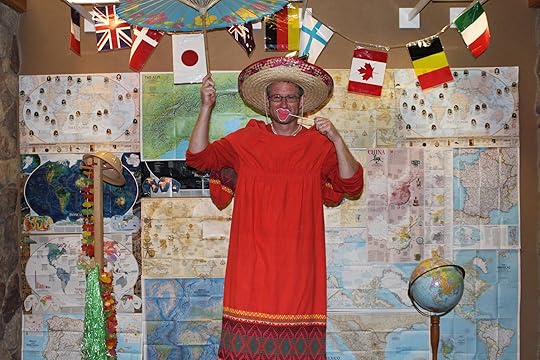
Trying to win the Photo Contest at Wells County Public Library
You can go to West Africa to meet cocoa farmers (although not advisable at the moment with the ebola outbreak). You can write a book about your experience meeting farmers on four continents. But none of this guarantees that your stories will reach the hearts and minds of readers.
For that a little help never hurts.
Last week I had the pleasure of visiting Wells County Public Library in Bluffton, Indiana. They used my book WHERE AM I EATING? in their One Book, One County reading program. Basically, they pick a book, get a ton of copies of it for their patrons, and start a community-wide conversation around the book. If possible, they bring in the author virtually or physically.
About 200 events ago, I learned not to set expectations, other than expecting myself to be pumped about sharing the stories of those farmers and factory workers who’ve let me into their lives. Whether an audience of seven or seven thousand it is my job, responsibility, duty, and calling to feel these stories as I share them.
This lack of expectation allows me always to be pleasantly surprised. And I was most pleasantly surprised at the enthusiasm and hard work those at the library put into their program.
They designed and printed a reading guide with info from the book, updates they compiled themselves, interviews of me, recipes, info about the Facing Project, and section on Fair Trade. I read the reader’s guide and learned stuff! You can view the entire guide here.
Loading
Look at this amazing reader’s guide the Wells County Library put together!
That said, the library itself freaked me out. Don’t get me wrong, it was a gorgeous library, but it was a gorgeous library with about 1,000 pictures of me hanging everywhere — my head hanging from a string, me with a farmer in Colombia. Although it was a bit weird seeing myself everywhere (I feel ya Beyonce), it was a lot of awesome to see a photo of Mr. Feng the apple farmer I wrote about in China holding up an apple, the old woman I taught to throw a Frisbee in Ivory Coast, and so many of the others I met on my journey.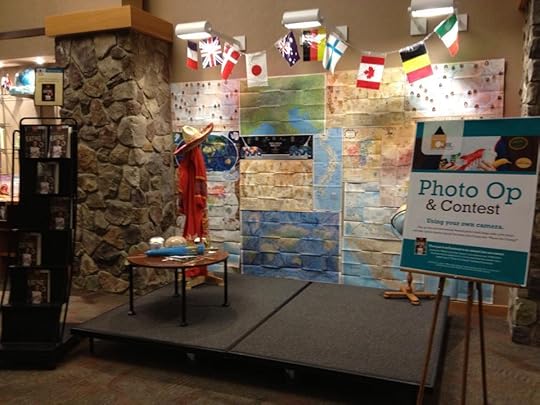
To see their stories come to life on the shelves of the library and know that the 30 copies of my books of the farmers’ stories, were constantly checked out and being read in Bluffton, Indiana, meant the world.
So a great big thanks to all of the amazing librarians who’ve helped share my stories, especially to Catherine Campbell (who designed the guide), Julie Christian (who I’m officially endorsing for county auditor), Emily Marshall (who made the event happen), and Stephanie Davis (who assembled such an amazing team). You all make the world a better place one book at a time.
Also, thanks to the fabulous audience that attended…