Kelsey Timmerman's Blog, page 22
October 9, 2014
Fatal diagnosis leaves young newly wed asking important questions
You’ve probably seen this video below of Brittany Maynard talking about her decision to end her own life after her fatal diagnosis. I wanted to highlight something she said that one asks themselves when facing death:
“What’s important to you? What do you care about? What matters?”
And her answer:
“Pursue that. Forget the rest.”
Brittany is choosing to spend more time with family and friends, and to travel to as many places she wants to see as she can.
Brittany is scheduled to die on November 1st.
Family. Friends. Travel. That’s what matters to Brittany. She doesn’t say that she wants to spend more time at work finishing a big project or buy a brand new corvette with her retirement money she’ll no longer need. Those things don’t matter to her.
I am not saying that working on a big project or getting a corvette is a bad thing. Obviously, when our lifespan shortens by decades priorities change. But thinking of our own mortality is an important reminder about what is actually important.
My friend, BJ McKay, recently told me to pick up a newspaper and look at the ads. Ads tell us that we’re not smart enough, rich enough, skinny enough, healthy enough, and not having enough “spine-tingling” sex. And then look at the obituaries. You won’t find anything about personal appearance, sex life, finances, or cars in an obituary. You read names of people and places and possible a life’s mission.
We are all scheduled to die at some point. Brittany’s story is an important reminder for us all to ask ourselves…
“What do I care about? What matters?”


October 8, 2014
Thankful for the Support of Hoosiers

Wells County selected WHERE AM I EATING? for their One Book One County community read program. Tomorrow night I’ll be speaking at the Main Library in Bluffton, Indiana, from 7-8 PM. Here are the details.
The event was made possible by the Indiana Humanities Novel Conversations program. Over the past year I’ve had the chance to interact with Indiana Humanities, The Indianapolis Public Library Foundation, and the Glick family, which supports both programs, and I’m so thankful for all the hard work all of them do.
Indiana Humanities
Indiana Humanities mission is to connect people, open minds and enrich lives by creating and facilitating programs that encourage Hoosiers to think, read and talk.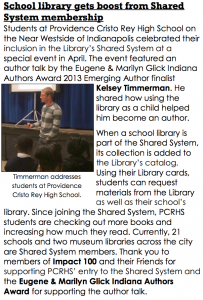
I can get behind that. If you are a hoosier, you should check out IH’s ALL-IN site that challenges Hoosiers to do all of the above by connecting with Indiana facts, art, books, events, and ways to be engaged as both a global and local citizen in Indiana.
Indianapolis Public Library Foundation
Earlier this year I was invited by the Indianapolis Public Library Foundation to speak at Providence Cristo Rey high school to celebrate the school’s inclusion in the Indianapolis Public Library system. The shelves of the school’s library were still pretty bare, but they were getting more books by the day, and the students could access any book in the entire system. But the change couldn’t been seen on the shelves, but on the faces of the students and the librarian who was almost moved to tears as she shared the story of the library and what it meant to the students.
Eugene & Marilyn Glick Indiana Authors Award
And of course there is the Indiana Authors Awards which supports authors and libraries, and celebrates both at the annual award dinner. I’m blown away that I’ve been nominated a consecutive year for the Emerging Author Award alongside Jessica Brockmole, and Clifford Garstang. The winner will be announced at the Award Dinner on October 25th where Michael Shelden, the national award winner and Norbert Krafp the Regional award winner will speak.
You can get tickets for the fancy shindig here. Here’s the Reading Guide they created for EATING.
Annie and I enjoyed the event last year. They put up the winners and nominees in a fancy downtown hotel. We treated it like a mini-vacation. Besides being an awesome kidless-getaway, the best part of the event was meeting the other authors.
I recently wrote for the Authors Award blog about the gold nugget I carry in my pocket and how it represents the told and untold stories I carry. Without support from great organizations like Indiana Humanities, the Library Foundation, and the Authors Award, my stories wouldn’t reach nearly as many people. It’s nice to have people who will help you carry and share the burden and joy of stories.
October 6, 2014
Why academic writing stinks?
Please call me Bachelor Kelsey Timmerman or if you prefer Kelsey Timmerman Bachelor of Arts.
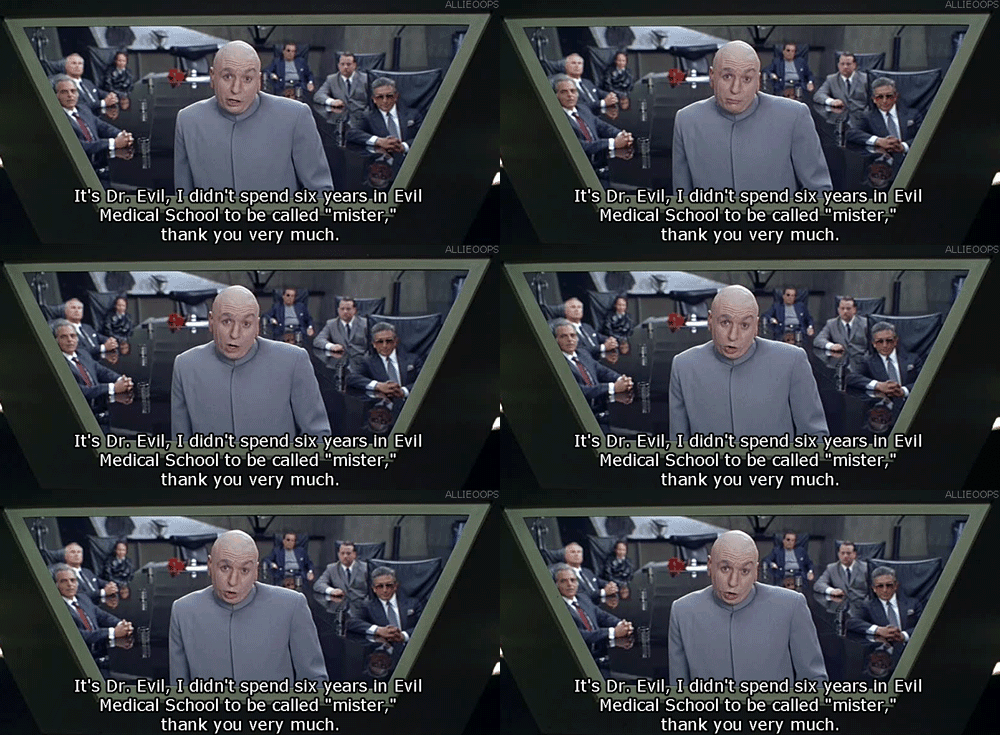
Actually, no one ever calls me that. A BA isn’t as noteworthy as, say, Dr. Evil’s PhD at Evil medical school.
I speak at a lot of universities and have the pleasure of chatting with a lot of really smart professors with PhD’s and Masters. Sometimes for some reason, folks assume that I at least have my masters.
“Where did you go to grad school?” They’ll ask.
My grad school was writing 100,000 words of travel columns cooped up in my Key West attic apartment accessed by a fold out ladder. That’s where and when I learned to write and found my voice.
So, I didn’t learn to write in an academic setting. I’ve had professors point out to me that my writing isn’t very academic. I’m not always sure how to perceive this and how to respond. Sometimes I think it is a bit of a dig and sometimes I actually think it’s a compliment, since after all, my goal is for people to actually read my work.
I have taken all of this in and was very concsious about making EATING a bit more academic than WEARING. This was mainly in the form of sited facts and studies. I hope however that I didn’t do this in tone or readability.
Recently I heard from a professor using WEARING in a remedial English class. They liked how WEARING was accessible to their students who read at a Junior High reading level. My goal is to write like I speak. Apparently I speak like I’m in Junior High!
So I try to strike a balance between writing to be easily read, but also to be somewhat academic.
The most awkward question I’ve ever been asked during a university visit was during a lunch with faculty. One of the professors in attendance asked:
“Professor Smith has been writing about these issues for years, but his work has reached far fewer people. How does this make you feel?”
Yikes! I had no idea how to answer that. “Sorry professor, Smith!”
I didn’t say that. I think I just took a bite of my sandwich and pretended to choke on it.
There is a place for academic writing, and I believe that certain standards and tone must be upheld so academia can build upon what we know already. Otherwise knowledge is based on pop-science, which is a shoddy foundation to advance knowledge. Malcolm Gladwell is always interesting, but I don’t feel that his work adds to the spectrum of “what we know.” But to make “what we know” spread to the masses someone has to decipher academic writing.
In the Chronicle of Higher Education, Steven Pinker, a professor of psychology at Harvard, outlines why academic writing stinks and challenges academics to write better:
Our indifference to how we share the fruits of our intellectual labors is a betrayal of our calling to enhance the spread of knowledge. In writing badly, we are wasting each other’s time, sowing confusion and error, and turning our profession into a laughingstock.
There is no excuse for bad writing. Writing that isn’t clear and concise is bad writing. An author of any article or story who doesn’t write with empathy for his or her reader, needs to work harder.
“Your writing isn’t very academic” shouldn’t be a compliment.
September 18, 2014
Are perfect attendance awards stupid?
Harper is home sick today from Kindergarten. This is her first ever missed day of school. She had a good run . . . for a month. Looks like she won’t be the Cal Ripken of Royerton elementary.
Anyhow, all of this got me thinking about awards for perfect attendance.
A perfect attendance award means:
a) a kid or employee was never sick;
or
b) they were sick, likely multiple times, and exposed the other students and their co-workers to their germs.
Never being sick is highly unlikely so that means awarding perfect attendance is encouraging the spread of germs in schools and the work place. And that seems kind of stupid, doesn’t it?
I could be wrong. In high school, before I had sinus surgery, I missed a lot of school. So much, in fact, that I got a letter from the school. So take my opinion with a grain of salt.
Right now Harper is on the couch watching cartoons experiencing her first sick day. I’m kind of jealous. There’s something really awesome about stretching out on the couch watching cartoons while all of your classmates are in class. It almost makes that sore throat or repeated trips to the bathroom worth it.
I remember a sick day where I was home alone and spent all day sitting in the bean bag playing Bulls vs. Lakers on Sega Genesis while listening to AC/DC’s Back in Black album. That was a pretty sweet day.
September 15, 2014
Urban Outfitters selling blood-stained Kent State hoodies

In 1970 four Kent State students were shot to death and nine more were wounded as the National Guard turned their guns on protestors. Forty-four years later, Urban Outfitters is monetizing the tragedy by selling a blood-stained hoodie complete with bullet holes.
Of course Urban Outfitters says the red stains and holes were simply an accident. Sure, an accident that the company photographed and posted on its site for sale for $125.
You can read about the controversy on Mashable and BuzzFeed so I’m not going to recount everything that has been said, but I want to make two points.
All Publicity is Good Publicity . . . unless we act
Has H&M benefitted from the fact that their clothing labels were found in the Rana Plaza disaster that killed 1,129 Bangladeshi garment workers?
Has American Apparel benefited from its ads depicting women as faceless sex objects all while having the King of Perves at the helm?
Hard to say. But I know that they will suffer the bad reputations they deserve if we choose to not give them our business. That’s the nice thing about a free market: We have a choice. If we choose to support companies like this and they succeed maybe they aren’t the problem, maybe we are.
Imagine the worker who made the holes
I’ve been to a factory in Cambodia where I witnessed young women using motorized grinders to put holes in perfectly good pairs of blue jeans. They would put a hole in the knee and then hold it up to the light as if asking themselves, “Will the Americans think this is a cool hole?” Holes aren’t put in by a machine; they are put in by people. People who can think, “Why the hell would anyone want to wear a hoodie that looks like the wearer had been shot.” I have no idea where these shirts were made, but I can guarantee the producers thought. “These people are nuts.”
Kent State’s response
Kent State University issued a statement condemning Urban Outfitters.
May 4, 1970, was a watershed moment for the country and especially the Kent State family. We lost four students that day while nine others were wounded and countless others were changed forever.
We take great offense to a company using our pain for their publicity and profit. This item is beyond poor taste and trivializes a loss of life that still hurts the Kent State community today.
We invite the leaders of this company as well as anyone who invested in this item to tour our May 4 Visitors Center, which opened two years ago, to gain perspective on what happened 44 years ago and apply its meaning to the future.
The reality
August 28, 2014
Craft Chocolate Sourced and Produced in Africa Fairly and Directly
Some African cocoa farmers have never eaten chocolate even though the continent supplies more than half of the world’s cocoa.
Cocoa is a commodity, one of the world’s most volatile, and the quality of the farmers’ lives rise and fall with the cocoa prices. The money isn’t in the growing of cocoa, but in the processing of the cocoa into chocolate, the packaging, and the selling of the chocolate. This typically happens far from African soil. Hence you have cocoa farmers who’ve never tasted chocolate, and others like the ones I ate Hershey’s Kisses with in Ivory Coast who rarely do.
But one company, Madécasse, is challenging that model. Of the 500 chocolate brands in the U.S., Madécasse is the only one making chocolate from bean to bar entirely in Africa.
Recently, I had the chance to talk via Live Google Hangout with Madécasse CEO Tim McCollum about all things chocolate.
Tim is a former Peace Corps volunteer who taught English in Madagascar. He taught classes of up to 100 first graders. Tim said it was inefficient and deficient, and he wanted to make a bigger impact beyond his time in the Peace Corps.
We talked about his path from college history major to becoming a cocoa entrepreneur (watch the video to hear about his background).
“If Africa as a continent would make a little more chocolate than they do today,” Tim said, “they’d create a lot of opportunity for people.”
And that’s exactly what the bean-to-bar movement that Madécasse is a part of is trying to do.
Craft Chocolate
Think of the bean-to-bar movement as being in the early stages of the craft beer movement. In fact, many are referring to it as craft chocolate.
So you have a few chocolate nerds across the country who travel the world searching for the best cocoa, and they’re willing to pay farmers a premium for it, which decommodifies cocoa. This close relationship with farmers is called “direct trade” and something many point to as an alternative to Fair Trade.
Direct Trade vs. Fair Trade
Some of the most interesting parts of my discussion with Tim were about direct trade and fair trade. Fair trade is a third-party certification that sets certain environmental and social standards on a product. Fair trade also establishes a minimum price so farmers are somewhat protected from a downswing in a commodities price, and a fair trade premium – currently about 6% of the price of cocoa goes back to farmer co-ops for them to vote on how to spend.
Direct trade is less about a certification than the nature of the relationship between the chocolate maker and the cocoa producer. The maker pays the producer directly and often meets with the farmers face-to-face.
Whenever I mention fair trade, of which I’m a fan, someone always throws out direct trade as a better alternative. It could be, but without third-party oversight and a system of checks and balances, consumers have to rely solely on the word of the chocolate maker.
Personally, I believe there is room for both fair trade and direct trade. Nestle, Hershey’s, and Cadbury could never know all of their own farmers or work directly with them, but could and are buying fair trade certified cocoa. Smaller direct trade chocolate brands are also purchasing Fair Trade Certified beans directly from farmers. In this way, fair trade and direct trade can work together so farmers earn more for the fruits of their labor and a third party ensures that social and environmental requirements are being upheld.
Madécasse’s model goes beyond direct trade and keeps more of the value of chocolate in Africa. According to Tim, Madecasse is changing the lives of 200 farmers and factory workers.
I hope more chocolate nerds follow in Tim’s and Madécasse’s footsteps. But it isn’t easy according to Tim:
“You have to be a little crazy to be doing what we are doing, making chocolate from start to finish in Africa.“
August 27, 2014
I Took the ALS Ice Bucket Challenge in my Anti-Fart Underwear
Harper is totally going to need therapy!
I’ve never known someone who died from ALS, nor was I fully aware of how scary the disease was until the challenge. So as silly as this challenge seems, it raised my awareness.
Is it a sustainable way to raise funds or even replicable? Probably not. But it’s fun and important, and even my own parents accepted the challenge. OnPoint explored the viral campaign on a show titled “Stunt Philanthropy in the Age of Social Media.” If you’ve criticized or defended the Ice Bucket Challenge, you should listen to this show:
And of course, I hope you’ll join Harper and me in donating to the ALS Association at www.alsa.org.
August 14, 2014
Places I’ll be telling stories: Iowa, Minnesota, Florida, Indiana, South Carolina, California, Illinois, Texas and beyond
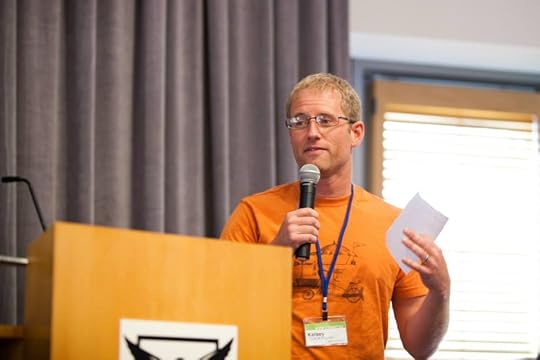
(I love this photo by Gail Werner of Gail Werner photography because it looks like I’m about to tell someone to F@#K off! For the record: I wasn’t.)
Have we met? Here’s my speaking schedule (as of 8/13). If I’m at a city near you, let’s grab a coffee or beer or come hear me speak. I’ll bring the novelty underwear and the banana. Wait? That doesn’t sound good. I mean that in the least sexual way as possible.
Seriously though, during these events I’m telling all sorts of stories, which I love to do. But do you know what I love to do more? I love to hear stories. I like to shut up and listen. It’s probably one of the things I’m best at. So if you are in, near, or traveling through one of the places below, let me know if you want to share your stories with me.
There will definitely be more events filling in this list. I just don’t like to list them until they are super official. One might even be in another country.
9/2: Iowa State
9/9: University in Minneapolis area. Will announce if/when firms up.
9/10 & 9/11: Gustavus Adolphus (common read. Students have choice of reading EATING or WEARING. Small class. I think 600)
9/11: Fair Trade Fashion Show Mankato, MN
10/9 Wells County Library Bluffton, IN
10/21:Bakersfield College (CA)
10/25 Indiana Authors Award
This is my second year in a row as a finalist for the Emerging Author Award. (Still emerging!) This is such a fun day. In the morning there is a panel of the 5 winners and finalists. In the evening there is a very schmancy shindig. You have to have tickets. Last year I wore a suit. And I never wear a suit!
11/6 Franklin College (Indiana) – speaking event
“Where am I Wearing?”
Thursday, November 6 • 7 p.m. | Branigin Room,
Napolitan Student Center
11/19 Cal-Poly Pomona
11/21 CSU Channel Islands
2015
1/25 – 1/30: Mini-residency at University of Illinois
2/11: University of Florida, Gainesville, Florida
2/25: Texas A&M – Kingsville
3/2 – 3/4: Winthrop University
August 13, 2014
Love chocolate? You’ll love this Live Hangout @2:30 ET
Tim McCollum, a former Peace Corps volunteer, is the CEO of Madecasse, a Brooklyn-based chocolate company that sources cocoa and manufacturers chocolate entirely in Madagascar. Tim joins me LIVE on Google Hangouts to discuss the African cocoa industry’s challenges and potential. Join us! Ask a question!
Here’s a promo video from Madecasse:
August 12, 2014
How to Talk About Suicide

In 2010 I traveled to Ireland to research suicides. The gap between the loveliness of the people and grimness of my topic was wider than the Atlantic. I had the world’s worst response to: “Welcome to Ireland! What brings you here?”
I’ve carried a lot of stories over the past twelve years I’ve been writing, but few have been as heavy as those stories from Ireland. They have been even heavier because the book never came into existence, and I’m not sure where you publish such stories. So for the first time, I’m sharing them on this blog and on the blog of the Facing Project.
I’m not an expert on suicides. I’ve never been personally touch by suicide. So one of the first things I did in Ireland was track down an expert, Tom, who you’ll meet in the piece below. Tom volunteers with a group that works to prevent suicides, Samaritans. Samaritans has a resource on how to report on suicides here.
The thing about writing about suicides is that reporting on suicides can lead to copycat suicides and ultimately suicide clusters. In the wake of Robin Williams’ tragic death by suicide, we need to talk about suicides, and we need to talk about suicides responsibly.
You can read about Michael and Rose who lost their son over at The Facing Project.
Trigger Warning: So if you are reading this and think maybe you shouldn’t, please stop.
—
“I was volunteering as a nurse at a prison and chatting with a man who tried to kill himself,” Tom says. “He was standing on a bridge waiting for a train to come and hit him. Right before the train got to him, he jumped. I asked him, ‘What was going through your head right as you jumped?’ I’ll never forget what he told me.” Tom leans in. “He said, ‘I was hoping to God I’d live.’”
Tom is the director of the Limerick branch of the Samaritans. The Samaritans are a group of trained volunteers that offer support for people when they are having suicidal thoughts or just need someone else to talk to when there is nowhere else to turn. There is something unusual about Tom: the way he talks and smiles and moves is happier than the real world. This is even more so when set against our morbid topic.
“Often people who hang themselves are found with scratch marks on their necks,” Tom says. He scratches at the imaginary noose around his neck. “At that last moment they are fighting to live.”
Tom and I are at a restaurant sitting in a long wooden booth, something that looks like it would be at a steakhouse in Texas.
“It used to be a crime to kill yourself,” Tom says. It wasn’t until 1993 that the legislature decriminalized suicide in Ireland.
How were the dead punished? They couldn’t be buried on church property. They couldn’t have a burial service. They were punished for eternity.
“Often the doctor wouldn’t say if it was a suicide or not,” Tom says. A lot of people “drowned” in rivers or died before their time of ‘natural causes.’ Now, when I talk with priests about doing services for someone who died by suicide, I tell them to use the word suicide.”
I’ve never heard anyone talk about suicide the way Tom talks about suicide.
When talking about answering the phones at Samaritans, he says, “I tell them to think about the worms eating into their brains…their flesh decomposing.” My mouth hangs open more than enough to let a few worms in. Here’s this witty, quick-talking Irishman with a small voice taking suicide head on.
One thing that really stands out is that Tom doesn’t ever say, “commit suicide.” The two words are almost married in everyday talk, in the newspapers, and on TV. “A criminal commits a crime. A murderer commits murder. A man who cheats on his wife commits adultery,” Tom says. “Suicide isn’t something you commit. It isn’t a crime. People choose suicide when they feel like they are a burden.” In this way maybe suicide is the ultimate act of love. You feel like your family would be better off without you so you make it so.
“How do you think the financial crisis relates to the increase in suicides?” I ask.
“We had a seventy-five percent increase in calls this Christmas,” Tom says. “Parents can’t buy presents for their kids. They explain that Santa can’t come this year, but Santa visits their neighbors.”
Limerick has been especially hit. A few blocks from the Samaritans’ office sit modern, shiny apartments, built to house some of the nearby Dell factory’s five thousand employees. The city, once known as “Stab City” for the amount of crime, had remade itself with the tech industry in the nineties. But Dell started to pull out in 2008 and now the apartments are mostly empty.
Not everyone believed the period of unprecedented growth in Ireland between 1995 and 2007, known as the Celtic Tiger, would continue.
In 2007 as the Celtic Tiger was showing signs of faltering, Ireland’s Prime Minister, Bertie Ahren, while discussing those predicting the economy’s collapse, said, “Sitting on the sideline or the fence, cribbing and moaning is a lost opportunity. In fact I don’t know how people who engage in that don’t commit suicide.” Now that the naysayers have been proven right, and the immortality of the Celtic Tiger has been proven wrong, many are doing exactly that.
The Irish Property council, a group made up of builders, has linked twenty nine suicides of their members to financial distress.
January 19th, 2009 – RIP Patrick ROCCA, 42, of Dublin
Patrick Rocca came from a successful family. The New York Times referred to him as a cub of the “Celtic Tiger.” In 2007 he was reportedly worth $647 million dollars. In his personal helicopter he took Bill Clinton on a tour of golf courses in Ireland. He once flew psychic, Uri Geller, over a World Cup qualifying match with Switzerland to send positive vibes to the Irish team.
The property and stock market collapses took much of his fortune with them. On a Monday, after a Sunday spent with family and friends, after his wife left to take their kids to school, Partrick, brother-in-law to singer Van Morrison, husband to Annette, father to sons Stuart and Patrick Jr., paced in his yard in his pajamas, put a shotgun to his head and pulled the trigger.
Some call the gunshot heard by his neighbors, “The Gunshot Heard Around the World” because it marked the death of the Celtic Tiger.
February 27, 2009 – RIP John O’DOLAN, 51, of Galway
John O’Dolan was one of the West Coast’s most successful builders. He believed the Celtic Tiger would continue, and bought the Island of Ireland in Dubai. The project, referred to as ‘The World’, was started in 2003. The islands were of such a scale that only satellites, astronauts, and gods looking down scratching their heads could see that they were placed to replicate the shapes of the continents. When the financial crisis hit, ‘The World’ collapsed.
Fourteen billion dollars later, only the island of Greenland has been developed. The other two hundred and ninety nine islands don’t have so much as a lone palm tree or shack on them. When The World collapsed it took down people with it. A pair of developers who bounced checks are in jail. Lawsuits nearly outnumber the island’s grains of sand. And John O’Dolan, husband to Eileen, father to daughters Fiona and Roisin and son Robert, went to an unused horse shed, tied a noose, stuck his head in it, and took his own life. He hung there until his father found him.
“John was a very strong character,” said Father Peter Finnerty, who knew John since he was nine. “He was the last person I would have thought that this would happen to. He had rung me the week before and he did say he was under terrible pressure in relation to business matters…He enjoyed what he had and he was a happy person. And if things were getting him down he would say ‘ah, sure it’s only money’ or ‘it’s only business’. He had that type of attitude. That’s why I believe that somewhere along the line he was put under a strain he couldn’t endure.”
“Many of you are saying … why did John do this? Why are we in this situation?” Father Finnerty said, presiding over John’s funeral. He didn’t shy away from how John died. He took it head on just like Tom would tell him to do. “John was under immense stress and strain that led to deep depression. And I think that John felt that he had let his friends down. That is my view, because he loved everybody and would never let anybody down.”
December 19, 2008 – RIP Jack MARRY, 64, of Meath
Jack Marry was a pig farmer, a very successful one. He retired in 2002, and after a lifetime of investing his money in living, breathing assets, put his money in the stock market. One morning, shortly after the market collapsed, Jack, husband to Rosemary and father to six children, placed a note on the kitchen table, walked upstairs to the bathroom, locked the door, put a shotgun against his head and pulled the trigger.
At his funeral, Father Joe Deegan said that Jack was a genius at solving problems.
Tom and I discuss these deaths and others that have made the headlines. In fact, one out of every ten calls the Samaritans receive now is recession-related. Suicides have become so common in the business community in Ireland that one businessman was reported to have texted another notifying him about a mutual acquaintance’s suicide and ended the text with, “It’s another financial.”
A financial crisis causes a loss of identity and introduces uncertainty. “It is especially demanding on men,” Tom says. “They lose their job and feel inferior. Some men have expressed concern about their wives selling themselves to make money. They think, ‘What if there is no other option and my wife has to sell herself and she doesn’t tell me?’ The crisis threatens morals. Robbery increases. I’ve talked with people who were afraid they would have to start stealing.”
It threatens our friendships. “It’s a change in culture. Before you had parties, you attended parties. You went on holidays with your friends. You went golfing with your buddies. You met them at the pub. Now you can’t do those things and you fall out of your social circle.”
It challenges our beliefs. “You had great faith and you prayed – prayed harder than you ever have before – but you get a negative outcome.”
But one thing is for sure, the person who kills himself doesn’t have to live with his actions.
—
You can read about Michael and Rose who lost their son over at The Facing Project.