Kelsey Timmerman's Blog, page 23
August 11, 2014
Review WHERE AM I EATING and get goodies!
Would you help share the stories of the farmers and fishermen who catch pick and grow our food? What if there was bacon and chocolate on the line? That’s right…BACON, chocolate, and some other goodies.
The paperback of WHERE AM I EATING? is coming out in about one month. I’m pumped for the stories of the farmers I met on my global farming adventure to spread even more. About 80% of the folks who read my first book, read the paperback. So a big push on the the paperback is really important.[image error]
If you’ve read EATING, now would be a great time to share what you thought of it by writing a short review on Amazon, Goodreads, or any other review site or blog of your choice. If you do so, send me the link to your review or simply tell me you wrote one, and I’ll email you some new materials we are including in the paperback (new introduction and Guide to Going Glocal).
I’ll also enter you in a drawing to win a gift basket hand-selected for you by me and made up of my favorite things from my local, organic, Fair Trade grocery — the Downtown Farm Stand in Muncie. It’ll be stacked with coffee, chocolate, tea and if you’re not a vegetarian, I might even throw in a little of my favorite bacon!
Here’s where to review EATING on Amazon and here’s where to review EATING on Goodreads.
It doesn’t need to be a five star, raving review. It doesn’t need to be an epic review. Just make it a few honest sentences about what you liked and/or learned from the book, or even what you didn’t like.
And if you haven’t read the book, please do. These folks let me into their lives to share their stories, and I’m honored each and every time I get to do that.


August 7, 2014
Unfortunately Ugly Produce Wins Hearts of French Consumers
Supermarkets checkout lines are filled with magazine covers of photoshopped, liposucked, and unnaturally enhanced specimens of biology and reality. But the unrealistic expectations in our supermarkets don’t end there.
We like ‘em big, round, smooth, and shiny. And of course now I’m talking about fruits and vegetables.
I love big beets and I cannot lie
Forty percent of food in the United States goes uneaten. This includes ugly fruits and lumpy vegetables. The cost to transporting food to our tables accounts for 10 percent of the U.S. energy budget, uses half of our land and 80 percent of the freshwater consumed. Yet, if a potato has an extra lump or an orange a strange phalange, they get tossed without a second thought.
More than 20 pounds of food per person is tossed every month. That’s $165 billion of wasted food each year. If only 15 percent of it were saved, 25 million Americans could be fed. Now that’s ugly.
(Stats from National Resources Defense Council report, Wasted: How America Is Losing Up to 40 Percent of Its Food from Farm to Fork to Landfill)
Bananas at the banana processing plant I visited in Costa Rica while researching Where Am I Eating? had to meet 40 consumer appearance requirements. Fifteen to twenty-five percent of the bananas do not and are discarded.
The produce section is a beauty contest void of dweebs, geeks, and weirdos.
A grocery chain in France, Intermarche, recognized that beauty may only be skin deep, but deliciousness is deeper. They bought the lumpy, blemished, and dull produce that the producers normally discarded, marked them on sale, and gave them their own display. Consumers saved money. Producers and retailers made more money. And all that energy, water, chemicals, fertilizers, and hard work that went into growing these formerly unwanted fruits and vegetables wasn’t for naught.
You can learn more about Intermarch’s efforts in this video:
Hat tip to the gang at Rule29, the folks who designed my site, for pointing me to this.
August 4, 2014
Cocoa Farmers Who’ve Never Tasted Chocolate – GASP!
The above video of cocoa farmers in Ivory Coast tasting chocolate for the first time has been making its rounds, and, in fact, has been pointed out to me about eleventy thousand times already. (Seriously, thanks for thinking of me folks; I’m not complaining.)
Like the reporter in the video, I traveled to Ivory Coast to meet farmers and lugged along some chocolate. I assumed they had never eaten chocolate too and that I would blow their taste buds with Hershey bars and Hershey kisses.
I assumed wrong.
Here’s a video from my own experience followed by an excerpt from Where Am I Eating? An Adventure Through the Global Food Economy:
In much of the reporting on Ivorian chocolate, a reporter asks if the farmers have ever tasted chocolate and then the reporter is shocked to learn that they haven’t. The reporter files his story full of indignation: “These farmers brave snakes and swing machetes to harvest cocoa and they haven’t even tasted chocolate.” The cruel irony! The humanity!
“Have you eaten chocolate before?” I asked.
Yes. Yes. Yes. They all have.
“Want some?” I reached into my bag and pulled out a few Hershey’s Kisses followed by Hershey bars I had grabbed from the emergency s’more section of our pantry before I left my home in Indiana.
I passed the slightly melting bar to Serdge, who broke off a piece and gave it to Jack, who passed it along to a tall farmer named Francois. Each person gently pulled back the wrapper and took their bite. Lips smacked and Michael, a father of three, was the last to join our chocolate communion. He broke off three pieces, handed two of them to boys next to him and then popped in his own bite, overacting a smile and sounds of pleasure to the delight of our group.
They asked me about the price of chocolate and I did some math. An individual Hershey’s bar is roughly one-tenth of a kilogram, and costs $1.
“Ten dollars per kilogram,” I said.
They leaned back and made various sounds of shock, no doubt including a few swear words in disbelief. They are currently receiving 50 to 60 centers per kilogram of cocoa beans.
They ride the highs and lows of chocolate while the consumer always pays the same amount. It seems like I’ve been buying $1 Hershey bars forever.
What is the price of chocolate? That is a good question. And it’s exactly what I came here to find out.
So the cocoa farming video went viral. Great!
But I think many of us are watching the video the same way, say that we’d watch a video of an elephant seeing the ocean for the first time or one where cows are released in the pasture for the first time. But the cocoa farmers are people trying to support their families selling a commodity into a supply chain dominated by just a few players, including Cargill and Archer Daniel Midland.
The tragedy isn’t that they’ve never tasted chocolate; it’s that they are valued so little. That they often have to rely on slave labor. (The industry relies on 160,000 slaves in Ivory Coast. I sort of freed one. It’s complicated.) That they long for knowledge on how to farm better, but receive little help. That all of the value to their product is added on another continent. That cocoa is one of the world’s most volatile commodities, and as the price rises and falls so do the futures of the children of the cocoa farmers.
June 30, 2014
Gay Married in Indiana for 7 hours
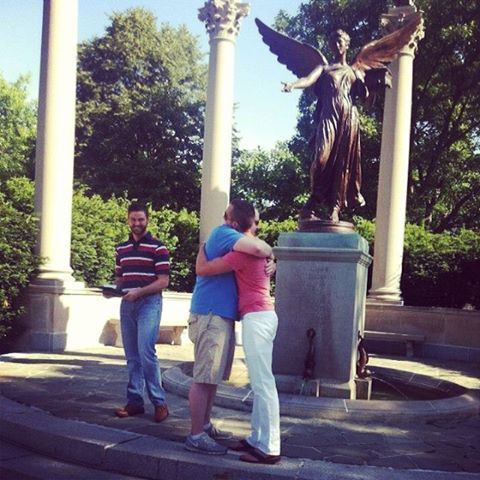
Last week I attended a wedding wearing a sweat-soaked T-shirt with a winking turd on it. However, my apparel was unremarkable compared to the event itself: Two men in Indiana were getting legally married.
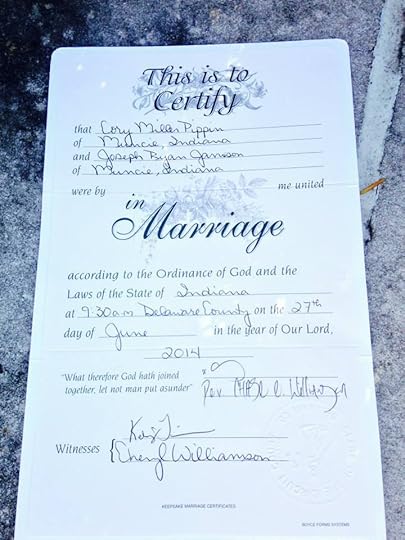
Same-sex marriage was was made legal by a court ruling on June 25th by Judge Richard L. Young. On June 27th, my good friend J.R. Jamison was marrying his husband Cory. They’ve actually been married longer than Annie and I have, but they wanted to make it official in the eyes of the State of Indiana and the federal government. Like many same-sex couples, they rushed to get married, fearing an emergency stay would be put in place by Indiana’s attorney general.
It wasn’t my intention to wear a turd T-shirt to the wedding. J.R. invited us to the wedding as Annie, Harper, and I were stepping into the gym. The text came at 7:47 AM, which was just an hour after J.R. had invited his mother to the wedding. The text read:
“Getting gay married today around 9.”
We finished our workout and hustled over to the Ball State campus. J.R. and Cory were getting married beneath the university’s iconic Beneficence statue.
On the way, Annie asked if we should say something to Harper about how this wedding was different than others she had attended. For starters her father had a turd T-shirt, but that’s not what Annie meant.
“Harper,” I said. “J.R. is marrying a boy named Cory.”
“Okay,” she said.
I looked at Annie. Do we leave it at that? Was that enough to not have her say, “Why are there two boys holding hands?” during the ceremony.
“Harper,” Annie said, deciding to expound a bit, “a girl can marry a boy, or a boy can marry a boy, or a girl can marry a girl.”
“I know that,” Harper said. “I guess that’s a little weird . . .” and then she shrugged as if to say whatever.
Annie pointed out all of the other same sex couples who Harper knows and loves — Cousin Brice and his husband Billy, Aunt Karen and Aunt Julie. Most of what Harper knows about weddings she has learned about from the weddings of Disney and My Little Pony princesses. These are “traditional marriages” if you count horses getting married as long as they are of opposite sexes as a traditional marriage. Harper didn’t have any more questions. She had accepted people could marry whomever they wanted and was done with the conversation and onto chattering about all of the other things five-year-olds chatter about.
Before the ceremony started, Cory said he couldn’t believe that he was about to get married in Indiana. July 2nd marks the couples 9th wedding anniversary and they had been planning for months to go to New York City the following week to get married. That marriage would be recognized by the federal government. And then the Indiana ruling happened and they were proud to get married in their home state.
During the ceremony, Harper stood between Annie and me. Although Annie and I weren’t dressed appropriately, Harper wore a rainbow Rainbow Dash dress. She didn’t say anything. She didn’t have any questions. She just stood and watched as if something like this happened everyday.
Some are against same sex marriage because of their religion. I don’t understand that, but I accept their choice to believe what they believe. But I don’t accept faith being used to discriminate against an entire group of people. Love is love and the law is the law.
Marriage equality isn’t a faith issue; it is a rights issue.
On June 27th in Indiana no matter who you loved or chose to marry, you had all the legal rights provided to you as a married couple by the state and by the federal government.
J.R. and Cory’s first wedding nine years ago was a symbol of their commitment to one another, but this wedding would provide them with rights.
Before the wedding, Cory and J.R. may not be allowed hospital visitation rights if the other were sick.
Before the wedding, if one of them were to die the other would not have the typical inheritance rights afforded to married couples.
Before the wedding, some health insurance plans would not look at them as a family.
(An Oct. 2, 2009 analysis by the New York Times, The High Price of Being a Gay Couple, estimated that a same-sex couple denied marriage benefits would incur an additional $41,196 to $467,562 in expenses over their lifetime compared to a married heterosexual couple.)
The minister, a friend of theirs, pronounced them, “man and husband” and we all clapped as they kissed.
J.R. and Cory were legally married. . . for seven hours. That afternoon an emergency stay was put in place that made same-sex marriage no longer legal in Indiana. In the eyes of the law their marriage was less than ours.
In Judge Young’s ruling to legalize same sex marriage, he wrote, “Today, the ‘injustice that [we] had not earlier known or understood ends.”
I’m not exactly sure what Harper understands about marriage — same sex or otherwise. Sometimes she says that she is going to marry me or her cousin, Cale. But I believe that the injustice that couples like J.R. and Cory have faced and continue to face, will not be known by Harper’s generation. To me their wedding was a remarkable event, and I was proud to sign their marriage license as a witness. Someday I hope that to Harper and to the rest of us, such a wedding will be no more remarkable than any other.
Twenty states and the federal government have legalized same-sex marriage. It will happen in Indiana. The injustice will end.
Happy Anniversary and Happy Honeymoon to J.R. and Cory!
June 25, 2014
John Oliver’s takedown of Dr. Oz is awesome
In WHERE AM I EATING? I came to Dr. Oz’s defense, but that doesn’t mean I’m a supporter of his. Dr. Oz pointed out that imported apple juice (2/3rds of which is from China) had high levels of arsenic. He was blasted because arsenic is natural in apples, but later vindicated by a Consumer Reports study that found high levels of inorganic arsenic from pesticides present in apple juice.
Dr. Oz for the win!
But as Oliver, points out, Dr. Oz is in the business of giving people what they want — magic pills and magic beans. And his snake oil salesman routine landed him in a congressional hearing.
—
Are you watching John Oliver’s new show Last Week Tonight?
We don’t get HBO, but I’ve been enjoying the YouTube clips. He’s been tackling difficult and often tedious, yet important topics, and presents them in a way that is fun and informative.
If you’re a fan of his, I recommend listening to his recent interview on FreshAir with Terry Gross.
June 23, 2014
Dance Like Everyone is Watching

Harper didn’t know it, but the future of her dance career depended on this one dance. It all came down to 90 seconds of Itsy Bitsy Spider.
She enjoyed the dance practices, but from her first class, she was dreading the recital, which would take place on Muncie’s largest stage — Emens Auditorium — in front of 1,000 people.
I sat in the audience as a nervous dad. The first group of kids came out and one little girl folded her arms and stared at the floor. She was not dancing. Other little kids beamed under the spotlights.
For a girl who was still hesitant to say “hi” to her preschool teacher whom she had known for three years, performing on a stage was going to be a big deal. Harper is shy. She gets it honest. Annie, my wife, likes to take her time to get to know people, and, although I’m pretty social, I don’t mind time alone. I know personality tests label one as an introvert or an extrovert, but I’m both sometimes. Sometimes I get energy from people and sometimes I get energy being alone. I am, however, a proud member of blushers not-so anonymous (read my post on overcoming blushing). I’ve mostly overcome this, but my face still turns the color of Superman’s cape unexpectedly.
The stage turned purple and out came nine little side-stepping spiders with their arms stretched out. Harper was among them and she was smiling and she was dancing and she wasn’t shy because she was in that moment loving everything about it.
When she got home, she put on her tap shoes and danced until bed time. Harper is a dancer.
People often tell me they couldn’t do what I do. They say they would get too nervous standing in front of hundreds or thousands of people on a stage alone and delivering a talk for an hour. I never thought I could do it either, but then I practiced and prepared and practiced and prepared more.
Annie worked as a dolphin trainer at Six Flags in Ohio. She wore one of those Madonna mics, pumped up the crowd, ad libbed interviews with audience members, and dove and danced. The first time I saw her do this, I about fell out of the chair. A dolphin could have sprouted wings and flown from the pool into lake Erie and I wouldn’t have been more surprised than I was watching Annie perform in a wetsuit wearing a purple boa around her neck.
Annie practiced for weeks before she worked her way into a show. She had a blast working the coolest summer job ever.
In turn, I studied piano for seven years. I didn’t mind piano, but I hated the recitals. We had to memorize the songs. I practiced enough that I could play the song straight through, but if I got stuck somewhere I had to start all the way over. Of course, during the recital I hit a clunker and the song came to a screeching halt. Just like one never knows darkness until they’ve been deep inside a cave, one doesn’t know silence until they are sitting at a piano at a recital unable to remember a single note. It was horrible! I’d rather have hours of invasive surgery than experience another second of that silence.
I wasn’t prepared.
Nervousness can be overcome by practice and preparation and enjoying what you do. Then when you step out on stage, you can dance like everyone is watching and love every second of it. And your dad will sit in the audience and and cry because his shy little girl isn’t so shy after all.
Harper has many more stages in her future.
June 18, 2014
Fathers actually matter, dammit!

The day I became a father, I felt like I didn’t matter.
Sure there were a few moments of feeling like the tiniest of cogs in a universe of space and time and life and death, but that’s not what I’m talking about.
I mean that I felt invisible at the hospital. I know that I wasn’t one of the patients, but I was a part of this new family, and the the hospital staff acted like I wasn’t there. Family structures are complex today, so I’m sure that nurses rarely assume that someone is the father, but it seems like there should be some inclusion or instructions for the father as well. Some kind of “You Contributed Your DNA, Now be a Dad,” guide or talk. Or some way to make fathers feel like they matter.
Because, dammit, we do! It has been scientifically proven.
Paul Raeburn, the author of“ Do Fathers Matter? What Science Is Telling Us About the Parent We’ve Overlooked” appeared on OnPoint with Tom Ashbrook and had some interesting things to say about how fathers matter.
A few nuggets:
Researchers have found that the prenatal presence of a father lowers the risk of a premature birth by four times.
A father’s testosterone falls dramatically when their partners are pregnant. Prolactin, the hormone that allows women to produce milk, rises in fathers. (Who knows what this all means. I never produced milk, but since becoming a father my eyes have been known to sweat at dance recitals and while watching Toy Story 3.)
The single most important thing for a child’s success is to stay out of poverty. When a father is in the picture, it’s more likely a child will not grow up in poverty. (I haven’t read any of the studies that Raeburn cites, but I can’t help but wonder if the socio-economic impact of fathers — or a two parent home — is the main factor in a lot of these “why fathers matter” stats.)
Fathers have a predominant influence on a child’s language. Because fathers often spend less time with children and are less attuned to a child’s language ability, fathers use more vocabulary, which pulls the kids along. The kids hear more words. Since language development helps determine success in school and social settings, this is a major influence a father has. (Again… I think a child with two parents in general has to be exposed to more language. Two-parent families have more time to read. A child is exposed to adults talking to one another more in a two-parent family.)
Fathers play differently. Rowdy play, open-ended play, and give and take play increases a child’s social competence. As children mature and go off on their own, play in the early years helps them prepare.
When a father is absent or barely present, teenage daughters go into puberty at an earlier age. Early puberty leads to higher risk of teenage pregnancy.
I am somewhat skeptical of the angle of this book. I’m guessing a lot of the above are simply a result of one parent vs. two parent families, and not necessarily all attributed to the presence of a father.
What About The Dude Effect?
In my work, I often talk about the importance of educating and employing girls and women. Development experts believe this is the best way to lift people out of poverty. They call it “The Girl Effect.” But I wonder about the Dude Effect. What if more guys were fathers?
An oversimplistic, oft stated stat from The Girl Effect goes like this: “If you give a man a wage he spends 30-40% of it on his family. If you give a woman a wage, she spend 90% on her family.” The state is used to argue that we need to provide women with more education and jobs. But what if men gave 30-40% more of their income to their families? That would have a pretty huge impact as well. But no one focuses on that.
It seems like many view guys as lost causes. Researchers have completed 10 times more studies on motherhood than fatherhood.
And let me say this, none of the above is to discount motherhood. My mom was and is a major influence on my life, and more than in just the “she gave me life and made sure I didn’t starve to death” way. And I even wrote in EATING that the kids and I would be totally screwed if something happened to my wife, Annie.
For instance, Harper’s dance recital was this weekend and the studio had very specific costume, makeup, and hair requirements. If something happened to Annie, Harper is dropping out of dance. Sorry Harper!
So mothers matter . . . a ton!
But I think that if we want families to expect more from their fathers, society needs to act like fathers matter.
What do you think?
June 16, 2014
CrossFit has me asking, “Can I jump on that?”
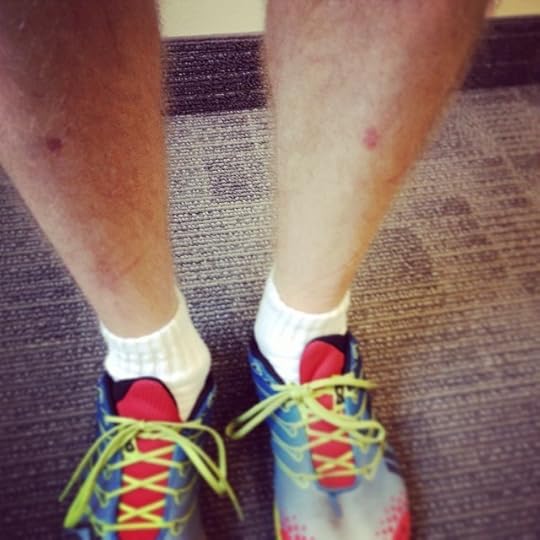
I’ve been doing CrossFit now for about a year at The Arsenal in Muncie. One of the many skills that we work on is the box jump.
No mystery here as to what this is. There’s a box and then we jump on top of it, leaving the ground with two feet and then landing on the box with two feet. You can spot someone who does CrossFit by their scarred shins. (see photo of my shins above four months after I missed). At some point everyone misses the box.
Most of the time during workouts we jump on 24-inch or 30-inch boxes, but sometimes we go for max height. I think the highest I’ve done is 36-inches. I’ve never been a good jumper, but that’s a height that I never thought I could land.
But like any hobby or lifestyle change, you start to see the world through the filter of that hobby or change. And now as I walk around in the normal world outside of the box, I’m constantly asking myself, “Can I jump on that?”
Can I jump on the trunk of my car?
Can I jump on that windowsill?
Can I jump on that high-top table? I wonder what that couple would think? If I did it, I would raise my arms and say Ta-Da!
I love how new skills and knowledge allow one to see the world differently. As a former SCUBA instructor and recreational free diver, I still walk into a house, auditorium, or even through Angkor Wat and imagine the space filled with water, and me swimming through it.
I wonder if I could hold my breath and swim from the top of the cathedral to the bottom?
Through what filters are you looking at the world?
June 15, 2014
What my dad taught me about the work of writing
 Today I work as a full-time writer. I have no boss. Sure, I answer to the occasional editor and deadline, but on a daily basis it’s just me sitting in a seat writing sentence after sentence. When I look back on what I’ve written, sometimes it’s not good enough and I have to start all over again until I get it right.
Dad wasn’t one to deliver lessons on subject-verb agreement, spelling, or the overuse of adverbs, but when it comes to the work of writing, he taught me everything I needed to know.
I share how and what over at Wasson Nursery’s blog this week.
And an even deeper dive into all that Dad has taught me appeared in Wabash Magazine a few years ago. Read “Labors of Our Fathers.”
Happy Father’s Day to my father, Ken, and all of the other fathers out there.
June 13, 2014
U.S. Border Swamped with Child Migrants
In WEARING I documented Amilcar’s journey. Amilcar, a former garment worker and father of three in Honduras, decided that his job didn’t provide his family with the life he wanted to provide them. So Amilcar crossed illegally into Mexico and rode atop trains and dodged police and bandits for three months. In some places in Mexico the locals threw bread at the migrants because the they knew why they were making the journey – their families. In other places the Mexican people were sick of desperate migrants traveling through their backyards and threw rocks at them.
While this journey is a very dangerous and a remarkable feat of endurance, love, luck, and survival, it is not rare. It’s also one not just undertaken by adults.
Recently OnPoint with Tom Ashbrook dedicated an hour of conversation to the migration. If you read WEARING and are interested in this migration or if you never heard of it, I highly recommend listening to the episode U.S. Border Swamped with Child Migrants.
In the past, this journey was primarily undertaken by children fleeing a lack of opportunity in their home countries and trying to reunite with their parents in the United States. Times have changed. Now nearly half of the children have had their lives threatened directly or a life of their family member threatened by the increasing gang and drug violence.
To learn more about this issue:
Read
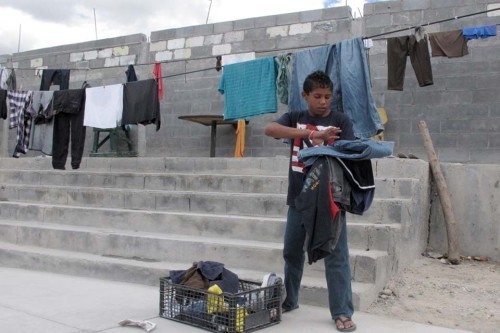
Brian Duran, 14, of Comayagua, Honduras collects his line-dried laundry at the Senda de Vida migrant shelter in Reynosa, Mexico, June 3, 2014. Duran traveled alone to the U.S.-Mexico border and hopes to soon become one of the more than 47,000 unaccompanied children to enter the United States since Oct. 1, 2013. (AP)