
Barbara Rainey's Blog, page 16
March 30, 2022
Friends & Family March 2022


What a difference a few weeks make!
Earlier this month Dennis and I went to the farm (my mom’s birthplace that my brothers and I inherited after her death in 2020) for a couple days. We wanted to check on work we’re having done to make repairs and updates to the over 100-year-old house.
While we were there we had the delight of witnessing a surprise snowstorm blow through. We’ve never been there when it snowed, so it was a treat to watch and take photos. Here is what it looked like when the snow began on Friday night and on Saturday morning when the sun came out.

 .
.


The spring snow covered most of our state and our daughter Ashley sent this photo of her son Isaac as it snowed at their house. He’s hilarious!

Answered prayer!
I wrote in one of these Friends & Family letters months ago about our need to find someone who can help me with so many things related to Ever Thine Home. I asked for prayers and many of you responded to say you were praying. THANK YOU!!
God has answered and I’m delighted to introduce you to Brandi Johnston who is officially our new vice president of marketing and probably lots of other things in time. Brandi is married to Dave, who is a pastor, and they have two cute kiddos. She started March 1 and I’m already so impressed and thanking God often for providing someone so capable and fun to work with.

Thoughts on our world
Though we are half a world away from the war in Ukraine, it’s still present with us every day. Living here in relative peace yet with daily exposures to the awful tragedy and destruction is a new experience as we all wonder what we would do were war to come here.
So many thoughts have come and prayers have been offered every day since it all began. I’ve prayed often for President Zelensky, whose name I didn’t even know a month ago. His remarkable courage and leadership, resolve and determination, has rallied the world. For him I’ve prayed that God will protect him and that he will come to know Jesus as his Messiah. He is Jewish if you haven’t heard.
We’ve heard through our Cru staff and others of some remarkable stories of God’s protection and provision for His people which is one of my prayers for the millions of Ukrainians. I so wish more of this hopeful news could be broadcast but our country is not presently very receptive to news about God and His work. But watching this has reminded me of a biblical truth that is God is always working (John 5:17) and no one is hidden from His view.
I’m sure you and yours are praying, too, for the situation and for all the people directly affected—especially the millions of refugees. Like you I also don’t know what to pray sometimes so I find myself praying the Lord’s prayer more than ever. “Thy will be done on earth as it is in heaven” is more needed than ever.
News from my backyard
In early April I’m speaking at a local church women’s retreat which I’m really looking forward to. My topic is “Cultivating Hope: Growing our Faith in Seasons of Disappointment.” If you live in the Little Rock area and are interested in attending, contact us.
I’m still studying really hard in my seminary class but learning a lot and finding it’s been really good for how I use my time. I’ve never lived by a daily schedule as tightly as I am now.
With Easter coming soon, the most important event of every year and of all time, I hope you will take time to look at the cute things we have in our Etsy store. I printed all of our Easter cards today and cut them to size to have then ready to mail to our kids since we won’t be with them this year. I also bought some sticker paper at Walmart and printed our Easter stickers today; they are also in our Etsy store. I cut them out and will include them in the cards to my children as a little Easter gift.


Happy Easter everyone!
Christ is Risen!
#easterpeople
The post Friends & Family March 2022 appeared first on Ever Thine Home.


March 28, 2022
3 Ways to Teach Your Children to Understand and Express Their Emotions

This is the conclusion of a two-part series on the importance of emotional security in your children. Read part one here.
When you welcomed your first child into the world, if someone had asked you, “How will you teach this child about their emotions?” how would you have answered? I would have stared back wordlessly with eyes that said, “I have no idea. And why are you even asking me about this?”
One of a parent’s most important responsibilities is teaching their children how to understand and express their emotions. Yet few of us give this responsibility much thought.
As our babies grew up, I began learning a lot about this crucially important parenting question. Ready to dive in with me?
Since we are made in God’s image, like Him, are our emotions like His? From what God has revealed about Himself in the Bible, we can answer yes.
He loves. “God is love” (1 John 4:8).He gives from His love. “For God so loved the world, that he gave his only Son” (John 3:16).He feels delight. “The Lord took delight in doing you good” (Deuteronomy 28:63).He laughs, is happy. “He who sits in heaven laughs” (Psalm 2:4).He feels kindness. “… according to His kind intention” (Ephesians 1:9 NASB)He enjoys and gives pleasure. “At your right hand are pleasures forevermore” (Psalm 16:11).He feels gladness. “You make him glad with the joy of your presence” (Psalm 21:6).He feels compassion. “He had compassion for them” (Matthew 9:36).He feels grief. “He was “grieved at their hardness of heart” (Mark 3:5).He feels deep sadness and loss. “Our sorrows He carried” (Isaiah 53:4).He feels anger. “I was angry with my people” (Isaiah 47:6).He feels regret. “I regret that I have made Saul king” (1 Samuel 15:11).He longs. “How often I have longed to gather your children together” (Matthew 23:37 NIV).He hurts and feels loss. “Jesus wept” (John 10:35).In His perfection, God’s emotions are always pure. His anger is always righteous. His love is never compromised. His creative work is always for good, always in the right time, always in line with the higher goal of his purposes and plans.
But human emotional expressions are never totally pure, righteous, or good. Our complete brokenness and depravity compromise our every intention. It is why we so desperately need the power of God’s Spirit within us to make our marriages work and to raise our children in a somewhat healthy way.
Importantly, our emotions are neutral. They are neither good nor bad, but it’s the expression that taints them positively or negatively.
1. Teach your children to identify and name their emotions.
When I was 40, I had corrective heart surgery. A couple days before I went to the hospital, we asked our two youngest to clean up their room. When we came back an hour or so later to put them to bed, we noticed that Deborah had stuffed everything under her bed, which wasn’t the way she usually cleaned up her things. We asked how she was feeling, and she said, “I’m scared.”
“What are you scared about?”
She timidly said, “I am sad.”
“Do you know what you are sad about?”
Then she began to cry and said, “I’m afraid you’re going to die.”
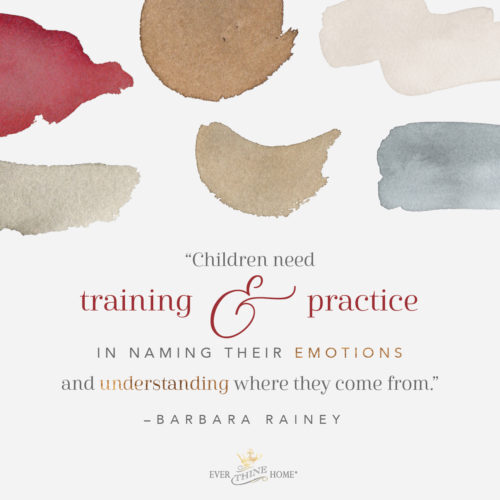
We hadn’t talked about the risk of this surgery with our children because we wanted to help guard their fears. In spite of our caution, our seven-year-old picked up on our tension and uncertainty. To help her respond well, we felt it was important for her to understand how she was feeling. Children need training and practice in naming their emotions and understanding where they come from.
With some children you will need to work especially hard to help them identify feelings. Several of our firstborn grandchildren are naturally reserved, highly intelligent kids who value rules and factual thinking. Ashley decided her firstborn son, Samuel, needed to learn to recognize and name his emotions. She announced to him and his brother, James, a natural feeler, that she would start asking them every night to describe one high and one low experience from the day and name the emotions they felt.
Samuel said he didn’t want to do it. It sounded hard. James enthusiastically said, “Oh, this is going to be easy. I got this!” What a dramatic difference in our God-created emotional makeup as people! We are not all alike.
After a while, Samuel found it reasonably easy to identify some positive basic emotions, like happy. But naming the unpleasant emotions was more challenging. One day Samuel tried to summarize his day as “normal,” but Ashley told him “normal” wasn’t an emotion and to try again.
This daily exercise lasted only a few weeks, but even in that short time Samuel learned to look within and describe his experiences at school with “feeling words.” Ashley was intentionally preparing both boys for a future as husbands and fathers who will need this emotional understanding to lead well.
2. Train your children in healthy, non-hurtful ways to express their emotions.
I wish I’d understood all this when our kid were young, so I hope you’ll keep reading to the end.
Our goal as parents is, first, to teach children to feel and name their emotions, to help them identify what is driving them, what is shaping their decisions and reactions. Then we teach, instruct, train, and praise them when they express those emotions in healthy, inoffensive, non-hurtful ways.
Did you know, God never corrects our emotions in His Word? What He does correct is the way we express those emotions. For example, He tells us to “Be angry, and do not sin” (Psalm 4:4; Ephesians 4:26).
For example, the prophet Elijah was afraid, ran away, and found a cave in which to hide. There he pouted in the dark feeling sorry for himself: “I alone am left” (1 Kings 19:10 NASB). God didn’t correct his emotion of fear or self-pity, but He did address his heart of unbelief by calling Elijah back to faith with the voice of a “gentle blowing” (verse 12).
With eight broken, sinful people living in our four-bedroom house, we had lots of emotions of every kind. Anger was one emotion everyone struggled with, so one night we had a family discussion about it. We asked our children, “How do you feel when you are angry?” On a poster board we wrote down their answers, which included phrases like “exasperated,” “like screaming,” “verbal vomit,” and “like tearing things up.”
Then we asked, “What kinds of things make you angry as a child or a teen?” On another column of the poster board we listed their answers:
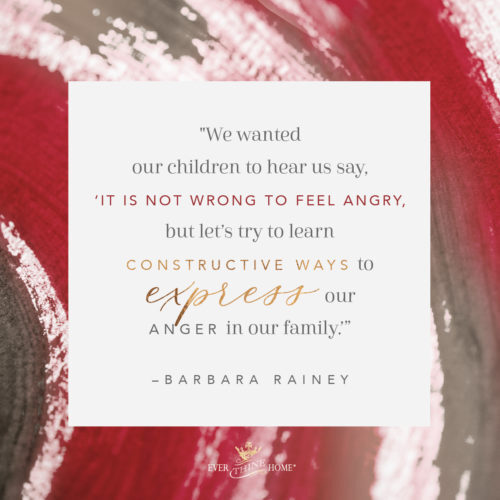
“When I’m left out or excluded by a family member.”“When I get hurt.”“When people make fun of me.”“When people are being a pest or picking on me.”“When people use my stuff without asking.”“When people don’t pay attention to what I’m saying.”We talked a little about why we shouldn’t hurt others when we feel angry, and suggested alternatives. The evening dissolved quickly after that, and our anger problems were not solved with one conversation. We simply wanted to help our children understand that anger is a normal emotional response to being hurt or afraid. We wanted them to hear us say, “It is not wrong to feel angry, but let’s try to learn constructive ways to express our anger in our family.”
We spent countless hours correcting our children when they expressed anger, disappointment, or fear in inappropriate and hurtful ways. Thousands of times we said things like, “You may not hit your brother when you are angry at him” … “You may not scream at your sister” … “You may not break something when you feel overlooked” … and more. Slowly they improved, not perfectly but with lots of baby steps, learning more appropriate ways to express their emotions without being hurtful.
Your goal is not just correcting behavior, but also growing, training, nurturing the kind of hearts that seek to understand and act wisely, the kind of hearts that eventually want to please God. Help your kids understand the emotion behind their behavior and then learn to express those foundational feelings to one another. Your kids will likely have each other all of their lives; they need to learn how to keep those relationships healthy. Other friends will come and many won’t last but family and siblings are forever.
 3. Make your home a safe place.
Children want and need feedback, especially as they get older, from their parents. You are their measuring line. You are their report card. You are the most important cheerleaders who must celebrate every good decision.
Don’t just correct them, but eagerly and enthusiastically rejoice with every right attitude. Reinforce all the good they choose to embrace on their own, reminding them that God sees and is pleased, and that pleasing Him should be their ultimate goal, now as children and one day on their own as adults.
Children want to be heard and understood, not lectured. If you are attentive and engaged emotionally on every level, your child will grow up feeling loved, secure, and whole.
Also, give your children grace as they process the conflicts and hardships of life and as they learn emotional boundaries. And always reaffirm your love and acceptance, especially when they make mistakes. Model God’s unconditional, grace-filled love in your home.
Put it into practice
Here are two activities to do with your kids:
1. Ask them one evening or on a Sunday afternoon to look up the verses in the list above which names some of God’s emotions. Direct them to read each verse and say what it says about how God feels. Then have them write each feeling/emotion on a list.
Give them a reward if you need to. (We’ve done that. You do what it takes to get cooperation sometimes!) Then go in a circle and share what they discovered. Talk about how they feel discovering God’s emotions.
2. Try the activity we did with our kids on anger, especially if your children are in elementary school. Ask them, “How do you feel when you’re angry?” and then, “What kinds of things make you angry?”
See what they list. Talk about it together and then pray for each other. Ask God to help everyone understand how to express feelings and appropriately express anger.
May God guide you and bless you!
If you enjoyed this post by Barbara, you might be interested in these other posts on parenting:
“How to Build a Relationship With Your Child” “Training Your Children to Choose Wisely” “Why Mission Matters”
The post 3 Ways to Teach Your Children to Understand and Express Their Emotions appeared first on Ever Thine Home.
March 17, 2022
The Barbara Rainey podcast: Getting Ready to Release Your Teens
Do you remember when you were 17 or 18 years old? Do you remember struggling with things like time management, learning the value of a dollar, and making sense of this crazy world? In today’s episode of The Barbara Rainey Podcast, Dennis and I talk about some of the lessons we learned while guiding our six children through their teenage years.
We talk about when to “bail out” your kids and when to let them learn a lesson. We also talk about starting to give more freedom to your teens during their senior year of high school so they can hopefully learn some lessons at home before they are out on their own. Dennis also reads a poem (because I couldn’t get through it!) written by our kids’ youth pastor and read at their youth group senior dinner. Our son Benjamin was in that senior class. It was a powerful moment we’ve never forgotten.
Next week is spring break here in Arkansas—hard to believe spring is almost here when we had snow last week! And all too quickly the school year will come to an end. And don’t worry, it’s not too late if you have seniors in your house to start implementing some of the practices we recommend in this podcast before they head off on their own.
And if you have teens about to graduate you might want to consider my book, Barbara and Susan’s Guide to the Empty Nest. It’s been a great help to many moms as they prepare to enter a new season without children living at home.
I pray this podcast gives you some encouragement and some practical ways to help launch your arrows into the world!
You can listen here or on any of the main podcast platforms.
Ever His,
Barbara

Buy your copy here!
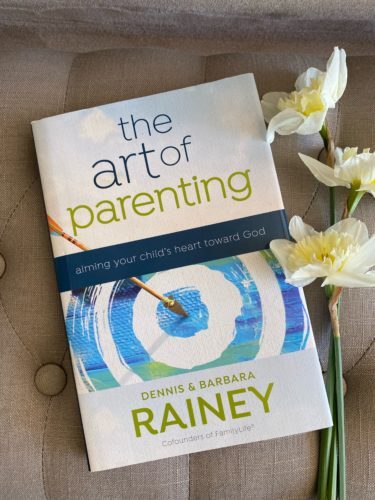
Buy your copy here!
The post The Barbara Rainey podcast: Getting Ready to Release Your Teens appeared first on Ever Thine Home.
March 14, 2022
Why Developing Emotional Security in Your Children Matters

The room was small, dark, and silent. Stepping inside we saw three walls lined with baby cribs each occupied by a tiny baby. In the back corner a disengaged caregiver lifted her eyes in our direction. The babies were alone. Unattended. Silent.
Our daughter Laura and I were part of an overseas medical mission team working for a week in an orphanage, home to hundreds of abandoned babies and children, most with physical disabilities or medical conditions their parents were unable to provide for them.
Most of the nonmedical members of our team were assigned to assist the American doctors in our group. But another woman, Lynn, and I asked if we could go to the baby room and just take care of babies all day, every day. For the next week we gave our hearts to these babies, snuggling them close while giving them bottles instead of letting the feeding happen as it normally did—with the bottle propped up on a rolled rag, much of the milk escaping the baby’s mouth and soaking into the bedding.
The smallest baby drew my heart instantly. I was amazed to discover she was six weeks old, as she weighted barely five pounds, having been born a preemie. Lethargic and sleepy, she seemed so vulnerable and alone. I held her as often as the workers would let me. Lynn and I named some of these little ones that week since we couldn’t speak their native language. I named this littlest one Sarah. I prayed for her life during the day when I was with her and at night back in our hotel.
By late in the week Lynn and I had a routine. On Thursday as usual, we arrived at the orphanage we went straight to baby room. My feet went straight to my tiny Sarah. Even in the dim lighting something didn’t seem right. I bent over her, put my hand on her tiny chest and discovered it was barely moving.
I ran to find our American doctor, who began the process of reviving her and then raced her to a hospital, where she completely recovered. Sarah’s needs, physical and emotional, had been ignored. Neglect nearly ended her life.
Quite miraculously, baby Sarah was adopted months later by one of the doctors on our medical team. She is now a thriving, healthy teenager, about to graduate from high school.
Little Sarah’s physical heart almost stopped because her emotional heart, the soul of who God made her to be almost gave up. Without a personally invested parent to both feed her body and love her, she failed to thrive and would have died had God not providentially led us there.
Emotional bonding which establishes security is the foundation upon which all facets of identity are eventually built in the life of every child. How we feel about ourselves—loved or unloved, competent or incompetent, empowered or shamed—will impact our emotional foundation and future. Emotional health also strongly supports the development of a child’s character, natural gifts, intelligence, and relationships.

In her book, Children Learn What They Live, Dorothy Law Nolte wrote with great insight about the impact of a child’s upbringing:
If children live with criticism, they learn to condemn…
If children live with fear, they learn to be apprehensive…
If children live with ridicule, they learn to feel shy…
If children live with encouragement, they learn confidence…
If children live with acceptance, they learn to love.
Like Sarah we are all kept alive by a heart that beats constantly, regularly, and quietly. But we also have a nonphysical heart in which resides our emotions, our thinking, and our decision-making or will. What we feed this heart shapes our child’s emotional identity.
Jesus spoke often of our heart:
Matthew 14:27: “Jesus spoke to them, saying, ‘Take heart; it is I. do not be afraid’” (emotion).Matthew 9:4: “Jesus, knowing their thoughts, said, ‘Why do you think evil in your hearts?’” (thinking).Matthew 19:8: “He said to them, ‘Because of your hardness of heart Moses allowed you to divorce your wives’” (will).In fact, God speaks of our hearts hundreds of times, from the first to last pages of the Bible. Two verses summarize this most important part of our in-His-image likeness, our hearts.
“For the Lord sees not as man sees: man looks on the outward appearance, but the Lord looks on the heart” (1 Samuel 16:7, emphasis added). God supremely values the choices we make internally in that hidden space inside each of us called the heart.
“You shall love the Lord your God with all your heart and with all your soul and with all your mind” (Matthew 22:37). God supremely values where we place our affections, our emotions, which also spring from our hearts.
For a child to feel secure and stable, to become emotionally healthy as an adult, is to know he is loved and cared for by those who have the power to do good to him. And for Christian parents it’s important to communicate the high value built in each of us as made-in-His-image children.
In the formative growing-up years, this responsibility of forming emotional health begins with and rests on parents.
Then, as children become teens and young adults, they need to begin to look for and experience their security and love needs in God Himself.
From birth, children pick up on the emotions of their parents—responding to warm welcoming hugs, kisses, and love lavishly given, or responding in bewilderment and fear, building early defense mechanisms to protect from a lack of parental love and presence. To be honest, most of us have probably been shaped in an environment marked by both types of emotional influences.
I grew up in a family that was secure and stable, and I knew I was loved. I never feared my parents would divorce or leave us. They cared for us, provided for us, and taught us many valuable lessons about life.
But what my head knew was true I did not always feel. My parents both grew up in families who experienced significant losses—the death of a child, the relentless hurtful attitude and comments of a mean father-in-law, the dissolution of a marriage, and difficult life struggles during the depression and World War II. As I looked back, it’s remarkable that my parents raised me and my brothers as well as they did.
I remember I often felt insecure about myself by the time I was nearing my teen years. I also remember working hard to please my parents. I wanted to make sure my dad had no reason to be angry with me. I became stoic and subdued, never getting angry, but not expressing much happiness, either. I did not laugh often, and I rarely cried. All those emotions were a part of me, but were hidden deep within as I sought to please others.
As a teenager, I didn’t know who I was or how I fit in. I became increasingly shy, timid, reserved, and self-protective. As a 19-year-old college student, I understood the gospel for the first time, and my sense of self and purpose changed dramatically.
When I became a parent myself, I worked hard to foster closeness and openness with my children. I snuggled with them on the couch reading books, even in their teens. I welcomed happy and hopeful creativity in spite of the messes they left in their wake. It was fairly easy in those early years.
But as our children got older, I saw that I was often reacting to or retreating from them out of fear because I didn’t how to nurture emotional health in teenagers. I still had toddlers when my oldest two became teenagers. I recognized how easy it was for me to kiss the little ones, stroke their faces, and cuddle them. But it was much harder for me to be affectionate with my 13-year-old daughter and 12-year-old son.
Ashley, our firstborn, noticed and made little snide comments about how I was spoiling the younger ones, giving them too much attention. I remember thinking at first, “It’s okay that I am not as close to the older ones. That’s just who I am. Besides, Dennis is very good with our teens.” I figured I could concentrate on the younger kids, he could concentrate on the older ones, and everything would be just fine.
Eventually I understood our daughter’s criticisms were her way of letting me know that she still desired my affection and nurturing. I made a commitment to myself and asked the Lord to help me strengthen my emotional connection with my teenagers. I remember going into Ashley’s room to hug her real tight, even though it felt awkward to me because I had not received similar affection when I was a teenager.
I also realized that by meeting her needs emotionally at home, I was helping to protect her from getting her emotional and security needs met from others, especially boys. It was like a light went on and I understood, If she does not get love and security from me and her dad, then she is going to have a vacuum in her heart that she will seek to fill with unhealthy relationships.
A good question to ask yourself is, “Do my children feel love from me, or do they just know that I love them?” There is a big difference. They need to feel loved and cared for in a real, emotional, intimate way that only comes from affectionate touching and physical closeness.
Do you want to raise emotionally healthy and stable kids? Here are some questions for you to ask yourself and God to help you evaluate how you are doing. You will likely have to think about it for a while to see the real truth.
How is the background of your childhood impacting your own children?What are you unconsciously replicating?Ask God to open your eyes to see what your kids are feeling deep inside.Ask Him to help you listen closely to what they say or how they act that night be signals to you.Here is a prayer for you as a mom or dad who knows you aren’t doing it all right, who wants to do the best you can for your kids because you love them. God knows, understands and wants to help you.
My heavenly Father,
You are the perfect parent
and I am not.
You know my flaws and faults
while I’m blind to many of them.
Help me see what you see in me
and help me trust you more.
Give me eyes to see my children as you do
with Your eyes, Your heart.
Give me Your patience, Your love, Your grace.
Help me most of all to love them well
in ways that say love to their little and teenage hearts,
to nurture and help them become emotionally stable and mature.
And last,
Lord help me guide them to You
the One who loves perfectly,
who has a unique and good plan for their lives.
God You alone can give them
what we moms and dads can’t.
Amen.
In my next blog post: Teaching your children how to name and express their emotions.
If you enjoyed this post by Barbara, you might be interested in these other posts on parenting:
“How to Build a Relationship With Your Child” “Training Your Children to Choose Wisely” “Why Mission Matters”The post Why Developing Emotional Security in Your Children Matters appeared first on Ever Thine Home.
March 10, 2022
In Times of War, Our God, Our Mighty Fortress, Is Still “the Stability of Our Times”


Every day I trust the walls and roof of my house to remain stable, the roads on which I drive to remain solid. But those remaining in Ukraine now know the opposite; the constant sound of bombs and the experience of crumbling walls, falling roofs, and impassible roads … if those who stayed even have access to transportation. Everything is shifting and unstable.
As Dennis and I watch the constant reporting every night we are praying daily and often for the believers—for their protection, for God’s provision for their needs, for power and strength. We also pray for those who don’t know Jesus as Savior … that they would meet Him and respond in faith.
And as we watch and feel from afar we wonder: What will tomorrow bring? How will life change, both in Ukraine and around the world. And we wonder about the unthinkable … could this lead to a nuclear confrontation? No one knows what Putin will do next. As Peggy Noonan wrote in The Wall Street Journal on February 26, “Putin has shocked the West. He wanted to shock the West.”
How do we respond to this shock, this unnerving and unraveling of all we depend on for stability and peace?
As I’ve written many times before the sure word of God says,
“And He shall be the stability of our times” Isaiah 33:6
Life-changing events have been happening with increasing regularity and intensity. The first time I wrote about this verse was in 2008 when our country was in the throes of a significant economic downturn. Since then we’ve known more school shootings, political turmoil, growing racial unrest, a worldwide pandemic, rising crime, and now a war. An unprovoked invasion displacing millions of people and destroying everything within the reach of bombs is uncharted territory for all of us born since World War II.
As believers in Christ we also have to ask, is this another step on the sure path to the return of Christ? The answer is decisively yes. Yes, we are closer. Yes, this figures in to the grand narrative God is authoring and orchestrating. Everything God does is a part of His grand plan. He is sovereign. He is always working toward His grand finale. And He did say there would be wars and rumors of wars.
Just one verse among many speaks to this: “… according to His purpose, which He set forth in Christ as a plan for the fullness of time, to unite all things in Him, things in heaven and things on earth” (Ephesians 1:9).
But until that day, which could be very near or yet in the distance, the words from Isaiah 33:6 remind me, over and over, to ask myself, Is my security and stability resting too heavily on my circumstances? Am I trusting in God today? And am I living not just for myself and my own people but am I giving my life for others?
How then shall we live?
First, as much as possible keep up with what God is doing in Ukraine and in surrounding countries … His deeds and wonders that are rarely told on regular news channels.
A friend of mine who was a missionary to Ukraine years ago still has friends there. She heard last week of other missionaries from America, living in Ukraine who have decided to stay because they believe this verse is true: “Having so fond an affection for you, we were well-pleased to impart to you not only the gospel of God but also our own lives, because you had become so dear to us” (1 Thessalonians 2:8, NASB). This world is not our home and it was so encouraging to hear of these believers living it as fact.
They also told about many people coming to Christ in the weeks preceding the invasion. Evidence God is going ahead since He was not surprised by this war. And from Israel we just heard this week that many thousands escaping Ukraine are ultimately headed for Israel. God continues to gather His people! Exciting? Yes!
Second, it’s important to support—with prayers and financial donations—the relief efforts for Ukrainians. Between the people struggling inside Ukrainian and those who have fled to neighboring countries, this may be the biggest humanitarian crisis in Europe since World War II.
Yet, sadly, there is so much hardship and pain you or I cannot change or fix in this world. That will always be true. And so the rock of Christ, the anchor of my soul, must be my sure hope and my stability, not the predictable norms I long to cherish. The eternal truth that God is sovereign is either true or it is not. I’m counting on its veracity because He brings more peace than any treaty or alliance of men possibly could.
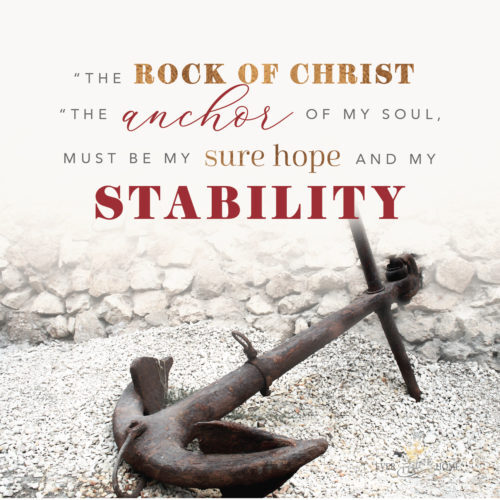
I am reminded of the classic hymn by Martin Luther, “A Mighty Fortress Is Our God.” Normally I wouldn’t use this space to include the words of an entire hymn, but I believe it’s worth it. Read these four verses and see how they build on each other to praise the God whose kingdom is forever. (And if you want to sing it, here’s a great video on YouTube by Matt Boswell.)
A mighty fortress is our God, a bulwark never failing;
our helper he, amid the flood of mortal ills prevailing.
For still our ancient foe, does seek to work us woe;
his craft and power are great, and armed with cruel hate,
on earth is not his equal.
Did we in our own strength confide, our striving would be losing,
were not the right Man on our side, the Man of God’s own choosing.
You ask who that may be? Christ Jesus, it is He;
Lord Sabaoth His name, from age to age the same;
and He must win the battle.
And though this world, with devils filled, should threaten to undo us,
we will not fear, for God has willed, His truth to triumph through us.
The prince of darkness grim, we tremble not for him;
his rage we can endure, for lo! his doom is sure;
one little word shall fell him.
That Word above all earthly powers, no thanks to them abideth;
the Spirit and the gifts are ours, through him who with us sideth.
Let goods and kindred go, this mortal life also;
the body they may kill: God’s truth abideth still;
His kingdom is forever!
These words were written nearly 500 years ago, yet they apply to our circumstances just as much as they did to Martin Luther as he lived his life with many threats of imprisonment and death during the years of the Reformation.
Whether this present instability is our new normal or not is irrelevant. What really matters is where I’m placing my hope.
Only Jesus can give the peace and the stability I desire. Only He can give what we long for in our hearts.
I pray that we will make the transcendent truth of God and His Word more a part of our conversations so we can together rest on His stability, and so that others may know of this hope. No matter what happens, we can rest on God’s promises.
Centuries-old trees, like sequoias and oaks, endure through drought and storms because when conditions are good they eagerly soak up nourishment and sink their roots deeper to prepare for the hard times that always come.
Will you sink your roots into the Rock of Christ so you will be prepared when hard times come?
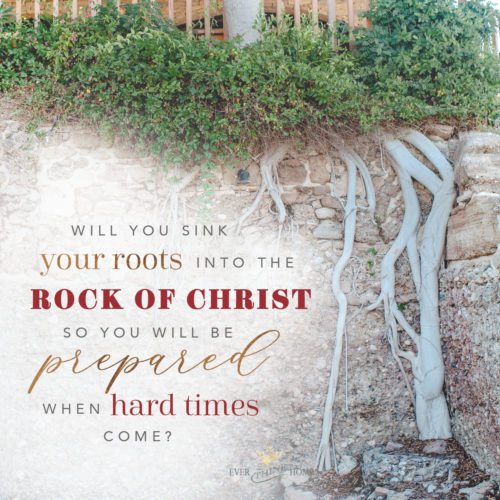
Will you invite God, our mighty fortress, to be the stability of your life, no matter what may come?
In our Etsy store we offer a digital download of our popular rendering of Isaiah 33:6: “And He shall be the stability of our times.” It’s perfect for framing and displaying in your home.
The post In Times of War, Our God, Our Mighty Fortress, Is Still “the Stability of Our Times” appeared first on Ever Thine Home.
March 3, 2022
The Barbara Rainey Podcast: Preparing Your Heart for Easter

I have a question for you to ponder today … How do you celebrate Easter in your home? A few years ago I realized how very important Easter is and it actually surpassed Thanksgiving as my favorite holiday! I’ve always known it was important, but in the words of Paul, without Easter our faith would be in vain. If you take away Easter and you take away the cross, the New Testament is gone.
On today’s episode of The Barbara Rainey Podcast, Dennis and I talk with our friend Tracy Lane about Easter and how to create meaningful traditions in your house this Easter season. We talk about how you can do simple things to incorporate the Resurrection account into your everyday life, even with small children!

Our desire with this podcast, and Ever Thine Home is to help you be changed by Jesus which will, in turn, transform your home. You can listen to “Preparing Your Heart for Easter” on any major podcast platform, or simply click here!
Praying you experience His Goodness this Lenten season,Barbara
P.S. A previous email mentioned an Easter bundle, which included our Waiting for the Lamb banner and our Behold the Lamb calendar. We have sold out of those bundles, but we do have Easter items available in our Etsy store, which you can find here.
The post The Barbara Rainey Podcast: Preparing Your Heart for Easter appeared first on Ever Thine Home.
The Barbara Rainey Podcast – new episode!
I have a question for you to ponder today… How do you celebrate Easter in your home? A few years ago, I realized how very important Easter is and it actually surpassed Thanksgiving as my favorite holiday! I’ve always known it was important, but in the words of Paul, without Easter —our faith would be in vain. If you take away Easter and you take away the cross, the New Testament is gone.
On today’s episode of The Barbara Rainey Podcast, Dennis and I talk with our friend, Tracy Lane about Easter and how to create meaningful traditions in your house this Easter season. We talk about how you can do simple things to incorporate the Resurrection account into your everyday life, even with small children!
Our desire with this podcast, and Ever Thine Home is to help you be changed by Jesus which will, in turn, transform your home. You can listen to “Preparing Your Heart for Easter” on any major podcast platform, or simply click here!
Praying you experience His Goodness this Lenten season,
Barbara
P.S. A previous email mentioned an Easter bundle, which included our Waiting for the Lamb banner and our Behold the Lamb calendar. We have sold out of those bundles, but we do have Easter items available in our Etsy store, which you can find here.
The post The Barbara Rainey Podcast – new episode! appeared first on Ever Thine Home.
February 28, 2022
9 Questions to Help You Take an Honest Look at Your Marriage


Does evaluating your marriage sound a little scary? Don’t be afraid to read this. Here’s why.
Most of us regularly do maintenance of our cars and our homes. We take performance appraisals at work. Our kids are graded at school.
But do we give our marriages even half this much focus?
Your first thought is probably, “Who has time?” I’ve been there. We had six kids in 10 years and marriage was not my focus for many minutes of any given day. It was an ongoing juggling act for most of our marriage. And it still can be.
Marriage maintenance is hard to prioritize because our culture doesn’t have built-in systems like we do for health, home, car, and job care.
But it doesn’t work to pretend your marriage has no issues, no cracks in the foundation, no work to be done. Pretending is only good for little children or actors on Broadway. It’s never good for your marriage or your faith.
Here are some questions to help you evaluate your own marriage. You might feel a bit of trepidation as you start this list, but be courageous.
Grab a cup of coffee or tea and try not to do this on the run in the carpool line. Or if you do come back to it later for a reread. It’s too important to gloss over or skim.
Are you teammates in life? Are you pulling for one another, encouraging one another, because you love each other and are still best friends? Do you have compassion for one another?I received many comments to last week’s post, “Your Marriage is Worth Fighting For: 9 Truths to Remember.” Many described significant issues and some told of their own divorces. As I read these I sensed a need to address the core of where we all find ourselves in any marriage: in a good place, a hard place, starting over or wondering why you are where you are. The essence of any healthy relationship or marriage is this principle we have taught for over 40 years: “My spouse is not my enemy.”
Listen carefully. This is crucial and foundational.
Both you and your spouse are victims. Victims of someone else’s sin; starting with Adam and Eve and progressing through the ages into endless kinds of evil and harm. And you are also victims of each other’s sin.
But you and your spouse, like every human, are also perpetrators. We are born with a self-focused sin nature that ever seeks importance, dominance, power, and revenge. We distrust, fear, control, self-protect and constantly devise ways to get what we want even if it means harming others.
Remembering these truths means neither of you are the enemy. You have a common enemy who is Satan. This also helps us help each other and be compassionate to each other in our common struggle against selfishness and sin.
It’s why you married your best friend. It’s why you need each other. It’s why the best foundation for marriage strength is keeping these truths in front of you. It helps prevent us from thinking we alone are the victims in our marriages. That it’s all his or her fault.
Are you co-laborers not only in bringing in the money, raising your kids, and doing all that life requires of you, but also in being a team, being united in the goal of becoming all God intended for you individually and as a couple?
Have you stopped being each other’s confidant? When we lose sight of who we are and what our goals are in marriage, we can easily move from friends to combatants. And who wants to go on a date with your enemy? Who wants to share personal struggles with someone who doesn’t feel safe?If this is where you are, start asking yourself first when the change began. What were the circumstances if you can pinpoint them. Why don’t you feel safe or free to share? Then take the risk to talk about it together. That means making time. And you may need to find a counselor or a marriage coach or someone to guide the conversations and debrief with.
I mentioned last week that the last four years have been especially challenging for Dennis and me. We met with a friend, a therapist, who helped us understand why we were feeling estranged, misunderstood, and not connected. For us it was a season of many losses and we were processing them all differently, so we were missing each other.
Take the time to address the problem or your relationship will start to die.
Have you stopped dreaming together? This too is a natural consequence of the above. If you aren’t sharing your fears and your hopes then you aren’t sharing your dreams. You probably aren’t even dreaming about the future.Marriage can easily become a business relationship. Your only communication centers on “to do” lists, your calendars, and the increasing demands of people and family members screaming for your attention and time and money.
To grow and keep a healthy marriage, these very real demands must be managed so you can have time to plan ahead, dream for the future when it‘s just the two of you again.
Do you risk sharing your struggles with sin with one another? Do you tell each other about your disappointment with God? When did you stop confessing your failures and mistakes? When did you stop asking your spouse to pray for you?This is the crux of what God knew we needed when He created marriage. He said it wasn’t good for Adam to be alone. We are not intended to do battle with the enemy of our souls alone. We need the person who knows us best to pray for us, listen to our struggles, have compassion on what matters. We need our spouse to value the way God made us with our gifts and strengths and encourage one another in that journey “which He prepared beforehand that we should walk in them” (Ephesians 2:10).
Do you ask your spouse to forgive you? A healthy marriage is a forgiving marriage. We offend each other daily, most often unintentionally. But when we recognize our mistakes, our failures, it’s important to say so. Deny your pride and practice forgiveness generously. Billy Graham’s wife, Ruth, once said, “Marriage is the union of two forgivers.”

A healthy marriage is dependent on this oneness between spouses. And forgiveness is not always quick and easy, like saying “I’m sorry I was snippy with you, will you forgive me?” There are many times it takes a lot of time and work to get to the place it is genuine and all the layers of the onion around the situation have been peeled back. Again, this might be the time to seek the advice of someone who has experienced these issues or is skilled in offering marriage help.
Do you still care about having sex together? Sex is the icing on the marriage cake. Good meaningful fulfilling sex is the result of a good meaningful healthy marriage relationship.Keeping sex a healthy part of your marriage is essential to keeping it alive. Unless there is a medical condition that prevents you or your spouse from sharing this experience regularly, you will be wise to pay attention to this God-created and ordained part of marriage.
Yes, sex is a mystery. It’s often challenging. It isn’t always a fireworks experience. But it is designed to be emotionally bonding, and bonding is like glue in your marriage.
By the way, when I say pay attention to having sex together I don’t mean three or four times a year. To read more about sex in marriage, I’d love for you to read my book, Letters to My Daughters, The Art of Being a Wife. I have an entire chapter on this subject.
Have you started pretending that all is well? When our kids were in high school they started talking about “living in the bubble.” I know they didn’t invent the phrase, but they introduced it to me.The idea is that many of us live in a Christian subculture, a “bubble.” We can live in the same neighborhoods, send our kids to the same schools, and associate almost entirely with other people like us in values and beliefs.
This isn’t wrong, but it can have a downside. When we live in the bubble we can begin to believe we are doing everything right because we are doing what everyone else is doing. We can easily begin to model our lives on those around us. And it can impact your marriage by leading you to believe your marriage is great because it looks like everyone else’s.
When was the last time you got away for an entire weekend to invest in your marriage? I want to encourage everyone who reads this post to find a weekend this year to attend the best marriage conference I know of—a proven success for over 40 years. Like a regular tune up for your car or regular check-ups with your doctor, the Weekend to Remember Marriage getaway is the realignment every marriage needs, not just once in a lifetime, but repeatedly over the life of your marriage. Every season in your marriage presents new needs. We have friends who go to one of these events every year as a way to get away for a marriage tune-up.Speaking at these events for nearly 40 years did more to keep our marriage focused on God’s plan for us and our marriage than anything else we did. We learned something new to apply every time too. Nothing is better than repeatedly investing.
The point is there are ways to make growing your marriage and seeing it become stronger over time. The question is, will you make it a priority?
Do you say no to other needs, activities, or tasks so you can have time for your marriage?Despite our modern beliefs, you simply cannot do it all. Your children can’t do every sport or activity and attend the best schools, while you give your lives to your work, your ministry, your mission, your community, your church, or your fixer-upper house.We live in a world that celebrates everything exceptional and we curate our social media to make ourselves look perfect. But we all have limitations. The best decisions are to practice living within those limitations. Then there is freedom to develop what God has given you rather than striving for what others have.
You may believe you have the energy to juggle it all, but something will suffer. Usually it’s your marriage. You must have margin in your life to invest in each other. When you are both working full time in separate spheres what do you have in common beyond your home address? You must make decisions that favor your marriage, decisions that give it room to grow. No one else can or will do it for you.
Here is the bottom line for all of us: “Search me O God and know my heart! Try me and know my thoughts” (Psalm 139:23). We cannot do marriage on our own. It is God’s invention and we need Him to make it work.
Go to Him.
Talk to Him.
Above all, ask His Spirit to help, guide, teach, and lead you in your marriage. Listen closely for His whispers to you. No marriage can survive without God’s specific and direct work in your life and in your spouses. And don’t worry about your spouse; you are only responsible for your part, what God has given you to do. Let God deal with him and his issues and heart.

Here is my prayer for you and all who are Christ followers in marriages:
May you stand strong for your marriage.
May you believe God and see Him work wonders
in your heart and your spouse’s heart.
May you stand with me and say,
“No more victories for Satan. Not in my marriage!”
Lord, give us women courage to believe You,
in every circumstance,
every day.
Amen!
For more help on building oneness in marriage, click here .
For more help on conflict in marriage, click here.
For more help on romance and sex, click here .
For more help on working on a troubled marriage, click here .
For information on the Weekend to Remember marriage getaway, click here.
To order a copy of Barbara’s book, Letters to My Daughters, click here.
The post 9 Questions to Help You Take an Honest Look at Your Marriage appeared first on Ever Thine Home.
February 24, 2022
Friends & Family February 2022

Happy shortest month everyone!
As the days continue to speed by, this month’s letter to all of you is more of a deep dive into what I’m learning in my online class at Dallas Theological Seminary.
But first here are two of my favorite photos from the Love Like You Mean It cruise we went on earlier this month. The first is with an Ethiopian-American couple who live in the DC area with their four kids. They have loved learning about marriage and family from our ministry so it was a treat to spend an evening with them. The second is a rainbow out our cabin windows which was gorgeous to see and so meaningful to be reminded of God’s love for us.


My class this semester is on the history of doctrine, which sounds terribly boring and dry, but what I’m learning is compelling and truly important to believers today. So stick with me for a few minutes and marvel that God has managed through broken sinful humans to keep the truth of His Word and His character pure and clear for generations.
This month I learned why the Church, meaning the universal body of believers around the world, wrote and adopted creeds and statements of belief. The story goes like this:
In the days, months and early years after Jesus’ ascension and Pentecost, the rapidly growing baby church all believed what they had seen: Jesus was a real human who they saw and touched; He really suffered and died and therefore He had to be God because He rose from the dead. Hundreds were witnesses, so no one questioned it.
The apostle John says it plainly: “That which was from the beginning, which we have heard, which we have seen with our eyes, which we looked upon and have touched with our hands, concerning the word of life—the life was made manifest, and we have seen it, and testify to it and proclaim to you the eternal life …” (1 John 1:1-2).
It wasn’t just the 12 who saw and touched Him! Paul records that Jesus appeared in His resurrected body to over 500 believers at one time, and who knows how many others saw Him at other times that weren’t recorded.
But eventually new converts began asking questions no one had asked before. And so those first-generation disciples—like Ignatius of Antioch in Syria, a disciple of the Apostle John—began to write explanations for why we believe Jesus is God, who existed eternally with the Father.
Okay, pause on this one. Can you even imagine what it would have been like to be a disciple of John? The real John of the Bible who saw Jesus transfigured on the mountain and saw Moses and Elijah! And how did he know the two who showed up with Jesus were Moses and Elijah? And John was in the boat when Jesus calmed the storm, when Peter walked on water, when Jesus fed 5,000 people … John saw it all. Literally. If I was discipled by John, I would have a thousand questions. And I would have believed everything he said.
Back to the story. From those early days to today, we believers need words to communicate our faith to others. As a result, creeds (or statements of faith) were written for the purpose of uniting the church in our beliefs about God.
Jesus prayed before He was arrested in the Garden of Gethsemane that God would keep us and that we would be one even as He and the Father are one. When the body of Christ all believe the same truths, we are united in our faith even if we practice our beliefs very differently.
This month one of the concepts we studied was the Trinity, which is present throughout the Scriptures, even though the word trinity is not in the Bible but was coined to explain our three-in-one God. For example, when Jesus instructed His disciples to “baptize them in the name of the Father, the Son and the Holy Spirit” (Matthew 28:19), He clearly listed all three members of the Godhead in equality. Nowhere is the deity of Christ or the Holy Spirit denied in the Bible. Thus the concept of the Trinity is clearly revealed in Scripture and the church Fathers defined it for us.
Concepts like the Trinity were eventually worked into creeds or statements of faith. Perhaps your church, as did mine growing up, recites one of these creeds during Sunday morning worship. The Methodist church, even with its increasing drift toward liberalism, still recites the Apostles Creed every Sunday. I was so surprised and interested to learn the earliest form of what became the Apostles Creed was first written in Rome and called the Old Roman Symbol. This was sometime between 200-300 A.D. It was a statement all new Christians memorized and stated before baptism.
The final wording of the Apostles Creed was adopted in the fifth century and has remained unchanged since. Which is truly remarkable … that almost two thousand years later churches worldwide are still professing the same beliefs, the same creeds as did those in the ancient church. Others from that era are Nicene Creed written in 325 A.D. which established the equality and unity of the Father and the Son; and the Constantinople Creed from 381 A.D. and the Chalcedonian Creed in 451 A.D., both of which added sentences declaring the deity of the Holy Spirit.
Following these there was no change in our major creeds for over a thousand years. Another remarkable providence of God.
If you are like me, you’ve never seen some of the lesser-known creeds unless your church repeats them or you learned them in a catechism class as a child. So at the end of this letter I’ve had our designer Julie create a few of them for you to print and keep to read for a quiet time or a prayer. The words are beautiful and inspiring and worthy of our attention since they are reflections of the God we serve and love.
Two weeks ago we had ice and snow and now the early daffodils are blooming! Such is the on again, off again nature of this season. As I type this a front has blown through and the temps dropped from the low 60s this morning to the low 40s now with lows tonight in the 20s. My desk is built below a window in our laundry room and the cold air blows through the cracks around the window so I need a cozy blanket to stay warm. I love the changing seasons.
I hope you will enjoy reading these beautifully written creeds of the faith and that you will join me in giving thanks for the wonder of God’s work through the ages.
Till next time in March!
Ever His,
Barbara
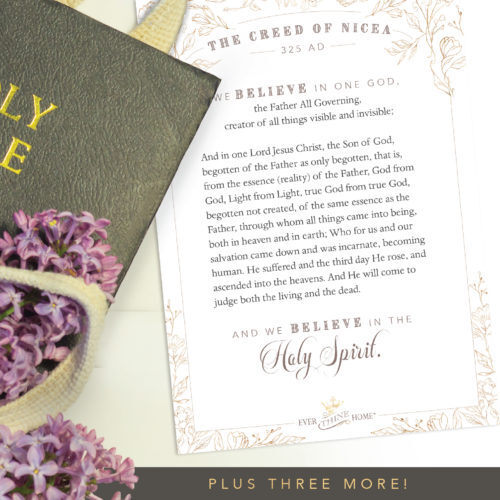 Click here to download your copy!
The post Friends & Family February 2022 appeared first on Ever Thine Home.
Friends & Family #14
Happy shortest month everyone!
As the days continue to speed by, this month’s letter to all of you is more of a deep dive into what I’m learning in my online class at Dallas Theological Seminary.
But first here are two of my favorite photos from the Love Like You Mean It cruise we went on earlier this month. The first is with an Ethiopian-American couple who live in the DC area with their four kids. They have loved learning about marriage and family from our ministry so it was a treat to spend an evening with them. The second is a rainbow out our cabin windows which was gorgeous to see and so meaningful to be reminded of God’s love for us.
My class this semester is on the history of doctrine, which sounds terribly boring and dry, but what I’m learning is compelling and truly important to believers today. So stick with me for a few minutes and marvel that God has managed through broken sinful humans to keep the truth of His Word and His character pure and clear for generations.
This month I learned why the Church, meaning the universal body of believers around the world, wrote and adopted creeds and statements of belief. The story goes like this:
In the days, months and early years after Jesus’ ascension and Pentecost, the rapidly growing baby church all believed what they had seen: Jesus was a real human who they saw and touched; He really suffered and died and therefore He had to be God because He rose from the dead. Hundreds were witnesses, so no one questioned it.
The apostle John says it plainly: “That which was from the beginning, which we have heard, which we have seen with our eyes, which we looked upon and have touched with our hands, concerning the word of life—the life was made manifest, and we have seen it, and testify to it and proclaim to you the eternal life …” (1 John 1:1-2).
It wasn’t just the 12 who saw and touched Him! Paul records that Jesus appeared in His resurrected body to over 500 believers at one time, and who knows how many others saw Him at other times that weren’t recorded.
But eventually new converts began asking questions no one had asked before. And so those first-generation disciples—like Ignatius of Antioch in Syria, a disciple of the Apostle John—began to write explanations for why we believe Jesus is God, who existed eternally with the Father.
Okay, pause on this one. Can you even imagine what it would have been like to be a disciple of John? The real John of the Bible who saw Jesus transfigured on the mountain and saw Moses and Elijah! And how did he know the two who showed up with Jesus were Moses and Elijah? And John was in the boat when Jesus calmed the storm, when Peter walked on water, when Jesus fed 5,000 people … John saw it all. Literally. If I was discipled by John, I would have a thousand questions. And I would have believed everything he said.
Back to the story. From those early days to today, we believers need words to communicate our faith to others. As a result, creeds (or statements of faith) were written for the purpose of uniting the church in our beliefs about God.
Jesus prayed before He was arrested in the Garden of Gethsemane that God would keep us and that we would be one even as He and the Father are one. When the body of Christ all believe the same truths, we are united in our faith even if we practice our beliefs very differently.
This month one of the concepts we studied was the Trinity, which is present throughout the Scriptures, even though the word trinity is not in the Bible but was coined to explain our three-in-one God. For example, when Jesus instructed His disciples to “baptize them in the name of the Father, the Son and the Holy Spirit” (Matthew 28:19), He clearly listed all three members of the Godhead in equality. Nowhere is the deity of Christ or the Holy Spirit denied in the Bible. Thus the concept of the Trinity is clearly revealed in Scripture and the church Fathers defined it for us.
Concepts like the Trinity were eventually worked into creeds or statements of faith. Perhaps your church, as did mine growing up, recites one of these creeds during Sunday morning worship. The Methodist church, even with its increasing drift toward liberalism, still recites the Apostles Creed every Sunday. I was so surprised and interested to learn the earliest form of what became the Apostles Creed was first written in Rome and called the Old Roman Symbol. This was sometime between 200-300 A.D. It was a statement all new Christians memorized and stated before baptism.
The final wording of the Apostles Creed was adopted in the fifth century and has remained unchanged since. Which is truly remarkable … that almost two thousand years later churches worldwide are still professing the same beliefs, the same creeds as did those in the ancient church. Others from that era are Nicene Creed written in 325 A.D. which established the equality and unity of the Father and the Son; and the Constantinople Creed from 381 A.D. and the Chalcedonian Creed in 451 A.D., both of which added sentences declaring the deity of the Holy Spirit.
Following these there was no change in our major creeds for over a thousand years. Another remarkable providence of God.
If you are like me, you’ve never seen some of the lesser-known creeds unless your church repeats them or you learned them in a catechism class as a child. So at the end of this letter I’ve had our designer Julie create a few of them for you to print and keep to read for a quiet time or a prayer. The words are beautiful and inspiring and worthy of our attention since they are reflections of the God we serve and love.
Two weeks ago we had ice and snow and now the early daffodils are blooming! Such is the on again, off again nature of this season. As I type this a front has blown through and the temps dropped from the low 60s this morning to the low 40s now with lows tonight in the 20s. My desk is built below a window in our laundry room and the cold air blows through the cracks around the window so I need a cozy blanket to stay warm. I love the changing seasons.
I hope you will enjoy reading these beautifully written creeds of the faith and that you will join me in giving thanks for the wonder of God’s work through the ages.
Till next time in March!
Ever His,
Barbara
Click here to download your copy!
The post Friends & Family #14 appeared first on Ever Thine Home.
Barbara Rainey's Blog

- Barbara Rainey's profile
- 24 followers

