
Barbara Rainey's Blog, page 10
December 8, 2022
The Barbara Rainey Podcast: Gift Giving in the Rainey Home


The gift-giving season is fully upon us! I’ve been working through our gift list for a while now, but with 27 grandchildren, I feel like I’ll never be done!
Many years ago, when our kids were small, Dennis and I decided we wanted to focus on giving, rather than receiving. In fact, the Bible points us in this direction! Acts chapter 20 tells us “it is better to give than to receive” and I really wanted that to be the focus in our home.
Today on The Barbara Rainey Podcast, Dennis and I talk about our own upbringings and how they played into traditions we started in our home with our six children. We talk through our tradition of gift-giving with our children and how our kids started shopping for their siblings with their own money and gift-giving actually became a kind of competition in our home!
We also talk about the newest book I wrote, Tales of the Resistance. In this book, I talk about many unsung heroes of the faith. Each story is written to where it can be told in several minutes or less, so you can read it around the dinner table or at bedtime. This month, we would love to send you a copy with your gift of $25. We only have a limited number of these books, so be sure to give today!
You can listen here or on any major podcast platform.
I hope you and your family have a very Merry Christmas!
Ever His,
Barbara
The post The Barbara Rainey Podcast: Gift Giving in the Rainey Home appeared first on Ever Thine Home.


December 5, 2022
What About Santa?
Dear Barbara: How should our family handle the popular tradition of Santa? I know Christmas is about Jesus, so is it wrong to talk about Santa too?
Like many of you, Dennis and I kept our favorite childhood holiday traditions alive as we began growing our new little family: cookie recipes, Christmas trees, church services, holiday decorations, Santa Claus, and more.
Several years into parenting though, I started questioning this borrowed tradition, asking myself, Did I want to teach my children to believe in Santa Claus when I knew he wasn’t real?
The responsibility of what we were modeling and teaching our children weighed on me heavily. By this time our oldest children were between three and five, and they were already rooted in our traditions. To them, Christmas was all about these activities that we repeated year after year. When we talked about Santa, they trusted what we told them. And that worried me.
What should we do as a mom and dad who knew that Christmas celebrated the birth of Christ?
Not only did I wonder how we should handle Santa at Christmas, but I also thought about the Easter Bunny and the Tooth Fairy. I questioned whether I should read fairy tales to our kids.
Truth has always been of immense importance to me. Even though Dennis and I didn’t feel we were harmed as children by pretending Santa was real, I feared my children would think I was lying to them if we told imaginary stories.
I wanted the best for my kids, and I know you do too.
A turning point for me was discovering the book, Honey for a Child’s Heart, by Gladys Hunt. Hunt addresses the importance of reading good stories to children of all ages. She helped put my fears in perspective when she wrote:
“Maybe you have wondered about the wisdom of fairy stories in your child’s life. I heard a man recently say that life wasn’t like Cinderella and others who say they don’t like elves and fairies and talking animals and Santa Claus. Children don’t take life as seriously as adults and are more inclined to read for pleasure without theorizing until all the fun is wrung out. Imagination is the stuff out of which creativity comes.”
Peace, encouragement, and clarity calmed my tangled mind as I read Hunt’s book. As an artist, and knowing God values our being creative since we are made in His image as Creator, I believed the value of growing creativity in my children was as important to me as teaching truth. This author’s words put the questions of pretending and imagining in perspective. Finally, as a mom I felt liberated to encourage my children to enjoy this delightful and very important part of being a child all year long.
Armed with a long list of great books from Gladys Hunt’s bibliography, I continued reading imaginative books from authors Dr. Seuss, Beatrix Potter, Maurice Sendak and one of my favorite stories, Good Night Moon. But as my children grew, I added more classics like Winnie the Pooh, Charlotte’s Web, and the Chronicles of Narnia series by C.S. Lewis. These books include talking animals and imaginary worlds that danced in our heads.
I reread the entire Narnia series only a few years ago after our granddaughter Molly died. As an adult I still love the possibilities C.S. Lewis presented. His imagery of heaven gave me hope and peace as I pictured Molly playing and laughing in Lewis’s land beyond the sea.
I often wonder if God, in His limitless creativity, might welcome us to a world where animals do indeed talk and fly. Psalm 98:8 says, “Let the rivers clap their hands, let the hills sing for joy together,” and Psalm 96:12 tells us, “Then shall all the trees of the forest sing for joy.” Are these just metaphors? Personally, I wonder. As 1 Corinthians 2:9 reads, “No eye has seen, nor ear heard, nor the heart of man imagined, what God has prepared for those who love him.”
Imagination isn’t just for our enjoyment. It’s important for our faith too. Do you believe in a God because you’ve seen Him? Are you confident you will go to heaven because you’ve been there and can verify that it is good? Of course not.
We believe by faith because we have read the story God has written for us that gives us glimpses into heaven and stories of people who believed in Jesus, most without having actually seen Him.
I think it’s important to encourage our children to dream, wonder, and speculate about ideas that are out of this world. This is practice for them in growing the ability to believe in a God who they cannot see. What about heaven with streets of gold, mansions just for us? I’ve never seen such a thing. But I can imagine!
I don’t think parents should fear a make-believe character like Santa. But neither would I encourage an emphasis that excludes the more important Bethlehem story of Jesus. In our home we made the placement of our nativity scene (on top of our piano) more important than the decorating of our Christmas tree. We always played Christmas carols about Jesus, we read the nativity story, and practiced Advent … or maybe I should say we tried to practice it, because with little children we failed more than we succeeded!
We can encourage our children to enjoy reading good stories and learn to create their own stories to tell. If you want, allow them to delight in a character named Santa who would give sacrificially to others without trying to convince them he is real any more than Cinderella or Peter Rabbit. And if you choose to include Santa in your celebrations you might want to teach your children that he is modeled on real historical people who did give gifts on Christmas Eve to children.
Good, make-believe narratives create a longing in all of us for something more, a longing only the true story of Christmas can satisfy.
Every family needs to decide for itself what to do with Santa Claus. There’s certainly no avoiding or ignoring it, since Santa is everywhere in our culture during the holiday season. The choice is yours and you must make it.
But even more important than this decision is the commitment by you, as parents, to live the Bible’s truth before your children as you teach it.
One friend shared, “I knew about Santa when I was growing up just as I read stories about elves and other pretend ideas. But I never got these stories mixed up with Jesus Christ because of the way my parents lived. They talked about Him as a living person all year long. I knew He was the real one!”
Whatever you decide to tell your family about Santa, the more important question is this: Do you live in a way that shows your children that Jesus is really alive and real every day, every moment of every year? If you do Santa will be all he really is; a make-believe story that goes away as they grow up just like the Tooth Fairy.
May you make Christ the center of your holiday gatherings and your everyday lives. This is why He came at Christmas.
The post What About Santa? appeared first on Ever Thine Home.
November 21, 2022
Do You Play Thanksgiving Holiday Music?


As you’ve been decorating and preparing for Thanksgiving, perhaps for several weeks, have you also been playing Thanksgiving music?
No?
Why not?
Several reasons come to mind, including the obvious one: Christmas decorating and celebrating has pre-empted Thanksgiving almost entirely. Christmas music began playing in many stores in early November. Some radio stations begin playing Christmas music non-stop even before Thanksgiving.
But equally obvious is the absence of any collected music themed for this holiday.
And yet … the singular core response to the work of God in our lives is gratitude and thanksgiving which breaks forth in worship, usually in songs of praise. I would guess the total corpus of Christian music—hymns, psalms, and praise and worship songs—is predominantly a collection of tunes about giving thanks.
Dearth of music is not the issue.
About a decade ago I was focused intently on helping women prepare their hearts and homes to facilitate the transfer of faith and the knowledge of God to their families during the holidays. I recognized this absence of Thanksgiving music, so to help fill the void, two dear friends of ours collaborated to produce a CD of music for this holiday.
Many of you have been asking for this collection of music for several years. Now we have permission to share their work so that you and yours can enjoy Thanksgiving-themed music this week. As you finalize meal prep, make beds and pull out sleeping bags, this music can help you focus on this historic holiday to thank God for His many provisions.
The hymns and songs in this collection are all instrumentals except for the last one, which is the doxology. The arrangements of these 16 familiar songs are unique to this collection, which was created by Keith Lynch and Alan Mesko, both exceptionally talented musicians. Alan’s fingers made beautiful music for more than one of our daughter’s weddings. He’s now in heaven and we who remain miss him.
May this beautiful music inspire generous thanksgiving and praise to God this week for His endless goodness to us. Thank you, Lord, for Keith and Alan and the gifts you gave them that they have so generously shared with others for your Kingdom work.
Happy Thanksgiving week everyone!!!
The post Do You Play Thanksgiving Holiday Music? appeared first on Ever Thine Home.
November 14, 2022
A Drone View of the Old Testament


Drones have given us ordinary people access to views only pilots and satellites once had. Recently a friend of ours took photos of our house with his drone. The images he captured show our house and yard, which from high above look tiny in the midst of the surrounding woods and forest. The view from above puts our existence in perspective. We too are tiny in the expanse of God’s world.
So studying the drone footage of the Bible brings to light the whole of God’s Word to me and to you. The elevation makes the important themes and ideas stand out. Instead of seeing the trees we see the entirety of His forest.
If you remember, last week I taught you 5-12-5-5-12 as a summary of the Old Testament? And I included in that post the summary of the entire Pentateuch in only 15 short stanzas. My goal was to highlight those pivotal moments of those crucial books. So much of everything else in the entire Old Testament and even the New Testament rests upon those beginning books. And as Jesus Himself said to the two disciples on the road to Emmaus, “ … beginning with Moses and the Prophets, He interpreted to them in all the Scriptures the things concerning Himself” (Luke 24:27).
For my seminary class I’ve been composing a poem that presents a drone view of the Bible. This week I’m posting the portion covering the twelve Old Testament history books: Joshua, Judges, Ruth, 1 and 2 Samuel, 1 and 2 Kings, 1 and 2 Chronicles, Ezra, Nehemiah and Esther. The key concepts are in the title.
I hope you enjoy this view of the history of God’s promised nation: Israel. It’s not quite finished, but it’s good enough to share with you:
God’s Promised Nation: Conquest, Chosen, Covenant, Kingdom, Chaos
See the Land! Just ahead! Go conquer
Joshua and Caleb led with a roar.
Rahab risked faith with the scarlet cord.
How I learn from saints long before.
Law reread, the sun stood still. Yet
lives remained prone to deceive.
“Choose you,” said Joshua. “Don’t forget!”
How God looks for each one who’ll believe.
The next generation knew not the Lord.
Glimpses of faith, evil decades of gloom.
Judges arose, purged idols with the sword.
How I watch God’s hesed* refuse to consume.
A glow in the darkness, a beauty pure
dared to believe; Ruth became a dreamer.
Noble. Loyal. Her true faith did endure.
How God reveals He’s Kinsman Redeemer.
Lured by envy, Israel begged for a king.
Samuel crowned Saul who soon self-destructed.
God then chose a shepherd boy, fearless with his sling.
How I see God’s plan, unthwarted by anything.
A theme persistent: God sees not as we
Not appearance or fame, but faith God does seek.
Unseen Rahab, Ruth, and Hannah show me
How God favors hearts teachable and meek.
David, valiant for God, rescued the Ark
saw His Presence return. Dreamed a place for
God’s Name to dwell; all to laud Yahweh as King!
How I wonder. Do You God, by me, feel adored?
Another covenant, three promises bright.
A house, a throne, a kingdom without end.
But the vision tarnished, David’s sins a sore blight;
Yet God’s divine plan and hesed transcend.
King David’s empire now gone with the wind.
Man of God blinded by lust. His offspring
ruined by the consequences of sin;
How closely to my Savior must I cling.
Solomon’s loves became idols. Wise one turned
a fool. In wealth he forgot Who provided.
Three kings, three hearts, the famed trio corrupted.
How God longs to find, pure hearts, undivided.
The kingdom once whole, fractured in two
Murderous reigns led a chaotic dismember.
Though Elijah worked miracles, most forgot Who;
How I too seem so weak to remember.
In the south, good kings were rare lights
Chosen Judah, a clock winding down. Heard
Isaiah and Micah speak woe. Even in plight
God always gives hope in His word.
God’s people refused Him, the land lay ruined,
Marched off to exile, Solomon’s temple razed.
Because God is love, He disciplines His children;
How in my exiles, God is to be praised.
A trilogy of tales show God does not sleep.
Three of His own in prominent roles
Scribe, cupbearer and queen, His sheep;
How God seems silent but His hand controls.
Ezra-Nehemiah return to restore
the land; its wall and temple rebuild
guide the people to God’s ways as before;
How I Your temple by You am refilled.
An unlikely queen, an invisible hand.
“If I perish I perish,” Esther’s words well known.
An outcome incredible! God’s in command;
How God ever loves me and cares for His own.
May you see in these lines the eternal patience and love of God continually seeking His own, calling then back to Himself, and all the good He has waiting for them to enjoy, both here and forever in heaven.
May your gratitude this month be focused on His abundant gifts of love to you.
O come let us adore Him.
*The word “hesed” is Hebrew for God’s steadfast, everlasting love.
The post A Drone View of the Old Testament appeared first on Ever Thine Home.
November 10, 2022
The Barbara Rainey Podcast: Thanksgiving: A Time to Remember
I don’t know about you, but to me it feels as though October dragged by a bit and now November is racing ahead and we are only two weeks from Thanksgiving! I feel like every year stores are putting out their Christmas decorations earlier and earlier and Thanksgiving gets glossed over. One of the things I have always tried to instill in my kids–and now my grandkids–is the importance of Thanksgiving and how significant this holiday is for our country and, more importantly, for us as people of faith.
This Thanksgiving season, to help you and your family celebrate this day, I want to share the audio version of a story I wrote many years ago, Thanksgiving: A Time to Remember. As a history major many years ago, I loved digging into the history of this story and writing about it through a Christian lens. I hope you take some time today to listen and are able to incorporate this story into your family’s celebration. You can listen here or on any major podcast platform. The podcast is a two-part series, but you can listen to both today! And please feel free to share this with your friends and family. I hope you are encouraged by this story!
I wanted to extend this special audio version of the book, Thanksgiving: A Time to Remember as a GIFT. We are so pleased to share it with you. Because of generous donations from listeners like you we are able to make this podcast available for FREE to anyone. If you enjoyed this podcast, would you consider making a donation to help support the ministry of Ever Thine Home? Go here to make your gift to help us continue the ministry of ETH.
Happy Thanksgiving!
Ever His,
Barbara
The post The Barbara Rainey Podcast: Thanksgiving: A Time to Remember appeared first on Ever Thine Home.
November 7, 2022
Newly-Discovered Nuggets From God’s Word
My seminary class this semester is “The Story of Scripture,” a high-level view of the whole Bible. To make it memorable my prof, who also happens to be the president of the seminary, taught us all a rhythmic chant. He’s very musical and would have been a great cheerleader or yell leader in high school or college!
It’s very simple. We clap our hands and repeat 5-12-5-5-12. 4-1-21-1.
That’s it! Like a children’s song with hand motions that you can’t forget, this pattern of numbers is now lodged in my brain and at random times I find myself subconsciously repeating it over and over.
It means 5 books of Moses, 12 books of history, 5 books of poetry, 5 major prophets, 12 minor prophets … the major sections of the Old Testament. The New Testament is as you might have guessed: 4 gospels, 1 history of the church, 21 letters, 1 prophesy.
Even as we’ve focused on the big picture, we also are seeing, by our prof’s direction, details that are important to the whole.
Here are two up close discoveries that were new to me early in this semester. I’m sure there will be more.
Discovery #1
Most of us know the story of the tower of Babel in Genesis 11. After the flood all the people gathered in a central locale and decided to cooperate in building a tower. Sounds innocuous at first. So why was this a problem God needed to stop?
First, remember how the serpent tempted Eve? He said she could be like God (see Genesis 3:5). It was a comparison trap and she took the bait.
In Babel this same sin lived on. The people wanted to be like God, and “make ourselves a name” (Genesis 11:4).
For the first time I saw how this ancient story about Babel is relevant in our day. Everybody wants to make a name for themselves. Think social media, politics, professional sports, corporate ladder climbing. It’s so easy to get sucked into power, prestige, and finding significance in our own abilities and accomplishments. It’s why donors to colleges put their names on buildings. And on it goes.
Recently I told God I too have been sucked into this comparison/making a name temptation via social media. Even if your struggle isn’t social media, we all have this desire to be known, to be strong, to not have needs or limitations. We want to be independent and not need God. But the bottom line of the Christian life is our absolute bankruptcy and need of God. Period.

My new prayer has been, “God help me remember every day to make Your name great, not my own.”
Discovery #2
A pivotal chapter in the book of beginnings (Genesis) is chapter 12 and the story of God giving Abram three unconditional promises: descendants (which would create a nation), land, and blessing. And very interestingly He also promises Abram that He will make his name great. As Abram obeyed God and followed Him, God would make him a great nation of people and give him a great name. Greatness comes from obedience to God not from our own achievements apart from Him.
But what I’d never seen before in this story is the command God gave to Abram in verse 1: “Go forth from your country,” which Abram did; “and from your relatives.” Wait … didn’t Abram take someone with him when he left? Genesis 12:4 tells us, “Abram went forth as the Lord had spoken; and Lot (his nephew) went with him.”
So Abram didn’t follow God’s instructions precisely. So interesting.
As the story of Genesis unfolds it becomes clear that Lot created some problems for Abram. It makes me wonder what would have happened had Abram left Lot behind as God instructed?
But most interesting of all is God’s character. God’s promises to Abram in Genesis 12 were unconditional. God’s plan was to create a nation through whom He would bless the entire world. We know today that included the Messiah, Jesus, who came from Abram’s line of descendants.
Here’s the startling truth for us today: God’s unconditional promise was NOT changed by Abram’s partial obedience.
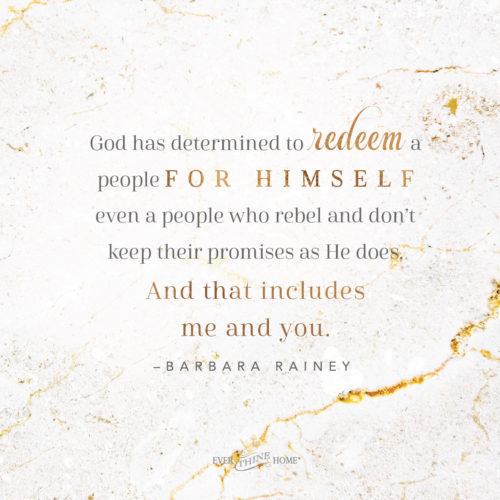
God has determined to redeem a people for Himself even a people who rebel and don’t keep their promises as He does. And that includes me and you. I find this truly head-shaking amazing!!!
Part of the final assignment for this class is a creative project of our choosing to tell our version of God’s story. It can be a song, a painting, or any other creative idea. I decided very early on to write God’s story in a poem form that I hope will be memorable. I’m going to have it designed too, because I have to make things beautiful if I can.
The rest of this post is the first section of my poem which covers the Pentateuch, the first five books of the Bible. I read a poem last winter during Lent that inspired me with its simple four-line cadence. It’s been a fun project playing with words, focusing on the richness of theology, and finding conclusions about God’s character and how I see God in every page of His inspired Word.
I haven’t totally finished this poem, but I think it’s good enough to share with you. I hope you’ll enjoy this excerpt.
Beginnings:
Chaos, Creation, Contest, Covenant, Commands
God. Spirit hovered. Word spoke
Light. Life. Kinds. Multiplied
Adam. Then Eve awoke
How the Triune God made me.
With beauty pure and God they dwelt
Harmony, freedom, no shame. See
sly enemy stalk. They listened, we knelt
How I too rebelled against Thee.
Eden lost. Sin and death aggregated
One upright imperfect man found
in the whole world deteriorated.
How God promised: a multi-colored vow.
Sin remained. Abram called. Leave.
Land, offspring, blessings: God’s oath
made by Covenant. By faith believe;
How I see He calls you and me both.
Isaac. A miracle. A type,
Foretelling the looked-for Savior.
Abraham obeyed, raised the knife
How God will one day deliver.
Jacob’s twelve sons, Joseph betrayed
enslaved in Egypt, with God, who’s ahead
Evil turned good, Israel is saved.
How I see my God has never misled.
400 years later a deliverer sent
Free the indentured generation
Ten plagues. Hard hearts. Pharaoh bent.
How God forged His promised new nation.
A sign. one year old, gentle and pure
To be saved by blood, keep Passover
A memorial. A lamb to prefigure,
How I too, by faith, am passed over.
Red Sea, supernatural escape,
The people feared. Then grumbled.
Writ with His finger two tablets of stone,
How God spoke to Moses who shone.
Offerings, laws, Moses did write,
Seven feasts and Sabbaths for rest
Order established to make hearts unite
How I see God’s pure holiness.
From Sinai to the land. Israel squandered
God’s promise. Stubbornly refused to believe.
For faithless grumbling, sentenced to wander
How God’s heart was so very grieved.
A sad story this faithless generation.
Still God’s grace provided manna and meat
With patience God waited till time-out was served.
How I too am parented by His pure grace.
40 years late, yet beginning anew
Repeat the Law. Teach children to be true.
Remember, relearn, and treasure
How God’s mercy will always pursue.
“Yahweh is God,” the new generation hears,
“He loves you and wants your life to be blessed!
if you obey.” You’re God’s covenant heirs.”
How I see God’s clear lines. It’s we who digress.
Moses, the one “God knew face to face,”
His last words were: “Fear God, love and obey
remember your God, full of power and grace.”
How tender is God. In the grave, Moses He laid.
Hope you enjoyed this! The Bible is alive. It’s eternal and endlessly rich in discoveries. I hope this only makes you want to know Him more! I’d love to hear from you!
Ever His!
The post Newly-Discovered Nuggets From God’s Word appeared first on Ever Thine Home.
October 31, 2022
Cultivating Gratitude: Moving From “I Have To” to “I Get To”
Two of my grandsons worked during their summers as counselors for Pine Cove Camp in Texas. It’s a great Christian camp with a long history of investing in kids, including inner city kids, and families.
One of Pine Cove’s goals every summer is training its leaders to be grateful servants. Not begrudging unhappy servants, but the kind of servant that looks more like Jesus, who willingly gave Himself to serve that He might win people for His kingdom.
To help accomplish this goal, and to be a model for the campers, the Pine Cove directors have a motto which says: “I get to.” The implication is that the counselors’ jobs are a privilege rather than a duty or a drudgery, even the jobs that aren’t pretty ones.
Tyler and James both shared how they learned to say, “I get to wake up at 5:30 a.m. to help in the kitchen to serve the kids breakfast.” Or, “I get to do lifeguard duty tomorrow afternoon to watch over all the kids in the pool to keep them safe.”
Ashley, their mom, told me this phrase carried over when they came home. Now she’s trying to remember to correct herself when she hears herself say, “I have to go take your brother to practice.” She changes it to “I get to …”
Interestingly, literally an hour after Ashley told me this story I was seated in my hair stylist’s chair listening to her give me an update on her husband. He’s had one health issue after another, and every time I marvel at her tenacious servant spirit and his resilient determination to keep working to get well.
Cynthia told me her husband called her with a change in their plans, which meant she had to assume some tasks for him that she wasn’t planning to do. As she continued her story she said, “I realized I was sounding whinny like a child and that I wanted to be grateful instead.” She said, “I changed my words and verbally said out loud, ‘I get to’ pack his suitcase for him and ‘I get to’ find a way to the airport on my own because finally he is well enough to be working again!”
I said, “You won’t believe I just heard this same phrase from my daughter.”
She replied, “Then I guess God wants us to pay attention?” I agreed.
Being grateful is a choice. Having an attitude of “I get to” changes our perspective, helping us see our life as a privilege, our circumstances as gifts, our duties (taking children to practices or tutoring or helping our husband) as a blessing.

Both of these conversations reminded me of a conference Dennis and I were a part of decades ago. It was run by a bunch of 20-somethings who created a motto which said, “You can’t make it hard enough for me to complain.” Our goal was to be grateful for every job and responsibility because we were all working together for a higher goal. It became contagious and we enjoyed the challenge of never complaining no matter how hard things got. Competition is a good thing when channeled positively. It can be a helpful tool for moms and dads too.
As I think about gratitude in this season when we more naturally are mindful of the concept, I’m very aware it’s not just our kids who are entitled … it’s all of us. Every. Day. We all need help changing our perspectives and our habits. We need to resist the way of the world which is entitlement and live more like Jesus … as servants.
It’s not easy to change your mindset—to change from “I have to” to “I get to.” Changing our lives is a cooperative work with God Himself. Only He can truly change hearts, but I have a responsibility to remind myself what pleases Him and feed my soul the truth that liberates.
Famous composer Johann S. Bach wrote on the top of every piece of music he composed the phrase “Soli Deo Gloria,” which means glory to God alone. It was a reminder to himself to keep God the focus of his musical work.
I need visual reminders like this. And likely you and your family do too. So try writing the words “I get to” on something you will see every day: a chalkboard, a piece of paper taped on your refrigerator or mirror or steering wheel. Help your kids practice this subtle but powerful shift of perspective. I’m going to do this.
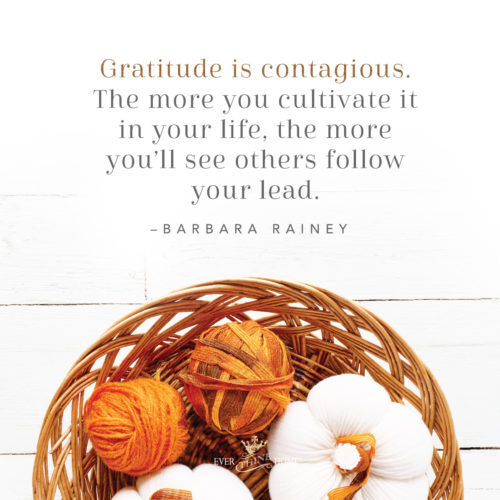
Gratitude is contagious. The more you cultivate it in your life, the more you’ll see others follow your lead!
May we who belong to Jesus look more and more like Him … a hopeful, grateful, “get to” servant hearted community!
Click here for more ideas for cultivating gratitude in your family!
The post Cultivating Gratitude: Moving From “I Have To” to “I Get To” appeared first on Ever Thine Home.
October 24, 2022
How to Face Holidays When It’s Hard to be Thankful
One spring, years ago now, Dennis and I watched other families experience all the celebratory festivities of a senior’s year in high school: proms, award nights, graduation … But our daughter, a senior that year, had decided she was done with school. At 18, she knew she was not legally bound to us anymore, so six weeks before graduation she dropped out and moved in with a friend who we barely knew.
I remember keenly the loneliness, isolation, and great sadness we felt as parents when all of our friends, many of whom we’d known since our kids were in grade school together, were all gathered happily at awards night and then at graduation. But we were home … alone. Wondering where our daughter was. Wondering if she was safe. Fear was our companion, not our friends.
I was not happy nor was I thankful. This was not what I had prayed for. This was not good for our daughter or for us.
So how do you face fast approaching holidays when your life is upside down?What do you do when you scroll through your social media feed and see stories and photos from others and their apparently perfect days and holiday preparations?When photos pop up on your phone from years ago with memories of happier days, what do you do? The reminders are painful stabs of what could have been or should have been. And it hurts.How do you live in a world that portrays fairytale perfection when yours is clearly not? How do you manage graduations, birthday parties, and holidays that should be happy when your world is filled with conflict and pain?Heartache and change are normal. “Happily ever after” is not.
First, remember this truth: We aren’t in heaven yet. We still live on a planet broken and infected with sin and death. God tells us we are “aliens and strangers” (1 Peter 2:11) on earth looking forward to a new heaven and earth where one day all will be well.” (see Hebrews 11 and Revelation 21:5). That reality will help right size any expectation of perfection or even expected happiness here and now.
Second, avoid social media during this season. Don’t give opportunities to the enemy of your soul, the devil, to cause you to compare with others who appear to have what you don’t. Instead of scrolling through images, scroll through your Bible. Do a word search on gratitude or thanksgiving or heaven to remind yourself of what is lasting. Feed your soul with eternal truth. Don’t put the junk food of social media into your heart.

Third, give thanks. I can’t tell you how many times I didn’t feel like giving thanks, forgiving, or showing grace. But it is an imperative, a bedrock essential of belonging to our Father in heaven as His child. When I choose to give thanks for my circumstances by faith I am reminding myself of several things:
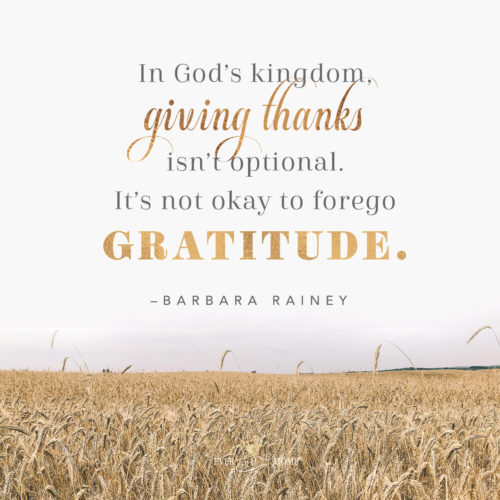
God is in control. My friend Nancy DeMoss Wolgemuth wrote in her new book that I highly recommend, Heaven Rules, “ … He is sovereign over everything that touches us … He is ruler over every diagnosis and prognosis, over all incomes and outcomes, over the most daunting challenges as well as the most seemingly trivial details of our lives.” God is in control is not a trite statement. It is the truth.He has a plan and is working it. John Piper said at a conference I attended some years ago, “God is always doing 10,000 things in your life, and you may be aware of three of them.” We always only see the current minutes and hours, while God sees every tomorrow and is always working good for those who love Him. And it’s good to remember His plan for me will never look like His plan for you or anyone else. Stop comparing!He can be trusted at all times. In spite of what we see and can’t see remember God sees all and is ahead of us in every circumstance. He is never surprised by those things which surprise us.In God’s realm, giving thanks isn’t optional. It’s not okay to forego gratitude. 1 Thessalonians 5:18 tells us, “give thanks in all circumstances; for this is the will of God in Christ Jesus for you.” In every situation and circumstance, good or bad, God commands us to give Him thanks.
Thanking Him is an acknowledgement of His authority. It also realigns our thinking and our faith with what is true. Romans 8:28 tells us, “And we know that for those who love God all things work together for good, for those who are called according to his purpose.”
It’s likely that the working of good God intends won’t be in our timing, meaning it won’t come nearly as fast as we’d like. The change we desire might not even happen at all.
But the outcome isn’t the point. It’s all about our hearts. Believing in Him by faith is what He desires. As 1 Samuel 16:7 says, “For the Lord sees not as man sees; man looks on the outward appearance, but the Lord looks on the heart.”
With Thanksgiving approaching, if the holiday feels all wrong may I encourage you to start today giving thanks for what He has allowed in your world?
Do this every day. Write a list of ways He is blessing you even when times are dark. It is good and biblical to share your hurt and pain and losses with God. He wants to hear you express it. But it’s equally important that you thank Him for all that is good.
I’ve been challenged recently to make sure my list of gratitude outweighs my list of complaints. The best way to do that is write your gratitude out in a journal or on a list on your phone. Numbers have a way of measuring objectively when our hearts are not!
God has a plan and will show you the way, but the first step to finding peace and rest in the turmoil of the now is to give thanks. Giving thanks clears the clutter in our hearts.
May you open the door to His presence by giving Him your thanksgiving.
May you experience the relief that giving thanks can bring.
May you know the peace of His presence with you in this season when it seems that everyone is happy but you.
May you trust God as never before.
The post How to Face Holidays When It’s Hard to be Thankful appeared first on Ever Thine Home.
October 20, 2022
The Barbara Rainey Podcast: The Importance of Gratitude
If you have been around children, I’m sure you have seen they can be selfish creatures! I vividly remember one day when my daughter Ashley called and said “Mom, I’ve figured out what my problem is.”
I said, “Okay?”
She said, “It is Daniel!”
I laughed—Daniel was her 14-month-old at the time and, long story short, the reason Daniel was her problem is because he was born selfish. He wants what he wants, when he wants it. It is our job, as parents, to train our children to be grateful. They are not born naturally grateful, and neither are we.
Being grateful is a learned behavior that we have to teach our children, and ourselves! On today’s episode of The Barbara Rainey Podcast, I talk about some things I did with my kids over the years to help teach them why we need to be grateful and content with what we have rather than always wanting more.
From reading to my kids about the Pilgrims coming to America on the Mayflower to having them memorize Scripture, I tried to instill an attitude of contentment in our house from an early age. I hope you will take a little time out of your day to listen to this episode. I pray you are encouraged by what you hear and perhaps try some of these activities in your house with your family! You can listen here or on any major podcast platform.
Ever His,
Barbara
P.S. If you know someone who might enjoy listening to this podcast, please forward and share. It’s free to anyone to listen.
The post The Barbara Rainey Podcast: The Importance of Gratitude appeared first on Ever Thine Home.
October 17, 2022
The Key to Raising Grateful Kids
One of the great privileges of my life has been visiting orphanages in places like Russia, China, and South Africa. Taking our children to see those little ones who had no parents, no room of their own, no toys or clothes of their own, was life changing. Through these many experiences we learned that those who have little are often much more grateful than those of us who have much.
Gratitude is not natural. It is an attitude that must be taught and nurtured. And it is a task more difficult for parents in the West because of our abundance and prosperity.
There is a story in the Bible that for many is hard to understand. After God freed the Israelites from slavery in Egypt … after He miraculously parted the Red Sea to save them from the Egyptian army and led them through the wilderness and provided manna for food every day … they came to the land of Canaan. God had promised them this land. When the scouting party of 12 went to spy out the land they discovered the produce of the land was exceptionally large and bountiful. Good news! But these men also saw it was occupied by a strong people. The men reported bad news.
The response of the population was fear voiced in grumbling and complaining to God. “Would that we had died in the land of Egypt!” they cried. “Or would that we had died in this wilderness! Why is the Lord bringing us into this land, to fall by the sword?” (Numbers 14:2-3).
Ten of the men and the people all responded with no faith in God and His promises. Instead they complained and griped and moaned and—possibly like your children–frowned and stomped their feet. For their ingratitude and lack of faith, God punished the Israelites—they wandered in the desert for another 40 years.
In the same way as a parent, I hated it when my children complained about what they had to eat or what they weren’t allowed to wear that everyone else could wear or what they couldn’t have. After all, didn’t they know we were trying to do our best in raising them?
We gave our kids penalties for complaining and had them memorize Bible verses in hopes that they would get the point. But we never were as radical in our discipline as God was with His children. I might have banished my children to their rooms for 30 minutes for complaining, but to be banished to a desert for 40 years seems a bit over the top!
Why did God make such a big deal about only a bad attitude?
Because it wasn’t just a bad attitude. God knew the issue was ungrateful hearts which were being fed from a heart of unbelief. Ingratitude is really a sign of a proud heart, a heart of rebellion, a heart that says to God, “I don’t believe Your promise that You’d give us the land.”
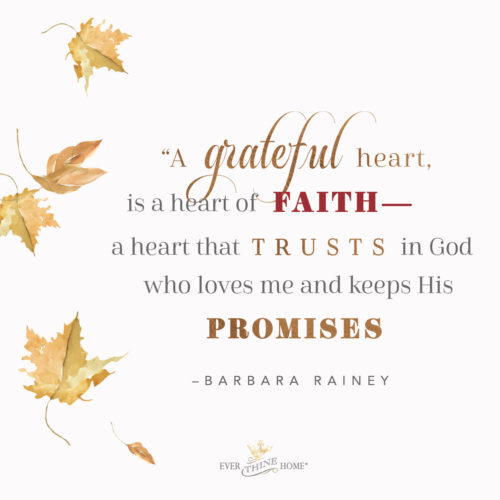
A grateful heart, on the other hand, is a heart of faith—a heart that trusts in God who loves and keeps His promises no matter what the circumstance might look like to us.
Because all of us are born selfish, it is every parent’s job to train their children’s hearts to be grateful. It’s not an easy task, but it’s a worthy one, for a child with a thankful heart is a delight to parents and to others. And I’m quite sure our Father in heaven smiles as well on your child and on you for a job well done.
But to tell the truth, my kids aren’t the only ones in our family who have a problem with ungratefulness and complaining. Unfortunately, I have to wonder how much of it they caught from their mother. It’s not something you’d see unless maybe you lived with me. But I’m sure that you’d see my problem if you saw my heart.
So if I’m going to have grateful children, I have to commit to being a grateful mother.

Here are a few practical ways to begin modeling gratitude for your family.
Talk out loud and frequently about things for which you’re thankful—big and small.Model gratitude. Let your kids see you thanking waitresses, cleaning staff, Sunday school teachers, and anyone else who helps or serves you.
Prompt them quietly to thank people who help them. Make thank-you notes written by your children and sent in the mail a normal project in your home. Include people like pastors and your children’s ministry leaders as well as grandparents and other family members.
Thank your children for their help around the house, their kindness to siblings, for exhibiting a good attitude, and any other small things you notice throughout the day. As a family, memorize Scripture that sets your hearts and minds on thankfulness. Try 1 Thessalonians 5:18 to start: “Give thanks in all things.” Remember all things means all things. Good and not so good. Thanking God helps us remember His already knows the hard things and what is ahead. Thanking Him is a way to strengthen your own faith.No matter your age, to cultivate gratitude you’ve got to step out of what you normally do, which is thinking about yourself. Set aside your natural bent toward selfishness and focus on others because that is the essence of thanksgiving and gratitude.
Ultimately for us as believers it’s directing our thanksgiving and our gratitude toward the source of everything that we enjoy in life, which is God Himself. Teaching our children to do this will prepare them to live a grateful life of worship.
May we who know Christ be known as a grateful joyful people whose trust rests in Him and not in ourselves or our circumstances.
The post The Key to Raising Grateful Kids appeared first on Ever Thine Home.
Barbara Rainey's Blog

- Barbara Rainey's profile
- 24 followers

