Alicia McKay's Blog, page 14
August 3, 2021
Wednesday Wisdom: Watch your language
Welcome to another Wednesday Wisdom, Friend. Every week, I share with you what I'm thinking about life, work, and leadership. This week we're talking about the power of language.
Two years ago, I ran a personal experiment after reading Atomic Habits by James Clear. To be more grateful in your life, Clear suggests that every time we say we "have to" do something, we replace it with "I get to." I gave it a go.
For a week, every time I found myself about to say "I have to" (‘I have to cook dinner’, ‘I have to pick up the kids’, ‘I have to be in Auckland that week’) I swapped it out for "I get to."
‘I get to cook dinner’ suddenly felt like a privilege. We have the food, skills and resources to create a healthy meal, and I’m home to do it.
‘I get to pick up the kids’ became a lifestyle indicator. I can prioritise my children inside my workday.
‘I get to be in Auckland’ became a marker of work variety and satisfaction.
Huh. Interesting!
I was genuinely floored by the difference - and it triggered a similar exploration in my work.
Could we maybe diagnose different patterns of behaviour and thinking based on the language people use?
After months of reviewing survey responses and monitoring the words people used in workshops and learning sessions, some clear themes emerged.
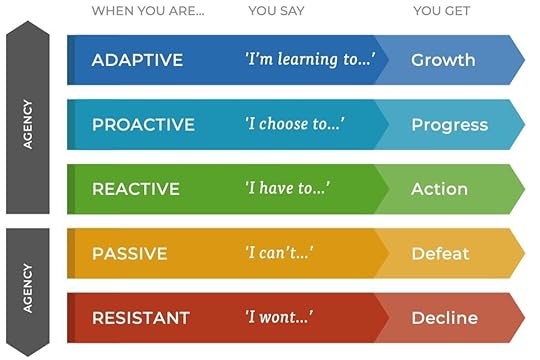
What we found
Worried and defeated people use passive language, and struggle to act on the things they cared about.
Busy and resentful people use the language of constraints, and find it hard to live by their priorities.
Proactive people use choice-focused language, and find opportunities to make a difference.
Adaptive and flexible people use the language of experimentation and are able to grow.
Like in Clear's experiment, the words we use don't just reflect how we think - they have a profound effect on the way we see the world and the choices we make. When we nudge language in a different direction, we can nudge our mindset along with it.
When I work with leadership teams, I encourage them to monitor how they speak, and what they're hearing. We always aim to shift at least one level on the ladder.
- What kind of language are you using most of the time?
- What about your peers and colleagues?
- What does it say about where your thinking is at right now?
- What difference would it make to try and use different words now and then?
If you give this. ago, let me know! I'd love to hear how you get on.
Til next week,
A


Quick hacks for bad attitudes
Estimated reading time: 4 minutes
 TL;DR:
The way we speak can change the way we think
Use the language of choice and experimentation to have more control in your life
Say “I choose to” or “I’m trying” more often.
Watch your language“Words create worlds”
- JONATHAN FRANZEN
Two years ago, I ran a personal experiment after reading Atomic Habits by James Clear. To be more grateful in your life, Clear suggests that every time we say we "have to" do something, we replace it with "I get to." I gave it a go.
For a week, every time I found myself about to say "I have to" (‘I have to cook dinner’, ‘I have to pick up the kids’, ‘I have to be in Auckland that week’) I swapped it out for "I get to."
‘I get to cook dinner’ suddenly felt like a privilege. We have the food, skills and resources to create a healthy meal, and I’m home to do it.
‘I get to pick up the kids’ became a lifestyle indicator. I can prioritise my children inside my workday.
‘I get to be in Auckland’ became a marker of work variety and satisfaction.
I was genuinely floored by the difference - and it triggered a similar exploration in my work. Could we diagnose different patterns of behaviour and thinking based on the language people use? It turns out that language isn’t just a reflection of what we think - it’s also a powerful way to shape it. We believe what we say, creating a virtuous (or not) cycle of feeding our beliefs and actions.
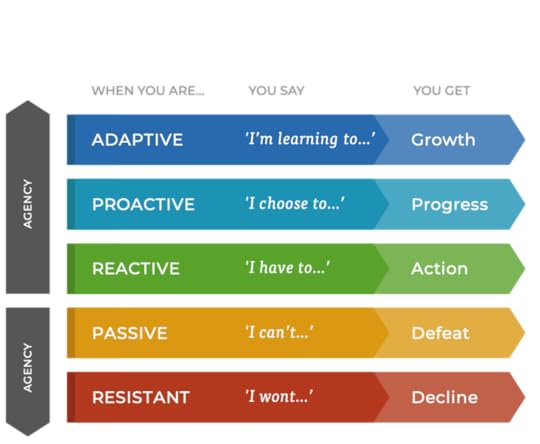
After months of reviewing survey responses and monitoring the words people were using in workshops and learning sessions, some clear themes emerged that showed the link at work. Check out the ladder below.
 Passive language
You might be familiar with the cliche of being less reactive and more proactive - but reactive gets a bad rap. At least you’re active!
Far worse is when we’re passive in the face of change and uncertainty. You’ll notice this language when people have slumped shoulders and start to sigh.
Faced with lockdown, they say “I just can’t homeschool again” or “I can’t take another one.”
This is the sort of language that leads us to defeat. Rather than finding options or looking for opportunities, speaking like this encourages people to throw in the towel.
If you’re noticing people - or yourself! - speaking about what you can’t do, try and nudge the dial toward more active language, by thinking about what you can do, for a quick boost.
 Active language
When we’re reactive, we’re busy and overwhelmed. We might be taking action, but we feel put upon and resentful. You can diagnose this behaviour when people talk in terms of constraints and obligations - reactive people say they “have to work from home” or “have to get this finished” - focusing on the external loss of control in their lives.
While it’s far better than being passive, getting stuck here has the potential to make us feel worse than we need to, by robbing us of a sense of agency.
To shift the dial on reactivity, focus your language toward what you can choose to do. Faced with a lockdown, the proactive person might be heard saying things like “I’m choosing to start earlier so I can homeschool in the afternoon” or “I’m choosing to get all my meetings done on a Tuesday.”
The difference is stark, and we see it in body language too - spines straighten, faces lighten and a sense of control sets in.
If you’re feeling put upon, and talking about shoulds and have-to’s, hack your attitude by verbalising what you can control and choose to change, to start making progress.
 Experimental language
The most powerful language we can use is focused on growth, through experimentation. Rather than trying to control all the variables, an adaptive attitude talks about what we can learn or try.
Faced with lockdown, an adaptive person can be heard saying “I’m trying a different schedule to see what happens” or “I’m learning to be smarter with my time this week.”
At this point, we’ve got a strong sense of self-control, and no longer feel so pulled and tugged by the uncertainties in our environment.
If you’re feeling frustrated by your lack of control, let go of certainty and think about how you might experiment. Say it out loud, to encourage other people to think that way too.

 Climb the ladder
No-one spends their whole life above the line - like it or not, everyone feels defeated or overwhelmed sometimes. That’s OK. What we’re looking for is a nudge in the right direction. By watching how we speak - and paying attention to the language of others - we can use our words as both a clue and a lever. Notice how you’re speaking, notice how you’re thinking, and try to move up a single level.
If you spend 10-20% of your time using experimental language, and more than 50% of your time focusing on what you can choose or control, you’ll notice the difference in your mindset, attitude and productivity in no time. Good luck!
IN SUMMARY
The way we speak is a good clue to the way we think
We can hack our language to improve our attitude
Move away from passive and reactive language
Try to focus on what you can
Do,
Choose, or
Experiment with.
Find out how strategic you are, in this handy three minute quiz. Then, receive a FREE cheat-sheet to start you on your way!
July 31, 2021
Leadership Reads
I love to read - ever since I was a kid, I’ve spent as much of my free time as possible engrossed in a book. Childhood me would be pretty stoked I ended up writing books! Though possibly disappointed that I’m writing business books and not legal thrillers a la John Grisham.
Books remain one of the the most incredible ways for us to grow and develop. How else can we access the life’s work of an expert for less than $40?!
Anyway, I digress. If you’ve read You Don’t Need An MBA and you’re looking for some more brain-fodder to level up your leadership, check out some of these titles!
Adaptive leadershipWhat Got You Here Won’t Get You There: How successful people become even more successful by Marshall Goldsmith
The Practice of Adaptive Leadership: Tools and tactics for changing your organization and the world by Heifetz, Grashow & Linsky
The Strategist: Be the leader your business needs by Cynthia Montgomery
Turning Pro by Steven Pressfield
Start With Why: How great leaders inspire everyone to take action by Simon Sinek
FlexibilityThe Obstacle is the Way: The ancient art of turning adversity to advantage by Ryan Holiday
Fear Your Strengths: What you are best at could be your biggest problem by Kaplan & Kaiser
DecisionsPredictably Irrational: The hidden forces that shape our decisions by Dan Ariely
Moments of Impact: How to design strategic conversations that accelerate change by Chris Ertel and Lisa Kay Solomon
Thinking, fast and slow by Daniel Kahneman
Seeing Around Corners: how to spot inflection points in business before they happen by Rita McGrath
he Strategy Book: How to think and act strategically to deliver outstanding results by Max McKeown
Creating Great Choices: A leader’s guide to integrative thinking. by Jennifer Rield and RL Martin
Rebel Ideas: The power of diverse thinking by Matthew Syed
Systems1/22/63: A novel by Stephen King
hink in systems: complexity made simple: the theory and practice of strategic planning, problem solving, and creating lasting results by Zoe McKey
Nudge: improving decisions about health, wealth, and happiness by Richard Thaler & Cass Sunstein
PerformanceDual transformation: how to reposition today’s business while creating the future by Anthony, Gilbert & Johnson
Atomic Habits: An easy & proven way to build good habits and break bad ones by James Clear
Necessary Endings: the employees, businesses, and relationships that all of us have to give up in order to move forward by Henry Cloud
Essentialism: the disciplined pursuit of less by Greg McKeown
When: The scientific secrets of perfect timing by Dan Pink
On influenceInfluence: Science and practice by Robert Cialdini
Tribes: We Need You to Lead Us by Seth Godin
Lead the Room by Shane Hatton
Made to Stick: Why some ideas survive and others die by Chip & Dan Heath
The Power of Moments: Why certain experiences have extraordinary impact by Chip & Dan Heath
To Sell is Human: The surprising truth about moving others by Dan Pink
July 27, 2021
Wednesday Wisdom: What’s your story?
Welcome to another Wednesday Wisdom, Friend. Every week, I share with you what I'm thinking about life, work, and leadership. This week we're talking about the stories we tell ourselves.
In December 2010, I started my first real job out of university. Like any new graduate, I was extremely nervous. Were they going to regret hiring me? Was I really up to the task?
As the first in my family to graduate university, I had no idea what to wear, or how to act. I also had a few more responsibilities than most 22 year olds. I was the mother of two young daughters. Bailey, 5, had just started school, and Charlotte was only 9 months old.
2010 had been a tough year. I’d completed my postgraduate study remotely, as a broke single mother living alone. I’d juggled late-night feeds with thesis research, and pushed hard to keep up with my course load, stretch a meagre budget and be a good parent.
The worst of it had come in June, when a traumatic tooth infection put me in hospital with septicaemia. My eyes burned with tears and shame as I begged at the local Studylink office for a loan to cover my root canal and treatment, despairing at a lack of resources and support.
As I left the office, dental voucher in hand, I made a decision that changed the course of my life and career:
I was never going to be poor, or depend on anyone else’s charity ever again...
The above extract is from a piece I published in Women's Agenda earlier this year, and something I've been thinking about this week, as I've wasted more time than I should have researching outdoor power tools.
I'm doing some gardening at home, and I need to pull a tree down. My first instinct is to go out there and get myself what I need - then I have it for the future, and I can take care of the job myself! Duh, right?
... Well, it turns out there's other ways to think about this problem.
My partner had a totally different approach - why didn't I ask the neighbour if I could borrow one?
My friend had another - why didn't I just get someone in to do the gardening, while I'm so busy?
Neither of these options had really crossed my mind.
The stories we tell ourselves early on stay with us for a long time. My story is that I'd better be self-sufficient, or I'm putting myself in danger.
They're not the same stories as the other people I surround myself with, and most of the time, that's really helpful.
What are you still telling yourself that you don't need to?
Can you speak to someone else with a different story?
.... Can you recommend a good line trimmer?
' Til next week,
A
Wednesday Wisdom: Upgrade Your Inner Google (Copy)
In December 2010, I started my first real job out of university. Like any new graduate, I was extremely nervous. Were they going to regret hiring me? Was I really up to the task?
As the first in my family to graduate university, I had no idea what to wear, or how to act. I also had a few more responsibilities than most 22 year olds. I was the mother of two young daughters. Bailey, 5, had just started school, and Charlotte was only 9 months old.
2010 had been a tough year. I’d completed my postgraduate study remotely, as a broke single mother living alone. I’d juggled late-night feeds with thesis research, and pushed hard to keep up with my course load, stretch a meagre budget and be a good parent.
The worst of it had come in June, when a traumatic tooth infection put me in hospital with septicaemia. My eyes burned with tears and shame as I begged at the local Studylink office for a loan to cover my root canal and treatment, despairing at a lack of resources and support.
As I left the office, dental voucher in hand, I made a decision that changed the course of my life and career:
I was never going to be poor, or depend on anyone else’s charity ever again...
The above extract is from a piece I published in Women's Agenda earlier this year, and something I've been thinking about this week, as I've wasted more time than I should have researching outdoor power tools.
I'm doing some gardening at home, and I need to pull a tree down. My first instinct is to go out there and get myself what I need - then I have it for the future, and I can take care of the job myself! Duh, right?
... Well, it turns out there's other ways to think about this problem.
My partner had a totally different approach - why didn't I ask the neighbour if I could borrow one?
My friend had another - why didn't I just get someone in to do the gardening, while I'm so busy?
Neither of these options had really crossed my mind.
The stories we tell ourselves early on stay with us for a long time. My story is that I'd better be self-sufficient, or I'm putting myself in danger.
They're not the same stories as the other people I surround myself with, and most of the time, that's really helpful.
What are you still telling yourself that you don't need to?
Can you speak to someone else with a different story?
' Til next week,
A
July 20, 2021
Wednesday Wisdom: Upgrade Your Inner Google
Welcome to another Wednesday Wisdom. Every week, I share with you what I'm thinking about life, work, and leadership. This week we're talking about purpose.
It feels like our experiences are factual, because they’re tangible. If you can see, smell, hear or taste something, it must be real… right? Wrong. Our external world isn’t as objective as it seems. In short, most of what we experience is just a projection of our own sh*t.
Like Google, our mind runs on a series of filters, helpfully sorting through the metric tonne of sensory information available at any given time to present us with relevant results. It's why you've never seen a Skoda Kodiaq in your life, until you buy one, and then everyone on the motorway is driving one. You've changed the criteria about what's relevant to you, and your brain is serving you different results to match.
This is great, if you’re a good Googler and you’re using the right search criteria.
But if your criteria are unhelpful - or worse, if they’re unclear, the sorting function doesn’t really work. Some things seem more important than they really are, while the most critical stuff falls by the wayside.
It’s why you get to the end of a busy day, exhausted but wondering what you achieved. In Essentialism (my most-gifted client book) Greg McKeown calls this the ‘paradox of leadership’ - feeling overwhelmed and underutilised at the same time.
The thing is, perspective doesn’t work without purpose.
It’s hard to see things for what they really are, if you don’t know who you are or what you care about.
McKeown calls this your ‘highest point of contribution.’ Simon Sinek calls it your ‘why.’ Woke mindfulness teachers talk about your ‘calling.’ Call it what you like. The guts of it is: when you’ve got your eye on something bigger and more meaningful, the minutiae doesn’t seem so relevant.
Who cares if someone cut you off on the motorway, or if Ben in Accounting took the wrong tone in his email, when you’re focused on building something important?
I don’t know what your bigger purpose is – maybe it’s saving dolphins with self-esteem issues. Maybe it’s bringing sustainability into the workplace. Maybe it’s being a present parent.
It kind of doesn’t matter what it is. It just matters that you have one. People with a clear sense of purpose live more meaningful lives, do better work and feel better about themselves at the end of a long and challenging day.
Purpose isn’t about changing the world. It’s about using our limited time doing stuff we care about. Discovering your purpose is about finding the things you care about that are bigger than you, so you can do more of that.
To cultivate a stronger sense of purpose in your life, try asking some useful questions, like:
What do you value most?
What really pisses you off? (the reverse is usually a core value for you)
What change do you most want to see in the world?
What would you do if you won Lotto? (hint: you can probably do something about that now.)
Til next week,
A
For more help on finding your purpose, check out this free resource pack.
July 13, 2021
Wednesday Wisdom: When In Doubt, Zoom Out
Welcome to another Wednesday Wisdom. Every week, I share with you what I'm thinking about life, work, and leadership. This week we're talking about perspective.
Some days it feels like the world is conspiring against us. You know those days, where it seems like everyone got up with the express purpose of f**king up your day? Slow walkers, unhelpful customer service staff, annoying emails and people cutting you off in traffic abound. What's everyone's problem?!
On the days when you're really in the hole, it seems like there's a new problem waiting around every corner, and that gets exhausting. If you're not careful, too many days like this can lead us into total burnout.
The answer to this is simple: we need better perspective. Perspective is something we're pretty good at when we look backwards. In hindsight, we're often grateful for our biggest challenges, because we can see how they changed us and what we learned. We're also pretty good at doing that to look forwards, when we set goals and think about the steps to get there. What we're not so great at is cultivating perspective in the present.
That's not our fault - it's how our brains work. The closer you are to something, the more important it seems. Our brains are wired to put immediate threats first, which makes sense from an evolutionary biology standpoint. We need to react to the threats in front of us, to stay alive. This is great when we’re staring down a woolly mammoth, but not so useful when we turn into reactive drama queens, panicking at every new email and catastrophising every relationship, project or meeting that doesn’t go to plan.
Given we’re so good at putting things into perspective in retrospect, it can be helpful to play Future You when everything seems unmanageable.
Try thinking about your life as a book, and about this disaster or phase as an event or a chapter. You can do things like...
• Create a monthly breakdown, mapping key events from each month
• Draw a timeline of your year on a wall or whiteboard, to see how it all fits together.
No matter how you do it, the trick is to zoom out and see how your problem, day or challenge fits into the big picture. Very little is as important as it seems at the time.
For more on this, check out last year's most popular article:
4 Steps to Playing the Long Game.
You might also like to download this neat little workbook, packed full of exercises and templates to get you thinking. Enjoy!
Til next week,
A
July 6, 2021
Wednesday Wisdom: Scary Questions
Welcome to another Wednesday Wisdom. Every week, I share with you what I'm thinking about life, work, and leadership. This week we're talking about asking scary questions.
Man, you're busy.
Meetings to go to, emails that need a response, all the little tasks that need ticking off the list.
Did you remember to ring that person back?
Have you finished that report?
Are you ready for next week's thing?
We bemoan the busy-ness, despairing at the pace and volume of work in front of us. But here's a controversial idea:
What if you secretly want to be busy?
In fact, what if you actually need it?
Sometimes we avoid boredom, so we don't have the space to stop and face niggly questions like...
“Is this all bullshit?"
"Do I actually care about this?"
"Do I like this job?"
"Am I happy in this relationship?"
"Does my life bring me real joy?"
Those are scary questions, and many of us will go to great lengths to shirk them. The bad news is: not asking the scary questions doesn't make them go away. They simmer inside of us and lead to poor decisions.
We eat them away. Work them away. Smoke them away. Drink them away. Show up poorly at work. Snap at our kids. Withdraw from our friends and partners.
Here's an idea: next time you get the twinge, pay attention to it. Stop for a minute, and think - instead of filling the hole with emails and Tim Tams.
Have you got any scary questions you need to answer?
Til next week,
A
PS - for more on the skill of perspective in tricky times, check out this free workbook to help you play the long game.
June 14, 2021
The five leadership skills we don’t teach you
Estimated reading time: 4 minutes
 IN THIS ARTICLE:
We don’t train people in what they need for the new world of work
Five skills that will actually help you.
WTF should you focus on?As the nature of work changes, new technology is introduced and social norms evolve, we need different skills from our people and leaders.
The COVID-19 pandemic abruptly accelerated this process, as we sprang into action learning to work remotely, manage business interruption and adapt to virtual environment.
The challenge for ambitious professionals is working out what to focus on, if we don't want to lose currency. What skills should we be teaching and learning?
How do we make sure we aren’t being left behind?
We don’t teach people what they really needFor decades, we’ve followed the same process at work: we teach people to be operational experts, then we give them some management training. All skill-based learning.
But it’s not working anymore. The half-life of a skill has dropped to less than five years – which means that while your typing skills may have served you for life 20 years ago, that new coding skillset will be out of date in little more time than it takes to do a degree.
Our development pathways haven’t caught up with the pace of the world, resulting in leadership teams full of experts in their field, who know how to balance a budget but are battling with the stuff people really need from them.
Study after study tells us that the strategic capacity of our leaders is the most important determinant of personal and organisational success - yet ths is the stuff we aren’t teaching.
 Strategy is the future of work
What we really need are strategic skills.
Instead of trying to predict the next-big technical skill or platform to master, we should think about how to build the capabilities that will keep us moving forward even when operational demands change.
When we know how to think (not what), how to respond to change and how to solve tricky problems, it doesn’t matter what problems we’re facing - because we have the skills to fix them.
Strategic leadership is all about context. Strategic leaders ask questions like: “what’s going on?” “what does that mean?” “what should we be thinking differently about?” and “what are we not seeing?”.
Strategic leaders have mastered five critical skills.
 Five untaught strategic skills
FLEXIBILITY - To cope with change
DECISIONS - To set direction
SYSTEMS - To solve tricky problems
PERFORMANCE - To make things happen
INFLUENCE - To have more impact.
1. FlexibilityTo lead through complexity, we need to be OK with change. Flexible leaders know that leadership isn’t about getting things done in spite of their environment, but because of it.
They have the awareness, agency and resilience to withstand pandemics, natural disasters and technological disruption, because they stay flexible to the world around them.
Old question: How do we manage risk?
Better questions:
How do we prepare for inevitable disruption?
What did we learn from this?
 2. Decisions
Making good decisions is a learned skill. Decisive leaders know it’s not what they think, but how they think that matters, focusing on providing direction that drives action.
They know that no cost-benefit analysis will save them, without the skills to capture diverse input and build in tolerance for change.
Old question: What should we do?
Better questions:
How should we think about this?
What’s the smallest possible choice we can test?
 3. Systems
Strategic leaders think in systems, because they know that successful organisations dismantle siloes and work out how things fit together.
Systems leaders don’t settle for what’s in front of them, focusing instead on the messy stuff – context, relationships and dependencies. They stop finger-pointing and problem-solving, to pull levers and dissolve issues before they take hold.
Old question: How do I solve this problem?
Better questions:
Why is this happening?
How do we change the conditions, to stop it taking hold in the first place?
 4. Performance
True performance isn’t operational excellence or time management – it’s focus. Strategic leaders understand that their most valuable resource is their attention, optimising their environments and teams to invest in the factors that make a real difference. They know that once they eliminate distraction and insist on value, quality and accountability, there’s nowhere left to hide.
Old question: How do I be more productive to get more done?
Better questions:
Which activities contribute the most to our big goals?
How do we reduce or simplify other tasks?
 5. Influence
Influential leaders know that political savvy isn’t slimy; it’s non-negotiable for impact at scale. They know that their integrity, reputation and relationships are what makes the difference. As our environment continues to shift, it will be the leaders who can bring others with them whose ideas will take hold.
Old question: How can I persuade them?
Better questions:
Why should they care?
What value do I add?
 Lessons that count
In the knowledge economy, we’ve got access to all the technical information and instruction in the world at the touch of a button. If you need finance knowledge, watch a video and get your head around it in 15 minutes. If you need marketing expertise, Google for a freelancer and book the job in online.
But if you need to understand how best to adapt to your environment, how to make quality decisions that capture the big picture, how to drive focus and how to take people along on the journey… well, it’s time for strategic leadership. Let’s shift the dial.
IN SUMMARY
We need to change the way we think about development
The most important skills for the future are strategic skills
Five key strategic skills are
Flexibility
Decisions
Systems
Performance
Influence
Asking better questions is the most important skill of all.
Find out which of the five strategic skills you most need to work on, in this handy three minute quiz. Then, receive a FREE cheat-sheet to start you on your way!
The five most important future skills
Estimated reading time: 4 minutes
 IN THIS ARTICLE:
The future is already here
Changing the way we think about development
The most important skills for the future of work.
Welcome to the future“The future is already here — it’s just not evenly distributed.”
- WILLIAM GIBSON
When ATMs came on the scene, economists, politicians and the media panicked. With people no longer required to give the correct change and stamp deposit slips, we were experiencing the early stages of the robot revolution. Automation was to rob bank tellers of their jobs!
The reality, however, was far more nuanced. In fact, there are more bank tellers now than ever. Rather than widespread job loss, the automation of routine tasks has allowed tellers to shift their focus to higher value tasks like customer and relationship management, financial services and sales.
Examples like this are playing out across all industries and organisations. As the nature of work changes, new technology is introduced and social norms evolve, we need a different set of skills from our people and leaders. The pandemic abruptly accelerated this process, as we sprang into action learning to work remotely, manage business interruption and adapt to virtual environment.
The challenge for ambitious professionals is working out what to focus on, if we don't want to lose currency. What skills should we be teaching and learning? How do we make sure we aren’t being left behind?
The answer lies in reframing the question.
 Asking better questions
For decades, we’ve followed a classic trajectory for leadership development: we teach people to be operational experts, then we give them some management training and, if they’re lucky, some personal development stuff to work out their Myers-Briggs or what bird they are.
But it’s not working anymore. The half-life of a skill has dropped to less than five years – which means that while your typing skills may have served you for life 20 years ago, that new coding skillset will be out of date in little more time than it takes to do a degree.
Our development pathways are lagging behind, resulting in leadership teams full of experts in their field, who know how to balance a budget but are battling with the stuff people really need from them.
Things like… how to respond well to change when things are uncertain and volatile. How to make good decisions in a complex environment. How to create smarter systems for complicated organisations, and how to maximise performance when people are overwhelmed. How to connect meaningfully and get people on board with change, when the way forward is unclear and their jobs feel under threat.
 Strategy is the future of work
All of these skills are strategic skills.
Rather than trying to predict the technical and operational capabilities we need the most, we should be thinking about how to tackle our strategic capabilities, so that we’re OK even when our operational demands change.
The strategic capacity of our leaders is the most important determinant of personal and organisational success.
When we prioritise quality thinking, big-picture perspective and insightful questions, we create a culture that bends and flexes to uncertainty, we build powerful organizations and equip people with what they need to succeed regardless of what’s happening around us.
Strategic leadership is all about context. Strategic leaders ask questions like: “what’s going on?” “what does that mean?” “what should we be thinking differently about?” and “what are we not seeing?”.
Strategic leaders have mastered five critical skills.
 Five untaught strategic skills
FLEXIBILITY - To cope with change
DECISIONS - To set direction
SYSTEMS - To solve tricky problems
PERFORMANCE - To make things happen
INFLUENCE - To have more impact.
1. FlexibilityTo lead through complexity, we need to be OK with change. Flexible leaders know that leadership isn’t about getting things done in spite of their environment, but because of it.
They have the awareness, agency and resilience to withstand pandemics, natural disasters and technological disruption, because they stay flexible to the world around them.
Old question: How do we manage risk?
Better questions:
How do we prepare for inevitable disruption?
What did we learn from this?
 2. Decisions
Making good decisions is a learned skill. Decisive leaders know it’s not what they think, but how they think that matters, focusing on providing direction that drives action.
They know that no cost-benefit analysis will save them, without the skills to capture diverse input and build in tolerance for change.
Old question: What should we do?
Better questions:
How should we think about this?
What’s the smallest possible choice we can test?
 3. Systems
Strategic leaders think in systems, because they know that successful organisations dismantle siloes and work out how things fit together.
Systems leaders don’t settle for what’s in front of them, focusing instead on the messy stuff – context, relationships and dependencies. They stop finger-pointing and problem-solving, to pull levers and dissolve issues before they take hold.
Old question: How do I solve this problem?
Better questions:
Why is this happening?
How do we change the conditions, to stop it taking hold in the first place?
 4. Performance
True performance isn’t operational excellence or time management – it’s focus. Strategic leaders understand that their most valuable resource is their attention, optimising their environments and teams to invest in the factors that make a real difference. They know that once they eliminate distraction and insist on value, quality and accountability, there’s nowhere left to hide.
Old question: How do I be more productive to get more done?
Better questions:
Which activities contribute the most to our big goals?
How do we reduce or simplify other tasks?
 5. Influence
Influential leaders know that political savvy isn’t slimy; it’s non-negotiable for impact at scale. They know that their integrity, reputation and relationships are what makes the difference. As our environment continues to shift, it will be the leaders who can bring others with them whose ideas will take hold.
Old question: How can I persuade them?
Better questions:
Why should they care?
What value do I add?
 Lessons that count
In the knowledge economy, we’ve got access to all the technical information and instruction in the world at the touch of a button. If you need finance knowledge, watch a video and get your head around it in 15 minutes. If you need marketing expertise, Google for a freelancer and book the job in online.
But if you need to understand how best to adapt to your environment, how to make quality decisions that capture the big picture, how to drive focus and how to take people along on the journey… well, it’s time for strategic leadership. Let’s shift the dial.
IN SUMMARY
The future is already here
We need to change the way we think about development
The most important skills for the future are strategic skills
Five key strategic skills are
Flexibility
Decisions
Systems
Performance
Influence
Asking better questions is the most important skill of all.
Find out which of the five strategic skills you most need to work on, in this handy three minute quiz. Then, receive a FREE cheat-sheet to start you on your way!