Alicia McKay's Blog, page 13
September 28, 2021
Success Hack: Surround yourself with the right people
The company you keep matters. When you're surrounded by smokers, you're more likely to be a smoker. When your friends are successful at work, you're more likely to be successful at work.
The people we're surrounded by have much more power than we realise - not always because we consciously emulate them, but because we absorb invisible social norms and expectations that have a strong impact on our psyche and decision-making.
When I joined Thought Leaders Business School in 2018, I felt the power of this pull almost immediately. I went from a background where writing a book felt like a "one day" aspirational goal, to a community where that was expected and normalised. Three years later, I've got two published books to my name. Crikey.
When you're surrounded by negative, small-minded people, it can suck you dry before you realise it. That's fairly easy to deal with in a friend group, where we have control over who we talk to. It can be hard at work, when we're surrounded by people that bring us down.
How do your people make you feel?
Reflect on how you feel when you leave meetings, coffee dates and conferences. Inspired? Energised? Flat? Dejected? Frustrated? Take note of who has what effect on you, and try to be conscious of that throughout the day.
Who do you need more of?
Wo do you need more of in your life? More grounding? More role modelling? More families? More go-getters? Write them down and start to think about how you can consciously make that happen.
Who do you want to be?
When you know who you want to be, and you're clear on your values, you have a higher chance of cultivating a network that supports that. Take some time to think about what you value, and what you're aiming to achieve in your life. Maybe that's in your community, or your personal life. Maybe it's at work. When you know what you're looking for, it's easier to find it.
Be proactive
It's hard making friends as an adult. I hate it. There's less time, it's more awkward, and it takes effort. Ironically, this is the time in your life when you're best-placed to make good decisions about who to spend time with, rather than falling into a default group from high school or an old workplace.
One of the most exciting things about Not An MBA is the calibre of people we've got on board. We've been really intentional about who this is a good fit for - and it's not everyone. It's for a particular breed of ambitious, frustrated learners who want to do something big, and aren't always surrounded by people who feel the same way.
Being intentional and proactive about who we're looking for has paid off - and it can for you too.
Who should you be surrounding yourself with, and where can you find them?
Til next week,
- A
Recent articles you might have missed:
Five secrets of successful CEOs


September 21, 2021
Wednesday Wisdom: Converting Uncertainty
Welcome to another Wednesday Wisdom. Every week, I share with you what I'm thinking about life, work, and leadership. This week we're talking about what people really value.
Nobody knows what they're doing. Literally nobody. We're all winging it.
We're digging through mental filing cabinets and muscle memory, every time we face a problem. We apply what we know and what we've done as best we can, but it's always a best guess.
I figured this out at the tender age of 22, in my first job. I quickly realised that everyone I worked with - politicians, Ministers, CEOs0 - was just making it up as they went along. I'm not sure if that's comforting or confronting, but I do know that everyone is uncertain, and that our effectiveness is often down to:
Being OK with that, and
Making decisions anyway.
Knowing everyone is uncertain means there's a lot of value in being a catalytic convertor. (No, not like the one from my 1984 50th Anniversary Nissan Langley. RIP.)
For example:
People hire employees because they're uncertain about their existing capacity to deliver. When they do that, they're still uncertain! About if they've scoped the job right, if they've picked the right person, and if they can keep them on.
Add value as an employee by converting those uncertainties into trust.
People hire consultants and advisors because they're uncertain what the right choices are, and how to get there. Even once they appoint someone, they're uncertain whether they're on the right track and if they really know what they want in the first place.
Add value as a consultant by converting those uncertainties into direction.
People work for leaders because they're uncertain about their abilities to make real impact or secure financial security by working for themselves. Even once they take a job, they're uncertain if they're in the right industry, and if they're up to the task.
Add value as a leader by converting those uncertainties into empowerment.
People vote for politicians because they're uncertain about what the future holds for them. After the election, they remain uncertain about whether they will do what they promised, or if their lives will change as a result.
Add value as an elected member by converting those uncertainties into progress.
If you're worried about your job, your business or your future, stop building technical skills. Start thinking about what you can convert for others. There's always a market for uncertainty.
How do you convert uncertainty?
Til next week,
- A
Recent articles you might have missed:
September 14, 2021
Wednesday Wisdom: No worries
Welcome to another Wednesday Wisdom. Every week, I share with you what I'm thinking about life, work, and leadership. This week we're talking about regret.
Life is full of worries. We can segment them by category: work worries v home worries; or by size: big v small; or by how legit they are: theoretical fear v real and present danger - but no matter how we slice and dice it, we've all got some.
Worries are tricky, because when we focus too much on our own, we forget about everyone elses. Our ones loom large in front of us, while we look on enviously at our comparatively worry-free friends, colleagues, partners and social media connections.
First of all: This is lies. They are worried.
I can't tell you what they're worried about (health, kids, weight, job security, money, foot fungus, climate change, cyber crime, elderly parents, anxiety...?) but I promise you they're worried about something.
It's important we remember that. Because when we forget, we lose compassion, we feel like a victim, and we can behave like a real d*ck. Don't.
Second of all: Worries are OK. Get better ones.
We've all got them, in some shape or form, and there's no escaping them - so don't try. Uncle Bob knew all sorts of things, but 'Don't worry, be happy' was terrible advice. It's more like 'Don't worry, be bored' or 'Don't worry, be unfulfilled and waste your potential.'
A far more useful goal is to upgrade your worries. I know for a fact that some of my Today Worries are ones that 5 years-ago Alicia would have been thrilled to have. Just get better worries.
Thirdly: Check your worries. They can turn cancerous.
Worries are fine - until they start to morph. If we're not careful, our worries turn into more sinister things. Things like... obsessions. Constraints. Resentment. Regret. This is where it gets dicey.
I reckon we need to treat our worries like a mole - checking if they're growing, darkening or changing shape. Because, left unchecked, you might find yourself thinking things like:
"It's not safe or smart to do the thing I really want to do. I'll just keep doing what I'm doing instead."
"My husband/ wife/ boss is my enemy, and they're trying to make my life difficult. I'm sick of their sh*t and I want a new one."
Then we're really in trouble. When we think like that, we start limiting ourselves and treating our one go at life without the care and excitement it deserves. If we're not careful, we find ourselves decades into a career, relationship or situation that we don't feel good about, lamenting our wasted potential and turning our resentment inward.
Nobody gets a worry-free life. But I reckon it is possible to live one without resentment and regret. I can't think of anything worse than facing the end of my life with a list of things I didn't try because I was too scared or stuck.
I don't know your worries, but I know you've got some. And I can promise you the following:
You're not going to retire wishing you'd made safer choices, stayed in the same career for longer or kept your mouth shut more.
You're not going to die feeling glad you didn't learn that language or instrument.
You're not going to watch your kids leave home, relieved that you worked more hours instead of hanging out with them while they still liked you.
So stop living like you will.
Til next week,
- A
For a longer read on this, check out my latest article:
It's a worrying time to be at the top table. Here's how you can still do a great job when you're worried about the future.
Recent articles you might have missed:
The Worried Leader
It’s a worrying time to be in charge.
How can you be a successful leader when you’re worried about the future?
Here’s 5 handy tips.
 We live in worrying times
We live in a time of unprecedented worry. Weary, worried leaders are leading weary, worried teams through lockdowns, financial panic, job uncertainty, health uncertainty and a never-ending deluge of organisational and personal change.
Hearts are heavy, the future is scary, and you could be forgiven for thinking it’s all a bit too hard.
The Worried LeaderIn 2021, we’ve got more things to be worried about than ever. Being a leader isn’t simple anymore. It’s not just: “be good at doing stuff, and help other people be good at it too” like the good old days.
Now we’re worrying about things like:
Are we vulnerable to cyber attack?
How do I protect my team’s mental health and wellbeing?
Can we pivot to online services quickly enough?
Are we environmentally responsible?
Do we have an inclusive work environment?
Does our organisation need redesigning?
Is our vision clear enough for people and customers to engage with?
No wonder we’re tired. But whatever your job title is – Chief People Officer, Head of Marketing, Manager Strategy and Performance – worrying is not in your official job description. There is no prize for Chief Worry Officer, and if you let the pressure overwhelm you, you’re no good to anyone.
 How to lead when you’re worried
Your worries aren’t going anywhere. The most successful leaders aren’t the people that are the best at their jobs, or who have the easiest run of it. They’re the ones who take stress and uncertainty in their stride, and steer themselves, their teams and their organisations through madness and emerge stronger for it.
You can’t control most of the things that are keeping you awake at night. But here are five useful tips for managing the load.
Tip #1: Set clear expectations
You know how you’re worried about how to do your job right now? It’s 10x worse for the people who have less control, less visibility and less agency than you do. People are wobbly, and rightly so.
It’s not easy to balance caring for your teams with keeping the wheels turning. Blending compassion and empathy with direction and leadership is hard, but it’s a necessary part of your job.
In 2021, with staff juggling families, home-schooling and lockdowns, it’s important to be connected, compassionate and flexible. However, a lack of clarity about expectations and deliverables will only add stress to their already full plates as they try to guess and infer what they should be doing. Reduce the decision load and ambiguity by creating as much certainty as possible.
Don’t leave people guessing about what you need from them, what the bottom lines are, and what the scaffolds and guidelines are for managing virtual meetings, variable hours and deadlines. Instead, ask them what they need, and agree on what’s expected. You’re not being harsh, you’re being helpful.
Next Steps
Ask your team what they need certainty about right now
Agree on ground rules for meetings, timelines and communication
Readjust priorities and projects in collaboration with affected staff members
Hold people accountable, with compassion.
Tip #2: Choose the right outlet
When you lead a family, team or organisation, you have a responsibility to the people you serve. You set the tone. Vulnerability, authenticity and openness are important – but not at the cost of safety and security for people who rely on you for direction and support.
You might be lying awake at night worried about whether you’ll still be in business next month, but it’s not fair to delegate that stress to your employees. They’re not going to tell you when you cross the line and make them fearful for their own security, because they’re worried about their jobs.
…but that doesn’t mean swallowing your stress into an internal ball that will eat you alive.
Instead, work out where the most appropriate outlet for each of your worries are, and channel them appropriately. You might share existential panic with your best friend, performance insecurity with your coach, financial concerns with your partner and deadline fears with your peers at the leadership table.
When they have somewhere to go, your worries become more manageable – just make sure you’re putting them in the right place.
Next Steps
Assemble your personal Board of Directors
Set clear intentions for what you share with your team, and what you share with others.
Tip #3: Get perspective
Not all worries are created equally – but when we’re in panic mode, or feeling overwhelmed, it can be difficult to make distinctions between the truly important things and the trivialities. Every new email can start to feel like a threat and every minor disaster has the potential to be the straw that breaks the camel’s back.
The reality is: at least 50% of what you’re currently worried about won’t happen, or doesn’t really matter that much. You’re overcomplicating most of it, because the boundary between when one worry starts and another ends isn’t clear anymore. It’s time to simplify.
You can’t work with what you can’t see, so rather than walking around with an amorphous worry cloud over your head, break it into pieces. Write down all of the things you’re currently stressing over, and sort through it, Marie Kondo style.
Use an Eisenhower urgent/ important matrix, score each worry out of 10 or list them in order of significance. It doesn’t matter what tool you use, the key is to use one. Organising your fears makes them far more conquerable.
Next Steps
List all of your stressors and unanswered questions
Sort through them, one by one.
Tip #4: Make decisions
When we’re worried, every decision feels heavier than it needs to. With increased uncertainty, all of our choices seem to blur into one another. Every time we try to decide on a course of action, all we can see are the other things it’s connected to, or dependent on, and if we’re not careful, we end up paralysed.
There’s no such thing as perfect information or perfect conditions. The more challenging our context gets, and the more senior our job is, the murkier things become and the harder decisions are to make – it comes with the territory.
The good news is, most decisions are un-doable. The bigger risk is remaining in limbo and not making any decision at all. When we do that, we carry an increasingly heavy mental load, a bit like running a dozen apps in the background. That wears us down, and when we already have low bandwidth, it’s completely unsustainable.
Instead, make small decisions and tweak as you go. As soon you lock in one or two pieces of the puzzle, you’ve got something to go from, and things get progressively clearer. With one thing decided, we can start to take action in other areas too, creating a snowball effect that drives us forward.
Don’t panic about getting it wrong – chances are, you can change or fix it. Just make a decision, and keep going.
Next Steps
Make one important choice, right now
Use that as the basis for the next one
Repeat as necessary.
Tip #5: Prepare for disaster
Some of the things you’re worried about are going to happen. Many of them aren’t. Other things you haven’t even though to worry about are going to pop up, and completely rock your world.
Another lockdown. Legislative change. A new competitor. Loss of a key staff member. A PR disaster. A big contract that falls through. I can’t tell you what it will be – but I can tell you that it will be something.
They don’t warn you how much of your job will be crisis response, before you move up the ranks. In the early stages of your career, you’re completely unaware of just how much drama and disaster takes place around the leadership table – and just how rocky things really are. You have a backstage pass now, and there’s no avoiding it. So get ready for more.
Instead of trying to predict the future, get prepared. Expect disruption and build flexibility and scalability into all of your plans and processes. Make it as easy as possible to expand and contract. Sort your risks by impact – not likelihood – and put pre-emptive measures in place. Work out the most critical things for business continuity, and shore them up.
Most of all: cultivate an expectation of disruption. Rather than being surprised and rattled every time something goes to plan, learn to embrace the chaos. Practice saying “It’s fine, we’ve got this” with a confident demeanour, and get ready to do that a lot.
Because you’ve got this.
TL; DRIf you’re feeling worried right now, that’s OK. We all are. Instead of letting the stress consume you, work on five key things to boost your leadership effectiveness in times of change:
Set clear expectations
Choose the right outlet
Get perspective
Make decisions
Prepare for disaster
For more on how you can build these skills, check out Not An MBA – a game-changing alternative to traditional executive education for emerging and aspiring leaders.
Or, take the quiz below and work out what you need to focus on most.
September 7, 2021
Wednesday Wisdom: Obsessions
Welcome to another Wednesday Wisdom. Every week, I share with you what I'm thinking about life, work, and leadership. This week we're talking about avoiding things.
I'm kind of intense, once I get *into* something. This time last year, I got into houseplants. It started with 6, and just a few weeks later, I had over 100. It's how I roll - I'm either into something, or not. There's not much of a middle ground. My family and friends are used to it now and have learned that resisting or raising objections will only result in me doubling down on it even harder.
It's generally OK, but sometimes it becomes a problem. Like when the obsession eats into other important areas of my life - shortchanging the time I have for my loved ones, or limiting my ability for self-care.
Often, my obsessions are displacement activities, rather than genuine creative impulses. I'm prone to using whatever I'm currently distracted by as an excuse for avoiding something else I don't want to deal with right now.
I have a particularly long list of new things I want to do at the moment. I'm keeping track of it in my bullet journal, and so far it includes things like: starting The Alicia McKay Show podcast, getting new courses on the AM Academy, knitting, writing a novel, filming a docu-series on class migrants, getting stuck into landscaping and home renovations, starting a vegetable garden and painting a fence mural. I'm also thinking about getting chickens.
I swing between work-related and non-work-related things depending on the day and how I'm feeling, but they all share one thing in common: they're generally a distraction, and a manifestation of my addictive personality.
I'm an addict by nature and genetics. Most of us are, to some extent. It's easier to numb ourselves in activities or substances than to deal with what's really hard. Gabor Mate does a much better job of explaining this than I do - check out his thoughts here.
Some addictions are more benign and socially acceptable than others, but whether you're a workaholic, shopaholic or alcoholic, they all exist on the same spectrum. I'm learning my impulses these days and while getting hooked on F45 or houseplants might be healthier or more virtuous than addictions of time past (smoking, compulsive working) they're still a sign of the same thing: I'm avoiding something.
Looking at my list right now, there's a few things on there I'm definitely going to do and some creative projects I can't wait to get stuck into, but there's also a couple of things that are really clear to me:
1. I need to take a deep breath, close a few internet tabs and work out what's actually going on
2. I don't even like chickens.
The list isn't the problem. It's what's motivating it that might be.
What are you avoiding, and how are you avoiding it?
Til next week,
A
August 31, 2021
Wednesday Wisdom: How to become a CEO
Welcome to another Wednesday Wisdom. Every week, I share with you what I'm thinking about life, work, and leadership. This week we're talking about busting success myths.]
We caught up on some of our Google analytics last week, and there was a surprising nugget in there. One of the most common search terms that brought people to our strategic leadership quiz was "how to become a CEO".
I've been thinking about that ever since. It's interesting to pinpoint the 'typical' pinnacles of success we measure ourselves against. CEO. Marathon. Married. Author. Whatever. I reckon those are usually proxies that we use to signify something else.
CEO = rich and professionally successful.
Marathon = fit and healthy.
Married = desired and loveable.
Author = smart and impressive.
Proxies are flawed though, aren't they? I've worked with heaps of CEOs and typically successful people, and many experience the same two realisations:
They're still the same people when they get there - they haven't transformed, and don't feel very differently about themselves.
The experience is not what they had in mind. The life of a CEO, or the reality of a marriage, don't align with the popular culture representation.
It's a bit like losing weight. Weight loss is a hollow achievement that rarely delivers what we hope it will. Instead, if we want to feel more confident in our body, or more attractive, or healthier, we're best to focus on how we do that, rather than making weight loss the goal.
Instead of aiming for typical "life success" markers, it's useful to think about the outcome we want, rather than the achievement itself. If we want to feel useful, or financially safe, or like we've contributed to the world, or fit, or healthy, or loved - what are the ways we can do that for ourselves?
I reckon once we nail that, we enjoy our achievements an awful lot more.
For those of you who are still stuck on the first paragraph and wondering what the secret to being a CEO is - I can help you with that too. Check out this article
But first: work out why you want it, and focus on liking yourself more. You're great.
Til next week,
A
August 30, 2021
5 Secrets of Successful CEOs
Want to become a CEO but can’t keep up with your current workload, much less anything else?
Wondering how they do it, how you can get there, and how to stay sane in the process?
Check out the five key secrets of successful CEOs.
 Secret 1: Successful CEOs aren’t busy – they’re focused.
“You cannot overestimate the unimportance of practically everything.”
― Greg McKeown, Essentialism: The Disciplined Pursuit of Less

I know. You’re busy. Trapped in the hamster wheel, answering email after email and barely keeping up. It’s hard enough with just a few people to manage – the idea of running an entire organisation seems impossible.
Here’s the secret: CEOs aren’t busy. In fact, they’re less busy than you are right now. They know the secret to success isn’t how frantic they are – when they become frantic, performance suffers.
In Michael Porter’s groundbreaking CEO study in 2006, they followed 27 CEOs of large businesses for a full 13 weeks – and the results were surprising. They discovered that CEOs are extremely agenda driven, spending almost half of their time on activities that furthered their big goals – some up to 80%. The most successful CEOs spent their time connecting with senior leaders, providing useful strategic direction and monitoring the wider health of their organisation and culture, rather than getting trapped in the nitty gritty. Rather than putting in double-digit hours, 7 days a week they worked, on average, 9 hours per day – being careful to make space for personal wellbeing.
This sort of space isn’t a luxury, it’s critical behaviour for sustainable success that doesn’t lead to burnout. Twitter CEO Jack Dorsey echoes this sentiment on an episode of The Boardroom: Out of the Office podcast. “I would rather optimize for making every hour meaningful – or every minute meaningful – than I would maximizing the number of hours or minutes I’m working on a thing.” Instead, Dorsey focuses on making space for meditating, exercising and learning throughout his day.
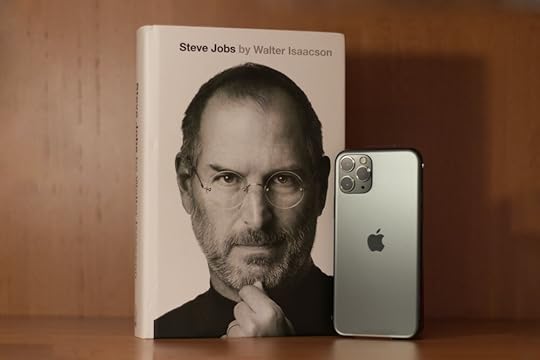
Focus isn’t about doing more. It’s about getting rid of all the things that don’t serve the big picture. When Steve Jobs took Apple back over in the late 90s, he knew what he had to do. At the 1997 Worldwide Developers Conference, Jobs famously addressed the crowd to talk about the importance of focus. Jobs was clear: focus is not about willpower and discipline, but the courage to say no to what isn’t the most valuable use of time and effort. That year, Jobs overhauled the way Apple worked, getting rid of all non-critical ideas, projects and initiatives to direct energy to just the most valuable and high-potential business lines.
“People think focus means saying yes to the thing you’ve got to focus on. But that’s not what it means at all. It means saying no to the hundred other good ideas that there are. You have to pick carefully. I’m actually as proud of the things we haven’t done as the things I have done. Innovation is saying ‘no’ to 1,000 things.”
STEVE JOBS
Your next step: Channel focus and SAY NO.
To read: Essentialism:The Disciplined Pursuit of Less, by Greg McKeown.
Secret 2: Successful CEOs aren’t right, they’re ready.
“There's no harm in hoping for the best as long as you're prepared for the worst.”
Stephen King

The pressure to get things right is immense. In an operational role, accuracy counts for everything, and many misguided leaders take this approach into more senior roles, panicking about their capacity to predict the future and make the right calls.
This pressure is unsustainable. When you’re responsible for the big picture, your planning horizon makes it extremely risky to try and predict all of the variables.
Never fear: successful CEOs know that detailed and operational business planning is generally a waste of time. As soon as you plan how long something will take, and the precise steps to take to achieve a goal, that will change.
Rather than spending weeks and months planning detailed steps, successful CEOs nail their long-game, set up the right conditions for success and get ready to tackle unexpected issues.
Rather than waiting for perfect information, the most successful leaders focus on decisiveness and direction instead. Jerry Bower, CEO of the private-label manufacturer Vi-John uses a 65% rule of thumb: “Once I have 65% certainty around the answer, I have to make a call.” Instead of focusing on accuracy, Bowe hones in on impact. “I ask myself two questions: First, what’s the impact if I get it wrong. And second, how much will it hold other things up if I don’t move on from this?” Using this approach, Bowe frees up his time to focus on the big picture as far as possible.
The data backs this up. In the longitudinal CEO Genome Study, published in 2017 with ten years of data, the authors were clear:
“Our analysis suggests that while every CEO makes mistakes, most of them are not lethal. We found that among CEOs who were fired over issues related to decision making, only one-third lost their jobs because they’d made bad calls; the rest were ousted for being indecisive.”
Your next step: understand your big picture.
To read: Vivid Vision: A Remarkable Tool for Aligning Your Business Around A Shared Vision of the Future by Cameron Herold
Secret 3: Successful CEOs aren’t good communicators, they’re good connectors.“The single biggest problem in communication is the illusion that it has taken place.”
– George Bernard Shaw

Your communication skills have been critical to your success so far. Crafting the right message, saying the right thing, and building the right relationships are important at all levels of the professional ladder - but to take the step toward CEO, communication isn’t enough. You need to become an influencer, with the power to shape people’s thinking and behaviour.
Successful CEOs know that it’s not what they say that counts – but how they connect with others. When we confuse influence with talking people into things, we focus on reports and slide decks. But that keeps us focused on ourselves. Real progress comes from the power of connecting with others.
In Lead the Room: Communicate a Message that Counts in Moments, leadership communication expert Shane Hatton explains this clearly: with communication, we get engagement and with connection, we get trust. With influence: we drive change.
Ineffective leaders focus on popularity and try to get everyone on board, exhausting themselves and bending in every direction to keep everyone happy. But the most effective CEOs know that quality beats quantity every time. True change doesn’t rely on everyone getting on board, but inspiring tribes of committed followers to make things happen. Seth Godin, author of Tribes: We Need You to Lead Us spells this out plainly: “…great leaders don't try to please everyone. Great leaders don't water down their message in order to make the tribe a bit bigger. Instead, they realize that a motivated, connected tribe in the midst of a movement is far more powerful than a larger group could ever be.”

Howard Schultz, CEO of Starbucks, has known this from the beginning. When he pitched his concept of Italian-inspired cafes to the founders of Starbucks, he was met with resistance. He had over 200 no’s before finally proving his concept could work, and credits much of his success to building a powerful team, treating them with respect, and instilling faith in the big picture.
"When you’re surrounded by people who share a passionate commitment around a common purpose, anything is possible."
HOWARD SCHULTZ
Your next step: identify who you need to reach – and what you want them to do
To read: Influence: The Psychology of Persuasion, by Robert C. Cialdini
Secret 4: Successful CEOs don’t know more, they ask more.
"We thought that we had the answers, it was the questions we had wrong."
- Bono

The old path to leadership depended on your expertise. Years spent accumulating knowledge at university, compounded by more years of doing your job well.
With the explosion of knowledge work and the increasing complexity of modern business, it’s not quite this easy anymore.
Most CEOs are leading complicated teams of people who know more about their job than they do – and rightly so. The more senior you are, the more you’d have to know for this model to make sense. No-one expects the CEO to be a marketing whiz, IT guru, legal boff and technical expert all in one.
As an expert, your job was to have the answers, but as CEO, your job is to ask the right questions and empower your team to find the answers. Don Yager, chief operating officer of cloud tech company Mural Corporation, famously asks his frontline team: “What are our policies that suck?” The power of a question asked with humility and openness shifts the inherent power dynamic between leader and follower, making it possible for people to contribute their knowledge and be honest about what needs to shift.
In “Questions Are the Answer: A Breakthrough Approach to Your Most Vexing Problems at Work and in Life,“ MIT Leadership Center executive director Hal Gregersen outlines his findings, providing that the world’s most successful companies are led by people who ask ‘catalytic’ questions to drive progress.
“These questions not only challenge false assumptions in the system, but they give people the energy to do something about it,” Gregersen said. “When you think of Rose Marcario, Marc Benioff, Jeff Bezos, Elon Musk, any of those folks, they systematically, habitually create conditions where they themselves are likely to be wrong, uncomfortable, and reflectively quiet, such that a question would emerge that they otherwise wouldn’t ask.”
Eric Schmidt, former CEO of Google, echoes this sentiment. Schmidt is the first person to admit that he wasn’t the best software engineer out there, but that wasn’t what he was hired for. It was constant curiosity and willingness to question assumptions – and be wrong – that impressed the people he worked with.
As Jonathan Rosenberg, who worked with Schmidt describes: “He's very smart and constantly thinking about how the world is changing, how industries are being disrupted, and how to change the way he manages every day."
“We run this company on questions, not answers.”
ERIC SCHMIDT
Your next step: ask better questions
To read: Good Leaders Ask Great Questions: Your Foundation for Successful Leadership by John C. Maxwell
Secret 5: Successful CEOs aren’t tough, they’re flexible.
“Notice that the stiffest tree is most easily cracked, while the bamboo or willow survives by bending with the wind.”
- Bruce Lee

The old perception of a CEO was an impenetrable fortress, staunch in the face of adversity. Former military leaders graced conferences to talk about their discipline and determination, while new CEOs were handed a copy of the ‘Art of War’ to get them on the right track.
Odds are, this perception was never really accurate – but now, we know for sure that’s not the case. In a fast-changing and complex business environment, CEOs are handling trickier change than ever before.
Today’s leaders are expected to account for a different set of pressures now – environmental sustainability, social responsibility, economic uncertainty, technological advancement and legislative change, to name a few. Juggling this kind of ambiguity and delicacy doesn’t call for military-style toughness and order – it asks for flexibility.
Deloitte’s 2017 CEO research, which tracked the behaviour of 24 global Fortune 250 CEOs, saw researchers ask the question: “What does it take to be un-disruptable today, and what will be demanded of CEOs and their organizations to avoid disruption tomorrow?”
They found that today’s CEOs stressed the importance of embedding constant exploration, experimentation and improvement at every stage of their decision-making process and value chain.” Their success wasn’t about their ability to toughen up, but to build the confidence in changing tack, taking risk and innovating while cultivating confidence with possible failure.
Salesforce CEO Marc Benioff underscores the importance of this agility, actively building the same attitude in his teams. “I respect the spirit of innovation,” Benioff says. “Sometimes that spirit is going through me and sometimes it’s going to come through someone else … I try to cultivate a beginner’s mind; I try to let go of all the other things that have ever happened so far in our industry (which is a lot of stuff) and go, ‘Okay, what’s going to happen right now?”
The old myth of the heroic, visionary leader is dying, as we recognise that success is more about perspective and willingness to change than the magic powers of a single individual. When Mary Barra assumed the helm at General Motors, she scrapped many of the stuffy old policies at the century-old company – famously shortening their old 10-page dress code down to just two words: “Dress Appropriately” – to work on building an organisation that was comfortable with taking new directions.

Rather than doubling down on their traditional business model, Barra has made huge shifts, investing in areas as diverse as insurance, electrical vehicles, self-driving cars and ride-share services. With Barra at the helm, GM has ushered in a new approach to old problems, as she empowers the team to innovate, operate independently and embrace the challenges of climate change and a changing social context with both arms.
“In this area of rapid transformation, you have to have a culture that’s agile”
MARY BARRA
Your next step: cultivate your capacity for change
To read: Mindset: The New Psychology of Success by Carol Dweck
TL; DRIf you’re looking to be a CEO, stop trying to know everything, do everything and project a slick and perfect exterior. Instead, work on the five most critical skills of the world’s game-changing leaders.
Be focused, not busy
Be ready, not right
Be a connector, not a communicator
Be an asker, not a teller
Be more flexible, not tougher.
For more on how you can build these skills, check out Not An MBA – a game-changing alternative to traditional executive education for emerging and aspiring leaders.
Or, take the quiz and work out what you need to focus on most.
August 24, 2021
Wednesday Wisdom: Learning in lockdown
Welcome to another Wednesday Wisdom. Every week, I share with you what I'm thinking about life, work, and leadership. This week we're talking about the power of learning when our brains are working differently.
I always have my best ideas on a plane. It's not great in lockdown, I'll admit, but there's something about putting myself in a different situation that brings the clarity I need to solve simmering problems and get some new perspective.
I'm not strange, either. (OK, not for that reason...) Lots of bright ideas were conceived in unexpected circumstances. J.K. Rowling mentally drafted the first Harry Potter book on a four-hour train ride. Archimedes figured out buoyancy in the bath.
There's a reason for this - and it's the same reason I ask leadership teams to go off-site whenever they can. A 2018 Yale Study found that uncertainty can "prime" the brain for learning. When a situation is unfamiliar or difficult to predict, we have more activity in our prefrontal cortex, compared to when the outcome is more certain. The result = better learning.
Lots of people have chosen to use lockdown as an opportunity to learn a new skill - whether that's baking bread, or knitting. It's a refreshing antidote to trying to do the same things under challenging circumstances. The dopamine hit we get from figuring new stuff out is a mood-booster that helps us to feel more capable and in-control, as the world around us feels a bit wobbly.
We've been thinking about how best to serve all you lovely mates during lockdown, and how to offer you up bite-sized learning that won't overwhelm you in an already tricky time. (Also, I've got three homeschooling girls at home who each seem to need 7 meals a day, so my time is a bit limited too.)
On that note, we're doing a couple of really exciting things 🤩
1.Live in Lockdown: Your Mini (na)MBA
We're continuing our morning lives on LinkedIn, at 9am every day this week, to help you kick-start your day. The response to last week's mini-series was truly touching, and I get a real kick out of it. I can't guarantee we won't be joined by a hungry child or two at some point in the broadcast... so you've been warned.
Join me LIVE on LinkedIn every morning this week at 9AM NZST, with a mini-series covering all five modules of my new book. Spend your lockdown getting a mini-MBA. Oh wait: a mini NOTAN MBA. If you love to learn, and you prefer doing it live and for free, these are the sessions for you. Add them to your calendar here.
2. Lockdown Special: Academy Prelaunch 🎉
Now THIS is flippin exciting. We've decided to pre-release a few of the courses on our new online learning platform: Alicia McKay Academy. We're not launching this to the general public yet, - but you're invited for a backstage look. The Academy is live for a sneak peek - including a free course for Strategy 101, a NEW Strategic Planning Fundamentals offer, and a new and improved Meetings that Matter experience.
We have all kinds of exciting stuff hitting there soon - including an app, and a full range of learning options for life and work. We'll be releasing new offers over the next little while, and we'd love you on board. For now, check out the first cabs off the rank - and, for as long as we're in lockdown, you can access any of the live courses with a 30% discount, using the code WW! How good is that!
My learning
For my part, I've picked the guitar back up, and I'm busy pulling together lots of exciting curriculum ideas while my brain is firing off in learning mode. Thanks to this poll on LinkedIn, I've got the go-ahead to build my most ambitious curriculum yet - a full nerdfest Strategy Intensive covering all the technical ins and outs of planning, business cases, benefits, risk and change management. Eep!
I'd love to hear how you're all learning this lockdown - reply, or post on socials and tag me in.
Even better, if you've decided the only thing you're keen to do is survive, eat snacks and get through the day... mate, you've got my blessing. Listen to your body, and do what you need.
Look after yourself, everyone.
Nga mihi nui,
A
August 17, 2021
Wednesday Wisdom: Lockdown attitudes
Welcome to another Wednesday Wisdom. Every week, I share with you what I'm thinking about life, work, and leadership. This week we're talking about the power of language in unexpected times.
In New Zealand, we've just moved back into Level 4 lockdown. Those of you in Sydney and Melbourne will be rolling your eyes - but we're not used to this!
I'm already watching the language coming out of my mouth and those around me as we quickly change our plans for the rest of the week.
I started out terribly, with:
"I can't fly to Christchurch to see my sister tomorrow" and
"I won't be able to keep up with the F45 Challenge"
...before I gave myself a metaphorical slap around the chops. This is the sort of attitude that's going to make me feel sad, throw out my meal prep and grab the nearest bag of chips.
Times like these are exactly when we need to grab on to the power of language.
I've tried to move into a bit of the "I'm trying" - so here's my little lockdown experiment.
I'll be going LIVE on LinkedIn every morning at 9AM NZST, starting today, with a mini-series on "The Strategist's Guide to Life." If you're like me and you're all about continuous improvement - but the cringey Instagram quotes and pop psychology make you wanna vom, these are the sessions for you. Add them to your calendar here.
Why the focus on language? Well, two weeks ago, I wrote about the power of watching our language, when we respond to change.
I shared how I discovered, in my leadership research, that we can diagnose different patterns of behaviour and thinking based on the language people use - and we can use those words to provoke a shift in our mindset.
To recap, we found that:
Worried and defeated people use passive language, and struggle to act on the things they cared about.
Busy and resentful people use the language of constraints, and find it hard to live by their priorities.
Proactive people use choice-focused language, and find opportunities to make a difference.
Adaptive and flexible people use the language of experimentation and are able to grow.
You can see this again in the handy model below:
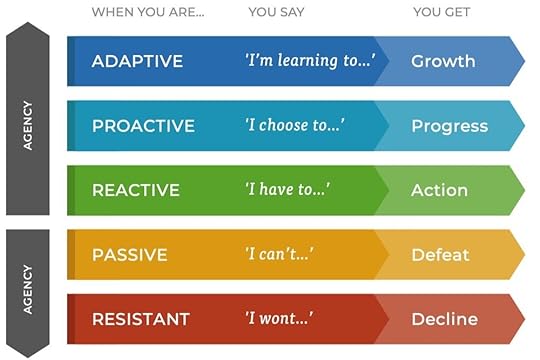
Swapping out the occasional "I have to" for an "I choose to" or "I'm learning to" can have a transformational effect on the way we think about our situation. I mean, it's happening anyway, so... why not?
Small shifts. Big difference.
Watch your language - and stay safe Aotearoa.
Nga mihi nui,
A
Read the full article here, to hack your language and boost your attitude in tricky times.
August 10, 2021
Wednesday Wisdom: How to get unstuck
Welcome to another Wednesday Wisdom, Friend. Every week, I share with you what I'm thinking about life, work, and leadership. This week we're talking about getting unstuck.
I really like making and discovering new things. It's a bit of a problem, because as soon as I've made something, I'm bored with it and looking for something else to do, know or create. It's the reason why I get "into things" so intensely, only to be done with them the next time somebody asks about it.
*cough* 120 houseplants *cough*
When my new book was finally printed and arrived, I eyed it with scepticism. I wrote You Don't Need An MBA between January and October 2020 and once it turned up in May 2021, I had already moved on to thinking about other things.
We're now taking enrolments for Not An MBA, with a curriculum based on that book, and I'm already looking for ways to change it or adapt it... before we've even started! This compulsion of mine is both a curse, and a blessing, depending on who you ask. (Try my team, they're having fun...)
But there's no inherent value in being static. Consistency and commitment is perfectly honourable until it begins to constrain creativity and growth.
For Not An MBA, the mindset shift was when I realised I don't have to stick to what's in the book - how boring would that be? You may as well just read the book! The value of naMBA will flourish as it's imbued with fresh thinking, interesting curation and new ideas that others build on, add to, challenge and enrich. I can't wait to see these ideas take on new shapes and forms as we make something new together.
Nothing we learn, immerse ourselves in, think or create ever really goes away. Instead, those experiences bleed across borders, inject life into new and dark corners and nest themselves in gorgeous and nuanced ways, bringing value and creativity to even the plainest of pursuits.
The same is true in our work and personal lives, every time we change direction or start something new. Sometimes we feel needlessly trapped. I hear people tell me that they've come too far to change jobs now. That they're too deep in a project to start again or change it, that they've committed too much to their relationship to leave and start afresh. Starting something new looks empty, scary and uncertain, and would waste all of the work that's come before.
I get it. I've been battling depression for most of this year, and one of the least useful stories The Big D likes to tell you is that you're stuck. That things are hopeless, and you've no hope of changing them for the better.
What rot. This is sunk cost fallacy at its finest, and it simply isn't true. Every time you take a new step, you bring all of the experience, knowledge and value from the last phase along with you. You're never starting with a blank sheet. The pages are already full of you, and everything that's brought you to this point in your life. You get to choose what to keep and what to discard, curating your sense of self as you step into the next leg of your journey.
Don't be afraid: to change your life, to update your opinions, to take a new job, to try a new hobby, or to buy more houseplants than you can fit in your house.
Every new thing you try is built upon what's come before, and will in turn seed new life, as you encounter new opportunities, build new relationships and deepen your identity with richer perspective and understanding.
Don't stop growing and changing because you feel stuck. You are never, ever stuck. There's always a way forward, and that way will be better for the journey you've taken to get there.
Do that thing. It's not too late. I promise.
Til next week,
- A