Alicia McKay's Blog, page 2
December 5, 2024
Mildura Rural City Council Case Study
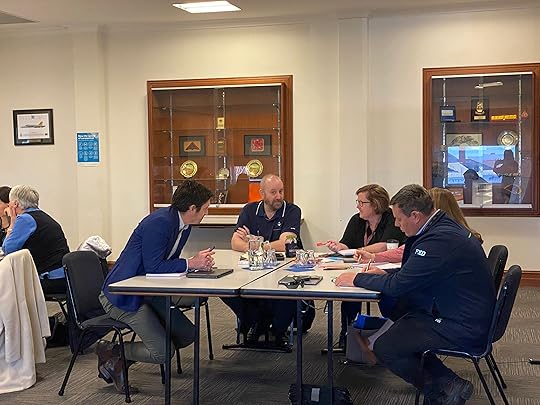
In 2022, Mildura Mayor Liam Wood, and Council CEO, Martin Hawson met Alicia at the Australian Local Government Association’s National Assembly. Mildura Rural City Council was regrouping after an extensive external review.


Glen Eira City Council Local Legends Case Study

Working in local government, you’re bombarded by demands from every angle. One key difference between an effective Council and an ineffective Council is their approach to that barrage. Every Council can choose to be strategic or reactive, impacting the legacy they leave.

December 3, 2024

December 2, 2024
The paradox of public leadership (or: just give them the damn picnic table)

“It was the best of times, it was the worst of times”
“I must be cruel to be kind”
“The child is the father of the man”
Literature is full of paradoxes—ideas that are both contradictory and true. Whether it's Dickens, Shakespeare, or Wordsworth, paradox provokes questioning. It gives us pause to ask, " What's going on here?"
Greg McKeown, in Essentialism, talks about the 'paradox of success.' He argues the more options we have, the more distracted we become from our highest point of contribution. Makes sense to me. In Not An MBA, we learn about the 'paradox of leadership'. As in, the further we advance in our career, the further we move away from our original source of value (the skills and subject matter expertise for which we were hired), and from the observable impact of our contribution, too.
In a managerial, bureaucratic landscape filled with reports, meetings, and emails, it can be hard to feel satisfied, even if we intellectually understand the value of our role.
“He who confronts the paradoxical exposes himself to reality.” - Friedrich Dürrenmatt
This paradox is also evident in ambitious, well-meaning public sector organisations. The more we add to our plate and evolve, transform, and grow, the more we risk drifting away from how we originally - and possibly best - add value.
In a recent meeting with a client, I mentioned the frustration of strategic planning (of which I'm generally a fan!) stymying community outcomes.
If the community collectively asks for new equipment for their public space, the Council is more likely to defer their request to a municipality-wide spatial planning process than to grant it. This same Council will bemoan the community's lack of engagement, spend six figures on a consultation strategy, and wonder how to "tell their story better."
18 months later, if they're lucky, the community may get their equipment—but it took a long time, a lot of people, many meetings, and some expensive reports and plans to get there. What if we just believed the community and provided the equipment? Our pathway to 'engaged, thriving communities' might get much simpler.
The paradox in this example is how good intentions and values-based choices - for Council, important things like clear planning, fair prioritisation, and transparent decision-making - can lead to perverse outcomes. By putting process first, we compromise the most important objectives: unintended community engagement, collective ownership and care for public spaces, localised solutions, partnerships, etc.
Maybe the decision was right. Maybe escalating the call on the equipment was fair. It often is. It's still worth asking questions and challenging assumptions along the way. We should always assume the road to hell is paved with good intentions - especially in the public sector - and stay vigilant to the trap and allure of complication solutions.
What if we used the paradox of leadership to examine the choices we make in our teams and organisations?
I think it's worth asking tricky questions like…
What do we assume about the services we deliver, the areas we are involved in, or how we do things?
How have these assumptions shaped our evolution as a team or organisation?
Do we understand the core value we deliver?
When should we stop specific programmes – or should we do them forever?
Is this the best use of our time and energy?
Are there others who would do a better job of this?
Could there be other options we haven't considered?
And possibly most importantly:
Is there a much simpler way of achieving this outcome?
Til next week,
A

November 26, 2024
Revenge of the Arts degree

I'm taking a brief break from my "Taking the Boot of the Public Sector" series to tell you something important about education and recruitment. In short: hire people with BAs. They’ve learned to think critically and appreciate context, the world’s most valuable skills.

November 19, 2024


Is the pain real? precedent, phantom and projection
One of the worst things I’ve experienced in my adult life was a horrific abscess I had in my tooth when I was 22. I was immobilised with pain and the infection got so bad, I ended up in hospital.
One of the strangest things about the whole ordeal was that for months afterward, I thought I had a problem with the tooth directly above it. I went to the dentist several times, only to be assured that this was the combination of two weird phenomena.
The first was projected pain. When one tooth is compromised, we sometimes feel the pain in a totally different place because of the way our nerves and signals are interconnected.
The second was phantom pain. There wasn’t anything wrong in my mouth anymore, but my brain was still processing the lingering trauma of those sensations. You might have heard about this with amputees too, who often feel sensations in their now missing limbs.
Thanks to the way our annoying brains work, phantoms and projections aren’t limited to our bodies. It’s easy to get signals about our thoughts, behaviours and feelings mixed up when they present as something they really aren’t. Internal imposters, if you like.
“It is far harder to kill a phantom than a reality” – Virginia Woolf
One of the reasons people like to bring me in – for executive coaching, or to work on strategy - is because I call out bullsh*t when I see it. More softly, I enjoy challenging invisible assumptions, to figure out what’s really going on.
Working with leaders, I see a lot of projected and phantom pain. Those ideas that look perfectly reasonable on the surface, until you look a little deeper.
A particular favourite is the (exc)use of precedent. How many times have you heard (or used!) “setting a precedent” to get out of doing something that should be done?
I call bullsh*t on precedent.
It’s inherently contradictory, especially as a reason not to do the right thing. If it’s the right thing to do, we would take the same decision again in identical circumstances. So, what’s really going on?
Precedent is a phantom pain. It’s the projection of another, less comfortable fear.
On the surface, this looks like fear of accountability. In my experience though, it’s often a lack of confidence in making the right decision, a fear of being blamed if things go wrong, a reluctance to acknowledge previous poor decisions, or worry about mobilising resources.
Left unearthed, these fears will seriously undermine our ability to make good decisions. Phantoms and projections need challenging, or we can’t tackle the real source of the pain.
What phantom pains are your leadership team dealing with?

Strategy needs space
Strategy needs space. Time, headspace, and physical space.
I’ve just returned to New Zealand after a few days of professional development in Melbourne, and I’m thrilled to be back at my desk and plotting the next few months. Every 90 days, I disappear over the ditch for three days to plot, plan, and think big picture. Then, I dedicate a half-day each week to checking in, reflecting on progress, and getting ready for the week ahead.
Yeah I know, good for me right?!
But here’s the thing – strategic thinking and action don’t happen by accident. Creating the time, mental leeway and physical space is critical if you want to think clearly, make non-obvious connections and pinpoint opportunities for change.
Richard A. Swenson discusses the concept of ‘margin’ – emotional, physical, financial and time reserves for overloaded lives. Creating margin, or space, shouldn’t be considered a luxury item. Yet, in a recent survey, 96% of leaders reported lacking time for strategic thinking. My strategy and coaching clients report the same. I hear “BAU already demands 110%” and “we’re stuck in the weeds” a lot.
Here’s a tip: you don’t get out of the weeds by going deeper into the weeds.
The more senior your position, the more ‘margin’ and strategy space you require. It is literally what you’re paid to do! Even better: the more margin and strategy space you create, the more successful you are likely to be.
When Michael Porter followed 27 CEOs of billion-dollar companies for 13 weeks, he found that the average CEO spends 43% of their time on activities that further their business. They also spend about 25 minutes every morning strategising and planning, leaving emails, calls, and other stuff until at least lunchtime.
The most successful CEOs report diligence about time away from work, too—spending an average of 45 minutes a day on exercise, sleeping an average of seven hours a night, spending three hours a day with their families, and spending two hours on personal pastimes. Richard Branson estimates that a morning workout adds at least four hours of productive time to his day.
My opinion: if CEOs of billion-dollar companies can do this, we can too.
If this seems ambitious, take heart. Research suggests that achieving the 90/10 rule – (10% of time spent in strategic thought) will deliver massive benefits. That’s a half day per week, two days a month, or a week per quarter.
How to make space for strategy
Schedule time – And protect it as a sacred appointment. On LinkedIn this week, Leanne Mash suggests blocking out two three-hour blocks each week with DO NOT TOUCH written on them!
Get in the zone – Reset your headspace through meditation, exercise, and chatting to someone who lifts your energy
Go somewhere else – Leaving your usual work environment triggers creativity and perspective.

It's just work: how to put work into perspective

On Sunday night, I went to check my calendar for the week. I knew I had a bit on, but I wasn't too worried. Until I got to Thursday.
At that point, my stomach dropped. According to my calendar, I was to be in two places at once: a full-day online training for Meetings that Matter, and a strategic leadership session with a new client. Yep, not a client that already knew me - but a brand new one, in Australia.
Sh*t.
I didn't sleep particularly well Sunday night, and on Monday, we sprung into action. We knew it wasn't good - we'd made a mistake, inside a week that was already extremely busy. On top of a big admin project we have on the go, and planning for an almost-full 2022, we have seven workshops across Not An MBA, Meetings that Matter, Countdown and our new client. Not the ideal time to mess up.
You know what, though? It's OK. It's a problem, but it's a quality one, as far as problems go.
1. You'll always have problems.
Problems are like cockroaches and glitter - they're always going to be there, even after the apocalypse. Solve these ones, and you'll get new ones. Also, your solutions will create problems you didn't foresee. Fun, eh?
2. Not all problems are created equally
While we can't aim for a problem-free life, we can pay attention to the quality of the problems we face. If we cultivate problems we're proud of, they're more likely to feel like privileges.3.
We want problems that 3-Years-Ago-You, 5-Years-Ago-You, 10-Years-Ago-You, would be impressed by.
Problems worth solving.
Problems worth being frustrated by.
Problems worth sacrificing for.
In my case, I got some perspective while I was out walking the dog on Monday morning. Yes, we'd stuffed up - but we'd stuffed up because our week is full of sessions where I'm reaching hundreds of incredible, committed leaders who are out there doing amazing things.
Where I'm working with dream clients and running awesome programmes that I'm proud of, and I'm doing all of it from the comfort of my home or virtual office.
Mate, Five Years Ago Alicia would be gobsmacked.
3. It's just work
Many of the big problems we battle during our days are work-related. At the time, they feel catastrophic. But in a week, month or year's time, we won't even remember them, much less why we were so upset.
Yes, problems happen. Yes, they're annoying. But most of the stuff we do isn't life or death... it's just work. There are so many other things to worry about that have a far greater impact on the quality of our lives and the contribution we make to the world.
Our families, our friends. Our homes. Our goals. Our dreams. Our health. Inequality. Society. Media. Love. Politics. Pandemics. Food. Death. Ideas. Books. Music. Art. Work is just one column, and it's not the most important one, so don't let it swallow you up.
TL;DR You'll always have problems - so you may as well pick good ones. Also: it's just work.

4 steps to playing the long game
How was your 2020, overall? Mine was a nightmare, to be honest.