Alicia McKay's Blog, page 9
July 10, 2022
Outrageous Conversations: How to convert controversy into connection

Thank you to everyone who contributed to this article. Your thoughts, links, resources and ideas were invaluable in pulling this piece together. I've captured many of your musings in the output below, but you can find a summary of responses at the bottom.
Use the links below to work your way through, or read at your leisure.
Do we have an outrage culture?
Should leaders be engaging in controversy?
Why is it so hard to have these conversations?
What are the ingredients for productive conversations?
How can you tell if it's worth engaging?
What process should you follow to make progress?
Why should I have to?
Your thoughts and ideas
We live in outrageous times
Maya Angelou said that “Each time a woman stands up for herself, without knowing it - possibly without claiming it, she stands up for all women.”
She’s right, of course. But man, I’m tired. The pressure of being an unelected and unskilled feminist representative makes it hard to do the job well. I don’t always describe issues properly. I sometimes get hurt and frustrated too quickly and instead of directing my annoyance at the patriarchy, I turn my resentment and disappointment inward or unleash it on others. It’s exhausting.
Feminist or not, there are a lot of things to be outraged about right now. Roe v Wade. War in Ukraine. Climate inaction. Child poverty. Economic uncertainty. Racial discrimination. Housing affordability. Income inequality. Political corruption. Gender discrimination. Insert cause here.
The potential for outrage is high right now. If you’ve logged into social media recently, you could be forgiven for thinking people are more outraged than ever.
Are we losing the capacity to come together on conflicting views and ideas?
Are we all just preaching to the converted, deriding the opposition and doing nothing to spread understanding?
Maybe.
But surely the answer isn’t to put the anger away – minimising struggle only makes it less visible. So, what do we do when we’re full of valid moral outrage?
How do we connect with people who think differently and have constructive dialogue without despairing at their ignorance or inadequacy, or demonising their views?
In this article, I'm going to unpick what's driving our outrage, how to show up with confidence and provide a step by step guide to tricky conversations.


June 12, 2022
Why Strategy Fails (and what to do differently)
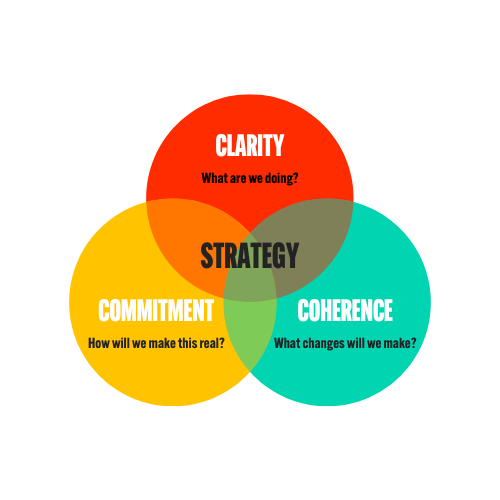
Many of us have the wrong idea about strategy. We think it's about workshops and documents, and then struggle to understand why everyone's still doing what they've always done.

May 11, 2022


April 30, 2022

April 24, 2022
How to Define Leadership In The Real World

Leadership is all the rage, but if you're sick of swimming in buzzwords, you might find yourself asking what it really means.
Read on for a real definition of leadership - with no jargon in sight.

April 12, 2022
Wednesday Wisdom: Put a tomato on your cracker (Copy)
Welcome to another Wednesday Wisdom. Every week, I share with you what I'm thinking about life, work, and leadership. This week we're talking about how to readjust your to-do list.
Driving to Palmerston North a couple of years ago, a good friend of mine was explaining what they'd learned in yoga about habit change.
"If you want to stop eating so many carbs," he explained "you need to start by adding more of what you want, not depriving yourself."
"Rather than trying to quit crackers, start by adding, say, a cherry tomato. Eventually you'll just have the tomato and not be feeling bad about anything."
This has always stuck with me.
When people get burnt out and look at a long list through the bleary eyes of overwhelm, the usual advice is to... delegate more, take some things off the agenda, draw a line through lower priority tasks, etc.
But if you're an adder by nature, odds are, you're just going to fill that space straight back up!
Before you start looking for things to take off the list, think about what you want more of.
If you want more time with your kids, that's great motivation to stick around longer at the table in the evening and leave the dishes. Far better than "relax housework standards."
If you love team meetings, but hate performance reviews, focus on connecting with your team and put more of that into your life before you worry about how you'll measure them on paper.
Put a tomato on your cracker.
Catch you next Wednesday.
A
April 5, 2022
Wednesday Wisdom: A hack for hard decisions
Welcome to another Wednesday Wisdom. Every week, I share with you what I'm thinking about life, work, and leadership. This week we're talking about how to make hard decisions.
The average person makes 17,000 decisions a day. Most of those are easy ones like what to have for breakfast or what time to leave for work, but some of them are harder.
Hard ones usually involve:
Infrequent or unknown situations that you aren't confident about (like buying your first house, or hiring for a new position)
Situations where there are no clearly superior options (where every alternative has a downside)
Scary decisions that have a high perceived risk (like a significant financial or personal commitment that could go wrong.)
Milestone choices that change how you think about yourself (like personal development or a job change.)
You'll know it's a tricky decision when generic Google searches are totally unhelpful and no-one can make the decision for you.
I've been making a few of these lately, as my business grows up at pace. We're going from "Alicia McKay the person" to "Alicia McKay the experience" and it's throwing up all sorts of big choices and fears.
In the last week alone I've made choices about our brand identity, hired a lead facilitator, looked at new office space, set ambitious targets, committed to a terrifying budget... and had to constantly challenge the little whisper in my head saying "who do you think you are, Alicia McKay? This is madness!"
Every tricky decision is unique and has its own considerations, and the more important it is, the less likely there is to be a 'right' answer. But there is a handy trick you can use that makes all hard decisions a bit easier - and it won't cost you a thing.
You need to tap into your personal compass.
You know the one. Maybe you think of it as your gut, or your integrity. It's the reason why no-one else can give you the answer - because you're the only one that has it.
Tapping into your personal compass means asking yourself questions like:
Why do you care about this?
What is the broader significance of this decision for you?
What would living your values look like?
And most importantly...
What failure could you live with, if you knew you'd done the right thing?
Then, if you get it 'wrong' or it blows up in your face, you'll be able to live with the consequences. No level of safety, sensibility or logic can give you that. Nor can Google.
Rock on.
A
March 29, 2022
Wednesday Wisdom: Need for speed
Welcome to another Wednesday Wisdom. Every week, I share with you what I'm thinking about life, work, and leadership. This week we're talking about how to plan better.
How’s your to-do list looking?
What about your teams?
If it’s all looking a bit unachievable, read on to learn about why this happens and how to address it.
1. We’re powered by storiesI always think I need to do things faster than everybody else. It’s been a great way to speed up my delivery over the years. It’s also burnt me out more than once and led to many avoidable mistakes.
Sometimes, I treat my need for speed as a strength. Other times, as a weakness. But like all key personality traits, it’s both, neither, and part of a larger, deeper story.
I used to worry it was a sense of arrogance or superiority (as in ‘I don’t need to take as long as everyone else, because I’m smarter than them.’) but it isn’t. When I observe someone else being careful and deliberate with something new, I don’t feel smug. I feel a pang.
That pang, if I stop to listen to it, says something like “That’s lucky for them. They’ve got that time and luxury.” I’ve never really stopped to examine that pang before, but I did recently, to ask: Is that true? Why don’t I have that time and luxury? What’s the real fear here?
I think it’s pretty core. I try to do everything as quickly as possible, because once upon a time, I genuinely needed to. At uni, I couldn’t procrastinate on assignments or hang out after lectures, because I had a baby at home to look after. In business, I didn’t develop a considered “offering” when I launched my practice in 2014, because we were on an apprentice builders’ wage and had a mortgage and two kids to provide for. That story played an important safety and survival role, and it used to serve me. But it doesn’t anymore.
Stop and think: What stories do you have about time? Where did they come from?
2. Plan for the real worldWe’re gearing up for recruitment of new facilitators and coaches right now, and I am beyond excited. We’ve just mapped out all our preparation, so we can go to market next Thursday. Eep!
Yesterday, as Sha and I were mapping our process and agreeing deadlines, I felt an alarm go off. I knew that if we weren’t careful, we’d get swept up in the excitement, forget about other priorities and box ourselves into unreasonable deadlines, causing unnecessary stress.
We’re all victim to planning bias, where we overestimate how much we can do, underestimate how long it will take and neglect past examples or risks. It’s a default setting – what Daniel Kahenman calls “System One” - and it requires intention and attention to ward off.
For us, we had to stop and make sure we’d built in time for discussion, iteration and unexpected derailments, so that we didn’t wind up panicking in a few weeks time.
Stop and think: Do you plan for reality, or best-case? Has planning bias caught you off-guard recently?
3. Lead by exampleLeaders set the tone. The example we set is much more powerful than the words we say. If you do everything as fast as possible, overwhelm your plate and regularly need more time to complete your projects, this has a powerful impact on the people who look to you.
It means that when you ask questions like “when will we have this done?” people actually hear “ “how fast can we do this?” If your team are similarly speed-inclined, this a recipe for disaster. You can’t get around it with communication, either. If you don’t walk your own talk, people will be more influenced by what you’re doing than what you say.
Stop and think: Are you setting the right example with workload and delivery?
TL;DR: We’re all powered by past stories that affect our relationship with time and work. As leaders, we need to pick those scabs, check how they’re affecting us and our teams, and lead by example.
Three things you can do next time you’re facing a deadline or time pressure.
Listen to your internal story and check whether it’s true or not
Check yourself for planning bias
Walk the talk on workload.
Catch you next Wednesday.
A
PS – if you’re an experienced trainer, facilitator or coach, and you’re interested in what a future with us might look like, let us know!
March 22, 2022
Wednesday Wisdom: Acting fast
Welcome to another Wednesday Wisdom. Every week, I share with you what I'm thinking about life, work, and leadership. This week we're talking about acting fast when it counts.
I've been deep down a leadership research rabbit hole recently. I'm pulling together data on strategic community leadership, and I've wound up reading a lot about COVID. (Funny that. Try researching anything these days and not winding up on COVID!)
As we start the COVID leadership autopsies with the benefit of glorious hindsight, there is one clear factor that seems to stand out from the rest - regardless of social and geographic differences, population size and homogeneity, religious and ideological positions, health and communications infrastructure or relative wealth. It makes the difference at every level of leadership, and across every sector (government, corporate, sporting, NGO, et al).
Speed.
The societies, governments and organisations who've performed the best are the ones who, early on, were comfortable making big calls based on very limited information.
They read the early warning signals, weighed up the impact of not acting, and made swift, sweeping decisions about what to do. And man, that is hard.
When things are up in the air and we don’t know how the chips will fall, we tend to delay decisions until things are clearer. The old 'wait and see'.
When our reputations are at risk, it's easier to err on the side of "not looking stupid if we get it wrong", than "we'd rather look stupid than risk catastrophe." That's particularly true in the public service, where all decisions are scrutinised in detail later. (Like we are now...)
A lack of urgency was one of the first failure points for pandemic responses across the world, and for many, set the tone for how the next two years would play out. While some leaders waited for more certain information, health systems collapsed under the pressure and people became confused, lost trust and turned on each other.
It was only those who were willing to slam the borders shut, send everyone home, and risk looking like they'd overreacted after the fact, who prevented mass deaths.
Sure, they had to change tack 12 times after the initial response. Sure, some people thought they'd gone mad, and the opposition and media had a field day with their analysis from the safety of the cheap seats. But that's cool, the KPI here wasn't saving face - it was doing the right thing.
This is a great lesson in what makes leadership so important, and also what makes it so bloody hard. It's not easy to put a stake in the ground and make decisions with huge impact, especially when they might be wrong. The more senior you are, the more important your decisions get - and the less certainty you get to make them with.
If leadership was easy, everyone would do it. Most people are more comfortable sitting home on their couch scoffing at the inadequacies of politicians and CEOs than they would be in the hot seat. And rightly so.
But we need people who are willing to take on that mantle, be bold, take risks, and cop the flak in the process, or we all lose out.
TL;DR: When sh*t gets real, and the future is uncertain, we need leaders who can make big decisions, fast.
PS - Don't miss the Alicia McKay Show. It's NZ's favourite new podcast, and the only one that you can watch and participate in live, every week! Catch us on LinkedIn, Facebook or Youtube at 8am Friday.
Or, catch up on Spotify or Apple.
(PS - If you click one of these podcast links, please rate us so we can move up the charts and attract cool new listeners like you!)
Til next week,
- A
March 15, 2022
Wednesday Wisdom: Hermits
Welcome to another Wednesday Wisdom. Every week, I share with you what I'm thinking about life, work, and leadership. This week we're talking about widespread changes in our social habits.
You heard it here first kids, the latest thing is... staying home.
I know, I can hear you. "Alicia, lockdown is SO 2020/21. We're not about that life anymore. The odd mandatory isolation, sure, but we go out now. Offices, cities and stuff."
Except... maybe you're not saying that.
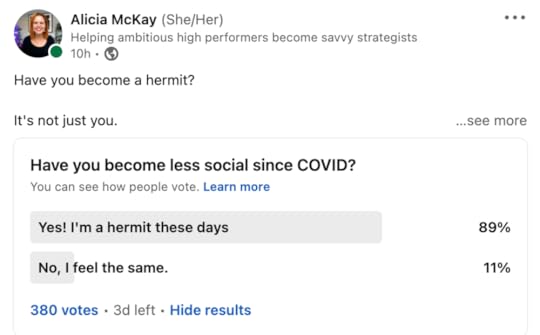
Maybe, instead, you breathed a deep sigh of relief when I said we're still into staying home. If you're anything like 89% of the people I asked this question to on LinkedIn yesterday afternoon, you might be feeling like a bit of a hermit. Check out these results after just a few hours!
Time got weird
I've spent much of the last year (or three?) in a beige fugue state, but I've recently realised that I'm not the only one. Everyone I've asked about this has admitted, somewhat guiltily, to a similar vibe. Many of us have spent months, if not years, enjoying the comfort of home and wondering what happened to our old selves.
On Sunday, my friend Glenn and I played detective over brunch, trying to fill in the gaps.
"How long has it been since we hung out? Have I seen you this year? Hold on, was it... JUNE?!"
Time's been a bit like that. Weeks or months go by and if someone asks what I've been up to I go blank trying to think of something. Well, something other than "I don't know, I went to a meeting and had a shower? I think I read a book? Then 6 months went by?"
You're not weird
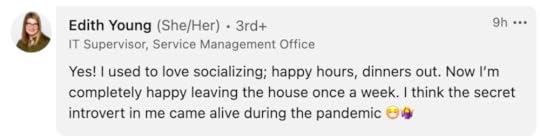
Feeling weird is painful. The threat of exclusion activates the same brain circuits as physical pain, because we're wired to feel part of a group - even if we'd rather do that from a distance. The good news is: you are part of the group. If you've been feeling a bit hermit-y, you can count yourself amongst an overwhelming majority right now.
Resting and recalibrating at home while the world has become a tricky, murky place is a totally sensible response. Between lockdowns, isolation, fear of sickness, new working norms, awkward social interactions and new hobbies and interests... why wouldn't you feel like this?
It's not just sensible. For many of us, it has been truly joyful.
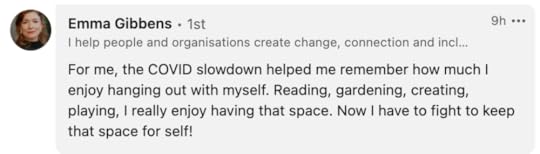
It's totally fine
None of this means you have a problem. There are some interesting questions for us to start asking about what this might mean - for civic engagement, urban centres and social habits - but I can tell you for absolutely certain that there is nothing wrong with you.
After years of trying to overcome, discipline or ignore most of my physical impulses, I've finally started listening to my body. Whether I was training for marathons, fighting off a cold or resisting a sugar craving, I spent almost all of my life up until now assuming that what I desire must be wrong.
It's only in the beige-ness that I've started to first, listen to what I feel and then secondly, trust it. If I feel tired and reclusive, I lean all the way into that vibe and trust I'll want social time again when it's right for me. Lo and behold, I was out laughing and drinking espresso martinis last Saturday, which would have seemed unheard of a few weeks prior.
If I feel sick or unmotivated, I'm doing my best not to be punitive or fearful about it. I trust that my creativity, purpose and passion will reignite soon, and in the meantime, I go with what my body is asking for. Sure enough, when the guilt and obligation is removed from the equation and I simply relax, new inspiration and excitement starts bubbling up - i.e. the Alicia McKay Show! - and without me having to self-flagellate to get there. Who would have thought?!
Trust yourself
I don't have the answers, and I don't know what's coming next. Maybe this is a phase. Maybe this is you now. Maybe you've lost your identity but it's on it's way home. Maybe you're getting a new one. Maybe it's just having a nap. You probably don't know yet, and you probably don't need to.
Just don't spend even one second feeling guilty, ashamed or frustrated about any of the choices you've made throughout the last couple of years - socially, professionally, financially, personally, any of it. You're doing great, Nikki.
You'll figure it out. You will give yourself what you need, when you need it. Trust that if your body whispers "I'm tired" - then it is tired, and you need to rest. Trust that if you want to stay home for a bit longer, that's what you need, and you'll go out when it's right for you.
Trust yourself.
TL;DR: COVID was weird, time got weird, we felt weird, and now most of us are hermits. There's nothing wrong with it, and we'll work it out as long as we trust ourselves.
PS - Did I mention the Alicia McKay Show? You can watch this week's episode live on Friday at 8am on LinkedIn, YouTube or Facebook.
Or, you can catch up on Spotify or Apple.
(If you click one of these podcast links, please rate the podcast so we can move up the charts and attract cool new listeners like you!)
Til next week,
- A