Alicia McKay's Blog, page 11
December 14, 2021
Wednesday Wisdom: Permission Slip
Welcome to another Wednesday Wisdom. Every week, I share with you what I'm thinking about life, work, and leadership. This week I've got a permission slip for you.
I saw a popular post on LinkedIn this week, where a Dad shared their family policy of allowing their teenage daughter to take mental health days when she's not feeling great.
I wholeheartedly agree with that stance. Why even be a parent if you don't get to use your power for permission slips? I spent half my teenage years forging notes, and now I enjoy writing credible ones when they're required.
I'm a generous Mum, and it's actually not my custody week, so I thought I'd write you one instead. If you require a permission slip to dip out and run on get-by mode for the rest of the week, this is it.
To Whom It May Concern,
Please accept this note as Iain's permission to treat this week like the last week at primary school. They may do the minimum for the next few days. They do not need to start anything new. They may watch TV or go for a walk in the middle of the afternoon if they like, depending on the weather, and they can eat as much chocolate as they want.
Sincerely,
Alicia McKay
PS: - Finishing that thing in the next week will make no difference. It will still be waiting for you when you get back after Christmas. Few people are really reading it, checking it or doing anything with it.
PPS: Crack open another box of scorched almonds and watch some Netflix. It's probably raining.
Til next week,
- A


December 7, 2021
Wednesday Wisdom: End like you mean to continue
Welcome to another Wednesday Wisdom. Every week, I share with you what I'm thinking about life, work, and leadership. This week we're talking about closing out the year.
There are 17 days until Christmas.
The way I see it, you've got two options:
1. Keep doing what you're doing.
Tell yourself that if you just survive the next couple of weeks, you'll do things differently next year. With some space over the break, you'll be able to think about it and make some decisions then.
2. Change now.
Realise that once these urgent things are over, there will simply be new ones to replace them. Make some hard calls now, and end this year the way you want to start the next one.
It's up to you.
Til next week,
- A
End Like You Mean to Continue
Welcome to another Wednesday Wisdom. Every week, I share with you what I'm thinking about life, work, and leadership. This week we're talking about closing out the year.
There are 17 days until Christmas.
The way I see it, you've got two options:
1. Keep doing what you're doing.
Tell yourself that if you just survive the next couple of weeks, you'll do things differently next year. With some space over the break, you'll be able to think about it and make some decisions then.
2. Change now.
Realise that once these urgent things are over, there will simply be new ones to replace them. Make some hard calls now, and end this year the way you want to start the next one.
It's up to you.

November 30, 2021
Wednesday Wisdom: 99 Problems
Welcome to another Wednesday Wisdom. Every week, I share with you what I'm thinking about life, work, and leadership. This week we're talking about upgrading our problems.
On Sunday night, I went to check my calendar for the week. I knew I had a bit on, but I wasn't too worried. Until I got to Thursday.
At that point, my stomach dropped. According to my calendar, I was to be in two places at once: a full-day online training for Meetings that Matter, and a strategic leadership session with a new client. Yep, not a client that already knew me - but a brand new one, in Australia.
Sh*t.
I didn't sleep particularly well Sunday night, and on Monday, we sprung into action. We knew it wasn't good - we'd made a mistake, inside a week that was already extremely busy. On top of a big admin project we have on the go, and planning for an almost-full 2022, we have seven workshops across Not An MBA, Meetings that Matter, Countdown and our new client. Not the ideal time to mess up.
You know what, though? It's OK. It's a problem, but it's a quality one, as far as problems go.
1. You'll always have problems.
Problems are like cockroaches and glitter - they're always going to be there, even after the apocalypse. Solve these ones, and you'll get new ones. Also, your solutions will create problems you didn't foresee. Fun, eh?
2. Not all problems are created equally
While we can't aim for a problem-free life, we can pay attention to the quality of the problems we face. If we cultivate problems we're proud of, they're more likely to feel like privileges.3.
We want problems that 3-Years-Ago-You, 5-Years-Ago-You, 10-Years-Ago-You, would be impressed by.
Problems worth solving.
Problems worth being frustrated by.
Problems worth sacrificing for.
In my case, I got some perspective while I was out walking the dog on Monday morning. Yes, we'd stuffed up - but we'd stuffed up because our week is full of sessions where I'm reaching hundreds of incredible, committed leaders who are out there doing amazing things.
Where I'm working with dream clients and running awesome programmes that I'm proud of, and I'm doing all of it from the comfort of my home or virtual office.
Mate, Five Years Ago Alicia would be gobsmacked.
3. It's just work
Many of the big problems we battle during our days are work-related. At the time, they feel catastrophic. But in a week, month or year's time, we won't even remember them, much less why we were so upset.
Yes, problems happen. Yes, they're annoying. But most of the stuff we do isn't life or death... it's just work. There are so many other things to worry about that have a far greater impact on the quality of our lives and the contribution we make to the world.
Our families, our friends. Our homes. Our goals. Our dreams. Our health. Inequality. Society. Media. Love. Politics. Pandemics. Food. Death. Ideas. Books. Music. Art. Work is just one column, and it's not the most important one, so don't let it swallow you up.
TL;DR You'll always have problems - so you may as well pick good ones. Also: it's just work.
Til next week,
- A
It's Just Work: How to be a better person

On Sunday night, I went to check my calendar for the week. I knew I had a bit on, but I wasn't too worried. Until I got to Thursday.
At that point, my stomach dropped. According to my calendar, I was to be in two places at once: a full-day online training for Meetings that Matter, and a strategic leadership session with a new client. Yep, not a client that already knew me - but a brand new one, in Australia.
Sh*t.
I didn't sleep particularly well Sunday night, and on Monday, we sprung into action. We knew it wasn't good - we'd made a mistake, inside a week that was already extremely busy. On top of a big admin project we have on the go, and planning for an almost-full 2022, we have seven workshops across Not An MBA, Meetings that Matter, Countdown and our new client. Not the ideal time to mess up.
You know what, though? It's OK. It's a problem, but it's a quality one, as far as problems go.
1. You'll always have problems.
Problems are like cockroaches and glitter - they're always going to be there, even after the apocalypse. Solve these ones, and you'll get new ones. Also, your solutions will create problems you didn't foresee. Fun, eh?
2. Not all problems are created equally
While we can't aim for a problem-free life, we can pay attention to the quality of the problems we face. If we cultivate problems we're proud of, they're more likely to feel like privileges.3.
We want problems that 3-Years-Ago-You, 5-Years-Ago-You, 10-Years-Ago-You, would be impressed by.
Problems worth solving.
Problems worth being frustrated by.
Problems worth sacrificing for.
In my case, I got some perspective while I was out walking the dog on Monday morning. Yes, we'd stuffed up - but we'd stuffed up because our week is full of sessions where I'm reaching hundreds of incredible, committed leaders who are out there doing amazing things.
Where I'm working with dream clients and running awesome programmes that I'm proud of, and I'm doing all of it from the comfort of my home or virtual office.
Mate, Five Years Ago Alicia would be gobsmacked.
3. It's just work
Many of the big problems we battle during our days are work-related. At the time, they feel catastrophic. But in a week, month or year's time, we won't even remember them, much less why we were so upset.
Yes, problems happen. Yes, they're annoying. But most of the stuff we do isn't life or death... it's just work. There are so many other things to worry about that have a far greater impact on the quality of our lives and the contribution we make to the world.
Our families, our friends. Our homes. Our goals. Our dreams. Our health. Inequality. Society. Media. Love. Politics. Pandemics. Food. Death. Ideas. Books. Music. Art. Work is just one column, and it's not the most important one, so don't let it swallow you up.
TL;DR You'll always have problems - so you may as well pick good ones. Also: it's just work.

It's Just Work: Perspective on your problems

On Sunday night, I went to check my calendar for the week. I knew I had a bit on, but I wasn't too worried. Until I got to Thursday.
At that point, my stomach dropped. According to my calendar, I was to be in two places at once: a full-day online training for Meetings that Matter, and a strategic leadership session with a new client. Yep, not a client that already knew me - but a brand new one, in Australia.
Sh*t.
I didn't sleep particularly well Sunday night, and on Monday, we sprung into action. We knew it wasn't good - we'd made a mistake, inside a week that was already extremely busy. On top of a big admin project we have on the go, and planning for an almost-full 2022, we have seven workshops across Not An MBA, Meetings that Matter, Countdown and our new client. Not the ideal time to mess up.
You know what, though? It's OK. It's a problem, but it's a quality one, as far as problems go.
1. You'll always have problems.
Problems are like cockroaches and glitter - they're always going to be there, even after the apocalypse. Solve these ones, and you'll get new ones. Also, your solutions will create problems you didn't foresee. Fun, eh?
2. Not all problems are created equally
While we can't aim for a problem-free life, we can pay attention to the quality of the problems we face. If we cultivate problems we're proud of, they're more likely to feel like privileges.3.
We want problems that 3-Years-Ago-You, 5-Years-Ago-You, 10-Years-Ago-You, would be impressed by.
Problems worth solving.
Problems worth being frustrated by.
Problems worth sacrificing for.
In my case, I got some perspective while I was out walking the dog on Monday morning. Yes, we'd stuffed up - but we'd stuffed up because our week is full of sessions where I'm reaching hundreds of incredible, committed leaders who are out there doing amazing things.
Where I'm working with dream clients and running awesome programmes that I'm proud of, and I'm doing all of it from the comfort of my home or virtual office.
Mate, Five Years Ago Alicia would be gobsmacked.
3. It's just work
Many of the big problems we battle during our days are work-related. At the time, they feel catastrophic. But in a week, month or year's time, we won't even remember them, much less why we were so upset.
Yes, problems happen. Yes, they're annoying. But most of the stuff we do isn't life or death... it's just work. There are so many other things to worry about that have a far greater impact on the quality of our lives and the contribution we make to the world.
Our families, our friends. Our homes. Our goals. Our dreams. Our health. Inequality. Society. Media. Love. Politics. Pandemics. Food. Death. Ideas. Books. Music. Art. Work is just one column, and it's not the most important one, so don't let it swallow you up.
TL;DR You'll always have problems - so you may as well pick good ones. Also: it's just work.
November 23, 2021
Wednesday Wisdom: Yes, it’s normal
Welcome to another Wednesday Wisdom. Every week, I share with you what I'm thinking about life, work, and leadership. This week we're talking about how normal it is to be dissatisfied at work.
One of the great things about being exposed to "important" people super early in my career - CEOs, Ministers et al - was how quickly the veil was torn. It was both satisfying and mildly terrifying to realise at the tender age of 22 that nobody knows what they're doing and everybody is just as human as everyone else.
Sometimes I forget that other people don't know this, or that they need a reminder.
This is particularly bad in a social media environment, where everybody showcases their highlight reel and hides their normal. Not because they're bad people, or liars, but because social media doesn't need people to narrate their flatulence, imposter syndrome, relationship worries and project failures for the rest of us.
So, this Wednesday, I wanted to let you know that pretty much everything that's messed up for you right now is probably normal.
I can't speak to all of it, but in my line of work, I can tell you that if you feel any of the things on the following list, you are not messing it up.
So if...
Your work is harder than it should be and it's hard to find joy right now
You're overwhelmed by constant, time-wasting meetings
You're a bit burnt out and unsatisfied
It seems like there's constant change but infrequent improvement
Setting priorities seems impossible because everything's both urgent and important
You don't have enough space for the work that really matters
You're frustrated by the way things work
Change takes too long and doesn't deliver what you expect
You have no idea when you're going to be promoted, or if you want it when it's offered....
Then you are totally, entirely normal and pretty much every person out there doing work that matters feels like that too. It's the price of progress.
Constant dissatisfaction and a push for improvement are the symptoms of a person who cares a lot and is working hard. It doesn't mean you're doomed to keep feeling like that, just that you've got new skills to learn now, because what got you here isn't going to get you there. It might be time to level up.
(Also: it probably doesn't have to be as hard as you're making it. But you already know that.)
TL; DR The price of progress is perpetual dissatisfaction
Til next week,
- A
Meetings that Matter is almost full!
As I write this, we've got just five spots left on Meetings that Matter LIVE AND ONLINE for Thursday 2 December. If you've been thinking about it, grab one now.
November 16, 2021
Wednesday Wisdom: Endings
Welcome to another Wednesday Wisdom. Every week, I share with you what I'm thinking about life, work, and leadership. This week we're talking about good things coming to an end.
Last week, I wrote about beginnings, so it seems only fitting that this week, we talk about endings. Because, unless you're an immortal with unlimited time, energy, money, and giving-a-shit... you don't get one without the other.
Good things should end
Ending bad things makes sense. Why would you keep doing something that sucks? We might find it hard to leave a bad relationship or a bad job, but we know we need to, and eventually, we get there.
It's harder to end things that are good.
Henry Cloud nailed the best analogy for this in ‘Necessary Endings’ when he talked about pruning rosebushes.
Rosebushes produce more buds than they can sustain and require regular pruning to be healthy and thrive. Cloud distinguishes between three types of pruning – the first is to remove dead branches. These branches are no longer contributing, and are taking up space that makes it harder for the others to grow. Easy. The second is to remove sick and diseased branches who are unlikely to recover and are taking energy away from healthy branches. Not bad.
The third type of pruning, though, is the removal of perfectly healthy buds. Having too many ‘good’ buds prevents the rosebush from totally thriving, by directing energy away from the buds that have the potential to be great. Without this critical third type, your rosebush will never be fabulous.
Like rosebushes, people produce more 'buds' than they can possibly sustain. We have so many good ideas, potential projects and plates spinning, and it's hard to put some down. They all could be great! Yes, they could be. But they won't be, if we try to do them all.
Find your zone
In Not An MBA, we recently looked at the Zone of Genius model, as explained by Gay Hendricks, author of The Big Leap. The basic idea is that we want to spend as much time as we can doing awesome stuff, and get rid of things we're mediocre at - nothing new there. The thing I most like about this model, however, is how clearly it spells out the danger of the Zone of Excellence
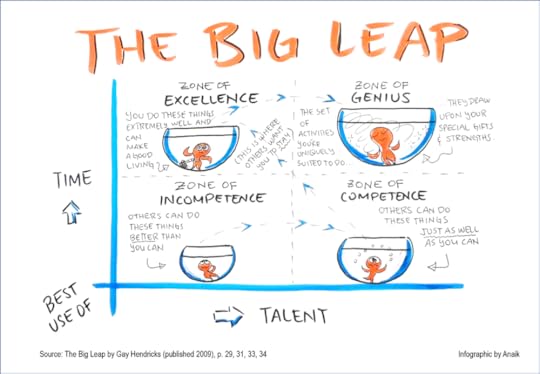
The Zone of Excellence is very alluring. It's often well-paid, and it's where other people would like you to stay. In the Zone of Excellence, you're doing things you're really great at, and you're being rewarded for them. So why would you want to spend any less time there? Because it's preventing us from our genius.
When yes becomes no
Covering this idea in Not An MBA is very meaningful for me. I've had to say no to lots of the stuff I'm really great at this year (strategy workshops, leadership coaching, personal mentoring) to be able to say yes to putting together my proudest achievement yet - an incredible programme where I get to be my best, and bring my best, to help the best people become even better.
The reality is, every time you say yes to things that sit in your Zone of Excellence, you say no to the space and opportunity to explore options that would be truly fulfilling, where you contribute your unique gifts to the world and feel bloody good about them.
We can think of our Zone of Excellence as our metaphorical 'good' rosebuds - it's those things that will hold us back, not the dead ones.
TL; DR At a certain point in your career, it's not incompetence that holds you back. It's the trap of your own excellence.
So, what perfectly healthy things do you need to prune, to get to great?
Til next week,
- A
Meetings that Matter is enrolling now!If just looking at your calendar gives you the heebie-jeebies, check out Meetings that Matter. We'll turn all those talkfests into action-oriented progress parties.
Endings: Letting go of the good
Last week, I wrote about beginnings, so it seems only fitting that this week, we talk about endings. Because, unless you're an immortal with unlimited time, energy, money, and giving-a-shit... you don't get one without the other.
Good things should end
Ending bad things makes sense. Why would you keep doing something that sucks? We might find it hard to leave a bad relationship or a bad job, but we know we need to, and eventually, we get there.
It's harder to end things that are good.
Henry Cloud nailed the best analogy for this in ‘Necessary Endings’ when he talked about pruning rosebushes.
Rosebushes produce more buds than they can sustain and require regular pruning to be healthy and thrive. Cloud distinguishes between three types of pruning – the first is to remove dead branches. These branches are no longer contributing, and are taking up space that makes it harder for the others to grow. Easy. The second is to remove sick and diseased branches who are unlikely to recover and are taking energy away from healthy branches. Not bad.
The third type of pruning, though, is the removal of perfectly healthy buds. Having too many ‘good’ buds prevents the rosebush from totally thriving, by directing energy away from the buds that have the potential to be great. Without this critical third type, your rosebush will never be fabulous.
Like rosebushes, people produce more 'buds' than they can possibly sustain. We have so many good ideas, potential projects and plates spinning, and it's hard to put some down. They all could be great! Yes, they could be. But they won't be, if we try to do them all.
Find your zone
In Not An MBA, we recently looked at the Zone of Genius model, as explained by Gay Hendricks, author of The Big Leap. The basic idea is that we want to spend as much time as we can doing awesome stuff, and get rid of things we're mediocre at - nothing new there. The thing I most like about this model, however, is how clearly it spells out the danger of the Zone of Excellence.
The Zone of Excellence is very alluring. It's often well-paid, and it's where other people would like you to stay. In the Zone of Excellence, you're doing things you're really great at, and you're being rewarded for them. So why would you want to spend any less time there? Because it's preventing us from our genius.
When yes becomes no
Covering this idea in Not An MBA is very meaningful for me. I've had to say no to lots of the stuff I'm really great at this year (strategy workshops, leadership coaching, personal mentoring) to be able to say yes to putting together my proudest achievement yet - an incredible programme where I get to be my best, and bring my best, to help the best people become even better.
The reality is, every time you say yes to things that sit in your Zone of Excellence, you say no to the space and opportunity to explore options that would be truly fulfilling, where you contribute your unique gifts to the world and feel bloody good about them.
We can think of our Zone of Excellence as our metaphorical 'good' rosebuds - it's those things that will hold us back, not the dead ones.
TL; DR At a certain point in your career, it's not incompetence that holds you back. It's the trap of your own excellence.
So, what perfectly healthy things do you need to prune, to get to great?

November 9, 2021
Wednesday Wisdom: Beginnings
Welcome to another Wednesday Wisdom. Every week, I share with you what I'm thinking about life, work, and leadership. This week we're talking about being a beginner.
On Saturday, I went to my first creative writing workshop. I walked in fairly confident. I've published two books, (non-fiction) and I write daily. I read more books than anyone I know. How hard could it be?
My confidence lasted for about 30 seconds.
For most of the workshop, I was uncharacteristically quiet, shrinking into the wall behind me to watch the interesting, experienced writers around me chat happily, and trade book and character references with ease. From the outside, you'd see nothing but friendly faces and animated voices. From the inside, it was like being in a foreign country, listening to people fluent in a language you've only got conversational aptitude in. Pass the salt, anyone?! Every new comment or suggestion was a fresh reminder of how little I knew and how out of my depth I was.
Gulp.
I'd like to say it got easier toward the end, but it got worse first. After a dialogue writing exercise, I winced with embarassment as the others read out their work - clear, interesting and clever. Their hours of practice and mastery of convention were obvious, and my own attempt looked crude and childish in comparison. I might be a writer, but in this world: I'm a novice! And it showed.
Learning is so much easier as a child. The social norms are clear: you're not expected to know anything yet. People are helpful, encouraging, and keen to see you grow.
Once you're an adult, there's lots of bullsh*t in the way. Airs, graces and egos. The success you've experienced elsewhere follows you around, furious at its irrelevance, resisting humility. It feels much less acceptable to admit your ignorance when you're a grown-up - which is why it's so important that we do.
1. Everyone was a beginner once
Once you know something well, you become victim to what the Heath Brothers call 'the curse of knowledge'. Essentially, you forget what it's like not to know and downplay the effort and time that went into your learning. The curse can make it frustrating to talk to people outside of your area of expertise, and make it difficult to connect.
In any environment, work or personal, it's worthwhile remembering what it's like to begin - your first day on the job, the first song you learned on the guitar, how you felt when you walked into your first meeting. That simple step toward empathy can open new paths to conversation and understanding - two things we need more of.
2. It's easy to stop beginning
It's astonishingly easy to stop learning new things. As we get older and our lives become fuller and more demanding, complacency sets in. We speak to the same kind of people, who live the same kinds of lives. We fall into routines: kids, exercise, work, friends, hobbies - and unknowingly shut ourselves off from alternatives. We sit in the same meetings, with the same colleagues, and the gap between ourselves and the richness and diversity of the world widens.
If we're not careful, we can find ourselves in an invisible bubble, reinforced by the news we read, the places we go, and the people we talk to. Unless we push out of our comfort zones and interact more widely, our inner world starts to shrink. Why is why...
3. We should all be beginners
It's easy to stop learning, but dangerous. The world is oblivious to our complacency, and if we don't stay open, it will move on without us. New ideas, trends and technology rocket forward at pace, and if we let our life shrink around our daily reality, it's hard to keep up.
As I write in You Don't Need An MBA if we don't intentionally stretch, we stiffen. We lose flexibility, empathy, and compassion. We close ourselves off to innovation and inspiration. We get stuck in our ways, stuck in our bubbles and stuck in our reality, fooled into a sense of safety by our same-ness. And that makes it hard to do good stuff.
A meaningful life, with meaningful relationships, and meaningful work, asks us to be flexible. To stretch ourselves out of our comfort zone, open our minds to new perspectives and feel the humility of our ignorance as often as we can. It makes us nicer people, better citizens, and more connected leaders and entrepreneurs - and if that's not a prize worth having, I don't know what is.
For my part, I stayed in the workshop on Saturday. Then, I sucked up my shyness and I went to another one, ready to listen and learn. I've got a long way to go, but rather than feeling silly, I'm choosing to embrace the fear and be excited instead. There's so much to learn, so much to know, and I'm hooked. I've been writing dialogue non-stop for days, and attempt 275 actually isn't too bad! By the thousandth attempt, it may even be good. By which time, I assume, it will be time to begin again, at something else I know nothing about.
TL;DR We should all be uncomfortably stupid about something new, as often as possible. It's good for us and the world around us.
Til next week,
- A
Helpful ResourcesTest your flexibility. Are you a strategic leader?
Medium Article - What You Need to Be A Successful Leader
Five Secrets of Successful CEOs
Training
Not An MBA: Strategic leadership for future CEOs