Alicia McKay's Blog, page 12
November 9, 2021
Always Be a Beginner

On Saturday, I went to my first creative writing workshop. I walked in fairly confident. I've published two books, (non-fiction) and I write daily. I read more books than anyone I know. How hard could it be?
My confidence lasted for about 30 seconds.
For most of the workshop, I was uncharacteristically quiet, shrinking into the wall behind me to watch the interesting, experienced writers around me chat happily, and trade book and character references with ease. From the outside, you'd see nothing but friendly faces and animated voices. From the inside, it was like being in a foreign country, listening to people fluent in a language you've only got conversational aptitude in. Pass the salt, anyone?! Every new comment or suggestion was a fresh reminder of how little I knew and how out of my depth I was.
Gulp.
I'd like to say it got easier toward the end, but it got worse first. After a dialogue writing exercise, I winced with embarassment as the others read out their work - clear, interesting and clever. Their hours of practice and mastery of convention were obvious, and my own attempt looked crude and childish in comparison. I might be a writer, but in this world: I'm a novice! And it showed.
Learning is so much easier as a child. The social norms are clear: you're not expected to know anything yet. People are helpful, encouraging, and keen to see you grow.
Once you're an adult, there's lots of bullsh*t in the way. Airs, graces and egos. The success you've experienced elsewhere follows you around, furious at its irrelevance, resisting humility. It feels much less acceptable to admit your ignorance when you're a grown-up - which is why it's so important that we do.
1. Everyone was a beginner once
Once you know something well, you become victim to what the Heath Brothers call 'the curse of knowledge'. Essentially, you forget what it's like not to know and downplay the effort and time that went into your learning. The curse can make it frustrating to talk to people outside of your area of expertise, and make it difficult to connect.
In any environment, work or personal, it's worthwhile remembering what it's like to begin - your first day on the job, the first song you learned on the guitar, how you felt when you walked into your first meeting. That simple step toward empathy can open new paths to conversation and understanding - two things we need more of.
2. It's easy to stop beginning
It's astonishingly easy to stop learning new things. As we get older and our lives become fuller and more demanding, complacency sets in. We speak to the same kind of people, who live the same kinds of lives. We fall into routines: kids, exercise, work, friends, hobbies - and unknowingly shut ourselves off from alternatives. We sit in the same meetings, with the same colleagues, and the gap between ourselves and the richness and diversity of the world widens.
If we're not careful, we can find ourselves in an invisible bubble, reinforced by the news we read, the places we go, and the people we talk to. Unless we push out of our comfort zones and interact more widely, our inner world starts to shrink. Why is why...
3. We should all be beginners
It's easy to stop learning, but dangerous. The world is oblivious to our complacency, and if we don't stay open, it will move on without us. New ideas, trends and technology rocket forward at pace, and if we let our life shrink around our daily reality, it's hard to keep up.
As I write in You Don't Need An MBA if we don't intentionally stretch, we stiffen. We lose flexibility, empathy, and compassion. We close ourselves off to innovation and inspiration. We get stuck in our ways, stuck in our bubbles and stuck in our reality, fooled into a sense of safety by our same-ness. And that makes it hard to do good stuff.
A meaningful life, with meaningful relationships, and meaningful work, asks us to be flexible. To stretch ourselves out of our comfort zone, open our minds to new perspectives and feel the humility of our ignorance as often as we can. It makes us nicer people, better citizens, and more connected leaders and entrepreneurs - and if that's not a prize worth having, I don't know what is.
For my part, I stayed in the workshop on Saturday. Then, I sucked up my shyness and I went to another one, ready to listen and learn. I've got a long way to go, but rather than feeling silly, I'm choosing to embrace the fear and be excited instead. There's so much to learn, so much to know, and I'm hooked. I've been writing dialogue non-stop for days, and attempt 275 actually isn't too bad! By the thousandth attempt, it may even be good. By which time, I assume, it will be time to begin again, at something else I know nothing about.
TL;DR We should all be uncomfortably stupid about something new, as often as possible. It's good for us and the world around us.
Helpful Resources
Test your flexibility. Are you a strategic leader?
Medium Article - What You Need to Be A Successful Leader
Five Secrets of Successful CEOs
Training
Not An MBA: Strategic leadership for future CEOs
Meetings that Matter: Drive change through conversation


November 2, 2021
Wednesday Wisdom: Intangible Assets
Welcome to another Wednesday Wisdom. Every week, I share with you what I'm thinking about life, work, and leadership. This week we're talking about future-proofing what makes you valuable.
I was listening to the radio this morning when a soundbite caught my attention - a business expert talking about "intangible assets." I've been using this phrase in my leadership training for years, so I tuned in keenly.
1. Businesses are valued differently
New research suggests that from now on, business growth will be driven by different stuff. Non-physical things like data, brand, reputation, strategy and content.
The logic is pretty clear - while any business can get their hands on the same plant or equipment, they can't all deploy it in the same way.
Intangible assets, while a bit unknown and scary, have some real advantages: there's no limit on growth, they're easier to scale, and they're far more flexible than buildings and machines.
This will be a scary shift for some companies. Just as the pandemic has shown us - it's only the most adaptive organisations that do well in disruption. Others panic, and many fail.
2. People are valued differently
The same is true for us. In the knowledge economy, as we wade through an uncertain transition toward automation and artificial intelligence, how we do things is far more important than what we do and what we know.
This is the way of the strategist, and what we teach in Not An MBA. There, we turn the traditional paradigm for education and leadership on its head. While our value in the job market may once have been in accumulating knowledge and having unique technical skills, the pendulum has swung well in the other direction.
The UN Future of Jobs research supports this - the most in-demand (and missing!) skills are clear: critical thinking, problem-solving, and flexibility.
3. Know your value
Think about the skills you draw on most, and which really make you valuable. Maybe it's your people skills, drawn from your time in sales. Maybe it's your resilience, after a big move in your teens. Maybe it's your strategic outlook, or your knack for problem-solving. It's unlikely to be your Word 95 competency or Anthropology degree.
Then, think about what it might take to get to the next step - when the methodology you're using goes out of favour, or large parts of your work become an algorithm... where will you add the most value?
Importantly: how can you build that now? (Check out the resources below for a good start)
TL;DR It's time to stop accumulating knowledge, and start building the skills that will really set you up for the future.
Til next week,
- A
Helpful ResourcesQuizzes
Not An MBA strategic leadership quiz
100 year Life Intangible Asset test
Videos
Not An MBA Sneak Peek: What's your real job?
Reading
Medium Article - What You Need to Be A Successful Leader
Five Secrets of Successful CEOs
Training
Not An MBA: Strategic leadership for future CEOs
Intangible Assets

I was listening to the radio this morning when a soundbite caught my attention - a business expert talking about "intangible assets." I've been using this phrase in my leadership training for years, so I tuned in keenly.
1. Businesses are valued differently
New research suggests that from now on, business growth will be driven by different stuff. Non-physical things like data, brand, reputation, strategy and content.
The logic is pretty clear - while any business can get their hands on the same plant or equipment, they can't all deploy it in the same way.
Intangible assets, while a bit unknown and scary, have some real advantages: there's no limit on growth, they're easier to scale, and they're far more flexible than buildings and machines.
This will be a scary shift for some companies. Just as the pandemic has shown us - it's only the most adaptive organisations that do well in disruption. Others panic, and many fail.
2. People are valued differently
The same is true for us. In the knowledge economy, as we wade through an uncertain transition toward automation and artificial intelligence, how we do things is far more important than what we do and what we know.
This is the way of the strategist, and what we teach in Not An MBA. There, we turn the traditional paradigm for education and leadership on its head. While our value in the job market may once have been in accumulating knowledge and having unique technical skills, the pendulum has swung well in the other direction.
The UN Future of Jobs research supports this - the most in-demand (and missing!) skills are clear: critical thinking, problem-solving, and flexibility.
3. Know your value
Think about the skills you draw on most, and which really make you valuable. Maybe it's your people skills, drawn from your time in sales. Maybe it's your resilience, after a big move in your teens. Maybe it's your strategic outlook, or your knack for problem-solving. It's unlikely to be your Word 95 competency or Anthropology degree.
Then, think about what it might take to get to the next step - when the methodology you're using goes out of favour, or large parts of your work become an algorithm... where will you add the most value?
Importantly: how can you build that now? (Check out the resources below for a good start)
TL;DR It's time to stop accumulating knowledge, and start building the skills that will really set you up for the future.
Til next week,
- A
Helpful Resources
Quizzes
Not An MBA strategic leadership quiz
100 year Life Intangible Asset test
Videos
Not An MBA Sneak Peek: What's your real job?
Reading
Medium Article - What You Need to Be A Successful Leader
Five Secrets of Successful CEOs
Training
Not An MBA: Strategic leadership for future CEOs
Meetings that Matter: Drive change through conversation

October 26, 2021
Wednesday Wisdom: Ideas and identities
Welcome to another Wednesday Wisdom. Every week, I share with you what I'm thinking about life, work, and leadership. This week we're talking about the difference between ideas and identities.
It's hard to take feedback when we take it personally. It's hard to change our opinion when our identity is attached to it. It's hard to change who we vote for, what job we do, or how we parent our kids if we've used that to define ourselves.
But it's really easy to change our ideas about things, if we:
a) Don't have our identity attached to them, or
b) Have a fluid sense of identity.
How comfortable would you be saying things like...
"I used to vote Labour. I've changed my mind about that, based on their housing policy. Now I vote Act."
(Who I vote for isn't about who I am, but about policy.)
"I used to smack my kids, but that's no how I parent now."
(My approach to parenting changes when new ideas come to light, it's not about who I am as a person.)
"I'm not a lawyer anymore. I paint, instead."
(My career doesn't reflect my worth, it's how I spend my working hours. I do what I enjoy.)
Could you imagine saying some of these - or are you already squirming, thinking about perception, judgement or opinion?
If you're squirming a bit, chances are, you've got your identity linked to one of those examples, and you might find that disagreements in these areas hit you in the feels. Makes sense.
One of the biggest sticking points in disagreements at work, in politics or in general is when we get our ideas and identities mixed up. It's easy to do, but not intractable.
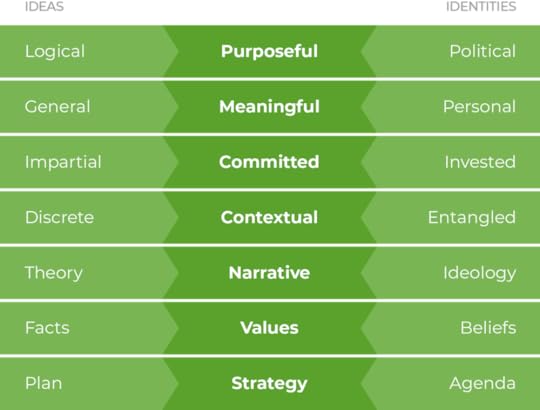
In Meetings that Matter, we talk about how to find the 'sweet spot' - a place where people are engaged, and coming from a place of values, principles and connection, but not so invested that they don't feel able to safely change their minds.
Check out the video below for a sneak peek of the MTM curriculum, talking about this very topic. If you're keen to learn how to orchestrate productive conflict, join us for a day's training on 2 December! We'd love to have you.
Til next week,
- A
October 19, 2021
Wednesday Wisdom: People are the problem
Welcome to another Wednesday Wisdom. Every week, I share with you what I'm thinking about life, work, and leadership. This week we're talking about life without others.
How much easier would driving be, without all the other cars on the road?
How much more enjoyable would going to the supermarket be, without all the other shoppers?
If you're an intolerant person under stress, you might be nodding your head vigorously. YES! You're screaming. That would be SO MUCH BETTER!
The same is true at work. Life would be a lot easier without our clients, bosses, colleagues and customers. We could just get on and do our job, without worrying about their problems, feelings, or presence.
Except... we wouldn't actually have a job, would we?
In Meetings that Matter, we have a meme: "People are the problem, but they're also the point."
It's catering to people's needs, fears, uncertainties and ambitions that make change difficult, but also - that's why we're changing in the first place. We're relational creatures, and most of the things we do only have value in that they serve others in some way.
So while life without people would be great, it'd probably be meaningless. Motivational? Probably not. But true.
Til next week,
- A
Last Live Training Opportunity for 2021!
We've booked in one final Meetings that Matter LIVE training for 2021. It's on Thursday 2 December. It's going to be brilliant, and spots are going quickly. Check it out now.
People are the Problem (and the point)
How much easier would driving be, without all the other cars on the road?
How much more enjoyable would going to the supermarket be, without all the other shoppers?
If you're an intolerant person under stress, you might be nodding your head vigorously. YES! You're screaming. That would be SO MUCH BETTER!
The same is true at work. Life would be a lot easier without our clients, bosses, colleagues and customers. We could just get on and do our job, without worrying about their problems, feelings, or presence.
Except... we wouldn't actually have a job, would we?
In Meetings that Matter, we have a meme: "People are the problem, but they're also the point."
It's catering to people's needs, fears, uncertainties and ambitions that make change difficult, but also - that's why we're changing in the first place. We're relational creatures, and most of the things we do only have value in that they serve others in some way.
So while life without people would be great, it'd probably be meaningless. Motivational? Probably not. But true.

October 12, 2021
Wednesday Wisdom: Wasted presence
Welcome to another Wednesday Wisdom. Every week, I share with you what I'm thinking about life, work, and leadership. This week we're talking about how to stop wasting time together.
When we came out of our first lockdown in New Zealand last year, I had some starry-eyed optimism. After being isolated for so long, and reaping the benefits of more time with our family, I thought... this could be it. This could be the catalyst we need to start really valuing people's presence, and putting a premium on our time.
Finally, we might start shifting the dial on how we work and spend time together, now that we appreciate how important that is. We won't take it for granted anymore.
...I was wrong.
How many meetings do you have in a week?
How many meetings do you have in a day?
Stop for a minute and tally up how much of your time is spent talking and trying to solve problems with others.
If you're like many professionals, it could be more than 50% of your working hours. More of your time might be spent working out what you need to do, than actually doing it.
HOW DID WE GET BACK HERE?!
We don't even skip a beat anymore. We just pop all those meetings straight onto Zoom and ram decision fatigue right down people's screens, until they resort to putting on fake backgrounds as they try not to stick pencils in their eyes.
I feel like we're missing the point, when it comes to meetings - and this is coming from a career facilitator. I'm not anti-meeting or anti-collaboration (though there are many days that I'd rather not interact with another living soul) - but I get extremely frustrated with wasted time.
The reason we get together is to make things happen outside of the meeting. To build understanding, shape choices and make decisions that will get the wheels of progress turning. If we're wasting time, we're also wasting energy, money and opportunity - none of which is OK.
If you're baffled as to why so many of your meetings and workshops suck, check out this free booklet. It's a brief overview to the work we do in our Meetings that Matter training, which provides a helpful diagnostic tool to work out what's missing with your team.
Maybe you don't trust each other, so you hold things back. Maybe you aren't focused on the same thing, so you're too scattered to make clear decisions. Maybe you're lacking commitment because there's too many other things going on. I don't know what your specific problem is - but you probably do.
So check it out.
Til next week,
- A
October 5, 2021
Wednesday Wisdom: Do, then decide
Welcome to another Wednesday Wisdom. Every week, I share with you what I'm thinking about life, work, and leadership. This week we're talking about making decisions.
What are you tangled up in knots about right now? I bet you've got a decision weighing on you. Whether it's a job offer, a location change, a relationship worry or a project at work, odds are you're facing decisions.
I'm not a psychic, and I can't see inside your brain. I just know that the average person makes 17,000 decisions a day, which can close to double in uncertain circumstances like lockdowns and personal change.
When we treat decision-making like a mental exercise, it's draining. We lie in bed at night with thoughts racing through our mind, scribble notes in our notebook and endlessly Google for advice. (If I ever have a team of cyber forensics go through my Google history, I'm not going to come off well.)
All good decision processes include action. When we're trapped in our own heads, we're blind to so many assumptions and options. When we expect perfection or accuracy straight away, we can wind up frozen and frustrated.
The trick is to try something. When we treat our lives like a series of experiments, it rather than significant milestones, the pressure releases and we can be lighter with ourselves.
What's the minimum viable decision?
Think about the smallest possible thing you can try to experiment with options for your tricky decision.
How can you fail faster?
When you commit a small amount of time, money or energy, you feel better about losing it. Go in expecting it to be a write-off, and be pleasantly surprised if something pans out.
Take a chance
You don't know what you don't know. When you do things, you immediately understand them better. That's why with naMBA, we complete a small project every week to immediately apply what we've learned to our work and lives. All the online article scrolling in the world pales in comparison to an afternoon of experimentation.
What can you test out to get clearer on your choices?
Til next week,
- A
Recent articles you might have missed:
Do, Then Decide
What are you tangled up in knots about right now? I bet you've got a decision weighing on you. Whether it's a job offer, a location change, a relationship worry or a project at work, odds are you're facing decisions.
I'm not a psychic, and I can't see inside your brain. I just know that the average person makes 17,000 decisions a day, which can close to double in uncertain circumstances like lockdowns and personal change.
When we treat decision-making like a mental exercise, it's draining. We lie in bed at night with thoughts racing through our mind, scribble notes in our notebook and endlessly Google for advice. (If I ever have a team of cyber forensics go through my Google history, I'm not going to come off well.)
All good decision processes include action. When we're trapped in our own heads, we're blind to so many assumptions and options. When we expect perfection or accuracy straight away, we can wind up frozen and frustrated.
The trick is to try something. When we treat our lives like a series of experiments, it rather than significant milestones, the pressure releases and we can be lighter with ourselves.
What's the minimum viable decision?
Think about the smallest possible thing you can try to experiment with options for your tricky decision.
How can you fail faster?
When you commit a small amount of time, money or energy, you feel better about losing it. Go in expecting it to be a write-off, and be pleasantly surprised if something pans out.
Take a chance
You don't know what you don't know. When you do things, you immediately understand them better. That's why with naMBA, we complete a small project every week to immediately apply what we've learned to our work and lives. All the online article scrolling in the world pales in comparison to an afternoon of experimentation.
What can you test out to get clearer on your choices?
Til next week,
- A
Recent articles you might have missed:
Five secrets of successful CEOs

September 28, 2021
Wednesday Wisdom: Surround yourself
Welcome to another Wednesday Wisdom. Every week, I share with you what I'm thinking about life, work, and leadership. This week we're talking about the impact of your network.
The company you keep matters. When you're surrounded by smokers, you're more likely to be a smoker. When your friends are successful at work, you're more likely to be successful at work.
The people we're surrounded by have much more power than we realise - not always because we consciously emulate them, but because we absorb invisible social norms and expectations that have a strong impact on our psyche and decision-making.
When I joined Thought Leaders Business School in 2018, I felt the power of this pull almost immediately. I went from a background where writing a book felt like a "one day" aspirational goal, to a community where that was expected and normalised. Three years later, I've got two published books to my name. Crikey.
When you're surrounded by negative, small-minded people, it can suck you dry before you realise it. That's fairly easy to deal with in a friend group, where we have control over who we talk to. It can be hard at work, when we're surrounded by people that bring us down.
How do your people make you feel?
Reflect on how you feel when you leave meetings, coffee dates and conferences. Inspired? Energised? Flat? Dejected? Frustrated? Take note of who has what effect on you, and try to be conscious of that throughout the day.
Who do you need more of?
Wo do you need more of in your life? More grounding? More role modelling? More families? More go-getters? Write them down and start to think about how you can consciously make that happen.
Who do you want to be?
When you know who you want to be, and you're clear on your values, you have a higher chance of cultivating a network that supports that. Take some time to think about what you value, and what you're aiming to achieve in your life. Maybe that's in your community, or your personal life. Maybe it's at work. When you know what you're looking for, it's easier to find it.
Be proactive
It's hard making friends as an adult. I hate it. There's less time, it's more awkward, and it takes effort. Ironically, this is the time in your life when you're best-placed to make good decisions about who to spend time with, rather than falling into a default group from high school or an old workplace.
One of the most exciting things about Not An MBA is the calibre of people we've got on board. We've been really intentional about who this is a good fit for - and it's not everyone. It's for a particular breed of ambitious, frustrated learners who want to do something big, and aren't always surrounded by people who feel the same way.
Being intentional and proactive about who we're looking for has paid off - and it can for you too.
Who should you be surrounding yourself with, and where can you find them?
Til next week,
- A
Recent articles you might have missed: