Alicia McKay's Blog, page 18
November 17, 2020
Convert your cynics.
As a facilitator, I can spot a cynic a mile away. Their body language is pure resistance: folded arms, suspicious expression, and deep sighs. They don’t need to say anything to identify themselves (although they usually do…) because their energy says most of it for them.
It’s easy to be frustrated by these people – negative, shooting down people’s ideas and generally throwing a spanner in the works. Worse, it’s even tempting to argue with them.
Why do they have to be so resistant to change? Why are they such a pain in the a*s? Why can’t they play the game like everyone else?
Here’s why: because they represent something important. Either they’re expressing things that other people are thinking but not saying, or they can spot a problem that others don’t.
Almost without exception, your cynics are worth converting. As I wrote in this article last week: anger beats apathy every time. When people care enough to be grumpy, they’re worth spending the time on.
When I train people to lead strategic conversations, I often have them complete a design-thinking empathy map for their cynics before they walk into a room (download yours free here). Digging a bit deeper doesn't take long, but it can make all the difference between getting frustrated, and understanding.
For some leaders, or facilitators, dealing with cynics is a chore. In the same way that traditional parenting encouraged us to ignore or punish bad behaviour, lest we ‘reward’ our children for needing help, traditional leadership was all about shutting down, removing or punishing cynicism. This might send it underground, but it won't remove it.
Positive parenting is all about taking the time to understand our children’s unmet needs, (so that they can learn to understand them too!). It took me a while to deprogram my instinctive response to shut my girls down when they acted out, because I certainly wasn’t raised that way. But once I managed it, and my children began to trust that my love and support wasn’t conditional, the difference was extraordinary.
The same is true of good facilitation, and good leadership. Not because we should think of our people like children (although, as Russell Brand once said, we’re all babies...) but because when people are being difficult, it’s usually for a good reason. If we take the time to figure that out, by moving past what we see on the outside, we find the good stuff. There’s no such thing as a single crime, so if someone is expressing cynicism or mistrust, you can be sure that exists quietly in other corners too.
Maybe this is the seventh one of these they've suffered through.
Maybe they've seen something similar fail.
Maybe they're afraid of what this will mean for their job.
Maybe they're worried how it will look to their boss, or an important client.
Maybe they're more switched on than you realise.
I like to operate on the assumption of positive intent - most people come to work to do a good job, and try their best. If they're being difficult, it's probably for a good reason*. I reckon this is true in most situations - friends, colleagues, and people overall.
And hey - maybe I'm wrong. Maybe they're not worried about something important, or seeing something you're not. But if you don't take the time to understand where they're coming from, you're asking for trouble. And if you do, you might be surprised. When you convert a cynic, they often become your biggest champion.
So, what's going on with your cynics?
What if you assumed positive intent?
Til next week
- A


November 10, 2020
How to handle uncertainty
Last week, I argued that people don’t actually fear change. As I outlined in this LinkedIn post, we fear what change represents: loss, uncertainty, learning and challenge.
All four of those are tricky, but uncertainty could be the hardest. Change management is one of this year’s most in-demand services, but what we really need is uncertainty management.
Uncertainty management is the new change management
Uncertainty management gives us the skills to plan for an uncertain future and face the unknown - because that stuff is exhausting. We feel stuck in place. Powerless. It’s understandable right now, but it’s dangerous. That stuckness, left unchecked, is a fast track to burnout.
When COVID hit, we had a common enemy to fight – things to change, things to do, adrenaline to keep us going. Now, though, the stuckness is creeping in. We don’t know when it’s going to end, or what it’s going to mean, and if we’re not careful, we start to feel a bit… over it. We get cynical. Our work and lives lose meaning.
Just about everyone I talk to right now has some variety of this stuckness. But uncertainty isn’t going anywhere anytime soon, so it’s time we got better at dealing with it.
You can't always change the thing
I recently encountered a powerful idea that I’d love to share with you - when it comes to stressful circumstances, it’s not always the stressor you need to manage – it’s the stress.
This podcast interview between Brene Brown and Emily and Amelia Nagoski, authors of Burnout: The Secret to Unlocking the Stress Cycle really spoke to me. It also inspired me to read the book – which I’m now recommending left, right and centre, especially to women.
Burnout, the Nagoski twins posit, happens when we get stuck in the middle of a stress response cycle – and the ticket out is finding a way to complete your own response.
As an action-oriented, #GSD kind of a person, I’ve spent my life making decisions, doing things quickly and charging forward. Realising that changing the thing isn’t always the answer – and will rarely be the entire solution - was a lightbulb moment for me.
In high uncertainty environments, this is a potent lesson, because you often can’t change the thing. What you can change is how you respond, and find agency in what you can control.
Play the question game
Here’s a helpful exercise I like to use with clients. I call it the Question Game, and it has magic powers for uncertainty management. You can’t work with what you can’t see, and uncertainty can feel like a nameless, shapeless fog. So, get it down. Make it real. Get all of that uncertainty out on a page, in the form of questions.
Step One: List all of your unspoken questions. Work ones, life ones, personal ones. Big ones, and small ones. You might write things like: "Will my job be safe?" "Will I be able to travel to see my family overseas soon?" "Will my kids be OK with my divorce?" "Will my business survive the year?" "Should we invest in that new system?" "Should we put this service online?"
Step Two: Work through each of your questions in turn, attempting an answer for each. Mine are usually some variety of:
Yes (So make a plan, take action, or stop thinking about it!)
No (So do what you have to, to let it go)
Maybe (It will become clear. Take a small step or try an experiment.)
Step Three: Take a deep breath, and feel better and more in control of your fog.
When you put it all down this way, your uncertainty stops being a dark cloud in your head, dragging you down and keeping you tired, and becomes a manageable, malleable little beast that you can draw lines through and talk about. And right now, that’s about the best we can ask for.
Who knows what’s coming next? Not me.
Give the question game a go – and let me know how you get on!
Manage uncertainty, before it burns you out.
Last week, I argued that people don’t actually fear change. As I outlined in this LinkedIn post, we fear what change represents: loss, uncertainty, learning and challenge.
All four of those are tricky, but uncertainty could be the hardest. Change management is one of this year’s most in-demand services, but what we really need is uncertainty management.
Uncertainty management is the new change management
Uncertainty management gives us the skills to plan for an uncertain future and face the unknown - because that stuff is exhausting. We feel stuck in place. Powerless. It’s understandable right now, but it’s dangerous. That stuckness, left unchecked, is a fast track to burnout.
When COVID hit, we had a common enemy to fight – things to change, things to do, adrenaline to keep us going. Now, though, the stuckness is creeping in. We don’t know when it’s going to end, or what it’s going to mean, and if we’re not careful, we start to feel a bit… over it. We get cynical. Our work and lives lose meaning.
Just about everyone I talk to right now has some variety of this stuckness. But uncertainty isn’t going anywhere anytime soon, so it’s time we got better at dealing with it.
You can't always change the thing
I recently encountered a powerful idea that I’d love to share with you - when it comes to stressful circumstances, it’s not always the stressor you need to manage – it’s the stress.
This podcast interview between Brene Brown and Emily and Amelia Nagoski, authors of Burnout: The Secret to Unlocking the Stress Cycle really spoke to me. It also inspired me to read the book – which I’m now recommending left, right and centre, especially to women.
Burnout, the Nagoski twins posit, happens when we get stuck in the middle of a stress response cycle – and the ticket out is finding a way to complete your own response.
As an action-oriented, #GSD kind of a person, I’ve spent my life making decisions, doing things quickly and charging forward. Realising that changing the thing isn’t always the answer – and will rarely be the entire solution - was a lightbulb moment for me.
In high uncertainty environments, this is a potent lesson, because you often can’t change the thing. What you can change is how you respond, and find agency in what you can control.
Play the question game
Here’s a helpful exercise I like to use with clients. I call it the Question Game, and it has magic powers for uncertainty management. You can’t work with what you can’t see, and uncertainty can feel like a nameless, shapeless fog. So, get it down. Make it real. Get all of that uncertainty out on a page, in the form of questions.
Step One: List all of your unspoken questions. Work ones, life ones, personal ones. Big ones, and small ones. You might write things like: "Will my job be safe?" "Will I be able to travel to see my family overseas soon?" "Will my kids be OK with my divorce?" "Will my business survive the year?" "Should we invest in that new system?" "Should we put this service online?"
Step Two: Work through each of your questions in turn, attempting an answer for each. Mine are usually some variety of:
Yes (So make a plan, take action, or stop thinking about it!)
No (So do what you have to, to let it go)
Maybe (It will become clear. Take a small step or try an experiment.)
Step Three: Take a deep breath, and feel better and more in control of your fog.
When you put it all down this way, your uncertainty stops being a dark cloud in your head, dragging you down and keeping you tired, and becomes a manageable, malleable little beast that you can draw lines through and talk about. And right now, that’s about the best we can ask for.
Who knows what’s coming next? Not me.
Give the question game a go – and let me know how you get on!
November 9, 2020
How to think about change
If you’re not doing ‘change’ right now, you’re not in fashion.
Whether it’s organisational change, personal transformation (hi Spring!) or even career change, it’s in the springtime air. I’m so down for this.
Change is my favourite thing – new growth, new ideas and new possibilities. But apparently, not everyone feels the same. People are always grumbling to me about how “resistant to change” their colleagues and teams are. Rubbish. People don’t fear change – as Heifetz and Linsky point out, no-one gives back a winning lottery ticket! It’s loss that people are afraid of.
The world got weird
In 2020, the world feels less knowable than it used to, and the potential for loss seems around every corner. People are losing their freedom, families and jobs as COVID continues to ravage the globe. In New Zealand, we’re bizarrely insulated from the primary impacts of the pandemic, but the secondary ones are starting to hit hard. Economic uncertainty and border closures are sending a ripple effect through our businesses, policy-making and future planning.
COVID aside, work and the world in general just feels less knowable than it used to, doesn’t it? Our parents and grandparents left school, got a job, and felt confident doing that job for the length of their career. It wasn’t necessarily easy, but it felt stable.
Teachers taught. Lawyers lawyer-ed. Doctors doctor-ed. But now, when my kids talk about what they want to be when they grow up, I’m not sure what to say. What is a teacher, in pandemic uncertainty and with online learning? What are lawyers, as we advance blockchain, encrypted data and global commerce? How will medicine evolve as bedside assistants become robots, society ages, the middle-class questions vaccines and biotechnology hurtles ahead?
Change is constant
If you’ve got personal, organisational or career change on the cards, take heart. According to a LinkedIn source, people will, on average, switch jobs fifteen times in their lifetime, which could include a handful of significant career shifts. The rules are different now, and the options available to us are more varied and flexible than ever before.
Change is not new. We’ve been grappling with new occupations, ideas, and technologies since forever. But the kind of change we’re dealing with is different. Like our career paths, it feels less knowable than before. Things are more complex.
Lucky for us, complexity’s not a bad thing. Complex systems, like in nature, are more resilient and adaptive. We lose our more fragile bits as we go through adversity and come out the other side smarter, stronger and better prepared for the next thing.
You're made for this
People, communities, businesses, society and policy have been growing, changing, learning and improving for centuries. Sometimes it’s slow and we hardly notice how far we’ve come unless we look back. Sometimes it’s fast, scary and turns everything upside down.
Either way, it’s OK. We’re built for this. We’re an evolutionary animal, and we thrive on the chance to make things better – as long as we feel like we’re part of it. So don’t step back. Don’t be a plastic bag, battered around by the winds of change. Focus on your bit. The exciting bit. The learning, the growth and the opportunities.
And hey - I know you can’t feel like that every day. It might be that today, this email hits your inbox and you roll your eyes and swear at me through your phone. That’s cool, I get it. Some days, it’s fine to get up and feel grumpy, worried, and resentful. Being a person is hard. Being a person who doesn’t know what’s coming next is even harder.
But you can’t stay there – and it’s unlikely you will. Take the day, be emo, and then start again tomorrow.
You’re born to change. Keep moving.
How to think about change.
If you’re not doing ‘change’ right now, you’re not in fashion.
Whether it’s organisational change, personal transformation (hi Spring!) or even career change, it’s in the springtime air. I’m so down for this.
Change is my favourite thing – new growth, new ideas and new possibilities. But apparently, not everyone feels the same. People are always grumbling to me about how “resistant to change” their colleagues and teams are. Rubbish. People don’t fear change – as Heifetz and Linsky point out, no-one gives back a winning lottery ticket! It’s loss that people are afraid of.
The world got weird
In 2020, the world feels less knowable than it used to, and the potential for loss seems around every corner. People are losing their freedom, families and jobs as COVID continues to ravage the globe. In New Zealand, we’re bizarrely insulated from the primary impacts of the pandemic, but the secondary ones are starting to hit hard. Economic uncertainty and border closures are sending a ripple effect through our businesses, policy-making and future planning.
COVID aside, work and the world in general just feels less knowable than it used to, doesn’t it? Our parents and grandparents left school, got a job, and felt confident doing that job for the length of their career. It wasn’t necessarily easy, but it felt stable.
Teachers taught. Lawyers lawyer-ed. Doctors doctor-ed. But now, when my kids talk about what they want to be when they grow up, I’m not sure what to say. What is a teacher, in pandemic uncertainty and with online learning? What are lawyers, as we advance blockchain, encrypted data and global commerce? How will medicine evolve as bedside assistants become robots, society ages, the middle-class questions vaccines and biotechnology hurtles ahead?
Change is constant
If you’ve got personal, organisational or career change on the cards, take heart. According to a LinkedIn source, people will, on average, switch jobs fifteen times in their lifetime, which could include a handful of significant career shifts. The rules are different now, and the options available to us are more varied and flexible than ever before.
Change is not new. We’ve been grappling with new occupations, ideas, and technologies since forever. But the kind of change we’re dealing with is different. Like our career paths, it feels less knowable than before. Things are more complex.
Lucky for us, complexity’s not a bad thing. Complex systems, like in nature, are more resilient and adaptive. We lose our more fragile bits as we go through adversity and come out the other side smarter, stronger and better prepared for the next thing.
You're made for this
People, communities, businesses, society and policy have been growing, changing, learning and improving for centuries. Sometimes it’s slow and we hardly notice how far we’ve come unless we look back. Sometimes it’s fast, scary and turns everything upside down.
Either way, it’s OK. We’re built for this. We’re an evolutionary animal, and we thrive on the chance to make things better – as long as we feel like we’re part of it. So don’t step back. Don’t be a plastic bag, battered around by the winds of change. Focus on your bit. The exciting bit. The learning, the growth and the opportunities.
And hey - I know you can’t feel like that every day. It might be that today, this email hits your inbox and you roll your eyes and swear at me through your phone. That’s cool, I get it. Some days, it’s fine to get up and feel grumpy, worried, and resentful. Being a person is hard. Being a person who doesn’t know what’s coming next is even harder.
But you can’t stay there – and it’s unlikely you will. Take the day, be emo, and then start again tomorrow.
You’re born to change. Keep moving.
October 27, 2020
Before you restructure, read this
In a client mentoring session on Friday, I was looking forward to hearing how a job interview had gone. After an extended secondment, and a long recruitment process, mucked around by COVID and non-COVID related delays, the big day was finally pegged to take place last week, and my client was excited.
Well, she didn’t get the job. Not because it went to someone else, but because the interview was called off… the day before. The ELT had decided to implement another “reshuffle” so all recruitment conversations were put on hold. Again. For the sake of some awkward conversations in the party of five, hundreds of people were affected and thrown back into uncertainty.
That conversation inspired me to have a bit of a rant on LinkedIn, which went gangbusters. The gist: restructures, by any name, are not the answers to most of your problems. When all you’ve got is a hammer, everything – decisions, delegations, management systems, poor relationships – can start to look like a nail.
Some of you might be familiar with Maslow’s Hierarchy of Needs. The basic idea is: not all human needs are created equally. We have some basic ones that need taking care of (food, shelter, safety) before we can even think about having woke conversations about the meaning of life.
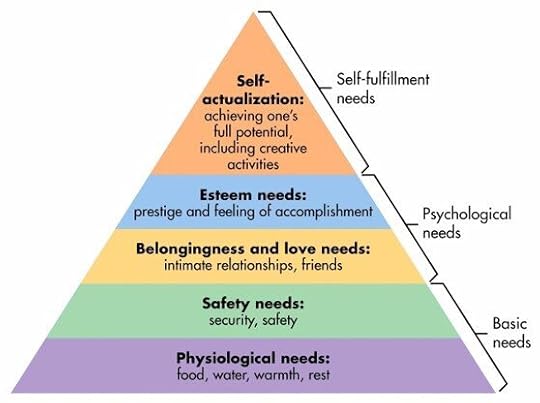
Maslow's Hierarchy of Needs
A year or two ago, working with a business that were using the restructure hammer multiple times a year, I developed the McKay Hierarchy of Organisational Needs. The idea is the same: not all organisational needs are created equally. Before we worry about the structure of our teams, or start having conversations about “changing the culture” we need to make sure our basic needs are taken care of first.
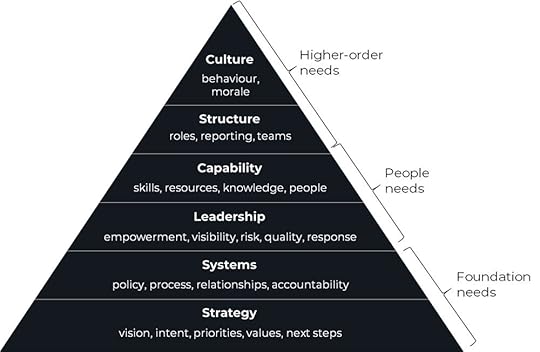
McKay's Hierarchy of Organisational Needs
If you’re struggling inside the madness that is 2020, and considering yet another restructure, take the time to work your way through the hierarchy first – are your foundation needs taken care of?
Before you worry about whether your people have the right capabilities, check whether they’re being supported by a clear direction, effective systems and strong leadership.
Before you start fiddling with your structure, take a good hard look at whether all of your other ducks in a row. Otherwise, you’re going to wind up with a team full of uncertain and unproductive people, who are no better off.
(And before you start talking about “changing the culture” as though it's an input, reconsider whether the way your organisation runs supports the kind of behaviours you’re sticking on posters in the staff-room.If you take care of those, you might find culture is an output that largely takes care of itself!)
What are your organisation's biggest needs right now?
Are you focusing on the right things?
Before you restructure, read this.
In a client mentoring session on Friday, I was looking forward to hearing how a job interview had gone. After an extended secondment, and a long recruitment process, mucked around by COVID and non-COVID related delays, the big day was finally pegged to take place last week, and my client was excited.
Well, she didn’t get the job. Not because it went to someone else, but because the interview was called off… the day before. The ELT had decided to implement another “reshuffle” so all recruitment conversations were put on hold. Again. For the sake of some awkward conversations in the party of five, hundreds of people were affected and thrown back into uncertainty.
That conversation inspired me to have a bit of a rant on LinkedIn, which went gangbusters. The gist: restructures, by any name, are not the answers to most of your problems. When all you’ve got is a hammer, everything – decisions, delegations, management systems, poor relationships – can start to look like a nail.
Some of you might be familiar with Maslow’s Hierarchy of Needs. The basic idea is: not all human needs are created equally. We have some basic ones that need taking care of (food, shelter, safety) before we can even think about having woke conversations about the meaning of life.
Maslow's Hierarchy of Needs
A year or two ago, working with a business that were using the restructure hammer multiple times a year, I developed the McKay Hierarchy of Organisational Needs. The idea is the same: not all organisational needs are created equally. Before we worry about the structure of our teams, or start having conversations about “changing the culture” we need to make sure our basic needs are taken care of first.
McKay's Hierarchy of Organisational Needs
If you’re struggling inside the madness that is 2020, and considering yet another restructure, take the time to work your way through the hierarchy first – are your foundation needs taken care of?
Before you worry about whether your people have the right capabilities, check whether they’re being supported by a clear direction, effective systems and strong leadership.
Before you start fiddling with your structure, take a good hard look at whether all of your other ducks in a row. Otherwise, you’re going to wind up with a team full of uncertain and unproductive people, who are no better off.
(And before you start talking about “changing the culture” as though it's an input, reconsider whether the way your organisation runs supports the kind of behaviours you’re sticking on posters in the staff-room.If you take care of those, you might find culture is an output that largely takes care of itself!)
What are your organisation's biggest needs right now?
Are you focusing on the right things?
October 20, 2020
How to stop being a plastic bag
American Beauty is one of my favourite movies. In one memorable scene, we watch Ricky’s video of an empty, wrinkled plastic bag tossed about in the wind. We follow the bag as it whips about violently, spiralling skyward then floating to the ground.
'And this bag was like, dancing with me. Like a little kid begging me to play with it. For fifteen minutes. And that’s the day I knew there was this entire life behind things.'
– Ricky, American Beauty
Have you ever opened your calendar to find nothing but other people’s priorities staring back at you? Look at it now and see.
It happens quickly, and your calendar is just the tip of the iceberg. If you’ve ever felt swept up in the rhythm and frustrated by the lack of space for stuff you care about, you’re not alone. Many well-intentioned people feel a bit like Ricky’s plastic bag. Pulled and tugged in all directions, they find themselves at the mercy of other people’s choices and priorities.
However, unlike a plastic bag, you have agency. You can’t control the wind but taking responsibility for your actions is the mark of real leadership.
We don’t know when the next pandemic will hit. We can’t control how our boss shows up today, what our partner or children will do next, what the economy will do, or whether our customers will be sold on our next big thing. But we do have absolute control over our response – and that agency is what life and leadership is all about.
As Henry David Thoreau wrote: 'Things do not change; we change.'
We can seize our sense of agency, by:
Knowing and living by our values
Having conviction in our thoughts and ideas
Creating our own rules for how we want to live and work
Intentionally seeking discomfort and risk
Making better choices.
Over the next few weeks, I’m going to dig into this stuff a bit more, because as the world around us continues to go mad, taking responsibility for our bit is more important than it’s ever been.
Is it time for you to seize agency?
Plastic bags.
American Beauty is one of my favourite movies. In one memorable scene, we watch Ricky’s video of an empty, wrinkled plastic bag tossed about in the wind. We follow the bag as it whips about violently, spiralling skyward then floating to the ground.
'And this bag was like, dancing with me. Like a little kid begging me to play with it. For fifteen minutes. And that’s the day I knew there was this entire life behind things.'
– Ricky, American Beauty
Have you ever opened your calendar to find nothing but other people’s priorities staring back at you? Look at it now and see.
It happens quickly, and your calendar is just the tip of the iceberg. If you’ve ever felt swept up in the rhythm and frustrated by the lack of space for stuff you care about, you’re not alone. Many well-intentioned people feel a bit like Ricky’s plastic bag. Pulled and tugged in all directions, they find themselves at the mercy of other people’s choices and priorities.
However, unlike a plastic bag, you have agency. You can’t control the wind but taking responsibility for your actions is the mark of real leadership.
We don’t know when the next pandemic will hit. We can’t control how our boss shows up today, what our partner or children will do next, what the economy will do, or whether our customers will be sold on our next big thing. But we do have absolute control over our response – and that agency is what life and leadership is all about.
As Henry David Thoreau wrote: 'Things do not change; we change.'
We can seize our sense of agency, by:
Knowing and living by our values
Having conviction in our thoughts and ideas
Creating our own rules for how we want to live and work
Intentionally seeking discomfort and risk
Making better choices.
Over the next few weeks, I’m going to dig into this stuff a bit more, because as the world around us continues to go mad, taking responsibility for our bit is more important than it’s ever been.
Is it time for you to seize agency?
Plastics Bags.
American Beauty is one of my favourite movies. In one memorable scene, we watch Ricky’s video of an empty, wrinkled plastic bag tossed about in the wind. We follow the bag as it whips about violently, spiralling skyward then floating to the ground.
'And this bag was like, dancing with me. Like a little kid begging me to play with it. For fifteen minutes. And that’s the day I knew there was this entire life behind things.'
– Ricky, American Beauty
Have you ever opened your calendar to find nothing but other people’s priorities staring back at you? Look at it now and see.
It happens quickly, and your calendar is just the tip of the iceberg. If you’ve ever felt swept up in the rhythm and frustrated by the lack of space for stuff you care about, you’re not alone. Many well-intentioned people feel a bit like Ricky’s plastic bag. Pulled and tugged in all directions, they find themselves at the mercy of other people’s choices and priorities.
However, unlike a plastic bag, you have agency. You can’t control the wind but taking responsibility for your actions is the mark of real leadership.
We don’t know when the next pandemic will hit. We can’t control how our boss shows up today, what our partner or children will do next, what the economy will do, or whether our customers will be sold on our next big thing. But we do have absolute control over our response – and that agency is what life and leadership is all about.
As Henry David Thoreau wrote: 'Things do not change; we change.'
We can seize our sense of agency, by:
Knowing and living by our values
Having conviction in our thoughts and ideas
Creating our own rules for how we want to live and work
Intentionally seeking discomfort and risk
Making better choices.
Over the next few weeks, I’m going to dig into this stuff a bit more, because as the world around us continues to go mad, taking responsibility for our bit is more important than it’s ever been.
Is it time for you to seize agency?