Scott L. Smith Jr.'s Blog, page 8
November 22, 2021
Novena to the Holy Spirit to Pray with Protestants and Non-Catholics During Religious Persecution and For Religious Freedom
Working with our brothers and sisters in Christ on Religious Freedom has been a great opportunity for us to pray together. I wanted our prayer to be focused, though, and consistent. In short, I wanted to pray a novena with Catholics and Non-Catholics alike.
I thought it would be best to go with the "O.G. Novena" -- the original novena that the Apostles prayed, at Jesus' instruction, for the coming of the Holy Spirit during the nine days between Jesus' Ascension and Pentecost ...
The Novena to the Holy Spirit!
This should work for all Christians, Catholics, Protestants, and other Non-Catholics, because It's a novena to the one of the members of the Trinity, not a particular saint (even though Novenas to St. Joseph and St. Jude are super effective and amazing)It's in the Bible! These nine days of prayer, i.e. "novena", by the Apostles and the Blessed Mother comes straight out of the Book of Acts. The gifts of the Holy Spirit are exactly what we need for the challenge we're confronting.
During each of the nine days of the Novena to the Holy Spirit we pray for different gifts of the Holy Spirit, starting with Charity. All together, the gifts are Charity, Joy, Peace,
Novena to the Holy Spirit to Pray with Protestants and Non-Catholics During Religious Persecution and For Religious Freedom: TABLE OF CONTENTSClick the links below for the nine days of the Novena: Day One Day Two Day Three Day Four Day Five Day Six Day Seven Day Eight Day Nine Let us bow down in humility at the power and grandeur of the Holy Spirit. Let us worship the Holy Trinity and give glory today to the Paraclete, our Advocate.
O Holy Spirit, by Your power, Christ was raised from the dead to save us all. By Your grace, miracles are performed in Jesus’ name. By Your love, we are protected from evil. And so, we ask with humility and a beggar’s heart for Your gift of Charity within us.
The great charity of all the the host of God's people is only made possible by your power, Oh Divine Spirit. Increase in me, the virtue of charity that I may love as God loves with selflessness. Amen.
Holy Spirit we ask for the grace of [Mention your intention here].
Amen.
Come Holy Spirit, fill the hearts of your faithful and enkindle in them the fire of your love. Send forth your Spirit and they shall be created. And You shall renew the face of the earth.
O, God, who by the light of the Holy Spirit, did instruct the hearts of the faithful, grant that by the same Holy Spirit we may be truly wise and ever enjoy His consolations, through Christ Our Lord,
Amen.
Let us bow down in humility at the power and grandeur of the Holy Spirit. Let us worship the Holy Trinity and give glory today to the Paraclete, our Advocate.
O Holy Spirit, by Your power, Christ was raised from the dead to save us all. By Your grace, miracles are performed in Jesus’ name. By Your love, we are protected from evil. And so, we ask with humility and a beggar’s heart for Your gift of Joy within us.
All of God's people are marked with uncompromising Joy in times of trial, difficulty, and pain. Give us, Oh Holy Spirit, the Joy that surpasses all understanding that we may live as a witness to Your love and fidelity! Amen.
Holy Spirit we ask for the grace of [Mention your intention here].
Amen.
Come Holy Spirit, fill the hearts of your faithful and enkindle in them the fire of your love. Send forth your Spirit and they shall be created. And You shall renew the face of the earth.
O, God, who by the light of the Holy Spirit, did instruct the hearts of the faithful, grant that by the same Holy Spirit we may be truly wise and ever enjoy His consolations, through Christ Our Lord,
Amen.
Let us bow down in humility at the power and grandeur of the Holy Spirit. Let us worship the Holy Trinity and give glory today to the Paraclete, our Advocate.
O Holy Spirit, by Your power, Christ was raised from the dead to save us all. By Your grace, miracles are performed in Jesus’ name. By Your love, we are protected from evil. And so, we ask with humility and a beggar’s heart for Your gift of Peace within us.
God's people are tempted, attacked, and harassed by the devil who is the destroyer of peace. When we are attacked by the devil, come to our aid as our Advocate and give us the Peace that lasts through all trials!
Holy Spirit we ask for the grace of [Mention your intention here].
Amen.
Come Holy Spirit, fill the hearts of your faithful and enkindle in them the fire of your love. Send forth your Spirit and they shall be created. And You shall renew the face of the earth.
O, God, who by the light of the Holy Spirit, did instruct the hearts of the faithful, grant that by the same Holy Spirit we may be truly wise and ever enjoy His consolations, through Christ Our Lord,
Amen.
Let us bow down in humility at the power and grandeur of the Holy Spirit. Let us worship the Holy Trinity and give glory today to the Paraclete, our Advocate.
O Holy Spirit, by Your power, Christ was raised from the dead to save us all. By Your grace, miracles are performed in Jesus’ name. By Your love, we are protected from evil. And so, we ask with humility and a beggar’s heart for Your gift of Patience within us.
O Holy Spirit, you give lavishly to those who ask. Please give us the patience of God's people who are now with you in heaven. Help us to endure everything with an eternal patience that is only possible with your help.
Holy Spirit we ask for the grace of [Mention your intention here].
Amen.
Come Holy Spirit, fill the hearts of your faithful and enkindle in them the fire of your love. Send forth your Spirit and they shall be created. And You shall renew the face of the earth.
O, God, who by the light of the Holy Spirit, did instruct the hearts of the faithful, grant that by the same Holy Spirit we may be truly wise and ever enjoy His consolations, through Christ Our Lord,
Amen.
Let us bow down in humility at the power and grandeur of the Holy Spirit. Let us worship the Holy Trinity and give glory today to the Paraclete, our Advocate.
O Holy Spirit, by Your power, Christ was raised from the dead to save us all. By Your grace, miracles are performed in Jesus’ name. By Your love, we are protected from evil. And so, we ask with humility and a beggar’s heart for Your gift of Kindness within us.
Jesus approached sinners with immense kindness. Holy Paraclete, please treat us humble sinners with the same kindness and give us the ability to treat all others with that kindness as well.
Holy Spirit we ask for the grace of [Mention your intention here].
Amen.
Come Holy Spirit, fill the hearts of your faithful and enkindle in them the fire of your love. Send forth your Spirit and they shall be created. And You shall renew the face of the earth.
O, God, who by the light of the Holy Spirit, did instruct the hearts of the faithful, grant that by the same Holy Spirit we may be truly wise and ever enjoy His consolations, through Christ Our Lord,
Amen.
Let us bow down in humility at the power and grandeur of the Holy Spirit. Let us worship the Holy Trinity and give glory today to the Paraclete, our Advocate.
O Holy Spirit, by Your power, Christ was raised from the dead to save us all. By Your grace, miracles are performed in Jesus’ name. By Your love, we are protected from evil. And so, we ask with humility and a beggar’s heart for Your gift of Faithfulness within us.
You, O Lord, are ever faithful. You are faithful until the end. Though we are weak and distracted, please give us the grace to be faithful to You as you are to us!
Holy Spirit we ask for the grace of [Mention your intention here].
Amen.
Come Holy Spirit, fill the hearts of your faithful and enkindle in them the fire of your love. Send forth your Spirit and they shall be created. And You shall renew the face of the earth.
O, God, who by the light of the Holy Spirit, did instruct the hearts of the faithful, grant that by the same Holy Spirit we may be truly wise and ever enjoy His consolations, through Christ Our Lord,
Amen.
Let us bow down in humility at the power and grandeur of the Holy Spirit. Let us worship the Holy Trinity and give glory today to the Paraclete, our Advocate.
O Holy Spirit, by Your power, Christ was raised from the dead to save us all. By Your grace, miracles are performed in Jesus’ name. By Your love, we are protected from evil. And so, we ask with humility and a beggar’s heart for Your gift of Gentleness within us.
Despite the gravity of our sins, O Lord you treat us with Gentleness. Dear Holy Spirit, give us your power to treat all in our lives with Gentleness.
Holy Spirit we ask for the grace of [Mention your intention here].
Amen.
Come Holy Spirit, fill the hearts of your faithful and enkindle in them the fire of your love. Send forth your Spirit and they shall be created. And You shall renew the face of the earth.
O, God, who by the light of the Holy Spirit, did instruct the hearts of the faithful, grant that by the same Holy Spirit we may be truly wise and ever enjoy His consolations, through Christ Our Lord,
Amen.
Let us bow down in humility at the power and grandeur of the Holy Spirit. Let us worship the Holy Trinity and give glory today to the Paraclete, our Advocate.
O Holy Spirit, by Your power, Christ was raised from the dead to save us all. By Your grace, miracles are performed in Jesus’ name. By Your love, we are protected from evil. And so, we ask with humility and a beggar’s heart for Your gift of Self-Control within us.
Your Martyrs had the overwhelming self-control to go joyfully to a painful death without shrinking from the opportunity to join You in heaven. Give us this self-control to have command over our emotions and desires that we may serve You more fully.
Holy Spirit we ask for the grace of [Mention your intention here].
Amen.
Come Holy Spirit, fill the hearts of your faithful and enkindle in them the fire of your love. Send forth your Spirit and they shall be created. And You shall renew the face of the earth.
O, God, who by the light of the Holy Spirit, did instruct the hearts of the faithful, grant that by the same Holy Spirit we may be truly wise and ever enjoy His consolations, through Christ Our Lord,
Amen.
Let us bow down in humility at the power and grandeur of the Holy Spirit. Let us worship the Holy Trinity and give glory today to the Paraclete, our Advocate.
O Holy Spirit, by Your power, Christ was raised from the dead to save us all. By Your grace, miracles are performed in Jesus’ name. By Your love, we are protected from evil. And so, we ask with humility and a beggar’s heart for Goodness within us.
Holy Spirit, renew us by your power with your Goodness that we may bring the Good News to the world.
Holy Spirit we ask for the grace of [Mention your intention here].
Amen.
Come Holy Spirit, fill the hearts of your faithful and enkindle in them the fire of your love. Send forth your Spirit and they shall be created. And You shall renew the face of the earth.
O, God, who by the light of the Holy Spirit, did instruct the hearts of the faithful, grant that by the same Holy Spirit we may be truly wise and ever enjoy His consolations, through Christ Our Lord,
Amen.


November 9, 2021
Catholic Parents Guide: 10 Family Prayer Time Ideas Throughout the Day and Year
"Pray without ceasing." St. Paul tells us, not only to pray, but to pray without ceasing. This is the ideal of monks and monasteries, but can a family do this, too?
That's what I've been working on ...

Slow and steady wins the race. My wife and I have been slowly adding family prayer times throughout our day. We started with a nightly Rosary or just a decade of the Rosary. Then we added a Morning Offering to our breakfast time together. I recently added the noon Angelus while we were on our family vacation.
Next steps? Annual consecration to Jesus through Mary or St. Joseph? Daily recitation of The Little Office of the Blessed Virgin Mary? More on all this below ...
If these family prayers and family prayer times don't work for your family, don't worry. I have provided 10 Family Prayer Ideas below, so there is something that's sure to fit your family.
Want a book with guides for saying all the following prayers? Here is the Catholic handbook for men I published: The Catholic ManBook!
[image error] [image error]
The studies on family prayer time are compelling. Here is a selection of quotes from Catholic studies on family prayer. From these, I draw this simple conclusion: If I want my kids to get to Heaven, I need to pray with them. And - not that we need to be told this - getting our kids to Heaven is our primary responsibility as parents.
The Faith is not transmitted to our kids through a series of logical, reasoned arguments. A Report on American Catholic Religious Parenting by Justin Bartkus and Christian Smith provides the following:
One of the most basic suggestions of our findings is that young adults arrive at a sense of their fundamental identity and worldview not by weighing all possible intellectual arguments for and against a proposed way of life, but rather by roughly adopting the worldview of those mentors who left the deepest impression upon them—and who loved them and cared for them the most. It should come as no surprise, then, that the emergence of the new generation of dedicated young Catholics will rise and fall with the choices of their parents.[1]
What is the single most powerful force in a child’s religious formation?
What has the most powerful on the Catholic formation of our kids? Is it providing them with a Catholic education? Is it a charismatic youth minister and well-funded youth group? Is it the parish priest? No and no and no.
It's you! The parents. The single most powerful force in a child’s religious formation is the spiritual personality of the parent. Young people’s religious outcomes are decided, not in the parish or in Catholic school, but in the home.
Fathers. Dads. You have an especially important role in all this. Studies have shown that a father's faith, even more than the mother's, plays the critical role in the transmission of the faith to the next generation. You can read more on this here:
According to Families and Faith: How Religion is Passed Down Across Generations, the parental factors that make the most significant difference in promoting faith in youth are the following, in no particular order:[2]
Parents’ personal faith and practice A close and warm parent-child relationship Parent modeling and teaching a religious faith Parent involvement in church life and Sunday worship Grandparent religious influence and relationshipAccording to Bartkus and Smith, the primary way to root catholic identity in children’s lives are "the day-to-day religious practices of the family and the ways parents model their faith and share it in conversation, collaboration, and exposure to outside religious opportunities."[1]
For more on these topics, here is a great article from the USCCB.
Here are some great ways to model your faith to your children, and maybe to enhance your faith, as well:
What makes a good bedtime prayer? What are the components of a good bedtime prayer? Afterwards, I'll share with you the bedtime prayer that works great for us and hits all the marks ... The prayer should calm the children down before bed. Bedtime prayer is good to situate right before bed. Or even when the kids are already in bed. After story time. This is a good way to transition into bedtime, if you have trouble with bedtime anxiety. Everybody should be able to participate. Everybody should be able to contribute somehow. A good way to do this is to add intentions at the end. What or who do your little ones want to pray for?Flexibility! You should be able to continue the family tradition of prayer wherever you go, whatever you are doing (see consistency below). Bedtime prayer should be simple enough to continue while on vacation. In the car. Even on a plane! Consistency. Bedtime prayer should be short enough that you will say it every night. Bedtime prayer should not be too burdensome that kids dread it. Hopefully, after the first nights or weeks of a new family prayer tradition, the kids will enjoy it or at least stop groaning. In our family, it's the kids that start reminding us, the parents, that it's prayer time. That's how you know the flame of tradition is burning on its own!

So what does our family do? What bedtime prayer is simple, short, easy to participate in, not too burdensome, and super flexible?
Rosary Bedtime PrayerThe Rosary! We will say either a single decade or a full rosary before bedtime every night. The parents say the first half of the "Our Father" or "Hail Mary" and the kids say the second half.
Each child takes a turn saying the second half of the "Hail Mary". This is how the kids learn their prayers in our house. You would be amazed how quickly they pick it up ... or just say a super-fast imitation of what the prayer sounds like. They get it eventually!
At the end of our Rosary Bedtime Prayer, each child says their own little litany of saints, whoever they choose. We say a round of litanies and then a second round of intentions. Otherwise, the saints and intentions get all jumbled together.
Before we get started, the Mass is the highest and greatest of all the prayers of the Church. It is not just a family prayer, but the foundation of all Christian families.
Fight like hell to bring your family to Mass every Sunday, because that's exactly what you're doing. As parents, fighting hell is in the job description.
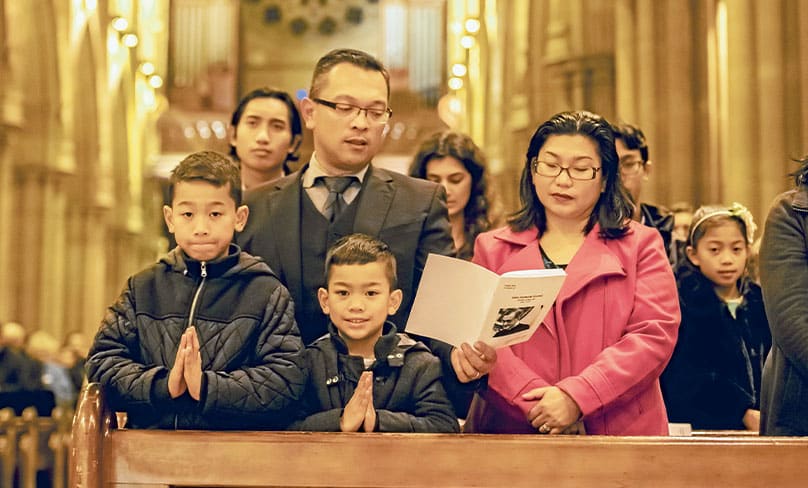
Like your own family, probably, we could talk forever about how to handle kids in Mass and teach them to be quiet and reverent. Just some quick notes on this, as it is worthy of a longer treatment:Sit as close to the altar as possible. The altar is visually stunning, full of light and spectacle. This is the best way to capture your children's attention. Don't use toys to distract your kids at Mass; let the Mass capture your kids' attention. As toys go, less is more. A chewable Rosary or a knotted Rosary is really all you need. Knotted Rosaries are good because (a) they survive teething, despite getting soggy, and (b) they don't CRASH when they hit the floor. When they get older, give your kids a children's missal/missalette.If you're really struggling with Sunday Mass, get your kids some extra practice. Try to go to a daily Mass, once-a-week (or month), as well. Know this. Your exhaustion after Mass is holy exhaustion. You have just poured yourself out in the most Christ-like of ways. Mission accomplished! Go have a coffee date with your wife :)
This is always a great place to start. You gotta eat, right?
As I mentioned above, Father Patrick Peyton of the Family Rosary Crusade gave us the saying, "The Family That Prays Together, Stays Together."
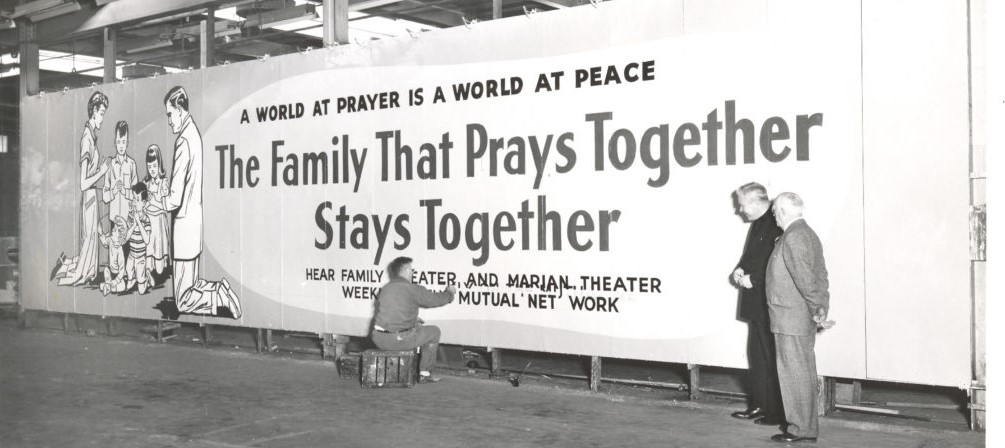
[For more on Father Peyton and his cause for sainthood, check out this site.]
Those were the good ol' days, right? Family meals were much more commonplace. Today, that same saying has shifted to "The Family That Eats Together, Stays Together."
It's understandable. Sports and other extracurriculars are destroying our kids' schedules. It gets hard to find a time for everybody to eat together. Nevertheless, fight to eat together.
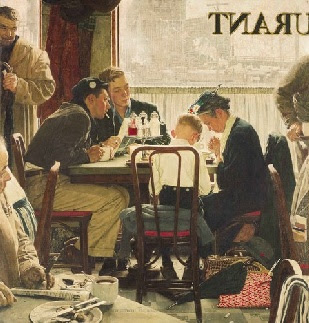
Fight to eat together, even if you have to eat out together. Making the Sign of the Cross and praying the blessing together in public and at restaurants is a great way to evangelize. Just look at Saying Grace, the Norman Rockwell painting below:
You probably already have the traditional Catholic blessing memorized:
Bless us, O Lord,And these, Thy gifts,which we are about to receive,from Thy bounty,through Christ Our Lord.Amen.
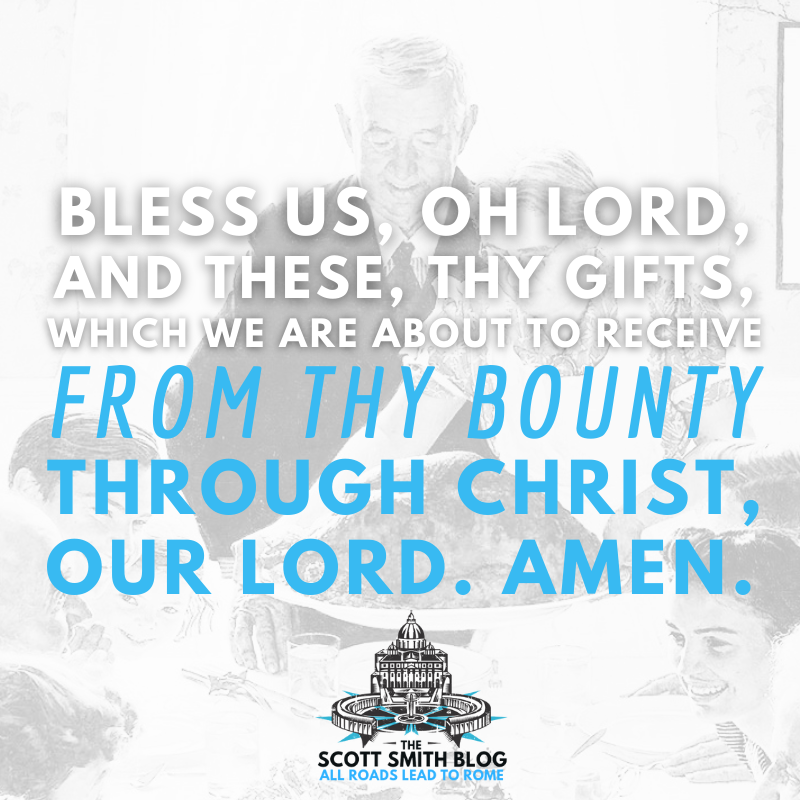
This is also a good opportunity to teach your kids the Sign of the Cross. More on that below.
After our family meal blessing, the kids usually add little litanies to their favorite saints. My boys usually fight over who says "St. John the Baptist, pray for us" first. Some saints just get repeated. This is the first prayer we learn as children. The Sign of the Cross is it's own prayer. The Sign of the Cross is also a deceptively difficult prayer. You might do it without thinking now. But - at least for my kids - getting the Sign of the Cross right has taken a lot of practice.
Let's start with the right way:
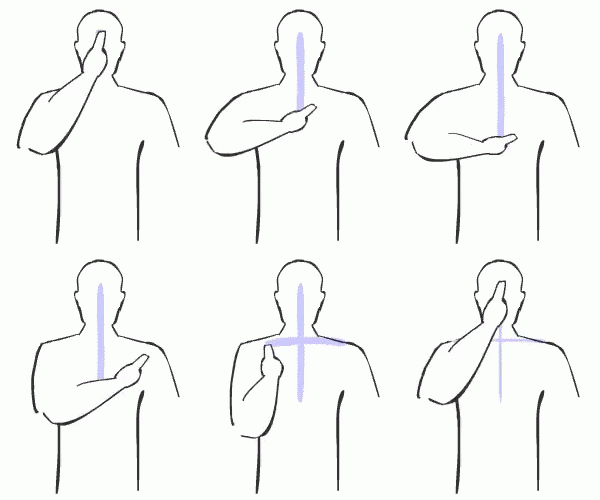
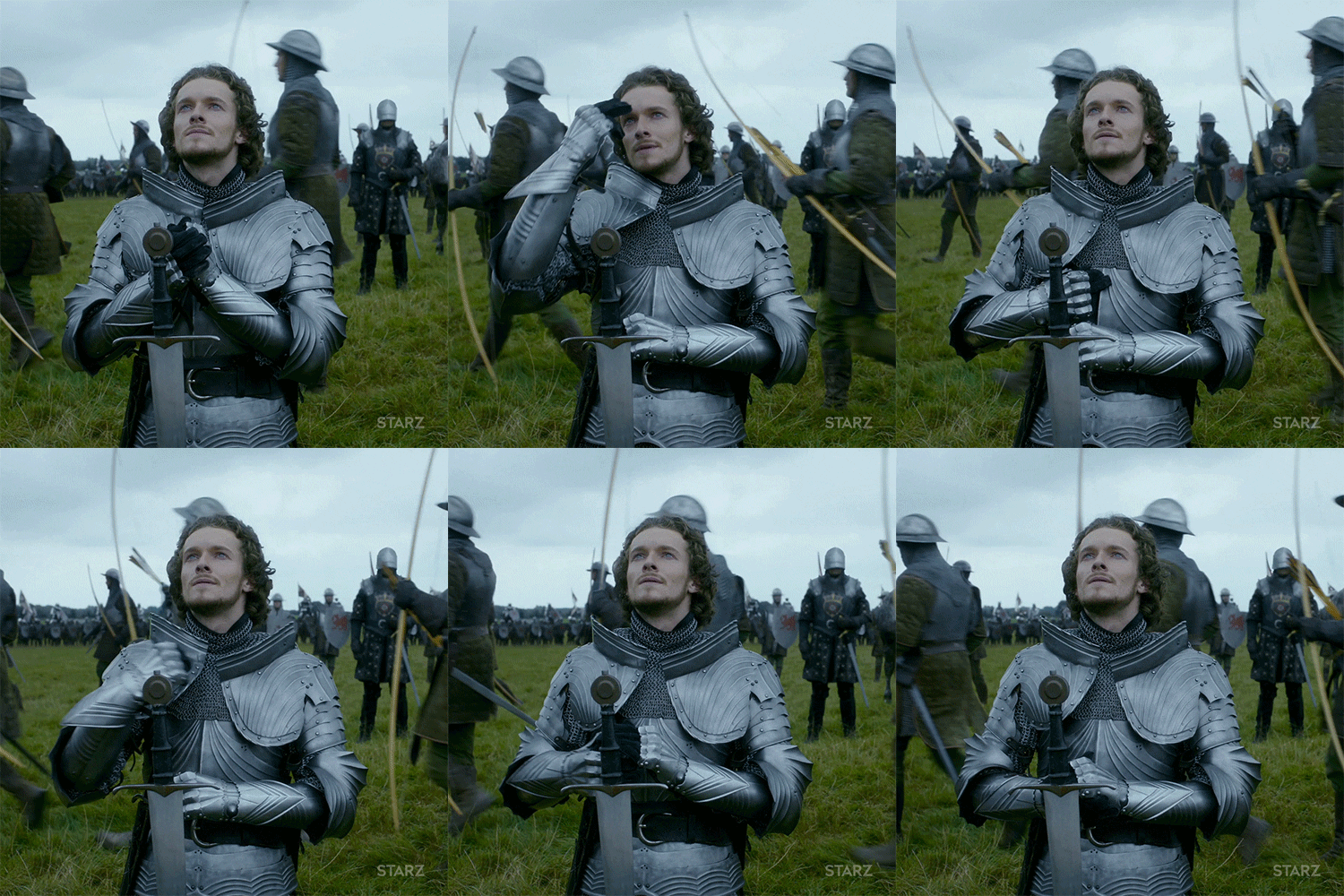
Error #1: The Backwards Sign of the CrossIt's your left shoulder to your right shoulder. But here's the problem. Your kids imitate you as a mirror image. You may actually want to do the Sign of the Cross right shoulder to left shoulder to help your kids get it right.
Your kids will quickly show you all the ways you can mess up the Sign of the Cross. But! This is a great opportunity to teach them reverence.
Error #2: The Muddled Sign of the CrossBig surprise! Our friend from the Superstore show gets it all kinds of wrong. Is that cross?

For starters, it looks like he's only hitting 3 of the 4 points of the Cross.
Error #3: The Lazy Sign of the CrossThe real problem, above and below, is the lazy hand. My kids will do this, and it drives me a little crazy. They just flick their hand towards the last three points of the Cross.
Here is another, unfortunate example of the lazy Sign of the Cross:
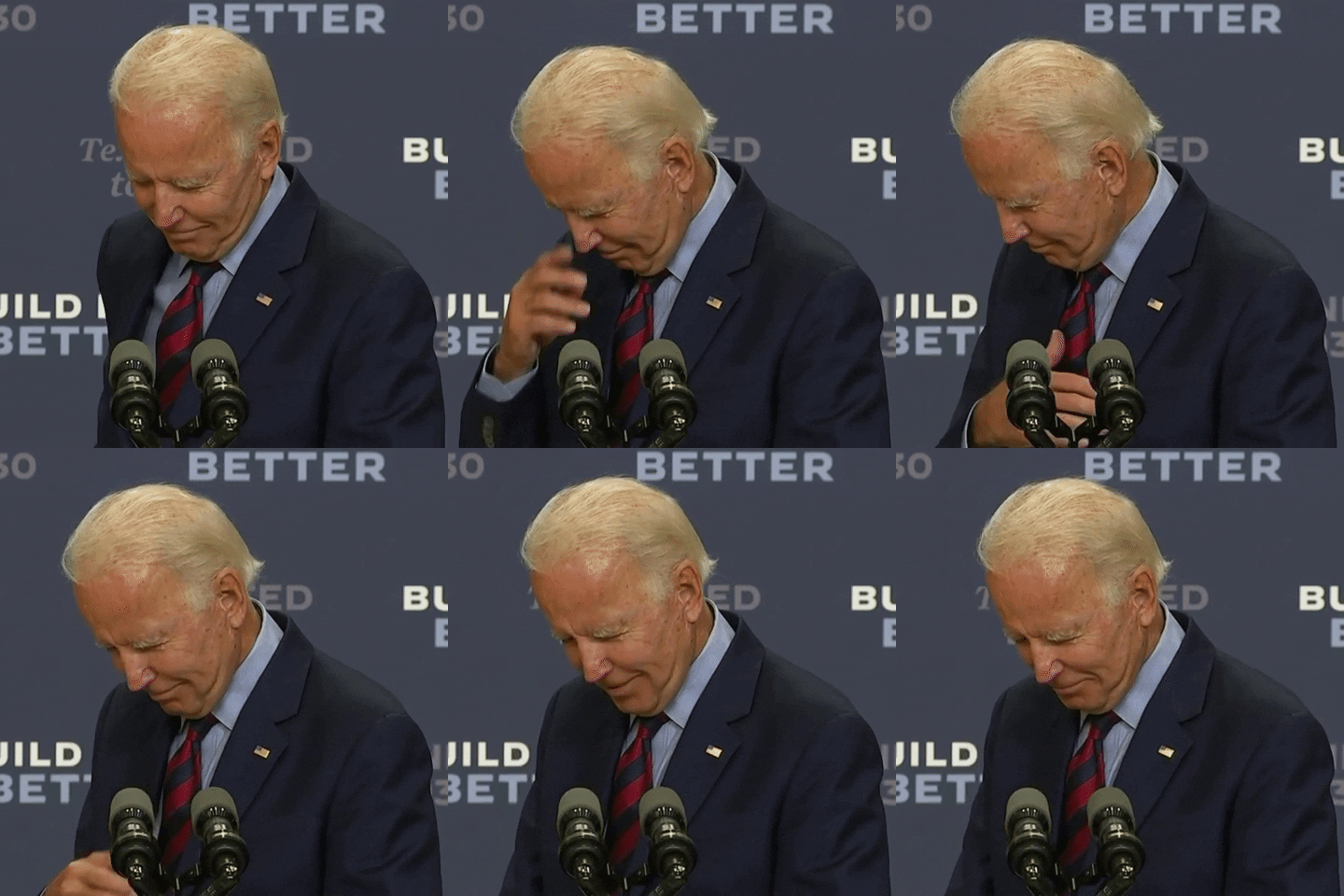
We need to move our hands across our chests. Let's look again at our rock star exemplar:
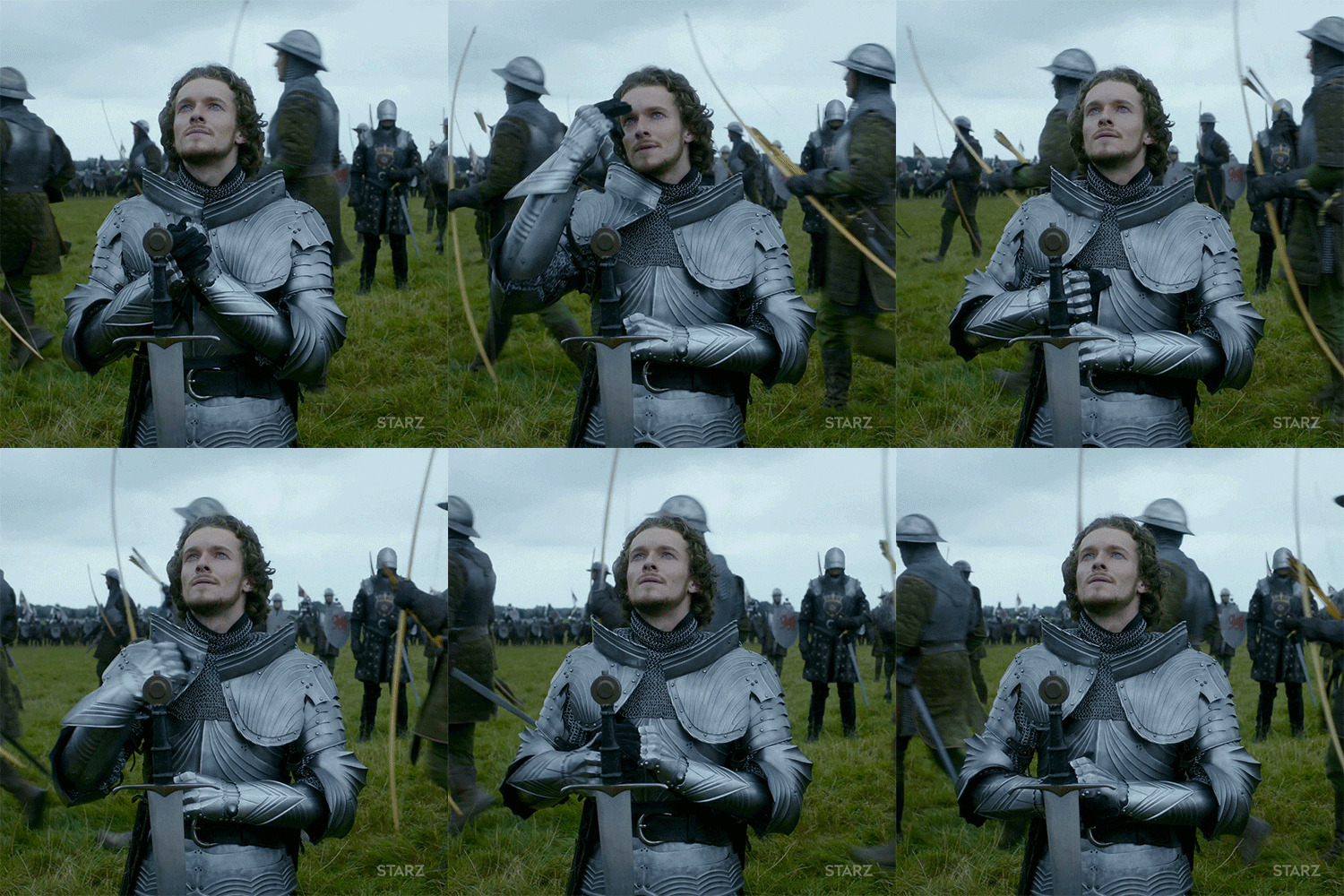
Feel free to incorporate a sword, as well :)
Add a Kiss to the Sign of the Cross?You might notice this little addition, too. You see this in a lot of Spanish-speaking countries.

Sorry for the UFC/MMA example ...
What is happening here? They are forming the Cross with their fingers and kissing it. It's like venerating the Cross after making the Sign of the Cross.
Here is what you do with your fingers. You make a little cross with your thumb and forefinger:

Do that, then kiss the knuckle of your thumb.
St. (Padre) Pio said "Undertake nothing, without first offering it to God." This is especially true of each new day. We need to offer all of our days to God.
That's why we add the Morning Offering at the end of our blessing at breakfast.
There are many variations on the Morning Offering. Here is a popular version invoking the Sacred Heart of Jesus: "My God, I offer you all my prayers, works, and sufferings of this day for all the intentions of your Most Sacred Heart. Amen."
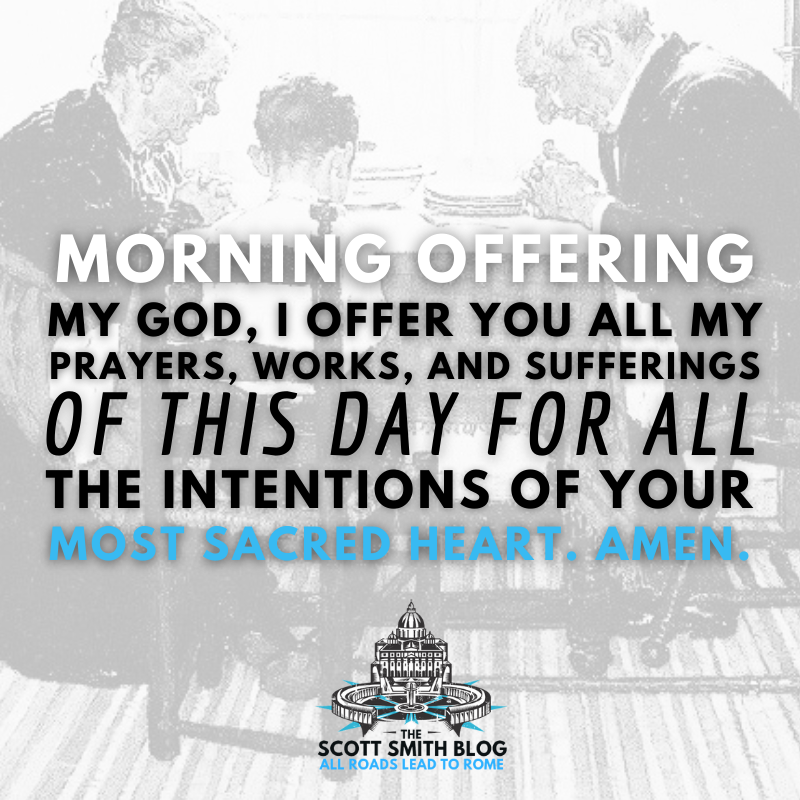
My family says a prayer we adapted from my father-in-law, so it has become a family tradition. Here is the Morning Offering prayer that we say:
Lord, we lift up this day to you, all of our thoughts, words, actions, and deeds, all of our joys, trials, and sorrows, all of our work and play; and we ask you Lord to open our hearts and minds to receive the graces needed to do Your Will this day, to bring you glory and honor and growth to Your Kingdom. We ask this through Jesus Christ, Our Lord. Amen.
You can craft your own family's version of the Morning Offering, too. Hand it down through the generations. Can you think of a better family heirloom? That's exactly what Jesus did with the "Our Father," our family prayer as Christians. The Examen is a great prayer to add to midday or evening prayer, because it involves a review of your day. It's a matter of recognizing God's grace acting on you during the day.
The Daily Examination (Examen) is basically praying through a series of questions and questions are a great way to interact with your kids: Put yourself in God's presence. Ask God to draw near. Thank God. In your day, what are you thankful for? Ask God to show you your day. Sort of like a Magic 8-Ball, moments from your day will bubble up. Why is God showing you this moment? Where is God's grace in this moment? In your day, where did you mess up? Where did you fail to accept God's grace? How will you do better next time?What are you looking forward to in the coming day? Here is a great prayer card for the Examen prayer (you can follow this link for a printable PDF version):
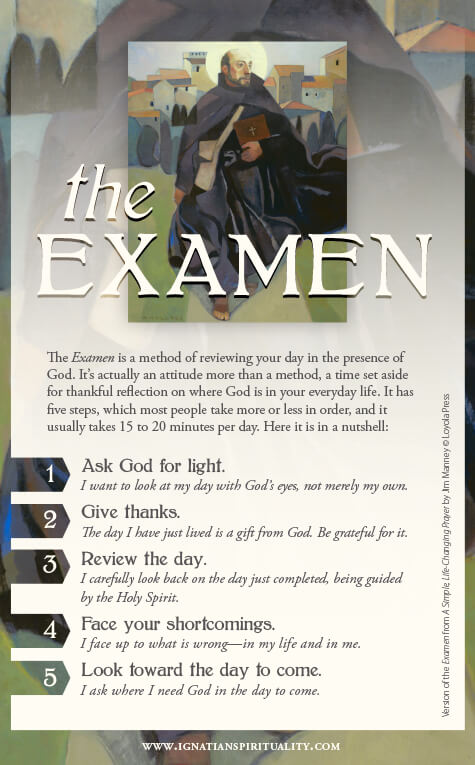
This may be a prayer to incorporate into your family prayer life when the kids get a little older. Kids of all ages can understand this prayer, though.
The Daily Examination may also be good for one-on-one situations with your kids, for husband and wife prayer ... or for your own personal review of your day.
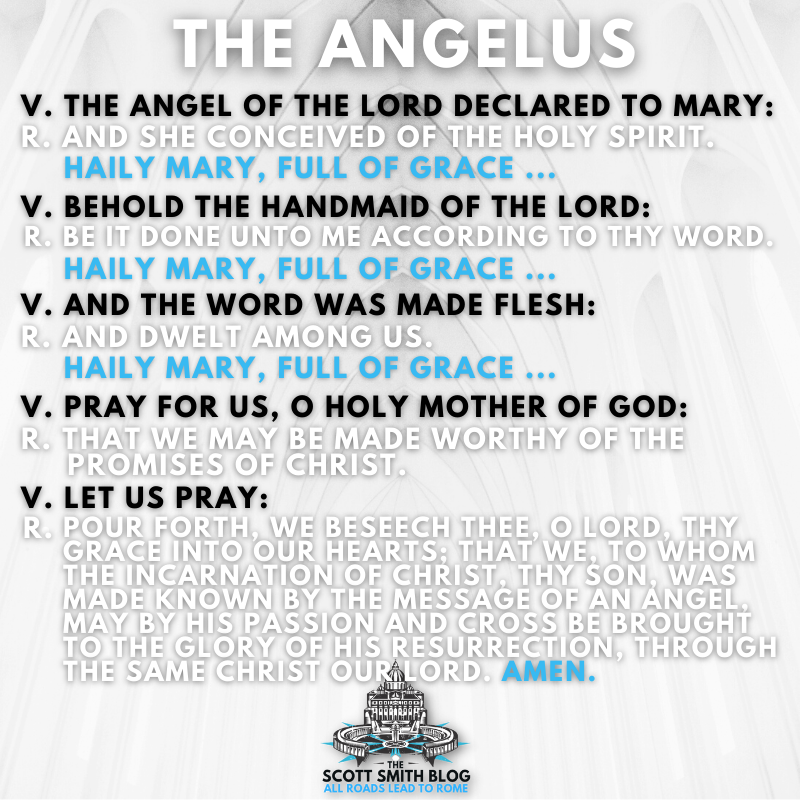
Pray the Angelus at noon with your family. It so short and simple and impactful. It's a great way to break up and refresh your day. The Angelus is also a good bedtime prayer for the family.
Here is the text of the Angelus prayer:
The Regina Caeli Prayer
Funny story ...
I had been planning to start saying the Angelus for years. I finally set an alarm on my phone to remind myself to pray the Angelus, and success! I finally remembered to say the Angelus for a whole week. I was feeling pretty good about myself ... then I had lunch with a priest friend of mine.
He told me, "but it's Eastertide, you're supposed to switch to the Regina Caeli Prayer." Doh.
So, don't make the same mistake I did. For Eastertide (Easter day through Pentecost), here is the link for the Regina Caeli (Queen of Heaven) Prayer.
We have a lot of little kids, so a single decade is about enough. We plan to expand to a full rosary as the kids get older.
Do you know one of the main reasons people give for not praying the Rosary? Too long? Too old-school? Nope. The main reason is they don't know how to pray the Rosary. If you need help reciting the Rosary, here is a quick guide to praying the Rosary:

This is a big commitment! It's not easy. Quite often, it's not the Holy Spirit flying around us, but peas and carrots whizzing past our faces. The trick is this: we do it every year. The kids learn a little more every year. The kids are a little more engaged every year. In this way, family prayer becomes family tradition and family tradition enflames Catholic tradition.
You may be asking yourself, what is a Marian Consecration? I have written a whole article focusing on just this question:
If we prayed a normal Marian Consecration, like St. Louis de Montfort's, my kids would be totally lost. Thankfully, Dr. Carrie Gress has published a Marian Consecration for Children :
[image error] [image error]
Plus! Fr. Donald Calloway, who gave us the Consecration to St. Joseph, and I have teamed up to write the Consecration to St. Joseph for Children and Families. This will be out in a matter of months! It will be a real game-changer for families.
These consecrations teach children (and parents) about the virtues and holiness of Mary and St. Joseph in ways the kids (and parents) will understand. The consecrations for children teach these lessons using classic children's stories and movies. There are also discussion questions and family activities to help keep the children engaged.
Remember, Rome wasn't built in a day. You may want to work up to these full 33-day consecrations. This 33-day family prayer commitment is like a nine-day Novena on steroids.
And speaking of Novenas ...
Is your family going through an especially difficult time? Do you need some concentrated prayer power? Pray a nine-day Novena together.
Do you where and when the Novena came from? It's Biblical!
The first Novena was the nine days from Jesus' Ascension to Pentecost that the Apostles prayed with the Blessed Mother in the Upper Room. The Church still prays the Novena to the Holy Spirit every year between Ascension and Pentecost.
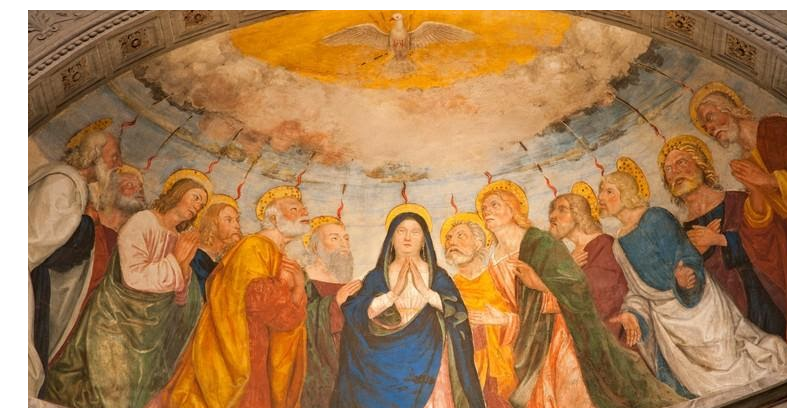
The family prayer of Novenas may not be an everyday prayer. Novenas are still great to incorporate into your family's prayer time during special seasons or events, like between Ascension and Pentecost, OR during difficult times ...
Novenas in Time of Need: Novenas to St. Joseph and St. JudeThe Novena to St. Joseph for is especially powerful. My wife and I have prayed the Novena to St. Joseph for work, job, and employment reasons, to help us sell our house or afford home repairs, and to help with family strife and struggles.
Novenas for the Church Calendar and Liturgical Seasons: Novenas to the Holy Spirit and the ArchangelsThere may also be liturgical reasons to pray Novenas. The Novena to the Holy Spirit is a great way to mark the span between Jesus' Ascension and the Descent of the Holy Spirit at Pentecost.
Ultimately, I am working towards praying the Liturgy of the Hours with my family. But this is pretty advanced for our little ones. So many bookmarks!
 The main idea behind the Liturgy of the Hours is to pray the Psalms. The Psalms are beautiful. This practice predates the Church by at least one thousand years. The Jews prayed the Psalms during the hours of the day, as well.
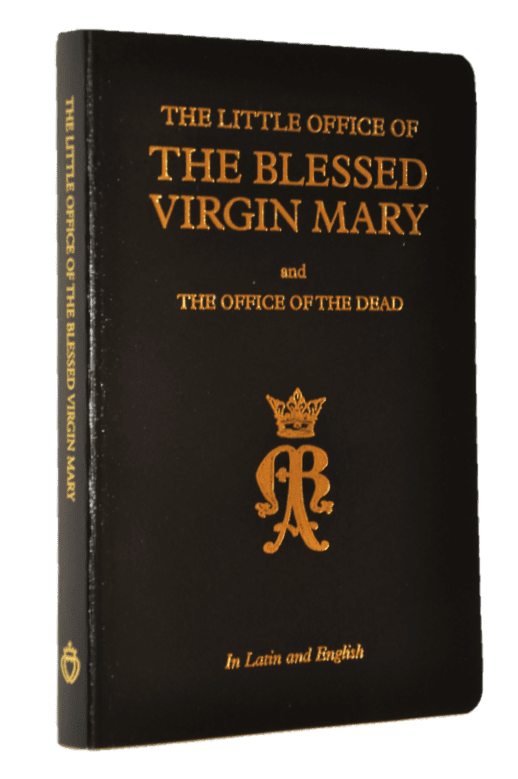
 The Little Office of the Blessed Virgin Mary is much easier for family prayer time. Like many of the prayers recommended in this article, it's short and sweet. Well, short and sweet compared to the full blown Divine Office.
Amazon sells copies of The Little Office of the Blessed Virgin Mary, but I would rather support the Carmelite sisters through their website.
Did you know either the daily Rosary or The Little Office of the Blessed Virgin Mary is required for investiture with the scapular?
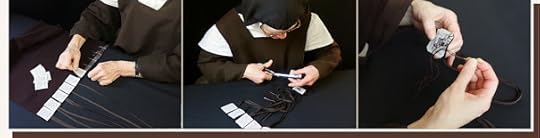
I highly recommend investing your children with the scapular when they're ready. My older kids love it. They also wear their scapulars out, so buy durable scapulars.
The Carmelite Sisters' website also sells some good, strong, handmade scapulars. Just look at that nun go:
Every day, we add the saint of the day to the litanies at the end of our prayers. We use this opportunity to teach the kids about this saint.
There are plenty of ways to go about this. I subscribe to an email service, so every morning I receive a short write-up on the Saint of the Day. You can also use the free Laudate app or other Catholic apps.
Footnotes on Catholic Family Prayer:[1] Bartkus, Justin and Christian Smith. A Report on American Catholic Religious Parenting. South Bend, IN: University of Notre Dame, 2017.
[2] Bengston, Vern, et al. Families and Faith: How Religion is Passed Down Across Generations. New York: Oxford University Press, 2013.

November 4, 2021
The Theology of Dune: Dune, Christianity, Islam, and Religion
Ever noticed all the Christian symbolism in Frank Herbert's Dune Series?
The Orange-Catholic Bible is a clue that much more lies beneath the dune-covered surface of this science-fiction masterpiece. From the Messiah-figure of the Kwisatz Haderach to the Flight into the Desert of Arrakis, there is quite a bit of Christian symbolism in Frank Herbert's epic Dune series.
Interested in the Theology of Dune? How about the Theology of all the Sci-Fi in the Galaxy? I have written the following book to cover exactly that. The Theology of Sci-Fi covers Star Wars, Dune, Asimov's Foundation Series, The Matrix, Superman, and the classics of science of fiction:
 [image error]
 Dune is one the great classics of science-fiction. It inspired, among others, George Lucas who conceived of another desert planet, Tatooine, and the Messianic-figures who would arise from it.
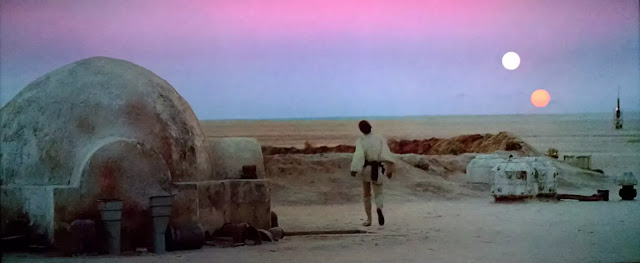
Here are the Christian symbols and connections that I have noticed reading and re-reading Dune Series. Please comment below and share you own insights into the Christian themes, motifs, and symbols hidden within Dune:

Paul Atreides, the Kwisatz Haderach, or Muad'Dib (Fremen) - The Messiah or Christ FigureThe Kwisatz Haderach is the Messianic figure of the Dune universe who will lead the people to "true freedom" and the Promised Land. The desert Messiah is known as the Kwisatz Haderach to the Bene Gessarit.
Paul is also known as Muad'Dib to the Fremen:


The name Muad'Dib comes from the name of a kangaroo mouse, a small rodent that lives on the planet Arrakis ... which the internet has fallen in love with.
A shadow resembling the Muad'Dib mouse is visible on Arrakis' second moon, as well as on a constellation. Paul Atreides takes the name Muad'Dib when he becomes a member of Stilgar's Fremen tribe.
The term Kwisatz Haderach is also likely derived from the Hebrew-Kabbalistic term, Kefitzat Ha'derech . In Hebrew, Kefitzat Ha'derech, literally "the Leap of the Way," describes the way an initiate may travel some distance instantaneously, even appearing to be in two or more places at once.[1] This is basically describing teleportation or, in Catholic terms, bi-location, a hallmark of living saints.
When explaining the term "Muad'Dib" to Duke Leto, Thufir Hawat actually describes the Muad'Dib as following the Messianic pattern.

Like Christ, Paul Atreides is also the son of a king (or a Duke). Also, like Christ, Paul Atreides must go undergo a series of trials or temptations, mostly in the desert.
Paul Atreides is first tested by Reverend Mother Gaius Mohiam with the Gom Jabbar, a meta-cyanide poisoned needle. This also foreshadows his drinking of the poisonous Water of Life.Paul Muad'Dib is then tested by the Water of Life after being received into the ranks of the Fremen. Paul takes this ordeal upon himself, knowing it is his Messianic destiny to do so. After surviving the ordeal of drinking the Water of Life, Paul Muad'Dib fulfills the Fremen's prophesies concerning the Messiah, including ... "The sleeper has awakened": The Water of Life is a Messianic fulfillment, the passage through death and new life. More on the Water of Life at the end of this article. To fulfill another prophesy, Paul must go into the desert and conquer Shai-Hulud, the great sandworm. In this sense, the Sandworm is like satan, the serpent, which Christ must overcome through a series of temptations - or trials as it is for Paul Atreides.
The Fremen viewed the great sandworms as physical embodiments of the One God of their original Zensunni religion, rather than a satanic figure. As will be discussed below, this is not necessarily a contradiction, as Judaism and Christianity both exposed many pagan religions as worshiping demons instead of the one, true God.
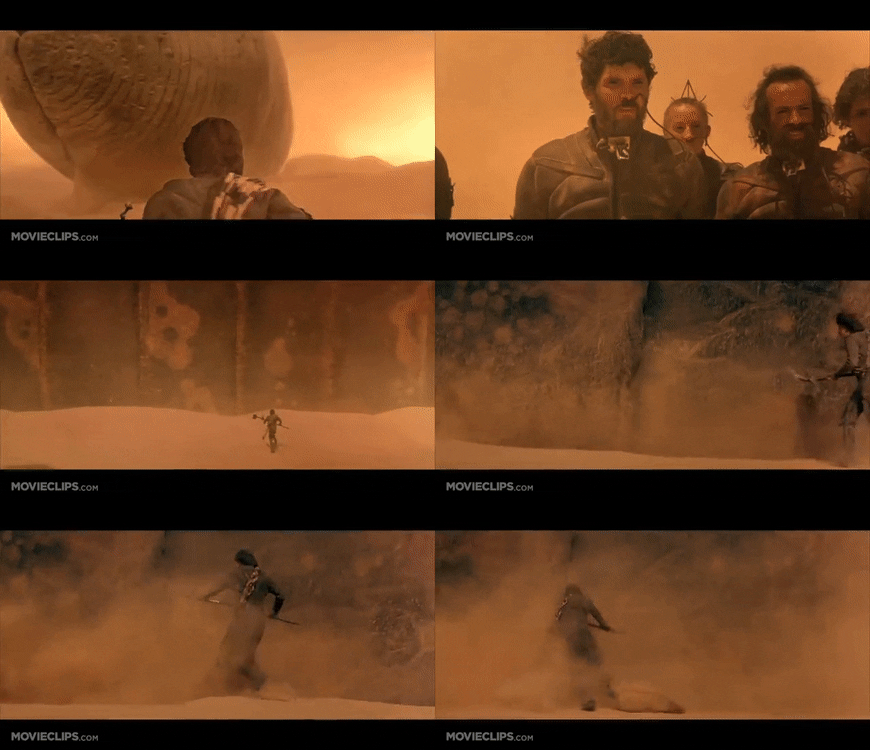
Frank Herbert wrote a 1977 essay "Sandworms of Dune" describing the function of sandworms in his story.[2] Sandworms, Herbert said, provide the danger and mystery of terra incognita. Paul Atreides must confront this terror to transform and then overcome his enemies. Great power and knowledge must come at a great price. This is why Paul must risk being devoured by the sandworm Shai-Hulud and the madness of the consuming the Water of Life, the extract of the sandworm.
Lady Jessica first notices the Muad'Dib among the constellations in the desert manual following their escape from Baron's men. The Muad'Dib is the desert mouse, and the tail of its constellation points north. Similarly, the Messiah had its own star among the Hebrews. You can read more about the constellation Leo and the Lion of Judah here.

The Sandworms, Shai-Hulud - Dragons, SatanThe Sandworms were the massive, native life-forms of the planet Arrakis. The Sandworms inhabited and were able to travel within and beneath the vast deserts of Dune. The Sandworms were also the source of the Spice Melange.
As described above, the Fremen viewed the Sandworms as the physical embodiments of the One God of their original Zensunni religion. The Fremen called the Sandworm by various names, notably "The Maker" and Shai-Hulud, which could be translated as "Old Man of the Desert", "Old Father Eternity", or "Grandfather of the Desert".
Frank Herbert describes the sandworms of Dune as inspired by the "archetypal black beast," who lives underground in a cavern and hoards treasure.[3] Herbert listed examples like the dragon in Beowulf and the dragon of Colchis which guarded the Golden Fleece from Jason and the Argonauts.
Here is a link to satan being the dragon of Genesis and the Garden of Eden:

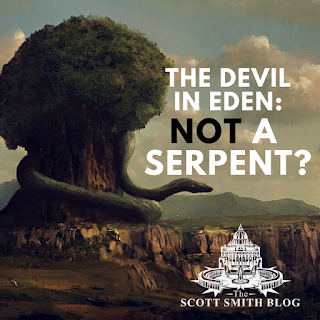
Like these dragons, the Sandworms of Arrakis "guard" the melange deposits. In the novels, the Sandworms are occasionally referred to as "dragons of the desert".[4]
Frank Herbert wrote a 1977 essay "Sandworms of Dune" describing the function of sandworms in his story.[2] Sandworms, Herbert said, provide the danger and mystery of terra incognita. Paul Atreides must confront this terror to transform and then overcome his enemies. Great power and knowledge must come at a great price. This is why Paul must risk being devoured by the sandworm Shai-Hulud and the madness of the consuming the Water of Life, the extract of the sandworm.
Frank Herbert provided the following description of the archetypal nature of the Sandworms:
The elements of any mythology must grow from something profoundly moving, something which threatens to overwhelm any consciousness which tries to confront the primal mystery. Yet, after the primal confrontation, the roots of this threat must appear as familiar and necessary as your own flesh. For this, I give you the sandworms of Dune. [...] the extension of human lifespan cannot be an unmitigated blessing. Every such acquisition requires a new consciousness. And a new consciousness assumes that you will confront dangerous unknowns — you will go into the deeps.
Like the dragons depicted in the Bible, Herbert's sandworm-dragons are supposed to be confronted and subjugated, like satan and sin. They are to be slain, as Adam and Eve failed to do.
Duke Leto as St. Joseph, the foster-father of the MessiahDuke Leto is Saint Joseph, who takes his family into the desert of Egypt, or in this case the planet "Dune" or Arakkis. However, Duke Leto taking his family to Arakkis is more like taking them into King Herod's camp.
Coincidentally, remember which actor played St. Joseph in the Nativity Story?
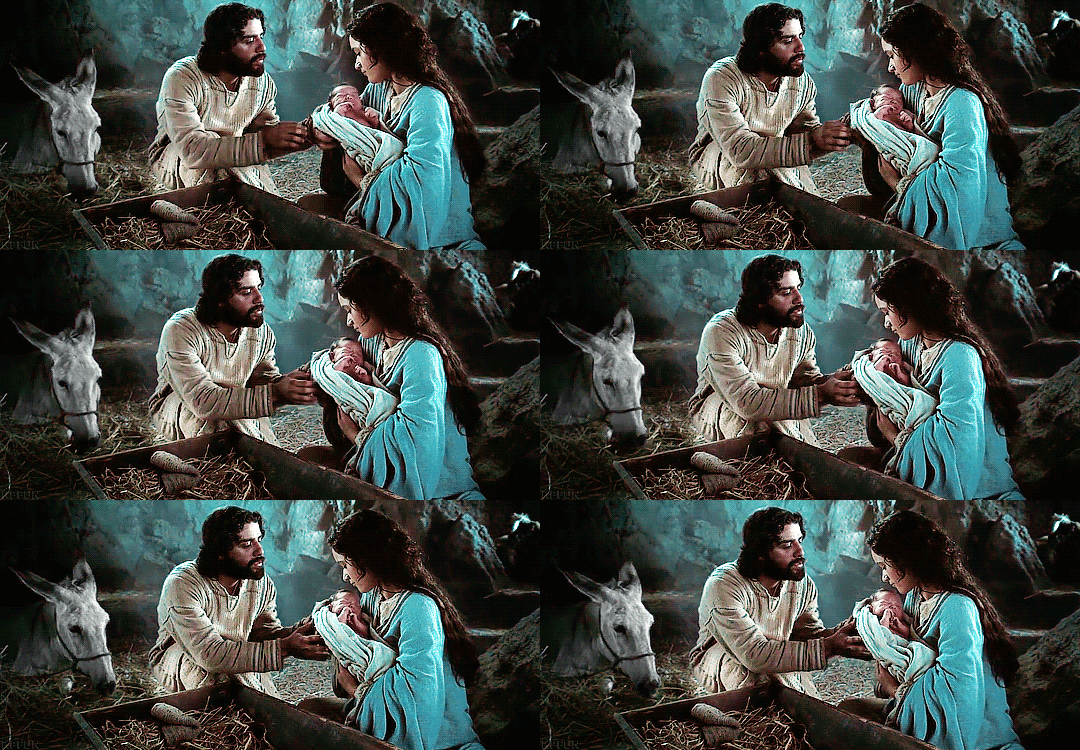
That's right! Oscar Isaac, who also portrays Duke Leto in Denis Villeneuve's 2021 Dune:

Lady Jessica as the Virgin MaryMary descends from the line of King David. Similarly, there is a matriarchal line of Bene Gessarit in Dune.
Speaking of the Bene Gessarit, the title "Bene Gesserit" resembles an epithet of the Jewish people, Bene Jeshurun (בְּנֵי יְשֻׁרוּן), especially as "Gesserit" is pronounced with a soft "G". "Bene Jeshurun" means, roughly "Sons of The Just", with יְשֻׁרוּן also taken to be a synonym for Israel.
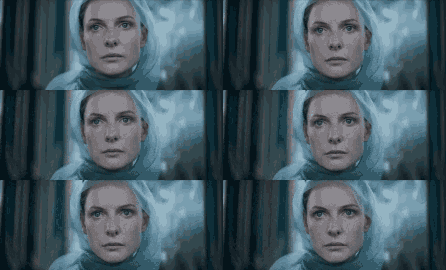
The Bene Gesserit were long prophesied to (and had been working for hundreds of generations) to bring forth the Kwisatz Haderach Messiah. Likewise, Lady Jessica is prophesied to be, as Stilgar says, "the Bene Gessarit of legend whose son will lead us to paradise."
The prophesy of an immaculate virgin who would give birth to the Messiah is the oldest prophesy in Christianity. See the following on Genesis 3:15, called the proto-evangelium or "first Gospel." For hundreds of generations, the people of Israel were awaiting the Virgin who would give birth to the Messiah, the Messiah who would "crush the serpent's head".
Perhaps most interesting, Muslims call the Blessed Mother the Sayyida, or Lady, while the Fremen appoint Lady Jessica as a Sayyadina . The term Sayyadina means "friend of God" in the Dune language of Chakobsa and was used by the Fremen to describe their priestesses who would drink the Water of Life and become Reverend Mothers.

The Quran describes all the major points in the life of the Virgin Mary - the Annunciation, the Visitation, and the Nativity. Angels are depicted as addressing the Blessed Mother and saying:
O Mary, God has chosen you, and purified you; He has chosen you above all the women of creation. (Quran 3:42)
Above all the women of the earth! This is similar to Elizabeth’s address of Mary, “blessed are you among women and blessed is the fruit of your womb” (Luke 1).
To the Muslims, the Blessed Mother is the true Sayyida, or Lady. The only serious rivals to Mary would be Mohammed’s daughter, Fatima, and his wife, both of whom are numbered along with Mary as the four greatest women in Islamic history.
Nevertheless, after the death of Fatima, Mohammed wrote, “Thou shalt be the most blessed of all the women in Paradise, after Mary." Fatima, herself, is even known to have said, "I surpass all women, except Mary."
Fremen as the Jews or Israelites or HebrewsThe Hebrew people were abused and colonized by the Romans, or the Harkonnen in Dune. The Messiah leads the Jews to freedom. Just as Moses freed the Israelites, Jesus Christ makes the Jews "free-men" or "Fremen".
The Fremen are also like the Hebrew slaves in Egypt. Both are suffering under the yoke of Pharoah's or the Harkonnens' tyranny. Both are awaiting a Moses-like figure to "free" them, leading an Exodus into the Promised Land. Stilgar describes Paul Muad'Dib as the Prophet they call the Mahdi, whom they believe is "The One Who Will Lead Us to Paradise".
Moses, himself, prophesied about the coming Messiah at Deuteronomy 18:15, saying "The Lord your God will raise up for you a prophet like unto me from among you, from your brethren—him you shall heed." Similarly, in the 1984 Dune movie, Dr. Kynes remarks on Paul Atreides' adroitness with a stillsuit, reciting the prophesy: "He shall know your ways as if born to them."

The military aspect of the Fremen is especially interesting. Many of the Jews expected a military conqueror for their Messiah. The Messiah was prophesied to be the Lion of Judah, who would overthrow the power of the Romans. Surprisingly, the Lion of Judah came as the Lamb of God.
Missionaria ProtectivaThe Missionaria Protectiva is depicting a dark version of religious evangelization and missionary work. The Missionaria Protectiva was called the "black arm of superstition" for Bene Gesserit Sisterhood. The Missionaria Protectiva sowed the seeds of superstition in primitive cultures throughout the known universe. Later, once the seeds sprouted into full-fledged legends, the Sisterhood would use this to their advantage. Despite such an ill intent, the legends proved to be true.
The Missionaria Protectiva is like the Christian Missionaries through history, especially during the Age of Discovery. The Missionaria Protectiva could also be compared to the diaspora of the Hebrew people which made for the easy spread of Christianity.
Perhaps Herbert is using the Missionaria Protectiva to provide cynical commentary on Christian evangelization and Muslim subjugation of primitive peoples.
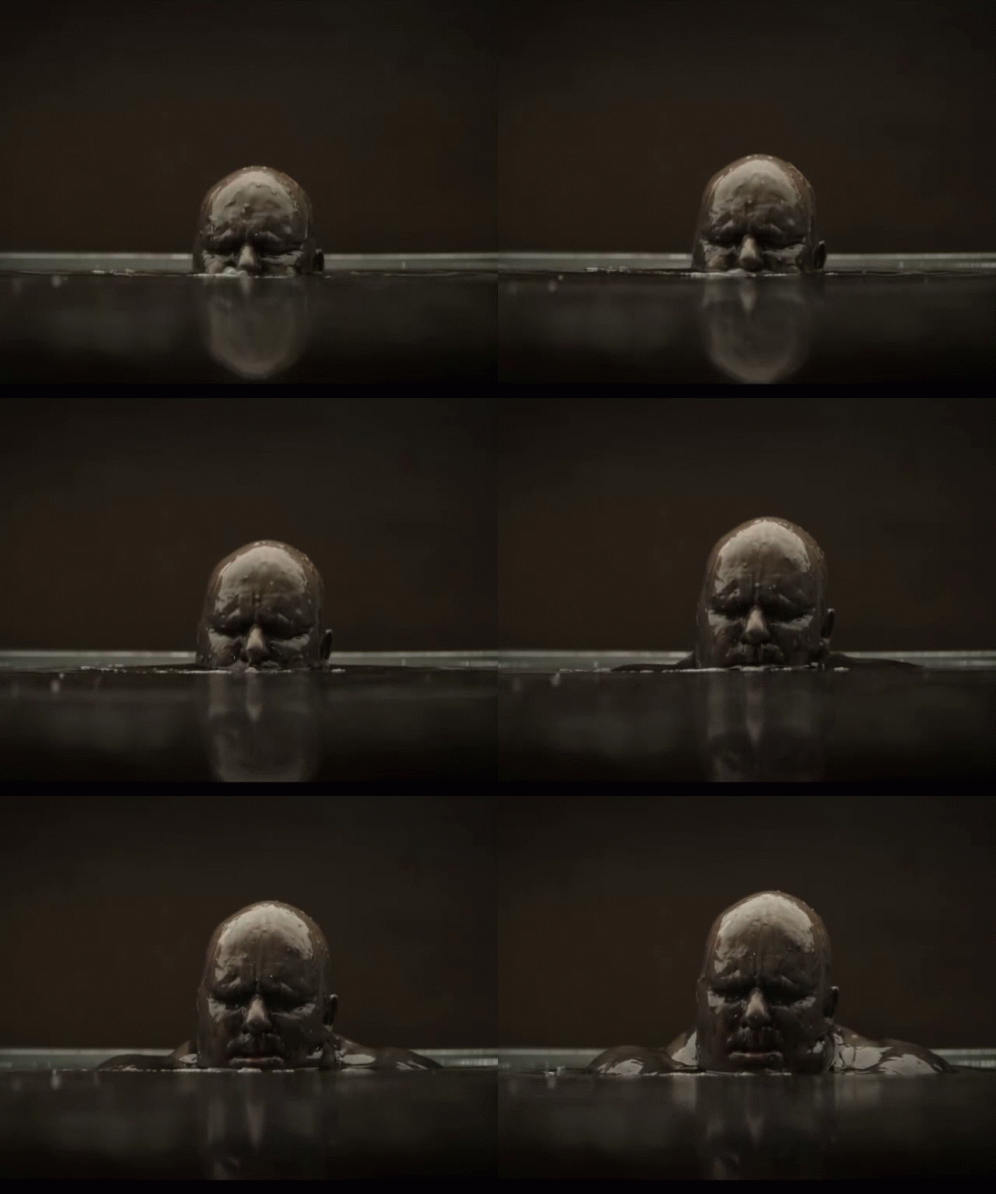
The Baron Harkonnen as King Herod or PharoahThe Baron Harkonnen is a King Herod figure. He is also a Pharaoh figure, given the desert background. Both figures attempted to abort the power of their rivals by killing the child who would be king. King Herod did this through the Slaughter of the Innocents at Bethlehem and elsewhere.
As mentioned above, the Fremen are like the Hebrew slaves in Egypt. Both are suffering under the yoke of Pharoah's or the Harkonnens' tyranny. Like Herod's Slaughter of the Innocents, pharaoh also instructed the midwives to kill the Hebrew children.
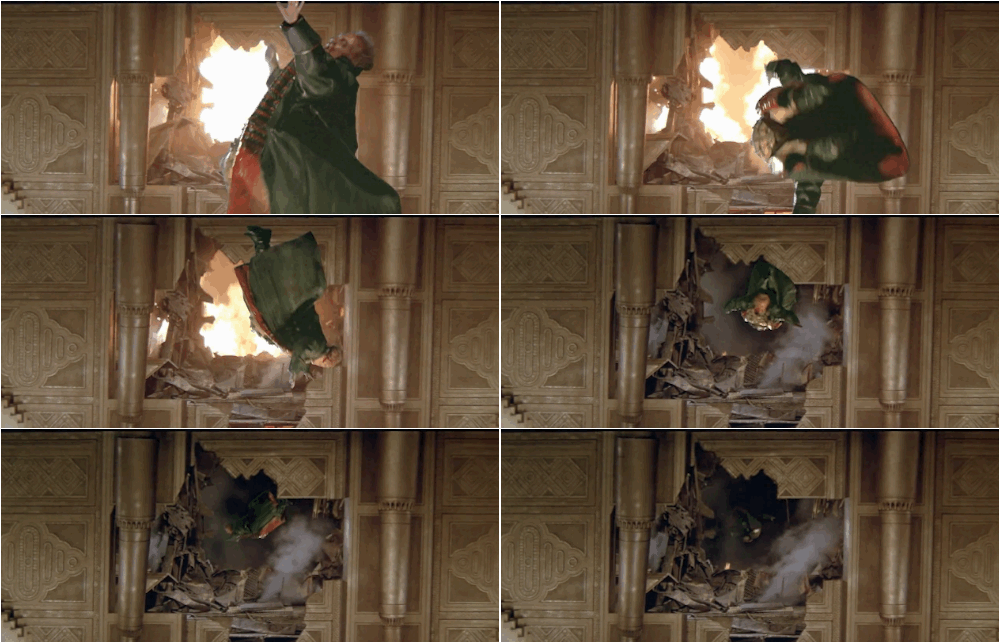
The Orange-Catholic BibleThe mention of a Bible speaks for itself. It appears that much of the Bible as we know it has survived into the future in the Dune universe. The mention of this Bible may even be Herbert's way of connecting our universe to that of Dune.
The color "orange" is especially interesting. In this context, orange typically represents the Protestant Irish. This may speak to an ancient reunion of Protestant and Catholic in the Dune universe.
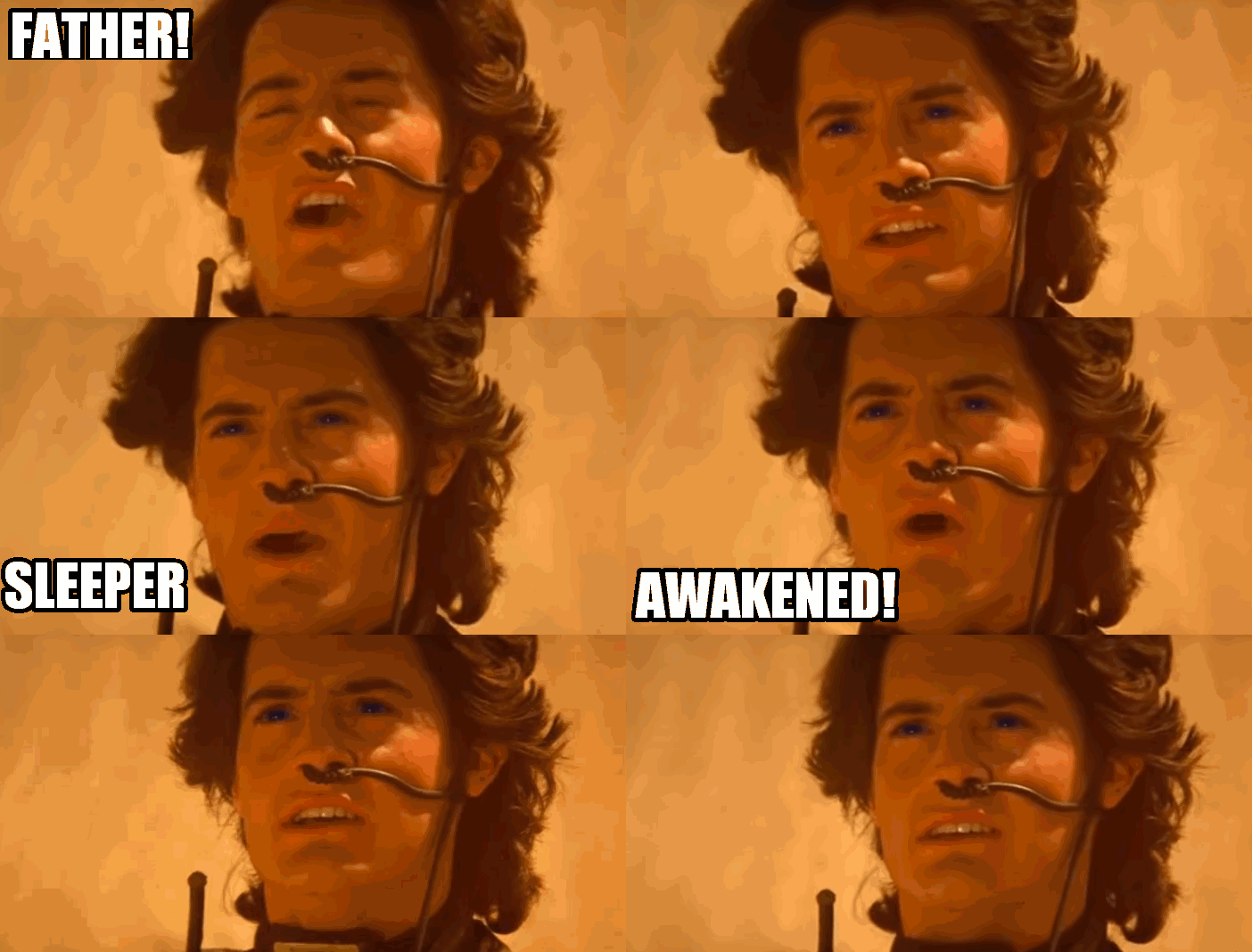
The Water of LifeWe read the following from St. Paul's Letter to the Ephesians:
Awake, O sleeper, and arise from the dead,
and Christ shall give you light. (Eph 5:14)
Sound familiar?
Paul screams out to the ghost of his father, "the sleeper has awakened!" He does this after drinking from the Water of Life. Why? Because like Christ, he has passed through death to awake on the other side.
The Water of Life is a Sacrament in the Dune universe. In particular, the Water of Life corresponds to either Baptism or the Tree of Life.
In Dune, the Water of Life was a poisonous blue liquid which came from the bile of an immature sandworm. It was used by the Bene Gesserit to transform their Sisters into Reverend Mothers. If one was untrained in prana/bindu body control, the substance was lethal. The smallest amount of the Water of Life would kill someone or cause incredible agony.

The connection to Baptism is in the name of Water of Life, itself. In the waters of Baptism, we pass through death to new life. We become Christians, which literally means anointed (with water), and we become new creations. Drinking the Water of Life is like dying. In fact, before Paul Atreides, any man who drank the Water of Life did die.
The Water of Life is also like another sacrament, the Eucharist. Typologically, the Eucharist is the new fruit of the Tree of Life. The phrasing of the Water of Life corresponds to the Tree of Life. What's more, if one eats or drinks the Eucharist unworthily, according to 1 Corinthians 11:27, drinks "death upon himself." Drinking the Water of Life is how one determines she is worthy of becoming a Sayyadina or Reverend Mother.
Quotes from the Saints appear within DuneLady Jessica at p. 85: "What is it Saint Augustine said? she asked herself. 'The mind commands the body and it obeys. The mind orders itself and meets resistance.' Yes--I am meeting more resistance lately. I could use a quiet retreat by myself."
Dune and Christianity Footnotes[1] Weingrad, Michael, "Jews of Dune," Jewish Review of Books: March 29, 2015.
[2] Herbert, Frank, "Sandworms of Dune", O'Reilly, Tim (ed.). The Maker of Dune: Thoughts of a Science Fiction Master. Berkley Books.
[3] "Unpublished interview with Frank Herbert and Professor Willis E. McNelly," February 3, 1969. FH: And I made it, classically, the archetypal black beast, the one who lives underground in the cavern, with the gold.
WM: I see. OK., right. Well, this is the dragon of Beowulf, who lives in the cave.
FH: Yes.
[4] Herbert, Frank (1976), Children of Dune: "'My vision', he said. 'Unless we restore the dance of life here on Dune, the dragon on the floor of the desert will be no more.' Because he'd used the Old Fremen name for the great worm, she was a moment understanding him. Then: 'The worms?'"

October 26, 2021
Novena to St. Martin de Porres for Healing, Race Relations, People of Mixed Race Heritage, Racial Harmony
A friend reminded me to start the Novena to St. Martin de Porres today. Today is October 26. It is nine days from St. Martin's feast day, November 3. Start praying the Novena to St. Martin de Porres today.
What is St. Martin de Porres the patron saint of? What do you pray to St Martin de Porres for? More on that below ...
Plus! A personal account of St. Martin de Porres' miraculous healing powers ...
OR, just skip down to the Novena for St. Martin de Porres' intercession by clicking the link:
St. Martin de Porres' Intercession: Personal Account of Miraculous Healing
St. Martin de Porres has been special to me for a long time. He is my confirmation saint.
I chose St. Martin de Porres (or he chose me), because he helped me through a really close call in high school. My appendix ruptured. The doctors didn't realize my appendix had ruptured until, if you can believe it, two weeks later.
Normally after two weeks later, an undiagnosed, ruptured appendix is buried ... along with the rest of the patient.
The doctors had a bit of an excuse for not realizing my appendix had ruptured.
Just a few weeks earlier, I had been a passenger in a car accident. I was sleeping when the van went off the road. I woke up at some point, maybe before the first collision, maybe not. I can't really remember. In all, we totaled four or five vehicles after we entered the opposing lane of traffic. It was nuts.
My whole family survived that accident, mostly uninjured. That was miraculous enough.
I thought I was uninjured. It turned out that the thrust of the seatbelt rearranged my guts a bit. The doctors later struggled to diagnose my ruptured appendix, because my appendix had relocated.
Meanwhile, the nuns of my family were praying novenas to St. Martin de Porres.
After two weeks with a ruptured appendix, the doctors finally decided to give me a full CT scan, instead of just X-rays. I was soon being prepped for surgery.
Thankfully, miraculously, all the infection had encapsulated. All that bad stuff that should have been flowing into my body and causing septicemia - about a softball-size blob of it - had been held together, as if my the hands of Jesus, himself.
It took some time and subsequent surgeries, but after 40 days, I was healed. It was a period of great spiritual growth, both for myself and my parents. My dad began RCIA shortly thereafter and became Catholic.
Pope Saint John XXIII spoke two years prior to the canonization of Martin de Porres saying,
I have thought of your lands, your immense and beautiful continent, lands where saints have flourished ... humble, pure and innocent ... Such was Martin de Porres, long recognized as blessed, but upon whose forehead we already see shining the radiant halo of the saints ... It is necessary to always speak and practice the truth, to observe the virtue of justice for all people, doing harm to no one, and, above all, to establish a world of fraternal and universal love. This is the great triumph of the gospel, the purest flower of Christian civilization and culture.
Later on May 6, 1962, Pope St. John XXIII canonized Martin, saying, “ A springtime flower has opened in the Church.”
The historical environs of Martin’s life are rather well known as they deal with the struggles of the American continent during a time of adventurous pioneers, monstrous conquerors; pagan savages and peaceful natives; and heralds of the Gospel, defenders of the indefensible. Father Antonio de Montesinos was one of the twelve original Dominicans sent to the New World, arriving in 1510 at the island of Hispaniola, and one of the first to denounce the ill treatment of the natives. He would be the first in a line of compassionate friars that would seek justice and salvation for the natives of America. In 1551 the friars arrived in Martin’s hometown of Lima and established the University of San Marcos—the first in all of the Americas.
St. Martin de Porres was born in Lima, Peru on December 9, 1579. His mother was a freed slave and his father was a Spanish nobleman. St. Martin's father did not acknowledge him. As a result, St. Martin endured hardship and extreme prejudice in his childhood and throughout his life.
St. Martin also experienced a great deal of ridicule and prejudice for being of mixed-race. According to the law of Peru, persons of African or Indian heritage were not allowed to become full members of religious orders.
Nevertheless, at age 15, St. Martin applied to join the Convent of the Rosary in Lima, a Dominican monastery. St. Martin encountered intense resistance in his attempts to enter the Dominican Order. One of St. Martin's fellow novices even called him a "mulatto dog".[1] Racial restrictions dictated that he be given the position of "tertiary" or lay helper, which he enthusiastically accepted.[2]
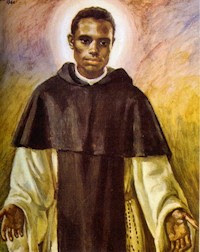
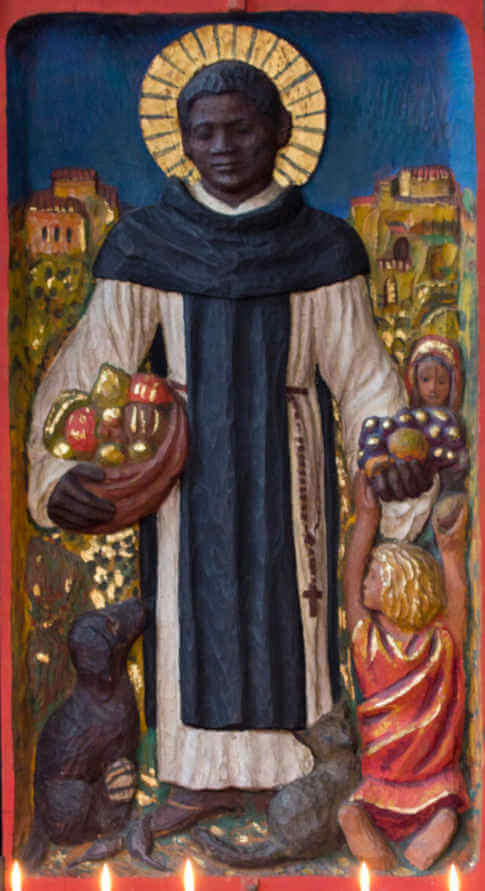
St. Martin de Porres often challenged his brothers on their racial attitudes.[4]
In one story, St. Martin came upon a group of Indians sweeping the floor under the watchful eye of one of the Dominican brothers. St. Martin was told they were cleaning to repay a meal they had received. St. Martin pointed out that the same brother had fed some white people the previous day without forcing them to clean. After St. Martin’s firm but gentle challenge, the brother took up the broom himself.
St. Martin also challenged the way servants were treated. He frequently insisted on performing such hard and menial chores as caring for the Order’s horses in the evenings. St. Martin insisted on these chores, even when reminded that servants were available for these chores. St. Martin would argue that the servants were tired from their day’s work.
St. Martin also extended his healing gifts to all races. He would visit the servants’ quarters and treat their ailments.
"What is the name of the black saint?"
Google reports that this is one of the most commonly used queries used to search for St. Martin de Porres. It's unfortunate, if only because there are so many black saints and saints of African descent and heritage.
Here is a non-exhaustive list of "black" saints and holy people: Charles Lwanga and his companions, Augustus Tolton, Sister Thea Bowman, Benedict the Moor, James, Alexander, and Patrick Healy, Mother Mary Lange, Charles Randoph Uncles, Pierre Toussaint, Josephine Bakhita, Mother Henriette Delille, AND Martin de Porres, to name a few.
There are also many African saints, several of whom are almost as ancient as the Church, herself: Saints Augustine and Monica, Anthony of Alexandria, Perpetua and Felicity, Victor, Melchiades, Gelasius, Maurice, Julian and Basilissa.
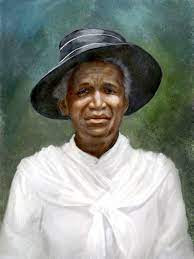
Pope Francis has also recently open the cause for canonization for many other black saints, including Servant of God Julia Greeley, Denver's Angel of Charity:
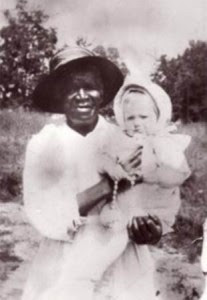
Was St. Martin de Porres the First Black Saint?Not exactly. St. Martin de Porres was the first black saint of the Americas.
There are many, many Catholic saints from Africa dating from the earliest years of Christianity. These include Saints Augustine and Monica, Felicity and Perpetua, and others.
What do you pray to St Martin de Porres for? What is St Martin de Porres the patron saint of?
St. Martin de Porres is the patron saint of health care workers, appendicitis and other intestinal maladies (like a ruptured appendix, see above personal account), barbers, and innkeepers.
Also, due to his life and racial heritage, St. Martin is the patron of many intentions related to race relations, including racial reconciliation, persons of mixed race heritage, social justice, and racial harmony, among others.
Ask St. Martin to pray for us for all these things.
After St. Martin de Porres had been given the religious habit of a lay Dominican brother, he was assigned to the infirmary. St. Martin was placed in charge of the infirmary and would remain in service there from the age of 34 until his death at the age of 59.[3]
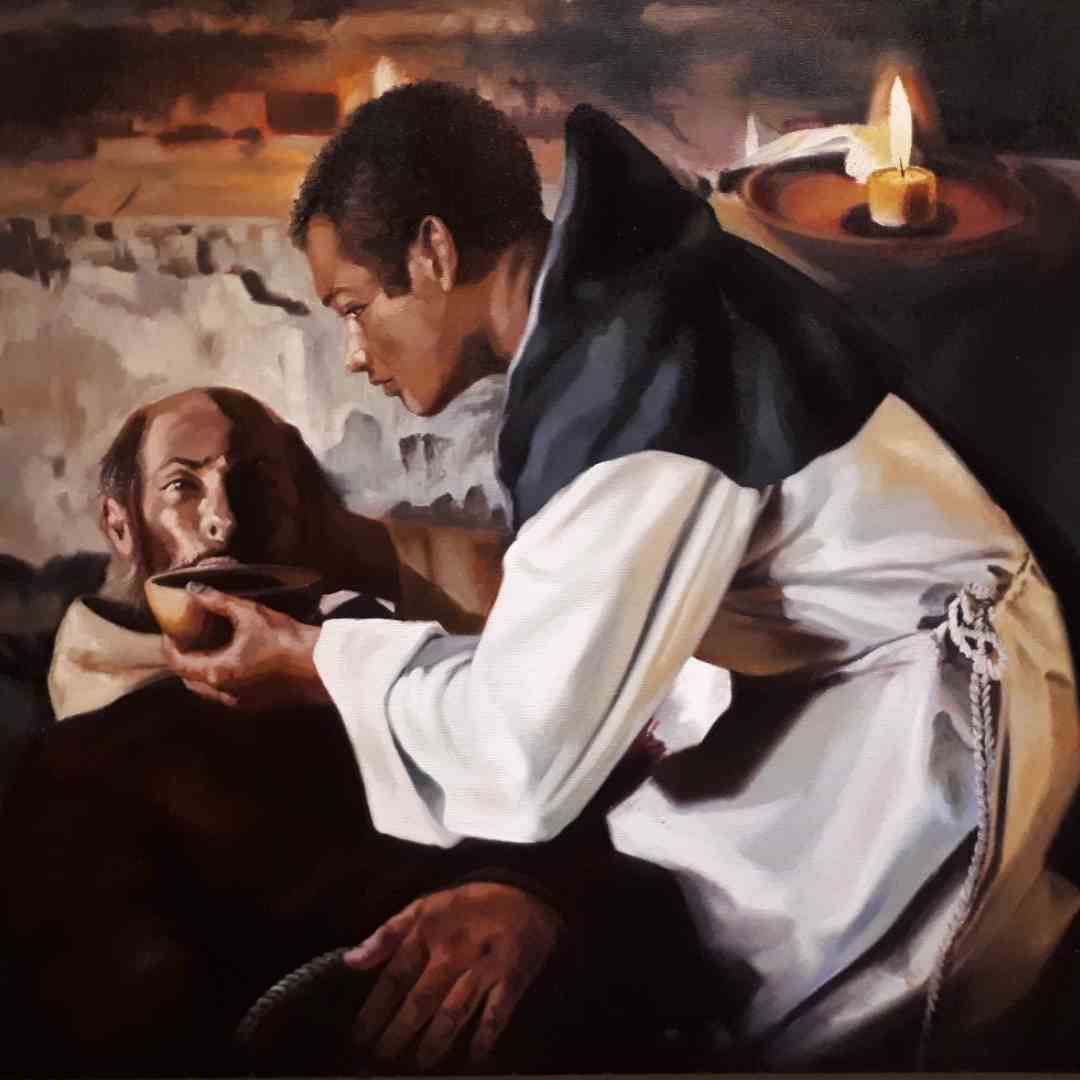
St. Martin was known for his care of the sick. His superiors recognized in him unfailing patience in this difficult role. It was not long before miracles, attributable to St. Martin, began to occur in the infirmary and beyond. St. Martin also cared for the sick outside his convent, often bringing them healing with only a simple glass of water. He ministered without distinction to Spanish nobles and to slaves recently brought from Africa.[2]
60 friars of St. Martin's Convent of the Rosary were suddenly struck by illness when an epidemic hit Lima. Many of the sick, however, were novices. Since the novices were kept separate from the professed members of the order, the sick novices were housed in a distant and locked section of the convent. St. Martin is said to have passed through the locked doors to care for them. This phenomenon was reported in the residence more than once.
The extraordinary fit side-by-side with the ordinary in St. Martin's life.
Along with his daily work in the kitchen, laundry and infirmary, St. Martin's is said to have many extraordinary experiences: ecstasies that lifted him into the air, light that filled the rooms where he prayed, bilocation, miraculous knowledge, instantaneous cures, and a remarkable rapport with animals.
One day an aged beggar stretched out his hand to St. Martin. The beggar was covered with ulcers and almost naked. Because the diseased man would not be accepted elsewhere, St. Martin gave him his own bed. One of St. Martin's brother Dominicans reproved him for this. St. Martin replied: "Compassion, my dear Brother, is preferable to cleanliness."
Though separate by several hundred years, St. Martin might remind you of Mother Teresa.
St. Martin once found a poor Indian on the street, bleeding to death from a dagger wound. St. Martin again gave the man his own bed, until he could be transported to a hospice run by St. Martin's sister.
When St. Martin's prior heard of this, St. Martin was again reprimanded for disobedience. The prior was extremely edified, however, by St. Martin's reply: "Forgive my error, and please instruct me, for I did not know that the precept of obedience took precedence over that of charity."[5]
Thereafter, the prior gave St. Martin great latitude to follow his inspirations in the exercise of mercy.
The original text for the following Novena to St. Martin de Porres was created by the Rosary Shrine of St. Jude.
Novena to St. Martin de Porres: Day 1First Day – Saint Martin’s Humility
Saint Martin imitated Our Lord, Who was meek and humble of heart. There was no pride or vanity in his soul. He realized that God is our Creator and that we are but His creatures. He understood that God loves us as children and only wants us to be happy. So he had common sense enough to submit entirely to the Holy Will of God. Let us all imitate Saint Martin by humbly doing the Will of God in all things.
Prayer
O Saint Martin, ask Our Lord and His Blessed Mother to give us the grace of true humility that we may not be puffed up with foolish pride, but have sense to be content with the gifts that God gives us. Obtain for us the light of the Holy Spirit that we may understand, as you did, that pride is a deceit of the devil and that only by doing the Will of God can we be really happy. Amen.
Now recite one decade of the Most Holy Rosary. Need help pray the Rosary? Here is a guide to praying the Rosary.
Novena to St. Martin de Porres: Day 2Second Day – Saint Martin’s Love of God
Saint Martin’s whole soul was filled with the fire of God’s love. He knew the Almighty God sent His Only Son into the world to suffer and die on the Cross for our Sins. His heart was stirred with deep affection for so loving a Redeemer, and his whole life gives evidence of his sincere gratitude. May we, too, learn to love Our Savior more and more and show our love by our good works.
Prayer
O Saint Martin, why are our hearts so cold and lacking in love for the Son of God, Who became a little Child for our salvation? Why are we so slow to love One Who loved us so much that He gave His life for mankind? Ask God and Our Lady of Sorrows to make us realize that the only way to happiness is by loving and serving God with all our hearts and souls. Amen.
Now recite one decade of the Most Holy Rosary. Need help pray the Rosary? Here is a guide to praying the Rosary.
Novena to St. Martin de Porres: Day 3Third Day – Saint Martin’s Love of the Poor
Saint Martin was called “The Father of the Poor.” He saw in the poor, the sick, and the dying the children of God, and he helped them in a thousand practical ways. He studied medicine so that he might know how to cure the sick. Every day he distributed alms to the poor. He built an orphanage for children. Let us imitate the charity of Saint Martin that God may bless us as He blessed him.
Prayer
O Saint Martin, teach us to be generous with the gifts that God has given us. Make us sympathetic towards those who are suffering and afflicted. Pray to Our Redeemer and to Our Lady of Mercy that our hearts may not be hardened by sin and selfishness, but that we may always be kind and generous to our neighbors because they are the children of Our Heavenly Father. Amen.
Now recite one decade of the Most Holy Rosary. Need help pray the Rosary? Here is a guide to praying the Rosary.
Novena to St. Martin de Porres: Day 4Fourth Day – Saint Martin’s Faith
Saint Martin had a lively faith in all the teachings of the Catholic Church because he knew that it was founded by Jesus Christ, the Son of God, Who can neither deceive nor be deceived. God rewarded Saint Martin’s humble faith by enlightening his mind so that he could understand the mysteries of our Holy Religion. May God give us the grace always to believe the truths which He has revealed.
Prayer
O Saint Martin, we need strong faith in God and His Holy Church, especially in these days when so many people have turned against religion. Bring to a knowledge and love of the true Church all non-Catholics that they may find the way to salvation and happiness. Ask Christ and Our Lady of Good Counsel to make us faithful soldiers of Jesus Christ in life and death. Amen.
Now recite one decade of the Most Holy Rosary. Need help pray the Rosary? Here is a guide to praying the Rosary.
Novena to St. Martin de Porres: Day 5Fifth Day – Saint Martin’s Confidence in God
Saint Martin firmly relied on the goodness and promises of God. He hoped, through the grace of God and the merits of Jesus Christ, one day to obtain an eternal reward. We know that Saint Martin’s trust in God was not in vain. We, too, are confident that God will forgive us our sins if we are truly sorry and that He will give us everlasting life if we serve Him faithfully by obeying His commandments.
Prayer
O Saint Martin, help us to have a great confidence in Almighty God. Make us understand that He is One Friend Who will never desert us as long as we are true to Him. Keep us from foolishly presuming that we will be saved without cooperating with Grace, but keep us also from despair, which forgets the mercy of God. Ask the Child Jesus and His dear Mother to increase in our hearts faith, hope, and charity. Amen.
Now recite one decade of the Most Holy Rosary. Need help pray the Rosary? Here is a guide to praying the Rosary.
Novena to St. Martin de Porres: Day 6Sixth Day – Saint Martin’s Devotion to Prayer
Saint Martin kept his mind and heart always lifted up to the Creator of all things. His prayer came from the depths of his soul. It did not come just from his lips. He turned to God to adore Him, to thank Him, and to ask Him for help. Saint Martin prayed with humility and perseverance, and God was pleased to answer his prayers in miraculous ways. He will pray for us before the Throne of God in Heaven.
Prayer
O Saint Martin, help us to realize that Christ really meant what He said when He promised “Ask, and it shall be given to you: seek, and you shall find.” Make us faithful in attending Holy Mass and other devotions held in church. Remind us to say our daily prayers to obtain the blessing of God. Ask the Queen of the Most Holy Rosary to give a share in the treasures of the Holy Rosary. Amen.
Now recite one decade of the Most Holy Rosary. Need help pray the Rosary? Here is a guide to praying the Rosary.
Novena to St. Martin de Porres: Day 7Seventh Day – Saint Martin’s Spirit of Penance
Saint Martin was a brave man. He was not afraid of hard work. He did not weakly seek for comforts as we so often do. Even though he labored so hard, he was glad to do severe penances for his sins and for the salvation of souls. If so holy a man did penances, how much more should we, who have seriously offended Almighty God by our sinfulness!
Prayer
O Saint Martin, from you we learn how to be courageous and valiant. From your life we learn to avoid idleness and self-seeking. Give us some of that spirit of penance which you had, so that we may be brave in the struggle with temptations. Ask Jesus Crucified and Mary, the Queen of Martyrs, to give us the grace to fight the good fight for victory. Amen.
Now recite one decade of the Most Holy Rosary. Need help pray the Rosary? Here is a guide to praying the Rosary.
Novena to St. Martin de Porres: Day 8Eighth Day – Saint Martin’s Reward
Saint Martin died a holy and peaceful death. He had spent his life in doing good as a humble Brother of the Dominican Order. But he that humbles himself shall be exalted. Soon his heroic life became known all over the world, and on May 6, 1962, Pope John XXIII solemnly declared Martin de Porres a Saint of God.
Prayer
O Saint Martin, you have been raised up by Almighty God to show us the way to our true home. You have given us the good example and the encouragement that we need. We now realize from your life that all we have to do to win the reward of glory is to love and serve the Merciful God. May we ever be humble that we, too, may be exalted unto everlasting life. Amen.
Now recite one decade of the Most Holy Rosary. Need help pray the Rosary? Here is a guide to praying the Rosary.
Novena to St. Martin de Porres: Day 9Ninth Day – Saint Martin’s Miracles
Saint Martin performed many miracles during his life and after his holy death. We can go to him with confidence for he will grant our petitions if they are for the good of our souls. His heart is very big, and he loves to help mankind in every way. We have only to tell him our troubles and to ask him to help us. If we do our part, we can be sure that our dear friend, Saint Martin, will do his.
Prayer
O Lord Jesus Christ, Who inflamed the heart of Saint Martin with an ardent love of the poor and Who taught him the wonderful joy of true humility and the wisdom of always submitting to God’s Holy Will, grant that, like him, we may be ever truly humble of heart and full of Christlike charity for suffering humanity. We thank You for having raised Blessed Martin to the High Dignity of Sainthood that, by imitating the holy life and enjoying the powerful help of this great saint, the whole world may be drawn nearer to You, the Savior of the human race, Who live and reign with God the Father in the unity of the Holy Spirit forever. Amen.
Now recite one decade of the Most Holy Rosary. Need help pray the Rosary? Here is a guide to praying the Rosary.
St. Martin de Porres Biography and Novena Footnotes:[1] Craughwell, Thomas J., "Patron Saints for Modern Challenges," Franciscan Media, 9/1/2016.[2] "St. Martin de Porres," Encyclopedia of World Biography.[3] "St. Martin de Porres, the first Black saint in the Americas," African American Registry, Retrieved April 22, 2020.[4] "Life of St. Martin de Porres," St. Martin Apostolate, Retrieved October 26, 2020.[5] Granger, Fr. Arthur M. (OP), Vie du Bienheureux Martin de Porrès, St. Hyacinthe: Dominican Press, 1941.[6] "St. Martin de Porres," American Catholic, April 27, 2015.

September 7, 2021
Why is Breakfast Called "Breakfast"? To Love Fasting: An Observance that is Possible and Necessary Today by Adalbert de Vogüé, O.S.B.
The Rule of St. Benedict. This set of rules changed the world. Life in basically all monasteries ever was based on The Rule of St. Benedict. It's The Rule. You don't even need to say it's author. Everybody knows it's St. Benedict.
Despite all that, something strange happened sometime in the twentieth or nineteenth century. The world's monasteries abandoned a certain part of the Rule of St. Benedict.
What was it? What rule of The Rule was suddenly abandoned?
The morning fast was broken. Break-fast. Breakfast!
St. Benedict didn't include breakfast in the Rule. St. Benedict included a morning fast. We broke it.
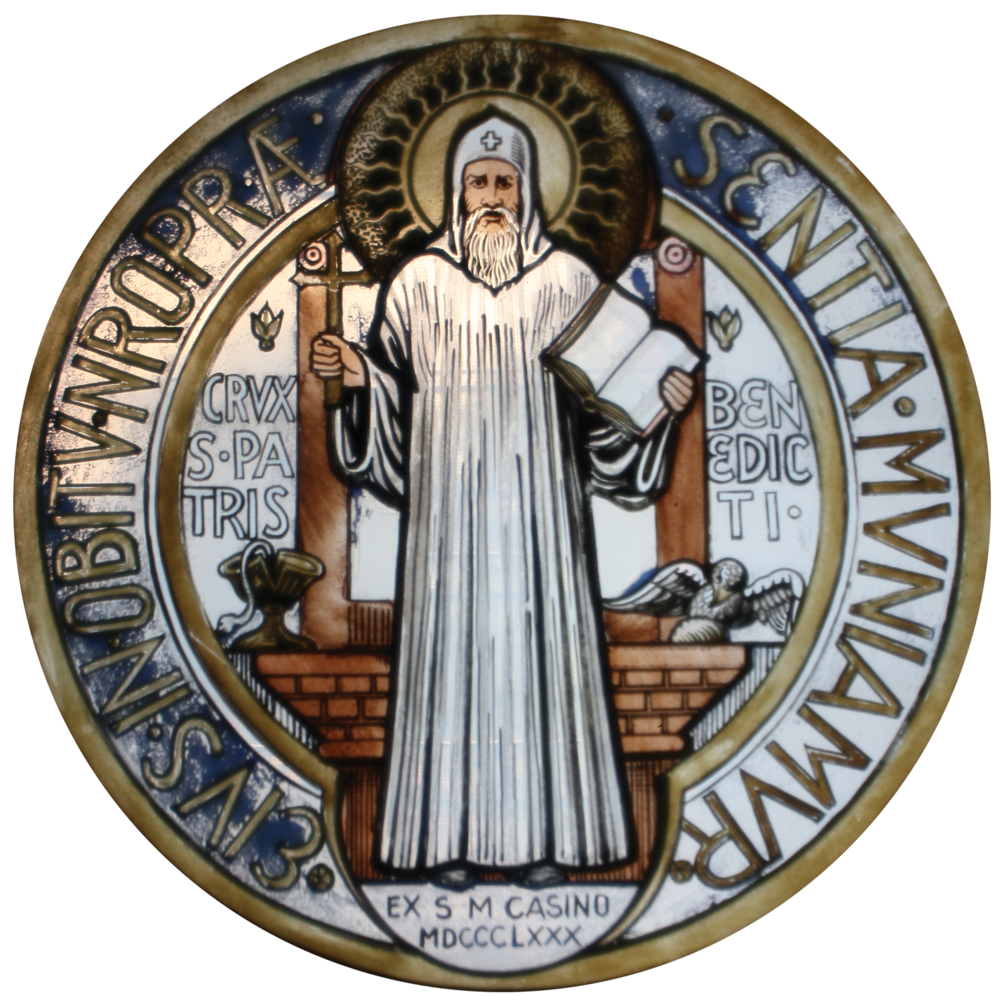
Why? And is breakfast really the most important meal of the day? Or should we break ourselves of break-fast and go back to just the fast part?
It's time (it's always time) to re-think the basic precepts "fed" to us by the secular world. We must be constantly replacing the profane with the sacred. A priest friend shared the following amazing article with me. It was written by a French Benedictine monk named Adalbert de Vogüé [pronounced Vo-goo-way]. This article was later expanded into a book entitled To Love Fasting: The Monastic Experience (In French, Aimer le Jeûne: L'expérience Monastique). Good luck finding this book, though. It is out of print. I'm currently working to acquire the publishing rights from St. Bede's Press and the original French publisher. Our Lady, Undoer of Knots, pray for us.
To Love Fasting: An Observance that is Possible and Necessary Today by Adalbert de Vogüé, O.S.B.[1] American Benedictine Review 35:3, Sept. 1984. pp. 302-312
If there is an element in the Benedictine Rule which has ceased to be practiced in the twentieth century, it is indeed this one. There is an obvious contrast and a complete contradiction between the schedule of meals as set by Saint Benedict and the customs prevailing in our monasteries.
According to Chapter 41 of the Rule, the monks should take two meals in Paschal time, a supper (cena) in the evening in addition to the midday meal. From Pentecost to the 12th of September only one meal is eaten at None (i.e. about mid-afternoon) on Wednesdays and Fridays, unless the abbot decides otherwise because of work or the heat. On the other days, a lunch (prandium) is served at midday, and probably there is also an evening meal.[2] From September 13th until Lent the monks fast every day until the ninth hour, except for Sundays, of course. Finally, during Lent the daily fast is prolonged until the evening.
This arrangement of fasts certainly represents an alleviation compared to that of the Master who prescribed a single meal--at midday--during Paschal time and throughout the whole summer maintained the fast until None, except on Thursday and Sunday.[3] However, it is far from true that Benedict has practically set aside all austerity, as some in our century have concluded too hastily. The mitigations to which he consents and which are found in the contemporary rules in Gaul,[4] leave intact a program which must have seemed quite demanding to a man of that time, accustomed to take two meals a day, if not three, inasmuch as nothing authorizes us to think that his monasteries were peopled with a majority of rough peasants almost insensible to privations, as has been imagined a little too readily.[5]
The State of Fasting - Present Day Our present-day regime differs from this moderate but real austerity by the absence of any effective fast. As far as we know, there is not a single monastery where three meals are not taken every day of the year: a very early breakfast, a dinner at midday, and a supper in the evening. At least in Anglo-Saxon countries a coffee break is often added in the morning, and tea in the middle of the afternoon. The Church’s Lenten regulations give rise to some more or less significant and obligatory restrictions, such as reducing breakfast and supper. As for the “monastic” fast (Wednesdays and Fridays in summer; the weekdays beginning with September 13th), it is marked only by very small changes, almost symbolic, such as the abstinence from meat at the chief meals or the suppression of milk at breakfast.
In this exposition we do not wish to belittle beyond measure the present state of affairs. The restrictions it includes can be meritorious, and sometimes are more keenly felt than they seem. But however serious they are made out to be, they have nothing to do with the fast properly so-called. “To fast” does not consist in eating less, but in not eating at all. “To breakfast,” no matter how little is taken, means “to break the fast.” Therefore, it can be said that our present-day custom of taking at least three meals a day completely excludes fasting.
At the present time, therefore, nothing remains of the dietary discipline established by Saint Benedict. Not a single day of the year do we content ourselves with only one meal, or even with two. This situation poses a problem: why has the fast thus completely disappeared from our observances? Until 1892, if we are correctly informed, part of the Trappist monasteries still kept in substance the horarium of the Rule. That year the union of the three Congregations of the Reformed Cistercians forced them to discontinue it. Departure from the fasts of the Rule must have occurred in the other communities of monks, white or black, sooner or later in the course of the preceding century according to diverse chronologies which would require extensive study. But however and whenever it came about, the overall result is in front of us and demands an explanation. Why in our day have the monks of every kind seemingly conspired to abandon an observance so characteristic of monasticism and so clearly established by the Rule?
Why Was the Fast Abandoned? The Weak Health of Modern Man?The most current explanation, which was given me in the novitiate almost forty years ago, consists in appealing to the weak health of modern man. It is said that the ancients were stronger than we are. Our bodily, and especially our nervous, weakness is such that we are incapable of fasting.[6] The observance was abandoned therefore because of physical impossibility. The evolution would be legitimate, indeed, necessary.
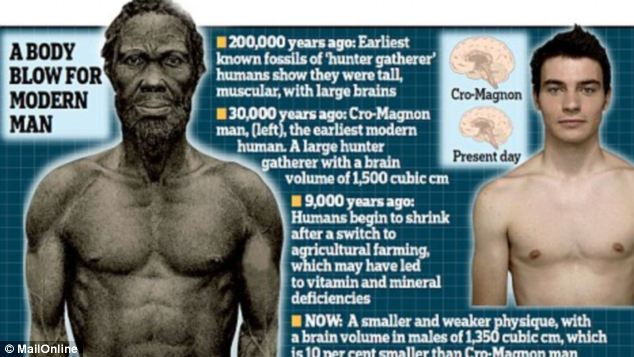
However, a recent experience has shown me that this explanation is totally false. Allow me for a while to present the example of my own reprehensible self. In this matter, as in many others, one can only speak about what one has experienced. And having had the experience I believe I can therefore affirm that our modern allergy to fasting is not a matter of diminished strength, but of faulty judgment and will. The cause is not in the physical, but in the spiritual order.
During the thirty years that I lived as a cenobite (1944-74), I was incapable of fasting for a single day, since the community diet, both in ordinary and in penitential seasons, seemed barely enough to me. Only when I began to lead a solitary life eight years ago, did I feel the energy and freedom to make an attempt. After a few years I was practicing the whole program of the Rule, even going beyond it a little.[7] Two stages of two or three years each had brought me to that point without the least violent effort: the progressive reduction and complete suppression of breakfast first of all, and then of supper. From then on, one meal a day, taken at a close of the day, was usually enough for me. Only Sundays and feasts were marked, in accord with ecclesiastical and monastic tradition, by a meal at noon and by supper. Breakfast was entirely out of the question.
To put this experience in the proper perspective, I must make it clear that I am not a “toughy.” I have good health, but little resistance to fatigue and very limited courage. Moreover I have not lessened my daily activity in any way: seven hours of intellectual work and one hour of manual work, in addition to a brisk walk of twelve to fifteen kilometers (7.5 to 9.3 miles). The experience in question seems therefore conclusive to me: a man of today with average strength and normal health can easily follow the Rule’s program.[8] To attain that, it is enough to have a good sense of judgment and a firm purpose of will, that result in a sustained effort towards improvement. By combining flexibility with firmness, without ever bypassing any steps or retreating, a person is readily set free from slavery to the three meals which were formerly judged indispensable.
But where does this servitude come from? After what we have just said, the question needs to be asked more than ever. If the explanation which invokes the diminution of physical strength is to be absolutely rejected, what other can we substitute for it?
Different Hypotheses: Increased Importance Given to Work for the Modern MonkA first hypothesis, advanced by us nearly twenty years ago and repeated recently,[9] is based on the increased importance given to work in the existence of the modern monk. He has as much strength as the monk of former times but he uses it differently. Instead of working on himself by ascesis he works on things outside himself. He invests all his energy on this exterior action and finds nothing left for mastering his own appetites. The relinquishment of the fast may well result from this sort of extraversion.
Certainly this explanation is partly true.[10] Our monasteries in the West are at one with the tremendous thrust which is pushing the whole human race towards the conquest of the universe. When work mobilizes all available energy and demands a degree of comfort, it tends to swallow up ascesis. However, the experience we have just described indicates that such an explanation is insufficient. The fact is, fasting does not at all keep one from working.

Another hypothesis came to mind as the result of my first attempts at the solitary life. When a person passes from the common life to solitude, he suddenly gains unsuspected energy. Whether one recognizes it or not, community life absorbs a considerable amount of energy. The simple obligation continually to be on time, to conform to one’s surroundings, to pay attention to one’s neighbors, to exchange signs and words with them, imposes a continual constraint which costs energy-to say nothing of the tensions which can arise. By getting rid of all that, the solitary life frees the energies so used. A person becomes stronger, better disposed and capable of greater austerity with less difficulty. And this new force needs to be used for some other cause. Ascesis becomes not only possible but necessary.
In the light of these facts it can be asked if the departure from fasting is not tied to a certain practice of the common life. Social life, no less than work, consumes a large portion of our energies; and this leads us to abandon the work of ascesis. The phenomenon is seen in every age. As early as the seventh century, Isaac of Nineveh makes a relevant remark about a hermit (himself perhaps?) he knew: although accustomed to eating only twice a week, he could not keep the fast on days when he spoke to someone,[11] as if conversation made him lose the self¬mastery required to keep fasting. What these solitaries of old noticed in their day, is not this also what is happening in our modern communities, but on a much larger scale? This appears all the more to be the case because social life has undergone nothing but further expansion in recent decades with the predilection for meetings and dialogue, as we all very well know.
However upon reflection, this explanation is no more satisfactory than the preceding one. First, the modern abandonment of the fast long antedates the intensification of the common life of which we have just spoken. Then, the rules laid down by Saint Benedict are specifically aimed at cenobites, and therefore are compatible with the social relationships which are unavoidable in a community. Finally, according to our own experience, if contacts and exchanges with others do not in fact make fasting easier, they do not prevent one from keeping the fast once it has become somewhat of a custom.
The Social Function of Eating (and Fasting)From this inadequate attempt at an explanation we can nevertheless maintain that normally a certain mutual relation unites fasting to solitude and silence, two additional essential characteristics of monasticism. The rediscovery of fasting should lead to a better observance of its two natural concomitants. In addition, this affinity of solitude and fasting draws our attention to an important fact: eating is both an individual need and a social act. We do not eat only because we are hungry, but also because the others are eating. The fear of making ourselves odd, or of feeling frustrated or of not being as alert and vigorous as the others, acts powerfully to dissuade us in a milieu where fasting is not practiced.

But let us return to our question: why do we no longer practice fasting? If work and the common life do not truly explain its abandonment any better than the decline of people’s health does, then what is the cause of this abandonment? The phenomenon certainly would merit a thorough historical and psychological study. Without prejudice to the findings of such a study, we can, in any case, ascribe great importance to a factor which certainly has played and still plays a decisive role: the loss of spiritual tone and conviction.
This is plain to see when we compare our inability to fast and the ability which some of our contemporaries draw from their political motivations. The newspapers periodically tell us that individuals or groups devote themselves to fasting to protest this or that injustice. Such facts only confirm that modern man is as capable of fasting as the ancients. They also reveal the underlying cause of our failure, namely that even though political fervor mobilizes the energy of our contemporaries, the monastic ideal, sad to say, has no such mobilizing power over us.
About ten years ago a Benedictine abbot, whose monastery is in one of the European capitals, forced himself to a fast of several days in company with a group of lay people under his influence to protest against the American bombings in Vietnam. These fast days did not prevent him from taking part in all the community exercises, except meals, and fulfilling his duties as superior as usual. But neither before nor afterwards does he seem to have practiced the much lighter fasts prescribed by the Rule, not for three days but for three hours. There was no question of his doing as a monk what he did without trouble as a member of a core group.
I understand well that an occasional fast inspired by a blaze of passion is one thing, and a regular fast, built into daily existence, is another. But this difference does not touch the heart of the problem. In both cases a motivation is both indispensable and sufficient. In the last analysis, if the monks do not fast, it is because they have no motive for doing so, because they do not believe in it.
The Wisdom of the Ancients: Ancient Philosophers and FastingWhat would be the considerations capable of moving us to fast? The ancients have left us many insights, often beautiful and profound, on the meaning and effects of fasting. From Saint Basil to Philoxenus of Mabbug and later, their views are repeated, interwoven and renewed like the various themes of a symphony. The Biblical recommendations and models of fasting, its benefits for soul and body, its relations with the other aspects of ascesis such as the angelic life, humility, prayer, all that has been described and celebrated by the Fathers. Without repeating these literary themes which are always useful,[12] we would like to sketch here only what experience can show us today in the most immediate way.
First of all, it is very true, as Cassian suggests,[13] that the fast plays a key role in the business of controlling the passions. Its special relation to chastity is perfectly plain. Perpetual abstinence from sex, periodical abstinence from food: these two forms of renunciation are similar to each other and interdependent. It is not for nothing that St. Benedict recommends them in the same terms, presenting both of them, and only them, as ascetical practices which must be “loved”: ieiunium amare ... castitatem amare.[14] In fact, fasting is allied to chastity. The importunities of the sexual appetite are easily warded off by fasting.
But on a larger scale fasting contributes greatly to the mastery of all the passions. In the very act of fasting, that is, during the hours when the body is without food, one notices an overall serenity of the soul, and this has a prolonged effect on the whole of life. It is difficult to describe this. Expertus potes credere (you can rely on the experienced). Serenity and refinement, detachment, freedom, joy.... This last word may be surprising, but it is strictly true. Fasting, which is viewed as a sad thing, is really a source of joy.
We can recall an observation presented not too long ago in the Collectanea[15] to explain this beneficial and beatifying power of fasting. The digestive functions are controlled by the brain. The latter therefore is at work when we are digesting, although we are unaware of it. Inversely, the absence of digestion gives the brain a rest, a relaxation, a leisure which makes the intellect happy and light like a schoolboy on vacation. In this way, no doubt, are explained the superior lucidity and agility of mind of the one who is fasting, together with a facility at prayer which accompanies them.
Medicinal Benefits of FastingOther authors stress the medicinal properties of the fast: it cleanses the body of its poisons.[16] Is this a causal relation or a simple analogy? In any case, fasting has a similar effect on the soul: it purifies it of its passions. The need to eat, being a primordial appetite, is not mastered without the entire person being healed and fortified in all the domains of moral life.
This spiritual benefit of the fast is by far the most important. To it can be added a secondary advantage which is not negligible, namely, the time saved. It is not that the time spent in eating is much less. When one eats only once a day, enough quantity and time must be put into it so that this one meal lasts about as long as the sum total of three ordinary meals.[17] But a considerable amount of time is saved relative to what surrounds the meal. The cooking and setting the table, gathering and sitting down to table, cleaning up and washing the dishes, all this takes place only once a day instead of three times. The time thus freed is available for reading and prayer, which are themselves facilitated by fasting, as we have said.
Another happy effect could be added: the differentiation of days and seasons. The discipline of fasting breaks the monotony of three meals a day and distinguishes ordinary days from Sundays and seasons of effort from those of relaxation. But this is only a secondary feature.
A Difference Between Monastic and Secular LifeAnother and more important point is the difference which fasting establishes between monastic and secular life. Our monastic life in its present state is lacking in specific content. Except for being centered on the common life and the liturgy, it scarcely differs from life in the world. Conversations and reading (especially of newspapers), eating, sleeping, clothing, all that is very similar or completely identical with what is done outside the cloister. The resulting lack of originality and vigor does not help to make this life attractive and interesting. Fasting, by giving a clearly distinctive note on an essential point, would restore to monastic life, or at least would accentuate in a decisive way, its character as an original conversatio (way of life), implying an effective rupture with one’s previous patterns of behavior.
It will be objected that the only rupture that matters is the break with sin, and that the true separation which makes the monk is that of the heart wholly given to God. very true, but this consecration in spirit and in truth needs concrete gestures which signify it and make it real. The fast is one of them, and one of the most eloquent. Whether envisaged under this aspect of a break with secular life, or-more important still-in its positive effects for the transformation of the person, it is an integral part of this system of meaningful observances which is monasticism.[18]

To those who would see in this insistence on some concrete observances only a sort of materialism, we must repeat that it is much rather a matter of spiritual realism. Just as we must steer clear of a Pharisaic exteriority which would reassure itself by the simple practice of fasting and other visible rites -- "I fast twice a week"[19] -- so we must strive to break out of the great modern illusion: pure interiority, a disincarnated spirituality, a web of words combined with middle-class comfort. Contrary to certain affirmations made by Butler[20] which lie at the root of contemporary Benedictinism, we can never repeat enough that Benedict in no way willed to replace austerities with obedience. Indeed, for him as for the whole of ancient monasticism exterior ascesis is an irreplaceable element in the spiritual formation of the monk.
Before concluding, it will no doubt be useful to recall the precise object we have in mind when, following Benedict and the ancients, we speak of “the fast.” It is not a question of refusing what we need and of starving ourselves. An ascesis of this type would not be without interest perhaps, if kept within just limits, but we are not talking of that. Fasting is not essentially a matter of quantity[21] but of time; the monk takes what is necessary, but only once a day, at a deliberately chosen moment, and at the end of a certain wait.
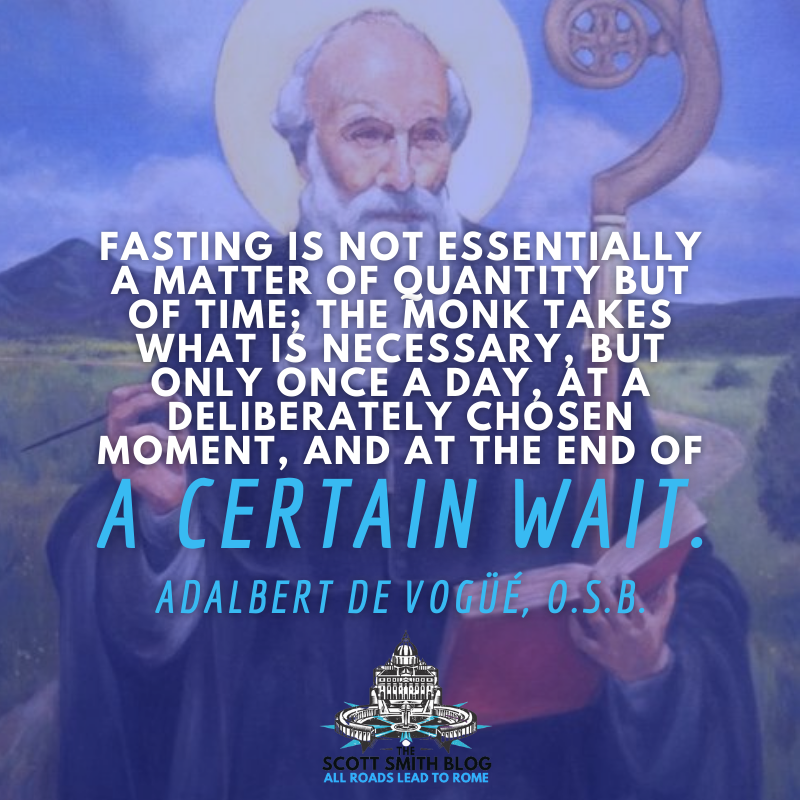
This one, movable meal is a daily affair. The Egyptian tradition, of which Cassian is the spokesman and Benedict the heir, counsels against the “superposition,” that is, fasting prolonged more than twenty-four hours. It recommends eating daily, in a moderate way, rather than taking bigger quantities at longer intervals.
Enumerating the Details of FastingEven limited in this way, fasting sometimes has its disagreeable aspects, at least in the beginning when one is not used to it. Let us enumerate some so as to avoid all idealization. The absence of breakfast makes one more sensitive to cold in the morning. Moreover sometimes one begins the day feeling rather low. Do not be alarmed; things improve as the sun mounts, and one will be at one’s zenith at midday. Constant experience indeed shows that as time passes, fasting does not impair the faster’s condition, but improves it. Paradoxically it is at the end of the fasting period that one feels the strongest and most recollected.
Another inconvenience is the heaviness felt during the last hours of the day when one has eaten at None (the middle of the afternoon). The siesta, if taken at noon, has been less restful. One can scarcely sleep without having eaten-and it is too late to take a siesta as evening approaches. The single meal of the day, which has to be filling, may be followed by a drowsiness which makes the end of the day burdensome.
For this reason certain people find it more expedient to fast until evening. The period of digestion coincides then with sleep, and the two great physiological functions take place together, leaving to the mind the maximum of time and freedom during the day. This regime of the evening meal, which Benedict reserves for Lent as an exceptional austerity, is perhaps in reality the easiest to follow at any time.
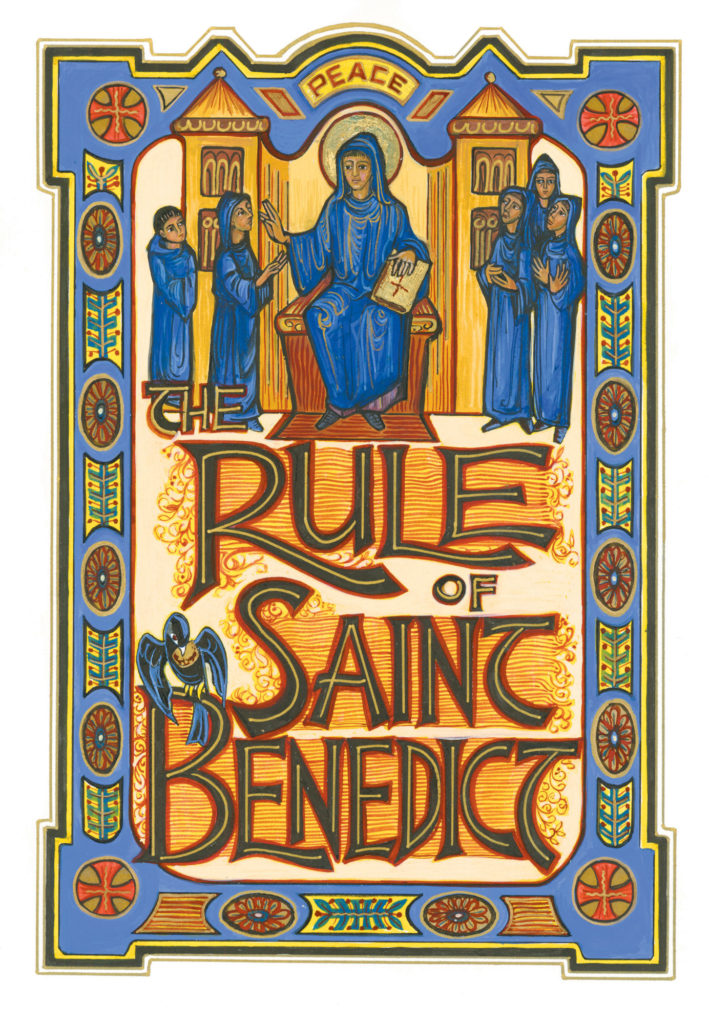
Conclusion: "The Love of Fasting"In conclusion, let us return from these concrete details to the essential, which is “to love fasting,” as Saint Benedict says. Today’s monks no longer practice it; they do not even know what it is. How could they “love” it? Love and practice go together. We shall practice the fast only if we love it. But to love it we need to experience its benefits, and thus we need to practice it. Happy he who breaks out of this circle, trusting in the wisdom of the Rule and trying it!
“To love fasting” and “to love chastity”--these are similar things. In both cases it is a matter of the attraction of a certain happiness. The happiness of chastity, as we know well in spite of its trials, is the happiness of a total consecration to God, with its exceptional possibilities for detachment and for prayer, for freedom and for love. The happiness of fasting is similar. It is the happiness of feeling one’s spirit grow lighter and stronger, of being more in control of one’s senses and body, more apt to listen to God and to seek Him. As we have already said, the last hours of a fast day are the best, and it is with a true joy that one begins again each week the daily, observance after the interruption of the Lord’s day.
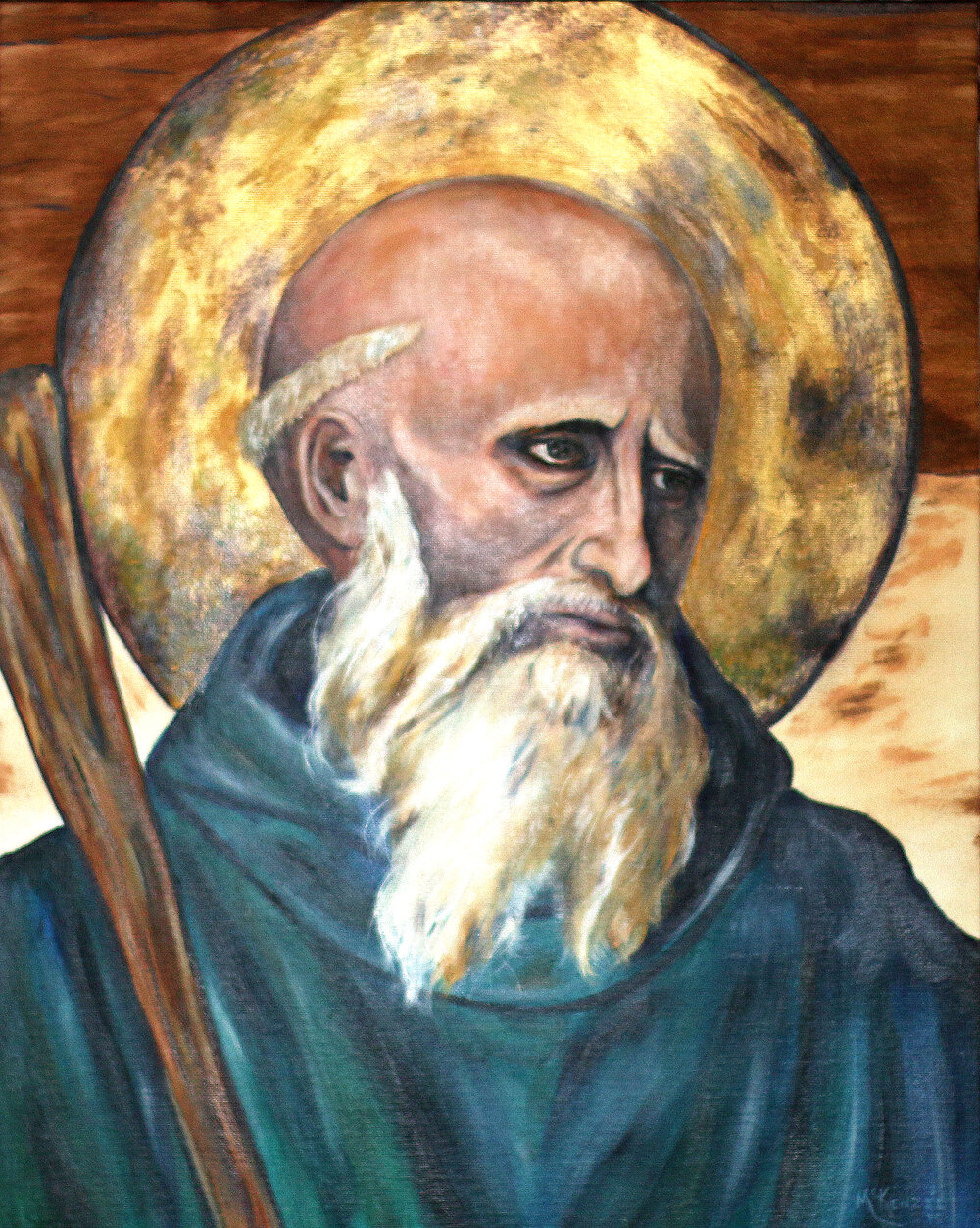
Although this observance is reckoned impossible today, it is truly possible and even easy. Having lost nothing of its beneficial power, it remains necessary and irreplaceable. Is this the only case in which a practice of the ancient monks, and of Saint Benedict himself, has been too quickly considered outmoded, but, as a matter of fact, still remains useful and salvageable for the present? The example of the fast serves well to confirm that the “renouatio accommodata” of our religious life of which the Council spoke, should consist in going beyond the desertions and distortions of a pseudo-tradition to recover the great, basic observances of monasticism.
Footnotes: To Love Fasting: An Observance that is Possible and Necessary Today by Adalbert de Vogüé, O.S.B.
[1] Fr. Adalbert de Vogüé is a monk of Abbaye Ste-Marie de La Pierre-qui-Vire, F-89830 Saint-Léger Vauban, France. He is the author of a major commentary on the Rule of Benedict as well as numerous other scholarly books and articles. This article first appeared in Collectanea Cisterciensia 45 (1983) and was translated by Fr. John Baptist Hasbrouck, O.S.C.O., Guadalupe Abbey, Oregon.
[2] RB 41.3: "reliquis diebus ad sextam prandeant." It seems that this prandium (midday meal) implies a cena (supper) (cf. RB 42.2-3).
[3] RM 28. The Master maintains therefore the old principle of “a uniform fast all year long” (Jerome, Ep. 22.35), but with derogations and discussions which foretell the Benedictine mitigation. See La Règle de saint Benoît, VI, Sources Chrétiennes, No. 186 (Paris: Editions du Cerf 1971) 1177 and 1187.
[4] Cf. La Règle, VI, 1179-82.
[5] See La Règle de saint Benoît, I, Sources Chrétiennes, No. 181 (Paris: Editions du Cerf 1972) 76.
[6] Such was the motive invoked to impose on the Trappists the abandonment of the fast in 1892 according to La Trappe in England: Chronicles of an Unknown Monastery, by a religious of Holy Cross Abbey, Stapehill, Dorset (London 1935) (We cite the second edition, Gethsemani 1946, p. 164): the Union of 1892 called for Constitutions and Usages as close as possible to the primitive Usages of Citeaux, “with the exception of the rules of fasting, which, at the express wish of Leo XIII, underwent some modification, in order to render them more in accordance with the weakness of modern constitutions” (our italics).
[7] At least in regard to the horarium of the meals (one meal in the evening, winter and summer). In regard to the menu I take far more than the three dishes-two cooked and one raw-prescribed by the Rule. I add a piece of cheese to the four dishes which make up my community’s dinner (eggs or fish, vegetables, salad, fruit). My bread is about the same as the ancient “pound” Saint Benedict speaks of, that is, 327 grams.
[8] In addition to this, the fasts of several days reported by many ancient documents seem to me now entirely believable; the little I have done convinces me that with a little practice one can do anything. Moreover, note the contemporary experiences described by Thomas Ryan, Fasting Rediscovered: A Guide to Health and Wholeness for your Body-Spirit (New York: Paulist Press 1982).
[9] In the article "Le procès des moines d’autrefois," in Christus 12 (1965) 113-28, see p. 121; La Règle de saint Benoît, VII (Paris: Editions du Cerf, 1977) 322; (English translation: Cistercian Studies No. 43, p. 230).
[10] Already in the sixth century there is a clear correlation between the fast and abstention from certain kinds of work. See La Règle, VI, 1190-1203.
[11] Isaac of Nineveh, Mystic Treatises , trans. A. J. Wensinck (Amsterdam 1923) p. 260 (p. 289 Bedjan).
[12] A survey of them will be found in La Règle, VII, 323-30.
[13] See especially Conf 5.4-6, 10, 25-26.
[14] RB 4.13 and 64=RM 3.13 and 70.
[15] A Benedictine Monk, Une expérience de jeûne, in Collectanea Cisterciensia 41 (1979) 274-79 (see p. 275). I must insist that this anonymous monk is not myself.
[16] See the detailed expositions of Thomas Ryan, Fasting Rediscovered (see note 7 above).
[17] Perhaps that is why Basil, Ep. 2.6, speaking of the one daily meal, says that the body is given `one hour’ out of the twenty-four hours of the day.
[18] Cf. our article “Saint Benoît aujourd’hui. La vie monastique et son aggiornamento,” in Noveau Revue Théologique 110 (1978) 720-33, reproduced in Saint Benoît. Sa Vie et sa Règle (Bellefontaine 1981) p. 221-34. (English translation: Cistercian Studies 14 [1979] p. 205-18).
[19] Luke 18:12. Cassian in Conf 21.12-18 recalls that the fast is not a “good” in itself, but a simple “means,” capable of being used well or badly.
[20] See La Régle, I, 76-78. More specifically, Butler thinks that in addition to the suppression of austerities Benedict replaced ascetic rivalry by “spiritual collectivism,” the essential being for him the simple leading of the community life. (See the English original: Cuthbert Butler, Benedictine Monasticism, 2nd ed. [New York: Longmans, Green and Co. 1924] pp. 35-45).
[21] Cf. RB 39.4-5: the same quantity of bread, a pound, is allotted per day whether there is only one meal or a dinner and supper. Moreover, we do not know of what the supper consisted besides the third of the bread ration mentioned by Benedict. The Master speaks of “an uncooked dish” and of “fruits” to which are added the leftovers of the dinner if there are any (RM 26.3, 5, 10). But this menu for supper holds only in summer; in winter there is only a drink (RM 27.28).

What is Breakfast Called "Breakfast"? To Love Fasting: An Observance that is Possible and Necessary Today by Adalbert de Vogüé, O.S.B.
The Rule of St. Benedict. This set of rules changed the world. Life in basically all monasteries ever was based on The Rule of St. Benedict. It's The Rule. You don't even need to say it's author. Everybody knows it's St. Benedict.
Despite all that, something strange happened sometime in the twentieth or nineteenth century. The world's monasteries abandoned a certain part of the Rule of St. Benedict.
What was it? What rule of The Rule was suddenly abandoned?
The morning fast was broken. Break-fast. Breakfast!
St. Benedict didn't include breakfast in the Rule. St. Benedict included a morning fast. We broke it.
Why? And is breakfast really the most important meal of the day? Or should we break ourselves of break-fast and go back to just the fast part?
It's time (it's always time) to re-think the basic precepts "fed" to us by the secular world. We must be constantly replacing the profane with the sacred. A priest friend shared the following amazing article with me. It was written by a French Benedictine monk named Adalbert de Vogüé [pronounced Vo-goo-way]. This article was later expanded into a book entitled To Love Fasting: The Monastic Experience (In French, Aimer le Jeûne: L'expérience Monastique). Good luck finding this book, though. It is out of print. I'm currently working to acquire the publishing rights from St. Bede's Press and the original French publisher. Our Lady, Undoer of Knots, pray for us.
To Love Fasting: An Observance that is Possible and Necessary Today by Adalbert de Vogüé, O.S.B.[1] American Benedictine Review 35:3, Sept. 1984. pp. 302-312
If there is an element in the Benedictine Rule which has ceased to be practiced in the twentieth century, it is indeed this one. There is an obvious contrast and a complete contradiction between the schedule of meals as set by Saint Benedict and the customs prevailing in our monasteries.
According to Chapter 41 of the Rule, the monks should take two meals in Paschal time, a supper (cena) in the evening in addition to the midday meal. From Pentecost to the 12th of September only one meal is eaten at None (i.e. about mid-afternoon) on Wednesdays and Fridays, unless the abbot decides otherwise because of work or the heat. On the other days, a lunch (prandium) is served at midday, and probably there is also an evening meal.[2] From September 13th until Lent the monks fast every day until the ninth hour, except for Sundays, of course. Finally, during Lent the daily fast is prolonged until the evening.
This arrangement of fasts certainly represents an alleviation compared to that of the Master who prescribed a single meal--at midday--during Paschal time and throughout the whole summer maintained the fast until None, except on Thursday and Sunday.[3] However, it is far from true that Benedict has practically set aside all austerity, as some in our century have concluded too hastily. The mitigations to which he consents and which are found in the contemporary rules in Gaul,[4] leave intact a program which must have seemed quite demanding to a man of that time, accustomed to take two meals a day, if not three, inasmuch as nothing authorizes us to think that his monasteries were peopled with a majority of rough peasants almost insensible to privations, as has been imagined a little too readily.[5]
The State of Fasting - Present Day Our present-day regime differs from this moderate but real austerity by the absence of any effective fast. As far as we know, there is not a single monastery where three meals are not taken every day of the year: a very early breakfast, a dinner at midday, and a supper in the evening. At least in Anglo-Saxon countries a coffee break is often added in the morning, and tea in the middle of the afternoon. The Church’s Lenten regulations give rise to some more or less significant and obligatory restrictions, such as reducing breakfast and supper. As for the “monastic” fast (Wednesdays and Fridays in summer; the weekdays beginning with September 13th), it is marked only by very small changes, almost symbolic, such as the abstinence from meat at the chief meals or the suppression of milk at breakfast.
In this exposition we do not wish to belittle beyond measure the present state of affairs. The restrictions it includes can be meritorious, and sometimes are more keenly felt than they seem. But however serious they are made out to be, they have nothing to do with the fast properly so-called. “To fast” does not consist in eating less, but in not eating at all. “To breakfast,” no matter how little is taken, means “to break the fast.” Therefore, it can be said that our present-day custom of taking at least three meals a day completely excludes fasting.
At the present time, therefore, nothing remains of the dietary discipline established by Saint Benedict. Not a single day of the year do we content ourselves with only one meal, or even with two. This situation poses a problem: why has the fast thus completely disappeared from our observances? Until 1892, if we are correctly informed, part of the Trappist monasteries still kept in substance the horarium of the Rule. That year the union of the three Congregations of the Reformed Cistercians forced them to discontinue it. Departure from the fasts of the Rule must have occurred in the other communities of monks, white or black, sooner or later in the course of the preceding century according to diverse chronologies which would require extensive study. But however and whenever it came about, the overall result is in front of us and demands an explanation. Why in our day have the monks of every kind seemingly conspired to abandon an observance so characteristic of monasticism and so clearly established by the Rule?
Why Was the Fast Abandoned? The Weak Health of Modern Man?The most current explanation, which was given me in the novitiate almost forty years ago, consists in appealing to the weak health of modern man. It is said that the ancients were stronger than we are. Our bodily, and especially our nervous, weakness is such that we are incapable of fasting.[6] The observance was abandoned therefore because of physical impossibility. The evolution would be legitimate, indeed, necessary.
However, a recent experience has shown me that this explanation is totally false. Allow me for a while to present the example of my own reprehensible self. In this matter, as in many others, one can only speak about what one has experienced. And having had the experience I believe I can therefore affirm that our modern allergy to fasting is not a matter of diminished strength, but of faulty judgment and will. The cause is not in the physical, but in the spiritual order.
During the thirty years that I lived as a cenobite (1944-74), I was incapable of fasting for a single day, since the community diet, both in ordinary and in penitential seasons, seemed barely enough to me. Only when I began to lead a solitary life eight years ago, did I feel the energy and freedom to make an attempt. After a few years I was practicing the whole program of the Rule, even going beyond it a little.[7] Two stages of two or three years each had brought me to that point without the least violent effort: the progressive reduction and complete suppression of breakfast first of all, and then of supper. From then on, one meal a day, taken at a close of the day, was usually enough for me. Only Sundays and feasts were marked, in accord with ecclesiastical and monastic tradition, by a meal at noon and by supper. Breakfast was entirely out of the question.
To put this experience in the proper perspective, I must make it clear that I am not a “toughy.” I have good health, but little resistance to fatigue and very limited courage. Moreover I have not lessened my daily activity in any way: seven hours of intellectual work and one hour of manual work, in addition to a brisk walk of twelve to fifteen kilometers (7.5 to 9.3 miles). The experience in question seems therefore conclusive to me: a man of today with average strength and normal health can easily follow the Rule’s program.[8] To attain that, it is enough to have a good sense of judgment and a firm purpose of will, that result in a sustained effort towards improvement. By combining flexibility with firmness, without ever bypassing any steps or retreating, a person is readily set free from slavery to the three meals which were formerly judged indispensable.
But where does this servitude come from? After what we have just said, the question needs to be asked more than ever. If the explanation which invokes the diminution of physical strength is to be absolutely rejected, what other can we substitute for it?
Different Hypotheses: Increased Importance Given to Work for the Modern MonkA first hypothesis, advanced by us nearly twenty years ago and repeated recently,[9] is based on the increased importance given to work in the existence of the modern monk. He has as much strength as the monk of former times but he uses it differently. Instead of working on himself by ascesis he works on things outside himself. He invests all his energy on this exterior action and finds nothing left for mastering his own appetites. The relinquishment of the fast may well result from this sort of extraversion.
Certainly this explanation is partly true.[10] Our monasteries in the West are at one with the tremendous thrust which is pushing the whole human race towards the conquest of the universe. When work mobilizes all available energy and demands a degree of comfort, it tends to swallow up ascesis. However, the experience we have just described indicates that such an explanation is insufficient. The fact is, fasting does not at all keep one from working.
Another hypothesis came to mind as the result of my first attempts at the solitary life. When a person passes from the common life to solitude, he suddenly gains unsuspected energy. Whether one recognizes it or not, community life absorbs a considerable amount of energy. The simple obligation continually to be on time, to conform to one’s surroundings, to pay attention to one’s neighbors, to exchange signs and words with them, imposes a continual constraint which costs energy-to say nothing of the tensions which can arise. By getting rid of all that, the solitary life frees the energies so used. A person becomes stronger, better disposed and capable of greater austerity with less difficulty. And this new force needs to be used for some other cause. Ascesis becomes not only possible but necessary.
In the light of these facts it can be asked if the departure from fasting is not tied to a certain practice of the common life. Social life, no less than work, consumes a large portion of our energies; and this leads us to abandon the work of ascesis. The phenomenon is seen in every age. As early as the seventh century, Isaac of Nineveh makes a relevant remark about a hermit (himself perhaps?) he knew: although accustomed to eating only twice a week, he could not keep the fast on days when he spoke to someone,[11] as if conversation made him lose the self¬mastery required to keep fasting. What these solitaries of old noticed in their day, is not this also what is happening in our modern communities, but on a much larger scale? This appears all the more to be the case because social life has undergone nothing but further expansion in recent decades with the predilection for meetings and dialogue, as we all very well know.
However upon reflection, this explanation is no more satisfactory than the preceding one. First, the modern abandonment of the fast long antedates the intensification of the common life of which we have just spoken. Then, the rules laid down by Saint Benedict are specifically aimed at cenobites, and therefore are compatible with the social relationships which are unavoidable in a community. Finally, according to our own experience, if contacts and exchanges with others do not in fact make fasting easier, they do not prevent one from keeping the fast once it has become somewhat of a custom.
The Social Function of Eating (and Fasting)From this inadequate attempt at an explanation we can nevertheless maintain that normally a certain mutual relation unites fasting to solitude and silence, two additional essential characteristics of monasticism. The rediscovery of fasting should lead to a better observance of its two natural concomitants. In addition, this affinity of solitude and fasting draws our attention to an important fact: eating is both an individual need and a social act. We do not eat only because we are hungry, but also because the others are eating. The fear of making ourselves odd, or of feeling frustrated or of not being as alert and vigorous as the others, acts powerfully to dissuade us in a milieu where fasting is not practiced.
But let us return to our question: why do we no longer practice fasting? If work and the common life do not truly explain its abandonment any better than the decline of people’s health does, then what is the cause of this abandonment? The phenomenon certainly would merit a thorough historical and psychological study. Without prejudice to the findings of such a study, we can, in any case, ascribe great importance to a factor which certainly has played and still plays a decisive role: the loss of spiritual tone and conviction.
This is plain to see when we compare our inability to fast and the ability which some of our contemporaries draw from their political motivations. The newspapers periodically tell us that individuals or groups devote themselves to fasting to protest this or that injustice. Such facts only confirm that modern man is as capable of fasting as the ancients. They also reveal the underlying cause of our failure, namely that even though political fervor mobilizes the energy of our contemporaries, the monastic ideal, sad to say, has no such mobilizing power over us.
About ten years ago a Benedictine abbot, whose monastery is in one of the European capitals, forced himself to a fast of several days in company with a group of lay people under his influence to protest against the American bombings in Vietnam. These fast days did not prevent him from taking part in all the community exercises, except meals, and fulfilling his duties as superior as usual. But neither before nor afterwards does he seem to have practiced the much lighter fasts prescribed by the Rule, not for three days but for three hours. There was no question of his doing as a monk what he did without trouble as a member of a core group.
I understand well that an occasional fast inspired by a blaze of passion is one thing, and a regular fast, built into daily existence, is another. But this difference does not touch the heart of the problem. In both cases a motivation is both indispensable and sufficient. In the last analysis, if the monks do not fast, it is because they have no motive for doing so, because they do not believe in it.
The Wisdom of the Ancients: Ancient Philosophers and FastingWhat would be the considerations capable of moving us to fast? The ancients have left us many insights, often beautiful and profound, on the meaning and effects of fasting. From Saint Basil to Philoxenus of Mabbug and later, their views are repeated, interwoven and renewed like the various themes of a symphony. The Biblical recommendations and models of fasting, its benefits for soul and body, its relations with the other aspects of ascesis such as the angelic life, humility, prayer, all that has been described and celebrated by the Fathers. Without repeating these literary themes which are always useful,[12] we would like to sketch here only what experience can show us today in the most immediate way.
First of all, it is very true, as Cassian suggests,[13] that the fast plays a key role in the business of controlling the passions. Its special relation to chastity is perfectly plain. Perpetual abstinence from sex, periodical abstinence from food: these two forms of renunciation are similar to each other and interdependent. It is not for nothing that St. Benedict recommends them in the same terms, presenting both of them, and only them, as ascetical practices which must be “loved”: ieiunium amare ... castitatem amare.[14] In fact, fasting is allied to chastity. The importunities of the sexual appetite are easily warded off by fasting.
But on a larger scale fasting contributes greatly to the mastery of all the passions. In the very act of fasting, that is, during the hours when the body is without food, one notices an overall serenity of the soul, and this has a prolonged effect on the whole of life. It is difficult to describe this. Expertus potes credere (you can rely on the experienced). Serenity and refinement, detachment, freedom, joy.... This last word may be surprising, but it is strictly true. Fasting, which is viewed as a sad thing, is really a source of joy.
We can recall an observation presented not too long ago in the Collectanea[15] to explain this beneficial and beatifying power of fasting. The digestive functions are controlled by the brain. The latter therefore is at work when we are digesting, although we are unaware of it. Inversely, the absence of digestion gives the brain a rest, a relaxation, a leisure which makes the intellect happy and light like a schoolboy on vacation. In this way, no doubt, are explained the superior lucidity and agility of mind of the one who is fasting, together with a facility at prayer which accompanies them.
Medicinal Benefits of FastingOther authors stress the medicinal properties of the fast: it cleanses the body of its poisons.[16] Is this a causal relation or a simple analogy? In any case, fasting has a similar effect on the soul: it purifies it of its passions. The need to eat, being a primordial appetite, is not mastered without the entire person being healed and fortified in all the domains of moral life.
This spiritual benefit of the fast is by far the most important. To it can be added a secondary advantage which is not negligible, namely, the time saved. It is not that the time spent in eating is much less. When one eats only once a day, enough quantity and time must be put into it so that this one meal lasts about as long as the sum total of three ordinary meals.[17] But a considerable amount of time is saved relative to what surrounds the meal. The cooking and setting the table, gathering and sitting down to table, cleaning up and washing the dishes, all this takes place only once a day instead of three times. The time thus freed is available for reading and prayer, which are themselves facilitated by fasting, as we have said.
Another happy effect could be added: the differentiation of days and seasons. The discipline of fasting breaks the monotony of three meals a day and distinguishes ordinary days from Sundays and seasons of effort from those of relaxation. But this is only a secondary feature.
A Difference Between Monastic and Secular LifeAnother and more important point is the difference which fasting establishes between monastic and secular life. Our monastic life in its present state is lacking in specific content. Except for being centered on the common life and the liturgy, it scarcely differs from life in the world. Conversations and reading (especially of newspapers), eating, sleeping, clothing, all that is very similar or completely identical with what is done outside the cloister. The resulting lack of originality and vigor does not help to make this life attractive and interesting. Fasting, by giving a clearly distinctive note on an essential point, would restore to monastic life, or at least would accentuate in a decisive way, its character as an original conversatio (way of life), implying an effective rupture with one’s previous patterns of behavior.
It will be objected that the only rupture that matters is the break with sin, and that the true separation which makes the monk is that of the heart wholly given to God. very true, but this consecration in spirit and in truth needs concrete gestures which signify it and make it real. The fast is one of them, and one of the most eloquent. Whether envisaged under this aspect of a break with secular life, or-more important still-in its positive effects for the transformation of the person, it is an integral part of this system of meaningful observances which is monasticism.[18]
To those who would see in this insistence on some concrete observances only a sort of materialism, we must repeat that it is much rather a matter of spiritual realism. Just as we must steer clear of a Pharisaic exteriority which would reassure itself by the simple practice of fasting and other visible rites -- "I fast twice a week"[19] -- so we must strive to break out of the great modern illusion: pure interiority, a disincarnated spirituality, a web of words combined with middle-class comfort. Contrary to certain affirmations made by Butler[20] which lie at the root of contemporary Benedictinism, we can never repeat enough that Benedict in no way willed to replace austerities with obedience. Indeed, for him as for the whole of ancient monasticism exterior ascesis is an irreplaceable element in the spiritual formation of the monk.
Before concluding, it will no doubt be useful to recall the precise object we have in mind when, following Benedict and the ancients, we speak of “the fast.” It is not a question of refusing what we need and of starving ourselves. An ascesis of this type would not be without interest perhaps, if kept within just limits, but we are not talking of that. Fasting is not essentially a matter of quantity[21] but of time; the monk takes what is necessary, but only once a day, at a deliberately chosen moment, and at the end of a certain wait.
This one, movable meal is a daily affair. The Egyptian tradition, of which Cassian is the spokesman and Benedict the heir, counsels against the “superposition,” that is, fasting prolonged more than twenty-four hours. It recommends eating daily, in a moderate way, rather than taking bigger quantities at longer intervals.
Enumerating the Details of FastingEven limited in this way, fasting sometimes has its disagreeable aspects, at least in the beginning when one is not used to it. Let us enumerate some so as to avoid all idealization. The absence of breakfast makes one more sensitive to cold in the morning. Moreover sometimes one begins the day feeling rather low. Do not be alarmed; things improve as the sun mounts, and one will be at one’s zenith at midday. Constant experience indeed shows that as time passes, fasting does not impair the faster’s condition, but improves it. Paradoxically it is at the end of the fasting period that one feels the strongest and most recollected.
Another inconvenience is the heaviness felt during the last hours of the day when one has eaten at None (the middle of the afternoon). The siesta, if taken at noon, has been less restful. One can scarcely sleep without having eaten-and it is too late to take a siesta as evening approaches. The single meal of the day, which has to be filling, may be followed by a drowsiness which makes the end of the day burdensome.
For this reason certain people find it more expedient to fast until evening. The period of digestion coincides then with sleep, and the two great physiological functions take place together, leaving to the mind the maximum of time and freedom during the day. This regime of the evening meal, which Benedict reserves for Lent as an exceptional austerity, is perhaps in reality the easiest to follow at any time.
Conclusion: "The Love of Fasting"In conclusion, let us return from these concrete details to the essential, which is “to love fasting,” as Saint Benedict says. Today’s monks no longer practice it; they do not even know what it is. How could they “love” it? Love and practice go together. We shall practice the fast only if we love it. But to love it we need to experience its benefits, and thus we need to practice it. Happy he who breaks out of this circle, trusting in the wisdom of the Rule and trying it!
“To love fasting” and “to love chastity”--these are similar things. In both cases it is a matter of the attraction of a certain happiness. The happiness of chastity, as we know well in spite of its trials, is the happiness of a total consecration to God, with its exceptional possibilities for detachment and for prayer, for freedom and for love. The happiness of fasting is similar. It is the happiness of feeling one’s spirit grow lighter and stronger, of being more in control of one’s senses and body, more apt to listen to God and to seek Him. As we have already said, the last hours of a fast day are the best, and it is with a true joy that one begins again each week the daily, observance after the interruption of the Lord’s day.
Although this observance is reckoned impossible today, it is truly possible and even easy. Having lost nothing of its beneficial power, it remains necessary and irreplaceable. Is this the only case in which a practice of the ancient monks, and of Saint Benedict himself, has been too quickly considered outmoded, but, as a matter of fact, still remains useful and salvageable for the present? The example of the fast serves well to confirm that the “renouatio accommodata” of our religious life of which the Council spoke, should consist in going beyond the desertions and distortions of a pseudo-tradition to recover the great, basic observances of monasticism.
Footnotes: To Love Fasting: An Observance that is Possible and Necessary Today by Adalbert de Vogüé, O.S.B.
[1] Fr. Adalbert de Vogüé is a monk of Abbaye Ste-Marie de La Pierre-qui-Vire, F-89830 Saint-Léger Vauban, France. He is the author of a major commentary on the Rule of Benedict as well as numerous other scholarly books and articles. This article first appeared in Collectanea Cisterciensia 45 (1983) and was translated by Fr. John Baptist Hasbrouck, O.S.C.O., Guadalupe Abbey, Oregon.
[2] RB 41.3: "reliquis diebus ad sextam prandeant." It seems that this prandium (midday meal) implies a cena (supper) (cf. RB 42.2-3).
[3] RM 28. The Master maintains therefore the old principle of “a uniform fast all year long” (Jerome, Ep. 22.35), but with derogations and discussions which foretell the Benedictine mitigation. See La Règle de saint Benoît, VI, Sources Chrétiennes, No. 186 (Paris: Editions du Cerf 1971) 1177 and 1187.
[4] Cf. La Règle, VI, 1179-82.
[5] See La Règle de saint Benoît, I, Sources Chrétiennes, No. 181 (Paris: Editions du Cerf 1972) 76.
[6] Such was the motive invoked to impose on the Trappists the abandonment of the fast in 1892 according to La Trappe in England: Chronicles of an Unknown Monastery, by a religious of Holy Cross Abbey, Stapehill, Dorset (London 1935) (We cite the second edition, Gethsemani 1946, p. 164): the Union of 1892 called for Constitutions and Usages as close as possible to the primitive Usages of Citeaux, “with the exception of the rules of fasting, which, at the express wish of Leo XIII, underwent some modification, in order to render them more in accordance with the weakness of modern constitutions” (our italics).
[7] At least in regard to the horarium of the meals (one meal in the evening, winter and summer). In regard to the menu I take far more than the three dishes-two cooked and one raw-prescribed by the Rule. I add a piece of cheese to the four dishes which make up my community’s dinner (eggs or fish, vegetables, salad, fruit). My bread is about the same as the ancient “pound” Saint Benedict speaks of, that is, 327 grams.
[8] In addition to this, the fasts of several days reported by many ancient documents seem to me now entirely believable; the little I have done convinces me that with a little practice one can do anything. Moreover, note the contemporary experiences described by Thomas Ryan, Fasting Rediscovered: A Guide to Health and Wholeness for your Body-Spirit (New York: Paulist Press 1982).
[9] In the article "Le procès des moines d’autrefois," in Christus 12 (1965) 113-28, see p. 121; La Règle de saint Benoît, VII (Paris: Editions du Cerf, 1977) 322; (English translation: Cistercian Studies No. 43, p. 230).
[10] Already in the sixth century there is a clear correlation between the fast and abstention from certain kinds of work. See La Règle, VI, 1190-1203.
[11] Isaac of Nineveh, Mystic Treatises, trans. A. J. Wensinck (Amsterdam 1923) p. 260 (p. 289 Bedjan).
[12] A survey of them will be found in La Règle, VII, 323-30.
[13] See especially Conf 5.4-6, 10, 25-26.
[14] RB 4.13 and 64=RM 3.13 and 70.
[15] A Benedictine Monk, Une expérience de jeûne, in Collectanea Cisterciensia 41 (1979) 274-79 (see p. 275). I must insist that this anonymous monk is not myself.
[16] See the detailed expositions of Thomas Ryan, Fasting Rediscovered (see note 7 above).
[17] Perhaps that is why Basil, Ep. 2.6, speaking of the one daily meal, says that the body is given `one hour’ out of the twenty-four hours of the day.
[18] Cf. our article “Saint Benoît aujourd’hui. La vie monastique et son aggiornamento,” in Noveau Revue Théologique 110 (1978) 720-33, reproduced in Saint Benoît. Sa Vie et sa Règle (Bellefontaine 1981) p. 221-34. (English translation: Cistercian Studies 14 [1979] p. 205-18).
[19] Luke 18:12. Cassian in Conf 21.12-18 recalls that the fast is not a “good” in itself, but a simple “means,” capable of being used well or badly.
[20] See La Régle, I, 76-78. More specifically, Butler thinks that in addition to the suppression of austerities Benedict replaced ascetic rivalry by “spiritual collectivism,” the essential being for him the simple leading of the community life. (See the English original: Cuthbert Butler, Benedictine Monasticism, 2nd ed. [New York: Longmans, Green and Co. 1924] pp. 35-45).
[21] Cf. RB 39.4-5: the same quantity of bread, a pound, is allotted per day whether there is only one meal or a dinner and supper. Moreover, we do not know of what the supper consisted besides the third of the bread ration mentioned by Benedict. The Master speaks of “an uncooked dish” and of “fruits” to which are added the leftovers of the dinner if there are any (RM 26.3, 5, 10). But this menu for supper holds only in summer; in winter there is only a drink (RM 27.28).
August 24, 2021
Padre Pio Comes to Louisiana: Saint Pio's Miracle Cures Multiple Sclerosis (MS)
Don't ever think "a miracle can't happen to me." This miracle happened in my own backyard, and not just to a friend of a friend, but to my friends.
Don't ever say "miracles don't happen anymore" or "the age of miracles is over". This just happened.
Don't ever think "I'm past the point of a miracle". My friend was healed of an incurable disease, which she had suffered from for decades. Five decades!
Miracles are happening all the time.

I have been meaning to write about this incredible miracle for some time.
Here are my friends Tom and Donna Hildebrandt:
Tom and I first met because our Knights of Columbus councils worked together on a few projects. Together, with a few other friends, we started the Men of the Immaculata, an organization that puts together an annual Catholic men's conference.
Tom and Donna were married in 1972. The very next year, Donna was diagnosed with Multiple Sclerosis (MS). The next twenty years were an unrelenting slide into jaws of this disease. Donna experienced a major exacerbation of symptoms in 1996 and was pronounced permanently disabled.
While MS treatments first became available in the 1990s, these have only been effective against the relapsing remitting phase of the disease. By this time, Donna had progressed to the secondary progressive form of the disease. There is no approved treatment for this phase of MS.
Donna and Tom traveled to Italy in 2016 as part of a church pilgrimage. Their local parish, Our Lady of Mount Carmel in St. Francisville, Louisiana, made the trip together and were led by their pastor, Father Cary Bani.
Father Cary Bani entered the priesthood later in life. He was ordained in 2007 at the age of 48. What's especially interesting to this story is Father Bani's previous career. He was a radiologist.
In Father Bani's words, “there are many similarities between medicine and theology. It’s about working with people, helping them with their problems whether they are spiritual or physical. You have a certain set of skills to help them live better lives.”[1]
Father Bani's pilgrimage, along with Tom and Donna, reached San Giovanni Rotondo on May 6, 2016.
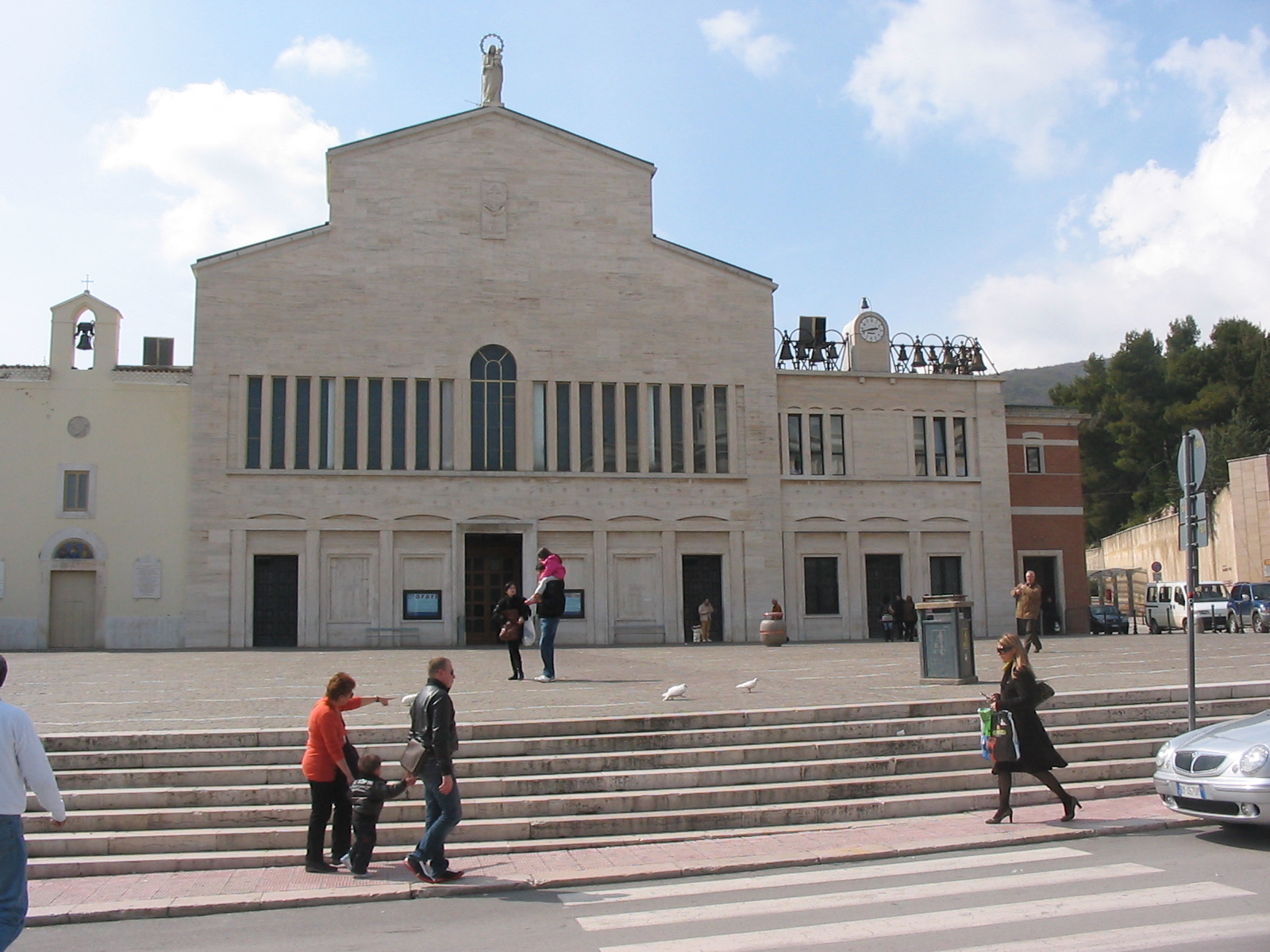 The Church-Shrine of Saint Mary of Graces and the Convent of Saint Padre Pio of Pietrelcina
San Giovanni Rotondo is best known as the home of Saint Pio ("Padre Pio") of Pietrelcina for most of his adult life.
I'm writing this thinking that the whole world already knows who Padre Pio is, but just in case, here is his story. In a nutshell, St. Pio was the most incredible mystic of the 20th century.
Multiple people witnessed Padre Pio bilocate, especially so he could hear multiple confessions at once; bear the stigmata, the nail holes and marks of Christ, on his hands; and read people's souls. St. Pio died in 1968 and was canonized by Pope St. John Paul II in 2002.
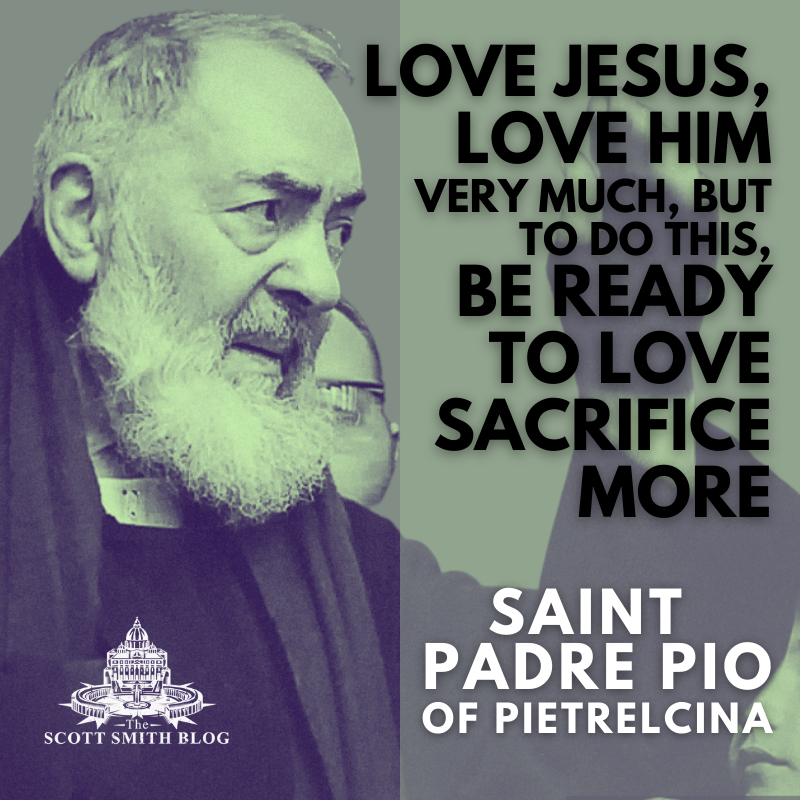
Looking for your own Padre Pio miracle? Here is a special gift from Tom and Donna. Here is a collection of Tom and Donna's personal prayer cards for St. Pio:
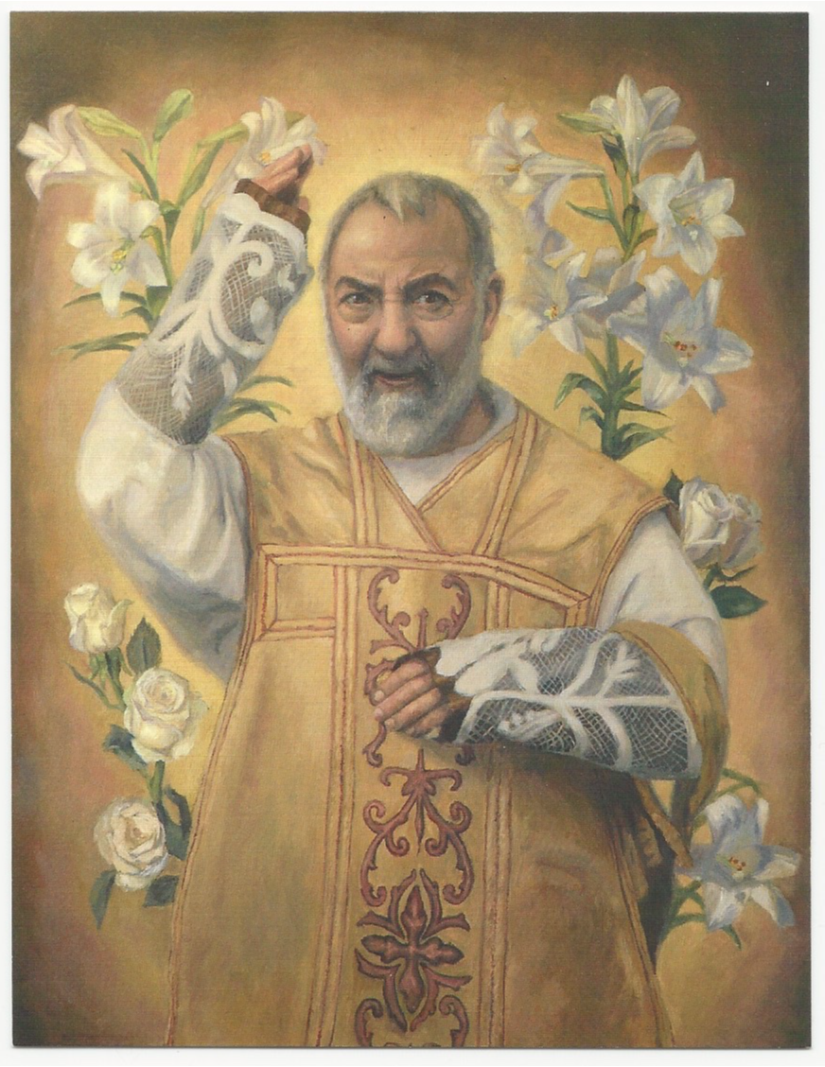
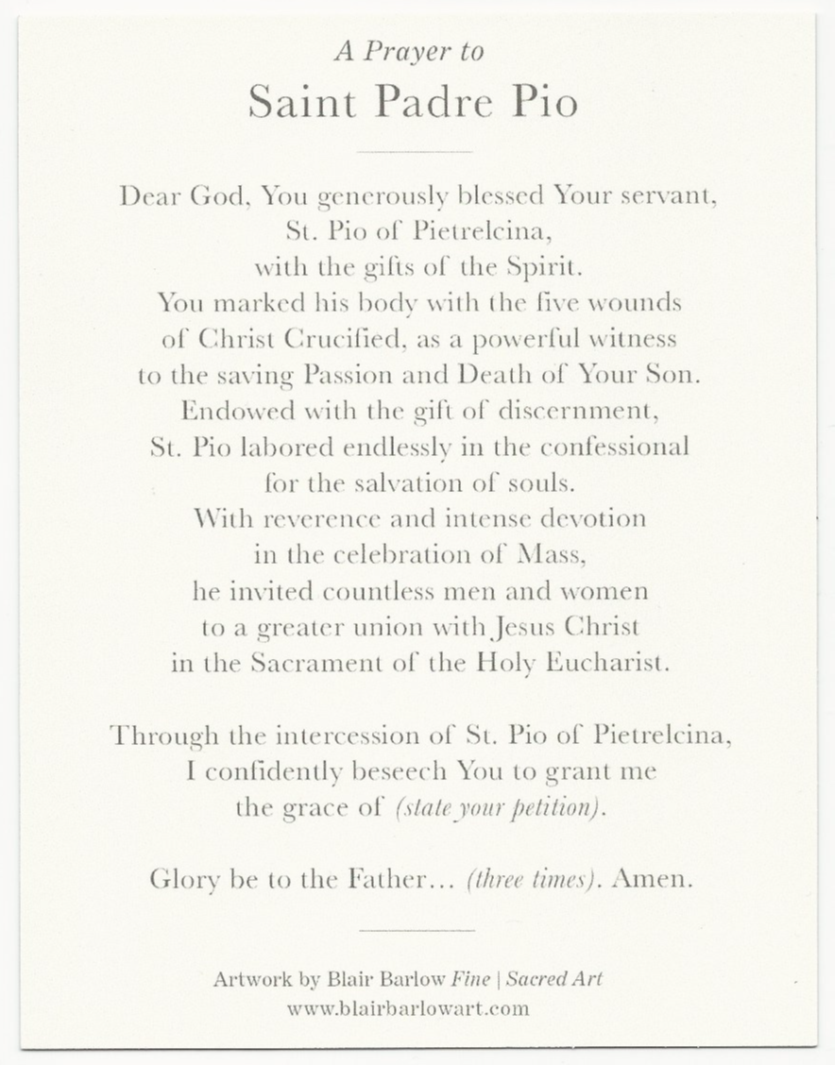
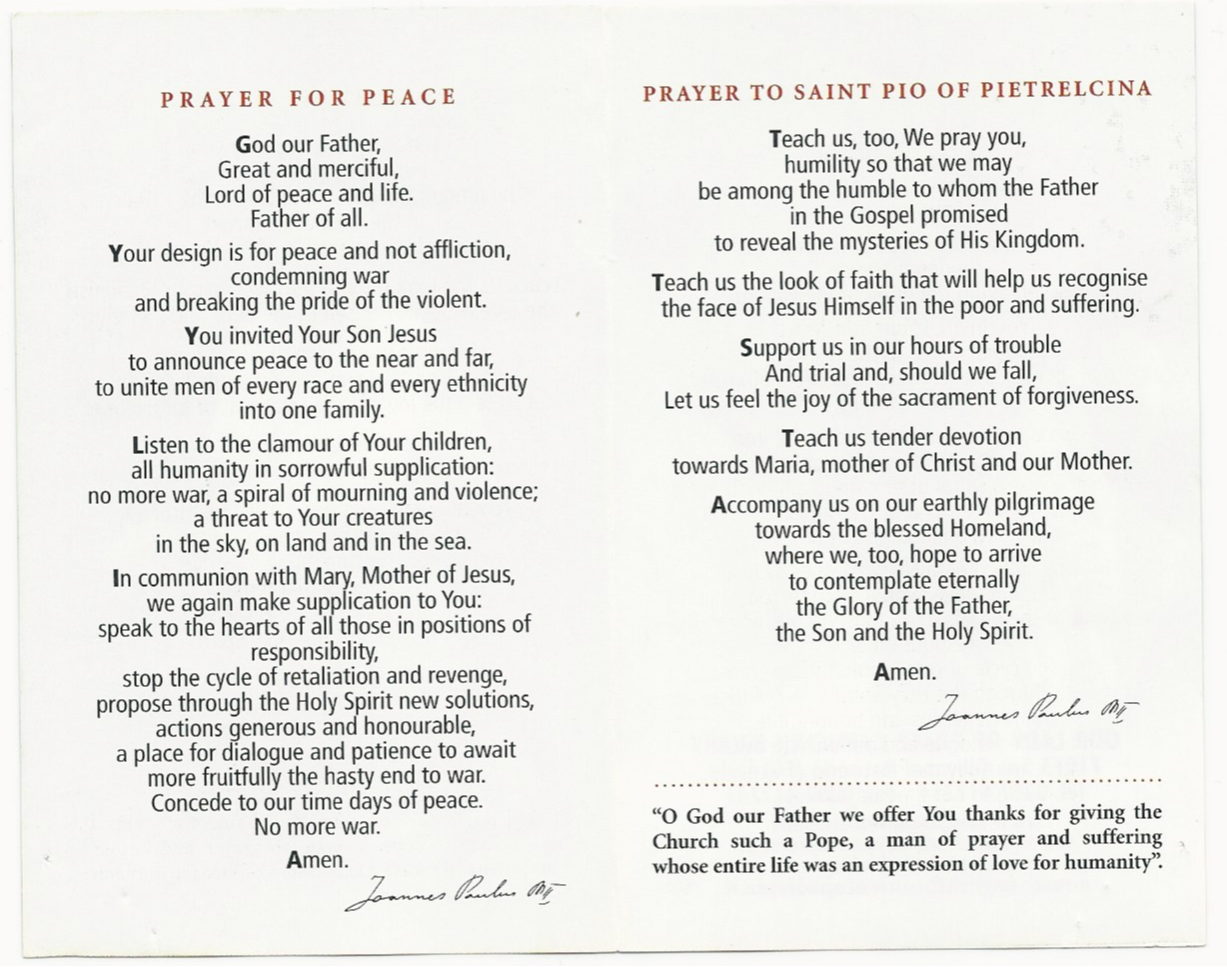
A Blessing from Padre Pio
St. Pio, however, did not roll out the red carpet for the church group, and especially for the longtime sufferer of MS.
According to Tom, "It was raining very hard as we walked up the walkway from the bus." Secondary progressive MS patients have trouble walking even in the best of conditions. Not only was it raining hard when Donna arrived at St. Pio's home, but there were steps and ramps to climb.
This was suddenly no obstacle to Donna. "Everyone from our group was amazed [when] Donna made it up the long incline without assistance," Tom describes.
The church group celebrated Mass in St. Pio's crypt. This was followed by a very special visit. The group met with Father Ermelindo Di Capua, OFM Cap.
Father Ermelindo is the Capuchin friar that assisted St. Pio in the last few years of his life. Here is a photograph of Pope St. John Paul II kneeling at St. Pio's tomb. You can see Father Ermelindo in the background:
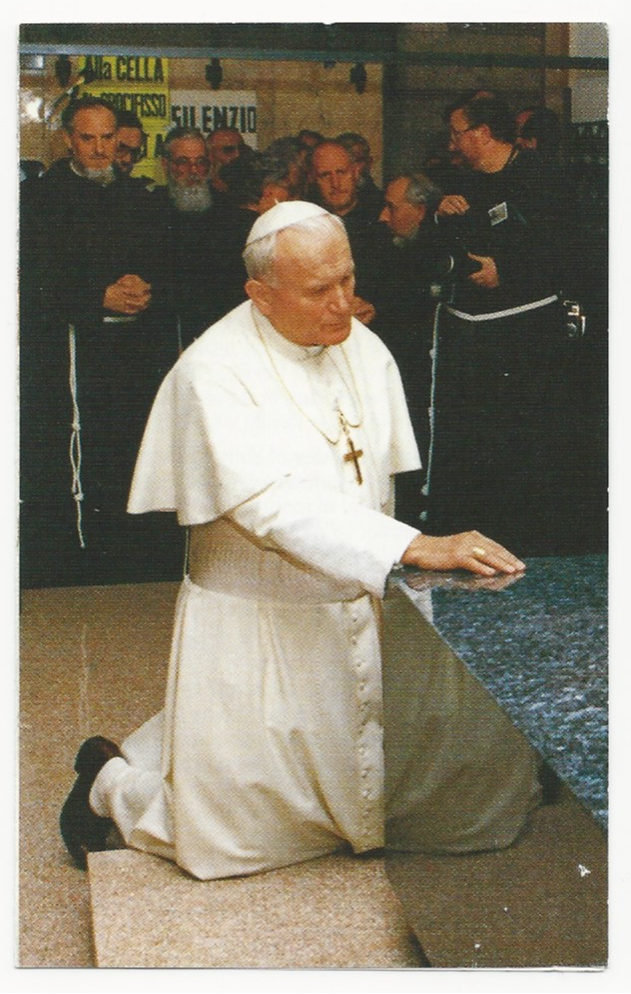
Tom and Donna made their trip to Italy just in time. Sadly, Father Ermelindo died on February 22, 2017. Here is the prayer card created for his funeral:

In his life, Father Ermelindo witnessed many miracles like the one described in this article. He will be sorely missed. Thankfully, the friars of San Giovanni Rotondo preserved some his memories and his testimony.
Here is also a video of Father Ermelindo describing his memories St. Pio:
Father Ermelindo blessed each member of the group with Padre Pio’s relics. He placed the relic on each of their foreheads, including Donna's.
St. Pio's relic was less than an inch from the source of all Donna's problems, the so-called "black holes" on her brain. For decades, MRI scans of Donna's brain showed "black holes" slowly spreading across her brain and impairing her motor and cognitive functions.
Before the group left St. Pio's shrine and monastery, they added Donna's name and condition to the prayer intentions at San Giovanni Rotondo.
Then nothing happened ...
For a while, at least. Four months, to be exact.
Four months later, Tom had prepared dinner for himself and Donna. Suddenly, Donna was unable to eat. Not because of the impairment of motor function, it was something else. The smell of roses.
Tom asked his wife what was wrong. Donna described a "very strong fragrance" of roses. She asked if Tom could smell them, too. He could not.
Tom had been reading about St. Pio. He knew that the floral fragrance was a sign of his presence. He relayed this information to his wife, but Tom continued to smell nothing ... except dinner.
Until ...
Tom and Donna fell asleep that night amazed at what had happened, but not understanding its significance. After a couple of hours, Tom suddenly awakened. He was sound asleep, but the fragrance of flowers was suddenly too intense.
I have often been awakened by sounds: my alarm, dogs barking, thunder, etc. I have been awakened by touch, like my kids shaking me in the morning to watch cartoons. I have been awakened by sights, like my wife turning on the bedroom lights. I have never been awakened by a smell. Thanks to my children, I have encountered plenty of intense smells while sleeping. Unless affected my some other sense, however, no smell alone has ever interrupted my sleeping.
Can you imagine how intense the smell of flowers must have been for Tom? Tom didn't just slowly awaken. He sat up straight in bed.
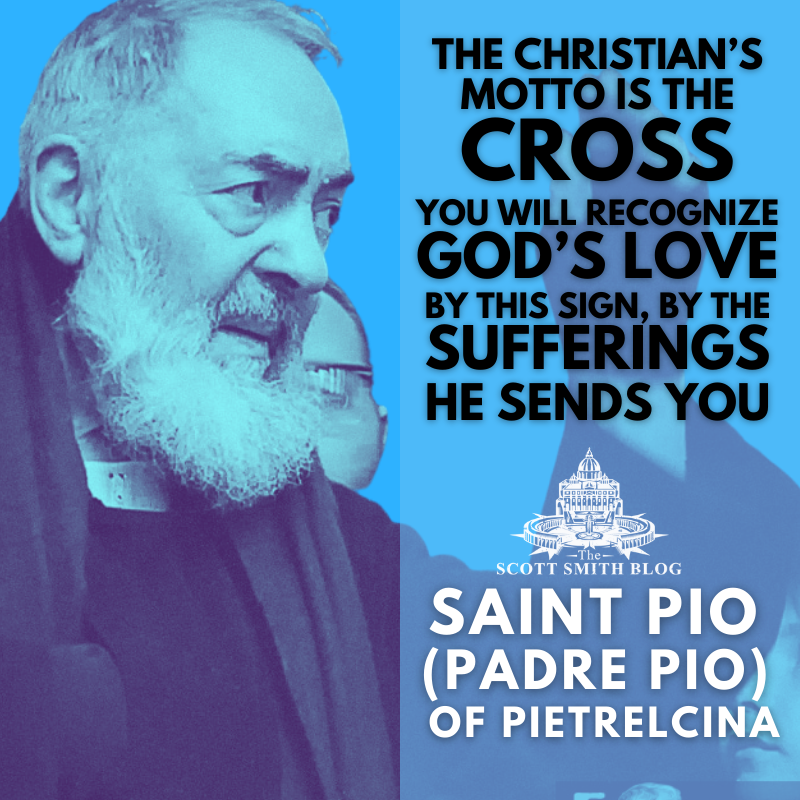
Several weeks following their night of flowers, it came time for Donna's regular appointment with her neurologist. As you might expect, something strange happened during that visit.
Donna scored higher on her disability index score than she had in over twenty years, since before her 1996 exacerbation. She also passed her cognitive test with 100%. This was the highest Donna had ever scored. Ever.
Before she met with the neurologist, an MRI was taken of Donna's brain. Every MRI up to this time showed progressively worsening brain atrophy and "black holes" across her brain.
The new MRI revealed no black holes. They were just gone.
Donna's neurologist said it is medically impossible for black holes to disappear, let alone heal.
The Hildebrandts also shared this news with their parish priest, Father Bani. Remember, Father Bani was a licensed radiologist before becoming a priest. Father Bani, the Hildebrandts' family doctor, and Donna's neurologist are all of one "mind". What happened to Donna was medically impossible.
To date, Donna's condition continues to improve. It is like the previous fifty years of multiple sclerosis were just wiped away. Her brain has fully healed.
Please share this message of hope and healing!
St. Pio, pray for us
Special Thanks to Tom and Donna
A big special thanks to Tom and Donna Hildebrandt for providing many of the photographs reproduced herein.
[1] Barbara Chenevert, "Worth the Wait: Late Vocations Answer God’s Call", Catholic Commentator.

August 16, 2021
St. Roch (St. Rocco) Novena for the Covid-19 Coronavirus Pandemic
Did you know we have a patron saint for protection in plagues, pestilences, and PANDEMICS?? And his feast day is today?
It is time to pray for intercession for our world in the midst of the Covid-19 Coronavirus Pandemic. Praying for the sick is always a good thing to do. It's a Spiritual Work of Mercy!
First, a little background on St. Roch ...
St. Roch was marked with a red cross on his chest at birth. When his parents died he inherited great wealth which he gave to the poor. St. Roch also devoted his life to helping the plague-stricken and sick.
St. Roch's miraculous powers were well-known, as was his birthmark turned trademark. He cured with the "Sign of the Cross".
During a 14th century plague in Italy, St. Roch came upon one of the most affected towns. According to the Catholic Encyclopedia, St. Roch “devoted himself to the plague-stricken, curing them with the sign of the cross. He next visited Cesena and other neighboring cities and then Rome. Everywhere the terrible scourge disappeared before his miraculous power.”
Read more about St. Roch's powerful intercession for plague-victims here.
 Saint Roch, in Pinacoteca Vaticana
After St. Roch's death, the following occurred, according to the Golden Legend:
... Anon an angel brought from heaven a table divinely written with letters of gold into the prison, which he laid under the head of S. Rocke. And in that table was written that God had granted to him his prayer, that is to wit, that who that calleth meekly to S. Rocke he shall not be hurt with any hurt of pestilence.
St. Roch is the patron saint of invalids and maybe, one day, those inflicted with the flu or coronavirus. His feast day is August 16.
Say this prayer:
O Blessed Saint Roch, Patron of the sick, have pity on those who lie upon a bed of suffering.
Your power was so great when you were in this world, that by the Sign of the Cross, many were healed of their diseases.
Now that you are in Heaven, your power is no less. Offer to God our sighs and tears and obtain for us the physical and spiritual health we week:
Share you request here ...
This we ask through Jesus Christ our Lord. Amen.
St. Roch: Pray for us, that we may be relieved from all diseases of body and soul.
(Repeat three times)
Lord Jesus, may thy will be done.
Lord Jesus, Divine physician, Have mercy on us.
(Repeat three times)
Pray the following: Our Father ... Hail Mary ... Glory Be ...
Repeat each day for nine days

August 10, 2021
Top 45 Best Quotes from Blessed Pier Giorgio Frassati on Faith, Joy, Nature, the Eucharist, Charity, Holiness, and Life
There are a ton of great quotes from Blessed Frassati. Even though Frassati lived only a short life - he died at 24 - many of his letters and other writings have been preserved.
I have curated below some of the best Pier Giorgio Frassati quotes. These Frassati quotes are organized into categories to help you, like the Eucharist, Nature, Happiness, etc. (some quotes fits in multiple categories). Enjoy!
Biography of Blessed Pier Giorgio Frassati Pier Giorgio Michelangelo Frassati was born in Turin, Italy on April 6, 1901.
Frassati was an avid mountain climber and often went to the theater, to the opera, and to museums. He loved art and music, and could recite whole passages from the poet Dante.
Though he only lived to the age of 24, Frassati packed his short life with great works of charity. In 1922, Frassati joined the Lay Dominicans (Third Order of St. Dominic). He took the name Girolamo after his hero, Renaissance preacher and Catholic reformer Girolamo Savonarola. Frassati loved Savonarola's fiery preaching. He wrote to a friend, "I am a fervent admirer of this friar, who died as a saint at the stake."
Blessed Pier Giorgio Frassati is a favorite among youth groups. Frassati is the patron of youth of all kinds: students, young Catholics, mountaineers, youth groups, Catholic Action, Dominican tertiaries, and World Youth Day.
Pier Giorgio Frassati's feast day is July 4th.
For a full biography of Blessed Pier Giorgio Frassati, check out my book, Blessed Is He Who ...: Models of Catholic Manhood . I collaborated on this book with historian Brian J. Costello.
[image error] [image error]
Blessed Pier Giorgio Frassati Quotes on CHARITYGod gives us health so that we may serve the sick.
In a world gone astray from God there is no peace, but it also lacks charity, which is true and perfect love.
Nothing is more beautiful than love. Indeed, faith and hope will end when we die, whereas love, that is, charity, will last for eternity; if anything, I think it will be even more alive in the next life!
Blessed Pier Giorgio Frassati Quotes on the EUCHARISTI urge you with all the strength of my soul to approach the Eucharistic Table as often as possible. Feed on this Bread of the Angels from which you will draw the strength to fight inner struggles.
Jesus who, because of infinite love for humanity, wanted to be in the Sacrament of the Eucharist, as our Consoler and as Bread of the Soul.
When you are totally consumed by the Eucharistic fire, then you will be able more consciously to thank God, who has called you to become part of His family.
Jesus is with me. I have nothing to fear.
Blessed Pier Giorgio Frassati Quotes on CHURCH & HOLINESSThe times we are going through are difficult because cruel persecution of the Church is raging. But you bold and good young people should not be afraid of this small thing; remember that the Church is a divine institution and cannot come to an end. She will last till the end of the world. Not even the gates of hell can prevail against her.
I hope that by the grace of God I will continue to follow these Catholic ideals so that one day, in the way God wishes, I will be able to preserve and promote these truths.
It is a difficult battle, but we must strive to win it and to rediscover our small road to Damascus in order to walk toward the destination to which we all must arrive.
Extended quote from above:It is a difficult battle, but we must strive to win it and to rediscover our small road to Damascus in order to walk toward the destination to which we all must arrive… What is clear is that faith is the only anchor of salvation and we must hold tightly to it: without it, what would our lives be? Nothing, or rather, wasted, because in life there is only suffering, and suffering without faith is unbearable. But suffering that is nourished by the flame of faith becomes something beautiful, because it tempers the soul to deal with suffering.
Blessed Pier Giorgio Frassati Quotes on LIFE We should never just get by; we should live!
A Catholic cannot help but be happy; sadness should be banished from their souls. Suffering is not sadness, which is the worst disease. This disease is almost always caused by atheism, but the end for which we are created guides us along life’s pathway, which may be strewn with thorns, but is not sad. It is happy even through suffering.
We who, by the grace of God, are Catholics, must not squander the best years of our lives as so many unhappy young people do, who worry about enjoying the good things in life, things that do not in fact bring any good, but rather the fruit of immorality in today’s world.
May peace reign in your soul… any other gift we possess in this life is vanity, just as all the things of this world are vain.
Blessed Pier Giorgio Frassati Quotes on NATURE & MOUNTAINSEvery day, my love for the mountains grows more and more. If my studies permitted, I’d spend whole days in the mountains contemplating the Creator’s greatness in that pure air.
Every day that passes, I fall more desperately in love with the mountains… I am ever more determined to climb the mountains, to scale the mighty peaks, to feel that pure joy which can only be felt in the mountains.
Every day, my love for the mountains grows more and more. If my studies permitted, I’d spend whole days in the mountains contemplating the Creator’s greatness in that pure air.
Blessed Pier Giorgio Frassati Quotes on TRUTHThere is no need to pay attention to gossip, much less get ill by giving in to those who perhaps have never known what truth is.
To live without faith, without a heritage to defend, without battling constantly for truth, is not to live but to 'get along'; we must never just 'get along'.
I hope that by the grace of God I will continue to follow these Catholic ideals so that one day, in the way God wishes, I will be able to preserve and promote these truths.
Blessed Pier Giorgio Frassati Quotes on JOY & SORROWTrue happiness does not consist in the pleasures of this world, or in earthly things, but in peace of conscience, which we only have if we are pure of heart and mind.
Foolish is he who follows the pleasures of this world, because these are always fleeting and bring much pain. The only true pleasure is that which comes to us through faith.
A Catholic cannot help but be happy; sadness should be banished from their souls. Suffering is not sadness, which is the worst disease. This disease is almost always caused by atheism, but the end for which we are created guides us along life’s pathway, which may be strewn with thorns, but is not sad. It is happy even through suffering.
Alternate translation of above quote:The end for which we are created invites us to walk a road that is surely sown with a lot of thorns, but it is not sad; through even the sorrow, it is illuminated by joy.
We who, by the grace of God, are Catholics, must not squander the best years of our lives as so many unhappy young people do, who worry about enjoying the good things in life, things that do not in fact bring any good, but rather the fruit of immorality in today’s world.
Modern society is drowning in the sorrows of human passions and it is distancing itself from every ideal of love and peace. Catholics, we and you, must bring the breath of goodness that can only spring from faith in Christ.
Blessed Pier Giorgio Frassati Quotes on FAITHThe faith given to me in baptism suggests to me surely: by yourself you will do nothing, but if you have God as the center of all your action, then you will reach the goal.
We must sacrifice everything for everything: our ambitions, indeed our entire selves, for the cause of the Faith.
In God’s marvelous plan, Divine Providence often uses the tiniest twigs to do good works.
All around the sick and all around the poor I see a special light which we do not have.
What wealth it is to be in good health, as we are! We have the duty of putting our health at the service of those who do not have it.
Learn to be stronger in spirit than in your muscles. If you are, you will be real apostles of faith in God.
To live without faith, without a heritage to defend, without battling constantly for truth, is not to live but to ‘get along’; we must never just ‘get along’.
May peace reign in your soul… any other gift we possess in this life is vanity, just as all the things of this world are vain.
What is clear is that faith is the only anchor of salvation and we must hold tightly to it: without it, what would our lives be? Nothing, or rather, wasted, because in life there is only suffering, and suffering without faith is unbearable. But suffering that is nourished by the flame of faith becomes something beautiful, because it tempers the soul to deal with suffering.
Faith enables us to bear the thorns with which our life is woven.
Blessed Pier Giorgio Frassati Quotes on HOPE & FEAR When God is with us, we don’t have to be afraid of anything.
I think peace will be a long time coming. But our faith teaches us that we must always keep on hoping we shall enjoy it one day.
With every day that passes, I grow more and more convinced how ugly the world is, of how much suffering there is, and, unfortunately, of how it is the good who suffer the most. Meanwhile, we who have been given so many of God’s blessings have repaid Him poorly. This is an awful reality that racks my brain; while I’m studying, every so often I ask myself: will I continue on the right path? Will I have the strength to persevere all the way? In the face of this pang of doubt, the faith given to me in Baptism reassures me of this: by yourself, you will accomplish nothing, but if you place God at the center of all your actions, then you will reach the goal.
To live without faith, without a heritage to defend, without battling constantly for truth, is not to live but to ‘get along’; we must never just ‘get along’.
Blessed Pier Giorgio Frassati Quotes on PRAYERIn prayer the soul rises above life’s sadnesses.
I beg you to pray for me a little, so that God may give me an iron will that does not bend and does not fail in his projects.
Prayer is the noble supplication which we lift up to the throne of the Most High. It is the most efficient means to obtain from God the graces which we need.
Blessed Pier Giorgio Frassati Quotes on SUFFERING & SACRIFICEWhat is clear is that faith is the only anchor of salvation and we must hold tightly to it: without it, what would our lives be? Nothing, or rather, wasted, because in life there is only suffering, and suffering without faith is unbearable. But suffering that is nourished by the flame of faith becomes something beautiful, because it tempers the soul to deal with suffering.
Our life, in order to be Christian, has to be a continual renunciation, a continual sacrifice. But this is not difficult, if one thinks what these few years passed in suffering are, compared with eternal happiness where joy will have no measure or end, and where we shall have unimaginable peace.
Faith enables us to bear the thorns with which our life is woven.
More Biographies of Blessed Pier Giorgio Frassati Blessed Pier Giorgio Frassati (1901-1925) was born in Turin, Italy, to a wealthy and prominent family. He was a vibrant, joyful, and athletic youth with an adventurous spirit and a strong zest for life. He loved mountain climbing, the theater, opera, and literature.
Blessed Pier Giorgio Frassati also had a deep spiritual life and a strong devotion to the Holy Eucharist and the Virgin Mary, even while his piety provoked criticism from his parents. He challenged his friends to a life of virtue, leading them in spiritual exercises such as daily Mass and the rosary.
Blessed Frassati joined the St. Vincent de Paul Society in 1918 and became a Lay Dominican in 1922. He was also politically active in resisting fascism and communism; he took part in public demonstrations and joined religious-political organizations such as the Catholic Students Federation and Catholic Action.
Frassati also spent much time caring for the sick and poor to a heroic degree, yet his parents punished him when they caught him giving away his money and possessions. While ministering to the sick he contracted polio and died just six days later at the age of 24. His family, thinking he suffered from a mild sickness, did not realize the seriousness of his condition until it was too late. At his funeral his parents were shocked to find thousands of the city's poor, whom their son had helped in some way, arrive to pay their respects.
For a full biography of Blessed Pier Giorgio Frassati, check out my book, Blessed Is He Who ...: Models of Catholic Manhood . I collaborated on this book with historian Brian J. Costello.
 [image error]
 Here is a link to another Blessed Pier Giorgio Frassati biography.

July 27, 2021
Was St. Joseph an Old Man or a Young Man? How Old was St. Joseph When He Married Mary? The Bible Tells Us St. Joseph's Exact Age
Yes! The Bible actually tells us St. Joseph's exact age. We can determine St. Joseph's exact age at Jesus' conception, birth, and when he married the Virgin Mary.
It's all in the original Greek.
You are going to love this ... We finally have an answer!
This is another awesome detail about St. Joseph's life that I learned from Dr. Brant Pitre. Check out his Bible study on St. Joseph, "The Hidden King".
While we're on the subject of St. Joseph ...
I was so inspired by Father Calloway's Consecration to St. Joseph ...
 [image error]
 ... that I was inspired to write a Consecration to St. Joseph for Children and Families, as well!
I'm excited to announce that Father Calloway and I will be publishing together the Consecration to St. Joseph for Children and Families. It will hopefully be released sometime during this year of St. Joseph.
Is St. Joseph an Old Man or a Young Man? How to Determine St. Joseph's Age from the BibleThere are two points in the same chapter of the Gospel of Luke that refer to a man's age. This is the first chapter of Luke. We see the age of Zechariah compared to the age of St. Joseph.
Compare Luke 1:18 and Luke 1:27.
The Age of Zechariah Compared to the Age of St. JosephAt Luke 1:18, Zechariah has just been told that God has heard his prayers. Elizabeth is going to bear a child in her old age. Zechariah asks the angel,
How shall I know this? For I am an old man, and my wife is advanced in years.
The Greek word that Zechariah uses for "old man" is presbytēs (πρεσβύτης).
 Zechariah by Michelangelo
Presbytes. Hold on to that for a second.
Just a few verses later, another word is used for "man". At Luke 1:26-27, another word for "man" is used to describe St. Joseph:
[26] In the sixth month, the angel Gabriel was sent from God to a city of Galilee named Nazareth, [27] to a virgin betrothed to a man whose name was Joseph, of the house of David; and the virgin's name was Mary.
The Greek word used to describe St. Joseph is andri (ἀνδρὶ).
Wait? These are just synonyms for "man", right? How can these two words tell us St. Joseph's (and Zechariah's) exact ages?
What was St. Joseph's Age at the Time of Jesus' Conception and Mary's Annunciation? Luke provides, within the space of a couple verses, two different words to describe St. Joseph and Zechariah:
Zechariah is described as an "old man": Presbytes (πρεσβύτης) St. Joseph is described as a "man": Andri (ἀνδρὶ) That's nice, you might be thinking. But how do these words tell us St. Joseph's age?
Philo of Alexandria Provides The Ages of ManhoodIn Jewish culture, certain words for man corresponded to specific age ranges. In English, we have specific terms for the ages of man: infant, toddler, boy, child, youth, man, middle-aged man, old man, etc. These terms usually do not correspond to specific ages. But in Judaism, they do.
The Church Father, Philo of Alexandria, provides the specific ages that correspond to these terms: infant, toddler, boy, child, youth, man, middle-aged man, old man. Each one is a seven-year period.
Here is the excerpt from On the Creation by Philo of Alexandria, paragraph 36: (here is a link to the PDF with the Greek and English side-by-side)
ON THE CREATION (A Treatise on the Account of the Creation of the World, as Given by Moses)
XXXVI. (105) Solon therefore thus computes the life of man by the aforesaid ten periods of seven years. But Hippocrates the physician says that there are seven ages of man, infancy, childhood, boyhood, youth, manhood (Gk. andri ἀνδρὶ, also ánír άνήρ), middle age (Gk. presbytes, πρεσβύτης), old age; and that these too, are measured by periods of seven, though not in the same order. And he speaks thus; ``In the nature of man there are seven seasons, which men call ages; infancy, childhood, boyhood, and the rest. He is an infant till he reaches his seventh year, the age of the shedding of his teeth. He is a child till he arrives at the age of puberty, which takes place in fourteen years. He is a boy till his beard begins to grow, and that time is the end of a third period of seven years. He is a youth till the completion of the growth of his whole body, which coincides with the fourth seven years. Then he is a man (Gk. andri ἀνδρὶ, also ánír άνήρ ) till he reaches his forty-ninth year, or seven times seven periods. He is a middle aged man (Gk. presbytes, πρεσβύτης) till he is fifty-six, or eight times seven years old; and after that he is an old man.
Did you know you were a boy until your beard starts to grow? The beard is apparently the doorway to manhood (Gk. andri). (I'm glad it's not the doorway to womanhood)
More importantly, do you notice the same two Greek words we found in the Gospel of Luke? Again, we have andri and presbytes, "man" and "middle-aged man", respectively:
"Man" or andri is the fifth seven-year period or ages 43-49"Middle-aged man" or presbytes is the sixth seven-year period or ages 50-56
Based on this, St. Joseph was between the ages of 43-49 when Jesus was conceived in the Virgin Mary and born. Zechariah, being a presbytes, was between the ages of 50-56.
There you have it!
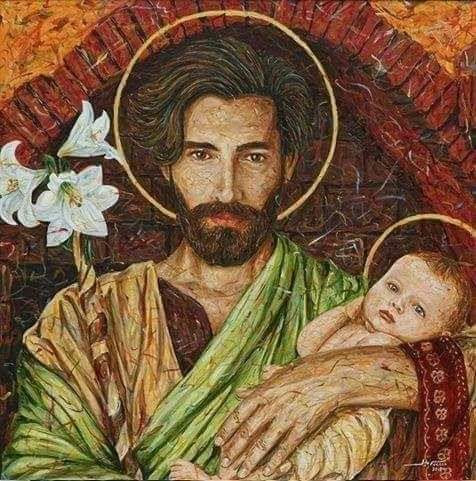
So, How Old was St. Joseph when He Married Mary? How Old was St. Joseph when Jesus was Born?The Gospel of St. Luke makes a distinction between two words for "man" -- andri and presbytes -- in the same chapter. Since St. Joseph is identified as a "man" or andri, we can narrow down his age to within seven years. St. Joseph is between 43-49 when he married the Virgin Mary and when Mary conceived Jesus in her womb (also called the Annunciation or Incarnation).
How's that for specificity?
Isn't that amazing?
Scholars have been fighting over the age of St. Joseph for over a millennium. All this time, the answer was just waiting for us in the first chapter of Luke.
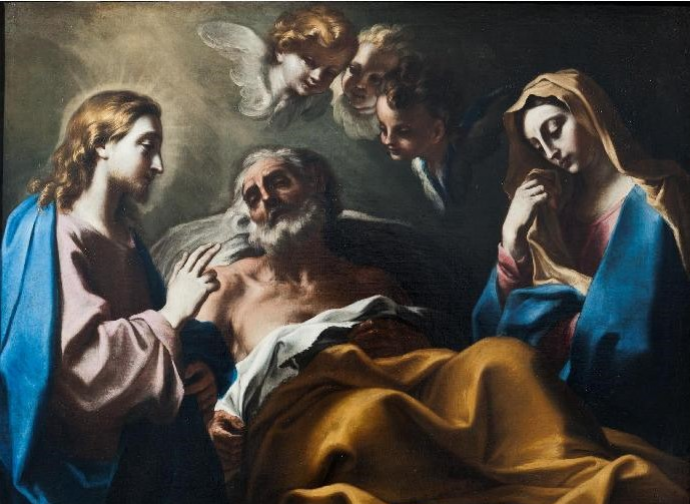
How Old Was St. Joseph When He Died?St. Joseph was between 43-49 when he married the Virgin Mary and when Jesus was conceived. St. Joseph is not mentioned again (as living) at or following the beginning of Jesus' public ministry. St. Joseph is not mentioned in the account of the Wedding at Cana, even though the Virgin Mary is. If the Virgin Mary was invited to the Wedding at Cana, St. Joseph likely would have joined her, if he could.
Therefore, Biblical scholars generally assume that St. Joseph was no longer living by the time Jesus was thirty years old.
Let's do the math. We add 30 years -- Jesus' age when he begins his public ministry -- to St. Joseph's age at the conception of Jesus. This takes us to ages 73-79. The upper limit of St. Joseph's age when he died is 73-79.
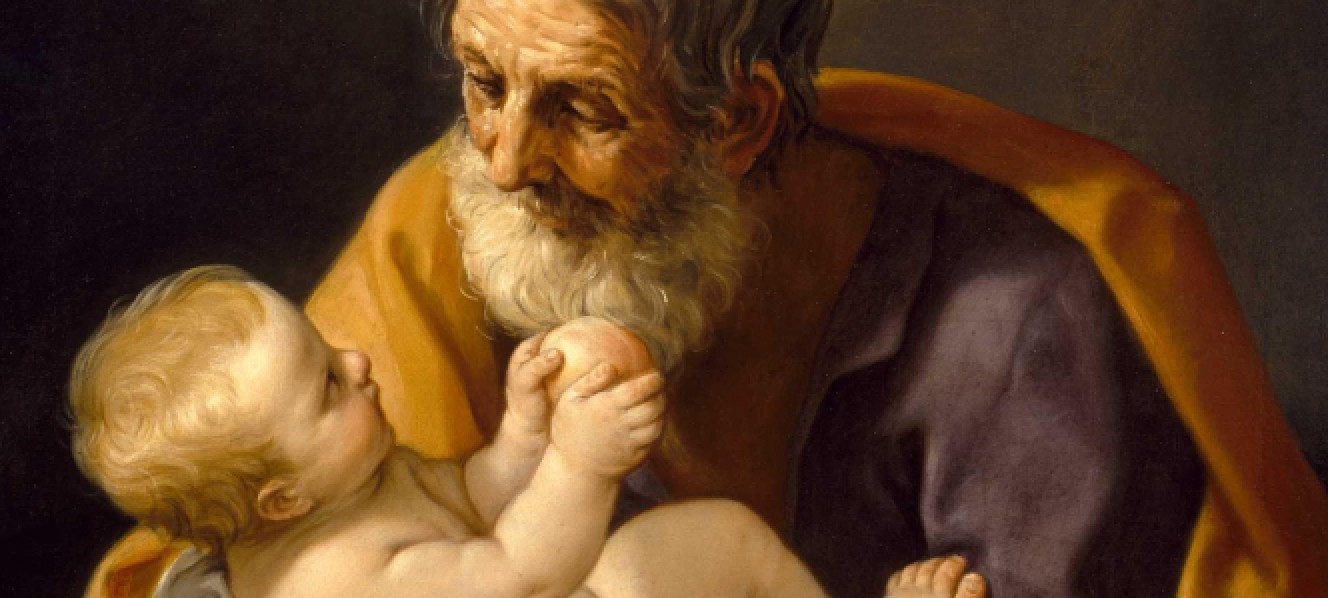
Later Apocryphal Texts Describe a MUCH Older St. JosephThere is an apocryphal text entitled History of Joseph the Carpenter. It was originally written long after the age of Jesus and the Apostles. The History of Joseph the Carpenter dates from the 5th or 6th century.
The History of Joseph the Carpenter includes a long account of Joseph's peaceful death. The work puts St. Joseph's age at 111 at his death.
This text, however, also describes Jesus' age at St. Joseph's death at 19. This appears to contradict the canon of the New Testament, because this gives us a much older St. Joseph. If Jesus was 19 when St. Joseph was 111, St. Joseph would have been ... a whopping 92 years old at Jesus' conception!
If St. Joseph had been 92 at the conception of Jesus, St. Joseph would have been almost twice the age of Zechariah! That does not work. Taking all the evidence together, St. Joseph dying at 73-79 is a much better fit.
How would a 92-year-old man walk the Holy Family to Egypt? And defend them from all the robbers and brigands along the way? God is a better planner than that.
A Note on St. Joseph's Age and the Perpetual Virginity of MaryWhy did the apocryphal works inflate St. Joseph's age? The later writers wanted to ensure the Virgin Mary was described as perpetually virgin. St. Joseph was described as an elderly widower to ensure a separate source for Jesus' brothers and sisters. This is not necessary, however.
The Gospels, themselves, describe Jesus having "brothers" (Gk. adelphoi). Adelphoi can mean biological brothers, cousins, kinsman, etc.
Jesus' brothers are identified as James, Joseph (Joses), Judas (Jude), and Simon at Mark 6:3 and Matthew 13:55-56. These men are later identified at Mark 16:1 as the sons of Clopas and the other Mary. Unless the Virgin Mary's parents named multiple daughters "Mary", Clopas was St. Joseph's brother and Mary's sister-in-law:
But standing by the cross of Jesus were his mother, and his mother’s sister, Mary the wife of Clopas, and Mary Mag′dalene (John 19:25)
For more on the family of Jesus and Mary's Perpetual Virginity, check out these other resources: Mary of Cleophas, EWTN articleJesus had Brothers? Catholic Answers article by Matt Fradd“Brethren of the Lord” Catholic Answers article