Scott L. Smith Jr.'s Blog, page 4
January 4, 2024
The Symbolic Power of Water in C.S. Lewis' Chronicles of Narnia Series
Water is a powerful symbol in many of the world’s best-selling novels and C.S. Lewis’ Chronicles of Narnia series, which comprises seven exciting and deeply meaningful stories, is no exception.
Within these works, it does more than serve as a metaphor for a quality or state of mind; it is often the chosen medium that represents a character’s transformation, self-discovery, and maturation.

In collaboration with Guest Author, Lottie Westfield
Water Symbolism in C. S. Lewis' Chronicles of Narnia - Table of Contents Table of Contents "A broad river divided itself into two streams and on the island between them stood the city of Tashbaan, one of the wonders of the world." - Chapter 4, A Horse and His Boy
The Woman at the Well of Narnia, The Silver Chair
Water is also used in the Narnia books to symbolize purity and spirituality. The character of Aslan, who in many ways is a Christ-like figure, is closely linked to water.
For instance, his presence is felt in the rain that falls over Narnia and restores life in this magical land. The rain is a symbol of divine intervention and the grace of God. There are fascinating parallels between the Christian God and Aslan.
For instance, in the Old Testament of the Bible, God is described as “the fountain of living waters.” In the New Testament, Jesus greets the Woman at the Well, revealing to her that He is the source of living water:
Jesus said to her, “Every one who drinks of this water will thirst again, but whoever drinks of the water that I shall give him will never thirst; the water that I shall give him will become in him a spring of water welling up to eternal life.” The woman said to him, “Sir, give me this water, that I may not thirst, nor come here to draw.” John 4:13-15
Likewise in The Silver Chair, Jill is dying of thirst and Aslan tells her that the only way she can stay alive is to “drink from his stream.”


Jill is afraid to approach the stream because Aslan, the lion, terrified her. So she tells Aslan that she will go find another stream. But Aslan, like Christ, is the only source of "living waters."
“Are you not thirsty?” said the Lion.
“I’m dying of thirst,” said Jill.
“Then drink,” said the Lion.
“May I — could I — would you mind going away while I do?” said Jill.
The Lion answered this only by a look and a very low growl.
…The delicious rippling noise of the stream was driving her nearly frantic.
“Will you promise not to – do anything to me, if I do come?” said Jill.
“I make no promise,” said the Lion.
…“I daren’t come and drink,” said Jill.
“Then you will die of thirst,” said the Lion.
“Oh dear!” said Jill, coming another step nearer. “I suppose I must go and look for another stream then.”
“There is no other stream,” said the Lion.
It never occurred to Jill to disbelieve the Lion – no one who had seen his stern face could do that – and her mind suddenly made itself up. It was the worst thing she had ever had to do, but she went forward to the stream, knelt down, and began scooping up water in her hand. It was the coldest, most refreshing water she had ever tasted. You didn’t need to drink much of it, for it quenched your thirst at once.
The Silver Chair, p. 19-21.
As you see above, C. S. Lewis is making a direct connection between Jill at the stream and the woman at the well of John 4. Jesus is the only source of these waters. Or, as Aslan says, "There is no other stream."
Also, the water quenched Jill's thirst at once: "You didn’t need to drink much of it, for it quenched your thirst at once." Likewise, Jesus says at John 4: "Whoever drinks of the water that I shall give will never thirst."
Again in The Voyage of the Dawn Trader, Eustace has to bathe in Aslan’s well to cleanse himself from the dragon form.
Of course, there are more parallels. For instance, Psalm 23:5 says, “My cup runneth over.” In The Horse and His Boy, Shasta drinks from a makeshift cup made by Aslan’s paw print, which is filled with water.
Water has a powerful symbolic role in the Narnia series of books. It symbolizes a plethora of important human values, including courage, renewal, and spiritual enrichment. It is also a powerful metaphor for transition and for facing loss and pain yet emerging with a richer and more meaningful life.
 Click to purchase a copyIn the book The Horse and His Boy, the characters Shasta and Aravis cross a great river on their journey from Calormen to Narnia. The river is an obstacle in itself, yet it is also the road to freedom from the tyrannical regime of Calormen, where they would have to resign themselves to a life of captivity and servitude if they stayed.
 The water also brings them new possibilities they never imagined—and the chance to meet new people and experience magnificent adventures. The characters additionally grow in confidence, and their crossing to Narnia represents their willingness to align themselves faithfully to the values of Narnia—including justice, honesty, and a commitment to doing the right thing.
Water in Narnia sometimes harks back to Christian roots—in particular to the ceremony of baptism—where water symbolizes new birth and the washing away of sin.
In The Lion, the Witch and the Wardrobe, the children's arrival in Narnia is accompanied by a great thaw, which symbolizes the end of the White Witch’s frozen hold over the land. The melting of the water, sparked by Aslan’s return, expresses the washing away of all things evil and impure and the restoration to life of all the creatures of Narnia who were frozen. It is a powerful metaphor for the power of good and the everlasting nature of hope—a flame that can never be put out.

In The Silver Chair, the characters Jill Pole, Puddleglum the Marshwiggle, and Eustace Scrubb travel through an underground river, as they fight to rescue Prince Rilian and defeat the villainous witch.
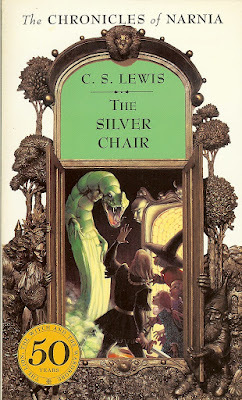 Click to purchase a copy
 (I love this vintage cover. These were the books from my childhood - Scott)
As lovers of mythology will know, underground bodies of water, like the River Styx, often symbolize the transition from life to death—the Underworld is the place where Hades reigns supreme. It is also home to five rivers that serve as a border between the worlds of the living and the dead.
 Map of Underland and the Sunless Sea, Silver Chair
The Sunless Sea in The Silver Chair similarly represents the characters’ symbolic death and rebirth. They undergo a myriad of incredible challenges, including the absolute darkness of the water, the strange sounds and creatures they encounter, and a powerful enchantment that causes them to fall into a deep sleep.
The Sunless Sea also symbolizes the many trials and tribulations that people go through—including sickness, loss, and pain. So many difficult and traumatic life events are unpredictable and when they occur, they can make it seem like we have lost control.
So, too, do our heroes find themselves going in the wrong direction, getting lost, and becoming confused and disoriented. There is a constant threat of danger and their emotional states range from fear to fatigue and anxiety. However, through resilience and determination, they eventually find their way out of their anguish.
By focusing on their mission and the things they value (in this case, their friends), they are able to find their way out of this underground labyrinth and once again find meaning and joy in their lives.
This sentiment once again echoes sacred passages, including the well-known passage of Isaiah 6:8, in which the reader is reminded that qualities like faith and hope must be expressed through our daily lives.
The whole world may be chaotic, and it can sometimes be hard to discover one’s purpose. Yet dedicating one’s time to fulfilling one’s purpose is a powerful manifestation of the importance of living a life filled with purpose.
mbtTOC();

November 14, 2023
Pray Without Ceasing: Catholic Family Daily Prayer Routine
Is your New Year's Resolution to reach Catholic Level: EXPERT? Here's how.
Need help balancing prayer and the daily grind? Trying to incorporate prayer into your or your family's hectic routine? Here's how to fit prayer into your life.Want to learn how to pray the Rosary everyday? Looking for step by step instructions for praying the Rosary, the Chaplet of Divine Mercy, and other Catholic prayers?

Catholic Family Prayer Infographics Table of ContentsHere are all the prayers your family needs to mark the day with unceasing prayer:
Table of Contents

So, what should we do in response to the quote above? Pray without ceasing.
1) All Day: Prayer before meals2) Morning: The Holy Rosary3) Noon: The Daily Examen4) 3pm: The Chaplet of Divine Mercy 5) Bonus: The Liturgy of the Hours (also called The Divine Office)
1 Thessalonians 5:17 tells us to "pray without ceasing". But how? A man's gotta eat, right?
All Day: Catholic Prayer Before Meals, Bless Your FoodWell, grace before meals is definitely a good start. If you're not already doing this, DO IT. Don't eat any more unblessed food this New Year.
Also, if you're a father, you need to be leading your family in the blessing before the meal. Invite contributions from your wife and kids, too. My little girl, Lucy, usually has about five intentions to add to our blessing before dinner. She even asks that we pray for her imaginary friend.
If the basic Catholic meal blessing (see below) feels a little rote or tired, try adding a short litany at the end in addition to taking intentions. My litany tends to be a little long, at least my family thinks so. I ask for intercession from all the kids' saintly namesakes, oldest to youngest, as well as my and my wife's Confirmation saints.
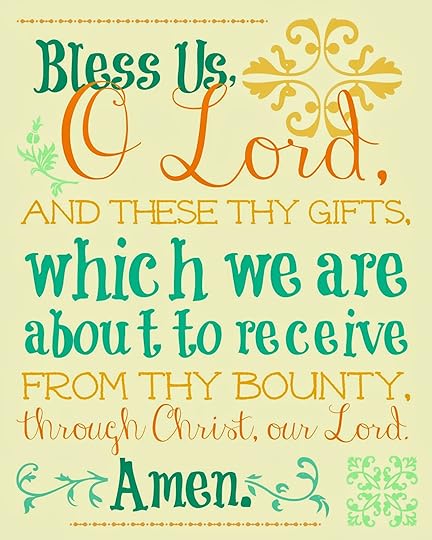 Kendra at Catholic All Year
Catholic Meal Blessings in LatinThere is also the Latin version of the meal blessing. Praying in different languages is a great way to incorporate different languages into your family life.
Here's the prayer infographic for the Catholic blessing before and after the meal in Latin:

Morning Rosary: How to Pray the Rosary Step by Step Infographic PrintableWould you rather have a good day than a bad day? I recommend praying the Rosary first thing or as near to it as possible. In your car on the way to work is a good time. Saying the Rosary puts your entire day on a better trajectory. That's why I recommend saying it as soon in the day as possible.
Want to say the Rosary, but you're for a guide on how to pray the Rosary step by step? Here's a great infographic on the Rosary:

Source: The Catholic Faith Store
Daily Examen at Noon: How to Pray the Daily ExamenNext, here's an infographic on the The Daily Examen, a prayer urged by St. Ignatius and considered by some, including St. Pope John Paul the Great, to be the most important prayer of the day, after the Rosary.
 Source: Busted Halo
Mid-Afternoon Divine Mercy Chaplet: How to Pray Divine MercyThe Chaplet of Divine Mercy is an excellent way to round out your day in prayer. Begin the day with the Rosary, pray the Daily Examen at noon, and then say the Chaplet of Divine Mercy at 3:00pm. 3PM is a very special time of the day for reflection, as it corresponds with the time of Christ's death on the Cross.

Bonus: The Liturgy of the Hours - How to Pray the Liturgy of the Hours? How to Pray the Divine Office?Pray like the monks!
Saying the Liturgy of the Hours (also called The Divine Office) is an ancient practice beginning in the very first centuries after Christ. It's also a skill that is best learned beside those who do it well.
It takes practice. If you don't have a monastery, seminary, or religious community nearby to learn from, this website is a great place to start: Universalis. In some parishes, there are even groups that meet at the local church to pray the Divine Office together.
Here's one last infographic showing the "hours," the periods of prayer during the daily Divine Office:
 For the work-a-day monk
, people like you and me trying to live common lives of holiness in the midst of all the hustle & bustle and the nitty & gritty, here's a way to pray the day, "Seven Times A Day":
For the work-a-day monk
, people like you and me trying to live common lives of holiness in the midst of all the hustle & bustle and the nitty & gritty, here's a way to pray the day, "Seven Times A Day":1-3) Prayer before meals: 3 per day (plus snacks)4) Morning: The Holy Rosary5) Noon: The Daily Examen6) 3pm: The Chaplet of Divine Mercy 7) Prayer before Bedtime
God bless!

November 6, 2023
The No-Watch List: Guide to All the Kids' Shows and Movies That Have LGBTQ Characters and Content
I keep hearing about new and old kids' shows and movies adding LGBTQ characters, storylines, etc. Or for the full, incoherent, and current alphabet soup abbreviation: LGBTQIA+.
Honestly, years ago, my family started weaning ourselves off constant TV shows and movies. TV and movies still leak into the cracks, though, when we are visiting friends, the dentist's office, etc. We will still have family movie night, of course--so many classics to show the kids!
But it's still good to know and to help others know. Please help me with this list! Comment below with new and old shows and movies that need to be added to this list. Thanks in advance.

It's also hard to find a list of LGBTQ kids shows and movies from the Christian perspective. A Google search on this topic quickly reveals Google's LGBTQ bias on this topic.
Phew! It has taken me a long time to put this together. I will greatly appreciate your help in adding to this list and helping me keep in current.
So, here is the list of kids' shows and movies ruined by the forced addition of LGBTQ characters and storylines, in alphabetic order, plus the approximate season for when the show went bad.
WARNING: Many of the quotes I use to describe when the show went bad have been compiled from LGBTQ-friendly sites, so they may describe the content in a positive light. I certainly do not see this content as a positive thing.
>> "Ab Initio" designation means a show was gay from the beginning
Yeah, Disney is on this list a lot ...
The table of contents below will help you navigate the list: (Note: Table of Contents may only be visible on desktop view)
Table of ContentsGRID OF ALL KIDS SHOWS WITH LGBTQ CONTENTYou can access this database here, as well. Warning: the database is celebrating gay content.




KIDS SHOWS, ANIMATED SERIES, TV OR STREAMING, WITH LGBTQ CONTENTFor movies, see the list below at the end of all the television shows.
Adventure Time, Cartoon Network - Ab Initio
Adventure Time is one of those shows that may look and feel like a children's show, but was never a children's show. This is likely by design, unfortunately.
Adventure Time has always been pretty obvious about promoting LGBTQ lifestyles. This has only increase over time. According to an article from queer-advocacy site Polygon:
It took 10 seasons and 283 episodes for Princess Bubblegum and Marceline the Vampire Queen to kiss on Adventure Time. Of course, it was obvious they were together — or at least had feelings for each other — long before that, evidenced by their sharing clothes and general moon eyes in each other’s presence. Since the series ended in 2018, we’ve seen the pair simply exist as queer people in the 2020 Adventure Time: Distant Lands “Obsidian” special, both as individuals and as a couple, and they’re still a couple in the new Fionna and Cake spinoff series on Max. They are always written as each other’s romantic destinies.

Not exactly promoting the institution of the family ... the sister of the protagonist in this show is also her mother and grandmother. [Squints eyes]
Description from What's Up, Moms, which, sadly, promotes gay shows for kids:
An artsy teenage girl named Andi finds out one day that her sister is actually her mom. But weirder than that, her mom is actually her grandmother. I know, I know, you just have to see it. This is a brilliantly written show about characters trying to find out who they really are and the crazy adventures they have in an effort find that truth. We love that Andi’s best friends Cyrus and Buffy are along for the ride and in Season Two, we watch as Cyrus courageously comes out.

Arthur, PBS Kids - Season 22This was a painful one. When I was a kid, I read the Arthur books -- the show wasn't really a thing yet. I can still remember the smell of those glossy pages. Partly because I still have them!
Here's the point of breakdown from an NBC News article:
Mr. Ratburn from the children's show “Arthur” got married to another man in the show's 22nd season premiere, spurring effusive reactions from those who grew up watching the program. The episode, titled “Mr. Ratburn and the Special Someone,” starred lesbian actor Jane Lynch as a special guest ...
Maybe there's some solace in the fact that it was the rat ...
This one is even more problematic, because Ratburn gets married:


Blues Clues, Nickelodeon - Reboot Ab Initio, Not Original SeriesGet a clue!
John Bursch of Alliance Defending Freedom, the author of a new book, Loving God’s Children: The Church and Gender Ideology, describes when Blue's Clues went dark:
Two years ago, it was an episode of Blue’s Clues — a show for very young children — that featured a ‘Pride Parade’ that included a float with a young cartoon beaver who had tape over her chest from breast removals.
That's literally crazy: teaching children about trans-based body disfigurements. Gross.

Bubble Guppies, Nickelodeon - Season 4, Episode 2Bubble Guppies was one of the first to go dark. That is, it was one of the first kids shows to introduce an overtly gay character. On June 2, 2015, gay drag queen RuPaul guest starred as a snail in the episode "Costume Boxing!" Bug Diaries, Amazon - Ab InitioThe “Bug Diaries” (Amazon) character Worm has two moms.
Chip and Potato, Netflix - Season 2According to the Philadephia Gay News :
Season 2 of Netflix’s animated series for preschoolers, “Chip and Potato,” has introduced a two-dad family to its cute anthropomorphic world. The series revolves around the adventures of Chip, a young pug, and her secret friend Potato, a mouse whom Chip pretends is a stuffed animal. In episodes 8 and 10 of season 2, we meet new neighbors Roy and Ray Razzle, two dad zebras, and their baby twins. Chip and her parents treat them just like any other family.

Clifford the Big Red Dog, PBS Kids, Amazon - Reboot Series, Season 1, Episode 12, Not Original Series In 2020, it was reported that the beloved animated show Clifford the Big Red Dog became the second PBS Kids series with a recurring LGBT character.
In “The Big Red Tomato/Dogbot,” one of Emily Elizabeth’s friends, Samantha, brought her two moms to a dinner party.

Creative Galaxy, Amazon - Season 3, Episode 1The 2018 “Arty’s Holiday Masterpiece” episode of Creative Galaxy depicts a girl showing a craft project to her two dads.
Dead End: Paranormal Park, Netflix - Ab Initio
Description from What's Up, Moms, which, sadly, promotes gay shows for kids:
This animated trans series that sprang from the graphic novel series called DeadEndia. This British American fantasy-horror-comedy follows a trans teen named Barney, his neurodivergent best friend Norma, and a pug as they battle demons at a haunted theme park. If they succeed, they might just save the world from a supernatural apocalypse.
Doc McStuffins, Disney Junior - Season 4, Episode 22 Doc McStuffins and the tale of two moms ...
The episode "The Emergency Plan" focuses on two mother dolls that separate from their kids after a dragon causes an earthquake.
NBC News reported Doc McStuffins going to the dark side in 2017:
Disney Junior's animated show "Doc McStuffins" aired an episode last week in which a family experiences an earthquake and learns how to plan for it in the future. The family just happens to be headed by two mothers: one black and one white.
Voiced by comedian Wanda Sykes and actress Portia de Rossi, Thea (Sykes) and Edie (de Rossi) are the latest same-sex couple to be featured on a children's television show.

Ducktales - Reboot Series, Season 3, Episode 1I was a big Ducktales fan as a kid, and I was really enjoying this reboot with my kids ... until ...
The Season 3 premier featured a pair of gay dads, pictured below:

Not good! But that's just the beginning ...
Of course, it would be the alien ducks that are made LGBTQ. In season 2, Donald's sister, Della, gets trapped on the moon with an alien civilization called the Moonlanders.
By Season 3, one of these Moonlanders has come back to earth with the Ducks and is trying to make a home on this planet with her new friends. This Moonlander is the character Penumbra, a guarded and pragmatic lieutenant voiced by Julie Bowen (Modern Family).
At one point, Penumbra says "What? No! We are not enemies. I just do not wish to date an Earth ... Male."
This implied lesbianism was later confirmed by the writer and director of the episode, Sam King. King said the following in a tweet:
"Hey yeah! For clarity, I had certain constraints I had to work in to get this across, so believe me I'm the first to say I wish it was more overt," she said. "But yes, Penny calls everything on Earth "Earth -" her saying "Earth... male" is specifically saying "Men." She's a lesbian."

Heartstopper, Netflix - Ab Initio
British school boys aren't just traveling to Narnia anymore.
Description from What's Up, Moms, which, sadly, promotes gay shows for kids:
You might recognize the title Heartstopper from the viral queer graphic novel that exploded in 2019; it features two British school boys, Charlie (who is openly gay) and Nick (who is not) falling in love. The Netflix series is based on the graphic novel by Alice Oseman and features themes around love, friendship, mental health, and LGBTQ+ issues. We’ve seen a million stories just like this one featuring heterosexual teens, but here we get to watch first love bloom between two queer characters, and we are so here for it.
Nothing good to see here, folks ...

Jurassic World: Camp Cretaceous - Season 4, implied; Season 5, LGBTQ kids kissing Jurassic World: Camp Cretaceous not only features LGBTQ characters. It also features LBGTQ kids kissing. RED ALERT! Yasmina “Yaz” Fadoula, a standout athlete and especially a track star is one of multiple LGBTQ characters. Here is the "progression" of her character to "out" and "out" gay from gay-friendly site Autostraddle.com:
Yaz is a little bit of a cynical loner. Sammy is the most exuberant, social gal in the group. Their friendship blossoms into Real Feelings. And, finally, in the final season, Yaz says them out loud ... When Yaz and Sammy find themselves alone (mostly; Ben’s trying to make himself invisible in the corner), Yaz says she’s been trying to tell Sammy something all day, but she’s been waiting for the perfect moment, but all those moments keep getting interrupted by the giant evil corporation that’s chasing them. She says she simply cannot wait another minute! Sammy’s like, “Wait another minute for what?” Well and finally Yaz blurts out, “I like you! Like a lot. Like a lot, a lot.” And before either of them can even process what’s happening, they get ambushed by a dinosaur. After they’re safe, Sammy says she feels the same, and has for a long time. AND THEN THEY KISS! ON THE MOUTH! IN A KID’S CARTOON!

The Loud House, Nickelodeon - Ab Initio
It would be nice if this show was trying to normalize big families. Alas, it's normalizing something else.
Description from What's Up, Moms, which, sadly, promotes gay shows for kids:
You just know that in a house with 11 kids (10 girls and 1 boy, oh my!), the volume must be at a constant fever pitch. So, it’s no wonder that 11-year-old Lincoln Loud finds ways to escape his house to chill out with his best friend, Clyde, and his two dads, Harold and Howard. Love how the gay dad characters are just as “standard” as any typical, heterosexual married parent characters that we always see on TV shows. Also, hope this isn’t a spoiler alert (it might be), but Lincoln’s sister, Luna, comes out as bisexual, giving even more layers of representation in this already excellent show.You can see from the description above that they are attempting to normalize both gay dads and homosexual marriage. No bueno.

My Little Pony: Friendship is Magic, Discovery Family - Season 9
Was there ever a time when My Little Pony wasn't gay? This has always been a riddle to us 80s kids. "Brony" culture ...
Specifically, the "Friendship Is Magic" series features homosexual characters, per Wikipedia:
"The Last Crusade" received recognition for being the first Friendship Is Magic episode to feature homosexual characters: Aunt Holiday and Auntie Lofty are lesbians. The characters first appeared in the My Little Pony book Ponyville Mysteries: Riddle of the Rusty Horseshoe.
Generally speaking, this show is fraught with issues. It's not good to play around with magic, like it's all good and natural.

Description from What's Up, Moms, which, sadly, promotes gay shows for kids:
The Owl House is a kid-friendly comedy horror that follows a bisexual character named Luz Noceda, who ends up in a magical portal that drops her into a fantastical realm where she becomes friends with a warrior king. Luz, who has always wanted to be a witch, becomes an apprentice and embarks on adventure after another. The show also features a two-dad household and a non-binary character.
Here's another description from The Parent Map website, a website for parents that, sadly, heavily promotes LGBTQ content:
The Owl House is the quirky queer magical series that every weirdo misfit needs growing up. The show hits hard at the theme of finding a place where you can be yourself from episode 1, but overt LGBTQ+ representation is limited to one character’s dads in season one. Season 2, on the other hand, sees teen girls embark on a wholesome, age-appropriate dating relationship, and introduces a nonbinary adult character. Bonus points for giving the main character’s mom her own story arc. Without ever questioning that she acts from a place of love, this single mom of color faces her own history of bullying as well as current social and financial pressures. She grows from a mindset of changing her child to fit the world to changing the world to fit her child. Chef’s kiss!
The National Catholic Register wrote a good article on this:
Rubble and Crew follows the beloved bulldog Rubble as he and his family work to build a new town called Builder Cove. It debuted earlier this summer, but already, in an attempt to appear “inclusive,” the show has featured what they called a “non-binary person.”

Tierin-Rose Mandelburg, Anderlik Fellow in Culture & Media, video host and blogger for The Media Research Center, told the Register:
The left’s attack in the Rubble and Crew episode was subtle with the transgender socks and the non-binary characters, yet has the potential to wreak havoc in families.
Mandelburg went on to say, "Pushing ideologies like this is exactly what the left aims to do. Parents can no longer put on what looks like an innocent children’s cartoon and have faith that it will be appropriate, making it incredibly hard to discern and teach children to discern right from wrong."
Peppa Pig, Nickelodeon - Season 7, Episode 41Peppa Pig has also featured two moms awaiting the birth of their baby, so we're also normalizing surrogacy and/or artificial fertilization.
Here's a good article about Peppa Pig's introduction of LGBTQ characters from the National Catholic Register.
Also, according to NBC News:
The popular British children’s show “Peppa Pig” has introduced its first same-sex couple — two lesbian polar bears — following years of calls for more LGBTQ characters on the show.
In an episode that aired Tuesday on Channel 5 in the United Kingdom, Penny the Polar Bear tells main character Peppa Pig that she has “two mummies” and draws a picture of herself holding hands with them.
“I live with my mummy and my other mummy,” Penny says in the episode, which is titled “Families.” She adds that one of her moms is a doctor.

Pete the Cat, Amazon - Ab initioThe character, Sally Squirrel, has two dads.
Pinky Malinky, Netflix - Ab Initio
Description from What's Up, Moms, which, sadly, promotes gay shows for kids:
Pinky Malinky might have been born a hotdog, but that doesn’t stop him from seeing the bright side of life. This hilarious kid’s show is a bright spot of LGBTQ+ inclusivity that includes characters like Pinky’s friend JJ Jameson who has three dads (yes, three, it’s a polyamorous relationship). The best part? If you fall in love with this show, there are more than 60 episodes to binge on.
Rescue Riders
Ridley Jones, Netflix - Ab Initio
Description from What's Up, Moms, which, sadly, promotes gay shows for kids:
If you loved Night at the Museum, then you’ll love Ridley Jones. This preschool series is set in the Museum of Natural History, where Ridley and her friends go on wild adventures to keep the museum’s secrets safe. We especially love that Ridley has two dads (who happen to be mummies), voiced by Chris Colfer and Andrew Rannells. And then there’s Fred, a wonderful, adorable non-binary bison who uses they/them pronouns.

This is another one from my childhood. Alas. The original run of Rugrats had no openly gay characters, but the revival retcons/confirms what was always suspected.
From a New York Post article:
The "Rugrats" revival includes Betty DeVille as an openly gay character. "Rugrats" premiered Thursday on Paramount+. "Rugrats" fans have long suspected Betty is a lesbian.
Also, notice that the openly gay character's last name is DeVille or "devil," similar to Cruella de Vil.

The method to this madness is more madness, plus sneakiness and creepiness.
Description from What's Up, Moms, which, sadly, promotes gay shows for kids:
Calling all 80s kids! This reboot features five seasons of girl power awesomeness. We follow an orphaned girl named Adora who finds a sword, turns into the badass She-Ra, and unites a rebellion to fight against evil. Also she totally falls in love with her bestie, Catra. This is an excellent show that casts queer characters in the hero role and shows kids that being gay doesn’t mean you can’t also save the day.
According to the Gamer.com, "She-Ra and the Princesses of Power was made for the gays." Continuing, "It’s an adventure like no other, pushing forward queer representation in animation."


Sesame Street, PBS - Season 1 (1981) or Season 52 (2021) Like My Little Pony, I feel like Sesame Street has been promoting the gay agenda from the beginning.
Bert & Ernie have always had a strange relationship. Grown man-puppets living and bathing together? But, at least according to the always-suspect New York Times:
Sesame Workshop, the nonprofit behind “Sesame Street,” quickly knocked down the idea, saying in a statement that Bert and Ernie are “best friends” and, being that they are puppets, have no sexual orientation.
Muppet Wiki compiled a gay timeline for Sesame Street. If not Bert and Ernie, Sesame Street first featured the gay lifestyle in 1981 with the song We All Sing the Same Song, which included the lyric “I’ve got one daddy, I’ve got two.”
Sesame Street introduced its first gay couple in 2021, according to Them, an explicitly gay magazine:
The couple made its historic appearance in Sesame Street’s latest episode, “Family Day,” which aired last week. Nina (Suki Lopez) welcomes her family into town: brother Dave (Chris Costa), his husband Frank (Alex Weisman) and the couple’s daughter Mia (Olivia Perez).

Spidey and Friends
Steven Universe, Hulu - Ab Initio
Description from What's Up, Moms, which, sadly, promotes gay shows for kids:
Steven is a little bro in a family of magical beings called the Crystal Gems, who are basically the guardians of the universe. Steven’s quest: to learn how to use his magical powers to save the world. By the way, those magical powers come from his belly button, making this show both hilarious and adorable. The show features two LGBTQ+ characters, Saphire and Ruby — known as the Gems — who share a 5,000-year-long relationship.
It's interesting that this show is, not just promoting gay/lesbian marriage, but also presenting such as particularly long-lasting. This is decidedly not the case. Long-lasting monogamy among homosexual partners is rare.
Maybe this irony is meant to enhance the fantasy element? LOL.
KIDS MOVIES WITH LGBTQ CONTENTFor now, we'll just list all the "kids'" movies with LBGTQ content. Hopefully, I will soon add descriptions of the content.
Disney children's movies with LGBTQ content? Pretty much every Disney children's movie since 2019/2020 has featured LGBTQ content.
For now, watch out for the following titles:
> Lightyear, Disney
> Luca, Disney - undertones, subtext, not outright
> The Mitchells vs The Machines, Netflix
> Onward, Disney
> Rapunzel's Tangled Adventures
> Strange World, Disney
October 4, 2023
Kneel-In Time? Denied Holy Communion for Kneeling in Diocese of Boise, Idaho
You've heard of the great Sit-Ins of the Civil Rights Era ... Anybody up for a Kneel-In?
My family was greatly disturbed on our recent vacation to Idaho. After driving two hours out of the mountains to attend Holy Mass, the parish priest denied all of us, my children and my in-laws, Holy Communion because we knelt to receive the Eucharist.
It was so sad to see my little children, kneeling reverently to receive the Eucharist, and then to see the priest wagging his finger at them. I thank God I went to the Sacrament of Confession right before Holy Mass, or I'm not sure what I would have done in response to the priest's brazenness.

As you might expect, I spoke to the priest after Mass to let him know about his violation of the Church's law. He stonewalled me. He just kept saying, "I'm very aware of Canon Law."
I emailed the priest afterwards, and he failed to reply. This began a series of emails with the Bishop of Boise, Idaho, Peter Christensen.
You can read all the emails to and from the priest who denied us Holy Communion for kneeling, as well as his bishop, the Bishop of Boise, Idaho.
Also, feel free to copy and paste these emails and use them if you are denied your right to receive the Eucharist kneeling.
And also prayerfully consider whether it might be time for a reverent, respectful kneel-in to protect our Catholic civil rights!
Father seemed like a really nice guy. I really didn't see it coming -- by "it," I mean the crazy liberal claws --until it was too late:


My Email to the Priest, After Being Denied Holy Communion for Kneeling: Full Statement from the USCCB on "The Reception of Holy Communion at Mass"
Dear Father [Name Redacted],
Good morning! We met before and after Mass at St. Charles Borromeo last Sunday. As you probably remember, you denied me and my family Holy Communion while we were kneeling.
Here is the full statement from the USCCB on "The Reception of Holy Communion at Mass," if you like, but I have reproduced the pertinent parts below, which reference the GIRM, Canon Law, and Redemptionis Sacramentum, the instruction issued by the Vatican's Congregation for Divine Worship.
The General Instruction asks each country's Conference of Bishops to determine the posture to be used for the reception of Communion and the act of reverence to be made by each person as he or she receives Communion. In the United States, the body of Bishops has determined that "[t]he norm... is that Holy Communion is to be received standing, unless an individual member of the faithful wishes to receive Communion while kneeling" and that a bow is the act of reverence made by those receiving (GIRM no. 160). This norm is supported by an Instruction by the Holy See regarding the Eucharist: "In distributing Holy Communion it is to be remembered that 'sacred ministers may not deny the sacraments to those who seek them in a reasonable manner, are rightly disposed, and are not prohibited by law from receiving them' (Code of Canon Law, can. 843 § 1; cf. can. 915). Hence any baptized Catholic who is not prevented by law must be admitted to Holy Communion. Therefore, it is not licit to deny Holy Communion to any of Christ's faithful solely on the grounds, for example, that the person wishes to receive the Eucharist kneeling or standing" (Redemptionis Sacramentum, no. 91).
As you see, there is no discretion given to either the bishop, the priest, or extraordinary minister to abrogate these rules. Indults may be granted by the local ordinary to add (reasonable) options, but not take away.
I would be very interested in reading any documentation you have to support the legality of denying Holy Communion for kneeling.
Would you now be willing to allow us to receive the Eucharist while kneeling next Sunday?
Thanks!
ICtM&J,
Scott Smith

My Email to the Bishop of Boise, Idaho After Being Denied Holy Communion for KneelingHere is my first email to the Bishop of Boise, Idaho. In all this correspondence, I hope you will see that I maintained the utmost respect and charity:
Most Reverend [Name Redacted],
Happy Feast of the Nativity of the Blessed Virgin Mary!
On a sad note, my family, my young children, and my in-laws were recently denied Holy Communion in your diocese because we were kneeling. This occurred at St. Charles Borromeo in Hailey on Sunday, August 20th. Fr. [Name Redacted] personally denied us Holy Communion, until and unless we stood up. I had an amicable discussion without resolution with Fr. Ronald after Mass and followed up with the email below, in which I provided the relevant laws and norms from the USCCB, Canon Law, and the GIRM. As I'm sure you're aware, it is a violation of Church law to deny Holy Communion solely on the basis that a person is kneeling.
This has caused my family a pain that has not gone away. What's more, Fr. [Name Redacted] seemed to indicate, though I could be mistaken, that this denial of Holy Communion was done on your authority.
I hope that I have maintained a charitable tone in all this, but my family was all very disturbed. Fr. [Name Redacted] was even preaching on inclusivity during this particular Mass, but his actions were a "clanging gong" of exclusivity. Not only is my family disturbed by this, I am also worried about Fr. Ronald and those whom he shepherds.
I had hoped that a discussion with Fr. [Name Redacted] would emend this problem, but he has not responded to my email after several weeks. As Matthew 18:17 instructs us, "If he refuses to listen, tell it to the Church." This is why I am writing to you today--also for today's Marian feast in hopes of her intercession, who especially teaches us to kneel before the Word made flesh.
Would you please instruct Fr. [Name Redacted]--or whatever action you believe is best to resolve this problem--that Church law prohibits the denial of Holy Communion in this situation? And that demonstrating reverence before the Holy Eucharist, especially in these years of Eucharistic renewal, is to be encouraged?
With deepest gratitude for your help --
In Christ through Mary and Joseph,Scott Smith
Can you imagine what these guys, on the shores of Normandy beach after D-Day, would think about us being denied the FREEDOM to receive the Eucharist while kneeling?

1st Reply from Bishop of Boise After Being Denied Holy Communion for KneelingHere is the first reply I received from the Bishop's Office of the Diocese of Boise:
Dear Scott,
Peace be with you.
Your message has been received and it will be reviewed with both the Bishop and the Vicar General for priests, Fr. [Name Redacted].
Sincerely in Christ,
Executive Assistant toBishop and Vicar General
2nd Reply from Bishop of Boise After Being Denied Holy Communion for KneelingHere is the Bishop's response:
September 13, 2023
Dear Scott,
Thank you for taking the time to write.
I was confused about your email when you said you and your family did not receive because you were kneeling, but it seems you did receive when [Name Redacted] asked you to stand. As our Church teaches when receiving communion, we are encouraged to have unity in our posture and gestures. Perhaps in Louisiana the general posture when receiving is kneeling, but that is not the case in the Diocese of Boise.
Blessings to you and your family –
As I remain sincerely yours in Christ,
Bishop [Name Redacted]Bishop of the Diocese of Boise
I'm confused by the bishop's confusion -- passive-aggressive, maybe? As you can read from the emails above, I was clear that my family had to stand to receive Holy Communion.
Note also, the Bishop makes no response to the violation of the Church's law.
He also seems to speak derogatively and dismissively of Louisiana. We're not a backwater of Catholicism, Your Excellency. We're giving life to the Church than you're trying to smother. My Reply to Bishop Peter F. Christensen's Response to the Denial of Holy Communion for KneelingHere is my response to the Bishop's reply, in which he again failed to address the violation of the Church's law:
Good morning, Bishop [Name Redacted]!
I was thinking about you and praying for you this morning during Prime prayers. There was a line from the second reading from (Bishop) St. Augustine for the feast of (Bishop) St. Januarius: "To be honest with you, my obligations involve me in so much turmoil that I feel as though I were tossed by storms on a great ocean. When I remember by whose blood I have been redeemed, this thought brings me peace, as though I were entering the safety of a harbor ..." So, prayers for a safe harbor!
Thank you for your response to my email.
You said, "As our Church teaches when receiving communion, we are encouraged to have unity in our posture and gestures." The Church's unity comes from its universality, its universal law, history, origin -- in a word, its Catholicity. Protestants have local uniformity in gestures, etc.; the *Catholic* Church provides a far greater unity.
Speaking of the universal law of the Church, the GIRM (no. 160) and Canon Law (Code of Canon Law, can. 843 § 1; cf. can. 915) state that the conference of bishops decides the norms for postures while receiving Holy Communion. Accordingly, the USCCB states, as I provided to Fr. Ronald (in full below), "Therefore, it is not licit to deny Holy Communion to any of Christ's faithful solely on the grounds, for example, that the person wishes to receive the Eucharist kneeling or standing (Redemptionis Sacramentum, no. 91)."
Can you please provide me with a legal basis for this violation of Canon Law and the norms established by the USCCB? Were you granted an indult or dispensation from this norm? If so, I would just plead that properly disposed communicants be allowed to show reverence before the Eucharist by kneeling to receive Holy Communion.
Not following the norms established by the USCCB creates disunity, not unity. Whether we're from Louisiana or Idaho, "Jews or Greeks, slaves or free" (1 Cor 12:13) ...
"I appeal to you, [Your Excellency], by the name of our Lord Jesus Christ, that all of [us] agree and that there be no dissensions among [us], but that [we] be united in the same mind and the same judgment. For it has been reported to me by Chloe’s people that there is quarreling among you, my brethren. What I mean is that each one of you says, 'I belong to Paul,' or 'I belong to Apollos,' or 'I belong to Cephas,' [or 'I belong to Bishop Peter' or 'I belong to Louisiana'] or 'I belong to Christ.' Is Christ divided?" (1 Cor 1:12)
Thank you, Your Excellency, for your time and blessing!
ICtM&J,Scott Smith
Conclusions: Being Denied the Eucharist While KneelingNote that the Bishop never addressed the violation of Canon Law and the norms promulgated by the USCCB. This is not the meekness of the lamb. It's passive aggressive. We have to demand more from our priests and bishops.
The Language of the Body is the Greatest Catechism of the Real Presence of Christ in the Eucharist. Why is this important? Because the language of the body is the greatest catechism of the Real Presence of Christ in the Eucharist. If the father of the family cannot teach his children by kneeling before Jesus, we are in deep trouble.
Why, Biblically, Do We Kneel to Receive Holy Communion?Okay, but why, Biblically, should we kneel to receive Holy Communion? Because we image the paschal lamb. Here's a full article on this, The Jewish Roots of Kneeling to Receive Holy Communion:

List of U.S. Bishops, Dioceses, and Parishes Violating Church Law that Protects KneelingHere is a list, provided by you, of the Bishops, Dioceses, and Parishes in the United States that are actively denying Holy Communion for kneeling and violating the Church's law prohibiting such denial:
Idaho Diocese of BoiseParish of St. Charles Borromeo, Hailey, Idaho
Please comment below with additions to this list! mbtTOC();
September 25, 2023
Fr. Gabriele Amorth: The Levels, Kinds, and Stages of Demonic Activity
I thought I would put together this list of the levels of demonic activity. The right vocabulary can be really important here, even for laymen such as myself, but sometimes it's hard to find. As Fr. Amorth writes, "There are few books on the subject and a lack of common language."
First off, who is Fr. Gabriele Amorth? He was the chief exorcist of the Diocese of Rome. He died on September 16, 2016, but, while he lived, was perhaps Public Enemy No. 1 to Satan. Fr. Amorth was also responsible for training many other exorcist priests and exorcist associates, like Adam Blai.
More than anyone else, Fr. Amorth may be responsible for re-establishing the order of exorcist-priests, whose numbers were decimated post-Vatican II.
Several movies have been inspired by Fr. Amorth. There was The Rite starring Anthony Hopkins, which was pretty decent. There was also the recent Russell Crowe film The Pope's Exorcist which was pretty indecent. Viewer beware.
Fr. Amorth's books are much better!

As always, before we begin, let us pray that God's angels protect us by invoking St. Michael the Archangel. Let us pray the Prayer to St. Michael together:

St. Joseph, Terror of Demons, pray for us!Mother Mary, Our Lady of Perpetual Help, pray for us!Christ, hear us,Christ, graciously hear us
Table of Contents
Speaking of books, I have also written a history of modern exorcisms, which you can find by clicking below. Now, also an audiobook!
[image error][image error]
The following classification of demonic activity, the various levels of demonic activity, is from the 1999 translation of Fr. Amorth's autobiography, An Exorcist Tells His Story.
[image error][image error]
"What harm can the devil cause to the living?" Fr. Amorth begins with a bit of understatement.[1]
I hope this will be a helpful, handy resource for you. It's one I have needed, but could not find well-situated online. As stated above, it is sometimes difficult to get a simple list of the levels of demonic activity, for whatever reason. Fr. Amorth explains this:
There are few books on the subject and a lack of common language. I will now attempt to define the words that I will use in this book.
Satan and his minions tempt us, all of us, every day. This is the common, ordinary activity of the fallen angels.
Before undertaking a description of the levels of extraordinary demonic activity, Fr. Amorth describes the "ordinary activity" of the demonic:
Ordinary activity. This is “temptation”, which is the most common activity of the demons, and it is directed against all men. When Jesus allowed Satan to tempt him, he accepted our human condition. I will not talk about this common diabolical endeavor, because the purpose of this book is to highlight Satan’s “extraordinary activity“, which can take place only if God so allows.
Now, for those six extra-ordinary forms ...
The Six Kinds or Levels of Extraordinary Demonic Activity
In An Exorcist Tells His Story, the late Father Gabriele Amorth, renowned chief exorcist of Rome, identified the following kinds of extraordinary demonic activity, as opposed to ordinary, daily demonic temptation.
First, Fr. Amorth describes “external physical pain caused by Satan.” An example of this is Padre Pio being tormented by the hounds of hell.
St. Thérèse of Lisieux also suffered this kind of torment as a child, as I have written about here, until freed by Our Lady of the Smile.
1. External physical pain caused by Satan. We know of this from many lives of the saints. We know that Saint Paul of the Cross, the Cure of Ars, Padre Pio, and many others were beaten, flogged, and pummeled by demons. This external form of persecution does not affect the soul; there- lore with this type there has never been the need for an exorcism, only for prayers.
This kind of demonic activity is a direct attack on Satan's enemies. This is the kind of attack suffered by holy men and women. This is outright warfare. The victim did not give any kind of consent or assent to these attacks.
"Here I will dwell only on the other types of actions that directly affect exorcists," Fr. Amorth continues.
Fr. Amorth goes on to describe the kinds of demonic activity that involve exorcists, like himself. These are demonic possession, oppression, obsession, infestation, and subjugation or dependence.
NOTE: Except for the last one, subjugation, these levels appear to be in order of decreasing gravity:
The Big Three: Possession, Oppression, ObsessionThese are the three kinds of demonic attack on persons. These are three that are most often described, mentioned, and confused. They are presented below in decreasing gravity. From lowest to highest level of attack, they are Obsession, Oppression, and Possession.
#2. Diabolical Possession
Here we go. Full-blown demonic possession, the highest level of demonic attack:
2. Demonic possession. This occurs when Satan takes full possession of the body (not the soul); he speaks and acts without the knowledge or consent of the victim, who therefore is morally blameless. It is the gravest and most spectacular form of demonic afflictions, and it attracts the attention of producers of movies such as The Exorcist. According to the Ritual for exorcisms, some of the signs of possession include: speaking in tongues, extraordinary strength, and revealing the unknown. The man of Gerasa [the Gerasene demoniac] is a clear Gospel example of possession. To fix a set “model” for demonic possession would be a serious mistake; the affliction runs the gamut of symptoms and severity. For instance, I have exorcised two totally possessed persons who remained perfectly still and silent during the exorcism. I could cite many other examples and as many different symptoms.
Job's boils and the "thorn" in St. Paul's side are examples of Demonic Oppression, as Fr. Amorth describes below:
3. Diabolical oppression. Symptoms vary from a very serious to a mild illness. There is no possession, loss of consciousness, or involuntary action and word. The Bible gives us many examples of oppression; one of them is Job. He was not possessed, but he lost his children, his goods, and his health. The bent woman and the deaf and dumb man who were cured by Jesus were not subject to total possession, but there was a demonic presence that caused physical discomfort. Saint Paul was most certainly not possessed by a demon, but he had a demonic oppression that caused an evil affliction: “And to keep me from being too elated by the abundance of revelations, a thorn was given me in the flesh, a messenger of Satan, to harass me” (2 Cor 12:7).
Fr. Amorth also addresses the relatively common occurrence of Demonic Oppression, relative at least to Demonic Possession:
There is no doubting the evil origin of the affliction. While possessions are still relatively rare today, we exorcists run into a great number of people who have been struck by the devil in their health, jobs, or relationships. We must make it clear that to diagnose and heal an oppression-related illness is not any easier than to diagnose and cure a person afflicted by full possession. The degree of gravity may be different, but the difficulty of the diagnosis and the amount of time involved in healing are the same.
Fr. Amorth describes the difficulty in differentiating Demonic Obsession with mental illness. It is also important to note the seemingly subtle difference between temptations at the obsession-level and ordinary pervasive temptations.
4. Diabolic obsession. Symptoms include sudden attacks, at times ongoing, of obsessive thoughts, sometimes even rationally absurd, but of such nature that the victim is unable to free himself. Therefore the obsessed person lives in a perpetual state of prostration, desperation, and attempts at suicide. Almost always obsession influences dreams. Some people will say that this is evidence of mental illness, requiring the services of a psychiatrist or a psychologist. The same could be said of all other forms of demonic phenomena. Some symptoms, however, are so inconsistent with known illnesses that they point with certainty to their evil origins. Only an expert and well-trained eye can identify the crucial differences.
5. Diabolic infestation. Infestations affect houses, things, or animals. This book will only mention the topic. I merely want to state that I will never use this term when I refer to persons. I will always talk about possession, oppression, and obsession.
Though last, this could be the worst of them all. This is the kind of demonic attack inflicted on those who practice witchcraft, black magic, and the like. The devil ultimately consumes those who serve him.
As stated above, this one is the exception to the decreasing order of magnitude.
6. Diabolical subjugation, or dependence. People fall into this form of evil when they voluntarily submit to Satan. The two most common forms of dependence are the blood pact with the devil and the consecration to Satan.
Please take a moment to again invoke the protection of St. Michael the Archangel, not just for ourselves, but for our loved ones and especially for those for whom nobody is praying:

Footnotes: Levels of Demonic Activity from Fr. Gabriele Amorth
[1] Fr. Gabriele Amorth, translator Nicoletta V. MacKenzie, An Exorcist Tells His Story, Ignatius Press (1999), San Francisco: p. 32-35.
mbtTOC();September 18, 2023
The Theology of the Walking Dead: Daryl Dixon and his Pilgrimage to Lourdes
Forgive me, but I've been a big fan of zombie movies, books, and comic books for a long time. I think it started after watching George Romero's Dawn of the Dead (1978) with my dad. We loved watching movies together.
The last voicemail I received from my dad, before he died, was a whispered voicemail from a movie theater. He had just learned they were re-making Dawn of the Dead. He was so excited to tell me.
It's not often that the Catholic world and the zombie world intersect. That's part of the reason I wrote the Catholic zombie apocalypse. Four volumes so far and still going.
Imagine my surprise when Lourdes and the Abbey of Saint Bernadette showed up in the season premiere of The Walking Dead: Daryl Dixon.

WARNING: SPOILERS AHEAD!
During the opening minutes of the first episode and season premiere, Daryl Dixon washes ashore on the beach of Marseille, France. From here, Daryl wanders randomly, seemingly, until he has made a succeeded in making a pilgrimage all the way to Lourdes.
Along the way, Daryl survives all the following:
les affamès: "the hungry ones," what the French call walkers; les brûlant: "the burners," zombies with acidic blood whose touch burns and infects; and les Guerriers: "the Warriors", the soldiers of a French political movement with Marxist or fascist undertones called Pouvoir Des Vivants ("Power of the Living").
The first episode is called L'âme Perdue or "The Lost Soul." Throughout the countryside, Daryl is met with various French graffiti and signs that read Dieu Vous Aime.
Darryl, the titular "lost soul," scoffs at the translation of these words: "God loves you."
Nevertheless, the "lost soul" finds his way to Lourdes and the Abbey of Saint Bernadette. And guess what happens in this place of healing waters? Daryl's wound is washed with healing waters.
The Abbey of Saint Bernadette is part of l'Union de I'Espoir ("Union of Hope"), a network of God-fearing survivors. The Union of Hope seems to be the counterpoint to Pouvoir Des Vivants ("Power of the Living").
The Abbey of Saint Bernadette is represented by a warrior-nun named Sister Isabelle, who is portrayed by actress Clémence Poésy (perhaps better known as Fleur Delacour from Harry Potter & the Goblet of Fire).

Sister Isabelle provides the MacGuffin-like purpose to Daryl's hero quest and, presumably, the entire story arc of the series. She believes that a 12-year-old orphan (Laurent) is prophesied to be a Messiah who will lead the revival of humanity.
Sister Isabelle is the orphan's guardian and needs Daryl to deliver Laurent to The Nest community. The Nest is the Union's base in northern France, where the boy must be taken to protected. There, he will become the Messianic leader of prophecy.

It seems like the entire series might be a continuation of Daryl's pilgrimage and involve a strong Christian message. Hopefully.
At the end of the episode, we receive the answer to this question of the episode title, "The Lost Soul."
A question is posed to Isa, short for "Isabelle" or Sister Isabelle of the Abbey of Saint Bernadette.
"Are we lost, Isa?"
"We are never lost with God."
C'est bon!
A very good start for a mainstream television show, but these things usually go south before long. The zombies always tend to show up eventually.
September 11, 2023
Our Lady of the Smile: History, Novena, and the Miraculous Healing of St. Thérèse of Lisieux
Did you know the Blessed Mother appeared to St. Thérèse of Lisieux?
And did you know, when St. Thérèse was a girl, she suffered nearly nine months of demonic torments? And that her healing or freeing from these attacks coincided with this apparition of the Blessed Mother?
This was the apparition of Our Lady of the Smile.
The Martin's family statue of the Blessed Mother smiled at St. Thérèse.
And, did you know this statue and the Miraculous Medal were based on the same statue that was destroyed in the French Revolution?
And did you know this also connects to the feast of Our Lady of Victory?
And did you know this appearance of the Blessed Mother to the child Thérèse also foreshadowed Mary's appearance to the shepherd children of Fatima?
You've got to read about this!

By the way, this is just a small section of a book I am writing on Catholic Near-Death Experiences that will be published this year by Sophia Institute Press
Stay tuned for more on that ...
Read St. Thérèse's Autobiography, Story of a Soul
Much of the following is excerpts from St. Thérèse's Autobiography, Story of a Soul. I have published an edition of this book with photographs taken by St. Thérèse's sister, as well as study guide questions. Follow the links below to buy a copy:
[image error][image error]
October is an auspicious month for St. Thérèse ofLisieux, and an important month for the Blessed Mother, as well.
We celebrate October 1 as the feast of St. Thérèse—thisis very near the date of her death September 30, 1897. October 2 was also asignificant day to St. Thérèse. It was on this day in 1882 that her secondmother, her sister Pauline, entered the Carmelite monastery. It was on thissame day—perhaps because the devil could not abide the thought of two Martinsisters entering the monastery and all the future defeats this would mean—that10-year-old Thérèse fell deathly and mysteriously ill.
St. Thérèse describes her illness as the devil’s retributionin her autobiography, Story of a Soul.
Thissuffering so affected me that I soon became seriously ill. The illness wasundoubtedly the work of the devil, who, in his fury at this first entry intothe Carmel, tried to avenge himself on me for the great harm my family was todo him in the future.
October 7 isthe feast of Our Lady of the Rosary, which was originally named Our Lady ofVictory. This feast commemorates the Battle of Lepanto of 1571. The whole ofChristian Europe joined in praying the Rosary to protect the combined Christiannavies of the Holy League, which were significantly outnumbered by the Muslimfleet. It was a decisive victory for the Church, and Pope Pius V instituted thefeast of Our Lady of Victory. This marked the high-water mark of Muslim powerand expansion in the Mediterranean.
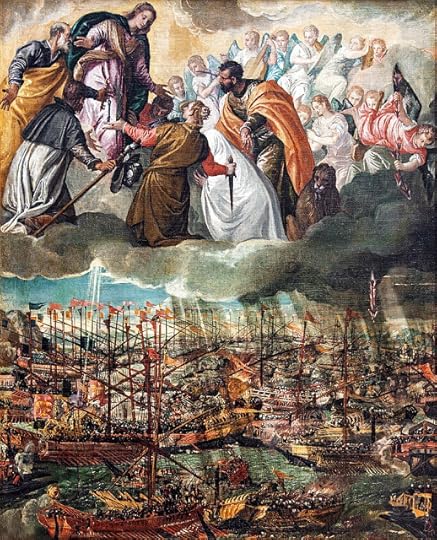
These are all very big, complex, and world-sizedevents. Far too big for the Little Flower, it seems. So St. Thérèse planted alittle flower beside the great oaks of these world events, a special,additional, though little-known feast for the Blessed Mother on October 7.
This is the story of how the Blessed Motherreceived the title of Our Lady of the Smile. As St. Thérèse wrote in Storyof a Soul, “A miracle was necessary, and it was Our Lady of Victories whoworked it.”
The Nature of the Sickness
On October 2, 1882, St. Thérèse’s dearest sister Paulineentered the Carmelite monastery. After the death of their mother (now St.)Marie-Azelie, Pauline had been Thérèse’s second mother. Thérèse was only 4years old when her mother died, and now it seemed, she was losing her motherall over again.
 Saints Marie-Azelie and Louis Martin
Thérèse did not yet know the “joy of sacrifice” andsuffering, so her pain at this parting was intense. She wrote:
Howcan I describe the anguish I suffered! In a flash I saw life spread out beforeme as it really is, full of sufferings and frequent partings, and I shed bittertears.
Pauline’s entrance into the monastery seemed tobring on incurable physical and mental torments for young Thérèse. Thérèsebegan to suffer terribly, but it was not for just one or two weeks. It wasmonths.
The sickness began with comnstant headaches. Theseintensified as winter approached, leading to shivering, convulsions,hallucinations, pains, and lack of appetite.
St. Thérèse’s doctors, including psychiatrist Dr.Marie-Dominique Fouqueray, were baffled by the young girl’s disease.Thérèse’s sister Marie, who never left her side through her torments, recalled hearingthe doctor’s prognosis after observing one of the girl’s strange fits. Thedoctor said there was nothing science could do for the child. No treatmenthelped.
There was no respite from her torments, except forone day, April 6, 1883. It was the day Pauline received her habit at Carmel. Itwas also Eastertide.The Little Flower had been suffering for nearly seven months at thispoint.
St. Thérèse describes this day in her autobiographyand makes it clear that there was no merely natural origin to her illness:
Onreaching home I was made to lie down, though I did not feel at all tired; butnext day I had a serious relapse, and became so ill that, humanly speaking,there was no hope of any recovery.
I donot know how to describe this extraordinary illness. I said things which I hadnever thought of; I acted as though I were forced to act in spite of myself; Iseemed nearly always to be delirious; and yet I feel certain that I was never,for a minute, deprived of my reason.
SometimesI remained in a state of extreme exhaustion for hours together, unable to makethe least movement, and yet, in spite of this extraordinary torpor, hearing theleast whisper. I remember it still. And what fears the devil inspired! I wasafraid of everything; my bed seemed to be surrounded by frightful precipices;nails in the wall took the terrifying appearance of long fingers, shriveled andblackened with fire, making me cry out in terror. One day, while Papa stoodlooking at me in silence, the hat in his hand was suddenly transformed intosome horrible shape, and I was so frightened that he went away sobbing.
But ifGod allowed the devil to approach me in this open way, Angels too were sent toconsole and strengthen me. Marie never left me, and never showed the leasttrace of weariness in spite of all the trouble I gave her.
The nature of St. Thérèse’s sickness appeared to besupernatural in origin. Though she was been harassed by the devil, she was notpossessed. Another one of Thérèse’s sisters, Céline Martin, who later became SisterGeneviève of Saint Teresa, provided testimony evidencing this point. Witnessingher sister’s sufferings, Céline noted, “However, unlike with illnesses causedby the devil, pious objects never frightened her.” Demonstrating revulsion toholy or blessed objects is a tell-tale symptom of demonic possession.
That St. Thérèse was suffering from demonic harassment,however, appears clear. St. Thérèse’s cries of distress were terrifying to all thosearound her.
St. Thérèse’s sister Marie never left her side.Like Pauline, Céline, and Thérèse, Marie also later became a religious, takingthe name Sister Marie of the Sacred Heart.
Sister Marie was asked to provide testimony forthe beatification and subsequent canonization of St. Thérèse. Regarding thisperiod, Sister Marie testified that, although Thérèse never lost her ability toreason, she experienced “terrifying visions that gave chills to all those whoheard her cries of distress.”
Sister Marie described that during some of theincidents, “Her eyes, which were usually so calm and gentle, had an expressionof terror in them that is impossible to describe.”
Thérèse’s Father, St. Louis Martin
One such example of these terrifying visions wasthe transformation of her father’s hat, described above. Thérèse recalledwatching as her father’s lumpy, worn hat suddenly morphed into some hideous,menacing shape.
Her father, Louis Martin—now Saint LouisMartin—was so disturbed that he began to weep in despair. After half a year ofthese unending torments, Louis was grief-stricken over the fate of his daughter.
Thérèse recalled how her father suffered greatly,thinking that she was going to die. Louis had already lost his wife and many ofhis children. Thérèse said that the Lord might have comforted her father duringthis time, telling him “This sickness is not unto death, but for the glory ofGod.”Of course, if Thérèse indeed had such awareness, she might also have comfortedher father.
Thérèse realized, perhaps later, that her fatherdid not know that “the Queen of Heaven was watching faithfully over her LittleFlower, that she was smiling upon it from on high, ready to still the tempestjust when the delicate and fragile stalk was in danger of being broken once andfor all.”
In May 1883, Louis came to Thérèse’s room to give moneyto Marie, ever at Thérèse’s side, to send for a novena of prayers to be offeredfor a cure at the shrine and in Paris—another connection to Our Lady of Victory.Given the non-natural origin of Thérèse’s illness, it appeared that a miraclewas necessary to restore her health.
 Basilica of Notre Dame des Victoires, Paris
“Yes, a great miracle, and this was wrought by OurLady of Victories herself,” Thérèse would later write.
The Statue of the Blessed Mother
In addition to sending Marie for a novena, Louis broughta statue of the Blessed Mother into Thérèse’s room. This would prove pivotal.
The particular statue venerated in the Martin’shome was a copy of a much-loved statue of the Blessed Virgin Mary created in 1735by Edme Bouchardon andlater destroyed during the French Revolution. It also closely resembled theimage of the Blessed Mother found on the Miraculous Medal, which were firstcreated in Paris in 1832 and thought to be also inspired by Bouchardon’s 1735statue of the Blessed Mother.It is believed that Catherine Labouré’s confessor, Fr. Jean Marie Aladel,presented the goldsmith Adrien-Jean-Maximilien Vachette with a copy of Bouchardon’sstatue to use as inspiration.
 The Chapel of Our Lady of the Miraculous Medal, Paris: as the original Edme Bouchardon statue was destroyed in the French Revolution, this is another iteration of the original
 Moments of relief were few and far between during Thérèse’sstrange and prolonged illness. Nevertheless, in those few precious moments,Therese contented herself by weaving embellishments for the Blessed Mother’sstatue.
Thérèse beautifully described her beloved pastimeand the Little Flower’s “shining sun”:
When my sufferingsgrew less, my great delight was to weave garlands of daisies and forget-me-notsfor Our Lady’s statue. We were in the beautiful month of May, when all natureis clothed with the flowers of spring; the Little Flower alone drooped, andseemed as though it had withered forever. Yet she too had a shining sun, themiraculous statue of the Queen of Heaven. How often did not the Little Flowerturn towards this glorious Sun!
The Little Flower would not “droop” and “witherforever,” nor even much longer.
The Novena Concludes & Pentecost Sunday
May 13, 1883 was another auspicious day for Thérèse.Not only was in Pentecost Sunday, but it was one of the last Sundays of theNovena of Sundays that her father had sought from Notre-Dame-des-Victoires. Itwas also another date of Marian significance, for on this date in 34 years, OurLady would appear to the children of Fatima.
Marie, who rarely left Thérèse’s side had,surprisingly, left Thérèse’s side. Marie was in the garden while Léonie, yet anotherof Thérèse’s sisters, remained at her side.
Thérèse would later describe what happened next:
I began to call:“Marie! Marie!” very softly … so I called louder, until Marie came back to me.I saw her come into the room quite well, but, for the first time, I failed torecognize her. I looked all round and glanced anxiously into the garden, stillcalling: “Marie! Marie!”
When Thérèse still did not recognize her afterseveral efforts, Marie knelt down in tears at the foot of Thérèse’s bed. Marie turnedtowards the statue of the Virgin Mary and begged her intercession with all the fervorof a mother who begs for the life of her child and will not be refused.
Thérèse’s sister Léonie, later SisterFrançoise-Thérèse Martin, testified how, at that moment, all three of Thérèse’ssisters fell to their knees filled with hope as they implored Our Lady to healtheir little sister. It is a scene reminiscent of another group of four sisters,the March sisters of the novel Little Women, begging for the health oftheir sister, Beth.
Marie, as Sister Marie of the Sacred Heart,testified that she thought this was finally going to be the dreaded, final momentof Thérèse’s torments. Her death. She and her sisters threw themselves “at thefoot of the statue of the Blessed Virgin,” Marie said.
Thérèse later wrote how the pleas of her sisterswere a storm sent up to Heaven:
That cry of faith forced the gates ofHeaven. I too, finding no help on earth and nearly dead with pain, turned to myHeavenly Mother, begging her from the bottom of my heart to have pity on me.
The result of these prayers was both swift and startling, atleast for Thérèse. She wrote next how the statue of Our Lady responded:
Suddenly the statue seemed to come tolife and grow beautiful, with a divine beauty that I shall never find words todescribe. The expression of Our Lady’s face was ineffably sweet, tender, and compassionate;but what touched me to the very depths of my soul was her gracious smile. Then,all my pain vanished, two big tears started to my eyes and fell silently … Theywere indeed tears of unmixed heavenly joy. “Our Blessed Lady has come to me,she has smiled at me. How happy I am, but I shall tell no one, or my happinesswill leave me!” Such were my thoughts.
Thus came to be Our Lady of the Smile.
St. Thérèse is Cured
“Our Blessed Lady has come to me; she has smiledat me,” Thérèse recounted.
It is important to remember at this point that thiswas not the first time in her life that Thérèse had been brought back from thebrink of death by a miraculous cure. As is his way, St. Joseph protected thebaby Thérèse from death and the devil, preserving her to be raised in the holywarmth of Mother Mary.
Céline later recounted this divine interventionearly in Thérèse’s life. Thérèse was dying of a fatal intestinal disorder thathad already claimed the deaths of two Martin children, but Thérèse’s mother, now-SaintMarie-Azélie Guérin Martin, fell to her knees before another family statue,that of St. Joseph. Azélie’s pleas before St. Joseph’s statue must havemirrored the pleas of the Little Flower’s three sisters before Our Lady’sstatue.
Heaven responded, as it so often would when theMartin family combined their pleas, and Thérèse survived.
And now, perhaps remembering the work of her mostchaste spouse, the Virgin Mary personally appeared to cure the Little Flower.
As if the Virgin Mary’s apparition was not enough initself, Thérèse further elaborated on the lasting effects of Marie’s prayers:
[Marie’s] prayershad gained me this unspeakable favor: a smile from the Blessed Virgin! When [Marie]saw me with my eyes fixed on the statue, she said to herself: “Thérèse iscured!” And it was true. The Little Flower had come to life again—a bright rayfrom its glorious Sun had warmed and set it free forever from its cruel enemy. “Thedark winter is past, the rain is over and gone,” andOur Lady’s Little Flower gathered such strength that five years later it openedwide its petals on the fertile mountain of Carmel.
Not only had the warmth of the Virgin Mary’s smile curedThérèse, such warmth would carry Thérèse all the way to her entrance into the Carmelitemonastery. But her entrance to Carmel would be its own ordeal, requiring additionalintercession and suffering, as Thérèse resolved to enter the Carmelites at the uncustomaryage of fifteen.
A Blessing and a Curse
St. Thérèse had resolved to tell no one of her miraculousexperience, writing “How happy I am, but I shall tell no one, or my happinesswill leave me!”
Thérèse’s vision had lasted for over forty minutes.It may have felt like just a moment to Thérèse, but she had been transfixed onthe statue for a substantial amount of time. Her sisters noticed.
After the apparition, Thérèse looked around at hersisters, and “recognized Marie; she seemed very much overcome, and lookedlovingly at me, as though she guessed that I had just received a great grace.”
Marie soon asked Thérèse to reveal what hadhappened. She fully believed the Blessed Mother had appeared to Thérèse. The LittleFlower admitted that she “could not resist her tender and pressing inquiries.”
Thérèse waited until she was alone with Marie. Shetold Marie that she was astonished that Marie knew her secret, even though shehad not said a word. Thérèse then divulged what had happened and how theBlessed Mother had smiled at her. After she told Marie the details, though, herjoy soured: “Alas! as I had foreseen, my joy was turned into bitterness. Forfour years the remembrance of this grace was a cause of real pain to me.”
Marie was bursting with excitement over theBlessed Mother’s miracle and apparition. This is, of course, a very understandablesentiment. And yet, the devil seemed to turn it to his advantage.
Marie begged Thérèse for permission to share her secretwith the nuns at the Carmelite monastery. Thérèse found she could not refuseher sister. When Thérèse first visited Pauline again after her dramaticrecovery, she was initially overflowing with joy at seeing her sister clothedin the habit of Our Lady of Carmel. “My heart,” she said, “was so full that Icould hardly speak.”
Then, things soured as Thérèse was questioned by theother Carmelite nuns:
Someasked if Our Lady was holding the Infant Jesus in her arms, others if theAngels were with her, and so on. All these questions distressed and grieved me,and I could only make one answer: “Our Lady looked very beautiful; I saw hercome towards me and smile.” But noticing that the nuns thought something quitedifferent had happened from what I had told them, I began to persuade myselfthat I had been guilty of an untruth.
Though Thérèse lamented the loss of the happiness that the appearanceof Our Lady of the Smile had given her, she mused also on the purpose of suchloss:
Our Lady allowed this trouble to befall me for the good of my soul;perhaps without it vanity would have crept into my heart, whereas now I washumbled, and I looked on myself with feelings of contempt. My God, Thou aloneknowest all that I suffered!
This period of humility, while formative, would not continueunabated forever. It would be four years:
Forfour years, the remembrance of this grace was a cause of real pain to me, andit was only in the blessed sanctuary of Our Lady of Victories, at my Mother’sfeet, that I once again found peace. There it was restored to me in all itsfullness, as I will tell you later.
At the Basilica of Our Lady of Victories
It was the early morning 4th November 1887,and the Little Flower and her family were passing alone through the silent streetsof Lisieux to the train station.They were leaving on a pilgrimage to Paris and Rome.
Each of the train compartments bore the name of asaint. The Martin family’s compartment bore the name “St. Martin,” andeverybody on the pilgrimage took to calling the future St. Louis Martin by “St.Martin.”
In Paris, Louis took his family to see all thesights in Paris, but for Thérèse one sight overshadowed all the others: the basilicaof Notre-Dame-des-Victoires. It was at this same shrine of Our Lady ofVictories that the novena had been prayed for Thérèse’s cure at her father’s request.
And it was also at the basilica that Thérèse wouldbe healed a second time. All the doubts that had come to torment Thérèse followingthe Blessed Mother’s apparition vanished and she once again found peace.
Ican never tell you what I felt at her shrine; the graces Our Lady granted mewere like those of my First Communion Day. I was filled with peace andhappiness. In this holy spot the Blessed Virgin, my Mother, told me plainlythat it was really she who had smiled on me and cured me. With intense fervor,I entreated her to keep me always, and to realize my heart’s desire by hidingme under her spotless mantle, and I also asked her to remove from me everyoccasion of sin.
Thérèse’s sister Marie also testified regardingthis event: “It was at the foot of Our Lady of Victories in Paris that herinner struggles ceased … she received confirmation … of the truth of thevision.”
The timing of this second encounter with theBlessed Mother was no coincidence. It prepared the Little Flower for hermeeting with Pope Leo XIII when the pilgrimage reached Rome.
Audaciously, and despite being told to say nothingbefore the pope, the Little Flower made a bold request of the Holy Father:
Ikissed his foot and he held out his hand; then raising my eyes, which werefilled with tears, I said entreatingly: “Holy Father, I have a great favour toask you.” At once he bent towards me till his face almost touched mine, and hispiercing black eyes seemed to read my very soul. “Holy Father,” I repeated, “inhonor of your jubilee, will you allow me to enter the Carmel when I amfifteen?”
Thérèse had made a special request to enter theCarmelites early at fifteen years old. This request had slowly ascended theranks to the desk of the Bishop of Bayeaux, but there it had stalled. Emboldenednow by the Blessed Mother, Thérèse decided to make her appeal directly to thepope.

What was the pope’s response?
After some explanation from the Vicar-General ofBayeaux and a second plea from Thérèse, the pope responded, “Well, well! Youwill enter if it is God’s Will.”
Thérèse was ushered away before she could make athird plea, but within a month, on December 28, the Feast of the HolyInnocents, the Bishop of Bayeux granted Thérèse’s special request and authorizedher “immediate entry into the Carmel.”
The rest, as they say, is history.
Prayer to Our Lady of the Smile
Do you feel a stirring of devotion to Our Lady ofthe Smile? Here is the prayer for her intercession:
Prayer to Our Lady of the Smile
O Mary, Mother of Jesus,
and our gentle Mother too,
with a visible and radiant smile
you consoled and cured
your beloved child, St. Thérèse of the ChildJesus.
We ask you now to smile on us,
amid the troubles of our lives.
May your gentle smile bring light and healing
to the darkness and disease of our body, mind andspirit.
Instill us with hope and deepen our faith
so that we enjoy forever
your maternal and enrapturing smile in heaven.
Amen.
Footnotes: Our Lady of the Smile & St. Thérèse of Lisieux
Storyof a Soul, Chapter 3: “Pauline Enters Carmel”
Storyof a Soul, Chapter 3: “Pauline Enters Carmel”
Dr.Marie-Dominique Fouqueray, “A Strange Illness: The Illness of Thérèse at AgeTen from Easter to Pentecost 1883.”
Easter Sunday was on March 25 in 1883, which happened to coincide that yearwith the Solemnity of the Anunciation.
John11:4
The Basilica of Notre-Dame-des-Victoires was named by King Louis XIII, whodedicated it to his victory over the Protestants at La Rochelle in 1628 duringthe French Wars of Religion. It was not named for Our Lady of Victory.Nevertheless, it is the same Blessed Mother interceding for both victories.
1698-1762
The Blessed Mother appeared to St. Catherine Labouré in 1830, but the firstmedals were not fashioned until 1832.
Descouvemont/Loose.
Storyof a Soul, Chapter 3: “Pauline Enters Carmel”
Songof Solomon 2:11
Storyof a Soul, Chapter 6: “A Pilgrimage to Rome”
Thoughthe Bishop’s permission reached the Carmelite monastery in December that Thérèsebe allowed to enter immediately, the Mother Superior resolved not to allow herentrance until the customary time during the Easter season. Thérèse describesthis in her autobiography: “You told me, dear Mother, that you had had theBishop’s answer since December 28, the feast of Holy Innocents; that heauthorized my immediate entry into the Carmel, but that nevertheless you haddecided not to open its doors till after Lent. I could not restrain my tears atthe thought of such a long delay. This trial affected me in a special manner,for I felt my earthly ties were severed, and yet the Ark in its turn refused toadmit the poor little dove.”
“The Healing of Our Lady of the Smile,” Society of the Little Flower, January9, 2021, accessed via littleflower.org.
August 4, 2023
A Pandemic of Violent Attacks on Priests in South Louisiana
The devil is on a rampage in south Louisiana, and our priests need your prayers.
First, it was the murder of Fr. Otis Young and Ruth Prats on November 28, 2022 in Covington.
Then, Fr. Jimmy Jeanfreau was killed in freak woodworking accident on November 29 in Marrero.
On May 23, 2023, Fr. Ryan Halford was shot multiple times by his brother in Ponchatoula.
On July 13, Fr. Stephen Ugwu was attacked by a man wielding a machete in Melville.
Thankfully, Fr. Ryan and Fr. Stephen both survived.
But only two days ago, on August 2, Fr. Mark Beard was killed in an automobile accident near Amite.
 Table of Contents
 From Christendom to Apostolic MissionI'm writing this mostly to call attention to this situation. Is this happening everywhere?
Are these the labor pains as we pass from Christendom back to Apostolic Mission? From Christendom to Apostolic Mission is an amazing book, by the way. Go buy a copy for your whole parish.
[image error] [image error]
This book has been pollinating and percolating through our south Louisiana dioceses -- Baton Rouge, New Orleans, Lafayette, and Lake Charles -- at a rate commensurate with the violence.
Another age of martyrs is already upon us. We just don't realize it.
As an attorney, I've represented entire hospitals of people who have been fired or threatened with termination for their religious beliefs. Who would have ever imagined that basic biological identification would have been fire-able offense at a hospital?
"God Writes Straight With Crooked Lines"This quote is often attributed to St. Teresa of Avila:
God writes straight with crooked lines.
The great movements in our lives -- in all of human history, for that matter -- very rarely follow a straight course.
The killing of priests is about as crooked a line as you can get. Perhaps the devil isn't brave enough to attack women religious. When you ask them, all of these men, the living and the dead, much prefer to bear this violence, themselves.
If this violence is as crooked as it gets, I'm looking forward to seeing what fruit is borne from these terrors. Here's another great quote: "The blood of the martyrs is the seed of the Church"
That one's from Tertullian:
I'm not sure if this quote comes from Jaws: The Revenge or Rambo III -- definitely not a Saint this time.
Some of these priests were my friends. Fr. Ryan Hallford and Fr. Mark Beard, especially. Again, Fr. Ryan survived multiple gun shot wounds. Fr. Beard did not survive his car accident.
Fr. Ryan Hallford
Fr. Ryan survived three -- three -- point blank gunshots wounds. His recovery has seemed almost effortless. One of the shots broke through his pelvic bone. The other two passed through flesh and avoided organs.
I have hung out with Fr. Ryan since the attack and during his recuperation. I guess you could say I've interviewed him about his attack and recovery, but it was really just two friends talking. He is doing amazingly well. His survival was nothing short of a miracle.
You can listen to the sheriff's office full account of the shooting here:
Fr. Ryan's speedy recovery will probably be attributed to his youth. Father is still in his thirties. And also his athleticism. Father is a long-time wrestler and, for several years now, has competed in Brazilian jiu-jitsu tournaments.
Through jiu-jitsu, Fr. Ryan has trained his body to function during asphyxiation, to continue wrestling while suffocating. He also trained his brain to manage rushes of adrenaline.
Because of these physical adaptations, not to mention his faith, Fr. Ryan stayed calm throughout the attack and aftermath. He had the presence of mind to keep praying, to say his Act of Contrition, and put himself in the hand of God, even while his blood was draining from his body and soaking his sister's small car.
When it came time to call an ambulance, Fr. Ryan looked down at his phone. He realized it had been destroyed by one of the bullets. He laughed and said, "not gonna need that anymore" and tossed it aside.
Because they couldn't call an ambulance, Fr. Ryan's sister actually drove him to the hospital. Poor darling, she had also been shot. A couple of her fingers were hanging by a thread as she drove her dying brother to the hospital.

We can already see how God is writing and righting this crooked situation to the good. For one, even though Fr. Ryan's brother, Casey, will be in prison for a long, long time, Casey can now get the mental help and restraint he has long-needed.
Casey Hallford's struggles have long been a heavy burden on Fr. Ryan. Not long before this, Father even stepped away from active ministry to help his family. While a younger man, Fr. Ryan was even named legal guardian of some of his siblings.
Fr. Ryan's heroism has long been hidden in the private struggles of his family, but now, I hope, Fr. Ryan can emerge from under this dark cloud.
Fr. Ryan has an amazing array of talents and abilities that have been temporarily shuttered by his family's struggles. He single-handedly organized our diocese's disaster response efforts in the wake of Hurricane Ida, which obliterated a dozen or so cities. He also started the Frassati House, an innovative approach to community-building for young families named after Blessed Pier Giorgio Frassati.
Fr. Ryan is a master of logistics. I hope, after he has fully recovered, he can now return to active ministry. Please keep him and his family in your prayers!

Fr. Otis Young's Scapular Miracle
Fr. Otis' death also included a miracle.
Warning: Fr. Otis' death wasn't just tragic, it was horrifying. He was bludgeoned to death, then, hopefully following his death, set on fire by his murdered in an attempt to hide evidence.
But, even in the midst of this horror, there was a miracle.
Fr. Otis Young entire body was burned beyond recognition. Only one item survived untouched, unscathed. It was the same item that guarantees our own escape from the flames of Hell. Fr. Otis' scapular.
And not just the metal parts of Fr. Otis' scapular survived! The cloth was untouched, too. The image of the Blessed Virgin Mary was singed, but not burned.
I have already written another article about Fr. Otis' Miracle of the Scapular here, if you would like to read the whole story:

Again, can you see God taking this crooked lines, these horribly bent and ugly lines, and creating beauty from them?
Please pray for the repose of the soul of Fr. Otis Young! Hopefully, we'll be able to ask for his intercession one day soon, as well.
Fr. Mark BeardFr. Mark Beard's lines were already big, bold, and bright. Though a late vocation to the priesthood, Fr. Beard's years as a priest were incredibly productive.
Assuredly, Fr. Mark Beard's story is still being written. The crooked line of his senseless death in an automobile accident -- this is not the end of this story. Fr. Mark, in his short time as priest, left a huge "Mark." Fr. Mark was a builder. He had already helped build a Eucharistic retreat center around his own parish and was building a sprawling Catholic retreat destination at Our Lady of Hope in Chatawa, Mississippi.
Speaking of "hope," I am reminded of a few lines from the Te Deum:
In you, Lord, is our hope:And we shall never hope in vain.
"Hope" still reigns, even after Fr. Mark's death. I can only imagine how Our Lady of Hope will continue to grow after Fr. Mark's death. There were plans for the site to include a great cathedral and a Catholic college.
Two things should be obvious to everyone who was touched by this man's great fire and zeal: (1) the devil wanted him out of the picture, and (2) great things will ripple out from Fr. Beard's life and death.
You can read more about Fr. Beard's conversion at Medjugorje, his vocation to the priesthood, and his last, prophetic homily here:

This article is still being written. God is still writing these stories, still creating miracles and beauty from the violence. Check back for more ... mbtTOC();
August 3, 2023
Fr. Mark Beard's Prophetic, Last Homily Before His Tragic Death: "The Fence"
We lost a great priest and friend yesterday: Rev. Mark Beard.
He built great things, he did great things, and he gave powerful homilies. He will be remembered as and numbered among those described as "The Priests We Need To Save the Church." And yes, Lord, he will "be in that number, When the saints go marchin' in."

People always ask, "if you had just one last homily to give, what would you say?" Fr. Beard treated every homily like it was his last homily. His last homily is no exception.
Treat it as the last homily you will ever hear ...
Here is a collection of the most poignant moments from Fr. Beard's last homily. "The only thing that matters is your soul ... No exceptions!"
Here is the Full Video:
Fr. Beard's homilies will probably remind you of some of the greats. Does he remind you of the Venerable Fulton Sheen?
Listen to more from him ...
Fr. Mark Beard's Conversion at MedjugorjeThe Blessed Mother marked Fr. Beard as a priest at Medjugorje. It was there that he experienced his conversion. His was a late conversion, now cut short.
Read about it below:
From Medjugorje Miracles, "Father Mark Beard Traveled to Medjugorje as an Angry Skeptic" >>
The following is an interview with Fr. Mark Beard, a then- newly ordained priest from Baton Rouge, Louisiana, whose life changed radically on a trip to Medjugorje. His conversion began when he traveled there as an angry skeptic, intending to disprove these visionaries who must have been getting some big money out of the whole deal . . .
In Fr. Beard’s words:
King David went to the hills of Judah and said, “How is it that the Ark of the Covenant came to me?” And he danced for joy. One thousand years later, Mary came to the hills of Judah, where her cousin Elizabeth exclaimed, “How is that the Mother of Our Lord has come to me?” And John the Baptist leapt for joy in Elizabeth’s womb. That’s the Mary I now know—the archetype of our Church, the holy tabernacle that carried God Himself into the world.
But just a few years ago, I did not know Mary. So when I heard that she was appearing in Medjugorje, I didn’t want to believe it. God had sent prophets, disciples, and His only Son! So why would He be sending His mother?
At that time, my father saw me going down a path he feared I would not recover from. I was young, in my 30s, bullet-proof, and liked money, power, and “dating”—the unholy Trinity. I did avoid drugs or alcohol, but that’s because I was too busy chasing women.
My father, a powerhouse of a man, designed water plants for cities and started several companies. He was chairman of the board, and I worked under him in the family business for twenty years, earning a sizable income, flying around the world, and coming home to a nice house, a maid, and a rag-top jeep.
One day, my father said to me, “It seems that Mary’s appearing in Medjugorje. Go check it out.”
“What!?” I thought. We have litigation to deal with, jobs we’re trying to get started overseas, and you’re telling me to travel halfway around the world to check out some visionaries? Yeah, that’s what I’m gonna do. My father has lost it,” I thought. “How am I going to hide this from the shareholders, the board of directors—from my mother?”
Then I talked to my buddy John about what my dad was asking, and he said, “You should get the book, Queen of the Cosmos.” I read the whole thing while standing up in a bookstore. I couldn’t put it down.
I thought, “I’ve got to research who these visionaries are. THE Blessed Mother? I mean really. She’s talking to people on Earth? Come on, now. The whole thing struck me really hard. “Ain’t no way it’s happening. Ain’t no way.”
Yet something Jacov said in that book— about how Mary told him gently that she wasn’t happy with the way he was acting at school—nagged at me. “She’s watching?” I wondered. “She knows? If she’s aware and she knows what we’re doing, that means HE must know. Then I’m accountable for my actions . . . and I might not settle up with Him too well at the end of time!”
I thought Ben Franklin was right: God helps those who help themselves. I did my job. I figured people could worship trees and still do their job, and if they did their job right, then whatever religion they had was good enough, and all that was expected.
I was an obligatory Catholic. I’d show up for Mass, and if the priest didn’t bore me, I’d stay. I figured I hadn’t killed anybody, so I was a good enough person. I confessed my sins directly to God, a forgiving God. No need for the Sacrament of Reconciliation. And I didn’t believe in the Real Presence.
So I needed to go across the world to put this animal to bed. I needed to debunk the hubbub. Travel and money were no problem, since I’d been flying around the world for a long time due to business, so I quickly boarded a plane for Medjugorje. I ran into nothing but problems. It started when I got lost. I was supposed to meet up with my pilgrimage group in Paris, but they had already left. Don’t ask me how I ended up in Germany, but when I was there in the airport, I decided to go home. As soon as I stood up to leave, I saw a group of women wearing Mary pins. I knew that face on the pin. It was the face used to portray Mary of Medjugorje, like I’d seen in the Queen of the Cosmos book.
I was not in a good mood on this trip and was “making friends” wherever I went. I figured I made a LOT of money, so I was IMPORTANT, so I deserved to have a BIG chip on my shoulder. The people in this group finally realized I was safe to talk to, and one woman in the group said, “You don’t really believe what’s going on in Medjugorje, do you?”
“No, I don’t.”
“Lucifer picks one to make sure there are trials and tribulations.”
“Ma’am, I’m the pick of the litter.”
When I finally arrived in Medjugorje—at midnight, after untold delays, problems, and missed connections—all I had was the name of a person in the town. I didn’t know anyone, didn’t know the language, couldn’t sleep, didn’t have my luggage since it had been lost along the way, and I was there to meet six people who thought they were seeing the Blessed Virgin Mary. I probably could have lit up the entire town with my anxiety.
I sat down with my new “faux” pilgrimage group at the pension where they were staying and started to eat some soup. I wanted to be left alone. Then someone said to me, “You need to sleep down the street.”
“No, I don’t,” I said.
“Yes, you do, really.”
“No, YOU really.”
She took me in her car, stopped it several yards from my destination, and pointed to a house.
“Good,” I said, “Just drive your car right to that home.”
“No,” she said, “there are too many potholes.” So I got out of the car, and she took off. It was now 2 a.m. I started to laugh. “CNN would not believe this,” I thought. “Cajun Man from South Louisiana Ends Up Across the World Searching for Visionaries.’”
I walked up to the door of this unknown house and knocked on the door. A woman opened it, and I heard the most magical words: “You must be Mark Beard. Where have you been?”
“Ma’am, we don’t have the time.”
The next person I met was the visionary Vicka. As I stood in the crowd of onlookers watching Vicka give her talk to pilgrims, a woman next to me said, “You don’t believe, do you? You’re like Thomas.”
“I make Thomas look like the rock.”
I had to admit, though, that Vicka glowed. That woman was radiant. She described heaven, purgatory, and hell. I wanted to get the skinny on why she was doing what she was doing. Where was the book deal–the movie–the money? This must be a seven-digit deal, not a three- or four-digit one.
After Vicka’s talk, she said she would pray with everyone two by two. “Great . . . like Noah’s ark,” I thought. I wanted to catch her at her game. I figured she’d cut her losses by not praying over everyone because there wouldn’t be anything in it for her; after praying over a few people, she would have put on enough of a show. To test this, I got out of line and went to the very back. I started timing her as she prayed over each person—one minute, ten seconds; one minute, ten seconds, each time. She took a full hour to do this, and prayed for every single person who was waiting. When it was my turn, I looked at my watch the whole time—one minute, ten seconds.
The woman who’d talked to me earlier asked, “Do you believe now?”
“The jury is still out.”
“You need to meet Ivanka,” she said.
I left and scoured the town, talking to whomever would listen—cab drivers, restaurant owners, pilgrims—trying to punch holes in the charade, but I couldn’t get the goods from anyone about what was “really” going on.
By the time I met Ivanka, I had a plan. I’d memorized an interview of her in Queen of the Cosmos, in which she told the story of Mary appearing and showing her her mother, whom she was able to embrace. At one point in Ivanka’s talk, she asked if there were any questions. I decided to make a statement instead of ask a question: “I’m so sorry to hear about your mom passing away. I can’t even imagine what that must be like.” At this point everyone around me started backing away from me, probably thinking, “This man is going to die from insolence, and we don’t want to die with him.”
Then I started to reiterate what I’d read in the book, but changing slightly a couple facts here and there, and adding a few nuances, trying to catch her in a lie— because if I caught her in a lie, then I would prove that the whole thing was a sham. Coming to a close, I ended my speech with, “I just want to thank you for sharing that with us.”
Ivanka responded, which took several minutes, and then the translator began to speak in English. Ivanka had corrected every misstatement, every false innuendo, every supposition I had made—and she did so like a mother to a child.
“Oh my God,” I thought. “That woman is telling the truth.”
I went to a pay phone and called my father. “Chief,” I said to him, they’re telling the truth. They’re living it. The whole town is living it. If they were lying, they’d be giving up their children’s inheritance, their children’s future . . . because if they were making this all up and someone found out, the whole town would consider them anathema, and they’d be left all alone. The risk is too great. There’s no money. No deal. No women. They’ve got nothing. Only God.
I went to Confession for the first time in years. And toward the end of the trip, I found myself sharing my heart with another pilgrim, an honest, kind, prayerful man–a former Protestant pastor, who had sacrificed a lot to become a Catholic. He said to me spontaneously, “There’s something I need to tell you.”
“If it makes you happy . . .”
“Are you sure you’re not supposed to be a priest?”
Obviously, the story didn’t end there . . .
Fr. Mark Beard's Last Homily: Transcript
Here's the transcript of Fr. Mark Beard's last homily >>
Fence, Fence as in straddling straddling the fence.
You know my friends in Christ, you know what I liked about Philip?
You can say what you want about him, but he is a Catholic. Now, [he] may not be a poster boy for Catholicism at the start, but this is like the 1980s, but later in life I got to tell you still to this day, Philip's Catholic. That's what a Big C.
Man, he grew up in uh Schenectady, New York. He'll tell you that he had a pretty good home life. Initially, he had, uh, three siblings, and he said he loved New York. His mom and dad separated. He's now got to move. I believe it's with his mom down to Miami, Florida, so he goes to Miami High School.
Philip would tell you he does two things very well. He is an excellent boxer and somehow another he got wrapped up into a play called The Serpent and he loved it.
The problem is he was far better at boxing 27-3 to be exact as a result of it. Man, he just he gets it. He likes the discipline, when he stays disciplined he stays out of trouble. Well, he's trying to decide what he wants to do either maybe do more plays but it's Miami. He gets in a little bit of trouble because he kind of gets away from boxing and as a result of it, Philip just gets ... Man, he gets in trouble. He said his sister comes to him, look here's four hundred dollars. You're on the next Greyhound out. Don't look back. Don't come back. They're looking for you. You're guilty. Get to New York. Start your life over.
[skipping ahead to about the 7 minute mark]
You can't keep walking, straddling the fence. That is the gospel. Not once, not twice, three times, He says the Kingdom of Heaven is this.
My brothers and sisters in Christ, He's trying to tell you you can't take it with you. You can't bury it. You're either on it or in it or you are not. You can't play both sides against the middle.
He gives you an example and remember you're Jewish, so you and I now know that when they use parables there's always a twist in the parable. Something that doesn't, uh, it just doesn't make sense. I mean let's be honest. You're walking down a road, you look into a field, and there's a treasure. You're walking down the road, nobody's seen it, but you, and there's a treasure. You're so excited. You go bury it. Sell everything you have and buy the field.
The fact that there's a treasure in the field, and you just didn't take it and run with it. You buried it and sold everything. Yeah, Brothers in Christ, it doesn't work. It's not logical. It's not reasonable. That's what he's saying. You can't bury this treasure and you can't take it with you.
He says, well, I'll give you another example. He said it's like you find this beautiful pearl. It is so beautiful that you go and sell your house, your car, your camp, your boats, your guns, and you go by The Pearl.
Then you realize, you can't eat with the pearl, you can't hunt with a pearl, you can't fish with the pearl. You can't buy anything. You can't be clothed with it. You can't put a roof over your head. He says you can't take it with you, my brothers and sisters in Christ, he's trying to tell people ...
It's like you're going net fishing on the Sea of Galilee. Now, why is this important to you? Because that's the only way you can fish on the Sea of Galilee. Today, you can only net fish, and as a result of it, when you throw the net out, you're going to get good and bad.
I'm telling you this now so that you make sure that you are all in, because if not, I'm going to send my angels and they will separate you. This is why this is important. Because our best players in Scripture are those who are able to delineate whether they're all in or all out.
You can't ride the fence, man.
My brothers in Christ, throughout Scripture, the best players are the ones we know very little about. For example, the wealthiest man in all of their day is Lazarus. Christ's best friend, if you will, is one of the wealthiest men of all. He has two sisters ... Mary and Martha.
Now, my brothers in Christ, he's got vineyards. He's got grounds. He's got slaves. He does have property. He does have equipment. He does have caravans. Everybody knows who he is.
But this is what you don't know about him. He's got to die twice, so that Christ can be proven. That's a friend. You got to die twice.
My brothers in Christ, do you know why [Lazarus is] not at the crucifixion, according to the Saints? Because he knows good and well that the the apostles have to have somewhere to go. Do you know why we can't find Peter, we can't find James, we can't find Nathaniel, Bartholomew, Thomas, we can't find Philip? We can't find the other Simon? Why? Because they're all over at his house, because if he's not there to protect them ... but you know what's amazing he already knew this is what he was going to do,so as a result of it I got to protect the good Lord and he actually conversed
...
[Jump to about the 7:40 mark]
Our best players know you can't straddle the fence ...
So now here you and I sit 2000 years later. Well, let's see Brothers in Christ, how good are you at straddling the fence? Or are you all in?
Well, let's see my brothers and sisters in Christ, when somebody says "are you Christian?" Will you stand up and say, well, "absolutely, I'm Catholic."
Well, tell me, as a Catholic, are there exceptions to abortion? Like rape and incest?
Absolutely not.
There are no exceptions. If there had been he would have told me there were. You don't think they had rape and incest in the time of Christ? You don't think they had that going on?
My brother in Christ, they're burning children in the pit they called Gehenna while Christ walked the Earth.
You can't have it both ways, my brothers and sisters in Christ.
When it comes to abortion, it's intrinsically evil in and of itself, and the fact of the matter is when people tell you, as Catholics, that ... "I'm sorry Father, I'm just not a one-issue person"
Well, that's a fine [how-do-you-do].
So what you're telling me is, well father, he's got a good diplomatic policy. He's got a good economic policy ...
You don't have a policy! Your policy is to kill children. So you think the good Lord's going to bless your supply and demand? You believe that your economic policy is going to work after you kill his children?
So when the good Lord asked you, father, Father Mark, where are my children?
My answer is going to be, well you know, I got to tell you, the president had a good economic policy. He's a pretty good diplomat -- for who I have no idea -- but he's a good diplomat.
My brothers and sisters in Christ, that's the point. All things come through Christ. You can't pick and choose whether you're in or out. You're either in the Church or you are not.
How many times do I hear people make the argument, well father you know we're just not ready to have children.
My brothers and sisters in Christ, please go back and read Scripture. You are not your not your own. You are not your own. You have been purchased with a great price. Saint Paul to the Romans.
When you start using the pill or some type of contraception, you are putting something between you and your spouse. I told you to go forth into multiply.
My brothers and sisters in Christ, He is the God of economics. If he wants you to be able to support you and your children then he will. For you and I to step in His shoes and tell him that this is how it will be -- you're telling Him, it's more important how we do it, than how You do it.
You can get upset. You can get mad. You can kick your dog. I'm telling you right now. That's the teachings of the Church. You got to decide whether you're in or whether you're out. You can't walk the fence, my brothers and sisters in Christ.
this is getting old this is why our country
is starting to fracture remember this it
does not matter to me what Francis says
or does not say
what matters to me is where you land all
I care about is your soul stop worrying
about what he says or doesn't say stop
worrying about what Joe says or doesn't
say the only thing that matters is your
soul do you not understand there is no
exceptions when you're in front of him
there's no arbitration there's no
mediation he's going to say man your
judgment you come in on this day you go
home on this day please for the love of
God remember this the Nano second you
and I die the nanu second before people
walk away from your bed before they
leave to get in their cars
you have already been judged and you're
either in heaven hell or purgatory
that's it it's done
and there's nothing else to go and it's
for all eternity I'm trying to tell you
you can't pick and choose either he's
The Great I Am or he's not you can't go
running both ways you can't say man I
believe in the church but I don't I have
exceptions to these rules man do you
understand why you went to the wedding
Decatur he went there to prove to you
that if I had to go there for seven days
then you need to come to my house when
you get married it was so important he'd
be at the wedding decana we don't even
know the name of the couple and it's
been 2 000 years so getting married on a
beach getting married at someone's house
or the backyard in an antebellum home is
not in front of him yes the good Lord is
everywhere but he's physically president
of the Tabernacle that's why I say this
is my body which will be given up to you
what I got to get you to understand is
if you don't understand the faith and
ask the questions you can't just keep
walking down the middle of the road you
can't say man father you know I'm I know
the Commandments
do you
because if you don't most of them are
exclusionary do you know the Beatitudes
do you know the very first one at least
fear of the Lord if you don't have that
then you won't make it if I ask you what
are the four pillars of the church would
you know one of them
well brother Christ how can you and I
Proclaim to be Catholic and remember
what Catholic means according to the
whole that if we Gather in one place we
listen to the reading we sing the Psalms
and different from the Jews we break
bread instead of sacrifice a lamb
that's the definition of Catholic it
became so popular it became Universal
you and I have got to stop apologizing
for being Catholic you need to learn
your faith yes we have let you down no
if ands or buts about it yes we make it
confusing because different priests
speak different ways that is true and
sometimes I'm not sure where Francis is
going that's a true statement too but it
doesn't change the fact that you need to
know the truth and I'm gonna tell you I
am not going to stand before him and say
well Lord I would have pitched it but
you know there's going to be pushback
because now that sins on me I've got my
own set my brother and sister Christ I'm
not going to burn for another so it's
important for me for you to tell you the
truth you can pick and choose what you
want and throw the rest away but
nobody's going to nail my foot to the
floor telling me man beard you just
didn't say what was truthful but running
Christ my job is to pitch it whether you
want to catch it or not it's on you
my job is to make sure you know the
whole truth and nothing but the truth so
help me God
at the end of the day you have got to
get off that fence you have got to plant
your flag my brother in Christ I'm not
saying that you will agree with 100 of
the church teaching but you don't get to
pick and choose she's been around for 2
000 years and someday you and I are
going to stand behind in front of you
naked and alone and let me promise you
we will hear one or two words come
Judgment Day man depart from me well
Lord man I proclaimed you to be the
Messiah I hold your money so did Judas
or he's going to say welcome to my table
God I have waited for you I bragged on
you I told the things about you I said
watch him watch her watch they're gonna
make the sign of the cross and they're
going to be beloved and condemned for it
watch he's going to break out the prayer
of the Hail Mary when everybody starts
to look down
they're going to say man I'm a one-issue
candidate because that's all that
matters is life
life Everlasting
my brother in Christ I'll leave you with
the words of Johnny Cash
a great Theologian in his own right
he said if there was a fence Between
Heaven and Hell it would be owned by the
Devil Himself
amen
amen
amen thank you thank you
I'd like to thank my family who came
here and stood up in clapped man God
bless you please stand thank you
August 1, 2023
The Real Story Behind The Exorcist Movie: The Exorcism of Roland Doe
One of the greatest horror movies of all time is based on true events. That thought should give everyone a moment's pause.
The Exorcist, both William Peter Blatty's 1971 novel and William Friedkin's 1973 movie, came a time in our history when people had stopped believing in the existence of the devil. A great time for the devil, a scary time for us.
Have you ever wondered how much is Hollywood and how much is real?
Spoiler ... It's a lot more reality than Hollywood.
 Here's the true story behind The Exorcist, taken from the notes of the exorcists priests, the eyewitnesses, the neighbors, friends, classmates, and the newspapers.
 You will find that truth is much stranger than fiction ...
This is a chapter in a larger book I wrote on the subject: True Catholic Exorcisms. Now, also an audiobook, narrated by BBC-veteran Alan Turton.
[image error] [image error] [image error] [image error]First off, it wasn't a little girl -- no Linda Blair. It was a little boy that was possessed.
Also, before diving into this, it's a good idea to pray the St. Michael prayer for protection:

Not Regan ...
Meet Ronald. Ronald Edwin Hunkeler was given the pseudonym, Roland Doe, by the original Washington, DC newspaper accounts of the possession in 1949. His real name wouldn't be revealed until his recent death in 2020, may he rest in peace.
Stay tuned until the end of the article for a yearbook picture of Roland.
Roland Doe,[1] 1949
The exorcism which re-captured the nation’s imagination – this is the exorcism which inspired William Peter Blatty’s 1971 horror novel turned movie, The Exorcist. Blatty, himself, heard rumors of the exorcism from the Jesuits priests of Georgetown University, while a student there as a member of the class of 1950.
Between1950 and 1971, many priests had begun dismissing the reality of the demonic,including many Jesuits. Merely metaphorical or social evil was preached fromthe pulpit. The Devil was just a personification of the evil within us. Demonsdid not exist. Psychologists and academics, even to this day, dismissed allsupernatural phenomena as superstitious nonsense.
Thisis why The Exorcist re-captured the nation’s imagination. TheDevil had succeeded, for a time, in convincing the world he did not exist.
MichaelCuneo discusses The Exorcist case atlength in the opening chapter of his book AmericanExorcism. Cuneo points out that the case was sensationalized. Some of thestory’s most basic details were changed. For example, the possessed child was aboy who lived in Mount Rainier, not a girl living in an upscale Georgetown neighborhood.
TheGeorgetown setting was due to the author’s personal encounter with the storywhile attending Georgetown University. Blatty’s time at Georgetown clearly madea lifelong impact: “Those years at Georgetown were probably the best years ofmy life,” Blatty said in a 2015 interview. “Until then, I’d never had a home.”
Projectilepea soup vomit and spinning heads were just literary embellishments. Once youhear the true story, however, you will wonder why any embellishment was neededin the first place.
Note:Unfortunately, the ridiculous quantities of green, projectile vomit were notmerely embellishments. Check out the chapter in True Catholic Exorcisms detailing the exorcism ofEmma Schmidt.

The Exorcist case is important not onlybecause of the extreme supernatural phenomenon on display. It’s important forthe impact it had on the American psyche. It is the single most familiar exorcismto the wider American public, whether or not people realize it was based on atrue story.
The Exorcist left an indelibleimpression on the world’s imagination more so than any other case of possessionever has. This is because it was thrust upon the world after several decades ofmounting disbelief in the existence of Satan.
AlthoughThe Exeter Report showed that fear ofSatan was already on the rise in England, exorcisms in America had declinedprecipitously. The United States had fallen into a deep sleep after its victoryover evil during World War II. Even the Pentecostals had tried to dampen theirmore charismatic deliverances.
Thelaunch of The Exorcist in movietheaters all over America released a flood of repressed fears. It had beensimple enough for the Devil to recede into the background of a world faced withnuclear annihilation and extinction. Then came the The Exorcist, and an ancient history of satanic awareness surged tothe foreground. Many people found themselves unable to cope with the sudden joltof religious revival, or at least the reminder of supernatural realities.
Thisresurgence in satanic awareness resulted in thousands of people suddenly fearingthat they or a loved one was possessed. Father Tom Bermingham, one of the film’sminor actors and a researcher for Blatty’s book, suddenly found himself swarmedby hundreds of requests from individuals seeking an exorcism.Exorcism and possession suddenly became mainstream, and the devil who hadbenefitted from being ignored and forgotten, now was suddenly benefitting frombeing a celebrity.
Forone thirteen-year-old boy,Satan had been a reality, long before the sale of the movie rights.
Firstoff, let’s get the location right.
RolandDoe, the pseudonym used for the possessed boy, is commonly described as being aresident of Mount Rainier, Maryland. At the time of the first exorcisms in 1949,Mount Rainier was a small, working-class community of nearly 8,000 residentsquietly tucked away in Victorian homes and bungalows on the outskirts ofWashington, D.C.
Eversince the early 1980s and the release of (the first) Exorcist movie, local teens have been flocking to a then-vacant lotat the corner of Bunker Hill Road and 33rd Street in the residential heart ofMount Rainier. Anurban legend, spawned by local newspapers, holds that this was the former siteof the house of Roland Doe.Prince George’s County teens have long delighted in roaming the lot at allhours of the night, drinking beer, conducting initiations, erecting woodencrosses on the property, and yelling and screaming until local police areforced to come and chase them away.
Alongwith several other sources, Dean Landolt, a lifelong Mount Rainier resident ofover seventy years, informed researchers that, “I was very good friends withFather Hughes, the priest involved in that case, as was my brother Herbert. FatherHughes told me two things: one was that the boy lived in Cottage City, and theother is that he went on to graduate from Gonzaga High and turned out fine.”
It’seasy to understand the confusion. Cottage City is an even smaller,semi-isolated community just a short distance from Mount Rainier. Cottage Cityis nestled between the towns of Colmar Manor and Brentwood.

DO NOT use Ouija Boards. Terrible idea.
Ina 1979 article for Fate magazine,Steve Erdmann includes the following description of events taken from a diarymaintained by one of the priest-exorcists, Father Bishop:
January 15, 1949—A drippingnoise was heard in his grandmother’s bedroom by the boy and his grandmother. Apicture of Christ on the wall shook and scratching noises were heard under thefloor boards. From that night on scratching was heard every night from 7 p.m.until midnight. This continued for ten consecutive days. After three days ofsilence, the boy heard nighttime “squeaking shoes” on his bed that continuedfor six consecutive nights.
Andin another description:
For some time prior to theexorcism [...] the unidentified boy had been tormented by a battery of bizarrephenomena: There were scratchings and rappings on his bedroom walls, pieces offruit and other objects were sent flying in his presence, and his bedmysteriously gyrated across the floor while he tried to sleep.
Whywere these things happening to the pseudonymously named Roland Doe? Was it justrandom? No, it appears the child’s aunt introduced him to the demonic.
RolandDoe was born into a German Lutheran family and was his parent’s only child. Sincethere were no other children in the family, Roland looked to his parents andother adults in his household for playmates. The boy spent much of his timewith his Aunt Tillie.Tillie was reportedly a “spiritualist”, which seems to indicate that she dabbledin witchcraft and other occult interests. She introduced Roland to the Ouijaboard.This is when the trouble began.
Avery detailed diary was kept by one of the priests that would later exorciseRoland. Under the heading January 26, 1949, the diary records the followingconcerning Aunt Tillie:
“Aunt Tillie,” who had a deepinterest in spiritualism and had introduced Roland to the Ouija Board, died ofmultiple sclerosis at the age of 54. Mrs. Doe suspected there may have beensome connection between her death and the seemingly strange events thatcontinued to take place. At one point during the manifestations Mrs. Doe asked,“If you are Tillie, knock three times.” Waves of air began striking thegrandmother, Mrs. Doe, and Roland and three knocks were heard on the floor.Mrs. Doe again queried, “If you are Tillie, tell me positively by knocking fourtimes.” Four knocks were heard, followed by claw scratchings on Roland’smattress.
Mrs. Doe also recounted using blessed candles whena comb flew across the room and extinguished them.Other observations include fruit flying across the room, a kitchen tableturning over, milk and food moving off a table, a coat and hanger flying acrossthe room, a Bible landing at Roland’s feet, and a rocker spinning around while Rolandwas sitting in it. Roland was also removed from school after his desk movedaround the classroom floor on its own.
The desk event left an indelible impression on oneeyewitness. Roland’s best childhood friend also recounted this event in detailin a 1998 interview with Mark Opsasnick:
One thing happened regarding all of this and I have a hardtime clearing it in my mind. We were in eighth grade, it was the ’48-’49 schoolyear and we were in a class together at Bladensburg Junior High. He was sittingin a chair and it was one of those deals with one arm attached and it lookedlike he was shaking the desk—the desk was shaking and vibrating extremely fastand I remember the teacher yelling at him to stop it and I remember he kind ofyelled “I’m not doing it” and they took him out of class and that was the lastI ever saw of him in school. The desk certainly did not move around the roomlike that book [Possessed] said, itwas just shaking. I don’t know if he was doing it or what was doing it becauseI just can’t clear it in my mind.
The diary also describes Mrs. Doe taking a bottleof holy water and sprinkling its contents throughout the house. When she returnedthe bottle to its shelf, it flew across the room on its own but did not break.
Another night, while holding a lit blessed candle atRoland’s bedside, Mrs. Doe experienced the whole bed rocking back and forth.
 The Tools of the Catholic Exorcist: Holy Water, Blessed Salt, and the Rosary
The Need for a Priest Accordingto American Exorcism by Michael Cuneo,the boy’s family initially requested the help of a Protestant minister, LutherMiles Schulze, but this only worsened the situation.
PastorSchulze had long been interested in parapsychology, and arranged for the boy tospend the night of February 17, 1949 in his home for observation.Schulze witnessed several disturbing phenomenon during this and subsequentencounters, including household objects and furniture moving by themselves.
BillBrinkley interviewed Pastor Schulz for an article for The Washington Post entitled “Pastor Tells Eerie Tale of ‘Haunted’Boy”.Schulz describes the as boy sleeping nearby in a twin bed. In the dark, theminister reported hearing vibrating sounds from the bed and scratching soundson the wall. Schulz also observed the boy sitting in a heavy armchair, which tiltedon its own and tipped over. While the boy was laying on them, a pallet ofblankets also inexplicably moved around the room.
Schulzesoon advised the boy’s parents to “see a Catholic priest.”The family then sought help from the local Jesuit community. Despite theirtheological disagreements with the Catholic Church, Protestants generallyacknowledge that priests are needed for the most difficult possessions.
Anyordained priest, with the blessing and permission of the local bishop, canperform an exorcism. Exorcisms, for that matter, are not all that rare.Elements of exorcisms are (or were once) incorporated into many Catholicliturgies, including the Mass and the Rite of Baptism, for example.
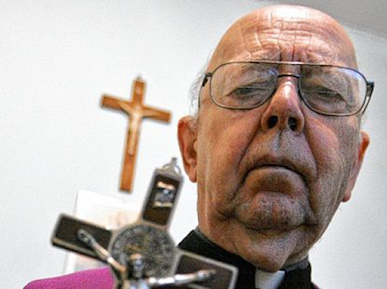 Father Gabriele Amorth, the foremost Catholic exorcist priest (now deceased)
 Nevertheless,the Church provides training for priests who are asked to specialize in exorcisms.This process is described by Father Gabriele Amorth, the designated exorcistfor the Diocese of Rome, in his book, AnExorcist Tells His Story. Father Amorth describes the benefit of specialtraining:
We cannot improvise anexorcism. To assign such a task to any priest is like demanding that someoneperform surgery after reading a textbook on the subject. Many, too many, thingsare not written in a text but are learned only through experience.
FatherAmorth also laments the decline of “the school” for training exorcists:
I am convinced that allowingthe ministry of exorcism to die is an unforgiveable deficiency to be laidsquarely at the door of bishops… Today the exorcist is seen as a rarity, almostimpossible to find… The Catholic hierarchy must say a forceful mea culpa. As a result of thisnegligence, we now have lost what once was the school; in the past, apracticing exorcist would instruct a novice.
Father Edward Albert Hughes(1918-1980) was a Catholic priest who served as an assistant pastor from June16, 1948 to June 18, 1960 at St. James Church in Mt. Rainier, Maryland. FatherHughes performed the first round of exorcisms on Roland Doe.
Just as Mrs. Doe had before him, Father Hughes isdescribed as experiencing supernatural events concerning blessed objects:
Hughes reported giving a bottle of holy water and candles toRoland’s parents to give to Roland before he went to sleep. The parents saidthe telephone table on which the holy water sat smashed into hundreds of pieceswhile the candle flamed up, torching the ceiling.
Shortly thereafter, it is recorded that FatherHughes received permission to exorcise the boy and the ritual was undertakenfirst and unsuccessfully at Georgetown University Hospital.
As discussed before, it is imperative that thelocal Bishop grant permission and authority to the presiding priest. It is notcertain whether Father Hughes received such permission. This may be the reasonFather Hughes was ultimately unsuccessful in exorcising Roland Doe. FatherHughes also only had a short time with the boy, and may have only attempted anabbreviated or informal exorcism.
The next attempt at exorcism would occur when theDoe family left Maryland for Missouri.
Dr.J. B. Rhine, director of the Parapsychology Laboratory at Duke University, reportedlydescribed the phenomena associated with the possession, the “most impressivemanifestation he has heard of in the poltergeist field.”
Despitethe best help of medical professionals, the situation continued to deteriorate:
When a natural cure wasn’tfound for his affliction, [...] and the bizarre symptoms threatened to ragecompletely out of control, it was decided to pursue a more drastic course ofaction. A Jesuit priest in his fifties was assigned to the case, and over thenext several weeks [...] he performed more than twenty exorcisms on the boy. Inall but the last of these, [according to an article in the Post] the boy broke into a violent tantrum of screaming, cursingand voicing of Latin phrases—a language he had never studied—whenever thepriest reached those climactic points of the 27-page [exorcism] ritual in whichcommanded the demon to depart. It was the last of the exorcisms, after two nerve-janglingmonths, that finally did the trick. Following its completion, the strangesymptoms disappeared entirely, and the boy was restored to full health.
One of the attending priests kept a meticulous diary during the boy’s exorcism. This diary was obtained by Blatty while he was researching The Exorcist and served as a major inspiration for the novel. The diary details many of the supernatural phenomena that occurred during the exorcisms.
Manyof the phenomena associated with demonic possessions can be attributed tomental illness, even some of the amazing displays of seemingly superhuman strength.
Thefollowing, however, cannot be attributed to merely natural causes.
Theexorcist’s diary described mysterious brandings and inflammations that spontaneously materialized on the thirteen-year-oldboy’s skin at various points during the ordeal. The brandings were not justrandom shapes. The brandings sometimes formed entire words, such as the word “SPITE”.There were times when images, even portraits, formed on the boy’s skin, includinga hideous satanic visage.
Thediary also described furniture shaking and crashing in the boy’s presence.There was also one particularly memorable incident in which a hospitalnightstand flung itself from floor to ceiling.
Perhapssome might dismiss such witness testimony out of hand, since it is coming fromreligious men. Men of faith are prone to delusions, right? Ignore the fact thatJesuit priests are among the most educated people in the world, and have beenfor the last five centuries.
However,these incidents were not just witnessed by the exorcist priests. Cuneo notesthat these incidents were also witnessed by a physics professor from WashingtonUniversity. The professor later remarked that there is much we have yet todiscover concerning the nature of electromagnetism.Truly.

Figure 8:The Exorcist movie still, "...an old priest and a young priest", as potrayed by Max Von Sydow and JasonMiller, respectively
FatherRaymond J. Bishop, S.J. was a Jesuit priest who assigned to teach at St. LouisUniversity. In case you are wondering, no – Father Bishop never became BishopBishop. He spent the last 20 years of his life teaching at another Jesuitinstitution, Creighton University in Nebraska.
Sometimein March 1949, Father Bishop was approached by one of his female students. Sheasked for the priest’s help with her thirteen-year-old cousin, Roland Doe (atthis point, sometimes also referred to by a second pseudonym, Robbie Manheim).After contacting his close friend, Father William Sporing Bowdern, the twopriests decided to perform the boy’s exorcism together.
FatherBowdern was the pastor of St. Francis Xavier Church, the church located on thegrounds of St. Louis University. In addition to the permission of the localbishop, the assistance of the priest with authority over the local geographicalarea would be crucial to the success of the exorcism.
Theage difference between the two Jesuit priests, Father Bishop and FatherBowdern, was not as well defined as TheExorcist movie portrayed it. Bowdern was 52 and Bishop, his assistant, was 43.
Accordingto the diary, Father Bishop met the boy for the first time on March 9, 1949,and witnessed the scratches on the boy’s body and the unexplained movements of hismattress.
Threedays later, on March 11,Father Bowdern arrived on the scene. After Roland fell asleep around 11pm, Bowdernand Bishop began praying a Novena for the intercession of St. Francis Xavier.Bowdern also blessed the boy with a first class relic of St. Francis Xavier,and fixed a relic-encrusted crucifix under the boy’s pillow. Shortlythereafter, both priests departed and the boy’s relatives left his room.


Father William Bowdern
Afteronly a short time had passed, a loud noise was heard in Roland’s room and the fiverelatives present rushed back to the boy’s bedroom. They discovered that alarge book case had moved, a bench had been turned over, and the crucifix hadbeen moved to the edge of the bed. The shaking of Roland’s mattress had alsoresumed and only came to a halt after family members yelled, “Aunt Tillie,stop!”
Theexorcism began on March 16 after Father Bowdern received the permission of thelocal bishop, Archbishop Joseph E. Ritter, to begin the formal rite ofexorcism.
Thatnight Father Bowdern was again accompanied by Father Bishop, as well as aJesuit scholastic,Walter Halloran. A series of exorcisms would occur over the next months andinto April. During this time, the ritual was performed at various locationsincluding the boy’s aunt’s house in Normandy, Missouri,the nearby rectory (likely of St. Francis Xavier parish), and the AlexianBrothers Hospital in the southern section of St. Louis.

Father Walter Halloran, then just a Jesuit Scholastic and not yet a priest
Latein the night, Father Bowdern succeeded in forcing Roland to wear a chain of holymedals and to hold a crucifix in his hands. Roland’s demeanor visibly softened,and he calmly asked questions about the meanings of certain Latin prayers.
Bowderncontinued the ritual and demanded to know the name of the demon that was possessingRoland and when he would leave the boy. Roland erupted into a tantrum, butnevertheless admitted that he was one of the fallen angels.
Bowdernpersisted with the ritual until 11:00 p.m., at which point Roland interruptedthe priest. There was a new voice coming from the boy. The voice announcedhimself as St. Michael. St. Michael roared through Roland the followingcommand:
Satan! Satan! I am St.Michael! I command you, Satan, and the other evil spirits to leave this body,in the name of Dominus, immediately! Now! Now! Now!
Roland’sbody shook with one last spasm before falling quiet. “He is gone,” Roland announced.
Rolandwould later tell Father Bowdern that he had experienced a vision of St. Michaelholding a flaming sword. Twelve days later Roland and his family left Missouriand returned to Maryland.
[Remember that prayer to St. Michael! Pray it with your Wheaties in the morning]
Byall accounts, Roland Doe, or Ronald Edwin Hunkeler, his real name, lived therest of his life in peace, in the most ordinary of ways. Doe/Hunkeler graduatedfrom Gonzaga High School in 1954 and, it seems, played a lot of canasta withfriends and family.
Familyfriends had little else of note to say about the boy or his family, except onenotable change occurred following the boy’s successful exorcism by FathersBowdern and Bishop.
Theyconverted to Catholicism.
Happily Ever After: Roland Doe's Yearbook Picture
 Ronald Edwin Hunkeler, the real Roland Doe,yearbook page,
 graduating senior class 1954, Gonzaga High School
Footnotes: The True Story Behind The Exorcist Movie: The Exorcism of Roland Doe
RonaldEdwin Hunkeler was given the pseudonym, Roland Doe, by the original Washington,DC newspaper accounts of the possession in 1949. In December 2021, The Skeptical Inquirer (JD Sword. "Demoniac: Who Is Roland Doe, the Boy Who Inspired The Exorcist?" Skeptical Inquirer, November/December 2021. Vol. 45, no. 6) and The Guardian (Maya Yang, 2021-12-20, "Boy whose case inspired The Exorcist is named by US magazine," The Guardian) reported the purported true identity of Roland Doe/Robbie Mannheim as Ronald Edwin Hunkeler (June 1, 1935 - May 10, 2020).
“WilliamPeter Blatty, Author of ‘The Exorcist’, Dies at 89,” The Washington Post, January 13, 2017.
JamieH. Parsons, The Manifest Darkness:Exorcism and Possession in the Christian Tradition, 2012, 64-68.
W.Scott Poole, Satan in America, 112.
MichaelCuneo, American Exorcism: ExpellingDemons in the Land of Plenty, 12.
Roland Doe is often described as being fourteen; however, his birthdate hasbeen confirmed as June 1, 1935 making him thirteen at the time of the firstexorcism. Also, it is interesting that both Roland Doe and Emma Schmidt firstsuffered possession at approximately the same age.
Though 3210 Bunker Hill Road is commonly listed as the home of the Doe family,research conducted by Mark Opsasnick of StrangeMagazine concluded that the family’s actual address was 3807 40th Avenue,Cottage City, Maryland. Opsasnick found that the yearbook entries for thegraduating seniors of Gonzaga High School listed their home addresses. Based onthe convergence of other clues including the boy’s birthdate, Opsasnickbelieves he found the correct entry for Roland Doe. A copy of the yearbook pageis provided at the end of this chapter.
Mark Opsasnick, “The Haunted Boy of Cottage City: The Cold Hard Facts Behindthe Story That Inspired ‘The Exorcist’”, StrangeMagazine, Issue 20 (1999).
Opsasnick, ibid.
Steve Erdmann, “The Truth Behind The Exorcist,” Fate Magazine, January 1975; “Aunt Tillie” referred to elsewhere as“Aunt Harriet”.
Thediary was entitled “Case Study by Jesuit Priests.” Erdmann describes the originand chain of title for this diary: duringthe fall of 1949 an unnamed Georgetown University student, whose father was apsychiatrist at St. Elizabeth’s Hospital in Washington, D.C. and may have beeninvolved in the case, told Georgetown faculty member Father Eugene B.Gallagher, S.J., of the existence of the mysterious diary. Father Gallagherobtained from the psychiatrist a 16-page diary-like document written as a guidefor future exorcisms. Mark Opsasnick states in his piece for Strange Magazine, referenced many timesherein, that the diary was kept and written by Father Bishop.
MichaelCuneo, American Exorcism: ExpellingDemons in the Land of Plenty (New York: Doubleday, 2001), 5.
Steve Erdmann, “The Truth Behind The Exorcist,” Fate Magazine, January 1975; “Aunt Tillie” referred to elsewhere as“Aunt Harriet”.
ThomasB. Allen, Possessed: The True Story of anExorcism, Book Country, 11 November 2013.
Erdmann, ibid.
Erdmann, ibid.
Erdmann, ibid.
Erdmann, ibid.
Allen, ibid.
The WashingtonPost, August 10, 1949.
The Evening Star, another Washington,D.C. paper, wrote a story of its own on the incident, which was published onthe same date, August 10, 1949. This article originally named the boy’s parents“Mr. and Mrs. John Doe” and the boy, “Roland”.
Allen, ibid.
Gabriele Amorth, An Exorcist Tell HisStory, Ignatius Press, 1999, 68.
Amorth, 55.
Allen, ibid.
“MinisterTells Parapsychologists Noisy ‘Ghost’ Plagued Family,” The Evening Star, August 10, 1949.
Cuneo,6.
Cuneo, 7.
Ibid.
TroyTaylor, The Devil Came to St. Louis: TheTrue Story of the 1949 Exorcism, Whitechapel Productions Press: 2006.
Steven A. LaChance, Confrontation withEvil: An In-Depth Review of the 1949 Possession that Inspired The Exorcist, Llewellyn Worldwide: 2017.
Opsasnick, ibid.
This particular relic was a piece of bone from the forearm of St. Francis Xavier.
Ascholastic is the stage in a Jesuit’s career after novice, i.e. after they havegraduated from the novitiate. Scholastics are not yet ordained priests. AJesuit seminarian typically attends university as a scholastic, and this occursin the third through fifth or sixth year of being a Jesuit.
This is a different aunt from Roland Doe’s Aunt Harriet or “Tillie”.
Erdmann describes that on one occasion Roland got his hand on a bedspring,broke it off, and jabbed it into a priest’s arm. It is uncertain whether
Opsasnick, ibid.
Opsasnick uncovered this detail in his interviews of the Does’ neighbors inCottage City. Alvin Kagey, a childhood friend of Roland and now a dentist inSouthern Virginia, provided this detail.