Scott L. Smith Jr.'s Blog, page 14
January 28, 2020
The Complete Catholic Confession Guide: Confession Script, Act of Contrition, and Examination of Conscience
It has many names - the Sacrament of Reconciliation, the Sacrament of Penance, or the Sacrament of Confession - but it's all the same sacrament. Confession.
Are you waiting in church right now to confess your sins to a priest? Are you panicking because it's been awhile and you forgot what to do? This Guide to Confession will walk you through the whole process:
How to examine your conscience before ConfessionWhat to do during Confession, how to start Confession, what to say during Confession, an example Act of Contrition to pray, plusWhat to do after Confession
Also, Catholic Hack: the Priest is always happy to walk you through the process. I know you may not want to seem like a novice, but do not worry about asking for help.
If you are looking for a Biblical basis for Confession instead, I have also prepared this article to help you.
According to the Catholic Canon, here's the definition of the Sacrament of Reconciliation:
In the Sacrament of Penance, the Faithful who confess their sins to a Priest, are sorry for those sins and have a purpose of amendment, receive from God, through the absolution given by that Priest, forgiveness of sins they have committed after Baptism, and at the same time they are reconciled with the Church, which by sinning they wounded. (Canon 959)
The following Complete Guide to Catholic Confession is also found in The Catholic ManBook (follow link to purchase on Amazon).
How to Make a Good Confession?Here is a good introductory video to making a good confession. Father Mike Schmitz always does a great job.
Complete Step-by-Step Guide to Confession: Script for ConfessionFirst step, do not be afraid!
What to do BEFORE Confession? Examination of Conscience using the Ten Commandments and 7 Deadly SinsPerform a thorough Examination of Conscience, using either or both of the two guides found below: (1) Examination of Conscience Based on the Ten Commandments and (2) Examination of Conscience Based on the Seven Deadly Sins.
Here is also a thorough breakdown of the Seven Deadly Sins and Seven Holy Virtues, if you would like to read more about this.
What to do DURING Confession: How do you start a confession? What sins do you confess? What is the Act of Contrition to say?
 You may kneel at the screen or sit to talk face-to-face with the priest. It is your choice.Make the sign of the cross, “In the name of the Father, and of the Son, and of the Holy Spirit.”State how long it has been since your last Confession: “My last confession was _______ weeks (months, years) ago.”Listen to the Priest: The priest may read a passage from Holy Scripture, offer a prayer, encouragement, etc.Recite your sins: Say the sins that you remember. Perhaps start with the ones that are most difficult to say. To make a good confession, the faithful must confess all mortal sins, according to kind and number.Catch-all phrase at end of recitation: After confessing all the sins you remember since your last good confession, you may conclude by saying, “I am sorry for these and all the sins of my past life.”Listen to the Priest. He will assign you some penance. Doing the penance will diminish the temporal punishment due to sins already forgiven.Act of Contrition: When invited by the priest, express some prayer of sorrow or Act of Contrition such as the one included below.
 What to do AFTER Confession? Perform your penance immediately after Confession, as soon as possible, or as directed by the Priest.
Catholic Confession Guide: Act of ContritionHere's an example Act of Contrition to use during Confession:
O my God, I am heartily sorry for having offended Thee, and I detest all my sins because I dread the loss of Heaven and fear the pains of hell, but most of all, because they offend Thee, my God, who art all good and worthy of all my love. I firmly intend with the help of Thy grace to confess my sins, to do penance and to amend my life. AMEN.

Examination of Conscience Based on the Ten Commandments[This Guide to Confession was prepared by Father John Trigilio]
Examine your conscience and review your sins according to the Ten Commandments, as provided below:
I. “I am the Lord, thy God, thou shalt not have strange gods before Me.”Have I sinned against Religion by seriously believing in New Age, Scientology, Astrology, Horoscopes, Fortune-telling, Superstition or engaging in the Occult? Did I endanger my Catholic Faith or cause scandal by associating with anti-Catholic groups & associations (e.g., the Freemasons)? Have fame, fortune, money, career, pleasure, etc. replaced God as my highest priority? Have I neglected my daily prayers?
II. “Thou shalt not take the name of the Lord thy God in vain.”Have I committed blasphemy by using the name of God and Jesus Christ to swear rather than to praise? Have I committed sacrilege by showing disrespect to holy objects (crucifix, rosary) or contempt for religious persons (bishop, priests, deacons, women religious) or for sacred places (in Church). Have I committed sacrilege by going to Holy Communion in the state of mortal sin without first going to confession e.g., after missing Mass on Sunday or a Holy day? Did I violate the one-hour fast before Communion? Did I break the laws of fast and abstinence during Lent? Did I neglect my Easter duty to receive Holy Communion at least once? Have I neglected to support the Church and the poor by sharing my time, talent and treasure?

III. Remember to keep holy the Sabbath day.Did I miss Mass on any Sunday or Holyday of Obligation? (Bad weather and being sick do not count) Have I shown disrespect by leaving Mass early, not paying attention or not joining in the prayers? Did I do unnecessary work on Sunday which could have been done the day before? Have I been stingy in my support for the Church? Do I give of my time & talent?
IV. Honor thy Father and Mother.Parents: Have I set a bad example for my children by casually miss-ing Mass, neglecting prayer, or ignore my responsibility to provide a Catholic education by either sending my children to parochial school or to C.C.D. (Religious Education Program)? Do I show little or no interest in my children’s faith and practice of it? Have I showed disrespect for those in authority, government or church? Have I not expressed my moral values to them?
Children: Have I been disobedient and/or disrespectful to my par-ents or guardians? Did I neglect to help them with household chores? Have I caused them unnecessary worry and anxiety by my attitude, behavior, moods, etc.?
V. Thou shalt not kill.Did I consent, recommend, advise, approve, support or have an abortion? Did I realize that there is an excommunication for anyone who procures an abortion? Did I actively or passively cooperate with an act of euthanasia whereby ordinary means were stopped or means taken to directly end the life of an elderly or sick person? Have I committed an act of violence or abuse (physical, sexual, emotional or verbal)? Have I endangered the lives of others by reckless driving or by driving under the influence of drugs or alcohol? Do I show contempt for my body by neglecting to take care of my own health? Have I been mean or unjust to anyone? Have I held a grudge or sought revenge against someone who wronged me? Do I point out others’ faults and mistakes while ignoring my own? Do I complain more than I compliment? Am I ungrateful for what other people do for me? Do I tear people down rather than encourage them? Am I prejudiced against people because of their color, language or ethnic-religious background?
VI. Thou shalt not commit adultery.
IX. Thou shalt not covet thy neighbor’s wife.Did I have any sex before or outside of marriage? Do I view pornographic material (magazines, videos, internet, hot-lines)? Have I gone to massage parlors or adult book stores? Did I commit the sins of masturbation and/or artificial contraception? Have I not avoided the occasions of sin (persons or places) which would tempt me to be unfaithful to my spouse or to my own chastity? Do I encourage and entertain impure thoughts and desires? Do I tell or listen to dirty jokes? Have I committed fornication or adultery?
VII. Thou shalt not steal.
X. Thou shalt not covet thy neighbor’s goods.Have I stolen any object, committed any shoplifting or cheated anyone of their money? Did I knowingly deceive someone in business or commit fraud? Have I shown disrespect or even contempt for other people’s property? Have I done any acts of vandalism? Am I greedy or envious of another’s goods? Do I let financial and material concerns or the desire for comfort override my duty to God, to Church, to my family or my own spiritual well-being?
VIII. Thou shalt not bear false witness against thy neighbor.Have I told a lie in order to deceive someone? Have I told the truth with the purpose and intention of ruining someone’s repu-tation (sin of detraction)? Have I told a lie or spread rumors which may ruin someone’s reputation (sin of calumny or slander)? Did I commit perjury by false swearing an oath on the Bible? Am I a busybody or do I love to spread gossip and secrets about others? Do I love to hear bad news about my enemies?
Examination of Conscience Based on the Seven Deadly SinsHere’s a helpful mneumonic device for the Seven Deadly Sins:
PLAGGES (like “Plagues”) - Pride, Lust, Anger, Greed, Gluttony, Envy, Sloth
1. PRIDEAccording to St. Thomas Aquinas, Pride is the mother of all sin (ST II-II q162).
Have I refused to admit my own weaknesses? Have I dwelt on the failings of others? Have I judged others, in my thoughts or words? Have I ranked myself better than others? Have I borne hatred or disdain for another? Have I refused to learn from others? Have I been irritable with others? Have I been critical of others? Have I been slow to listen to others and quick to speak over them? Have I been stubborn? Refused to admit I was wrong? Have I refused to accept that another person had a better idea? Have I been arro-gant? Have I held others in contempt? Have I reacted negatively when questioned?
Pusillanimity, also called Timidity or Cowardice – the opposite of pride (Note: Pusillanimity is the opposite vice from Pride. Humility is the opposite virtue from Pride):
Have I neglected to use the talents that God has given me? Have I shied away from my duties or doing or saying what is right because of fear of how others will respond? Have I failed to give witness to my faith in Christ in public?
Vanity
Vanity, which is an expression of pride, is excessive concern about what others think of me, not just what they think of my appearance (ST II-II q132).
Have I been overly concerned about what others think of me? Have I allowed this to motivate my actions? Have I failed to follow God’s will because of a fear of what others might think of me? Have I lied or exaggerated to make myself look good? Have I wasted undue time and money on clothes and appearance? Have I been content with my lowly position, or have I resented the role that Christ asks of me? Do I constantly take selfies or spend time primping and correcting my hair, clothing or other aspects of my appearance?
2. LUSTLust disordered desire for sexual pleasure, isolated from its procreative and unitive purpose (ST II-II q.153; CCC 2351).
Have I maintained custody of my eyes or have I allowed them to wander?: “Whoever looks at a woman with lust for her has already committed adultery with her in his heart” (Mt 5:28) Have I viewed other people as mere sexual objects rather than as persons to be loved and served? Have I viewed pornography or related sexual or sexualized material on internet? or TV? or Social Media? Have I engaged in romantic fiction leading to sexual fantasy? Have I entertained impure thoughts? Have I engaged in masturbation, alone, or with another?
3. ANGERAnger/Wrath is undue desire for vengeance, i.e. undue in cause or in amount (ST II-II q158).
Have I harbored resentment, grudges, and hatred in my thoughts? Have I nurtured imaginary angry conversations? Have I been slow to forgive? Have I lost my temper?
Impatience, as an associated vice to Anger:
How have I carried my cross without complaint or self-pity? Have I been impatient with people, family, events, sufferings, sicknesses?

4. GREEDCovetousness/Avarice is the excessive love of possessing things (ST II-II q118).
Have I been overly concerned about my own comfort and well-being? Have I been resentful of my lack of money or resources? Have I been generous in giving? Have I given with a cheerful heart? Have I avoided sacrificial giving? Do I only give what is easy to give? Have I cheated, stolen, or failed to pay my bills on time? Have I used people for my own ends and advantage? Have I wasted money on things I don’t absolutely need?
5. GLUTTONYGluttony is the inordinate or excessive desire for, focus on, attach-ment to, or use of food or other material goods (ST II-II q148).
Have I consumed more than I need to – more than my body needs to maintain a healthy weight? Have I consumed food or drink that is damaging to my body to satisfy my tastes or appetites? Have I spent time engaging with food (or other material things) or fantasizing about food (or other material things) that should be spent elsewhere?
Have I spent excessive money on food? Have I consumed alcohol excessively? Have I driven after drinking? Have I eaten greedily with little consideration for those at table with me? Have I failed to give money to help the hungry? Have I failed to practice fasting and self-denial, especially on Fridays? Have I failed to abstain from meat on Fridays? Have I always fasted an hour before receiving Holy Communion at Mass? Do I spend excessive energy and expense seeking to ensure my food or environment is perfectly to my desires (temperature, texture, atmosphere)? Do I spent excessive energy and expense seeking comfort?
6. ENVYEnvy/Jealousy is sadness at the happiness of another (ST II-II q36).
Have I envied or been jealous of the abilities, talents, ideas, good-looks, intelligence, clothes, possessions, money, friends, family, of others?
Gossip:
Have I judged others in my thoughts? Have I damaged the reputa-tion of another person by my words, attitude, or looks, reactions, responses? Have I repeated accusations that might not be true? Have I exaggerated? Have I failed to defend the reputation of others? Have I failed to keep secrets? Do I despise others of different race, class or culture?
Lies:
Have I lied, exaggerated, or distorted the truth?
7. SLOTHSloth/Apathy is laziness, especially in the things of God (ST II-II q35). Sloth is a sorrow in the face of spiritual good. It makes you lethargic and want to do nothing, and/or it drives you to neglect spiritual goods.
Have I sought God above all else, or have I put other priorities ahead of him, e.g. friendships, ambition, comfort and ease? Have I got so caught up in the things of this world that I’ve forgotten God? Have I risked losing my faith/piety by bad company, bad reading, cowardice, or pride? Have I trusted God, especially in times of difficulty? Have I attended Mass each and every Sunday? Have I neglected to say my daily prayers? Have I entertained distractions in prayer, or failed to give God due concentration in prayer or in the Mass? (Note: Not giving God the effort He deserves in prayer is a sin, but it is not the same thing as involuntary weakness in mental distractions.) Have I made a prayerful preparation before Mass and a good thanksgiving after Mass? Have I received Holy Communion while in a state of serious sin? Have I neglected to seek Confession before Holy Communion? Have I taken the Lord’s name in vain? Or used other foul language?
My Neighbor:
Have I been lazy in helping others? Have I been attentive to the needs of my neighbor, the needs of my extended or immediate family? Has my conversation been focused on my own pleasure, or on others? Has my humor been insensitive to others?
My Family:
Have I been more focused on myself than on the needs of others? Have I spent time with my family? How have I manifested my con-cern for them? Have I been forgiving and tolerant of them? Have I scandalized them by a bad or lazy example?
Punctuality and Self-Discipline:
Have I wasted other people’s time or dishonored them by being late or have I failed to keep my commitments regarding being on time? Have I sinned against God and the congregation by being late for Mass? Have I gone to sleep on time? Have I made good use of my time, or have I wasted time needlessly, e.g. cell phone, TV, gaming, or internet? Have I planned good use of relaxation and recreation, knowing that I need to rest well in order to serve well?


January 16, 2020
"Give Us This Day Our Daily Bread": The Eucharist & The "Our Father"
What if I told you that all Christians everywhere are praying for the Eucharist?
"Give us this day our daily bread"
Look at this sentence. Think back to your 7th grade English class and diagramming sentences. What's wrong with this sentence? Do you see something odd about it? Here's a clue. Do you see a word that's redundant?
Think about the word "day." Why does it say "day" and "daily"?
Mind you, Our Lord Jesus taught us to say this prayer, knowing that it would be said again and again through history, billions of times every day. The lines of the Lord's Prayer have likely been said more than any other collection of words in human history. Why would it include a spare word?
Why would Jesus use "day" twice in one line? Is there a reason for this redundancy? Was this line translated by the Department of Redundancy Department?
No. "Give us this day our daily bread" -- is an inaccurate, a bad, translation. There is an important word hidden in this phrase.
What is the Greek word for "Daily" in the Our Father for "Daily Bread"?The word that Jesus uses for "daily" is epiousios or epiousion, according to Matthew 6:11 and Luke 11:3. This word is something of a mystery. It occurs no where else in the New Testament, nor anywhere else in Greek literature. It's a neologism. This is the first time this word was ever used. According to Origen, a father of the early Church, Matthew and Luke coined this word, or perhaps Jesus himself did.
It's sort of a difficult word to translate because it's brand new. Before Christ, nobody had used this word. This word is found no where else in Greek literature. Jesus actually coined this word. Perhaps he did so to give this petition special significance.
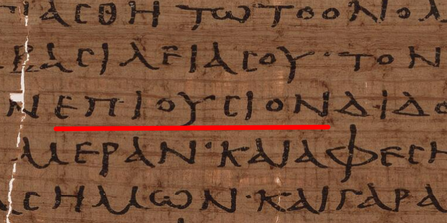
There is also the literal meaning of the word, broken down into its partsepi-ousios. What does epi mean? Think of epi center and epidermis and epithelial. This prefix means higher, above, or super.
The stem, ousios, was very important when the early Church councils and fathers were formulating their understanding of the three persons and one nature of God and the human and divine natures of Christ. Ousios can mean nature, being, essence, or substance.
So what words do these components make when put together? "Super-substance," "Super-nature," or "Super-essence". That gives us "supersubstantial," "superessential," or "supernatural."
I think you know where this is going. This "supernatural bread" is obviously referring to the Eucharist. Let's keep digging, though!
Why Don't We Translate "Our Daily Bread" as "Our Supernatural Bread"?Why hasn't this translation been used before? It has.
Dr. Brant Pitre, in his Jesus and the Jewish Roots of the Eucharist - an amazing book! - seems to favor "supernatural.
The Catechism of the Catholic Church, par. 2837, also confirms this translation ...
What does the Catechism say about "Daily Bread" and Epiousios?So, what does this mysterious word, epiousios, mean? The Catechism of the Catholic Church (CCC) paragraph 2837 explains the first levels of meaning, the meanings we probably all would have expected:
"Daily" (epiousios) occurs nowhere else in the New Testament. Taken in a temporal sense, this word is a pedagogical repetition of "this day," to confirm us in trust "without reservation." Taken in the qualitative sense, it signifies what is necessary for life, and more broadly every good thing sufficient for subsistence.
Not only that, that's how St. Jerome translates "daily bread" ...
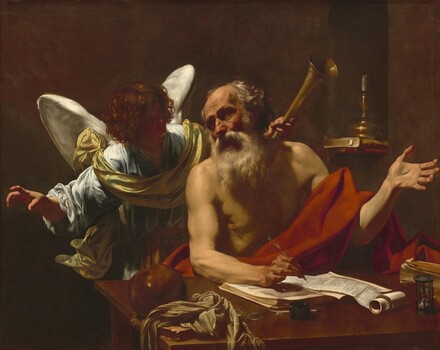
St. Jerome and "Daily Bread" in the Our FatherWorking in the Fourth Century A.D., St. Jerome translated the Bible from Greek into Latin, creating the Vulgate Bible.
St. Jerome translated epiousios as "supersubstantial." The Vulgate Bible translates the Our Father as "Give us this day our super-substantial bread."
What's also interesting is where St. Jerome was working: Bethlehem, the birthplace of Christ. Do you know what "Bethlehem" means in Hebrew?
Bethlehem means "House of Bread".
Isn't that amazing? St. Jerome was working in the "House of bread," the place where Jesus, the "bread of heaven," was born and placed in a "manger", which translates as "to eat"!
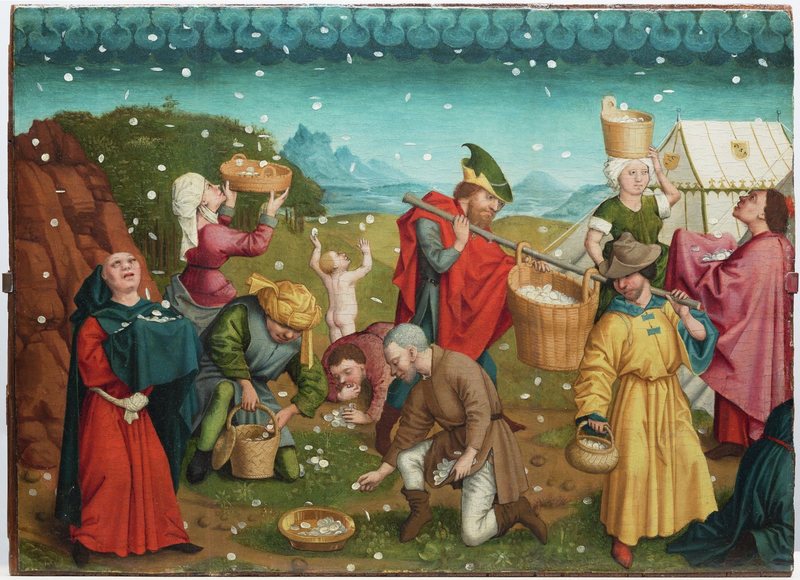
What is this "Supernatural Bread" mentioned in the "Our Father"?What, then, is this super-substantial or supernatural or super-essential bread? It could mean the Manna, the supernatural Bread from Heaven, that fed the Israelites for their entire 40 years of wandering in the wilderness. Coming from Jesus, however, "supernatural bread" means the fulfillment of the manna: the Eucharist.
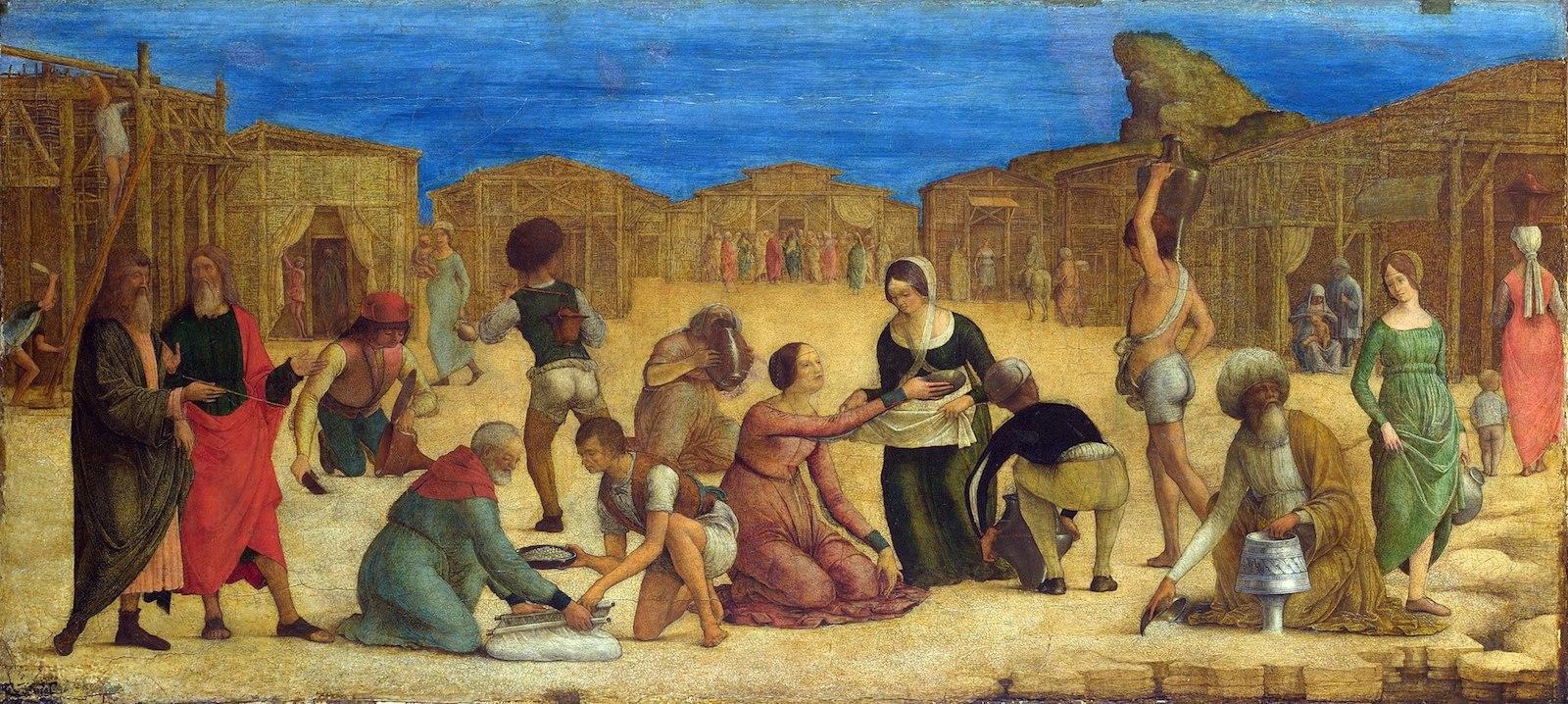
The original "supersubstantial bread" was the Manna of MosesThere is SO much more that could be said of this heavenly reality. "Supersubstantial" or "supernatural" bread is also a reference to the greatest miracle of Moses: the Manna.
The manna fed the Israelites for forty years in the desert, cf. Exodus 16. It is the original bread from heaven which came to earth every morning, except on the Sabbath.
It formed on the ground like dew. Does that sound familiar? The bread came down "like the dewfall". These words are uttered by the priest at the epiclesis, the consecration of the bread, when the work of the Holy Spirit makes the bread supernatural.
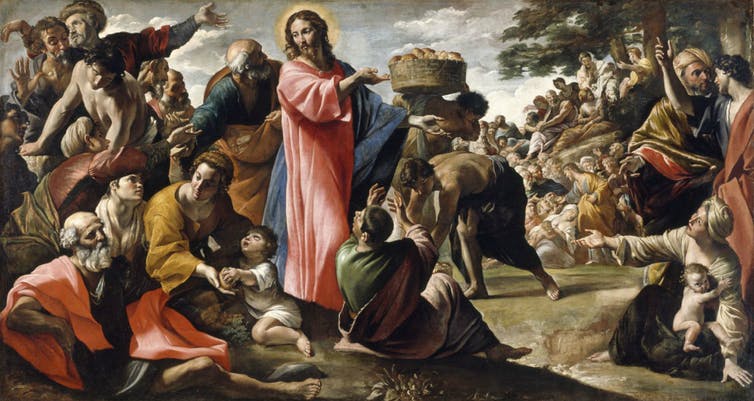
Why Does Jesus Refer to the Manna in the "Our Father"? Jesus usually refers to the Manna of Moses when talking about the Eucharist. Jesus does so repeatedly in the Bread of Life Discourse at John 6, which I describe in depth here. The Bread of Life Discourse is Jesus' most explicit and in-depth teaching on the Eucharist.
In John 6, Jesus refers to His own flesh as the New Manna. Jesus' own flesh, the Eucharist, is the New Manna.
Put it all together and what do you get?
... GIVES US THIS DAY OUR EUCHARIST
The Catechism (par. 2837) confirms all this in its typical style, very beautiful and very dense:
Taken literally (epi-ousios: "super-essential"), it refers directly to the Bread of Life, the Body of Christ, the "medicine of immortality," without which we have no life within us. Finally in this connection, its heavenly meaning is evident: "this day" is the Day of the Lord, the day of the feast of the kingdom, anticipated in the Eucharist that is already the foretaste of the kingdom to come. For this reason it is fitting for the Eucharistic liturgy to be celebrated each day.
Our daily bread, that all Christians everywhere pray for daily, is both our earthly bread and our heavenly bread. It is, of course, right that we eat bread every day for our physical well-being. Just as much, for the health of our immortal souls, it is right that we consume the "medicine of immortality" daily.
Wait ... Does that Mean Protestants are Praying for the Eucharist?Sure does. Isn't it funny that every day, every hour Protestants everywhere are crying out to the Lord for the Eucharist? If they only knew how ready the Catholic Church was to answer their prayer! What a great tool this one line from the Lord's Prayer could be for reaching our separated brothers and sisters in Christ.
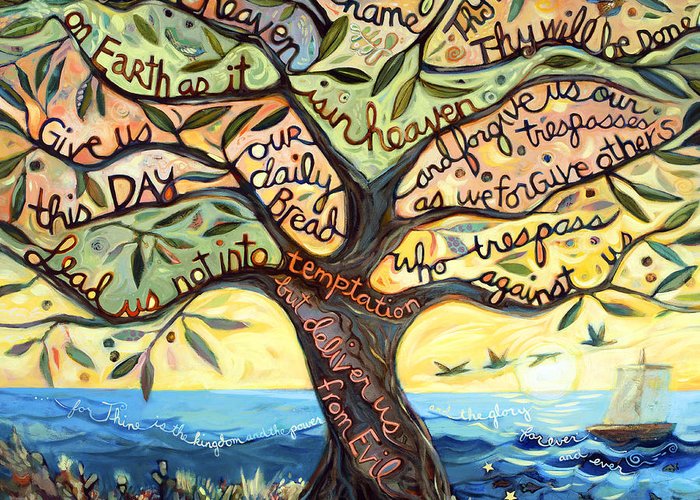
How Does the Eucharist Shed New Light on the "Our Father"?This should shed more light on the lines that come before and after "gives us this day our supernatural bread." First off, "Thy kingdom come, thy will be done." The coming of Our Father's kingdom is somehow bound up with our daily reception of the Eucharist. Moreover, the Father's "will" is accomplished -- as is the Son's will to "do this in remembrance of me."
The Eucharist and the Forgiveness of SinsWhat follows "give us this day our supernatural bread"? "Forgive us our sins." Is it possible that this "supernatural bread" is also involved with the forgiveness of our sins? Of course!
What comes after "give us this day our supernatural bread"? The second petition, right after that, is "forgive us our trespasses" or "forgive us our sins." Why? Might this "supernatural bread" have something to do with the forgiveness of sins?
Yes, of course! This is the ultimate mercy of God that He would give us His own flesh to eat in the appearance of bread. In consuming the Eucharist, we are forgiven our venial sins.
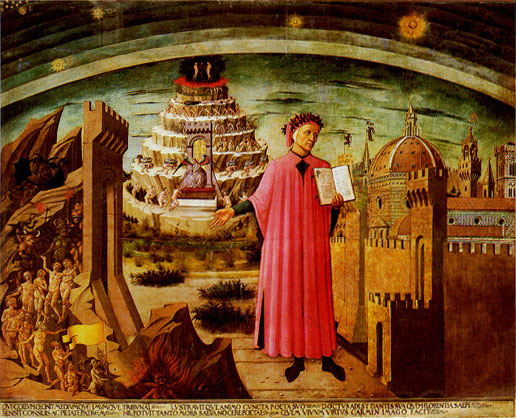
Extra: Dante's Divine Comedy, "Daily Bread" and "Daily Manna"The Divine Comedy is a long narrative poem by Dante Alighieri from the Fourteenth Century. Dante wrote the Divine Comedy in three parts: Inferno, Purgatorio, and Paradiso. Dante wrote his masterpiece from 1308 until 1320, a year before his death. It is widely considered the pre-eminent work of Italian literature, as well as one of the greatest works of world literature.
Dante provides an expanded form of the "Our Father" in the first terrace of Purgatory, the terrace of Pride. Look how he translates the "daily bread" section:
Give unto us this day the daily manna
without which he who labors most to move
ahead through this harsh wilderness falls back.
Isn't that interesting? Not only does Dante use the "manna" translation, but there's more.
The use of "manna" is followed by a description of the "harsh wilderness." Why? Because the manna and the Eucharist are the "bread for the journey."
What "journey," you might ask? Exactly the one that Dante is describing. Our journey to Heaven through Purgatory. Just like the Israelites wandering in the Wilderness, this manna feeds us on our journey to the Promised Land.
Conclusion: Importance of the "Our Father"As I hope you're beginning to see, this one word, properly translated, opens so many other doors of meaning. I hope this simple insight adds new meaning and depth to your recitation of the Lord's Prayer, in which every word is important. I know it has for me.

December 23, 2019
What is the Meaning of the Star of Bethlehem? Why Does Mary Ride a Donkey? Why is There No Room at the Inn? Typology of the New Ark and Christmas
Have you ever wondered about the Star of Bethlehem? If it represented a deeper meaning? There are a host of interesting videos on whether or not it existed. But have you ever wondered why it existed?
And what about the Blessed Mother riding a donkey to Bethlehem? We know that the Virgin Mary rode a donkey to Bethlehem, but why?
Lastly, why is there no room at the inn for Joseph and Mary? We know the town of Bethlehem was packed for the Census. But what foreshadowed this event in the Old Testament?
The Answer? The Virgin Mary is the New Ark of the Covenant. All of the above happened to the Old Ark of the Covenant, as well.

Mary being the Ark of the New Covenant will completely change the way you understand the Christmas story. Hopefully, after reading this article you will see Mary and Joseph’s journey to Bethlehem in a completely different light, even the light of the Star of Bethlehem, itself.
Why does Mary Travel on a Donkey to Bethlehem?Some dispute that the Blessed Mother even rode on the back of a donkey, as the Gospels do not mention it.[1] This idea is nevertheless corroborated by the apocryphal Protoevangelium of St. James:
The day of the Lord shall itself bring it to pass as the Lord will. And he saddled the ass, and set her upon it; and his son led it, and Joseph followed. (verse 17)
But what's going on behind the scenes? Is the Virgin Mary riding a donkey only because she is so close to giving birth?
Have you ever wondered if there was a hidden meaning behind simple scene? There is.

The answer begins with the curious incident with Uzzah. Do you remember Uzzah from 2 Samuel 6? Uzzah was killed just for just touching the Ark of the Covenant. Why?
(6) And when they came to the threshing floor of Nacon, Uzzah put out his hand to the ark of God and took hold of it, for the oxen stumbled. (7) And the anger of the Lord was kindled against Uzzah; and God smote him there because he put forth his hand to the ark; and he died there beside the ark of God. (8) And David was angry because the Lord had broken forth upon Uzzah; and that place is called Pe′rez-uz′zah, to this day.
The reason for God’s smiting of Uzzah was that he “put forth his hand to the Ark”. Uzzah had some other things going against him, as well.
Uzzah happened to be a Kohathite. Numbers 4:15 specifically designated the Kohathites to carry the Ark on poles. Unfortunately, Numbers 4:15 also specifically forbade the Kohathites from touching the Ark and "the holy things, or they will die." God always remembers his promises. Gulp.
Here’s the bottom line, though …
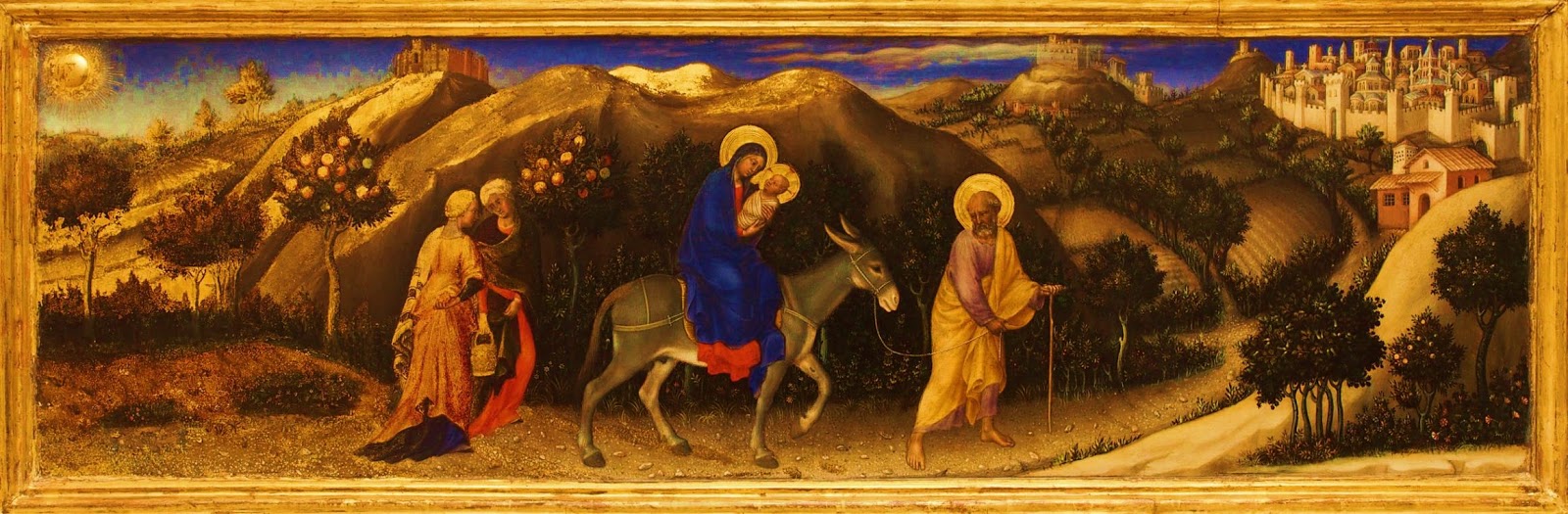 Adorazione dei Magi by Gentile da Fabriano (middle section)
The bottom line was this: Only the priests were allowed to carry the Ark of the New Covenant. The Ark was not supposed to be carried on a cart, pulled by oxen.
Why? Well, would you like to be downwind of a team of oxen? Is that a fitting place for the golden box which carried the presence of God, Himself? No.
Also, the Ark was definitely not supposed to be touched by even lower-order priests, like Uzzah. The Ark was never supposed to be in situation in which it could tumble off a cart, requiring someone like Uzzah to “put forth his hand.”
Now, compare the travels of the Old Ark through Israel on an ox cart to the travels of the New Ark, the Virgin Mary. Any similarities?
That’s why Mary travels on the back of a donkey.
This also speaks to the perpetual virginity of the Virgin Mary. The Ark of the Covenant, the Holy of Holies, was not to be touched by any man, except the High Priest. Even Joseph did not carry this title. The High Priest was the male that Mary carried in her womb. Only Jesus was permitted in this holy place.

Why Does the New Ark, the Virgin Mary, Go to Bethlehem? There’s more. What about Bethlehem? Was there perhaps a notable journey of David and the Old Ark to Bethlehem?
Absolutely.
Here are a few verses of King David singing of the Old Ark’s journey to Bethlehem from Psalm 132, verses 1-7:
Remember, O Lord, in David’s favor,
all the hardships he endured;
how he swore to the Lord
and vowed to the Mighty One of Jacob,
“I will not enter my house
or get into my bed;
I will not give sleep to my eyes
or slumber to my eyelids,
until I find a place for the Lord,
a dwelling place for the Mighty One of Jacob.”
Lo, we heard of it in Eph′rathah,
we found it in the fields of Ja′ar.
“Let us go to his dwelling place;
let us worship at his footstool!”
Wait, you might be saying, where’s the mention of Bethlehem? In the time of King David, Bethlehem was known as Eph′rathah, or it is elsewhere named in the Psalms “Ephratah-Bethlehem”.[2][3]
Also, what’s David mean when he says “I will not enter my house or get into my bed … until I find a place for the Lord, a dwelling place for the Mighty One of Jacob”? In short, it means that the Old Ark will be in want of a dwelling place or a roof over its head. More on that in a moment …
Lastly, there’s a great amount of humility contained in this comparison. This Ark of God, which traveled through Israel with King David, himself, and which was carried before all of Israel’s victorious armies, is now a simple woman, on a the back of a plain donkey, being led by a carpenter.
We should be struck by the majesty contained in such a simple caravan.
But there’s still more. This also tells us something about the Perpetual Virginity of Mary.

This is why Uzzah was smote for touching the old Ark of the Covenant. Uzzah wasn’t just trespassing on sacred ground. It was as if he had violated the Ark’s virginity.
Joseph does not make the mistake of Uzzah! Joseph has no children by Mary. Mary remains a virgin.

“I know not man” is the literal translation from the Greek text. Other translations try “because I am a virgin” or “because I know not a man,” but these alternatives don’t quite cut the mustard.
Mary’s question to the angel makes no sense unless Mary had professed a vow of virginity.
Just a few verses back at verse 27, we are told that Mary and Joseph are already “espoused”. Mary and Joseph already have what would be akin to a ratified marriage in Jewish culture. They were married. Joseph would have had the right to the marriage bed.
How can we account then for Mary’s confusion? Mary did not say simply: “How can I bear a son? Since I have not yet known a man but intend to soon enter into relations with Joseph.” She would have just presumed that the child would be the son of Joseph.
If Mary and Joseph were part of an ordinary Jewish marriage, she would not be asking about the father of the child. Joseph would be the father of the child, unless they were to be celibate in marriage.
Normally, after the espousal the husband would go off and prepare a home for his new bride and then come and receive her into his home where the union would be consummated. This is precisely why Joseph intended to “divorce her quietly” (Mt 1:19) when he later discovered she was pregnant.
This background is significant because a newly married woman would not ask the question “How shall this be?” She would know. Unless, of course, that woman had taken a vow of virginity and the vow was continuing into the marriage.
Mary believed the angel’s message in faith, but had no idea how this was going to be accomplished in light of her vow. This also indicates she was not planning on the normal course of events for her future with Joseph.

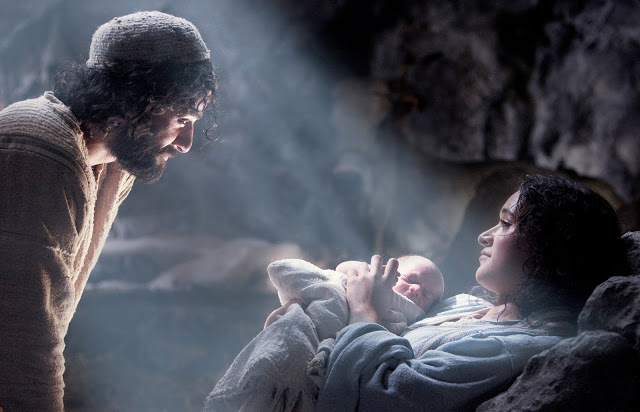
It was foretold in the Old Testament that there would be no room for Mary and Joseph at the inns of Bethlehem. In addition to Psalm 132, the readings from the Christmas liturgy give us a special insight into the Nativity Story.
The First Reading from Morning Mass on December 24 (Cycle A) comes from 2 Samuel 7:
When King David was settled in his palace, and the LORD had given him rest from his enemies on every side, he said to Nathan the prophet, “Here I am living in a house of cedar, while the ark of God dwells in a tent!” Nathan answered the king, “Go, do whatever you have in mind, for the LORD is with you.” But that night the LORD spoke to Nathan and said: “Go, tell my servant David, ‘Thus says the LORD: Should you build me a house to dwell in?’"
King David returns home from his victories on the battlefield. These victories were won because David's armies carried the Ark of the Covenant before them into battle. Now David wonders at how the Ark of God dwells in a tent, while he dwells in a palace.
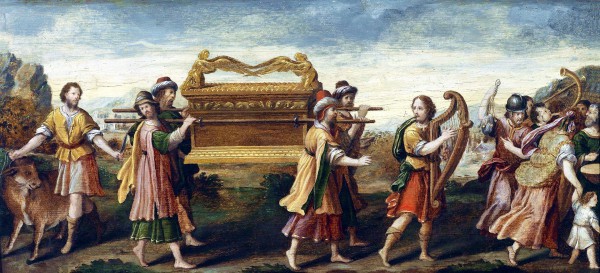
So what do King David's musings have to do with the Christmas story which won't occur for another 1,000 years?
We covered some of David’s journeys with the Ark of the Covenant in this article, “What’s Really Happening at the Visitation?”
Here, at last, the Ark is done at the end of its long journey. Its journey began at Mount Sinai, where God through Moses first ordered it constructed. The Ark wandered with the Israelites through their forty years in the desert. The Ark crossed the River Jordan ahead of them and parted the waters, just as before with the Red Sea. The Ark was carried before all of Israel’s armies through battle after battle. And now, it has finally arrived in Jerusalem.
So, back to David dwelling in a palace while the Ark of God dwells in a tent. Mary is the New Ark, and where is she forced to dwell? There is no room for Mary and Joseph at the Inn of Bethlehem. The New Ark dwells in a stable. Neither the Old Ark nor the New Ark are permitted a palace, but must dwell outdoors.
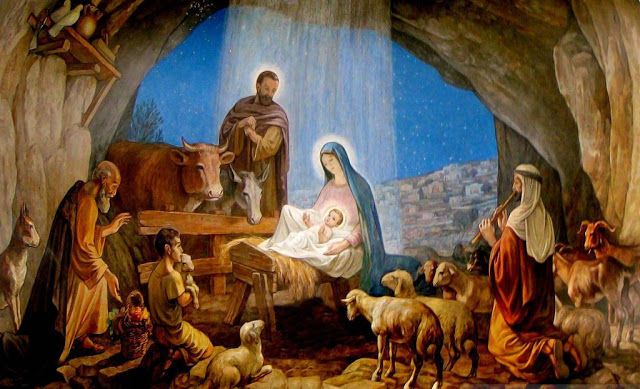
Or, the New Ark dwells in a cave to give birth ...
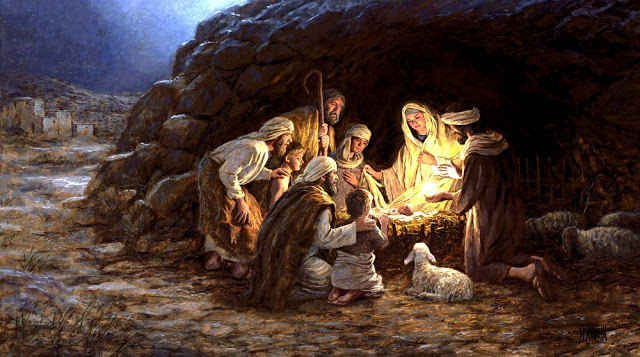
Never fear! The First Reading from December 24, still from 2 Samuel 7, goes on to make a promise:
The LORD also reveals to you that he will establish a house for you. And when your time comes and you rest with your ancestors, I will raise up your heir after you, sprung from your loins, and I will make his Kingdom firm. I will be a father to him, and he shall be a son to me. Your house and your Kingdom shall endure forever before me; your throne shall stand firm forever.
The Lord says he will raise up an heir to David "sprung from [his own] loins." But how can this be? King David has been dead from a thousand years when Mary gives birth in Bethlehem. Also, the Lord says that He will be father to the "heir". How can the heir be the child of both King David and God?
Because Christ is born into the family of David. Mary is a descendant of David, as the Angel Gabriel confirms at Luke 1:31-33. Also, Christ is the Son of God, confirming both parts of the prophesy. Through the New Ark and Christ, therefore, the throne of David "shall stand firm forever.What is the Meaning of the Star of Bethlehem? The Star of Bethlehem does some odd things. The Wise Men are able to follow it until it comes to a rest above Jesus’ manger. The star is usually depicted as a tower of light shining down on the nativity scene.
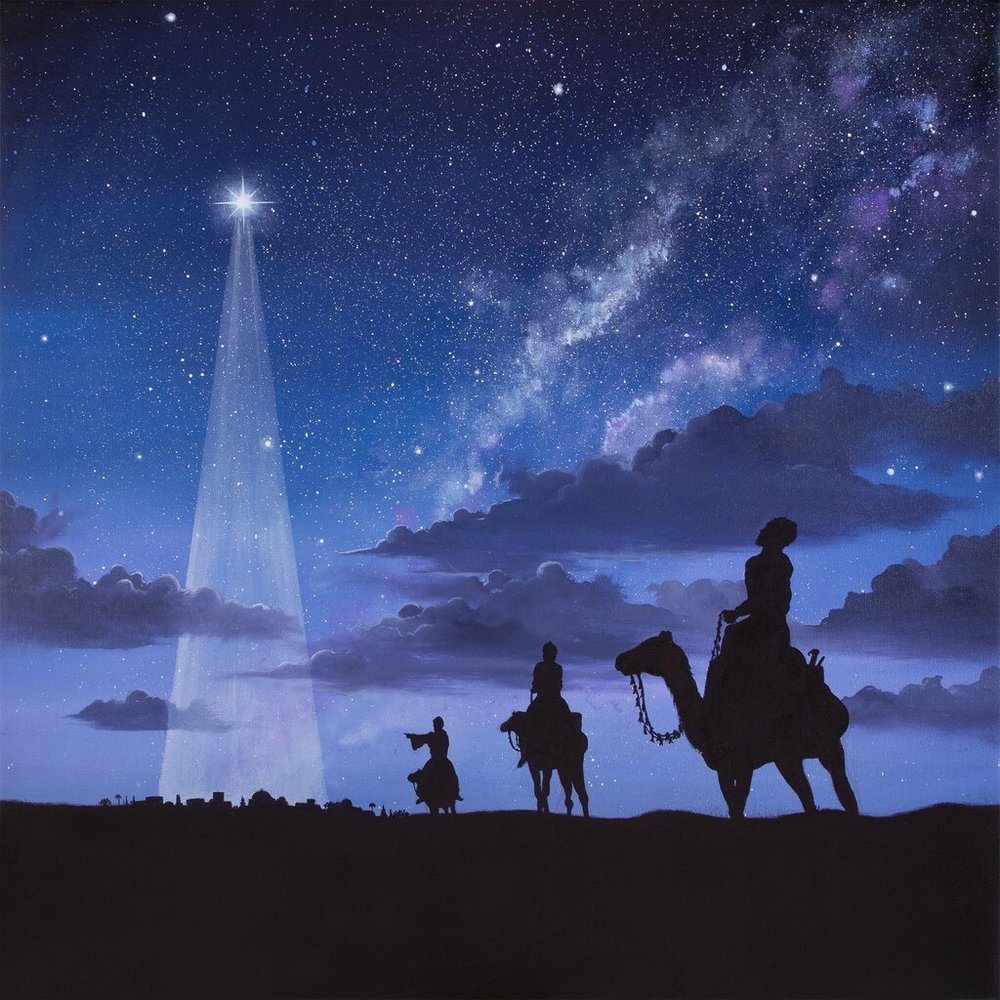
Why is all this happening? We take all this for granted. It’s just God doing His thing, right? It’s just miracles. Sure, but why this particular combination of miracles?
Here is the description of these events from the second chapter of the Gospel of Matthew:
When [the Wise Men] had heard the king they went their way; and lo, the star which they had seen in the East went before them, until it came to rest over the place where the child was. When they saw the star, they rejoiced exceedingly with great joy.
Why is the light from the star following Mary and Joseph? Do you remember light following anyone else in the Bible?
Remember the Shekinah, the “Glory Cloud”? It's also described in the article on the Visitation, above. The Glory Cloud was a tower of light and fire which “overshadowed” the Ark of the Covenant.
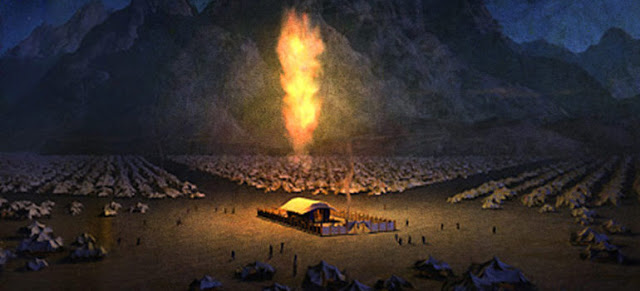
The Shekinah was a brilliant beacon of light at the center of the Israelite’s camp. If the shepherds or their flocks strayed too far from the Israelite camp, the light of the Glory Cloud would lead them back.
The Shekinahstayed with Israelites and the Ark of the Covenant for some time, but eventually left them. After the Jews returned from their captivity, a modest Second Temple was completed in 515 BC. But, the visible presence of God as the Shekinah cloud of glory did not return.
The Shekinah was prophesied to return, however.
The 17th blessing of the daily Amidah (Standing) prayer expresses the longing in the Jewish heart that the Shekinah will one day return: “Blessed are You, God, who returns His Presence (Shechinato) to Zion.”
The Prophet Jeremiah also prophesies the return of the Glory Cloud AND the Ark of the Covenant at 2 Maccabees 2. After hiding the Ark of the Covenant, he rebukes those that followed him, saying the following:
When Jeremiah learned of it, he rebuked them and declared: “The place shall be unknown until God (1) gathers his people together again and (2) shows his mercy. And then the Lord will disclose these things, and the glory of the Lord and the cloud will appear, as they were shown in the case of Moses, and as Solomon asked that the place should be specially consecrated.” (2 Maccabees 2:7-8) [numbers added]
So when did the Shekinahreturn? When do we a see a tower of light and fire rising above the Ark of the New Covenant? A tower of light rising above a place that is "specially consecrated"? That is, when do we see a tower of light above the Virgin Mary?
That’s right! The Star of Bethlehem.
The light of the star, the tower of light, illuminates the birth of the “light of the world”.
We have already discussed how the Gospel of Luke connects Mary to the Shekinah. The Holy Spirit “overshadowed” the Virgin Mary when Jesus was conceived in her womb. The word “overshadow” was used in the Old Testament specifically to describe the Shekinah Glory Cloud resting above the Ark of the Covenant. Now it rests upon the Ark of the New Covenant, Mary.

Also, in her Magnificat, Mary further fulfills Jeremiah's prophecies. She describes the (1) gathering of God's people and (2) God's "mercy" twice to Elizabeth, who has already described the Virgin Mary as the Ark:
For behold, henceforth all generations will call me blessed;
for he who is mighty has done great things for me,
and holy is his name.
And his mercy is on those who fear him
from generation to generation.He has shown strength with his arm,
he has scattered the proud in the imagination of their hearts,
he has put down the mighty from their thrones,
and exalted those of low degree;
he has filled the hungry with good things,
and the rich he has sent empty away.
He has helped his servant Israel,
in remembrance of his mercy,
as he spoke to our fathers,
to Abraham and to his posterity for ever.
But How is the Glory Cloud a Light to All NationsBut the original Shekinah stood as a light to all Israel. The conception of Jesus was a private affair, as was the Visitation. When does the Shekinah shine again for all Israel to see? Even for all the world to see?

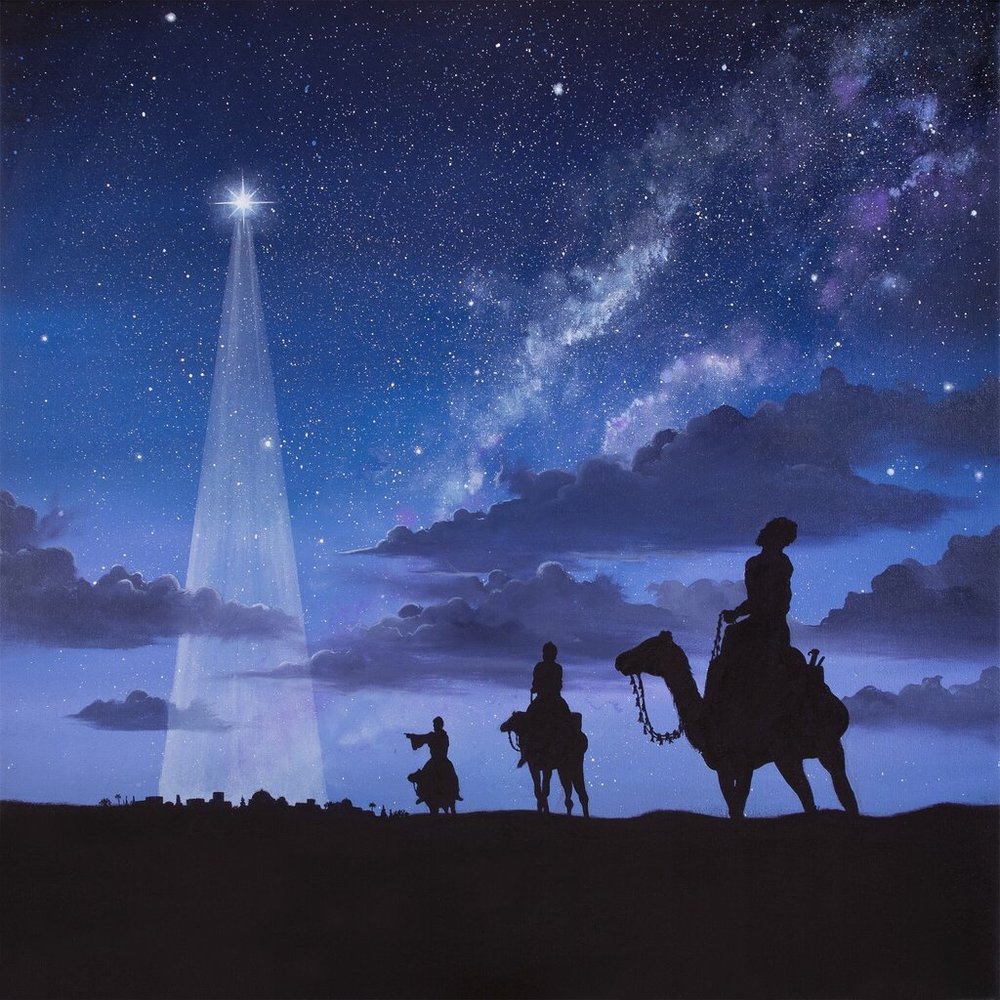
That's right ...
The Shekinahreturns as the Star of Bethlehem. Notice the strange behavior of the Star of Bethlehem:The star is a tower of light “overshadowing” the Virgin Mary and the entire Holy Family before, during, and after the Nativity.The star is a sign to all Israel, to the shepherds and even to the evil King Herod; andThe star is visible to the entire world! The Magi, the Kings of the East, are guided by the star to Christ’s manger.
What does this tell us about Christ and His mission? Christ will bring light to all of Israel and the entireworld!
Also, as amazing as Moses was, Jesus is far superior. He is God. The Ark of Jesus, too, is far superior to the Ark of Moses. She is a human being. Even Moses’ Shekinah, as amazing a sight as it was, it is also far exceeded by Jesus’ Shekinah, the Star of Bethlehem. Moses had a tornado. Jesus had an entire star!
Footnotes: What is the Meaning of the Star of Bethlehem? Why No Room at the Inn? Why Does Mary Ride a Donkey? Typology of the New Ark and Christmas[1] Some also suggest that Joseph would have been too poor to possess a donkey. This is due to the fact that the Holy Family was allowed to offer the less costly of the sacrificial options at the Presentation at the Temple. There are other possibilities, however, including that Joseph simply borrowed the donkey. One can easily imagine a kind person letting the pregnant mother borrow a donkey for her long ride. Additionally, there was already talk spreading about Mary's baby and her virgin birth. Ensuring Mary's safe travels may have been paramount in the minds of many in Nazareth.
[2] Biblical scholar Joseph Addison Alexander argues for this understanding: “The only explanation, equally agreeable to usage and the context, is that which makes Ephratah the ancient name of Bethlehem (Genesis 48:7), here mentioned as the place where David spent his youth, and where he used to hear of the ark, although he never saw it till long afterwards, when he found it in the fields of the wood, in the neighbourhood of Kirjathjearim, which name means Forest town, or City of the Woods. Compare 1 Samuel 7:1 with 2 Samuel 6:3-4."
[3] Another Biblical scholar, Christopher Wordsworth, states the following: “The Psalmist says, that David himself, even when a youth in Bethlehem Ephratah, heard of the sojourn of the ark in Kirjathjearim, and that it was a fond dream of David's boyhood to be permitted to bring up the ark to some settled habitation, which he desired to find (Psalms 132:5).”

December 10, 2019
The Catholic Parent's Complete Guide to the Seven Holy Virtues and the Seven Deadly Sins
Want to teach your kids about virtue? Not only that, want to teach your kids how to defeat vice?
My wife and I started something a while back with our kids. It is just a simple addition to family prayer night.
Each Vice is defeated by a particular Virtue. Each week for seven weeks, the kids pick out a new virtue to pray for and work on all week. I will spell out the specifics below.
Here's the basic idea to help your kids learn virtue. As you will see in the infographic below, each virtue defeats a specific vice.
Afterwards, we will take deep dives into all of the following below:
What is Virtue? What are the 7 Deadly Sins? Plus explanations and Bible verses for eachWhat are the 7 Holy Virtues? Plus explanations and Bible verses for each
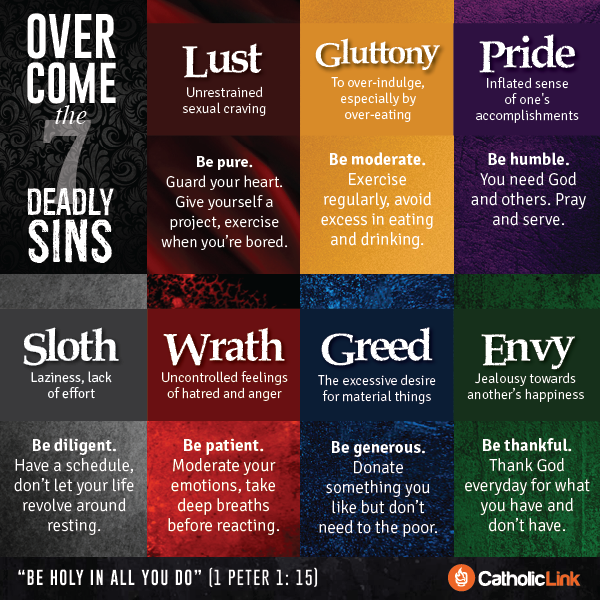
Infographic: Overcome the 7 Deadly Sins with the 7 Holy Virtues
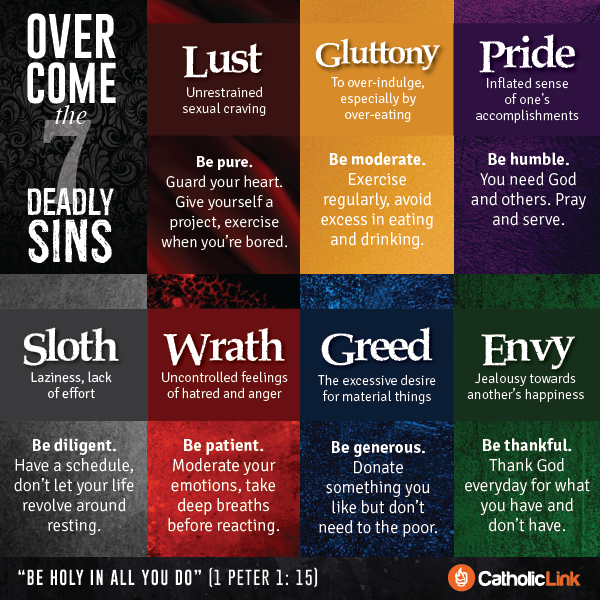
What Virtues Defeat Which Vices? The Contrarian or Remedial Model of VirtueYou can think of the Seven Virtues as a sword forged to defeat a specific Vice. This is the "remedial" or "contrarian" model of the Seven Holy Virtues. Each specific virtues is the "cure" or "remedy" or "antidote" that stands in opposition to each of the Seven Deadly sins.
Prudentius devised this model in 410 AD in his allegorical poem the Psychomachia ("The Battle for the Soul"). Prudentius' scheme of virtues and vices looked something like this:
Humility defeats Pride
Kindness defeats Envy
Temperance defeats Gluttony
Chastity defeats Lust
Patience defeats Wrath
Generosity defeats Greed
Diligence defeats Sloth
Family and Kids Prayer Exercise to Teach Virtue and Defeat ViceHere are the steps we take for our Virtue Defeats Vice prayer exercise with the kids:We cut out different colored rectangles of construction paper and write each of the above on each rectangle. For example, the red rectangle will read "Patience defeats Wrath" because Wrath seems like a red color to us. Envy is green, of course. Beware the green-eyed monster! But whatever you think best. This is our prayer bulletin board:
 Oops! Looks like I made Anger the green one. Anger should be red, right?
 We focus on a different slip of paper each week. Who picks out the slip of paper? We try to pick the child that most exemplified the previous week's virtue. We'll also try a rotation, since some of our kids may be too young to understand why they never get to pick a virtue. We ask Jesus every night to grant us the grace of this week's Virtue and to use it to defeat the week's Vice. We also use the opportunity to praise expressions of Virtue in the kids and talk about how we could have done better or when we failed to practice virtue. Sometimes, we will spend more than a week on a particular Virtue and Vice. (Or, sometimes we just mess up the seven-week schedule)At Christmas, we also have a virtue Christmas tree. We slowly [patiently] adorn it with homemade ornaments:

Background on Virtue, the 7 Holy Virtues, and the 7 Deadly SinsFirst off, we should probably think about virtue for second. What is it?
What is Virtue?
Whatever is true, whatever is honorable, whatever is just, whatever is pure, whatever is lovely, whatever is gracious, if there is any excellence, if there is anything worthy of praise, think about these things. (Philippians 4:8)
According to the Catechism of the Catholic Church, paragraph 1803:
A virtue is an habitual and firm disposition to do the good. It allows the person not only to perform good acts, but to give the best of himself. The virtuous person tends toward the good with all his sensory and spiritual powers; he pursues the good and chooses it in concrete actions.
According to St. Gregory of Nyssa, "The goal of a virtuous life is to become like God."[1]
Virtue is a Habit of the WillVirtue is a habit of the will, according to Aristotle and St. Thomas Aquinas.[2]
It takes time and practice to develop a good habit. Virtue takes practice.
For example, here is a quote from Aristotle's Nicomachean Ethics:
... We become just by doing just acts,Here's a video if you would like a deeper dive into Aristotle's understanding of virtue:
temperate by doing temperate acts,
brave by doing brave acts.[2]
Children are born vicious?Aquinas is also known for saying, and I paraphrase, "children are born vicious."[3] This may not sound too inspiring, but give me a second. Virtues are habits. Habits take time to develop. If you are just born, you haven't had much time to develop habits or virtues. Except maybe patience!
If you are lacking in virtue, you are vicious. Therefore, we parents must teach our children good habits. We must teach our children virtue.
So, what are the Seven Deadly Sins and the Seven Holy Virtues?
What are the Seven Deadly Sins (Vices)? The Seven Deadly Sins are Pride, Envy, Wrath, Sloth, Greed, Gluttony, and Lust.
Here is a listing below with some additional categories:
The Seven Deadly Sins
Three Spiritual Sins
1. Pride (spiritual sin)
2. Envy (spiritual sin)
3. Wrath (spiritual sin affected by body)
Four Corporal Sins
4. Accidia or Sloth (corporal sin)
5. Avaricia/Cupiditas or Greed (corporal sin)
6. Gluttony (corporal sin)
7. Lust (corporal sin)
The Seven Deadly Sins are divided into spiritual and corporal sins. Corporal Sins are sins "of the body." Spiritual Sins are sins "of the spirit." Pride, for example, occurs primarily in our thoughts. Lust, on the other hand, might begin in our thoughts, but is consummated with the body.
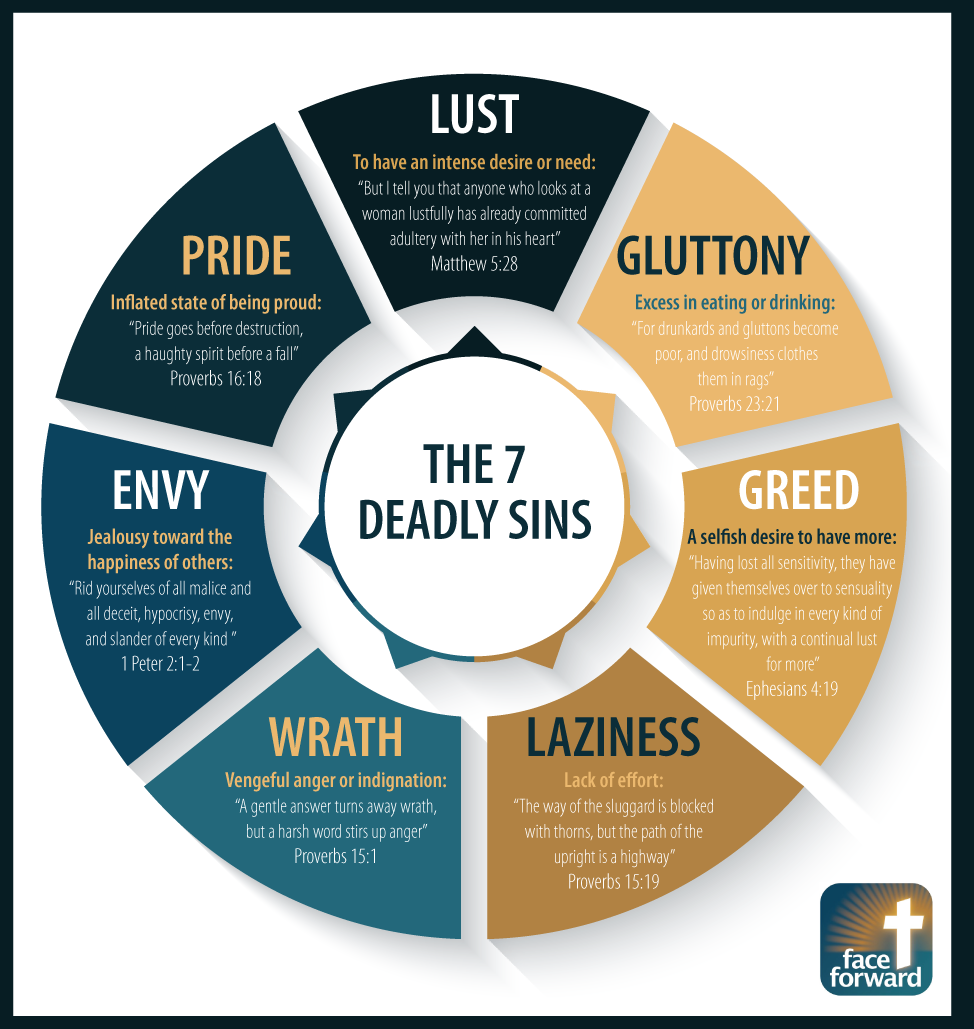
Here's a handy infographic for the 7 Deadly Sins ...
Infographic: 7 Deadly Sins
Did you know the Seven Deadly Sins were paired with Seven Holy Virtues? See below ...
Definitions and Bible Verses for Each of the Seven Deadly SinsYou may be asked to define the Seven Deadly Sins. Here are good definitions, not just for adults, but for kids, as well. Defining "lust" for a child can be tricky, right?
Here are definitions for each of the Seven Deadly Sins, plus Bible verses for each: (provided by All About God)
Lust – to have an intense desire or need: “But I tell you that anyone who looks at a woman lustfully has already committed adultery with her in his heart” (Matthew 5:28).Gluttony – excess in eating and drinking: “for drunkards and gluttons become poor, and drowsiness clothes them in rags” (Proverbs 23:21).Greed - excessive or reprehensible acquisitiveness: “Having lost all sensitivity, they have given themselves over to sensuality so as to indulge in every kind of impurity, with a continual lust for more” (Ephesians 4:19).Laziness – disinclined to activity or exertion: not energetic or vigorous: “The way of the sluggard is blocked with thorns, but the path of the upright is a highway” (Proverbs 15:19).Wrath – strong vengeful anger or indignation: “A gentle answer turns away wrath, but a harsh word stirs up anger” (Proverbs 15:1)Envy – painful or resentful awareness of an advantage enjoyed by another joined with a desire to possess the same advantage: “Therefore, rid yourselves of all malice and all deceit, hypocrisy, envy, and slander of every kind. Like newborn babies, crave pure spiritual milk, so that by it you may grow up in your salvation” (1 Peter 2:1-2).Pride - quality or state of being proud – inordinate self esteem: “Pride goes before destruction, a haughty spirit before a fall” (Proverbs 16:18).

Memorize It: Handy Mneumonic for the Seven Deadly SinsThe Seven Deadly Sins are like Plagues of the Soul! PLAGGES. Ok, it's not exactly spelled like "plagues", but pretty close, right?
P - Pride
L - Lust
A - Anger/Wrath
G - Greed
G - Gluttony
E - Envy
S - Sloth

What are the Seven Holy Virtues?Did you know there were Seven Holy Virtues to match and defeat the Seven Deadly Sins?
As above, the Seven Holy Virtues are divided in Spiritual and Corporal Virtues:
The Seven Holy Virtues
Three Spiritual (or Theological) Virtues
1. Fides (Faith)
2. Spes (Hope)
3. Caritas (Charity)
The Four Cardinal (or Pagan) Virtues
4. Prudence
5. Temperance
6. Fortitude
7. Justice
Definitions and Bible Verses for Each of the Seven Holy VirtuesYou may be asked to define the Seven Holy Virtues. Here are good definitions, not just for adults, but for kids, as well. Sometimes it can be hard defining faith for a child, even though they likely understand it better than we do. Nevertheless, you don't want to be stuck saying something like "faith" - oh, you know, it's when you have faith.
Here are definitions for each of the Seven Deadly Sins, plus Bible verses and citations from the Catechism of the Catholic Church (CCC) for each:
Faith (CCC 1814-1816): Faith is the theological virtue by which we believe in God and believe all that he has said and revealed to us, and that Holy Church proposes for our belief, because he is truth itself.
By faith "man freely commits his entire self to God."[4] For this reason the believer seeks to know and do God's will. "The righteous shall live by faith." Living faith "work[s] through charity" (Romans 1:17; Galatians 5:6).
The gift of faith remains in one who has not sinned against it.[5] But "faith apart from works is dead" (James 2:26): when it is deprived of hope and love, faith does not fully unite the believer to Christ and does not make him a living member of his Body.
The disciple of Christ must not only keep the faith and live on it, but also profess it, confidently bear witness to it, and spread it: "All however must be prepared to confess Christ before men and to follow him along the way of the Cross, amidst the persecutions which the Church never lacks."[LG 42; cf. DH 14].
Service of and witness to the faith are necessary for salvation: "So every one who acknowledges me before men, I also will acknowledge before my Father who is in heaven; but whoever denies me before men, I also will deny before my Father who is in heaven" (Matthew 10:32-33).
Hope (CCC 1817-1821)Hope is the theological virtue by which we desire the kingdom of heaven and eternal life as our happiness, placing our trust in Christ's promises and relying not on our own strength, but on the help of the grace of the Holy Spirit.
"Let us hold fast the confession of our hope without wavering, for he who promised is faithful" (Hebrews 10:23).
"The Holy Spirit . . . he poured out upon us richly through Jesus Christ our Savior, so that we might be justified by his grace and become heirs in hope of eternal life" (Titus 3:6-7).
The virtue of hope responds to the aspiration to happiness which God has placed in the heart of every man. Hope takes up the hopes that inspire men's activities and purifies them so as to order them to the Kingdom of heaven.
Hope keeps man from discouragement. Hope sustains him during times of abandonment. Hope opens up his heart in expectation of eternal beatitude. Buoyed up by hope, he is preserved from selfishness and led to the happiness that flows from charity.

Charity (CCC 1822-1829) - the "First Virtue""If I . . . have not charity," says St. Paul, "I am nothing." Whatever my privilege, service, or even virtue, "if I . . . have not charity, I gain nothing" (1 Corinthians 13:1-4).
Charity is superior to all the virtues. It is the first of the theological virtues: "So faith, hope, charity abide, these three. But the greatest of these is charity" (1 Corinthians 13:13).
The practice of all the virtues is animated and inspired by charity, which "binds everything together in perfect harmony" (Colossians 3:14). Charity is the form of the virtues. Charity articulates and orders the virtues among themselves. Charity is the source and the goal of their Christian practice. Charity upholds and purifies our human ability to love, and raises it to the supernatural perfection of divine love.
The practice of the moral life animated by charity gives to the Christian the spiritual freedom of the children of God. He no longer stands before God as a slave, in servile fear, or as a mercenary looking for wages, but as a son responding to the love of him who "first loved us" (cf. 1 John 4:19):
If we turn away from evil out of fear of punishment, we are in the position of slaves. If we pursue the enticement of wages, . . . we resemble mercenaries. Finally if we obey for the sake of the good itself and out of love for him who commands . . . we are in the position of children.[6]
The fruits of charity are joy, peace, and mercy. Charity demands beneficence and fraternal correction. Charity is benevolence. Charity fosters reciprocity and remains disinterested and generous. Charity is friendship and communion.
Love is itself the fulfillment of all our works. There is the goal; that is why we run: we run toward it, and once we reach it, in it we shall find rest.[7]
Prudence (CCC 1806) - the "Charioteer of the Virtues"Prudence is the virtue that disposes practical reason to discern our true good in every circumstance and to choose the right means of achieving it; "the prudent man looks where he is going" (Proverbs 14:15). "Keep sane and sober for your prayers" (1 Peter 4:7). Prudence is "right reason in action," writes St. Thomas Aquinas, following Aristotle.[8]
Prudence is not to be confused with timidity or fear, nor with duplicity or dissimulation.
Prudence is called auriga virtutum (the charioteer of the virtues); it guides the other virtues by setting rule and measure. It is prudence that immediately guides the judgment of conscience. The prudent man determines and directs his conduct in accordance with this judgment. With the help of this virtue we apply moral principles to particular cases without error and overcome doubts about the good to achieve and the evil to avoid.

Temperance (CCC 1809) Temperance is the moral virtue that moderates the attraction of pleasures and provides balance in the use of created goods. It ensures the will's mastery over instincts and keeps desires within the limits of what is honorable.
The temperate person directs the sensitive appetites toward what is good and maintains a healthy discretion: "Do not follow your inclination and strength, walking according to the desires of your heart" (Sirach 5:2; cf. 37:27-31). Temperance is often praised in the Old Testament: "Do not follow your base desires, but restrain your appetites" (Sirach 18:30).
In the New Testament, temperance is called "moderation" or "sobriety." We ought "to live sober, upright, and godly lives in this world" (Titus 2:12).
St. Augustine says the following about Temperance and its relationship to Fortitude, Justice, and Prudence:
To live well is nothing other than to love God with all one's heart, with all one's soul and with all one's efforts; from this it comes about that love is kept whole and uncorrupted (through temperance). No misfortune can disturb it (and this is fortitude). It obeys only [God] (and this is justice), and is careful in discerning things, so as not to be surprised by deceit or trickery (and this is prudence).[9]
 Temperance, Piero del PollaiuoloFortitude (CCC 1808)Fortitude is the moral virtue that ensures firmness in difficulties and constancy in the pursuit of the good. It strengthens the resolve to resist temptations and to overcome obstacles in the moral life. The virtue of fortitude enables one to conquer fear, even fear of death, and to face trials and persecutions.
 Fortitude disposes one even to renounce and sacrifice his life in defense of a just cause. "The Lord is my strength and my song" (Psalms 118:14). "In the world you have tribulation; but be of good cheer, I have overcome the world" (John 16:33).
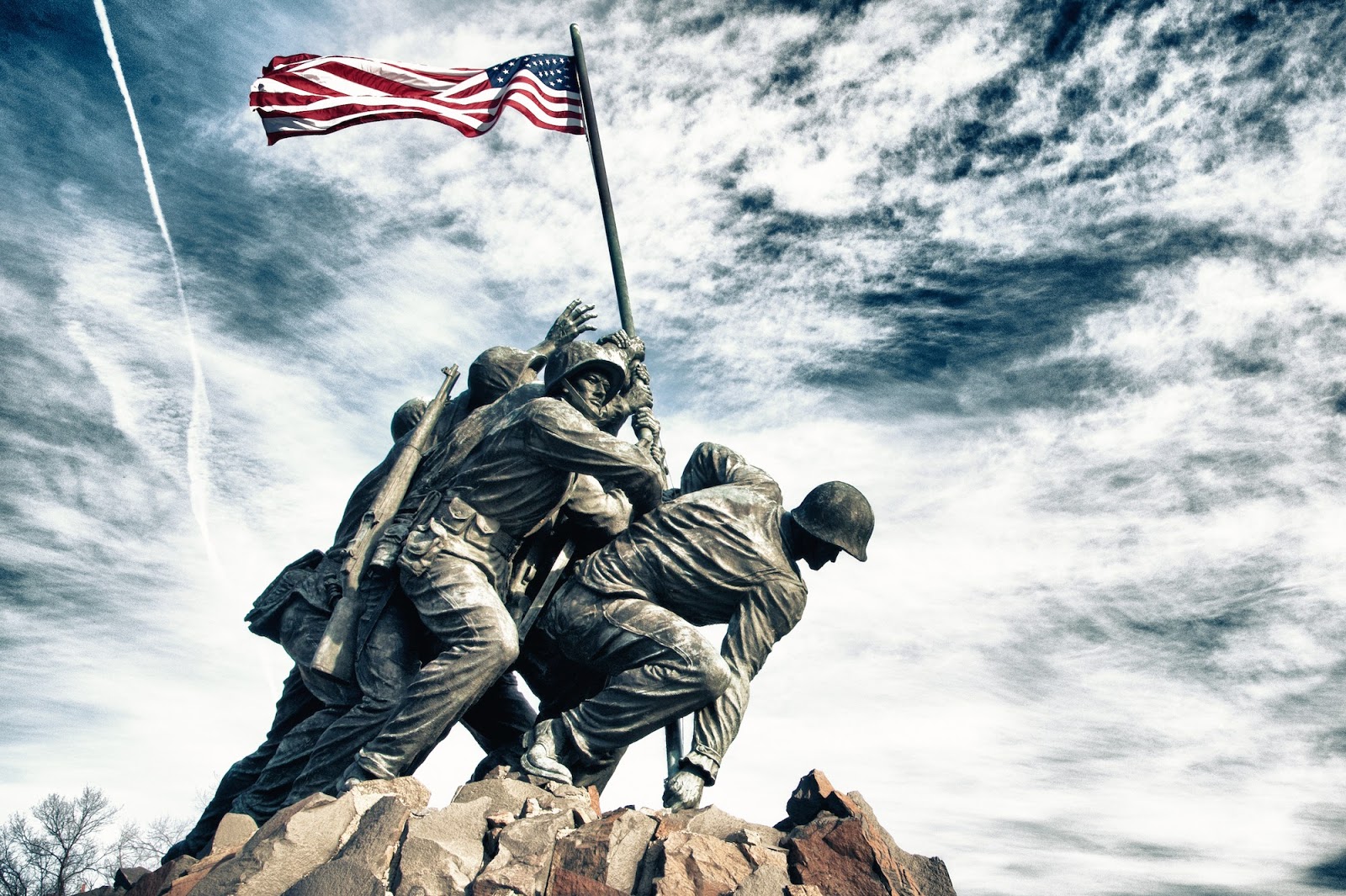
Justice (CCC 1807) - the "Virtue of Religion" Justice is the moral virtue that consists in the constant and firm will to give their due to God and neighbor. Justice toward God is called the "virtue of religion." Justice toward men disposes one to respect the rights of each and to establish in human relationships the harmony that promotes equity with regard to persons and to the common good.
The just man, often mentioned in the Sacred Scriptures, is distinguished by habitual right thinking and the uprightness of his conduct toward his neighbor. "You shall not be partial to the poor or defer to the great, but in righteousness shall you judge your neighbor" (Leviticus 19:15). "Masters, treat your slaves justly and fairly, knowing that you also have a Master in heaven" (Colossians 4:1).

Footnotes: Catholic Dad Guide to Teaching the Virtues[1] De beatitudinibus, 1:PG 44, 1200D.
[2] cf. Aristotle, Nicomachean Ethics 1103b; Aquinas, DVC 1; ST IaIIae 49.1
[3] cf. Aquinas, Summa theologica, trans. Fathers of the English Dominican Province (New York: Benziger Brothers, 1911-1925), IIIa, q. 68, arts 6.
[4] Dei Verbum 5
[5] cf. Council of Trent (1547): DS 1545
[6] St. Basil, Reg. fus. tract., prol. 3:PG 31,896B.
[7] St. Augustine, In ep. Jo. 10,4:PL 35,2057.
[8] Aquinas, STh II-II,47,2.
[9] St. Augustine, De moribus eccl. 1,25,46: PL 32,1330-1331.

November 28, 2019
Happy Catholic Thanksgiving!
Did you know the Greek word for "Thanksgiving" is Eucharist? So what does that mean for Catholic Thanksgiving?
... that the Last Supper was the First Thanksgiving! Move over, Pilgrims.

Since Eucharist is the Greek word for "Thanksgiving," it is no wonder why many families go to Holy Mass on Thanksgiving, even though it's not a Holy Day of Obligation. It's a good way to give the holiday its proper Christian context.
It is good to be reminded of all the blessings in our lives, but none more so than the ultimate gift of Christ, Himself.
Happy Catholic Thanksgiving to everyone! Happy Eucharist!

November 5, 2019
The Eucharist and The Sandlot - A Primer on Eucharist Etiquette, Homily by Father Brent Maher
The year was 1962.
Scotty Smalls had just moved to a new home in Los Angeles and was looking to make some friends. Scotty found a group of neighborhood boys, but was unfamiliar with the game of baseball that seemed to consume their free time ...

"Babe Ruth and the Bread of Life"
Homily by Father Brent Maher
St. Anne's Church
Morganza, Louisiana
(philomenarocks.blogspot.com)
Readings for Sunday, May 29 (Corpus Christi Sunday)
Genesis 14:18-20
Psalm 110
1 Corinthians 11:23-26
Luke 9:11-17
... Scotty soon began to be introduced to America’s favorite pastime as the boys played on a local field. One day the boys were playing when a hard hit knocked the cover right off the ball! They were amazed but also upset because it was their only ball. Scotty said, ‘I have a ball!’ and ran home to grab the ball set upon his father’s shelf. He came back and, because of the gift of the ball to the team, was given first chance to bat. He hit the ball as far as he ever had; right over the fence into the neighbor’s yard that restrained a dog that consumed everything that went into it.
Scotty began to get upset because he knew his father would be upset, especially because the ball has someone’s name on it… Babe… something. The boys around him began to freak out when they realized they had just played with and lost a Babe Ruth autographed baseball, explaining the importance of such an item to Scotty, who had until then never heard the name. Providence was on their side, as the boys soon made their way to the home of the neighbor who himself had a Babe Ruth autographed ball and was willing to give it to Scotty. In the end everything was resolved and Scotty fell in love with the game that he had previously known nothing about.
In case you haven’t caught on by now, that is the storyline of the movie The Sandlot. It came out in 1993, so I wasn’t worried about spoiler alerts because if you haven’t seen it by now, you probably won’t. This movie came to mind because Scotty held within his hand an item of great value and yet he was totally unaware of it until it was explained to him.
The FragmentsIn the Gospel we just heard there is a little point that caught my attention this time that never had that emphasized the same point to me about this miracle. When I’ve preached on this passage in the past it is usually concerned with the clear connections to the Last Supper and the words that tie the two together; how Jesus took bread, blessed it, broke it, gave it to His disciples, and they then gave it to others afterward. The phrasing is rather obvious that it is a reference to what would later happen and that which we celebrate every Mass: the giving of the Eucharist to the Church. At times I have done a bit of pondering on the meaning of the twelve wicker baskets, a specific detail mentioned here. But I never for a moment gave consideration to the fact that the Lord had the disciples pick up the fragments themselves.
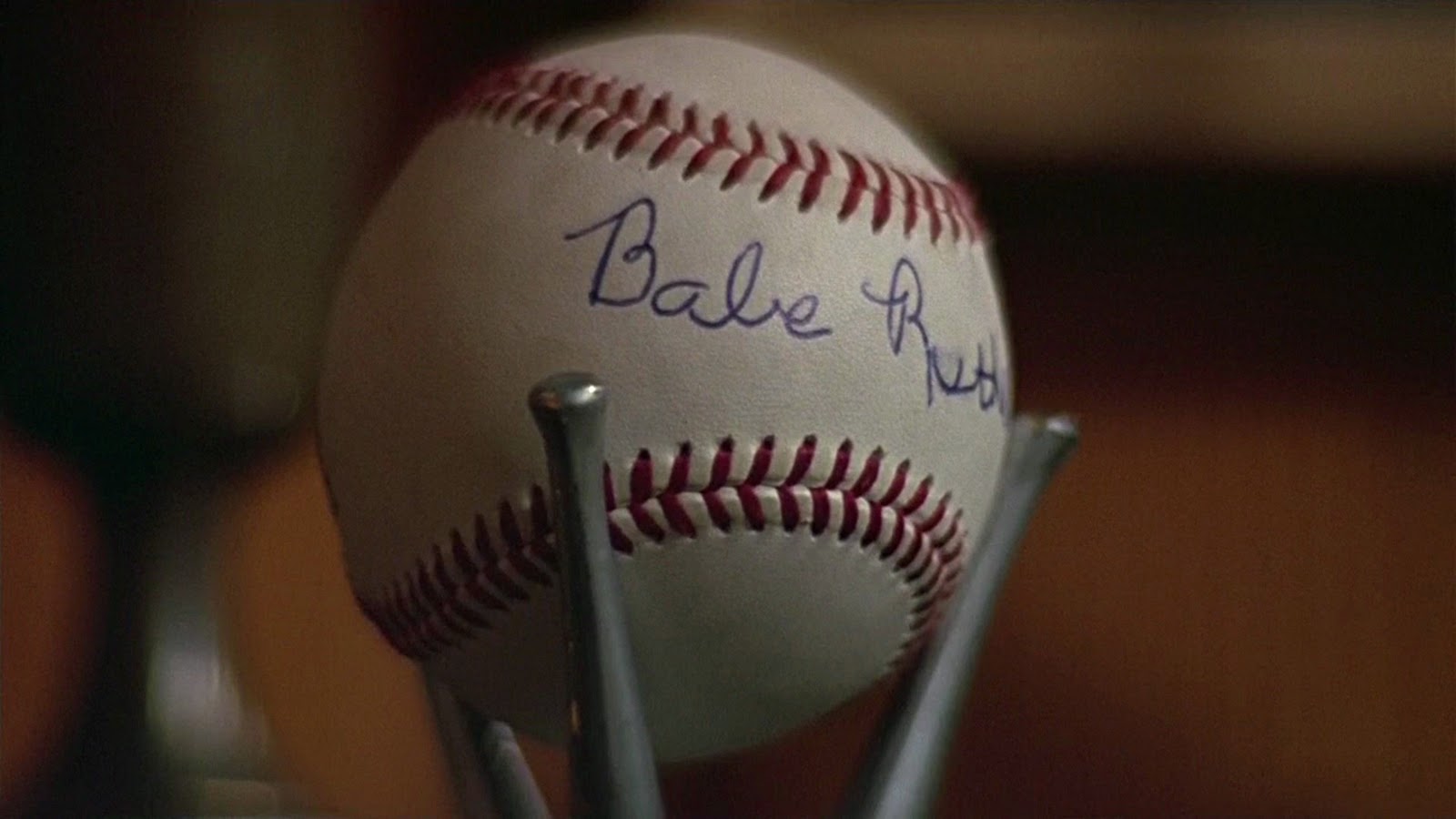 The Forged Babe Ruth Ball (from The Sandlot Movie):
 It's the real autographed baseball that is the treasure; not this mere *symbol*
The Lord knew they were in a deserted place and that the people would still have to travel to find lodging or to return to their homes. It would have been logical for Him to say, ‘Okay, there is a bit of extra bread for each of you, so take it with you for the journey home.’ But He didn’t. He had the disciples gather it back up, for what reason we are unsure. (One parishioner this weekend suggested maybe it was for a nice bread pudding. I’ll leave that for your contemplation.)
What intrigued me was that even if the Lord had explicitly given the bread to the people, it would have been okay to leave it for the birds and beasts to consume. And yet, it was intentionally gathered again. The bread pointed toward the Eucharist that would eventually be given, and so important was that reality that even the SYMBOL of it deserved respect. And so the bread was gathered and carried away for the Lord’s future plan.
Corpus Christi Sunday, the Solemnity of the Most Holy Body and Blood of Our LordThis weekend we celebrate Corpus Christi Sunday, the Solemnity of the Most Holy Body and Blood of Our Lord. The Church reminds us on this feast that what we receive is not a symbol, reminder, representation, or remembrance of what Jesus did. It is making present again the one sacrifice Jesus made of Himself on the Cross; it is the Lord Himself that is present in the Host and Chalice, not merely signs of Him.
This is an essential point of the Catholic faith and something that distinguishes us from the numerous protestant denominations found throughout the world. For the rest of this homily I would like to move from the normal homily style to a more catechetical approach, addressing a number of questions and important points on the Eucharist that I’ve been asked and encountered at times through my ministry. So if you get bored listening to me, just talk to Him.
Eucharistic EtiquetteThe first section is etiquette. When we come into church we genuflect. We all know that. At our church and chapel the tabernacle with the Hosts is in the center, so it’s normal to genuflect toward the center. If, however, the tabernacle is off to the side, it is proper to genuflect in the direction of the Blessed Sacrament and not simply toward the middle. If the Blessed Sacrament is not reserved at the church or chapel, then one simply bows to the altar. And because details are important, we genuflect by bringing our right knee to the floor because we want to be on the right hand of the Father in heaven and so everything we do is the right – right knee, right hand for sign of the cross, etc.
What about Adoration? If you come into or exit a church or chapel and Eucharistic Adoration is taking place, the traditional posture is a ‘double genuflection’ in which you kneel down on both knees and bow slightly toward the Blessed Sacrament. These two points are, of course, acknowledge that some of us don’t have two good knees, and sometimes not even one. So we do the best we can in the situation.
Why do we call a Host a "Host"? This was something I hadn’t ever wondered about, but the answer really lifted up my heart. At the beginning of Adoration/Benediction we sing the chant ‘O salutaris hostia’ which means ‘O saving victim’. The word ‘host’ references the fact that what we receive is not bread nor some symbol, but the Victim Himself, Jesus Christ the Lamb of God slain for our salvation!
What happens if the Eucharist is dropped? This has happened at some point to nearly every person who receives Holy Communion in the hand; the handoff is poor and Our Lord falls to the floor. At that point, we have two options. First, we can eat the Host off the floor (by picking it up, not by getting down on all fours like a dog!) or we can get the Host and give it to the minister and they will give another Host and care for the Host that was dropped. The Church also prescribes that the place where the Host fell be purified by a special process of cleansing with water and liturgical linens. It’s hard to do on carpet, but we do the best we can.
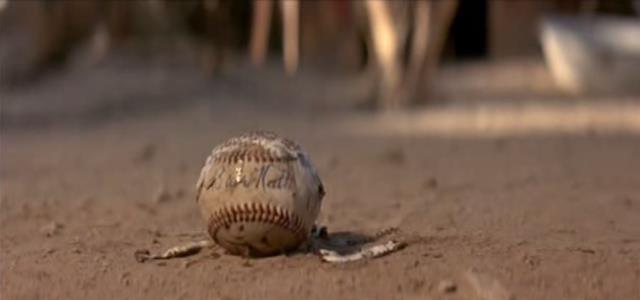 The Babe Ruth-signed ball has been pickled by THE BEAST
What happens if a Host is found in the pew, on the floor, in the missalette, or somewhere else? You look at me like I’m crazy, but this has happened in other places and it is something to be aware of. If this is the case, I would ask you to bring it to me immediately and indicate where you found it. If I am not around and nobody else is in the office, I ask you to place it on the altar in front of the tabernacle and let us know by phone call or email what happened.
If you see someone receive the Host in their hand and not consume it, it is okay to approach them about it?Which brings me to the next point: if you see someone receive the Host in their hand and not consume it, it is okay to approach them about it. You can simply ask “Are you going to consume that?” and if not, then I ask you to get it from them and bring it to the altar. If you don’t feel comfortable, I do, so please don’t hesitate if you know for a fact a Host has been taken but not consumed.
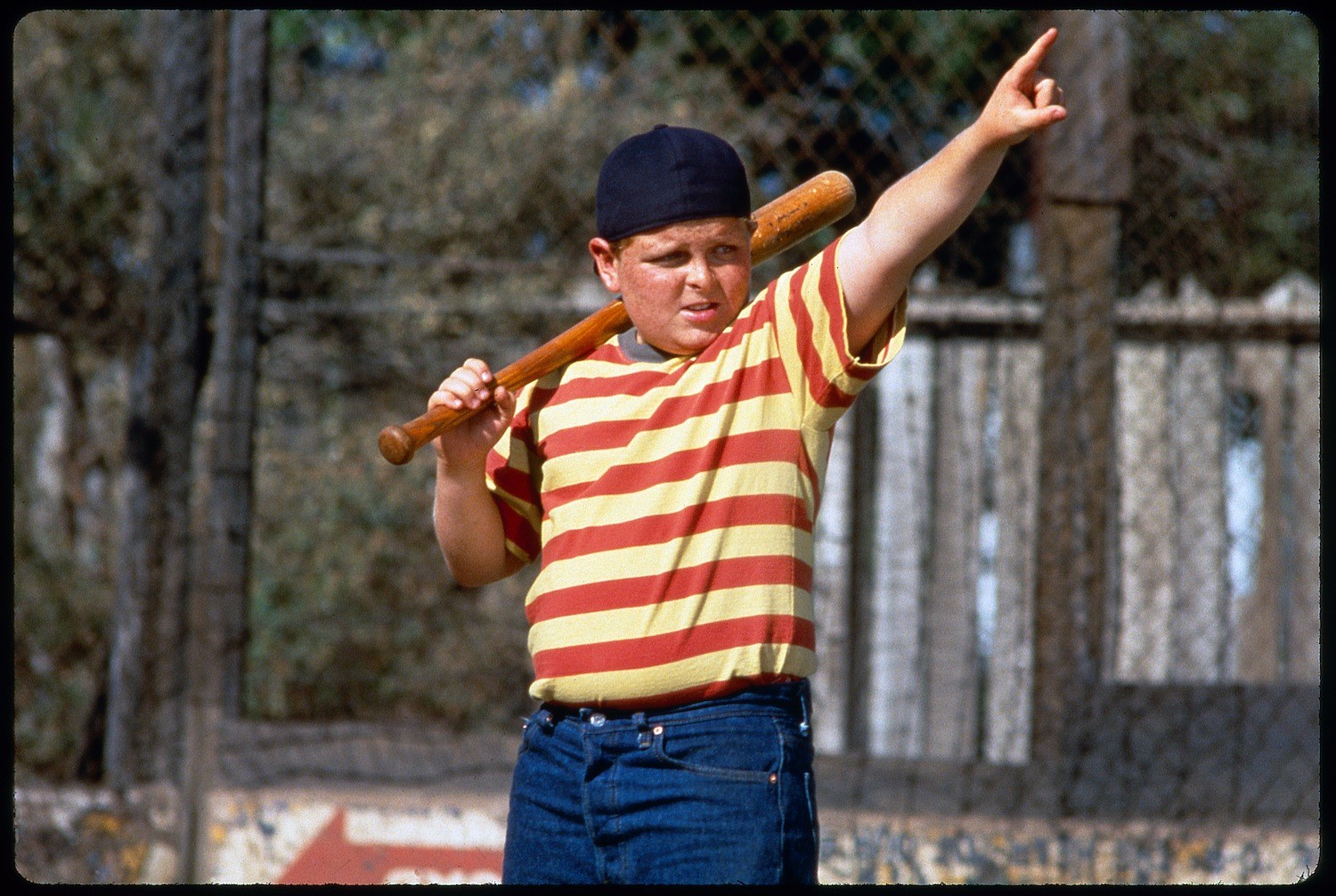 The Great HAMBINO calls his shot
Can a non-Catholic receive Holy Communion and can we receive communion in their services? The answer to both is ‘No.’ As Catholics, we profess that receiving Holy Communion is not simply a sign of our union with Jesus but also being in Communion with the Catholic Church and her teachings. This is why those who object to the essential teachings of the Church are asked to refrain from the Sacrament. For someone to come to our Church and receive Holy Communion is to speak a lie that they are in Communion, when in fact they are not. And the same for us in attending other places. It is good for us to be present at other communities from time to time for celebrations such as weddings, funerals, and the like. But being there does not mean we ought to receive Communion, since in doing so the Catholic Church would understand it as being in union of belief with that particular community, which I pray would not be the case. It’s not a matter of the Church not wanting others to receive Holy Communion, but a case of the Church wanting to honor the Blessed Sacrament and to highlight the disunity in the Body of Christ that calls us to continue to work toward greater union.
Can we do Intinction? What is Intinction? Intinction is a proper term for when a Host is taken and dipped into the chalice of the Precious Blood and both received at once. This is not permitted for the laity to do for themselves and I’m not permitted to do it for others under normal circumstances either. In fact, the only time I’ve done it is when I was concelebrating Mass when sick and wanted to refrain from spreading my illness by receiving directly from the chalice (a priest is required to receive both species when offering Mass). It is contrary to law and can be a cause of profanation of the Blessed Sacrament if the Host dipped were to drip some of the Precious Blood onto shoes, shirts, dresses, the floor, etc.
Do I have to receive both the Host and the Precious Blood? No. The Church has given us the term ‘concomitance’ as a way of explaining that when we receive on species, either the Host or the Blood, we receive the fullness of Jesus – body, blood, soul, and divinity. We don’t receive half and half, but the fullness of Christ. The reception of both is not obligatory, but doing so is a ‘fuller sign’ of the gift that Christ gave at the Last Supper. This means that one who has issues with gluten or alcohol may receive under one form and not be deprived of even the smallest bit of grace.
Should I receive on the tongue or in the hand? Both are permitted, but either way I ask that you really focus on reverence in receiving. If you receive on the tongue, it is good to make sure to stick out your tongue and open your mouth far enough to permit easy distribution. A good general rule is to touch the tip of your tongue to the bottom of your bottom lip. If you receive in the hand, it is good to be attentive to the particles that may come from the Host and remain on your hand. Remember that even the smallest particle is still the fullness of Christ. So be sure to check your hand and fingers used to receive Communion – you’ll be surprised sometimes to find the little pieces still present.
Receiving the Eucharist & ConfessionThe last ones are the questions that can be a bit contentious. The Church requires that those who receive Holy Communion do so in a state of grace. This means that we have not committed any mortal sin since our last sacramental confession. Often I’ve heard it said that skipping Sunday Mass is no longer a serious matter, but that is wrong. To intentionally skip Sunday Mass is to tell the Lord that we have something better to do than worship Him, which is a serious thing. There are exceptions such as illness, inability to get to church safely, some types of work, and other sensible occasions. But as the norm, we ought to be here every Sunday. If you find yourself in a state of mortal sin rather than grace, get to confession as quickly as possible! Please do not receive Holy Communion for fear of what others may think – it is far better to have people talk about us than for us to receive Holy Communion poorly. Make use of confession as often as needed and receive Communion well.
Receiving the Eucharist & FastingThe Church requires an hour of fasting before receiving Holy Communion. This is simply for us to have a period of time for our body to prepare to receive the Blessed Sacrament. Exceptions can be made for diabetics, those with medical issues, and various other issues that might require one to eat within that timeframe, but under normal circumstances we ought to wait an hour after eating. If you haven’t fasted, it is okay to make a ‘spiritual communion’ to ask for the grace that you would have gained from the Eucharist. The Lord honors our desire for Him!
Can a divorced person receive Holy Communion?Can a divorced person receive Holy Communion? If a person is simply divorced, they can and should received Holy Communion. There is no excommunication or restriction for one who has been divorced. The problem comes when one who is divorced remarries without an annulment; then those parties would be expected to refrain from receiving Holy Communion until an annulment would be investigated and (hopefully) granted.
This is not a matter of the Church being cruel to people but rather it is that hard side of the Church honoring the Sacrament of Matrimony. We always presume that the profession of legitimate marital vows is valid until explicitly shown to be otherwise. This means that when one marries after being divorced, it is a question that must be resolved because the Church sees the party (or parties) as married to one person, but living as spouse to another person. It’s not a matter of cruelty but of clarity and ensuring that bonds created by God are respected.
Some of these things can be quit sensitive and painful to discuss, but I invite anyone who is struggling or concerned in any manner to come talk with me. In the end, while some of these things can seem a bit picky, they are important. Too many people come forward to Holy Communion like Scotty Smalls, unaware of the incredible value of the reality before us. All the money in the world would not be enough to purchase this great gift, and yet the Lord longs to give it to us freely and frequently. May the good Lord increase our faith, our piety, and our love for the Blessed Sacrament. And may we come to know the richness of the gift we receive.
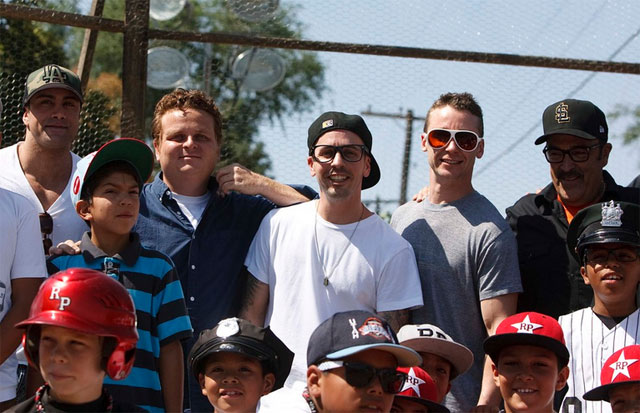 2013 Sandlot Cast Reunion Photo
October 29, 2019
The First Halloween ... in the Bible? The Catholic & Biblical Origins of Halloween
It’s that time of year again! All the traditional sounds filling the cool night air: Autumn leaves crackling underfoot, the hum of children in costumes racing from house to house, and ... howls of Christian indignation over Halloween.[1]
Can traditional Catholics participate in this spookiest of holidays? Isn't it all just derived from devil worship?
First off, have you ever noticed the reference to Halloween in the Bible? This one is pretty spooky!
We'll also discuss how, yes, traditional Catholics can, with all respect to tradition, celebrate this traditionally Catholic celebration. Join in the discussion and don't forget to comment below!

First off, some quick background:
Background on the Feasts of All Saints & All SoulsThe word “Halloween” is a Scottish shortening of the phrase “All hallow-even,” literally meaning “All Holy Evening” and dates to the 18th century.
The English have a similar phrase, “All Hallows’ Eve,” with the same meaning. These both describe the night before All Saints Day, November 1, and refer to the celebration of the holy men and women who are recognized in the Catholic Church as alive in Heaven. These men and women are collectively called the "Church Triumphant."
Though many claim that the celebration originated with the pagan rituals of Druids that escaped suppression by the Church, the origins of Halloween are very much Catholic.
The Catholic Church Created HalloweenPope Gregory III established the feast during the 8th century after consecrating a chapel named in honor of “All Saints” in Saint Peter’s Basilica. This feast was originally celebrated on May 13th.
Later in the 840s, the feast was extended to the universal Church by Pope Gregory IV, making November 1st a holy day of obligation for all Catholics - this is how it spread to the British Isles. Along with its celebration, All Saints Day was given a special vigil Mass the night before, i.e. October 31, which led to that date being regarded by Catholics as a “holy evening.”
In 998, St. Odilo, the abbot of the powerful monastery of Cluny in southern France, added a celebration on November 2.[2] This was a day of prayer for the souls of all the faithful departed. This feast, called All Souls Day, spread from France to the rest of Europe.
Now, with feasts for those in Heaven and Purgatory, Irish Catholic peasants began to worry about the consequences of leaving out the souls damned to Hell. Though "All Damned Day" never became a Church feast for obvious reasons, it became customary to bang pots and pans on All Hallows Eve to let the damned know they were not forgotten.

For the Catholic origins of "Trick or Treat", check out the connection to Guy Fawkes day in this uCatholic article.
The First Halloween ... in the Bible?Remember what happened immediately following Christ's death? Here's Matthew's account of the succeeding events (Matthew 27:51-53):
And behold, the veil of the temple was torn in two, from top to bottom; and the earth shook, and the rocks were split; 52 the tombs also were opened, and many bodies of the saints who had fallen asleep were raised, 53 and coming out of the tombs after his resurrection they went into the holy city and appeared to many.
Isn't this an interesting passage? Scary! Most of these things re-occur, by the way, in the Book of Revelation, i.e. at the so-called "End Times". But what are we to make of it? Let's take note of a few things that are happening in this Gospel passage:
(1) The "Veil of the Temple" was Torn in Two from "Top to Bottom"The "veil of the temple" was torn in two from "top to bottom". The veil of the temple, as it did in the Tabernacle of Moses, separated the Holy of Holies from the rest of the Temple and the rest of the world. When the veil was torn in two, the separation between the clean and unclean ended and the Temple was thereby desecrated.
This is what Jesus prophesied at John 2 when he said "tear down this temple". The literal tearing down of the Temple occurred when the Jews tore down Jesus' body, i.e. the New Temple. The Temple was also destroyed, in a very real sense, at Christ's death by its desecration.
Note, also, it was torn from "top to bottom," which means this thick curtain was torn apart "from above."
(2) The "Rocks Were Split": Halloween & the Well of SoulsThe "rocks were split" could be a reference to a spooky place called the "Well of Souls." This is the name of a cave located inside the Foundation Stone underneath the former site of the Temple in Jerusalem. The spooky title, the "Well of Souls", originates from a medieval Islamic legend and likely far more ancient writings that the spirits of the dead can be heard there, awaiting Judgment Day.
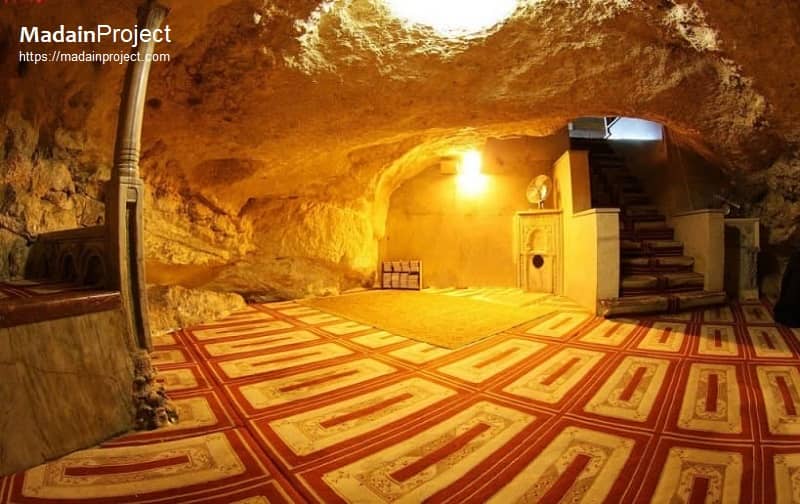 The Well of Souls cave
The Gospel passage above talks about the raising of the bodies of the dead, right?
It is possible that the "rocks" which were split were those near the place where the veil was torn, i.e. the rocks or stones making up the walls and foundation of the Temple, itself.
Therefore, the mention of "rocks were split" could be a reference to the Foundation Stone. Were the Foundation Stone to split, it would release the purgatorial souls waiting beneath it in the "Well of Souls."
Note this, as well (we'll come back to this later): the Feast of All Souls, which follows Halloween and All Saints, is the feast for all those souls waiting in Purgatory - are you starting to see the connection?
(3) "Tombs opened", "Saints raised", "Coming out of tombs", and "Appeared to many" If it weren't for the assurance of the evangelist Matthew that those rising from their tombs were "saints", wouldn't this seem an awful lot like a scene from a zombie movie? Bodies rising out of their graves and all that "Hocus Pocus"?

What should be noted here is another reference to purgatorial souls, i.e. souls awaiting the Resurrection of their bodies. This is another possible connection to the "Well of Souls" and the splitting of the Foundation Stone.
What's more, it's another reference to the feast which accompanies Halloween and All Saints, the Feast of All Souls, meaning the souls waiting in Purgatory.
Pagan Origins of Halloween?While largely debunked, many neo-pagans and pseudo-historians, such as those that proliferate on the History Channel, claim that Halloween originated with the pagan Celtic celebration of Samhain. In his book Stations of the Sun, historian Ronald Hutton explains:[3][4]
[T]he medieval records furnish no evidence that 1 November was a major pan-Celtic festival, and none of religious ceremonies, even where it was observed (p. 362).
This idea largely originated with the Protestants, who wanted to distance themselves from, not only Catholic holidays and traditions, but specifically Purgatory and prayers for the dead. Disconnecting Halloween from its Christian origins while fabricating a pagan origin served to de-legitimize the feast days of All Saints and All Souls.
Back to Samhain for One Last Spooky Connection ...Not to delve too deep into pagan mythology, but Samhain was seen as a liminal time. During such a time, the boundary between this world and the spirit world could more easily be crossed. That is, the veil of this world and the next was at its thinnest.
Think for a moment, didn't a veil come up earlier in this discussion? The time in Scripture when the boundary between this world and the Netherworld was being crossed by saints rising from their tombs corresponded with what other event? The tearing of the veil of the Temple! The veil of the Temple was the earthly representation of the boundary between earth and Heaven, as well.
Best not to read too much into this odd coincidence between two ancient religions! But it's interesting and a little spooky, nonetheless.
This Halloween, Check out my Pro-Life Catholic Horror Novel, The Seventh WordMy own contribution to the Catholic spookiness of Halloween ... my Pro-Life Catholic Horror novel: The Seventh Word ...
Here's the premise. The Aztecs sacrificed their children to one of their gods. What if he decided to open up an abortion clinic?
I hope you enjoyed this article. Please remembers to share it with your friends and comment below! Happy Halloween! All Saints, pray for us!
Footnotes:[1] I have to admit I borrowed from some of Jimmy Aiken's delightful prose found in this other good article on the holiday, "Reinventing the Halloween Light."
[2] For more on this, check out this uCatholic article.
[3] For more on debunking the Samhain-Halloween connection, here's a great article from Catholic Answers.
[4] The jack-o’-lantern idea was thrown in as another half-baked basis for the druid origin. Lamps made from turnips (not pumpkins) had been part of ancient Celtic harvest festivals, so they were translated to the American Halloween celebration.

October 24, 2019
Top Myths about the Crusades and the Catholic Church #FakeHistory
You have probably heard about that great evil committed by the Catholic Church ... the Crusades. But were they evil? This article explores many of the common myths surrounding the Crusades and the Catholic Church.
Conventional wisdom is fraught with myth when it comes to the Crusades and the Catholic Church. This was not always the case, though.

The Crusades were not even the most significant period in Muslim history until very recently. Until the 20th century, the Crusades were little more than a blip on the radar. Then, Muslims began to profit from using the Crusades in their propaganda.
That's why I drew the following comic strip:
With the support of presidents and historians, Muslims began to explain that all the modern-day terrorist attacks were the result of the Crusades. Did you catch the lie embedded in that nasty piece of propaganda?
If modern-day terrorist attacks were caused by the Crusades, and the Crusades were caused by the Catholic Church, then the Catholic Church caused modern-day terrorist attacks. The Catholic Church is ultimately the responsible party, not the Muslims. Does your brain feel nice and "washed", now?
Top 5 Myths About the Crusades and the Catholic ChurchHere's a solid video about the top myths that are trotted out about the Crusades and the Catholic Church. Were the Crusades unprovoked? Were the Crusaders just greedy second sons? Were they lacking in piety? Find out below:
Islamic Terrorists Using the Crusades Myth as Propaganda By Steve Weidenkopf
[Here's the link to the original article, "ISIS Flogs the Crusades Myth"]
The world reacted in horror at the despicable and evil Nov. 13 terrorist attacks in Paris. It is natural, in the face of such evil, to ask why. Why did these attacks occur? Why are some Muslims drawn to groups like ISIS, and why are they willing to kill innocent people in the name of religion? Many believe economics, Western foreign policy, or religion is to blame. Some believe that history—or, more specifically, certain historical actions—provide the answer.
ISIS, in a statement issued after the attacks, claimed responsibility for the massacre, indicating that “soldiers of the Caliphate” had targeted the “lead carrier of the cross in Europe” and “cast terror into the hearts of the crusaders in their very own homeland.” The statement also referred to the victims as “pagans” and “crusaders.” Reading the statement at face value might lead one to believe that the Islamic state (and other like-minded Islamic groups) commit terrorism the avenge the wrongs committed by Christian knights during the medieval Crusades.
Osama bin Laden and Crusades PropagandaIndeed, ISIS is not the first Islamic group to make reference to the Crusades after acts of violence. Osama bin Laden stated, shortly after the September 11, 2001, attacks on the United States, “This is a battle of Muslims against the global Crusaders. . . . Our goal is for the nation to unite in the face of the Christian Crusade.”[1]
St. Pope John Paul II's Assassin and the Crusades Mehmet Ali Agca, the man who attempted to assassinate St. John Paul II, indicated that he wanted to “kill Pope John Paul II, [the] supreme commander of the Crusades.”[2]
 St. Pope John Paul II visits his attempted assassin, Mehmet Ali Agca, in prison
 President Bill Clinton and Crusades PropagandaThis Islamic propaganda can lead one to believe the historical events of the Crusades are the primary reason for modern-day terrorist attacks. Unfortunately, many Westerners believe and parrot this propaganda. Former President Bill Clinton, in a speech at Georgetown University in October 2001, opined that the September 11 attacks were the result of the Christian attack on Jerusalem in 1099 during the First Crusade.
Liberal Catholics and Crusades PropagandaKaren Armstrong, a former Catholic nun and popular author, has written that the Crusades are “one of the direct causes of the conflict in the Middle East today.”[3]
The historical reality is far removed from the picture painted by Bill Clinton, Karen Armstrong, and others. The Crusades were largely forgotten in the Islamic world until the late nineteenth century and received prominent attention only in the twentieth century.
The Arabic Word for the Crusades Didn't Exist Until the mid-1800sThe Arabic word for the Crusades, harb al-salib, was introduced in the mid-nineteenth century. In 1899, the first Arabic history of the Crusades was written by an Egyptian, Ali al-Hariri, when the Ottoman Empire was in a deep crisis. It was a time when the Ottomans were forced to recognize the independence of most of their Eastern European territory. Seeking to find a rationale for the disintegration of the once mighty Ottoman Empire, the Egyptian author placed blame not on the internal failings of the sultans and their policies but rather on the historical bogeyman of the Crusades.
Crusades Were a Small Part of the Islamic HistoryIt is easy to understand why Muslims did not remember the Crusades: they were a small and insignificant part of Islamic history. The Holy City of Jerusalem was in Christian hands for only eighty-eight years (1099–1187), and the Crusader States survived for less than two centuries. The goal of the Crusades—the permanent liberation of Jerusalem and recovery of ancient Christian territory—was not achieved. Islamic historians through the centuries therefore neglected the Crusades.
This negligence changed in the twentieth century, when reconstructed Muslim memory of the Crusades began in earnest. After World War I, Britain and France were given mandates to govern Palestine and Syria. Ironically, it was these European colonial powers that shaped the modern Muslim interpretation and memory of the Crusades. Particularly, the French vision of the Crusades at the time focused on the twelfth-century campaigns as proto-colonizing expeditions (which they were not), now resurrected in the twentieth century.
Historical Origins of the Crusade MythsThe myth of the Crusades in the Islamic world was created, in part, by European intellectuals influenced by Enlightenment and Romantic interpretations of the Crusading movement. Arab nationalists, utilizing imagery from the British and French colonial authorities, presented the Crusades as the first European colonial efforts and the reason for the poverty, corruption, and violence in the twentieth-century Middle East.
Arab Nationalists and Crusade PropagandaCultural traditions and propaganda rooted in this false narrative of the Crusades were reinforced through education in Muslim schools. The contrived and artificial memory of the Crusades in the Islamic world, initially used by Arab nationalists, changed in the late twentieth century as jihadist groups, who turned their attention to the West after originally directing their hatred and violence toward secular Muslim regimes, hijacked the Crusades to further their violent goals. Jihadists utilized the reconstructed memory of the medieval Crusades to incite hatred and anger of the West and increase recruitment for their nefarious cause.
ISIS and Crusade PropagandaISIS and other groups continue to use “Crusade language” in their statements and recruitment videos, because it provides an effective tool in motivating young Muslim men and women to engage in violent attacks against innocent people. Like all forms of propaganda, the false story presented by the Islamic state relies on ignorance to achieve its objective. The Crusades are not the reason for the current state of affairs between Islamic jihadist groups and the Western world.
Ignorance about the Crusades plays into the hands of the terrorists by perpetuating the false narrative of these historical events. Terrorism and its propaganda must be combated—and the first step is to know the real story of the Crusades.
8 Myths About the Crusades By Thomas F. Madden, SJ
[This article originally appeared in the January/February 2002 issue of Catholic Dossier]
Where Did the Current Mis-Understanding of the Crusades Come From? The Enlightenment & Steven RuncimanIt was in the Enlightenment of the eighteenth century that the current view of the Crusades was born. Most of the philosophes, like Voltaire, believed that medieval Christianity was a vile superstition. For them the Crusades were a migration of barbarians led by fanaticism, greed, and lust.
Since then, the Enlightenment take on the Crusades has gone in and out of fashion. The Crusades received good press as wars of nobility (although not religion) during the Romantic period and the early twentieth century. After the Second World War, however, opinion again turned decisively against the Crusades.
In the wake of Hitler, Mussolini, and Stalin, historians found war of ideology–any ideology –distasteful. This sentiment was summed up by Sir Steven Runciman in his three-volume work, A History of the Crusades (1951-54).

For Runciman, the Crusades were morally repugnant acts of intolerance in the name of God. The medieval men who took the cross and marched to the Middle East were either cynically evil, rapaciously greedy, or naively gullible. This beautifully written history soon became the standard. Almost single-handedly Runciman managed to define the modern popular view of the Crusades.
Modern Scholarship Parrots Runciman Since the 1970s the Crusades have attracted many hundreds of scholars who have meticulously poked, prodded, and examined them. As a result, much more is known about Christianity’s holy wars than ever before. Yet the fruits of decades of scholarship have been slow to enter the popular mind. In part this is the fault of professional historians, who tend to publish studies that, by necessity, are technical and therefore not easily accessible outside of the academy. But it is also due to a clear reluctance among modern elites to let go of Runciman’s vision of the Crusades.
And so modern popular books on the Crusades–desiring, after all, to be popular–tend to parrot Runciman. The same is true for other media, like the multi-part television documentary, The Crusades (1995), produced by BBC/A&E and starring Terry Jones of Monty Python fame. To give the latter an air of authority the producers spliced in a number of distinguished Crusade historians who gave their views on events. The problem was that the historians would not go along with Runciman’s ideas. No matter. The producers simply edited the taped interviews cleverly enough that the historians seemed to be agreeing with Runciman. As Professor Jonathan Riley-Smith quite vehemently told me, "They made me appear to say things that I do not believe!"
The Real Story of the CrusadesSo, what is the real story of the Crusades? As you might imagine, it is a long story. But there are good histories, written in the last twenty years, that lay much of it out. For the moment, given the barrage of coverage that the Crusades are getting nowadays, it might be best to consider just what the Crusades were not. Here, then, are some of the most common myths and why they are wrong.
Myth 1: The Crusades were wars of unprovoked aggression against a peaceful Muslim world.This is as wrong as wrong can be. From the time of Mohammed, Muslims had sought to conquer the Christian world. They did a pretty good job of it, too. After a few centuries of steady conquests, Muslim armies had taken all of North Africa, the Middle East, Asia Minor, and most of Spain.
In other words, by the end of the eleventh century the forces of Islam had captured two-thirds of the Christian world. Palestine, the home of Jesus Christ; Egypt, the birthplace of Christian monasticism; Asia Minor, where St. Paul planted the seeds of the first Christian communities: These were not the periphery of Christianity but its very core. And the Muslim empires were not finished yet. They continued to press westward toward Constantinople, ultimately passing it and entering Europe itself.
As far as unprovoked aggression goes, it was all on the Muslim side. At some point what was left of the Christian world would have to defend itself or simply succumb to Islamic conquest. The First Crusade was called by Pope Urban II in 1095 in response to an urgent plea for help from the Byzantine emperor in Constantinople. Urban called the knights of Christendom to come to the aid of their eastern brethren. It was to be an errand of mercy, liberating the Christians of the East from their Muslim conquerors. In other words, the Crusades were from the beginning a defensive war. The entire history of the eastern Crusades is one of response to Muslim aggression.
Myth 2: The Crusaders wore crosses, but they were really only interested in capturing booty and land. Their pious platitudes were just a cover for rapacious greed.Historians used to believe that a rise in Europe’s population led to a crisis of too many noble "second sons," those who were trained in chivalric warfare but who had no feudal lands to inherit. The Crusades, therefore, were seen as a safety valve, sending these belligerent men far from Europe where they could carve out lands for themselves at someone else’s expense. Modern scholarship, assisted by the advent of computer databases, has exploded this myth.
We now know that it was the "first sons" of Europe that answered the pope’s call in 1095, as well as in subsequent Crusades. Crusading was an enormously expensive operation. Lords were forced to sell off or mortgage their lands to gather the necessary funds. They were also not interested in an overseas kingdom. Much like a soldier today, the medieval Crusader was proud to do his duty but longed to return home.
After the spectacular successes of the First Crusade, with Jerusalem and much of Palestine in Crusader hands, virtually all of the Crusaders went home. Only a tiny handful remained behind to consolidate and govern the newly won territories. Booty was also scarce. In fact, although Crusaders no doubt dreamed of vast wealth in opulent Eastern cities, virtually none of them ever even recouped their expenses. But money and land were not the reasons that they went on Crusade in the first place. They went to atone for their sins and to win salvation by doing good works in a faraway land.
Myth 3: When the Crusaders captured Jerusalem in 1099 they massacred every man, woman, and child in the city until the streets ran ankle deep with the blood.This is a favorite used to demonstrate the evil nature of the Crusades. Most recently, Bill Clinton in a speech at Georgetown cited this as one reason the United States is a victim of Muslim terrorism. (Although Mr. Clinton brought the blood up to knee level for effect.) It is certainly true that many people in Jerusalem were killed after the Crusaders captured the city. But this must be understood in historical context.
The accepted moral standard in all pre-modern European and Asian civilizations was that a city that resisted capture and was taken by force belonged to the victorious forces. That included not just the buildings and goods, but the people as well. That is why every city or fortress had to weigh carefully whether it could hold out against besiegers. If not, it was wise to negotiate terms of surrender.
In the case of Jerusalem, the defenders had resisted right up to the end. They calculated that the formidable walls of the city would keep the Crusaders at bay until a relief force in Egypt could arrive. They were wrong. When the city fell, therefore, it was put to the sack. Many were killed, yet many others were ransomed or allowed to go free.
By modern standards this may seem brutal. Yet a medieval knight would point out that many more innocent men, women, and children are killed in modern bombing warfare than could possibly be put to the sword in one or two days. It is worth noting that in those Muslim cities that surrendered to the Crusaders the people were left unmolested, retained their property, and allowed to worship freely. As for those streets of blood, no historian accepts them as anything other than a literary convention. Jerusalem is a big town. The amount of blood necessary to fill the streets to a continuous and running three-inch depth would require many more people than lived in the region, let alone the city.
Myth 4: The Crusades were just medieval colonialism dressed up in religious finery.It is important to remember that in the Middle Ages the West was not a powerful, dominant culture venturing into a primitive or backward region. It was the Muslim East that was powerful, wealthy, and opulent. Europe was the third world. The Crusader States, founded in the wake of the First Crusade, were not new plantations of Catholics in a Muslim world akin to the British colonization of America.
Catholic presence in the Crusader States was always tiny, easily less than ten percent of the population. These were the rulers and magistrates, as well as Italian merchants and members of the military orders. The overwhelming majority of the population in the Crusader States was Muslim. They were not colonies, therefore, in the sense of plantations or even factories, as in the case of India. They were outposts.
The ultimate purpose of the Crusader States was to defend the Holy Places in Palestine, especially Jerusalem, and to provide a safe environment for Christian pilgrims to visit those places. There was no mother country with which the Crusader States had an economic relationship, nor did Europeans economically benefit from them.
Quite the contrary, the expense of Crusades to maintain the Latin East was a serious drain on European resources. As an outpost, the Crusader States kept a military focus. While the Muslims warred against each other the Crusader States were safe, but once united the Muslims were able to dismantle the strongholds, capture the cities, and in 1291 expel the Christians completely.
Myth 5: The Crusades were also waged against the Jews.No pope ever called a Crusade against Jews. During the First Crusade a large band of riffraff, not associated with the main army, descended on the towns of the Rhineland and decided to rob and kill the Jews they found there. In part this was pure greed. In part it also stemmed from the incorrect belief that the Jews, as the crucifiers of Christ, were legitimate targets of the war.
Pope Urban II and subsequent popes strongly condemned these attacks on Jews. Local bishops and other clergy and laity attempted to defend the Jews, although with limited success. Similarly, during the opening phase of the Second Crusade a group of renegades killed many Jews in Germany before St. Bernard was able to catch up to them and put a stop to it.
These misfires of the movement were an unfortunate byproduct of Crusade enthusiasm. But they were not the purpose of the Crusades. To use a modern analogy, during the Second World War some American soldiers committed crimes while overseas. They were arrested and punished for those crimes. But the purpose of the Second World War was not to commit crimes.
Myth 6: The Crusades were so corrupt and vile that they even had a Children’s Crusade.The so-called "Children’s Crusade" of 1212 was neither a Crusade nor an army of children. It was a particularly large eruption of popular religious enthusiasm in Germany that led some young people, mostly adolescents, to proclaim themselves Crusaders and begin marching to the sea. Along the way they gathered plenty of popular support and not a few brigands, robbers, and beggars as well.
The movement splintered in Italy and finally ended when the Mediterranean failed to dry up for them to cross. Pope Innocent III did not call this "Crusade." Indeed, he repeatedly urged non-combatants to stay at home, helping the war effort through fasting, prayer, and alms. In this case, he praised the zeal of the young who had marched so far, and then told them to go home.

Myth 7: Pope John Paul II apologized for the Crusades.This is an odd myth, given that the pope was so roundly criticized for failing to apologize directly for the Crusades when he asked forgiveness from all those that Christians had unjustly harmed. It is true that John Paul recently apologized to the Greeks for the Fourth Crusade’s sack of Constantinople in 1204. But the pope at the time, Innocent III, expressed similar regret. That, too, was a tragic misfire that Innocent had done everything he could to avoid.
Myth 8: Muslims, who remember the Crusades vividly, have good reason to hate the West.Actually, the Muslim world remembers the Crusades about as well as the West–in other words, incorrectly. That should not be surprising. Muslims get their information about the Crusades from the same rotten histories that the West relies on.
The Muslim world used to celebrate the Crusades as a great victory for them. They did, after all, win. But western authors, fretting about the legacy of modern imperialism, have recast the Crusades as wars of aggression and the Muslims as placid sufferers. In so doing they have rescinded centuries of Muslim triumphs, offering in their stead only the consolation of victimhood.
Crusades Myth Footnotes:[1] Quoted in Jonathan Riley-Smith, The Crusades – A History, Second Edition (New Haven, CT: Yale University Press, 2005), 307.
[2] Quoted in Carole Hillenbrand, “The Legacy of the Crusades”, in Crusades – The Illustrated History, ed. Thomas F. Madden (Ann Arbor: The University of Michigan Press, 2004), 208.
[3] Karen Armstrong, Holy War: The Crusades and Their Impact on Today’s World, 2ndedition (New York: Random House, 2001), xiv.

October 1, 2019
7 Steps to Start Catholic Estate Planning Today
There are nearly 70 million Catholics living in America. That's about one in every five Americans. Approximately 55% of these Catholics will die without a Will or any Estate Planning arrangements stipulating the importance of their religious values. That's nearly 40 millions Catholics!
Catholic religious issues are too often overlooked in Estate Planning. Beyond leaving legacies to the Church, your local parish, a Catholic school, or ministry, there are many other Catholic Estate Planning considerations.
Below you will find the 7 Steps for Catholic Estate Planning. This article begins with a simple Catholic Estate Planning Checklist ...
After that, we will go a few steps deeper, too. Many people hear the term Estate Planning and can’t help but yawn. When they attempt to read about the topic, they struggle to focus. The stress starts to build ... We will cover all this in nice, bite-size nuggets.
Future articles will also examine each aspect of Catholic Estate Planning, both legal and financial. Financial aspects include retirement, insurance, and taxes. The legal aspects of Catholic Estate Planning include the following:
Letters of InstructionSelection of Guardians and Fiduciaries Charitable Giving, Planned Giving, Legacies, Bequests, and Financial StewardshipPowers of AttorneyLiving Wills and Health Care Proxies (including nutrition/hydration, pain relief, pregnancy, organ donation, Anointing of the Sick, and funeral provisions)
All the above aspects of Estate Planning can be tailored to Catholic values. Even small changes can make a tremendous impact to Catholics, their heirs, and the causes they believes in.
Estate Planning: A Christian's Most Important Act of Stewardship71% of Americans say having a well-crafted estate plan would help them feel like a better spouse or parent. Why spend your life building up and working towards financial freedom only to lose it later in life simply for lack of planning?
Worse yet, why should your wealth, large or small die with you, when it could serve your heirs and your Church, feeding, clothing, and sheltering the needy? Such waste!
For Christians, Estate Planning may be the most important act of stewardship we will ever undertake.

First off, Let's Define "Estate Planning"Your Estate is all of the assets and liabilities you have acquired during your life and at the time of your death. The point of Estate Planning is secure the maximum benefit from your resources now, at retirement or disability, and after death, as well.
People once regarded estate planning as only for the wealthy. Today, anyone who owns anything should develop a plan.
Estate Planning is the best way to pass your assets to family members, the Church, particular ministries, and others during life and at death, with minimum losses in taxes.
Here's the central question: Would you rather leave your estate to your heirs and the Church or the government?
Now, for those 7 Steps for Catholic Stewardship, Planned Giving, and Estate Planning:
7 Steps for Catholic Estate PlanningThe following are steps you can take to start properly managing your estate. You can start all of these today.[1]
Determine the Priorities of your Estate Plan. What do you want? Do you want a steady income for life to provide for yourself, your spouse, and your dependent children? Do you want to fund a particular church parish, ministry, or Catholic school? Do you want to ensure the transfer belongings and assets to family and friends? Set up education accounts? Bless a ministry or organization? Or all the above?Organize your Financial Records. Gather and keep information on your employment data, bank accounts, insurance records, investment data, tax returns, wills, deeds, and titles to any property you own or are paying for. Keep all records in a safe and accessible place.Educate yourself. Read articles and books on financial planning and attend financial seminars. These can help you discover new and better ways to take care of all God has entrusted to you.Choose your Advisors. Choose an Estate Planning Attorney, CPA, Insurance Agent, and Financial Planner. Sometimes your church parish will have a list of recommended professionals. These may serve you at a discounted rate if your estate plan benefits the Church. If you are Catholic, you should strongly consider using the insurance products offered by the Knights of Columbus, given their strong financial reputation and commitment to Church teachings. Unlike the KCs, many insurance companies do not come close to honoring the Church's values. Check out this article, for example: Top 5 Most Anti-Christian and Anti-Life Insurance Companies.Preserve your Estate. Review all the options for increasing, preserving, and transferring the assets of your estate. Consider tax-advantage vehicles which may be available to you, including 401(k)s, 403(b)s, IRAs, or other tax-deferred growth opportunities. There are also many charitable trusts and annuities and other gift tools which can be used to create income, receive tax deductions, and transfer assets.Formulate a Plan. Put the Plan in Action. One way or another, everyone will have an Estate Plan when they pass away. You can either write it yourself. OR, the state will determine your plan for you by operation of the law. The Estate Plan you write is the only one which will distribute your assets according to your wishes. Review and Revise your Plans and Documents on a Regular Basis. Do this yearly or when major changes occur in your life. Major changes might include having a baby, changing your investment strategies, changing your giving priorities, etc.Successful Estate Planning develops a long-term stewardship program which actively manages personal and business assets for this and future generations.

Families and Estate PlanningDid you know 55% of people do not even have a Will? A Will is the most basic part of Estate Planning. A properly-written Will can spare your loved ones from unnecessary family squabbles.
Families are making Estate Planning a higher priority. You have the opportunity to discover God’s overall plan of stewardship for your life and family.
Through effective Estate Planning, you can make decisions today which will positively impact the future generations of your family. AND, a well-crafted legacy or endowment to your Church parish or local Catholic school may impact even more lives for the greater glory of God.
NEXT: Legal Aspects of Catholic Estate PlanningThe legal aspects of Catholic Estate Planning include the following:
Letters of InstructionSelection of Guardians and Fiduciaries Charitable Giving, Planned Giving, Legacies, Bequests, and Financial StewardshipPowers of AttorneyLiving Wills and Health Care Proxies (including nutrition/hydration, pain relief, pregnancy, organ donation, Anointing of the Sick, and funeral provisions)We will be going over all this in the next article ... Stay tuned!
Estate Planning Footnotes:
[1] Adapted from Financial Freedom, More Than Being Debt-Free by Patrick Clements, as well adapted by Church Extension Plan.

September 23, 2019
New Research Connecting Tertullian to the U.S. First Amendment Freedom of Religion Clauses
What if I told you the Church Fathers, not the Founding Fathers, wrote the First Amendment? Stay tuned for a startling new discovery!
Pop Quiz! Think back to your high school U.S. Government course or Poli-Sci 101 in college. Where did all the great ideas in the U.S. Constitution come from? Where did the Founding Fathers get all those great ideas?
The Enlightenment, right? John Locke, Jean-Jacques Rousseau and the Social Contract. Baron de Montesquieu and The Spirit of the Laws. All the great minds. Right?
Nope.
Separation of Powers and the three branches of government? Sure, that can be traced to the Baron de Montesquieu.
The Freedom of Religion, however, is far more ancient.
This is the premise of a new book by Robert Louis Wilken, Liberty in the Things of God: The Christian Origins of Religious Freedom (see links below).
Robert Louis Wilken's Liberty in the Things of GodWilken is a the William R. Kenan, Jr. Professor of the History of Christianity emeritus at the University of Virginia. Wilken's The Spirit of Early Christian Thought: Seeking the Face of God is required reading in many schools of Theology, including the one I attended.
I highly recommend all of Wilken's books, but it is Wilken's most recent book Liberty in the Things of God that will be the subject of this article. In it, Wilken makes a startling discovery.
Christian Origins of Freedom of ReligionWhat ancient communities do you think might have something to say about freedom of religion? Those communities which faced terrible religious persecution.
Crucifixion after crucifixion, the Christian community suffered religious persecution at the hands of the Romans. The Christians nonetheless endured and prospered.
Nearly all of Jesus' Apostles were martyred. St. Peter was crucified upside-down in Rome. St. Paul was eventually beheaded after a period of imprisonment in Rome.

There were also the virgin martyrs of Rome, including Saints Agnes, Agatha, and Lucy, who died in the persecutions led by Emperors Decius and Diocletian.
Saints Felicity and Perpetua, both mothers, were also martyred by the Roman Empire. They were not Italians, though. Felicity and Perpetua were from North Africa, specifically Carthage.
Tertullian and "Freedom of Religion"Along with Saints Felicity and Perpetua, there was also a Church Father from Carthage. Tertullian.[1] Some scholars actually credit the writing or editing of the Passion of Saints Felicity and Perpetua to Tertullian. Tertullian is one of the primary reasons we even remember Saints Felicity and Perpetua into modern times.
Tertullian coined a few very important words and phrases. For starters, Tertullian first coined the phrase "Old and New Testaments". Tertullian also first gave us the word "Trinity" (Latin trinitas) to describe the three Divine Persons. Read more about that here.
Put another way, the perfect self-governing community of Persons - the Holy Trinity - Tertullian named that!

But What Does Tertullian have to do with "Freedom of Religion"?Here's another incredible connection. In addition to "Old and New Testaments" and "Trinity", Tertullian also was the first to coin the phrase "Freedom of Religion."
Wow. Wouldn't it be incredible if somehow Tertullian's writings inspired the Founding Fathers?
Because that's exactly what happened.
Wilken's Discovery: The Connection between Thomas Jefferson and TertullianAnti-Catholic sentiment was very strong among many of the Founding Fathers. Many of our Founding Fathers were Deists, who basically believed in a "Watchmaker" God that never intervened in human history. How could Jesus' Incarnation into human history possibly fit into this worldview? Moreover, how could the Catholic Church, the institution which perpetuates Jesus' intervention into human history?
This is one of Thomas Jefferson's more well-known quotes on religion:
Honest religion neither picks my pocket, nor breaks my leg.
This is taken from a longer passage in Jefferson's work, Notes on the State of Virginia :
The error seems not sufficiently eradicated, that the operations of the mind, as well as the acts of the body, are subjects to the coercion of the laws. But our rulers can have authority over such natural rights only as we have submitted to them. The rights of conscience we never submitted, we could not submit. We are answerable for them to our God. The legitimate powers of government extend to such acts only as are injurious to others. But it does me no injury for my neighbour to say there are twenty gods, or no god. It neither picks my pocket nor breaks my leg.
Wilken noticed that this quote as well as the context it fit into resembled the following quote from Tertullian.

You can see that the line in bold - "neither harms nor helps" - matches AT LEAST IN STRUCTURE the line, "neither picks my pocket nor breaks my leg":
It is only just and a privilege inherent in human nature that every person should be able to worship according to his own convictions. The religious practice of one person neither harms nor helps another. It is not part of religion to coerce religious practice. For it is by choice, not coercion, that we should be led to religion.
But how could Wilken prove this connection? It is not a direct quote, though there is a match in meaning and neither/nor structure.
What did Thomas Jefferson write in the Margins of His Personal Copy of Notes on the State of Virginia?How could Wilken possibly prove this connection? Remember, I said Wilken is a professor emeritus at the University of Virginia (UVA).
Guess who just happens to have Thomas Jefferson's personal copy of Notes on the State of Virginia? You guessed it. The UVA Rare Book Library.
Wilken turned to the page in Jefferson's personal copy on which the above quote - honest religion "neither picks my pocket nor breaks my leg" - is found.
Guess what Wilken found scribbled in the margins? Tertullian's quote!
Thomas Jefferson had scribbled Tertullian's quote in the margins in the original Latin.
But there's still more ...
Thomas Jefferson's Personal Copy of Tertullian Wilken knew that Thomas Jefferson had written a bookseller in Richmond for some copies of Latin manuscripts. Wilken wondered if perhaps there might be a Tertullian manuscript among the collection of books that Jefferson had purchased from Richmond.
While finishing his own book, Liberty in the Things of God, Wilken was researching in the Library of Congress. Guess which library contains most of Thomas Jefferson's personal library? The Library of Congress. Still curious about the Tertullian connection, Wilken decided to see if Jefferson's personal library contained a collection of Tertullian's writings.
It did. The Library of Congress allowed Wilken to look through Thomas Jefferson's personal copy of a 17th century Latin edition of Tertullian's writings.
Wilken turned to the page from which Thomas Jefferson had transcribed the above quote from Tertullian - the one which begins, "It is only just and a privilege inherent in human nature ..."
Jefferson had underlined the quote and put a big "X" in the margin beside it.
Isn't that amazing. Wilken was able to find a direct connection between Tertullian and Thomas Jefferson.
But there's still more!
Compare Tertullian's quote to the First AmendmentHere's my addition to all this. This might be something I notice being a lawyer.
The connection from Tertullian to Thomas Jefferson does not end at Notes on the State of Virginia. Look at the First Amendment, itself! Look at the Freedom of Religion clauses of the First Amendment:
Congress shall make no law respecting an establishment of religion, or prohibiting the free exercise thereof ...
Look at the either/or structure and content of the Freedom of Religion section of the First Amendment:
First there is the Free Exercise Clause: "Congress shall make no law respecting an establishment of religion"Next there is the Establishment Clause: "or prohibiting the free exercise thereof"
Now, look again at Tertullian's quote. Not the middle part about religion "neither harming nor helping". I have omitted that below. Look at the sentences which come before and after that:
It is only just and a privilege inherent in human nature that (1) every person should be able to worship according to his own convictions ... It is (2) not part of religion to coerce religious practice. For it is by choice, not coercion, that we should be led to religion.
Do you see it?
Part One is about Free Exercise of religion, including worship and conscience protections. Part Two is about the coercive power of an Established Church.
Do you know what this means? Tertullian wrote the first draft of the First Amendment and Thomas Jefferson knew it. Tertullian's quote contains the archae-Free Exercise Clause and the archae-Establishment Clause.
Isn't that incredible?
There's still more!
This means that the Freedom of Religion, from Roman times to the writing of the U.S. Constitution, included conscience protections, not merely a freedom to worship.
Please share this incredible discovery with your friends and family. Feel "FREE" to comment below, as well, with any questions you might have.
Footnotes on Tertullian:[1] In case you are wondering, that's not a typo. Tertullian is not Saint Tertullian because he fell into a couple heresies along the way, including Montanism. Tertullian is one of only Church Fathers not to be considered a saint. Describing Tertullian as a "Church Father" is also the minority position. For more on that, check out this video from Jimmy Akin and Catholic Answers.
Appendix: St. John Paul II on Constitutional Rights, especially Right to LifeExcerpt from Homily given by St. John Paul II at the 8th World Youth Day in Denver, Colorado, on Solemnity of the Assumption, Sunday, August 15, 1993:
Dear Friends, this gathering in Denver on the theme of Life should lead us to a deeper awareness of the internal con-tradiction present in a part of the culture of the modern “me-tropolis”.
When the Founding Fathers of this great nation enshrined certain inalienable rights in the Constitution – and something similar exists in many countries and in many International Declarations – they did so because they recognized the existence of a “law” – a series of rights and duties – engraved by the Creator on each person’s heart and conscience.
In much of contemporary thinking, any reference to a “law” guaranteed by the Creator is absent. There remains only each individual’s choice of this or that objective as convenient or useful in a given set of circumstances. No longer is anything considered intrinsically “good” and “universally binding”. Rights are affirmed but, because they are without any reference to an objective truth, they are deprived of any solid basis. Vast sectors of society are confused about what is right and what is wrong, and are at the mercy of those with the power to "create" opinion and impose it on others.
The family especially is under attack. And the sacred character of human life denied. Naturally, the weakest members of society are the most at risk: the unborn, children, the sick, the handicapped, the old, the poor and unemployed, the immigrant and refugee, the South of the world!
Young pilgrims, Christ needs you to enlighten the world and to show it the "path to life" (Ps 16,11). The challenge is to make the Church’s "yes" to Life concrete and effective. The struggle will be long, and it needs each one of you. Place your intelligence, your talents, your enthusiasm, your compassion and your fortitude at the service of life!
Have no fear. The outcome of the battle for Life is already decided, even though the struggle goes on against great odds and with much suffering. This certainty is what the Second Reading declares: " Christ is now raised from the dead, the first fruits of those who have fallen asleep. ...so in Christ all will come to life again" ( 1Cor 15,20-22). The paradox of the Christian message is this: Christ – the Head – has already conquered sin and death. Christ in his Body – the pilgrim People of God – continually suffers the onslaught of the Evil One and all the evil which sinful humanity is capable of.
6. At this stage of history, the liberating message of the Gospel of Life has been put into your hands. And the mission of proclaiming it to the ends of the earth is now passing to your generation. Like the great Apostle Paul, you too must feel the full urgency of the task: "Woe to me if I do not evangelize" (1Cor 9,16). Woe to you if you do not succeed in defending life. The Church needs your energies, your enthusiasm, your youthful ideals, in order to make the Gospel of Life penetrate the fabric of society, transforming people’s hearts and the structures of society in order to create a civilization of true justice and love. Now more than ever, in a world that is often without light and without the courage of noble ideals, people need the fresh, vital spirituality of the Gospel.
Do not be afraid to go out on the streets and into public places, like the first Apostles who preached Christ and the Good News of salvation in the squares of cities, towns and villages. This is no time to be ashamed of the Gospel (Cfr. Rom 1,16). It is the time to preach it from the rooftops (Cfr. Matth 10,27). Do not be afraid to break out of comfortable and routine modes of living, in order to take up the challenge of making Christ known in the modern "metropolis". It is you who must "go out into the byroads" ( Matth 22,9) and invite everyone you meet to the banquet which God has prepared for his people. The Gospel must not be kept hidden because of fear or indifference. It was never meant to be hidden away in private. It has to be put on a stand so that people may see its light and give praise to our heavenly Father.
Jesus went in search of the men and women of his time. He engaged them in an open and truthful dialogue, whatever their condition. As the Good Samaritan of the human family, he came close to people to heal them of their sins and of the wounds which life inflicts, and to bring them back to the Fa-ther’s house. Young people of "World Youth Day", the Church asks you to go, in the power of the Holy Spirit, to those who are near and those who are far away. Share with them the freedom you have found in Christ. People thirst for genuine inner freedom. They yearn for the Life which Christ came to give in abundance. The world at the approach of a new millennium, for which the whole Church is preparing, is like a field ready for the harvest. Christ needs laborers ready to work in his vineyard. May you, the Catholic young people of the world, not fail him. In your hands, carry the Cross of Christ. On your lips, the words of Life. In your hearts, the saving grace of the Lord.