Scott L. Smith Jr.'s Blog, page 10
January 11, 2021
Top 10 Saint Quotes on Redemptive Suffering for Comfort During Tough Times
Tough times got you down? I thought I would put together some Saint Quotes on redemptive suffering for these tough days of pandemic, political acrimony and strife.
As Pope St. John Paul II said, "don't waste your suffering!" Read the full story on this quote below ...
I hate wasting anything. My family well knows that all food scraps are saved for the chickens, and the chickens turn our scraps into eggs. So please, don't let your sufferings go to waste! They are the building blocks that will restore the Church and, from her, the entire world.
Hopefully, these Saint Quotes will help turn our eyes towards heaven.
Also, my wife and I have been concerned about people's prayer lives during these difficult times. That's why we published the following Catholic Prayer Journal for Women suffering from stress, fear, and anxiety:
[image error]
St. Thérèse of Lisieux on Redemptive Suffering
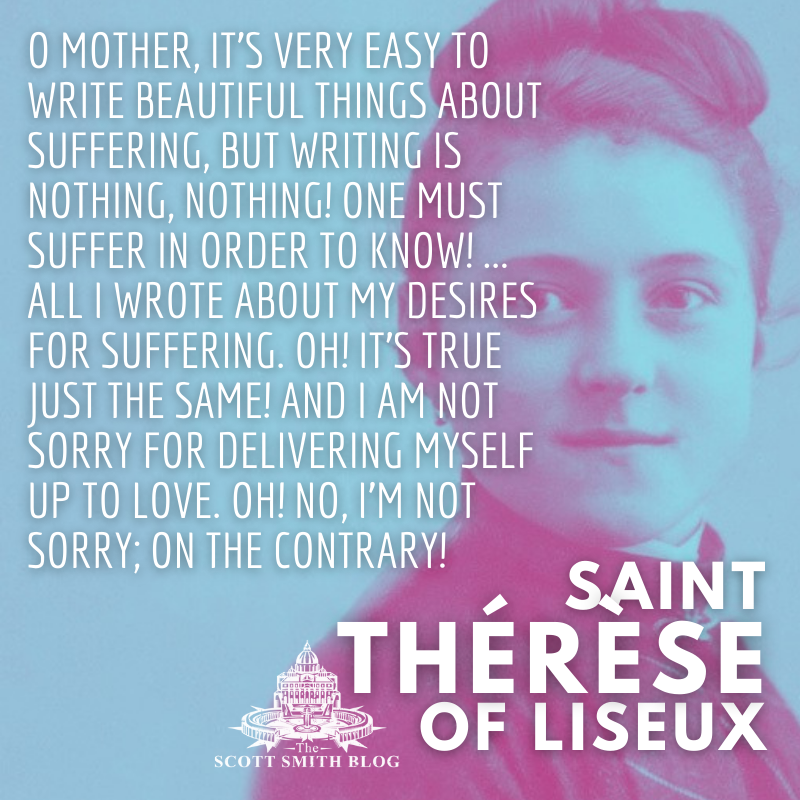
St. Thérèse of Lisieux wrote the following about her own redemptive suffering from her deathbed:[1]
O Mother, it’s very easy to write beautiful things about suffering, but writing is nothing, nothing! One must suffer in order to know! I really feel now that what I’ve said and written is true about everything ... It’s true that I wanted to suffer much for God’s sake, and it’s true that I still desire this ... All I wrote about my desires for suffering. Oh! it’s true just the same! And I am not sorry for delivering myself up to Love. Oh! no, I’m not sorry; on the contrary!
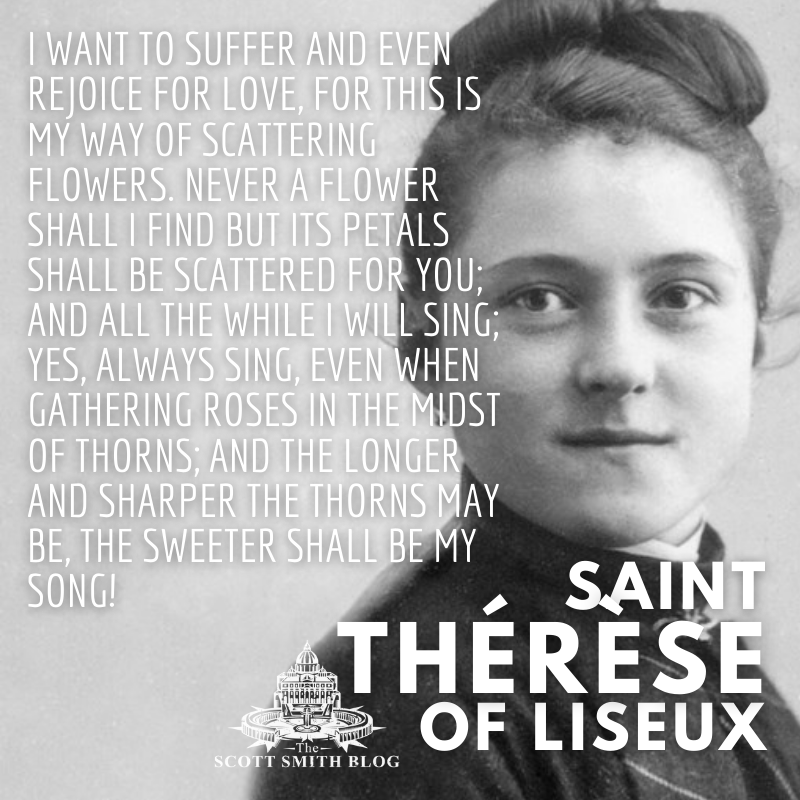
St. Thérèse of the Little Flower! Here she speaks of suffering as thorns among her flowers. Only the Little Flower could speak so sweetly of suffering:
I want to suffer and even rejoice for love, for this is my way of scattering flowers. Never a flower shall I find but its petals shall be scattered for you; and all the while I will sing; yes, always sing, even when gathering roses in the midst of thorns; and the longer and sharper the thorns may be, the sweeter shall be my song!
We're just getting started ...
(Mother) St. Térèsa of Calcutta on Redemptive Suffering
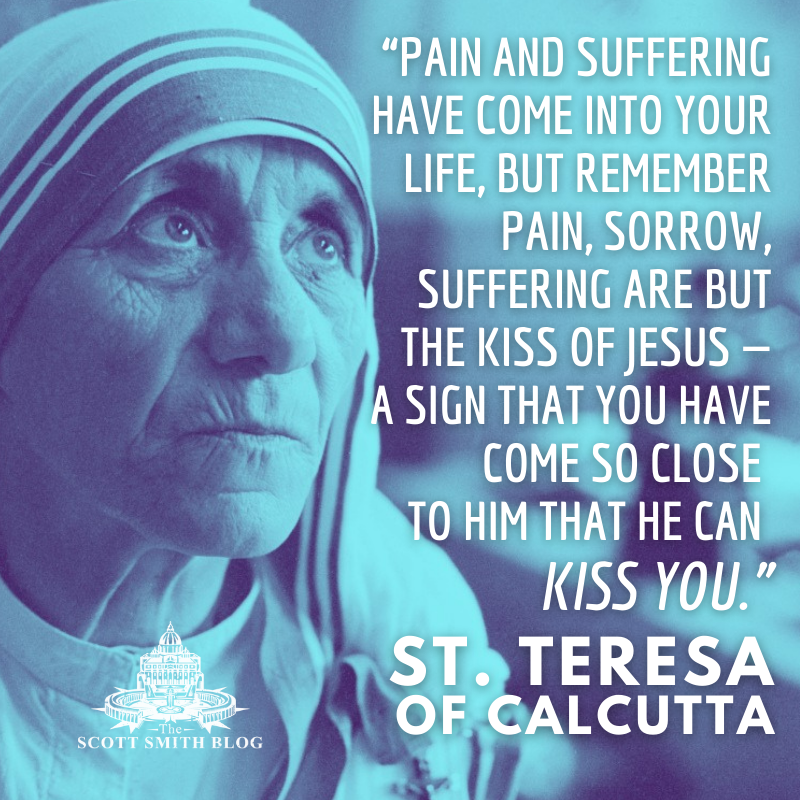
Mother Teresa described redemptive suffering in such sweet, simple terms. Redemptive suffering is the kiss of Christ:
“Pain and suffering have come into your life, but remember pain, sorrow, suffering are but the kiss of Jesus — a sign that you have come so close to Him that He can kiss you.”
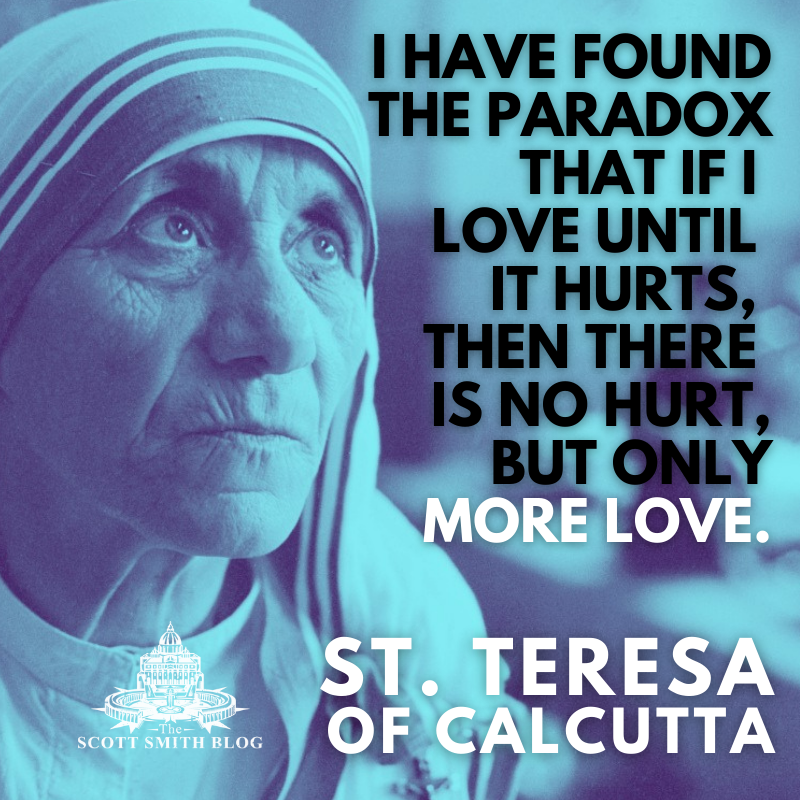
Here is also St. Teresa's description of redemptive suffering as the "paradox of love":
I have found the paradox that if I love until it hurts, then there is no hurt, but only more love.
Saint Pio (Padre Pio) of Pietrelcina on Redemptive Suffering St. Pio knew suffering in life better than most anyone, save Christ Himself, for Pio bore the wounds of Christ.
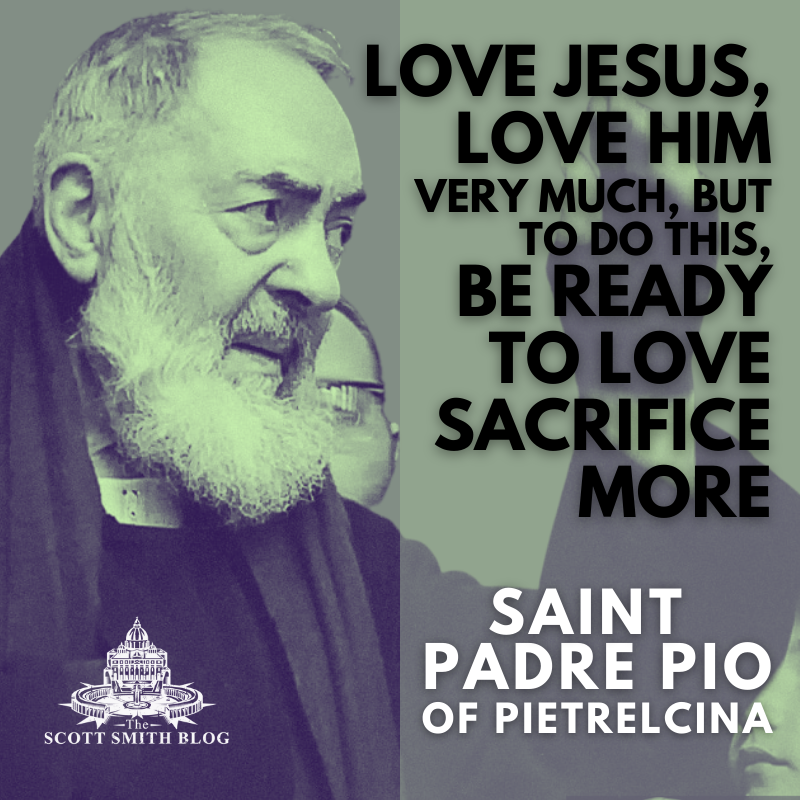
Here St. Pio describes redemptive suffering in terms of sacrifice:
Love Jesus, love Him very much, but to do this, be ready to love sacrifice more.
And another great quote from St. Pio. There are so many more!
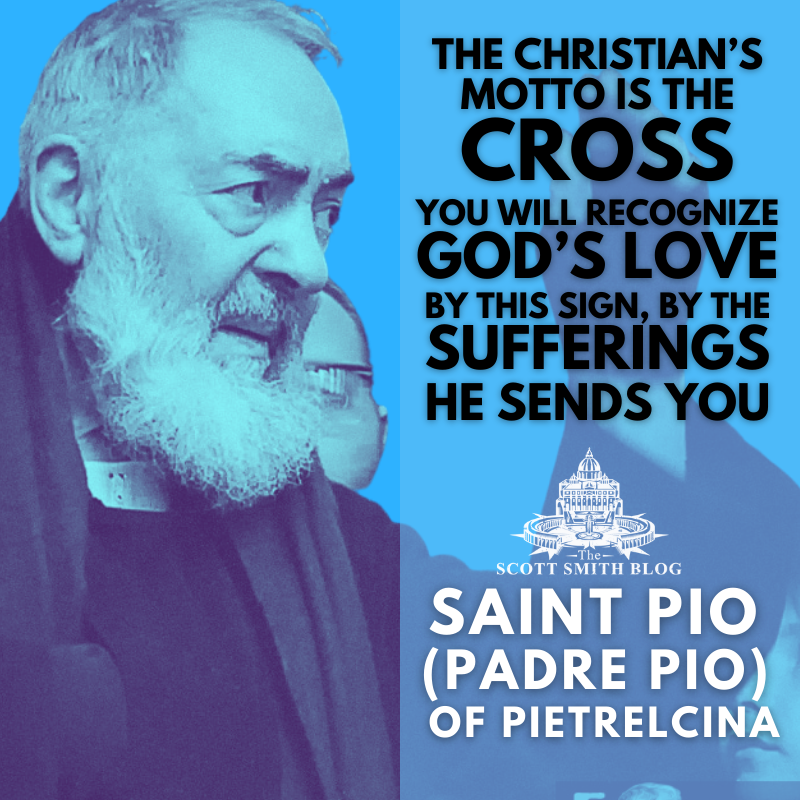
Here Padre Pio speaks about the sign of redemptive suffering, the Cross:
The Christian's motto is the Cross. You will recognize God's love by this sign, by the sufferings He sends you.
There's still so many great quotes:
St. Maria Faustina Kowalska on Redemptive Suffering
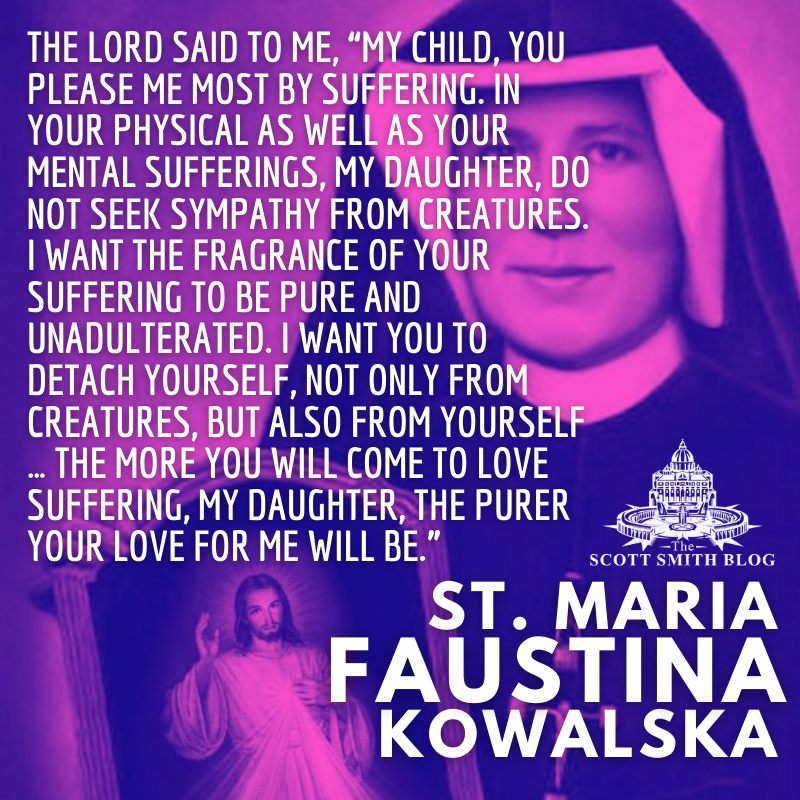
Saint Faustina described redemptive suffering in her diary. Union with Christ in suffering is a great start, but there is a sweeter fragrance still:[2]
And the Lord said to me, “My child, you please Me most by suffering. In your physical as well as your mental sufferings, My daughter, do not seek sympathy from creatures. I want the fragrance of your suffering to be pure and unadulterated. I want you to detach yourself, not only from creatures, but also from yourself … The more you will come to love suffering, My daughter, the purer your love for Me will be.”
This is an interesting note. Suffering purifies our love for Christ. Also, our suffering may also be purified. Seeking sympathy and consolation muddies our suffering, for Christ was denied these balms.
St. Josemaria Escriva on Redemptive Suffering
Here St. Escriva describes redemptive suffering as the "apostolate of suffering":
Those who pray and suffer, leaving action for others, will not shine here on earth; but what a radiant crown they will wear in the kingdom of life! Blessed be the "apostolate of suffering"!
Saint Josemaria Escriva is a saint of so many good quotes! I often wonder what it would have been like to be around this man who seemed to drip with great quotes.
Pope St. John Paul II on Redemptive Suffering
JP2 was actually the first one I quoted: "Don't waste your suffering!" It doesn't get much better and succinct than that.
Here's the full story from Carpe Verbum:
Whenever I think of suffering, I’m reminded of a story I heard from a priest years ago. He traveled with a group of priests on a pilgrimage to Rome where they had a chance to meet Pope John Paul II. They knew they’d only have a short meeting with him and wondered at the words of wisdom he would tell them. One of the priests hurt his leg and had to do most of the pilgrimage limping, with a cast on his foot and crutches. After their journey and finally at the moment when they’d meet the Pope they approached him one at a time. When the injured priest had his turn, JP2 saw his leg, pulled him in close and whispered in his ear, “Don’t waste your suffering!” And with that, the visit was done.
Here Pope St. John Paul II describes redemptive suffering as a "share in glory":[3]
To the prospect of the Kingdom of God is linked hope in that glory which has its beginning in the Cross of Christ. The Resurrection revealed this glory — eschatological glory. … Those who share in the sufferings of Christ are also called, through their own sufferings, to share in glory.
This is by no means all JP2 had to say on the subject. Here is also the book I published on St. John Paul the Great and the Rosary:
[image error]


January 1, 2021
What is a Marian Consecration? St. Louis de Montfort's Total Consecration to Jesus through Mary
This could change everything for you!
Holy Mother Church offers us an incredibly rich spiritual buffet. As Catholics, we can feast on a vast array of prayers, devotions, liturgies, and traditions. There is devotion or tradition to fit every appetite, personality, and life stage of the Church's children.
One such tradition that is particularly powerful is Marian consecration. Consecrating yourself to the Blessed Mother is a profoundly impactful path to sanctity.
Here are the updated translations of St. Louis de Montfort's Total Consecration to Jesus through Mary that I have published:

What is a Marian Consecration? Introduction to Consecration and Entrustment to Mary“Consecrate” means to “dedicate formally to a religious or divine purpose.”
Marian consecration is the act of entrusting one’s body, soul, possessions, works, and entire life to the protection, guidance, and intercession of the Blessed Mother.
The act of entrusting oneself to Mary’s care and intercession is nothing new. Jesus Himself entrusted His beloved disciple, John, to Mary while He was on the Cross (John 19:26-27).
Early Christians and the Church fathers recognized Mary’s holiness and her significance as the Mother of God. We’ve been asking for Mary’s intercession and intervention in our lives since the beginning of the Church. She is our mother, after all!
Saint Louis de Montfort developed a formal method of consecration to Jesus through Mary in the 1600s. More on this below ...
A Marian Consecration can be as short and simple as praying the following prayer. However, there are many more rigorous, formal, retreat-like methods, as well, which I will describe in the next section.
Here is the Marian Consecration prayer composed by St. Maximilian Kolbe for the Militia of the Immaculata:
O IMMACULATA, Queen of Heaven and earth, refuge of sinners and our most loving Mother, God has willed to entrust the entire order of mercy to you. I, (name), a repentant sinner, cast myself at your feet, humbly imploring you to take me with all that I am and have, wholly to yourself as your possession and property. Please make of me, of all my powers of soul and body, of my whole life, death and eternity, whatever most pleases you. If it pleases you, use all that I am and have without reserve, wholly to accomplish what was said of you: “She will crush your head,” and “You alone have destroyed all heresies in the whole world.” Let me be a fit instrument in your immaculate and merciful hands for introducing and increasing your glory to the maximum in all the many strayed and indifferent souls, and thus help extend as far as possible the blessed kingdom of the most Sacred Heart of Jesus. For wherever you enter you obtain the grace of conversion and growth in holiness, since it is through your hands that all graces come to us from the most Sacred Heart of Jesus.
V. Allow me to praise you, O Sacred Virgin.
R. Give me strength against your enemies.
Since this time, other kinds of Marian Consecrations or variations of St. Louis' formula have been developed. St. Maximilian Kolbe developed a 9-day version. Fr. Michael Gaitley developed 33 Days to Morning Glory.
These variations will be described below:
The Original and Classic Marian Consecration: St. Louis de Montfort's Total Consecration to Jesus through MaryThe original! Lost for centuries but miraculously recovered, St. Louis de Montfort's Marian Consecration is the gold standard for Marian consecrations. St. Louis' Consecration follows the 34-day format.
Here are the updated translations of St. Louis' Marian Consecration books that I have published:
[image error]
Here is the prayer journal version, as well. This version of my translation includes extra writing space for your thoughts and reflections: [image error]

St. Louis de Montfort's 33-day sequence consists of prayers and readings from his book Total Devotion and St. Thomas a Kempis' Imitation of Christ. These meditations focus on why consecration to Mary is proper. The prayers include some beautiful litanies and praying the Rosary.
St. Louis' 33 days of Marian Consecration prayers culminates in a beautiful prayer of consecration on the 34th day, which is ideally a Marian feast day. The Act of Consecration is made in conjunction with the Sacrament of Reconciliation and the reception of Holy Communion.
More recently, Fr. Michael Gaitley wrote 33 Days to Morning Glory, which focuses on the Marian spiritualities of four Saints: Mother Teresa, Pope Saint John Paul II, St. Louis de Montfort, and Maximilian Kolbe.
Why Should I Consecrate Myself to Mary?
What’s the point of consecration to Mary, anyway? What if I already have a devotion to Mary, pray the Rosary, and ask for her intercession?
Consecration to Mary is simply a furthering and deepening of our devotion to and relationship with Jesus through Our Lady. If you already have an affection for Mary and talk to her often, consecration is a natural next step. But even you don’t really know Our Lady yet and aren’t convinced of the hype, Marian consecration can be that bridge that unites you to her more deeply.
When we consecrate ourselves to Mary, we give her our entire lives and selves as well as the merits of all our prayers and works in order to belong more fully to Our Lord. We give Mary everything we are and do to present to the Lord and use at her disposal.
Why give Mary everything? Because she’s a good mom. She only wants what’s best for us and for all her children. Mary wants us to know, love, and serve Jesus more. She wants us to get to Heaven even more than we do. She’s invested in our happiness, both temporal and eternal. Mary takes all the good we are and do, adds her grace, and presents us to her Son. The best part? When she presents us to Jesus, in all our littleness and with all our feeble efforts, He does not refuse her, because she never refuses Him.
Yes! And ultimately, that’s exactly what Marian Consecration accomplishes. When we consecrate our selves to Mary, really we are consecrating ourselves to Jesus through Mary. They are so intimately united that truly giving ourselves to Mary can lead to nothing but total surrender to God.
By consecrating ourselves to Mary, we leap with faith and joy into the arms of our mom, knowing that she advocates for us, loves us, and wants to see us become saints. We cannot go wrong with Marian Consecration.
To complete a Marian consecration, you really just need a willing heart. Just begin with a desire to know Jesus more deeply through His Mother.
You’ll probably also want a guide. St. Louis de Montfort’s Preparation for Total Consecration is timeless and has been used for decades.
St. Maximilian Kolbe’s 9-day formal consecration to Mary is also beloved by many.
In more recent years, Fr. Michael Gaitley wrote 33 Days to Morning Glory, which focuses on the Marian spiritualities of four Saints.
I suggest taking a look at each one and praying about which best suits your soul at this time. Again, you can’t go wrong here, so don’t stress too much about which form of consecration you select.
It is customary to renew one’s consecration to Our Lady every year by repeating the 33-day process and ending on the same Marian feast day. You can always select various methods of consecration throughout the years, too!
We are all called to holiness. God created us to be saints. We are made to know the Lord, to love Him, and to serve Him. Consecrating ourselves to Mary is one way that we grow in that knowledge, love, and service. We allow Mary to take us by the hand and lead us to her Son. She knows, loves, and serves Him best. We have so much to learn from her life, and so much to gain by placing ourselves in her hands.
Mary, Mother of God, Mother of the Church, and Our Mother, pray for us!
Have you consecrated yourself to Our Lady? Is your heart stirred to it for the first time?

December 30, 2020
TOP 10 Catholic Christian New Year's Resolutions Plus Infographic: What Sort of New Year's Resolution Should a Christian Make?
How are Christian New Year's Resolutions different from typical New Year's resolutions? Typical resolutions tend to be self-centered. The following resolutions are self-denying or self-sacrificing.
As Christians, we deprive ourselves of something for a purpose outside ourselves. We can take inspiration from the ancient desert fathers and monastic practices still in use to this day.
Below you will find a TOP 10 LIST PLUS INFOGRAPHIC of ancient monastic practices of asceticism adapted to our modern world that make wonderful, Christian New Year's Resolutions.
This secular tradition of New Year's Resolutions - find out how to return this to Christ! Christian Perspective on New Year's Resolutions: What are Godly Resolutions?Losing weight to fit into our summer swimsuits - maybe that shouldn't be our #1 goal for the New Year.
Don't worry about these worldly pursuits. God usually has a way of answering these more worldly prayers, too, if we will just put our trust in Him.

But maybe you're not trying to lose weight for superficial reasons. Maybe it's for heart health. Maybe it's a promise to your family and loved ones.
Try fasting ...
What Does the Bible Say About New Year's Resolutions? New Year's Resolutions in the BibleThere are three types of Christian New Year's Resolutions that Jesus shows us in the Gospels: Prayer, Fasting, and Almsgiving. We typically see these during Lent, but why not bring them into the New Year?
Jesus gives us Prayer, Fasting, and Almsgiving to conquer the Threefold Lusts of Original Sin: Lust of the Eyes, Lust of the Flesh, and Pride of Life. Read more on all this in this article I've written on the subject:
FASTING: New Year's Resolutions in the BibleTry the practice of intermittent fasting! Pick a day or two a week to fast. Eat only light meals without snacking between meals. Or don't eat all day.
Why fast? Fast for our country. Fast for an end to abortion. Fast for the salvation of your family and children. OR, just fast and give your sacrifices to the Blessed Mother to multiply blessings and help where help is most needed.
But fasting is just one ancient Christian practice to try (if you're not trying it already). There are many more options.
Below you will find a list of ancient monastic and ascetic practices adapted to our modern world.
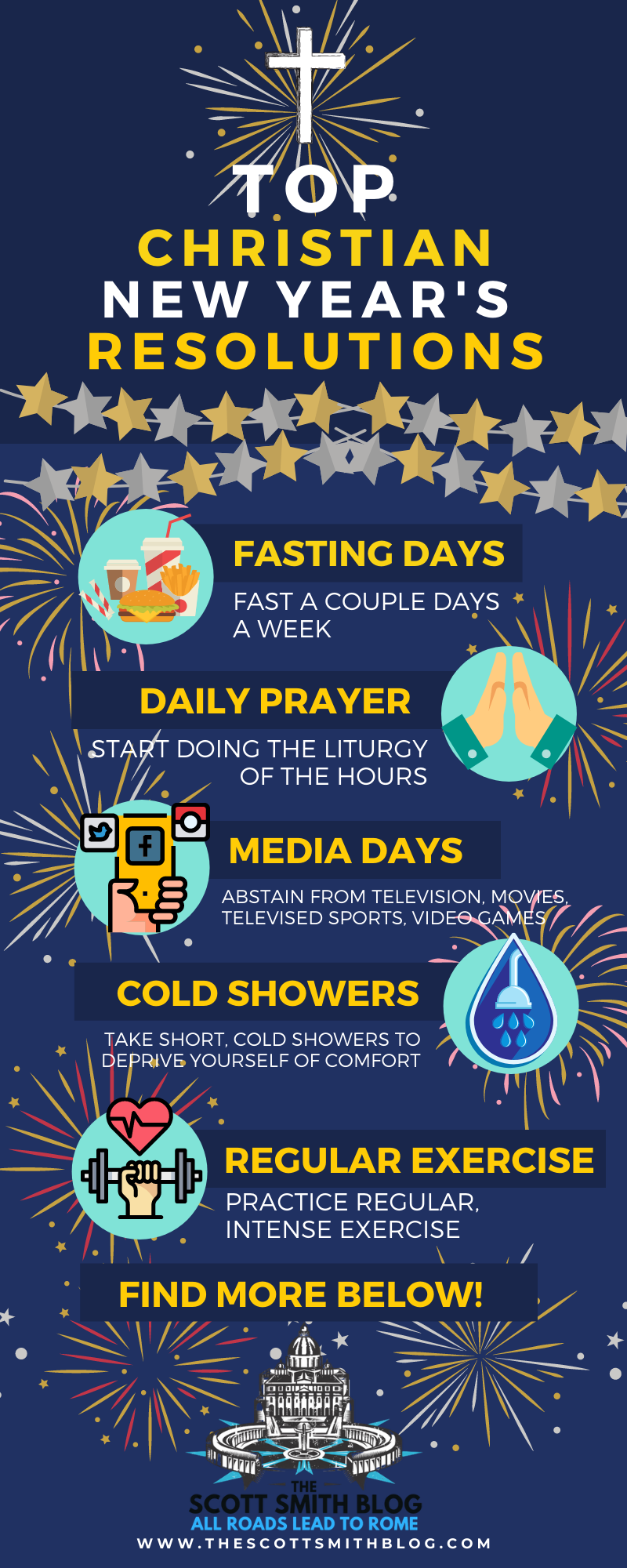
Top Ten List of Christian New Year's ResolutionsHave you considered any ancient ascetic practices for your New Year's resolutions? These are both highly powerful and very different from typical resolutions, in part because of their immense purpose and antiquity.
All the techniques listed below are adapted from ancient monastic practices for modern times.
Also, all of the following ascetic practices are also designed to strengthen virtue and weaken vice:
Take short, cold showers. Practice regular, intense exercise. This is a great response to temptation. It helps rewire your brain away from the temptation. Fasting: Take Wednesdays and Fridays as days of fasting.Fasting: Abstain from alcohol, desserts, sweets, soda and sweet drinks (white milk, black coffee, and black tea are permissible).Fasting: Abstain from eating between meals.Prayer: Dedicate one or more hours of daily prayer (one hour blocks of time are good), or the next option:Prayer: The Divine Office: Adopt one or more of the 7 daily Liturgies of the Hours, which include Matins, Lauds, Terce, Sext, None, Vespers, or Compline (use Universalis.com to get started) Abstain from television, movies, televised sports, video games.Abstain from non-essential material purchases. Only listen to music that lifts the soul to God.Only use the computer for work, school, or essential tasks (e.g., paying bills).Only use mobile devices for essential communications; cut out non-essential texting, app, and internet use.Purposefully interrupt sleep patterns with dedicated prayer period(s).
How to Keep Your Christian New Year's Resolution? Accountability Partners!Want to make sure you actually keep your New Year's Resolution? Get help! Don't go it alone.
Ask your wife, your husband, your friend or friends to be your Accountability Partners.
Many of the above resolutions came from the Exodus 90 program. Exodus 90 is a 90-Day Catholic Spiritual Exercise for Men. Undertake this great regime of prayer and asceticism with a friend this year. Click on the image below for more information:

Men, want to resolve to break your Porn Addiction this year? Try Covenant Eyes! This program also involves the use of Accountability Partners. Also, if you have a porn addiction, almost all of the above TOP TEN practices will help you break that craving for sinful material.
Rewire your brain this year away from addictive habits!
New Year's Resolution Devotional: Christian Thoughts for the New YearAdvice from the Saints on New Year's ResolutionsHere's a devotional of advice from the Saints on forming your New Year's Resolutions:
Advice from St. Gemma Galgani: Christian New Year's Resolutions “During this new year I resolve to begin a new life. I do not know what will happen to me during this year. But I abandon myself entirely to you, my God. And my aspirations and all my affections will be for You. I feel so weak, dear Jesus, but with Your help I hope and resolve to live a different life, that is, a life closer to You.” – St. Gemma Galgani
Getting more organized with St. Benedict and St. Zita: Catholic New Year's ResolutionOne of your resolutions this year may be to to finally get more organized. Here is some advice from Susan Anthony at Busted Halo:
I’ve tried old-school to-do lists and digital solutions, but I still feel overwhelmed keeping up with my schedule, my responsibilities, and of course, the stacks of magazines and mail that threaten to swallow up my desk. While St. Expeditus can help with my general procrastination, I might need to consult an organizational expert on this one.
I thought of St. Benedict, whose “rules” set out how to efficiently run a monastery. Then I read that Benedict was so strict in his organizational skills that some of his fellow brothers tried to poison him. Maybe I will ask for his help sparingly.
St. Zita, the patron of homemakers and house cleaners might be a gentler and more accessible choice to support me. She managed to keep up with the daunting level of chores her demanding employer required while never missing Mass. And all in the days before dishwashers and washing machines.
Have Patience With Yourself as You Begin Your Catholic New Year's Resolutions"Have patience with all things, but chiefly have patience with yourself. Do not lose courage in considering your own imperfections but instantly set about remedying them—every day begin the task anew."– St. Francis de Sales
"Never forget that there are only two philosophies to rule your life: the one of the cross, which starts with the fast and ends with the feast. The other of Satan, which starts with the feast and ends with the headache."– Venerable Fulton Sheen
What is Christian Asceticism? Here is the New Advent Catholic Encyclopedia entry:
The word asceticism comes from the Greek askesis which means practice, bodily exercise, and more especially, athletic training. The early Christians adopted it to signify the practice of the spiritual things, or spiritual exercises performed for the purpose of acquiring the habits of virtue. At present it is not infrequently employed in an opprobrious sense, to designate the religious practices of oriental fanatics as well as those of the Christian saint, both of whom are by some placed in the same category. It is not uncommonly confounded with austerity, even by Catholics, but incorrectly. For although the flesh is continuously lusting against the spirit, and repression and self-denial are necessary to control the animal passions, it would be an error to measure a man's virtue by the extent and character of his bodily penances. External penances even in the saints, are regarded with suspicion. St. Jerome, whose proneness to austerity makes him an especially valuable authority on this point, thus writes to Celantia:
Be on your guard when you begin to mortify your body by abstinence and fasting, lest you imagine yourself to be perfect and a saint; for perfection does not consist in this virtue. It is only a help; a disposition; a means though a fitting one, for the attainment of true perfection.
Thus asceticism according to the definition of St. Jerome, is an effort to attain true perfection, penance being only an auxiliary virtue thereto. It should be noted also that the expression "fasting and abstinence" is commonly used in Scripture and by ascetic writers as a generic term for all sorts of penance. Neither should asceticism be identified with mysticism. For although genuine mysticism can not exist without asceticism, the reverse is not true. One can be an ascetic without being a mystic. Asceticism is ethical; mysticism, largely intellectual. Asceticism has to do with the moral virtues; mysticism is a state of unusual prayer or contemplation. They are distinct from each other, though mutually co-operative. Moreover although asceticism is generally associated with the objectionable features of religion, and is regarded by some as one of them, it may be and is practised by those who affect to be swayed by no religious motives whatever.
What is the Purpose of Christian Asceticism?There are several important purposes underlying the practice of asceticism. We sacrifice as acts of solidarity with the poor. We deny ourselves to open us up to God’s grace. We also offer up our sacrifices to God that He may use them to heal the world.
December 28, 2020
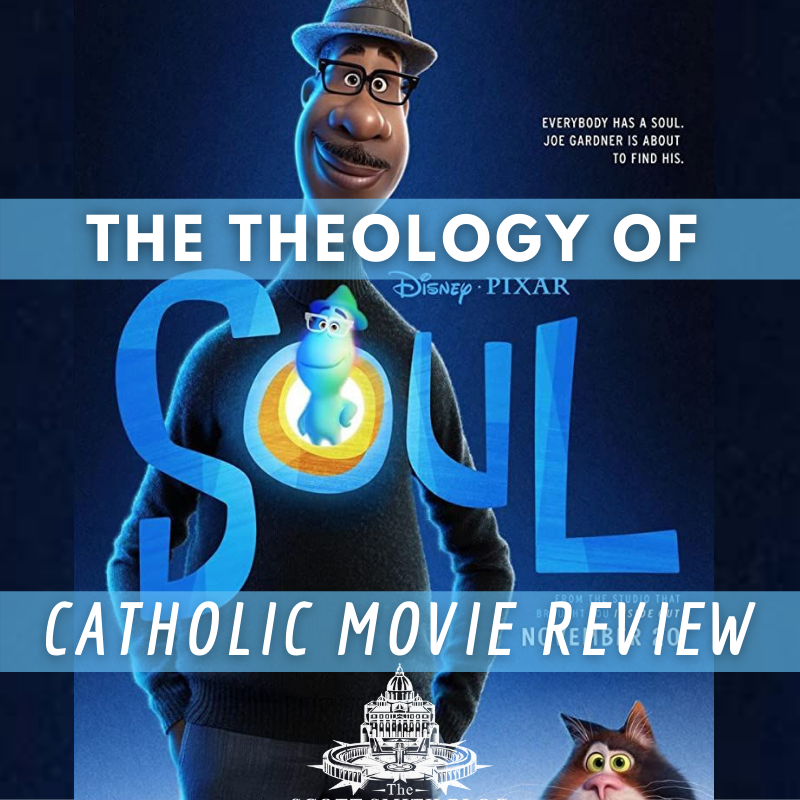
The Theology of Pixar's Soul: Catholic Movie Review
Well, it's not a stroll through the Baltimore Catechism. However, Pixar's SOUL may be the basis for some good discussions with your family. It's an amazing exploration of the "meaning of life".
"Everybody has a soul. Joe Gardner is about to find his." The movie's tagline is bold considering the typically anti-supernatural and hyper-materialist Hollywood culture. Acknowledging the existence of the soul is a just a half-step away from acknowledging the Creator of the soul, God.
The central premise is exploring the soul's journey from the perspective of a soul musician. So what do you think? Did Pixar push the pro-abortion agenda of unborn babies having no souls? Or did they come down on the only logical conclusion (also the Church's teaching): ensoulment occurs at conception?
Find out below:
[SPOILERS AHEAD!]
No scary death scenes here for our young watchers. After avoiding several near encounters with death, Joe falls through an open manhole in the street and lands as a soul somewhere else.
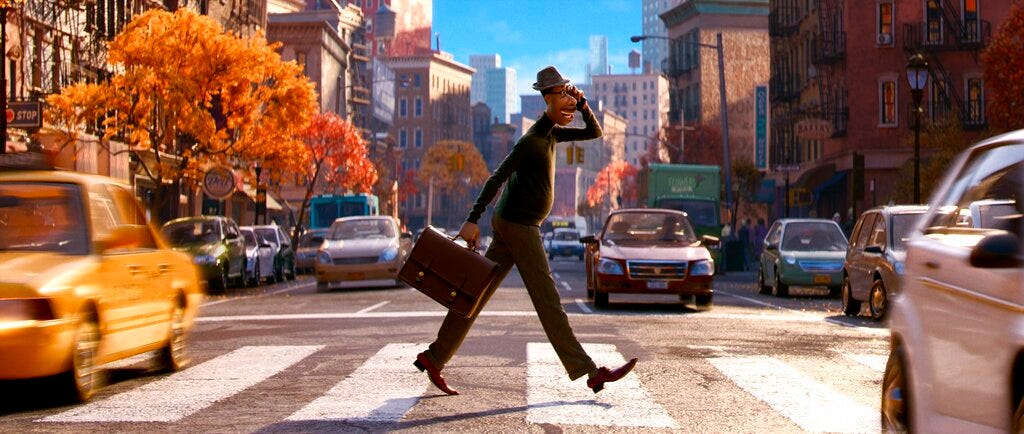

When Joe Gardner dies, he lands on a giant keyboard-like bridge-elevator leading to the a massive light called "the great beyond." But, as in many of these movies, Joe declares "I can't die now." After landing pretty far ahead in line, he fights his way backward in line.
Eventually, Joe falls into a black abyss of abstracted forms. He falls through a window in the sky and lands in a field of blue grass. It is a nursery of "new souls".
SOUL: The Great Before or "You Seminar"
Joe is discovered by a friendly pack of new souls. He is greeted by a sort of nursery mother. She calls herself the "Coming Together", that is "all quantized fields of the universe" appearing in a manner Joe's "feeble mind" can understand - or "Jerry"
It is interesting that Jerry refers to Joe's "mind", even though he is purely soul at this moment. What does she mean by "mind" absent our bodies?
For that matter, Joe is absent his body, but not his hat:

Joe then asks the all-important question: "Is this heaven?" "Is it H-E-double hockey sticks?"
Jerry answers "no" to both. It's not the Great Beyond. It's the Great Before. The Great Before is now called "You Seminar" as a bit of "rebranding".
Joe asks another all-important question: "Does this mean I'm dead?" "Not yet. It means your body is in a holding pattern." What that means ...

Personality and Original Sin: Excitable Pavilion, Aloof Pavilion
Joe asks "This is where personalities come from?"
Jerry answers "Of course, do you think we're just born with them?"

Some souls' personalities are benign: one soul describes himself as an "agreeable skeptic who's cautious yet flamboyant" and another as a "irritable wallflower who's dangerously curious". One, however, describes herself as a "manipulative megalomaniac who's intensely opportunistic."
These highly developed personalities result neither from nature, nor nurture. It's not genetics or environment.
Could this be SOUL describing the effects of Original Sin? Pre-birth and pre-ensoulment, these souls are prone to personality disorders. These souls haven't done anything wrong and haven't had anything wrong done to them. Yet, some at least suffer inclinations to sin.
"Insecure" and "self-absorbed" personalities are also very common - thanks, Original Sin.
Joe tries to jump to earth along with all the new souls, but he keeps getting plopped back in the nursery. Apparently, reincarnation is highly unusual, if not impossible, in this universe.
Joe is offered the job of "mentor" in the soul nursery.
Another Jerry leads the New Mentor Seminar - All the Great Before's "Coming Togethers" are named "Jerry", unfortunately. He states, among other zingers, that "forgetting the trauma of childbirth is one of the great gifts of the universe."
Is Jerry alluding to ensoulment occurring pre-birth? More on this in the ensoulment section ...
This Jerry tell the mentors that all these souls, despite their highly developed personalities, are missing something: the spark. You can find the new souls' sparks in the "Hall of Everything" or the "Hall of You".
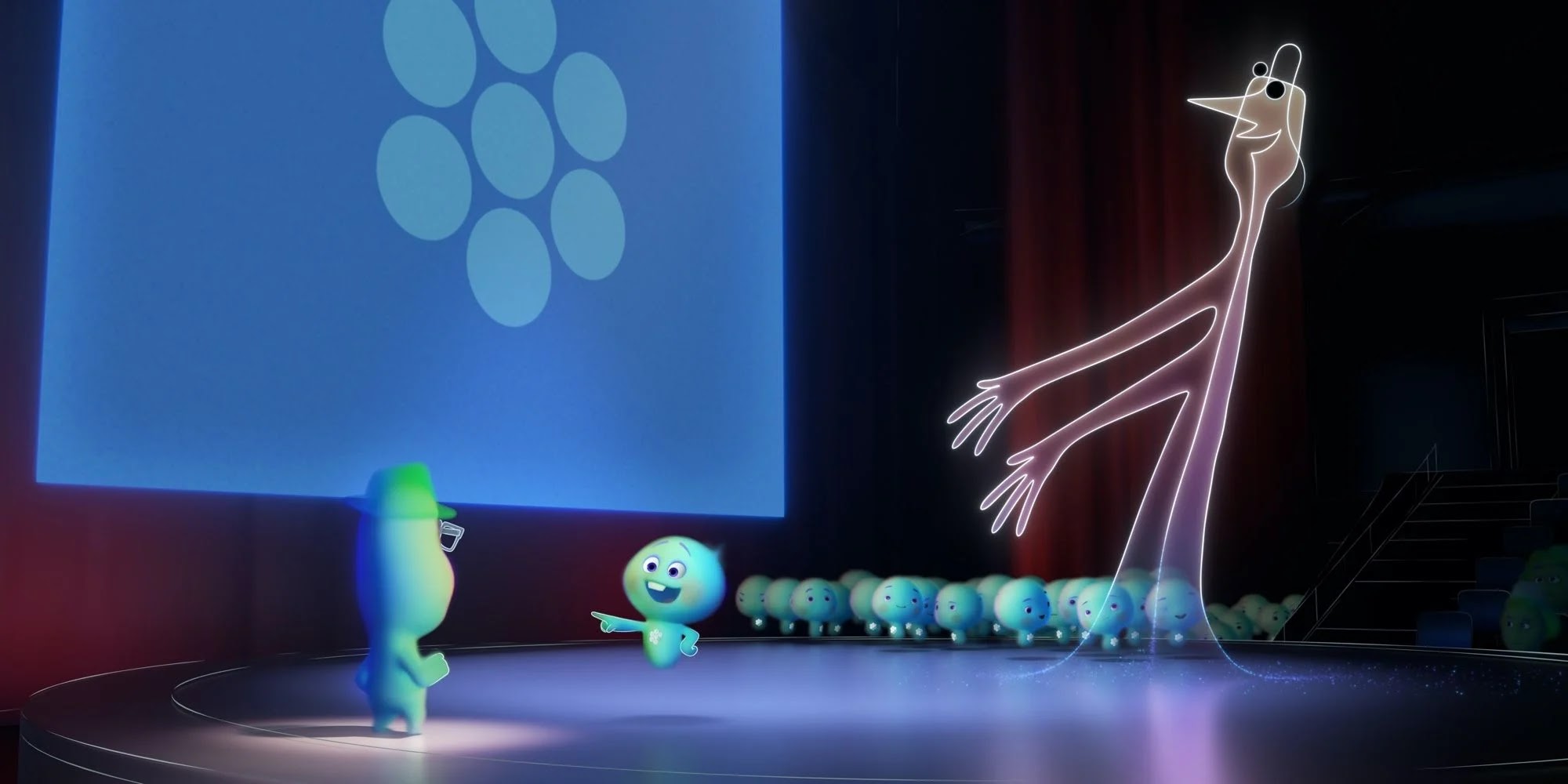
Joe, under a false name, is assigned as mentor for Soul #22. 22 still lacks her "spark". 22 has apparently failed to be successfully mentored by all the greatest mentors in history including Mother Teresa, Copernicus, Muhammed Ali, Marie Antoinette, and Carl Jung. This is likely why her number is so low compared to the other souls numbered in the hundreds of millions.
A flashback of Mother attempt to mentor 22 quotes Mother Teresa as saying: "I have compassion for every soul. Except you. I don't like you."
These mentors could be a form of saintly intercession, especially since the mentors include Mother Teresa.
There are definitely some issues with dualism here, meaning the disconnect between body and soul. The Church teaches that the body and the soul are one.
The new souls are not able to taste food, for example, in the Hall of Everything:

This is especially true prior to ensoulment. Ensoulment occurs at conception. As soon as the body exists, God creates a soul.
Pixar's presentation of souls existing prior their bodies is heretical. There may be ways to get around this as time does not exist in the nursery. Also, it's not revealed when the new souls enter their baby bodies. It may be possible for the souls to enter their bodies at conception.
Pixar, as far as I can tell, side-stepped the whole issue of when ensoulment occurs. I was worried Pixar would push the pro-abortion agenda of unborn babies having no souls.
Pixar left this as a gray area. While gray areas are dangerous, it could also be an example of restraint. Hollywood exercising restraint in deep moral areas (as opposed to haughtiness or contempt) is a good thing. Not ideal, though.
There is a hint that birth still lies ahead for these new souls. The Jerry leading the New Seminar states that "forgetting the trauma of childbirth is one of the great gifts of the universe." This seems to suggest the new souls will enter their bodies pre-birth. Again, we can't exactly pinpoint when ensoulment occurs in SOUL, but it does appear that an unborn baby does indeed have a soul in the Pixar universe.
Pixar's SOUL does dabble pretty heavily into the heretical idea of the pre-existence of the human soul. That is, that our souls exist pre-conception. I take this as mostly creative license, not a theological point.
To their credit, Pixar does not present the soul as existing for eternally prior to conception. This would be worse. There is a moment in the Pixar universe when the soul is created. The logical, if not addressed, moment for this would be conception.
22 leads Joe into the Zone: "The Space Between the Physical and the Spiritual".
Joe and 22 find a ship with tie-died sails and full of entranced hippies, describing themselves as "Mystics without Borders" dedicated to getting lost souls back home. Moonwind, by the way, is voiced by the ever-irreverent Graham Norton, so it's appropriate that he would be a crazy hippie.
Moonwind's ship appears to be powered by Bob Dylan music.
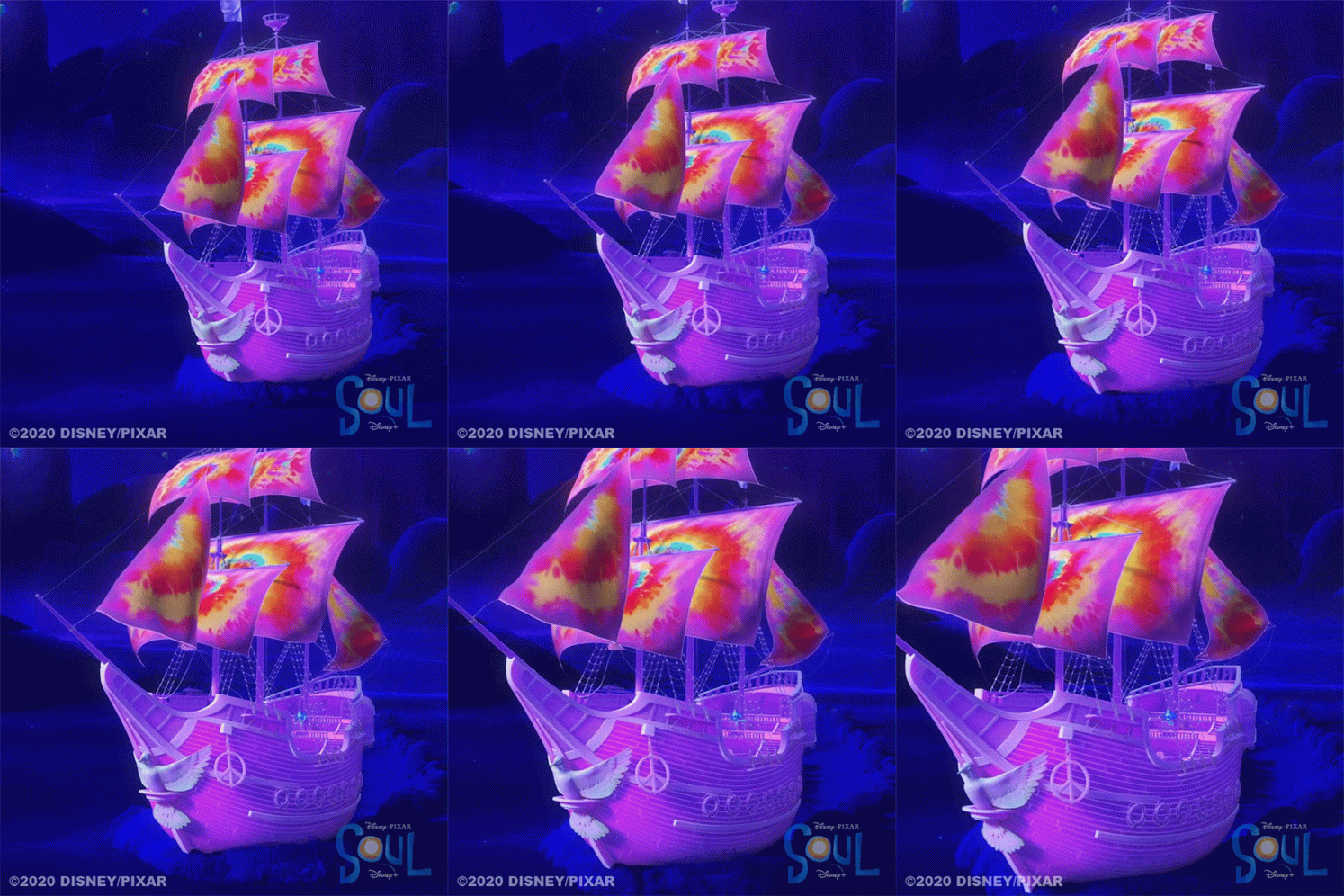
Moonwind describes the people they are helping: "Some people just can't let go of their own anxieties and obsessions leaving lost and disconnected from life." They help free "another hedge fund manager".
These so-called great practitioners of meditation are all yoga or psychedelic-based. None of the "Mystics without Borders" are actually praying, apart from "centering prayer".
There are some serious astrological references, plus "astral migration" - all the crazy things hippies love.
Lots of soul-body confusion! Not good.

Fortunately (maybe), Pixar is here portraying a female in a male's body as a mistake, not at all normal or natural, and exceedingly rare, though nevertheless still possible. Not great, but better than typical depictions of transsexual identity disorders.
What is a Spark? The Meaning of Your Life is More Than Your Greatest Accomplishments and Skills "Meaning of life," (first) Jerry says, you humans have such basic concepts. This is a good message. Joe thinks his only purpose is music. He thinks after this great adventure that his life is only about to start when he gets his big "start" in music. But there's a lot more to Soul and the soul than just playing soul music.
This is what Joe discovers. After playing the night of his life, he thought it would feel different. As Dorothea explains with a parable, Joe is a young fish swimming in the ocean that is searching for the ocean, who says "this is the ocean; this is just water."
The meaning of life is not so "shallow" as our greatest professional accomplishments. Joe discovers there's nothing regular and old about "regular old living".

December 26, 2020
Mary and Marilyn Monroe: "Candles in the Wind"
My aunt passed down to me all her original Aerosmith, Cars, Styx, and Elton John records. Not a lot of Catholic saints in the bunch, despite being my early catechists. I was spinning Elton John's Goodbye Yellow Brick Road record this morning. That's the one with "Candle in the Wind" as well as the title track.
As we enter the last week of our Marian Consecration, Elton John's reflection on Marilyn Monroe, "Candle in the Wind", turned into a reflection for me on the Blessed Mother. These are two feminine icons: the Blessed Mother and Marilyn Monroe. I was struck by how perfectly different these two beautiful women lived.
Two very different kinds of beauty. One beautiful woman was ravaged by Satan; another beautiful woman trampled Satan underfoot.
Here are some thoughts on the Marilyn Monroe of "Candle in the Wind" and the Virgin Mary. Just a little Christmas reflection:
Goodbye Norma Jean
Though I never knew you at all
You had the grace to hold yourself
While those around you crawled
Marilyn had physical grace. Mary was "full of grace".
They crawled out of the woodwork
And they whispered into your brain
The serpents crawled out of their holes for one woman. The serpents whispered to her and destroyed her. Angels hailed the other. Serpents feared her, and she crushed them underfoot.
They set you on the treadmill
And they made you change your name
Marilyn was, coincidentally, given Mary's name. Not as a nun would change her name, but as one minted by Hollywood. Mary was given a name above all names, save One. Mary was named "Full of Grace". It is Mary's title in Heaven.
And it seems to me you lived your life
Like a candle in the wind
Never knowing who to cling to
When the rain set in
Mary and Marilyn both had the delicacy and fragility of "candles in the wind". Marilyn never knew who to cling to "when the rain set in". Mary always clung to God.
The harsh winds of fortune battered Marilyn to death. The divine wind of the Holy Spirit espoused Mary and ensured she never tasted death.
And I would have liked to have known you
But I was just a kid
Marilyn was an unreachable ideal, even for Marilyn. Mary is ever-present. She waits to be our mother and our unflinching ideal. She can be closer to us than we are to ourselves.
Your candle burned out long before
Your legend ever did
Marilyn's legend is dying out even now. She is just an image now, slowly fading from memory, and she lived not even a century ago. Mary's life and legend is undimmed even after thousands of years.
Such different icons:
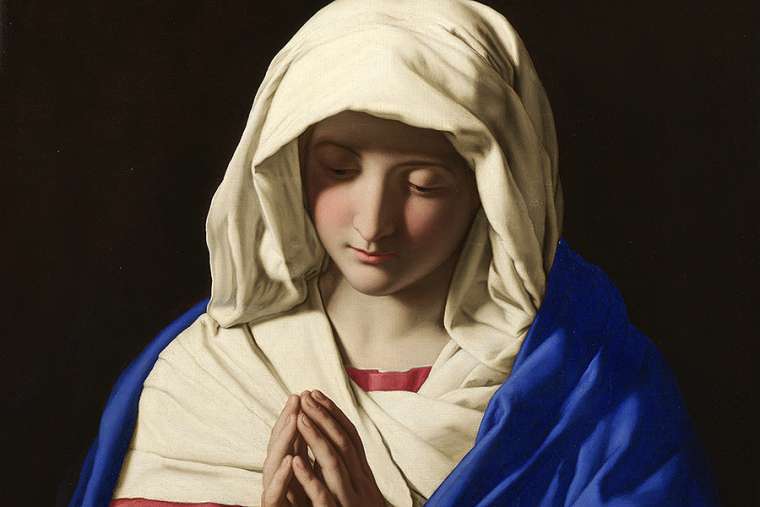
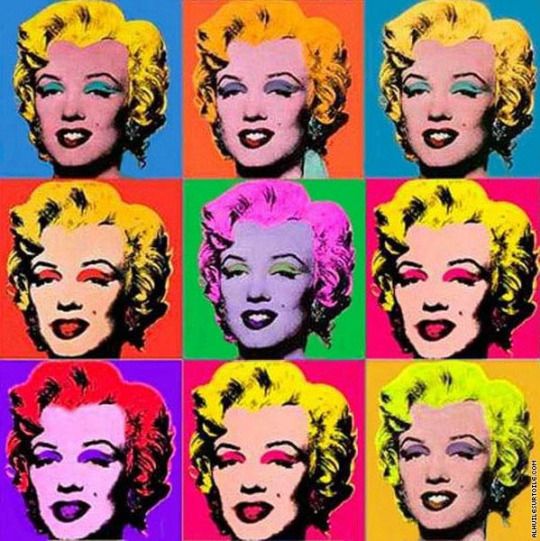
When Mary appears to her children, she is always described as the "most beautiful woman". It's an entirely different kind of beauty than the "Hollywood created superstar". Mary's beauty is, in fact, the antidote to our addiction to this kind of flesh-deep beauty.

December 18, 2020
Star of Bethlehem 2020, the "Great Conjunction": What is the Meaning of the Star of Bethlehem? The New Ark and Christmas
Does this mark a return of the Star of Bethlehem? Star of Bethlehem 2020? Possibly, but there was something much bigger than even Jupiter and Saturn combined with the original Star of Bethlehem.
This is the amazing part:
 Have you ever wondered about the Star of Bethlehem? Is there a deeper meaning? There are a host of interesting videos on whether or not it existed. But have you ever wondered why it existed?
And what about the Blessed Mother riding a donkey to Bethlehem? We know that the Virgin Mary rode a donkey to Bethlehem, but why?
Lastly, why is there no room at the inn for Joseph and Mary? We know the town of Bethlehem was packed for the Census. But what foreshadowed this event in the Old Testament?
The Answer? The Virgin Mary is the New Ark of the Covenant. All of the above happened to the Old Ark of the Covenant, as well.
Mary being the Ark of the New Covenant will completely change the way you understand the Christmas story. Hopefully, after reading this article you will see Mary and Joseph’s journey to Bethlehem in a completely different light, even the light of the Star of Bethlehem, itself.
But that's just the beginning:
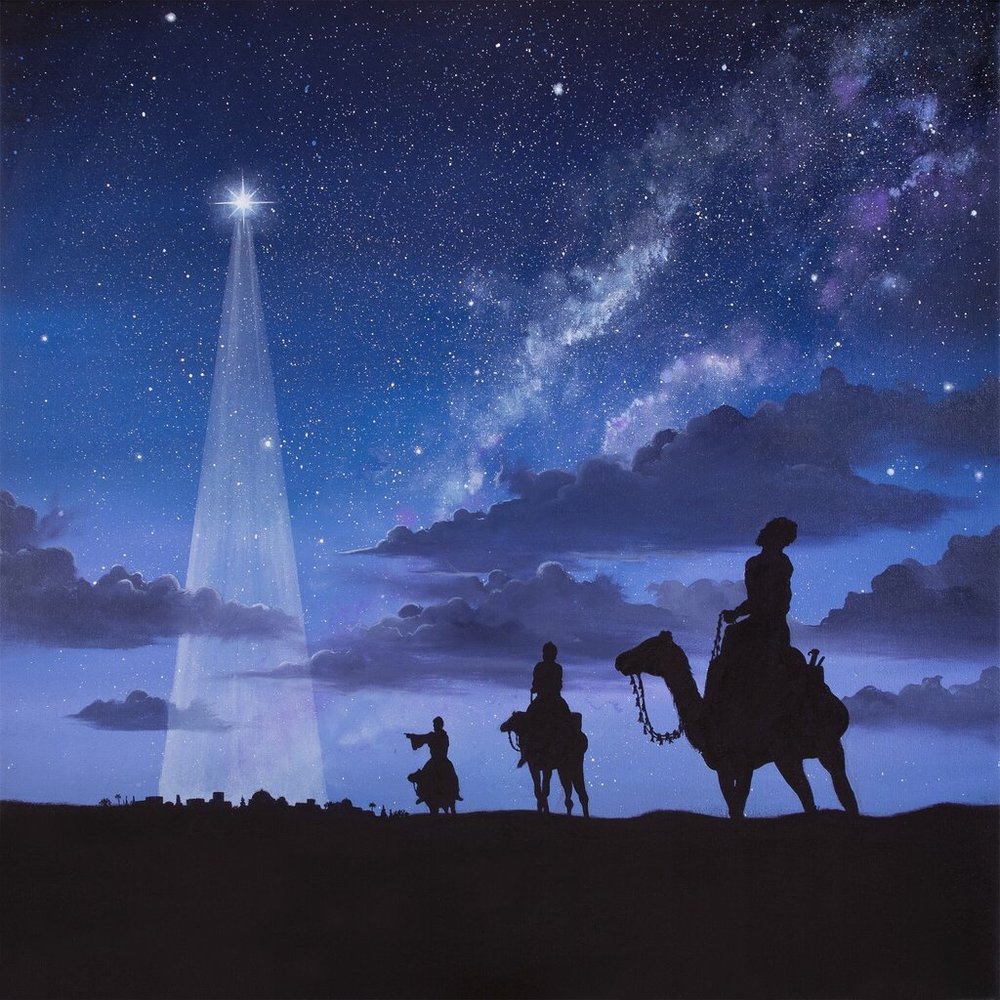
What is the Meaning of the Star of Bethlehem? The Star of Bethlehem does some odd things. The Wise Men are able to follow it until it comes to a rest above Jesus’ manger. The star is usually depicted as a tower of light shining down on the nativity scene.
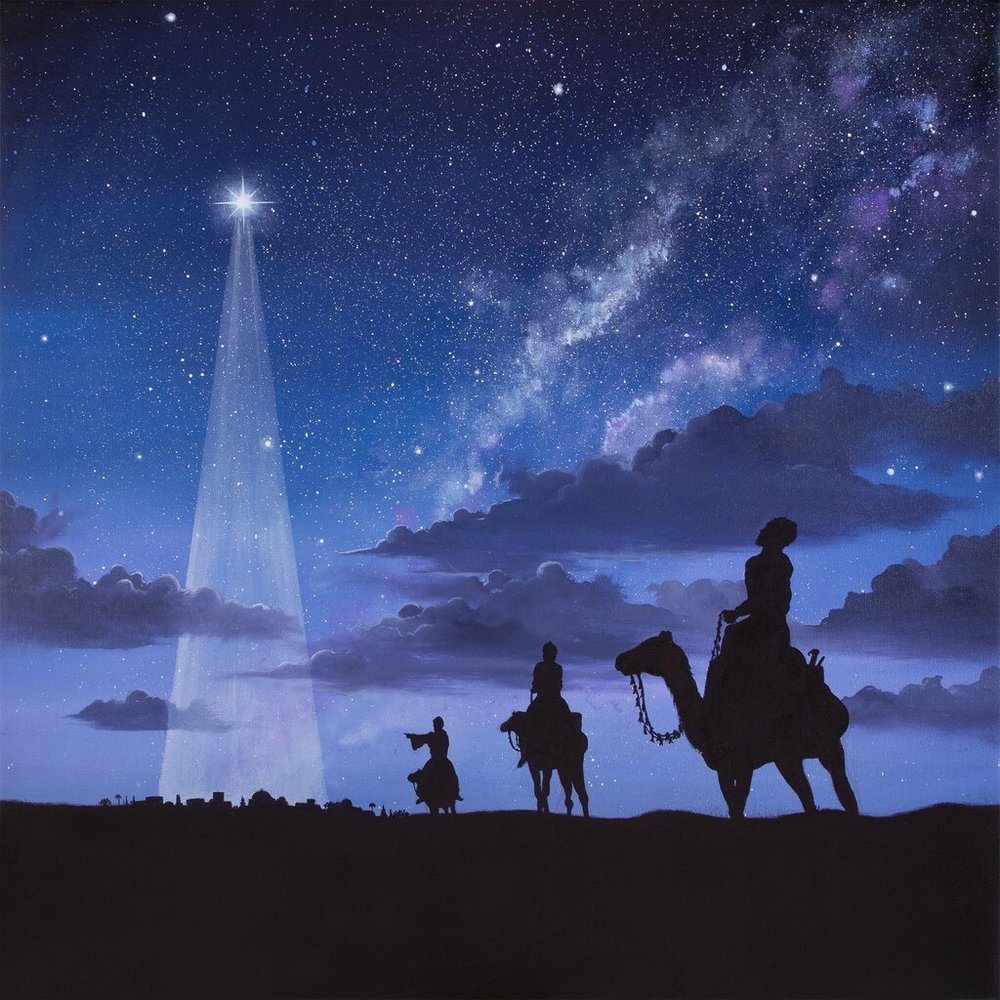
Why is all this happening? We take all this for granted. It’s just God doing His thing, right? It’s just miracles. Sure, but why this particular combination of miracles?
Here is the description of these events from the second chapter of the Gospel of Matthew:
When [the Wise Men] had heard the king they went their way; and lo, the star which they had seen in the East went before them, until it came to rest over the place where the child was. When they saw the star, they rejoiced exceedingly with great joy.
Why is the light from the star following Mary and Joseph? Do you remember light following anyone else in the Bible?
Remember the Shekinah, the “Glory Cloud”? It's also described in the article on the Visitation, above. The Glory Cloud was a tower of light and fire which “overshadowed” the Ark of the Covenant. That same word "overshadow" is used at the Annunciation of Mary in Luke 1 - more on that below!
When it was time for the Israelites to leave their camp site and journey to a new one, they would follow the Shekinah:
And whenever the cloud was taken up from over the tent, after that the people of Israel set out; and in the place where the cloud settled down, there the people of Israel encamped. (Numbers 9:17)
The tribes of Israel followed the light of the Shekinah to their home.
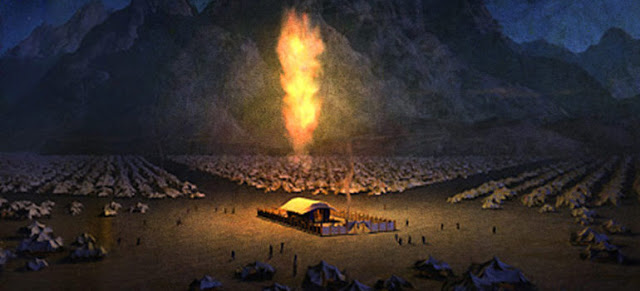
The Shekinah was a brilliant beacon of light at the center of the Israelite’s camp. If the shepherds or their flocks strayed too far from the Israelite camp, the light of the Glory Cloud would lead them back.
The Shekinah stayed with Israelites and the Ark of the Covenant for some time, but eventually left them. After the Jews returned from their captivity, a modest Second Temple was completed in 515 BC. But, the visible presence of God as the Shekinah cloud of glory did not return.
The Shekinah was prophesied to return, however ...
The Prophesied Return of the Shekinah The 17th blessing of the daily Amidah (Standing) prayer expresses the longing in the Jewish heart that the Shekinah will one day return: “Blessed are You, God, who returns His Presence (Shechinato) to Zion.”
The Prophet Jeremiah also prophesies the return of the Glory Cloud AND the Ark of the Covenant at 2 Maccabees 2. After hiding the Ark of the Covenant, he rebukes those that followed him, saying the following:
When Jeremiah learned of it, he rebuked them and declared: “The place shall be unknown until God (1) gathers his people together again and (2) shows his mercy. And then the Lord will disclose these things, and the glory of the Lord and the cloud will appear, as they were shown in the case of Moses, and as Solomon asked that the place should be specially consecrated.” (2 Maccabees 2:7-8) [numbers added]
So when did the Shekinah return? When do we a see a tower of light and fire rising above the Ark of the New Covenant? A tower of light rising above a place that is "specially consecrated"? That is, when do we see a tower of light above the Virgin Mary?
That’s right! The Star of Bethlehem.
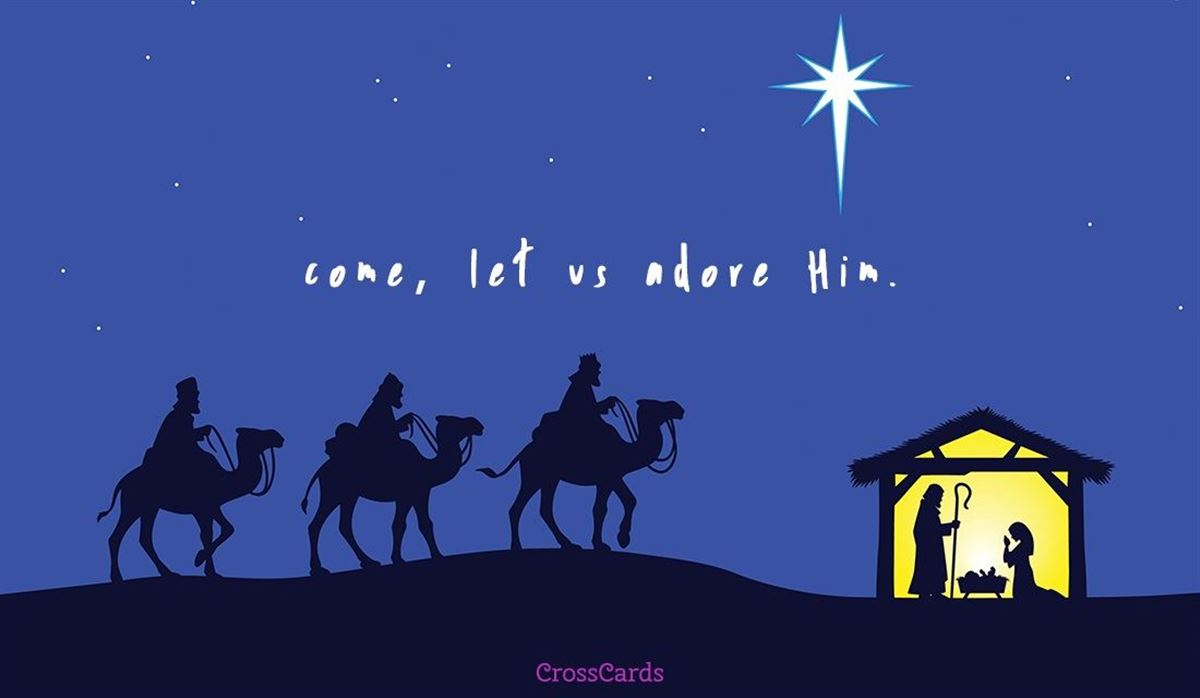
The light of the star, the tower of light, illuminates the birth of the “light of the world”.
And how is the Blessed Mother "specially consecrated"? She is the Immaculate Conception ... more on this below:
Why does Mary Travel on a Donkey to Bethlehem?This is one of the most iconic scenes in human history. It is at the core of the Christmas story. Joseph is walking on foot and leading the donkey. Mary, fully pregnant, is traveling on the donkey’s back.
But why?
Some dispute that the Blessed Mother even rode on the back of a donkey, as the Gospels do not mention it.[1] This idea is nevertheless corroborated by the apocryphal Protoevangelium of St. James:
The day of the Lord shall itself bring it to pass as the Lord will. And he saddled the ass, and set her upon it; and his son led it, and Joseph followed. (verse 17)
But what's going on behind the scenes? Is the Virgin Mary riding a donkey only because she is so close to giving birth?
Have you ever wondered if there was a hidden meaning behind simple scene? There is.

The answer begins with the curious incident with Uzzah. Do you remember Uzzah from 2 Samuel 6? Uzzah was killed just for just touching the Ark of the Covenant. Why?
Why Was a Man Killed for Touching the Ark of the Covenant? The Bible records a curious incident of a man named Uzzah being struck dead for touching the Old Ark of the Covenant. This occurred at 2 Samuel 6:
(6) And when they came to the threshing floor of Nacon, Uzzah put out his hand to the ark of God and took hold of it, for the oxen stumbled. (7) And the anger of the Lord was kindled against Uzzah; and God smote him there because he put forth his hand to the ark; and he died there beside the ark of God. (8) And David was angry because the Lord had broken forth upon Uzzah; and that place is called Pe′rez-uz′zah, to this day.
The reason for God’s smiting of Uzzah was that he “put forth his hand to the Ark”. Uzzah had some other things going against him, as well.
Uzzah happened to be a Kohathite. Numbers 4:15 specifically designated the Kohathites to carry the Ark on poles. Unfortunately, Numbers 4:15 also specifically forbade the Kohathites from touching the Ark and "the holy things, or they will die." God always remembers his promises. Gulp.
Here’s the bottom line, though …
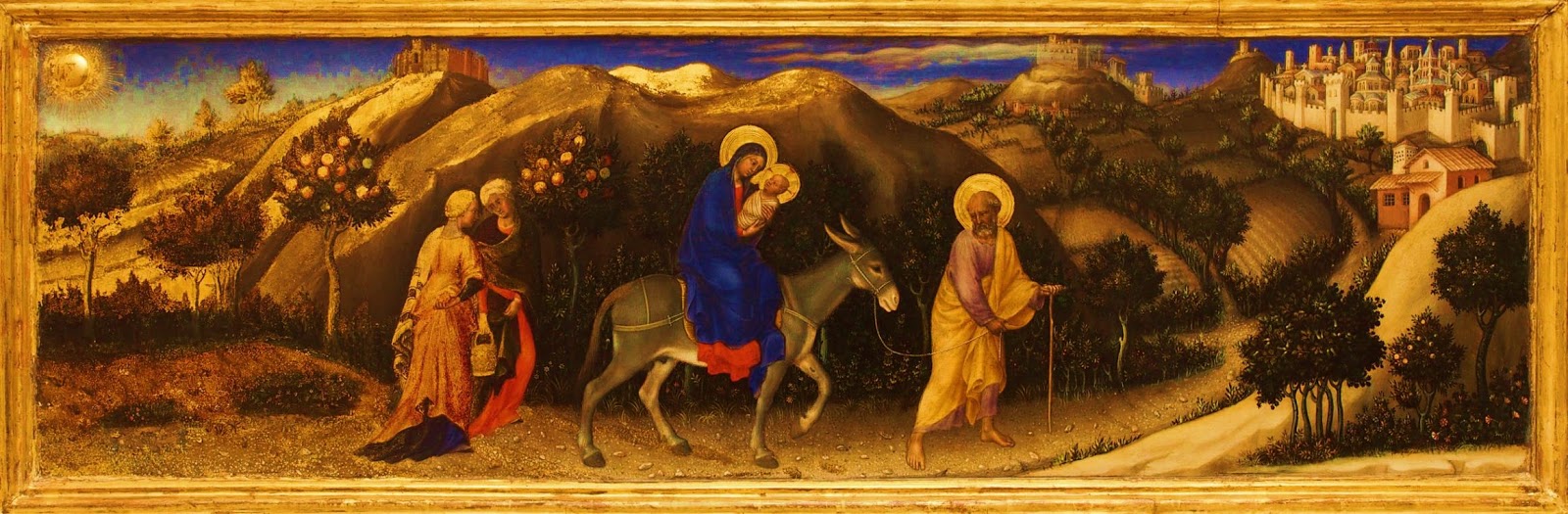 Adorazione dei Magi by Gentile da Fabriano (middle section)
The bottom line was this: Only the priests were allowed to carry the Ark of the Covenant. The Ark of the Covenant was "specially consecrated". The Ark was not supposed to be carried on a cart, pulled by oxen.
Why? Well, would you like to be downwind of a team of oxen? Is that a fitting place for the golden box which carried the presence of God, Himself? No.
Also, the Ark was definitely not supposed to be touched by even lower-order priests, like Uzzah. The Ark was never supposed to be in situation in which it could tumble off a cart, requiring someone like Uzzah to “put forth his hand.”
Now, compare the travels of the Old Ark through Israel on an ox cart to the travels of the New Ark, the Virgin Mary. Any similarities?
Why Does Mary Ride to Bethlehem on a Donkey? Saint Joseph Carries the New ArkSaint Joseph, therefore, is serving in the role of priest and carrying the Ark of the New Covenant on the back of a donkey. Joseph, as you will remember, is also a descendent of King David. It is fitting, then, that Joseph should accompany the Ark of the New Covenant, just as his forebear traveled with the Ark of the Old Covenant.
That’s why Mary travels on the back of a donkey.
This also speaks to the perpetual virginity of the Virgin Mary. The Ark of the Covenant, the Holy of Holies, was not to be touched by any man, except the High Priest. Even Joseph did not carry this title. The High Priest was the male that Mary carried in her womb. Only Jesus was permitted in this holy place.

Why Does the New Ark, the Virgin Mary, Go to Bethlehem? There’s more. What about Bethlehem? Was there perhaps a notable journey of David and the Old Ark to Bethlehem?
Absolutely.
Here are a few verses of King David singing of the Old Ark’s journey to Bethlehem from Psalm 132, verses 1-7:
Remember, O Lord, in David’s favor,
all the hardships he endured;
how he swore to the Lord
and vowed to the Mighty One of Jacob,
“I will not enter my house
or get into my bed;
I will not give sleep to my eyes
or slumber to my eyelids,
until I find a place for the Lord,
a dwelling place for the Mighty One of Jacob.”
Lo, we heard of it in Eph′rathah,
we found it in the fields of Ja′ar.
“Let us go to his dwelling place;
let us worship at his footstool!”
Wait, you might be saying, where’s the mention of Bethlehem? In the time of King David, Bethlehem was known as Eph′rathah, or it is elsewhere named in the Psalms “Ephratah-Bethlehem”.[2][3]
Also, what’s David mean when he says “I will not enter my house or get into my bed … until I find a place for the Lord, a dwelling place for the Mighty One of Jacob”? In short, it means that the Old Ark will be in want of a dwelling place or a roof over its head. More on that in a moment …
Lastly, there’s a great amount of humility contained in this comparison. This Ark of God, which traveled through Israel with King David, himself, and which was carried before all of Israel’s victorious armies, is now a simple woman, on a the back of a plain donkey, being led by a carpenter.
We should be struck by the majesty contained in such a simple caravan.
But there’s still more. This also tells us something about the Perpetual Virginity of Mary.

Perpetual Virginity of Mary - Mary & Joseph: No Ordinary MarriageRemember, this is no ordinary marriage between Mary and Joseph. Joseph never physically consummates the marriage covenant with Mary. The Holy Spirit enters Mary’s womb, but never mortal man. Mary’s womb is the birthplace of God. It is the new Holy of Holies. No mortal man is permitted there, except the high priest, namely Jesus. It is the most sacred of sacred grounds.
This is why Uzzah was smote for touching the old Ark of the Covenant. Uzzah wasn’t just trespassing on sacred ground. It was as if he had violated the Ark’s virginity.
Joseph does not make the mistake of Uzzah! Joseph has no children by Mary. Mary remains a virgin.

The Virgin Mary's Perpetual Vow of VirginityIn fact, Mary indicates that she has taken a perpetual vow of virginity. The Douay-Rheims translation of the Bible gives us the following for at Luke 1:34: “And Mary said to the angel: ‘How shall this be done, because I know not man?’”
“I know not man” is the literal translation from the Greek text. Other translations try “because I am a virgin” or “because I know not a man,” but these alternatives don’t quite cut the mustard.
Mary’s question to the angel makes no sense unless Mary had professed a vow of virginity.
Just a few verses back at verse 27, we are told that Mary and Joseph are already “espoused”. Mary and Joseph already have what would be akin to a ratified marriage in Jewish culture. They were married. Joseph would have had the right to the marriage bed.
How can we account then for Mary’s confusion? Mary did not say simply: “How can I bear a son? Since I have not yet known a man but intend to soon enter into relations with Joseph.” She would have just presumed that the child would be the son of Joseph.
If Mary and Joseph were part of an ordinary Jewish marriage, she would not be asking about the father of the child. Joseph would be the father of the child, unless they were to be celibate in marriage.
Normally, after the espousal the husband would go off and prepare a home for his new bride and then come and receive her into his home where the union would be consummated. This is precisely why Joseph intended to “divorce her quietly” (Mt 1:19) when he later discovered she was pregnant.
This background is significant because a newly married woman would not ask the question “How shall this be?” She would know. Unless, of course, that woman had taken a vow of virginity and the vow was continuing into the marriage.
Mary believed the angel’s message in faith, but had no idea how this was going to be accomplished in light of her vow. This also indicates she was not planning on the normal course of events for her future with Joseph.

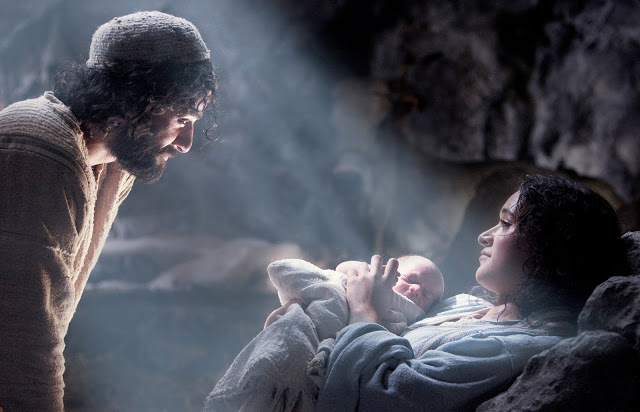
The First Reading from Morning Mass on December 24 (Cycle A) comes from 2 Samuel 7:
When King David was settled in his palace, and the LORD had given him rest from his enemies on every side, he said to Nathan the prophet, “Here I am living in a house of cedar, while the ark of God dwells in a tent!” Nathan answered the king, “Go, do whatever you have in mind, for the LORD is with you.” But that night the LORD spoke to Nathan and said: “Go, tell my servant David, ‘Thus says the LORD: Should you build me a house to dwell in?’"
King David returns home from his victories on the battlefield. These victories were won because David's armies carried the Ark of the Covenant before them into battle. Now David wonders at how the Ark of God dwells in a tent, while he dwells in a palace.
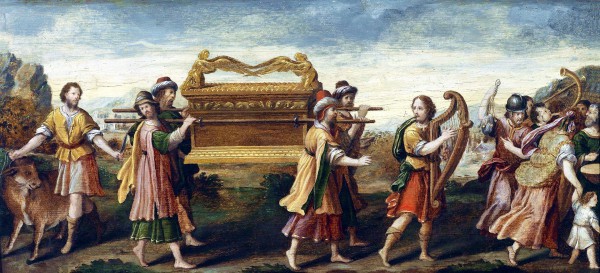
So what do King David's musings have to do with the Christmas story which won't occur for another 1,000 years?
We covered some of David’s journeys with the Ark of the Covenant in this article, “What’s Really Happening at the Visitation?”
Here, at last, the Ark is done at the end of its long journey. Its journey began at Mount Sinai, where God through Moses first ordered it constructed. The Ark wandered with the Israelites through their forty years in the desert. The Ark crossed the River Jordan ahead of them and parted the waters, just as before with the Red Sea. The Ark was carried before all of Israel’s armies through battle after battle. And now, it has finally arrived in Jerusalem.
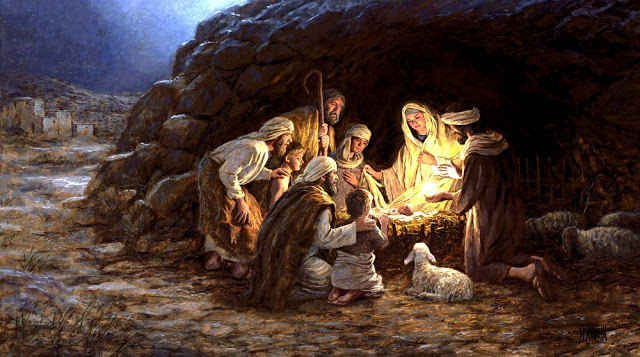
So, back to David dwelling in a palace while the Ark of God dwells in a tent. Mary is the New Ark, and where is she forced to dwell? There is no room for Mary and Joseph at the Inn of Bethlehem. The New Ark dwells in a stable. Neither the Old Ark nor the New Ark are permitted a palace, but must dwell outdoors.
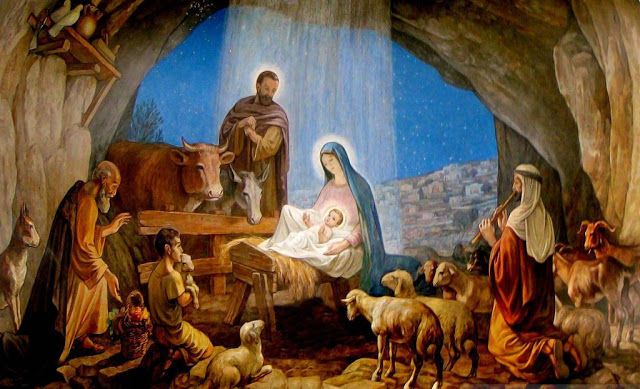
Never fear! The First Reading from December 24, still from 2 Samuel 7, goes on to make a promise:
The LORD also reveals to you that he will establish a house for you. And when your time comes and you rest with your ancestors, I will raise up your heir after you, sprung from your loins, and I will make his Kingdom firm. I will be a father to him, and he shall be a son to me. Your house and your Kingdom shall endure forever before me; your throne shall stand firm forever.
The Lord says he will raise up an heir to David "sprung from [his own] loins." But how can this be? King David has been dead from a thousand years when Mary gives birth in Bethlehem. Also, the Lord says that He will be father to the "heir". How can the heir be the child of both King David and God?
Because Christ is born into the family of David. Mary is a descendant of David, as the Angel Gabriel confirms at Luke 1:31-33. Also, Christ is the Son of God, confirming both parts of the prophesy. Through the New Ark and Christ, therefore, the throne of David "shall stand firm forever.
The Shekinah Rests Above and "Overshadows" the Ark of the CovenantWe have already discussed how the Gospel of Luke connects Mary to the Shekinah. The Holy Spirit “overshadowed” the Virgin Mary when Jesus was conceived in her womb. The word “overshadow” was used in the Old Testament specifically to describe the Shekinah Glory Cloud resting above the Ark of the Covenant. Now it rests upon the Ark of the New Covenant, Mary.

Also, in her Magnificat, Mary further fulfills Jeremiah's prophecies. She describes the (1) gathering of God's people and (2) God's "mercy" twice to Elizabeth, who has already described the Virgin Mary as the Ark:
For behold, henceforth all generations will call me blessed;
for he who is mighty has done great things for me,
and holy is his name.
And his mercy is on those who fear him from generation to generation.
He has shown strength with his arm,
he has scattered the proud in the imagination of their hearts,
he has put down the mighty from their thrones,
and exalted those of low degree;
he has filled the hungry with good things,
and the rich he has sent empty away.
He has helped his servant Israel,
in remembrance of his mercy,
as he spoke to our fathers,
to Abraham and to his posterity for ever.
But How is the Glory Cloud a Light to All NationsBut the original Shekinah stood as a light to all Israel. The conception of Jesus was a private affair, as was the Visitation. When does the Shekinah shine again for all Israel to see? Even for all the world to see?

That's right ...
The Shekinah returns as the Star of Bethlehem. Notice the strange behavior of the Star of Bethlehem:The star is a tower of light “overshadowing” the Virgin Mary and the entire Holy Family before, during, and after the Nativity.The star is a sign to all Israel, to the shepherds and even to the evil King Herod; andThe star is visible to the entire world! The Magi, the Kings of the East, are guided by the star to Christ’s manger.
What does this tell us about Christ and His mission? Christ will bring light to all of Israel and the entire world!
Also, as amazing as Moses was, Jesus is far superior. He is God. The Ark of Jesus, too, is far superior to the Ark of Moses. She is a human being. Even Moses’ Shekinah, as amazing a sight as it was, it is also far exceeded by Jesus’ Shekinah, the Star of Bethlehem. Moses had a tornado. Jesus had an entire star!
Footnotes: What is the Meaning of the Star of Bethlehem? Why No Room at the Inn? Why Does Mary Ride a Donkey? Typology of the New Ark and Christmas[1] Some also suggest that Joseph would have been too poor to possess a donkey. This is due to the fact that the Holy Family was allowed to offer the less costly of the sacrificial options at the Presentation at the Temple. There are other possibilities, however, including that Joseph simply borrowed the donkey. One can easily imagine a kind person letting the pregnant mother borrow a donkey for her long ride. Additionally, there was already talk spreading about Mary's baby and her virgin birth. Ensuring Mary's safe travels may have been paramount in the minds of many in Nazareth.
[2] Biblical scholar Joseph Addison Alexander argues for this understanding: “The only explanation, equally agreeable to usage and the context, is that which makes Ephratah the ancient name of Bethlehem (Genesis 48:7), here mentioned as the place where David spent his youth, and where he used to hear of the ark, although he never saw it till long afterwards, when he found it in the fields of the wood, in the neighbourhood of Kirjathjearim, which name means Forest town, or City of the Woods. Compare 1 Samuel 7:1 with 2 Samuel 6:3-4."
[3] Another Biblical scholar, Christopher Wordsworth, states the following: “The Psalmist says, that David himself, even when a youth in Bethlehem Ephratah, heard of the sojourn of the ark in Kirjathjearim, and that it was a fond dream of David's boyhood to be permitted to bring up the ark to some settled habitation, which he desired to find (Psalms 132:5).”

December 15, 2020
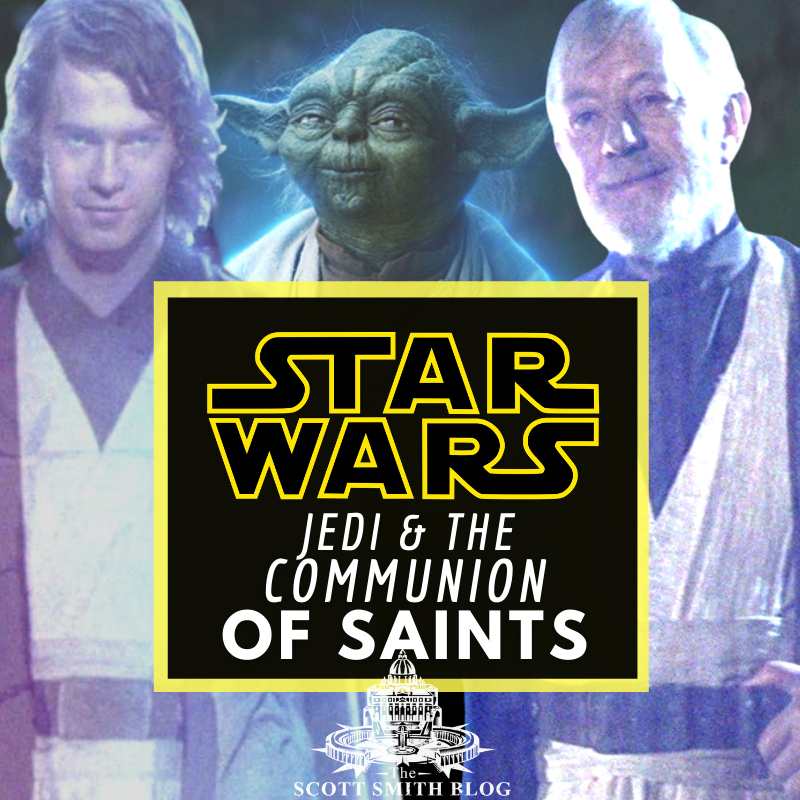
The Theology of Star Wars: The Jedi Netherworld and the Communion of Saints
You can't win, Darth. If you strike me down, I shall become more powerful than you could possibly imagine.- Obi-Wan Kenobi, Episode IV: A New Hope)
Interested in the Theology of Isaac Asimov? How about the Theology of all the Sci-Fi in the Galaxy? I have written the following book to cover exactly that. The Theology of Sci-Fi covers Star Wars, Dune, Asimov's Foundation Series, The Matrix, Superman, and the classics of science of fiction:
 [image error]
 In a very similar way, though much more demure, St. Therese of Lisieux addresses her own approaching death: "I want to spend my heaven in doing good on earth."[1]
St. Therese is a fine and powerful example of the Communion of Saints.
The Communion of Saints' action in this world is similar to Obi-Wan Kenobi's helping Luke Skywalker, following his journey from the Jedi netherworld.
Also, there's another reference in Episode 9: The Rise of Skywalker. Luke tells Rey: "One thousand generations are now with you." Find out what that could mean ...

How does Obi-Wan come back from the dead after Darth Vader kills him?Let's cover a little background. Yoda and Qui-Gon Jinn answer this question at the end of Episode III: Revenge of the Sith.
At the end of Episode III, George Lucas does a lot of connecting the dots for us; for example:
We're shown how Leia becomes an Organa and Crown Pincess of Alderaan.We see the construction of the first Death Star with a cameo from a young, beefy Grand Moff Tarkin.We find out why Obi-Wan and Yoda go into exile, to Tatooine and Dagobah, respectively, to learn Qui-Gon's new trick.

What's Qui-Gon's new trick? First off, Qui-Gon is Obi-Wan's old Jedi Master. We find out at the end of Revenge of the Sith that Qui-Gon has "returned from the netherworld of the Force" and is ready to teach Yoda and Obi-Wan the same.
It seems Yoda had a conversation with Qui-Gon's spirit in much the same way that Obi-Wan will later aid Luke.
On a side note, the book adaptation of Revenge of the Sith includes more details about Yoda and Qui-Gon's conversation. Yoda regrets harboring doubts of Qui-Gon's abilities, saying "A great Jedi Master you always were, but too blind I was to see it ... Your apprentice, I gratefully become."
Dead Jedi and SaintsWhen a Jedi dies, he or she is not truly dead. They are alive in the Force, in the Netherworld of the Force. So it is with Saints. Christians live beyond death. They are alive in Christ. All baptized Christians form one, united body of Christ: the communion of saints.
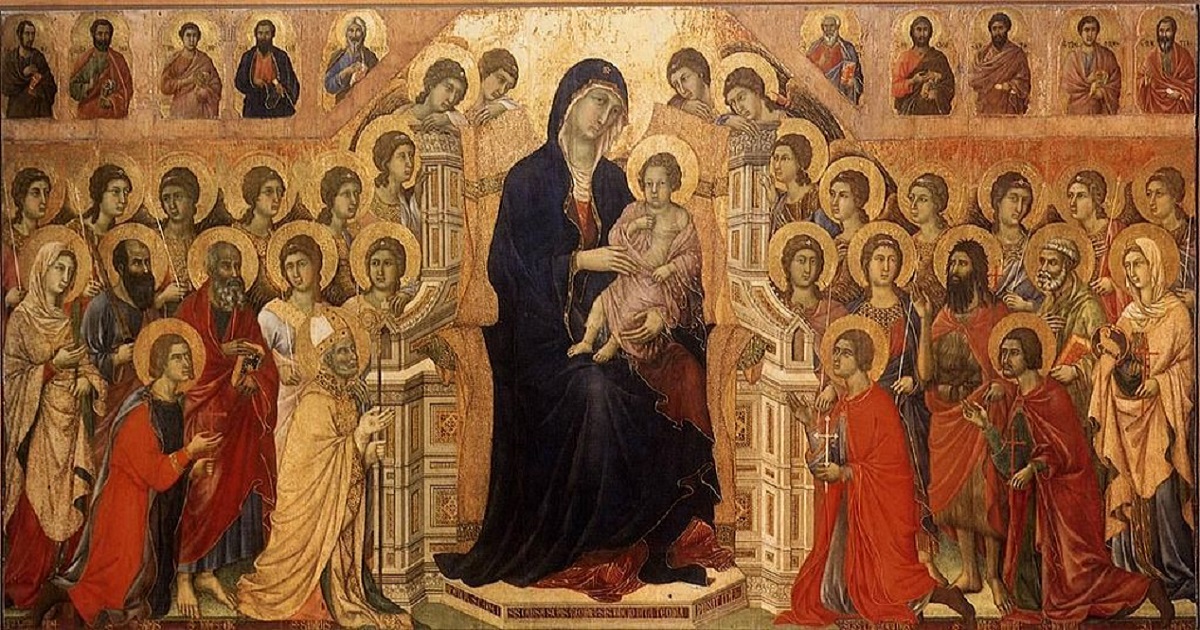
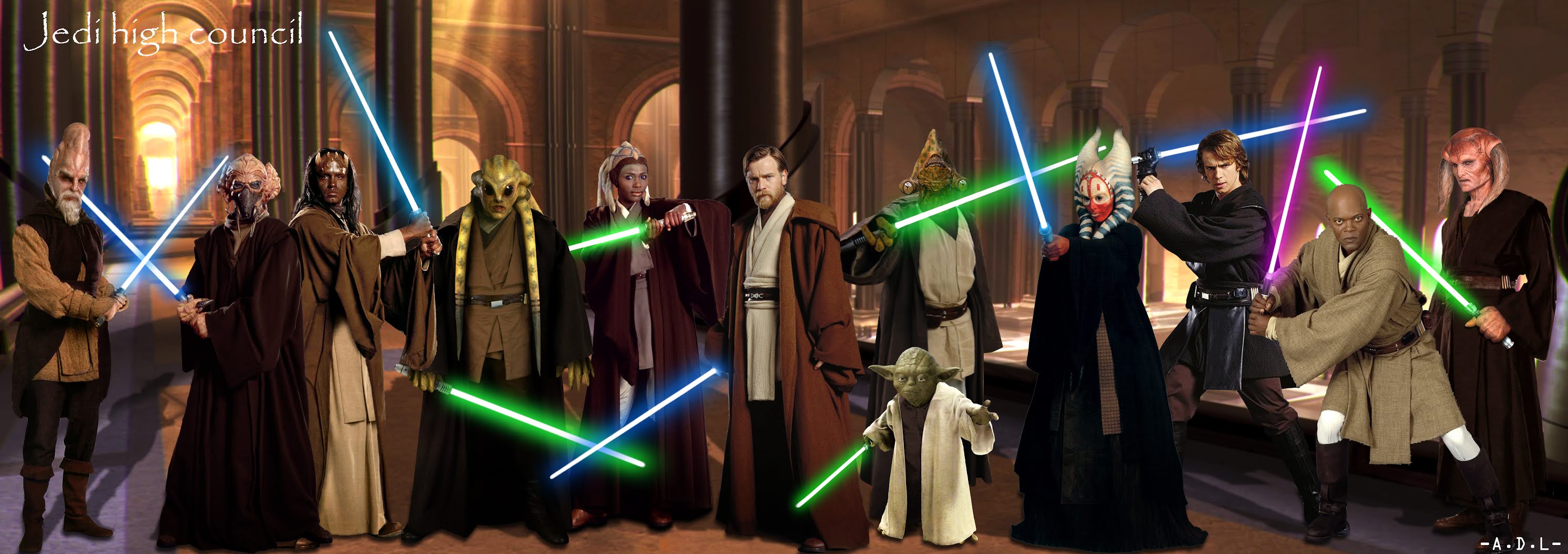
Paragraph 2683 of The Catechism of the Catholic Church explains this. The witnesses who have entered the kingdom of heaven before us (cf. Heb 12:1), especially those that the Church has recognized as saints, "share in the living tradition of prayer by the example of their lives, the transmission of their writings, and their prayer today."
The Saints take care of those members of the communion who remain on earth, being "put in charge of many things" (cf. Mt 25:21). Refer, also, to the quote from Saint Therese at the beginning of this article.
Just as Saints help those who remain on earth build up the kingdom of heaven, Obi-Wan helps Luke destroy the Death Star, directs him to Yoda in Dagobah, and helps him discern his ultimate battle with his father.
With parting words similar to Obi-Wan (and St. Therese), St. Dominic instructed his brothers, "Do not weep, for I shall be more useful to you after my death and I shall help you then more effectively than during my life."
Sidenote on Sheol: Should we compare the Jedi Netherworld to Heaven?No. I think the Netherworld compares better to Sheol (cf. Job 7:9; Ps 18:5-7, 86:13, 139:8; Jonah 2:2) . Sheol is a twilight sort of place, the destination of both the righteous and unrighteous.
This is a Hebrew conception of the afterlife similar to Hades in Greek mythology, a gloomy place of shadows. Sheol is a place awaiting the Resurrection of Christ.

Use of the word "Netherworld" and a lack of a true resurrection lead me to this Sheol connection. Sheol is sometimes translated as "netherworld" and the two words are at least regarded as synonyms.
Also, the Messianic figure of Anakin Skywalker does not possess the power to resurrect his own life, though he very much sought this power credited to Darth Plagueis, as I've described in my post, The Virgin Birth of Star Wars.
Following his resurrection, Christ walked the earth as a glorified body; Anakin's resuscitated body, dependent on mechanical parts to keep him alive, is very different from this. Very different, as Saint Obi-Wan describes in Return of the Jedi:
"He's more machine now than man; twisted and evil."
It is such a contrast that it almost seems intentional. The resuscitation of Vader seems like the opposite of a resurrection.
Of course, Vader’s mechanical resuscitation is also a very different process than Jedi returning from the Netherworld of the Force. The difference between a Force Ghost and Jesus’ resurrected body is also pretty clear: Jesus is both body and soul.
The comparison between Force Ghosts and apparitions of the Saints is much closer.
The argument could be made, also, that Qui-Gon's first re-turn from the Netherworld and later instruction to other Jedi is similar to Jesus leading his disciples to the Resurrection. Not only is Jesus a teacher, he is the Resurrection, itself, and life (cf. Jn 11:25).

The Buddhist concept of the Bodhisattva may have also inspired Qui-Gon’s return to guide others back from the Jedi Netherworld.
Cardinal Ratzinger, later Pope Benedict XVI, reflects on how Christ, as well as the saints through Christ, fulfills the myth of the Bodhisattva:
The nature of love is always to be “for” someone. Love cannot, then, close itself against others or be without them so long as time, and with it suffering, is real. No one has formulated this insight more finely than Therese of Lisieux with her idea of heaven as the showering down of love towards all. But even in ordinary human terms we can say, How could a mother be completely and unreservedly happy so long as one of her children is suffering? And here we can point once again to Buddhism, with its idea of the Bodhisattva, who refuses to enter Nirvana so long as one human being remains in hell. By such waiting, he empties hell, accepting the salvation which is his due only when hell has become uninhabited. Behind this impressive notion of Asian religiosity, the Christian sees the true Bodhisvatta, Christ, in whom Asia’s dream became true. The dream is fulfilled in the God who descended from heaven into hell, because a heaven above an earth which is hell would be no heaven at all.[2]
There is a critical difference between the Jedi Force Ghosts and the Saints, however. The direction is different. The main idea behind the Force Ghosts seems to be helping deceased Jedi return to the living. The purpose of this return is not to help the living to the Star Wars equivalent of heaven but to defeat the Sith.
Nevertheless, there is a strong resemblance between Force Ghosts and the Saints when it comes to their intercessional power. Both return to the living to help them defeat evil.
Star Wars, Jedi, Communion of Saints Footnotes:[1] St. Therese of Lisieux, The Final Conversations, tr. John Clarke (Washington: ICS, 1977), 102.
[2] Ratzinger, Joseph, Eschatology: Death and Eternal Life, CUA Press (2007): 188.

December 10, 2020
19 Most Amazing Things about Our Lady of Guadalupe: The Essential Guide to Our Lady of Guadalupe
I feel like there's always something new and amazing to learn about Our Lady of Guadalupe. It's unending! So, despite the title of this article, we're probably just scratching the surface of what's knowable about the miraculous image of Our Lady of Guadalupe.
But what makes the image so special? Yeah, it miraculously appeared on the cloak of a Mexican peasant. That's pretty special right there. But there's so, so much more!
Here is just a sampling of the 18 Amazing Things about Our Lady of Guadalupe:
● There are people reflected in her eyes;
● She survived a bomb untouched;● There is a perfect celestial map hidden on her robe;● She can change her ethnicity ... and MORE!
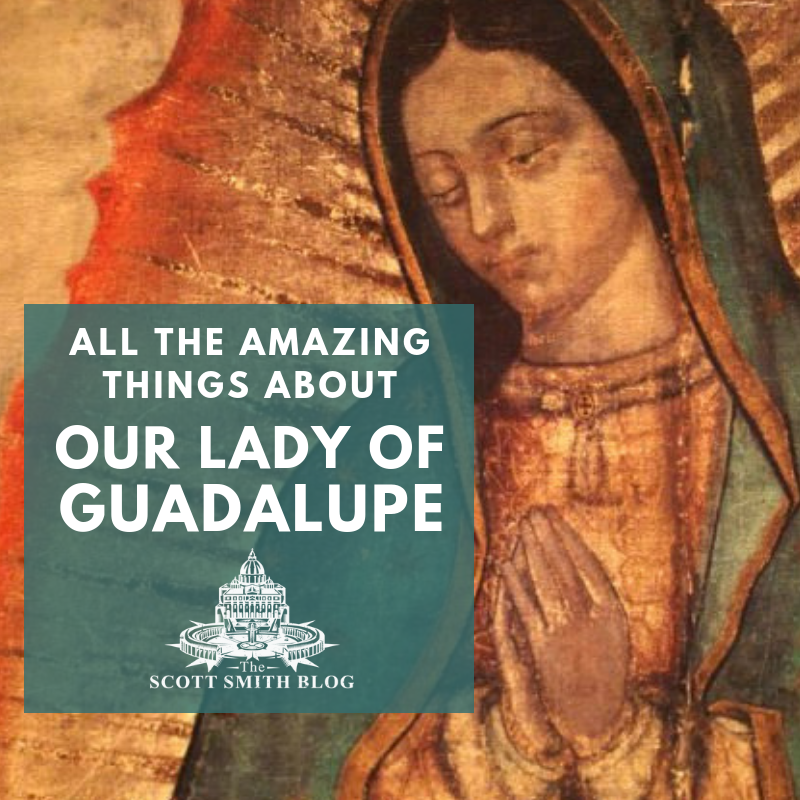
Our Lady of Guadalupe appeared to Saint Juan Diego on December 9, 10 and 12, 1531. The image left of her on Saint Juan Diego's cloak is the only true picture of Our Lady of Guadalupe in existence, as will be explained below.
After her appearance, Our Lady of Guadalupe quickly became the image and icon of the Mexican people.
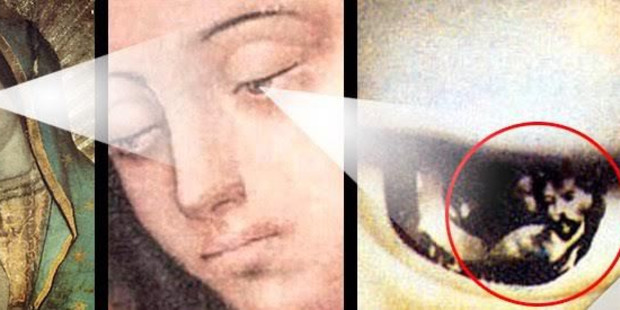
Our Lady of Guadalupe Miracle #1: Our Lady of Guadalupe's eyes reflect the figures in the room when the image appeared ...And at the perfect radius of curvature for a human lens.
Satellite imaging expert Dr. Aste Tonsman studied the image using image digitization. On inspection of Our Lady of Guadalupe's corneas, he mad a startling discovery!
Dr. Tonsman saw in the corneas of the eyes of the image a series of people and objects: an Indian unfurling a tilma before a priest, another young man, a half-nake d Indian with his lips open and his hands together, pieces of furniture, a ceiling arch, and other details.
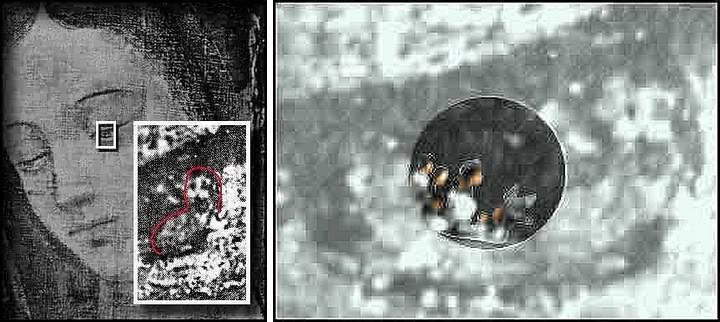
Our Lady of Guadalupe Miracle #2: Within 8 years of Our Lady's miraculous appearance, 9 million of the native people of Mexico converted to Catholicism ...The crazy thing ...
This almost exactly counter-balanced the number of people who fell away from the Church during the Protestant Reformation/Revolution.[1]
The Protestants were rebelling against the Church in Europe. Ironically, the Protestant schisms were partly a response to the great respect and veneration that Catholics paid to the Virgin Mary.
St. Juan Diego converted to Catholicism about the year 1524 after encountering missionaries. This occurred just 7 years after Martin Luther posted his 95 Theses sparking the Protestant Revolution.
Our Lady of Guadalupe Miracle #3: Our Lady of Guadalupe survived a bomb blast which obliterated everything around the image.Here's a description of the image's miraculous survival of a bombing from, of all places, the cynical and largely anti-Catholic Huffington Post:
In 1921 an anti-clerical radical detonated twenty-nine sticks of dynamite in a pot of roses beneath the tilma. The blast destroyed a marble rail, twisted a metal crucifix and shattered windows throughout the old Basilica but the tilma itself was untouched.
There are some miracles even the HuffPost can't deny!
Here's a picture of the crucifix that was warped by the bombing. It is credited with shielding Our Lady of Guadalupe from the explosion of dynamite.
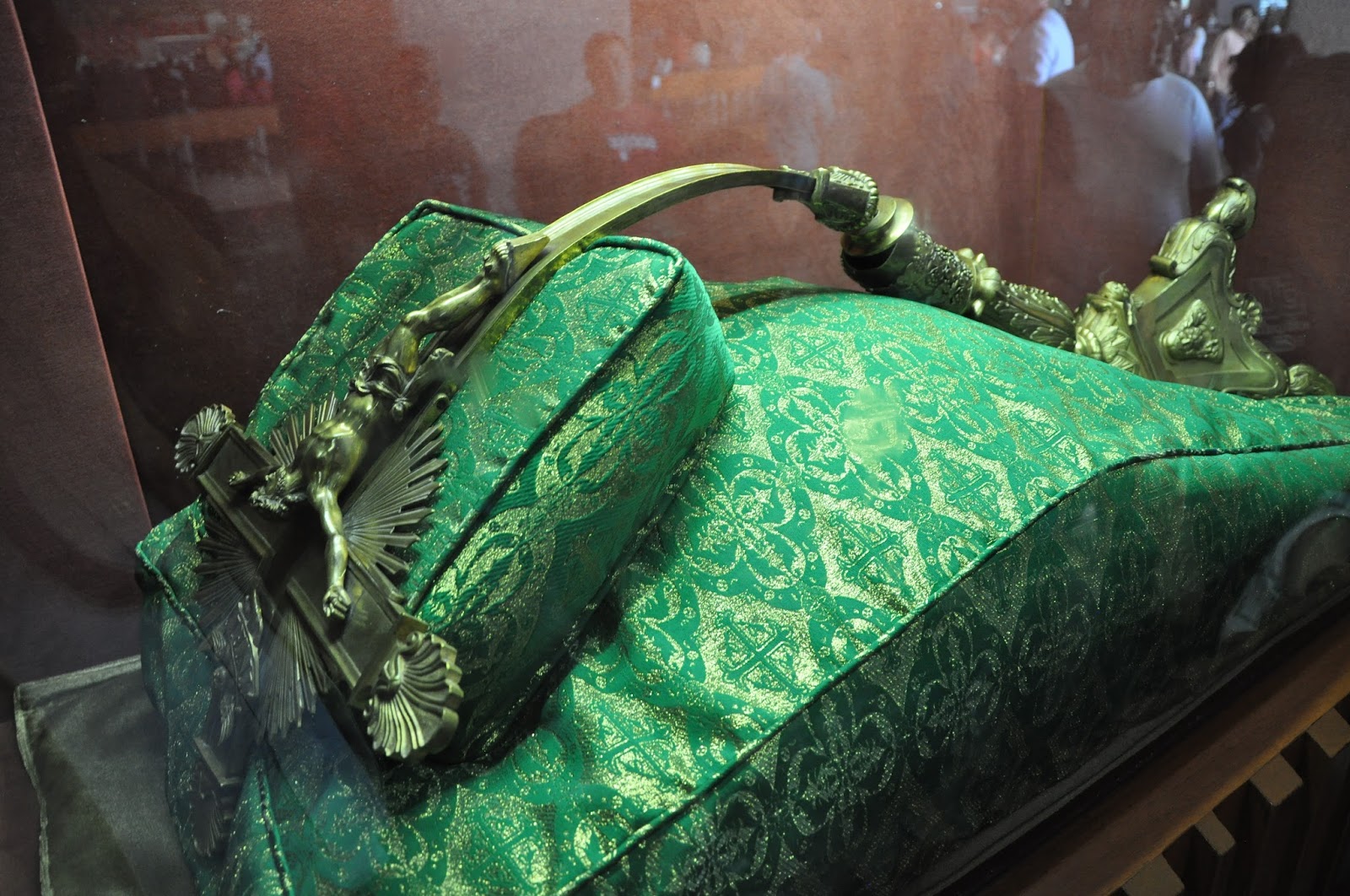
The crucifix is now known as the "Holy Christ of the Attack". The bomb-deformed crucifix is displayed at the back of the Basilica of Our Lady of Guadalupe.
Not only did Our Lady of Guadalupe survive a bomb ...
Our Lady of Guadalupe Miracle #4: The image of Our Lady of Guadalupe should have deteriorated, faded, and turned to dust a long time ago. The image of Our Lady of Guadalupe appears on a tilma made of cactus fibers. The natural life span of a cloak made with fiber from the agave or maguey plant is only about 30 years.
Despite this (and the bomb blast above), the image has remained intact with all its original color and vibrancy for over 475 years.
Dr. Aldofo Orozco, a physicist, said that the remarkable preservation of the cloak of St. Juan Diego on which Our Lady of Guadalupe appeared 478 years ago, “is completely beyond any scientific explanation.”
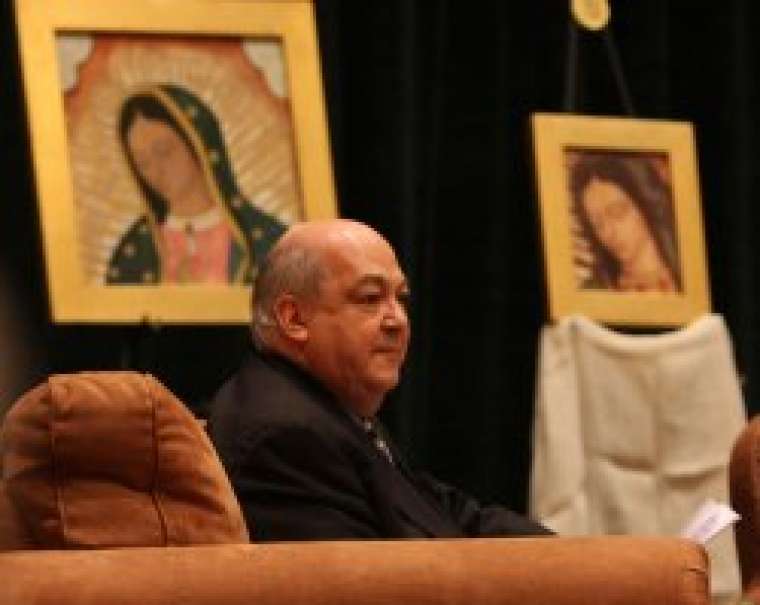 Dr. Adolfo Orozco at the International Marian Congress on Our Lady of Guadalupe in Glendale, Arizona
Otherwise stated, it's miraculous. Dr. Orozco also remarked on the rapid deterioration of similar tilmas:
"All the cloths similar to the Tilma that have been placed in the salty and humid environment around the Basilica have lasted no more than ten years," he explained. One painting of the miraculous image, created in 1789, was on display in a church near the basilica where the Tilma was placed. "This painting was made with the best techniques of its time, the copy was beautiful and made with a fabric very similar to that of the Tilma. Also, the image was protected with a glass since it was first placed there."
Pope Pius XII had the following to say about Our Lady of Guadalupe surviving through the centuries ...
“And it happened,” Pope Pius XII proclaimed in a radio address in 1945, “the sounding of the Hour of God … when on the shores of Lake Texcoco there flowered the Miracle … brushes which were not of this earth painted an Image most tender, which the corrosive work of the centuries has marvelously respected.”
Pope Pius XII also mentions "brushes which were not of this earth". Scientists, too, have remarked on the supernatural brush strokes of Our Lady of Guadalupe:
Our Lady of Guadalupe Miracle #5: The miraculous preservation of Our Lady of Guadalupe has even been confirmed by NASA! Many skeptics have attacked the claim that NASA has confirmed the miraculous nature of Our Lady of Guadalupe. Here is an example from Snopes.
Nevertheless, it is true that Our Lady of Guadalupe has been studied by NASA scientists AND that she has left them baffled. Philip Callahan, a biophysicist, USDA entomologist, and NASA consultant, who is quoted throughout this article, was allowed direct access to visually inspect and photograph the image and later published his findings. [2]
Callahan specializes in infrared imaging. Studying the miraculous preservation of Our Lady of Guadalupe, he took numerous infrared photographs of the front of the tilma. His team noted that the original art work was neither cracked nor flaked. This was considered odd, they noted, because later additions to Our Lady of Guadalupe, such as gold leaf and silver plating of the moon, showed serious signs of wear, if not complete deterioration.
The excellent state of preservation of the untouched areas of Our Lady of Guadalupe was, according to Callahan, inexplicable.
Our Lady of Guadalupe Miracle #6: Our Lady of Guadalupe was not painted by man. The mysterious lack of brushstrokes ... The following is even confirmed by the notoriously skeptical Snopes and even Skeptoid, again referencing the Callahan study:
The most notable examination was a three hour infrared photographic session by [Dr.] Philip Callahan in 1981, who did note multiple layers of paint covering changes to the hands and crown, but came away with more questions than answers. Callahan found, for example, that most of the entire painting seemed to have been done with a single brush stroke.
Even skeptics admit that, even if the image might have been touched up over the centuries, the original image was created by a single brush stroke.
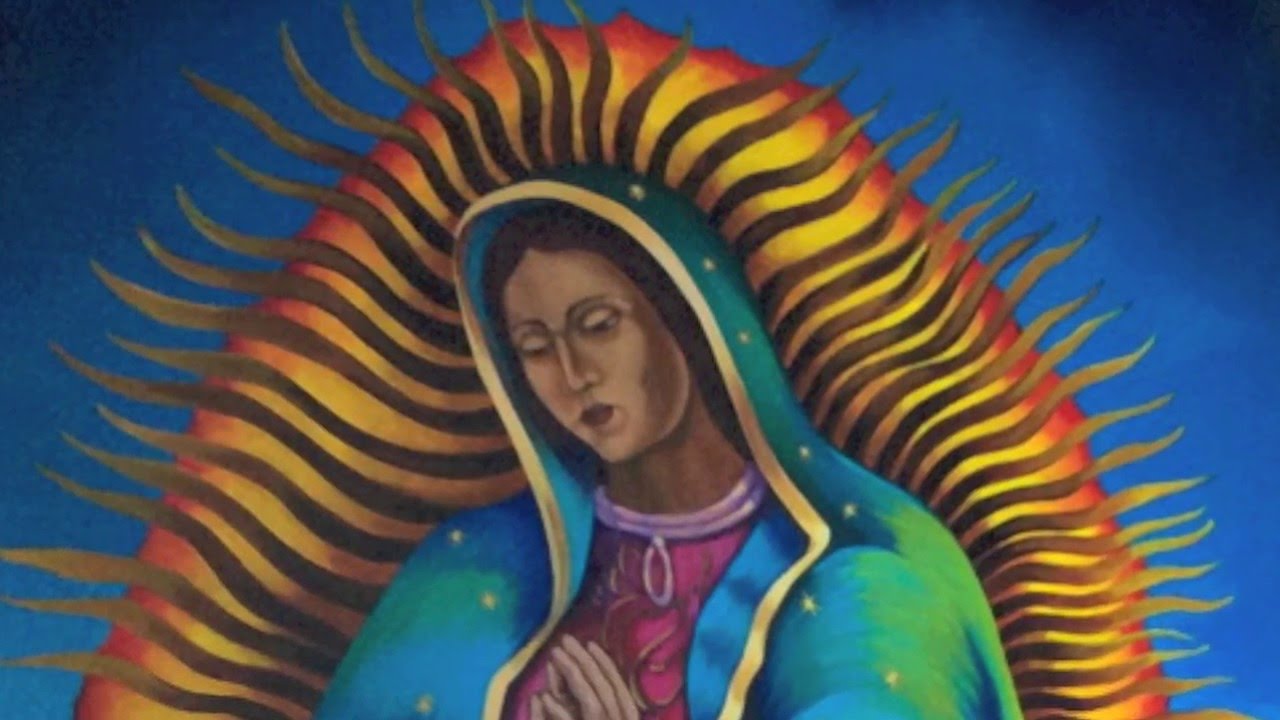
Unless Saint Juan Diego had access to an inkjet printer, this is further proof of the image's supernatural origin.
Man requires many brushstrokes. God requires only one!
Our Lady of Guadalupe Miracle #7: Our Lady of Guadalupe has a heart beat ... and Another, second heart beat for the child depicted in her womb.
Therefore, the Immaculate Heart and Sacred Heart are part of Our Lady of Guadalupe!
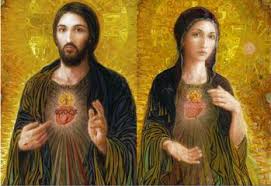
Carlos Fernandez del Castillo, a gynecologist, examined Our Lady of Guadalupe and listened to her using a stethoscope. Placing his stethoscope below the black band at the waist of Our Lady, he heard rhythmic heartbeats at 115 beats per minute. This is the same beats per minute as that of a baby in the womb.
Something else that's very interesting ... Dr. Castillo was also able to estimate the baby's due date, as will be described below! I wonder when the baby was born?
Not only that, an unborn child's heartbeat has repeatedly been heard from a copy of Our Lady of Guadalupe, called a "missionary image." Here's an article providing the testimony of several witnesses.
There's still more ...
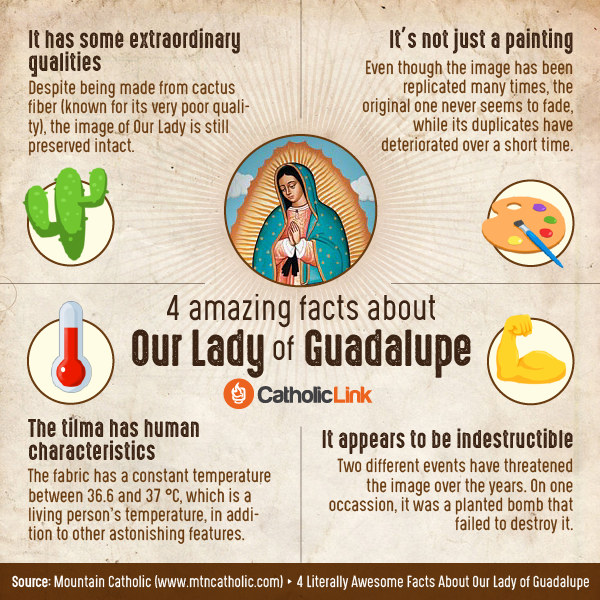
Our Lady of Guadalupe Miracle #8: Our Lady of Guadalupe maintains a body temperature Dr. Philip Callahan's 1979 infrared examination of Our Lady of Guadalupe revealed yet another miracle besides its miraculous preservation. He discovered that the tilma maintains a constant temperature of 98.6 degrees Fahrenheit. Therefore, Our Lady's image maintains its own body temperature!
Our Lady of Guadalupe Miracle #9: Speaking of Our Lady of Guadalupe showing signs of being pregnant and nearing delivery ... Our Lady of Guadalupe confirms the date of ChristmasIf you've ever heard people going back and forth about whether Jesus was actually born on Christmas or not, this will interest you.
Dr. Carlos Fernandez de Castillo, a Mexican gynecologist, examined the tilma for signs hidden in the image relating to the Virgin Mother's pregnancy. Dr. Castillo concluded that the dimensions of Our Lady’s body in the image were that of an expectant mother that was due quite soon.
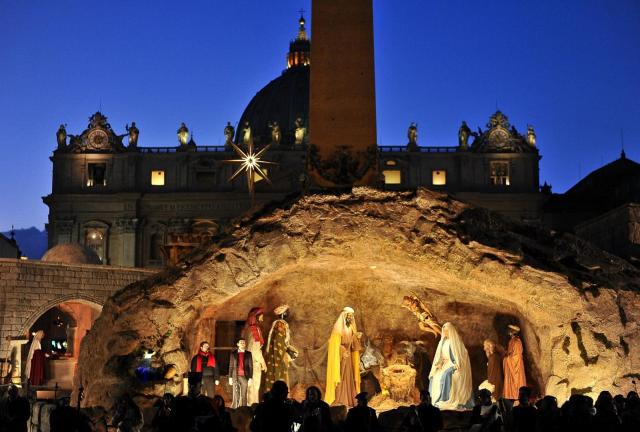
So what does that tell us about the date of Christmas? Remember the day that St. Juan Diego presented the roses to the Bishop and opened his tilma? December 12. That day is barely two weeks from Christmas.
Our Lady of Guadalupe Miracle #10: Our Lady of Guadalupe not of this earth? In 1936, Our Lady of Guadalupe was analyzed by a Nobel prize-winning chemist, Dr. Richard Kuhn. He analyzed the fibers and coloring of St. Juan Diego's tilma.
Dr. Kuhn discovered that the color was not of vegetable, mineral, or animal origin and was not of any known earthly element. The coloring of Our Lady of Guadalupe is, literally, not of nature. It is super-natural.
Our Lady of Guadalupe Miracle #11: Speaking of the coloring of Our Lady of Guadalupe, Mary appears as different ethnicities depending on one's vantage point At one distance, Our Lady appears to be a Native American. At another distance, she appears to be of European descent. Why?
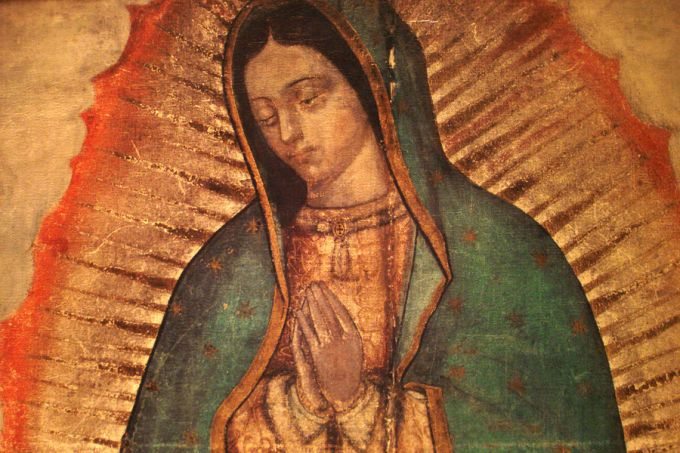
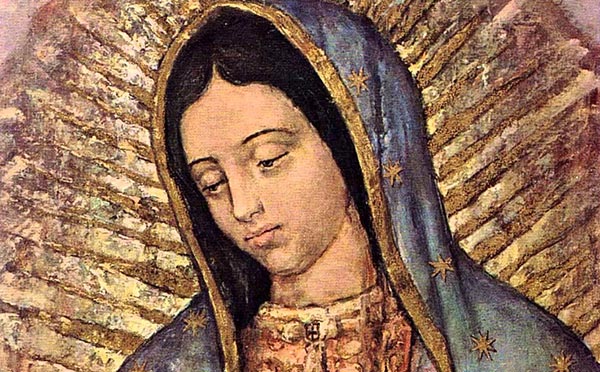
This miraculous feature of Our Lady of Guadalupe is meant to show the unity of the two peoples and cultures in light of the true faith of Christ.
There was intense strife between the Spaniards and the native peoples when the Virgin Mary decided to appear to a native man, St. Juan Diego. Mary, thus, implored the peoples of the New World to live as one.
Dr. Philip Callahan explains how Our Lady of Guadalupe is able to achieve the effect of varying colors at different distances. It is a trait that is seen only in nature, not paintings:
At a distance of six or seven feet, the skin tone becomes what might best be termed Indian olive, grey green in tone. It appears somehow the grey and caked-looking white pigment of the face and the hands combines with the rough surface of the unsized hue. Such a technique would be an impossible accomplishment in human hands, it often occurs in nature however, in the coloring of the bird feathers and butterfly scales and on the elytra [wing cases] of brightly colored beetles.
The image combines with the rough surface of the cloth to create the effect of changing colorations. Amazing!

Our Lady of Guadalupe mimics the properties of nature. Perhaps that's because He who created nature, the birds and the beetles, also created the miraculous image.
No human artist could replicate this effect.
Our Lady of Guadalupe Miracle #12: The time Our Lady of Guadalupe repelled an invasion by a Muslim armada, the Battle of LepantoEurope was extremely divided following the Protestant schisms from the Catholic Church. The Turkish Muslims took this opportunity to mount a re-invasion of Europe.
Pope Pius V was able to convince only Spain and Venice to mount a defense. Together, they managed to cobble together a small fleet of 200 ships to stop the coming invasion. The Catholic fleet was outnumbered by the Muslim fleet by nearly a hundred ships.
But it didn't matter that the Catholics were outnumbered, because they had a secret weapon ...
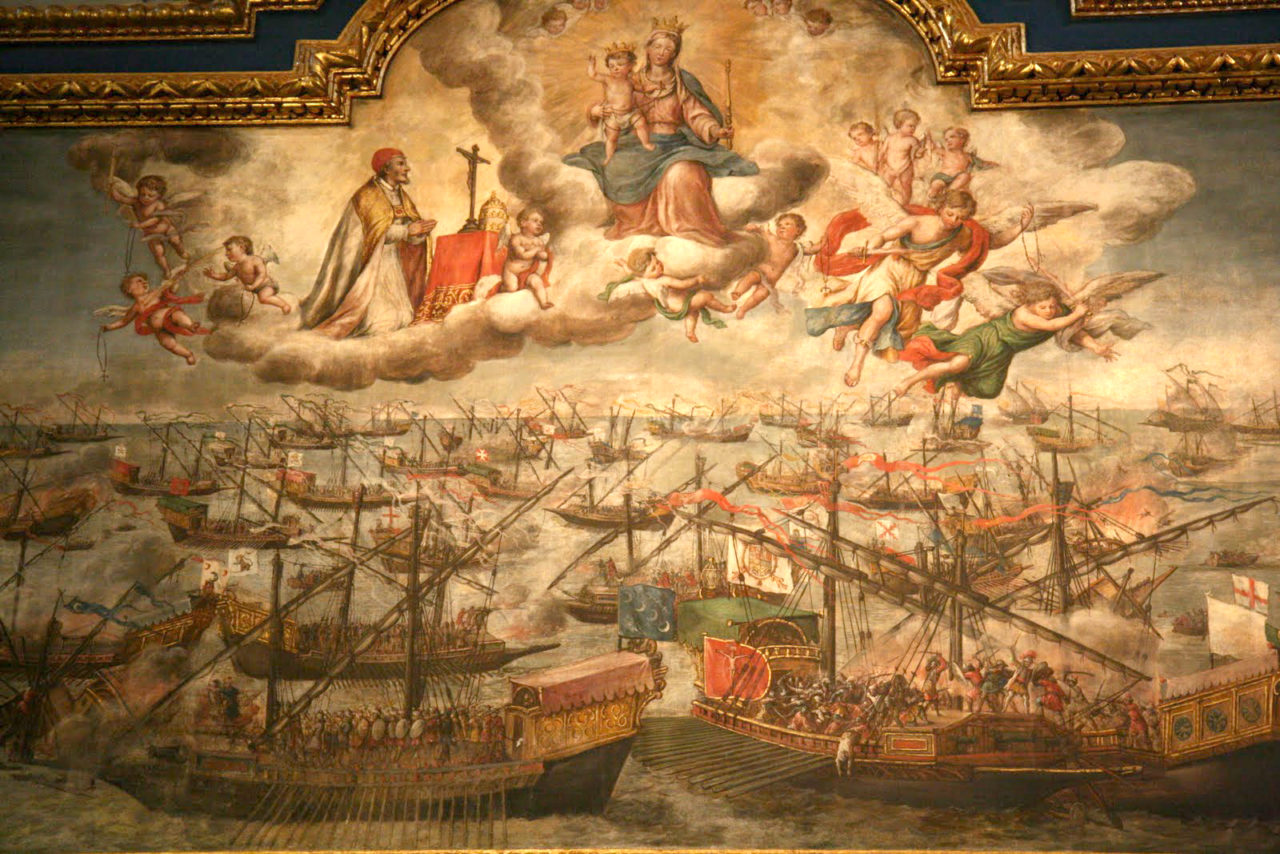
One of the admirals of the fleet, Andrea Doria, carried within his flagship an exact copy of the Holy Image of Guadalupe. The Archbishop of Mexico had sent the replica image as a gift to King Philip II. The blue standard of Our Lady of Guadalupe was also flying from the masthead of Don Juan’s flagship.
When the armada went to war on the morning of October 7, 1571, all of Europe, too, joined together to pray the Rosary for Our Lady's intercession.
On October 7, the Catholic fleet decisively defeated the Muslim fleet. The victory was credit to Our Lady's intercession.
From that great victory came the devotion to Our Lady of Victories, later renamed Our Lady of the Rosary, which is still celebrated in the Church calendar on October 7 of every year.
Want to read more about the Battle of Lepanto and Our Lady of the Rosary? Check out this homily by Father Mitch Pacwa, SJ:
Our Lady of Guadalupe Miracle #13: Pope Benedict said the following about Our Lady of Guadalupe:"The venerated image of the Black Madonna of Tepeyac, with her sweet and peaceful countenance, imprinted on the tilma of the indio St. Juan Diego, shows her as “the ever Virgin Mary, Mother of the True God from whom she lives” (From the Office of Readings. Nicán Mopohua, 12th ed., Mexico City, D.F., 1971, 3-19).
"She reminds us of the “woman clothed with the sun, with the moon under her feet, and on her head a crown of twelve stars; she was with child” (Rev 12:1-2).
"She signals the presence of the Savior to the indigenous and mestizo population.
"She always leads us to her divine Son, who is revealed as the foundation of the dignity of every human being, as a love that is stronger than the powers of evil and death, and the fountain of joy, filial trust, consolation and hope."
Our Lady of Guadalupe Miracle #14: Stars and constellations appear on the robe and mantle of Our Lady of GuadalupeOur Lady is wearing a blue-green mantle. This is the color worn by Aztec royalty. Also, notice that the mantle is covered with golden stars.
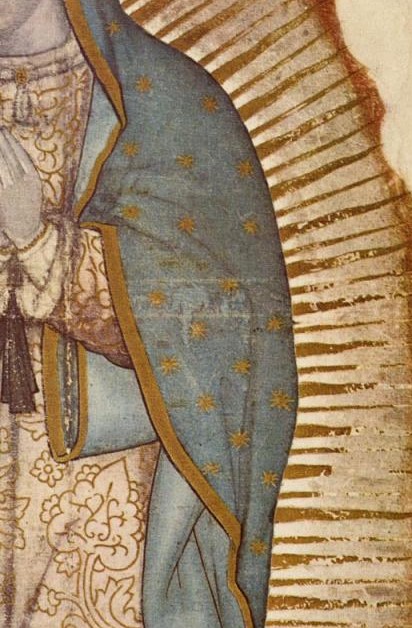
This reminds us, as Pope Benedict XVI is quoted above, that Our Lady of Guadalupe should remind us of the woman of Revelation 12. The woman of Revelation 12 is clothed with celestial bodies. The stars of Our Lady of Guadalupe's mantle should remind us of the crown of stars worn by Our Lady in Revelation, as the Queen of Heaven.
But there's more than meets the eye ...
Our Lady of Guadalupe Miracle #15: The arrangement of the stars depicted on Mary's mantle is not random and decorative. It is very specific. Our Lady's stars represent entire constellations :
 What's more ...
 According to Dr. Robert Sungenis, the constellations are in the exact position as they would have appeared before dawn on the morning of December 12, 1531 in Guadalupe, Mexico.
There's still more!
Notice how the specific constellations correspond to the Gospel story.
• Corona Borealis, which means the Northern Crown, appears at Mary's head. Mary is crowned with stars! Just as described in Revelation 12.
• Virgo, which means Virgin, appears near Mary's heart. This represents her purity and virginity.
• Leo, which means the Lion, appears at Mary's pregnant belly. This signifies that the Virgin Mary is pregnant with a lion, specifically the Lion of Judah. One of the most important prophesies of the Messiah in the Old Testament is that of the Lion of Judah, read all about it here:
• Draco, which means the Dragon, is face-to-face with the Virgin Mary. This represents the enmity and battle between Mary and Satan prophesied at Genesis 3:15 and depicted in Revelation 12. You can read more about Genesis 3:15 and the Protoevangelium here:
Also, why a dragon? Because Satan appeared, not as a serpent, but a dragon in Genesis, as described in this article:
• Not only that, there's sort of a Dark Trinity encircling Mary in all directions except heavenward. Not only is there Draco, the dragon, the rest of the triangle is formed by Scorpio (the Scorpion) and Hydra (the serpent).
... The Southern Cross ... Sword/cross shall pierce your heart as well?
Our Lady of Guadalupe Miracle #16: Our Lady of Guadalupe appeared at an Aztec site dedicated to the worship of Tonantzin "Our Mother" Mary picked this seemingly unknown site on purpose. The Aztec goddess Tonantzin had been worshiped for decades at the very same site, Tepeyac, which is now home to the Basilica of Our Lady of Guadalupe in Mexico City.
Tonantzin means “Our Mother” in the Aztec language of Nahautl. It is clear, then, that Mary was specifically seeking the conversion of the Aztecs.
Our Lady of Guadalupe Miracle #17: Our Lady of Guadalupe's robe holds several secrets and Aztec symbolsHave you ever noticed the detailed floral design of Our Lady's robe?
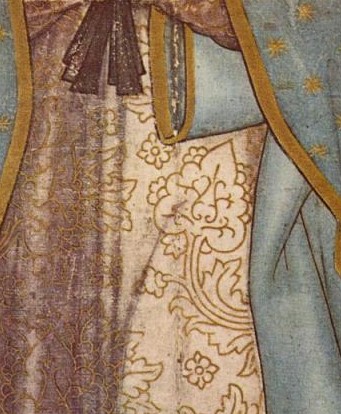
Our Lady's robe is rose-colored or pale red and covered with Aztec flowers. This is symbolic of an Aztec princess.
Among the designs are four-petal quincunx flowers in the shape of a cross. Some of these lay at the center of Our Lady's robe across the virgin's womb.
The flower was called the Nahui Ollin by the Aztecs and was the symbol of the sun and plenitude. It is also the Aztec sign of the divine, as well as the center of the cosmic order. This grouping of symbols means the virgin’s baby is both divine and the new center of the universe.
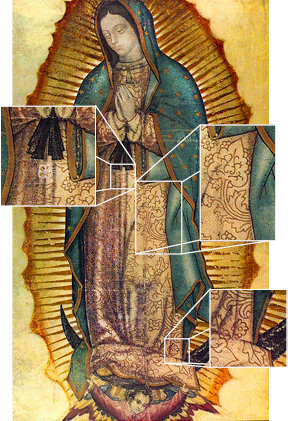
Black Maternity Sash: Our Lady is wearing the Aztec black maternity lace around her waist. This signifies that she is, not only a pregnant woman, but is about to give birth. The sash, then, is a sign new life and that someone is about to come. The ends of the sash's bow represent the end of a cycle and the starting of a new age.
Our Lady of Guadalupe Miracle #18: The Basilica of Our Lady of Guadalupe is the third most visited sacred site in the world20 million people per year visit the basilica located in Mexico City.The Old Basilica, begun in the 1500s and completed in 1709, stands in stark contrast to the massive new basilica that was built in the mid-1970s and looks like a sports arena. It is, in fact, designed to hold 50,000 people, who come for mass—celebrated several times daily—and to see the miraculous image of Our Lady.
Our Lady of Guadalupe Miracle #19: Hillary Clinton once visited the Basilica of Our Lady of Guadalupe, and she said something absolutely mind-bogglingDuring a visit to Mexico in 2009 while Secretary of State according to Catholic News Agency, Hillary Clinton made an unexpected stop at the Basilica of Our Lady of Guadalupe and left a bouquet of white flowers “on behalf of the American people.” The miraculous image had been lowered from its usual altar for the occasion.
She then asked Monsignor Diego Monroy ...
Are you ready for this?
Mrs. Clinton asked Monroy, "Who painted it?"
Without missing a beat, Msgr. Monroy responded “God!"
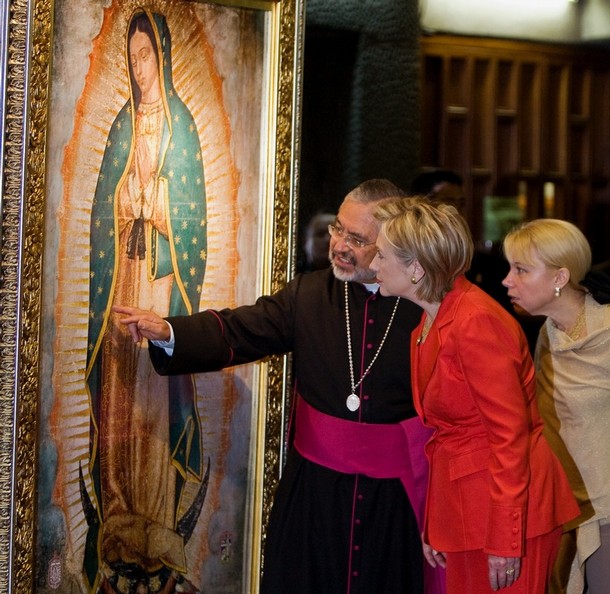 Our Lady of Guadalupe Miracles ENDNOTES:[1] Todd M. Johnson and Gina A. Zurlo, eds. World Christian Database (Leiden/Boston: Brill, 2018). By the year 1600, the world Protestant population is estimated to have been 12.67 million. Here's a Protestant population growth chart: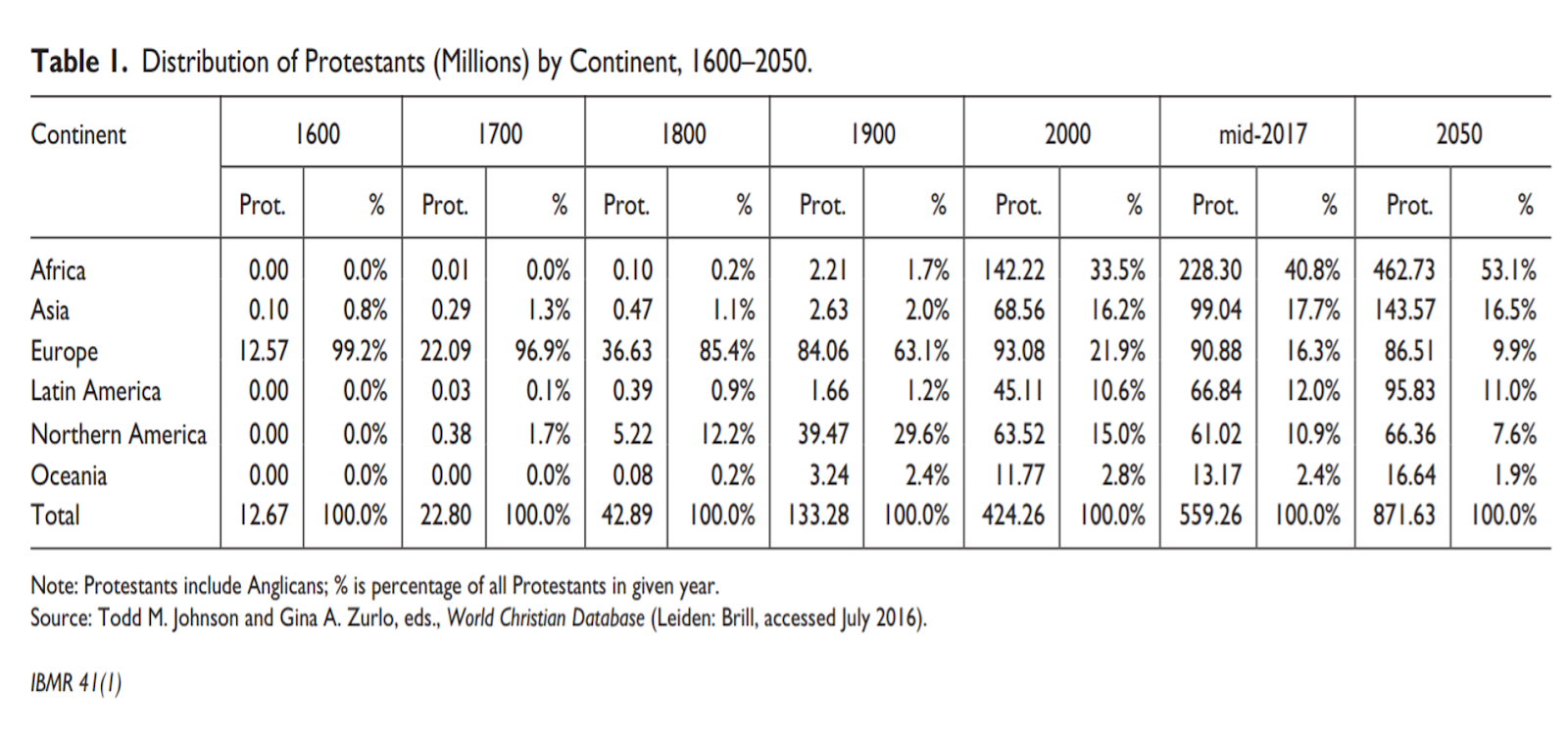
[2] Callahan, Philip: "The Tilma under Infrared Radiation", CARA Studies in Popular Devotion, vol. II, Guadalupan Studies, No. III (March 1981, 45pp.), Washington, D.C.
● More background on Philip Callahan here.
● The attack on Our Lady of Guadalupe is in part due to some possible exaggerations of the claims made by the scientists. One such headline stated that NASA, itself, claimed Our Lady of Guadalupe was "living" or "alive". While Dr. Callahan did serve as a NASA consultant, he obviously does not speak for NASA, itself. However, if, as has been reported, his studies show that Our Lady of Guadalupe maintains her a 98.6 body temperature, the claims of a "living" image are pretty on the nose.

December 1, 2020
St. Thérèse of Lisieux, Her First Confession: St. Thérèse Quotes and Guide to Confession
I recently came across a passage in the diary of St. Thérèse of Lisieux, entitled The Story of a Soul. It was the passage where St. Thérèse described her First Confession.
My daughter just made her first Sacrament of Reconciliation, so this piqued by interest. If she could grow up with just an ounce of the simple love and faith of St. Thérèse, I will be very blessed as a father.
 St. Thérèse's First Confession
Here is the passage from The Story of a Soul about St. Thérèse's First Sacrament of Reconciliation:
Well instructed as to what I was to do, I entered the confessional, and turning round to the priest, so as to see him better, I made my confession and received absolution in a spirit of lively faith—my sister having assured me that at this solemn moment the tears of the Holy Child Jesus would purify my soul. I remember well that he exhorted me above all to a tender devotion towards Our Lady, and I promised to redouble my love for her who already filled so large a place in my heart. Then I passed him my Rosary to be blessed, and came out of the Confessional more joyful and lighthearted than I had ever felt before. It was evening, and as soon as I got to a street lamp I stopped and took the newly blessed Rosary out of my pocket, turning it over and over. “What are you looking at, Thérèse, dear?” asked Pauline. “I am seeing what a blessed Rosary looks like.”
Isn't that a beautiful passage? Such an amazing insight into the soul of the young saint?
I especially love the reference to the Rosary. Here is a guide to the Rosary that I put together, FYI. Have you ever thought of handing your Rosary to the priest after Confession for a blessing?
This seems like a reference to an old custom for children after receiving their first Sacrament of Reconciliation. Maybe we could bring it back?
St. Thérèse Quote: "What does a blessed Rosary look like?""What does a blessed Rosary look like?" Her childlike simplicity is so beautiful, but what's more incredible - St. Thérèse never lost it. I pray for this special grace for my children.
St. Thérèse's devotion to the Blessed Mother is also remarkable. St. Thérèse promised to "redouble my love for her who already filled so large a place in my heart."
St. Thérèse and Her Devotion to the Holy Child JesusNote, also, how St. Thérèse's sister, Pauline, had encouraged her in her devotion to the Holy Child Jesus. This simple encouragement from an older sibling blossomed into one of history's greatest devotions. Never underestimate the effect of encouragement from an older brother or sister.
"Well instructed as to what I was to do" - Sacrament of Reconciliation StepsSt. Thérèse's First Confession was such an indelible and important memory for the future saint. Such grace flowed from her experience. But notice how well St. Thérèse had been prepared for this sacrament.
Note how St. Thérèse described her preparation for the Sacrament of Reconciliation. St. Thérèse said she was "Well instructed as to what I was to do". It appears she was instructed, not just by her sister Pauline, but her parents, Saints Louis Martin and Marie-Azélie Guérin Martin, as well.
Now, I know all children aren't lucky enough to be instructed in the sacraments by Saints, but we should try, right?
I have prepared the following Guide to Confession with an Act of Confession, step-by-step script, etc., to help our children or any new Catholic feel more comfortable when entering the confessional for the first time. Hope it helps!
... And get to the confessional as quickly as you can. Reading about St. Thérèse's First Confession reminded me that I'm due for a visit, myself!
St. Thérèse, pray for us!

November 24, 2020
What are the Best Catholic Children's Books for Ages 5-9 and 10-15? Plus Book Reviews
Looking for some Christmas gift ideas for the Catholic kids in your life? Black Friday shopping? Let me see if I can help!
Here are book suggestions and book reviews of all the Catholic books that our kids have enjoyed. Please let me know what other books should be added to this list.
 Best Catholic Children's Books Table of ContentsClick the links below for more information: Best Catholic Children's Books for Ages 5-9 "The Lego Catechism": Catechism of the Seven Sacraments
The Weight of a Mass
Picture Book of Saints by Father Lawrence G. Lovasik Theology of the Body for Younger Kids Books (Board Books): Every Body Is a Gift: God Made Us to Love, Everybody Has a Body: God Made Boys and Girls, and Every Body Is Smart: God Helps Me Listen and Choose Marian Consecration for Children Best Classic or Vintage Catholic Children's Books for Ages 10-15 The Father Finn Books: Tom Playfair, Harvey Dee, Percy Wynn The Vision Books of Saints: Kateri Tekakwitha, Saint Joan: The Girl Soldier, Father Marquette and the Great Rivers, etc.
Best Catholic Children's Books Table of ContentsClick the links below for more information: Best Catholic Children's Books for Ages 5-9 "The Lego Catechism": Catechism of the Seven Sacraments
The Weight of a Mass
Picture Book of Saints by Father Lawrence G. Lovasik Theology of the Body for Younger Kids Books (Board Books): Every Body Is a Gift: God Made Us to Love, Everybody Has a Body: God Made Boys and Girls, and Every Body Is Smart: God Helps Me Listen and Choose Marian Consecration for Children Best Classic or Vintage Catholic Children's Books for Ages 10-15 The Father Finn Books: Tom Playfair, Harvey Dee, Percy Wynn The Vision Books of Saints: Kateri Tekakwitha, Saint Joan: The Girl Soldier, Father Marquette and the Great Rivers, etc.[image error]

[image error]

[image error]

[image error]

What I've taken from these books - and hopefully my kids, too - is that you don't need money to give gifts to your loved ones. Money is not the measure of our love and the substance of our dignity. Kids can use the language of their bodies - hugs and kisses - as their gift to us. (Of course, this doesn't mean give hugs and kisses to strangers)
This teaches children not to objectify themselves and their bodies.
[image error]

[image error]

TOBET also has a series of Theology of the Body books for older kids, too: God Has a Plan Boys & GirlsEvery Body Has Something to SayEverybody Has Something to Give
These do a great job of building on the lessons of the younger kids' books. Plus, what I love, they are teaching children about Natural Law.
[image error]
 [image error]
 [image error]

My wife and I renew our Consecration on January 1st, the Solemnity of the Motherhood of Mary, so we do our and our kids' Consecration through Advent and Christmas.
[image error]

This book includes selections from other classic children's books like the Chronicles of Narnia, Anne of Green Gables, Secret Garden, etc. Gress uses these to teach kids about virtue, in particular the Virgin Mary's virtues. We really have enjoyed using this book over the last few years.
Father Finn would write twenty-seven books all together, including That Football Game, Claude Lightfoot, Ethelred Preston, Lucky Bob, His Luckiest Year, Facing Danger, and Cupid of Champion.
Here are the TAN book reprints of Father Finn's Tom Playfair series:
[image error]

[image error]

[image error]

You can click on any of the below covers to see the book on Amazon:
[image error]
 [image error]
 [image error]

[image error]
 [image error]
 [image error]