Scott L. Smith Jr.'s Blog, page 6
March 17, 2023
3 Things To Do on St. Joseph's Feast Day According to St. Teresa of Avila, and Why St. Joseph is Special Among the Saints
St. Joseph has a gift waiting for you on his feast day this year ...
Did you know that the church's widespread devotion to St. Joseph is relatively new? Do you know how all this got started?
Heaven got the ball rolling, but how?
And through whom?
St. Joseph was declared the "Patron of the Universal Church" in 1870 by Pope Pius IX. That's a huge deal. But how could something of such universal proportions escape the Church's notice for over 1,800 years?

A short time later, relatively speaking, in 1889, Pope Leo XIII spoke about this growing devotion to St. Joseph in Quamquam Pluries, encyclical letter on St. Joseph. This is what he said:
On the subject of this devotion [to St. Joseph], of which We speak publicly for the first time today, We know without doubt that not only is the people inclined to it, but that it is already established, and is advancing to full growth.
What would "full growth" of the devotion to St. Joseph mean?
I'll tell you what I think it means. Consecration of every man, woman, and child -- of every family in the world -- to Jesus through St. Joseph.
That's why Fr. Donald Calloway and I wrote the Consecration to St. Joseph for Children and Families:
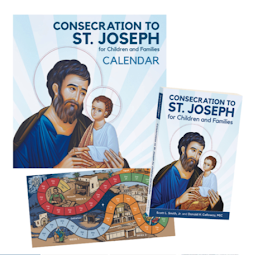
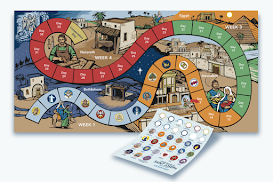
So St. Joseph can protect all families -- as he protected the Holy Family -- in this last great battle between Heaven and Hell over the family.
Here's a talk I recently gave about consecrating your families to St. Joseph:
St. Teresa was on fire with love for Jesus, and through Jesus, St. Joseph.

Here are some quotes from St. Teresa of Avila about her devotion to St. Joseph:
I have never known anyone who … honored him by particular services who did not advance greatly in virtue, for he helps in a special way those souls who recommend themselves to him
Why would somebody advance greatly in virtue with St. Joseph? The secret lies in the meaning of his name. St. Joseph means "increase" (because Rachel, the mom of the Patriarch Joseph, wanted to "increase" the number of her children). St. Joseph is the "increaser" of virtues!
Would that I could persuade all men to be devout to this glorious saint … for I know by long experience what blessings he can obtain for us from God
And, regarding St. Joseph's Feast Day:
It is now very many years since I began asking him for something on his feast, and I always received it ... If the petition was in any way amiss, he rectified it for my greater good.So what should you do on St. Joseph's Feast Day this year?
ASK HIM FOR SOMETHING SPECIAL!!
But there's more ...
3 Things To Do on St. Joseph's Feast Day According to St. Teresa of Avila#1. Ask for St. Joseph's intercession on his feast day, March 19
#2. Ask St. Joseph for a special intercession, something challenging, a special grace or conversion
#3. Challenge somebody else to ask St. Joseph for something special

#1. Ask for St. Joseph's intercession on his feast day, March 19 What should you ask St. Joseph's intercession for? What's St. Joseph's specialty?
St. Joseph is known for helping families with jobs and homes. Here's a great Novena to St. Joseph for just these purposes.
But guess what? We're selling St. Joseph short. St. Joseph has no specialty, properly speaking.
No specialty?
That's right. You can "Go to Joseph" for ANYTHING!!
Why?
Pharaoh said at Genesis 41:55: “Go to Joseph and do whatever he tells you!” Ite Ad Joseph!

Pharaoh was speaking of the Old Testament's Joseph, Joseph the Patriarch, whom Pharaoh had made "lord of his household, and prince over all his possessions" (Psalms 105:21). We also use these titles for St. Joseph in the Litany of St. Joseph.
St. Joseph was made guard over "all of His possessions" -- guard over all of Heaven's greatest treasures, starting with the Blessed Virgin Mary and Jesus.
St. Joseph is able to dispense from the vast treasury of Heaven whatever grace you need. Ask St. Joseph for a great treasure. But what is a great treasure? #2. Ask St. Joseph for a special intercession, something challenging If you can ask St. Joseph, "lord over his household, prince over all his possessions," for anything? What should you ask for?
Ask St. Joseph to break you of an addiction, of a persistent sin that you've been wrestling with for years or even your whole life.
Ask St. Joseph for the conversion of somebody close to you: a child, a husband, a wife, a parent. Ask him to make that conversion finally happen.
Ask St. Joseph for help for your family. Are you the provider of your family, barely providing for your family? Ask St. Joseph for help!
Is your house falling apart? Ask St. Joseph the Carpenter to fix your house, just like he built the miraculous staircase for the chapel of Our Lady of Loretto in Santa Fe, New Mexico.

#3. Challenge somebody else to ask St. Joseph for something specialSt. Teresa of Avila would challenge her friends, fellow Catholics and fellow Saints.
One of her best friends, St. John of the Cross, didn't understand St. Teresa's devotion to St. Joseph, so St. Teresa challenged St. John to ask St. Joseph for something special, a special grace, on St. Joseph's feast day.
St. John of the Cross accepted. His prayer was answered. And St. John of the Cross also became a great devotee of St. Joseph. (You're probably wondering what St. John of the Cross asked for -- I don't know! I wish I did.)

St. Teresa kept challenging her friends to "Go to Joseph." Their prayers kept getting answered. They kept challenging others.
THAT'S how devotion to St. Joseph spread across Christendom. That's how St. Teresa got the balling rolling!
You should do the same. Challenge your friends and family to "Go to Joseph!" on his feast day.
And please comment below with the results!
Somebody asked this very good question in the comments. No special prayer is needed. Feel free to just ask your foster-father in Heaven for his help and intercession.
Nevertheless, the "Memorare to St. Joseph" would be a fitting prayer:
Remember, O most chaste spouse of the Virgin Mary, that never was it known that anyone who implored your help and sought your intercession were left unassisted.
Full of confidence in your power I fly unto you and beg your protection.
Despise not O Guardian of the Redeemer my humble supplication, but in your bounty, hear and answer me. Amen.
Also, if possible, ask St. Joseph for his intercession before or after Mass and kneeling before the Tabernacle.


January 30, 2023
What Is the Meaning of "It Is Easier for a Camel to Go Through the Eye of a Needle"? Is the "Eye of the Needle" a Gate? Matthew 19:24 Meaning
Again I tell you, it is easier for a camel to go through the eye of a needle than for a rich man to enter the kingdom of God.
Jesus may be speaking about a literal needle here.
OR, He may be speaking about a literal gate that camels struggled to pass through.
OR, the Eye of the Needle Gate may be a MYTH!
So, which is it? It's impossible for a camel to pass through the tiny eye of a needle. It's just really difficult for the camel to shimmy through the tight gate, known as the "Eye of a Needle."
Was there such a thing as the Eye of Needle Gate? Where did this idea come from?
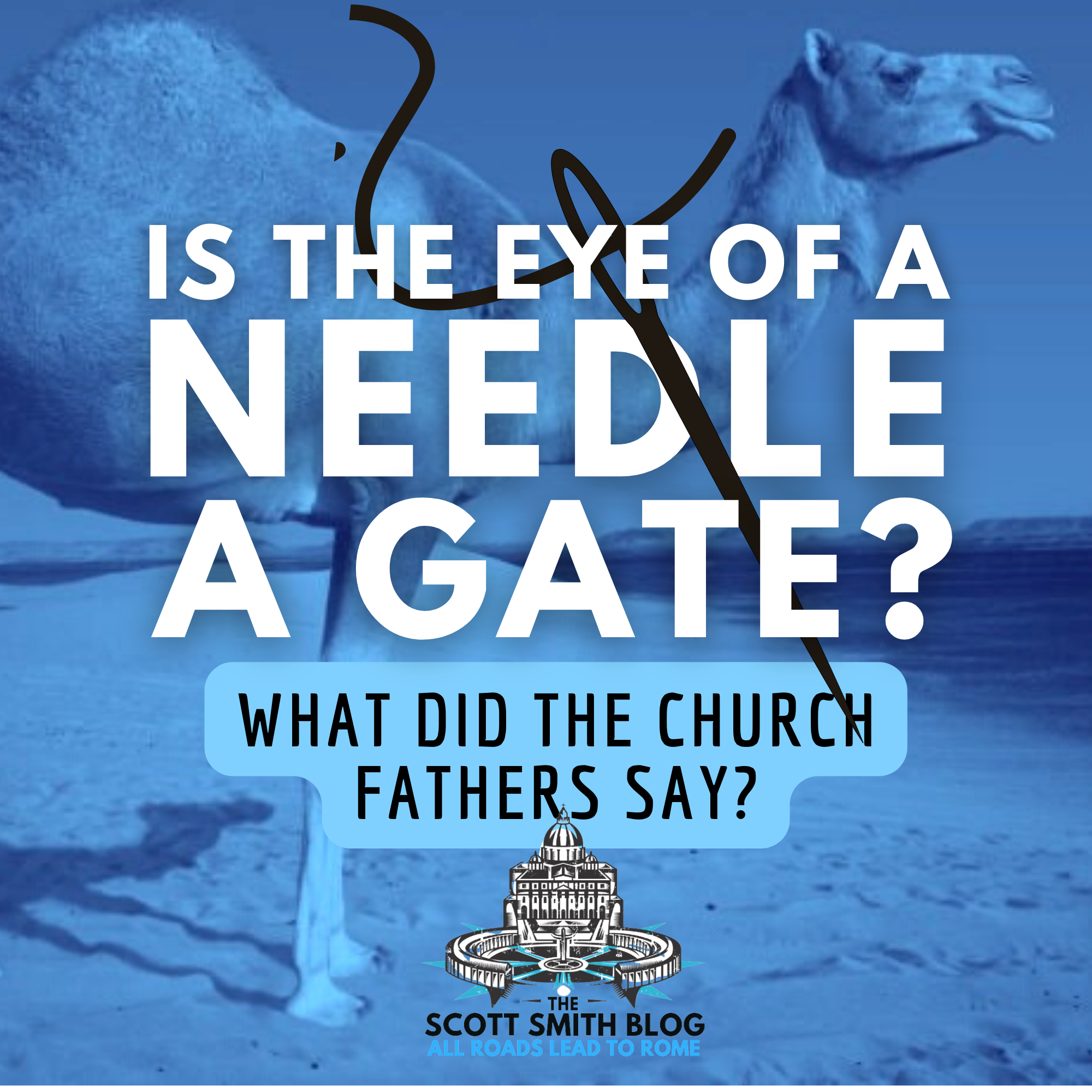
Don't let Jesus' core message get lost in this debate. It's really hard for a wealthy person to get to Heaven. You cannot be possessed by your possessions and expect to get to Heaven. They will drag you down. Wealth only helps somebody get to Heaven insofar as it is given away.
Was there an Eye of the Needle Gate or not?
Modern scholars say NO! That's just a silly idea. (Silly modern scholars)
Whereas, the Church Fathers provide broad support for the idea.
Here's the breakdown of all the sources:
Greek: ῥαφίδος (raphidos = needle). Some have understood this to refer to the passageway through a walled city, such that the camel would have to stoop to enter. But this has no precedent. Classical Greek (e.g., Corpus Hippiatricorum) and the LXX (Exo 27:16; 38:23 [37:21]) use the word ῥαφίδευτού (raphideutou = "needlework") containing the root ῥαφίδευ in reference to a needle for stitching.
Sungenis provides us with a strange argument, if I may paraphrase. Jesus isn't referring to a gate named for the stitching tool, because the word refers to the stitching tool. That's some strange logic.
Sungenis also states that there is "no precedent" for such an interpretation. However, there is an ancient precedent for such an interpretation, as will be demonstrated below.
Apologies for the ad hominem argument, but it should also be noted that Robert Sungenis is an outspoken advocate for Geocentrism, the theory that the Earth is orbited by the Sun, the planets, and all the stars of the Universe.

Ronald Knox, A New Testament Commentary for English Readers, Volume 1: The Four Gospels, p. 43:
In verse 24, there is no need for such ingenious conjectures as that the "camel" meant a kind of rope, or that the "Needle's Eye" was the name given to some gate-way. Our Lord deliberately exaggerates his effects; cf. Matthew 7:3.
Here again, there's no basis provided for why the gate interpretation is merely an "ingenious conjecture." Just a drive-by attack.
Needle's eye. It is obviously impossible for the largest known animal in the region to pass through the smallest opening normally encountered. Late manuscripts and versions which substitute "cable" or "rope" for "camel," likewise commentaries which suppose the "needle's eye" refers to a small gate kept open in a large gate closed to protect a walled city, are later efforts to tone down Yeshua's starkly incongruous image.
Stern describes the "Needle's eye" as "a small gate kept open in a large gate closed to protect a walled city." That's a good breakdown of the idea.
Stern says putting the verse in the context of a gate is among "later efforts to tone down Yeshua's starkly incongruous image."
To try to explain camel by a similar-sounding Greek word meaning "rope," or to interpret an eye of a needle as meaning a low gate in the walls of a city through which pedestrians, but hardly camels, can pass, are futile attempts to whittle down the force of Christ's words.
Again, what's argument? No reasons are given why the gate interpretation is wrong. Just a conclusion without basis.
 What did St. Thomas Aquinas think? Always a good question to ask ...
Doctors of the Church CONFIRM Eye of the Needle Gate
No less a source than the Angelic Doctor, St. Thomas Aquinas, confirms the Eye of the Needle Gate interpretation.
In Aquinas' Commentary on the Four Gospels, the Catena Aurea, he collects a number of prominent Church sources on Matthew 19:24. Most of his sources, like St. John Chrysostom and St. Hilary of Poitiers, provide the basic interpretation that riches complicate the path to Heaven. However, St. Jerome and St. Anselm of Canterbury actually discuss and support the Eye of the Needle Gate theory.
St. Jerome is quoted as saying the following:
According to this, no rich man can be saved. But if we read Isaiah, how the camels of Midian and Ephah came to Jerusalem with gifts and presents, [Isa 60:6] and they who once were crooked and bowed down by the weight of their sins, enter the gates of Jerusalem, we shall see how these camels, to which the rich are likened when they have laid aside the heavy load of sins, and the distortion of their whole bodies, may then enter by that narrow and strait way that leads to life.
St. Jerome is writing this in the 300s AD. Very early on. Very close to the time of Christ. Why St. Jerome held that the "eye of the needle" was an actual gate must be addressed.
 St. Jerome and the Lion - read about this charming story below in footnote [1]
Also, guess where St. Jerome completed his life's work, the translation of the Bible into Latin. Just outside the Gates of Jerusalem. In Bethlehem. Do you think he might have some familiarity with the gates of Jerusalem during those early centuries?
Not only is St. Jerome's interpretation authoritative and confirmed by St. Thomas Aquinas, but he illustrates the "distortion" of the "bowed down" camels so strikingly. "They who once were crooked and bowed down by the weight of their sins ... enter by that narrow and strait way that leads to life."
This is a beautiful piece of writing. It is far more helpful to us than modern Biblical commentaries that discard this (or any) interpretation without any basis.
 St. Anselm also provides support for the Eye of the Needle gate
St. Anselm of Canterbury is quoted as saying the following:[2]
It is explained otherwise; That at Jerusalem there was a certain gate, called, The needle’s eye, through which a camel could not pass, but on its bended knees, and after its burden had been taken off; and so the rich should not be able to pass along the narrow way that leads to life, till he had put off the burden of sin, and of riches, that is, ceasing to love them.
St. Anselm clearly supports the Eye of the Needle Gate theory. That's about as straightforward as you can get.
Note, also, what St. Anselm says: "It is explained otherwise." St. Anselm has observed teachers explaining this passage differently than a literal "eye of a [sewing] needle." Just one person? No. Multiple sources, if not a majority position. The gate interpretation was an explanation common in his day. Further, St. Anselm does not dispute this interpretation. He supports it.
St. Anselm presented his observations and explanation of the gate theory in the 11th century. St. Anselm was Archbishop of Canterbury from 1093 to 1109.
Between St. Jerome and St. Anselm -- some heavy hitters, for sure -- we have sources for the gate interpretation from the 300s and 1000s.
Hugh of Saint-Cher: In the Postilla of the thirteenth-century French Dominican friar and noted Biblical commentator, Hugh of Saint-Cher, we find this reference to the Eye of the Needle Gate:[3]
There was a gate in Jerusalem which was called the needle, through the opening of which one could not pass unless unencumbered.
There is some reference to Theophylact, an 11th century monk, being the origin of the Eye of the Needle Gate theory. However, this is a false trail likely propagated by an erroneous entry in the 16th century Geneva Bible, a Protestant translation. Theophylact discusses the parallel theory that "camel" should actually be translated as rope, not the gate theory.[4]
The Eye of the Needle Gate may have been just a small gate. It has also been described as sort of a gate-within-a-gate. A door-within-a-door.
Typically, the Eye of the Needle Gate is described as sort of an "after-hours" entrance to Jerusalem. The city gates would be closed at night for safety and defense. Access through them "after-hours" would be restricted. A large door would close the gate, but there would be a smaller door within the larger door.
Is there evidence of such doorways existing in Jerusalem in Christ's time?
Travelogue: 15th Century Pilgrim to the Holy Land, Joannes Poloner
According to Joachim Gnilka, a German Catholic theologian and New Testament scholar, the "Eye of a Needle" gate interpretation is supported by the writings of the 15th century pilgrim Joannes Poloner -- "Poloner," because he is considered to be Polish.
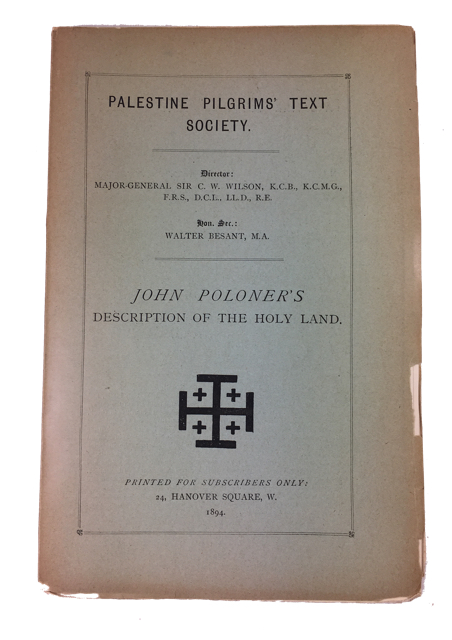 John Poloner's Description of the Holy Land. Joannes Poloner, active 15th century. Reprinted 1894.
Gnilka actually argues that Poloner's travelogue was the original source, i.e. fabrication, of the gate interpretation. This is demonstrably false because, as said above, St. Jerome and St. Anselm were writing about the gate interpretation 1200 and 400 years, approximately, before Poloner was born.
The Jerusalem travelogue attributed to Poloner is entitled Johannis Poloner descriptio Terrae Sanctae.[5] Poloner's travelogue provides the following support for the gate interpretation: "On the same street is a small door to the south, which in their language is called the eye of a needle, of which the Lord said: It is easier for a camel to go through the eye of a needle, etc."[6]
This is a very interesting piece of evidence, because it both (1) references the existence of an actual "eye of a needle" gate, and (2) connects it to the Gospel passage. Wow.
The city walls of Jerusalem have many famous gates: the Jaffa Gate, the Zion Gates, the Damascus Gate, even the Dung Gate. Many of these are mentioned in the Bible and are well-known to the annals of history.
The Ottoman emperor Sulieman sealed the Eastern Gate or Golden Gate in 1541, though the prophets speak of the Messiah returning through this gate.[7]
 The sealed Eastern Gate (or Golden Gate)
 The Zion Gate is named for its proximity to Mount Zion, the burial place of King David. It is pictured below riddled with bullet holes from Israel's 1947 war of independence:

Jerusalem's Postern Gates: A Possibility for the Eye of the Needle? The concept of a hidden gate or postern gate has been a common element of castle and wall design for as long as castles have existed. Here is a definition of postern gate:[8]
A postern is a secondary door or gate in a fortification such as a city wall or castle curtain wall. Posterns were often located in a concealed location which allowed the occupants to come and go inconspicuously. In the event of a siege, a postern could act as a sally port, allowing defenders to make a sortie on the besiegers. Placed in a less exposed, less visible location, they were usually relatively small, and therefore easily defensible.
Postern gates have been used in Jerusalem throughout its fortified history. In fact, each of the gates mentioned above -- the Zion Gate, Damascus Gate, plus Tanners' Gate and Herod's Gate -- are all known to have ancient postern gates.
In an 1896 article in the London Palestine Pilgrims' Text Society, C. R. Condor compiled a list of all the gates and postern gates of Jerusalem, known currently in the 19th century, as well as the 15th century (Arab), 12th century (Crusading), and 4th century (Byzantine). Condor described Zion Gate in Jerusalem, built west of one of the city's medieval main gates, as likely a postern gate. Condor also described the postern of St. Lazarus, west of the Damascus Gate, the postern of the Tanners' Gate, and the postern of the Madeleine at Herod's Gate.[9]
Lots of possibilities for an "Eye of a Needle" Gate!
As you can see below and in the "Hidden Gate" section below, postern gates are the size of a small doorway. A camel, laden with goods or not, would certainly struggle to pass through such gates.
 Museum of London reconstruction of the Postern Gate from the London Wall Walk guide.
To illustrate just how far back this idea of postern gates goes, here is the "Secret Stairway" to the postern gate of the Mycenean citadel Tiryns, 15th century BC. That's 1,500 years before Christ.
Also, note how small: [Poor camel!]
 (Photo by CM Dixon/Print Collector/Getty Images)
According to Shimon Gibson, one of Jerusalem's postern gates could have served as the location of Jesus’ temporary incarceration and the trial in front of Pilate, as described in John's Gospel. There was a gate here, designated as the “Hidden” Gate, which Gibson thinks was the Gate of the Essenes mentioned by Josephus, the Jewish historian.[10]
Ferrell Jenkins, a professor of Biblical studies, has provided the following diagrams and pictures, based on Gibson's research. This first picture provides a great diagram of a postern gate:

Here are additional pictures showing where this location fits into the larger map of Jerusalem, modern day (first picture) and during Christ's time (second picture):


What About Gates-Within-A-Gate? Another Possibility for the "Eye of the Needle" Gate?
There is a long history of postern gates. There are also many examples of gates-within-a-gate found throughout the history of castles.
The photo below depicts a similar gate in Nazareth.[11] It illustrates the concept of the "Eye of the Needle" gate quite well. You can see that a camel could not pass through the gate unless it first had all its baggage removed and then stooped to get through the gate.


Is this just something tour guides tell unwary tourists? Likely. Even so, it demonstrates that gates of this nature are presently found in Jerusalem. The questions that remain are (1) how long has this been the practice, and (2) was there ever a gate or gate concept that bore the name "Eye of the Needle"?
Conclusion: The "Eye of the Needle" Gate Is NOT a MythI would conclude with the following four points regarding the "Eye of the Needle" Gate interpretation of Matthew 19:24:The Church Fathers appear to agree that the gate interpretation is viable, credible, and well-founded. St. Jerome's support, in particular, is very credible, given his proximity in both time (within 200 years of Christ's time) and geography (spent a significant amount of time in Jerusalem).The archaeological record from Christ's time provides, not merely possible, but plausible gate options for the restricted passage of camels through the Jerusalem city walls.Given the weight of the evidence from the Church Fathers and the archaeological record, the burden of proof falls on the contra position, i.e. the position that the "Eye of the Needle" Gate interpretation is wrong. The "Eye of the Needle" Gate interpretation was not seriously refuted until modern day. Modern Biblical commentators often refute the gate interpretation without any supporting evidence, rest on incorrect assumptions, or merely state the conclusion without supporting arguments.
In short, the "Eye of the Needle" Gate theory is not a myth, but is both plausible and confirmed by the Church Fathers.
[1] Painting by Scott Gustafson: "One day, a roaring lion made its way into the monastery and began threatening the monks. Heading down the cloistered halls, it eventually came to St. Jerome’s study. The monk looked up from his studies and realized the raging beast was in pain, as it had a large thorn stuck in it’s paw. Gently, he held the lion’s foot and removed the thorn. From that moment on, the man and beast were inseparable friends."
[2] In the original: Hierosolymis quaedam porta erat, quae foramen acus dicebatur, per quam camelus, nisi deposito onere et flexis genibus, transire non poterat. Tomas Aquinas, Catena aurea: Commentary on the Gospels from the Fathers, vol. i: St Matthew, Part iii (Oxford: John Henry Parker/J. G. F. and J. Rivington, 1842), 19, 6. Regarding Anselm see Gross, F. L., ed., ‘Anselm of Canterbury’, Oxford Dictionary of the Christian Church (Oxford/New York: Oxford University Press, 1997).
[3] Hugh of Saint-Cher, Postilla Hugonis de Sancto Charo, vol. vi (Venice: N. Pezzana, 1703) 65, available at LINK (accessed 1/18/2023): porta erat in Jerusalem, quae acus dicebatur, per cujus foramen non nisi inonerati transire poterant.
[4] Agnieszka Ziemińska, "The Origin of the 'Needle's Eye Gate' Myth: Theophylact or Anselm?" Cambridge University Press, June 9, 2022: "From There is another medieval source mentioned in homiletic and pastoral texts. Some authors have proposed that it was the the eleventh-century monk Theophylact in his Gospel Commentary who first referred to the ‘eye of a needle’ gate. However, they do not point to a specific place in Theophylact's work. The problem is that this is a false trail. Theophylact nowhere states that the ‘needle's eye’ is a gate in the wall of Jerusalem. In the commentary on Matt 19.24, he only writes that ‘some say that “camel” is not the animal, but the thick cable used by sailors to cast their anchors’, but there is no mention of gates, doors or other types of entrance. In the Western world, the hypothesis of Theophylact being the author of the concept of a gateway called the ‘eye of a needle’ became popular probably through an entry in the sixteenth-century Geneva Bible. The annotation in the margin to Matt 19.24 refers to Theophylact's comment. It refers to the view that the camel meant a rope but makes no mention of a gate. It was, however, close to attributing to Theophylact, known through the Geneva Bible for his rational explanations of Jesus’ words, also the notion about the ‘needle's eye’ gate. The trope pointing to Theophylact's commentary as the first known source, although repeated, must be considered false."
[5] J. Gnilka, Das Matthäusevangelium (2 vols,; HThK.NT 2; Freiburg: Herder, 1993) ii.166.
[6] In the original: in eadem platea est portula versus austrum, quae lingua eorum foramen acus dicitur, de qua Dominus dixit: Facilius est, camelum ire per foramen acus etc. (translation by Agnieszka Ziemińska, "The Origin of the 'Needle's Eye Gate' Myth: Theophylact or Anselm?" Cambridge University Press, June 9, 2022). Poloner, J., ‘Johannis Poloner descriptio Terrae Sanctae’, Descriptio Terrae Sanctae ex saeculis viii ix xii xv (ed. Tobler, T.; Leipzig: J. C. Hinrich, 1874) 225–81, at 240.
[7] John Malvern, "Gates to the Old City of Jerusalem and Their Meaning," LINK.
[8] Postern Gate: Van Emden, Wolgang, "Castle in Medieval French Literature", The Medieval Castle: Romance and Reality (Kathryn L. Reyerson, Faye Powe, eds.) U of Minnesota Press, 1991, 17.
[9] Condor, C.R., "The City of Jerusalem," Palestine Pilgrims' Text Society, London, 1896, 4.
[10] “The Trial of Jesus at the Jerusalem Praetorium: New Archaeological Evidence,” pp. 97-118 in C.A. Evans (ed.), 2011, The World of Jesus and the Early Church: Identity and Interpretation in Early Communities of Faith, Peabody: Hendrickson:
"This chapter cautiously argues against taking such a negative approach to the subject of the trial of Jesus as portrayed in the Gospels. The basis for this conclusion is a new study I have made on the overall layout of the palace of Herod the Great, which later became the seat of the Roman governor when in residence in Jerusalem, the praetorium. My work also highlights previously unpublished archeological discoveries pertaining to the appearance of the western gateway of the palace/praetorium, which I think is the Gate of the Essenes referred to by Josephus. This monumental gateway had inner and outer gates flanked by large towers, and these gates were separated one from the other by a large, open, and paved court at its center, with a rocky area on its north. In the first century CE, the gateway undoubtedly provided direct access to the palace grounds, which incorporated palace residences, an ornamental pleasure garden, and military barracks. Remarkably, these archeological remains fit very well with John’s description of the place of Jesus’ temporary incarceration and the trial in front of Pilate, and with the two topographical features that are mentioned by him, the lithostrotos and gabbatha."
[11] This reference comes from the modern day travelogue of Mariane Schwab. Schwab is not a scholar, however, but an executive producer of multiple televisions shows about international travel. According to Schwab, "The eye of the needle mentioned in the book of Matthew was one of several gates that provided passage through the city of Jerusalem's massive walls. The Needle Gate was used when the city's main gates were closed at night and used for people entering the city 'after hours.'"
[12] Ibid.
December 26, 2022
What are the Twelve Days of Christmas? How To Celebrate the 12 Days of Christmas?
Are the 12 days of Christmas just a song? Where did the 12 days of Christmas come from? When do the 12 days of Christmas start? Also, was the original meaning of the "12 days of Christmas" a crypto-Catholic children's catechism or is that "urban legend"? Find out below!

Wait! I thought Christmas ended on Christmas! The Christmas Season begins the day after Thanksgiving, right? That's when trees go up and houses are suddenly bedecked with rows of Christmas lights, right? All of this goes away with the garbage bags full of torn wrapping paper ... right?
The traditional Christian celebration of Christmas is exactly the opposite of the secular presentation of Christmas. The season of Advent begins on the fourth Sunday before Christmas, and for nearly a month Christians await the coming of Christ in a spirit of expectation, singing hymns of longing. Then, on December 25, Christmas Day itself ushers in 12 days of celebration, ending only on January 6 with the feast of the Epiphany.
The eve of the last day of Christmas is also known as Twelfth Night, but more on that below ...
Also, check out the Catholic Nerds' (my) podcast on the 12 Days of Christmas:
What or Who is celebrated on each of the 12 Days of Christmas?The 12 Days of Christmas each traditionally celebrate a saint's feast day or another special event:
 Day 1 (25th December): Christmas Day, the feast of the Birth of Jesus! Here's one of my favorite images of the Nativity, Adoration of the Shepherds by Christian Wilhelm Ernst Dietrich (1712-1774):
There is such rich theology hidden in this image. The Virgin Mary is the perfect reflection of Christ's light, while St. Joseph is hidden in shadow and yet casting a giant shadow. This speaks to the great hiddenness of St. Joseph.
 Day 2 (26th December aka Boxing Day): The Feast of St. Stephen, the first martyr. This is a traditional day for giving leftovers to the poor, as described in the carol "Good King Wenceslas."
 Do you remember the lines of the Christmas carol? "Good King Wenceslas looked out o n the feast of Stephen ... Bring me flesh and bring me wine, Bring me pine logs hither." "Good" King Wenceslas thus finds a peasant to dine with at Christmas, and the carol ends:
Therefore, Christian men, be sureWealth or rank possessingYe who now will bless the poorShall yourselves find blessing
Likewise, as one of the first deacons, Saint Stephen was the forerunner of all those who show forth the love of Christ by their generosity to the needy. But more than this, he was the first martyr of the New Covenant, witnessing to Christ by the ultimate gift of his own life.
 Day 3 (27th December): The Feast of St. John the Evangelist. What is unusual is that St. John, as opposed to St. Stephen, is traditionally held to be the only one of the Twelve Apostles who did not die a martyr. Rather, John lived a long life and in some accounts an exceptionally long life. This was perhaps prophesied by Christ himself in the final verses of John's Gospel (21:20-25): “If it is my will that he remain until I come, what is that to you?
Day 4 (28th December): The Feast of the Holy Innocents, the children murdered by Herod. According to Christianity Today, in the Holy Innocents, we see the long agony of those who suffer and die through human injustice, never knowing that they have been redeemed. If Christ did not come for them too, then surely Christ came in vain. In celebrating the Holy Innocents, we remember the victims of abortion, of war, of abuse. We renew our faith that the coming of Christ brings hope to the most hopeless.
Day 3 (27th December): The Feast of St. John the Evangelist. What is unusual is that St. John, as opposed to St. Stephen, is traditionally held to be the only one of the Twelve Apostles who did not die a martyr. Rather, John lived a long life and in some accounts an exceptionally long life. This was perhaps prophesied by Christ himself in the final verses of John's Gospel (21:20-25): “If it is my will that he remain until I come, what is that to you?
Day 4 (28th December): The Feast of the Holy Innocents, the children murdered by Herod. According to Christianity Today, in the Holy Innocents, we see the long agony of those who suffer and die through human injustice, never knowing that they have been redeemed. If Christ did not come for them too, then surely Christ came in vain. In celebrating the Holy Innocents, we remember the victims of abortion, of war, of abuse. We renew our faith that the coming of Christ brings hope to the most hopeless. 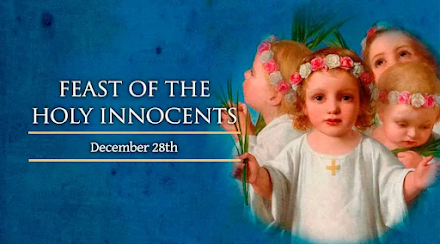
First Three Days once celebrated together: In the Middle Ages, these three feasts were each dedicated to a different part of the clergy. Saint Stephen is the patron of deacons, so deacons were celebrated on this day. The feast of John the Evangelist was dedicated to the priests, and the feast of the Holy Innocents was dedicated to young men training for the clergy and serving the altar.
 Day 5 (29th December): The Feast of Saint Thomas à Becket. A strong man who wavered for a moment, but then learned one cannot come to terms with evil, and so became a strong churchman, a martyr, and a saint—that was Thomas Becket, archbishop of Canterbury, murdered in his cathedral on December 29, 1170. [Read more on Franciscan Media]
Day 6 (30th December): The Feast of the Holy Family ... sometimes (see below). There is an amazing Litany to the Holy Family. Check it out here. "Jesus, Mary, and Joseph, restorers of fallen families, pray for us!"
Day 5 (29th December): The Feast of Saint Thomas à Becket. A strong man who wavered for a moment, but then learned one cannot come to terms with evil, and so became a strong churchman, a martyr, and a saint—that was Thomas Becket, archbishop of Canterbury, murdered in his cathedral on December 29, 1170. [Read more on Franciscan Media]
Day 6 (30th December): The Feast of the Holy Family ... sometimes (see below). There is an amazing Litany to the Holy Family. Check it out here. "Jesus, Mary, and Joseph, restorers of fallen families, pray for us!" You can also fill your Advent with family prayer by consecrating your family to St. Joseph--the 33 days of preparation prayers end on the Feast of the Holy Family! Fr. Donald Calloway and I wrote the book together: Consecration to St. Joseph for Children and Families .
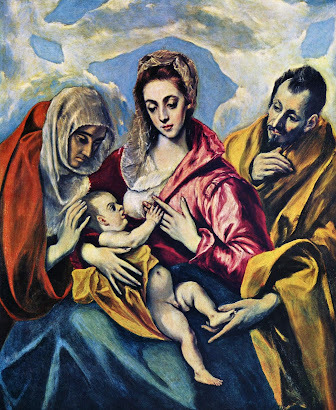
December 30? In the General Roman Calendar since 1969, the Feast of the Holy Family is held on the Sunday between Christmas Day and January 1. If both are Sundays, the Feast of the Holy Family is celebrated on December 30th.
It's also the Feast of Saint Egwin of Worcester. Chances are you aren’t familiar with this Saint, unless you’re especially informed about Benedictine bishops who established monasteries in medieval England. As a bishop he was known as a protector of orphans and the widowed and a fair judge. [Read more on Franciscan Media]
Day 7 (31st December): New Year's Eve! Pope Sylvester I is traditionally celebrated on this day. In many central and eastern European countries New Year's Eve is still sometimes called 'Silvester' after the pope.
Day 8 (1st January): Feast of the Solemnity of Mary, the Mother of Jesus, a holy day of obligation for Catholics. Solemnities are the highest rank of liturgical celebration, higher than feast days or memorials. By celebrating a solemnity dedicated to Mary’s motherhood, the Church highlights the significance of her part in the life of Jesus, and emphasizes that he is both human and divine. [Read more on Busted Halo ]Not to mention ...
Pope Paul VI, in his apostolic exhortation Marialis Cultus (1974), called the Solemnity of Mary “a fitting occasion for renewing adoration of the newborn Prince of Peace, for listening once more to the glad tidings of the angels (cf.Lk 2:14), and for imploring from God, through the Queen of Peace, the supreme gift of peace.”
Day 9 (2nd January): Feasts of Saints Basil the Great and Gregory Nazianzen. Childhood friends described as "two bodies, one spirit," these Cappadocian Fathers, both Doctors of the Church, proved to be some of the most influential Christian teachers of all time, honored by both East and West, Eastern Orthodox and Roman Catholic. Here's a great video with Mike Aquilina and Matthew Leonard, "What's so 'Great' about St. Basil?"
Day 10 (3rd January): Feast of the Holy Name of Jesus. Although Saint Paul might claim credit for promoting devotion to the Holy Name because Paul wrote in Philippians that God the Father gave Christ Jesus “that name that is above every name” (see 2:9), this devotion became popular because of 12th-century Cistercian monks and nuns but especially through the preaching of Saint Bernardine of Siena, a 15th-century Franciscan. [Read more at ]
Day 11 (4th January): Feast of St. Elizabeth Ann Seton , the first native born American to be canonized by the Catholic Church . It is also celebrated as the feast of Saint Simon Stylites, who lived on a small platform on the top of a pillar for 37 years!
Day 12 (5th January also known as Epiphany Eve): Feast of St. John Neumann . He was the first member of the Redemptorists to profess vows in the United States and became the first American bishop to be beatified. He served for several years in Pittsburgh with fellow denizen of Heaven, Blessed Selos, who you can read more about here.What is Twelfth Night?January 6th is the Feast of the Epiphany. The celebration of Christmas comes to an end the night before the Epiphany with the "Twelfth Night".
"The 12th Night," as all lovers of Shakespeare know, is the ultimate celebration of Christmas madness. Epiphany commemorates the beginning of the proclamation of the gospel—Christ's manifestation to the nations, as shown in three different events: the visit of the Magi, the baptism of Jesus, and the turning of water into wine. In the Western tradition, the Magi predominate. But in the Eastern churches, Jesus' baptism tends to be the primary theme.
But that's not all ...
In the Bucharest subway, children leading lambs walk through the trains in commemoration of the Lamb of God to whom John pointed. Orthodox Christians traditionally have their homes blessed with holy water on or around this day. Nowhere is Epiphany celebrated more joyously than in Ethiopia. Pilgrims from all over the country converge on the ancient city of Aksum, where they bathe in a great reservoir whose waters have been blessed by a priest.
What about the "12 Days of Christmas" Urban Legend? The Secret Catechism Behind the Song is a FabricationHave you heard the urban legend about the "12 Days of Christmas"? Is it true? Was the original meaning of the "12 days of Christmas" a crypto-Catholic children's catechism used in anti-Catholic Anglican in Tudor England?
Here's the short of it: It's likely that each of the 12 days of Christmas are symbolic. But a secret catechism? Unlikely.

You may have received an email that ran something like this:
You’re all familiar with the Christmas song, “The Twelve Days of Christmas” I think. To most it’s a delightful nonsense rhyme set to music. But it had a quite serious purpose when it was written. It is a good deal more than just a repetitious melody with pretty phrases and a list of strange gifts.
Catholics in England during the period 1558 to 1829, when Parliament finally emancipated Catholics in England, were prohibited from ANY practice of their faith by law – private OR public. It was a crime to BE a Catholic.
“The Twelve Days of Christmas” was written in England as one of the “catechism songs” to help young Catholics learn the tenets of their faith – a memory aid, when to be caught with anything in writing indicating adherence to the Catholic faith could not only get you imprisoned, it could get you hanged, or shortened by a head – or hanged, drawn and quartered, a rather peculiar and ghastly punishment I’m not aware was ever practiced anywhere else. Hanging, drawing and quartering involved hanging a person by the neck until they had almost, but not quite, suffocated to death; then the party was taken down from the gallows, and disembowelled while still alive; and while the entrails were still lying on the street, where the executioners stomped all over them, the victim was tied to four large farm horses, and literally torn into five parts – one to each limb and the remaining torso.
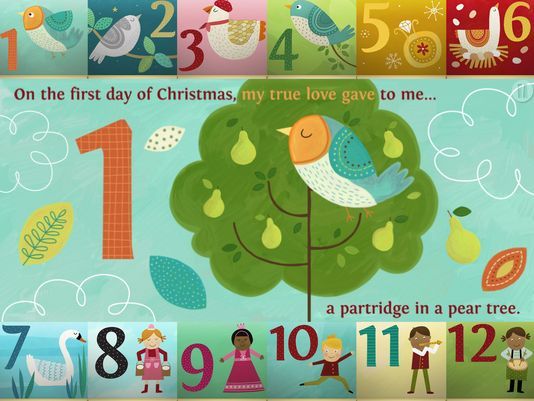
The songs gifts are hidden meanings to the teachings of the faith. The “true love” mentioned in the song doesn’t refer to an earthly suitor, it refers to God Himself. The “me” who receives the presents refers to every baptized person. The partridge in a pear tree is Jesus Christ, the Son of God. In the song, Christ is symbolically presented as a mother partridge which feigns injury to decoy predators from her helpless nestlings, much in memory of the expression of Christ’s sadness over the fate of Jerusalem: “Jerusalem! Jerusalem! How often would I have sheltered thee under my wings, as a hen does her chicks, but thou wouldst not have it so…”
The other symbols mean the following: 2 Turtle Doves = The Old and New Testaments3 French Hens = Faith, Hope and Charity, the Theological Virtues4 Calling Birds = the Four Gospels and/or the Four Evangelists5 Golden Rings = The first Five Books of the Old Testament, the “Pentateuch”, which gives the history of man’s fall from grace.6 Geese A-laying = the six days of creation7 Swans A-swimming = the seven gifts of the Holy Spirit, the seven sacraments8 Maids A-milking = the eight beatitudes9 Ladies Dancing = the nine Fruits of the Holy Spirit10 Lords A-leaping = the ten commandments11 Pipers Piping = the eleven faithful apostles12 Drummers Drumming = the twelve points of doctrine in the Apostle’s Creed
So, is it true?
It is true that Catholics suffered severe persecution and scores of martyrdoms in England from the time of St. Thomas More onward. However, there are some significant issues with the idea, itself.
Here's the first problem ...
Why would young Catholics need to study these elements of the Catholic Faith in secret? The Church of England (Anglican Church) made some pretty major breaks with Catholic teaching, including a rejection of the True Presence of Christ in the Eucharist and the authority of the Pope. But the memory-aid above describes facts that both churches would believe.
The number of Apostles, etc. wouldn't need to be studied in secret.
Here's another problem ...
This is a pretty bad memory device. There's no intrinsic connection between what's being connected. Children wouldn't be memorizing anything of substance. It's just numbers! Does anybody really need to memorize how many books are in the first five books of the Bible? Or, for that matter, who's buried in Grant's tomb? A mnemonic to help me remember the names and order of the first five books would be helpful, not that there are five.
A memory device for catechizing children the "12 Days of Christmas" probably is not; however, that doesn't mean the song wasn't infused with symbolic Christmas meaning. That's about all we can say from the historical sources.
What is the "Twelfth Night"? Not Just a Shakespearean PlayHere's a little extra on Twelfth Night, specifically, from Why Christmas:
Twelfth Night was a big time of celebration with people holding large parties. During these parties, often the roles in society were reversed with the servants being served by the rich people. This dated back to medieval and Tudor times when Twelfth Night marked the end of 'winter' which had started on 31st October with All Hallows Eve (Halloween).
At the start of Twelfth Night the Twelfth Night cake was eaten. This was a rich cake made with eggs and butter, fruit, nuts and spices. The modern Italian Panettone is the cake we currently have that's most like the old Twelfth Night cake.
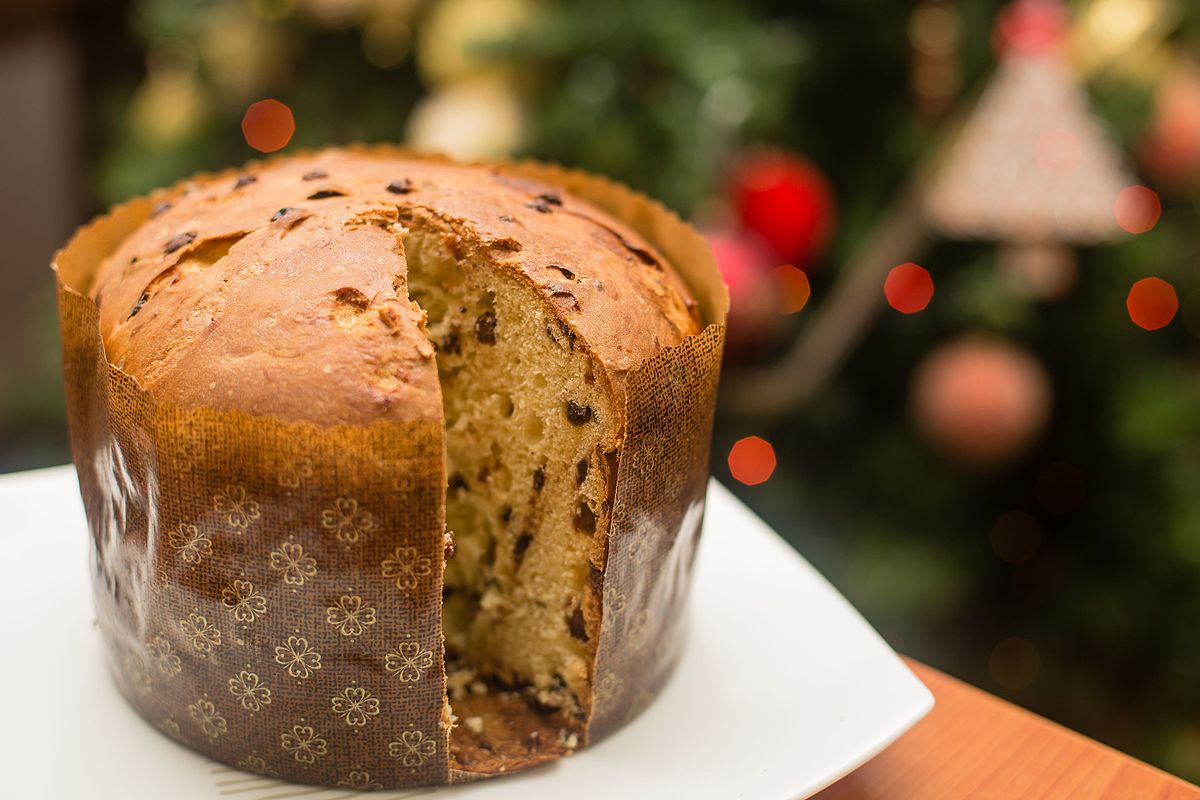
A dried pea or bean was cooked in the cake. Whoever found it was the Lord (or Lady) of Misrule for night. The Lord of Misrule led the celebrations and was dressed like a King (or Queen). This tradition goes back to the Roman celebrations of Saturnalia. In later times, from about the Georgian period onwards, to make the Twelfth Night 'gentile', two tokens were put in the cake (one for a man and one for a women) and whoever found them became the the 'King' and 'Queen' of the Twelfth Night party.
In English Cathedrals, during the middle ages, there was the custom of the 'Boy Bishop' where a boy from the Cathedral or monastery school was elected as a Bishop on 6th December (St Nicholas's Day) and had the authority of a Bishop (except to perform Mass) until 28th December. King Henry VIII banned the practice in 1542 although it came back briefly under Mary I in 1552 but Elizabeth I finally stopped it during her reign.
During Twelfth Night it was traditional for different types of pipes to be played, especially bagpipes. Lots of games were played including ones with eggs. These included tossing an egg between two people moving further apart during each throw - drop it and you lose; and passing an egg around on spoons. Another popular game was 'snapdragon' where you picked raisins or other dried fruit out of a tray of flaming brandy!
The first Monday after the Christmas feast has finished was known as ‘Plough Monday’ as this was when farming work would all begin again!
In many parts of the UK, people also went Wassailing on Twelfth Night.
Twelfth Night is also known as Epiphany Eve. In many countries it's traditional to put the figures of the Wise Men/Three Kings into the Nativity Scene on Epiphany Eve ready to celebrate Epiphany on the 6th January.
It's also traditional to take your Christmas decorations down following Twelfth Night.
Twelfth Night is also the name of a famous play written by William Shakespeare. It's thought it was written in 1601/1602 and was first performed at Candlemas in 1602, although it wasn't published until 1623.
Any questions? Comments? Let me know below and I'll address all I can or point you in the right direction.
Pace e Bene (Italian for peace and goodness - thanks, Father Karl!)
December 6, 2022
Why You Should Wear the Brown Scapular: In Loving Memory of Fr. Otis Young and Ruth Prats
A tragedy happened in Louisiana during the closing days of November. You may have heard about it. It made headlines around the country.
Two people were killed, Father Otis Young and Ruth Prats. We lost, not just a great and humble priest, but a devoted member of his parish and the parish staff, as well.

I don't want to focus too much on the more morbid aspects of what happened. It appears that Father Otis and Ruth were the victims of a double homicide. Afterwards, both bodies were burned, as though an attempt was made to to conceal the evidence.
What's most interesting, most hopeful, is what was left behind.
Because of the nature of what happened, only one item was recovered from Fr. Otis' body.
It was his scapular.[1]
 Fr. Otis Young and Ruth Prats
This is certainly a heartbreaking moment for St. Peter's Catholic Church, for the entire Archdiocese of New Orleans, and our entire state.
"Where was the Lord when Otis was suffering that brutal death? The Lord was here," Archbishop Gregory Aymond said at Fr. Otis' funeral.[1]

It was a beautiful and moving funeral. Here is the link to the video of the Funeral Mass, if you would like to share in a beautiful celebration of the Mass.
While awaiting confirmation of the deaths, Father Daniel Brouillette, the current pastor of St. Peter's Catholic Church in Covington, led his parish in prayer vigil for the missing persons. This was another beautiful outpouring of prayer from a grieving community.

Fr. Damian Zablocki, who attended the prayer vigil and holy hour, described it as "a very moving and striking thing to see so many kneel before the Lord in prayer with their suffering hearts."
Father Otis and His Scapular
Fr. Damian Zablocki, a brother priest to Fr. Otis in the Archdiocese of New Orleans, posted the following on Facebook. Fr. Damian gave me permission to share this with you:
I post this because of the miraculous nature I find in the details of this. On hearing of Fr. Otis’s death, I told my people at the chapel that he was always wearing his scapular. It was always sticking out of his shirt and I was a little bit leery mentioning details because I didn’t want to further burden anyone with emotional details or things that would upset them given the manner of his death. For some reason, I found it important to mention that he was wearing the scapular all the time. Today at the funeral Fr. Bru mentioned that Fr. Otis was very faithful to his priestly duties, and also in his love to the most Blessed Virgin, including wearing the scapular. Indeed, because of the manner of his death, there was nothing left to recover….except for the scapular.
“Whosoever dies clothed in this Scapular, shall not suffer eternal flames.”
Our Lady of Mount Carmel, pray for us!
Through Thy Most Holy Scapular, protect your children dear Mother!!!!!
"It was always sticking out of his shirt" -- I love that part. A little reminder of the love of the Blessed Virgin Mary, always sticking out of his shirt.
“Whosoever dies clothed in this Scapular, shall not suffer eternal flames.” What does that mean? What's the meaning of this promise? See below ...
Of course, I can't speak for Fr. Otis, but I think there is a way we could still bring good from the tragedy of his and Ruth's deaths.
There is a way we could honor Fr. Otis and do much more, besides.

Hope from Tragedy
What better, more fitting memorial to both Fr. Otis and Ruth than for all of us to start wearing the scapular?
Many a good priest, like Fr. Otis, would be willing to endure what Fr. Ortis endured, if it meant that more people would wear the scapular. If it meant that more people would come to know and love the Blessed Virgin Mary more, and, through her, Jesus. If it meant that more people would reach Heaven.
So, please, let's not waste this chance that Fr. Otis has given us!
You might be wondering, though, what is a Scapular? Or, what is the Scapular?

When most people hear the word "scapular," they think of the two small pieces of wool people wear under their shirts as sort of a necklace. Or maybe they think of the "scapula," the anatomical term for the shoulder blade. The two are, of course, connected.
The scapular is a sacramental based on an important piece of a monk's robes or habit. The original scapular is a shoulder-width piece of cloth worn over the shoulders that falls almost to the wearer’s feet.
Here are some images of the scapular being worn as part of the religious habit (left), the original scapular by itself (middle), and the smaller scapular (right):

The scapular is the most important garment for those in monastic orders, like the Carmelites pictured above.
You might have noticed that the scapular resembles an apron. This is a symbol of the wearer’s readiness and willingness to serve. This is based on St. Benedict's Rule. St. Benedict said that the scapular was to be worn "for work." Benedict didn't use the words for either manual labor or prayer ("God's work") here, though. Instead, Benedict wrote scapulare propter opera ("scapular for work"). He meant that the scapular is to be worn always, whether at work in prayer or manual labor.
At times in the past, the scapular also included arm bands. Together, the arm bands and the vertical pieces hanging from the neck formed a cross on the body. This is why the scapular has also been called a crux, meaning "cross."
The smaller, more practical scapular was designed for laypeople who desired to participate in this devotion. It is usually worn under the clothing. We can definitely wear this always, whether at prayer work or manual work.
But wait, why would a cloth scapular survive a fire?
Scapulars also typically include some medals, like the St. Benedict medal and crucifix attached in the following image:

This is the part of Fr. Otis' scapular that survived the fire. These two medals.
You might be asking, what are those words on the back of the scapular (above, right)? Or, who is receiving the scapular from the Blessed Mother (above, left)? All this is answered below ...


Receive most beloved son, the scapular of thy Order, a sign of my confraternity, a privilege both to thee and to all Carmelites, in which he that dieth shall not suffer eternal fire; behold the sign of salvation, a safeguard in danger, the covenant of peace and everlasting alliance.
That's a wonderful promise, right? The Blessed Virgin Mary promises that he who dies wearing the scapular "shall not suffer eternal fire." That is, you will be spared from Hell.
But wait ... all you have to do is wear these two pieces of wool, and you will be spared from Hell?
No, there's more to it. The scapular isn't magic. The scapular doesn't bypass the need for Jesus and salvation.
What are the Conditions for Receiving the Graces of the Scapular? What is the Sabbatine Privilege?The Sabbatine Privilege is the promise that the Blessed Virgin Mary made to Pope John XXII in a vision. The Virgin Mary promised that she will bear her faithful children, those who have worn the scapular devoutly, from Purgatory to Heaven soon after their death. How soon? The first Saturday after their death.
That's why it's called the Sabbatine Privilege. The wearer of the scapular will pass from Purgatory to Heaven in time for the first Sabbath following their death.
Here are the Blessed Mother's words to Pope John XXII:
As a tender Mother, I will descend into Purgatory on the Saturday after their death, and will deliver them into the heavenly mansions of life everlasting.
The Sabbatine Privilege was promulgated and taught in the 1322 papal bull of Pope John XXII entitled Sacratissimo Uti Culmine, also called the "Sabbatine Bull." This was later, definitively ratified by the Holy See in 1908.


Here are the conditions provided by Pope John XXII to receive the Sabbatine Privilege:Wear the Brown Scapular continuously.Observe chastity according to one's state in life.Recite daily the "Little Office of the Blessed Virgin."
And yes! You can take the scapular off while bathing!
The third requirement has several alternatives:
Observe the required fast of the Church as well as abstaining for meat on Wednesday and Saturday, orRecite the Rosary daily, or With permission, substitute some other good work.Again, it bears repeating ... the scapular is not a Get Out of Jail, Hell, or Purgatory Free Card.
Who can wear the scapular? All the Catholic faithful are eligible to be enrolled. Children are customarily enrolled after their First Holy Communion, but even infants can be invested.
So, how do you enroll in the scapular?
Any priest can enroll or invest you in the scapular (or Brown Scapular). There is a specific formula of investiture that the priest will perform for you.
Here is a link to the investiture formula for the scapular.
Any More Questions about the Scapular? Here is a wonderful Frequently Asked Questions page from the Sisters of Carmel. The Carmelites are the experts on the scapular.
What if you're allergic to wool? You are permitted to wear the scapular over your clothing.
What is the Confraternity of the Brown Scapular?

Let Us Honor Fr. Otis! And Save Our Souls and Those of Our Family, TooWhat are you waiting for? Buy some scapulars. Here is the Sisters of Carmel website, a great place to buy a sturdy scapular and support our Carmelite communities.
Get your scapular and get invested. Fr. Otis will be smiling at you from Heaven.
Footnotes on Father Otis Young and the Brown Scapular:
[1] Link, "Father Brouillette: Scapular only item recovered from Father Otis Young's burned body," 4WWL, 12/5/22.
[2] “A Short Treatise of the Antiquity, Institution, Excellency, Indulgences, Privileges, etc., of the Ancient Confraternity of Our Blessed Lady of Mount Carmel, Called the Scapular,” by R.J. Colgan, 1847.
November 19, 2022
The Consecration to St. Joseph for Children and Families: 33-Day Family Prayer Routine to Build Holier Families by Fr. Donald Calloway and Scott L. Smith
Entrust your family -- like God, Himself, did -- to the protection of St. Joseph. Hide your families from Satan within St. Joseph's cloak. And be perfect parents! St. Joseph circumscribes and surrounds all of our weaknesses and inadequacies as parents and supports us as the Pillar of Families!
Want a holier, more prayerful family? Here's the 33-day prayer routine by co-authors Fr. Donald Calloway and, yours truly, Scott L. Smith. Copies available to purchase HERE from Marian Press.
Fr. Donald Calloway's original book, Consecration to St. Joseph, sold almost 2 million copies worldwide during the Year of St. Joseph. The #1 question he kept getting asked? When is the children's version coming out?
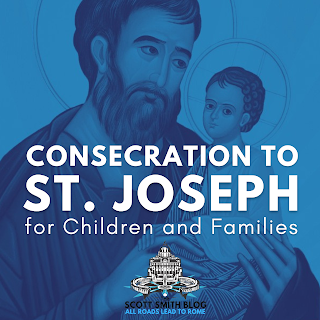
Consecration to St. Joseph for Children & Families:
TABLE OF CONTENTSClick the links below to find out more about the Consecration to St. Joseph for Children & Families: Video Introduction from Fr. Donald Calloway NEW Calendar for the Consecration to St. Joseph for Children & Families Why Consecrate Your Family to St. Joseph? Host a Parish-Wide Family Consecration! Dates for the Consecration to St. Joseph for Children & Families Questions? Contact Co-Author Scott L. Smith
Here's a video from Father Donald Calloway's introducing this new book, Consecration to St. Joseph for Children and Families :
This is ideal as an Advent and Christmas family prayer routine. Want to build a holier family? The Consecration ends on December 30, the Feast of the Holy Family! How perfect is that? Consecrations also end on the Solemnity of St. Joseph, St. Joseph the Worker, and the other feasts of St. Joseph -- see the full List of Dates below:
We created a table-top Calendar to go with the family Consecration to St. Joseph. We wanted to spark the children's imaginations visually and give them something to focus on.
Also, there are STICKERS! One for each day. Kids can take turns putting on the sticker of the day.
Here's a video of Fr. Donald Calloway introducing the Calendar:
Here are some more calendar images:

Thanks to the amazing Chris Lewis of Baritus Catholic for designing this beautiful calendar! I always loved the Candyland game board as a kid. It really sparked my imagination. So I asked Christ to design something in that grain. He nailed it!
In just a few words? BECAUSE GOD DID. God entrusted the Holy Family to St. Joseph. We should entrust our families to St. Joseph, too!
Families are under attack!
Our Lady of Fatima warned that the "The final battle between the Lord and the kingdom of Satan will be about marriage and family." The battle is underway, and we need Jesus' own champion, St. Joseph.
To preserve and protect our families, we need to be perfect parents . Really. I mean it. Perfect. "Be ye, perfect, as your Father in Heaven in perfect" (Mt 5:48).
But how? How is that possible?

St. Joseph, the Pillar of Families! St. Joseph will cover all our weaknesses and inadequacies as parents with his cloak. St. Joseph will hide our children from Satan, just as he hid the Holy Family, with this cloak.
This is the purpose of the consecration! Entrust your family to St. Joseph just like God entrusted the Holy Family to St. Joseph ... and do it soon.
We've been going around the country launching parish-wide and diocesan-wide Consecrations to St. Joseph for Children & Families. Email StJoeConsecration@gmail.com if you are interested in bringing this to your parish or diocese. Scott is happy to travel to your location for free to help you launch the consecration!
Here are some pictures of a recent parish launch at St. Patrick's Catholic Church in Dallas:


Want more specifics on how to host a parish-wide Consecration to St. Joseph for Children & Families? Here's a white paper for parishes:

Here are all the Feast of St. Joseph through the year with the corresponding date, 32 days beforehand, to begin your family's Consecration to St. Joseph:

Feel free to email us at StJoeConsecration@gmail.com. Thanks!
November 17, 2022
The One Question to Convert All Protestants: Where Did The Bible Come From? Did Catholics Add Books to The Bible OR Did Protestants Remove Books from The Bible? The Truth About The Apocrypha
If there was ever a zinger to stump Protestants, it is this question. And it's such a simple question! If all Christians truly knew and understood this question, our divisions would begin to evaporate.
Where did the Bible come from? That's it. That's the question every Protestant must answer for himself or herself.More specifically, where did the Bible's Table of Contents come from? Why does the Bible include some books and exclude others?
Did Catholics add the deuterocanonical books, the so-called Apocrypha? Or did Protestants remove these books? Because the books contradicted Protestant theology?
Here's also a great interview of Dr. John Bergsma, a Protestant minister and convert to Catholicism, on The Journey Home, which centers on these basic questions that troubled him as a Protestant:
Dr. Bergsma describes how, as a Protestant minister, he couldn't satisfactorily answer the fundamental question of where the Bible came from. This ultimately resulted in his Catholic conversion. So, what's the Answer? Where did the Bible come from? What Bible did Jesus and the Apostles use?Here's a comic I drew up about Martin Luther's Bible. Luther removed several key books from the Christian Bible. Why would the Father of Sola Scriptura (the "Bible alone") remove books from the Bible? Books which conveniently did not match his Protestant theology?
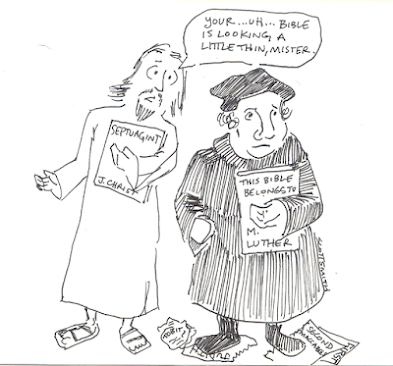
It is extremely important to get this right. Did Catholics add books or did Protestants take books away?
There is a terrible warning against adding or taking away books from the Bible. Revelation 22:18-19:
[18] I warn every one who hears the words of the prophecy of this book: if any one adds to them, God will add to him the plagues described in this book, [19] and if any one takes away from the words of the book of this prophecy, God will take away his share in the tree of life and in the holy city, which are described in this book.
For 1500 years ...
From the time of Christ until the Protestants break from the Catholic Church ...
All Christians everywhere had been using the same version of the Old Testament.
Then Martin Luther comes along.
Guess which version of the Old Testament, i.e. the Jewish Scriptures, Jesus and the Apostles used? The pre-Luther version.
Why would Luther and, subsequently, John Calvin change the Bible so dramatically, especially with their emphasis on Sola Scriptura, the doctrine of authority residing in the Bible alone? It doesn't make any sense.

The version of the Old Testament used by Jesus, the Apostles, St. Paul, and all Christians until the 1500s was the Septuagint version. It was the Greek translation of the Jewish scriptures. This was the translation commissioned by King Ptolemy of Egypt for his Library at Alexandria.
Septuagint? Weird word. Where's it come from? It means "seventy." King Ptolemy brought together seventy Jewish scholars to translate the Bible from Hebrew into Greek. Ptolemy isolated the translators from each other, so they could not collaborate. Miraculously, each and every translation was identical.
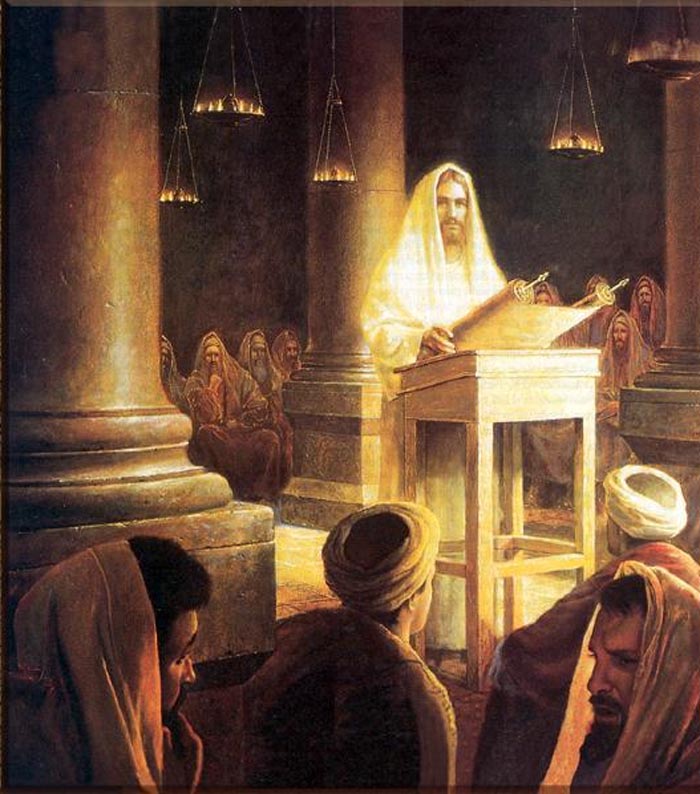
When Jesus reads from the Scriptures, he's reading from the Septuagint version.
When the Apostles read from the Scriptures, they're reading from the Septuagint version.
Then, what version should Christians read from?
Martin Luther took out the following books from the Septuagint translation of the Old Testament: Tobit, Judith, Wisdom, Sirach, Baruch, 1 & 2 Maccabees, and parts of Daniel and Esther.
Luther put these books into an appendix of his Bible. John Calvin ripped them out entirely.
But why these books? The all important question! Because Luther didn't find these books in the canon of the Jews of his time. Luther took his Table of Contents from the Jews of his time over the Jews of Jesus' time ... even over the Canon of Jesus, Himself!
So, ask yourself:
Which version of the Bible should you be reading?
The Bible Came from the Catholic ChurchThe Bible was (and is) a liturgical book meant for Catholic worship. In the first centuries, Christians began to ask, what can we read in church? They answered this question simply: What have we been reading in Mass? This was their principal criterion for canonicity: Tradition.
That was how we got the Bible. According to Dr. John Bergsma, "[The Bible] was a book for the liturgy based on what was read in the liturgy."
Certain books were included in the Canon of Scripture and certain books were excluded. Why were certain books included? Who made the decision? What was the criteria?
Here is a great in-depth video from Dr. Brant Pitre on exactly these questions:
How do Protestants know that the Bible is Inerrant and Inspired?Protestants have largely rejected the Catholic Canon of Scripture. Calvin and Luther removed several books from the Catholic Old Testament and cast suspicion on many books from the Catholic New Testament, as well.
What proof do they offer for the Protestant Canon and the rejection of the Catholic Canon? Dr. Pitre answers this question above in his debunking of the so-called Council of Jamnia. I also address it in this article.
The underlying question, however, is more fundamental. How do we know the Bible is inerrant and divinely inspired?
Protestant Answer #1: No clue. Many Protestants are even blind to where they got the idea that the Bible is infallible and divinely inspired. They simply don't know and don't care.
How can this be? The Bible, itself, is silent on these subjects. You don't find a list anywhere in the Bible of which books belong in it. You don't find a statement within the Bible that it is infallible and inerrant, either.
It was the Catholic Church that first taught the Protestants that the Bible was the Word of God. The Church produced this book, then handed it to believers, and said this is the Word of God. It is infallible and inerrant.
So whenever a Christian, Catholic or Protestant, believes these things about the Bible, they are inherently putting trust in the Catholic Church which first taught them that. Therefore, according to Dr. John Bergsma, "if you believe in the infallibility of the Bible, you're actually assuming the infallibility of the Church."
Protestant Answer #2: It's obvious. It's self-evident."It's obvious, isn't it?" When you ask this question of our Protestant brethren, this will usually be the response. No, it's not obvious.
Understandably, this isn't a question thoroughly explored in Protestant circles. Most Protestants you ask will be puzzled just by the premise of the question. This is an opportunity for another sola, sola fide ("Faith alone"). Faith and reason should go together.
Bergsma quotes a statement in one of his Dutch Reformed confessions: "even the ignorant can see the things that take place therein are being fulfilled." Say what? That's obviously some circular reasoning.
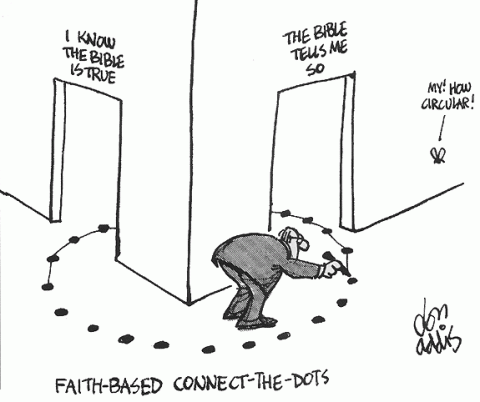
Want more circular reasoning? After a rejection of rational thought which might lead him to embrace of the Council of Nicaea, one Protestant pastor says "God’s word proves itself as God’s word."
John Calvin in his seminal work, Institutes of the Christian Religion , provides the following basis for the inerrancy and infallibility of the Bible:
Let this point therefore stand: that those whom the Holy Spirit has inwardly taught truly rest upon Scripture, and that Scripture indeed is self-authenticated; hence, it is not right to subject it to proof and reasoning. And the certainty it deserves with us, it attains by the testimony of the Spirit…it seriously affects us only when it is sealed upon our hearts through the Spirit. Therefore illumined by his power, we believe neither by our own nor by anyone else’s judgment that Scripture is from God; but above human judgment we affirm with utter certainty…that it has flowed to us from the very mouth of God by the ministry of men. (John Calvin, Institutes, I.vii.5)
There it is. Straight from the horse's mouth. The Canon of Scripture is "self-authenticated". It's self-evident and obvious. Not only that, it is "not right" to subject Scripture to "proof and reasoning". Yikes.
Nevertheless, Calvin does find proof for the Canon in the "testimony of the Spirit." The Holy Spirit provides proof that Scripture comes from God. When our hearts burn with the Spirit's fire upon reading, we know. This is true! But it is not the full truth. That's not how the Church decided what books would go in the Bible and which would not.
This "heart-burn" explanation actually creates more issues than it solves. Why? Mormons, for one, love this explanation for Scripture.
Have you ever had a Mormon missionary knock on your door? Ask them why they believe the Book of Mormon is Scripture. Ask a Mormon why their book deserves to be added to the Canon.
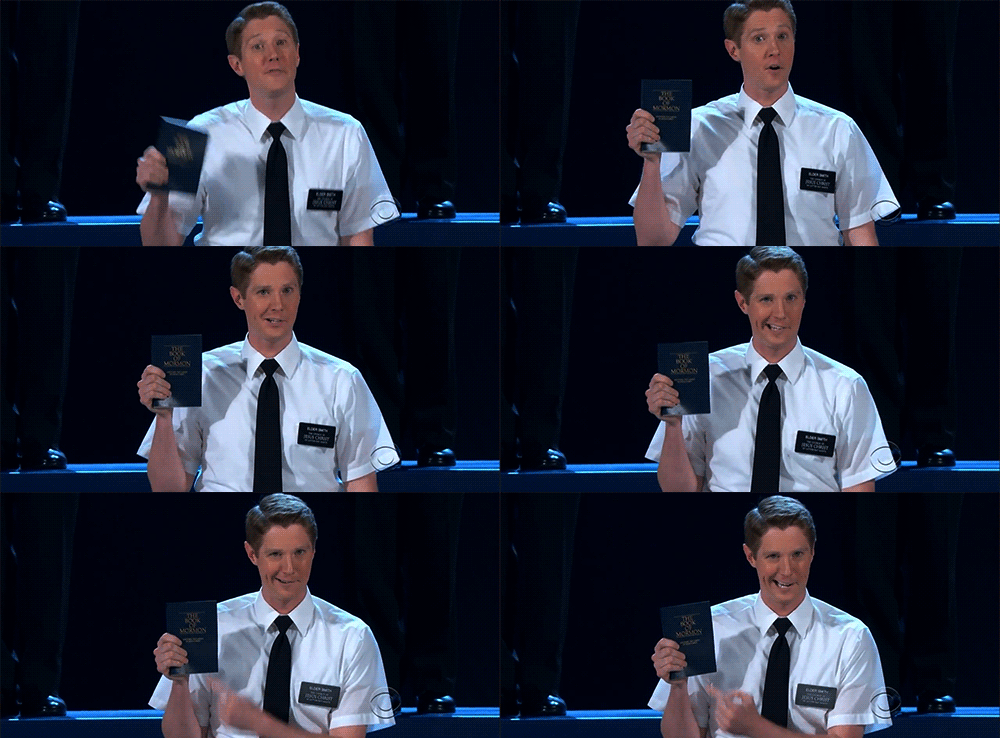
The Mormon will say "pray for the Holy Spirit" and "the Holy Spirit will confirm" that the Book of Mormon is Scripture. Uh-oh. The Mormons will ask after reading from their book, "did not your hearts burn with the reading of those words?" Gulp. How does a Protestant respond to that?
You see, the problem with throwing away the laws and history is that, once everything is wiped away, you will have nothing to defend your position with. Even against the devil, himself ...
No where is this so eloquently described as in the following scene from A Man For All Seasons:
I hope you enjoyed this article! Please comment below about your experience, as a Catholic or Protestant, asking or answering this question. Also, please remember to share!
October 27, 2022
Pray the Rosary with Blessed Anne Catherine Emmerich: Emmerich's Revelations for the Mysteries of the Rosary
Incredibly, God gave this nun the special privilege of beholding innumerable Biblical events from Creation to Christ’s Passion and beyond. You may have already seen many of her visions, as depicted in Mel Gibson's 2004 film The Passion of the Christ.
Blessed Anne Catherine Emmerich's visions of Christ's Passion, Death, and Resurrection brought these events to life, cinematically, like never before.
So, I had an idea ...
What if Emmerich's visions could do the same for the Rosary?

Pray the Rosary like never before!
I just published this new book. There is a section for every mystery of the Rosary - Emmerich had a vision for every one.
Enter into the mysteries of the Rosary through the eyes of this 19th-century Catholic mystic: Blessed Anne Catherine Emmerich.
[image error] [image error]
Never before have Emmerich’s revelations been collected in a single volume to help you pray the Rosary. Emmerich was able to describe the events of the Rosary in intimate, exquisite detail.
Adding depth and texture to the Gospel accounts, these passages will greatly enhance your experience of the meditations of the Rosary. Enjoy!
So, who was Blessed Anne Catherine Emmerich?
Who was Blessed Anne Catherine Emmerich?Anne Catherine Emmerich or Anna Katharina Emmerick was born on September 8, 1774 and died on February 9, 1824. Emmerich was an Augustinian nun, or more specifically, an Augustinian Canoness Regular of Windesheim. Emmerich was also a mystic, visionary, and stigmatist.
Emmerich was a stigmatist, meaning she experienced the stigmata -- the wounds of Christ's Passion and Crucifixion -- on her body. She experienced bleeding from her hands and feet periodically from 1813-1818.
The Blessed Virgin Mary gave to Blessed Anne Catherine Emmerich visions of the life and passion of Jesus Christ.
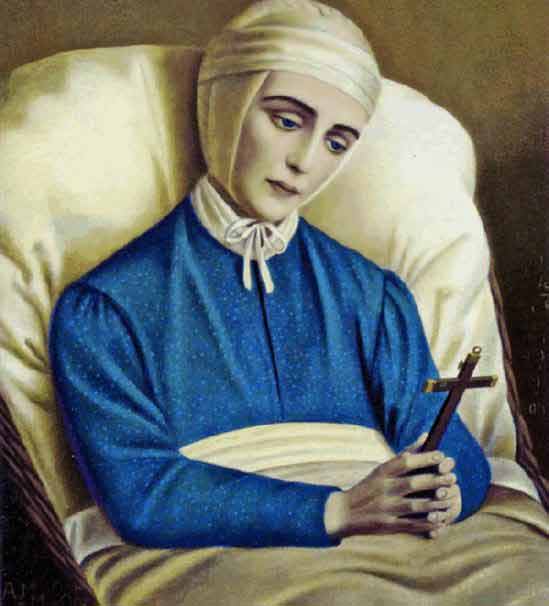
Emmerich was bedridden for most of her adult life. During her bedridden years and years experiencing the stigmata, a number of well-known figures were inspired to visit her. These included the poet Clemens Brentano, who interviewed her at length and published two books based on his notes of her visions.
Read more below on how Emmerich's visions have been confirmed archaeologically or otherwise ...
Emmerich was beatified by Pope John Paul II on October 3, 2004. Emmerich's cause for beatification was adjudicated solely on the basis of her own personal sanctity and virtue.
Blessed Anne Catherine Emmerich & the Movies, Watch the Movie About Emmerich's Life, The PledgeIn 2003, Mel Gibson used Emmerich's visions, as compiled in Brentano's book The Dolorous Passion, as a key source for his movie The Passion of the Christ. Gibson stated that Scripture and "accepted visions" were the only sources he drew on. A careful reading of Brentano's book shows the film's high level of dependence on it.[1]

Clemens Brentano's interviews of Emmerich were dramatized and made into the 2007 film The Pledge [Das Gelübde, also translated as The Vow] by German director Dominik Graf. It's sort of a difficult movie to track down, since there are a couple other, better known movies with the title The Pledge. I advise looking it up using the German title Das Gelübde. You can read more about it here. The film was based on a novel by Kai Meyer. Emmerich was portrayed by actress Tanja Schleiff.
Confirmation of Blessed Anne Catherine Emmerich's VisionsOftentimes, Blessed Anne Catherine Emmerich would experience visions and not have any idea what she was seeing. Then, maybe even years or decades after her death, the visions would be confirmed.
This is what happened with Santo Anello -- Mary and Joseph's Wedding Ring! I've written another article about this here .
Blessed Anne Catherine Emmerich & The Finding of the House of Mary in Ephesus (The Domus Mariae)Remember Christ's words from the Cross to the Apostle John, "Behold, Your Mother!" From that point on, John took the Blessed Virgin Mary as his own mother and as a member of his household.
John eventually settled in Ephesus, in modern-day Turkey. This is Ephesus as in St. Paul's Letter to the Ephesians.
So where was Mary's house? The house she lived in before her Assumption into Heaven?
Ephesus.
Check out this video of the House of Mary in Ephesus, as well as the notes on the healing waters found there:
The House of Mary, however, was lost to time and the centuries. Neither Brentano nor Emmerich had ever been to Ephesus, and archaeologists had not yet excavated the city during Emmerich's life.
However, Emmerich's visions were actually used during the discovery of the House of the Virgin Mary. According to Emmerich. the Blessed Virgin's home was located on a hill near Ephesus.
Check out the detail Emmerich uses to describe Mary's house: [2]
The Blessed Virgin's dwelling was not in Ephesus itself, but from three to four hours distant. It stood on a height upon which several Christians from Judea, among them some of the holy women related to her, had taken up their abode. Between this height and Ephesus glided, with many a crooked curve, a little river. The height sloped obliquely toward Ephesus. From the southeast one beheld the city as if lying just before him, at the foot of a mountain, but on nearer approach, he found the latter stretching still further away. From Ephesus, before which I saw great avenues with yellow fruit strewing the ground, narrow footpaths led up to this wild, overgrown height, upon which, to the circumference of about an hour, stretched a very solitary but fertile plain covered with smooth-trunked, wide-spreading trees, and containing clean rocky caves. These latter had, by means of light woodwork, been converted into hermitages by the early Christian settlers who had fled thither for refuge. These abodes, along with others that stood alone scattered here and there over the whole country, gave the region the appearance of a little village. From the top of this elevated plain, which was nearer to the sea than Ephesus, one could see both the city itself and the sea with its numerous islands.
What a beautiful setting! Fitting for the Blessed Mother, the Queen of the King of Kings.
In 1881, the Abbé Julien Gouyet, a French priest, used Emmerich's book to search for the house in Ephesus. Father Julien found the house based on Emmerich's descriptions!
Father Julien's discovery was not taken seriously at first. Nevertheless, Servant of God Sister Marie de Mandat-Grancey kept promoting the discovery. Marie de Mandat-Grancey was a French nun and nurse. After many years as a nurse in France, she was assigned to the Mission to Turkey in 1886. There, she served in the French Naval Hospital at Smyrna. She was able to secure the purchase of the House of Mary (the Domus Mariae or Meryem Ana Evi) in November 15, 1892, despite many obstacles.
Finally, thanks to Marie de Mandat-Grancey persistence, two other priests followed the same path and confirmed the discovery of the Domus Mariae.[3][4]
Pope Pius XII declared the Domus Mariae a Holy Place in 1951. Pope John XXIII subsequently made the declaration permanent. Many popes have also visited the house and reverenced it as a shrine, including Pope Paul VI in 1967, Pope John Paul II in 1979 and Pope Benedict XVI in 2006.[5]
When was Blessed Anne Catherine Emmerich Beatified? Who Beatified Blessed Anne Catherine Emmerich?Anne Catherine Emmerich was beatified by Pope John Paul II on October 3, 2004. Emmerich's cause for beatification was adjudicated solely on the basis of her own personal sanctity and virtue.
Footnotes Blessed Anne Catherine Emmerich: [1] Jesus and Mel Gibson's The Passion of the Christ by Kathleen E. Corley and Robert Leslie Webb, 2004, p. 160-161[2] Life of Jesus Christ by Anne Catherine Emmerich (1774-1824), Volume 4, p. 450-451.[3] The Ancient Traditions of the Virgin Mary's Dormition and Assumption by Stephen J. Shoemaker, 2006, p. 76[4] Chronicle of the Living Christ: The Life and Ministry of Jesus Christ by Robert A. Powell, 1996, p. 12[5] "Where Mary Is Believed to Have Lived," November 29, 2006.
August 30, 2022
The Catholic Hero of Custer's Last Stand: The Vatican Soldier at the Battle of Little Bighorn, Lt. Col. Myles Keogh
George Armstrong Custer is the hero of Little Bighorn, right? It was Custer that made the "last stand" in the massacre that became Little Bighorn ... right?
Not according to the only surviving eyewitnesses to the battle: the Sioux.
Custer was not the only man who wore a buckskin coat at the Battle of Little Bighorn. There was another.
This other soldier also wore medals of valor given to him, not by the U. S. Army, but by the pope.
These medals and Keogh's courage accorded him a special honor in death.
All of which giving rise to the ...
Legend of the Medal. The Decline of American HeroesThese days, we are being told that there were no American heroes, especially in the Indian Wars following the Civil War. I deeply distrust this movement to emasculate American heroes. However, I'm not going to make my "last stand" defending George Armstrong Custer. Custer had some issues.
All this revisionist history aside, there remain enduring measures of heroism ... and lesser measures.
Custer's fame was due, in large part, to Wild West shows and beer advertisements. In the decades following Little Bighorn, barrooms across America were festooned with grand paintings of Custer's Last Stand. Budweiser literally painted the legend of Custer.

Perhaps one of the greatest ways to measure valor in battle is the treatment accorded a soldier by his enemies. This is how we can measure Myles Keogh. More on this in a minute ...
Lt. Col. Myles Keogh and Pope Pius IXLt. Col. Myles Walter Keogh is a fascinating, but relatively unknown Catholic historical figure. He was an Irish immigrant to the United States, but his path to America ran first through Italy.
In 1860, Myles Keogh was 20 years old. He volunteered, along with over one thousand of his Irish countrymen, to defend the pope. Catholic clergy in Ireland issued a call to arms to defend Pope Pius IX.
Pope Pius IX, now Blessed Pope Pius IX, is considered by both his enemies and his supporters to be the most influential pope of the 19th century. It was Pius IX who issued Ineffabilis Deus formally and finally defining the dogma of the Immaculate Conception on December 8, 1854.

At that time, the pope ruled over, not just religious matters, but an Italian kingdom of lands and people: the Papal States.
The Papal States were under attack by Italian nationalists and Freemasons, Giuseppe Garibaldi and Giuseppe Mazzini. Garibaldi and Mazzini had initially pledged their loyalty to Pope Pius IX, who attempted to help unite Italy, but these Freemasons later betrayed the pope and led their armies to attack the Papal states.
Keogh and his Irish countrymen fought in defense of these Papal States. Keogh was eventually promoted to second lieutenant of the Battalion of St. Patrick and posted at Ancona, a central port city of Italy.[1]
The Battalion of St. Patrick! Who wouldn't want to serve in that unit? You can read more about them here.


In September 1860, the papal forces at Ancona were surrounded and the pope's army was defeated in in the Battle of Castelfidardo. As many as 100 Irish soldiers in the Battalion of St. Patrick were killed or wounded during those few weeks of the siege of Ancona. Despite their admirable defense of Ancona, the Battalion of St. Patrick was forced to surrender, and Keogh was imprisoned at Genoa.
This would not be the last time Myles Keogh found himself surrounded in battle.

Keogh was soon released in a prisoner exchange and he traveled to Rome. In Rome, he was invited to wear the bright green uniforms of the Company of St. Patrick as a member of the Vatican Guard.
Pope Pius IX Awards Medals to Myles KeoghDuring his continued service, Pope Pius IX awarded him a medal (medaglia) for gallantry: the Pro Petri Sede Medal. Pius IX also knighted Keogh, giving him the Cross of a Knight of the Order of St. Gregory the Great (Ordine di San Gregorio).
Here are Keogh's personal medals below, the Order of St. Gregory the Great Cross (left) and the Pro Petri Sede Medal (right):[2]
 Don't be disturbed by the upside-down cross! That's the Pro Petri Sede Medal - the Cross of St. Peter. Remember, St. Peter asked to be crucified upside-down, because he didn't believe himself worthy to be crucified like Jesus.
 The face of St. Peter medal is circumscribed with the words Pro Petri Sede, which means "For the seat of Peter." The front of the medal also bears the inscription "PIO*IX*P*M*A*XV," meaning "Pius IX, Pontifex Maximus, 15th year, for the 15th year of the reign of Pope Pius IX, 1860." The reverse of the medal is circumscribed with Victoria Ovae Vincit Mundum Fides Nostra, which means "The victory of our flock conquers the world with our faith."
Myles Keogh, Civil War Hero The fighting was soon over, and the Vatican receded to what it is today, more or less - a city-state. Keogh's duties as a member of the Vatican Guard were too mundane for the young soldier.
Meanwhile, civil war had broken out in America. Lincoln's Secretary of State William H. Seward was seeking experienced European officers to serve the woefully inexperienced Union Army. Seward called upon a number of prominent Catholic priests to help him. John Hughes, the Archbishop of New York, journeyed to Rome to recruit the veterans of the war of the Papal States. There, he met with Keogh and the remnants of the Battalion of St. Patrick.

In March 1862, Keogh boarded the steamer Kangaroo for New York City along with his senior officer, Daniel J. Keily of Waterford.
Keogh under General Shields and McClellanKeogh, Keily, and another Papal comrade, Joseph O'Keeffe, the 19-year-old nephew of the Bishop of Cork, Ireland, were given the rank of captains on April 15 in Washington, D.C. They were assigned to the staff of Irish-born Brigadier General James Shields.
A competent enough general, Shields was, unfortunately, about to confront a Confederate army led by a tactical genius. None other than Thomas "Stonewall" Jackson.


Shields confronted Stonewall Jackson in the Shenandoah Valley at the Battle of Port Republic. The Union was defeated, but Keogh acquitted himself admirably on the battlefield. Keogh impressed no less a personage than George B. McClellan, the Commander of the Potomac Army and an extremely popular general. McClellan described the young Captain:[3]
His record had been remarkable for the short time he had been in the army. He appeared to be a most gentlemanlike man, of soldierly appearance, and I was exceedingly glad to have him as an aide.
McClellan requested that Keogh be transferred to his personal staff. Though only with McClellan a few months, Keogh served McClellan during his most difficult trial, the Battle of Antietam.
Unfortunately, McClellan failed to turn a technical victory into a decisive victory by refusing to pursue Robert E. Lee's army as it retreated. Lincoln removed the general from command, a difficult decision owing to McClellan's popularity. Lincoln would later defeat McClellan in the election of 1864.
This would not be the last time Keogh served an extremely popular, though ultimately doomed commander.
Keogh at GettysburgIn November 1862, Keogh and his Papal brother-in-arms, Joseph O'Keeffe, were reassigned to General John Buford's staff. There, they would skirmish against another brilliant Confederate tactician, Lee's cavalry commander J. E. B. "Jeb" Stuart.
Jeb Stuart's cavalier image may have inspired future cavalry leaders, like Custer, himself. Stuart wore a red-lined gray cape, the yellow waist sash of a regular cavalry officer, a hat cocked to one side plumed in ostrich feathers, and red flower in his lapel, not to mention copious amounts of cologne.


On June 30, Keogh's skirmishes with Jeb Stuart reached a climax as Buford's cavalry rode into Gettysburg, Pennsylvania. Buford quickly defended key strategic points, the high ground of the battlefield, which proved decisive in the Union Army's eventual victory over Lee's army on July 4, 1863.
Though victorious at Gettysburg, Buford's constant skirmishing against Jeb Stuart took its toll. Despite Keogh never leaving his commander's side, Buford finally succumbed to typhoid.
Keogh as a Prisoner of WarKeogh was again reassigned to serve under General George Stoneman, Chief of Cavalry, Army of the Potomac, who would say of Keogh:
Major Keogh is one of the most superior young officers in the army and is a universal favorite with all who know him.
General Stoneman led risky cavalry raids behind enemy lines in Georgia attempting to liberate Union prisoners of war in Macon and the infamous Andersonville prison. Keogh eventually became a prisoner of war, himself.
On July 28, 1866, Keogh was promoted to Captain and reassigned to the 7th Cavalry at Ft. Riley in Kansas. There, Keogh took command of Company I. The 7th Cavalry Regiment was commanded by Colonel Andrew Smith until Colonel Samuel D. Sturgis assumed command in 1869.[4]
Lieutenant Colonel George Armstrong Custer would become the regiment's deputy commander.[5] Pictured below are Custer (left) and the officers of the U.S. 7th Cavalry (right):


Keogh, Custer, & The Indian WarsKeogh did not serve under Custer during the Battle of Washita (1868), the Yellowstone Expedition (1873), or the Black Hills campaign (1874). While the Battle of Washita is considered the first real victory in the Southern Plains War, it was during this battle that Custer massacred women and children. Custer had adopted the total war military tactics encouraged by General Philip H. Sheridan. The quote "the only good Indian is a dead Indian" has been attributed to Sheridan.
Maybe the Battle of Washita or the Black Hills campaign would have turned out differently had Keogh been present, maybe not. Regardless, Keogh's recorded is gratefully unstained by any massacre of women and children.
As 1867 progresses, Keogh was fighting Indians almost every day while on expedition with Alfred Sully, another commander infamous for leading Indian massacres. It was in one such fight that Keogh's new horse, Comanche, received his first wound and, as the story goes, his name.[3] Comanche would remain Keogh's loyal mount through the Battle of Little Bighorn.

Keogh's Last Stand, the Battle of Little BighornOn June 25, 1876, Myles Keogh died during the Battle of Little Bighorn. Keogh was the senior captain among the five cavalry companies there were wiped out with Custer that day. Keogh commanded one of the two squadrons under Custer's command.
While it is known as Custer's Last Stand, it was actually Keogh's Last Stand. Evidence from the battlefield and eyewitnesses suggest that the last surviving troops under Custer's command rallied to Keogh, as Custer died much earlier in the battle.
One of the only American survivors of Little Bighorn was actually Keogh's own mount, Comanche. More on his hero horse later ...
Since a horse cannot provide much of an eyewitness account, the only eyewitness accounts available are from Sitting Bull's people, the victors: the Lakota, Cheyenne, and Arapaho.
One of the most vivid and thorough eyewitness accounts is not written or even a transcribed interview. It's a series of 42 "ledger art" illustrations by Red Horse, a Minneconjou Lakota Sioux warrior who fought in the battle.[8]
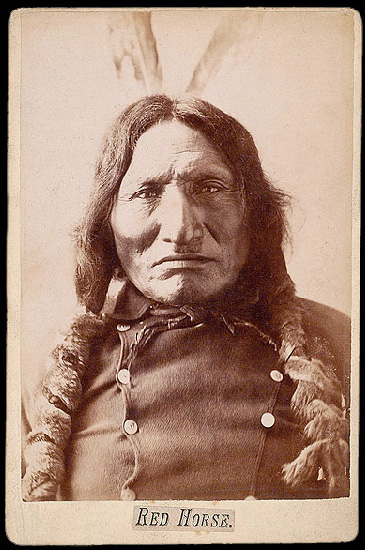
Caution: Red Horse depicted in vivid detail the mutilated corpses of the American soldiers killed in the battle. Even though they are just drawings, they are still very graphic:
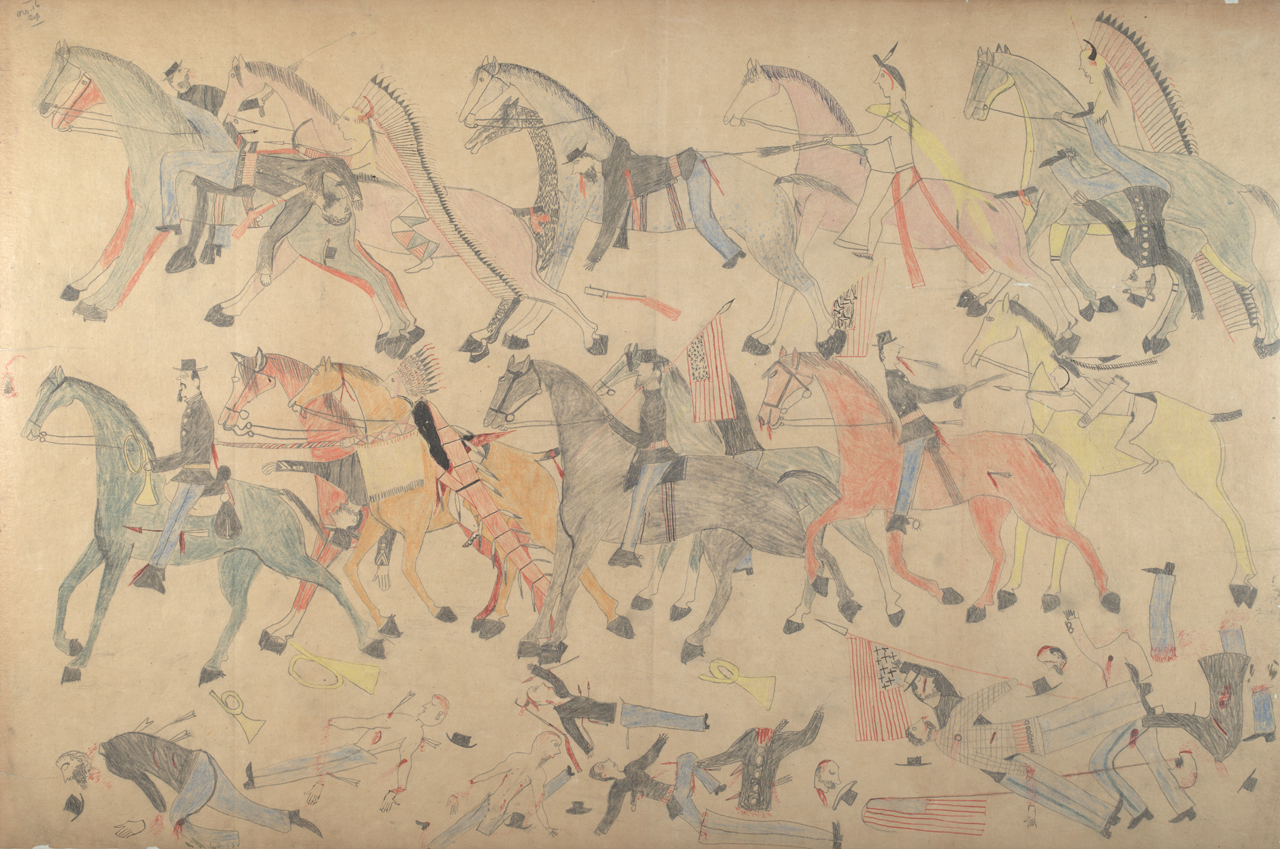 Red Horse, “Untitled from the Red Horse Pictographic Account of the Battle of the Little Bighorn” (1881), graphite, colored pencil, and ink (08570700, National Anthropological Archives, Smithsonian Institution)
Not to go into excruciating, gory detail, the accounts of the battle describe that the bodies of all the American soldiers were mutilated ...
Except one.
Keogh's Last Stand - The Legend of Keogh's MedalThe precise details of Keogh's death will never be fully known, but the testimony of the Sioux agree on one fact in particular: Lt. Col. Myles Keogh was the bravest man they ever fought. Keogh died fighting and encouraging his men to make a last stand, all with Comanche by his side.
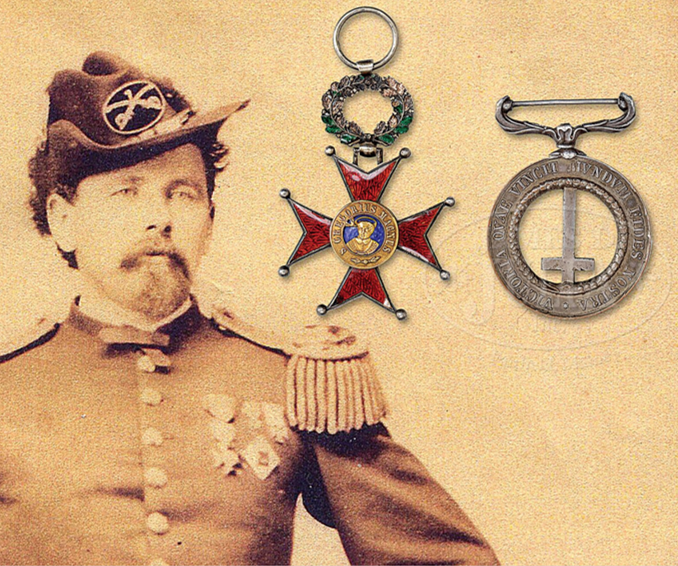
There are differences in the historical accounts. Some even say Sitting Bull, himself, was wearing Myles Keogh's Pro Petri Sede medal around his neck when he was killed by his own Indian Police.[6]
All the accounts agree on several facts, however. First, Myles Keogh's body was the only one not mutilated. Second, the Sioux either treated Keogh's body with respect from the beginning because of Keogh's great courage in the battle or began treating his body with care, once they stripped the body and discovered his Catholic medals.[7]
Some believe the Sioux treated Keogh's body with respect because they viewed the Pro Petri Sede cross medal (sometimes referred to as an "Agnus Dei" medal) as a powerful charm. Other accounts hold that some of the Sioux were Catholic converts, and understood the honor accorded to Keogh.
Keogh died in the true "last stand" of Little Bighorn, surrounded by the men of Company I. When the remaining troops of the 7th Cavalry arrived days later, they found Keogh's body near his horse and surrounded by the dead bodies of his own company, Company I. All the dead were buried on the battlefield, but on the October 25, 1877, Keogh's body was re-interred with full military honors at Fort Hill Cemetery in Auburn, New York. A dignified monument keeps watch over his final, earthly resting place.
Requiescat in Pace.
 "Joe Keough [sic] of Ohio plays the bagpipes Monday commemorating the 125th anniversary of the death of Lt. Col. Myles Keogh at the Battle of Little Big Horn [sic] ..."
"America's Greatest Horse" The Survivor: Keogh's Horse, ComancheOne last amazing detail about Keogh: the sole U.S. survivor of the Battle of Little Bighorn was Keogh's horse, Comanche. Okay ... just one more amazing detail: Comanche was one of only four horses in US history to be given a military funeral with full military honors. Wow!
Disney even made a movie about Comanche: 1958's Tonka, which was also released as A Horse Named Comanche. The Disney film starred Sal Mineo and was based on David Appel's book.

You can read more about Comanche here and here from the University of Kansas' Natural History Museum and here.
Footnotes Myles Keogh, Catholic Hero of Little Bighorn[1] The Papal Army was under the command of General Christophe Léon Louis Juchault de Lamoricière.
[2] The medals pictured are actually those of Myles Keogh. They were sold at auction in 2015 for over $36,000 by Morphy Auctions. Here is the description provided from Morphy Auctions:
RARE AND UNIQUE MEDALS OF CAPTAIN MYLES KEOGH FROM CUSTER BATTLEFIELD.The “Pro Petri Sede Medaglia” was taken from the body of Myles Keogh when found June 27, 1876 on the east side of the battle ridge at the Little Big Horn. Myles Keogh is seen wearing these two medals in Civil War photography and during the Indian War. The “Medaglia di Pro Petri Sede” (Pro Petri Medal) was presented to Keogh after the Papal War by Pope Pius IX 1860, he was also awarded the “Ordine di San Gregorio” (St. Gregory Medal). Vatican records confirm these two medals both given to Keogh. The Papal War of 1860 ended with the fall of Ancona where as many as 100 Irish soldiers in the Battalion of St. Patrick were killed or wounded during those few weeks in September. For their service, each officer and enlisted man was awarded the Medal for Gallantry “Pro Petri Sede Medaglia” by Pope Pius IX. The medal is a circular, silvered nickel-silver medal with hollow center with inverted Latin cross. With a circular ring in the form of a scaled mythical creature swallowing it’s own tail, on ornate swivel suspension with ribbon bar; the face circumscribed ‘PRO PETRI SEDE’ (literally ‘for the seat of Peter’, meaning for the Vatican) above and ‘PIO*IX*P*M*A*XV’ (= Pius IX Pontifex Maximus 15th year, for the 15th year of the reign of Pope Pius IX = 1860); the reverse circumscribed ‘VICTORIA OVAE VINCIT MUNDUM FIDES NOSTRA’ (The victory of our flock conquers the world with our faith). These medals were of great importance to Keogh when he lost both in a fire at the famous Galt House Hotel in Louisville, Kentucky in 1865. In 1867 Keogh obtained replacement medals. Keogh affirmed he didn’t want to take leave for home in Ireland unless he had both medals with him. The last known photograph of Keogh taken in 1872 shows both medals prominently displayed on his left breast. These two medals of Myles Keogh are extremely well provenanced from direct family descent and lastly, one of the largest historians and authorities of Custer memorabilia, Dr. Elizabeth Lawrence. There are few personal mementos documented from the Custer battlefield that have a more interesting history than Keogh’s Medal for Gallantry “Medaglia di Pro Petri Sede” given him by Pope Pius IX in 1860 while he was fighting with other Irish Catholics in the Battalion of St. Patrick in the Papal Army. There are numerous accounts concerning Keogh’s body being not mutilated due to the fact he was wearing this medal. One of the most comprehensive texts on the Custer battle is Evan Connell’s 1984 Son of the Morning Star where he summarizes several accounts of Keogh’s body and this medal “Captain Myles Keogh had not been disfigured. He lay naked except for his socks, with a Catholic medal around his neck which usually is identified as an Agnus Dei, perhaps because Agnus Dei is a familiar phrase. Romantics describe it as a cross hanging from a golden chain. Almost certainly this medal was kept in a small leather purse or sheath and Keogh most likely wore it suspended by a leather thong or length of cord. It was the Medaglia di Pro Petri Sede awarded to him by Pope Pius IX for service with the Papal Army.” In the most important biography of Keogh, written in 1939 by Edward Luce Keogh, Comanche and Custer. Luce was positive it was “the Pro Petri” medal that he wore and further claimed it was in “… a leather case attached to a cord around his neck…””. Accompanying these medals is a file of correspondence from descendants and Dr. Lawrence concerning medal. It is interesting to note that in a copy of Keogh’s will written just three days prior to his death states his $10,000 life insurance policy and all his personal affects would be given to his sister Margaret Keogh in Ireland. In an article posted online, PROVENANCE: Myles Keogh 7th US Cavalry 1860, Margaret Keogh (sister) Kil Kenny, Ireland 1876, Dr. Desmond Blanchfield Keogh,Carlow, Ireland 1947, Garret Keogh Dublin, Ireland 1988, Dr. Elizabeth Atwood Lawrence 1988, Dr. Robert P. Lawrence 2003. CONDITION: Very good overall. Minor chipping in red enamel on St. Gregory Medal. Suspension ring opened on St. Gregory cross to green enameled wreath which is chipped, missing about 60% of enamel overall. Pro Petri still exhibits some luster, however plating is worn and scratched over much of its surface with small reductions of silver plating on cross as can be seen in photographs. 4-54477 JS (30,000-50,000)
[3] The Honor of Arms: A Biography of Myles W. Keogh, Charles L. Convis, 1990.
[4] Myles Keogh: The Life and Legend of an "Irish Dragoon" in the Seventh Cavalry, John P. Langellier, Kurt Hamilton Cox, Brian C. Pohanka, 1998, ISBN 0-912783-21-4.
[5] "Lt Col George Armstrong Custer – Little Bighorn Battlefield National Monument". National Park Service (nps.gov). 9 May 2019. Retrieved 25 September 2019.
[6] Robert Hollow's The Last Years of Sitting Bull states that Sitting Bull's crucifix was given to him by Father Pierre-Jean de Smet, the missionary priest of the northern plains. No mention is made of the St. Peter's cross medal in this account.
Hollow, Robert C., and Herbert Theodore Hoover, The Last Years of Sitting Bull, North Dakota Heritage Center, State Historical Society of North Dakota, North Dakota Heritage Center, 1985
[7] Lt. Edward S. Godfrey, who was present at the Battle of Little Bighorn, told artist E.S. Paxson in 1896 that Koegh's medal had not been removed. Trumpeter Martini, the last man to get out, insisted Benteen took the medal. Certain historians provide Keogh with two medals: one around his neck, another in his pocket. This is conceivable because the Pope awarded him, as a mark of special favour, the Cross of the Order of St. Gregory. Whatever the exact truth most scholars agree that he had the Pope's medal, and that it kept his corpse from being abused. Another historian records that the Pro Petri Sede medal was recovered by Captain Henry J. Nowlan, 7th Cavalry.
Keogh died in a "last stand" of his own, surrounded by the men of Company I. When the sun-blackened and dismembered dead were buried three days later, Keogh's body was found at the center of a group of troopers that included his two sergeants, company trumpeter and guidon bearer. The slain officer was stripped but not mutilated, perhaps because of the "medicine" the Indians saw in the Agnus Dei ("Lamb of God") he wore on a chain about his neck or because "many of Sitting Bull's warriors" were Catholic. Keogh's left knee had been shattered by a bullet that corresponded to a wound through the chest and flank of his horse, indicating that horse and rider may have fallen together prior to the last rally.
[8] "A Lakota Sioux Warrior’s Eyewitness Drawings of Little Bighorn," Allison Meier, November 19, 2015
June 29, 2022
The Jewish Roots of the Altar Rail: The History and Origins of the Altar Rail in the Temple of Jerusalem
Altar rails? Aren't those a pre-Vatican II thing? An old-fashioned, antiquated church concept?
Altar rails aren't just from the 1950s. Did you know the liturgical tradition of the altar rail is not antiquated, but ancient?
Did you know altar rails even predate JESUS?
I have been studying and uncovering the riches of the Mishnah recently. The Mishnah is the ancient collection of Jewish traditions. Tradition is a pillar of Judaism, just as it is in Christianity -- at least Catholic and Orthodox Christianity.
The slaughter of the Passover lambs in the Mishnah is fascinating! There is rich theology here pointing to the Eucharist, and even why we should receive the Eucharist kneeling and on the tongue. This will be the subject of future articles, as well.

The Slaughter of the Passover LambsThe Jews had to slaughter A LOT of lambs at Passover. The Jewish historian Josephus records that as many as 256,000 lambs were slaughtered at Passover during the time of Jesus. So many lambs! Wars of the Jews by Josephus, Book Six, Chapter 9, Section 3:
... found the number of sacrifices [in Jerusalem at Passover circa 4 BC] was two hundred and fifty-six thousand five hundred [256,500 lambs]; which, upon the allowance of no more than ten that feast together, amounts to two million seven hundred thousand and two hundred persons that were pure and holy was 256,500 lambs.
And where were all 256,000 lambs slaughtered? The Temple.
This created a river of blood and water flowing from the side of the Temple, as from the side of Christ, but more on that in future articles.[1]
Not only that!
St. Justin Martyr records that the manner of preparation of the Passover lambs resembled a CRUCIFIXION![2] The Jews crucified the Passover lambs and the Lamb of God, Himself. But again, but more on that in future articles, as well as Footnote #2 at the end of the article.


The Communion Lines in the Temple in JerusalemThe Mishnah describes lines and lines of Jews waiting to slaughter their lambs. Think of communion lines, lots of them. The lines of men in the Temple in Jerusalem sort of resembled a holy version of the checkout lines on a busy day at Costco or Sam's Club. The Mishnah Tractate PESAĤIM, Chapter 5, Mishnah 5 describes this scene:
The paschal lamb is slaughtered in three groups, for it says'the whole community of the congregation of Israel shall slaughter it' -community, congregation and Israel. The first group would come in, thecourtyard would be filled and the doors of the courtyard would be closed. Theywould sound Teki'ah-Teru'ah -Teki'ah. The priests would be standing in manylines holding basins of silver and gold: one line entirely silver, one lineentirely of gold; nor were they mixed. The basins had no base so that theycould not be set down [since] thus the blood would congeal.
The lines of men were met with lines of priests. The priests would collect the blood from the slaughtering of the lambs in golden chalices.
One Rabbinic explanation of this passage provides the following:[3]
The main and largest courtyard of the Bet Mikdash was the so-called 'Courtyard of Women'. Here all the peopleassembled with their lambs and their numbers must have been formidable. Whenthe time came to commence the process of slaughtering the great Nicanor Gatewhich gave access to the Courtyard of the Priests was opened and the people began to surge forward, up the fifteen stepsthat led up to the gate and into the holy Courtyard ...
When the people were admitted tothe holy courtyard they found rows of priests already present and waiting forthem. Each row of priests consisted of men holding basins of gold or silver.These basins were to hold the blood of the paschal sacrifice, which was to besprinkled on the side of the main altar ...
The Misnah continues to describe in great detail the preparation of the lambs, their skinning, etc. Very gruesome, if you're not acquainted with this sort of thing.
But we've finally arrived at the Altar rail part ...
Did you notice the different courtyards? Guess what divided the Israelites from the Courtyard of the Priests?
The Altar Rail of the Courtyard of the Priests in the Jerusalem TempleThe Jewish men at Passover would each be carrying a lamb to the Courtyard of Priests. They would process from the Courtyard of the Israelites to the Courtyard of the Priests, stopping at the border of the Courtyard of the Priests.
Here is a map of the Jerusalem Temple. The area of focus is highlighted in yellow. I have also added a red dotted line to mark the separation between the Court of the Israelites and the Courtyard of the Priests (or "Priests Court"):

Do you see all the similarities to the traditional design of a Catholic Church? There's the "Chamber of Phinehas, Keeper of Vestments." That's the church's sacristy and Phinehas, the sacristan. There's the Holy of Holies, too - the (centrally-located) Tabernacle of a Catholic Church.
And notice the divisions by height leading up to the altar ...
Do you see the dividing line between the Courtyard of the Israelites (the laymen) and the Courtyard of the Priests.
This dividing line is further described in the Mishnah Middot 2. This section of the Mishnah is translated by the Talmudic scholar Dr. Joshua Kulp, who helped guide me in the writing of this article:[4]
The Court of Israel was a hundredand thirty-five cubits in length by eleven in breadth. Similarly, the Court ofthe Priests was a hundred and thirty-five cubits in length by eleven inbreadth. And a row of mosaic stones separated the Court of Israel from theCourt of the Priests. Rabbi Eliezer ben Jacob says: there was a step a cubit high on which aplatform was placed, and it had three steps each of half a cubit in height. Inthis way the Court of the Priests was made two and a half cubits higher thanthat of Israel.
What was that "row of mosaic stones" and "step a cubit high"?
THE FIRST ALTAR RAIL.
There you have it.
The terminus of all those original communion lines ...
The place where the necks of the lambs would be stretched out ...
The place where the men of Israel knelt before the priests of Israel ...
It was at the Temple's Altar Rail.

Footnotes on the Jewish Roots of the Altar Rail[1] The Mishnah's depiction of the blood and water streaming from the side of the Temple. Mishnah Middot 2, trans. Dr. Joshua Kulp: "At the southwestern corner [of the foundation] there were two openings like two small nostrils through which the blood which was poured on the western side of the foundation and on the southern side flowed down till the two streams became mingled in the channel, through which they made their way out to the Kidron wadi."[2] Saint Justin Martyr (110-165), Dialogue with Trypho, Ch. 40, translated by Alexander Roberts and James Donaldson, https://www.logoslibrary.org/justin/trypho/040.html
“The mystery, then, of the lamb which God enjoined to be sacrificed as the passover, was a type of Christ; with whose blood, in proportion to their faith in Him, they anoint their houses, i.e., themselves, who believe on Him. For that the creation which God created—to wit, Adam—was a house for the spirit which proceeded from God, you all can understand. And that this injunction was temporary, I prove thus. God does not permit the lamb of the passover to be sacrificed in any other place than where His name was named; knowing that the days will come, after the suffering of Christ, when even the place in Jerusalem shall be given over to your enemies, and all the offerings, in short, shall cease; and that lamb which was commanded to be wholly roasted was a symbol of the suffering of the cross which Christ would undergo. For the lamb, which is roasted, is roasted and dressed up in the form of the cross. For one spit is transfixed right through from the lower parts up to the head, and one across the back, to which are attached the legs of the lamb. And the two goats which were ordered to be offered during the fast, of which one was sent away as the scape [goat], and the other sacrificed, were similarly declarative of the two appearances of Christ: the first, in which the elders of your people, and the priests, having laid hands on Him and put Him to death, sent Him away as the scape [goat]; and His second appearance, because in the same place in Jerusalem you shall recognise Him whom you have dishonoured, and who was an offering for all sinners willing to repent, and keeping the fast which Isaiah speaks of, loosening the terms of the violent contracts, and keeping the other precepts, likewise enumerated by him, and which I have quoted, which those believing in Jesus do. And further, you are aware that the offering of the two goats, which were enjoined to be sacrificed at the fast, was not permitted to take place similarly anywhere else, but only in Jerusalem.
Also, cf.
Joseph Tabor – “offered in a manner resembling a crucifixion” – 48min, The Jewish Roots of Holy Week, part 1, by Dr. Brant Pitre[3] Mishnah Tractate PESAĤIM, Chapter 5, Mishnah 5, Explanation No. 3-4: http://www.bmv.org.il/shiurim/pesachi... Mishnah study in the religious climate of Masorti (Conservative) Judaism by Rabbi Simchah Roth; originally published between Febuary 14th 2002 / Adar 2nd 5762 and March 18th 2002 / Nisan 5th 5762
[4] Dr. Joshua Kulp's translation of the Mishnah Middot can be found online here.
The Jewish Roots of the Altar Rail: The Origins of the Altar Rail in the Temple of Jerusalem
Altar rails? Aren't those a pre-Vatican II thing? An old-fashioned, antiquated church concept?
Altar rails aren't just from the 1950s. Did you know the liturgical tradition of the altar rail is not antiquated, but ancient?
Did you know altar rails even predate JESUS?
I have been studying and uncovering the riches of the Mishnah recently. The Mishnah is the ancient collection of Jewish traditions. Tradition is a pillar of Judaism, just as it is in Christianity -- at least Catholic and Orthodox Christianity.
The slaughter of the Passover lambs in the Mishnah is fascinating! There is rich theology here pointing to the Eucharist, and even why we should receive the Eucharist kneeling and on the tongue. This will be the subject of future articles, as well.
The Slaughter of the Passover LambsThe Jews had to slaughter A LOT of lambs at Passover. The Jewish historian Josephus records that as many as 256,000 lambs were slaughtered at Passover during the time of Jesus. So many lambs! Wars of the Jews by Josephus, Book Six, Chapter 9, Section 3:
... found the number of sacrifices [in Jerusalem at Passover circa 4 BC] was two hundred and fifty-six thousand five hundred [256,500 lambs]; which, upon the allowance of no more than ten that feast together, amounts to two million seven hundred thousand and two hundred persons that were pure and holy was 256,500 lambs.
And where were all 256,000 lambs slaughtered? The Temple.
This created a river of blood and water flowing from the side of the Temple, as from the side of Christ, but more on that in future articles.[1]
Not only that!
St. Justin Martyr records that the manner of preparation of the Passover lambs resembled a CRUCIFIXION![2] The Jews crucified the Passover lambs and the Lamb of God, Himself. But again, but more on that in future articles, as well as Footnote #2 at the end of the article.
The Communion Lines in the Temple in JerusalemThe Mishnah describes lines and lines of Jews waiting to slaughter their lambs. Think of communion lines, lots of them. The lines of men in the Temple in Jerusalem sort of resembled a holy version of the checkout lines on a busy day at Costco or Sam's Club. The Mishnah Tractate PESAĤIM, Chapter 5, Mishnah 5 describes this scene:
The paschal lamb is slaughtered in three groups, for it says 'the whole community of the congregation of Israel shall slaughter it' - community, congregation and Israel. The first group would come in, the courtyard would be filled and the doors of the courtyard would be closed. They would sound Teki'ah-Teru'ah -Teki'ah. The priests would be standing in many lines holding basins of silver and gold: one line entirely silver, one line entirely of gold; nor were they mixed. The basins had no base so that they could not be set down [since] thus the blood would congeal.
The lines of men were met with lines of priests. The priests would collect the blood from the slaughtering of the lambs in golden chalices.
One Rabbinic explanation of this passage provides the following:[3]
The main and largest courtyard of the Bet Mikdash was the so-called 'Courtyard of Women'. Here all the people assembled with their lambs and their numbers must have been formidable. When the time came to commence the process of slaughtering the great Nicanor Gate which gave access to the Courtyard of the Priests was opened and the people began to surge forward, up the fifteen steps that led up to the gate and into the holy Courtyard ...
When the people were admitted to the holy courtyard they found rows of priests already present and waiting for them. Each row of priests consisted of men holding basins of gold or silver. These basins were to hold the blood of the paschal sacrifice, which was to be sprinkled on the side of the main altar ...
The Misnah continues to describe in great detail the preparation of the lambs, their skinning, etc. Very gruesome, if you're not acquainted with this sort of thing.
But we've finally arrived at the Altar rail part ...
Did you notice the different courtyards? Guess what divided the Israelites from the Courtyard of the Priests?
The Altar Rail of the Courtyard of the Priests in the Jerusalem TempleThe Jewish men at Passover would each be carrying a lamb to the Courtyard of Priests. They would process from the Courtyard of the Israelites to the Courtyard of the Priests, stopping at the border of the Courtyard of the Priests.
Here is a map of the Jerusalem Temple. The area of focus is highlighted in yellow. I have also added a red dotted line to mark the separation between the Court of the Israelites and the Courtyard of the Priests (or "Priests Court"):
Do you see all the similarities to the traditional design of a Catholic Church? There's the "Chamber of Phinehas, Keeper of Vestments." That's the church's sacristy and Phinehas, the sacristan. There's the Holy of Holies, too - the (centrally-located) Tabernacle of a Catholic Church.
And notice the divisions by height leading up to the altar ...
Do you see the dividing line between the Courtyard of the Israelites (the laymen) and the Courtyard of the Priests.
This dividing line is further described in the Mishnah Middot 2. This section of the Mishnah is translated by the Talmudic scholar Dr. Joshua Kulp, who helped guide me in the writing of this article:[4]
The Court of Israel was a hundred and thirty-five cubits in length by eleven in breadth. Similarly, the Court of the Priests was a hundred and thirty-five cubits in length by eleven in breadth. And a row of mosaic stones separated the Court of Israel from the Court of the Priests. Rabbi Eliezer ben Jacob says: there was a step a cubit high on which aplatform was placed, and it had three steps each of half a cubit in height. In this way the Court of the Priests was made two and a half cubits higher than that of Israel.
What was that "row of mosaic stones" and "step a cubit high"?
THE FIRST ALTAR RAIL.
There you have it.
The terminus of all those original communion lines ...
The place where the necks of the lambs would be stretched out ...
The place where the men of Israel knelt before the priests of Israel ...
It was at the Temple's Altar Rail.
Footnotes on the Jewish Roots of the Altar Rail[1] The Mishnah's depiction of the blood and water streaming from the side of the Temple. Mishnah Middot 2, trans. Dr. Joshua Kulp: "At the southwestern corner [of the foundation] there were two openings like two small nostrils through which the blood which was poured on the western side of the foundation and on the southern side flowed down till the two streams became mingled in the channel, through which they made their way out to the Kidron wadi." [2] Saint Justin Martyr (110-165), Dialogue with Trypho, Ch. 40, translated by Alexander Roberts and James Donaldson, https://www.logoslibrary.org/justin/trypho/040.html
“The mystery, then, of the lamb which God enjoined to be sacrificed as the passover, was a type of Christ; with whose blood, in proportion to their faith in Him, they anoint their houses, i.e., themselves, who believe on Him. For that the creation which God created—to wit, Adam—was a house for the spirit which proceeded from God, you all can understand. And that this injunction was temporary, I prove thus. God does not permit the lamb of the passover to be sacrificed in any other place than where His name was named; knowing that the days will come, after the suffering of Christ, when even the place in Jerusalem shall be given over to your enemies, and all the offerings, in short, shall cease; and that lamb which was commanded to be wholly roasted was a symbol of the suffering of the cross which Christ would undergo. For the lamb, which is roasted, is roasted and dressed up in the form of the cross. For one spit is transfixed right through from the lower parts up to the head, and one across the back, to which are attached the legs of the lamb. And the two goats which were ordered to be offered during the fast, of which one was sent away as the scape [goat], and the other sacrificed, were similarly declarative of the two appearances of Christ: the first, in which the elders of your people, and the priests, having laid hands on Him and put Him to death, sent Him away as the scape [goat]; and His second appearance, because in the same place in Jerusalem you shall recognise Him whom you have dishonoured, and who was an offering for all sinners willing to repent, and keeping the fast which Isaiah speaks of, loosening the terms of the violent contracts, and keeping the other precepts, likewise enumerated by him, and which I have quoted, which those believing in Jesus do. And further, you are aware that the offering of the two goats, which were enjoined to be sacrificed at the fast, was not permitted to take place similarly anywhere else, but only in Jerusalem.
Also, cf.
Joseph Tabor – “offered in a manner resembling a crucifixion” – 48min, The Jewish Roots of Holy Week, part 1, by Dr. Brant Pitre[3] Mishnah Tractate PESAĤIM, Chapter 5, Mishnah 5, Explanation No. 3-4: http://www.bmv.org.il/shiurim/pesachi... Mishnah study in the religious climate of Masorti (Conservative) Judaism by Rabbi Simchah Roth; originally published between Febuary 14th 2002 / Adar 2nd 5762 and March 18th 2002 / Nisan 5th 5762
[4] Dr. Joshua Kulp's translation of the Mishnah Middot can be found online here.