Scott L. Smith Jr.'s Blog, page 11
November 23, 2020
Is Gandalf Jesus? All the Similarities between the Resurrections of Gandalf and Jesus
Have you ever noticed how similar Gandalf’s death and resurrection are to that of Christ? Let’s take a moment to walk through the events immediately preceding Gandalf the Grey’s resurrection as Gandalf the White.
Read more on the Theology of The Lord of the Rings! These articles form part of a larger work I have written on the Christian symbolism in The Lord of the Rings, available in paperback and ebook versions:

Lord of the Rings: Who is Gandalf? Gandalf is one of the five Istari (Wizards) sent to Middle-earth by the Valar in the Third Age. Gandalf is the wisest of the Maiar, who are minor Ainu. The Ainu, which means "Holy Ones," were the first of the creations of Eru Ilúvatar.
The Maiar were born of Eru Ilúvatar's thought. This is very much like the Word of God, which is made flesh. The wizards – Gandalf, Saruman, Radagast, et al. – were each a Maiar. They all existed before Elves, Men, and Dwarves.
So, how old is Gandalf? Gandalf states that “300 lives of men, I have walked this earth.”Taking the average life expectancy of man, conservatively, at 50, that would put Gandalf at the ripe old age of 15,000. That’s fifteen thousand years old!
After 15,000 long years, Gandalf is about to die …

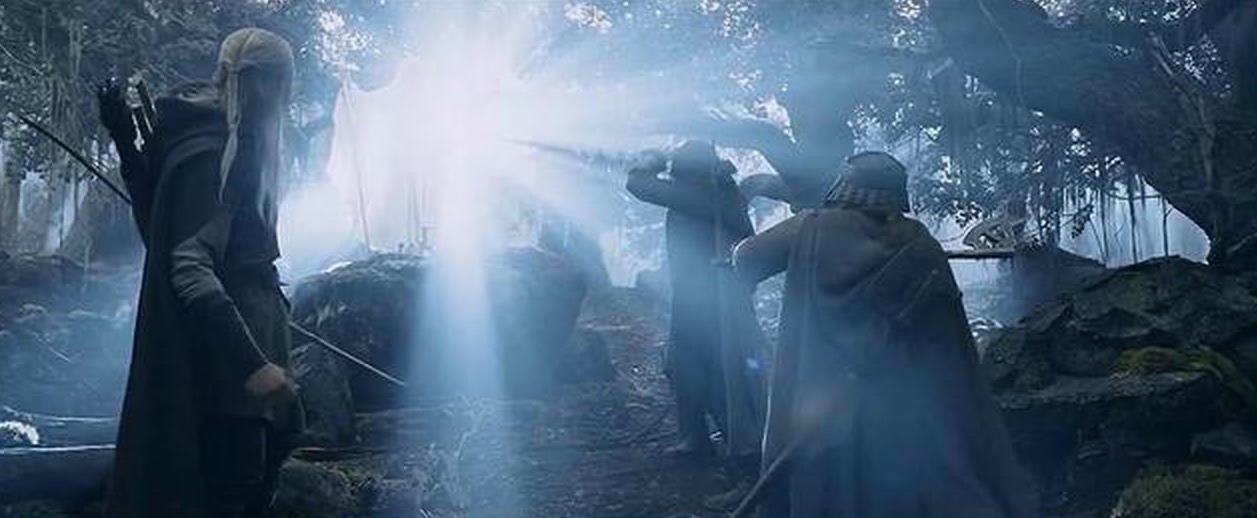
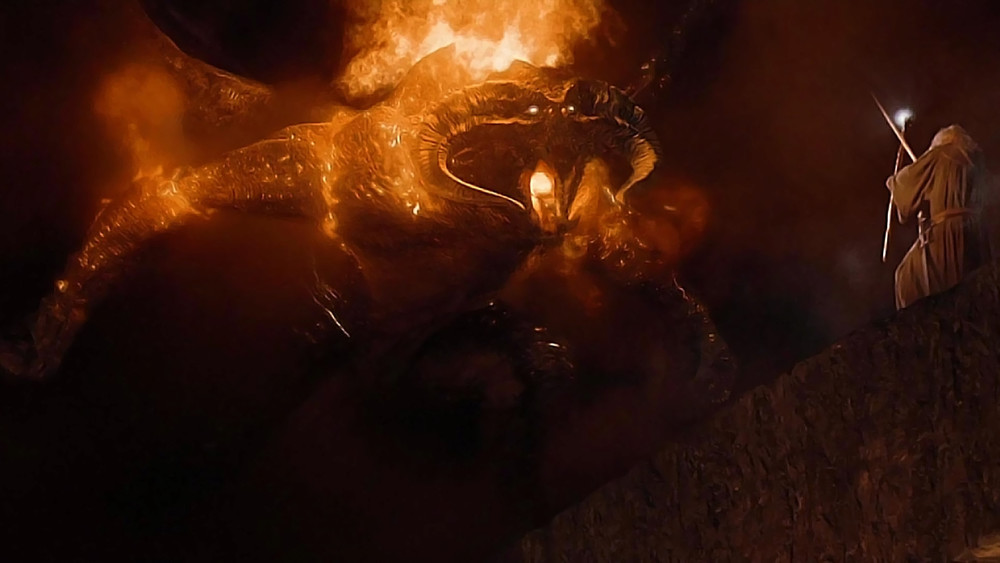
The trouble began when Gandalf was forced to finally confront the Balrog of Morgoth on the Bridge of Kazad-dûm.
The Bridge of Kazad-dûmThe Balrog had pursued the Fellowship throughout the mines of Moria and would have, presumably, pursued them beyond the Dimrill (eastern) gate of Moria, as well.
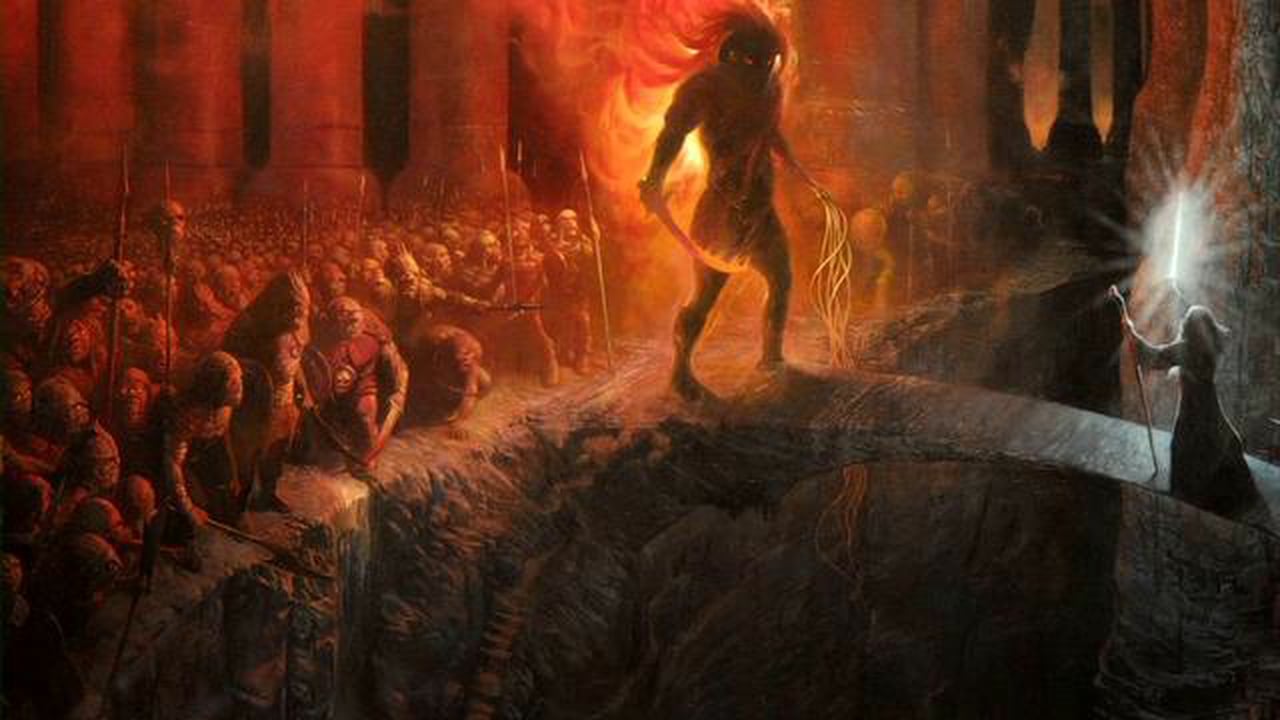
Here is the passage from The Lord of the Rings describing Gandalf and the Fellowship at the Bridge of Kazad-dûm:
Suddenly Frodo saw before him a black chasm. At the end of the hall, the floor vanished and fell to an unknown depth. The outer door could only be reached by a slender bridge of stone, without kerb or rail, that spanned the chasm with one curving spring of fifty feet ...They could only pass across it single file. At the brink Gandalf halted and the others came up in a pack behind.Gandalf turned and confronted the Balrog, wielding the “Secret Fire,” which actually refers to the Spirit of the Creator God of Tolkien's mythos. This is "Secret Fire" is a reference to the Holy Spirit of the Lord of the Rings, which I have written more about here.
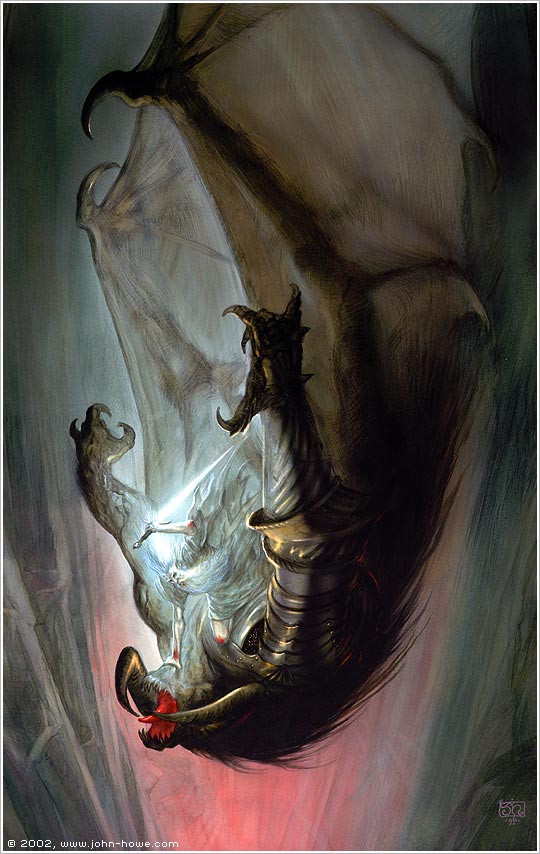
Gandalf blocks the narrow bridge, allowing the others to escape. Gandalf shatters the Balrog’s sword and then cracks the bridge with his staff. The wizard ultimately defeats the Balrog on the bridge, but in so doing seals his own fate, as well. They both fall from the bridge together.
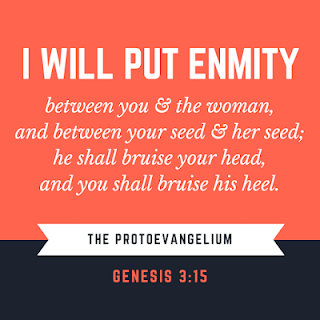
The Balrog strikes at Gandalf's heel! Note how this resembles Genesis 3:15, the Protoevangelium: "he shall bruise your head, and you shall bruise his heel."
Together, the Balrog and the wizard fall down into the deepest hole beneath Middle Earth. They fall and they fall and the fall. They fell for a very long time, possibly hours to even an entire day.
All the while, Gandalf was burning in the Balrog’s fire. At the end of the nearly endless descent, they plunge together into the deep lake beneath the roots of the mountain. Gandalf would later call this lake as cold as the tide of death and that it nearly froze his heart.
Gandalf and the Balrog fought in the lake until the creature fled into the dark tunnels which surround the lake. Gandalf describes these tunnels as hiding dark secrets:Far, far below the deepest delving of the Dwarves, the world is gnawed by nameless things. Even Sauron knows them not. They are older than he. Now I have walked there, but I will bring no report to darken the light of day.One of these “nameless things” might even have been the Watcher in the Water that hid at the entrance of the western gate of Moria.
The Endless Stair & Christ's Return from the Abode of the Dead, SheolGandalf pursued the creature farther until the Balrog led him to the Endless Stair. Following the Balrog was Gandalf’s only means of escaping the pit.
The Endless Stair spiraled up from the roots of the mountain all the way the pinnacle of the Silvertine above the clouds. The stair led to Durin's Tower in the living rock of Zirakzigil. The Balrog likely learned the way to Durin’s Tower from Durin, himself, as the Balrog was named “Durin’s Bane”.
They fought on the highest peak of the highest mountain until at last Gandalf threw down his enemy. So massive was Gandalf’s adversary that it broke the mountain-side as it fell.
After his victory, darkness took Gandalf, and he died. His body lay on the peak as on a giant altar. The entire battle, from Bridge of Khazad-dûm to the mutual demise of Gandalf and the Balrog, took ten days.
The Passion, Death, and Resurrection: All the Similarities Between Gandalf and JesusSo, how does Christ’s victory over Satan on the Cross resemble a wizard fighting a demon? Further, how does Christ’s descent into Hell, Resurrection, and eventual Ascension compare with Gandalf’s great fall into the depths and rising again?
Gandalf casts down the power of evil, just as Christ defeated Satan’s power over death on the CrossGandalf is a sacrificial lamb, just as Christ is the Lamb of GodGandalf wields a sword, just as Christ wields the Sword of the SpiritGandalf and Christ both begin their descent into the depths from a CrossGandalf’s victory over evil results in his death, just like ChristGandalf descends into the abyss, just as Christ descended into hellGandalf descends to “hell” first through fire and then through cold, similar to Dante’s depictionThe days of Gandalf’s descent and ascent are numbered like Christ’s descent into hell, 10 versus 3Both Gandalf and Christ have an AscensionBoth Gandalf and Christ’s friends don’t recognize him after the ResurrectionBoth Gandalf and Christ are adorned in blinding white clothes
Gandalf casts down the power of evil, just as Christ defeated Satan’s power over death on the CrossBalrog is basically a demon. It is a Balrog created by Morgoth, formerly named Melkor. This is the Satan figure in The Lord of the Rings. Sauron once fought alongside Morgoth as his lieutenant.
Gandalf is a sacrificial lamb, just as Christ is the Lamb of GodGandalf lays down his life for the Fellowship. He is the sacrificial lamb. In ancient Jewish tradition, all the sin of the nation was heaped onto the back of a lamb or goat.
The goat was the “scapegoat”. This is where that term originated. The goat was then thrown off a cliff as a sacrifice. In much the same way, Gandalf sacrifices himself willingly (the goat wasn’t a willing sacrifice) to save the Fellowship. But it is the power of sin and evil, the Balrog, that casts Gandalf over the edge of the precipice.
Gandalf wields a sword, just as Christ wields the Sword of the SpiritGandalf’s sword breaks the Balrog’s sword. Gandalf wields Glamdring, a legendary sword. Though Gandalf found Glamdring in a troll-hoard ealong with Bilbo’s Sting in The Hobbit, the sword’s history traced back over 6,500 years.
Glamdring was originally borne by Turgon, the King of Gondolin. It was called the “Foe-Hammer.”
Look at Ephesians 6:16-17: “Above all taking the shield of faith, with which you can quench all the flaming darts of the evil one. And take the helmet of salvation, and the sword of the Spirit, which is the word of God.”
I have written more about the "armor of God" at Ephesians 6 HERE.
When Gandalf stands alone before the Balrog, he is clearly wielding faith, the shield of Scripture. More direct than that, he is the wielder of the Secret Fire, which is the Holy Spirit in the Tolkien universe. Gandalf is, therefore, wielding the Sword of the Spirit.
Gandalf and Christ both begin their descent into the depths from a CrossWhen Gandalf strikes his staff against the narrow bridge of Khazad-dûm, the wizard’s staff and the bridge together form a cross. Even Gandalf’s wooden staff, itself, is a sort of cross. It is very much like a bishop’s crozier or staff, most of which are cross-shaped.
Gandalf’s victory over evil results in his death, just like ChristIn Genesis 3:15, it is prophesied by God that the Messiah “shall bruise [the serpent’s head,” but in so doing, the serpent “shall bruise his heel.” In Christ’s Passion and Death, he strikes at the serpent’s skull.
I have written more on Genesis 3:15, the "First Gospel" or Proto-evangelium, HERE:
On the literal level, the Cross of Christ stabs into the ground at Golgotha, the “place of the skull.” The Cross of Christ also dealt a mortal blow to the skull of Satan, breaking his power over death.
I have written more on the "skull" of Golgotha HERE:
Even so, Christ accomplished these great works through his own death. That is, Satan struck out, like a serpent, biting Christ’s heel. Christ and Satan mortally wound each other.
Similarly, Gandalf casts the Balrog into the abyss. In the midst of the wizard’s triumph, however, the Balrog’s whip lashes out at Gandalf’s heel and they fall together into the abyss. The Balrog striking at Gandalf’s heel cannot be a coincidence. Though there is also the possibility of an allusion to Achilles’ infamous weakness, his heel, this is clearly a Messianic reference.
Though Gandalf and the Balrog cast each other into the abyss, they do not mortally wound each other, which is the “crux” of the Messianic symbolism. This happens later.
Gandalf pursues the Balrog down into the deepest depths and up to the highest peak. Thereupon, Gandalf smites the Balrog against the mountainside. Gandalf kills the Balrog and then shortly thereafter succumbs to death, himself. In the end, they mortally wound each other, just like Christ and Satan.
There will be no resurrection for Satan and the Balrog, however.
Gandalf descends into the abyss, just as Christ descended into hellIt can be no coincidence that Gandalf fell into the abyss after sacrificing himself. Immediately after his death on the cross, Christ descended into the abyss to hell.
The Apostles’ Creed states that Christ “descended into hell” following his death on the cross. This is also called the “Harrowing of Hell.”
Christ didn’t exactly descend into hell. It was more likely Sheol, the place where the dead, some righteous and some not, waited for the coming of the Messiah. In 1 Peter 3:19-20, we are given more information about where Christ descended:[Jesus] went and preached to the spirits in prison, who formerly did not obey, when God’s patience waited in the days of Noah, during the building of the ark, in which a few, that is, eight persons, were saved through water.
It is worth noting that a giant lake of water lay at the bottom of the abyss in LOTR, as the verse above just happens to mention the water of Noah’s flood.
Gandalf descends to “hell” first through fire and then through cold, similar to Dante’s depictionWhen we think of hell, we often associate it with hellfire. Gandalf definitely encounters fire in his descent, as he is burned all the way down in the fire of the Balrog. Though Gandalf burns in the Balrog’s fire, he is not consumed. In this, he is like the Burning Bush which Moses encountered in the desert. The ancient Hebrews also recognized the burning bush as a type for the coming Messiah.
At the bottom of the almost bottomless abyss, however, is not a pool of fire, but a bitterly cold lake. Gandalf would later call this lake as cold as the tide of death and that it nearly froze his heart.
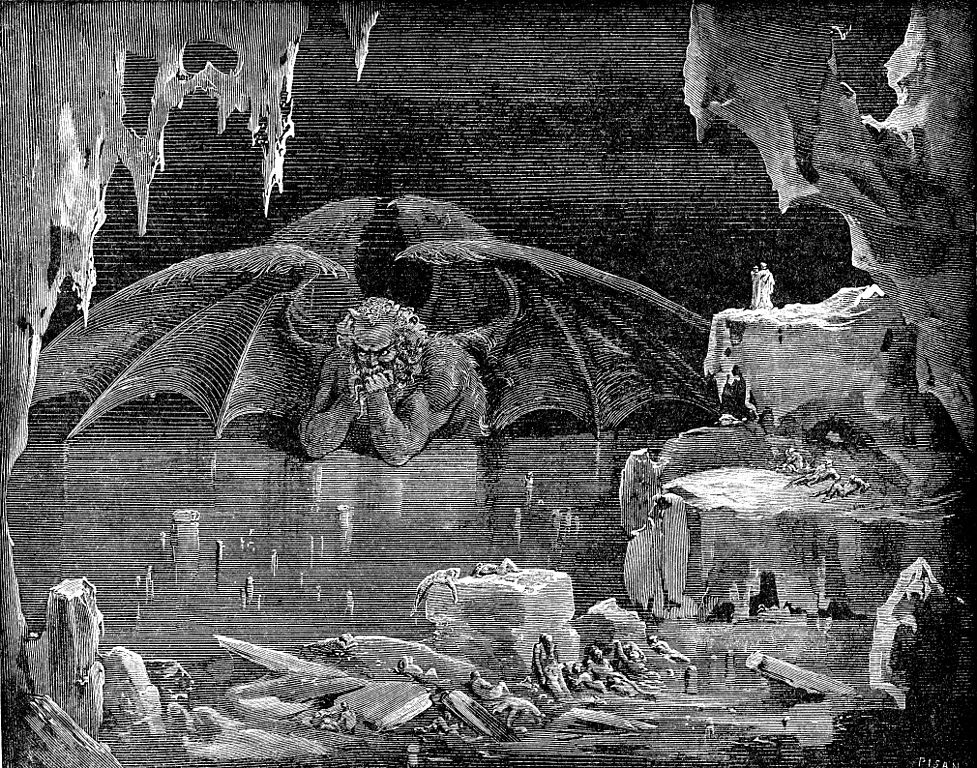
Compare this to the description of the Ninth Circle of Hell in Dante’s Inferno. At the center of the Ninth Circle is Satan himself frozen up to his breast in ice. The beating of Satan’s wings creates the ice which ensnares him. The cold wind he creates is felt throughout the other circles of hell, as well. In this section of Hell, sinners are frozen alongside Satan in a great lake of ice.
Dante’s description of the ninth circle of hell is amazingly similar to Tolkien’s description of the abyss. The tide of death that nearly froze Gandalf’s heart could easily be Dante’s frozen lake.
The days of Gandalf’s descent and ascent are numbered like Christ’s descent into hell, 10 versus 3 Tolkien takes the time to number the days of Gandalf’s descent, just as Scripture numbers the days of Christ’s descent. This is an important detail.
Christ descended into hell for three days between the Crucifixion and the Resurrection. Gandalf’s time period was ten days. Was Christ faster because He is God? No, just kidding. I think Tolkien is doing a couple things here.
First off, there were three days between Christ’s Crucifixion and Resurrection. There were ten days between Gandalf’s fall from the bridge and his death. Between Gandalf’s death and resurrection, he said he experienced entire “life ages” of the earth. The timeline is obviously different.
But why ten days? It is possible that Gandalf descended for three days, just like Christ, and then ascended for seven, totaling ten days in all. Seven is obviously a special number in Scripture. While some mistakenly call it the number of perfection, the Hebrew word for seven is associated with the covenant.
The Covenant between God and Creation was confected on the seventh day. If Gandalf died on the seventh day of his rising, Tolkien could be saying that Gandalf became a new creation on seventh day.
There is also a nod to the Sacrament of Baptism embedded in this seventh day concept, because Gandalf passes through the cold waters of death and the lake before rising, ultimately,to new life.
Both Gandalf and Christ have an AscensionFollowing the descent, Gandalf ascends to the highest peak, just like the Ascension of Christ that followed His Resurrection. The order of Gandalf’s ascension and resurrection is somewhat reversed from that of Christ.
Nevertheless, Gandalf’s physical ascension on the Endless Stair takes him to the clouds, if not the heavens. Next, the great eagle Gwaihir actually comes and bears him up into the heavens and then on to Lothlórien, where he was clothed and replenished, and given a new staff by Galadriel.
Gandalf’s first ascension ends in his death and precedes the last stage of his ascension beyond death to new life.
Both Gandalf and Christ’s friends don’t recognize him after the ResurrectionAragorn, Legolas, and Gimli do not recognize the hooded figure of an old man that first appears to them at the edge of Fangorn Forest and scares away their horses. They actually mistake Gandalf for Saruman.
Compare this to Mary Magdalene’s encounter with the risen Christ at John 20:14-15:She turned round and saw Jesus standing, but she did not know that it was Jesus. Jesus said to her, “Woman, why are you weeping? Whom do you seek?” Supposing him to be the gardener, she said to him, “Sir, if you have carried him away, tell me where you have laid him, and I will take him away.”
Mary Magdalene actually confused Jesus for the gardener. She confuses him for another, just as Gandalf’s friends confuse him for Saruman.
Both Gandalf and Christ are adorned in blinding white clothesUpon his resurrection, Gandalf the Gray becomes Gandalf the White. More than that, Gandalf’s garments became supernaturally bright:There [Gandalf] stood, grown suddenly tall, towering above them. His hood and his grey rags were flung away. His white garments shone. […] They all gazed at him. His hair was white as snow in the sunshine; and gleaming white was his robe; the eyes under his deep brows were bright, piercing as the rays of the sun; power was in his hand. Between wonder, joy, and fear they stood and found no words to say.
At the Transfiguration of Christ, the Apostles are treated to an image of the Risen Christ. Matthew 17:1-2 describes the Transfiguration:And after six days Jesus took with him Peter and James and John his brother, and led them up a high mountain apart. And he was transfigured before them, and his face shone like the sun, and his garments became white as light.
Elsewhere, at Mark 9:3, Jesus’garments are further described as becoming “glistening, intensely white, as no fuller on earth could bleach them.”
For more quality Sci-Fi and Fantasy nerdiness, you can check out my articles at Nerdatron.com.
Footnotes on Gandalf and the Resurrection





November 22, 2020
Lord of the Rings and the Trinity
Tolkien's stories are nearly bottomless and all of it is rich in theology. Here's a deep dive into the hidden Trinity and Trinities in the The Lord of the Rings. Tolkien was a good and studied Catholic, so the origins of his gods are steeped in rich Trinitarian theology.
Read more on the Theology of The Lord of the Rings! These articles form part of a larger work I have written on the Christian symbolism in The Lord of the Rings, available in paperback and ebook versions:
First off, where did Gandalf come from?He's the wisest of the Maiar, who are minor Ainu. Huh? The Ainu, which means "Holy Ones," were the first of the creations of Eru Ilúvatar--they were born of his thought. The wizards--Gandalf, Saruman, etc.--were each a Maiar, and existed before Elves, Men, and Dwarves.

Lord of the Rings: Who is God, the Father?Eru Ilúvatar is the Godhead of the Tolkien mythos. He is God the Father, the first person of the Trinity. The name, Eru Ilúvatar, means "The One" (Eru) and "Father of All" (Ilúvatar) in the ancient Elvish language of Quenya.
You can make a direct connection between Eru and El, the word for God or "The One" in Hebrew, such as in Elohim ("the all-powerful One"), El Shaddai ("God Almighty"), Gabriel [Gabri-El] ("Strength of God"), and Michael [Micha-El] ("Who is like God?").

Gandalf and the other wizards and Maiar were born of the thoughts of Eru Ilúvatar (of God, the Father). Similarly, God the Father speaks the Word, which is the Son of God--the Word made Flesh is Jesus Christ. You might be thinking, "Tolkien's Trinity is way more than three persons."
Tolkien actually addressed all the gods, sub-gods, and co-gods in his mythology. In a draft letter to Peter Hastings, the manager of a Catholic bookshop in Oxford, Tolkien explained his mix of monotheism and polytheism and its seeming unorthodoxy. All these gods are "a tribute to the infinity of [God's] potential variety."[1]
 A creature, Tolkien argued, does not necessarily have to create in the same manner as he was created.
HOWEVER! There are powers reserved to Eru Ilúvatar alone, such as the power of RESURRECTION, and other interventions into the natural order. And so God the Son incarnated as Jesus was revealing something particular about his Divine Nature and the Christian Trinity when he said, "I am the Resurrection and the life" (Jn 11:25).
Gandalf, unlike Jesus, did not share in the Divine Nature of Eru Ilúvatar. Gandalf, unlike Jesus, did not resurrect himself.
There's no single Christ, Messiah, or God-the-Son in Tolkien's mythology--this will be the subject of another article: The Christs of Lord of the Rings.
God the Son, as a person of the Trinity, is splintered among many different characters. The other persons of the Trinity--God the Father and God the Holy Spirit--are not splintered and are very straightforward.
Lord of the Rings: Who is the Holy Spirit?God the Father is Eru Ilúvatar, as I've explained, but who is Tolkien's Holy Spirit? It is the Secret Fire or the Flame Imperishable, which is the power of life possessed by Eru Ilúvatar alone. Tolkien, himself, admits to this Trinitarian connection.[2]
Do you remember hearing about this Secret Fire in Lord of the Rings? It's definitely one of the cooler scenes from the movie. Gandalf, himself, finds his courage to stand before the Balrog of Morgoth (Morgoth is the Satan figure, a fallen member of the Valar) when he calls himself a "servant of the Secret Fire":
"You cannot pass," he said ... "I am a servant of the Secret Fire, wielder of the flame of Anor. The dark fire will not avail you, flame of Udûn. You cannot pass."[3]

I love this quote, not only because it shows how awesome Gandalf is, but also because it reveals the good and evil of Middle-Earth and the discernment needed between them.
There is the Secret Fire of Eru Ilúvatar, the Holy Spirit, which is purely good and all-powerful. At war against the Secret Fire is the "dark fire." The Balrog before Gandalf was created by Tolkien's Lucifer-figure, Melkor or Morgoth, in Tolkien's Hell-equivalent, the fortress of Morgoth, Utumno or Udûn.

Gandalf announces that he is a servant of Tolkien's Holy Spirit before the embodiment of evil, a creature made of the dark fire, itself. Gandalf's power is rooted in his faith. He stands on that narrow bridge, the razor's edge, guided by his faith. His willingness to sacrifice himself was further rooted in his faith in the resurrection--in Eru Ilúvatar, Himself. It was by the same faith that Abraham could sacrifice his only son, Isaac.
The power of the dark fire can only corrupt the creations of the Secret Fire; it cannot create on its own. Isn't this a true image of evil? of Satan? Evil can only pervert and destroy. Frodo explains this to Sam in Return of the King, as he describes the origin of orcs:
"The shadow that bred them can only mock, it cannot make: not real new things of its own."(4)
Lord of the Rings: Who is God the Son? Who is the Jesus of Lord of the Rings?As I said earlier, there's more than one Christ figure in The Lord of the Rings. Tolkien splintered his Messiah into three characters: Gandalf, Frodo, and--of course--Aragorn. Each of these characters represents a different aspect of Christ:
Gandalf the Gray (and White) represents the Resurrection, but more importantly he represents the third person of the Trinity, The Word, who exists outside of time.Frodo Baggins represents the Sacrifice (the Crucifixion), the journey which begins in sleepy, out-of-the-way Nazareth and ends on the slopes of Golgotha.Aragorn, son of Arathorn represents the King, the restoration of the Davidic Kingdom.
Is Tolkien's Trinity a true Trinity? Eru Ilúvatar never exists, truly, in three persons. Though Tolkien has Christ figures, his Trinity does not include a full-fledged God, the Son, much less is Ilúvatar actually incarnated. Also, the Flame Imperishable does not seem to exist as a person or as equal to Ilúvatar. Rather, the Secret Fire seems to be something that is possessed by Ilúvatar.
An Old Testament Trinity: I would have to conclude that Tolkien's Trinity is not a New Testament Trinity. It more closely resembles the Trinity as expressed in the Old Testament. In the Old Testament, the Trinity is only partially revealed. Also, Tolkien's Trinity is most developed in its action of creation.

Compare Tolkien's creation to the Book of Genesis. In Genesis, God the Son is the Word spoken at creation. He appears in Scripture whenever Wisdom and Truth are spoken of in capital letters. God the Holy Spirit is present at creation, also, as the spirit moving over the waters (Gn 1:2). This very similar to The Lord of the Rings:
The Son: the first of the creations of Eru Ilúvatar, the Ainu, were born of his thought, much as God spoke the Word at creation.The Holy Spirit: the Flame Imperishable is the power of life possessed by Eru Ilúvatar alone, similar to the Spirit of God which is active in creation across the formlessness. The full doctrine of the Trinity won't be fully explained until the Gospel of John and Paul's epistles. This is how doctrine develops: as "through a mirror dimly" which clears through the passage of time (1 Cor 13:12).
St. Augustine was warned by an angel not to expect too much of his feeble mind when investigating the mysteries of the Trinity. Tolkien seems to heed the same warning; the creation of Middle-Earth is not simply a recapitulation of the Genesis story. His imagination has great power. Tolkien reveals the infinite wonder which can be found in just the natures of God and creation.
For more quality Sci-Fi and Fantasy nerdiness, you can check out my articles at Nerdatron.com.
Lord of the Rings and the Trinity: Footnotes1. Carpenter, Humphrey, ed. (1981), The Letters of J. R. R. Tolkien, Boston: Houghton Mifflin, #153, ISBN 0-395-31555-7
2. Clyde S. Kilby. Tolkien & The Silmarillion. Harold Shaw, 1976, p. 59.
3. Tolkien, J. R. R., The Fellowship of the Ring II 5: "The Bridge of Khazad-dûm"
4. Tolkien, J. R. R., The Return of the King VI 1: "The Tower of Cirith Ungol"

November 18, 2020
Powerful Novena to St. Joseph for Work, Family, Job, Employment, to Sell House
This incredibly powerful novena can help you guide your family through any crisis. I'm speaking from personal experience. I received my first and second job out of law school after praying this novena.
Obviously, every blessing that comes from this novena flows from God. St. Joseph's prayers, however, are very powerful in Heaven. Apart from the Blessed Mother, St. Joseph may be the most powerful intercessor we have.
St. Joseph Novena Table of ContentsClick the links below for the nine days of the Novena: Day One Day Two Day Three Day Four Day Five Day Six Day Seven Day Eight Day Nine
Source: EWTN
St. Joseph Novena for Employment, Selling a House, and Family IntentionsSt. Joseph, Pillar of Families,Protector of the Church,Terror of Demons,Pray for us!
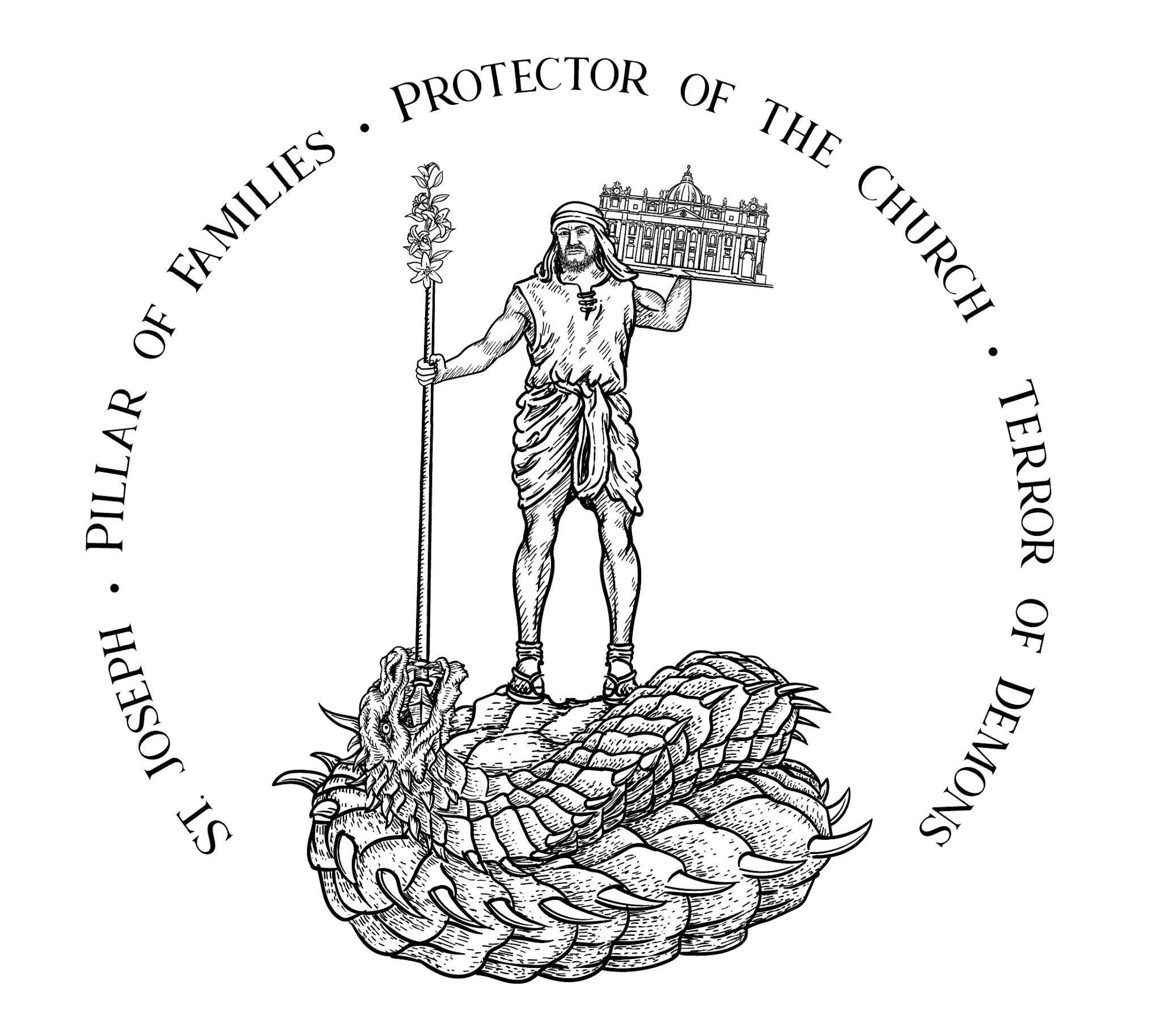 Logo for the 2021 Men of the Immaculata Catholic Men's Conference
You were also the protector and witness of Mary's virginity. By your marriage you gave to each other your virginity, and also the mutual right over it -- a right to safeguard the other's virtue. This mutual virginity also belonged to the divine plan of the Incarnation, for God sent His angel to assure you that motherhood and virginity in Mary could be united.
This union of marriage not only brought you into daily familiar association with Mary, the loveliest of God's creatures, but also enabled you to share with her a mutual exchange of spiritual goods. And Mary found her edification in your calm, humble, and deep virtue, purity, and sanctity. What a great honor comes to you from this close union with her whom the Son of God calls Mother and whom He declared the Queen of heaven and earth! Whatever belonged to Mary belonged to you also, and this included her Son, even though He had been given to her by God in a wonderful way. Jesus belonged to you as His legal father. Your marriage was the way which God chose to have Jesus introduced into the world, a great divine mystery from which all benefits have come to us.
God the Son confided the guardianship and the support of His Immaculate Mother to your care. Mary's life was that of the Mother of the Savior, who did not come upon earth to enjoy honors and pleasures, but to redeem the world by hard work, suffering, and the cross. You were the faithful companion, support, and comforter of the Mother of Sorrows. How loyal you were to her in poverty, journeying, work, and pain. Your love for Mary was based upon your esteem for her as Mother of God. After God and the Divine Child, you loved no one as much as her. Mary responded to this love. She submitted to your guidance with naturalness and easy grace and childlike confidence. The Holy Spirit Himself was the bond of the great love which united your hearts.
Saint Joseph, I thank God for your privilege of being the virginal husband of Mary. As a token of your own gratitude to God, obtain for me the grace to love Jesus with all my heart, as you did, and love Mary with some of the tenderness and loyalty with which you loved her.
Saint Joseph, I, your unworthy child, greet you. You are the faithful protector and intercessor of all who love and venerate you. You know that I have special confidence in you and that, after Jesus and Mary, I place all my hope of salvation in you, for you are especially powerful with God and will never abandon your faithful servants. Therefore I humbly invoke you and commend myself, with all who are dear to me and all that belong to me, to your intercession. I beg of you, by your love for Jesus and Mary, not to abandon me during life and to assist me at the hour of my death.
Glorious Saint Joseph, spouse of the Immaculate Virgin, obtain for me a pure, humble, charitable mind, and perfect resignation to the divine Will. Be my guide, my father, and my model through life that I may merit to die as you did in the arms of Jesus and Mary.
Loving Saint Joseph, faithful follower of Jesus Christ, I raise my heart to you to implore your powerful intercession in obtaining from the Divine Heart of Jesus all the graces necessary for my spiritual and temporal welfare, particularly the grace of a happy death, and the special grace I now implore:
(Mention your request).
Guardian of the Word Incarnate, I feel confident that your prayers in my behalf will be graciously heard before the throne of God. Amen.
MEMORARE
Remember, most pure spouse of Mary, ever Virgin, my loving protector, Saint Joseph, that no one ever had recourse to your protection or asked for your aid without obtaining relief. Confiding, therefore, in your goodness, I come before you and humbly implore you. Despise not my petitions, foster-father of the Redeemer, but graciously receive them. Amen.
You were chosen by the Holy Spirit. He is the mutual Love of the Father and the Son -- the heart of the Holy Trinity. In His wisdom He draws forth all creatures from nothing, guides them to their end in showing them their destiny and giving them the means to reach it. Every vocation and every fulfillment of a vocation proceeds from the Holy Spirit. As a foster-father of Jesus and head of the Holy Family, you had an exalted and most responsible vocation -- to open the way for the redemption of the world and to prepare for it by the education and guidance of the youth of the God-Man. In this work you cooperated as the instrument of the Holy Spirit. The Holy Spirit was the guide; you obeyed and carried out the works. How perfectly you obeyed the guidance of the God of Love!
The words of the Old Testament which Pharaoh spoke concerning Joseph of Egypt can well be applied to you: 'Can we find such another man, that is full of the spirit of God, or a wise man like to him?' (Gen. 41:38). No less is your share in the divine work of God than was that of Egypt. You now reign with your foster-Son and see reflected in the mirror of God's Wisdom the Divine Will and what is of benefit to our souls.
Saint Joseph, I thank God for having made you the man specially chosen by Him. As a token of your own gratitude to God, obtain for me the grace to imitate your virtues so that I too may be pleasing to the Heart of God. Help me to give myself entirely to His service and to the accomplishment of His Holy Will, that one day I may reach heaven and be eternally united to God as you are.
Saint Joseph, I, your unworthy child, greet you. You are the faithful protector and intercessor of all who love and venerate you. You know that I have special confidence in you and that, after Jesus and Mary, I place all my hope of salvation in you, for you are especially powerful with God and will never abandon your faithful servants. Therefore I humbly invoke you and commend myself, with all who are dear to me and all that belong to me, to your intercession. I beg of you, by your love for Jesus and Mary, not to abandon me during life and to assist me at the hour of my death.
Glorious Saint Joseph, spouse of the Immaculate Virgin, obtain for me a pure, humble, charitable mind, and perfect resignation to the divine Will. Be my guide, my father, and my model through life that I may merit to die as you did in the arms of Jesus and Mary.
Loving Saint Joseph, faithful follower of Jesus Christ, I raise my heart to you to implore your powerful intercession in obtaining from the Divine Heart of Jesus all the graces necessary for my spiritual and temporal welfare, particularly the grace of a happy death, and the special grace I now implore:
(Mention your request).
Guardian of the Word Incarnate, I feel confident that your prayers in my behalf will be graciously heard before the throne of God. Amen.
MEMORARE
Remember, most pure spouse of Mary, ever Virgin, my loving protector, Saint Joseph, that no one ever had recourse to your protection or asked for your aid without obtaining relief. Confiding, therefore, in your goodness, I come before you and humbly implore you. Despise not my petitions, foster-father of the Redeemer, but graciously receive them. Amen.
How perfect was your obedience! Your position in the Holy Family obliged you to command, but besides being the foster-father of Jesus, you were also His disciple. For almost thirty years, you watched the God-Man display a simple and prompt obedience, and you grew to love and practice it very perfectly yourself. Without exception you submitted to God, to the civil rulers, and to the voice of your conscience.
When God sent an angel to tell you to care for Mary, you obeyed in spite of the mystery which surrounded her motherhood. When you were told to flee into Egypt under painful conditions, you obeyed without the slightest word of complaint. When God advised you in a dream to return to Nazareth, you obeyed. In every situation your obedience was as simple as your faith, as humble as your heart, as prompt as your love. It neglected nothing; it took in every command.
You had the virtue of perfect devotedness, which marks a good servant. Every moment of your life was consecrated to the service of our Lord: sleep, rest, work, pain. Faithful to your duties, you sacrificed everything unselfishly, even cheerfully. You would have sacrificed even the happiness of being with Mary. The rest and quiet of Nazareth was sacrificed at the call of duty. Your entire life was one generous giving, even to the point of being ready to die in proof of your love for Jesus and Mary. With true unselfish devotedness you worked without praise or reward.
But God wanted you to be in a certain sense a cooperator in the Redemption of the world. He confided to you the care of nourishing and defending the Divine Child. He wanted you to be poor and to suffer because He destined you to be the foster-father of His Son, who came into the world to save men by His sufferings and death, and you were to share in His suffering. In all of these important tasks, the Heavenly Father always found you a faithful servant!
Saint Joseph, I thank God for your privilege of being God's faithful servant. As a token of your own gratitude to God, obtain for me the grace to be a faithful servant of God as you were. Help me to share, as you did, the perfect obedience of Jesus, who came not to do His Will, but the Will of His Father; to trust in the Providence of God, knowing that if I do His Will, He will provide for all my needs of soul and body; to be calm in my trials and to leave it to our Lord to free me from them when it pleases Him to do so. And help me to imitate your generosity, for there can be no greater reward here on earth than the joy and honor of being a faithful servant of God.
Saint Joseph, I, your unworthy child, greet you. You are the faithful protector and intercessor of all who love and venerate you. You know that I have special confidence in you and that, after Jesus and Mary, I place all my hope of salvation in you, for you are especially powerful with God and will never abandon your faithful servants. Therefore I humbly invoke you and commend myself, with all who are dear to me and all that belong to me, to your intercession. I beg of you, by your love for Jesus and Mary, not to abandon me during life and to assist me at the hour of my death.
Glorious Saint Joseph, spouse of the Immaculate Virgin, obtain for me a pure, humble, charitable mind, and perfect resignation to the divine Will. Be my guide, my father, and my model through life that I may merit to die as you did in the arms of Jesus and Mary.
Loving Saint Joseph, faithful follower of Jesus Christ, I raise my heart to you to implore your powerful intercession in obtaining from the Divine Heart of Jesus all the graces necessary for my spiritual and temporal welfare, particularly the grace of a happy death, and the special grace I now implore:
(Mention your request).
Guardian of the Word Incarnate, I feel confident that your prayers in my behalf will be graciously heard before the throne of God. Amen.
MEMORARE
Remember, most pure spouse of Mary, ever Virgin, my loving protector, Saint Joseph, that no one ever had recourse to your protection or asked for your aid without obtaining relief. Confiding, therefore, in your goodness, I come before you and humbly implore you. Despise not my petitions, foster-father of the Redeemer, but graciously receive them. Amen.
I believe that the Church is the family of God on earth. Its government is represented in priestly authority which consists above all in its power over the true Body of Christ, really present in the Blessed Sacrament of the Altar, thus continuing Christ's life in the Church. From this power, too, comes authority over the Mystical Body of Christ, the members of the Church -- the power to teach and govern souls, to reconcile them with God, to bless them, and to pray for them.
You have a special relationship to the priesthood because you possessed a wonderful power over our Savior Himself. Your life and office were of a priestly function and are especially connected with the Blessed Sacrament. To some extent you were the means of bringing the Redeemer to us -- as it is the priest's function to bring Him to us in the Mass -- for you reared Jesus, supported, nourished, protected and sheltered Him. You were prefigured by the patriarch Joseph, who kept supplies of wheat for his people. But how much greater than he were you! Joseph of old gave the Egyptians mere bread for their bodies. You nourished, and with the most tender care, preserved for the Church Him who is the Bread of Heaven and who gives eternal life in Holy Communion.
God has appointed you patron of the Church because the glorious title of patriarch also falls by special right to you. The patriarchs were the heads of families of the Chosen People, and theirs was the honor to prepare for the Savior's incarnation. You belonged to this line of patriarchs, for you were one of the last descendants of the family of David and one of the nearest forebears of Christ according to the flesh. As husband of Mary, the Mother of God, and as the foster-father of the Savior, you were directly connected with Christ. Your vocation was especially concerned with the Person of Jesus; your entire activity centered about Him. You are, therefore, the closing of the Old Testament and the beginning of the New, which took its rise with the Holy Family of Nazareth. Because the New Testament surpasses the Old in every respect, you are the patriarch of patriarchs, the most venerable, exalted, and amiable of all the patriarchs.
Through Mary, the Church received Christ, and therefore the Church is indebted to her. But the Church owes her debt of gratitude and veneration to you also, for you were the chosen one who enabled Christ to enter into the world according to the laws of order and fitness. It was by you that the patriarchs and the prophets and the faithful reaped the fruit of God's promise. Alone among them all, you saw with your own eyes and possessed the Redeemer promised to the rest of men.
Saint Joseph, I thank God for your privilege of being the Patron of the Church. As a token of your own gratitude to God, obtain for me the grace to live always as a worthy member of this Church, so that through it I may save my soul. Bless the priests, the religious, and the laity of the Catholic Church, that they may ever grow in God's love and faithfulness in His service. Protect the Church from the evils of our day and from the persecution of her enemies. Through your powerful intercession may the church successfully accomplish its mission in this world -- the glory of God and the salvation of souls!
Saint Joseph, I, your unworthy child, greet you. You are the faithful protector and intercessor of all who love and venerate you. You know that I have special confidence in you and that, after Jesus and Mary, I place all my hope of salvation in you, for you are especially powerful with God and will never abandon your faithful servants. Therefore I humbly invoke you and commend myself, with all who are dear to me and all that belong to me, to your intercession. I beg of you, by your love for Jesus and Mary, not to abandon me during life and to assist me at the hour of my death.
Glorious Saint Joseph, spouse of the Immaculate Virgin, obtain for me a pure, humble, charitable mind, and perfect resignation to the divine Will. Be my guide, my father, and my model through life that I may merit to die as you did in the arms of Jesus and Mary.
Loving Saint Joseph, faithful follower of Jesus Christ, I raise my heart to you to implore your powerful intercession in obtaining from the Divine Heart of Jesus all the graces necessary for my spiritual and temporal welfare, particularly the grace of a happy death, and the special grace I now implore:
(Mention your request).
Guardian of the Word Incarnate, I feel confident that your prayers in my behalf will be graciously heard before the throne of God. Amen.
MEMORARE
Remember, most pure spouse of Mary, ever Virgin, my loving protector, Saint Joseph, that no one ever had recourse to your protection or asked for your aid without obtaining relief. Confiding, therefore, in your goodness, I come before you and humbly implore you. Despise not my petitions, foster-father of the Redeemer, but graciously receive them. Amen.
Your family life at Nazareth was all radiant with the light of divine charity. There was an intimate union of heart and mind among the members of your Holy Family. There could not have been a closer bond than that uniting you to Jesus, your foster-Son and to Mary, your most loving wife. Jesus chose to fulfill toward you, His foster-father, all the duties of a faithful son, showing you every mark of honor and affection due to a parent. And Mary showed you all the signs of respect and love of a devoted wife. You responded to this love and veneration from Jesus and Mary with feelings of deepest love and respect. You had for Jesus a true fatherly love, enkindled and kept aglow in your heart by the Holy Spirit. And you could not cease to admire the workings of grace in Mary's soul, and this admiration caused the holy love which you had consecrated to her on the day of your wedding grow stronger every day.
God has made you a heavenly patron of family life because you sanctified yourself as head of the Holy Family and thus by your beautiful example sanctified family life. How peacefully and happily the Holy Family rested under the care of your fatherly rule, even in the midst of trials. You were the protector, counselor, and consolation of the Holy Family in every need. And just as you were the model of piety, so you gave us by your zeal, your earnestness and devout trust in God's providence, and especially by your love, the example of labor according to the Will of God. You cherished all the experiences common to family life and the sacred memories of the life, sufferings, and joys in the company of Jesus and Mary. Therefore the family is dear to you as the work of God, and it is of the highest importance in your eyes to promote the honor of God and the well-being of man. In your loving fatherliness and unfailing intercession you are the patron and intercessor of families, and you deserve a place in every home.
Saint Joseph, I thank God for your privilege of living in the Holy Family and being its head. As a token of your own gratitude to God, obtain God's blessing upon my own family. Make our home the kingdom of Jesus and Mary -- a kingdom of peace, of joy, and love.
I also pray for all Christian families. Your help is needed in our day when God's enemy has directed his attack against the family in order to desecrate and destroy it. In the face of these evils, as patron of families, be pleased to help; and as of old, you arose to save the Child and His Mother, so today arise to protect the sanctity of the home. Make our homes sanctuaries of prayer, of love, of patient sacrifice, and of work. May they be modeled after your own at Nazareth. Remain with us with Jesus and Mary, so that by your help we may obey the commandments of God and of the Church; receive the holy sacraments of God and of the Church; live a life of prayer; and foster religious instruction in our homes. Grant that we may be reunited in God's Kingdom and eternally live in the company of the Holy Family in heaven.
Saint Joseph, I, your unworthy child, greet you. You are the faithful protector and intercessor of all who love and venerate you. You know that I have special confidence in you and that, after Jesus and Mary, I place all my hope of salvation in you, for you are especially powerful with God and will never abandon your faithful servants. Therefore I humbly invoke you and commend myself, with all who are dear to me and all that belong to me, to your intercession. I beg of you, by your love for Jesus and Mary, not to abandon me during life and to assist me at the hour of my death.
Glorious Saint Joseph, spouse of the Immaculate Virgin, obtain for me a pure, humble, charitable mind, and perfect resignation to the divine Will. Be my guide, my father, and my model through life that I may merit to die as you did in the arms of Jesus and Mary.
Loving Saint Joseph, faithful follower of Jesus Christ, I raise my heart to you to implore your powerful intercession in obtaining from the Divine Heart of Jesus all the graces necessary for my spiritual and temporal welfare, particularly the grace of a happy death, and the special grace I now implore:
(Mention your request).
Guardian of the Word Incarnate, I feel confident that your prayers in my behalf will be graciously heard before the throne of God. Amen.
MEMORARE
Remember, most pure spouse of Mary, ever Virgin, my loving protector, Saint Joseph, that no one ever had recourse to your protection or asked for your aid without obtaining relief. Confiding, therefore, in your goodness, I come before you and humbly implore you. Despise not my petitions, foster-father of the Redeemer, but graciously receive them. Amen.
It was especially for the poor, who compose the greater part of mankind, that Jesus came upon earth, for in the synagogue of Nazareth, He read the words of Isaiah and referred them to Himself: 'The Spirit of the Lord is upon me, because He has anointed Me to bring good news to the poor...' (Luke 4:18). It was God's Will that you should be occupied with work common to poor people, that in this way Jesus Himself might ennoble it by inheriting it from you, His foster-father, and by freely embracing it. Thus our Lord teaches us that for the humbler class of workmen, He has in store His richest graces, provided they live content in the place God's Providence has assigned them, and remain poor in spirit for He said, 'Blessed are the poor in spirit, for theirs is the kingdom of heaven' (Matt. 5:3).
The kind of work to which you devoted your time in the workshop of Nazareth offered you many occasions of practicing humility. You were privileged to see each day the example of humility which Jesus practiced -- a virtue most pleasing to Him. He chose for His earthly surroundings not the courts of princes nor the halls of the learned, but a little workshop of Nazareth. Here you shared for many years the humble and hidden toiling of the God-Man. What a touching example for the worker of today!
While your hands were occupied with manual work, your mind was turned to God in prayer. From the Divine Master, who worked along with you, you learned to work in the presence of God in the spirit of prayer, for as He worked He adored His Father and recommended the welfare of the world to Him, Jesus also instructed you in the wonderful truths of grace and virtue, for you were in close contact with Him who said of Himself, 'I am the Way and the Truth and the Life.'
As you were working at your trade, you were reminded of the greatness and majesty of God, who, as a most wise Architect, formed this vast universe with wonderful skill and limitless power.
The light of divine faith that filled your mind, did not grow dim when you saw Jesus working as a carpenter. You firmly believed that the saintly Youth working beside you was truly God's own Son.
Saint Joseph, I thank God for your privilege of being able to work side by side with Jesus in the carpenter shop of Nazareth. As a token of your own gratitude to God, obtain for me the grace to respect the dignity of labor and ever to be content with the position in life, however lowly, in which it may please Divine Providence to place me. Teach me to work for God and with God in the spirit of humility and prayer, as you did, so that I may offer my toil in union with the sacrifice of Jesus in the Mass as a reparation for my sins, and gain rich merit for heaven.
Saint Joseph, I, your unworthy child, greet you. You are the faithful protector and intercessor of all who love and venerate you. You know that I have special confidence in you and that, after Jesus and Mary, I place all my hope of salvation in you, for you are especially powerful with God and will never abandon your faithful servants. Therefore I humbly invoke you and commend myself, with all who are dear to me and all that belong to me, to your intercession. I beg of you, by your love for Jesus and Mary, not to abandon me during life and to assist me at the hour of my death.
Glorious Saint Joseph, spouse of the Immaculate Virgin, obtain for me a pure, humble, charitable mind, and perfect resignation to the divine Will. Be my guide, my father, and my model through life that I may merit to die as you did in the arms of Jesus and Mary.
Loving Saint Joseph, faithful follower of Jesus Christ, I raise my heart to you to implore your powerful intercession in obtaining from the Divine Heart of Jesus all the graces necessary for my spiritual and temporal welfare, particularly the grace of a happy death, and the special grace I now implore:
(Mention your request).
Guardian of the Word Incarnate, I feel confident that your prayers in my behalf will be graciously heard before the throne of God. Amen.
MEMORARE
Remember, most pure spouse of Mary, ever Virgin, my loving protector, Saint Joseph, that no one ever had recourse to your protection or asked for your aid without obtaining relief. Confiding, therefore, in your goodness, I come before you and humbly implore you. Despise not my petitions, foster-father of the Redeemer, but graciously receive them. Amen.
You bore all this suffering in a truly Christ-like manner, and in this you are our example. No sound of complaint or impatience escaped you -- you were, indeed, the silent saint! You submitted to all in the spirit of faith, humility, confidence, and love. You cheerfully bore all in union with and for the Savior and His Mother, knowing well that true love is a crucified love. But God never forsook you in your trials. The trials, too, disappeared and were changed at last into consolation and joy.
It seems that God had purposely intended your life to be filled with suffering as well as consolation to keep before my eyes the truth that my life on earth is but a succession of joys and sorrows, and that I must gratefully accept whatever God sends me, and during the time of consolation prepare for suffering. Teach me to bear my cross in the spirit of faith, of confidence, and of gratitude toward God. In a happy eternity, I shall thank God fervently for the sufferings which He deigned to send me during my pilgrimage on earth, and which after your example I endured with patience and heartfelt love for Jesus and Mary.
You were truly the martyr of the hidden life. This was God's Will, for the holier a person is, the more he is tried for the love and glory of God. If suffering is the flowering of God's grace in a soul and the triumph of the soul's love for God, being the greatest of saints after Mary, you suffered more than any of the martyrs.
Because you have experienced the sufferings of this valley of tears, you are most kind and sympathetic toward those in need. Down through the ages souls have turned to you in distress and have always found you a faithful friend in suffering. You have graciously heard their prayers in their needs even though it demanded a miracle. Having been so intimately united with Jesus and Mary in life, your intercession with Them is most powerful.
Saint Joseph, I thank God for your privilege of being able to suffer for Jesus and Mary. As a token of your own gratitude to God, obtain for me the grace to bear my suffering patiently for love of Jesus and Mary. Grant that I may unite the sufferings, works and disappointments of life with the sacrifice of Jesus in the Mass, and share like you in Mary's spirit of sacrifice.
Saint Joseph, I, your unworthy child, greet you. You are the faithful protector and intercessor of all who love and venerate you. You know that I have special confidence in you and that, after Jesus and Mary, I place all my hope of salvation in you, for you are especially powerful with God and will never abandon your faithful servants. Therefore I humbly invoke you and commend myself, with all who are dear to me and all that belong to me, to your intercession. I beg of you, by your love for Jesus and Mary, not to abandon me during life and to assist me at the hour of my death.
Glorious Saint Joseph, spouse of the Immaculate Virgin, obtain for me a pure, humble, charitable mind, and perfect resignation to the divine Will. Be my guide, my father, and my model through life that I may merit to die as you did in the arms of Jesus and Mary.
Loving Saint Joseph, faithful follower of Jesus Christ, I raise my heart to you to implore your powerful intercession in obtaining from the Divine Heart of Jesus all the graces necessary for my spiritual and temporal welfare, particularly the grace of a happy death, and the special grace I now implore:
(Mention your request).
Guardian of the Word Incarnate, I feel confident that your prayers in my behalf will be graciously heard before the throne of God. Amen.
MEMORARE
Remember, most pure spouse of Mary, ever Virgin, my loving protector, Saint Joseph, that no one ever had recourse to your protection or asked for your aid without obtaining relief. Confiding, therefore, in your goodness, I come before you and humbly implore you. Despise not my petitions, foster-father of the Redeemer, but graciously receive them. Amen.
You looked into eternity and to your everlasting reward with confidence. If our Savior blessed the shepherds, the Magi, Simeon, John the Baptist, and others, because they greeted His presence with devoted hearts for a brief passing hour, how much more did He bless you who have sanctified yourself for so many years in His company and that of His Mother? If Jesus regards every corporal and spiritual work of mercy, performed in behalf of our fellow men out of love for Him, as done to Himself, and promises heaven as a reward, what must have been the extent of His gratitude to you who in the truest sense of the word have received Him, given Him shelter, clothed, nourished, and consoled Him at the sacrifice of your strength and rest, and even your life, with a love which surpassed the love of all fathers.
God really and personally made Himself your debtor. Our Divine Savior paid that debt of gratitude by granting you many graces in your lifetime, especially the grace of growing in love, which is the best and most perfect of all gifts. Thus at the end of your life your heart became filled with love, the fervor and longing of which your frail body could not resist. Your soul followed the triumphant impulse of your love and winged its flight from earth to bear the prophets and patriarchs in Limbo the glad tidings of the advent of the Redeemer.
Saint Joseph, I thank God for your privilege of being able to die in the arms of Jesus and Mary. As a token of your own gratitude to God, obtain for me the grace of a happy death. Help me to spend each day in preparation for death. May I, too, accept death in the spirit of resignation to God's Holy Will, and die, as you did, in the arms of Jesus, strengthened by Holy Viaticum, and in the arms of Mary, with her rosary in my hand and her name on my lips!
Saint Joseph, I, your unworthy child, greet you. You are the faithful protector and intercessor of all who love and venerate you. You know that I have special confidence in you and that, after Jesus and Mary, I place all my hope of salvation in you, for you are especially powerful with God and will never abandon your faithful servants. Therefore I humbly invoke you and commend myself, with all who are dear to me and all that belong to me, to your intercession. I beg of you, by your love for Jesus and Mary, not to abandon me during life and to assist me at the hour of my death.
Glorious Saint Joseph, spouse of the Immaculate Virgin, obtain for me a pure, humble, charitable mind, and perfect resignation to the divine Will. Be my guide, my father, and my model through life that I may merit to die as you did in the arms of Jesus and Mary.
Loving Saint Joseph, faithful follower of Jesus Christ, I raise my heart to you to implore your powerful intercession in obtaining from the Divine Heart of Jesus all the graces necessary for my spiritual and temporal welfare, particularly the grace of a happy death, and the special grace I now implore:
(Mention your request).
Guardian of the Word Incarnate, I feel confident that your prayers in my behalf will be graciously heard before the throne of God. Amen.
MEMORARE
Remember, most pure spouse of Mary, ever Virgin, my loving protector, Saint Joseph, that no one ever had recourse to your protection or asked for your aid without obtaining relief. Confiding, therefore, in your goodness, I come before you and humbly implore you. Despise not my petitions, foster-father of the Redeemer, but graciously receive them. Amen.
Did your prayers for St. Joseph's intercession spark a desire for deeper prayer? Here are some great resources to enhance your prayer life:
Pray the Rosary with Saint Pope John Paul II: Guide to Using the Book for Daily Rosary or Rosary RetreatPrayer Journal for Catholic Women to Overcome Anxiety, Stress, and Fear [image error]
 These are some of the many fruits of the Men of the Immaculata(MOTI), an organization I co-founded with a number of laymen and priests from the Diocese of Baton Rouge. The MOTI host an annual men's conference and sponsor opportunities for men's intellectual formation throughout the year.


An invisible war rages around you. Something or someone is attacking you, unseen, unheard, yet felt throughout every aspect of your life. An army of demons under the banner of Satan has a singular focus: your destruction and that of everyone you know and love.
You need to protect your soul, your heart, your mind, your marriage, your children, your relationships, your resolve, your dreams, and your destiny.
Do you want to be a Prayer Warrior, but don’t know where to start? The Devil’s battle plan depends on catching you unarmed and unaware. If you're tired of being pushed around and wrecked by sin and distraction, these books are for you.

November 17, 2020
7 Reasons to Keep a Prayer Journal Infographic: How to Keep a Catholic Prayer Journal
Worried about the pandemic, the election, hurricanes and fires, climate change? Quarantined and need help shifting your focus away from all your worries? Or just want to do something productive and healthy?
You should start keeping a prayer journal. Here are 7 reasons why, plus an infographic:

"A Goal without a Plan is just a Wish"
-- Antoine de Saint-Exupéry
Even secular voices understand the importance of spiritual prayer journaling. Author Michael Hyatt says “What happens to us is not as important as the meaning we assign to it. Journaling helps sort this out.”
Why keep a prayer journal? I have created the following infographic to explain just that.
7 Reasons to Keep a Prayer JournalINFOGRAPHIC: 7 Reasons to Keep a Prayer Journal Feel free to share the following infographic on why you should keep a prayer journal:
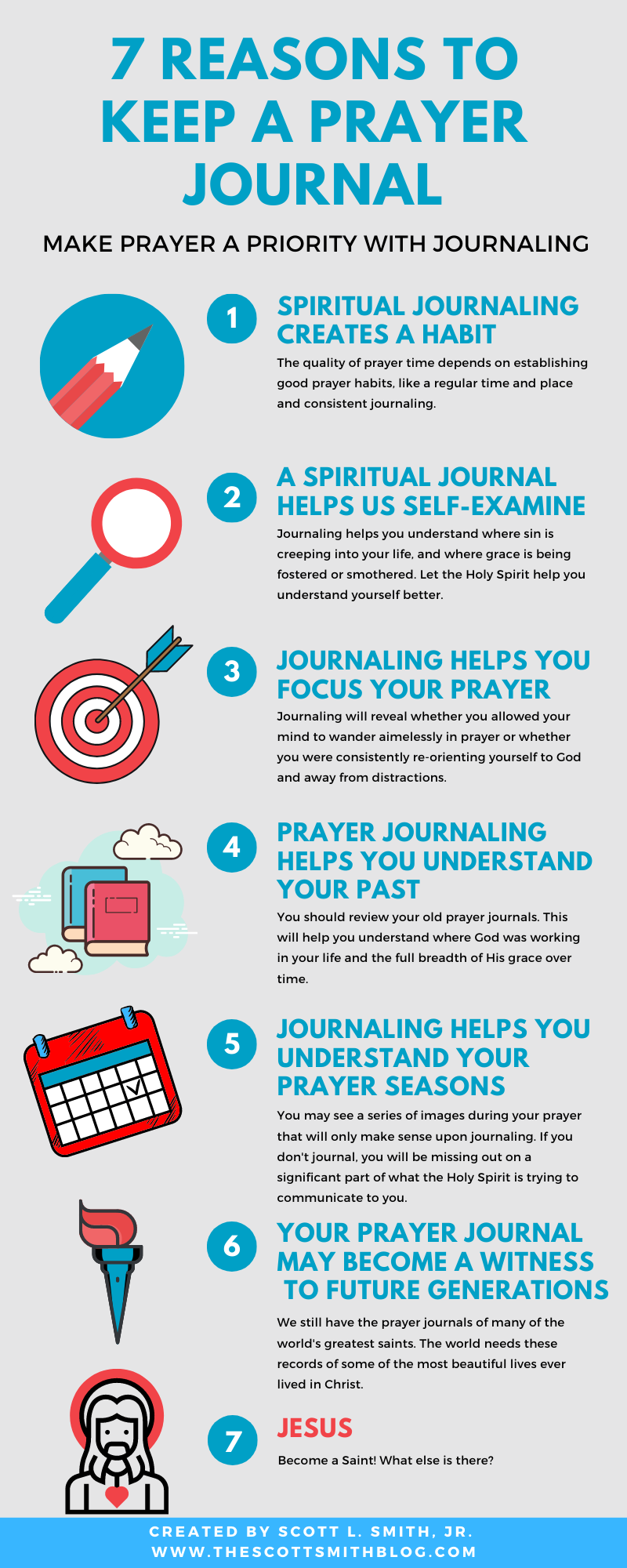
Notice that last step ... He should always be the End toward which we are striving.
#1 Reason To Keep a Prayer Journal:
Spiritual Journaling Creates a Prayer HabitThe quality of prayer time depends on establishing good prayer habits, like a regular time and place and consistent journaling.
#2 Reason To Keep a Prayer Journal:
A Spiritual Journal Helps Us Self-ExamineJournaling helps you understand where sin is creeping into your life, and where grace is being fostered or smothered. Let the Holy Spirit help you understand yourself better.

#3 Reason To Keep a Prayer Journal:
Journaling Helps You Focus Your PrayerJournaling will reveal whether you allowed your mind to wander aimlessly in prayer or whether you were consistently re-orienting yourself to God and away from distractions.
#4 Reason To Keep a Prayer Journal:
Prayer Journaling Helps You Understand Your Past You should review your old prayer journals. This will help you understand where God was working in your life and the full breadth of His grace over time.
#5 Reason To Keep a Prayer Journal:
Journaling Helps You Understand Your Prayer SeasonsYou may see a series of images during your prayer that will only make sense upon journaling. If you don't journal, you will be missing out on a significant part of what the Holy Spirit is trying to communicate to you.

#6 Reason To Keep a Prayer Journal:
Your Prayer Journal May Become a Witness to Future GenerationsWe still have the prayer journals of many of the world's greatest saints. The world needs these records of some of the most beautiful lives ever lived in Christ.
#7 and BEST Reason To Keep a Prayer Journal:
Jesus!Become a Saint! What else is there?
New Catholic Prayer Journal For WomenCheck out the new Prayer Journal for Catholic Women that my wife and I published together. It is a 52-week (or day) devotional for overcoming worry and stress and conquering fear:
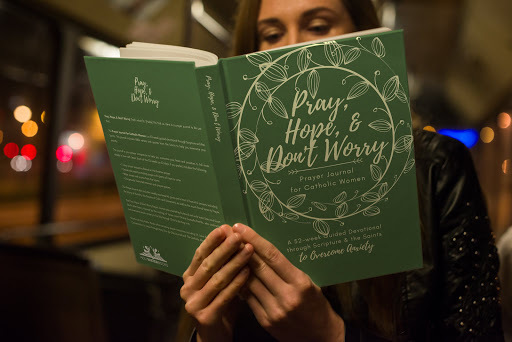
Read even more about the new Catholic Prayer Journal HERE.
The title comes from Padre Pio’s famous quote, but it was another holy person that inspired this book. It was Chiara Corbello Petrillo, surely one of the Church’s upcoming saints, who gave us the idea to create this prayer journal.
It started with my wife reading Chiara Corbello Petrillo, A Witness to Joy . She shared the book with all her sisters and girlfriends, and it spread like wildfire.

Why Keep a Spiritual Journal When Suffering from Anxiety?I didn't realize there were so many women suffering from anxiety, often crippling anxiety. It may even be a silent pandemic.
It's frustrating for husbands, too. It's another one of those things we can't fix. We can be understanding - which isn't especially easy for us. We can make sure our wives get time enough recuperation time with their girlfriends and date nights with us. But, honestly, that's just a start.
So, my wife and I made this prayer journal. If you are overcome with anxiety, we hope and pray you will find God in these pages, and He will give you comfort.
We also made a version for our sisters in Christ who are not (yet) Catholic :)

Take a Look Inside: A Seven-Step Structured Prayer JournalHere is a look inside the prayer journal. In that blank space under "Reflect", you will find a new Saint quote or Bible verse to "ponder in your heart" each week (or day):


How to Use the Catholic Prayer JournalHow to Use a Prayer Journal During Holy Hour?This journal is an excellent companion for Holy Adoration or other kinds of Holy Hours. Use the journaling prompts to guide your prayers before the Blessed Sacrament.
52 Week (12 Month) or 52 Day Catholic Prayer Journal and Daily Bible Verse JournalThere are several different ways to use this prayer journal. Though the journal is designed for 52 weeks of guided prayer, it could also be used for 52 days. Just use each weekly section as a day section, instead. This could also be a resource for Lent if you just use it for 6 weeks or 40 days. We hope this journal will adapt itself to your needs.
Each of the 52 weeks (or days, if you prefer) includes a seven-step prayer sequence modeled after the Examen prayer of St. Ignatius. The seven steps are (1) Breathe, (2) Become aware of God’s presence, (3) Thanksgiving, (4) Reflect, (5) Examination, (6) Contrition, and (7) Hope.
Journaling as a Spiritual Practice: 7 StepsHere is a more in-depth look at the purpose and significance of these steps:
The first step, Breathe, guides you through a breathing exercise that you can also use whenever you feel stressed, especially when you first begin to feel stressed. This breathing exercise can help you ward off a panic attack.Take time to become aware of God’s presence. Remember that He is closer to you than you are to yourself. He is with you right now, in the now. Let your soul come to rest, for as St. Augustine says, “Our hearts were made for You, O Lord, and they are restless until they rest in You.”Thanksgiving: A key to overcoming anxiety is re-orienting yourself to gratitude. That is, focusing less on your fears and more on God’s gifts to you. Lord, I realize that all, even myself, is a gift from you. Today, for what things am I most grateful?Reflect on the provided quote from the Saints or verse from Scripture. We chose these quotes and verses specifically to help you overcome anxiety. What words stand out to you? What comes into your mind as you reflect on the words? This is the meditative practice of lectio divina. Sit with these passages for five minutes or more each day through the week. Plant them in your mind, water them daily with reflection, and let them take root.Ask the Lord to guide you through your day and week. Jesus will take you by the hand to Examine the moments and experiences of your life. Wait and see what bubbles up in your memories. What is Jesus trying to reveal to you? Jesus might be saying “I was there in that moment” but you did not see me, feel me, or hear me. Over time, this exercise will help you to know that Jesus never leaves your side and to sense him always there.Contrition: Big or small, where, when, and how did sin creep into your day? Learning when you are tempted will help you remake your sin habits into virtues. Learn to prayerfully anticipate the future in Hope. So much of our anxiety comes from unwarranted fear of the future. We dread events that may never come to pass. This exercise will help you shift your focus toward the good that is coming. The ultimate goal is to see God’s presence in all things.

Catholic Weekly Prayer JournalA Weekly Prayer is also included. We chose prayers that are focused on overcoming anxiety through gratitude, healing, empowering, and surrendering.
Lastly, each week (or day) also includes a page of Prayer Goals. The goals include a section to list your Prayer Intentions, a Goals Checklist, and a place to list your weekly Acts of Love and Sacrifice:
Prayer Intentions: This is an opportunity to give your worries away to God. Imagine taking these intentions from your heart and placing them in Jesus’ outstretched hands. Prayer especially for those people who stress you or have hurt you or a loved one. This is an amazing way to sever the chains that bind you to hurt. Goals Checklist: We provide some helpful prayer and sacramental practices to help you grow in the practice of the Catholic faith. Small Things with Great Love: Here is a place to list the times that you did a small act for another person with great love. When you do the dishes when it’s not really your responsibility, when you apologize when it’s not your fault, when you forgive the rude person at the grocery store – write it down here.
Lastly, be assured of our prayers for you, and maybe one day we will meet in Heaven ... where there’s no such thing as fear and anxiety.
Totus tuus!
Scott & Ashton Smith

Catholic Prayer Journal for Women: Sample Quotes from the Journal to Overcome Worry and StressChiara Corbella Petrillo: Catholic Journal Prompts and Catholic Quotes"Peace is experienced by the one who allows himself to be loved.""Seen from the outside, all these trials are frightening. We wondered if we could ever confront anything similar. But each step is accompanied by a necessary grace.""The past to mercy, the present to grace, the future to Providence ... Let us ask for grace ... each morning grace permits us ... to make it again to the evening."
Saint Mother Theresa of Calcutta: Catholic Journal Prompts and Catholic Quotes"Yesterday is gone. Tomorrow has not yet come. We only have today. Let us begin.""Pain and suffering have come into your life, but remember pain, sorrow, suffering are but the kiss of Jesus — a sign that you have come so close to Him that He can kiss you."“I have found the paradox, that if you love until it hurts, there can be no more hurt, only more love.”

St. Augustine of Hippo: Catholic Journal Prompts and Catholic Quotes"Our hearts were made for You, O Lord, and they are restless until they rest in You.""Watch, O Lord, with those who wake or watch or weep tonight, and give your angels and saints charge over those who sleep. Tend your sick ones, O Lord Christ. Rest your weary ones. Bless your dying ones. Soothe your suffering ones. Pity your afflicted ones, shield your joyous ones. And all for love’s sake.”“In my deepest wound, I saw Your glory and it dazzled me.”
Catholic Prayer Journal for Women: Sample Prayers, Catholic Journal Prompts from the Journal to Overcome Worry and StressA Prayer for Soothing Panic AttacksDear God,I come before You to Lay my panic and anxiety at Your feet. When I’m crushed by my fears and worries, remind me of Your power and Your grace. Fill me with Your peace As I trust in You and You alone. I know I can’t beat this on my own, but I also know that I have You, Lord, And You have already paid the ultimate price To carry my burdens.For this I thank you. Amen.

“Take and Receive” PrayerTake, Lord, and receive all my liberty, My memory, my understanding, And my entire will – All that I have and call my own.You have given it all to me.To you, Lord, I return it.Everything is yours; Do with it what you will.Give me only your love and your grace.That is enough for me. Amen.
Prayer for CalmMy Lord and my God, I do not know what will happen to me today,But what I do know is thatNothing will happen to me todayThat You and I together cannot handle.This thought is enough To bring me to face the day in peace. I adore you in your wisdom and love. I commend myself into your hands with the complete trust. Amen.

A Prayer for Calming a Troubled HeartLoving God,Please grant me peace of mind And calm my troubled heart. My soul is like a turbulent sea. I can't seem to find my balance, So I stumble and worry constantly.
Give me the strength and clarity of mind To find my purpose and walk the path You've laid out for me. I trust Your Love, God, And know that You will heal this stress. Just as the sun rises each day Against the dark of night.Please bring me clarity with the light of God.In Your Name I pray.Amen.

November 10, 2020
The Lion, The Witch, and the Wardrobe: The Complete Guide to Christian Symbolism and Bible References in C. S. Lewis' The Chronicles of Narnia
You have probably figured out by now that Aslan is Jesus, but that's just the beginning. I have tried to find every Christian symbol in Narnia! What does the snow and the endless Winter represent? Is the White Witch Satan?
What are the wolf, the fox, and the mice symbols for in Narnia? What is the symbolism of Susan's horn and the lamppost in Narnia? What does Mr. Tumnus represent?
Here is everything you will need if you want to host a Chronicles of Narnia Bible Study, too. Look especially to the symbolism of Aslan's sacrifice at the stone table as representing Christ's passion, death, and resurrection and the Sacrifice of Isaac. This would be a great Bible study for Lent.
Have you noticed any other Christian symbols in the Chronicles of Narnia? I have examined not just The Lion, the Witch, and the Wardrobe, but also Prince Caspian, The Voyage of the Dawn Treader, The Silver Chair, The Last Battle, and, my favorite, The Magician's Nephew.
You will find sections below for each of C. S. Lewis' books. Please let me know if I missed anything!
Christian Symbolism in J.R.R. Tolkien's Lord of the RingsIf you're interested in the Christian symbols and allegory in the Chronicles of Narnia, you will enjoy this book I published on the theology of the masterwork of C. S. Lewis' good friend, J.R.R. Tolkien - the Lord of the Rings:
[image error]

The Lion, the Witch, and the Wardrobe - Who Do The Characters Represent in Narnia?

Narnia Symbolism: The White WitchWhat Does the White Witch Symbolize?The White Witch clearly represents Satan, or at the very least a fallen angel. Satan's reign over earth is marked by sin and death. The White Witch's reign over Narnia is marked by un-ending winter and snow.

What Does The Snow Symbolize in Narnia?The Golden Age Prophecy was the ancient prediction of the Golden Age of Narnia. It tells of the ending of the unending winter and snow at Aslan's roar:
Wrong will be right, when Aslan comes in sight,At the sound of his roar, sorrows will be no more,When he bares his teeth, winter meets its death,And when he shakes his mane, we shall have spring again.
When Adam's flesh and Adam's bone,Sits at Cair Paravel in throne,The evil time will be over and done.
The White Witch's reign over Narnia is marked by un-ending winter and snow and turning people to stone. This all comes to an end when Aslan comes.
Likewise, Satan's reign over earth is marked by sin and death. This all comes to an end with the coming of Christ, the Messiah.
The White Witch tries to prevent the prophecy - specifically the "when he shakes his mane, we shall have spring again" part - by shaving off Aslan's mane before the ritual sacrifice and killing of Aslan.
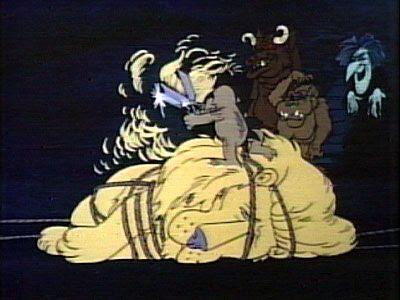
Likewise, Satan tried to prevent Jesus Christ's victory over sin and death. Satan tempts Jesus in the desert to kneel before him. Satan eventually uses Judas - as the White Witch uses Edmund, more on that below - to betray Jesus to his death on a cross.
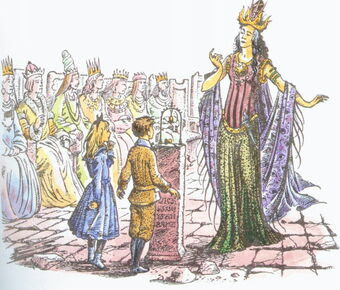
Christian Symbolism in The Magician's Nephew - The White Witch's Origins as Queen JadisIn The Magician's Nephew, C. S. Lewis gives us the White Witch's backstory and makes the parallels more obvious.
For example, in the pre-history of Narnia, the Queen Jadis of Charn, the original name and title of the White Witch, sneaks into Aslan's Garden. The White Witch sneaks into a garden very similar to Eden, instead of entering through the gate.
Inside, the witch plucks and eats a silver apple of the Tree of Youth, much as Satan tempts Eve to eat of the fruit of the Tree of Knowledge of Good and Evil. Nevertheless, Jadis acquires inexhaustible strength and steals immortality.
As an evil, anti-Eve figure from Genesis, Jadis strongly resembles Lilith, as well. Read more about Lilith, the anti-Eve and anti-Mary here.
Narnia Symbolism: AslanIs Aslan Jesus?Aslan is Jesus. Plain and simple. C.S. Lewis eventually pulls away the veil of allegory and makes this point explicit. In the Voyage of the Dawn Treader, Aslan is depicted as a lamb, as in the Lamb of God.

Similarly, in Revelation 5:3-7, the long-awaited Lion of Judah finally appears, and is described as "a Lamb standing, as though it had been slain." Read more on this dramatic turn of events in "The Most Surprising Moment in the Bible".
Frank Herbert's Sci-Fi series Dune also makes use of the Biblical Lion of Judah. Read more about that HERE.
Also, in Voyage of the Dawn Treader, C. S. Lewis wrote the following:
"It isn't Narnia, you know," sobbed Lucy. "It's you. We shan't meet you there. And how can we live, never meeting you?"
"But you shall meet me, dear one," said Aslan.
"Are -are you there too, Sir?" said Edmund.
"I am," said Aslan. "But there I have another name. You must learn to know me by that name. This was the very reason why you were brought to Narnia, that by knowing me here for a little, you may know me better there.”
This is one of my favorite passages in all of C. S. Lewis' Chronicles of Narnia - in all of Lewis' books for that matter. The symbolism of Aslan as Jesus is extremely rich in the Chronicles of Narnia. Several components of Christ's life, death, and resurrection, are symbolically represented by Aslan. We will continue discussing this below ...
Narnia Symbolism: Sons of Adam and Daughters of Eve, The Pevensie ChildrenThe coming of the Pevensie children - Peter, Susan, Edmund, and Lucy - to Narnia was the subject of an ancient prophesy. This was called the "Golden Age Prophecy".
The Golden Age Prophecy was the ancient prediction of the Golden Age of Narnia. It is not known when the prophecy was first told, but it likely originated when the White Witch first conquered Narnia. The Golden Age Prophecy is a set of two separate sayings, as first told in the story by Mr. Beaver:
Wrong will be right, when Aslan comes in sight,At the sound of his roar, sorrows will be no more,When he bares his teeth, winter meets its death,And when he shakes his mane, we shall have spring again.
When Adam's flesh and Adam's bone,Sits at Cair Paravel in throne,The evil time will be over and done.
The Pevensie children are identified as the "Sons of Adam" and "Daughters of Eve". Right off the bat, we know the Chronicles of Narnia takes place in the same universe as Genesis and the Garden of Eden.
The phrasing of the prophesy even seems to quote Genesis 2:23: "This at last is flesh of my flesh and bone of my bone".
Adam and Eve, the first man and woman of Narnia, were created by the "Emperor-Beyond-The-Sea". The "Emperor-Beyond-The-Sea" is the Narnian term for "God", the Father.
Prophecy in the Book of Genesis: Both the Immaculata Conception, the Virgin Mary, and her son, Jesus, the Messiah, are all prophesied at Genesis 3:15, what's called the Protoevangelium.
Narnia Symbolism: EdmundWho does Edmund represent in Narnia?
Aslan dies because of Edmund's betrayal.
Likewise, Judas' betrayal leads directly to Jesus' arrest and death. According to the Deep Magic, the punishment for Edmund's betrayal is death. Similarly, the "wages of sin is death" (Romans 6:23).The Turkish Delight also represents sin and the White Witch, temptation and the Tempter, as described above.


Narnia Symbolism: What Does the The Turkish Delight Symbolize in Narnia?Edmund betrays his family for 30 pieces of Turkish Delight. Judas betrays Jesus for 30 pieces of silver. The Turkish Delight is the thirty pieces of silver.
The Turkish Delight is also a symbol for the Forbidden Fruit of the Tree of Knowledge of Good and Evil. Edmund betrays his family to eat this "forbidden fruit". By the way, did you know that the Forbidden Fruit was NOT an apple?
This actually ties into The Magician's Nephew, the first of the Chronicles of Narnia. The White Witch - then known as the Queen Jadis - steals fruit from a garden. This garden is from the genesis of the world of Narnia. Aslan has also forbidden the taking and eating of this fruit.
Inside Aslan's garden, the White Witch plucks and eats a silver apple of the Tree of Youth. This forbidden fruit then becomes the source of the White Witch's power and immortality, while also damning her.
Narnia Symbolism: Peter Pevensie is Peter the ApostleWho leads Aslan's armies when Aslan must go away?Peter, the High King of Narnia. Who leads the Apostles when Jesus ascends to Heaven? Peter, the leader of the Apostles.

What is the Christian Symbolism of Peter as "Wolf's Bane"? What is the Allegorical Meaning of the Wolf in Narnia? During the Long Winter, the wolves fought on the side of the White Witch. The wolves served the White Witch as her Secret Police. Their captain was Maugrim.
The Secret Police of the White Witch, especially in its wolf aspect, appears to be more a symbol for the Nazi secret police forces, the Gestapo or the S.S., which often used wolves.
Also, the Pevensies, especially Lucy, enter Narnia oblivious of their danger. They are "like sheep for the slaughter". As at Matthew 10:16, "Behold, I am sending you out as sheep in the midst of wolves, so be wise as serpents and innocent as doves.

This is why King Peter, who is the symbol for the Apostle Peter, is called "Wolf's Bane". Aslan names Peter "Wolf's Bane" after his resurrection.
Likewise, Jesus visits the Apostles after His resurrection. Jesus instructs St. Peter to care for Jesus' sheep, as a shepherd-pastor and the first Pope. Here are Jesus' words from the last chapter of the Gospel of John, John 21:
When they had finished breakfast, Jesus said to Simon Peter, “Simon, son of John, do you love me more than these?” He said to him, “Yes, Lord; you know that I love you.” He said to him, “Feed my lambs.”
A second time he said to him, “Simon, son of John, do you love me?” He said to him, “Yes, Lord; you know that I love you.” He said to him, “Tend my sheep.”
He said to him the third time, “Simon, son of John, do you love me?” Peter was grieved because he said to him the third time, “Do you love me?” And he said to him, “Lord, you know everything; you know that I love you.” Jesus said to him, “Feed my sheep."
Peter "Wolf's Bane" and Saint Peter the Pope-Shepherd are tasked by Aslan and Jesus, respectively, to protect their sheep - their people - from the wolves.
What is the Symbolism of Aslan's Table and Tomb? Jesus' Passion, Death, and ResurrectionWhat Happened to Aslan in the Stone Table?Aslan is ritually sacrificed at the Stone Table. Evil spirits and witches surrounding him. It closely resembles the abomination of a Black Mass.
The Stone Table, Biblically-speaking, is most directly a reference to the stone altar where Isaac was to be sacrificed by Abraham. But the Sacrifice of Isaac directly points to the Sacrifice of Jesus on the Cross.
The Stone Table of Aslan is the Cross of Christ.
Look at this image of Susan and Lucy holding the dead body of Aslan side-by-side with Michelangelo's Pieta, a depiction of the Blessed Mother holding the body of Christ, after He was taken down from the Cross:
 Michelangelo's Pieta compared to Narnia
 The Stone Table is also the Tomb of Aslan, since he was not buried ...
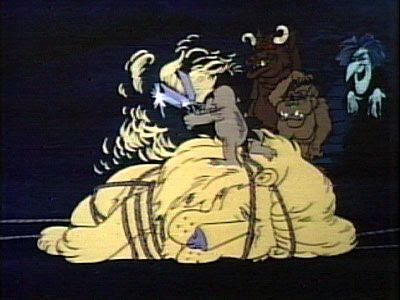
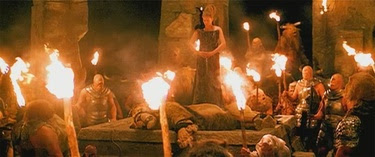
What is the Symbolism of the Binding of Aslan with Ropes?The sacrifice of Jesus on the Cross is prefigured by Abraham's (almost) sacrifice of Isaac. The sacrifice of Isaac is often referred to as the "Binding of Isaac" or the Akedah, in Hebrew.
Similarly, Aslan is bound by ropes. Aslan is not crucified, exactly, because this is the manner of execution reserved for a human. Instead, C. S. Lewis' crucifixion symbolism is based on animal sacrifice. A ram was bound (with ropes) and sacrificed as a substitute for Isaac.
The Akedah Binding of Aslan connects to two more Christian symbols in Narnia: (1) Susan's Horn and (2) the Mice biting through Aslan's ropes.
What is the Symbolism of Susan's Horn in Narnia?Reference to the Akedah, the binding of Isaac, appears throughout the Rosh Hashanah liturgy of the Jews. Even the shofar (ram’s horn) blown on the holiday is said to be a reminder of the Akedah, and how Isaac was spared.

This is why Susan is given the horn by Father Christmas! Father Christmas tells Susan the following:
And when you put this horn to your lips and blow it, then, wherever you are, I think help of some kind will come to you.
Queen Susan's Horn was a prized possession of Susan Pevensie when she reigned in Narnia as "Queen Susan the Gentle". Given to her by Father Christmas just before the Winter Revolution, the horn was a magical object, used in times of emergency to call for help. Queen Susan's Horn is later used to summon the Pevensie children back to Narnia to aid Prince Caspian.
What do the Mice Represent in Narnia?After Aslan was bound by ropes and killed by the White Witch, mice chewed through the ropes which bound Aslan. These mice and their descendants became talking mice as a reward for this kindness.
The warrior mouse Reepicheep is likely a descendant of these mice blessed by Aslan.
Later in The Voyage of the Dawn Treader, these mice receive a further blessing through their representative Reepicheep. On Caspian X's voyage to the end of the world, Reepicheep became the first and only Narnian to sail beyond the eastern end of the world to Aslan's country.

The use of mice by C. S. Lewis is a reference to the Beatitudes: "Blessed are the meek, for they shall inherit the earth" (Matthew 5:5).
Mice are similar to the hobbits of Tolkien's worlds, of which Tolkien wrote: “Even the smallest person can change the course of the future”. Or, in Narnia, “Even the smallest [animal] can change the course of the future”.
Narnia and Easter Morning: How Many Women Visit Jesus' and Aslan's Tomb?Lucy and Susan visiting the broken stone table is like Mary Magdalene and the other Mary visiting the tomb of Jesus. Lucy and Susan are surprised to find a resurrected Aslan, as are the Marys.
Also, look how the movie depicts Aslan emerging from his resurrection, similar to Jesus emerging from the tomb.

Narnia Symbolism: LucySt. Lucy of Narnia is actually a Catholic Saint! Read more about her here.
Lucy Pevensie is like the person who comes to believe in Jesus, while her friends and family are still non-believers or even atheists. Lucy's siblings, Peter and Susan, are bewildered at Lucy's behavior and wild stories, despite Lucy being known as honest and trustworthy.
Peter and Susan ask the Professor about Lucy's stranger behavior ...

Who Does The Professor Represent in Narnia?The Professor in The Lion, the Witch, and the Wardrobe (Professor Kirke) uses the Christian reasoning of the trilemma - liar, lunatic or Lord - in defending Lucy to her siblings. It's the same argument Christians often invoke in discussion of Jesus as the Son of God.
It is the same argument that C.S Lewis, himself, stated perhaps better than anyone:
I am trying here to prevent anyone saying the really foolish thing that people often say about Him: I’m ready to accept Jesus as a great moral teacher, but I don’t accept his claim to be God. That is the one thing we must not say. A man who was merely a man and said the sort of things Jesus said would not be a great moral teacher. He would either be a lunatic — on the level with the man who says he is a poached egg — or else he would be the Devil of Hell. You must make your choice. Either this man was, and is, the Son of God, or else a madman or something worse. You can shut him up for a fool, you can spit at him and kill him as a demon or you can fall at his feet and call him Lord and God, but let us not come with any patronizing nonsense about his being a great human teacher. He has not left that open to us. He did not intend to.-- Mere Christianity
One could even say that the Professor in The Lion, the Witch, and the Wardrobe represents C. S. Lewis, himself.
Narnia Bible Symbolism: The Talking AnimalsThe Bible does contain talking animals. Some were bad and some were good. There is the possession of the serpent by Satan - the serpent of Eden was actually a dragon, by the way. There is a Satan-Serpent character in The Silver Chair, more on that later on ...
The Bible also includes the talking donkey, "Balaam's Ass" ...
What Does the Talking Donkey Represent in Narnia?In the Book of Numbers 22:28, Balaam starts punishing the donkey for refusing to move, it is miraculously given the power to speak to Balaam.
There are many talking donkeys in Narnia:
In the Magician's Nephew, one of the first animals to be given the power of speech was a donkey. This donkey wisely described the evil magician, Uncle Andrew, by saying, "Perhaps it's an animal that can't talk but thinks it can."
Puzzle the Donkey - Christian Allegory for Sin, Contrition, and Sacrament of Reconciliation
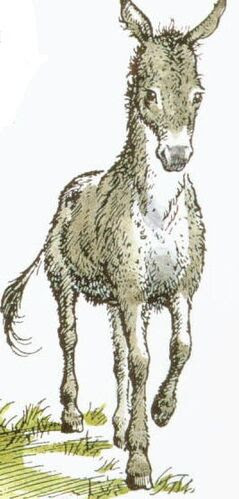 In the Last Battle, the donkey Puzzle was a friend of Shift the Ape. The clever Shift was able to convince the well-meaning Puzzle to participate in the False Aslan Affair by dressing up in a lion-skin and pretending to be Aslan. The well-meaning donkey thereby becomes an anti-Aslan or anti-Christ figure.
Puzzle's conscience was uneasy during this charade, and he eventually returns to Aslan's side. When Aslan ended the Narnian world, Puzzle enters Aslan's Country through the stable door with all of the other Narnians who loved Aslan.
When he finally met the Lion, Puzzle afraid and ashamed:
The Lion bowed down his head and whispered something to Puzzle at which his long ears went down, but then he said something else at which the ears perked up again. The humans couldn't hear what he had said either time.― The Last Battle (Chapter 16)
Here, Puzzle the donkey models the Christian pattern of sin, contrition, and reconciliation with Jesus-Aslan, and ultimately, redemption.
Who Does The Fox Represent in Narnia?The Fox was an elderly fox who lived in Narnia during the reign of the White Witch. He was also one of the first Narnians to receive a present from Father Christmas after Aslan ended the Long Winter.

The fox represents people who do not seem to be religious but when tested are proved to be very pious and like the fox, willing to give up their lives for the sake of their beliefs.
What Do Mr. and Mrs. Beaver Symbolize in Narnia?Mr. Beaver and Mrs. Beaver, also known as "She-Beaver", the wife of Mr. Beaver, were certainly kind characters of Christian virtue. Together, they aided the Pevensie children in their escape from the White Witch's Secret Police.

Mr. and Mrs. Beaver could be symbolic of guardian angels, since they are forever trying to help the Pevensies by guiding them to safety and leading them through the snow.
Mr. and Mrs. Beaver are also a representation of Moses. They lead the Pevensie children through the Wilderness, as Moses lead the Israelites through the Wilderness of Sinai. Likewise, the Israelites eventually left the Wilderness by the crossing of a river, the Jordan River.
Mr. and Mrs. Beaver are also a symbol of St. Christopher. As water creatures, they help bear the Pevensie children across the river. St. Christopher is said to have borne the Christ child across a river, as well. What Does Mr. Tumnus Represent in Narnia?You might be tempted to say Mr. Tumnus is another Christian symbol in Narnia for Judas, the betrayer of Christ. But wait!

Mr. Tumnus is more like the Apostle Paul. Paul is originally Saul, a member of the Jewish leadership and persecutor of Christians. While he begins by leading the stoning and martyrdom of St. Stephen, he soon realizes his mistake and converts, ultimately giving his life for Christ.
Likewise, Mr. Tumnus begins by betraying the Pevensies, but - at least in the movie - realizes his mistake and lays down his life for them. Unwilling to betray the Pevensies any further, Tumnus is then "stoned" or turned to stone by the White Witch.
What is the Allegorical Meaning of the Wolf in Narnia? As described in the section on King Peter and St. Peter ...
During the Long Winter, the wolves fought on the side of the White Witch. The wolves served the White Witch as her Secret Police. Their captain was Maugrim.
The Secret Police of the White Witch, especially in its wolf aspect, appears to be more a symbol for the Nazi secret police forces, the Gestapo or the S.S., which often used wolves.
Also, the Pevensies, especially Lucy, enter Narnia oblivious of their danger. They are "like sheep for the slaughter". As at Matthew 10:16, "Behold, I am sending you out as sheep in the midst of wolves, so be wise as serpents and innocent as doves.
This is why King Peter, who is the symbol for the Apostle Peter, is called "Wolf's Bane". See the section above on the Christian symbolism of King Peter for more on this ...
Prince Caspian -
Christian Symbolism & Biblical ParallelsWhat is the Biblical Symbolism of the Narnian River God Scene Destroying the Armies?River gods and Naids were created by Aslan at the birth of Narnia when he gave the beasts speech. River gods were powerful male water spirits. The female water spirits were called Naiads. The most famous River god one is the one at the Fords of Berunan, known as the Berunan River god.
When Aslan returned, during the War of Deliverance, the Berunan River God awoke and greeted Aslan:
"Hail, Lord! Loose my chains."
"Loose my chains" sounds like the Hebrew slaves being "delivered" from their bondage in Egypt. And, of course, the god describes Aslan as "Lord", the same title borne by Jesus. The River God also uses "Hail" - more on the use of "Hail" in the Gospels here.
What the River God did next may remind you of a certain scene in Exodus. The Narnian river god destroys the armies of King Miraz just as God used the Nile to destroy the armies of Pharaoh.


The Narnian river god even looks a bit like Moses.
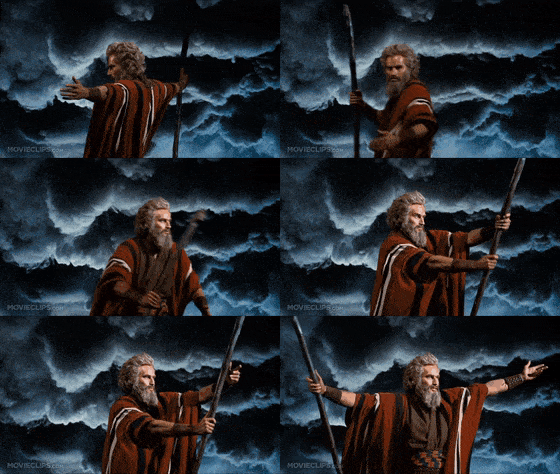

The Voyage of the Dawn Treader -
Christian Allegory & Symbolism Narnia Symbolism: Aslan's Country - Why Does the Light Grow Stronger? Why Does the Water Grow Sweeter?As the ship, the Dawn Treader, sails closer and closer to Aslan’s country, the light from the sun grows brighter and brighter. Everyone’s vision improves, too. This happens because of the ocean water, which is also growing sweeter and sweeter.
Why does the light grow brighter and brighter approaching Aslan's country?
The symbolism of the light of Aslan's Country refers to the light that Jesus Christ brings to men. Jesus is the "light of the world". The symbolism of the water of Aslan's Country refers to the power of the Holy Spirit that fills us when we put our faith and trust in God through Jesus Christ.
Water symbolism is, of course, very rich in the Bible. The Dawn Treader can be viewed as a kind of Ark, carrying the characters over the waters to the sanctuary of dry land, or toward a "New Heaven and a New Earth."
Why does the water grow sweeter and sweeter? Jesus promises us a feast of the choicest wines, a feast of wine on the lees". Likewise, the water is the clearest and choicest.
Also, Jesus tells the woman at the well at John 4:14, “Whoever drinks the water I give them will never thirst. Indeed, the water I give them will become in them a spring of water welling up to eternal life.”
Narnia Symbolism: Aslan changes from a Lion into a LambThe Lion is a massive Biblical symbol. Read more on the Lion of Judah here. As described above in this article, the Lion of Judah appears in the Book of Revelation as a Lamb.
In the Voyage of the Dawn Treader, Aslan describes himself as a lamb, as in "the Lamb of God, who takes away the sins of the world". These are the words of St. John the Baptist upon seeing Jesus at John 1:29. Remember, also, that the Sacrifice of Isaac was replaced with a male lamb, a ram.
Similarly, in Revelation 5:3-7, the long-awaited Lion of Judah finally appears, and is described as "a Lamb standing, as though it had been slain." Read more on this dramatic turn of events in "The Most Surprising Moment in the Bible".
Frank Herbert's Sci-Fi series Dune also makes use of the Biblical Lion of Judah. Read more about that HERE.
Also, in Voyage of the Dawn Treader, C. S. Lewis wrote the following:
"It isn't Narnia, you know," sobbed Lucy. "It's you. We shan't meet you there. And how can we live, never meeting you?"
"But you shall meet me, dear one," said Aslan.
"Are -are you there too, Sir?" said Edmund.
"I am," said Aslan. "But there I have another name. You must learn to know me by that name. This was the very reason why you were brought to Narnia, that by knowing me here for a little, you may know me better there.”
The Silver Chair -
Christian Allegory & SymbolismThe Silver Chair was a magical device constructed by the Queen of Underland, also known as the Lady of the Green Kirtle - another Satan figure like the White Witch. The Silver Chair was designed to keep Prince Rilian bound to a cursed enchantment. Every night, Rilian was sat down onto the chair to renew the manipulative magic.
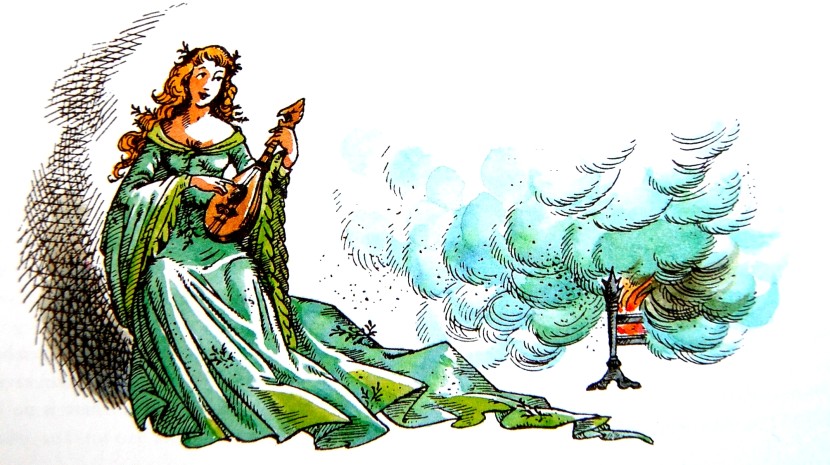
Queen of Underland, The Lady of the Green Kirtle - The Satan Serpent of The Silver ChairWhen Prince Rilian was about twenty years old, Rilian's mother, Lilliandil, was attacked and killed while taking a nap in the northern lands. She was killed by a giant green serpent. We later find out that the green serpent was - surprise! - the Lady of the Green Kirtle.
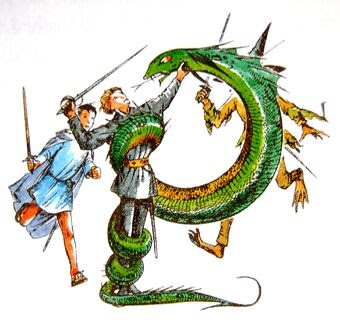
The Bible, of course includes the possession of the serpent by Satan in Genesis. The serpent of Eden was actually a dragon, by the way.
Is Prince Rilian the Prodigal Son?Prince Rilian journeys to the northern lands where his mother was killed. While there, Rilian becomes smitten by the appearance of a beautiful woman, dressed in *cough* GREEN. Rilian did not know who she was, but once he saw her, he forgot all about the serpent and avenging his mother's death. Whether this was due to the woman's beauty or some form of enchantment is not known.
The Prodigal Son leaves home because of sin and vice. These are like the enchantments of the Green Serpent Woman.
King Caspian X also longs for the return of his son, like the father in the Parable of the Prodigal Son.
The Thorn in Aslan's Paw - The Crown of Thorns and "Jesus Wept"There is much more happening here than just a reference to the thorn in the lion's paw, the possibly-Aesop fable of Androcles and the Lion. It seems that C. S. Lewis wanted to Christianize the classic story ...
After Caspian dies, Aslan appears to Eustace and Jill Poe in Narnia and brings them back to the mountain. Aslan weeps over the dead king's body as it lies in the stream. Similarly, Jesus weeps over the death of his friend Lazarus.
Aslan commands Eustace to drive a thorn into his paw and allows his blood to fall on Caspian's body. First off, the use of a thorn is significant. C. S. Lewis purposefully recalls the Crown of Thorns that pierced and drew blood across the brow and head of Jesus during His Passion and Crucifixion. Aslan's blood is also important. Even though Caspian's body lies in the water of the stream - as though washed by the waters of Baptism - it is Aslan's blood that resurrects King Caspian, for it is by Jesus' blood that we are redeemed and resurrected. As in the blood of the Eucharist, we receive Jesus' own life within us.
The Last Battle -
Christian Allegory & SymbolismWhere to start? C. S. Lewis really brings home many of his Christian themes in The Last Battle. Even the title, The Last Battle, is a reference to the last battle of Armageddon.
More to come!

November 5, 2020
Feast of St. Elizabeth: What is Really Happening at the Visitation? Mary is the New Ark
Happy Feast of Saint Elizabeth of the Visitation!
Mary's visit to Elizabeth was no ordinary family visit. Why does the baby leap in Elizabeth's womb? What other historical event happened in Saint Elizabeth's neighborhood? And what does King David have to do with all this?
2) And David arose and went with all the people who were with him from Ba′ale-judah, to bring up from there the ark of God, which is called by the name of the Lord of hosts who sits enthroned on the cherubim ... (5) And David and all the house of Israel were making merry before the Lord with all their might, with songs and lyres and harps and tambourines and castanets and cymbals.And when they came to the threshing floor of Nacon, Uzzah put out his hand to the ark of God and took hold of it, for the oxen stumbled. And the anger of the Lord was kindled against Uzzah; and God smote him there because he put forth his hand to the ark; and he died there beside the ark of God. And David was angry because the Lord had broken forth upon Uzzah; and that place is called Pe′rez-uz′zah, to this day. And David was afraid of the Lord that day; and he said, “How can the ark of the Lord come to me?” So David was not willing to take the ark of the Lord into the city of David; but David took it aside to the house of O′bed-e′dom the Gittite. And the ark of the Lord remained in the house of O′bed-e′dom the Gittite three months; and the Lord blessed O′bed-e′dom and all his household.
(12) And it was told King David, “The Lord has blessed the household of O′bed-e′dom and all that belongs to him, because of the ark of God.” So David went and brought up the ark of God from the house of O′bed-e′dom to the city of David with rejoicing; and when those who bore the ark of the Lord had gone six paces, he sacrificed an ox and a fatling. And David danced before the Lord with all his might; and David was girded with a linen ephod. So David and all the house of Israel brought up the ark of the Lord with shouting, and with the sound of the horn.
(16) As the ark of the Lord came into the city of David, Michal the daughter of Saul looked out of the window, and saw King David leaping and dancing before the Lord; and she despised him in her heart ... (22) And Michal the daughter of Saul had no child
[until] the day of her death.
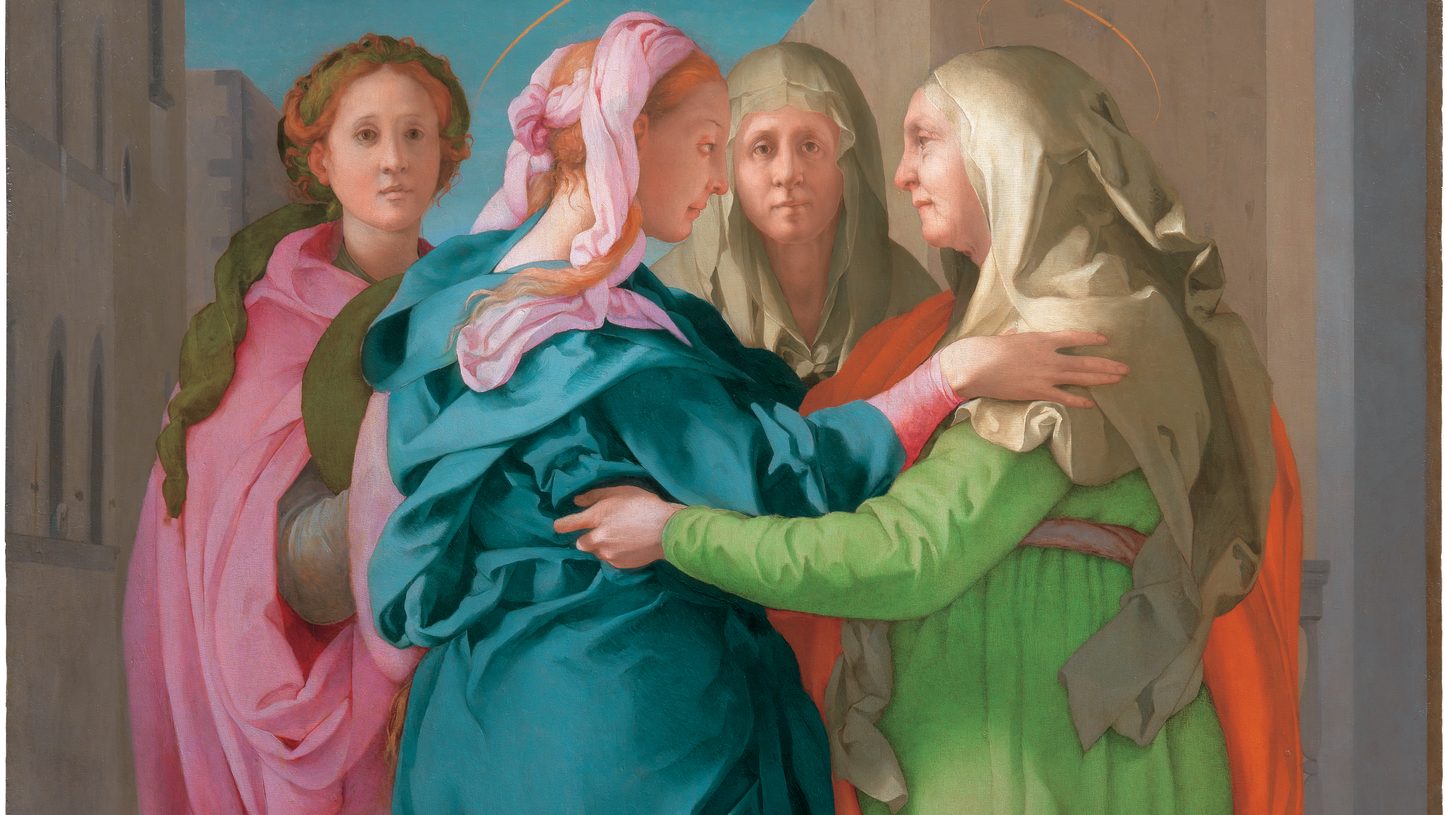
Gospel of Luke: The Visitation of St. ElizabethNow re-read Luke's account of the Visitation at Luke 1:39-45, 56:
In those days Mary arose and went with haste into the hill country, to a city of Judah, and she entered the house of Zechari′ah and greeted Elizabeth. And when Elizabeth heard the greeting of Mary, the babe leaped in her womb; and Elizabeth was filled with the Holy Spirit and she exclaimed with a loud cry, “Blessed are you among women, and blessed is the fruit of your womb! And why is this granted me, that the mother of my Lord should come to me? For behold, when the voice of your greeting came to my ears, the babe in my womb leaped for joy. And blessed is she who believed that there would be a fulfillment of what was spoken to her from the Lord.” [Mary sings her Magnificat] ... And Mary remained with her about three months, and returned to her home.

Do you notice any similarities? Let's go through them one-by-one:
Visitation: Mary is the New Ark"And why is this granted me, that the mother of my Lord should come to me?"Elizabeth says this to Mary, but what does David say at 2 Samuel 6:9? "How can the ark of the Lord come to me?" Elizabeth just replaces "the mother" for "the ark".
Elizabeth is quoting King David when she announces Mary's arrival. Luke is plainly equating the "ark of the Lord" and the "mother of my Lord."
The babe "leaped for joy"Where could there possibly be a connection here, right? There's no baby at all described in 2 Samuel 6. But there were people "leaping" in both passages: King David was "leaping and dancing before the Lord". Therefore, both King David the and the unborn John the Baptist were leaping before the Ark.
Not only that, there were both naked! Michal, the one who is struck barren, rebukes David at 2 Samuel 6:20: “How the king of Israel honored himself today, uncovering himself today before the eyes of his servants’ maids, as one of the vulgar fellows shamelessly uncovers himself!” Michal reveals that David was "uncovered" in public.
"Three months"Did you notice the amount of time that the Ark of the Lord remained at the house of Obed-edom? It was "three months" (verse 11). And how long did Mary, the New Ark, remain at the house of Elizabeth? Again, three months! Check out verse 56.
"Arose and went" & "The hill country" of JudahFirst off, the first few words of both passages are repeated: David "arose and went" and Mary, too, "arose and went". These are all tags used by Luke to connect the passages. Moreover, David was coming from "Ba′ale-judah" and Mary was headed "in haste" into "the hill country, to a city of Judah."
Both were in the lands of Judah.
Elizabeth lived in the "hill country" of Judah. But "what has this to do" with King David and the Ark? Where is the Ark headed in 2 Samuel 6? In this chapter, the Ark travels from Abinadab in Gibeah to the house of Obededom the Gittite1 and then to the "City of David." So where were all these locations?
Before the Ark arrived at the house of Obed-edom, Uzzah made his fateful mistake (more on why this was a mistake below). The place where he touched the Ark and was smote dead by God is called "Perez-Uzzah to this day" according to 2 Samuel 6:8. While "to this day" was quite a long time ago, the place is still known.
After Uzzah's mistake, David hesitated in bringing the Ark into the "City of David." The "City of David" is Jerusalem, and David and his group were almost there.
All of these places - Baale-Judah, the "threshing floor of Nacon," Perez-Uzzah, and the house of Obed-edom - are all within a couple miles of each other. These are all near the ancient city of Kirjath-jearim, which is northwest of Jerusalem.2
So if Kirjath-jearim is where the events of 2 Samuel 6 took place, where was the home of Zechariah and Elizabeth?
Zechariah and Elizabeth's home is well known. It is near Ein Karem. Zechariah had two homes, one in the valley and a summer home higher up on the hillside, where it was cooler. The home in the valley is the site of the Church of the Nativity of John the Baptist. The home up on the hillside is the site of the Church of the Visitation.
 Church of the Visitation and Gorny Monastery, Ein Karem, near Jerusalem
How far apart do you think the site of the Visitation is from the house of Obed-edom, near Kirjath-jearim? Would it surprise you to learn that they are only about 3-4 miles apart as the crow flies?
So not only did these two events both happen in the "hill country of Judah" - both happened in the same neighborhood!
"Exclaimed"At Luke 1:42, Elizabeth bursts out with an exuberant cry. Elizabeth "exclaimed with a loud cry, 'Blessed are you among women, and blessed is the fruit of your womb!'" She is basically the first human to pray the "Hail Mary!" Remember that you are repeating the words of Elizabeth and the Angel Gabriel when we pray this ancient prayer.
The particular expression used for "exclaim" is very interesting. It is rarely used in the Bible and only ever in a very specific context. This is actually the only time it is found at all in the New Testament.
Every time "exclaimed" is used in the Old Testament, it refers to the music of the Levitical singers and musicians that accompanied processions of the Ark of the Covenant. It described the "exultant" sound of instruments as the Ark processed into Jerusalem with King David (1 Chronicles 15:28) and into the Temple with King Solomon (2 Chronicles 5:13).
In 2 Samuel 6, the processions of the Ark are also accompanied by music, instruments, and shouting: (verse 5) "And David and all the house of Israel were making merry before the Lord with all their might, with songs and lyres and harps and tambourines and castanets and cymbals"; and (verse 15) "So David and all the house of Israel brought up the ark of the Lord with shouting, and with the sound of the horn."
In summary, when Elizabeth "exlaims" before Mary, she is singing as the New Ark is processing into her home, just as the Levites did at the processions of the original Ark. And, there's one more thing. Elizabeth was a Levite!
"Overshadow"Just as the expression for "exclaim" found in the Visitation is reserved for a certain context in Scripture, so, too, is the word "overshadow." The verse containing "overshadow" occurs a little bit earlier in the Gospel of Luke. It is found at the Annunciation. If you will recall, the Angel Gabriel said to Mary at Luke 1:35, "The Holy Spirit will come upon you, and the power of the Most High will overshadow you."
Like "exclaim," the particular expression for "overshadow" occurs no where else in the New Testament or even Scripture, except at Exodus 40:34-35:
Then the cloud covered the meeting tent, and the glory of the LORD filled the Tabernacle. Moses could not enter the meeting tent, because the cloud settled down upon it and the glory of the LORD filled the Tabernacle.
What was the principal object found within the Tabernacle? The Ark of the Covenant.
Luke, therefore, is referencing the way the Spirit of God came upon the Ark as the Glory Cloud (Hb. shekinah) to describe the way the Spirit of God will come to the Virgin Mary, the New Ark. Amazing!
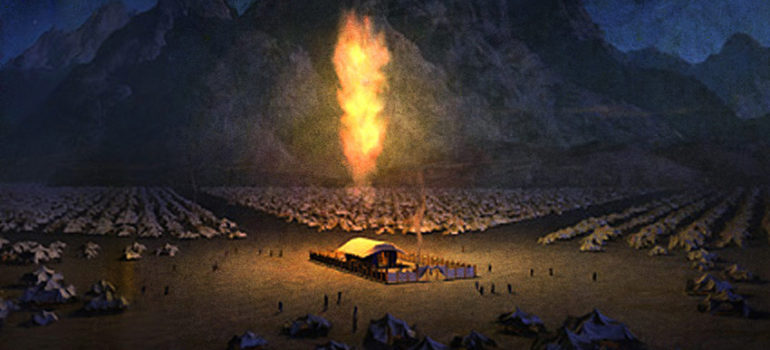
Here are some additional insights on Mary provided by 2 Samuel 6:
Perpetual Virginity of MaryThe Incident with UzzahSo why did God strike Uzzah dead? That seems right out of left field. All Uzzah did was try to stop the Ark from falling off the cart, right?
Not quite. God's original command was for the priests, specifically the Levitical priests, to carry the Ark using the golden poles and rings provided at Exodus 25. Uzzah and his brother were not priests, and the oxen pulling the cart were certainly not priests.
On top of this irreverence, Numbers 4:15 specifically forbade the Kohathites, such as Uzzah, from touching the Ark and "the holy things, or they will die." God always remembers his promises.
But what might this scene say about Mary? If merely touching the original Ark could mean death, what would happen if a mortal man touched, let alone conceived with, the Virgin Mary, the spouse of the Holy Spirit? This scene with Uzzah, therefore, provides typological proof for the dogma of the Perpetual Virginity of Mary.
"Until the day of her death"For the hate she bore in her heart for King David, Michal was struck barren, not unlike Uzzah being struck down dead. Elizabeth, too, was believed to be barren, which again connects 2 Samuel 6 to Luke 1.
But there's more! One of the verses most frequently cited to disprove the Perpetual Virginity of Mary is Matthew 1:24-25:
When Joseph woke from sleep, he did as the angel of the Lord commanded him; he took his wife, but knew her not until she had borne a son ...
See?? Mary was only a virgin until she gave birth to Jesus, and not after!" That's what people will say.
Not quite. It's the "and not after" part that is a false assumption. The word "until" when used in Scripture does not mean what it means in every day American English.
How do we know? Compare the "until" in Matthew 1:24-25 with the "until" in 2 Samuel 6:22, "And Michal the daughter of Saul had no child [until] the day of her death."
Does this mean Michal, who was struck barren by God, gave birth to children after her death?
Absolutely not. In the same way, Joseph is not assumed to have "known" Mary, in the Biblical sense, following Jesus' birth.
Footnotes for St. Elizabeth, the Visitation, & Mary is the New Ark1. Gath was one of the five royal cities of the Philistines. Gath was also famous as the birthplace or residence of Goliath (1 Samuel 17:4). David fled from Saul to Achish, king of Gath (1 Samuel 21:10; 27:2-4; Psalms 56), and his connection with it will account for the words in 2 Samuel 1:20. It was afterwards conquered by David (2 Samuel 8:1). It occupied a strong position on the borders of Judah and Philistia (1 Samuel 21:10; 1 Chronicles 18:1). Its site has been identified with the hill called Tell esSafieh, which rises 695 feet above the plain on its east edge. The Crusaders built the castle of Alba Specula here in the Middle Ages. It is noticed on monuments about B.C. 1500. Interestingly, "Gath" translates as "wine vat," which may have certain typological and specifically Eucharistic meaning. For more information, see Gath and Tell es-Safi ↩
2. The ark was brought to this place (1 Samuel 7:1, 2) from Beth-shemesh and put in charge of Abinadab, a Levite. Here it remained till it was removed by David to Jerusalem (2 Samuel 6:2, 3, 12; 1 Chronicles 15:1-29; compare Psalms 132). It was also called Baalah (Joshua 15:9) and Kirjath-baal. It has been usually identified with Kuriet el-'Enab (i.e., “city of grapes”), among the hills, about 8 miles northeast of 'Ain Shems (i.e., Beth-shemesh). The opinion, however, that it is to be identified with 'Erma, 4 miles east of 'Ain Shems, on the edge of the valley of Sorek, seems to be better supported.↩

October 30, 2020
Saint Alphonsus Rodriguez - Poem by Gerard Manley Hopkins
Today is October 30, the Feast of St. Alphonsus Rodriguez. St. Alphonsus Rodriguez, pray for us!
Have you ever read Gerard Manley Hopkins' poem about St. Alphonsus Rodriguez? It is one of my favorites. It speaks to the great work that can be done with simple virtue and simple acts.
It was the Age of Discovery. It was a time when Jesuits accompanied the European explorers to the most remote parts of the globe, and in some cases, like Saint Francis Xavier and Mateo Ricci, when the priests went farther then the explorers.
St. Alphonsus Rodriguez was a porter, a doorman, for a remote Jesuit retreat house on an island in the Mediterranean Sea. It was the backwater of backwaters for a Jesuit during the Age of Explorers.
Nevertheless, Rodriguez' great spiritual insight became renowned throughout Europe. The simple man became the destination for kings and princes.
Read more about St. Alphonsus Rodriguez below. His was a life of great tragedy before joining the Jesuits.
Here is one of Gerard Manley Hopkins' greatest poems about one of the simplest saints:
St. Alphonsus Rodriguez
Laybrother of the Society of Jesus
Honour is flashed off exploit, so we say;
And those strokes once that gashed flesh or galled shield
Should tongue that time now, trumpet now that field,
And, on the fighter, forge his glorious day.
On Christ they do and on the martyr may;
But be the war within, the brand we wield
Unseen, the heroic breast not outward-steeled,
Earth hears no hurtle then from fiercest fray.
Yet God (that hews mountain and continent,
Earth, all, out; who, with trickling increment,
Veins violets and tall trees makes more and more)
Could crowd career with conquest while there went
Those years and years by of world without event
That in Majorca Alfonso watched the door.
[from Franciscan Media]
Tragedy and challenge beset today’s saint early in life, but Alphonsus Rodriguez found happiness and contentment through simple service and prayer.
Born in Spain in 1533, Alphonsus inherited the family textile business at 23. Within the space of three years, his wife, daughter, and mother died; meanwhile, business was poor. Alphonsus stepped back and reassessed his life. He sold the business, and with his young son, moved into his sister’s home. There he learned the discipline of prayer and meditation.
At the death of his son years later, Alphonsus, almost 40 by then, sought to join the Jesuits. He was not helped by his poor education. He applied twice before being admitted. For 45 years he served as doorkeeper at the Jesuits’ college in Majorca. When not at his post, he was almost always at prayer, though he often encountered difficulties and temptations.
His holiness and prayerfulness attracted many to him, including Saint Peter Claver, then a Jesuit seminarian. Alphonsus’ life as doorkeeper may have been humdrum, but centuries later he caught the attention of poet and fellow-Jesuit Gerard Manley Hopkins, who made him the subject of one of his poems.
Alphonsus died in 1617. He is the patron saint of Majorca.

October 29, 2020
“The Unbreakable Prince”: Biography of Adam Stefan Cardinal Sapieha, the Teacher of Pope St. John Paul II
This is especially true of Pope St. John Paul II. Growing up in Poland, so many of his friends and teachers were martyred. First at the hands of the Nazis, then at the hands the Communists.
One of the greatest men in the life of Pope St. John Paul II was his teacher, Adam Stefan Cardinal Sapieha.
St. John Paul II said the following of this great man:
He was a great son of his homeland; resolute in difficult moments, brave beyond the measure of mediocrity, an extraordinary son of his homeland, an extraordinary man of history and Poland
- 1976 statement of former student Karol Wojtyła, then Archbishop of Krakow, subsequently Pope St. John Paul II
I hope you enjoy the following guest post by acclaimed writer Brian J. Costello, KHS, OT, CLJ.
Together, we wrote the following collection of biographies of "Blesseds" including Carlo Acutis and Father Seelos:
[image error] [image error]
Also, if you love Pope St. John Paul II and want to learn from him "how to pray the Rosary", I have compiled the following book of JP2's contemplations of the mysteries of the Rosary:
[image error]

Cardinal Sapieha: HOLY MAN OF ROYAL LINEAGEBorn May 14, 1867 at Krasiczyn - into a family renowned for its commitment to God, Church, country, education, philanthropy, and each other - Prince Adam Stefan Stanisław Bonifacy Józef (ultimately Cardinal) Sapieha, was the seventh and youngest child of Prince Adam Stanisław Sapieha and Princess Jadwiga Klementyna, née Sanguszko. His forebears included in addition to the Houses of Sapieha and Sanguszko, the Czartoryski, Zamoyski, Potockti, Jablonowski, and Sosnowski, all prominent in Polish history and culture.
 Cardinal Sapieha as a young boy
Adam Stefan Sapieha studied law at the Jagiellonian University in Krakow and the University of Vienna, and theology in Innsbruck. Meanwhile, in 1893, he was ordained a priest by Bishop Jan Puzyna, Suffragan of Lviv.
Rev. Sapieha’s assignments and further education included the vicarate of Jazłowiec; doctoral studies at the Lateran University and education in the field of diplomacy at the Pontifical Noble Academy, both in Rome; priest of the Archdiocese of Lviv; deputy director of the Metropolitan Seminary; capitular canon of Lviv; representative for Poles under the Partitions; chamberlain of Pope Pius X; and Bishop of Krakow (appointed 1911).
Notable for his time, Fr. Sapieha was a champion of mutually-enriching pastoral and parishioner relationships, close access for the faithful to the clergy, and subdividing large parishes into smaller ones to achieve these goals. To that end, he created some 63 parishes.
Cardinal Sapieha: FIRST WORLD WARWith Poland ransacked as chief theatre of the Eastern Front of the First World War, Bishop Sapieha early on coordinated aid to the suffering populace, distributed through the Prince-Bishop’s Committee. This assistance included vaccination of and spiritual comfort to the impoverished of Galicia and Krakow by two “columns” of traveling doctors, nurses, sanitary workers, and priests. He was specific that aid be provided the poor Jewish residents of the Kazimierz.
Simultaneously, Bishop Sapieha headed fundraising campaigns, contributing his own resources, and supporting religious congregations which provided aid.
Following World War I, Sapieha established a children's hospital in Zakopane-Bystre and a hospital for trachoma patients in Witkowice.
Cardinal Sapieha: INTERWAR WORKWith the regaining of Polish independence, Bishop Adam Stefan Sapieha - son and grandson of celebrated patriots – admonished: "The present moment [is] given to us by God in order to build the edifice of our Homeland in it. We must not waste this moment; we are responsible for it before God."He served as senator during 1922-1923, representing the Christian Union of National Unity.
With the establishment of the metropolis in Krakow, in 1925 Adam Sapieha was elevated to the dignity of the Archbishop, Metropolitan of Krakow.
In the interwar period, Archbishop Sapieha organized Caritas and Catholic Action for the Archdiocese of Krakow, the Bishop’s Rescue Committee for Help to the Poor, the Aid Committee for the Unemployed, and the Catholic Scientific Institute.
He supported orphanages and homes for the elderly, directed the building of 50 new churches in the Archdiocese, established the Artistic and Advisory Committee for the Restoration of the Wawel Cathedral, and protested the imprisonment of “political” prisoners during these years.
Biographer Dr. Jacek Czajowski said Sapieha “frequently appealed to the rich not to forget about the poor. At the same time, he was relatively conservative; he condemned the class-struggle theory, advocating social solidarity in its stead.”
Citing Czajowski, biographer Adam A. Hetnal wrote of Sapieha: “On occasions…he could be quick-tempered, ready to reprove and proverbially stubborn, a feature inherited from his Sapieha ancestors,” adding more importantly, however, that he “disliked all pomp and magnificent religious services. He was reserved and self-effacing.”
Cardinal Sapieha: SECOND WORLD WARUpon the brutal invasion of Poland by Nazi Germany and Communist Russia in 1939, Archbishop Sapieha refused to flee Krakow and Poland. He connected with the independence underground and the Polish government in exile.
He courageously stood up to occupying Nazi authorities, and several times refused to participate in celebration of Adolph Hitler’s birthday.
Archbishop Sapieha is famously reputed to have responded to a personal invitation to honor Hitler's birthday by proffering coarse “brown” bread and water to a Nazi official, explaining that such was the fare of starving Polish families.
Throughout the terror of Third Reich rule and genocide, the Archbishop spoke out against abuse of his countrymen, both Jewish and Gentile. He commissioned the issuing of false birth certificates to Jews, showing them as Christians, in an attempt to spare their lives.
He, meanwhile, supported the humanitarian activities of the Central Welfare Council and established the Civic Aid Committee.
With the abolition of seminary institutes, Archbishop Sapieha had instruction organized underground,Owing to his lifetime commitment, which reached heroic heights during World War II, to assisting the poor and suffering, Adam Stefan Sapieha was given the nickname "The Great Allah."
Cardinal Sapieha: CARDINALFollowing the war, on February 18, 1946, Adam Stefan Sapieha was elevated to the College of Cardinals by Pope Pius XII. He received the cardinal's hat from the Pope five days later in the Basilica of St. Peter, and was assigned the Church of Santa Maria Nuova in the Roman Forum as a cardinal church.
After returning from the ceremonies to Krakow, Sapieha was greeted with ovation by immense throngs, who had long-waited him to to be awarded the cardinal's dignity.
Later in that eventful year, on All Saints’ Day, November 1, 1946, Cardinal Sapieha ordained to the priesthood Wadowice native Karol Wojtyła, the future Pope St. John Paul II.
Cardinal Sapieha: UNDER STALINIST RULEDuring Stalinist rule of Poland, Cardinal Sapieha protested the closing of Catholic schools, suppression of Caritas, obstruction and restriction of pastoral ministry to the ill and incarcerated, abolition of the Catholic press, forced indoctrination of citizens, and defamation of the clergy and Church hierarchy. He continuously called for the release of the arrested and an end to repression.
In 1947, during growing Communist terrorism, Cardinal Sapieha declared: "I have not yielded to the Germans; all the more I will not yield now."
For his adamant attitude towards the Nazis and Communists, Cardinal Adam Sapieha was affectionately referred to as “The Unbreakable Prince.”
Naturally, the Communist Party held Cardinal Sapieha in contempt. Informants reported his activities, and his name constantly appeared as the target of secret police plots.
Cardinal Sapieha, in declining health for more than a decade but continuing a demanding schedule, suffered a heart attack in 1950. Shortly before, fearing even greater persecutions in Poland, anticipating his possible arrest, and the means by which forced “confessions” were wrought and “admissions” publicized, he wrote:
Should I be arrested, I hereby declare that all my statements, requests and admissions made therein are untrue. Even if they were given to witnesses, signed, they are not free and I do not accept them as my own.
Cardinal Sapieha: END OF EARTHLY JOURNEY, AND TRIBUTESCardinal Sapieha celebrated Holy Mass for the last time on April 19, 1951 and died the following July 23 in Krakow. His funeral five days later was reportedly “a manifestation of the memory and gratitude of the faithful and clergy.” He was buried in the crypt beneath the Wawel Cathedral.
Primate Stefan Wyszyński (to be beatified in 2020) eulogized Cardinal Sapieha:
He will remain among us the spirit of his deeds, because these deeds live and bring him to the face of a longing nation that craves wonderful models of life, which must have great husbands at all ages, images of a dignified life.
Pope St. John Paul II regarded Cardinal Sapieha as his authority, and during his 7th Pilgrimage to Poland, in 1999, addressed the faithful from a window of the Archbishop’s Palace in Krakow:
Here stands a statue of the Cardinal ... The Unbreakable Prince. ... And I still remember his face, his features, his words, his sayings ...
The years go on; many do not remember Prince Cardinal Adam Stefan Sapieha. Those who remember like me are obliged to remind that this greatness should last and create the future of the nation and the Church in this Polish land.
God bless you, Father Cardinal, for what you were for us, for me, for all Poles of the terrible period of the Occupation. God bless you.
Guest Author: Brian J. Costello, KHS, OT, CLJI hope you enjoyed the following guest post by acclaimed writer Brian J. Costello, KHS, OT, CLJ. In addition to being my good friend, Brian J. Costello is a lifelong resident of New Roads, Louisiana, USA and an 11th generation Louisianan. He is a graduate of Louisiana State University, Baton Rouge. An authority on Louisiana and European history, culture, religion and linguistics, he is, as of 2018, the sole author of 19 books and co-author of seven books, as well as numerous feature articles.
Together, we wrote the following collection of biographies of "Blesseds" including Carlo Acutis and Father Seelos:
 [image error]
 Also, if you love Pope St. John Paul II and want to learn from him "how to pray the Rosary", I have compiled the following book of JP2's contemplations of the mysteries of the Rosary:

October 20, 2020
Theology of Superman: Man of Steel, Batman v. Superman, and Justice League
The recent reboot of Superman - Man of Steel, Batman v. Superman, and Justice League - has really upped its references to Jesus. There are so many Biblical allusions to the Messiah. Some are oddly specific ... as if somebody really knew what they were talking about.

References to Jesus and the Messiah in Superman: Man of Steel, Batman v. Superman: Dawn of Justice, and Justice League
Let's start off with some of the references on the "surface" (ha, that's an Aquaman reference):
The Names of Superman: Kal-ElSuperman has many names: Clark Kent, the name he is given my his "earthly" parents; Superman, the name he is given by the world; and Kal-El, the name he is given by his "heavenly father", Jor-El.
Jesus also has these categories of names. He is named "Jesus" by his earthly parents, "Christ" by the world or Israel, and He provides his proper name "I AM", the name of God (e.g. Exodus 3:14; Mark 14:62; John 8:58-59).
What's interesting is that both Father and Son are named for God. "El" is a Hebrew word meaning "God". "El" means "god" in basically every ancient language of the Middle East.
But what about the full Trinity? What about the Holy Spirit?
Both Father and Son, Jor-El and Kal-El, are described with the "El" epithet. That's two members of the Christian Trinity. So, where is the Holy Spirit?
The ghost of Jor-El, Superman's father, is alive in the Kryptonian scout ship. As General Zod says, the hologram ghost of Jor-El contains his memories and conscience, almost a living image of the Father. Here is Jor-El, as played by Russell Crowe, actually talking about salvation:


Jor-El's "ghost" is also shown in Superman's "Fortress of Solitude" from the 1980s Salkind Superman movies, here played by Marlon Brando:

Superman and Jesus are OmnipotentSuperman's powers are vast and almost god-like. Superman's powers are on another level from the rest of the Justice League, too.
Jesus is God and is, therefore, all-powerful or omnipotent, though He refrains from using these powers publicly, except on rare occasions, such as when He walked on water or multiplied the loaves and fishes.
Just as Jesus refrained from using his powers publicly, so, too, Superman keeps his identity and power secret. Or tries to. More on this to come ...
Baby Superman: Incarnation, Miraculous and Moses-like BirthThe Incarnation of Superman
Superman is sent to earth from the heavens to live as a human man, like Jesus. Jesus is fully man and fully God. Superman is, of course, neither. He is fully Kryptonian, but the Kent family gives him something akin to a human spirit, if not ontologically.
Superman also has close kinship with Earth's yellow sun. It gives Superman his power. Jesus, the Son of God, is frequently associated with the "sun", as well.

The Miraculous and Pro-Life Birth of Superman
Superman's birth may not have been miraculous, but it was certainly unique. General Zod accused Superman's parents of "heresy" for procreating naturally:
General Zod: What have you done?
Jor-El: Krypton's first natural birth in centuries. And he will be free, free to forge his own destiny.
Zod: Heresy. Destroy it.
Krypton had instituted selective and eugenic-like breeding policies long ago. These policies sound similar to China's "one child" policy
All the children on Krypton, except Kal-El, were genetically engineered to a pre-determined purpose and thus artificially created through artificial insemination.

General Zod even uses religious phrasing to condemn the natural birth: heresy. Again, the bad guy is saying the bad things, unlike most movies. Natural birth is truth and orthodoxy, as opposed to the heresy of artificial insemination.
General Zod as King Herod ... and Pharaoh ... and Satan
Note how General Zod finds new purpose in killing the baby. It is a purpose which will propel him on a journey across the stars. This is much like King Herod who searched for Jesus. Herod slaughtered the innocents of Israel to find and kill the baby king, Jesus.

General Zod is also the Satan figure. Zod is the angel who was cast down or exiled from Heaven (Krypton) for making war in Heaven. St. Michael the Archangel, however, would be the general of heaven's forces, not Lucifer.
Jesus is, of course, the new Moses. Moses was set adrift in the river by his mother to save him from Pharaoh's order to strangle the babies of the Hebrew slaves, for they had become too numerous. Moses was found and adopted by new parents and raised as their own.
Likewise, Superman is set adrift in the universe to be saved from the destruction of Krypton, as well as the pharaoh-figure, General Zod. Super-baby is also adopted by new parents, the Kents, and raised as their own.
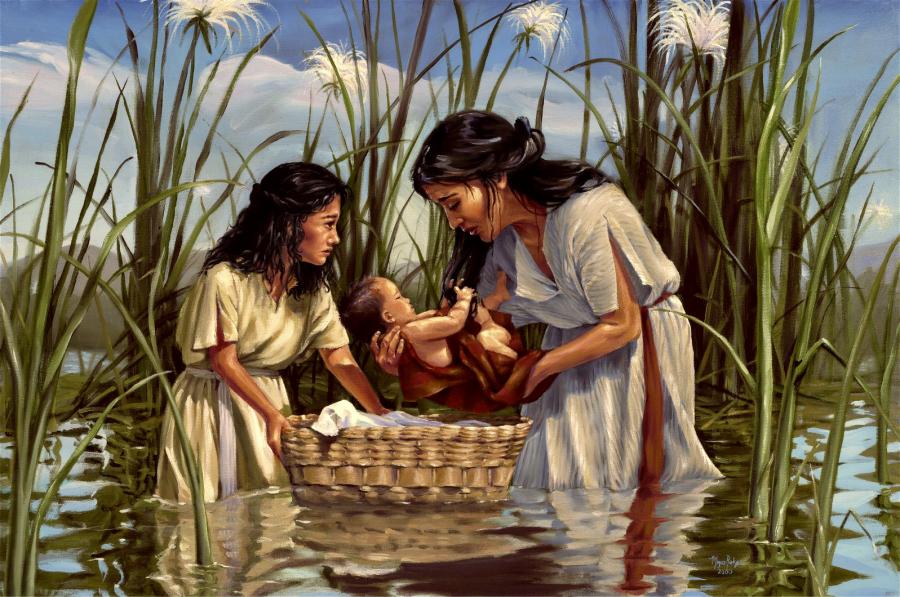

This makes sense since Superman's original creators, Jerry Siegel and Joe Shuster, were Jewish. Here's an article from FoxNews making this exact point:
When Jerry Siegel and Joe Shuster created their iconic comic book hero Superman in 1938, their character wasn’t just a representation of “Truth, Justice and the American Way,” but for many, a metaphor for Jewish immigrants in 1930s America. Created by two young Jewish men, Superman was an allusion to the Jewish faith and history, from his baby Moses-like origins to his golem-esque invincibility, to his outcast status, and his ultimate struggle to assimilate in a new land.
This may be the coolest connection between Jesus and Superman in all of Man of Steel, Batman v. Superman, and Justice League ...
Jesus wasn't just the New Moses. Jesus was also the New Adam. Adam was the forefather of the entire human race by blood, likewise Jesus, by his blood, redeems the whole human race.
Remember the skull that Jor-El steals from Krypton?


That skull is the Kryptonian citizen registry growth codex (or simply the codex). The skull was the remains of an ancient Kryptonian that contained the potential genetic information of all Kryptonians. The skull bore the genetic blueprint of the entire Kryptonian race.
It was the skull of the Kryptonian Adam! The codex was to be used in conjunction with Kryptonian GENESIS chambers. Yes, Genesis, as in the Book of Adam and Eve.
The Codex held the genetic attributes of all artificially incubated infants before their inception. Jor-El stored all the Codex's information in the body of Kal-El, the last known survivor of Krypton.
... Therefore, Superman was the New Adam of Krypton, just as Jesus is the New Adam of the human race. This is an amazingly deep connection between Superman and Jesus.
One more thing ...
There is also a connection between Jesus and Adam's skull. Where was Jesus crucified? Golgotha, the "place of the skull" in Hebrew. Mt. Calvary, or "skull", in Greek. Whose skull was it?
... It was ADAM's skull!
For the full explanation of the connection between Jesus and Adam's skull, I have written this article:
What is the age of Superman when he begins his "public ministry"? 33 is the age of Kal-El when he performs his first public miracles. Of course, that's not the age Jesus began his public ministry, but the year of his crucifixion.
Jesus' public ministry likely lasted three years, so 30 would have been the more Jesus-like age, BUT a lot of things happen in Man of Steel. Superman basically begins his public ministry and gives up his life all at 33, so it still works.

Superman, like Jesus, had a Messianic secret. Jesus often implored people to keep his gifts of healing and his Messianic mission a secret. Take the following the Gospel of Mark, chapter 8:
"Who do men say that I am?" And they told him, "John the Baptist; and others say, Eli′jah; and others one of the prophets." And he asked them, "But who do you say that I am?" Peter answered him, "You are the Christ." And he charged them to tell no one about him.
Likewise, Jonathan Kent, played by Kevin Costner below, told young Clark to keep his powers a secret. Jonathan Kent, below, is telling Clark not to save him from the oncoming tornado. Superman's foster father dies to protect Superman's Messianic secret.

Speaking of Jonathan Kent ...
Superman's St. Joseph: Jonathan Kent, His Adopted FatherJonathan Kent (Kevin Costner), Clark Kent’s adoptive father, is like Jesus’ adoptive dad, Saint Joseph. Both foster fathers are tradesmen. Saint Joseph is a carpenter. Jonathan is a farmer and a mechanic, working with his hands (and reminding me of Field of Dreams).
Superman’s ship or flying "manger", if you will, is even kept in the Kents' stable.
By the time of Jesus' public ministry, we no longer hear about St. Joseph. As in the case of Jonathan Kent, many Biblical scholars believe that St. Joseph has already died.
Jesus and Superman are both the Salvation of Mankind
Both of Superman's fathers, Jor-El and Jonathan Kent, talk about Superman's salvific mission and destiny. Here is Jor-El speaking about this in Man of Steel:

Here is another quote from Jor-El on the salvation to be wrought by Superman:
You will give the people an ideal to strive towards. They will race behind you, they will stumble, they will fall. But in time, they will join you in the sun. In time, you will help them accomplish wonders.
Jonathan Kent speaks to how Superman will lead humanity to new heights by his example, as well:
You're not just anyone. One day, you're going to have to make a choice. You'll have to decide what kind of man you want to grow up to be. Whoever that man is, good character or bad, he's going to change the world.
 The Justice League and the Apostles of Jesus; Batman as Saint Peter
The Justice League is like Superman's apostles. Superman's powers are extraordinary, even among the Justice League.
Batman, of course, is the one who actually goes around gathering up the other meta-humans, like Wonder Woman, the Flash, and Aquaman. Batman, however, speaks of Superman in Messianic terms.
Batman is like St. Peter, gathering the Church together after the death of Jesus (and the death of Superman).
Aquaman is even a "fisherman" of sorts like Saints Peter and Andrew. Of course, he also wields a trident like Poseidon, even made from the "Poseidon metal", as we are told in the Aquaman movie. This makes a connection between Superman and Zeus.
Similarities in the Deaths and Resurrections of Superman and Jesus [SPOILERS]The Sacrifice (Passion) of Superman
Superman is always being called on to sacrifice himself, as Jesus did on the Cross. There are several moments through the Man of Steel, Batman v. Superman, and Justice League when Superman is depicted in a cruciform or cross-like posture:


[SPOILER ALERT] Superman wields a spear against Doomsday. Conversely, a spear is used to pierce the side of Jesus on the Cross.
[SPOILERS] After Superman's death in Batman v. Superman, the Justice League resurrects Superman using the "Mother Box" in an amniotic chamber aboard the Kryptonian ship. Jesus is also resurrected, obviously, but by the power of God, not his friends.
Superman does a number on his friends after his "Pet Sematary" Resurrection:

There is a giant burst of energy following Superman's resurrection. This is similar to the giant burst of energy that created the Shroud of Turin when Jesus was resurrected and still laying in the tomb.
Here's a link to the Catholic Nerds Podcast when we talk about the huge amount of energy required, even by today's terms, to create the image on the Shroud of Turin:
The Gnostic Gospels, written long after the actual Gospel, depict Jesus striking down a bully and then healing him. I believe something like this is also depicted in the Protoevangelium of St. James.
From FoxNews article: "When things get tough, Clark Kent seeks advice from a priest. Visible in the background is a large painting of Jesus so you can see Supes and Christ side-by-side."
Jesus' Second Coming will coincide with Armageddon or "Doomsday". Also, one of Superman's chief villains is "Doomsday". This is the Lex Luthor-created "big bad" of Batman v. Superman.
Jesus admonishes Saint Peter after Peter cuts off the ear of the temple servant Malchus: "Those who live by the sword will die by the sword". Likewise, Jor-El says to General Zod:
You've taken up the sword...
...against your own people.