Tim Patrick's Blog, page 33
July 11, 2011
The High Cost of Free
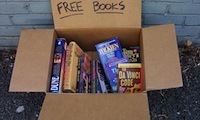
The Internet has more free stuff than the US Department of Health and Human Services. And it's not just the illegal things you find on torrent web sites. There is enough free and legal intellectual property available online to keep you busy for centuries. And I'm just counting the time needed to search for the stuff through Google.
The problem is that free doesn't always mean good. I have a pair of garden sheers that I'll give you for free. They make a great garage wall decoration, assuming you have a metal-and-rust motif. And that's how it is with much of the content on the Web, especially when it comes to classic books.
There are some reputable sites feeding up e-content from out-of-copyright authors like Jane Austen and Mark Twain. And while the content is readily available, it's not always in a form that is conducive to serious reading and study. Consider, as an example, The Analects of Confucius, the Well-Read Man Project book that I finished reading a few days ago. My copy is a free ebook that I downloaded from a reputable supplier of electronic classic books. The content was based on the 1910 English translation by Chinese literature expert James Legge. It had a finger-clickable table of contents, as well as all of the standard ebook bells and whistles. But it was also chock full of spelling and punctuation mistakes made during its manual retyping, HTML artifacts left over from some automated conversion process, and a quarter-page advertisement for the transcriber's web site at the end of each chapter. Sure, it was free, but it wasn't cheap (with my apologies to Dietrich Bonhoeffer).
For the reading project, I downloaded sample after sample of free ebooks to find usable copies that wouldn't leave me wondering if I had read the actual book. It was a more difficult endeavor than I expected. While pretty much every classic book in my collection could be found on the Google Books web site, they were mostly scans of physical books from the Harvard Library, stored as PDFs, and were useless for tablet-style highlighting and note-taking. Other volumes could be had in the standardized EPUB format, but suffered some of the same defects as The Analects.
In the end, I opted to purchase copies of some classic works, including The Epic of Gilgamsh, Julian of Norwich's Revelations of Divine Love, and the play The Misanthrope. While it cost me some money, it was much cheaper than the time I would have wasted on the so-called free versions.
(Image Credits: thejamesbondbooks.com)


July 8, 2011
My First Week with Books

It has been about one week since I started reading books for the Well-Read Man Project. The week started out a little crazy, since it coincided with the Fourth of July weekend. But as the days have progressed, I can honestly say that it's getting even crazier.
Part of the craziness is the time commitment required to read the books. I haven't officially timed myself yet, but it seems to be taking close to two hours per day to consume the content. Still, I expected there to be a lot of chair time. But there is an added time-consumption activity: taking notes. Because these are "great books," reading them casually as if they were the latest John Grisham novel isn't going to cut it. I have to highlight content and take notes as I read, building summaries of the books that I can use for later reflection. It's this part that adds a considerable amount of time to the reading process. No wonder most people just want to sit on the couch and watch Dancing with the Stars.
My enjoyment of the books has been hit-and-miss. If you've read my review of The Art of War, you already know that I wasn't that impressed with the book. But The Epic of Gilgamesh was a pretty good read. The third book, The Analects of Confucius, was another Art of War (I'll have a review out next week), but I'm very much enjoying Plato's Republic. Reading these books is kind of like watching Star Trek movies: odd-numbered releases are bad; evens are good.
Overall, I am finding the entire project quite fulfilling. Yet in the back of my mind there is a fear that these great books are having no lasting impact. I've read numerous quotes by the famous and infamous in history, all of whom insist that reading the classics will be transformative and enriching. They are probably right, but when you are racing through the books at forty pages per day, it's a little tough to stop and smell the enrichment. Books like The Art of War and The Analects are meant to be parsed and studied over the course of years, not dispensed with in a two-hour sitting. I worry that this quick jaunt through fifty essential books will not have the long-term influence I've heard so much about.
Then again, pondering the impact of said books in a blog post like this is already a step in the right direction, as far as life-changing activities goes. Perhaps these books have already made me into an amazing person.
(Image Credits: Microsoft Office clip art)
July 7, 2011
Review #2: The Epic of Gilgamesh
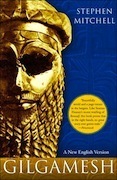
The second book in the Well-Read Man Project is The Epic of Gilgamesh, written three or four thousand years ago by Anonymous. The story is really quite good, so I'm surprised that the author didn't want his name associated with it.
WARNING
This review contains spoilers. If you don't want to know how the story turns out, then I'm not sure what to tell you. I mean, you've had at least three thousand years to read it, right?
The Epic of Gilgamesh tells the story of the eponymous Gilgamesh, king of Uruk, an actual person from human history. It's possible the story is not an accurate biography, though, since in the book he fights monsters, has a goddess propose to him, and crosses an ocean of death without getting a drop of water on himself.
At the start of the story, Gilgamesh is a powerful king, mostly because he is two-thirds divine. As a result of his power, he's somewhat of a jerk, and his people despise him, especially when he exerts his right to have first crack at all newly married brides before the husband is allowed into the house.
The gods are not amused. To help balance the king, they create Enkidu, a man who is Gilgamesh's equal in most respects, except he is nice. Enkidu goes to confront King G on this bride-snatching issue, but in the end they become best friends, bosom pals, kindred spirits, drinking buddies, inseparable demigods; you get the picture.
One day, while fighting the monster-of-the-week, Enkidu finds out he is going to die, which he does. This throws Gilgamesh into an existential crisis of sorts, and he grieves and cries for upwards of an entire chiseled stone tablet. To overcome his grief and possibly obtain eternal life for himself, he travels to the literal ends of the earth to visit Utnapishtim, better known to Westerners as Noah, the survivor of the Great Flood. Unfortunately, Noah says, "Tough luck," and sends him back to Uruk, where he lives happily ever after, at least until he dies.
I enjoyed reading Gilgamesh. Part Harlequin romance, part J. J. Abrams action flick, the story contains all of the basic elements of human drama: life, death, love, hate, sex, religion, and Noah's ark. Despite being one of the oldest known human stories, it contains themes and ideas that are just as fresh today. And it's not written like today's novels, where an author spends hundreds of pages of prose easing you into the book's core idea. Gilgamesh is short, and doesn't have time for that level of manipulation. Instead, it just puts all of life in your face. The two paragraphs that transform Enkidu from a creation of the gods to a man of base needs is amazingly R-rated and blunt. Yet it's still just two paragraphs.
In the end, Gilgamesh is a friendship story. While it is a fictional account, it truthfully communicates the basic concept that friends can be life-changing, especially those hand-crafted by the gods.
July 6, 2011
The Truth about Books and Taxes

Your days of making a quick buck off of a major bookseller and fleecing the general public are over, at least if you live in California. That's because governor Jerry Brown signed a new law last week that required online retailers like Amazon.com to start collecting California state sales tax. Amazon hadn't collected taxes before because it has no stores in the state. With the new law, any California resident with a web site that redirects readers to Amazon.com as part of its Affiliates program would count as a store. I'm a store!
Supporters of the law called it a win for California; that's what supporters do. Here is what was supposed to happen.
Companies like Amazon.com would collect taxes and submit them to the state
Sacramento would enjoy a new stream of tax revenues
In-state companies that compete with Amazon would now have a level playing field, with both sides saddled by the same tax rules
Employment in California would rise thanks to more purchases at local retailers
Puppies and other small pets would have more playtime thanks to their owners spending less time online
Here is what actually happened.
Amazon.com terminated its Affiliate contracts with all California participants
Sacramento received no new revenues from retailers who followed Amazon's lead
Tax-collecting local companies continued to compete against tax-not-collecting online retailers
Unemployment in California stayed woefully high
Puppies and other small pets didn't notice any change because they lack the higher cognitive functions of their human owners
So in effect, nothing changed. Well, one thing did change; I'm no longer a store. All of those California-based Amazon Affiliates that had a business relationship with the online behemoth lost a source of income. My direct sales were low enough to make it a moot point. But one non-profit organization that I support was bringing in $600 per year from Amazon.com, funds it used to purchase books for low-income children in the state. That part of the program has come to an end. Where is the win for California again?
July 5, 2011
Review #1: The Art of War
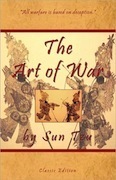
I just finished reading the first book in the Well-Read Man Project, Sun Tzu's The Art of War. It is a short book written by a successful Chinese general from thousands of years ago; I finished it in just one day. Even with its terse content, it is hard to summarize in a short blog post due to its diverse structure. Each of its chapters provides bullet-point lists of military-grade advice—good advice no doubt, but not the stuff from which movie scripts are drawn.
Much of Sun Tzu's content applies easily to our modern situation: "Consider your enemy's personality defects and use them to your advantage" is good advice. There's also, "Let your plans be dark and impenetrable as night, and when you move, fall like a thunderbolt." I mean, who can argue with that? Other statements from the text are specific to his time and circumstance. In the second chapter, Sun Tzu recommends avoiding a "prolonged war," which is great. But from the context, a prolonged war is one that last more than a few days, a week at the outset. World War II would not have met the standard.
He also documents specific costs in measured silver for each troop on the ground, numbers that are laughable in the era of the military-industrial complex. Even when he speaks generally, some sayings just don't feel right. In Chapter 1, he famously states that "all warfare is based on deception," and he provides many tools for keeping the enemy in the dark. But near the end of the book, he also stresses the importance of keeping your own troops confused and unsure of your strategy until just before an attack. It seems like a textbook case for failure. I'm just saying.
As I read through the book, I seldom thought of what the original author had to contend with in an ancient Chinese military. Instead, I kept reflecting on America's military reality, with its weapons and soldiers stationed in locales foreign and domestic, and its TSA-blessed barriers against terrorism. Can the words of a military commander from three millennia ago guide us in an age of improvised explosive devices and airport pat-downs? Perhaps. Sun Tzu does provide useful bromides for any situation, especially in his Boy Scout "Be Prepared" attitude that ties the text together. But even when his ideas are far removed from us historically, his overall system for teaching military strategy is useful.
If there is a soundbite to be drawn from the text, it is, "Know your enemy, know yourself, and then you will know what to do in battle" (my paraphrase). Whether you are attacking a four-foot stack of books, or working to quell international terrorists, knowledge of yourself and of your enemy—the art of war—is essential.
July 4, 2011
The Fourth of July
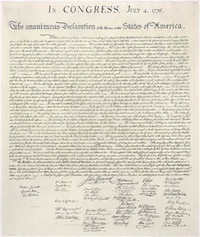
Today is the Fourth of July in America, and everywhere else for that matter. But in America it's a celebration of our independence from England back in 1776. Well, sort of. Representatives of the thirteen American colonies did declare independence in July of that year, but a true separation was not attained until May 12, 1784, when England and America exchanged ratified copies of the Treaty of Paris. But "the Twelfth of May" just doesn't have the same ring to it. So celebrate today!
If you are unsure how to spend your day, consider reading some of these books from the Well-Read Man Project candidate list that didn't make it into the final project, but that did influence America's founders.
The Spirit of the Laws , by Charles de Secondat, Baron de Montesquieu
The Social Contract , by Jean-Jacques Rousseau
The Wealth of Nations , by Adam Smith
Theological-Political Treatise , by Benedict de Spinoza
Check back tomorrow after the celebrations for a quick review of the first project book, The Art of War, by Sun Tzu.
July 1, 2011
Reading Begins Today
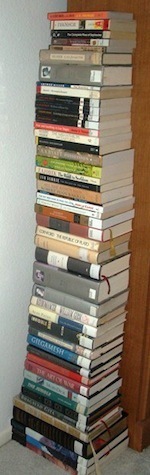
The reading for the Well-Read Man Project begins today. By the time you scan this sentence, I will already have several pages of Sun Tzu's The Art of War under my belt, as painful as that sounds.
The image to the right shows the books (or all but four of them that hadn't arrived from the library yet) in all their four-foot-high glory. When I see a screenshot of the book covers on my iPad, it doesn't seem that intimidating. But having seen them in person, I can now say that four feet of tree pulp is very intimidating.
Over the course of the entire project, I will read 15,309 pages of core content. That certainly sounds impressive, much more impressive than saying that I'll read 42 pages per day. I'm not a very fast reader, but 42 pages each day seems like a brisk yet comfortable pace. Beyond this core stack, I will also read the notes and introductions for each book (when available), some supporting materials and web sites that provide additional background information, and your comments. As I document my progress several times each week, be sure to add your own voice to the conversation by responding to the posts.
When I tell people I meet that I will be reading fifty of the most important books in history over the course of a year, most of them simply say, "Oh" or "Wow." But I've been pleasantly surprised that a few have said, "I should read along with you." I didn't introduce them to the project as a challenge, but it was refreshing to see them consider it that way. It's unlikely that any of them will move through the entire collection, but it will still be a joy knowing that I will have some camaraderie for most or all of the books.
And so I issue this challenge to you, too. If you have the time and the interest, join in on the reading. For some of you fast readers out there, 42 pages of day is a walk in the park. The list of books is available here, and most of them are available online, many of them for free. By reading along, you will not just enjoy the musings of a random person on the Internet; you will experience Well-Readness for yourself.
June 30, 2011
Book Set #13 Revealed – Last Things
And now the moment you've all been waiting for. It's time to announce the fiftieth and final book in the Well-Read Man Project. This book will be read after my pass through the other forty-nine, and will be the proverbial cherry on top of my literary hot fudge sundae. Not that I recommend pouring hot fudge on books.
Despite being one of the most important works in the history of publishing, this book is often used as a pejorative taunt when asking someone about their reading habits. Weighing in at over a thousand pages of dense prose, it nonetheless continues to be sold and read by book lovers worldwide. (Click on a book to access its detail page.)

Book 50
War and Peace
by Leo Tolstoy
Yes, War and Peace. When I told a few friends that this would be my final book, they all responded the same way: "Are you nuts?" Perhaps. But any project that involves reading significant works would feel somewhat empty without this Russian masterpiece. While I have forty-nine other classics to get through before this final set, I am still looking forward the day when I can open the covers—whether paper or electronic—of this important work of literature.
June 29, 2011
Book Set #12 Revealed – Modern Ideas and Modernism
Not all great books are from antiquity. Some important works deal with ideas and topics that are relatively new in mankind's time here on earth. When I first starting working on the list of candidates, I assumed that nothing important was written during my own lifetime. Boy was I wrong. I found several significant works from the last forty or fifty years. In setting up the final list, I reserved ten percent of the space—five selections—for books from my lifetime, some of which appear in this section.
This penultimate set of books for The Well-Read Man Project puts the focus on "modern" themes and styles, including one work of "modernist" writing. (Click on a book to access its detail page.)

Book 45
The Metamorphosis
by Franz Kafka

Book 46
To the Lighthouse
by Virginia Woolf

Book 47
The Stranger
by Albert Camus

Book 48
Fear and Loathing in Las Vegas
by Hunter S. Thompson

Book 49
Neuromancer
by William Gibson
To the Lighthouse is the book that uses a nontraditional, modernist style. The Metamorphosis and The Stranger, while employing common storytelling techniques, contain plots that are absurdist or existentialist in nature. The last two books, Fear and Loathing in Las Vegas and Neuromancer, were both written during my lifetime, putting the focus on the 1960s drug culture and the postmodern cyberpunk culture respectively.
June 28, 2011
Book Set #11 Revealed – Society in Eastern and Latin Cultures
The more than 1,700 books in the candidate list for The Well-Read Man Project show a definite bias toward Western works. Since Westerners selected the candidates for consumption by other Westerners, this isn't surprising. Fortunately, these source lists recognized the value of writings from other cultures.
While non-Western books show up throughout the final list of fifty, this section includes works that specifically address concerns outside of America and Western Europe. (Click on a book to access its detail page.)

Book 41
Kokoro
by Natsume Soseki

Book 42
The Bridge on the Drina
by Ivo Andrić

Book 43
One Hundred Years of Solitude
by Gabriel García Márquez

Book 44
Midnight's Children
by Salman Rushdie
Kokoro takes place during Japan's Meiji Transformation. The Bridge on the Drina tells the story of a bridge currently located in Bosnia and Herzegovina, an nation that has gone through several boundary and political name changes during the 400 years covered in the book. One Hundred Years of Solitude also covers a long time span, this time in Columbia. Midnight's Children, a story of India's move to independence, is one of many "postcolonial" books that appeared in the candidate list.