Tim Patrick's Blog, page 31
August 19, 2011
AT&T Rejects Reading
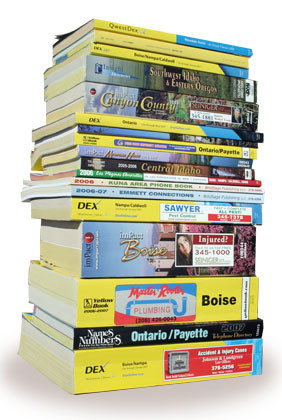
This week I received a letter from AT&T, and by "this week" I naturally mean "the third week of every month for the past four years." The letter came on official AT&T letterhead, bearing the hallmarks of an important notice.
Dear Tim Patrick,
In a review of your account conducted on 6/22/11, we have found that as an AT&T home phone service customer, you are eligible for the following special bundle that may save you money.
The text goes on to document a special bundle that may save me money. It ends with a friendly "Sincerely" by "Kelly," my AT&T Customer Service representative.
Over the years, I have gotten to know Kelly pretty well, seeing as she sends me regular letters. And here's the main thing you need to know about her: She thinks I don't read. I know this is what she believes because she sends the exact same letter to me every month, with the same words and the same "Hi Tim, I'm Kelly" faux personal touch. It's a natural mistake, with so many Americans opting to spend their time using AT&T services rather than leafing through the pages of a book.
AT&T has millions of customers, and I understand that they need to send out form letters to motivate the customer base. But companies used to care about the missives they sent out. They had teams of marketing experts who knew which phrases would tug at the purse-strings of the phone-service-using public. But no more. AT&T has finally realized that nobody reads their form letters, and so they make no attempt at targeting readers. Instead, the letter includes three boldface items that draw the eyes away from the main text: (1) a price, (2) a phone number, and (3) a web site. Oh, and Kelly's signature. Nothing else on the page matters.
For the amount I spend on local phone service, I think I deserve much more in terms of literary marketing schpeels. And so I offer this updated content for AT&T's consideration.
Fourscore and seven days ago, our marketing team brought fourth to our home phone service customers a new bundle, conceived as special, and dedicated to the proposition that you may save money. We are now engaged in a time of civil war against our typically high prices, testing whether for $37.95 per month, you will accept our Complete Choice® Basic calling service and the hallowed ground of U-verse High Speed Internet. We are highly resolved that a bundle offer of the people, by the people, and for the people shall not perish from the earth, if you act by October 22, 2011.
Sincerely,
Kelly


August 17, 2011
Microsoft Reader, RIP
This week Microsoft announced the end of its Microsoft Reader eBook platform. Released in 2000 to showcase the software giant's "ClearType" text display technology for LCD screens, Reader was available nearly a decade before the eBook era ushered in by the Sony Reader and the Amazon Kindle. Those devices came out four years ago, and at a time when eBook builders were rushing to outdo each other, Microsoft was already preparing its Reader for retirement. The last major update to Microsoft Reader appeared in 2007.
The Microsoft Reader was a stable, usable product; it did what it said it would do. But it only did it on Microsoft platforms (recently, third party readers such as Stanza do provide some cross-platform support). When it came out at the turn of the millennium, Microsoft owned the Internet. By mid-2000, Internet Explorer-enabled systems outnumbered the waning Netscape Navigator variety four to one. IE ran on Windows, Mac, and Unix-based systems. So it was a no-brainer to provide a proprietary Windows-only reading solution.
Then came Kindle. In the four short years since that dedicated device appeared, eBooks have rocked the publishing world. But all that rocking didn't faze Microsoft. And frankly, it's not all that surprising. Microsoft is not a content company; it's a software company. Without a dedicated eBook store (and just 60,000 books across all vendors), without dedicated cross-platform support, and even without a complete book-conversion solution—its conversation kit targets programmers more than publishers—it was only a matter of time before Microsoft announced the end of the product line.
I used to read books on my HP iPAQ using the Microsoft Reader. It was basic, but it worked. Now it won't work at all. Starting this November, no new "lit" format books will be published, and full support will end on August 30, 2012.
August 15, 2011
Review #7: The Confessions
If you have ever attended a revival meeting, there always comes a point where someone gets up and gives their testimony. It is usually a person who has had a rough life further complicated by poor choices or sudden tragedies. They always have a happy ending, where the testifier says clearly what God has done for him. Preach it, brother!
The Confessions, by Augustine of Hippo, the late-fourth century AD Catholic Bishop, is just such a testimony, albeit one that requires close to 250 pages. Although the book looks like an autobiography on the surface, it is actually an emotionally-charged altar call from a preacher who knows how to tell his story well.
Warning
I confess that this review contains spoilers.
Augustine was a typical fourth-century North African boy. Born to a Christian mother (Monica) and a pagan father, the youth showed a talent for learning, and was especially fond of studying the Roman classics in Latin. After completing his education, he quickly entered the teaching profession, instructing students in rhetoric. And as he advanced, his mother prayed for his eternal soul.
Since this is a testimony, there has to be the part about living a sinful life. By his own account, he became a consumer of "vanities," elements of life that met his own selfish wants, sometimes at the expense of others. Yet at the time, such behavior didn't bother him. "I was foul, and I loved it." He lived with a woman who he had no intention of marrying; he took jobs that built up his personal reputation and honor; and he even dedicated a book to a famous orator, hoping for some public reciprocation. His mother continued to pray.
At nineteen, he attached himself to Manichaenism, a belief system that combined elements of Christianity, Buddhism, and Zoroastrianism, and focused on how cosmological events could help direct one through issues of good and evil, sin and salvation. Augustine was also attracted the philosophy of Neo-Platonism. He put his all into these two groups, but no matter how much he studied, he never found satisfying answers to questions of ultimate importance. Guess what his mother was doing?
Finally he reached a breaking point. "I cast myself down I know not how, under a certain fig-tree, giving full vent to my tears." At this moment, the voice of a nearby child prompted him to reach for a Bible and find truth in its pages. And he did, moving from degenerate to penitent in a manner of weeks. He went on to become an influential church leader and the author of several important Christian writings, including The Confessions. His mother simply praised God.
It's a very satisfying testimony, but there's that thing about the length again. While the book is clearly an autobiography, as much as half the content consists of prayers and doxologies to God. They are quite reverent, but they act to hinder the core testimony. Additionally, of the book's thirteen chapters, only the first ten are biographical. The last three use the Bible to address specific errors in Manichaen teachings, something that could have been moved easily into its own book.
Even with the extra content, The Confessions does what a testimony is supposed to do. Augustine said that the purpose of the book, the "fruit" of his confession, is that others should read it and believe in God. The book is proof that there were many competing philosophies to choose from during the fourth and fifth centuries AD. By publishing his own confessions, he defined clearly the benefits of Christianity that make it an option for troubled hearts, and he set into motion a revival meeting altar call that lasted for centuries.
August 12, 2011
Publishers Weekly

Work and personal projects have keep me pretty busy during the past week, so I haven't had time to keep you informed on the latest in books and reading. But even when I let you down, there is a web site that always has up-to-date book and publishing news: Publishers Weekly.
The go-to publication of publications, Publishers Weekly is a weekly hardcopy journal of what is happening in the world of books. And now it is also the website of choice for that same level of information. A quick browse of the site introduces you to the latest authors, coverage of the rise and fall of bookstores and publishers, and what to expect in the future of eBooks.
If you are a reader, you will certainly enjoy the news at publishersweekly.com. One warning about its print publication: a standard annual subscription will set you back about $250, a price that appeals to industry professionals, but probably not the casual reader.
August 9, 2011
Read Like a Billionaire
Do you want to read the books that billionaires read? Then choose nonfiction books with deep and disturbing titles, or anything written by your dad. At least, that's what Bill Gates has done. A few weeks ago, the Microsoft co-founder and philanthropist posted a recommended reading list on his Gates Notes web site.
The list includes fifty-three volumes that provide a glimpse into the mindset of one of the world's richest people. The books appear in five categories: Education, Energy, Development, Health, and a selection of Bill's personal favorites. There are books in each set that still smell like the tweed jacket of the college professors that likely wrote them: Global Catastrophes and Trends: The Next Fifty Years, Tropical Infectious Diseases: Principles, Pathogens, & Practice, and The Feynman Lectures on Physics, although I've read and enjoyed a portion of this last selection. Other books are more mainstream, including Levitt and Dubner's SuperFreakonomics, The World is Flat by Thomas L. Friedman, and Physics for Dummies.
One of the selections included in the Personal section is Showing Up for Life, penned by Bill Gates, Sr. The famous son wrote the preface for that book, but reading your own preface must be like rereading your own emails. The Catcher in the Rye, one of the books in The Well-Read Man Project, appears as one of only two fictional works on the list.
Of course, this isn't Bill Gates' "real" library of books. The computer magnate maintains an adequate personal library in his home (or so I've heard) that includes several valuable original manuscripts. The most famous of these documents is the Codex Leicester, a set of scientific writings by Leonardo da Vinci. The next time you are invited to the Gates' Medina, Washington home, you should really ask to see his manuscript collection. Baring that, you will gain a successful businessman and philanthropist's view of the world by reading entries from the Gates Notes site.
August 8, 2011
Review #6: The Bhagavad Gita
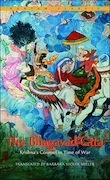
The sixth book in The Well-Read Man Project is one of the core religious texts of Hinduism, the Bhagavad Gita.
Warning
This review contains spoilers. But keep this in mind: it's a religious book. Even if I don't say anything, you already know it deals with a powerful deity and those humans who both love and hate said deity. So I'm not really spoiling anything.
Although the title is somewhat hard to pronounce, the core plot of the Bhagavad Gita is simple and straightforward. As the Hindu epic begins, Prince Arjuna prepares to lead his troops into battle. But there's one hitch: he knows many of the opposition soldiers, and thinks it would be a shame to kill so many great men, both in his army and in the approaching forces. And for what, I ask you, for what?
Unfortunately, the only person nearby that the prince can ask for advice is his charioteer. Fortunately, this charioteer is actually Krishna, the creator and destroyer of the universe. He's in disguise, so it's hard to tell it's him. But when he starts talking, his true qualities becomes crystal clear.
Here is Krishna's advice: Go ahead and kill them, because (1) it's your duty, and (2) they're not really going to die, not if you look at it in the grand scheme of things. Arjuna isn't sure about this guidance, so Krishna lays on the theology pretty thick. He also reveals his true nature to the prince. That does the trick. Arjuna and his trusty charioteer-god are ready to resume the battle.
The battle story is actually a thin wrapper around the core content of Krishna documenting the main tenants of Hindu belief: reincarnation; all is life and life is all; all paths lead to truth unless your desires get in the way (or if you belong to the Veds, a group that Krishna isn't to excited about); meditation and duty are both great ways show spirituality; and the renunciation of the things of this world is what you really should be doing.
As a Christian, many of the theological details in the text were in conflict with my own beliefs. But even those in a Judeo-Christian culture can find wisdom in the pages of this text. One major point is that a constant devotion to your own desires leads to trouble. This sentiment is echoed in most major religions, and even atheists hold up this ideal as a personal goal.
Krishna can get a little long-winded, especially when he talks about himself and his own attributes. But overall, the Bhagavad Gita is a pleasant read, and a good introduction into the mindset of one of the world's largest belief systems.
August 4, 2011
Reading the Government

Earlier this week, Congress and President Obama agreed to raise the debt ceiling another few feet. It all seemed very exhausting, but fortunately most of the politicians were able to get right back up and pass new spending bills. Those leaders are tireless!
What do you get for all of this borrowed money? Well, some of it comes in the form of printed and bound reading material. Enter the Government Printing Office, the official publisher of the United States government. Created in 1860, the GPO's main role is to fulfill the constitutional requirements of the Congress (Article 1, Section 5, Clause 3) in making a record of its proceedings available to the public. But it prints other things as well, including passports, Social Security checks, and consumer brochures such as Medicare and You, the woeful tale of the uninsured infirm.
If you don't get excited about Medicare, there's still plenty to read. In fact, according to a 2008 speech printed by the Public Printer of the United States, Robert C. Tapella, the GPO emits over three billion pages of content each year for the Congress. That doesn't include those passports, Social Security checks, or any of the heartwarming brochures. It's just the stuff that Congress uses. It works out to about ten pages per year for each American, but if you only count the 435 members of Congress, it's close to seven million pages per person per year. It's time for me to stop complaining about my paltry forty-two page reading requirement per day.
To find out more about the Government Printing Office, visit its web site or its online bookstore.
August 2, 2011
Reading as Leisure
Each year, the Bureau of Labor Statistics, part of the United States Department of Labor, collects statistics on what Americans do with their time each day. Its annually published Time Use Survey summarizes the results with a detail that makes you wonder, "Are they watching me?"
The survey documents time spent in various leisure activities, including reading. The following table, taken from the 2009 edition of the report, shows a portion of the reading-specific hours per day by various segments of American society.
Weekday Reading
Weekend Reading
Sex
Men
0.26
0.28
Women
0.41
0.45
Age
Total, 15 years and over
0.33
0.37
15 to 19 years
0.17
0.09
20 to 24 years
0.19
0.15
25 to 34 years
0.17
0.15
35 to 44 years
0.16
0.24
45 to 54 years
0.26
0.35
55 to 64 years
0.43
0.57
65 to 74 years
0.71
0.68
75 years and over
1.03
1.03
Race and ethnicity
White
0.37
0.41
Black or African American
0.14
0.14
Hispanic or Latino ethnicity
0.13
0.10
By weekly earnings
$0-$510
0.14
0.18
$511-$780
0.22
0.23
$781-1,190
0.20
0.27
$1,190 and higher
0.25
0.46
So on average, out of about five-plus hours of leisure time available to each person each day, Americans are reading around 20, maybe 25 minutes. This includes all forms of leisure reading, including magazines, blogs, and the backs of cereal boxes. It's not much, although it is more than I assumed. Since I've been spending around two hours per day reading for The Well-Read Man Project, I only have one word for that limited reading schedule: Lucky!
Reading a few hours per day is work, especially when you read great works with the goal of getting something lasting out of the content. Between note-taking and highlighting and thinking about the implications of what each writer said, reading can be an exhausting endeavor. It's no wonder that the typical American citizen would rather spend two or more hours per day staring vacantly at a TV screen.
The table above does show some interesting trends. Older people read more than the youngest group, although even that group reads more than the thirtysomethings. The rich outread the poor, and whites read about three times as much as those from the minority groups included in the statistics.
What does all this mean? Mark Bauerlein, in his book The Dumbest Generation, says the statistics point to a dumbing down of those raised in an era of television and internet saturation. He is probably right in his assessment. Statistics are just statistics, and even in colonial days, when everyone read much more than they do now, there were those who exceeded the typical text consumption of the average American. People of this ilk will always be the exception in any generation. But when the mainstream opts out of casual reading, it impacts every aspect of their lives, from their work situation to their political views. Americans would do well to heed the warnings raised by this study. Of course, they would need to find time to read it first.
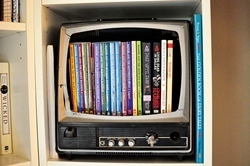
The Books-in-TV image is from the House of April, the blog of photographer April Chandler.
August 1, 2011
The eBook Wars

Last week, Amazon and Barnes & Noble released updates to their iOS-based apps. In both cases, the nature of the update was identical: removal of a button from the app that leads to an associated book-purchasing web site. App vendors for Apple's mobile devices must either provide Apple with a cut of in-app purchases, or make the apps fully ignorant of a customer's ability to purchase content.
As a book buyer, as a programmer, and as a future well-read man, I think it stinks. It's not that Apple doesn't have a right to do what it is doing; it does. But when it hinders third parties from providing new revenue activities through their apps on the iOS platform, it does so at its own long-term peril.
I'm reminded of the "browser wars" that took place back in the late 1990s between Netscape and Microsoft. Netscape sold a popular web browser for a reasonable price, a few dozen dollars if I recall correctly. Microsoft offered a similar product on the Windows platform, and at no cost. It did so, in part, to further the technological abilities of Windows, but also (and many observers caustically insisted that) it sought to control the platform to achieve dominance in the web space by hindering other vendors, vendors that enhanced the overall Windows experience.
Microsoft's actions worked in the short term, at least in terms of knocking out Netscape's market share. But in the long term, Microsoft's comfort in its dominant position brought with it a lack of innovation, and a lack of insight into where the browser needed to be in the twenty-first century. Internet Explorer, while still one of the major web browsers available to consumers, lacks many of the technological advances found in its main competitor's products. It also is the target of much scorn, including within the community of Windows software developers. To quote a cliché, Microsoft won the battle, but is losing the war.
As part of The Well-Read Man Project, I investigated many different eBook reading devices and applications. I tried dedicated devices, such as the Kindle, the Sony Reader, and the Nook, both in its color and monochrome formats. I also tried out a handful of different readers on several general purpose tablet devices. I narrowed down my choices to the Nook Color reading device and a combination of the iBooks and Kindle reading apps on the Apple iPad device. I ultimately chose the iPad, primarily because I found the highlighting features in Apple's own iBooks app to be so user-friendly. In short, it won me over because it was designed well. If the Nook Color had been slightly faster and included better note-taking features, I might have selected that device instead.
So for me, it was all about quality and the experience. By preventing other apps from including a link to their own bookstores, Apple is insisting that convenience is the key factor. But it's not. Internet Explorer comes installed automatically in Windows; that's convenient. But millions of people still click over to the Firefox and Opera web sites to download a replacement for something they already have. They aren't looking for convenience. They are looking for quality. Quality is what matters in a software choice, and in so many other choices. If Apple really wants to dominate in the eBook space, it needs to focus on quality. It needs to stop obsessing about whether Amazon's app includes a "Shop in Kindle Store" button, and instead figure out why iBooks features slow down at the end of long chapters.
July 28, 2011
Guest Opinion: Why Read The Art of War
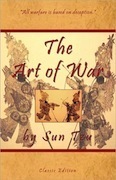
Sun Tzu's The Art of War isn't a book many people would announce to the world they are reading. This is because so many misinformed individuals view the book in a bad light simply because it has the word "war" in its title. Of course, as a well-read man or woman, you know better. You know that The Art of War is a must read because it provides logical and interesting approaches to conflict and competition.
The Art of War ("Ping Fa" in Chinese) is an old book. In fact, it's ancient. Scholars believe it was written 2,500 years ago. That would make its author, Sun Tzu, even more ancient. Although he is now dead, his work is very much alive. When the former US Secretary of Defense Robert Gates went before the Congress to explain how he would protect America, he quoted George Washington and Sun Tzu. Let's just say Bob did an above average job, expressed in the humblest way. The next guy could do worse than to emulate his reading list.
I love to read, especially self-help nonfiction. When I was a kid, the words of Zig Ziglar helped me kick butt academically in school. It gave me confidence in myself as I skewed the grading curve time and again. Zig would have been proud. Soon after, my attention turned to more serious topics, namely war and accounting. And why not? I was studying about two sure things in life: death and taxes.
At the risk of putting you to sleep, I will first talk about accounting. On second thought, I won't risk it. And that is exactly Sun Tzu's first lesson. When something is important to you and you want to succeed, never take risks if you can help it. Only move when you're sure. In this case, I decided not to move and thus your attention was salvaged. The image of the brave soul who goes out there without preparation is a bad one to try out in real life. It is paved with bad jobs with bad bosses all stemming from bad decisions. When you go to war with this same attitude, people die. That's worse than bad.
Unlike Zig Ziglar, Sun Tzu can be negative. But when you're negative, you also tend to plan. And planning is what everyone can do more of nowadays. Iraq and Afghanistan, anyone? Life can't be edited like movies or music videos. Your life is unscripted and you have only one crack at any opportunity or dilemma. Therefore, you want to make sure the path in front of you is safe. You want to ask people you trust and who have been there what to expect. Sun Tzu's last chapter on spies is all about this idea. Before you waste your time and energy, and before you experience a lot of heartache and disappointment, you'd be wise to proceed like Sun Tzu.
In summary, why read Sun Tzu's The Art of War? Because Sun Tzu took his endeavors as seriously as I take mine. His purpose was not the destruction of the other side. It was about preservation, and protection, and making life better for others, and me, but not the bad guys. Doom to the bad guys. But all my best intentions won't make a hill of beans until I am effective at what I do and I am able to go where I need to go. And the best tool to make this a reality today is a 2,500-year-old book called The Art of War.
Thomas Huynh is the founder of Sonshi.com, a web site that promotes the ideas and strategies found in The Art of War. Visit the site at www.sonshi.com.