Tim Patrick's Blog, page 28
December 15, 2011
Book Review: Six Crises
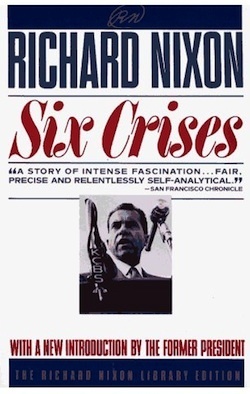
We don't have Dick Nixon to kick around any more, but what we do have are his writings. He published nearly a dozen books, all but one of them after his resignation from the Oval Office. Among the presidents, only Jimmy Carter, Theodore Roosevelt, and Herbert Hoover were more prolific in their publishing efforts. Nixon's first book, Six Crises, appeared in the aftermath of his defeat in the 1960 presidential campaign against John F. Kennedy.
The book provides a first-person account of six major events in Nixon's life, events that at the time were front-page news, often with Nixon at the center.
The Alger Hiss Case — In 1948, Nixon served as a member of the House Un-American Activities Committee (HUAC) during its investigation of Time magazine editor Whittaker Chambers and his ties to communism. Nixon played a key role in questioning Alger Hiss, a State Department official named by Chambers and eventually convicted as a spy (the actual charge was perjury).
The "Checkers" Speech — During the 1952 Eisenhower campaign, the media reported on a "secret fund" used by VP candidate Nixon. This chapter presents the key events, including the live TV speech Nixon gave to defend his innocence.
President Eisenhower's Heart Attack — Eisenhower had a heart attack during his first term, and Nixon began to take seriously the expression "one heartbeat from the presidency."
Visit to Caracas, Venezuela — As part of a South American tour, Richard and Pat Nixon visited Venezuela, which was undergoing a fight for its political identity. While there, angry mobs and communist agitators attacked Nixon's car, nearly turning it over and setting it on fire with the Nixons still inside.
The Kitchen Debates — Vice President Nixon visited Moscow in July of 1959, and clashed with Soviet leader Nikita Khrushchev in the kitchen of a demonstration model American home set up at a cultural exposition.
The 1960 Presidential Campaign — Consuming nearly one-third of the book, the final chapter gives Nixon's view of his recent defeat in his 1960 presidential campaign against Kennedy.
Although the book uses "crises" to tie the sections together, the text is really a memoir of Nixon's political life. And while the focus is on himself as politician, he does play the role of model historian, filling in details for an audience interested in the background for the sound bites and brief images that appeared on their black-and-white televisions.
Reading the book post-Watergate is somewhat bizarre. In several places, Nixon stresses the importance of integrity, character, and transparency in government, things he struggled with in the aftermath of his own public scandal. But a decade before those events, Nixon is honest and concerned about the public perception of activities at the highest levels of government.
As Vice President, Nixon was in contact with the most powerful and important people in the world. He never misses and opportunity to name-drop, and it's not always clear if he is in historian mode or fame mode. But there is no doubt that he did pass through several events that were key to building up the American life we experience today. Although he refers to them as "crises," Nixon accentuates the positive, reflecting on how each event made him, and America, stronger.


December 8, 2011
To Lose the Presidency

Since America's founding in the late eighteenth century, forty-three men have held the office of president (Barack Obama is number forty-four, but Grover Cleveland, with his divided terms, gets counted twice), but not all of them arrived by election. Through the death, assassination, or resignation of their direct reports, nine vice presidents have passed Go to become the Chief Executive.
When John Tyler, "His Accidency," took over the job after the 1841 death of William Henry Harrison—just one month into Harrison's term—it wasn't clear that the vice president deserved the promotion. Article II of the US Constitution always identified the Veep as being the natural successor when a president meets an early demise. But whether this new role was as a full president, or only as "acting president," wasn't fully decided until passage of the Twenty-Fifth Amendment in 1967.
As lucky as it was for those nine men to stumble into the Oval Office without help from the Electoral College, it was equally unlucky for four others who missed out on that same opportunity. The first such missed opportunity occurred when John Wilkes Booth assassinated Abraham Lincoln in April of 1865. Lincoln had taken the oath of office for his second time just six weeks earlier, along with his running mate Andrew Johnson. But Johnson was a new addition to the ticket. During Lincoln's first time through the White House, Hannibal Hamlin served as vice president. A former congressman and governor from Maine, Hamlin considered the vice president's office a "nullity," an apt sentiment for his ouster from the 1964 Republican ticket by party leaders over the objection of Lincoln. Not one to wallow in the self-pity of missed chances, Hamlin returned to the US Senate for two more terms.
Another close loss of the presidency occurred for Henry Wallace, Franklin Roosevelt's vice president during his third term. (John Nance Garner, FDR's VP during his first eight years in office, also missed the chance, but not due to the president's immediate death.) As with Hamlin, Wallace was kicked off the ticket by (Democratic) party leaders, although Roosevelt might have made the decision anyway after several conflicts with his vice president. A Roosevelt-Wallace ticket was no longer a guarantee for electoral victory, and a switch to the folksy Harry S. Truman brought a stronger ticket, but a downgrade for America's only third-term vice president.
Garret Hobart served as William McKinley's first vice president from 1897 to 1901. But when anarchists killed President McKinley halfway through his second term, the death carried VP Number 2, Theodore Roosevelt, into presidential prominence. Still, Hobart didn't really miss out on becoming president since he himself had died while serving as vice president. In the year-and-a-half between Hobart's death and TR's inauguration as vice president, that office remained dormant and unfilled.
The last missed chance occurred not with death, but with the resignation of the thirty-seventh president, Richard Nixon. Spiro Agnew, America's first Greek American vice president, resigned the office after being hounded by charges of bribery and tax evasion. Nixon elevated Gerald Ford, then the House Minority Leader, to the VP's office just ten months before his own Watergate-related resignation. Ford remains the only president never elected for that office or the vice presidency.
This list of four near-misses could be expanded by including Thomas Marshall, vice president under Woodrow Wilson. Although Wilson finished out all eight of his elected years, he suffered a severe stroke more than halfway through his second term, leaving him incapacitated and, in the opinion of some, unfit for office. His wife took over some of his duties, earning her the title "the first female President of the United States." If Wilson was truly unable to perform his duties, the job should have fallen to Marshall.
Other vice-presidents might have risen to the presidency had various illnesses or assassination attempts succeeded in removing the sitting president. Andrew Jackson survived a point-blank assassination attempt in 1833, an event that, had it succeeded, might have moved Martin Van Buren into office a full four years earlier than the date listed in history books. But in such cases, "unlucky" is a harsh word to stamp on the vice president.
How different would America have been had any of these lost chances assumed the presidency? It's hard to say. Had Garret Hobart completed his own time in office, there might never have been a President Theodore Roosevelt. If the politically aggressive Agnew had still been VP under Nixon instead of the mild-mannered Ford, the post-Watergate trial and pardon might have played out differently. The Oval Office has been filled by an intriguing array of charismatic men through all of America's history. But in these four or five cases, it was nearly taken over by others who were equally intriguing, but somewhat unlucky.
[Image Credits: Official White House photo]
December 6, 2011
Review #22: The Jungle
Come and listen to my story 'bout a man named Jurgis, a poor Lithuanian, barely kept his family fed. And then one day he was butchering up some food, when up through the ground came every possible misery and corrupt human behavior you could ever think of, all compressed into a ten-square-mile area.
Upton Sinclair's tragic story, The Jungle, follows Jurgis Rudkis and his family, newly arrived to Chicago from their impoverished Lithuania at the turn of the twentieth century. Jurgis looks to the "land of opportunity" with hope, but even before he steps onto American soil, he gets his first taste of the nonstop thefts, political corruptions, cheating shop-keepers, and murderous business owners that are the United States of America.
Let me make it clear: The Jungle is a propaganda piece for the Communist Party. Sinclair describes an America where every business is corrupt, every product is substandard, every politician is on the take, every policeman is open to graft and petty theft, every doctor engages in medical experimentation, and every citizen eventually descends into a life of beggary, prostitution, and unsafe, unsanitary working conditions. The only solution to these problems, according to the book, is to unite the proletariat and institute a Socialist workers' paradise. These sentiments are not veiled behind interesting plotlines; the final chapters of the book literally break into song over the virtues of communism.
If The Jungle was an interesting literary work on the struggle between communism and capitalism, I might forgive Sinclair his ideological bent. But the book is far from interesting. The constant misery that Jurgis and his family experience is as farcical as movies like The Money Pit, where by the end you are hoping that the theater has a refund policy.
Perhaps most people today know The Jungle as "that book that talks about the horrors of the meat packing industry in Chicago." The claims made by the book did in part lead to the creation of America's current Food and Drug Administration. It's no surprise to me that the book led to government action, since the text reads like a Department of Transportation feasibility study.
For those who like to make decisions on emotion alone with their brains checked at the door, The Jungle is great reading. Perhaps I should forgive Sinclair for the things he wrote. His book came out a decade before the Russian Revolution, before the horrors of that system came to light. But in later years, he ran twice for the United States Senate on the Socialist ticket, and was the leading Democratic candidate in the 1934 California gubernatorial race. He never strayed from his literary view that America was a problem in need of a labor-centric solution.
Sinclair went on to pen other popular works. His 1937 book The Gnomemobile was turned into a Disney children's film, and his 1927 book Oil! was adapted just four years ago as the Daniel Day-Lewis movie There Will Be Blood. But it was The Jungle and its blatant, humorless political ideals that made him famous. Despite the book's extreme fiction, it should be read today, if only to understand that complicated political machinations in Chicago are nothing new.
November 29, 2011
Review #21: The Catcher in the Rye
If Holden Caulfield, the seventeen-year-old focus of J. D. Salinger's The Catcher in the Rye, were to pen this review, he would probably say, "It's a lousy book. That Salinger guy is the biggest phony in the whole world, and his stupid book has like a million pages in it. It took me year to read it and all, and I nearly threw up like twenty-six times. I'm not kidding, I almost did. I mean, I flunked all of my classes, but not English. I like English books, really I do. But not ones written by phonies, and the teachers always make us read books by phonies."
That's just a taste of what you can expect from the text. In developing a character going through the world's worst bout of teenage angst, Salinger did a great job at putting you into the mind of a sarcastic, morose, ungrateful kid who seems to hate everything around him. You know, just like your own teenagers.
As the story begins, Holden Caulfield is being kicked out of yet another East Coast prep school. It's not that his grades are bad, though they are. It's not that his family back in New York City is struggling, although the death of his younger brother a few years back is always on his mind. It's not even his attitude, which is atrocious. Yet, it is all of these things, a pile of burdens Holden refuses to admit to, even as he talks about them constantly.
Holden is a study in opposites. He's a pacifist who is always looking for a fight; an atheist who wishes he could join a monastery; a loner who phones people he's never met at 2:00am, looking for companionship; a teenager who thinks he knows everything, yet doesn't know how he's going to spend the next five minutes of his life. Above all, he's a phony who hates phonies.
I hated Holden Caulfield, and yet I couldn't get away from caring about him. In a way, I am Holden Caulfield. Externally, our lives are very different. Holden is a spoiled upper-class East Coast type, ungrateful for constant care and attention thrown at him. I'm a middle-class, middle-tier, mid-life family man, originally from the Midwest. And yet, Holden and I share so much. My life lacks the incessant drama of teenage puppy love and New York taxi cab drivers and teachers who might be a little creepy. But if I let my mind wander—as Holden does nonstop—I can meander down those same confusing paths, tossed between the things I know I want and the thinks I know are unknowable.
It's a little sad that this WWII-era book is read primarily by high school students. The strong PG-13 language is theirs, but the raw emotions belong to someone who has trudged through decades of life, perhaps even someone who ends up as a recluse, as Salinger did. The first-person style, through well written and consistent, is aggravating in its peevishness. But if you can get past the whiny teenage voice and overlook the fact that nothing is ever resolved, you will find in Holden Caulfield that phony part of you that hates to read books like The Catcher in the Rye, and the part that needs to.
November 22, 2011
Review #20: The Red Badge of Courage
The Red Badge of Courage, by nineteenth-century author Stephen Crane, is standard high school reading fare. It's a relatively short book with simple, clear language, except for some attempts at setting regional dialects to type. Its premise is equally simple: An examination of the thoughts and emotions experienced by someone entering a war zone.
The story centers around young Henry Fleming, a Union Army private in the 304th regiment during the American Civil War. Henry enlisted on a whim, looking for the excitement and glory that he saw in the faces of local soldiers. Instead, he finds a military experience that includes weeks of boredom and an utter lack of anything glorious. That is, until he has to face the enemy. That's when fear shows up.
In the midst of the regiment's first big battle, Henry deserts his post, literally running for his life as those in his company are gunned down by Confederate forces. But when he sees some of the walking wounded behind the battle lines, he has a change of heart, and wishes that he had his own battle wound, his own red badge of courage. Eventually, he returns to his group, takes up his post despite continuing qualms, and even receives a commendation from a superior officer.
While the book does document aspects of the Civil War and its horrors, the core text focuses on the internal emotions and thoughts of a person in crisis. Henry passes through all five of the Kübler-Ross stages of grief (denial, anger, bargaining, depression, acceptance), plus about three dozen other distinct patterns of thought, all documented in paragraph after paragraph of Crane's prose. Sometimes it becomes repetitive and tedious. "Stop whimpering and go shoot the enemy already," you want to scream at Fleming. But he eventually gets around to dealing with his conflicting emotions.
Considering the work's typical reader, I wonder how reasonable it is to expect someone so young to process the depth of emotions expressed in the book. There are some very young individuals who have an unexpectedly firm grasp on life, even in times of war. President Andrew Jackson joined the Revolutionary War when he was yet 13, was captured by the British, saw his brother die in battle and his other brother and mother die of smallpox, making him an orphan by 14. Yet he still managed to deal with it all and go on to great things. Perhaps this is akin to what the protagonist in Crane's book experiences, albeit compressed into the course of a few days. But in the text it seems somewhat artificial.
Despite what I think of the book, secondary English teachers around the country consider the text essential reading for young readers going through their own emotional wars. Although I hardly remember it now, high school may, in fact, be a battlefield all its own. Perhaps many of today's youth, once you look past the video games, the grunge clothes, and the constant beat of their ear buds, are also looking for some form of victory and success, even if it means having to get some red badge of courage to obtain it.
November 15, 2011
Review #19: The Picture of Dorian Gray
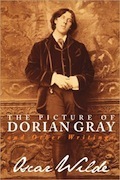
Oscar Wilde's The Picture of Dorian Gray is the second book in the Well-Read Man Project to take up the "fountain of youth" theme, the first being Frankenstein. (Other books in the project, such as All the King's Men, discuss those who try to build legacies that outlive their founders, but not outright eternal youth.) While Victor Frankenstein's attempt at longevity was an utter failure, the one experienced by Dorian Gray had some success, until it ended in utter failure.
The core premise of Wilde's only novel is fairly well known: A young man experiences eternal youth while a portrait of him ages vicariously. The magic event isn't actively sought out, but is thrust upon him by the actions and attitudes of the book's three major characters.
Dorian Gray, an innocent youth, is swayed by mentions of his beauty and innocence, eventually prompting him to offer up anything, even his own soul, in order to possess these two traits in perpetuity.
Basil Hallward, the painter of Gray's portrait, idolizes Dorian and his canvas doppelganger nearly to the point of veneration. He sees in Dorian the perfectibility of mankind, although this image is ruined (as is the painting) within minutes of expressing this sentiment.
Lord Henry "Harry" Wotton, a friend of Hallward, whose hedonistic ideas corrupt the youth of his generation (read: Dorian) to an extent that Socrates' accusers would have never thought possible.
When these three—the worship of man's potential, the exaltation of debauchery, and the desire for eternal life and power—come together, Eden falls again, with the portrait playing the role of the Tree of Knowledge, and mankind himself acting as his own serpent.
It's not just Dorian's youth that the painting absorbs. The image acts as his conscience, expressing in colored oils the ugliness of a life spent in worldly excess and dehumanization. In part, Dorian Gray is a warning against the epicurean tendencies of Wilde's era, some of which Wilde was accused of practicing himself.
Although the book is classified as a tragedy, its readability is light and easy. Through the simple plot device of an enchanted painting, Wilde delves deeply into the nature of the human soul, sin and salvation, and how different views of morality play out in people's lives. Although Wilde intended the book to be a commentary on the late nineteenth century, its exposition of human nature lives on as if the book was its own Basil Hallward portrait.
November 8, 2011
Review #18: Moby-Dick
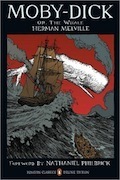
Moby Dick is a boring book. Someone told me this many years ago, and naturally I believed it. But the book a classic, a must-read. And when you do start reading Herman Melville's famous work, it appears to be very interesting.
But it's all a lie. Avast! It's a boring book! It lulls you into interest from its first line: "Call me Ishmael." The narrator's friendship with the cannibal Queequeg in the early chapters is intriguing and promising; the native is a cannibal after all. But nobody gets eaten in this dull book, at least not by a cannibal. And after a few borderline surprising encounters with Ishmael's new pagan friend, the story slips into an overly-descriptive travelogue.
The reason the book is boring is because nothing happens. The main story takes place aboard Captain Ahab's whaling ship, the Pequod. Sent out on a three-year whaling journey, Ahab's true intent is to exact revenge on Moby Dick, the whale that in a prior journey bit off the captain's leg. It sounds very romantic and exciting, but it's not.
There is some examination over what revenge does in the heart of a man, as there should be in a book deemed a classic. But the bulk of the book's 135 chapters and epilogue are consumed with dry descriptions of ship parts and the work of whaling. There's even an entire chapter devoted to describing books about whales. It's a book describing books. While it's all good content for someone doing a report on the whaling industry, it doesn't move the story along. Even with hundreds of pages at his disposal, the author barely fleshes out the major characters.
It's not just me who thinks the book is boring; Herman Melville agrees with me. That's certainly why he plays around with different styles of writing within the book. Chapter 108 tells its part of the story in the form of a theatrical play. But even this can't save the narrative.
The book does end with an intense battle scene, making for great Hollywood action. But it comes too little, too late. If you want to learn about revenge, try The Count of Monte Cristo instead. If it's exciting whale battles you seek, skip to the last three or four chapters of Moby-Dick. You won't miss much by skipping the hundred-plus introductory chapters.
November 3, 2011
Review #17: Frankenstein
[image error]
The story of Frankenstein is familiar to us all. A mad scientist works in the secret lab of a dark, foreboding castle, builds frightening and powerful electrical machines, and with the help of his eerie companion Igor, imparts life into formerly dead tissue. It's got suspense. It's got human drama. It's got nothing to do with the 1818 book by Mary Shelley.
Much of what you know about Frankenstein is not found in the book, but instead comes from a 1927 play by Peggy Webling. The play, and the spin-off Boris Karloff movie, are action-packed, but the book is much more heady. The main characters wax rhapsodic on their own thoughts, or talk endlessly about their trials and emotions. There are several chapters in the middle of the book where the monster tells its own story with calm eloquence and a flowing, Romantic-era flair. Yes, the creature speaks.
In the book, young Victor Frankenstein supplements his scientific genius with a pursuit for the elixir of life, a fountain of youth borne of his efforts. The culmination is the monster, a resuscitation of dead tissue into a living, breathing, and eventually murdering being. While in the popular image of the story, the monster's failures stem from its mediocre second-hand brain, in Shelley's original book, the creature's angst and anger are reflections of its own experiences of rejection by its creator and the world.
Frankenstein is filled with a pathos that was typical in novels of the day. As Victor Frankenstein's life unravels, it's easy to feel for him as each wretched event occurs. But the book, written by someone in her late teens, is surprisingly complex, multi-layered, and deep, and reading it through with the emotions turned off still stirs up lots of thoughts and eternal questions. Can a man play God (or play Prometheus, from the book's subtitle)? What are the limits of science? Is beauty really only skin deep? What is the soul? Can murder be justified? What is the meaning of life?
I need to give you one bit of warning when you first read Shelley's book. The opening chapters are a series of letters from the captain of a ship, written to his sister in England. When I started reading these early pages, I was sure that I had purchased the wrong book. The letters have almost nothing to do with the core story other then to introduce Victor Frankenstein, although Captain Walton's scientific pursuits may foreshadow those of the book's protagonist. But whether these epistles are a reflection of the deeper story, or simply good storytelling, Frankenstein is a true classic of gothic literature. As stated in the popular 1931 movie version, "It's alive!"
October 31, 2011
Review #16: All the King's Men
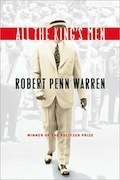
All the King's Men was the first book in the reading project that I was looking forward to reading with some anticipation. I enjoy political thrillers in my movie choices, and while this book was nothing like an Air Force One or Manchurian Candidate, it was a good primer on basic human struggles as seen through political intrigue.
The focus of the novel is Willie Stark, governor of a southern state, and modeled on the real-life Louisiana governor and later US Senator Huey P. Long. The narrator is Jack Burden, a newspaper reporter covering Stark's early career before becoming the governor's right-hand man after his election. Through the various common relationships of both Stark and Burden, author Robert Penn Warren explores the human condition, especially the themes of sin and guilt, idealism and expediency, justice and revenge, means and ends, and how a single choice can redirect the lives of both saints and sinners.
Due to the nature of the story, with its sudden revelations and surprise endings, I won't give away the plot. But suffice it to say that the lives of each character tend to go from good to bad; this story is a tragedy, not a comedy. From political blackmail to outright bribery of high officials, from secret Civil War-era marital affairs to present-day murders, the story covers the bases of human depravity. But none of the characters are outright evil. Instead, they are ordinary people confronted with complex choices that, when they choose wrong, lead down the path of destruction.
All the King's Men (for which the Nixon-focused All the President's Men is a clear homage) is not a happy story, but classics seldom are. Instead, it is a case study in how, when someone insists that ends justify means, the means quickly become a destructive, insatiable monster.
October 27, 2011
More Humor! More Morality!

Before the Well-Read Man Project, there was Humorality.com, a humble humor web site. For nearly two years it presented weekly news articles, and by "news" I mean "lies, lies, and more lies, but funny lies." It was a great run, but a year spent with serious books took priority.
With all of the contemplative reading I've been doing lately, I felt the desire to craft my own thoughtful content, apart from the book-specific updates found on this site. And so, starting today, I am re-purposing Humorality.com. It will still have the occasional fact-free humor article. But the "morality" side of "Humorality" will now play a larger role.
Today's article, "Americans Demand Hidden Fees," starts this new endeavor. With the Well-Read Man Project ongoing, articles on Humorality.com will appear periodically and somewhat inconsistently. But appear they will. I promise they will include challenging and controversial ideas, just like you find in classic books, but with more humor. Please follow along with me in this new experience, and invite your friends to the humor and morality that is "Humorality.com."