Tim Patrick's Blog, page 24
July 20, 2012
Encyclopedia Brown, RIP
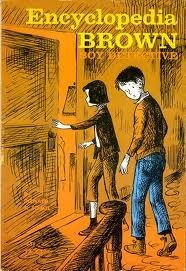
Donald J. Sobol, author of the beloved Encyclopedia Brown children’s mystery book series, passed away on July 11, 2012, at the age of 87. A former reporter for the New York Daily News, Sobol wrote short mysteries for a decade before starting on the Brown books in 1963.
Sobol wasn’t the only famous writer to shuffle off this mortal coil in recent days. Steven Covey, author of The Seven Habits of Highly Effective People and other motivational books, died on July 16. He was 79.
I grew up reading the adventures of Encyclopedia Brown, his business associate and tough female bodyguard Sally Kimball, and the boy most likely to die in a federal penitentiary, Bugs Meany. I also once owned a copy of Covey’s popular book, and I’m pretty sure that I read much of it, possibly the whole thing. As a Well-Read Man, it is my responsibility to ponder which of these books had the most influence on me.
Of course it was the Encyclopedia Brown books. The problem with motivational books is that they require motivation. To have Covey’s book influence your daily life, you must read it while sitting up straight in a firm, wooden chair with plenty of incandescent light nearby, highlighter in hand. Easing back on a comfortable sofa with a lemonade nearby won’t do it. I know; I’ve tried. But that posture does work for Sobol’s books, which is why they were so good.
More than just entertaining stories, Sobol’s writings were miniature brainteasers that trained elementary school students how to thing through a problem. Covey’s book also teaches you to think through things, but for some reason, it was the lessons I learned from Encyclopedia that worked their way into my thinking processes. To this day I can’t name one of the seven habits. Can you? Encyclopedia could.


July 17, 2012
Review #49: Neuromancer
William Gibson’s 1984 novel Neuromancer is by far the strangest book in the Well-Read Man project. In fact, it is so unusual that I am nearly at a loss as to what I can say about it. And yet, it is the type of book for which things must be said. To ease you into the story, I’ll start with a bit of trivia. Written a full decade before web browsers became a key access point to the Internet, this book popularized the term “cyberspace,” a word coined by Gibson himself.
Neuromancer takes place in a future where technological and medical advances allow mankind to command the resources of the earth and space, connect the brain at will into productivity and entertainment networks, modify the human body to the point of inhumanity, and extend life through cryogenics, cloning, and extreme organ transplants. Henry Case is a criminal hacker of sorts, or at least he was until he stole from a client who in turn destroyed his nervous system’s ability to interface with computer networks. Now he has to engage in crime the old fashioned way, buying and selling in black market transactions for commonplace money.
Molly, a mysterious woman with Wolverine-style knuckle blades, shows up one day, promising Case a revamped spinal cord in exchange for a little hacking help. How could he know that this one simple job would involve holographic killers, space travel to an orbiting Las Vegas-style entertainment village, interactions with Jamaican religious zealots, the murder of the only woman he loved, and the possible activation of a computer network so powerful that it can harbor the souls of the dead?
Yes, the story is that strange, but not when gauged against other dystopian future narratives. As in Huxley’s Brave New World and Bradbury’s Fahrenheit 451, Gibson extrapolates humanity’s potential future based on current trends. In the mid-1980s, medical advances such as Jarvik’s artificial heart were popular magazine article topics, space shuttles were flying into orbit with a regularity that rivaled Pan Am, and Bill Gates’ vision of a computer on every desk and in every home was turning the world into a more intricately connected place. Gibson’s future world, though strange, has it roots in the technology he saw invading life around him.
Neuromancer set the standard for “cyberpunk” writings and media. For non-cyberpunk types like me, the genre carries the straightforward warning that advances in technology can lead to a degeneration of humanity if we are not careful. I didn’t like the book all that much. (I also read Cory Doctorow’s Down and Out In the Magic Kingdom a few years ago, which exhibits a similar future vision, and I came away with the same negative feelings.) But because Neuromancer speaks to the essence of what humankind is and may become, it certainly deserves a place alongside more traditional classic writings.
July 13, 2012
Review: A Golden Voice
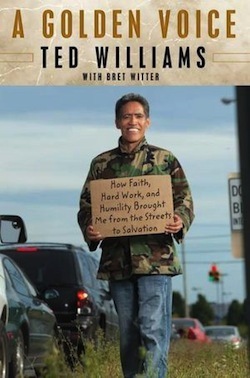
I’m not into pop culture. My son is frequently embarrassed at the sad state of my non-hip attire and my archaic music preferences. And since I seldom watch broadcast television, I don’t always know about the latest trends and fads. But I knew about Ted Williams. Everyone did. Homeless for two decades, he rose to international acclaim through YouTube when he demonstrated his “golden voice” for a reporter. In his new book, A Golden Voice: How Faith, Hard Work, and Humility Brought Me from the Streets to Salvation, Williams gives a biographical outline of the man behind the resonate voice and the scraggly hair.
The book documents what you probably already know about him: the story of a man brought down by drugs, but miraculously returned to favor through the God-given gift of his voice. The majority of the book’s content deals with the dark side of his history: the drugs. Page after depressing page, Williams provides shocking details on how far he was willing to go to maintain his crack cocaine habit. It’s a sad tale of betrayal, rejection, addiction, abuse, and nearly every other form of debasement short of murder. Of course, the story has a happy ending. But with perhaps ninety percent of the content dedicated to his downfall, you close the book with a decidedly negative outlook on the state of mankind.
I was impressed with Williams’ candor concerning how he treated God with the same disrespect that he had for his family, local businesses from which he stole, and the world at large. He speaks repeatedly of thanking God for the drugs he was about to consume, knowing all the time that his actions turned that same thankfulness into something profane. Williams is not unique in his pretend acceptance of the role of God in his life, and I found myself reflecting on my own lip service when it comes to spirituality and the deeper life.
The book reminded me of The Vicar of Wakefield from the Well-Read Man project. They are both stories of degradation and humiliation, bookended by more idyllic times. There are differences, to be sure, but in each book I was reminded that we have so little control over our own lives. While Williams chose to take that first hit of cocaine, there was something involuntary in the addiction that came with it, not to mention the details of his ultimate rescue that came in part from streaming video technologies that he didn’t even know existed, much less controlled.
Despite the uplifting message at the end, I didn’t fully enjoy Williams’ autobiography. I wanted to read more about how his life was transformed by the sudden fame that so many seek in this YouTube-enabled century. But the author downplays his current life, instead using the details of his sufferings to communicate the key to his salvation: that God never gave up on him or his golden voice.
To learn more about Ted Williams and his life, purchase his book from Amazon.com or Barnes & Noble.
July 10, 2012
Review #48: Fear and Loathing in Las Vegas
Hunter S. Thompson’s 1971 experiment in “gonzo journalism,” Fear and Loathing in Las Vegas, is precisely the type of multifaceted enigma-within-a-novel that I most feared (and loathed) coming into the Well-Read Man project. As you may recall from earlier posts, I failed at reading Albert Camus’ The Stranger back in college, thinking it was a quaint story about disease and quarantine when it was instead a deep philosophical work on life, religion, and existence. The deeper meaning of Thompson’s controversial work was similarly presented beneath a layer of seemingly unrelated storytelling. Fortunately, he anticipated dense people like me and included nice, neat paragraphs stating his purpose clearly.
The book tells the shocking tale of a drug-filled romp through the streets and hotel rooms of Las Vegas in search of the American Dream. The narrator, Raoul Duke, is a “doctor of journalism” and a semi-fictional stand-in for the author himself. Duke’s sidekick and attorney, Dr. Gonzo, represents Thompson’s real-world lawyer, Oscar Zeta Acosta. During their two trips to Sin City within the span of two weeks, they manage to consume “almost every type of drug known to civilized man since 1544A.D.,” destroy two convertibles and two hotel suites, skip out on thousands of dollars of purchases, and abuse “every rule Vegas lived by—burning the locals, abusing the tourists, terrifying the help.”
It’s a repulsive story, and yet the protagonist manages to pull his head out of the desert sand and the cloud of illicit pharmaceuticals long enough to wax eloquent on the condition of America in the 1960s, especially the counterculture that was still in vogue at the time. That cultural movement, as exemplified in the book by references to psychedelic drug advocate Timothy Leary, never lived up to its promise of “consciousness expansion.” Instead, says Thompson, drugs like LSD and the accompanying “turn on, tune in, drop out” attitude they engendered resulted in “grim meat-hook realities that were lying in wait for all the people who took [Leary] too seriously.”
Seeing that the failures of the counterculture were little better than the promises of the American Dream lifted up by mainstream culture—a dream which Thompson links with the excesses and superficial consumerism of Las Vegas—Duke and Gonzo decide to cope in the only way they know how, by giving themselves over completely to the drugs, making a mockery of both the drug lifestyle and “normal” world that the mainstream culture preferred instead.
I did not enjoy Fear and Loathing in Las Vegas. Its glorification of the type of behavior that I wish most for my own child to repudiate is maddening. The protagonists are abhorrent at best, extreme archetypes of a cultural revolution that I, by a quirk of my birth year, was able to avoid. And yet, despite my revulsion, I can’t shake the feeling that Thompson is talking to me, reminding me that some of the cultural niceties that I accept and take for granted are just as vapid and destructive as the long litany of drug abuses presented in the book.
July 6, 2012
Review #47: The Stranger
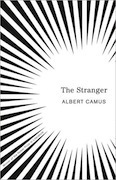
The Stranger, Albert Camus’ 1946 pseudo-existentialist classic, was my most feared book in the Well-Read Man project. I read his other famous work, The Plague, back in college. I thought it was a pretty decent book about a town going through the misery of plague and quarantine. I found out after I turned in my essay that the book wasn’t really about an actual plague at all, but about something deeper, more meaningful, more existential, more difficult to figure out.
Warning: This review contains spoilers, but does it make a difference?
So I didn’t have much hope in being able to grapple with The Stranger, and the book didn’t disappoint. The story, narrated by a Mr. Meursault, speaks of life and death in and around Algiers, along the North African coast. Specifically, the story involves his own life and pending execution, stemming from both the natural death of his mother and the violent death of an Arab man by the narrator’s own hands. In the first half of the book, he attends his mother’s funeral and has a fling with his girlfriend before shooting the man on the beach. In the second half, he deals with his year in prison, his time before the court, and his pending death sentence.
The narrator makes it clear that it matters not whether he lives or dies, whether he loved his mother or not, whether he pulled the trigger or not. As Freddy Mercury says in Bohemian Rhapsody, “Mamma, I just killed a man…. Nothing really matters to me.” The story is all about a man for whom nothing really matters. What I can’t figure out is why Camus wrote the book at all, since it doesn’t really matter if he writes or doesn’t write. As he says in the book, “In either case, other men and women continue living, the world will go on as before.”
The narrator goes out of his way to discard God and the Christian view of salvation. But he is equally indifferent about man and society. It can’t be said enough: Nothing really matters. And yet, the mere existence of the book proves that it must matter, or Camus would not have bothered writing it, and college students wouldn’t bother reading it. Like The Catcher in the Rye, this novel makes the case for a worldview that itself helps to tear down. And while that victory over apathy doesn’t prove that God exists, that there is life after death, or that loving your mommy makes any difference at all, it does at least give one a reason to wonder if those things are important.
July 3, 2012
Review #46: To the Lighthouse
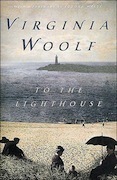
Have you ever stopped to think what other people are thinking? Have you ever felt the need to write a hundred pages obsessing over it? Virginia Woolf did, in her 1927 book To the Lighthouse. This work of modernism uses stream of consciousness to communicate a standard story through the disjointed thoughts of several of the book’s major and minor characters.
The book has three parts. The first section shows the Ramsay family and those in the house with them discussing various things, including whether Mr. Ramsay will take some of his kids by boat to a nearby lighthouse. In the third part, Mr. Ramsay finally takes two of his sons across the water to see the lighthouse up close. The middle section is a non-stream-of-consciousness block showing the passage of the ten years between the other two parts. That’s right, it took the Ramsay’s ten years to make a decision about the trip.
Why did it take them so long? Perhaps it’s because they couldn’t get past all the introspection and thinking and worrying about what other people were introspecting and thinking and worrying. The bookend sections of the text are thick with “he thought, she thought.” I kept expecting to see “Tim Patrick thought…” show up somewhere, what with all the competing thoughts from so many different people filling each page.
It’s useful to know what characters are thinking, especially in a book that tries to troll the depths of human understanding. And this book does take seriously its role in trolling such depths. I think Woolf does accomplish her goal of communicating the story in a classic-worthy manner. But it’s still a pain to read. Something as simple as a question posed by a character can be a chore to read because the answer might not show up until two chapters later, one of which takes place in another character mind several miles away.
To the Lighthouse is certainly essential reading from a literary perspective. There is nothing else in the Well-Read Man project quite like it. But I still don’t recommend that you read it, at least not just once. Attack it five or six times with a spreadsheet at your disposal to help you figure out which character’s thoughts begin each sentence and which one’s end it. Then, like the proverbial lighthouse itself, the flashes of light might just invade your mind. Assuming you have room in there with all that messy introspection.
July 1, 2012
It is Finished!

The reading portion of the Well-Read Man project is complete! It was a very long year, filled with 42-pages per day of classic content, both good and bad. But don’t despair. Even though I’ve managed to plow through all fifty books in the project list, the Well-Read Man project lives on.
As with a classic tome, the experience doesn’t end with the turning of the final page. Stay tuned for the remaining project-related reviews, discussions about books and reading, and new announcements for the project and its author.
[Image Credits: Microsoft clip art]
June 29, 2012
Review #45: The Metamorphosis
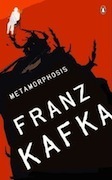
Have you ever had one of those days where nothing seems to go right, something like the worst day of Samsa Gregor’s life? He wakes up late for work one morning, has a scratchy voice, and can’t seem to get out of bed because his short bug-legs just wiggle around, unable to reach the bed below his beetle-shell back. Yeah, a day just like that.
For Gregor, the focus of Franz Kafka’s 1912 short story The Metamorphosis, things only go downhill from there. After waking up as a “monstrous vermin,” Gregor experiences a stream of curses from his boss, rejection by his family, the pain of seeing his loved ones suffer at his hand (or what used to be his hand), and the injustice of getting swatted with a newspaper just because he eats rotting food, climbs on walls and ceilings, and has visible mandibles.
The absurd plot of Kafka’s most famous work is, in a word, Kafkaesque. Gregor’s transformation from a successful traveling salesman into an insect that has no hope of anything is inexplicable, unexplained, and without reason or meaning. While it is understandable that his boss would dismiss him for his inability to schmooze with customers given his inability to speak, walk, eat, or breath like his potential clients, the abrupt rejection by his family, given the years that he has worked to provide them with a comfortable life is also curious and extraordinary.
One feels a need to commiserate with Gregor’s circumstances. And yet, I found myself quickly joining the family in their condemnations. Gregor could not, in fact, speak to his family, but he did retain his human capacity for intelligent thought. Why couldn’t he spell out “Help” with things found on his desk? That would have turned the book from Kafkaesque to Shaggy Dogesque. But Gregor contributes nothing to any kind of happy ending. In fact, in the face of his circumstances, he gives up trying even faster than his family does.
The plot presented in The Metamorphosis does give one possible outcome to a person being thrown into an impossible situation. I myself haven’t yet met anyone who suddenly changed into a hideous vermin, but I do know people who, due to illness or family trauma or work-related abuse, found themselves in seeming impossible environments from which the means of escape eluded them. Neither stories nor real life are guaranteed to provide happy endings, and Gregor Samsa’s existence makes that absurdly clear.
June 26, 2012
Star Trek Books
I’ve enjoyed playing the role of a well-read man over the past year. Perhaps “role” isn’t the right word. I really do like reading books that have had a broader influence on people and events throughout history. One quick look at my Goodreads account (please visit my page and sign up as my Goodreads friend) shows that I’ve been blessed to experience hundreds of choice writings, many of them easily placed in the “classics” category.
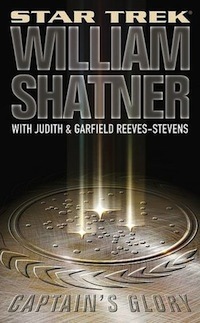
And yet there are other books that, frankly, I am hesitant to put on my public list of read works. These are Star Trek books. Yes, I read Star Trek books. There, I said it.
These novels, typically just a few hundred small pages, are based on the characters and events found in the Star Trek universe. It’s not that I’m a Trekkie. As of this writing, I doubt I’ve seen more than about a third of the episodes in the original series from the 1960s. But I’ve watched enough of the movies and of the episodes in each of the franchise’s series to have a general understanding of the characters, the storylines, and the underlying themes they present.
I read Star Trek books because, to be blunt, they’re easy. It’s like picking up one of the old picture books I used to read to my son when he was four years old. The characters are clearly defined, simple to understand, and I always know what to expect from them. At some point, Kirk will beat up an alien just before McCoy pronounces him “dead, Jim.” Riker will make some funny off-handed comment that Geordi will need to explain to Data. Neelix will mosey up to the bridge and eventually do something that will cause emotionless Tuvok to contemplate first-degree murder.
Clearly these are not deep books—or are they? Gene Roddenberry’s vision for the first series was as a medium to deal with complex human concerns: racism, war, imperialism, sexism, power, money, and other topics of general concern to non-aliens. Some of the books are little more than theater for the mind. But many of the authors followed in the Star Trek creator’s footsteps and imbued their works with human (?) drama and cultural controversies that parallel those found in any eighteenth century literary masterpiece.
I would never compare the books to some play by Shakespeare, and yet I enjoy them. I read a lot of heavy, non-fiction works, some for my job, some for self-enrichment. But there are only so many life lessons you can pack into your brain in one day before you need to escape from reality. For me, the somewhat superficial, mildly entertaining, and periodically thought-provoking episodes found in Star Trek novels give me the literary breather I need from time to time.
June 22, 2012
Review #44: Midnight’s Children
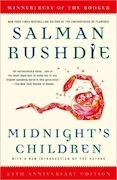
Sometimes when we hear some famous person’s name, we immediately link that person with some event in history. Abraham Lincoln and the Civil War. Christopher Columbus and the year 1492. Karl Marx with the age of Communism. But what if one person was linked—almost physically linked—with the fortunes and events of a single nation? That’s the idea explored in Salman Rushdie’s 1981 book Midnight’s Children.
The book’s core chronology follows Saleem Sinai, born at the stroke of midnight on August 15, 1947, the exact moment when the nation of India gains its colonial independence from the British. From that point, the story, narrated by Saleem, provides an autobiographical sketch of his life, regularly linking events and feelings of his own experience with the larger events and feelings occurring nationally within India, Pakistan, and later, Bangladesh. The story concludes in the late 1970s with Saleem unsure if he will live to see his—and by extension, India’s—next birthday.
Saleem isn’t the only Midnight Child. In the book’s universe, the 1,001 native children born during the first hour of India’s independence are linked, to some extent, with the complexities of the nation’s political, religious, cultural, geographical, and historical reality. But Saleem, born exactly at the moment that India was freed from its prior colonial bonds, becomes newly bound to the nation in a way that links him as prime among all the children of midnight.
Midnight’s Children is a fascinating book for what it is. Saleem is more than just a statistical aggregate of Indians. Saleem is India—and his sister just happens to be Pakistan. It is an interesting premise, but for readers not raised in that part of the world, the link between India and one of its citizens is a bit of a stretch. Rushdie goes to great lengths to ensure that the protagonist’s life ties in with all major events in the history of modern India—and it shows. Some of the things that happen to Saleem are so contrived that it reduces the story to some low-grade work of science fiction. While the story does introduce readers to the nations on the Indian subcontinent, it does so in a way that is as complex and hard to deal with as the conflicts between the nations themselves.