Tim Patrick's Blog, page 22
October 29, 2012
The Right Bible for You

NOTE: This post was originally published on October 10, 2007, on my personal blog. I am in the process of moving relevant articles to the Well-Read Man site. Please enjoy this slightly-old reading-related article.
The other day I was at my local mega-mega-bookstore and saw The Archaeological Study Bible shelved in the Bibles section. While I knew that archaeological discoveries over the centuries have helped to shed light on portions of scripture, it never occurred to me to obtain a Bible with information on the discoveries interleaved with the main biblical text.
Specialized Bibles such as this one from Zondervan have been available for years. Other examples include the popular Life Application Study Bible (keyed to your life), the Apologetics Study Bible (to help you debate with atheist nasties), The Reformation Study Bible (to help you debate with Catholic and Protestant nasties), Woman Thou Art Loosed Edition Holy Bible (that sounds fun), The Police Officer’s Bible (yes, it’s a real book), and the classic Oxford Study Bible (now with more Oxfords).
With all of these theme-specific Bibles, some on topics that only loosely parallel the 66 books of the Bible, why not come out with some new Bibles that really give the people what they want to read? Here are just a few samples I came up with.
The Sin Study Bible – People, even atheists, will buy this one without even checking the content first.
The God Who Is Hard To Understand Study Bible – It wouldn’t explain God any better, but it would sit by your side and commiserate with you.
The Just-the-words-of-the-Bible-and-nothing-else Study Bible – Isn’t this what we used to read?
The Juicy Parts Study Bible – No more reading 1 or 2 Chronicles!
The Betty Crocker Study Bible – Great recipes for manna and wine-from-water.
The Study Bible – Bible Sold Separately – Just the entertaining study texts with no actual Bible content to get in the way.


October 25, 2012
Book Review: A Short History of Nearly Everything

NOTE: This post was originally published on June 20, 2007, on my personal blog. I am in the process of moving relevant articles to the Well-Read Man site.
When you name your book A Short History of Nearly Everything, you run the risk of having readers ignore all of your other books, since they can’t possibly contain anywhere near the content of said book. But Bill Bryson has gambled with both reputation and financial ruin, and published yet another giant book on whatever topic strikes his fancy at the moment. Coming in at over 500 pages with endnotes galore, Bryson presents a history of the universe, starting from the pre-Big-Bang singularity and ending with a dismal view of man’s existence on this lucky planet. And dismal is the operative word. If you haven’t been scared out of your BVDs by Bryson’s taunts of killer meteorites and runaway eruptions at Yellowstone National Park, you will arrive at a state of persistent guilt for all of the evils done by, well, you.
Short History compares favorably to the World Book Encyclopedia for sheer number of historical names and facts crammed onto the printed page, with new important names appearing on nearly every page. But at least the first half of the book is interesting and relatively guilt-free. From his treatment of the universe’s not-so-humble beginnings to the inner workings of the atom, to the line of descent leading up to Homo Sapiens, Bryson introduces in fireside-chat mode the movers, shakers, and accidental tourists that make up the history of scientific discovery. A glutton for the simile, Bryson ensures that you will easily understand the size of the components of a molecule, the scope of the universe, and the various reasons why the city of Denver should possibly not exist (page 184).
Bryson makes an admirable attempt at being thorough in his science, but he is lax in filling in the historical realities sufficiently, despite including “history” in the title. His key omission is any hint that anyone in the history of the earth ever thought that a God or gods were involved in creative activity. I don’t expect the author to support the ideas conveyed in the various theories of Young-Earth or Old-Earth Creationism, Intelligent Design, or Biblical Literalism. If Bryson had called all such ideas “rot,” I would have been assuaged. But for hundreds of pages on what amounts to a treatise on human origins, he pretends such views don’t even exist. Bishop Ussher does receive passing mention on pages 74-75, but only to clarify that nobody every listened to the high-church calendar cruncher.
While you will find Short History entertaining, especially when read in slow chunks over several weeks, you would be hard pressed to identify it as a history of nearly everything, when it lacks nearly everything that really counts in a history of life.
To purchase a copy of A Short History of Nearly Everything, recently updated and illustrated, click here.
October 18, 2012
Google Tracks Down a Whale

Today marks the 161st anniversary of the publication of Herman Melville’s classic work Moby-Dick. Normally nobody would know about this or even care. But this day the entire English-speaking world knows thanks to a visual reminder from Google.
For those of you too young to remember, neither the Internet nor Google existed back in 1851. But that doesn’t mean that the world was without its connections. Morse-code telegraphs had been in use for more than a decade, and the first undersea cable for intercontinental messaging would be placed a few decades later. Queen Victoria opened London’s Great Exhibition, a grand world’s fare that would run through most of 1851. And in nearby France, Napoleon made dramatic political changes in advance of declaring himself Emperor. In this time of technological advancement and worldwide transformation, Captain Ahab got on a boat and chased a whale.
Moby-Dick was one of the fifty books included in the Well-Read Man project. Click here to visit the project page for the book.
October 15, 2012
Refunds for Ebooks

If you purchased an ebook between April 2010 and May 2012, you could be rich! That’s because three major book publishers settled a class-action lawsuit with forty-nine of the fifty American states (sorry Minnesota residents) and other territories, a suit that claimed Hachette, HarperCollins, and Simon & Schuster colluded to inflate ebook prices. Two other publishers, Penguin and Macmillan, refused to settle and will go to court next year to argue their case.
According to an email I received from Amazon.com this weekend, those affected by the suit should expect to receive (once the case is finalized next year) a credit on their accounts based on items they purchased from the three publishers: $1.32 for all New York Times Bestsellers, and $0.30 for everything else. Readers who made these purchases from Amazon, Barnes & Noble, Apple, or Kobo don’t have to do anything; the credit will appear on their accounts. Refunds from Google, Sony, and other retailers require additional paperwork.
The Amazon email I received calls this a win for readers. But readers were already winning. The typical ebook price, even for New York Times Bestsellers, is typically half to one-third of the equivalent hardcover edition. If these major publishers were colluding to raise prices on books and control the market, they were doing a lousy job at it. It always amazes me that someone would sue a company for what already amounts to be a great deal. The lawsuit also gives booksellers like Amazon more discretion in setting the prices of individual books, which does seem reasonable.
If you are a lover of class-action lawsuits or simply want more details on the case, visit the settlement web site, ebooksagsettlements.com.
[Image Credits: Microsoft Office clip art]
October 8, 2012
Guest Article: What I’m Reading Now

When I dropped off my latest batch of library books, I noticed yellow crime-scene tape stretched across a corner of the familiar building. As I drew closer I read in big block letters of something not out of a CSI series, but just as criminal: “Banned Book Week.” Clever display.
During the week of September 24, 2012, the American Library Association celebrated the thirtieth anniversary of Banned Book Week, a memorial to books and materials once—and sometimes still—considered offensive to the point of prohibition.
Censored novels included Catcher in the Rye, by J.D. Salinger, and Fahrenheit 451, by Ray Bradbury. What was the big deal? The first book was about an adolescent, potty-mouthed teenage rebel trying to find his way through life. I saw (and lived) through worse growing up in Los Angeles. The second was about a future American society where books are outlawed and firemen burn any house that contains them. I remember reading those titles in school and in my opinion both were good stories.
The public display of “bad” literature made me wonder what other good, controversial stories I missed out on. In the spirit of the Well-Read Man and the rebel inside me, I’ve decided to read Slaughterhouse-Five, by Kurt Vonnegut, a favorite author whose novel I told myself I’d read one day. In the story, Billy Pilgrim, a former prisoner of war in Germany, is taken prisoner once again, this time by little green men from another planet who toss Billy into a zoo.
In 1972, a Michigan circuit judge called the book, “depraved, immoral, psychotic, vulgar, and anti-Christian.” That same year, Levittown, New York’s school board added, “anti-American, anti-Semitic, and just plain filthy” to the list of reasons for the ban. I look forward to scratching it off my bucket list.
###

Michael Varma is an award-winning instructor, professional magician, and writer. He has authored the book Tasteful Toasts, developed a series of educational puzzle books (Mental Blocks), and created games (Arithmesticks). Michael frequently performs at the Magic Castle in Hollywood, California; email him for a free guest pass. Find out more at his web site, michaelvarma.com, or subscribe to his funny and informational blog.
October 2, 2012
Classic Books from Planet X

Just because a book is deemed a classic doesn’t mean it needs to be boring. Now, a small bookshop in New York City is out to prove it. Singularity & Co. (savethescifi.com) vows to “rescue” at least one vintage out-of-print science fiction work each month, converting the books to electronic format. It’s like an intergalactic death ray that makes books!
The project began on Kickstarter, where 1,500 fans of science fiction, fantasy, and pulp fiction committed their dollars and hearts to the cause. So far, Singularity has scanned, proofread, and formatted three works, making them available to its subscribers, and eventually through its online bookstore. A one-year subscription is $29.99 (sorry, no Federation credits accepted), giving you access to all rescued books.
September 27, 2012
Guest Article: What I’m Reading Now

Obedience by Will Lavender (published by Three Rivers Press, available from Amazon and Barnes and Noble), is a puzzle mystery. On their first day, students in a logic-and-reasoning class are presented a startling assignment: Save Polly! Using clues dripped out by the professor, the students must to solve the puzzle of her disappearance by the end of the term or Polly will die and they will be held responsible for her murder.
The novel focuses on three students, each of whom has dreadful secrets, as well as damaged psyches. Add to that mix the weirdness of the faculty, and there are bound to be explosive interactions. What fun would college be without lies, sex, and death?
There are several reasons I bought and read this book.
First, I met and spoke with the author (as well as taking one of his classes) at Killer Nashville, a conference for crime writers. The concepts behind the book and the way he wrote it gave me insights that any author could use.
Next, this story, as I said, is billed as “a puzzle mystery.” Aren’t all mystery novels puzzles? Yes, but this one has a clear and distinct enigma that cuts the proverbial elevator cables at the beginning of the story. To be worthwhile, a story must concern a crucial problem happening to believable characters, which eventually presents a resolution that stops the runaway elevator from slamming into the cellar.
Finally, my own mystery novel had just been published and, until I met Will Lavender, I hadn’t realized that I’d also written a puzzle novel. I’d never heard of that subgenre before, and yet I can help but direct my second mystery novel down that same path.
Will’s novel is perfect for the puzzle aficionado, the mystery lover, and the philosopher.
The puzzle lover in you will be sifting through the clues the professor doles out in tiny drips. At times, you’ll want to reach through the pages and strangle the professor or, more likely, some of the strange characters who pop up. Patience, dear reader, all is explained in the end and you’ll slap your forehead for not realizing the significance of the information you got.
As a lover of mysteries, I’m always curious about how the crime (usually murder) was committed. Without spoiling the ending, the book goes into great depth about the causes of the murder. This turns Obedience into a bit of a psychological thriller, another layer on the underlying puzzle mystery.
Would a philosopher like this book? Yes. The university and the characters are placeholders for examining the universe and the people who inhabit it. What secrets could be so deadly that they should be covered? What secrets, if revealed, would cause a murderer to strike? What responsibility do you as an individual have not just to society but to some anonymous person that you didn’t even know existed before you came to this crazy man’s classroom?
Obedience is a fun romp.
###

Bill Hopkins uses his decades of experience as a private lawyer, a prosecuting attorney, and a Missouri state judge to capture readers with his Judge Rosswell Carew murder mysteries. Courting Murder, his first mystery novel, is available from Amazon.com. You can follow Judge Hopkins at judgebillhopkins.com, or through his Facebook and Twitter pages.
Guest Article: What I’m Reading Now?
Obedience by Will Lavender (published by Three Rivers Press, available from Amazon and Barnes and Noble), is a puzzle mystery. On their first day, students in a logic-and-reasoning class are presented a startling assignment: Save Polly! Using clues dripped out by the professor, the students must to solve the puzzle of her disappearance by the end of the term or Polly will die and they will be held responsible for her murder.
The novel focuses on three students, each of whom has dreadful secrets, as well as damaged psyches. Add to that mix the weirdness of the faculty, and there are bound to be explosive interactions. What fun would college be without lies, sex, and death?
There are several reasons I bought and read this book.
First, I met and spoke with the author (as well as taking one of his classes) at Killer Nashville, a conference for crime writers. The concepts behind the book and the way he wrote it gave me insights that any author could use.
Next, this story, as I said, is billed as “a puzzle mystery.” Aren’t all mystery novels puzzles? Yes, but this one has a clear and distinct enigma that cuts the proverbial elevator cables at the beginning of the story. To be worthwhile, a story must concern a crucial problem happening to believable characters, which eventually presents a resolution that stops the runaway elevator from slamming into the cellar.
Finally, my own mystery novel had just been published and, until I met Will Lavender, I hadn’t realized that I’d also written a puzzle novel. I’d never heard of that subgenre before, and yet I can help but direct my second mystery novel down that same path.
Will’s novel is perfect for the puzzle aficionado, the mystery lover, and the philosopher.
The puzzle lover in you will be sifting through the clues the professor doles out in tiny drips. At times, you’ll want to reach through the pages and strangle the professor or, more likely, some of the strange characters who pop up. Patience, dear reader, all is explained in the end and you’ll slap your forehead for not realizing the significance of the information you got.
As a lover of mysteries, I’m always curious about how the crime (usually murder) was committed. Without spoiling the ending, the book goes into great depth about the causes of the murder. This turns Obedience into a bit of a psychological thriller, another layer on the underlying puzzle mystery.
Would a philosopher like this book? Yes. The university and the characters are placeholders for examining the universe and the people who inhabit it. What secrets could be so deadly that they should be covered? What secrets, if revealed, would cause a murderer to strike? What responsibility do you as an individual have not just to society but to some anonymous person that you didn’t even know existed before you came to this crazy man’s classroom?
Obedience is a fun romp.
###
Bill Hopkins uses his decades of experience as a private lawyer, a prosecuting attorney, and a Missouri state judge to capture readers with his Judge Rosswell Carew murder mysteries. Courting Murder, his first mystery novel, is available from Amazon.com. You can follow Judge Hopkins at judgebillhopkins.com, or through his Facebook and Twitter pages.
September 24, 2012
Moby Dick Big Read
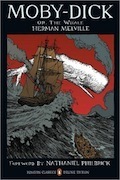
I’m not a big fan of Moby-Dick. Despite the snappy ending, it was one of my least favorite books in the Well-Read Man project. But as with the voting records of politicians, there’s always someone trying to make the thing look better than it is. Welcome to the Moby Dick Big Read project.
Starting just over a week ago, this Melville-centric web site began posting one chapter per day in audio format, read aloud by famous talents, or at least those with great speaking voices. Chapter 1 comes to you via British actress Tilda Swinton. Each chapter also includes a work of visual art meant to evoke the inner whale in each spoken section.
Given the book’s length, it will take several months to complete the chapters. You can follow along through the web site (mobydickbigread.com), iTunes podcast, or RSS feed.
September 11, 2012
Anonymous Reading

Yesterday, in a rush to discover books that should be read by every shadowy computer agent, hackers associated with the mysterious group Anonymous brought down this very web site. An unfortunate side impact, and likely one that was completely unexpected by those rushing to access these pages, is that another five-million-plus other web sites became inaccessible for that same four-hour window. It’s amazing what avid readers can do in this technology-centric age.
As a public service to Anonymous and other like-minded groups, I have compiled a short list of classic works that younger members may have not yet had time to read in their heretofore short network-manipulating lives.
The Count of Monte Cristo – Some have suggested that yesterday’s disruption in service stemmed from GoDaddy.com’s prior stand on the Stop Online Piracy Act, and that revenge motivated the hosting provider’s takedown. This book by Alexandre Dumas examines revenge as a motivating factor in making important decisions, and how those decisions impact the revenge-taker and others.
The Art of War – Surprising, there are people in this world who want to stop organizations like Anonymous from gaining access to informative reading lists like this one. This ancient Chinese book may prove useful in understanding the tactics used by those who find “black hat” hacking less than savory. It also makes a great gift for FBI agents on the trail of hacking groups.
Selected Works by William Blake – The poet Blake addressed issues of right and wrong, and of eternal consequences, often by reversing the very ideas he sought to communicate. For hackers unsure if their actions warrant praise or condemnation, a quick read through Blake’s classic verse may bring peace, or a life-altering crisis.
The Ego and the Id – Have a little down time while your DDOS attack runs its course? Why not spend that time delving deep into your soul, far into the recesses of the unconscious. Some things are best left anonymous, but not your soul. This famous work by the father of psychoanalysis, Sigmund Freud, will have you pondering the meaning of life and your mother’s involvement in it.