Tim Patrick's Blog, page 20
March 18, 2013
Exploring History
Being well-read means more than just curling up with the latest Jane Austen thriller. It’s about consuming a wide-range of written content and incorporating it into your life. The words can come from a variety of sources, including books, blog posts, and if my first-year college English professor was telling the truth, even print advertising.
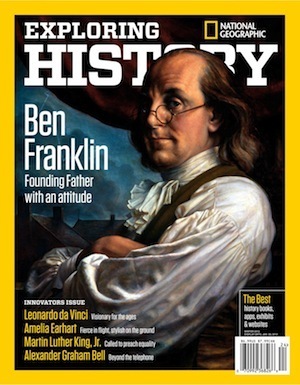
One major source of diverse content comes through magazines, a key source of modern writing in America since they rose to popularity in the mid-nineteenth century. It’s becoming a tough market, with journals depending more and more on electronic sales, and the complete abandonment of the print market by Newsweek last October. You can still find news racks, though, and while passing by one recently I came across Exploring History, a special issue of National Geographic‘s regular magazine.
This Winter 2012 edition, the “Innovators Issue,” includes biographies of some of the most famous inventors and explorers of the last several centuries: Ben Franklin, Leonardo da Vinci, Amelia Earhart, Martin Luther King, Jr., and ending with Alexander Graham Bell, the second president of the National Geographic Society and one of its founders.
The biographies are entry level, but interesting, covering the basics you hope your high school student would be able to include for an A-grade. Beyond this history issue, National Geographic produces regular special editions that cover topics as diverse as scientific discoveries and scenic drives. And unlike the main magazine in its heyday, the special releases appear to be safe for giggling junior high boys.


March 11, 2013
The House on the Drina

Ivo Andrić’s classic novel The Bridge on the Drina—one of the books in the Well-Read Man project—tells the story of the sometimes raging events in a small town near the sometimes raging Drina River in present day Bosnia and Herzegovina. The events in the story are tumultuous, so much so that I imagined an untamable river that cleared away everything but the Mehmed Paša Sokolović Bridge that is at the center of the book’s historical narrative. So I was quite surprised to find a house in the middle of the water.
The small structure sits on a mid-river rock near the town of Bajina Basta, Serbia, downstream from the book’s famous bridge, about 20 miles (31 kilometers) as the crow flies. Far from being in peril, the wooden cabin has survived the harsh weather and, like Piglet, being entirely surrounded by water since 1968. To see pictures of the structure and the magnificent river the makes the house a wonder in the first place, read about the 45 Year Old Tiny Serbian Drina River Home at the architecture and style web site inthralld.com.
[Image Credits: inthralld.com]
March 4, 2013
Inaccessible Classics
As a typical American Internet user, I see the world largely in English. Whether it’s online shopping or doing research about this very blog, the sites I visit tend to be written in my native tongue. But once in a while I come across something in a foreign language that I need to understand, and in those cases I turn to the translation feature on Google’s web site.
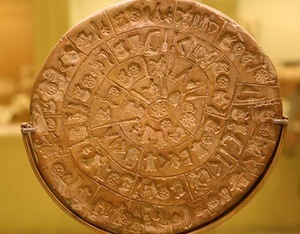
It turns out that there are big gaps in that system, the biggest being that it does not include every language every written by humans. Come on, Google, get on the ball! Fortunately, they cover the major languages, but I recently read an article about seven ancient languages that have not yet been deciphered by linguists, nor by Google developers.
As has been the case in other ancient writing samples, the unintelligible sources may turn out to be mundane tax records from some nomadic IRS agent. Still, the stories surrounding the demise of these languages and the search to uncover their meanings are interesting. In one case—the Sitovo inscription—a researcher was sentenced to death for trying to crack what Bulgarian official thought was a secret message to Soviet officials. And I thought writing a blog was a dangerous profession!
You can read more about the 7 Ancient Writing Systems That Haven’t Been Deciphered Yet on the web site for Mental Floss magazine.
[Image Credits: Wikimedia Commons]
February 26, 2013
Digitizing Like a Snail
I’ve been doing some research on the American presidents recently. For all presidents since Herbert Hoover and a handful of others before his term, official and unofficial presidential libraries house the vast majority of available documents. For earlier officeholders, the most complete source for presidential papers is the Library of Congress. The Library’s Manuscript Division maintains a microfilm collection of these older documents, made available to the general public through university libraries and other institutions across the country. To read the documents, you have to drive to the library, pay ridiculous prices for college parking, obtain the microfilm from the librarian, sit yourself in front of 1930s-era imaging technology, and glare.
Just because a copyright for some work has expired, it doesn’t mean you can retrieve it easily, even in this digital world. Significant portions of the presidential materials are still accessible only through disconnected, physical, photographic media, or multi-volume reference collections. I found this limitation shocking, especially since Google has been working hard at digitizing 20 million library books using machines that manage the page turning and picture taking automatically (now with some publisher permission). There must be a device that can scan through thousands of reels of film per day, convert them to digital format, and offer them in a centralized, convenient online location.
Perhaps there is, but it won’t help me this week. For now, I have to be content with hanging around college students and ignoring the strange looks aimed at the old guy—that would be me—sitting in the Microforms room. There are groups working to move many archived historical documents online for free or paid access. Here are a few that peaked my interest recently.
The American President Project is trying to make my dream come true. Located at the University of California San Barbara, the project has made available online over 100,000 documents covering all presidents from Washington to Obama.
The British Library is bringing its own collections to the masses through “digitisation.” Recent uploads include a nearly 600-image copy of notebooks from Leonardo da Vinci.
Google recently press-released information about its participation in bringing high-resolution images of the Dead Sea Scrolls to a web browser near you.
[Image Credits: Microsoft Office clip art]
February 18, 2013
One-Book-a-Day Habit
When I first proposed the Well-Read Man Project, it included a goal of 100 great books. Fortunately, I had several good friends who were able to talk me down off of the eight-foot-high stack of books, and I eventually tackled a more reasonable fifty works. A reader named Jeff Ryan, if his “366 Days, 366 Books” article in Slate a few months ago is any indication, definitely needs more friends.
A book each day; that was his goal. I started to feel a little sheepish with little to show beyond my four-dozen-plus selections, at least until I started scanning his list. Mr. Ryan’s objective was to finish books, not necessarily to immerse himself content of pedagogic value. In fact, he admits freely that comic books were a regular staple of his reading journey: “I can start and finish a six-issue collection of Captain America or Green Lantern comics in less than an hour.” He also included some books for youths—Roald Dahl’s James and the Giant Peace made his list, as did several of Ridley Pearson’s Kingdom Keepers books—helped along by the daughter he read to each night.
There was some substantial content in there as well. O Pioneers! from Willa Cather was in his list, and also on my initial candidate list. He also read from the likes of Thomas Hardy (The Return of the Native) and Virginia Wolff (The Common Reader), plus that classic author Weird Al Yankovic (Weird Al: The Book). One project rule was “Read Short Books,” but some longer items crept in anyway, including Walter Isaacson’s Steve Jobs. And while there were a surprising number of biographies on Walt Disney in the mix, he did include books from a varied assortment of genres. Kudos!
For me, 366 books in one year are too many. As in running a marathon (or so I’ve heard), at some point the brain drops into neutral and lets the body push through to the goal. So I could probably physically do it. But book choice would make the difference. I can’t imagine reading a book by Plato, or even Jane Austin, each and every day. Comic books and young adult works would ease the pain, but I would struggle with the value of what I was consuming. Mr. Ryan said that he had to give up late-night horror flicks to give him more time to read. But I wonder how many graphic novels I would need to read before I started having nightmares of being hunted down by books.
You can read the full article on Slate‘s web site, and browse through his complete list of books.
February 4, 2013
Robert R. Livingston
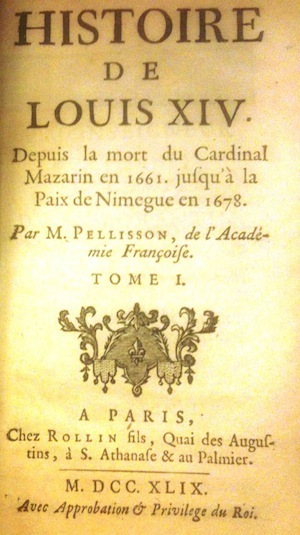
Last week I wandered into a used bookstore and peered into the glass case containing the rare books. The case included several first editions of twentieth century works; I recall seeing a faded copy of John Hersey’s Hiroshima, which I read with some interest back in college. There were also two very old-looking items that caught my eye. One was a German-language volume with a price tag of $1,000 adoring its protective plastic cover. Achtung! The other one was much more reasonable, just a few dozen dollars, but if the description attached to it was to be believed, it seemed to be the most valuable item in the case.
The hand-sized work bore the title Histoire de Louis XIV, the first of two volumes. Published in 1749, one must assume—for the complete loss of my high school French prevents me from confirming this directly—that it describes King Louis XIV and his Grand Siècle just thirty-four years after his death. While the volume was something that would look nice on a bookshelf, it was the note written inside that made it a must-have.
This book from library
of Robt R Livingston, the
Chancellor of administered
oath of office to George
Washington when made
president of U.S.
Apart from the use of “of” as a conjunction, the note tells a compelling story. Assuming for the moment that people never write lies in books, the comment identifies Robert R. Livingston as the once owner of this very same item. Born in 1746—about the same time the book was being written—Livingston was America’s Minister to France during the early years of the nineteenth century (1801-1804). Even more significant, Livingston served as a member of the Committee of Five, the small group charged with writing the Declaration of Independence in 1776. Other committee members included Thomas Jefferson, John Adams, Benjamin Franklin, and Roger Sherman. You might have heard of them.
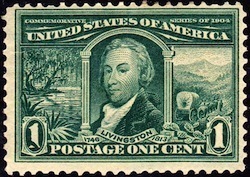
Livingston spent more than two decades as the first Chancellor of New York, where he earned his lifelong nickname “The Chancellor.” He also served as America’s first Secretary of Foreign Affairs, an office that George Washington would later rename as “Secretary of State.” As Minister to France, Livingston negotiated the Louisiana Purchase on behalf of the Jefferson administration. Although I didn’t recall his name from my history courses, he was clearly numbered among the Founding Fathers, and he had in his personal library a book that I am now able to call my own!
I still need to do some research to confirm the provenance of the book. Someone named John Woods published, in 1800, a catalog of the items in Livingston’s personal library. Hopefully Woods mentions the book I purchased, although his list predates Livingston’s stint in France during its First Republic. It’s entirely possible that the used bookstore I visited perpetrated some elaborate ruse just to get this ancient boat anchor off their hands. But for now, I will put Histoire de Louis XIV in a place of honor in my book collection.
January 28, 2013
The Bay Psalm Book
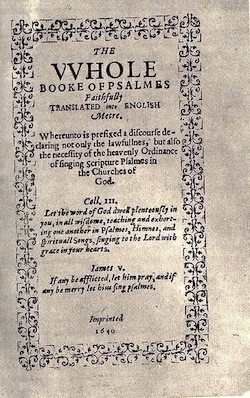
Last month, Boston’s Old South Church decided to part with one of its two copies of The Bay Psalm Book, originally published in 1640. Identified by the Library of Congress as “the very first book printed in what is now the United States” (although it is likely the third such book published on that same early printing press), the sale is expected to raise between $10 million and $20 million for the congregation’s building repair and upkeep needs.
Published under the more pedestrian title, “The Whole Booke of Psalmes Faithfully Translated into English Metre,” the text served as a hymnbook for Puritans in the Massachusetts Bay Colony throughout the seventeenth and early eighteenth centuries. Only eleven copies remain, five of which are complete, including the one proposed for sale. You can thumb through the full work at the church’s website.
January 14, 2013
Book Review: Home
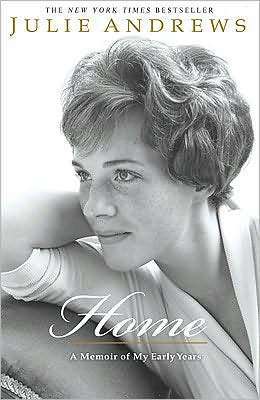
I only knew Julie Andrews from movies like The Sound of Music and Mary Poppins, and when I purchased Home: A Memoir of My Early Years, I expected the book to cover the events through which I had even that limited connection to her work. That’s what I get for ignoring words like “Early Years” in book titles. The autobiography covers only the first twenty-eight years of her life, from her birth in 1935 until the day that she flies to Los Angeles (in a plane, of course, not with an umbrella) to begin work on Mary Poppins.
For someone raised on that crisp and perfect image of her Disney years, it was a surprise to discover some of the complications of her family life. From her mother who ran off with a piano player, to the sudden revelation during her teen years that her father was not her biological father, the bombshells fell like the literal bombs during her World War II-era London upbringing. All of it tame by today’s standards, of course. She never outright embarrasses anyone, and even when the book puts someone in a negative light, she always balances it with a list of that person’s many accomplishments.
After full coverage of her childhood upbringing, the book eventually slips into her theater years, primarily her time in the two Broadway plays My Fair Lady (reprised by some of the same cast later in London) and Camelot. She namedrops regularly from the pantheon of New York stars of the late 1950s, including her costars like Rex Harrison and Richard Burton; musical wonders Stephen Sondheim, Richard Rogers, and Oscar Hammerstein, among others; writers such as T. H. White and Truman Capote; and others just getting their start in the entertainment world, including her best friend Carol Burnett.
The memoir provides extremely thorough coverage of Ms. Andrews’ early years, detailed to the point where you are sure she must have started her diary in utero. The writing is as proper as the author’s diction. My key disappointment with the book is that it ends so abruptly at the very point where I was actually keen to take an interest in her life. It has been nearly five years since this biography came out, so hopefully a continuation of her more recent work will find its way home as well.
You can purchase a copy of Home from Amazon.com or Barnes & Noble.
January 7, 2013
The New Almanac is Here!
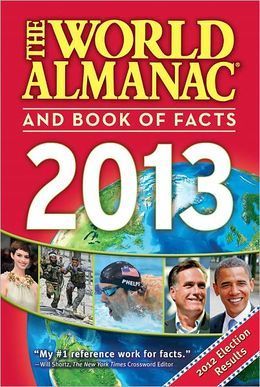
I just picked up my copy of the World Almanac and Book of Facts 2013. It’s filled to the brim with facts and figures, great for verifying pesky statistical questions and whacking your political enemies over the head with cold, hard facts, or with a cold, hard paperback book if needed.
I don’t want you to get the idea that I’m an almanac geek or anything like that. It’s not like I read the book from cover to cover; that would be crazy. I skip the sports section. Actually, once I’ve read a few articles that interest me, I take a few minutes to skim through most of the entry titles just to remind myself what this book has available for those times when I will need to access it for reference purposes.
The new edition of this book comes out each December, updated with content up until just a few weeks before publication. While it’s overkill for most people to purchase one of these more than every few years (I only buy one every three to five years), now might be your year!
December 31, 2012
The Click-Clack of Writing
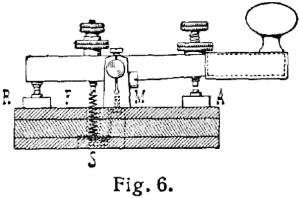
Today’s article is a little off topic from my normal coverage of book reading and the classics, and yet it has that message-from-the-past quality to it that I just couldn’t pass up. A friend posted an article on my Facebook wall that talked about the use of Morse Code at Disneyland’s New Orleans train station. The story is compelling not only because it is about Disneyland—yeah!—but because the author unraveled a mystery through an old dialect of English-language communication: nineteenth century Morse Code. In fact, the message and its medium were so old that even the Disney engineer in charge of its content didn’t know how to “read” it.
If you’ve been to the train station near Disneyland’s Haunted Mansion, you’ve likely heard the clicking and clacking of recorded telegraph noise over the loudspeakers. More than just random sounds, the dots and dashes communicate a short message about memories from the past and promises for the future. While the message itself is standard inspirational fare, the effort that the article’s author took to discover the message communicated an even stronger inspiration about uncovering the words of our forebears from written classics of centuries past. Enjoy!
Link to original story: http://www.hiddenmickeys.org/Disneyland/Secrets/Square/Morse.html