Tim Patrick's Blog, page 19
May 13, 2013
The Faith of Stephen Hawking

A few weeks ago, the eminent physicist Stephen Hawking gave a speech at the California Institute of Technology (Caltech) in Pasadena. It was a popular event, with the audience overflowing out of the auditorium and onto a grassy courtyard where a giant projection screen showed the wheelchair-bound scientist communicating through a computer.
The speech, titled “The Origin of the Universe,” was a near repeat of a 2005 lecture Hawking gave at Oxford University. Using his digitized voice, the ALS-stricken scientist spoke not only of the beginnings of our universe, but about the history of research insights of those trying to uncover the secrets of where we came from. After mentioning the quantum theory and General Relativity as supports for his ideas, Hawking introduced the concept that our universe, in tandem with other parallel universes, generated spontaneously all on their own, like bubbles that form seemingly from nowhere on the surface of a boiling liquid. This view of a “multiverse” is a key component of his 2010 book The Grand Design, a text in which he posits a universe formed without the help of an omnipotent creator.
This rejection of any sort of god as the source of the universe isn’t simply a passing notion for Hawking. His Pasadena speech is riddled with reminders that religious belief is a useless path for understanding creation. He brings up those same old swipes at religious history, including the Inquisition, those who believed in a flat earth, and Bishop Usher’s proclamation that God created the world on an otherwise quiet evening in 4004BC. For Hawking, the idea of God speaking the world into existence is just plain funny: “What was God doing before He made the world? Was He preparing Hell for people who asked such questions?”
In a 2011 interview, Hawking said, “Science predicts that many different kinds of universe will be spontaneously created out of nothing.” As a conclusion from one of the most fascinating and reputable scientists of our generation, it’s quite intriguing, and quite wrong. Science, of course, predicts nothing, but is the framework in which predictions and hypotheses can be tested. But even beyond this admittedly picky detail about definitions, it is the multiverse theory (called “M-Theory”), and not science in general, that is fixated on the generation of multiple universes. Even worse, it is a theory that cannot be proved or disproved; it’s not falsifiable, in part because the nature of the scientific experiments that could prove or disprove it are limited by the confines of our universe.
Roger Penrose, Hawking’s compatriot in some of his most important scientific work, rejected the idea that M-Theory represents credible science. In his 2010 Financial Times review of The Grand Design, Penrose stated, “Unlike quantum mechanics, M-Theory enjoys no observational support whatsoever.” Paul Davies, another noted British theoretical physicist, agreed with Penrose, and in a New York Times editorial, he called into question the roots of Hawking’s idea.
“Extreme multiverse explanations are therefore reminiscent of theological discussions. Indeed, invoking an infinity of unseen universes to explain the unusual features of the one we do see is just as ad hoc as invoking an unseen Creator. The multiverse theory may be dressed up in scientific language, but in essence it requires the same leap of faith.”
Even if M-Theory enjoyed widespread scientific assurance, it would do little to solve the problem of where everything came from. Multiverse theory doesn’t propose a handful of parallel universes. Instead, it suggests that there might be an infinite number of such universes, each supporting a different set of physical properties, but some—that is, an infinite number of them—strikingly similar to our own. Given the mindboggling amount of mass and energy just in our own universe, the idea that there may be an infinite number of powerful and heavy universe bubbles begs the question of where all that energy and matter came from in the first place. Hawking and some of the more vocal New Atheists wet their pants over the thought that a multiverse scenario forces a creation without God, and yet it leaves unanswered the question of how the multiverse itself came into being.
M-Theory, for all its scientific language and support, is philosophy, and religious philosophy at that. It would be wrong to dismiss Hawking’s ideas as meaningless. He is a thoughtful scientist who has spent a lifetime grappling with some of the toughest questions of our era. But it is wrong to label as science any theory that is not backed up by the rigor of the scientific method. Perhaps there are other universes just out of our reach. Yet for an academic to talk repeatedly of their existence apart from any falsifiable research is not science, but prayer.


April 29, 2013
The Heart of Stupid Political Thought

With the possible exception of Zachary Taylor, none of America’s forty-three presidents have been woefully uneducated or outright stupid, including the one you despise the most. As Americans, we revere the office of president, lifting it up as a symbol of all that is great about this nation. That goodwill doesn’t always extend to those who occupy the office. If recent elections are any clue, about half of all Americans think that George W. Bush was an inept, bumbling, greedy, and borderline-evil tool of his Big Oil puppet masters, while the other half is certain that Barack Obama is a corrupt, foreign-born America hater who pushes aside his teleprompter just far enough to bow toward Mecca five times per day. At the heart of these slurs is the widely held belief that our political opponents are innately dimwitted and too intellectually incompetent to understand clear-minded political truths.
For portions of the voting public, that assessment might be spot on, but not for presidents. From a purely educational standpoint, more than eighty percent of them attended or completed college—many of them in the Ivy Leagues (George Washington and Abraham Lincoln being two notable college-free exceptions). The two most recent officeholders are good collegiate examples. Both Bush and Obama hold post-graduate degrees from Harvard University, Obama in law, Bush in business. Blogs are filled with assertions of low marks and special treatment for each, but the fact is that, were these men anything other than presidents, the words “Harvard Graduate” on their resumes would confer an automatic assumption of mental discipline and intelligence.
As in all situations where facts are dismissed in favor of loud opinions, the charge of “dummy” against those we abhor says more about us than it does our targets. The fixation on deriding those in the other party harms our participation in the political process, not because it maligns others, but because it masks our own mental laziness. Instead of engaging in the intellectual rigor of political investigation and debate, we disparage the brain capacities of those taking issue with our weakly held positions, never realizing that it only works to expose our own ineptitude.
Life is complex, and our modern politics is a reflection of that complexity. We’ve now reached a point where elected officials routinely pass thousand-page laws without concern over the particulars. The issues are too intricate with too many variables to permit straightforward solutions, and frankly it’s easier to take sides on the cutesy ten-word title of a bill being debated than to sully ourselves with the specifics. And when the number of issues threatens to overwhelm us, the easiest path of all is to wrap them all up in a one-size-fits-all “Republican” or “Democratic” label, and attach it with malice on any controversial surface.
Substituting thoughtful political discourse with empty insults is nothing new. What is new is the ability to package such propaganda in cute memes and distribute them instantly to a waiting social media world. A power once available to a few newspaper publishers is now within reach of anyone carrying a smartphone.
Fortunately, that same power brings with it tools and resources that can wipe away the ignorance that so quickly seduces. From complete transcripts of every recent speech by all major politicians, to web sites that examine domestic and international issues from every possible angle, the Internet finally frees use from the excuse of ignorance. A few minutes spent in serious research can impart wisdom to nearly any Facebook controversy-du-jour.
We are free to engage in fact-free mudslinging anytime we want. But with easy access to the entirety of human knowledge via a pocket-sized gadget, taking the insult path is the essence of stupidity.
April 22, 2013
Life is Complex

Life is complex, and we treat it as simple to our detriment.
We believe that life is simple, that people are easy to control, that if we set up the right conditions, the world will right itself. Crime will cease. Hunger will disappear. Global warming will end. All it takes is the passage of a 2,500-page law that nobody, including the politicians, has the time or inclination to read.
We believe that cultures are simple, that at their core they understand that they should behave the way our culture does, the American way. A little diplomacy, a treaty here and there, a little meddling in the affairs of others and all will be well.
We believe that the environment is simple, that ice is good and fire is bad, that before humans showed up the ecosystem’s thermostat was set at a constant nature-loving temperature. We wring our hands at the stupidity of those who don’t see things our way, the simple way, the right way.
We’ve been trained, in our nation of ease, to think things are simple. All troubles resolve themselves by the time the sixty-minute episode ends. No matter how we live our lives, there’s a cleaning product or a government agency or a diet plan that will take care of it. But it’s not true. People die every day, sometimes from their own poor choices, sometimes in spite of their own good choices.
Despite all the education and inculcation of American ways, someone picks up a gun or a pressure cooker and starts killing the innocent. Even with all the entitlements and support programs, someone lives on the street within easy reach of low-cost housing and help-wanted signs. Notwithstanding our strict adherence to low-carb, low-fat, high-fiber diets forged with the help of cows not treated with rBST, someone gets cancer and dies, someone good, someone who didn’t deserve it.
Life has always been complex like this, built on a foundation of subatomic chaos and human free will. Sometimes the complications turn out for our good. Chemistry is filled with intricacies, but look at the amazing things we can build from ordinary elements and molecules. Sometimes the complexity fails us. As long as we acknowledge the complexity, the culture will endure and grow. When we pretend that life is simple—when we try to simply grab hold of life by its skinny little neck—things start to break down.
The books in the Well-Read Man Project have given me an appreciation of how complex life is, sometimes horrifying complex. Many of the works, including Max Havelaar, acknowledge the conflicting desires of people and races and nature itself, proposing borderline hopeful conclusions that make the best of a difficult environment. Others, such as Upton Sinclair’s The Jungle, embrace the lie of simplicity, building worlds from stereotypes and cardboard caricatures, storylines where one well-placed violent revolution or romance will wipe away every care.
No matter what you read in the pages of a classic novel or on the cover of the New York Times, the complexity of life is real. As human beings who care about the world around us, we naturally work to bring order to our local pockets of chaos. But if we take some time to reflect on how pervasive that chaos is, we can hopefully bring allow the wisdom of complexity to guide us to actions that make sense.
[Image Credits: Copyright © 2006 by Carl Silver (sxc.hu/profile/carlsilver, image 451176)]
April 15, 2013
Review: Man’s Search for Meaning
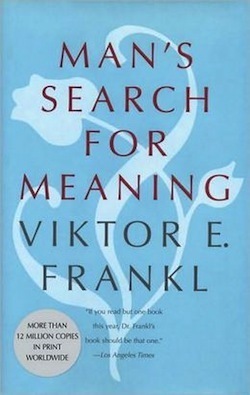
Life in the United States of America is incredibly easy. On a typical day, the most difficult decision I have to make is which restaurant to visit to consume my over-requirement of calories. Even when I endure a particularly hard day at work, I have a device in my house that’s purpose is to provide mindless, care-removing entertainment for an entire evening, while I just sit. There is the occasional tragedy, a Sandy Hook shooting or a Hurricane Katrina, that injects suffering into an otherwise peaceful existence. Some Americans are plagued by chronic financial or physical concerns. But for the most part, this nation of 300 million-plus people enjoys a level of comfort and ease unparalleled in human history.
This safety and freedom has provided time for innovation, an opportunity to create something that helps others and makes the inventor rich. For others, the additional free time afforded by first-world living brings room for sports and activities with friends, a chance to kick back with a beer and a laugh. And of course, there is the time spent with loved ones.
All of these activities that we enjoy so much bring meaning to our lives. Humans need meaning and purpose, and, according to Victor Frankl, the search for such meaning is essential to our existence. In his 1946 book Man’s Search for Meaning, Frankl explains how the pursuit of meaning allowed him and so many others to endure one of the most difficult burdens in human history: a Nazi concentration camp.
At the time of his arrest by the Nazis in 1942, Frankl was working at a psychologist in Vienna, Austria. It was a time of tremendous loss for the Jewish population. So many deaths, so much of life and so many goods taken from them, tossed into bonfires and trash heaps. The things that provided comfort and joy and normalcy were ripped from them, violently. Six million of them were summarily executed. For those that remained, some endured while others gave up. Frankl tried to understand “the apparent paradox that some prisoners of a less hardy make-up often seemed to survive camp life better than did those of a robust nature.” He endured the torture of the SS guards, the injustice of being beaten and broken, and the pain of seeing those around him “treated like nonentities,” and in the midst of the horror, he found what carried some through to the end: meaning.
It was meaning, or the quest for meaning in one’s life, that made the difference. This isn’t a general “meaning of life” feeling, but particular purposes that “differ from man to man, and from moment to moment.” For Frankl during his time in the camp, the desire to see his wife again (he didn’t know she was already dead) and his hope of publishing a book on his psychiatric theories gave him a meaning that helped bring him through his nearly three years of captivity.
While some died violent and empty deaths at the hands of their enemies, many more died internally. Frankl said that when a prisoner ignored a guard’s order to get out of bed and instead began smoking a cigarette, he knew that the prisoner would die within two weeks, not from weapons, but from purposelessness. “The prisoner who had lost faith in the future—his future—was doomed…. In the final analysis it becomes clear that the sort of person the prisoner became was the result of an inner decision, and not the result of camp influences alone.”
The first half of Man’s Search for Meaning describes life in the camp in light of the author’s discovery of meaning as a key survival factor. The content is intense though not overly graphic. But this is the Holocaust, and the details portray life stripped to the bone. “Everything that was not connected with the immediate task of keeping oneself and one’s closest friends alive lost its value.” Food was rationed to the point of intentional starvation, and warmth—both physical and emotional—was scarce. But the source of trouble did not come solely from the guards. “Even among the guards there were some who took pity on us…but the senior camp warden, a prisoner himself, was harder than any of the SS guards…. It is apparent that the mere knowledge that a man was either a camp guard or a prisoner tells us almost nothing. Human kindness can be found in all groups, even those which as a whole it would be easy to condemn.”
Frankl tells the story of a camp commander, a Nazi, who used his own money to buy medicines for the prisoners from a nearby town. Upon liberation by Allied forces, the prisoners protected this “enemy” from harsh treatment by their rescuers. This kindness for a tender heart, even in an enemy’s garb, proved to Frankl the fallacy of a superior Aryan race. “There are two races of men in this world, but only these two—the ‘race’ of the of the decent man and the ‘race’ of the indecent man. Both are found everywhere; they penetrate into all groups of society. No group consists entirely of decent or indecent people. In this sense, no group is of ‘pure race.’”
In the second part of the book, Frankl explains Logotherapy, his method of “curing the soul by leading it to find meaning in life.” Such meaning carried so many prisoners through to the time of their rescue. But for some who experienced the terrors of the camps, liberation brought a new kind of enslavement. “They were now the oppressors instead of the oppressed,” finding an “existential vacuum” that expressed itself in “bitterness and disillusionment,” and also a “state of boredom.” To counteract this emptiness, logotherapy promotes three methods of discovering meaning: “(1) by creating a work or doing a deed; (2) by experiencing something or encountering someone; and (3) by the attitude we take toward unavoidable suffering.”
Because he passed through some of the worst of what life has to offer, Frankl understood well that it’s not circumstances that define meaning, but what we take from those circumstances. Normally such an idea would be little more than an empty platitude. But his experiences inject into them the ring of authority. “The way in which a man accepts his fate and all the suffering it entails, the way in which he takes up his cross, gives him ample opportunity—even under the most difficult circumstances—to add a deeper meaning to his life.”
April 1, 2013
Reading in Paradise

Updates will be sparse this week as I am basking in the near-equatorial sunshine of Hawaii. It’s our family’s first-ever visit here, and as with classic books, there is a mixture of amazement and cold reality. The scenery around Oahu, where we are staying, is breathtaking, but as we went around Honolulu looking for places on our must-see list, my son remarked, “I thought Hawaii would be more resort-like.”
Although the vacation will include much-needed downtime from everyday life, the reading never stops. Here are some Hawaii-themed books that will keep you company through this time of relaxation.
Hawaii’s Story by Hawaii’s Queen , by Queen Lili’uokalani, the last monarch of the Hawaiian islands. She penned this history in 1898, five years after she was forced off the throne. The book covers Hawaiian history in general, and also gives a first-person account of the overthrow of the monarchy by business interests.
Letters From Hawaii and the Hawaii-specific portions of Roughing It , both by Mark Twain. Selections from the humorist’s many travel writings.
Moloka’i , by Alan Brennert. Although fictional, Brennert’s novel tells a compelling story of life in a Hawaiian leper colony at the end of the nineteenth century.
At Dawn We Slept , by Gordon W. Prange. Considered the definitive work on the Japanese attack of America’s military base at Pearl Harbor, this thick book has silently mocked me from bookstore shelves for years, daring me to read it. I now dare you to beat me to it.
Hawaii , by James A. Michener. As with Michener’s other monstrously large books, the story of the main fictional characters is backed up by rich and accurate historical content. In Hawaii, that history covers millions of years, beginning with the geological formation of the islands.
[Image Credits: Me, a photo from my hotel room!]
March 29, 2013
Answer: Loosely Based Entertainment
This week’s quiz pitted classic works against the marginally similar movies that used those books as inspiration. And now, with a Hollywood fanfare ringing in your head, here are the movies from that quiz, and the original books on which they were based.
Apocalypse Now
Based on Heart of Darkness
Clueless
Based on Emma
My Own Private Idaho
Based on Henry IV (Parts 1 and 2) and Henry V
Oh Brother Where Art Thou?
Based on The Odyssey
Roxanne
Based on Cyrano de Bergerac
She’s the Man
Based on Twelfth Night
Strange Brew
Based on Hamlet
Ten Things I Hate About You
Based on The Taming of the Shrew
West Side Story
Based on Romeo and Juliet
March 27, 2013
Quiz: Loosely Based Entertainment
Classic books are, well, classic. So it’s no surprise that many of these timeless stories have made their way to the silver screen. In some cases, all that silver dust has a side effect on those who develop the associated screenplays. Some artistic license was necessary, for instance, to move the Lord of the Rings books into a theatrical epic format. But when other books have made this same transition, the result has been wholly unrecognizable from the original, expect in some of the most basic storyline elements.
Below is a list of nine movies, followed by nine classic books. See if you can match the original masterpieces to their Hollywood offspring. Put your answers in the comments below, and no fair using Google, IMDb, or Wikipedia!
The Movies
Apocalypse Now, a Vietnam war film (1979)
Clueless, a comedy (1995)
My Own Private Idaho, a friendship drama (1991)
Oh Brother Where Art Thou?, a comedy set in 1937 rural South (2000)
Roxanne, a romantic comedy (1987)
She’s the Man, another romantic comedy (2006)
Strange Brew, a comedy based on SCTV characters (1983)
Ten Things I Hate About You, a teen comedy (1999)
West Side Story, a musical play (1957)
The Books
Emma, novel by Jane Austen (1815)
Cyrano de Bergerac, play by Edmond Rostand (1897)
Hamlet, play by William Shakespeare (1603)
Heart of Darkness, novel by Joseph Conrad (1899)
Henry IV (Parts 1 and 2) and Henry V, plays by William Shakespeare (1596 to 1599)
The Odyssey, epic by Homer (8th Century BC)
Romeo and Juliet, play by William Shakespeare (1595)
The Taming of the Shrew, play by William Shakespeare (1592)
Twelfth Night, play by William Shakespeare (1602)
Forgive the overrepresentation by Shakespeare, but his plays seem to be irresistible to moviemakers. Check back on Friday for the answers.
March 25, 2013
Article Review: Bitter Pill

There’s a healthcare crisis in America, gosh darn it. Unless you’ve been blessed with that fast cellular regeneration superpower, you probably already know that healthcare procedure and insurance costs are skyrocketing. I’ve seen my policy rates go up some years by as much as twenty-five percent. These increases come at a time when the economy is down overall, non-medical technology costs are stable or decreasing, and per-hour physician salaries are rising at about the same level as in all other industries according to Census Bureau statistics. So why the crazy price increases?
Steven Brill attempts to answer that question in the March 4, 2013 “Special Report” issue of Time Magazine. His 24,000-word cover story, “Why Medical Bills are Killing Us,” looks specifically at the prices charged by hospitals and similar healthcare providers. You pay $84 for a bag of IV saline at the hospital when you can buy it online for about $5. A single Tylenol tablet is charged out at $1.50, but that the same hospital gets it for one-hundredth that price. CT scans are billed out at thousands of dollars when the equivalent charge to Medicare is around $300. The article estimates that Americans overspend more than $750 billion on healthcare, a number that rises annually, much faster than the rate of inflation.
The article focuses on the “chargemaster,” the mysterious charge list for parts and labor that hospitals bill for all procedures and equipment used when giving care. In many cases, individual entries on a provider’s chargemaster include obscene markups, and while some hospitals told the author that such rates were used as a “starting point for negotiation,” those with insufficient insurance or no insurance at all are often forced to pay the full bill. The anecdote-heavy article is shocking, infuriating, and leaves you with a sense of hopelessness.
Brill includes a few recommendations for solving the crisis, but some of these cures seem worse than the disease. He recommends putting a cap on medical care prices, similar to government actions during World War II that led to our current insurance-centric healthcare system in the first place. He also suggests a seventy-five percent tax on all hospital income, although it’s not clear how that would curb prices, since all businesses raise prices to account for taxation. Other suggestions make more sense, including his call for tort reform and the expansion of a Medicare pilot program that allows for more flexibility in shopping around for the best medical care. His suggestion of lowering the age for Medicare participation while simultaneously requiring that all participants fork out a reasonable minimum of their healthcare costs before Medicare kicks in is intriguing, even for a fiscal conservative like me.
The author also recommends a surcharge on non-doctor hospital administrative salaries over $750,000. He seems to have a particular distaste for high CEO incomes, and peppers the text with example compensation amounts of healthcare executives in an effort, I guess, to shame them and make his readers seethe with anger. The incomes do seem surprisingly high given the level of customer dissatisfaction, but once again, Brill doesn’t indicate how caps on CEO incomes would impact healthcare cost to any significant degree.
The article does a good job at laying out a major problem with healthcare prices, and laments the effect it has on most Americans. “Unless you are protected by Medicare, the health care market is not a market at all. It’s a crapshoot. People fare differently according to circumstances they can neither control nor predict.” He also faults Obamacare in that, while it “does some good work around the edges of the core problem,” it “hasn’t done much to change the prices we pay.”
These statements, however, only magnify the key feature I found lacking in the article. Brill’s journalism skills are to be applauded, and his anecdotes are heartrending. But the article never addresses the reason why hospitals can abuse their customers (patients) through the manipulative chargemaster system in the first place. If companies in other sectors of the economy—Microsoft, Starbucks, and Ford come to mind, but the possible examples are legion—engaged in similar practices, they’d go out of business in a heat beat, no medical pun intended. In part, the problem stems from sick patients being a captive audience to the emergency room, and the “lack of price transparency” when a hospital acts as the middleman for medical equipment. But there still seems to be a deeper issue that isn’t brought out in the text.
Why doesn’t the medical industry respond to the same capitalistic influences that guide prices for computer, coffee, and automobile companies? It’s an important question, and one that I would like to learn more about. Steven Brill’s article doesn’t completely diagnose the core disease afflicting medical care in America, but it does document a few of its symptoms.
March 22, 2013
Answer: Dangerous Presidents
This week’s question was: Which president acted as executioner in the years before his term as America’s president? The answer is: Grover Cleveland, America’s 22nd and 24th president. As the sheriff of Erie County, New York, Cleveland personally carried out the hangings of two, or possibly three, murderers, despite his reservations in at least one case as to whether the penalty was appropriate.
The Wikipedia page on President Cleveland includes a short description of his role as sheriff, and later his terms as Buffalo mayor and governor of the entire state. A New York Times article from September 7, 1782, provides the details on the first execution, written in a personal style seldom seen in modern newsprint. (Click the View Full Article link to see the article in PDF format.) You might also want to read a book review I posted on some of the controversy surrounding Grover Cleveland when he was still working as Buffalo’s mayor.
March 20, 2013
Quiz: Dangerous Presidents
Every four years, the presidential election season includes questions about the military service background of the candidates. Many of America’s commanders in chief have themselves engaged in combat against military threats, both on foreign soil (think of Teddy Roosevelt rushing up San Juan Hill) and closer to home (US Grant’s Civil War service comes to mind). America as a nation was forged during a time of Revolutionary War, so it’s no surprise that some of its leaders have battle experiences.
Outside of the theater of war, there is one president who personally ended the lives of two or possibly three other men. Before his election to high office, in his role as a local county sheriff, this future president carried out the death penalty on two convicted murderers (and possibly a third, although there is some conflicting detail in the various sources).
Which president acted as executioner in the years before his term as America’s president? Hint: You can find the answer in a previous Well-Read Man article. Leave your answer in the comments section below, or check back on Friday for the reveal.