Tim Patrick's Blog, page 21
December 17, 2012
Reading When it Hurts
Books are a great form of escape from the cares of a turbulent and coarse world. Instead of focusing on today’s often-gruesome headlines, you can instead turn your attention to the chivalrous Knights of the Round Table, looking forward in anticipation to the next dragon slaying or fair maiden rescue attempt. Happy endings are easy to ridicule for their simplistic answers to already simplistic scenarios, but from what I’ve seen in my decades of living in yet another moment of local and international turmoil, such simplicity is sometimes needed to help our brains get through trying times.
News reports of evil acts bubble quickly to the top of the news cycle, and it’s hard to process conclusions from, say, the senseless killing of more than two dozen adults and children in Connecticut. While ignoring the impact this story has on the families of those most affected by the mass-murder would be wrong, taking time to read about what might have happened a long time ago in a galaxy far, far away is a useful, even healthy, act to help digest what happened. There is no such thing in the real world as a Sith Lord wielding midichlorian-based power, yet the tale of young Skywalker and others like it can help us understand in new ways what happens when wickedness invades our otherwise mundane and peaceful lives.
Beyond fanciful adventure tales, nonfiction books also provide access to alternate solutions to life’s problems. From self-help works to historical accounts of nineteenth century American politics, well-researched volumes expand our toolset for dealing with complex issues. Used in this way, books become more than just cute stories or journalistic sources. Consuming such input allows our minds to make connections and resolutions using options we likely would have never come up with on our own.
At a more personal level, as I pass through my middle age years, I find myself looking back with dreamy eyes on problematic events from my past, replaying ephemera from my own life to see if minute changes or different choices would have had a dramatic Butterfly Effect on who I am today. Living in the past like this can be dangerous, and in extreme cases can lead to the purchase of sports cars or hipster clothing. Fortunately, there are books to bring relief when needed. While they don’t contain the specifics of my own story, books nonetheless allow me to play out scenarios that the author, kind heart that he is, took time to flesh out for me.
Whether it’s coming to terms with a shocking news report or grappling with the disappointments and unresolved choices from one’s own life, I recommend good books as yet another tool to work through the intellectual and emotional trauma inherent in a fallen world.


December 10, 2012
Pattern Recognition
I’ve been reading The Presidents Club, a detailed look at the friendships and conflicts between America’s presidents since Truman. In reading the section on John F. Kennedy, I came across an interesting anecdote related to the 1960 election season that pitted Senator Kennedy against then Vice President Richard Nixon. After Kennedy’s victory, former President Hoover tried to set up a meeting between the president-elect and lame duck VP. Nixon took the call from Hoover and agreed that a meeting would be in order. He checked in with the sitting president, Eisenhower, to let him know about the plan just minutes before receiving the formal request from Kennedy himself.
“As I hung up and walked slowly back to our table,” Nixon recalled, “it dawned on me that I had just participated in a probably unprecedented series of conversations. In the space of less than ten minutes, I had talked to a former President of the United States, the present president and the President-elect!”
As I read this quote from the future president, I couldn’t shake the feeling that I had read it all before. And I had, in Nixon’s own book Six Crises. Written in the aftermath of his 1960 defeat, Six Crises documents several key events that Nixon identified as influential in his life, including his close defeat by Kennedy. The quote included in The Presidents Club was taken directly from Nixon’s post-election memoir.
It’s not surprising that authors Nancy Gibbs and Michael Duffy would draw on a primary source like Six Crises for a chapter discussing the relationship between the 35th and 37th presidents. It’s even less shocking that I would recognize such a singular event from a biography. But that connection reminded me of another relatively recent news story that drew my mind back to Nixon’s first biographical work.
Earlier this year, on July 14—Bastille Day—Secretary of State Hillary Clinton traveled to Egypt to meet with representatives of the post-Mubarak government. As her motorcade moved through Alexandria, protesters began tossing shoes and tomatoes at each vehicle, with one of the errant fruits (or are they vegetables?) striking an Egyptian official in the face. Secretary Clinton’s car was not directly in the line of fire, possibly kept at a distance after the lessons learned from a much more tense Nixon state visit.
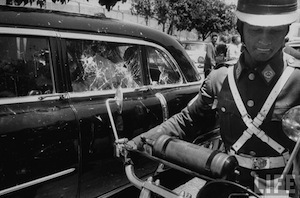
In that same Six Crises book, Nixon documents a 1958 trip that he and his wife took to Caracas, Venezuela, as part of a diplomatic tour of several South American countries. A provisional junta controlled Venezuela at the time, and the political situation was in turmoil. By the time the veep’s group arrived, a large, agitated crowd had formed outside the airport. As the car crawled through the streets, the crowd began throwing rocks at the motorcade, breaking the bulletproof glass and putting the passengers in extreme danger. It took twelve minutes for the Secret Service to get the motorcade free from the rioters.
While the protests greeting Clinton in Egypt were certainly noteworthy, they take on a broader context of American international policy when examined in light of Nixon’s earlier trip to Venezuela. I never would have been able to see the broader picture had I not put historical and classical works in my reading path.
[Image Credits: Paul Schutzer snapped this image of Nixon's long-suffering car as it moved through Caracas on May 13, 1958.]
November 29, 2012
Membership Had Its Privileges

A few weeks ago, I allowed my Barnes & Noble membership to lapse. I applied for the membership card with its $25 annual fee many years ago, back when the book superstore was king, and young couples looking for a cheap date would spend their evenings browsing books at stores like B&N, Borders, and Tower Books. Then came the Kindle.
Convenient and portable ebooks have been around since the 1990s, but it was the introduction of the Amazon Kindle in 2009 that transformed how people read and, more importantly for my membership status, how much readers paid for their books. Barnes & Noble shops typically charged the full cover price for most works on their shelves, with standard discounts focusing on New York Times bestsellers and a few other sale items. With a membership, you could get 40% off of the latest $26.95 release. But even at just over $16 for a bundle of 400 or so pages, it was hard to compete with $9.95 for the same item in digital, especially after you paid out $25 for the privilege of getting that lower hardcover price.
I held out for as long as I could, being as devoted as I am to the printed book. But as my ebook purchases increased in inverse proportion to my physical book acquisitions, I had to question the value of being a recipient of exclusive offers for high-priced hardcover books. Sure, I could get thirty cents off of my Starbucks drink purchases from the in-store café, not to mention free shipping from the online store. But shipping is already free on ebooks, and I don’t like coffee.
I won’t stop buying traditionally printed books, and I’ll continue to browse and purchase books from my local Barnes & Noble. But unless they lower the cost of their membership program dramatically, I’ll do that browsing and shopping as an anonymous guest of the establishment instead.
November 26, 2012
Guest Article: What I’m Reading Now
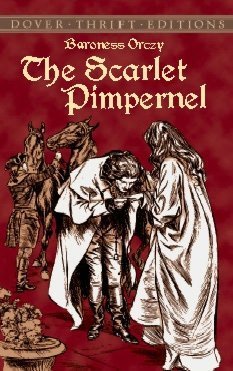
A well-read friend of mine told me I had to read The Scarlet Pimpernel (first published by Baroness Emmuska Orczy in 1905) because it held the adventure of the first “masked hero,” the prototype of superheroes with secret identities. I looked it up in my university library and found myself in the old books section, wandering through shelves of cloth-bound volumes with few external markings. After a somewhat lengthy search, my friend spotted it: a thin little book, a bit tattered along the spine and yellowed on every page. But the near-frail covers held something epic beyond everything I’d hoped.
Reading The Scarlet Pimpernel for the first time sparked a warm fuzzy love for its hero, Sir Percy Blakeney, deep within my heart. Discovering there are seventeen sequels gave me something akin to a panic attack of joy.
At present, I’ve gotten through eight of the Pimpernel books. I’ve sat up reading them in the middle of the night. I’ve read them out loud near a waterfall halfway up a small mountain. I’ve listened to them on audiobook while running…and stretching…and stretching some more. I’ve seen four of the film and TV adaptations and listened to the soundtrack from the Broadway musical so many times my roommate made me stop.
I try to make Scarlet Pimpernel converts out of as many people as possible. We could all do with a bit of good swashbuckling fun, but The Scarlet Pimpernel is not simply empty panache. It holds significance in literary history as the forerunner of an entire genre. Percy Blakeney is the Bruce Wayne of eighteenth century Paris—wealthy, skilled, and harboring an idiot-by-day, vigilante-by-night dual personality. Would there be a Batman without the Scarlet Pimpernel?
Furthermore, Pimpernel shows us something you don’t see much anymore: the interaction between honor and love. Percy and his dedicated wife Marguerite share enough sap to satisfy any romance novel addict, but they both understand the importance of his mission and the way that and his boundless care for others only strengthens the love they share. You won’t find any unhealthy codependency here, just a lot of passion and life-saving action.
The Scarlet Pimpernel is a timeless story. We might reshape it, replacing the White Cliffs of Dover with the skyscrapers of New York or moving the drama to Gotham City instead of Paris, but the original hero with many faces never loses his charm.
###
Elizabeth Kobayashi spends her weekdays editing educational videos, her evenings writing a novel and catching up on years and years of television, and her weekends training to be a ninja. She’s motivated by food and likes Star Wars.
November 19, 2012
Review: Think a Second Time
In the book 1491, a history of the western hemisphere before the arrival of Christopher Columbus, author Charles C. Mann introduces readers to a North and South America quite different from the ones typically presented through high school history courses. Based on new discoveries and updated scientific methods, Mann reveals how the earliest settlers on these two continents transformed landscapes, planted some forests while razing others, and managed wildlife in a way that would make a grown PETA member cry.
It’s all far removed from the teepee-centric, campfire-crowding image of American natives that I grew up on. Despite my long-held view of Indians as peace loving and environmentally conscious, they were people too, no different from any other hopeful yet self-obsessed mass of humanity, now or in the past. It was hard for me to accept Mann’s view of North American history, but when I thought a second time about it, the truths about human nature caused me to change my mind in a way that lined up with scientific research.
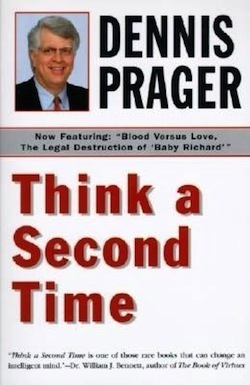
This act of reevaluating assumptions forms the core theme of Dennis Prager’s book Think a Second Time. “Most of us form opinions about life’s great issues at a young age and retain them forever,” says Prager in the book’s intro. “It isn’t comfortable to think through every issue; serious thought is as strenuous as serious exercise, and as we age, most of us become preoccupied with other matters.” Unfortunately, some of our initial positions turn out to be wrong, and avoiding a second thought means avoiding the truth. In this book, Prager encourages readers by example to actively challenge their own passive ideas.
Structurally, the book is a collection of forty-three essays that Prager wrote over the course of a decade or so. The subjects vary from the deeply philosophical (“Is This Life All There Is?”) to random thoughts that are only marginally interesting to the I’m-not-Prager crowd (“Headlines I Would Like to See”). Some of those latter entries didn’t seem to even require a first thought, much less a second. Fortunately, those are more than offset by the tremendous depth of the more well-considered items.
The subject matter ranges from philosophy and religion to politics and modern culture. While this variety provides for broad enjoyment, Prager does return often to a few core themes, especially his promotion of “Ethical Monotheism” as a solution for many of societies ills. Some of his positions are controversial, but it is abundantly clear that he takes seriously his call to think deeply, not just once, but twice, about each subject included in the text.
To purchase Think a Second Time from Amazon.com, click here.
November 15, 2012
Review: 1491
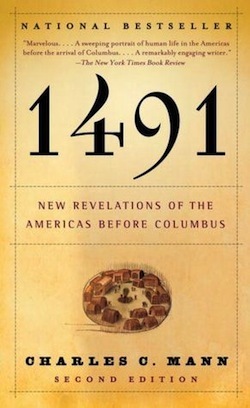
As my son passed through his elementary school years, his history education fell into a predictable topical routine: Revolutionary War, China, Native Americans, Revolutionary War, China, Native Americans, and just keep going. His teachers did cover other topics, but these were the big ones, and they kept coming up over and over again. Why this occurred is a mystery, especially with so much great history to learn from in other eras and locales.
This defective merry-go-round of history topics can be remedied, in part, by reading 1491, a book that describes life in the Americas in the year before the arrival of Christopher Columbus. Author Charles C. Mann also recognized the dearth of Meso- and South American content in the typical English speaker’s history studies, and decided to issue a correction by writing, in no particular order, on every conceivable pre-Columbian topic. Whether it’s archaeology, agriculture, religion, art, economics, ecology, or geology, if it happened in the 15,000 years before Europeans arrived in the Western Hemisphere, it’s probably somewhere in this thick book.
Mann’s work revolves around two key theses. The first is that early North, Middle, and South American residents were as numerous as their European counterparts, as technologically advanced despite a lack of ready access to the same metals and land resources found half a world away, and as deliberately impactful to their environment as any comparable society. Some of his specific statements are at odds with the traditional “noble savage” interpretation of Native American history. Mann recognizes this, and includes sufficient documentation in support of—and opposed to—his conclusions.
The second thesis, though somewhat downplayed in the text, is that all of these features and advances of Western Hemisphere civilization came to an abrupt end when Columbus and his contemporaries stopped by and sneezed on the immunity-lacking natives.
The book is well researched, expansive in its coverage, and engrossing in its presentation. If it has one deficiency, it’s that the author did not provide any linear structure to the overall text. While adjacent chapters do bear some relation to each other, the book as a whole lacks any type of point-A-to-point-B direction, whether chronologically, geographically, culturally, or topically.
The book originally came out in 2006; I read the second edition from 2011, which enhances the text with the latest relevant research. Mann has also released a companion volume, 1493, which documents more fully his second theses of widespread change after the initial visit by the Niña, the Pinta, and the Santa Maria. If you think you know about Indians—a term Mann uses due to its continued popularity within Native American tribes—you can learn even more, and learn it thoroughly, by picking up a copy of this revised work.
Purchase 1491 from Amazon.com
Purchase 1491 from Barnes & Noble
November 12, 2012
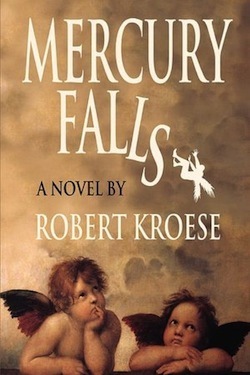
Book Review: Mercury Falls
NOTE: This post was originally published on November 15, 2009, on my personal blog. I am in the process of moving relevant articles to the Well-Read Man site. Please enjoy this slightly-old reading-related article.
True believers have been trying to pin down the apocalypse since angels first visited the Apostle John on Patmos, a crazy evening 1,900 years ago that perhaps included a few too many late-night chili-dogs. Some of these prognosticators of man’s demise are charismatic, by which I mean that they will force-feed you grape Kool-Aid in your sleep or train you in the use of semi-automatic weapons. Some are even crazy enough to craft multi-volume fiction bestsellers, only to have their main characters played by former child TV stars in low-budget theatrical releases.
But in every pack of end-times extremists is a voice of reason, someone who will make the muddy eschatological waters crystal clear. And standing next to him is Robert Kroese, the class clown, the person who, whether for right or for wrong, is able to bring true joy to something that—let’s face it—is a real downer. In Mercury Falls, Rob’s first novel on the apocalypse, the curtain that separates this world from eternal realities is torn open, revealing a glimpse of heaven normally only seen in a Department of Motor Vehicles field office.
The story centers on Mercury, a middle-class angel in the heavenly bureaucracy who, despite having friends in really high places, is feeling uncomfortable with this whole end-of-the-world thing. Through his dealings with angelic airport stewards, demonic call center agents, and mundane humans, Mercury manages to take the apocalypse to the very brink of Armageddon.
After I originally published this review, Amazon.com selected Rob Kroese as one of its “Emerging Authors” in its AmazonEncore group. Rob has since added two more volumes to the Mercury trilogy: Mercury Rises in October 2011, and Mercury Rests just a few weeks ago in October 2012. You can purchase each of the books in paper or electronic format from Amazon.com:
Mercury Falls
Mercury Rises
Mercury Rests
November 8, 2012
How I Lost the Bulwer-Lytton Fiction Contest
NOTE: This post was originally published on July 29, 2009, on my personal blog. I am in the process of moving relevant articles to the Well-Read Man site. Please enjoy this slightly-old reading-related article.
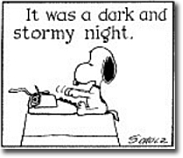
Since 1982, San Jose State University has hosted the Bulwer-Lytton Fiction Contest for both accomplished and inept writers. The event is named for famed novelist Edward George Bulwer-Lytton (1803-1873), the author who penned such memorable phrases as “the almighty dollar,” “the pen is mightier than the sword,” and the raison d’être of the contest, “It was a dark and stormy night.”
Now in its twenty-seventh year [that is, back in 2009], this international fiction contest draws thousands of submissions from dark and stormy typewriters across the globe, each with a single purpose: to craft the worst possible opening sentence to the worst possible imaginary novel.
I submitted eight opening lines to the contest. When the results of the 2009 contest were announced in early July, it was with much sadness that I found my name absent from winners’ page. But perhaps it is all for the best. The contest winners receive as their reward “a pittance” and the chance to be known forever as someone who can generate truly pathetic prose.
To experience the eye-damaging results for yourself, visit the contest web site:
For your consideration, here are the eight sentences I submitted to the contest.
Fred hated geometry, but here it was again, angling for his attention, bisecting his feelings, and arcing past the hopes of his youth, and he felt that his life was once again taking a big tangent as he started to sign and cosign the loan documents.
Charles hated geometry, with its circles and dodecahedrons, its angles and vertices, its endless lists of rules and formulae that threatened to dissuade him from his plans for world domination, and as he sat down in the classroom’s gum-encrusted chair-with-desk, he remembered that it was geography, not geometry, that he hated.
Smith—and it just goes to show you how you can’t always judge someone by their given name, since in Smith’s case his quest for adventure in the darkest jungles of Africa, his near-hero status on five continents, and his MacGyver-like ability to overcome whatever malice the enemy could throw at him carried him far beyond the generic qualities of his common surname—died.
Gwendolyn’s golden locks cascaded over the delicate lace and puffed sleeves of her powder-blue gown, the gown she knew would ignite the fires of passion in Roberto’s eyes, and as she fingered the insignia and badges of military honor that graced her womanly form and that identified her as the ranking officer on the ship, she quickly realized that her author had once again put her in the wrong book.
As he cruised across the California desert and into the hot Arizona landscape, Bruce thought about how he would have to pass through Alabama, Alaska, Arkansas, Colorado, Connecticut, Delaware, Florida, Georgia, Hawaii, Idaho, Illinois, Indiana, Iowa, Kansas, Kentucky, Louisiana, Maine, Maryland, Massachusetts, Michigan, Minnesota, Mississippi, Missouri, Montana, Nebraska, Nevada, New Hampshire, New Jersey, New Mexico, New York, North Carolina, North Dakota, Ohio, Oklahoma, Oregon, Pennsylvania, Rhode Island, South Carolina, South Dakota, Tennessee, Texas, Utah, Vermont, Virginia, Washington, West Virginia, Wisconsin, and Wyoming before he could claim to have driven through all fifty states, although not necessarily in that order.
Mark boarded the eastbound train from Track 9 in Los Angeles’ Union Station, his thoughts already 2,000 miles away in the Windy City, and as he read again the tear-stained letter from Beatrice, he realized that a westbound train departing from Chicago station traveling at 40 miles per hour would meet with his train in 20 hours, assuming his train traveled at a constant 60 miles per hour and departed at the same time, which seemed unlikely given the railroad strike.
From a glance at the blood-red coloring on his clothes, the heavy boots wiped clean of any incriminating dirt or fingerprints, and the bag he carried that contained heaven-knows-what, I knew in a moment it must be St. Nick.
As I looked with love on the face of my wife Delores, knowing how much this once-in-a-lifetime trip to Las Vegas to see the Rat Pack meant to her, I was unprepared for the guttural screams that emitted from her mouth as hundreds of rodents filled the stage.
November 5, 2012
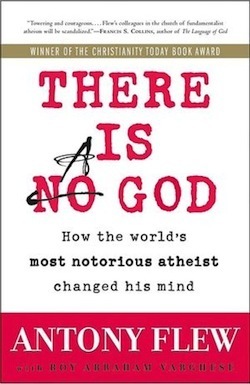
Book Review: There Is A God
NOTE: This post was originally published on May 29, 2008, on my personal blog. I am in the process of moving relevant articles to the Well-Read Man site. Please enjoy this slightly-old reading-related article.
Today’s atheists and Christians seem to rub each other the wrong way. Whether it’s a “new atheist” like Sam Harris or Richard Dawkins dumping on believers, or a James Dobson type identifying atheists as the source of all evils in the world, there’s sure to be someone dogmatic making a rude statement somewhere. But it wasn’t always like this. If you go back to England sixty years ago, you would have seen C. S. Lewis, the famous Narnia author and Christian apologist, rubbing elbows regularly with his colleague Antony Flew, an atheistic philosopher. Despite being as Dobson-Dawkins as you could get, meetings at Oxford University’s Socratic Club were cordial and deeply philosophical. In this atmosphere of “following the argument wherever it leads,” those with opposing views seemed to follow that path together as friends.
After following that Socratic path for decades, Anthony Flew has been rubbed the right way, at least from his own perspective. The man identified as “the world’s most notorious atheist” is now a believer in God. Not Lewis’s personal God necessarily, but still a powerful, omni-everything creator God. In his new book, There Is A God, Professor Antony Flew documents his journey from atheism to theism. Some of the book is auto-biographical, providing the typical glimpse into an author’s formative years. But most of the text is devoted to providing what Flew loves doing most: philosophizing. In this case, he waxes philosophical on God, detailing the logical steps that led him to make a slow but firm about face away from atheism.
While Flew has stopped short of endorsing Christianity, he includes as an appendix compelling content from Bishop N. T. Wright concerning the claims surrounding Jesus Christ. Although Bishop Wright’s discussion is thought-provoking, its short length makes it less influential than the more general proofs for God found in Flew’s main chapters.
If you consider yourself to be left-brained you will certainly enjoy the book, whether you believe in God or not. Flew is a trained ivy-league professor and an octogenarian, so he slips into incoherent philosophical ramblings and twenty-syllable words periodically. But most of the text is cogent, well organized, and pensive. It might not be a page-turner, but for some it will be a life-turner.
To purchase a copy of There Is a God from Amazon.com, click here.
November 1, 2012
Book Review: Freedomnomics
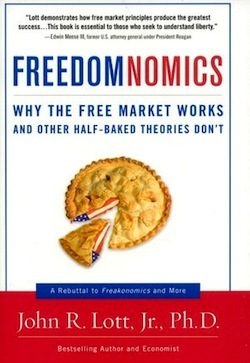
NOTE: This post was originally published on February 6, 2008, on my personal blog. I am in the process of moving relevant articles to the Well-Read Man site. Please enjoy this slightly-old reading-related article.
I just finished reading Freedomnomics, a book by John R. Lott, Jr., that is, in part, a response to the popular book Freakonomics by Levitt and Dubner. To be honest, I didn’t really read the book; I listened to it as an audio book. Years ago I listened to a 5-million-hour recording of Lord of the Rings during my commute. It was a great way to pass the drive, but I found that I didn’t retain much, a fact made clear when I eventually watched the movie version.
But I doubt there will be a movie version of Freedomnomics, so I thought I would write a review to keep the ideas fresh. Despite having been written by an economics professor, the book turned out to be pretty enjoyable. A big plus for the book is that the author lived for a while in Montana, so the book automatically gets an extra ten points.
The five chapters of Freedomnomics exist to communicate four main ideas.
Levitt and Dubner are buffoons.
The free market works way better than a government-controlled economy.
Abortion did not cause the crime rate to decrease in the 1990s.
America’s government largess was caused primarily by women’s suffrage in the early twentieth century.
The last idea is, naturally, the most controversial, and despite the plausible arguments provided by Lott, I’m sure a lot more went into the making of a bloated federal bureaucracy than women showing up at the polls. He did provide a lot of facts and figures to support the claim, but they are a little hard to follow when strolling through a park with headphones on.
Still, I did learn some new things about how the market economy works. I also learned that economists don’t just spend their days counting money or money systems. Lott was constantly saying, “A study by economists…” about studies that had nothing to do with finances. And most of the studies were intriguing.
I recommend Freedomnomics, especially in its audio format. While it didn’t convince me to take classes in economics, it did prompt me to think a little more deeply about the way that I interact with businesses, government, and audiobooks.
NOTE: After I posted the original review, Mr. Lott, the author of Freedomnomics, added a brief comment about my review to his web site. On February 7, 2008, he said of me, “Overall, I thought what he thought was the main point of the book was much too narrow.” I guess he forgot that I gave him ten bonus points for having lived in Montana!
To purchase a copy of Freedomnomics, click here.