
Steve Hely's Blog, page 10
October 31, 2024
Dry Head and Bloody Bones
An American horror story for this Halloween:
On November 20, 1936, in Jacksonville, FL a WPA field worker named Rachel Austin interviewed a former enslaved person named Florida Clayton (she was given that name as the first in her family born in that state).
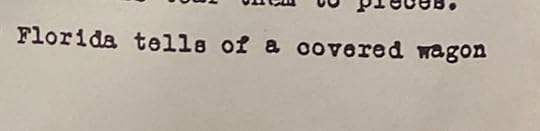
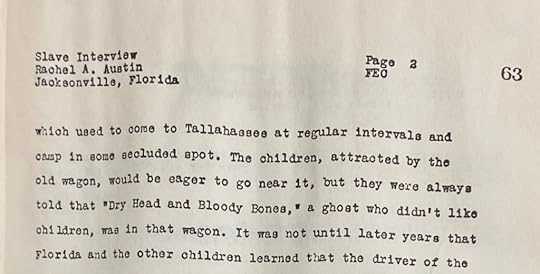
The rest of this story is too upsetting to reprint, it can be found in The American Slave: A Composite Autobiography, volume 17, Florida Narratives, reprinted 1972. Or here.
Dry Head and Bloody Bones. If you go poking into American history you’ll find some scary stuff!
Be safe out there this Halloween! 


October 30, 2024

October 29, 2024
Ballot

Donald Trump is pure toxicity, he tried half-seriously to end the peaceful transfer of power, he’s beyond unacceptable. We endorse native daughter of the Golden State Kamala Harris and hope that a special Providence continues to look after children, drunks, and the United States.
I put this together for my own use, perhaps it is useful to you, much cribbed from The LA Times. I’ll be voting in person in a few days so feel free to make a strong case I am open to persuasion on city, state and county measures.
Community College, Seat 1: Andra Hoffman
Community College, Seat 3: David Vela
Community College, Seat 5: Nichelle Henderson
Community College: Seat 7: Kelsey Iino
US Rep: Laura Friedman
City Measure DD: Yes
City Measure HH: Yes
City Measure II: Yes
City Measure ER: Yes
City Measure FF: Yes (on the fence here, it’s expensive, but I go with Mayor Bass)
City Measure LL: Yes
Uni Measure US: Yes
District Attorney: Nathan Hochman (both bad options here, voting to express disgust.)
It makes me a little mad that I have to vote for judges. I found this helpful.
Judge No 39: Steve Napolitano
Judge No. 48: Ericka Wiley (I don’t see anything wrong with Renee Rose)
Judge No. 97: Sharon Ransom
Judge No. 135: Steven Yee Mac (nothing wrong with Georgia Huerta)
Judge No. 137: Tracey Blount
County Measure G: Yes
County Measure A: Yes
My inclination is to vote against any state ballot propositions, it’s part of why our state is so wacky, but we exist within a context of everything that came before, so vote we must:
State Measure 2: Yes
State Measure 3: Yes
State Measure 4: Yes
State Measure 5: Yes
State Measure 6: Yes
State Measure 32: No
State Measure 33: No
State Measure 34: Yes (LA Times disagrees here)
State Measure 35: No
State Measure 36: No
(source on that photo)
Voter Guide
Donald Trump is beyond unacceptable, he’s like the Framers’ nightmare, this should be obvious, that we’re here is kind of a brain-melt. We endorse native daughter of the Golden State Kamala Harris and hope that a special Providence continues to look after children, drunks, and the United States.
I put this together for my own use, perhaps it is useful to you, much cribbed from The LA Times. I’ll be voting in person in a few days so feel free to make a strong case I am open to persuasion on city, state and county measures.
Community College, Seat 1: Andra Hoffman
Community College, Seat 3: David Vela
Community College, Seat 5: Nichelle Henderson
Community College: Seat 7: Kelsey Iino
US Rep: Laura Friedman
City Measure DD: Yes
City Measure HH: Yes
City Measure II: Yes
City Measure ER: Yes
City Measure FF: Yes (on the fence here, it’s expensive, but I go with Mayor Bass)
City Measure LL: Yes
Uni Measure US: Yes
District Attorney: Nathan Hochman (both bad options here, voting to express disgust.)
It makes me a little mad that I have to vote for judges. I found this helpful.
Judge No 39: Steve Napolitano
Judge No. 48: Ericka Wiley (I don’t see anything wrong with Renee Rose)
Judge No. 97: Sharon Ransom
Judge No. 135: Steven Yee Mac (nothing wrong with Georgia Huerta)
Judge No. 137: Tracey Blount
County Measure G: Yes
County Measure A: Yes
My inclination is to vote against any state ballot propositions, it’s part of why our state is so wacky, but we exist within a context of everything that came before, so vote we must:
State Measure 2: Yes
State Measure 3: Yes
State Measure 4: Yes
State Measure 5: Yes
State Measure 6: Yes
State Measure 32: No
State Measure 33: No
State Measure 34: Yes (LA Times disagrees here)
State Measure 35: No
State Measure 36: No
(source on that photo)
October 25, 2024
Years of Theory
Here’s an anecdote. One of Sartre’s closest friends in school was Raymond Aron, a conservative, pro-American political scientist. In those days, the French government had scholarships to various foreign countries. They started a whole French school in Brazil. Lévi-Strauss himself taught in that school and his early work is the result of that contact with Brazil. Roland Barthes taught on this scholarship in Egypt, because the French had a teaching fellowship in Cairo. There was one in Berlin, and when Aron had just gotten back he said, “There’s this thing called phenomenology. What does it mean?” He is sitting in a cafe with Sartre and Beauvoir, and Aron says, “What it means is: you can philosophize about that glass of beer.” Suddenly, the whole idea that phenomenology allowed one to think, write, and philosophize about elements of daily life transforms everything. As historically reconstructed by participants, the drink turns out to have been a crème de menthe, but that doesn’t matter too much. That’s the lesson that these people got from phenomenology, and that’s what seems to me to set off this immense period of liberation from philosophy, a liberation toward theory.
What is postmodern? Structuralist? When someone’s making a Marxist critique of like semiology, what’s happening?
Deluze. Sartre. Levi-Strauss. Lacan. Barthes. Foucault: who were these guys? what’s up here? What is the meaning of these names both as signifiers and signified and as referent?
Theory, structuralism, might not sound important. Academic stuff. Easy to dismiss. But guess what? Theory Thought has real, practical, worldly impact. These ideas are powerful.
The great sentence is not pronounced by Sartre but by Simone de Beauvoir: “On ne naît pas femme: on le devient.” 8 You aren’t born a woman: you become a woman. You are constructed and you construct yourself as a woman.
Interrogating, politicizing, gendering, queering, these are Theory ideas. Lived experience. My truth. The fathers of both Kamala Harris and Pete Buttigieg were Theory-adjacent professors, does that have any meaning? And DJT? The Theorists would say of course, a media figure whose words have no meaning and every meaning? who cannot be taken literally or seriously yet must only be taken literally and seriously? who seems to break reality by his very existence? create experiences across which no translation is possible? That was exactly what we’re talking about. This was the inevitable outcome. Don’t be mad at us for calling it.
Anxiety is: you can’t be free, and you can’t really be authentic, unless you feel anxiety. The French word is angoisse, so the translator is tempted to use the word “anguish,” which is the false friend, the immediate cognate of angoisse. Anguish, that makes it too metaphysical. In French, angoisse is an everyday word. At least angoissé( e). It means, I don’t have any cigarettes—can I go out? I’m waiting for a phone call. Then you’re angoissé( e). That doesn’t mean you’re in anguish, like one of the saints. It just means you have anxiety, and anxiety is an everyday experience.
Making thoughts actions, and words tools of power. Now, Theory would argue, twas ever thus we’re just pointing it out. Language has always been a tool of power. (But Theory would say that, wouldn’t it?)
Karl Marx was a Theorist. The master Theorist. His theory infected and took over huge portions of the world. Many millions died. There are places named after Karl Marx in Cuba Vietnam Russia China etc. All that from a theory he worked out over pints at a pub after doing his reading at The British Museum.
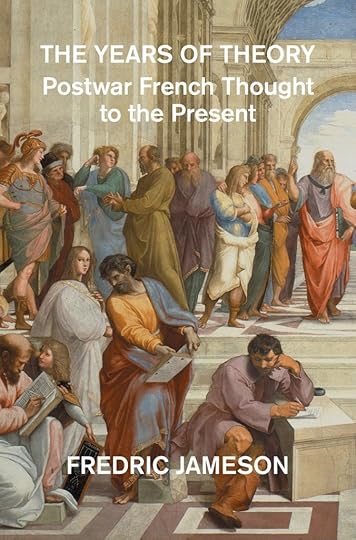
The Years of Theory: Lectures on Modern French Thought aka Postwar French Thought to the Present by Frederic Jameson may be one of the highest value books I ever bought. It is dense. But it’s less dense than Jameson’s other books, because it is transcripts of the guy talking.
If you’re very good at skipping/skimming huge parts of books, it’s fantastic. The drag may be sections where the ideas are so big, weird, vague or complicated that this reader found themself often saying “ok I’m moving on here because my mind is already blown and my circuits are fried.”
Now let’s look at this from a different point of view. We have said that each of these philosophical periods—Greece, the Germans, and now the French—are characterized by a problematic, but a changing problematic, a production of new problems. This is, in effect, Deleuze’s whole philosophy, the production of problems. But, if you put it that way, if you say philosophy’s task is the production of problems, what problems could there be if philosophy has come to an end? These problematics always end up producing a certain limit beyond which they are no longer productive.
The book functions pretty well as a history of France since WW2. Jameson quotes Sartre talking about the Occupation:
Never were we freer than under the German occupation. We had lost all our rights, beginning with the right to speak. We were insulted to our faces every day and had to remain silent. We were deported en masse as workers, Jews, or political prisoners. Everywhere—on the walls, on the movie screens, in the newspapers—we came up against the vile, insipid picture of ourselves our oppressors wanted to present to us. Because of all this, we were free. Because the Nazi venom seeped into our very thoughts, every accurate thought was a triumph. Because an all-powerful police force tried to gag us, every word became precious as a declaration of principle. Because we were wanted men and women, every one of our acts was a solemn commitment.
On the power and demise of the French Communist party:
The minute Mitterrand includes them in his government, they disappear. That’s the end of the Communist Party. After 1980, the Party is nothing. Of course, it is even less than nothing after the dissolution of the Soviet Union. There is still a Communist Party in France, of course, but its power is broken. Mitterrand’s political act here is a very cunning tactic of cooptation, which does them in as rivals to his socialist government, which itself ends up being not very socialist. But, in this period, the Party is a presence; it can irritate all these intellectuals. They revolt against it in various ways.
An idea: Theory begins for real after Camus. Camus says, man’s search for meaning? Forget it. No meaning. You’re pushing a rock up a hill. It’s absurd. Consider Sisyphus happy, live, move on.
Theory maybe says, sure ok but what even is Being? What is it that “we” (?) are experiencing? Jameson:
I’m alive in this moment when the sun is dying, or when climate change is destroying the planet, so many years from the big bang. So also with the body. I have a tendency to fat. Okay, that’s my situation. But I have to live that in some way. I have to choose that. So I keep dieting; I keep struggling against it. Or I let myself go completely. Or I become jolly like Falstaff. We are not free not to do something with this situation. Freedom is our choice of how we deal with it, but we have to deal with it, because it is us. But it’s not us in the way a thing is a thing. We are not our body. We are our body on the mode of not being it. We want people to understand that we are different, that we have a personality, that we’re not exactly what our body seems.
Here’s another one:
Everything we are we have to play at being, even if we don’t feel it that way. That’s a social function, so, of course, you have to rise to the occasion and play at being that social function.
Terry Eagleton, reviewing the book in the LRB, says:
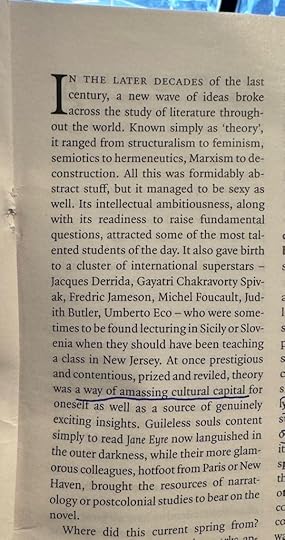

and:

Theory was a big Yale and Duke and Brown thing. There was some of it at Harvard, but it’s not so easy to buy Theory when you remember Cotton Mather and John Adams and John Kennedy and Franklin Roosevelt.
I once interviewed an East German novelist who was quite interesting at the time, and we asked him the then-obvious question: “How much of an influence did Faulkner have on you?” As you know, after the war, all over the world, it is the example of Faulkner that sets everything going, from the Latin American boom to the newer Chinese novel. Faulkner is a seminal world influence at a certain moment. But what does that mean, “Faulkner’s influence”? So he said, “No, I never learned anything from Faulkner—except that you could write page after page of your novel in italics.”
Any time Jameson says “here’s a story for you” or “start with a bit of biography” I perk up. What would the narratologists say about that? Why are stories so addictive? So much more popular than Theory? To answer those questions would be to Theorize stories. Should you spend your time Theorizing stories? Or telling stories?
Why is this detail included in Jameson’s Wikipedia page?:
Both his parents had non-wage income over $50 in 1939 (about USD$1130 in 2024)).[12][15]
October 23, 2024
Church & state
From 1940 to 2000 — through rock ’n’ roll, through the sexual revolution — an eerily stable 70-ish per cent of Americans belonged to a church. From the millennium, that share started collapsing to what is now less than half.
Janan Ganesh in FT. He’s trying to reason through why every US election ends up 50/50.
The stabilisation of the west after 1945 is really a story of dominant parties, such as the Conservatives in the UK, the Christian Democrats in Germany, the right in France and to some extent the Democrats in the US, who ran Congress for much of the second half of the 20th century. The ascendant party could afford to be magnanimous, while the other had every incentive to appeal beyond its base. Veering too far from the centre brought Goldwater-style annihilation. Competition between equals is beautiful in theory. In practice? Well, how edifying have you found the past couple of decades?
(is that true?)
October 19, 2024
Stinkards and Suns of Mississippi

This is a description of the Natchez people, found in:

Southern Union State Junior College’s loss is my gain.
Optimal outcome: to be a hot Stinkard?
The source for this information is the Histoire de la Louisiane set down by Antoine-Simon Le Page du Pratz, who had an adventurous life, including time spent among the Natchez around 1720-1728:

A dance:

Du Pratz (or Le Page’s) book was translated into English, and a copy was loaned by Benjamin Barton:

to Meriwether Lewis to take on his expedition with his bro Clark.
The Natchez people had a tough history. At the Michigan State Vincent Voice Library, there are some audio samples recorded in the 1930s of Watt Sam, one of the last native speakers of Natchez (or Natche) telling stories in the language. Regrettably these don’t seem to be available online. If anyone in the Lansing area can check it out for us, we’d be appreciative. It’s not urgent.
An intriguing aspect of the Natchez language was “cannibal speech”:
Traditionally the Natchez had certain stories that could only be told during the winter time, and many of these stories revolved around the theme of cannibalism. Protagonists in such stories would encounter cannibals, trick cannibals, marry the daughters of cannibals, kill cannibals, and be eaten by cannibals. In these stories Natchez storytellers would employ a special speech register when impersonating the cannibal characters. This register was distinct from ordinary Natchez by substituting several morphemes and words for others.
October 10, 2024
Drop the Trop
They imploded The Tropicana in Las Vegas, clearing room for a potential future stadium for the former Oakland As.

The strangeness of The Tropicana had my fascination.

Doomed for a long time, it was near vacant inside, adding to the odd effect.

On a visit to Las Vegas a couple years ago for Badlani’s birthday I took a walk through there. I was certain I’d taken a set of photos of the place, but today I couldn’t find them. The problems of archiving and curating remain, maybe even more challenging, in the age of infinite photos. What happened to them? Did I delete them as unsatisfactory? Are they lost in the cloud?
I can reconstruct some of the atmosphere from found pieces. Those above are from UK site Freedom Destinations. Here’s one from Oyster.com:

Those strange white couches. The Tropicana seemed like it had given up years ago, and yet the whites were kept close to spotless. A bleached aesthetic. The place was like a 1960s idea of the 1990s, or a 1990s idea of the 1960s. A coherent incoherence.
I find a fine set of photos of the lost Tropicana at, of course, reddit/r/LiminalSpaces:

The most times I ever heard the word “liminal” was in a debate between two professors that broke out during Sue Bell’s masters’ presentation in public art.
Strangely, for whatever reason the one photo of The Tropicana my phone seems to have preserved is this one:

October 9, 2024
The Gentleman of Elvas

“Hernando de Soto was the son of an esquire of Xeréz de Badajoz, and went to the Indias of the Ocean sea, belonging to Castile, at the time Pedrárias Dávila was the Governor. He had nothing more than blade and buckler: for his courage and good qualities Pedrárias appointed him to be captain of a troop of horse, and he went by his order with Hernando Pizarro to conquer Peru.” The words are those of a Portuguese knight known only as the Gentleman of Elvas, a witness to and survivor of the long and agonizing disaster that was de Soto’s Florida enterprise.
The Gentleman of Elvas is one of several members of that expedition whose accounts have come down to us, and his was the first to be published, in 1557.
An English translation by the geographer Richard Hakluyt appeared in 1609, and there were other English editions in 1611 and 1686, as well as Spanish and French versions in the seventeenth century; so there was never any question of the work’s inaccessibility. Another account, by Luis Hernández de Biedma, remained unpublished until 1857, while that of de Soto’s secretary, Rodrigo Ranjel, has never appeared except in severely abridged form. The most extensive work on the expedition, known as The Florida of the Inca, was written by a man born just a month before de Soto first set foot in Florida: Garcilaso de la Vega, known as “the Inca” because his mother, Chimpa Ocllo, had been a princess of Peru. (His father, Don Sebastián Garcilaso de la Vega Vargas, had seen action with the Pizarros during the Spanish conquest of Peru.) Garcilaso, an attractive and complex figure who spent most of his life in Spain but who was fiercely proud of his royal Inca ancestry, published his book on de Soto at Lisbon in 1605. His chief sources were the oral recollections of an anonymous Spaniard who had marched with de Soto, and the crude manuscripts of two other eyewitnesses, Juan Coles and Alonso de Carmona.
From these Garcilaso wove a lengthy and vivid history, long thought to be largely fantastic, but now recognized as a trustworthy if somewhat romantic narrative. Its chief concern to us is the detailed descriptions it provides of Indian mounds of the Southeast.
De Soto had served with distinction in Peru. He fought bravely against the Incas, and acted as a moderating influence against some of the worst excesses of his fellow conquerors. The darkest action of that conquest-the murder of Atahuallpa, the Inca Emperor-took place without de Soto’s knowledge and despite his advice to treat the Inca courteously. He shared in the fabulous booty of Peru and in 1537 came home to Spain as one of the wealthies men in the realm. Seeking some tract of the New World that he could govern, he applied to the Spanish king, Charles V, for the region now known as Ecuador and Colombia. But Charles offered him instead the governorship of the vaguely defined territory of “Florida,” which had lapsed upon the disappearance of Pánfilo de Narvez. By the terms of a charter drawn up on April 20, 1537, de Soto obligated himself to furnish at least 500 men and to equip and supply them for a minimum of eighteen months.
In return, he would be made Governor of Cuba, and upon the conquest of Florida would have the rank of Adelantado of Florida, with a domain covering any two hundred leagues of the coast he chose. There he hoped to carve out a principality for himself as magnificent as that obtained by Cortés in Mexico and Pizarro in Peru.
In the midst of de Soto’s preparations, Cabeza de Vaca turned up in Mexico, and at last revealed the fate of Narvez’ expedition. De Soto invited Cabeza de Vaca to join his own party, but he had had enough of North America for a while, and went toward Brazil instead. De Soto collected men, sailed to Cuba, and recruited more men there. His reputation had preceded him from Peru; he was thought to have the Midas touch, and volunteers hastened to join him. He gathered 622 men in all, including a Greek engineer, an English longbowman, two Genoese, and four “dark men” from Africa. In April of 1539 they departed for Florida.
The expedition entered Tampa Bay a month later, and on May 30 de Soto’s soldiers began going ashore. Their object was to find a new kingdom as rich at Atahuallpa’s, and it seems strange that they would have begun the quest in the same country where Narváez had found only hardship and death.
From Mound Builders of Ancient America: Archaeology of a Myth (1968) by Robert Silverberg, who writes more vividly on de Soto than many a de Soto specialist. You can read all of the Gentleman of Elvas account here, it ain’t exactly Tom Clancy. Silberberg picks up:
had de Soto been gifted with second sight, he would have sounded the order for withdrawal at that moment, put his men back on board the ships, and returned to Spain to fondle his gold for the rest of his days. Thus he would have avoided the torments of a relentless, profitless, terrible march over 350,000 square miles of unexplored territory, and would have spared himself the early grave he found by the banks of the Mississippi. This was no land for conquerors. But a stroke of bad luck, in the guise of seeming fortune, drew de Soto remorselessly onward to doom. His scouts, while fighting off the Indian ambush, had been about to strike one naked Indian dead when he began to cry in halting Spanish, “Do not kill me, cavalier! I am a Christian!” He was Juan Ortiz of Seville, a marooned member of the Narvez expedition, who, since 1528, had lived among the Indians, adopting their customs, their language, and their garb. He could barely speak Spanish now, and he found the close-fitting Spanish clothes so uncomfortable that he went about de Soto’s camp in a long, loose linen wrap. He seemed precisely what de Soto needed: an interpreter, a guide to the undiscovered country that lay ahead.
Unhappily, Ortiz knew nothing of the country more than fifty miles from his own village, and each village seemed to speak a different language.
Nevertheless, the Spaniards proceeded north along Narvez’ route, looking for golden cities. Ortiz spoke to the Indians where he could and arranged peaceful passage through their territory. Where he could not communicate with them, the Spaniards employed cruelty to win their way—a cruelty that quickly became habitual and mechanical. The Indians were terrified of the Spaniards’ horses, for they had never seen such beasts before. With the Spaniards there came also packs of huge dogs, wolfhounds of ferocious mien.
Wolfhounds of ferocious mien.

That illustration, by Herb Roe, I find on de Soto’s Wikipedia page. Here’s a Herb Roe evocation of the Kincaid Site in Illinois:

Here is Herb Roe’s website.
Tampa’s on my mind today as its about the get wrecked by Hurricane Milton.

Prayers up for the Cigar City.
Source for that map of de Soto expedition is the Florida Historical Society. Winds tracker from earth.nullschool.net.
Related matters: Cahokia.
October 8, 2024
Robert Coover

The postmodernist Robert Coover died at 92. The Universal Baseball Association is the only one of his I’ve read. This is how the NYT describes it in Coover’s obituary:
Mr. Coover’s many other books included “The Universal Baseball Association, J. Henry Waugh, Prop.” (1968), about an accountant who invents a fantasy-baseball game and is driven mad by it
That’s accurate enough I guess. I loved reading the book. It’s the only one of Coover’s I read, and although it’s sort of fantastical, the plot’s kinda straightforward and the setting is vivid and lived-in. I went looking for the back cover copy that was on my old edition:

He eats delicatessen.
In new editions that’s updated to “take-out,” a mistake in my opinion. I remember Fener laughing out loud when he read that off the back cover when he found it in my office. The term “b-girl” was also dated by the time I read it, it seemed to mean something like this.
Spoiler below as I recall the plot:
Waugh is playing out a season of a dice based fantasy baseball game of his own invention. A star player, a wonderful pitcher, freakishly good emerges, and Henry comes to love him. Then one night he rolls the dice and can’t believe the outcome. The player is killed by a pitch. Henry can’t believe it. It shatters his world. It seems to be sort of a metaphor for God and Jesus (J. Henry Waugh/Yahweh).
The idea of going home to your own private world was on my mind at the time I read the book, when I was a young single man in LA, I’d leave work at 6pm or whatever and walk home to my one bedroom apartment and read or work on writing scripts or novels. It spoke to me, and what spoke to me about it wasn’t the postmodernism (in fact the metaphorical stuff kinda made me roll my eyes) but the realism, the portrait of a life, the investment and absorption into a private entertainment, the sadness and loss of having the game shattered.
So, salute to Robert Coover.


