
Steve Hely's Blog, page 9
January 13, 2025
Did not love this vibe
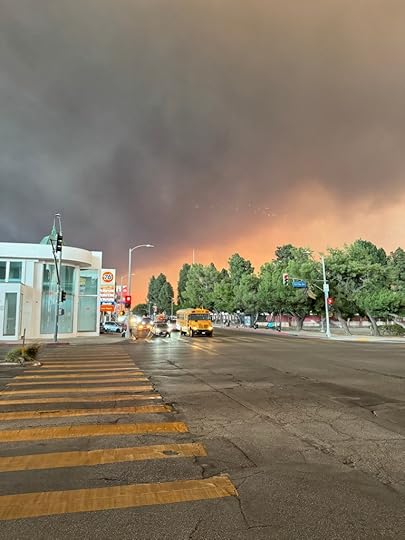
Nor
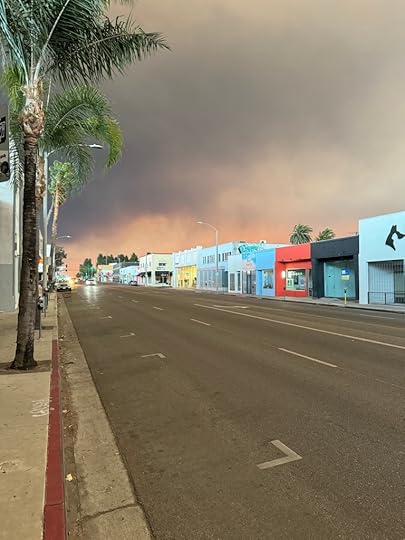
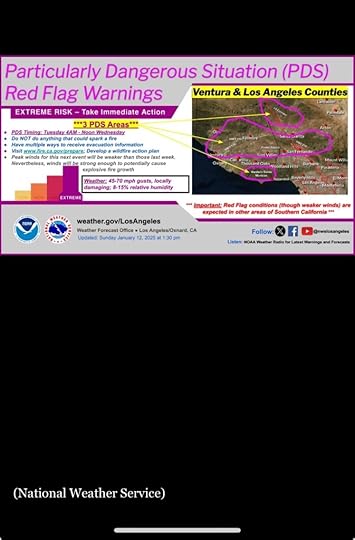
Today the air is perfect! There is the National Weather Service declaring the PDS however:


January 11, 2025
Edge case
Just after 5:30 pm Thursday, on a walk, with daughter strapped to me, relieved the worst is over. We round the corner to Fairfax and see Runyon Canyon on fire.
Like a volcano erupting. It looks like Vesuvius I thought, and then I realized I’d never seen Vesuvius except in illustrations. Maybe painted in the wall of an Italian restaurant? Or is that Mount Etna? Was I thinking of my dad describing Mount Etna?
I’d been on a smoking volcano in Guatemala (or was it Nicaragua? We roasted marshmallows) but had I ever seen one glowing?
The plaster casts of dead people in Pompeii, those I had seen, in National Geographic probably. I did not wish to become one. Time to pack.
The LA as I understood it as a youth in Massachusetts, the sense of LA, before I’d ever been there: convertibles palm trees swimming pools, soulless, “shallow.” Frequent natural disasters. The LA riots, the LA Lakers, both were viewed in Boston with fear, confusion, distress, upset, disquiet.
Imagine my surprise when I moved there for a job and loved it. It was like the famous story from Hockney:

The Los Angeles basin is so blessed, sunny almost every day, warm, rarely too hot. The beach, the mountains. When I arrived it was cheap, believe my rent was $900 for my own comfy place, walkable to LACMA and the tar pits and the movies, many bars and more restaurants and food stands than I could try. And the people! You could ask someone what they were up to and they’d say I’m developing.
California is on the edge, edge of the country, edge of the continent, edge of what’s acceptable, edge of politics, technology, edge of destruction. It’s all moving. You can’t expect it to stay.
The deadliest natural disasters in LA history are floods. The St Francis dam disaster, if you count that as “natural.” Six hundred some people washed to see. The 1938 flood. The river’s in that ugly concrete basin to keep floods contained. Last couple winters when the atmospheric rivers came there were many days when you could see why.
Back from my walk we watched the TV news. TV news: that’s a way to see LA and a way LA sees itself. The scale of LA first showed itself to me when I watched TV news and saw OJ’s Bronco.
Everybody’s been telling each other to stay safe. Stay safe! It’s like, ok! But what can you do? It’s like asking “how was your flight?”
Later that night I observed dense traffic on Fairfax as evacuees drove south. Though it was close to “bumper to bumper” there was no honking and it seemed like very little unpleasantness. Tension, sure, but people weren’t taking it out on each other. Reminded of Orwell’s quote: when it comes to the pinch, human beings are heroic. There are scattered tales of looters and opportunistic thieves on TV, but almost everyone is looking for ways to be helpful.

What’s the play? We must watch ourselves that capitalism doesn’t zombify our humanity like a cordyseps on an ant. (Also: “almost inevitable”? bad writing and thinking. Also inaccurate LA is HUGE it’s not gonna ALL burn down).
Nithya was ahead, warning about the wind event. See here for more on the local spooky winds. There’s a whole literature. It consists of a couple lines of Chandler reprinted by Didion (LA literary history in a nutshell).
Some remarks in the news etc make me wonder if everyone comprehends the scale of Los Angeles. It’s quite vast. The Palisades Fire and the Altadena fire are about twenty five miles apart, on a straight line, for example. Here’s Massachusetts overlaid on Los Angeles:

(Is that helpful?) I guess my point is there’s like one fire that’s in like East Boston and one that’s in like Framingham. The Sunset fire, my Vesuvius, now out, would be in I dunno Newton? Very different experiences that in the news may be lumped together as “LA.” Reminded me of when Bronson of Scarsdale, NY was in Tennessee and people asked him if 9/11 affected him. Yes, but it’s not like next door.

This is a faulty comparison as almost all of both the Palisades and Eaton fires are happening in national forest/recreation area or other wildlands, not built up areas.
Three good friends have lost their homes in Palisades. I was impressed with their reactions. Stoic humor. Cool. Several friends and friendlies have lost homes in Altadena. Displacement high, anxiety high, lots of friends in hotels or friends’ houses or had to leave for a scary night and come back. Dogs in hotels, people evacuating horses. Overall disturbance and on-edge-itude are at high. On Monday the biggest problem in LA was housing. Now there are 10,000 fewer places to live and +10,000 (?) more homeless people.
 Not confidence boosting.
 Smoke east, smoke west. Inhaling smoke from wildfires is bad for you, I’ve seen the studies. Burnt houses and cars and asbestos and drywall, melted Emmys. Imagine the horrible particulates. Walking around was giving me a small headache. But what’s the point in reading scary articles, I gotta breathe something.
You know when you light a candle? Most of the smoke and scent comes when you blow it out.

West down Melrose, towards Palisades fire.
Friends dear and distant have reached out, from Australia and Sweden and Japan and Texas, New York, Massachusetts. We’re fine for now. Resisting leaving town. That feels like abandoning ship. If we were gonna leave we would take a treasured painting of a dog, Johnathan. Taking Johnathan off the wall felt like taking down the American flag.
It keeps seeming over and people have written their eulogies, but we consider this an update from the ongoing catastrophe/circus/intermittent paradise that is LA!
Here’s one by Piranesi, from the Fantastic Ruins show :

January 6, 2025
Jimmy Carter reconsidered

Tyler Cowen didn’t like him. George Will didn’t like him. Ken Layne made me laugh:

Aren’t we always interested in the history that came right before we appear?

Delta Airlines has not one but two documentaries about Jimmy Carter available to view: Carterland and Jimmy Carter: Rock and Roll President. (Do these movies make money? Who is funding them?) I was able to watch most of both of them (without sound, with subtitles) on recent transcontinental travels. Rock and Roll President was particularly interesting, for example how Carter did not turn on Gregg Allman even after he was busted for and then testified in a case involving pharmaceutical cocaine, or the role John Wayne played in helping the Panama Canal treaty to pass
All this has me to prepared to somewhat revise my view of Carter’s presidency. His inability to “do something” about the Iranian hostage crisis was because he was unwilling to start a war or kill a lot of innocent Iranians. Though his temperament may not have suited him to win reelection, he improved life in the United States, made a lot of difficult choices on tough problems, avoided war (Panama could’ve been one). His presidency was devoted to peace, and helped heal the United States.
The contradictions are endless but was it not good for us, in that moment, to have a prayerful man of peace and leadership that reached for the spiritual?
Similar to the way Gerald Ford was later honored for his courage (?) in pardoning Richard Nixon, should Jimmy Carter be honored for absorbing political consequences of hard decisions and hard efforts that kept the peace?
At the Carter Library the fact that Carter never dropped a bomb or fired a missile during his presidency is highlighted. He’s the last president of whom that can be said. The American people don’t seem to want that.
Perhaps his story is a Christian story, of the martyr, the saint, who suffers as he absorbs our sins. A traveling preacher who came to town.
Perhaps all post-1945 US presidents should be judged on one standard only: whether there was a nuclear war on their watch. We must give Carter an A!
In his Miller Center interview, Jimmy Carter notes several times that the governor of Georgia is very powerful – more powerful, relative to the legislature, than the president is to Congress:
Fenno
Mr. President, I just wanted to follow up one question about the energy preparation. In your book you note that when you came to present the energy package, you were shocked, I think the word was shocked, by finding out how many committees and subcommittees this package would have to go through.
Carter
Yes.
Fenno
I guess my question is in the preparation that you went through, didn’t Congressmen tell you what you were going to find? Why were you shocked?
Carter
Well, I don’t know if I expressed it accurately in the book. I don’t think it was just one moment when all of a sudden somebody came in the Oval Office and said there was more than one committee in the Congress that has got to deal with energy. I had better sense than to labor under that misapprehension. But I think when Tip O’Neill and I sat down to go over the energy package route through the House, I think Jim Wright was there also, there were seventeen committee or subcommittee chairmen with whom we would have to deal. That was a surprise to me, maybe shock is too strong a word. But in that session or immediately after that, Tip agreed as you know to put together an ad hoc committee, an omnibus committee, and to let [Thomas Ludlow] Ashley do the work.
That, in effect, short-circuited all those fragmented committees. The understanding was, after the committee chairmen objected, that when the conglomerate committee did its work, then the bill would have to be resubmitted, I believe to five different, major committees. There were some tight restraints on what they could do in the way of amendment. So that process was completed as you know between April and August, an unbelievable legislative achievement.
In the Senate though, there were two major committees and there had to be five different bills and unfortunately, Scoop Jackson was on one side and Russell Long was on the other. They were personally incompatible with each other and they had a different perspective as well. Scoop had been in the forefront of those who were for environmental quality and that sort of thing, and Russell represented the oil interest. That was one of the things that caused us a problem. But we were never able to overcome the complexities in the Senate. In the House, we did short circuit the process. I never realized before I got to Washington, to add one more sentence, how fragmented the Congress was and how little discipline there was, and how little loyalty there would be to an incumbent Democratic President. All three of those things were a surprise to me.
Truman
Were those in sharp contrast to the experience in the Georgia legislature?
Carter
Well, there’s no Democratic-Republican alignment of the Georgia legislature. It’s all Democrats, and therefore, there is no party loyalty. You had to deal with individual members. The Governor is really much more powerful in Georgia than the President is in the United States. As Georgia Governor, I had line-item veto, for instance, in the appropriations bills. And, as you also know, in Georgia and in Washington, most of the major initiatives come from the executive branch. There’s very seldom a major piece of legislation that ever originates in the legislature. I think that there is a parallel relationship between the independent legislature confronting an independent Governor or the independent Congress confronting an independent President. At the state level, the Governor, at least in Georgia, is much more powerful than the President in Washington.
Neustadt
Did you have the same kind of subcommittee structure?
Carter
No. It’s not nearly so complicated.
Neustadt
That helps you too.
Carter
The seniority and the guarding of turf and so forth is not nearly so much of a pork barrel arrangement in the state legislature. Also, the Georgia legislature only serves forty days a year. They come and do their work in a hurry, and then they go home.
Truman
A simple legislature doesn’t have much staff either.
Carter
They are growing rapidly in staff, but nothing like the Congress. And you don’t have the insidious, legal bribery in the Georgia legislature that is so pervasive in the Congress. That’s a problem that’s becoming much more serious and I don’t believe that it’s going to be corrected until we have a major, national scandal in the Congress. I think it’s much worse than most people realize.
The reviews all focus on the presidency but Carter was an extremely effective governor of Georgia.
wish I could read this redacted story:

The ex-presidency of Carter is often cited as admirable, the work on guinea worm is undeniable. James Baker contacted Carter frequently. He helped convince Daniel Ortega to leave office. But then:
In the run-up to the 1991 Gulf War, Carter’s relationship with President Bush turned sour. Carter felt passionately that Saddam Hussein’s invasion of Kuwait wasn’t worth going to war over, even though Bush cited the Carter Doctrine in justifying it. The former president said so publicly, then took matters a fateful step further, writing each member of the UN Security Council and urging them to vote against the United States on the resolution.
That is wild! Brian Mulroney told the Bush White House about it and they were unsurprisingly pissed!
The Carter/ Bill Clinton relationship is funny, Alter says Carter’s freelance riffing with North Korea made Clinton apoplectic. Bill and Jimmy, could make an almost not boring play.
Maybe I will stake out the take that Carter was a great president and a mixed bag as an ex-president. Could be fun!
Consider this:
In 2016, the squabbling children of Martin Luther King Jr. needed Carter to mediate. They were at one another’s throats over their family’s possessions, including an old pool table. Brothers Marty and Dexter teamed up to sue sister Bernice, who had possession of their father’s Bible (used by Barack Obama to take the oath of office) and his Nobel Peace Prize. Carter’s approach was the same as at Camp David: both sides would agree at the end of the process to one document. This time, the document went through six or seven drafts, with the parties finally agreeing that Carter’s decisions on what would be sold or kept were to be final. One night Carter would be hard on Bernice; the next, on Dexter or Marty. Carter finally determined — and a judge soon ratified that Marty, as chairman of the estate, had control of the Bible and the Nobel, but they would be displayed at the King Center in Atlanta, not sold.
The one document method might be something practical we can all learn from Jimmy Carter. I haven’t felt like time spent studying this American original has been wasted. The more I learn about him the more complex he becomes.
(photo of Dolly and Jimmy borrowed from Parton News instagram)
December 31, 2024
His Very Best: Jimmy Carter, A Life by Jonathan Alter

If you’re wondering why he’s wearing watchface facing in, submariner’s habit, so you could tell time while working the periscope.
As a preteen he castrated hogs, ploughed a field with a mule (Emma), sheered sheep, pulled boil weevils from cotton by hand. By the time he was a teenager he was a slumlord, renting out tenant cabins to black farmers. After he graduated the Naval Academy he went to work for Admiral Rickover, who was inventing the nuclear navy. “Life is a constant fight against stupidity,” Rickover used to say. When the classified Chalk River Laboratories – National Research Experimental reactor nearly melted down, he led a group of twenty four who donned primitive “anti-C” suits and rehearsed removing as many flanges and turning as many valves as possible in an allotted ninety seconds before entering the contaminated space. Their urine and feces was examined for six months afterwards (they turned out to have no ill effects). When his father died, he agonized about what to do, but decided to quit the Navy and go back home without telling his wife, who was furious.
“No matter what happened – if it was a beautiful day or my older son made all As on his report card… underneath it was gnawing wawy because I owned twelve thousand dollars and didn’t know how I was going to pay it,” he would say about the next two years. Around this time he joined the Lions Club, as his father had:
Any time Jimmy wanted a toehold in some distant community, he would speak at one of Georgia’s 180 Lions Clubs, most in small towns.
He became obsessed with the poetry of Dylan Thomas, and it was his efforts that started a movement that led to a stone for Thomas being placed in Poets’ Corner at Westminster Abbey.
In Georgia at this time, there was a state requirement that busses carrying black kids to black schools had to have their fender painted black. Jimmy Carter was not a leader on integration. “This was a time, I’d say, of very radical elements on both sides,” he would say while he ran for president.
In 1962 the Supreme Court ruling in Baker v Carr enshrined a “one man, one vote” principle. Previously Georgia was organized on a “county unity system,” which meant Fulton County got only three times as many votes as a small rural county, even though it was 200x bigger.
Carter saw that by curbing the power of old courthouse politicians, Baker v. Carr would make a career in politics possible for a moderate like him.
The first time he ran for governor of Georgia he lost. “Show me a good loser and I’ll show you a loser,” was how he felt about that. He resolved to never lose another election. In 1970 he ran again, against Carl Sanders, who had helped bring major league baseball, football and basketball teams to Atlanta for the first time. Carter needed to win both racist George Wallace voters and liberal and black voters.
His solution was to avoid explicit mention of race in favor of class based populist appeals to Wallace voters, as well a overtures to moderates on education, the environment, and efficiency in government.
A research paper about southern populism by 25 year old Jody Powell affected his thinking. Powell would be a close aide all the way to the White House.
Carter shared his technique: “Notice how I didn’t ask for his vote. I said: ‘I want you to consider voting for me.'” At small and midsized campaign events, he would arrive early and park himself by the door so that he shook hands with every person entering the room – a simple and effective gesture neglected by many politicians.
During his inaugural speech as governor, he declared “the time for racial discrimination is over.” About a dozen conservative senators who had supported him walked out. But the speech got him on the cover of Time magazine.

During his term as governor he expected his team to work eighty and ninety hour weeks. He was aggressive, unrelenting, confrontational. Hunter S. Thompson would call Jimmy Carter one of the three meanest men he ever met – the other two being Muhammed Ali and Hells Angels president Sonny Barger.
“The conventional image of a sexy man is one who is hard on the outside and soft on the inside,” Sally Quinn wrote in the Washington Post. “Carter is just the opposite.”
When he ran for president his family was a tremendous advantage. During the Florida primary, Rosalynn and Edna Langford, her son’s mother-in-law, would drive into a town, look for the tallest antenna, and ask the station manager if someone wanted to interview them. Carter’s dynamic mother Lillian, who joined the Peace Corps at age sixty eight, would become a frequent guest on The Tonight Show.
Dick Cheney was working for Carter’s opponent Gerald Ford:
“Everybody knows about Plains Georgia and Lillian. Nobody really knows Ford,” Cheney wrote in a memo. “He never had a hometown. He never had a mother. He never had a childhood as far as the American people are concerned.”
Meanwhile:
Cutting the other way, Billy Carter crisscrossed Texas telling enthusiastic audiences that the Carers had always been conservatives, and that he would shoot Cesar Chavez, leader of the United Farm Workers of America union, if he came on his property.
It was a narrow win. If Ford hadn’t chucked Nelson Rockefeller, if Ford hadn’t said the thing in the debate about Eastern Europe, if.. if…
Exit polls showed that Carter won on pocketbook issues… The improbability of Carter’s victor struck speechwriter Rick Hertzberg who said later that electing him was as close “as the American people have every come to picking someone out of the phone book to be president.”
Hertzberg’s quote does not ring true to me. This was not a random guy. A nuclear engineer, a canny politician, a furious worker, a poet, rigid, deeply strange. As Alter says, comparing his post-presidency to the Clintons and Obamas, Carter was “built differently.” But then again Hertzberg knew him and I didn’t.
The parts of this book about the Carter presidency are mostly quite sad. Frustrations, bad luck, endless problems, prayers, defeats. An almost desperate search for spiritual answers, not even political ones. The great triumph, the Camp David Accords, took up enormous amounts of time and energy. Sadat had already visited Jerusalem, were Israel and Egypt on the road to peace anyway? I don’t know enough about it.
A good man, but not a good president, was and is a widely held opinion. Was he not a good president because he was a good man? Does dealing with the Ayatollah (or Congressional committee chairs) require a nasty operator on the level of Johnson or Nixon? Consider Reagan’s team, who got their hands on Carter’s debate prep book, and almost certainly cut a secret deal with the Iranians that involved selling weapons for the war with Iraq which killed more than a million people.
Was Carter caught between the pious Sunday school teacher and the tough engineer with not enough of the jolly, dealmaking, wink and a handshake stuff you need in our system?
Carter vocally committed the US to “human rights” as president. The resulting hypocrisies are not hard to spot. The Carter administration was effectively advising the Shah of Iran to shoot protestors, to take one example. Can human rights really be a presidential interest in this soiled world?
Can a true follower of Jesus Christ ever be an effective US president?
Maybe the biggest way the Carter presidency ripples through daily life in 2025: deregulation. Trucking, rail, airlines, natural gas. Southwest Airlines, Wal-Mart, Amazon, the shale boom, none of these would be the same without Carter-era deregulation. The consequences are many and mixed, and the result may not have matched the vision. The main stated goal was to fight inflation, massive problem and major part of Carter’s undoing.
Biographies have to make the case for the subject’s significance (otherwise why am I reading?). So they might be biased towards showing a master shaping events. Alter’s Carter doesn’t come off like that, he seems blown about by winds beyond his control.
The book is great by the way, I was very absorbed. Something I should learn more about would be Carter’s relationship to unions, organized labor. In Passage of Power Caro, reporting on LBJ’s first presidential weekend mentions several calls with labor leaders like Walter Reuther. By the next Democratic presidency I hear almost nothing about labor. Jimmy was a business owner, manager and employer. Georgia was not a union friendly state. Maybe there’s a bigger story to be told about the collapse of US labor power between 1963 and 1976. Maybe Carter is a part of that story.
While he was governor Carter launched the Georgia Film Commission, which has had a significant impact on my life, as my friends are always flying to Atlanta to shoot stuff. Los Angeles is being outcompeted as a filming location.

Carter was friends with James Dickey, and helped arrange Georgia as a shooting location for Deliverance and The Longest Yard (using Georgia inmates).
On a recent visit to Atlanta* I had a chance to visit the Carter Library. I thought I might buy my daughter a present at the gift shop. After all, at the Reagan Library the gift shop is enormous, mugs, toys, models, posters, DVDs. At the Carter Library, not so:

Very sparse, not even all of Jimmy’s books.
There’s a replica of the Oval Office as it existed in Carter’s time. A recording of Carter says that tough, strong-willed people he’d known in Georgia would come to see him in the Oval Office, and the aura of the room would strike them dumb, they’d forget what they came to see him about.

I was very struck by this photo of Amy:

So vulnerable.

*Trip unrelated to Georgia Film Commission, although related to the Ted Turner cable empire, a tentacle of which will air Common Side Effects, premiering Feb. 2, 11:30pm, first airing on Cartoon Network/Adult Swim, streaming on Max next day. Don’t miss!
December 8, 2024
Jimmy Carter and Bob Dylan
Jimmy Carter bonded with his son Chip over Dylan:
In 1969 Chip and his father hadn’t spoken for a year, mostly because of Chip’s drug use. They reconnected through Bob Dylan, whose album The Times They Are A-Changin’ they had enjoyed together. “We talked on the phone in Dylan verses because of the tensions,” Chip remembered. Struggling at Georgia Southwestern, Chip drove home to Plains at two in the morning, went to the foot of his parents’ bed, and informed them he was addicted to speed. Jimmy’s response was to tell his nineteen-year-old son to cut his hair, put away his bell-bottom jeans, and buy a suit. After promoting Powell, he assigned Chip to be his part-time driver in the campaign; that way, he could be with him often enough to make sure he wasn’t abusing drugs. Chip’s decades of substance abuse had only begun, but he said later that his parents’ intervention in 1969 saved his life.
Talking to Hunter S. Thompson:
The governor first impressed Thompson when he said that after theologian Reinhold Niebuhr, “the other source of my understanding about what’s right and wrong in this society is from a friend of mine, a poet named Bob Dylan.” He explained, “I grew up a landowner’s son. But I don’t think I ever realized the proper relationship between the landowner and those who worked on the farm until I heard Dylan’s record ‘I Ain’t Gonna Work on Maggie’s Farm No More?” Carter’s easy familiarity with Dylan’s work would harvest young votes once the 1976 primaries began.
Dylan enthusiasm culminated in a meeting while Carter was governor of Georgia:
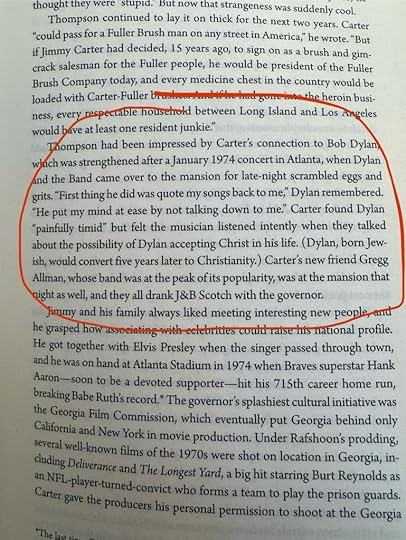
From Jonathan Alter, His Very Best: Jimmy Carter, A Life. I shared this story with Dylan enthusiast Vali, who told me posting it would be a service to the Dylan community. But the Dylan community being what it is, all connections to Carter are thoroughly covered in a post on flaggingdown.com, where I find this photo of Chip, Dylan, Jimmy and Jeff Carter.

Concerts became an important part of Carter’s early presidential campaign. It was not Dylan but another musician Carter considered indispensible:
October 1975 was when the campaign began to cohere. Rafshoon filmed Carter in a Florida pulpit and turned the sermon into two ads that began running in Iowa. Because each spot was five minutes long, Iowa voters saw them as news pieces, and they began breaking through. In the ads, Carter says, “T’ll never tell a lie. I’ll never make a false statement. I’ll never betray the confidence you have in me, and I won’t avoid a controversial issue. Watch television. Listen to the radio. If I do any of those things, don’t support me.” The ads were paid for in part by a series of inspired concerts arranged by the “godfather of rock” Phil Walden, president of Capricorn Records and a friend of Carter from Georgia. The first, by the Marshall Tucker Band, was held at Atlanta’s Fox Theatre. Soon Carter would raise money with the help of Charlie Daniels, Willie Nelson, Lynyrd Skynyrd, John Denver, Jerry Jeff Walker, Jimmy Buffett, and the Allman Brothers.* “If it hadn’t been for Gregg Allman, I never would have been president,” Carter said after Allman died in 2017.
The political risks of being associated with a druggy counterculture never concerned the candidate, even when he saw handmade “Coke Fiends for Carter” signs at his rallies. His admiration of the long-haired musicians was real and reciprocated, with many saying later that they felt a deep, almost mystical connection to him. And the fund-raising advantage offered by the rock concerts was significant. Each ticket stub was used as a receipt to show a contribution that could later be used for matching federal campaign funds.
Carter was also pals with Elvis. Elvis called Carter on the phone one day at the White House, apparently fucked up, shortly before he died.
Carter was smart at these concerts:
Carter understood just what to do onstage. “I’m gonna say four things,” he said at a rock concert in Providence, Rhode Island, in 1975. “First of all, I’m running for president. Secondly, I’m gonna be elected. Third, this is very im-portant, would you help me? Fourth, I want to introduce to you, my friends and your friends, the great Allman Brothers!” This was followed by thunderous applause. A politician who knew better than to make a speech at a rock concert was guaranteed to win the votes of thousands of grateful fans.
November 30, 2024
Norms
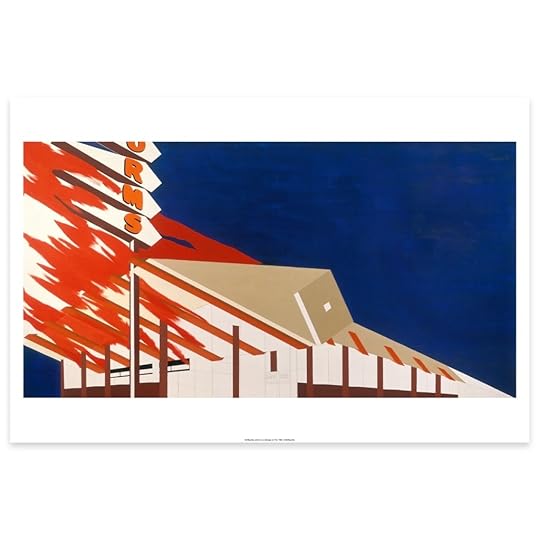
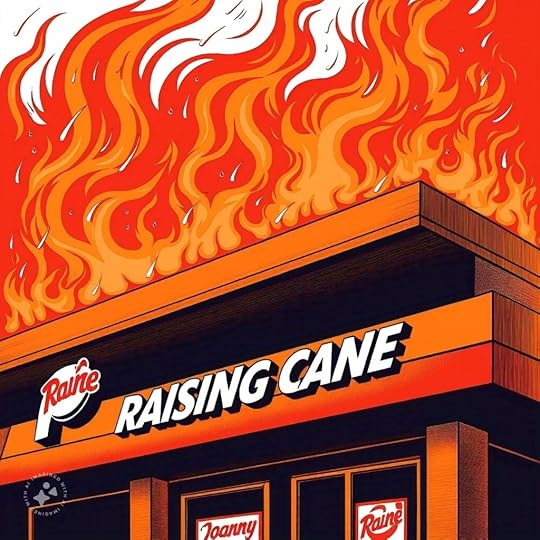
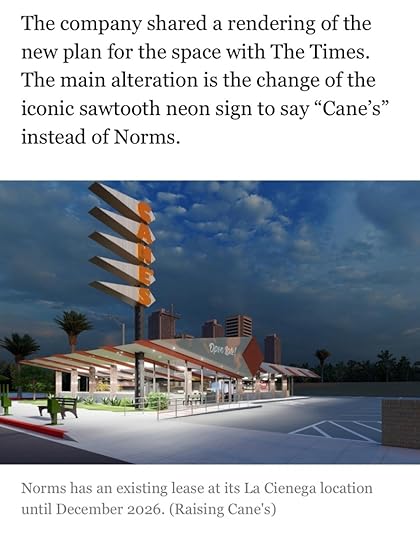
I read that Norms on La Cienega, a classic LA diner, may be replaced by a Raising Cane’s.
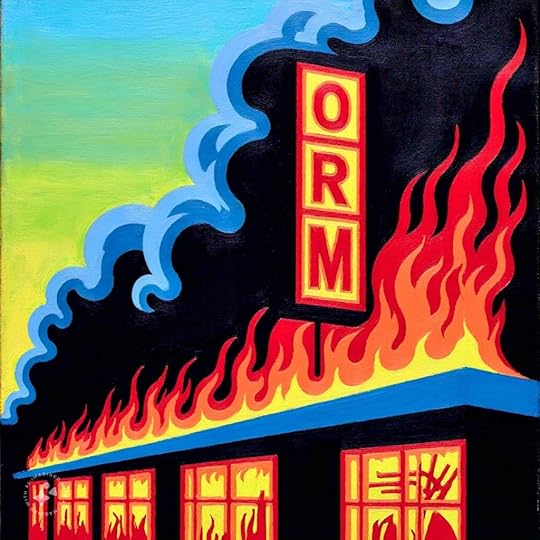
This Norm’s is the subject of a famous painting by Ed Ruscha:
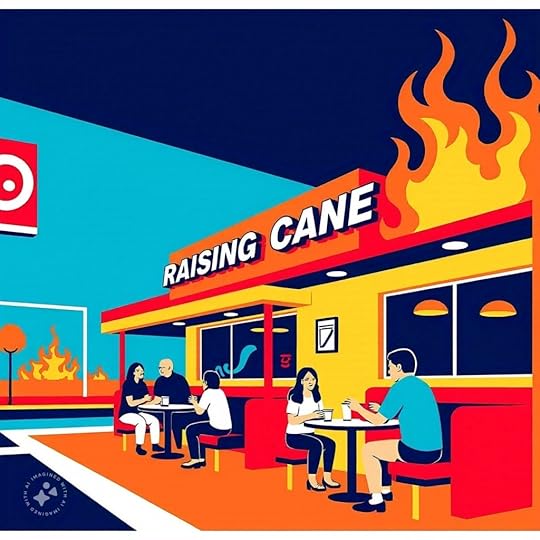
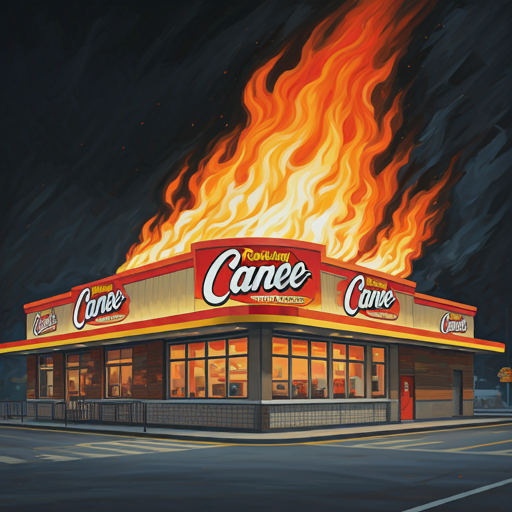
I asked different AIs to generate some versions of this painting if it were a Cane’s instead of a Norm’s.
From The LA Times:
November 18, 2024
[Senator Lyndon Baines Johnson with U.S. Representative Victor Anfuso and his daughter (right) at a party at the Shoreham Hotel, Washington, D.C.] / MST. digital file from original

source. I’ve been listening to Caro’s Years of Lyndon Johnson: Passage of Power. Very calming in a way.
Caro makes much of the cruel “Rufus Cornpone” nickname (although he never says who made that up). JFK had his own nickname for LBJ. He called him “Riverboat.”
A tactic LBJ used was getting people to feel sorry for him:
Having observed Johnson close up for more than twenty years, Rowe was aware, he says, that Johnson would always use “whatever he could” to “make people feel sorry for him” because “that helped him get what he wanted from them.” But that awareness didn’t help Rowe when, in 1956, the person from whom Johnson wanted something was him. Having observed also how Johnson treated people on his payroll, he had for years been rejecting Johnson’s offers to join his staff, and had been determined never to do so. But Johnson’s heart attack in 1955 gave him a new weapon—and in January, 1956, he deployed it, saying, in a low, earnest voice, “I wish you would come down to the Senate and help me.” And when Rowe refused, using his law practice as an excuse (“ I said, ‘I can’t afford it, I’ll lose clients’ ”), Johnson began telling other members of their circle how cruel it was of Jim to refuse to take a little of the load off a man at death’s door. “People I knew were coming up to me on the street—on the street—and saying, ‘Why aren’t you helping Lyndon? Don’t you know how sick he is? How can you let him down when he needs you?’ ”
Johnson had spoken to Rowe’s law partner, Rowe found. “To my amazement, Corcoran was saying, ‘You just can’t do this to Lyndon Johnson!’ I said, ‘What do you mean I can’t do it?’ He said, ‘Never mind the clients. We’ll hold down the law firm.’ ” Johnson had spoken to Rowe’s wife. “One night, Elizabeth turned on me: ‘Why are you doing this to poor Lyndon?’ ”
Then Lyndon Johnson came to Jim Rowe’s office again, pleading with him, crying real tears as he sat doubled over, his face in his hands. “He wept. ‘I’m going to die. You’re an old friend. I thought you were my friend and you don’t care that I’m going to die. It’s just selfish of you, typically selfish.’ ”
Finally Rowe said, “Oh, goddamn it, all right”—and then “as soon as Lyndon got what he wanted,” Rowe was forcibly reminded why he had been determined not to join his staff. The moment the words were out of Rowe’s mouth, Johnson straightened up, and his tone changed instantly from one of pleading to one of cold command. “Just remember,” he said. “I make the decisions. You don’t.”
Amazing. But:
Now this technique was used with Jack Kennedy. At meetings, the soft voice was coupled with a face that varied between sullen and sorrowful—the look of a very sad man. And if pressed particularly pointedly by the President for an explanation or a recommendation, he would say, “I’m not competent to advise you on this,” sometimes adding that he didn’t have enough information on the subject, statements that Kennedy viewed, in Sorensen’s phrase, as being Johnson’s “own subtle way of complaining to the President” about his treatment. With Kennedy, however, the tactic had no success at all. “I cannot stand Johnson’s damn long face,” the President told his buddy Smathers. “He just comes in, sits at the Cabinet meetings with his face all screwed up, never says anything. He looks so sad.… You’ve seen him, George, you know him, he doesn’t even open his mouth.” Smathers suggested foreign travel. “You ought to send him on a trip so that he can get all of the fanfare and all of the attention … build up his ego again, let him have a great time”—and also, although Smathers didn’t say it, get him out of Kennedy’s hair. “You know, that’s a damn good idea,” Kennedy replied—and at the beginning of April sent him to Senegal, which was celebrating the first anniversary of its independence.”

Here they are the return from that trip. The man in the middle is listed as “Unidentified.”
November 13, 2024
A galled crotch
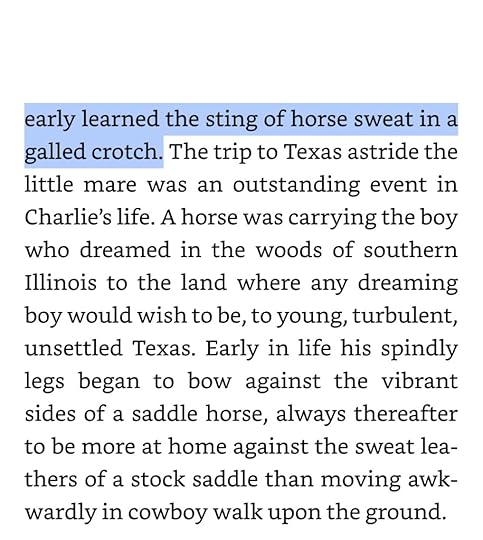
Reading at last J. Evetts Hayley’s biography of Charles Goodnight.
November 3, 2024
Querencia
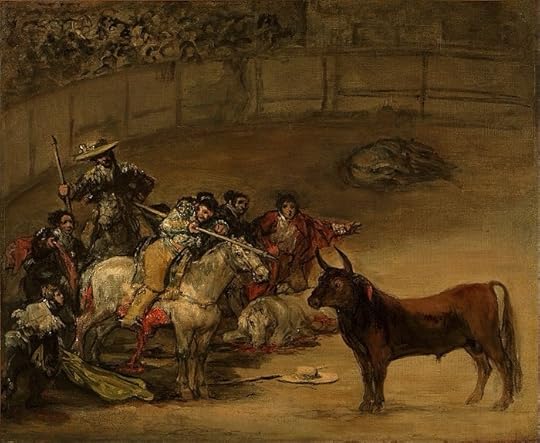 Goya
Goya
The first page of Proust: I woke up, and I never knew in the beginning where I was, so I went through all the bedrooms of my life. The way I think of it is like a Disney film. First, you think it was better when you were seven years old, and furniture looked a certain way. Then you think, no, it was best when you were twelve, so all the chairs dance around and restructure themselves into the bedroom you had when you were twelve. Finally, you reach your current age, and, here, they find their places in yet a different arrangement. Territorialization works in this way. In music, the refrain is making that home for yourself in music by territorializing sound through repetition.
What does it mean to have a home?
I don’t know whether any of you have seen bullfights; maybe you think they are horrible, or maybe you are interested in death, like Hemingway. In a bullfight, the bull emerges out into a world which is completely unfamiliar. The bull must then territorialize this world, so he finds a part of the bull ring—it’s arbitrary, because the space is all the same-which will be his terrain. In bullfighting language, this is called the querencia, from querer.
This space belongs to the bull. None of the actors in the bullfight, and especially not the matador, will ever try to get into that place. They have to identify it, because there the bull is supreme. They have to lure it out of its querencia in order to fight it in some other place. All of this is in Hemingway’s Death in the Afternoon, his book on the bullfight. As he says, he was interested in the bullfight because, as a writer, he wanted to know what death was, and the bullfight often results in the deaths of the bulls and also of the mata-dors. But you can see the usefulness of understanding territorialization as your querencia, the way you naturalize, normalize, make your own space, space being understood in the sense of the plane of immanence, that is to say, the connections of all these things. Some are interests or pas-sions; some are objects, tasks, or habits. All that you organize into something which I guess you call your identity, but it isn’t your identity; it is your territorialization, and you are caught in it. For the infant, that will be the parents. Why do you think Deleuze and Guattari attack Freud and the Oedipus complex? Who wants to be caught with their parents their whole life?
You want to get away from them. Kristeva and Irigaray’s description of the mother:
You have to get away. You have to deterritorialize.
And now another crucial Deleuzean ex-pression: the line of flight. You must try to invent lines of flight out of your territory, because your territory is going to be taken over by Google, by General Motors, by Coca-Cola. It will lie in the globalized world of the great corporations. It doesn’t belong to you anymore. You can try to make a little space that you call your own, and that will be what Deleuze calls your secret garden.
that from Jameson’s Years Of Theory.


