
Jimmy Carter and Bob Dylan
Jimmy Carter bonded with his son Chip over Dylan:
In 1969 Chip and his father hadn’t spoken for a year, mostly because of Chip’s drug use. They reconnected through Bob Dylan, whose album The Times They Are A-Changin’ they had enjoyed together. “We talked on the phone in Dylan verses because of the tensions,” Chip remembered. Struggling at Georgia Southwestern, Chip drove home to Plains at two in the morning, went to the foot of his parents’ bed, and informed them he was addicted to speed. Jimmy’s response was to tell his nineteen-year-old son to cut his hair, put away his bell-bottom jeans, and buy a suit. After promoting Powell, he assigned Chip to be his part-time driver in the campaign; that way, he could be with him often enough to make sure he wasn’t abusing drugs. Chip’s decades of substance abuse had only begun, but he said later that his parents’ intervention in 1969 saved his life.
Talking to Hunter S. Thompson:
The governor first impressed Thompson when he said that after theologian Reinhold Niebuhr, “the other source of my understanding about what’s right and wrong in this society is from a friend of mine, a poet named Bob Dylan.” He explained, “I grew up a landowner’s son. But I don’t think I ever realized the proper relationship between the landowner and those who worked on the farm until I heard Dylan’s record ‘I Ain’t Gonna Work on Maggie’s Farm No More?” Carter’s easy familiarity with Dylan’s work would harvest young votes once the 1976 primaries began.
Dylan enthusiasm culminated in a meeting while Carter was governor of Georgia:
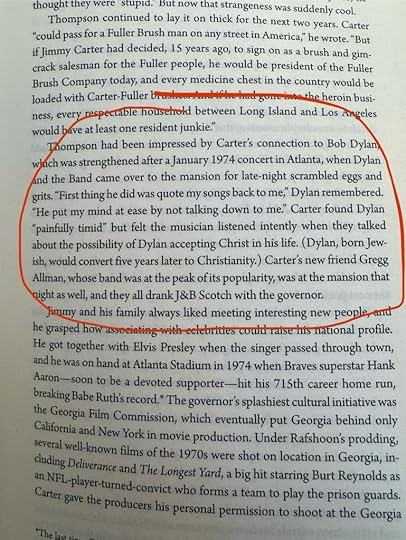
From Jonathan Alter, His Very Best: Jimmy Carter, A Life. I shared this story with Dylan enthusiast Vali, who told me posting it would be a service to the Dylan community. But the Dylan community being what it is, all connections to Carter are thoroughly covered in a post on flaggingdown.com, where I find this photo of Chip, Dylan, Jimmy and Jeff Carter.

Concerts became an important part of Carter’s early presidential campaign. It was not Dylan but another musician Carter considered indispensible:
October 1975 was when the campaign began to cohere. Rafshoon filmed Carter in a Florida pulpit and turned the sermon into two ads that began running in Iowa. Because each spot was five minutes long, Iowa voters saw them as news pieces, and they began breaking through. In the ads, Carter says, “T’ll never tell a lie. I’ll never make a false statement. I’ll never betray the confidence you have in me, and I won’t avoid a controversial issue. Watch television. Listen to the radio. If I do any of those things, don’t support me.” The ads were paid for in part by a series of inspired concerts arranged by the “godfather of rock” Phil Walden, president of Capricorn Records and a friend of Carter from Georgia. The first, by the Marshall Tucker Band, was held at Atlanta’s Fox Theatre. Soon Carter would raise money with the help of Charlie Daniels, Willie Nelson, Lynyrd Skynyrd, John Denver, Jerry Jeff Walker, Jimmy Buffett, and the Allman Brothers.* “If it hadn’t been for Gregg Allman, I never would have been president,” Carter said after Allman died in 2017.
The political risks of being associated with a druggy counterculture never concerned the candidate, even when he saw handmade “Coke Fiends for Carter” signs at his rallies. His admiration of the long-haired musicians was real and reciprocated, with many saying later that they felt a deep, almost mystical connection to him. And the fund-raising advantage offered by the rock concerts was significant. Each ticket stub was used as a receipt to show a contribution that could later be used for matching federal campaign funds.
Carter was also pals with Elvis. Elvis called Carter on the phone one day at the White House, apparently fucked up, shortly before he died.
Carter was smart at these concerts:
Carter understood just what to do onstage. “I’m gonna say four things,” he said at a rock concert in Providence, Rhode Island, in 1975. “First of all, I’m running for president. Secondly, I’m gonna be elected. Third, this is very im-portant, would you help me? Fourth, I want to introduce to you, my friends and your friends, the great Allman Brothers!” This was followed by thunderous applause. A politician who knew better than to make a speech at a rock concert was guaranteed to win the votes of thousands of grateful fans.


