
Steve Hely's Blog, page 6
April 9, 2025
Helytimes Prize for Sandwich Journalism
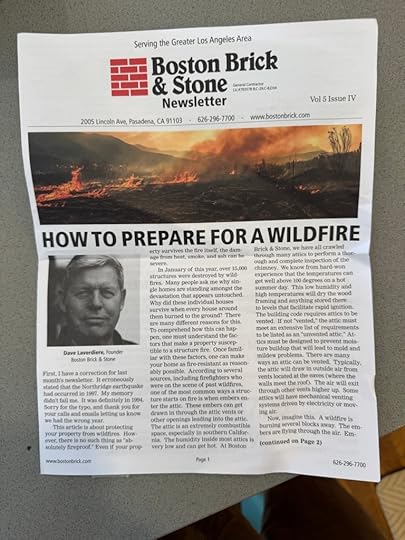
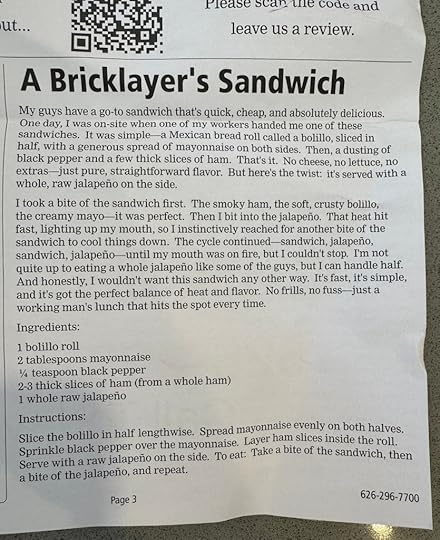
The Boston Brick & Stone newsletter is interesting marketing, and honestly one of my favorite periodicals. I’m awarding it a Helytimes Prize for Sandwich Journalism for this feature, “A Bricklayer’s Sandwich.”


April 6, 2025
“Buy when there’s blood in the streets”
On the famous quote sometimes attributed to Nathan Rothschild
His four brothers helped co-ordinate activities across the continent, and the family developed a network of agents, shippers and couriers to transport gold—and information—across Europe. This private intelligence service enabled Nathan to receive in London the news of Wellington’s victory at the Battle of Waterloo a full day ahead of the government’s official messengers.[2] He is famously quoted as saying “Buy when there’s blood in the streets”, though the original quote is believed to have appended “even if the blood is your own”. The quote refers to his contrarian investing strategy that he is well known for adhering to as to buy assets when the financial markets are crashing and panicking investors are selling. The quote has a tremendous impact today on value investing and modern businesspeople and investors alike when buying assets in down markets when investment opportunities arise.[3][4][5]
The first part of this concerning the Battle of Waterloo has already been adequately dealt with. The second part of this seems equally dubious, and I can’t find a good source for it. You can find this “buy when there is blood in the streets” quote in many modern business books, but they hardly count as a reliable source for a biography of Nathan Rothschild. The earliest sources I’ve found so far date from 1907/8 – for example Thomas Gibson’s Market Letters for 1907 contains the following supposed conversation:
“Buy Rentes,” advised Rothschild.
“But the streets of Paris are running with blood.”
“That is why you can buy Rentes so cheap.”
Grateful to Wikipedia editor Franz for getting to the bottom of that quote.
The first time I heard Cass McCombs was in a car in Queensland, Australia. The aux cord wasn’t working properly, so the vocals weren’t coming through, just the instrumentals. For awhile I was like “who is this genius that just plays rhythmic patterns?!” It was cool either way!
People drop this quote every time there’s a stock market downturn. But it sounds like Rothschild was speaking of a time when blood was literally running in the streets.
April 3, 2025

Great coat of arms

reading about Dauphiné, was wondering why this region of France was called that, and of course it’s because Guigues IV had a dolphin on his coat of arms.
Glimpses of Abraham Lincoln: awaiting election results with Charles Dana
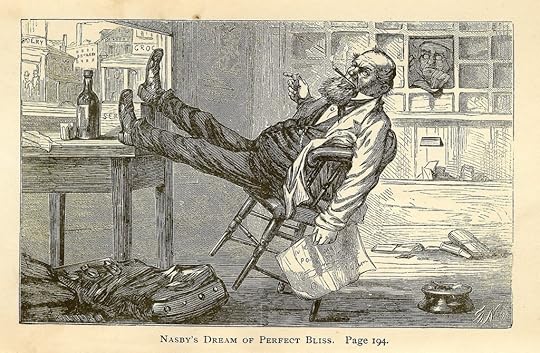
Charles Dana, former journalist and assistant secretary of war was with Abraham Lincoln as he awaited results of the election of 1864:
All the power and influence of the War Department, then something enormous from the vast expenditure and extensive relations of the war, was employed to secure the re-election of Mr. Lincoln. The political struggle was most intense, and the interest taken in it, both in the White House and in the War Department, was almost painful. After the arduous toil of the canvass, there was naturally a great suspense of feeling until the result of the voting should be ascertained. On November 8th, election day, I went over to the War Department about half past eight o’clock in the evening, and found the President and Mr. Stanton together in the Secretary’s office. General Eckert, who then had charge of the telegraph department of the War Office, was coming in constantly with telegrams containing election returns. Mr. Stanton would read them, and the President would look at them and comment upon them. Presently there came a lull in the returns, and Mr. Lincoln called me to a place by his side.
“Dana,” said he, “have you ever read any of the writings of Petroleum V. Nasby?”
“No, sir,” I said; “I have only looked at some of them, and they seemed to be quite funny.”
“Well,” said he, “let me read you a specimen”;
“let me read you a specimen”;
and, pulling out a thin yellow-covered pamphlet from his breast pocket, he began to read aloud. Mr. Stanton viewed these proceedings with great impatience, as I could see, but Mr. Lincoln paid no attention to that.
He would read a page or a story, pause to consider new election telegram, and then open the book again and go ahead with a new passage. Finally, Mr. Chase came in, and presently somebody else, and then the reading was interrupted.
Mr. Stanton went to the door and beckoned me into the next room. I shall never forget the fire of his indignation at what seemed to him to be mere nonsense.
The idea that when the safety of the republic was thus at issue, when the control of an empire was to be determined by a few figures brought in by the telegraph, the leader, the man most deeply concerned, not merely for himself but for his country, could turn aside to read such balderdash and to laugh at such frivolous jests was, to his mind, repugnant, even damnable. He could not understand, apparently, that it was by the relief which these jests afforded to the strain of mind under which Lincoln had so long been living, and to the natural gloom of a melancholy and desponding temperament-this was Mr. Lincoln’s prevailing characteristic-that the safety and sanity of his intelligence were maintained and preserved.
Petroleum Naseby was a character, a cowardly Copperhead who supported the Confederacy but didn’t want to do anything about it, invented by David Ross Locke.
In his day Locke was up there with Josh Billings and Mark Twain.
April 2, 2025
Val Kilmer
Can’t forget him doing his one man show as Mark Twain at the Hollywood Cemetery. Afterwards he stayed on stage while he was taking his elaborate makeup off and asked the audience if they uncomfortable with him saying the n word so much.
The Doors, Tombstone, Heat, Spartan… he wasn’t just pretending, he was in it.
Kilmer briefly considered running for Governor of New Mexico in 2010, but decided against it.
What if?
March 22, 2025
Hely’s Grave

Hely’s Grave is a heritage-listed grave at 559 Pacific Highway, Wyoming, Central Coast, New South Wales, Australia. It was designed by John Verge and built in 1836.
Hely’s Grave is the resting place of Frederick Augustus Hely, born in County Tyrone, Ireland, who ended up as superintendent of convicts in New South Wales in 1823. Was that a good job or a bad one? It must’ve been the equivalent of moving to the moon.
John Verge, the architect who designed this grave, also designed Hely’s house, Wyoming Cottage, which still stands and looks nice:

(Source)
Why did John Verge move to Australia? He was having success in London it seems. This may be a clue:
Verge’s marriage eventually failed and, in 1828, he migrated to Sydney, New South Wales, Australia, with his son George Philip, intending to take up a land grant.
His architectural legacy remains all over the Sydney area, I should like to go on a tour some day.
Frederick Hely’s son Hovendon Hely had an interesting career:
He took part in the 1846-47 expedition of Ludwig Leichhardt but was accused by Leichhardt of indolence, disloyalty and “disgusting” behaviour.
Interesting. More details are revealed by The Australian Dictionary of Biography:
Although described by Ludwig Leichhardt as a ‘likeable idler’, Hely joined his unsuccessful expedition of 1846-47. Leichhardt later accused him of disloyalty and dereliction of duty, after Hely and his relation, John Frederick Mann, had also disgusted Leichhardt ‘with their bawdy filthy conversations or with their constant harping on fine eating and drinking’.
Wonderful. “Likeable idler” is my dream job.
Ludwig Leichhardt, a German naturalist, had a curious nature.

His first expedition spanned a lot of northern Australia:

It was not without casualties. A vivid and blunt memorial to John Gilbert is on the wall of St. James Church in Sydney:

“Speared by the blacks.”
A second expedition doesn’t seem to have been much more successful:
Members of the party nearly mutinied after learning that Leichhardt had failed to bring along a medical kit. Faced with failure, Leichhardt seems to have suffered a nervous breakdown, and Aboriginal guide Harry Brown effectively took over as leader of the party, taking them successfully back to the Darling Downs.
Nevertheless Leichhardt kept at it. He tried another expedition and got malaria, survived, and went for one more. On this expedition, he went missing. Who was send to find him but Hovendon Hely:
In December 1851 Hely was appointed head of the official search for Leichhardt after the original appointee had drowned, but revealed little imaginative leadership. According to the Empire in 1864, the expedition ‘established nothing whatever’.
The fate of Leichhardt continues to inspire investigation, there are a number of intriguing clues like a brass plate and a letter recording an aboriginal oral history:

As for Hovendon Hely, he survived and had six sons and a daughter. Many Helys remain in Australia, among them both judges and murderers. So far as I know none of these Helys can be counted as relatives in any meaningful way, but any doorway into Australian history is welcome, and any explorations of that bizarre land are usually rewarded (as long as you don’t get speared).
If any of my Australian correspondents are available for a bit of field work, I’d like to learn why Hely’s Grave is reported by Google Maps as permanently closed. It’s a bit of a trek, an hour six minutes drive from the Park Hyatt Sydney. But on the plus side it’s across the street from a Hungry Jack’s

Carolina Whopper on me for anyone who reports.
March 15, 2025
Turned Inside Out: Recollections of a Private Soldier in the Army of the Potomac by Frank Wilkeson

This is one of the most vivid books I’ve ever read. It’s cinematic. It describes the journey of a teenage boy from upstate New York into hell. A harrowing journey in a series of scenes that get more and more intense. It’s like watching 1917 or something.
(Trigger warning: sad)
The war fever seized me in 1863. All the summer and fall I had fretted and burned to be off. That winter, and before I was sixteen years old, I ran away from my father’s high-lying Hudson River Valley farm. I went to Albany and enlisted in the Eleventh New York Battery, then at the front in Virginia, and was promptly sent out to a penitentiary building. There, to my utter astonishment, I found eight hundred or one thousand ruffians, closely guarded by heavy lines of sentinels, who paced to and fro, day and night, rifle in hand, to keep them from running away. When I entered the barracks these recruits gathered around me and asked, “How much bounty did you get?” “How many times have you jumped the bounty?” I answered that I had not bargained for any bounty, that I had never jumped a bounty, and that I had enlisted to go to the front and fight. I was instantly assailed with abuse. Irreclaimable blackguards, thieves, and ruffians gathered in a boisterous circle around me and called me foul names. I was robbed while in these barracks of all I possessed—a pipe, a piece of tobacco and a knife.
I remained in this nasty prison for a month. I became thoroughly acquainted with my com-rades. A recruit’s social standing in the barracks was determined by the acts of villany he had performed, supplemented by the number of times he had jumped the bounty. The social standing of a hard-faced, crafty pickpocket, who had jumped the bounty in say half a dozen cities, was assured.
The first people he sees killed are three men attempting to desert as they march down State Street in Albany. They take a steamboat to New York, where a guard kills another man trying to desert. Then they’re put on another steamboat:
Money was plentiful and whiskey entered through the steamer’s ports, and the guards drove a profitable business in selling canteens full of whiskey at $5 each. Promptly the hold was transformed into a floating hell. The air grew denser and denser with tobacco smoke.
Drunken men staggered to and fro. They yelled and sung and danced, and then they fought and fought again. Rings were formed, and within them men pounded each other fiercely. They rolled on the slimy floor and howled and swore and bit and gouged, and the delighted spectators cheered them to redouble their efforts. Out of these fights others sprang into life, and from these still others. The noise was horrible. The wharf became crowded with men eager to know what was going on in the vessel. A tug was sent for, and we were towed into the river, and there the anchors were dropped. Guards ran in on us and beat men with clubbed rifles, and were in turn attacked.
We drove them out of the hold. The hatch at the head of the stairs was closed and locked. The recruits were maddened with whiskey. Dozens of men ran a muck, striking every one they came to, and being struck and kicked and stamped on in return. The ventilation hatches were surrounded by stern-faced sentinels, who gazed into the gloom below and warned us not to try to get out by climbing through the hatches.
Men sprang high in the air and clutched the hatch railings, and had their hands smashed with musket butts. Sentinels paced to and fro along the vessel’s deck, and called loudly to all row-boats to keep off or they would be fired upon. They did not intend that any fresh supplies of whiskey should be brought to us. The prisoners in this floating hell were then told to “go it,” and they went it. We had been searched for arms before we entered the barracks at Albany. The more decent and quiet of us had no means of killing the drunken brutes who pressed on us. There was not a club or a knife or an iron bolt that we could lay our hands to. I fought, and got licked; fought again, and won; and for the third time faced my man, and got knocked stiff in two seconds. It was a scene to make a devil howl with delight.
They reach Alexandria, and then are put on a train to the Union winter camp at Brandy Station. Five more deserters are shot along the way. In the spring, Wilkeson is marched into Virginia. Along the road they pass the bones of unburied dead left from the battle of Chancellorsville.
As we sat silently smoking and listening to the story, an infantry soldier who had, unobserved by us, been prying into the shallow grave he sat on with his bayonet, suddenly rolled a skull on the ground before us, and said in a deep, low voice: “That is what you are all coming to, and some of you will start toward it tomorrow.” It was growing late, and this uncanny remark broke up the group, most of the men going to their regimental camps.
I found this book in a strange way. I was trying to sort out Grant’s Overland Campaign. Here’s an informative video of the strategic level. You can read Grant’s memoirs and many histories and accounts from officers. But what was it like? At Spotsylvania Courthouse, at the Mule Shoe Salient, there was a 22 hour hand to hand scrum, thousands of people killed in like a one square mile bit of earthworks. Did anyone survive to tell about that? In the course of investigating I did find these Australian guys recreating the battle with miniatures:


Their work is amazing.

I’d been playing around with testing various AIs on historical questions. I asked Claude:
What are some notable firsthand account of the fighting at mule shoe salient in the us civil war?
Claude came back with a numbered list of seven sources. Six were officers’ memoirs or official reports, and one was Frank Wilkeson’s “Recollections of a Private Soldier.”

Wilkeson wasn’t actually at the “mule shoe” I don’t think, but close enough. Strangely, on other occasions, Claude has completely made up sources that don’t exist. I go to check them and find they’re nothing, I tell Claude “hey can you give me more information about this, I can’t find it” and Claude says “I apologize, you’re right, I was mistaken.” Weird.
Anyway Frank Wilkeson is very real, his book was reprinted by University of Nebraska Press in 1997. The original title, Recollections of A Private Soldier in the Army of the Potomac, is so boring that it possibly caused this book to be ignored. The new title, Turned Inside Out, refers to how the pockets of the dead would all be turned out by battlefield ghouls and robbers of the dead.
At one point Wilkeson actually sees Grant:
One of my comrades spoke to me across the gun, saying: “Grant and Meade are over there,” nodding his head to indicate the direction in which I was to look. I turned my head and saw Grant and Meade sitting on the ground under a large tree. Both of them were watching the fight which was going on in the pasture field. Occasionally they turned their glasses to the distant wood, above which small clouds of white smoke marked the bursting shells and the extent of the battle. Across the woods that lay behind the pasture, and behind the bare ridge that formed the horizon, and well within the Confederate lines, a dense column of dust arose, its head slowly moving to our left. I saw Meade call Grant’s attention to this dust column, which was raised either by a column of Confederate infantry or by a wagon train. We ceased firing, and sat on the ground around the guns watching our general, and the preparations that were being made for another charge.
Grant had a cigar in his mouth. His face was immovable and expressionless.
His eyes lacked lustre.
He sat quietly and watched the scene as though he was an uninterested spectator. Meade was nervous, and his hand constantly sought his face, which it stroked. Staff officers rode furiously up and down the hill carrying orders and information. The infantry below us in the ravine formed for another charge. Then they started on the run for the Confederate earthworks, cheering loudly the while. We sprang to our guns and began firing rapidly over their heads at the edge of the woods. It was a fine display of accurate artillery practice, but, as the Confederates lay behind thick earth-works, and were veterans not to be shaken by shelling the outside of a dirt bank behind which they lay secure, the fire resulted in emptying our limber chests, and in the remarkable discovery that three-inch percussion shells could not be relied upon to perform the work of a steam shovel. Our infantry advanced swiftly, but not with the vim they had displayed a week previous; and when they got within close rifle range of the works, they were struck by a storm of rifle-balls and canister that smashed the front line to flinders. They broke for cover, leaving the ground thickly strewed with dead and dying men. The second line of battle did not attempt to make an assault, but returned to the ravine. Grant’s face never changed its expression. He sat impassive and smoked steadily, and watched the short-lived battle and decided defeat without displaying emotion. Meade betrayed great anxiety. The fight over, the generals arose and walked back to their horses, mounted and rode briskly away, followed by their staff. No troops cheered them. None evinced the slightest enthusiasm.
The enlisted men looked curiously at Grant, and after he had disappeared they talked of him, and of the dead and wounded men who lay in the pasture field; and all of them said just what they thought, as was the wont of American volunteers. This was the only time that I saw either Grant or Meade under fire during the campaign, and then they were with. in range of rifled cannon only.
For a “you are there” quality of the War of the Rebellion – what Wilkeson calls “the suppression of the slaveholders’ revolt” – I’m not sure this book can be matched by anything I’m aware of except Ambrose Bierce and Sam Watkins. The power here is the scenes.
Before noon we came to the village of Bowling Green, where many pretty girls stood at cottage windows or doors, and even as close to the despised Yankees as the garden gates, and looked scornfully at us as we marched through the pretty town to kill their fathers and broth-ers. There was one very attractive girl, black-eyed and curly-haired, and clad in a scanty calico gown, who stood by a well in a house yard. She looked so neat, so fresh, so ladylike and pretty, that I ran through the open gate and asked her if I might fill my canteen with water from the well. And she, the haughty Virginia maiden, refused to notice me. She calmly looked through me and over me, and never by the slightest sign acknowledged my presence; but I filled my canteen, and drank her health. I liked her spirit.
Everybody who knows their Civil War history knows that a key moment was when Grant, after a disastrous first fight with Lee’s Army of Northern Virginia at the Wilderness, advanced instead of retreating like every previous Army of the Potomac commander. But Wilkeson’s there, man.
” Here we go,” said a Yankee private; “here we go, marching for the Rapidan, and the protection afforded by that river. Now, when we get to the Chancellorsville House, if we turn to the left, we are whipped at least so say Grant and Meade. And if we turn toward the river, the bounty-jumpers will break and run, and there will be a panic.”
“Suppose we turn to the right, what then?”
I asked.
“That will mean fighting, and fighting on the line the Confederates have selected and in-trenched. But it will indicate the purpose of Grant to fight,” he replied.
Then he told me that the news in his Sixth Corps brigade was that Meade had strongly advised Grant to turn back and recross the Rapidan, and that this advice was inspired by the loss of Shaler’s and Seymour’s brigades on the evening of the previous day. This was the first time I heard this rumor, but I heard it fifty times before I slept that night. The enlisted men, one and all, believed it, and I then believed the rumor to be authentic, and I believe it to-day. None of the enlisted men had any confidence in Meade as a tenacious, aggressive fighter. They had seen him allow the Confederates to escape destruction after Get-tysburg, and many of them openly ridiculed him and his alleged military ability.
Grant’s military standing with the enlisted men this day hung on the direction we turned at the Chancellorsville House. If to the left, he was to be rated with Meade and Hooker and Burnside and Pope-the generals who preceded him. At the Chancellorsville House we turned to the right. Instantly all of us heard a sigh of relief. Our spirits rose. We marched free. The men began to sing. The enlisted men understood the flanking movement. That night we were happy.
The site of the turn:

as it was:

James McPherson notes in the introduction, Shelby Foote and Bruce Catton took some of the best stuff from Wilkeson.
The most intense chapter of Wilkeson’s book is called “How Men Die In Battle.” You can read it here if you like. Here’s an excerpt (warning: intense, sad):
Near Spottsylvania I saw, as my battery was moving into action, a group of wounded men lying in the shade cast by some large oak trees. All of these men’s faces were gray. They silently looked at us as we marched past them. One wounded man, a blond giant of about forty years, was smoking a short briar-wood pipe. He had a firm grip on the pipe-stem. I asked him what he was doing. “Having my last smoke, young fellow,” he replied. His dauntless blue eyes met mine, and he bravely tried to smile. I saw that he was dying fast. Another of these wounded men was trying to read a letter. He was too weak to hold it, or maybe his sight was clouded. He thrust it unread into the breast pocket of his blouse, and lay back with a moan. This group of wounded men numbered fifteen or twenty. At the time, I thought that all of them were fatally wounded, and that there was no use in the surgeons wasting time on them, when men who could be saved were clamoring for their skillful attention. None of these soldiers cried aloud, none called on wife, or mother, or father. They lay on the ground, pale-faced, and with set jaws, waiting for their end. They moaned and groaned as they suffered, but none of them flunked. When my battery returned from the front, five or six hours afterward, almost all of these men were dead. Long before the campaign was over I concluded that dying soldiers seldom called on those who were dearest to them, seldom conjured their Northern on Southern homes, until they became delirious. Then, when their minds wandered, and fluttered at the approach of freedom, they babbled of their homes. Some were boys again, and were fishing in Northern trout streams. Some were generals leading their men to victory. Some were with their wives and children. Some wandered over their family’s homestead; but all, with rare exceptions, were delirious..
so I guess that’s what it was like.
In looking for info on the original Chancellor House I find this:
In the early 20th century, Susan Chancellor would often stop by for unannounced visits to the re-built house, much to the chagrin of a young girl who lived there with her family. “It was odd that she never knocked,” 89-year-old Hallie Rowley Sale told the Fredericksburg Free-Lance Star in 2003. “It was like she still thought of it as her home. We would hear a door open. And the next thing we knew, Mrs. Chancellor would be leading a group of people through the house.”
March 13, 2025
Movie idea

Mikey Madison

is Dolley Madison.
Aaron Burr set her up with James Madison. A haunted photograph of her late in life.


.jpg)
