
Glimpses of Abraham Lincoln: awaiting election results with Charles Dana
Charles Dana, former journalist and assistant secretary of war was with Abraham Lincoln as he awaited results of the election of 1864:
All the power and influence of the War Department, then something enormous from the vast expenditure and extensive relations of the war, was employed to secure the re-election of Mr. Lincoln. The political struggle was most intense, and the interest taken in it, both in the White House and in the War Department, was almost painful. After the arduous toil of the canvass, there was naturally a great suspense of feeling until the result of the voting should be ascertained. On November 8th, election day, I went over to the War Department about half past eight o’clock in the evening, and found the President and Mr. Stanton together in the Secretary’s office. General Eckert, who then had charge of the telegraph department of the War Office, was coming in constantly with telegrams containing election returns. Mr. Stanton would read them, and the President would look at them and comment upon them. Presently there came a lull in the returns, and Mr. Lincoln called me to a place by his side.
“Dana,” said he, “have you ever read any of the writings of Petroleum V. Nasby?”
“No, sir,” I said; “I have only looked at some of them, and they seemed to be quite funny.”
“Well,” said he, “let me read you a specimen”;
“let me read you a specimen”;
and, pulling out a thin yellow-covered pamphlet from his breast pocket, he began to read aloud. Mr. Stanton viewed these proceedings with great impatience, as I could see, but Mr. Lincoln paid no attention to that.
He would read a page or a story, pause to consider new election telegram, and then open the book again and go ahead with a new passage. Finally, Mr. Chase came in, and presently somebody else, and then the reading was interrupted.
Mr. Stanton went to the door and beckoned me into the next room. I shall never forget the fire of his indignation at what seemed to him to be mere nonsense.
The idea that when the safety of the republic was thus at issue, when the control of an empire was to be determined by a few figures brought in by the telegraph, the leader, the man most deeply concerned, not merely for himself but for his country, could turn aside to read such balderdash and to laugh at such frivolous jests was, to his mind, repugnant, even damnable. He could not understand, apparently, that it was by the relief which these jests afforded to the strain of mind under which Lincoln had so long been living, and to the natural gloom of a melancholy and desponding temperament-this was Mr. Lincoln’s prevailing characteristic-that the safety and sanity of his intelligence were maintained and preserved.
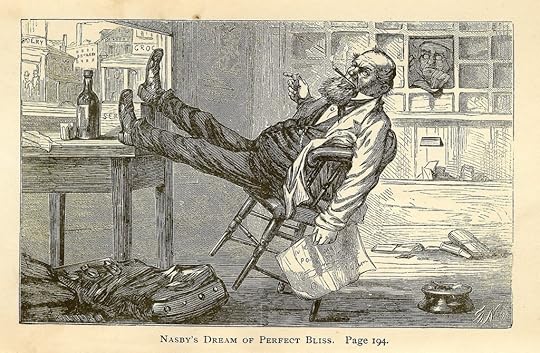
Petroleum Naseby was a character, a cowardly Copperhead who supported the Confederacy but didn’t want to do anything about it, invented by David Ross Locke.
In his day Locke was up there with Josh Billings and Mark Twain.


