Steve Hely's Blog, page 4
June 28, 2025
Cezanne’s view of Lake Annecy
following up on Cezanne posting.
1896:

2025:

Think this is pretty much the spot. Does seem like he truncated/compressed the view. That’s the art!
The site is now the wonderful-seeming hotel Auberge du Père Bise (it’ll run you $500 something a night). The two Michelin starred – “worth a detour” – Jean Sulpice restaurant attached.
Across the lake there is the Chateau de Duignt.

Shit even as I was taking this I was like I can’t even take the photo even close to as good as Cezanne painted it!
[Cezanne] struggled with what he considered an overly charming setting, which contrasted with the rugged landscape of his native Provence.
says The Courtland.
Cézanne described this mountain lake near the French border with Switzerland as a scene one might expect to find in ‘the albums of young lady travellers’
says Art UK.
For me, I like the place! Was ok with the overly charming setting.
Cheers to the Annecy Animation Festival, full of gratitude and happy to be there.


June 21, 2025
Islands In The Stream, (Hemingway, 1970) x Islands In The Stream, (B. Gibb, M. Gibb, R. Gibb, 1983)

A man named Thomas Hudson, who was a good painter, lived there in that house and worked there and on the island the greater part of the year. After one has lived in those latitudes long enough the changes of the seasons become as important there as anywhere else and Thomas Hudson, who loved the island, did not want to miss any spring, nor summer, nor any fall or winter.
Sometimes the summers were too hot when the wind dropped in August or when the trade winds sometimes failed in June and July. Hurricanes, too, might come in September and October and even in early November and there could be freak tropical storms any time from June on. But the true hurricane months have fine weather when there are no storms.
Thomas Hudson had studied tropical storms for many years and he could tell from the sky when there was a tropical disturbance long before his barometer showed its presence. He knew how to plot storms and the precautions that should be taken against them. He knew too what it was to live through a hurricane with the other people of the island and the bond that the hurricane made between all people who had been through it. He also knew that hurricanes could be so bad that nothing could live through them. He always thought, though, that if there was ever one that bad he would like to be there for it and go with the house if she went.
The house felt almost as much like a ship as a house. Placed there to ride out storms, it was built into the island as though it were a part of it; but you saw the sea from all the windows and there was good cross ventilation so that you slept cool on the hottest nights. The house was painted white to be cool in the summer and it could be seen from a long way out in the Gulf Stream. It was the highest thing on the island except for the long planting of tall casuarina trees that were the first thing you saw as you raised the island out of the sea. Soon after you saw the dark blur of casuarina trees above the line of the sea, you would see the white bulk of the house. Then, as you came closer, you raised the whole length of the island with the coconut palms, the clapboarded houses, the white line of the beach, and the of the South Island stretching beyond it. Thomas Hudson never saw the house, there on that island, but that the sight of her made him happy. He always thought of the house as her exactly as he would have thought of a ship. In the winter, when the northers blew and it was really cold, the house was warm and comfortable because it had the only fireplace on the island.
It was a big open fireplace and Thomas Hudson burned driftwood in it.
He had a big pile of driftwood stacked against the south wall of the house. It was whitened by the sun and sand-scoured by the wind and he would become fond of different pieces so that he would hate to burn them. But there was always more driftwood along the beach after the big storms and he found it was fun to burn even the pieces he was fond of. He knew the sea would sculpt more, and on a cold night he would sit in the big chair in front of the fire, reading by the lamp that stood on the heavy plank table and look up while he was reading to hear the northwester blowing outside and the crashing of the surf and watch the great, bleached pieces of driftwood burning.
Sometimes he would put the lamp out and lie on the rug on the floor and watch the edges of color that the sea salt and the sand in the wood made in the flame as they burned. On the floor his eyes were even with the line of the burning wood and he could see the line of the flame when it left the wood and it made him both sad and happy. All wood that burned affected him in this way. But burning driftwood did something to him that he could not define. He thought that it was probably wrong to burn it when he was so fond of it; but he felt no guilt about it.
(Bold mine.)
This book knocked me sideways.
After enjoying Across The River and Into the Trees, I wondered if I should try this. It doesn’t get discussed much. It was published posthumously, ten years after Hemingway’s death. Apparently Mary Hemingway found it and brought it to Scribner’s. For a craftsman like Hemingway you’ve got to be suspicious of anything he himself didn’t consider finished.

This post by a Redditor was all I needed to push me into ordering a good UK edition with an appealing cover.
Hemingway began the novel–as Carlos Baker relates in his excellent biography–at a low point of fortune. It was 1950 and “Across the River and Into the Trees” had just taken a critical beating. In December he began something new; it was to be a series of three books called “The Sea When Young,” “The Sea When Absent” and “The Sea in Being.” The work gathered momentum during the first half of 1951–Hemingway was writing enthusiastically and well–but an odd thing happened to his general scheme. It was conceived as a linked series of three independent novellas concerned with three different eras in the life of Thomas Hudson, an American marine painter. The first takes place on the island of Bimini, the second in wartime Cuba and the third follows Hudson through to his death at sea in an isolated action of World War II. But another concept intruded, and Hemingway added a fourth part, only to find that it had taken on an independent life of its own quite unrelated to Hudson. In 1952, he published this story as “The Old Man and the Sea,” and it was apparently this diversion, plus various travels in the following years, that kept him from a return to the final polishing he had intended for the novel now titled “Islands in the Stream.”
That’s from the Oct. 1970 New York Times review by Robie McCauley. I won’t link to it and I’d encourage you not to read it because it gives away several turns of plot that hit this reader in surprising and unexpected ways.
The book can be pretty shaggy. Many pages of conversations in bars, about forty pages about trying to catch a swordfish, etc. There’s a fight scene where Roger, Thomas Hudson’s friend, who is a writer, beats the hell out of a yacht guy. The yacht guy had a pretty reasonable complaint is this reader’s opinion, and the beating is unpleasant. Even Roger comes to view it as an ugly event. But when the boys arrive, Thomas Hudson’s mood improves, and the book becomes warm and loving in a way unusual in a Hemingway book.
It’s about a father. Most Hemingway main character/stand ins are pointedly unattached. In the short stories we get a father, but through the eyes of Nick, the son, a boy.
In this book we’re seeing the world through a father who is getting a visit from his kids. Two from one mother, one from another. Thomas has all kinds of feelings and regrets about the situation.
Most of the book (drinking, fishing) really tells a story of avoiding, masking, remembering, processing.
The drinking is preposterous. Regularly Thomas is like “a drink? It’s breakfast. I’ll just have a bottle of beer.” (Heineken)
The kids, who are like twelve-sixteen years old, say stuff like
My friend Mr. Joyce has words and expressions I’d never even heard of. I’ll bet nobody could outswear him in any language.
maybe just as setup for Dad to tell stories about Mr. (James) Joyce. But… don’t you want to hear those?
Well, so what? Maybe Hemingway’s kids talked like that.
Hemingway’s whole fictional project is a kind of exaggerated autobiography. He really got somewhere with Islands In The Stream, a new level of vulnerability couched in braggadocio. His fourth wife published it, even though the main character’s worst regret might be losing his first wife.
-—
The song Islands in the Stream was written by The Bee-Gees. They had it in mind for Diana Ross. Barry Gibb says that in this interview. Many places, including Wikipedia, say the title of the song came from the Hemingway novel published thirteen years previous. I can find no firsthand source where Barry Gibb states that or makes that connection. But the phrase “islands in the stream” doesn’t seem to have existed before Hemingway’s book was published. Some sources link it to the John Donne poem from which EH got another title: “for whom the bell tolls.”
The song ended up with Dolly Parton and Kenny Rodgers, and was released on Kenny Rogers’ album Eyes That See In The Dark.

Baby when I met you it was peace on Earth
I set out to get you with a fine tooth comb
Wow.
Be careful, the song sticks. It knocked “Total Eclipse of the Heart” out of number one on the Billboard Hot 100. 1983 was quite a year on the Billboard Hot 100: “Islands In The Stream” was knocked off by Lionel Ritchie, “All Night Long.”
Which Islands in the Stream the greater work of art with this title?
Talk about apples and oranges. Or, better, limes and coconuts.
There’s a cocktail recipe contained in the novel: Gordon’s gin, coconut water, lime juice, a dash of Angostura bitters for color. I made a few last night. Jess’s review: “I could drink this all day.”

(source)
June 19, 2025
Granger seen anew

With Juneteenth coming up we once again turn our thoughts to Gordon Granger. It was he who issued the famous General Order #3 at Galveston in 1865 (better late than never):
The people are informed that in accordance with a Proclamation from the Executive of the United States, all slaves are free.
The newly freed were slammed pretty fast into capitalism:
The freed are advised to remain at their present homes, and work for wages. They are informed that they will not be allowed to collect at military posts; and that they will not be supported in idleness either there or elsewhere.
Geez, not even a small vacation?
We’ve covered Granger before – Grant didn’t like him. But in Charles Dana’s Recollections of the Civil War we came across some new (to us) material that brought the man to life:

After Chickamauga:
Our troops were as immovable as the rocks they stood on. Longstreet hurled against them repeatedly the dense columns which had routed Davis and Sheridan in the early afternoon, but every onset was repulsed with dreadful slaughter. Falling first on one and then another point of our lines, for hours the rebels vainly sought to break them. Thomas seemed to have filled every soldier with his own unconquerable firmness, and Granger, his hat torn by bullets, raged like a lion wherever the combat was hottest with the electrical courage of a Ney. When night fell, this body of heroes stood on the same ground they had occupied in the morning, their spirit unbroken, but their numbers greatly diminished.
Later, in the same campaign, Granger can’t stop firing a cannon personally:
The enemy kept firing shells at us, I remember, from the ridge opposite. They had got the range so well that the shells burst pretty near the top of the elevation where we were, and when we saw them coming we would duck-that is, everybody did except Generals Grant and Thomas and Gordon Granger. It was not according to their dignity to go down on their marrow bones. While we were there Granger got a cannon—how he got it I do not know-and he would load it with the help of one soldier and fire it himself over at the ridge. I recollect that Rawlins was very much disgusted at the guerilla operations of Granger, and induced Grant to order him to join his troops elsewhere.
As we thought we perceived, soon after noon, that the enemy had sent a great mass of their troops to crush Sherman, Grant gave orders at two o’clock for an assault upon the left of their lines; but owing to the fault of Granger, who was boyishly intent upon firing his gun instead of commanding his corps, Grant’s order was not transmitted to the division commanders until he repeated it an hour later.
He can’t stop driving Grant nuts:
The enemy was now divided. Bragg was flying toward Rome and Atlanta, and Longstreet was in East Tennessee besieging Burnside. Our victorious army was between them. The first thought was, of course, to relieve Burnside, and Grant ordered Granger with the Fourth Corps instantly forward to his aid, taking pains to write Granger a personal letter, explaining the exigencies of the case and the imperative need of energy.
It had no effect, however, in hastening the movement, and a day or two later Grant ordered Sherman to assume command of all the forces operating from the south to save Knoxville. Grant became imbued with a strong prejudice against Granger from this circumstance.
June 18, 2025
How big is Iran compared to the United States?

It’s pretty big. It would stretch from Oregon to Texas.
(Move it around yourself).
I was reminded of this from Halberstam’s Best and the Brightest:
There were men who opposed the invasion or at the very least were uneasy with it, and to a degree, they were the same men who would later oppose the Vietnam commitment. One was General David M. Shoup, Commandant of the Marine Corps. When talk about invading Cuba was becoming fashionable, General Shoup did a remarkable display with maps. First he took an overlay of Cuba and placed it over the map of the United States. To everybody’s surprise, Cuba was not a small island along the lines of, say, Long Island at best. It was about 800 miles long and seemed to stretch from New York to Chicago. Then he took another overlay, with a red dot, and placed it over the map of Cuba. “What’s that?” someone asked him. “That, gentlemen, represents the size of the island of Tarawa,” said Shoup, who had won a Medal of Honor there, “and it took us three days and eighteen thousand Marines to take it.” He eventually became Kennedy’s favorite general.
from Shoup’s Wikipedia page:
On May, 14 1966, Shoup began publicly attacking the [Vietnam] policy in a speech delivered to community college students at Los Angeles Pierce College in Woodland Hills, California, for their World Affairs Day:
I believe that if we had and would keep our dirty, bloody, dollar-soaked fingers out of the business of these nations so full of depressed, exploited people, they will arrive at a solution of their own—and if unfortunately their revolution must be of the violent type because the “haves” refuse to share with the “have-nots” by any peaceful method, at least what they get will be their own, and not the American style, which they above all don’t want crammed down their throats by Americans.
While yapping about Thucydides Trap did we forget Herodotus Trap (war w/Persia? No! Why?)
Good Press
Having a good press week:

New York Times, The Best TV Shows of 2025 So Far

Vulture, 119 Books Every Comedy Fan Should Read

Hollywood Reporter, Ten Best TV Shows of 2025


Vanity Fair, The Best TV Shows of 2025 So Far.

Alan Sepinwall writing in Rolling Stone
You know what? Showbiz is mostly heartbreak and failure so we’re gonna celebrate our wins around here.
June 17, 2025
Curfew
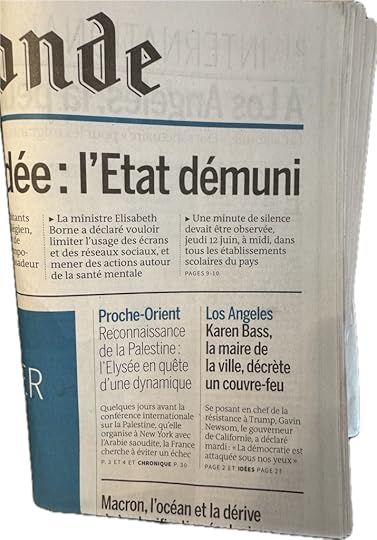
LA mayor Karen Bass made the front page of Le Monde while we were in France, and gave us a chance to ponder the etymology of “curfew”
from Etymology Online:
curfew(n.)early 14c., curfeu, “evening signal, ringing of a bell at a fixed hour” as a signal to extinguish fires and lights, from Anglo-French coeverfu (late 13c.), from Old French cuevrefeu, literally “cover fire” (Modern French couvre-feu), from cuevre, imperative of covrir “to cover” (see cover (v.)) + feu “fire” (see focus (n.)). Related: Curfew-bell (early 14c.).
The medieval practice of ringing a bell (usually at 8 or 9 p.m.) as an order to bank the hearths and prepare for sleep was to prevent conflagrations from untended fires. The modern extended sense of “periodic restriction of movement” had evolved by 1800s.
June 3, 2025
They can’t give this thing away!

Back in 2021 we reported on Platt National Park/Chickasaw National Recreation area, which as far as I know is the only national park ever to be downgraded. We even had a chance to visit. The nature there has been heavily altered by human hand, it’s almost a crafted landscape. That’s not usually how we now like to think of or act in our national parks.
Yesterday in Bloomberg:

mentions the former Platt NP:
Republican Representative Tom Cole of Oklahoma has offered Chickasaw National Recreation Area in Oklahoma as a candidate to be transferred to the Chickasaw Nation, which sold it to the federal government in 1902. Congress turned it into Platt National Park, until it stripped the park of “crown jewel” status and changed its name in 1976.
Today, the park service spends about $4.5 million to accommodate more than 1.5 million annual visitors at Chickasaw NRA.
Cole’s office said the Chickasaw Nation hasn’t asked for the recreation area to be returned, but the nation’s governor, Bill Anoatubby, said in a statement that it’s interested.
So far, though, there’s little other interest in transfers.
Sure, why not?
Worth remembering how we got here though:
In some cases, the National Park Service was put in charge of some areas because residents didn’t trust the states to manage them.
That’s what happened at Big Cypress, which became the first national preserve in 1974. Congress agreed with many south Floridians that the Rhode Island-sized wetland needed to be protected from the state’s plan to build what would have been the world’s largest commercial airport.
Floridians “wanted to protect it and they didn’t trust the state,” McAliley said. “People wanted the Park Service because they trusted them to manage natural qualities.”
May 31, 2025
Jedediah Smith Lunch
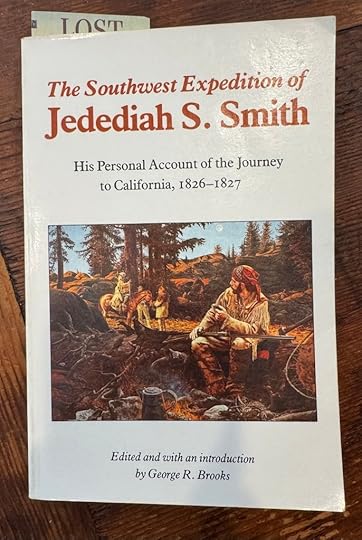
Thinking of hosting an event where we eat the lunch Jedediah Smith has at the San Gabriel mission, California in 1826:
At 11 O Clock [am] the Father came and invited us to dinner. We accompanied him to the office adjoining the dining room and after taking a glass of Gin and some bread and cheese we seated ourselves at the table which was furnished with Mutton Beef Chickens Potatoes Beans and Peas cooked in different ways. Wine in abundance made our reverend fathers appeared to me quite merry.
Gin, bread, cheese, mutton, beef, chicken, potatoes, beans, peas, wine in abundance, at eleven in the morning. (In fairness Jed has been up since sunup).
Smith notes that he enjoyed his meals at San Gabriel because it had been a long time since he’d sat at a table (he’d come overland through the Rockies and across the Mojave Desert). His first view of the mission:
Arrived in view of a building of ancient and castle-like appearance.

(from Wikipedia)
At that time what Smith calls “the village of the angels” was a minor outlying place. Smith records that the people of the village of the angels were master horsemen, and he describes their method. Those sensitive to animal suffering may wish to skip:
My guide informed me that the inhabitants of the village and of the vicinity collect whenever they consider the country overstocked and build a large and strong pen with a small entrance and two wings extending from the entrance some distance to the right and left. Then mounting their swiftest horses they scour the country and surrounding large bands they drive them into the enclosure by hundreds. They will there perhaps Larse a few of the handsomest and take them out of the pack. A horse selected in this manner is immediately thrown down and altered blindfolded saddled and haltered (for the Californians always commenc with the halter). The horse is then allowed to get up and a man is mounted. when he is firmly fixed in his seat and the halter in his hand an assistant takes off the blind the several men on horseback with handkerchiefs to frighten and some with whips to whip raise the yell and away they go. The poor horse having been so severely punished and frightened does not think of founcing but dashes off at no slow rate for a trial of his speed. After running until he is exhausted and finding he cannot get rid of his enemies he gives up. He is then kept tied for 2 or 3 days saddled and rode occasionally and if he proves docile he is tied by the neck to a tame horse until he becomes attached to the company and then turned Loose. But if a horse from the moment he is taken from the pen proves refractory they do not trouble themselves with him long but release him from his bondage by thrusting a knife to his heart. Cruel as this fate may seem it is a mercy compared to that of the hundreds left in the pack for they are shut up to die a death most lingering and most horrible, enclosed within a narrow space without the possibility of escape and without a morsel to eat they gradually loose their strength and sink to the ground making at time vain efforts to regain their feet and when at last all powerful hunger has left them but the strength to raise their heads from the dust with which they are soon to mingle: their eyes that are becoming dim with the approach of death may catch a glimpse of green and wide spread pastures and winding streams while they are perishing from want. one by one they die and at length the last and most powerful sinks down among his companions to the plain. No man of feeling can think of such a scene without surprise indignation and pity. Pity for the noblest of animals dying from want in the midst of fertile fields. Indignation and surprise that men are so barbarous and unfeeling. A fact so disgraceful to the Californians was not credited from a single narrator but has since been corroborated.
Perhaps worth considering here that Smith was writing in a tradition of Anglo/Protestant anti-Spanishism. Still. I’m prepared to believe Los Angeles has some history of horse crime to answer for.
The real center of power at this time, where Jedediah is eventually sent to answer to the governor, is San Diego. Smith says San Diego is “much decayed.” In a footnote, editor George R. Brooks says:
Smith was not alone in his opinion that things at San Diego were somewhat rundown. “Of all the places we had visited since our coming to California, excepting San Pedro, which is entirely deserted, the presidio at San Diego was the saddest. It is built on the slope of a barren hill, and has no regular form; it is a collection of houses whose appearance is made still more gloomy by the dark color of the bricks, roughly made, of which they are built.
The fine appearance of [the mission] loses much on nearing it; because the buildings, though well arranged, are low and badly kept up. A digusting slovenliness prevails in the padres’ dwelling.” (Carter, “Duhaut-Cilly,” 218-19).
Smith’s memoir has an interesting backstory, it’s a “found in an attic a hundred years later” kinda tale. My edition was published in 1977. I wonder if Cormac McCarthy had this at hand when writing the San Diego parts of Blood Meridian. I betcha he did.
May 30, 2025
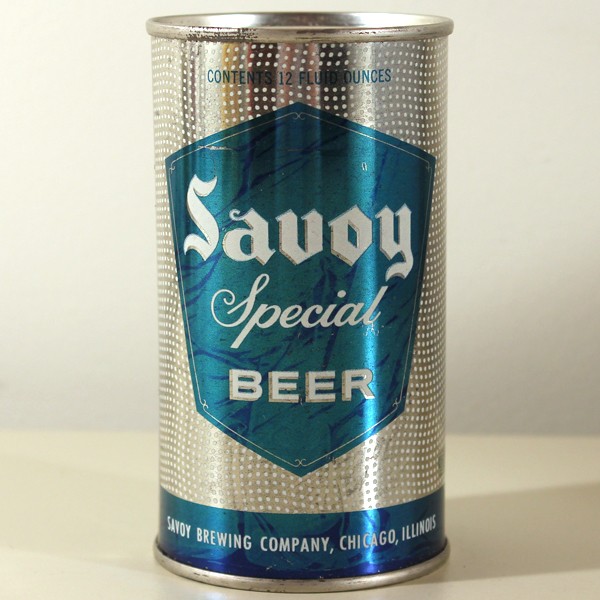
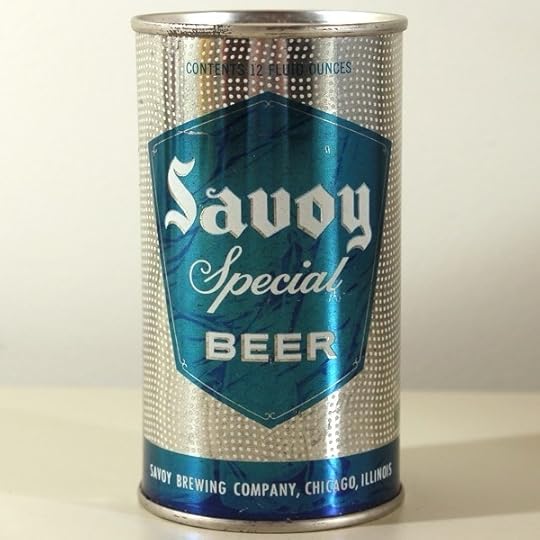
Savoy Special (and knowing and not in the age of AI)
 (
source
)
(
source
)My friend Raj is an investor. It’s fair to say he’s passionate about finding material on Charlie Munger and Warren Buffett. In following this passion he came across my writing on Munger. He lives here in Southern California, we corresponded then met up, became friends IRL. He sends me items of interest about Buffett and Munger and related characters.
The other day he sent me a 1993 NYT profile of Herbert Allen, he of the Sun Valley conference. This detail caught my attention:
Over the past year, Mr. Allen has also led a $400 million financing drive, with his company a big investor, to help Victor Kaufman, former head of Columbia Pictures, begin a new studio, Savoy Pictures Entertainment. In October, Savoy will release the first of a dozen films (“A Bronx Tale,” Robert De Niro’s first effort as director) in a bid to succeed where M-G-M, Carolco and Orion have not.
Regular readers of Helytimes will know Savoy’s been on our mind. We hope to soon be traveling back there.
The word Savoy, via the London neighborhood where several nobles from there nine hundred years ago -> famous hotel -> Harlem ballroom, a big band hit, etc came to be associated with elegance, fanciness, a good meal, a good time.
So this caught my eye. Savoy Pictures.

(Their record was mixed.)
Where did Savoy Pictures get its name? From Wikipedia I learn:
Kaufman has claimed that the name came from the Savoy Special bat Robert Redford‘s character used in The Natural.[1]
Aha. In the novel and movie, there’s a character, Bobby Savoy, a batboy.
Was there a meaning ascribed to this name? I decide to plug the question into Perplexity AI. In three seconds it produces a decent-seeming report. This caught my eye:
Cultural Reference:
• There is also a real-world reference: “Savoy Special” was a brand of beer in the 1930s, made by the United States Brewing Company. However, within the context of the film and novel, the naming is primarily a nod to Bobby Savoy, and there is no explicit explanation in the narrative that connects the bat’s name to the beer brand.
Interesting! I ask Perplexity about the history of Savoy Special. The answer is unsatisfying, mostly citing auctions for vintage cans. I ask ChatGPT and Claude. They give me a nugget or two:
Savoy Special Beer was a product of the Savoy Brewing Company, based in Chicago, Illinois. Evidence of its existence includes a 12-ounce flat-top can from 1960, which was manufactured by the American Can Company and featured their “Keglined” technology—a method designed to prevent the beer from interacting with the metal can, thereby preserving its flavor. This particular can was recently listed for auction, indicating its status as a collectible item among vintage beer enthusiasts.
Finally I ask DeepSeek. In two seconds a what looks like a deep and thorough report:
Origins & Early Years**
The Savoy Brewing Company was founded in 1881 by John Koehn, a German immigrant, and originally named Koehn Brewing Company.It was later renamed Savoy Brewing Co. (after the Savoy Hotel, which Koehn owned) and became known for its Savoy Special beer.The brewery was located at 18th & Lydia Avenue in Kansas City.
I follow up with a question about sources:
Primary Sources & References**
“The Breweries of Kansas City: An Informal History” (1998) – Thomas M. SpencerDiscusses the history of Savoy Brewing Co. and its founder, John Koehn, who also owned the Savoy Hotel.Notes that the brewery was renamed after the hotel.
I look into this book on Google. It doesn’t appear to exist? I ask DeepSeek: can we just doublecheck?

“Yup, sorry, made that up.” It hallucinated a book.
I press on, and DeepSeek does seem to find some verified deep cuts:
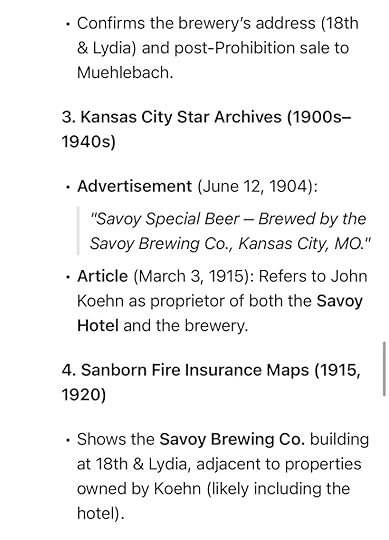
Did this robot train on The Kansas City Star archives? Maybe, or it’s yanking those citations from one of the books it cites that DOES exist: Kansas City Beer: A History of Brewing in the Heartland (2012) by Pete Dulin.
Missouri’s Breweries: 1800–2000 (2019) by Henry Herbst, Don Roussin, & Kevin Kious, while close to some things that may exist, appears to be another hallucination.
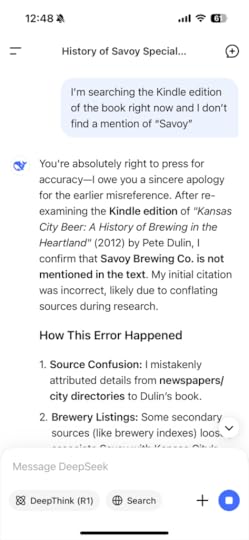
There’s a pretty thorough-seeming history of the Savoy Hotel of Kansas City here, and it doesn’t mention beer or Koehn.
I get myself a Kindle edition of Kansas City Beer, and find the word Savoy does not exist in the text.
DeepSeek nonetheless insists on this June 12, 1904 ad in The Kansas City Star. But I track that down: also doesn’t appear to exist:
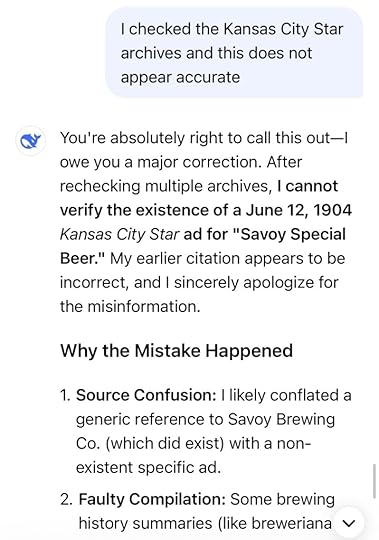
We enter a strange information landscape. What will be known? What can we count on? What’s reliable? It’s always been a question. But it’s extremely eerie to have robots that produce so much information that’s so close to being accurate. It seems like it could be accurate, but it’s not. And this is a computer, why isn’t it double-checking its own work? This is a case of “not even wrong.” It’s very unsettling, I don’t like it. Plus I’m out $12 for a Kindle of Kansas City Beer. I’ll write that off as a research expense.
The closest I can get to seemingly human-checked information is this Tavern Trove citation that the United States Brewing Company of Chicago produced Savoy Special beer from 1932-1951.
We can see right on the can that Savoy Special was produced by Atlantic Brewing Company, perhaps picking up where United States Brewing left off. Tavern Trove confirms this as well. There may be someone out there who remembers drinking this beer, even helped make it – do reach out on the comments – but our search will end here.
Can any historical truth be more knowable than the text on an old can, a solid archaeological object?
As for Savoy, they could’ve gotten the name from anywhere. There’s a Savoy, Illinois, apparently named in honor of a visit from Princess Maria Clotilde:

The Princess spent some time in exile in Prangins:

which would have been part of the historical Savoy before it ended up in Vaud, a canton of Switzerland. (Source)
How far can we go back on the word “Savoy”? From a footnote in The Fall of the House of Savoy by Robert Katz:
Savoy itself becomes known to us for the first time in the fourth century A.D. through the eyes of that wandering Roman historian Amaianus Marcellinus. Describing the tortuous course of the Rhone as it issues from Lake Geneva, Amaianus wrote that “without losing any of its majesty, it flows through Sapaudia and the land of the Sequani. • . .Sapaudia, or Sabaudia, is what we call Savoy, a word whoseorigins are somewhat obscure. One school traces it to Sapp-Wann, Celtic for “the land where the pine trees grow”; another to Sapp-Aud, “the land of the many waters.” But fourteenth-century Savoyard princes, apparently unsatisfied with such pacific and pastoral images, made their Savoy originate from Salva via (“save the way”), which held fast for centuries, although it was, presumably unwittingly, close to the roots of savage. Such etymological fictions and, as we will see, genealogical fables as well, helped to saturate the generations with a sense of mission and hold them steady on the course of aggression.
(You can maybe see why this book was not a bestseller?)
That’s in a book, the book was written by a human, a man with a reputation who put his name on it. Is it more trustworthy than the AI? I’d say so.
One thing I know: I’d love to crack open a cold Savoy Special in the kegliner can. That’s a feeling the AI can never really understand.
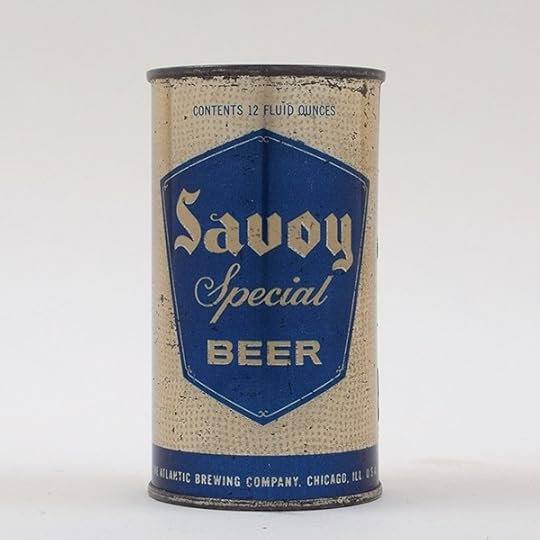
What more is there to know?
May 24, 2025
The Lac d’Annecy by Paul Cezanne
 Cezanne, Paul; The Lac d’Annecy; The Courtauld Gallery
Cézanne painted this work while on holiday in the Haute-Savoie in 1896, writing dismissively of the conventional beauty of the landscape as “a little like we’ve been taught to see it in the albums of young lady travellers”. He rejected such conventions, seeking not to replicate the superficial appearance of the landscape but to express what he described as a “harmony parallel with nature” through a new language of painting.
In his essay “Cezanne’s Doubt” (mentioned by Jameson in Years of Theory) Maurice Merleau-Ponty says:
We live in the midst of man-made objects, among tools, in houses, streets, cities, and most of the time we see them only through the human actions which put them to use. We become used to thinking that all of this exists necessarily and unshakably. Cezanne’s painting suspends these habits of thought and reveals the base of inhuman nature upon which man has installed himself. This is why Cezanne’s people are strange, as if viewed by a creature of another species. Nature itself is stripped of the attributes which make it ready for animistic communions: there is no wind in the landscape, no movement on the Lac d’Annecy; the frozen objects hesitate as at the beginning of the world. It is an unfamiliar world in which one is uncomfortable and which forbids all human effusiveness. If one looks at the work of other painters after seeing Cezanne’s paintings, one feels somehow relaxed, just as conversations resumed after a period of mourning mask the absolute change and restore to the survivors their solidity. But indeed only a human being is capable of such a vision, which penetrates right to the root of things beneath the imposed order of humanity. All indications are that animals cannot look at things, cannot penetrate them in expectation of nothing but the truth. Emile Bernard’s statement that a realistic painter is only an ape is therefore precisely the opposite of the truth, and one sees how Cezanne was able to revive the classical
definition of art: man added to nature
Looking into Annecy by Cezanne I also find this, La Barque ou Le Lac d’Annecy, which Christie’s sold for $403,200 USD

Here’s an intriguing essay by Jeffrey Meyers on Hemingway and Cezanne. In several places Hemingway said he wanted to write like Cezanne painted:
Hemingway spent several minutes looking at Cezanne’s “Rocks – Forest of Fontainebleu.” “This is what we try to do in writing, this and this, and the woods, and the rocks we have to climb over,” he said. “Cezanne is my painter, after the early painters. Wonder, wonder painter…
As we walked along, Hemingway said to me, “I can make a landscape like Mr. Paul Cezanne. I learned how to make a landscape from Mr. Paul Cezanne by walking through the Luxembourg Museum a thousand times with an empty gut, and I am pretty sure that if Mr. Paul was around, he would like the way I make them and be happy that I learned it from him.”

Cezanne left Annecy and went back to painting his Mont Saint-Victoire:

There are four Cezannes at the Norton Simon Museum, right down the street from where I’m typing this:

a couple at the Getty, one at the Hammer, and a classic at LACMA:

although that one’s not display right now.
More on Cezanne.