Darcy Pattison's Blog, page 29
December 6, 2013
Rudolph’s Top 5 Writing Tips
MIMS HOUSE: Great NonFiction for Common Core

The story of the oldest known wild bird in the world. At 62+, she hatched a new chick in February, 2013. Read her remarkable story. A biography in text and art.
Kindle
Paperback
Hardcover
Happy Holidays
Just got an e-newsletter from the North Pole and Santa passed along these writing tips from the Frosty the Snowman, posted for the young-at-heart who are writing novels this year.
Back by popular demand is my series on writing tips from popular Christmas figures. First published in 2007, they are updated here for your Christmas cheer.
Santa Claus’s Top 5 Writing Tips
12 Days of Christmas Writing Tips (live on 12/3)
The Gingerbread Man’s Top 5 Writing Tips (live on 12/4)
Frosty the Snowman’s Top 6 Writing Tips (live on 12/5)
Rudolph The Red Nosed Reindeer’s Top 5 Writing Tips (live on 12/6)
Rudolph the Red Nosed Reindeer’s top 5 Writing Tips

Image by Richard Clifford
Unique characters. Give characters a tag, a physical or emotional something that makes them stand out from the crowd. That red nose, in the context of a reindeer herd, is absolutely astoundnig.
Rudolph, the red-nosed reindeer
had a very shiny nose.
And if you ever saw him,
you would even say it glows.
Conflict. The conflict here is the usual playground teasing and bullying of someone who is different. It’s a classic theme because we can all identify with it on some level. Don’t’ be afraid of classic themes; just use them in unique ways.
Also, pile on the conflict. The other reindeer do three things to Rudolph, each an escalation: laugh, call him names, exclude him from games.
All of the other reindeer
used to laugh and call him names.
They never let poor Rudolph
join in any reindeer games.
Poor Rudolph. He must have felt All Alone: “I’m All Alone” from Monty Python’s Spamalot
If you can’t see this video, click here.
Turning point. After the set up and the conflict, comes the turning point. The crisis here is that Santa must deliver the toys to the children around the world, but the weather isn’t cooperating.
Then one foggy Christmas Eve
The unusual characteristic becomes a blessing. Again, this is a cliched way of handling a conflict and crisis, but it still works. The very thing that sets the character apart, that makes him/her different and weak, is also the very thing that makes the hero able to save the day. Of course, this means we are matching up conflict and resolution, too. Santa also functions as a sort of mentor here, one who is able to recognize the unique qualities of Rudolph for what they are.
Santa came to say:
“Rudolph with your nose so bright,
won’t you guide my sleigh tonight?”
Rejoice. It’s not just the climax here, but also the concept of a celebration of successfully completing a quest. Give characters a moment to celebrate. This often comes after a big battle, or a big effort to overcome something.
Then all the reindeer loved him
as they shouted out with glee,
Rudolph the red-nosed reindeer,
you’ll go down in history!
Darcy’s Best Writing Advice: Fiction Notes Books

And, of course, you must end with the famous cowboy Gene Autry, singing Rudolph, the Red Nosed Reindeer in 1953. His original recording hit the top of the charts in 1950.
If you can’t see this video, click here.
Think the story is still a little slight for todays’ market? Here’s why.


December 5, 2013
Frosty the Snowman’s Top 5 Writing Tips
MIMS HOUSE: Great NonFiction for Common Core
The story of the oldest known wild bird in the world. At 62+, she hatched a new chick in February, 2013. Read her remarkable story. A biography in text and art.
Kindle
Paperback
Hardcover
Happy Holidays
Just got an e-newsletter from the North Pole and Santa passed along these writing tips from the Frosty the Snowman, posted for the young-at-heart who are writing novels this year.
Back by popular demand is my series on writing tips from popular Christmas figures. First published in 2007, they are updated here for your Christmas cheer.
Santa Claus’s Top 5 Writing Tips
12 Days of Christmas Writing Tips (live on 12/3)
The Gingerbread Man’s Top 5 Writing Tips (live on 12/4)
Frosty the Snowman’s Top 6 Writing Tips (live on 12/5)
Rudolph The Red Nosed Reindeer’s Top 5 Writing Tips (live on 12/6)
Frosty The Snowman’s Top 5 Writing tips
These tips are based on the popular song, “Frosty the Snowman.” Read about the history of this song. Oh, what a great 3-D snowman cake pan!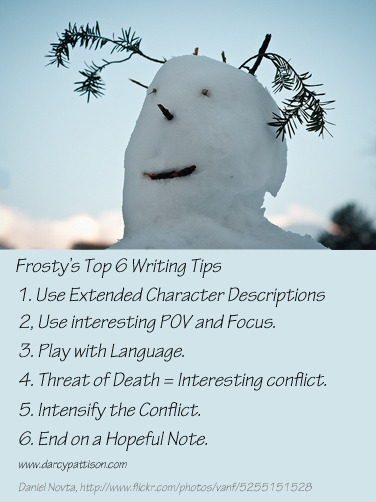
Image by Daniel Novta
Frosty the snowman was a jolly happy soul,
With a corncob pipe and a button nose
And two eyes made out of coal.
Frosty the snowman is a fairy tale, they say,
He was made of snow
Extended character descriptions. Don’t be afraid to take time to describe the main character. One the continuum of character descriptions, this one is longer than you’ll find in most children’s picturebooks. But it works because this is a character story.
but the children
Know how he came to life one day.
There must have been some magic in that
Old silk hat they found.
For when they placed it on his head
He began to dance around.
Point of view. Notice the point of view here. The attention is squarely on Frosty, not on the children who found the old silk hat. When you write a story for kids, you don’t always have to put the child as the main character.
O, Frosty the snowman
Was alive as he could be,
And the children say he could laugh
And play just the same as you and me.
Thumpetty thump thump,
Thumpety thump thump,
Look at Frosty go.
Thumpetty thump thump,
Thumpety thump thump,
Over the hills of snow.
Language play. This section doesn’t add much to the plot, it’s just pure language play. But this is perfect for the younger audiences, who know that playing around with language is half the fun of reading a story or singing a song. Great onomatopoeia.
Frosty the snowman knew
The sun was hot that day,
So he said, “Let’s run and
We’ll have some fun
Now before I melt away.”
Conflict. Every good story needs conflict. And the character’s attitude in the face, well, in the face of certain death, is evident. It’s an attitude of taking joy where you find it and facing the future with courage.
Darcy’s Best Writing Advice: Fiction Notes Books
Down to the village,
With a broomstick in his hand,
Running here and there all
Around the square saying,
Catch me if you can.
He led them down the streets of town
Right to the traffic cop.
And he only paused a moment when
He heard him holler “Stop!”
For Frosty the snow man
Had to hurry on his way,
Development of the conflict. The traffic cop provides an extra bump of conflict that adds to the story’s development. For picturebooks, it doesn’t have to be much; in fact, it can’t be huge, or you’re writing a novel. This is perfect, just the introduction of an authority figure who yells, “Stop!” but can’t really do anything to stop the breakneck speed of Frosty’s life.
But he waved goodbye saying,
“Don’t you cry,
I’ll be back again some day.”
Thumpetty thump thump,
Thumpety thump thump,
Look at Frosty go.
Thumpetty thump thump,
Thumpety thump thump,
Over the hills of snow.
Hope. Children’s stories may end in tragedy, but the best offer a spot of hope. Notice also the nice repetition of the language play that sends the story off with a nice echo.
December 4, 2013
The Gingerbread Man’s Top 5 Writing Tips
MIMS HOUSE: Great NonFiction for Common Core
The story of the oldest known wild bird in the world. At 62+, she hatched a new chick in February, 2013. Read her remarkable story. A biography in text and art.
Kindle
Paperback
Hardcover
Happy Holidays
Just got an e-newsletter from the North Pole and Santa passed along these writing tips from the Gingerbread Man, posted for the young-at-heart who are writing novels this year.
Back by popular demand is my series on writing tips from popular Christmas figures. First published in 2007, they are updated here for your Christmas cheer.
Santa Claus’s Top 5 Writing Tips
12 Days of Christmas Writing Tips (live on 12/3)
The Gingerbread Man’s Top 5 Writing Tips (live on 12/4)
Frosty the Snowman’s Top 6 Writing Tips (live on 12/5)
Rudolph The Red Nosed Reindeer’s Top 5 Writing Tips (live on 12/6)
The Gingerbread Man’s Top 5 Writing Tips
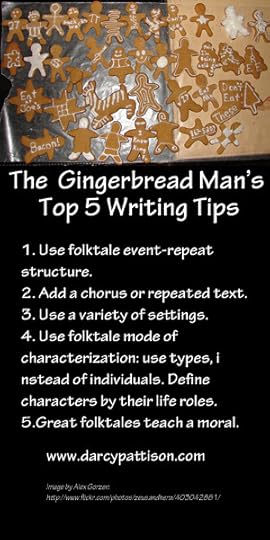
Image by Michael Bentley
Based on the folktale about this popular Christmas pastry that comes to life, the Gingerbread Man gives his writing tips.
Event Repeat. The story of the Gingerbread Man uses an event-repeat type plot. An event is repeated several times, with only a minor change. When the Gingerbread Man escapes and runs away, he meets several people who want to eat him. Each character is added to the parade as the Gingerbread Man runs away, until the Fox outsmarts him at the last.
Chorus. Using a Chorus is effective in short stories and picturebooks.
Repetition of this chorus make the story fun and invites the audience to join in.
“Run, Run, Fast as you can, you can’t beat me, I’m the Gingerbread Man.”
Changing Setting. Especially for the picturebook format, it’s important to keep the setting interesting, so the illustrations are exciting. By sending the Gingerbread Man across the landscape, the illustrations have visually exciting possibilities.
Darcy’s Best Writing Advice: Fiction Notes Books
Folktale Mode. This story is in the folktale mode, which treats characters as a general type. For example, the ugly stepsisters in Cinderella, have a role as mean, ugly stepsisters, and not much more. When Gingy is added to the Shrek movies, though, his character is made more interesting by giving him individual characteristics. Decide if your story needs a general, folktale type character or a more individual character.
Folktale Morals. Folktales and fables often add a moral at the end of a story. Of course, the Gingerbread Man should not have trusted the Fox! It’s seldom that picture books and stories today have such an explicit, straight forward moral. Instead, it’s usually implied and the reader is left to verbalize it for him or herself.
December 3, 2013
12 Days of Christmas Writing Tips
MIMS HOUSE: Great NonFiction for Common Core
The story of the oldest known wild bird in the world. At 62+, she hatched a new chick in February, 2013. Read her remarkable story. A biography in text and art.
Kindle
Paperback
Hardcover
Happy Holidays
Just got an e-newsletter from the North Pole and Santa had these writing tips posted for the young-at-heart who are writing novels this year. Stay tuned: Santa promised to send me Rudolph’s writing tips tomorrow.
Back by popular demand is my series on writing tips from popular Christmas figures. First published in 2007, they are updated here for your Christmas cheer.
Santa Claus’s Top 5 Writing Tips
12 Days of Christmas Writing Tips (live on 12/3)
The Gingerbread Man’s Top 5 Writing Tips (live on 12/4)
Frosty the Snowman’s Top 6 Writing Tips (live on 12/5)
Rudolph The Red Nosed Reindeer’s Top 5 Writing Tips (live on 12/6)
The Twelve Days of Christmas Writing Tips
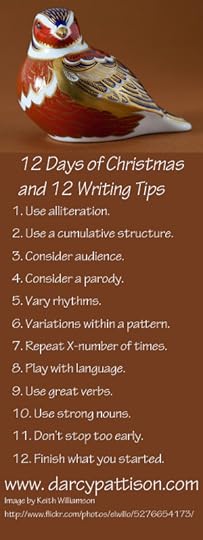
Image by Keith Williamson
These writing tips are based on the song, “The 12 Days of Christmas” and focus on structure and language.
On the first day of Christmas,
my true love sent to me
A partridge in a pear tree.
Play with alliteration. Part of the reason the opening stanza works is the repetition of the initial sound, P, in partridge and pear. Can you add alliteration or other language play in your story?
On the second day of Christmas,
my true love sent to me
Two turtle doves,
And a partridge in a pear tree.
Set up a cumulative pattern. This stanza is important because it sets up the pattern: we now know that this is a cumulative story, a story that adds a line each time and repeats all the other lines. Some cumulative stories keep going and take off a line each time. Study other cumulative stories, then try writing one.
On the third day of Christmas,
my true love sent to me
Three French hens,
Two turtle doves,
And a partridge in a pear tree.
Consider your audience. Always, you want to consider the audience for your work. For example in this video, the audience is Canadians and those interested in all things Canuck.
If you can’t see this video, click here.
Darcy’s Best Writing Advice: Fiction Notes Books
On the fourth day of Christmas,
my true love sent to me
Four calling birds,
Three French hens,
Two turtle doves,
And a partridge in a pear tree.
Parodies of this song are popular. They demonstrate the importance of playing with the themes, structures and particulars of a story to create something fresh and new. Have fun.
In this video, “The 12 Pains of Christmas,” the concept is turned on it’s head.
If you can’t see this video, click here.
On the fifth day of Christmas,
my true love sent to me
Five golden rings,
Four calling birds,
Three French hens,
Two turtle doves,
And a partridge in a pear tree.
Vary the rhythms When you do a long story, try to find places where the language can slow down the rhythm. This line is traditionally slow, extending the story and adding variety.
On the sixth day of Christmas,
my true love sent to me
Six geese a-laying,
Five golden rings,
Four calling birds,
Three French hens,
Two turtle doves,
And a partridge in a pear tree.
Variety within a pattern is established here. We’re still adding a line each time, but now the verb at the end becomes important. For longer pieces like this be sure to add variety to keep the interest.
On the seventh day of Christmas,
my true love sent to me
Seven swans a-swimming,
Six geese a-laying,
Five golden rings,
Four calling birds,
Three French hens,
Two turtle doves,
And a partridge in a pear tree.
Numbers are often important to picturebooks, classic songs and our culture. For example, there are three little pigs and seven dwarves. Part of this fascination with numbers is cultural. In the Navajo culture, four is important: the four cardinal directions and the four sides of a hogan. Three and seven repetitions are generally in northern European stories. Nine is three-threes and twelve is four-threes (or three-fours). Watch for repetitions in stories and notice how many times something repeats. Try retelling stories with a different number of repeats and notice what it does for the story.
On the eighth day of Christmas,
my true love sent to me
Eight maids a-milking,
Seven swans a-swimming,
Six geese a-laying,
Five golden rings,
Four calling birds,
Three French hens,
Two turtle doves,
And a partridge in a pear tree.
Play with language. Here’s the Straight No Chaser men’s accapella choir. By the time they get to the 8th day, things get very complicated — and wonderful. Don’t be afraid to play and have fun with language.
If you can’t see this video, click here.
On the ninth day of Christmas,
my true love sent to me
Nine ladies dancing,
Eight maids a-milking,
Seven swans a-swimming,
Six geese a-laying,
Five golden rings,
Four calling birds,
Three French hens,
Two turtle doves,
And a partridge in a pear tree.
Use great verbs. Notice the verbs that are added each time. They make the story come alive with action. Wikipedia has a great introduction to the history of this song. This article includes the lyrics, the music and links to parodies.
On the tenth day of Christmas,
my true love sent to me
Ten lords a-leaping,
Nine ladies dancing,
Eight maids a-milking,
Seven swans a-swimming,
Six geese a-laying,
Five golden rings,
Four calling birds,
Three French hens,
Two turtle doves,
And a partridge in a pear tree.
Use strong nouns. Just as important is the use of specific nouns. The story doesn’t have generic birds; instead, we have a partridge, turtle doves, calling birds, and geese. Be as specific as possible in choosing nouns.
On the eleventh day of Christmas,
my true love sent to me
Eleven pipers piping,
Ten lords a-leaping,
Nine ladies dancing,
Eight maids a-milking,
Seven swans a-swimming,
Six geese a-laying,
Five golden rings,
Four calling birds,
Three French hens,
Two turtle doves,
And a partridge in a pear tree.
Don’t stop too early. The temptation in a story like this, especially a cumulative story that gets longer with each stanza, is to stop too soon. Instead, this story goes the full dozen stanzas. Take a deep breath — and finish what you started. Don’t give up before you finish a writing project. See it through to the end.
On the twelfth day of Christmas,
my true love sent to me
Twelve drummers drumming,
Eleven pipers piping,
Ten lords a-leaping,
Nine ladies dancing,
Eight maids a-milking,
Seven swans a-swimming,
Six geese a-laying,
Five golden rings,
Four calling birds,
Three French hens,
Two turtle doves,
And a partridge in a pear tree!
Finish what you started. Notice that each stanza builds on the previous and the whole cumulative stanza here is satisfying. Create a unified story that hangs together.
And you just have to end with Burl Ive’s version with its lush illustrations.
If you can’t see this video, click here.
December 2, 2013
Santa Claus’ Top 5 Writing Tips
MIMS HOUSE: Great NonFiction for Common Core
The story of the oldest known wild bird in the world. At 62+, she hatched a new chick in February, 2013. Read her remarkable story. A biography in text and art.
Kindle
Paperback
Hardcover
Happy Holidays
Just got an e-newsletter from the North Pole and Santa had these writing tips posted for the young-at-heart who are writing novels this year. Stay tuned: Santa promised to send me writing tips based on “The 12 Days of Christmas” tomorrow.
Back by popular demand is my series on writing tips from popular Christmas figures. First published in 2007, they are updated here for your Christmas cheer.
Santa Claus’s Top 5 Writing Tips
12 Days of Christmas Writing Tips (live on 12/3)
The Gingerbread Man’s Top 5 Writing Tips (live on 12/4)
Frosty the Snowman’s Top 6 Writing Tips (live on 12/5)
Rudolph The Red Nosed Reindeer’s Top 5 Writing Tips (live on 12/6)
Santa’s Top 5 Writing Tips
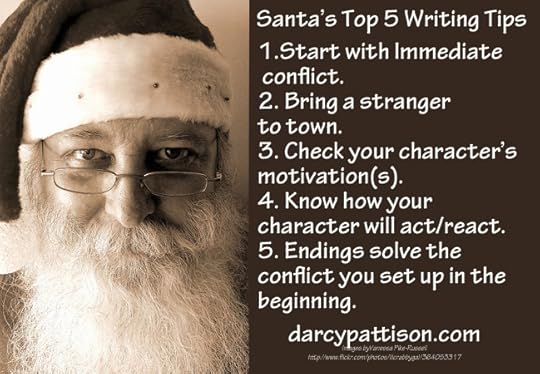
Image by Vanessa Pike-Russell
These tips from Santa Claus are based on the song, Santa Claus Is Coming To Town.
Oh! You better watch out,
You better not cry,
You better not pout,
Instant Conflict. When you open a story, make sure it has instant conflict. Here, the characters are crying and pouting.
I’m telling you why:
Santa Claus is coming to town!
Plots. A Stranger comes to town. It is said that there are only two plots in the world: a character leaves home, or a stranger comes to town. This time it’s promised that the stranger will bring happiness and joy. But will he?
He’s making a list,
He’s checking it twice,
He’s gonna find out
who’s naughty or nice.
Santa Claus is coming to town!
Character Motivations. Are you checking your character’s motivations? You should know who is naughty or nice and especially why. No character should be totally one or the other. Soften villains and round out main characters by giving them a flaw.
Darcy’s Best Writing Advice: Fiction Notes Books
He sees you when you’re sleeping,
He knows when you’re awake.
He knows when you’ve been bad or good,
So be good for goodness sake!
Know your characters. You should know your character’s feelings, actions, morals. When s/he is admonished to be good, what would s/he do?
So…You better watch out,
You better not cry
You better not pout,
I’m telling you why.
Santa Claus is coming to town.
Endings. Make sure the story’s ending resolves the conflict you set up. Here, the song doesn’t resolve the conflict, so we have an unsettled feeling. Well, that’s probably OK. Christmas morning will tell the real tale. And it’s OK to leave the reader wanting a little bit more, as long as you resolve the inner conflict and leave the reader with hope.
November 30, 2013
2014 Cover Revealed: The Girl, the Gypsy & the Gargoyle
MIMS HOUSE: Great NonFiction for Common Core
The story of the oldest known wild bird in the world. At 62+, she hatched a new chick in February, 2013. Read her remarkable story. A biography in text and art.
Kindle
Paperback
Hardcover
Here’s the cover of my new book that will be out in March 2014! Wahoo! Only 90 days or so till you can read it.
And for your pleasure, here’s the recipe for Cranberry Tea Punch that we always have during the holidays.
Cranberry Tea Punch
1 cup sugar
2 cups Pineapple
4 cups Cranberry Juice Cocktail
4 cups brewed tea (I use Luzianne Decaf)
Cinnamon stix, cloves.
I also like to float slices of lemon and orange.
Warm it up and have it close while you read a book.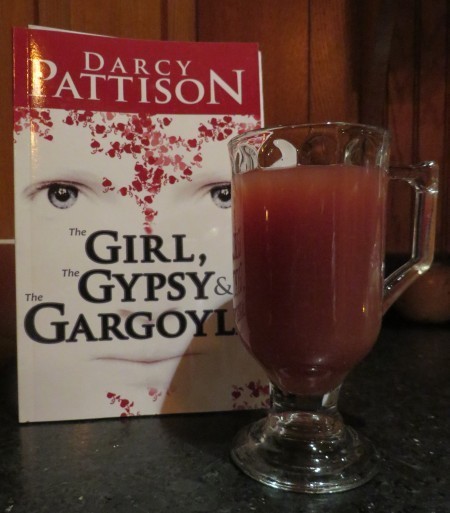
November 26, 2013
Top Writing Blogs of 2013
MIMS HOUSE: Great NonFiction for Common Core
The story of the oldest known wild bird in the world. At 62+, she hatched a new chick in February, 2013. Read her remarkable story. A biography in text and art.
Kindle
Paperback
Hardcover
Over at the Write to Done blog, they are taking nominations for the Top Writing Blogs of 2013. If anything here at Fiction Notes has been helpful or touched you this year, I’d appreciate a nomination. If you’re looking for great articles about writing, here are the 2012 winners.
How to Nominate Your Favorite Writing Blog
Nominate your favorite blog in the comment section of this post.
You have only one vote (only your first will be counted).
Please include the web address of the blog. (www.darcypattison.com0
Explain why you think the blog is worthy of winning this year’s award.
To make the cut, a blog must be nominated more than once.
Nominations must be received by 12th December, 2013.
Do not comment here, it won’t count as a nomination. You must go to this website to nominate a blog.
Thanks for the nomination!
Darcy
Dancing on Top of the Mountain with the Top Writing Blogs of the Year.
The post Top Writing Blogs of 2013 appeared first on Fiction Notes.
November 25, 2013
I Don’t Like Your Story
MIMS HOUSE: Great NonFiction for Common Core
The story of the oldest known wild bird in the world. At 62+, she hatched a new chick in February, 2013. Read her remarkable story. A biography in text and art.
Kindle
Paperback
Hardcover
What do you do when your friends or your editors don’t like your story?
This has indeed happened to me several times, the most recent on a current WIP. One of my reliable first readers has been hesitant to say much about this story and I realized that it’s because she doesn’t like it. The story is a tragedy and while I soften the blow at the end, it does end tragically. READER said that the ending was a “sharp left turn.” But for me, it’s a straight arrow right to the heart of the story.
What to do? Revise to please my reader, or keep it “my way”?
I would be a fool to ignore feedback! Of course, I need to know how others view my stories and where the communication breaks down. I will always revise to make sure I am communicating clearly. What is in my head needs to be clearly reproduced in the reader’s head through the medium of words. That’s communication through writing.
But that’s not the case here. Instead, there’s a gap in vision, or an honest difference in how another person view story and how a story should unfold. READER wanted a happy ending.
There are actually four ways a story can end:
Happy/Happy. The protagonist gets what s/he wants and that makes him/her happy.
Happy/Sad. The protagonist gets what s/he wants and that makes him/her sad.
Sad/Happy. The protagonist fails to get what s/he wants, but in the end, that makes him/her happy.
Sad/Sad. The protagonist fails to get what s/he wants and that makes him/her sad.
My story is the third kind. The protagonist does not get what she wants, but in the end, her goals are accomplished in a different way and she is content and peaceful about it all. I actually think this is a more realistic ending, more true to life. How many times do you get what you want, exactly how you want it? Not often! Yet much of literature is the Happy/Happy kind of ending. That’s great: I do those endings most of the time, too. But this ending satisfies my ideas for this story.
You can’t get a Happy Face from readers all the time. But I always need a Happy Face from myself.
I won’t change it. It makes me sad that READER doesn’t like the story because I chose to end it in an unusual way. I want READER to always like my story. But even when she doesn’t, we remain friends. Instead, I need to realize that my friends, family and even critique partners or editors are not always the best audience for a particular story. And that’s OK.
The post I Don’t Like Your Story appeared first on Fiction Notes.
November 18, 2013
I Don’t Want an Honest Critique
MIMS HOUSE: Great NonFiction for Common Core
The story of the oldest known wild bird in the world. At 62+, she hatched a new chick in February, 2013. Read her remarkable story. A biography in text and art.
Kindle
Paperback
Hardcover
Fear
No, don’t tell me what’s wrong with this novel. I don’t want to hear it. Minor problems? OK, I’ll fix those. But major structural, plot or character problems? Don’t tell me.
Cynthia Ozynick says, “Writing is essentially an act of courage.” When I get an honest critique, my courage fails me.
I fear the revision needed: I won’t ever be able to “get it right.” Obviously, I thought that I had communicated my intentions well in the first draft, or I would have changed it before you read it. But you say that you don’t understand, or that I’m inconsistent, or that I’m unfocused. How could that be? I see it so clearly. And if my vision of my story is so skewed, then how will I ever get it right?
I fear that you’re right and I’m wrong. But how can I be sure? This is my story and it comes from my psychological leanings, my background, my research. How can you tell me what is right for my story? If the story doesn’t communicate what I want, then, yes, I need to revise. I repeat: Obviously, I thought it did communicate what I wanted, or I would have revised it before you saw it. Do you just have a different vision of the story because of your psychological leanings, your background? Are you trying to envision what I intended, or are you envisioning what you would have written? Where does your ego slam up against my ego? And where does your objective appraisal need to push my ego back into line with what it really wants to do anyway? Perspective is hard to achieve.
I fear that all my hard work, all the months spent thinking and rewriting, will be wasted.
As a novelist, time haunts me. To write a novel isn’t the work of a week or a month. It takes many months, a year, a year and a half. More. It’s a long, long process. Your revision notes mean that the time is extended, and that without any guarantee of being finished even then. Meanwhile, that means that I’m a year older, that it’s a year in which I couldn’t write anything new (even if I could find the courage to begin again).
I fear your honesty; I need your approval (or someone’s approval; if not yours, then whose?). Will it crush me emotionally if you don’t “like” my story? I gloss over the approval part of critiques and agonize over the “needs work” assessment. Is there a way for you to only show approval, yet open my eyes, so that I recognize what needs work? I’d rather recognize it for myself than have it pointed out.
I fear that my standards are too lax. I want to be finished, I want to have this story out there. I want to have written, but in the throes of writing, I want the end of the process long before the story is really finished. Submission comes too early and then I get rejections. Then, it’s harder than ever to revise. But waiting is excruciating. Typical advice: Put the manuscript in a drawer for three months and then pull it out and read it with a fresh eye. What? Waste three more months? Never. It’s done and ready to send out. (Ok, maybe it isn’t, but I can’t stand looking at it one more time and in three months, my editor could read it and buy it. OK, maybe they won’t buy it until I revise, but three months? Isn’t there any other way?)
Critiques, especially honest and on-target critiques, are fearful things. I know that I need them; but they are painful, emotionally draining, and confidence shaking.
But I need them. OK, can you give me a minute? Let me find my mask of courage. There. I have it on. Now bring on your best critique!
More reading:
Other thoughts on critique of an artist and humility.
Art and Fear: One of my favorite books on the psychology of making art. It deals with fears about our unworthiness, fears of critiques, fears of displaying our art and much more.
Top 10 Ways to Stop the Sting of Critiques
Here are my slightly tongue-in-cheek Top 10 Ways to take the Sting out of Critiques!
Take the Sting Out of Critques!
Avoidance: Have someone else read the critique for you and only highlight the good comments. Read only the highlighted comments.
Revenge: Give the creep back an ever harsher critique than you just got.
Denial: Write out the reasons why the critiquer is totally off base. Ignore all suggestions.
Excitement: Fake excitement about the critique and tell everyone you know exactly what’s wrong with the story and how you plan to fix it.
Suspicion: Read each comment with the suspicion that the critiquer is trying to get your manuscript out of the running, so their own manuscript will do well. Therefore, you can safely ignore any comments you want to.
Surprise: Allow each comment to be a revelation at how far off base this critiquer is.
Pride: Take pride in your ability to “take it” from the tough ones.
Loneliness: Understand that you and you alone are in the situation of receiving harsh critiques; such things have never been written about any manuscript and will never be written again.
Forgiveness: Realize that the critiquer has sinned by so harshly criticizing your story and at some point they will have to come and ask for forgiveness; be ready to give it gracefully.
Hope: Find hope in the good things the critiquer noticed, and Hope in the process of revision.
The post I Don’t Want an Honest Critique appeared first on Fiction Notes.
November 15, 2013
The Incredible Power of This Question: What Comes Next?
Now available!

Kindle
Paperback
Nook
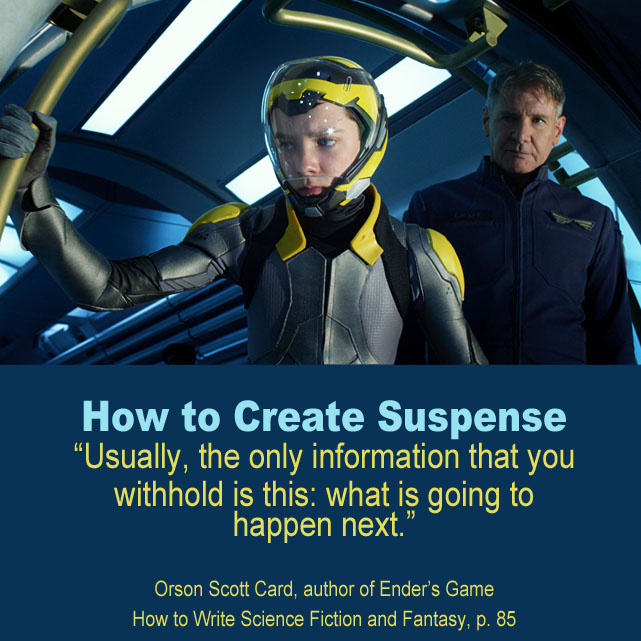
Here’s a quote from Orson Scott Card, the author of Ender’s Game:
So as you look at your bogged down first draft, look to see how much of your effort is spent on withholding information, and then examine whether your reader has any reason to care about what’s going on as long as that information is withheld. Most novice writers imagine that this is how suspense is created–by hodling back key information from the reader. But that is not so. Suspense comes from having almost all the information–enough information that the audience is emotionally involved and cares very much about that tiny bit of information left unrevealed.
Usually the only information that you withhold is this: what is going to happen next.
–Orson Scott Card. How to Write Science Fiction and Fantasy, p. 85.